Author Archives: nannyGOAT

Next Meeting – 17th September 2019

Our next meeting will be on Tuesday, 17th September, at the Horse and Jockey pub in Stanford-in-the-Vale. As usual, we will be playing shorter games from 7.30pm as people arrive, until 8pm when we will start something a little longer.

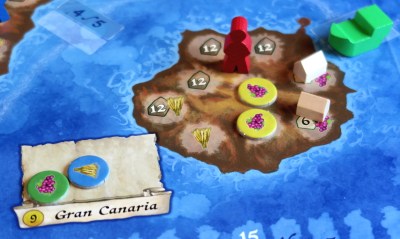
This week the “Feature Game” will be West of Africa which is a game set in the Canary Islands where players cultivate goods, try to sell them as profitably as they can and then use the money to build settlements. Each player has their own deck of cards which they use to carry-out their actions, keeping the requirements of the other players in mind.

West of Africa
– Image by boardGOATS

And speaking of canaries…

The festive season was approaching and Jeff’s daughter was getting excited in the way only small children can.  One day, she asked, “Dad, can I have a canary for Christmas?”

Jeff replied, “No, you can’t, you’ll have turkey like everyone else…”


3rd September 2019

There were a lot of people feeding and food was a little delayed, so we didn’t start until gone 8pm.  At this point, people were keen to chat and almost everyone seemed interested in giving the “Feature Game”, Lords of Vegas, a go.  Although it involves dice, it is totally different to our old favourite, Las Vegas, and in fact, very different to pretty much anything else we have played too.  Although the game is very “rules-light”, it is still a bit of a “brain-burner” with the potential for inducing “analysis paralysis”.
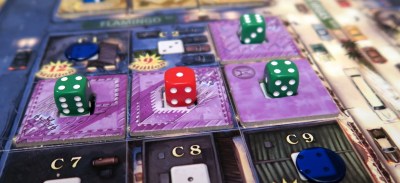
Lords of Vegas
– Image by boardGOATS

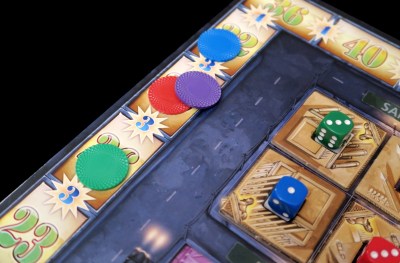
The idea of the game is that players are developers in Las Vegas in 1941.  The board depicts Highway 91, what will become known as “The Strip”, and the blocks either side, each divided into plots.  Players acquire these plots, build casinos, improve their casinos, take-over other casinos, and when desperate, gamble.  At the start of their turn, the active player turns over a card which indicates one plot and one of the five casinos.  The active player claims the plot by placing a clear plastic counter in their colour on it and then everyone receives income:  every plot owner gets $1,000,000 per plot, and then every casino that matches the card pays out cash (in our case, in poker chips) and points.

Poker Chips
– Image by boardGOATS

After everyone has received their income, the active player can do as many actions as they like, the only limit is what they can afford.  The first action is build on a plot they own:  they pay the amount of money listed on the board, chose a coloured casino tile and place it on the board together with a die of their colour showing the face depicted on the board.  The number shown is important for many reasons, but initially it indicates the income that the player will get when that casino pays out: one million dollars per pip shown.  The casino colour chosen can be the same as casino adjacent casinos, or different, which is a critical decision.  If it is the same, the two (or more) casinos merge and the owner of the die with the highest face value becomes The Boss of that casino.
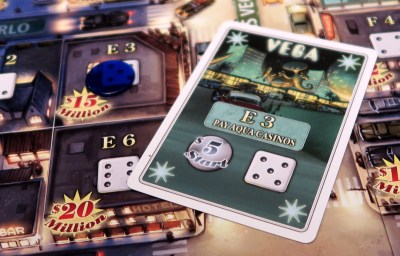
Lords of Vegas
– Image by boardGOATS

The Boss gets victory points when that casino colour pays out, receiving points equal to the total number of plots the casino occupies.  Since The Boss controls the casino, their are things they can do that others cannot.  For example, they can choose to “remodel” the casino, changing the colour of all the tiles.  There is a cost, of course, five million dollars per space, but it can be worth it to force mergers giving more points.  The Boss can also “sprawl” their casino which means expand into neighbouring, unoccupied plots.  This is both costly and risky, but can be worth it to give a short term benefit or to merge casinos.  It is costly because the cost to build is twice the usual fee, and it is risky, because if the card that shows that plot is drawn later in the game, the player who draws the card replaces the die with one of their own.

Lords of Vegas
– Image by boardGOATS

Merging casinos are a vital part of the game because unusually, increments in the score track progressively increase.  So, at the bottom, the steps increase by a single point, but after eight, each step is two points, and after twenty the steps increase to three.  Since the points are added casino by casino (rather than summing them and adding them all at the same time), it is critical to match casino size to the current increment.  For example, two casinos of size “three” would add six points if the player were below eight points or above twenty.  However, if they were between eight and twenty, the same casinos would only be worth two each as the remainder would be lost as each casino is added.
Lords of Vegas
– Image by boardGOATS

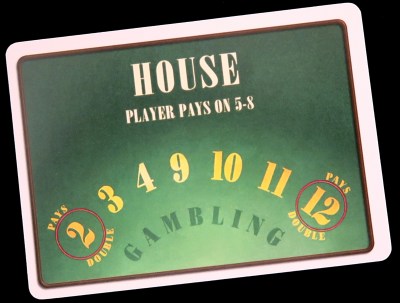
Thus, with the merging and taking over, the game is highly strategic with a sprinkle of luck from the card draw.  Perhaps the most important part of Lords of Vegas though are the gambling aspects. There are two:  firstly, once per turn, the active player can gamble at any casino by rolling two dice.  The odds are slightly in favour of The House, but it can be a good source of cash, as well as providing the opportunity to damage an opponent, as The Boss of that casino provides the pay out (though they can lay this off with the bank).  More importantly, any player can choose to “Reorganise” any casino they have a stake in, by paying a million dollars per pip to re-roll all the dice in that casino with the chance of control changing hands.

Lords of Vegas
– Image by boardGOATS

So the game is not especially difficult to understand, but small changes can have a large impact.  As well as the mix of strategy, luck and gambling, there are a number of little things that really make the game sing.  For example, almost anything can be traded for almost anything else at any time, which enables players at the back to gang up on a run-away leader and neutralise the effect of overtly bad (or good) draws and dice rolls.  The quick description had most people interested in playing it, but Burgundy (who had played before) felt that it would be very chaotic with five, so in the end, Pine, Black, Red, Lime and Ivory left Blue, Burgundy, Mulberry and Purple to their visit to Nevada.

Lords of Vegas
– Image by boardGOATS

The game started very slowly, with incomes small and investment correspondingly small.  Blue tried to increase her income by building her number of plots.  That probably wasn’t a good move, though she was able to build some cash and then invest heavily a couple of turns later.  Despite the lack of rules complexity, the groups still managed to make a mess of it:  when Reorganising, each die can only be rolled once per turn.  It was perhaps a good thing the messed this up though as otherwise Purple, Blue and Mulberry would have been deprived the chance of seeing Burgundy attempt to Reorganise a single two and re-roll a two three times.  Hilarity ensued when, a few turns later the casino had merged to form two-plot casino now with a two and a three and Burgundy chose to try Reorganising again, this time getting a two and a three and then a double three before finally settling for a one and a four!

Lords of Vegas
– Image by boardGOATS

As the game progressed, the casinos merged and grew, with one particularly large “Sphynx Casino”, occupying five plots.  Blue, Burgundy and Mulberry all had an interest and re-rolled the five dice many, many times during the game, but despite his lack of success elsewhere, Burgundy mostly retained control.  The other side of Flamingo Road, Mulberry built a lovely casino, mostly uncontested.  The “Vega Casino” cards came out a lot at the start and since some cards are removed at random, it didn’t look a good gamble.  As a result, only Purple took the risk of investing and made a killing with her “Big Purple Casino” when the group kept drawing the Vega cards ending up with all nine putting in an appearance.

Lords of Vegas
– Image by boardGOATS

Mulberry and Burgundy stole a slight early march, but when the steps in the scoring track increased it became clear that this was an illusion and it was in fact a very close game as the leader’s jersey kept changing hands.  The balance of power was held by whoever was in charge of the Big Sphinx Casino, and Blue and Mulberry ganged up on Burgundy to try to break his hold on it.  First Blue rolled the dice and gave control to Mulberry only for Burgundy to wrest if from her and Mulberry to then give control to Blue.  In what turned out to be the final turn of the game, Blue gambled in Purple’s Big Green Vega Casino, won $10,000,000 and used it to remodel her small Sphinx Casinos and sprawl the Big Sphinx Casino into one extra space.
Lords of Vegas
– Image by boardGOATS

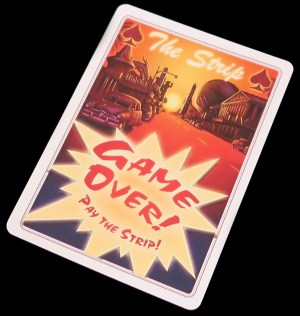
This turned out to be critical, because the game ends when the “End of Game” card is drawn and all the casinos on the strip score for one final time.  That final sprawl gave an extra three points for the Big Sphinx which was just enough to cross the boundary from twenty-nine to thirty-two, breaking what would otherwise have been a three way tie.  Money is the tie-breaker, which meant that Burgundy just sneaked into second place $7,000,000 ahead of Purple, who would have been $20,000,000 better off if Blue had not won when she bet in her casino.
Lords of Vegas
– Image by boardGOATS

All in all, it had been a lot of fun and everyone was agreed that they’d like to play it again, and that they’d play it differently next time.  It had been a really slow burner though and while the foursome had been gambling property in Vegas, the others had had time to play two games and get up to date with the Brexit riots and discuss all the possible outcomes—some  people even had time to check out the proxy voting and postal vote options and evaluate both options!

Ticket to Ride: Europe
– Image by boardGOATS

The group had started the evening with Ticket to Ride, the original USA version, rather than the more usual Europe version or the relatively new, New York edition, which had also been also an option.  It is relatively rare that the USA edition gets played because it can be quite unforgiving, this time though, everyone was quite experienced, and knew what they were letting themselves in for.  The game rules are much the same as for every other version of Ticket to Ride: on their turn players can take any two two cards from the face up market or blind from the draw deck; place some of their plastic trains to score points paying for them with appropriately coloured cards, or draw more ticket cards which score points at the end of the game if completed.

Ticket to Ride (USA)
– Image by boardGOATS

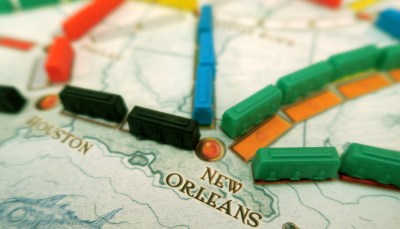
There are no tunnels, ferries or stations in the original USA version, and Locomotive cards can be used as wild under any circumstances, but only one face up Locomotive card can be drawn per turn.  It was a very tight game with everyone obstructing each other a bit, though Red got the worst of it.  Green prioritised trying to get the ten point bonus for the longest continuous set of trains, while Black was concentrated on completing his tickets from Los Angeles to Miami and Winnipeg to Boston.  It was very clear it was going to be a close, high scoring game where completed tickets were going to be essential to the final scores.
Ticket to Ride (USA)
– Image by boardGOATS

Pine completed his first two tickets and started on his third route, from Montreal to Vancouver.  As the game came to a finish, everyone put the finishing touches to their plans: Green added a couple of trains to his longest route, and Pine just managed to complete his third route before the game ended.  As players totalled up their extras, it turned out that Green had just managed to take the longest route bonus by a single carriage, and red had been Red totally stymied—someone was always likely get stuffed in a five player game that was so very, very close.  In fact, in the final accounting there was just nine points between first and fourth place.  Black topped the podium with a hundred and four points, a single point ahead of Green with Pine a few points behind him.
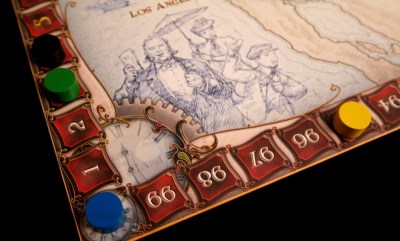
Ticket to Ride (USA)
– Image by boardGOATS

There was a bit of debate as to what to play next, but as Ivory had never played it before, the group eventually settled on Carcassonne, with the River expansion.  This is one of the most popular “gateway” game so it was quite remarkable that Ivory had managed to avoid it for so long.  The rules of the game are really simple, though they generate a surprising amount of depth, especially when played with two.  With five, there is less control, but it can still be a lot of fun.  On their turn, the active player draws a tile from one of the available stacks and adds it to the central map, making sure that any features on the edge of the map are preserved.  The active player may then place one of their Meeples on the tile they’ve just added to the tableau.

Carcassonne
– Image by boardGOATS

The Meeple is placed on a feature – a Road, a City, a Monastery or Farm.  The key rule, however, is that a Meeple cannot be placed on a feature that already has a Meeple on it.  So if the tile is added in a way that means it extends an occupied pre-existing City for example, the player cannot place his Meeple on that City, though if it were unoccupied it would be fair game.  Once the player has finished placing their tile and Meeple, any features that were completed are scored and the associated Meeples returned to their owner.  When complete, Cities score one point per tile they occupy, double for every tile with a blue and white shield on it; Roads also score one point for every tile that contributes to them.
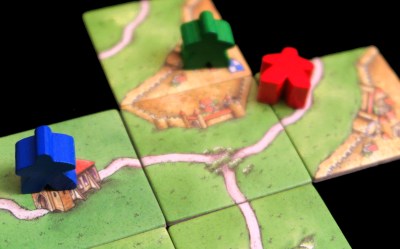
Carcassonne
– Image by boardGOATS

Monasteries are rather different and when completely surrounded by eight tiles, score nine points.  Farms are a little different, only scoring at the end of the game, giving three points for every city it supplies.  These are usually a crucial source of points and the player who controls the biggest Farm usually wins.  Again, a Meeple cannot be added to a farm if there is already a Meeple occupying it, so this aspect of the game is all about joining Farms together and sharing or ideally, taking control of other people’s Farms.  Adding the River expansion helps to reduce the dominance of Farming by helping to prevent one single super-Farm forming, though Farms are still a very important part of the game and timing is crucial.
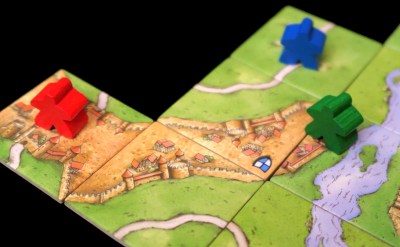
Carcassonne
– Image by boardGOATS

This time, the game was played very quickly, especially given who was playing.  As a result, poor Ivory, on his first experience, had no idea what was going and really struggled to follow some of the more subtle parts of the game.  The game began as the Battle of the Cities, with Red and Ivory merging their Cities to increase their points haul,, and Black and Green sharing another City to do the same.  At the end, however, it all came down to eating and praying, i.e. Farms and Monasteries, in what was also a very close game.  Again, there was just one point between first and second and again the top two places were held by Black and Green, with Black once again pipping Green to the win.  This time it was Red who took a very close third, just three points behind.  Black’s comment as Ivory left, was that the game had been “Quite vicious,” and as the group waited for Lords of Vegas to finish and caught up on the votes in the House of Commons, that would be an appropriate description for the happenings in Parliament too.
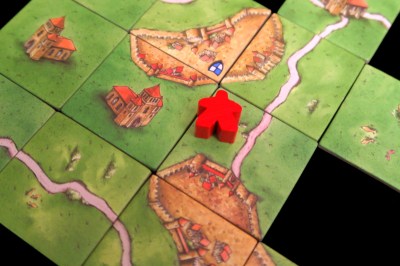
Carcassonne
– Image by boardGOATS

Learning Outcome:  It doesn’t take many rules to make a really good game, just the right rules.
Next Meeting – 3rd September 2019

Our next meeting will be on Tuesday, 3rd September, at the Horse and Jockey pub in Stanford-in-the-Vale. As usual, we will be playing shorter games from 7.30pm as people arrive, until 8pm when we will start something a little longer.

This week the “Feature Game” will be Lords of Vegas. In this game, players represent powerful developers in the burgeoning 1940s Nevada city. Players earn money and prestige by building the biggest and most profitable casinos on “The Strip,” the town’s backbone of dust and sin. They start with nothing but parking lots and dreams, but from there build, sprawl, reorganize and gamble their way to victory or destitution.

Lords of Vegas
– Image used with permission of BGG contributor ckirkman

And speaking of gambling…

Julia rushed home from the casino.  From the door she started yelling at her boyfriend, “Jeff, pack your things. I just won a million pound pay out from a slot machine!”

Excited, Jeff replied, “Oh yes, finally, we’re going on vacation? Should I pack for warm weather or cold?”

His wife looked at him and said, “I don’t care, you can go wherever you want to go! Go to the North Pole if you want, as long as you’re out of the house by noon!”

20th August 2019

It was ominously gloomy and empty in pub the when Khaki and Mulberry arrived.  With Blue away for work, she had left the logbook with the landlord and it was sadly sitting on the table waiting for them.  Fearing the repercussions of ignoring the demanding tome, they ordered food and took their places at the table.  They were soon joined by Burgundy, Purple, Black, Lime and Ivory, making it a decent turn-out for a meeting that was very nearly cancelled.

The Book - 20/08/19
– Image by boardGOATS

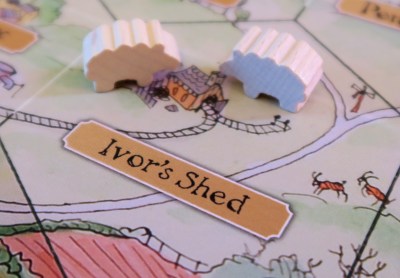
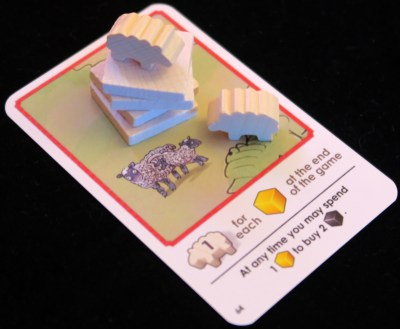
Once the feeding was over and done with, it was time to organise people to play games.  Purple, Mulberry and Lime began with the “Feature Game”, Ivor the Engine.  This is a great little game with fantastic artwork from the late, great Peter Firmin.  Although it is designed round a the children’s cartoon, the cute artwork belies the viscous little teeth the game has.  The idea is that players move their wagon round the board, playing cards to carryout errands which are paid in sheep – the player with the most sheep at the end of the game is the winner.

Ivor the Engine
– Image by boardGOATS

At the start of the game the board is randomly filled with lost sheep. On their turn, the active player begins by collecting a sheep at their current location, if one is available, receiving bonus sheep if they take the last sheep in a location. Then they play cards and move their wagon playing cards before or after they move.  There is one free movement and others can be bought with coal.  The active player can play as many or as few cards as they wish, but there is a tight hand-limit of four cards and only one card can be played at each location. The cards can be used in one of two ways:  they can provide a special action (e.g. extra moves or moving sheep about), or if the active player is at a location where there are no sheep, they can use them to complete a “Job” receiving sheep as a reward.  Finally, players take a card from the face-up display discarding a card if necessary.

Ivor the Engine
– Image by boardGOATS

It seems very gentle at first glance, but there are a couple of things that make the game quite strategic.  Firstly, only one player can be in a location at any one time, which can be surprisingly inconvenient for players who have built a plan and a hand of job cards only to be obstructed by another player squatting in the wrong place.  With cards at such a premium it is also surprisingly irritating when another player takes a desired card.  Managing these is key to being successful, but the nastiest part of the game are the event cards.  At the end of a player’s turn, they draw cards from the deck to replace any they have taken and place them face up in the display.

Ivor the Engine
– Image by boardGOATS

If an Event card is revealed, then the actions must be carried out by everyone – some are nice, some are slightly inconvenient, others are downright nasty.  For example, some Events cause players to move their wagon to the other end of the board which can be very helpful or extremely frustrating depending on the player’s plans.  Players can also be forced to forfeit sheep, or worse, hard won resources or Job cards.  Like Job cards, Event cards are also dual purpose, and (once the Event has been resolved) can be taken from the “market” at the end of a turn, like Job cards.  They are valuable though, providing a means to score more at the end of the game, so they must be bought using gold, which is very rare and difficult to come by.

Ivor the Engine
– Image by boardGOATS

Purple explained the rules very thoroughly as there are a couple of slightly fiddly exceptions, for example, it costs two coal to move along the main line, but eventually the game got going.  Everyone started on the same side of the board and got in each other’s way a bit.  Lime struggled a bit in a game that can be quite unforgiving despite it’s cute graphics and child-friendly theme.  Things improved for him as he picked up six sheep on his final turn.  Mulberry’s game started well, but in contrast to Lime, fizzled out towards the end.  Purple got lucky as she picked up sheep throughout and cards that were conveniently close to her current position.  Purple’s experience ensured she capitalised on her good fortune, finishing five points ahead of Lime, with thirty-three.

Ivor the Engine
– Image by boardGOATS

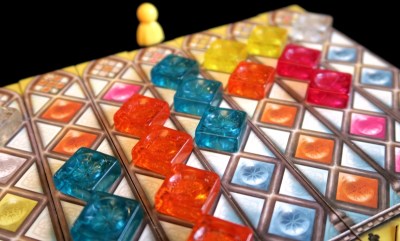
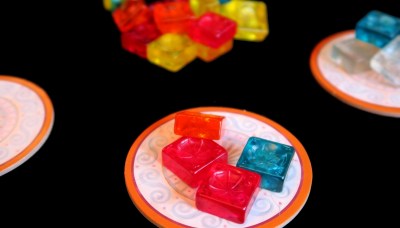
Meanwhile on the next table, “the boys” were playing Azul: Stained Glass of Sintra.  This was released last year at Essen and uses the market mechanism from the 2018 Spiel des Jahres winner, Azul.  The idea is of this is that on their turn, players take all the pieces of one colour from a market and place the left-overs in the middle, or, take all the tiles of one colour from the middle.  In Stained Glass of Sintra, instead of placing these pieces in a row and moving them onto a grid, pieces are placed directly into the player’s window.  This is modular consisting of the double-sided strips laid out at random so everyone has a different starting setup.

Azul: Stained Glass of Sintra
– Image by boardGOATS

There are restrictions on how the pieces can be placed though:  tiles must be placed in the strip immediately below their Glazier meeple, or in a strip to its right.  The Glazier is then placed above the strip the tiles were placed in,, so he gradually moves to the right. Instead of taking tiles, players can choose to reset the Glazier’s position, moving him back to the left most strip.  Players get points when strips are completed scoring the sum of the score depicted below the strip and any strips to the right that have already been completed. There is also a colour bonus—each round has a colour drawn at random at the start of the game, and any tiles that match the colour for the round score extra.

Azul: Stained Glass of Sintra
– Image by boardGOATS

Once a strip has been completed, it is flipped over; after it has been filled a second time it is removed. Any left over tiles that cannot be placed are placed into the glass tower and yield a penalty with players moving along a negative score track which has small steps at the start that gets larger. When the market is empty the round ends and the round indicator tile is also dropped into the glass tower which is emptied when the .  There are also end-game bonus points with two variants available, one colour dependent and the other rewarding completing adjacent strips.

Azul: Stained Glass of Sintra
– Image by boardGOATS

Kahki started, but was the only one new to the game and didn’t know what he was doing.  Somehow though he managed to build a lead which kept growing. Black and Burgundy weren’t far behind although there was a lot of smashed orange “glass” when Burgundy was forced to pick up eight orange pieces but only had space for four.  Ivory struggled and there was yet more broken orange glass when he picked up twelve orange pieces, only having space for two.  As a result, there were a lot of penalty points at the end, and it was only a surprise to Kahki that he was the winner by some twenty points.

Azul: Stained Glass of Sintra
– Image by boardGOATS

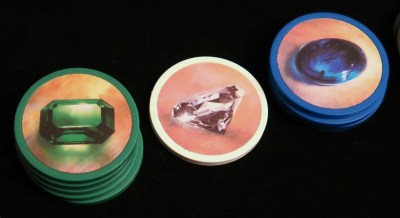
The Ivor group had barely finished the rules explanation by this point, so the group moved on to play Splendor.  This is one of our most popular games, but has largely degenerated into an exercise in trying to beat Burgundy as he wins every time.  The game is a very simple engine builder, where players can either take “gem” chips on their turn, or use them to buy a card from the display.  Cards then provide a perpetual “gem” allowing players to buy more expensive cards which give points.  Points are also provided by “Noble” tiles which are revealed at the start of the game and are won by the first player to get a certain combination of gem cards.

Splendor
– Image by boardGOATS

This time, all the Noble tiles needed rubies (red), but very few ruby cards came out.  Ivory started well taking an early lead with a few low scoring cards before Khaki caught up him taking a three point card. Burgundy made a very slow start, reserving a couple of cards while Black picked up a few points here and there.  Ivory took the first Noble and managed to fight his way to fourteen points, but then the inevitable happened.  Burgundy’s game suddenly snowballed and a couple of rounds later he bought his last reserved card and, as the last player in the round, brought the game to an end.  Burgundy finished on sixteen points, just two ahead of Ivory who took second place in what was a very tight game where Burgundy was pushed right to the wire, albeit with the usual result.

Splendor
– Image by boardGOATS

By this time, Ivor was finally finished, and Khaki and Mulberry headed off for an early night, leaving everyone else to play Alhambra.  This, the 2003 Spiel des Jahres winner, is a tile laying game where players are building their city.  Basically, on their turn, the active player may take money from the open money market; purchase a building from the building market and either place it in their Alhambra or their reserve, or engage in construction and re-construction projects with buildings that had been placed in the player’s Alhambra or their reserve.  The core of the game is the market, where players buy building tiles with coloured money cards and add them to their Alhambra.  This key purchasing mechanism comes from its predecessor, Stimmt So!.

Alhambra
– Image used with permission of BGG contributor EndersGame

There are four different currencies which come in different colours.  At the start of a player’s turn, there are four tiles available, each in a different coloured market, which can only be purchased with the currency that matches the market’s colour.  If the active player can pay with exactly the correct amount, they can buy another tile, but if they over-pay, they get no change and their turn ends.  While this all sounds simple enough, there is the little problem that sets Alhambra apart from Stimmt So!:  most of the tiles have walls along one, two or three edges, and when placed, these must match up without partitioning the Alhambra.  The walls are critical as poor play in the early stages can mean it is possible to get backed into a corner later in the game.

Alhambra
– Image used with permission of BGG contributor EndersGame

There are fifty-four tiles in six different types, each type in a different colour. They are Pavilions (Blue), Manors/Seraglios (Red), Mezzanines/Archades (Brown), Chambers (White), Gardens (Green) and Towers (Purple).  Most tiles have one or more walls around the edges and each tile also shows numerical value from two to thirteen, which is their cost.  Each of the six different building types in a player’s Alhambra score in each of the scoring phases, with players receiving points for having the most of each type in the first scoring round.  In the second scoring round the player in second place also scores and in the final scoring round points are also available for third place in each building type.  Points are also awarded in each scoring round for players’ longest external “wall” section within their complex.

Alhambra
– Image used with permission of BGG contributor mothertruckin

The game ends when the building market can no longer be replenished from the building tile supply, and there is a final scoring, whereupon the player with the highest score wins.  In this game, the distribution of tiles was very uneven, with all the Tower tiles coming out early and and the Manor and Garden tiles coming out late.  Ivory took an early lead after the first scoring round having picked up a lot of the early Towers.  It was not to last though.  Alhambra is a game that rewards efficiency, and Black and Burgundy both made the most of paying exactly the right amount and taking extra turns, while Ivory and Lime fell into the trap of putting tiles into their reserve which cost them an extra turn to place them in their Alhambras.

Alhambra
– Image used with permission of BGG contributor EndersGame

While Purple had the most Towers in the second scoring round, others had caught up by the third and final scoring round.  As a result, Towers finished in a three-way tie, so nobody scored well.  Lime finished with the longest wall taking a massive fifteen points in the final scoring phase, but unfortunately he did not have enough points elsewhere to trouble the leaders, Burgundy and Black.  Burgundy also had a substantial wall, giving him twelve points, and with his Gardens and Pavillions, he took a creditable second place, but was some way behind Black who finished with over a hundred points thanks to having the most Chambers and coming second in many of the other buildings and generally being efficient throughout.

Alhambra
– Image used with permission of BGG contributor EndersGame

Learning Outcome: boardGOATs can survive without Blue and Green as long as Purple is around.

Next Meeting – 20th August 2019

Our next meeting will be on Tuesday, 20th August, at the Horse and Jockey pub in Stanford-in-the-Vale. As usual, we will be playing shorter games from 7.30pm as people arrive, until 8pm when we will start something a little longer.

This week the “Feature Game” will be Ivor the Engine. This is a great little card-driven, sheep-collecting, train game featuring fabulous artwork from the late, great Peter Firmin.  Although it is not a difficult game to play and looks like a cute kiddies game, it has vicious little teeth that make it a fine little game.

Ivor the Engine
– Image by boardGOATS

And speaking of trains, and sheep…

A mathematician, a physicist, and an engineer were traveling though Scotland by train, when the engineer looked out the window, saw a black sheep.  He exclaimed, “Hey! They’ve got black sheep in Scotland!”

The physicist looked out the window and corrected the engineer, “Strictly speaking, all we know is that there’s at least one black sheep in Scotland.”

The mathematician looked out the window and corrected the physicist, “Strictly speaking, all we know is that is that at least one side of one sheep is black in Scotland…”

6th August 2019

With a party just arriving, Blue and Khaki took a gamble on Burgundy being on his way, and ordered his ham, egg, ‘n’ chips for him on the understanding that they’d have a second course if he failed to turn up in time.  Blue, then eschewed her usual pizza in favour of fajitas which she then proceeded to throw down her front.  Pine, meanwhile, arrived fractionally too late to order food at all.  Burgundy arrived just in time to avoid everyone playing musical food and eating his dinner, so Pine ended up eating everyone else’s chips instead.  With the substantial matter of food dealt with and the arrival of Purple and Black, the group moved on to games.  There was some discussion about playing one large game or two smaller, three-player games, but the latter won out, with the “Feature Game”, Century: Spice Road, the first game on the table.

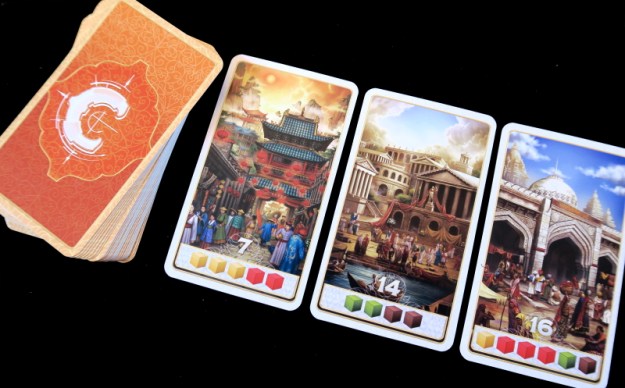
Century: Spice Road
– Image by boardGOATS

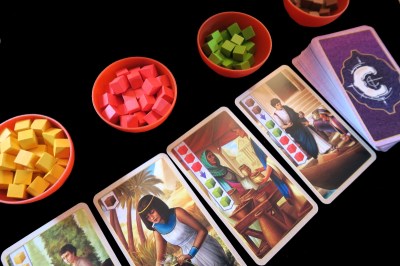
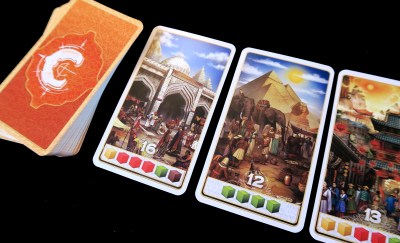
This being a similar engine builder type game to Splendor and Burgundy keen to play, Pine could see the writing on the wall and decided to leave Blue and Khaki to it.  The game itself is actually quite different to Splendor.  In Splendor, players take gems and use them to buy cards which then deliver permanent gems enabling them to buy other cards, and eventually get cards that also give points.  In Century: Spice Road, players are spice traders and take cards from a conveyor belt and then use these cards to get spices and then use the spices to buy scoring cards.

Century: Spice Road
– Image by boardGOATS

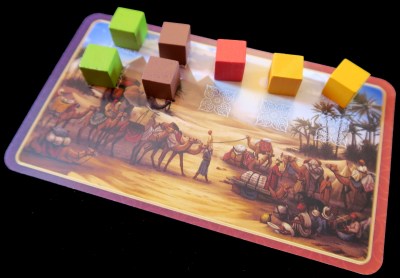
The clever part is the fact that there are four spices available, turmeric, saffron, cardamom and cinnamon, with cinnamon worth the most, and turmeric the least.  Thus, the activity cards, variously enable players to take spices, upgrade them, or convert them into other spices.  Players place their spices in their caravan, which holds a maximum of ten spices.  Like Splendor, the game is all about building an efficient engine, though in this case, it uses deck building, so a key part is making sure that as many cards as possible are used before the deck is picked up, which costs a turn.  Similarly, any conversions can be carried out as many times as desired when the card is played, so timing is everything.

Century: Spice Road
– Image by boardGOATS

Burgundy went first and it wasn’t long before he took his first points, leading Pine to comment from the next table, comparing Burgundy taking the lead to Bayern Munich taking a five-nil lead ten minutes in.  Burgundy replied that he wasn’t winning… yet.  It wasn’t long before Blue and Khaki scored themselves, though rather than equalising, it was more a case of reducing the deficit.  It was around this point that Blue made a big play, going for a card that allowed her to upgrade three spices (compared to the initial two in the cards everyone started with), but she immediately regretted it as she paid through the nose to take it (the card at the end of the conveyor belt is free, but taking newer arrivals costs one spice per card space nearer to the deck).

Century: Spice Road
– Image by boardGOATS

This mistake was compounded by the fact that Blue didn’t really use the card as she had more efficient ways upgrading her spices.  Meanwhile, Burgundy and Khaki were building up their pile of scoring cards, with Khaki ominously taking a lot of the oldest scoring cards, and with it a large number of the rather pretty bonus metal coins.  The game moved really quickly – it’s not really multi-player solitaire, but everyone had plans, so play moved on very quickly with only sporadic breaks when people had to make decisions, so it wasn’t long before everyone was getting close to taking the critical sixth scoring card which triggers the end of the game.

Century: Spice Road
– Image by boardGOATS

It turned out that all the high scoring cards had come out at the beginning and towards the end, everyone was waiting and hoping someone else would take a low scoring card and leave them with something more exciting.  Blue had the chance to kill the game early and prevent Burgundy and Khaki taking a sixth card, but she thought Burgundy was setting his sights higher than he was.  So in the end it was Burgundy who took his sixth card to trigger the final round and everyone finished with the same number scoring cards, though Burgundy’s were generally of much higher value.

Century: Spice Road
– Image by boardGOATS

It was really close for second place, with Blue taking it by just one point, but Burgundy finished eleven points clear with eighty-six, fulfilling Pine’s prophecy (based on his unbeatable prowess at Splendor) that he would win.  Blue was left ruing the fact she hadn’t ended the game when she had the chance, but in reality Burgundy would probably have won anyhow as he’d only taken a low scoring card end, giving him fewer points than his margin of victory.  However, we’d all enjoyed the game, as it plays quickly and doesn’t out-stay it’s welcome as well as being quite nicely produced.  It does look like it is going to be one of those games that nobody else will want to play with Burgundy though.

Century: Spice Road
– Image by boardGOATS

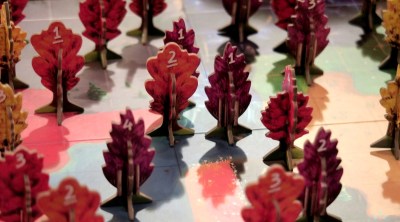
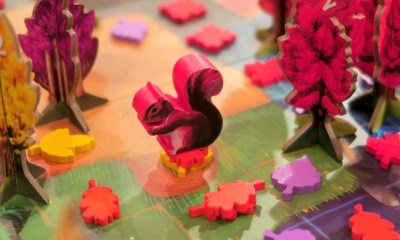
Meanwhile, on the next table, Pine had joined Black and Purple to play the rather beautiful Bosk.  This is a fairly simple little game that has had a couple of outings recently and has proven quite popular.  The game plays over two seasons, spring, where players grow their saplings, and autumn, where the trees then drop their leaves.  Summer and winter are scoring phases.  In summer, players score points for each row or column where they have the largest total and in winter, players score for having the most leaves in each area.

Bosk
– Image by boardGOATS

This time, with players becoming more familiar with how the game works, it was really tight.  Although the scoring in the first half always seems important, it isn’t really, and is usually quite close.  It is a game where small margins are always important though.  So while the wooden squirrels were doing acrobatics in the middle of the table, players’ trees were shedding leaves all all over the forest.  When it came to scoring, it was very “tit-for-tat” with one player scoring best in one area and then another playing scoring best in the next area.  In the end, it was Black who just managed to sneak the win, two points ahead of Pine.

Bosk
– Image by boardGOATS

With both games finishing simultaneously, and everyone being keen to play together, we decided to introduce Khaki to one of our favorite games, Las Vegas.  This is a great betting game which is quite unlike anything else.  The idea is that there are six casinos, each with a pot of money in one or more notes.   On their turn, each player rolls a handful of D6 dice and place some on one of the casinos.  The player with the most dice on a casino once all dice have been played takes the highest denomination note in the pot.

Las Vegas
– Image by boardGOATS

As with all the best games, it is the little rules that make the difference.  In this case, there are two “catches”.  Firstly, the player must place all of one number on one of the six casinos, so if they rolled a two and six fives, the must place the two on the “Two” casino, or all six fives on the “Five” casino.  Secondly, when everyone has run out of dice, any dice that tie are eliminated, which means there could be three players with four dice each, and one player with a singleton and the singleton wins.  A new edition of the game has just been announced, Las Vegas Royale, but rather than implement the changes to the rules released with the new edition, we played in our usual, highly enjoyable way.

Las Vegas
– Image by boardGOATS

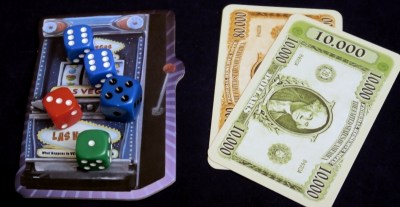
The game is supposed to be played over four rounds, but we find it can outstay it’s welcome a little for players who are out of the running, so we house-rule it to three rounds instead.  We also add “The Biggun” dice and the Slot Machine from the Boulevard expansion.  The big dice count for two in the final reckoning, which adds a little bit of variety to the game, while the Slot Machine gives players an alternative to placing dice in the casinos.  Each number can only be placed once in the slot machine, but the player must place all their dice of that number (as usual).  In the event of a tie, the total number of pips, and then the highest value dice are the deciding factors.  This a relatively relaxing game to play with friends with short burst of thought interspersed with a lot of table chat and general encouragement and exhortation to make a mess of things for someone else.

Las Vegas: The Slot Machine
– Image by boardGOATS

In the first round, Khaki rolled a handful of fours, so made a play for the “4” casino.  Following it with more fours secured his position, so when he rolled more fours in the second round he was encouraged to go for it again.  By the final third round, everyone was placing subconscious bets on whether he would try again, which of course he did, ultimately winning the “4” casino in all three rounds.  In fact the last round was the deciding factor, ultimately coming down to the last couple of dice, which lost Pine and Burgundy a lot of cash.  It was Blue and Purple, mostly flying under the radar that took the honours with $330,000 each, finishing joint first, and opting to share victory rather than invoking the tie-breaker.

Las Vegas
– Image by boardGOATS

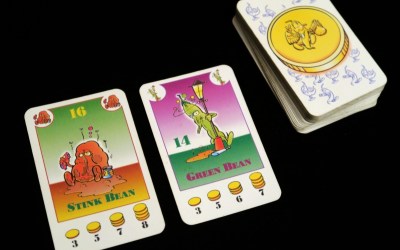
There was still plenty of time, but clearly everyone was in a holiday mood and fancied playing light fare, so we decided to finish with an old favourite, Bohnanza.  Kahki had not played it before, so was given a quick run-down of the rules.  The important thing, is that players must not re-order their hand – this is so automatic in card games that new or not, everyone always reminds everyone else immediately after the cards are dealt.  On their turn, players then play the first card from their hand into one of the two “bean fields” in front of them.  They may optionally play a second, but then the top two cards from the deck are turned over.  These must be “planted” before anything else can happen, but they can be planted in the active player’s field or can be traded for something and planted in a field belonging to another player.

Bohnanza
– Image by boardGOATS

Once the trades have been dealt with, the active player can trade with other players, swapping cards in hand, and then finally tops up their hand by drawing a set number from the deck (dependent on the number of players). There are many clever things about this game, but one of the most important is that when fields are harvested, some of the beans are turned over and become coins which are kept by the player, with the rest moving to the discard pile.  The reason this is important is because some beans are rarer than others and rare beans give a better yield.  This means the balance of the deck changes during the game with rare beans becoming rarer, while there is a glut of common beans.  The winner is the player with the most coins at the end, which is usually the player who best surfed this changing balance.

Bohnanza
– Image by boardGOATS

The game is very sociable and always played in good nature, with players generally offering and accepting reasonable trades, and not being obnoxiously obsessed with winning.  This time was no exception, although Burgundy did refuse Pine’s totally reasonable offer to take a pint for a Red Bean.  Purple made good progress early on, with a large number of Black-eyed Beans while others struggled to make much progress at all.  As a result, when the deck was depleted for the first time round, there were very few cards in the discard pile making the second round extremely short.  The third was even shorter, made worse by the fact that Blue lost the plot and shuffled the last few cards in with the discard pile

Bohnanza
– Image by boardGOATS

When, in the last turn of the game, Purple turned over two Green Beans which Blue wanted, she offered her whole hand, sizeable hand to purple in exchange.  Purple being a kind-hearted, generous sort, graciously accepted, much to Black’s disgust.  The offer was partly to make up for the screw-up with the deck in the hope that Purple would be able to score some points, but of course did Blue no harm either.  In the end it nearly cost Purple the game.  Often the game ends in a multi-way tie, sometimes for first, but more commonly for second place.  The pair of Green Beans that Blue received gave her one extra point, breaking what would have been a three way tie for second with Black and Khaki, putting her one coin behind Purple, the winner with fourteen.

Bohnanza
– Image by boardGOATS

Learning Outcome:  Don’t play Splendor OR Century with Burgundy unless you fancy a pasting.

Next Meeting – 6th August 2019

Our next meeting will be on Tuesday, 6th August, at the Horse and Jockey pub in Stanford-in-the-Vale. As usual, we will be playing shorter games from 7.30pm as people arrive, until 8pm when we will start something a little longer.

This week the “Feature Game” will be Century: Spice Road. This is a pretty, engine-builder card game, similar to Splendor, but with a few more bits.  In Century, players are caravan leaders who travel the famed silk road to deliver spices to the far reaches of the continent for fame and glory.

Century: Spice Road
– Image by boardGOATS

And speaking of spices…

There was a world shortage of spices, however, Jeff had seen it coming and had stocked up. His brother Joe was pushing to sell before the market fell and so that people could have all of their favorite dishes once more.

Jeff looked at Joe and said, “What’s the rush? We’ve got all the thyme in the world…”

23rd July 2019

It was a quiet, if hot night; Blue and Khaki were the first to arrive closely followed by Pine and Burgundy, and all four settled down to eat and discuss the very British subject of The Weather.  Just as they were finishing eating, Ivory turned up toting his copy of the “Feature Game”, Wingspan.  Then he started something when he ordered a desert, specifically ice cream.  Everyone else, who had struggled to finish their supper and had hitherto been replete watched with envious eyes as Ivory tucked into his two scoops, one each of Baileys and Toblerone.  Only Burgundy held out and it wasn’t long before another food order was placed, including two grown-up orders of a single scoop of raspberry sorbet and one childish order of a scoop each of chocolate orange and Toblerone.

Ice Cream
– Image from horseandjockey.org

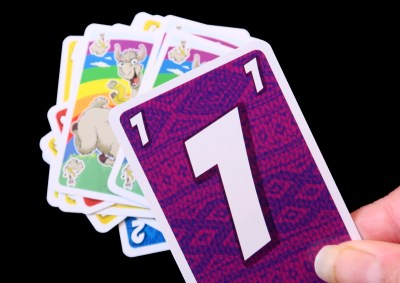
While waiting for the second round of deserts to arrive, the group decided to play something, and, given that the Spiel des Jahres awards had just been announced, decided to give L.A.M.A. a go. L.A.M.A. was nominated, but did not win (despite Reiner Knizia’s amazing outfit), however, for our group it was a much better fit than Just One, the winner.  Just One, is a word guessing game in a similar vein to the previous laureate, Codenames, which was extraordinarily unpopular with our Tuesday night group.  Word games are similarly unpopular, so Werewords was never likely to go down well either, making L.A.M.A. our group’s pick, even though we had not hitherto played any of the nominees to form a real opinion.

L.A.M.A.
– Image by boardGOATS

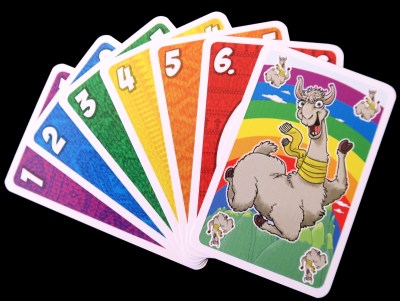
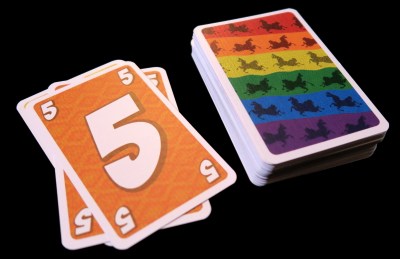
As Ivory commented, L.A.M.A. has a reputation of being a bit of an “UNO killer”, that is to say, it is a similar game to UNO, but perceived to be better.  L.A.M.A. is an abbreviation for “Lege alle Minuspunkte ab”, which roughly translates as “get rid of your negative points”, and indeed this is what players do, in a similar way to UNO.  The deck contains coloured cards numbered one to six, and some Llama cards.  Players take it in turns to play a single card, the same number or one higher than the last card played.  Llama cards can be played on sixes, and one’s can be played on Llamas.  If they cannot play (or choose not to), players can draw a card from the deck, or stick with what they have, and not play for the rest of the round.

L.A.M.A.
– Image by boardGOATS

When either everyone has passed, or someone has played out their hand, everyone scores points equivalent to the face value of their cards in their hand, and Llama cards score ten.  There is a catch though, in a mechanism faintly reminiscent of No Thanks!, any duplicate cards do not score, thus, a two fives and a six will only score eleven.  Players receive tokens for their score, but if a player checks out with nothing they can return a token to the pool.  Since white tokens are worth one and black worth ten, and players can return either, the advantage can  sometimes be with the player with a higher score.  For example, someone with nine points can only return one white token leaving them with eight, while someone with a single black ten can return everything they have.  The game ends when someone reaches forty.

L.A.M.A.
– Image by boardGOATS

Blue started badly, by picking up a massive twenty-four points on the first round.  Burgundy did slightly better, although the size of his total was largely thanks to Pine who repeatedly stepped up the current card value upsetting Burgundy’s plans.  This became something of a running joke, with Pine playing a one and thus preventing Burgundy playing his Llama cards.  Pine and Ivory started well remaining in single digits for several rounds, but in the end it was surprisingly close.  Fairly inevitably though, it was Blue who hit the magic forty first with Burgundy and Ivory just behind with thirty-nine each.

L.A.M.A.
– Image by boardGOATS

Khaki took a very creditable second place thanks to winning one round and ditching ten points as a result.  It was Pine who won the game, however, as the most consistently low scoring player, finishing with eight points fewer than Khaki, a total of only twenty.  With the ice cream desserts and the llama aperitif dealt with, it was time to move on to the main course, the “Feature Game”, Wingspan.  Ivory commented that he’d been really looking forward to this and described it as, “an engine builder like Terraforming Mars, but much prettier”.  While we set up, Pine explained that his curious order of “Yardbird” was not a reference to the game, but the IPA.  It turns out the beer is not named after the the rock group (that featured Eric Clapton among others), but actually Charlie Parker, the jazz saxophonist.

Wingspan
– Image by boardGOATS

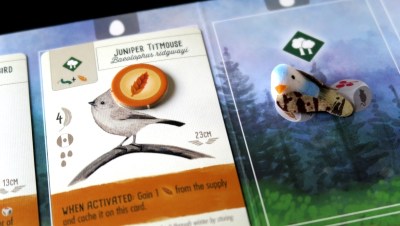
The players are bird enthusiasts seeking to discover and attract the best birds to their network of wildlife reserves.  The game itself is fairly straight forward: there are two main types of actions, introduce a new bird card, or carry out an an action and activate the associated birds.  In order to introduce a new bird card into their reserve, a player needs entice them by spending food.  Each bird is played in one of the three habitats: woodland, grassland or wetland.  Some birds, like the Common Raven, can be found in any habitat so players can choose where to play them, others birds like a Green Heron are only found in one or two habitats (in this case, wetland), so  can only be placed in those habitats.

Wingspan
– Image by boardGOATS

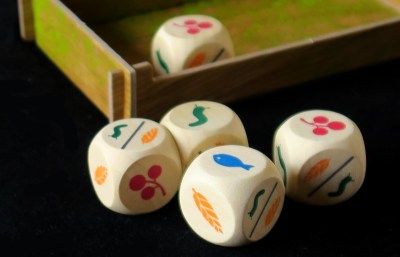
There are three other actions, collect food, lay eggs or acquire more cards.  In each case, players place one of their action cubes (or fluffy little birds in our pimped out copy), in the space to the right of the right most card in the associated habitat.  The more birds there are in a habitat, the better the action.  So, for example, if a player has no woodland birds and decides to take food, they can only take one food die from the bird-box dice tower receiving one food in return.  On the other hand, a player that has four bird cards in their woodland habitat can take  three food if they activate their woodland habitat.  Once the action has been completed, the player activates each bird in that habitat, in turn.  The grassland action, laying eggs, and the wetland action, taking cards work in a similar way.

Wingspan
– Image by boardGOATS

Eggs can generally be placed on any bird card as long as it has sufficient capacity.  Eggs, aside from looking a lot like Cadbury’s Mini Eggs, are very useful as they are needed when adding cards to habitats—after the first card in a habitat, in addition to food, there is a cost of one or two eggs per bird.  They are also worth points at the end of the game.  Activating the wetland action, allows the player to take a face up card from the three available, or draw blind (similar to Ticket to Ride games).  In both cases, any birds in the habitat are also activated after the action has been taken.  Some birds have a special power on activation, while others give a bonus when they are originally played and some give an advantage when other players do  a particular action.  These special actions include providing extra food, laying extra eggs or acquiring extra food.

Wingspan
– Image by boardGOATS

Some actions dictate where the food goes, so in some cases, the food is left on the bird card and cannot be used by the player, instead scoring a point at the end of the game.  Similarly, some cards are tucked under other cards, simulating flocking birds, or the prey caught by predators, and these score a point each at the end of the game.  Eggs on cards also score, and there are interim challenges, and the most successful players at these also score.  Finally, each bird is itself worth points, and each player starts with a choice of two bonus cards which provide points if that player is successful in a given category.  The game lasts four rounds with each player getting eight actions in the first round, but only five in the final round.

Wingspan
– Image by boardGOATS

Aside from the gorgeous artwork, there are a lot of very nice little touches in this game.  For example, although the egg capacities for the birds aren’t correct, they are proportionally right with the American White Pelican only holding one egg, while the Mourning Dove holds five.  Similarly the food requirements and habitats are correct.  Sadly, the cards are all North American birds, but there are plans in the pipeline for European birds and even Australian, African and Asian bird expansions in due course.  At the start of the game each player gets two bonus cards and keeps one of them.  These can reward players with two points for every predator they have, or give points if the player has, say, four or more birds with a large wingspan, but the probability of these is given on the card which is a nice feature too.  So, all in all, it is a very well produced game.

Wingspan
– Image by boardGOATS

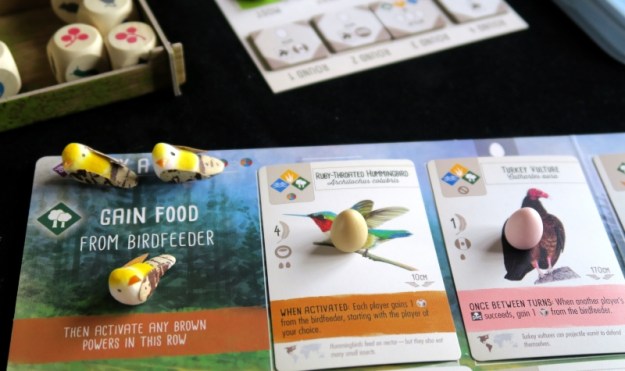
Ivory started very quickly, luring a Barn Owl to his woodland, and it quickly started hunting, with any prey caught being stored on the owl card and worth points later in the game.  He quickly followed this with two cards that allowed him to draw extra bonus cards, and looked to be set up for a strong game.  Next to him, Pine was struggling—the game is not complicated, but it is a little different to anything else we’ve played.  He got the hang of things eventually though, and his Canada Goose looked a very nice card as it allowed him to tuck two cards underneath it (each worth a point at the end of the game) for the cost of one wheat when activated.  Khaki was helping everyone out though, as his Ruby-throated Hummingbird kept everyone supplied with food.

– Image by boardGOATS

Burgundy just quietly got on with things, but as he and Khaki had the most eggs in nests on the ground at the end of the first round, they took the end of round bonus points.  Meanwhile, Blue’s Yellow-Billed Cuckoo was giving her useful eggs whenever someone else laid eggs, as long as she remembered to activate it.  With Burgundy and Khaki taking the end of round bonus for the most wetland birds at the end of the second round, it was starting to look ominous.  Ivory had his eye on a bigger prize however.  The end of round bonuses increase in value throughout the game, so he was clearly after the bonus at the end of the third round, which rewarded the player with the most grassland birds.  Burgundy had his eye on that too though, as did Blue and as the number of actions decreased the game became increasingly difficult.

Wingspan
– Image by boardGOATS

Blue’s Eastern Bluebird proved very useful as it allowed her to play to birds for one action.  So in the end Burgundy, again took the points, this time tying with Blue, with Ivory just edged out.  As the final round came to a close, it was too late to improve the engines and everyone just had to concentrate maximise their points.  And after that, all that was left was the counting.  The game is a little bit “multi-player solitaire”, so nobody was sure who was going to win, though Burgundy was high on most people’s list.  Indeed, it was very close with just five points separating the podium positions, and only one point between the rest.  In the end, Burgundy on eighty-six tied for second place with Khaki, who had a lot of high value birds and had been determined not to disgrace himself (and definitely didn’t).  Blue just had the edge however, largely thanks playing her Inca Dove which allowed her to lay a lot of eggs in the final round.

Wingspan
– Image by boardGOATS

Learning Outcome:  Tempt a hot group of gamers with ice cream and most will give in.

It didn’t Win, but there’s No Cause for A-LAMA…!

“The llama is a quadruped which lives in the big rivers like the Amazon.
It has two ears, a heart, a forehead, and a beak for eating honey.
But it is provided with fins for swimming.
Llamas are larger than frogs.
Llamas are dangerous.
So if you see one where people are swimming, you shout…

Look out, there are llamas!”

Reiner Knizia
– Adapted from footage
on spiel-des-jahres.com

Spiel des Jahres Winners – 2019

The 2019 winner of the coveted German Game of the Year or Spiel des Jahres award is Just One.  This is a cooperative party game where one player guesses a word based on clues given by the rest of the group.  The really clever part is that the clues can’t be too obvious in a way faintly reminiscent of Dixit, the 2010 winner.  However, in Just One, this effect is achieved by the removal of any clues that are given more than once.  Just One was designed by the same people as The 7th Continent, though the two games couldn’t be much more different.

Just One
– Adapted from image by BGG contributor kalchio

The Kennerspiel des Jahres was awarded at the same time.  This honours more challenging games and this year was awarded to Wingspan (known as Flügelschlag in Germany).  This is a very pretty engine-builder card game where players are bird enthusiasts trying to attract the best birds to their network of wildlife preserves.  The Kinderspiel des Jahres award was announced last month and went to Tal der Wikinger (aka Valley of the Vikings) which is dexterity game where players are rolling balls to knock down barrels.

Wingspan
– Image by boardGOATS