 |
| – Image by boardGOATS |
Author Archives: nannyGOAT
Next Meeting – 11th December 2018
Our next meeting will be on Tuesday, 11th December, at the Horse and Jockey pub in Stanford-in-the-Vale.
As this is our last meeting before Christmas
we will be meeting early at 7pm for pizzas and Christmas festivities.
This week, the “Feature Game” will be Giftmas at Dungeon Abbey followed by a range of Christmas and winter themed games like Christmas Tree, Snow Tails, The Great Downhill Ski Game, Snowboard, Antarctica, Carcassonne: Winter Edition and Ticket to Ride: Nordic Countries. Giftmas at Dungeon Abbey is a short game set in a world somewhere between Downton and The Adams Family, designed by a local gamer and member of the Didcot Games Club, Rob Harper.
 |
| – Image by boardGOATS |
And speaking of Christmas…
Jeff wasn’t in a festive mood. He was in a lot of pain, so he went to see his doctor to get the problem looked at.
“What seems to be the problem?” Jeff’s GP asked.
Jeff looked a bit shifty and uncomfortable, and not just due to his ailment. “I’ve, er… got um…” he mumbled.
“Speak up, I can’t help you if I don’t know what’s the matter,” interrupted the doctor.
Jeff tried again, “I’ve, um…” but again his voice faded away to silence.
The doctor took pity on him and gently coaxed him on, “Is it something to do with an intimate area? You know there’s nothing to be ashamed of, we’re all the same really. Now what’s bothering you? You can tell me.”
Jeff took a deep breath “Doctor…” then he blurted out, “I seem to have a mince pie stuck up my bottom!”
“Oh, you’re in luck,” answered the Doctor, “I’ve got some cream for that!”
Christmas GOATS 2018 – Calendar Update
 |
| – Image from imagefully.com |
The Calendar has been updated, but here is a quick summary of the key dates for GOATS and Didcot Gamers:
| Christmas 2018 |
||
| Tuesday 11th December 2018 (Last normal meeting of the year) |
“Un-Christmas Dinner” meeting at 7pm; Festive and Wintery games from 8.00pm(ish) at the Horse and Jockey pub in Stanford-in-the-Vale. |
|
| Friday 21st December 2018 (Didcot Gamers) |
Games, at The Loop. |
|
| Thursday 27th December 2018 (GOATS do the Quiz) |
Quiz Night at the Horse and Jockey pub in Stanford-in-the-Vale from 9pm, with food from 8pm. |
|
| Saturday 29th December 2018 (Monster Games) |
Something longer in the afternoon at Barney’s House. |
|
| Monday 31st December 2018 (New Year Party) |
Games and food from 7pm until the early hours at Barney’s House. |
|
| Friday 4th January 2019 (Didcot Gamers) |
Games at The Loop in Didcot (back to normal). |
|
| Tuesday 8th January 2019 (boardGOATS) |
Games from 7.30pm at the Horse and Jockey pub in Stanford-in-the-Vale (back to normal). |
|
27th Movember 2018
With the Festive Season now apparently upon us, the pub was once again packed and food was later than usual. For this reason, we started with a quick game of No Thanks!. This used to be one of our “go-to” filler games, but has been somewhat neglected of late, so was surprisingly unfamiliar to some people. It is very simple though and very easy to learn on the fly: everyone starts with eleven red chips and the first player turns over the top card—they can take it, or pay a chip for the privilege of passing the problem on to the next player. The player with the lowest summed card total when the deck expires is the winner.
/pic984616.jpg) |
| – Image used with permission of BGG contributor msaari |
There are are two catches, firstly, where a player has a run of consecutive cards only the lowest is counted and secondly, a small number of cards are removed from the deck at random. Top scorer looked to be a toss up between Blue, Red and Mulberry, but Red took the dubious honour in the end, with forty. It was tight between Pine and Burgundy, however, both of whom had a large pile of chips and a substantial run of high cards (between them they had nearly forty of the fifty-five chips and the cards numbered twenty-eight to thirty-five). There were only two points in it in the end and it was Pine who took the honours.
/pic158418.jpg) |
| – Image used with permission of BGG contributor ronster0 |
The group had been just about to start playing when Black, Purple and Green had walked in. Since No Thanks! only plays five, so pre-empting a discussion of options, Blue chucked over a copy of Dodekka which the group obligingly settled down to play. This is another light set collecting game where the aim is to get the highest score possible from one of the five colour suits, while ideally scoring nothing in all the other suits. Gameplay is very simple: take the first card on display, or reveal a card from the deck and add it to the end of the row (thus “passing”). If the sum of the cards on display now totals more than twelve, the active player must pick up all of the cards on display. When the deck runs out, the winner is the player with the highest score (the total face value of one suit minus one for each other card). It was very close at the top, with only one point separating Black and Purple, and much to Purple’s chagrin, it was Black who came out on top.
 |
| – Image by boardGOATS |
Just as No Thanks! was coming to an end, food arrived, along with Ivory. Dodekka was still going, so while some munched, those remaining decided to give The Game an outing (played with a copy of The Game: Extreme, but ignoring the special symbols). This is a surprisingly popular game within the group, which is remarkable because it is cooperative and we generally prefer competitive games. Another simple game, the idea is that the team have a deck of cards from two to ninety-nine and they must play each card on one of four piles: two where the card played must be higher than the top card, and two where it must be lower. There are just three rules: on their turn, the active player can play as many cards as they like (obeying the rules of the four piles), but must play at least two cards before replenishing their hand, and players can say anything they like but must not share “specific number information”. Finally, there is the so-called “Backwards Rule” where players can reverse a deck as long as the card they play is exactly ten above or below the previous card played on that pile.
 |
| – Image by boardGOATS |
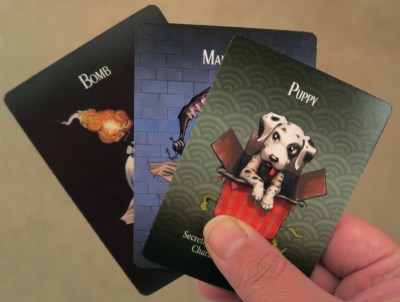
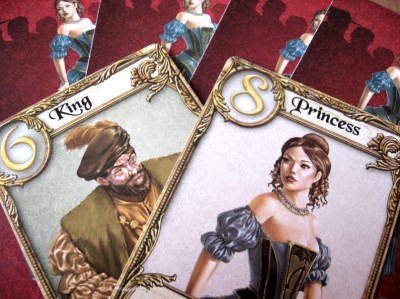
Red started and it quickly began to go wrong with with Pine holding a “nice mid-range hand”. With the help of everyone else he battled through though, and it wasn’t long before he had a “nice extreme hand” while all the piles were offering “nice mid-range options”. It perhaps wasn’t surprising with this that the group didn’t win (i.e. play all their cards onto the four decks), but given that they had such a poor run of luck, they did well to exhaust the draw deck and ultimately have only eight cards they were unable to play. Inevitably, Dodekka finished just after The Game started, so Black, Purple and Green killed time with a quick game of Love Letter. This is the original “micro game”, consisting of just sixteen cards. The idea is that each player starts with a single card, draws a second card and chooses one of the pair to play. The cards are numbered one to eight (with more of the lower numbers), and each number has an action associated with it. The aim is to eliminate all opponents, as the last man standing is the winner.
 |
| – Image by boardGOATS |
Rounds only take a minute or two, so elimination is not a problem. This time, each player won a round. So with honours even and with the other game and food coming to an end, it was sudden death. This time it was Purple’s turn to come up trumps, taking the final hand and with it, the game. This started a big debate as to who was going to play what. As it was likely to be Ivory’s last chance for a meaty game for a few weeks (with Christmas and his impending arrival), the “Feature Game” was Ambition, the expansion to one of his favourite games, Roll for the Galaxy. With Burgundy fed-up with the feeling of confusion that Roll for the Galaxy always gave him and Black feeling that he’d played it a couple of times recently, for a while it looked like it was only going to be Blue and Ivory. Eventually Black saw sense, and Green joined in, despite the fact that he felt he’d not played the base game enough to appreciate the expansion.
/pic2423031.jpg) |
| – Image used with permission of BGG contributor punkin312 |
Roll for the Galaxy is the dice game of the popular empire building card game, Race for the Galaxy. Both suffer from the same “iconography confusion”, but that aside, neither are actually complicated games. The idea builds on the Puerto Rico/San Juan idea of different phases or activities that only happen if or when players want them to. Roll for the Galaxy is almost a “worker placement” game where dice are the workers and have a say in what sort of work they do with players “spending” these dice to make actions happen. Each player starts with a dice in their cup which they roll and assign, in secret behind a screen. When dice are used they are placed into the player’s Citizenry and it costs a dollar to move them from the citizenry to back into the cup. Each face of the worker dice corresponds to one of the five different action phases: Explore, Develop, Settle, Produce, Ship. Each player uses one die, any die, to select a single phase that they want to “happen”. All the other dice are assigned to the Phase that corresponds to the face rolled. Any that do not correspond to the chosen phase can only be used if another player chooses those phases to happen. Any that are used move into the player’s Citizenry, any that are not used go back into the cup.
/pic2421787.jpg) |
| – Image used with permission of BGG contributor punkin312 |
As such everyone is reliant on other players to help them out and the player who best piggy-backs other players’ choices usually does well. It is not only about second-guessing what other players are going to do though: success also requires a good strategy, a complementary tiles (Worlds), an understanding of probability, the ability to effectively manipulate the dice rolled, and a modicum of luck. Luck is everywhere, but there are ways to mitigate its effect. For example, in Phase I (“Explore”), players draw tiles out of a bag. These are double-sided with one side being a Development World and the other a Production World. These are “Built” in Phases II & III (“Develop” and “Settle”) and the cost is paid in dice, anything from one to six (with expensive Development Worlds generally partnered with cheap Production Worlds). These tiles are drawn at random in Phase I and a side chosen and the Worlds added to the bottom of their personal Development or Settle pile as appropriate. The top World tile is the one that will be built first and if there is not enough to complete a building, that means there will be fewer dice available for the following rounds, until it is finished.
/pic2421786.jpg) |
| – Image used with permission of BGG contributor punkin312 |
This may seem very harsh, with players potentially getting stuck with a high value building and a shortage of dice so that they struggle to complete it in a timely fashion. However, clever use of the Explore Phase can ensure that this is not a problem, despite the luck involved. Players can discard as many tiles as they like, drawing one extra from the bag. Thus, an early round committing lots of dice to the Explore phase can enable lots of tiles to be recycled as better ones are drawn. Dice assigned to Phase IV (Produce) are moved to Production Worlds where they will stay until Phase V (ship) happens and that player has dice assigned to it. In this way, dice can get “stuck” in a similar fashion to dice involved in Developing or Settling. Thus dice management is one of the key skills to the game. Points come from building (a building that requires five dice is generally worth five points at the end of the game); from bonus points Development buildings which give points for some particular feature (e.g. one extra point for a particular type of Production World), and from victory points generated during Phase V (Shipping) by using the “Consume” option.
/pic2729841.jpg) |
| – Image used with permission of BGG contributor dotKeller |
The Ambition expansion doesn’t change the game very much, simply adding a very small number of Worlds, some extra Starting Worlds, some in game Objective tiles and replaces one of each player’s starting white dice with a black “Leader” die. The first player (and only the first player) to achieve each of the objectives receives “Talent” counters; these can be treated as single-use workers or as victory points at the end of the game. There are also orange “Entrepreneur” dice—these and the “Leader” dice have some faces with two symbols allowing players to choose which of these Phases to assign them to and giving them the magic power of automatically switching to the alternative Phase if the initial nomination does not happen. There are a couple of other little twists, for example on some faces the second symbol is a dollar sign signifying that if the die is used for its intended Phase then the die goes back into the Cup (not into the Citizenry) after use, making it effectively free to use.
/pic2380421.jpg) |
| – Image used with permission of BGG contributor punkin312 |
Ivory was fastest out of the blocks with a large amount of liquidity from his “Doomed World” that gave him $8 start up. Furthermore, his “Alien Artefact Hunters” start-world gave him $2 each time he consumed Alien goods, and Victory points (from Consuming). For everyone else it looked like it was going to be over before it had begun when Ivory was the first to achieve an Objective, adding the associated Talents to his already growing pile of victory points. Although they were a little less obvious , everyone else’s Start Worlds were quite useful too however. Black for example received extra cash every time he developed, Green had the ability to reassign two of his white dice as Explorers or Settlers and Blue could reassign any two dice to explore. These special abilities were slower to take effect, but gradually, these, together with the lack of production on the “Doomed World” meant the group began to haul back Ivory’s rapid head-start.
/pic2459532.jpg) |
| – Image used with permission of BGG contributor punkin312 |
Blue, and to a lesser extent Green, spent a lot of time Exploring (using their special abilities), carefully choosing which Worlds to build and stacking the deck to control the order, a tactic that paid dividends later in the game. In Blue’s case, she used the Objectives as a target and then used the Talents to finish off Worlds quickly enabling her to grab a couple from under Ivory’s nose. Green more or less ignored the Objectives as he was too busy trying to remember how to play the base game while fiddling with his phone. Black was less fortunate, and really struggled with the luck of the dice and found it difficult to make use of his special ability to get his engine going. Then suddenly it looked like Ivory might end the game as the Victory Point reserve rapidly depleted. He couldn’t make it on the first attempt though and there were a couple more things he wanted to do in any case. In the end it was Blue who ended it—building not only her twelfth World, but also an extra one giving her a massive forty points for that alone.
/pic2399474.jpg) |
| – Image used with permission of BGG contributor punkin312 |
Although Blue had a couple of Victory Point chips and a handful of Talents left over, it paled into insignificance compared with the massive pile of chips in front of Ivory—the question was whether it would be enough though. It was very close, but Blue’s last round just tipped it in her favour and she won by five points. With that, Ivory and Green took their leave, leaving Black and Blue to consider their options. While they had been playing with their dice, the others had played a full four rounds of Saboteur and moved on to their next game. Saboteur is a fun little hidden traitor game where players are either Dwarves trying to find the treasure or Saboteurs trying to stop them. We’ve played it quite a bit and in truth it plays best with more than six players, as the number of Saboteurs varies and there is an element of doubt. With five their can be either one or two Saboteurs, and the odds are heavily stacked against a lone Saboteur, but in favour of a pair. Nevertheless, the group were keen to introduce Mulberry to it.
/pic221276.jpg) |
| – Image used with permission of BGG contributor mothertruckin |
It is another quite simple game: On their turn, players can play a tunnel card onto the grid in the centre, play a special card (a broken or fixed tools card on another player or a map card to look at the destination cards), or discard a card face down and then draw a replacement. If the Dwarves don’t get to the treasure before the cards run out, the Saboteurs win. In the first round, Burgundy was isolated as the Saboteur and despite his best efforts, he failed to disrupt an organised team of Dwarves. In the second round Burgundy was joined by Pine, and with two of them the odds were much better and the pair took the opportunity to prevent the Dwarf team from getting to the gold. As a group, we normally only play a couple of rounds, but everyone wanted to see if luck would deal Burgundy a Dwarf card. The immediate answer was no, and in the end it turned out that the third rounds was a direct replay of the second with Pine joining Burgundy on the Saboteur winning team.
/pic860825.jpg) |
| – Image used with permission of BGG contributor mikehulsebus |
By this time the group had decided they would keep playing until Burgundy wasn’t the Saboteur, and in the fourth round they finally got their way when Mulberry was a lone Saboteur. Inevitably she failed to break the will of the “gang of four” who easily found the treasure. Normally we don’t bother sharing out the “gold” scoring cards as it is very arbitrary who goes first and in a low number of rounds it is purely luck who wins overall which takes some of the fun out of the game. This time though, the group played the rules as written. With Burgundy and Pine winning two rounds and sharing the spoils two ways (instead of three) it was inevitable that they would score well. In the end it was Pine who did lightly better, thanks to the fact he had been on the winning Dwarf team in the first round. As Roll for the Galaxy was still going (and Red and Mulberry had gone home for an early night), the group looked round for something else to play and Purple’s beady eye lit on Steam Donkey.
 |
| – Image by boardGOATS |
Steam Donkey is a card game that involves building a seaside resort consisting of a four by three grid of attraction cards. The three rows represent the different parts of the resort: beach (yellow), town (pink) and park (green). Similarly, the four columns correspond to the different types of building: amusements, lodgings, monuments and transport. In order to place a feature, it must go in the correct location and must be paid for using cards of the same type, as such it has similarities with games like Race for the Galaxy and San Juan. As players build their resort, visitors arrive at the station and come to see the attractions. Each attraction can take a certain number of visitors, which are actually a row of face down cards that are used to replenish the cards in players’ hands. Thus, on their turn players carry out one of the following actions: choose a colour and build as many attractions in that colour as they can/want paying with other cards from their hand; choose a colour and start taking cards in that colour from the “station” (a row of face down cards), or if there are no visitors of the chosen colour (or there are no spaces for the visitors to go), they can add visitor cards to their hand and refill the station platform with four new visitors.
 |
| – Image by boardGOATS |
The colour of the visitor side of cards does not reflect the colour of the attraction on the other side, however, the type of attraction is indicated. There is a hand limit of twelve though and this can actually be quite a serious impediment for players collecting cards to build the more valuable attractions. At the end of the game, points are scored for each unique attraction built as well as for fulfilling individual goals and bonuses depicted on players’ resort posters. It was a long time since anyone in the group had played it, and Pine hadn’t played it at all, so it took a while to get going. It was close at the top with Burgundy and Pine scoring pretty evenly for their buildings and taking almost exactly the same number of bonus points too. Burgundy just had the edge however, and took the game by three points, with a grand total of seventy.
x |
| – Image by boardGOATS |
When Roll for the Galaxy finally finished and Green and Ivory left Blue and Black alone it was clear that they were going to be waiting for a while, so they looked round for something that wasn’t too long and played well with two. In the end, they settled on Kingdomino, but decided to add the new Age of Giants expansion acquired at Essen. Kingdomino is a tile-laying game with a couple of clever mechanics. Players take it in turns to choose a “domino” and add it to their “Kingdom”. The clever part of the game is that the tiles are numbered with players who choose the high numbered (and therefore more valuable) dominoes taking their turns later in the next round. In the two player game, players get two turns per round, so their first turn can be used to try to set up the second turn. In the two-player game, each player is building kingdoms consisting of 7×7 arrays of “squares” rather than 5×5 arrays, which makes the game much more strategic.
x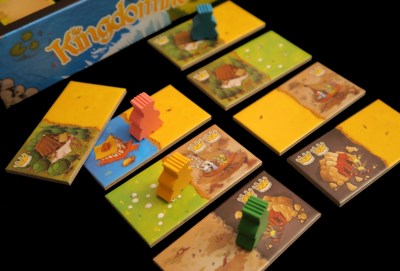 |
| – Image by boardGOATS |
The game ends when there are no more tiles to place. Scoring is by multiplying the number of tiles in each terrain by the number of crowns in that terrain. Thus a moderate sized area with plenty of crowns is worth more than a large area with very few crowns. The Age of Giants expansion doesn’t change things as much as Queendomino, which we found managed to take all the fun out of the game and add a whole load of unnecessary complexity instead. This expansion adds a small number of tiles that feature either a Giant or a Giant’s footprints. When a Giant Tile is drawn, a large wooden giant meeple is placed on it. When this is taken, the Giant is taken too and is placed over one of the crowns anywhere on that player’s area. When a footprints tile is taken, a Giant of their choice moves from their Kingdom to another player’s Kingdom.
x/pic4262165.jpg) |
| – Image by BGG contributor kalchio |
There are two problems with this little addition, firstly, there is a rules tweak that means five tiles are drawn in the two player game and one is discarded. Blue and Black found that this meant they just chose not to take tiles with Giants on them except when forced to right at the end. Secondly, even when forced to take a Giant, there was almost always somewhere it could be poked that caused minimal damage, so it wasn’t really a big issue. This was a real shame as the Giants are lovely. As well as adding a fifth player there is also a a small pile of bonus-point tiles; both Blue and Black really liked these as they thought that they added a nice twist. This time, they ended up with bonus points for Sea tiles adjacent to the castle and Marsh land on the corners. Both players tried to accommodate these, though Black did a much better job than Blue.
x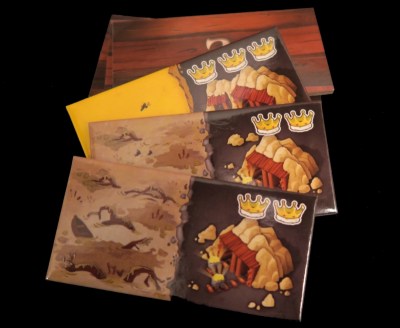 |
| – Image by boardGOATS |
It may have been that Black was focussing too much on the bonuses however, as he ended up unable to place all his tiles. And although he scored well on the bonuses and for Sea and Pasture, he scored very little for Woodland, Marshland and Mountains. In contrast, while Blue completely failed to score for Pasture, she scored well in every other terrain and made a killing with her Wheat fields, giving her a total of two-hundred and thirty-three, some sixty more than Black. With that done and the epic game of Steam Donkey finally over, there was just time to arrange some of the details for the Christmas Party nest time before everyone went home.
x |
| – Image by boardGOATS |
Learning Outcome: We like simple games: they can be quick to learn, but take time to master.
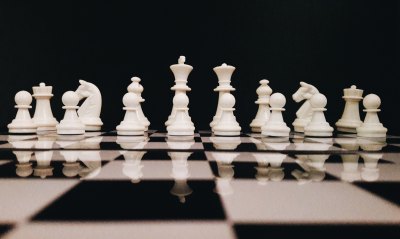
Boardgames in the News: Drawing Out the 2018 World Chess Championship
The World Chess Championship is run by the Fédération Internationale des Échecs (FIDE), and in recent years has been settled on a two year cycle with the reigning champion playing against the winner of the Candidates Tournament. The Candidates Tournament is an eight player double round-robin tournament and this year was won by Fabiano Luigi Caruana, an Italian-American Chess prodigy. Currently number two in the world rankings, Caruana become the youngest ever Italian or American Grandmaster, earning the title in 2007 at the age of 14 years and eleven months. Caruana is playing Sven Magnus Øen Carlsen (known as Magnus), a Norwegian Chess Grandmaster. Carlsen is currently number one in the world rankings, a position he has held since 2010, when the became the youngest person to achieve the highest rank at just nineteen. In 2013 Carlsen won the World Championships for the first time, retaining the title in 2014 and 2016.
 |
| – Image by Unsplash contributor sk |
This year the protagonists are very evenly matched, ranking one and two in the world and separated by just eighteen months. What is remarkable though is just how evenly matched their Chess has been: the World Chess Championship is a twelve match game played over three weeks, and for the first time in history, all twelve matches have ended in a draw. Each of these matches was played against the clock with a maximum possible time of over three hours. Since these ended in a tie, the players will be challenged further by increasing the speed of play, increasing the chance of errors. Thus a series of four “speed chess” tie-breaks will initially be used to decide the match each taking approximately half an hour. If this fails to separate the combatants, there will be up to five mini-matches of best-of-two blitz games (five to ten minutes each). If the match is still tied, this will be followed by an an “Armageddon” game where White starts with five minutes on the clock and Black with four minutes, with both players receiving a three second increment after sixty moves. In the case of a draw, Black wins.
 |
| – Image by Unsplash contributor Felix Mittermeier |
The tie-breaks will be played on Wednesday 28th November, with the winner taking 55% of the €1,000,000 prize pot, and of course, the title of “World Chess Champion”.
Next Meeting – 27th Movember 2018
Our next meeting will be on Tuesday 27th Movember, at the Horse and Jockey pub in Stanford-in-the-Vale. As usual, we will be playing shorter games from 7.30pm as people arrive, until 8pm when we will start something a little longer.
This week the “Feature Game” will be Ambition, the expansion to one of our most popular games, Roll for the Galaxy. Roll for the Galaxy is the dice game of the popular empire building card game, Race for the Galaxy. The dice represent the players’ populace, which are directed to develop new technologies, settle worlds, and ship goods. The Ambition expansion adds the new black Leader and orange Entrepreneur dice as well as Objective tiles which give players a bonus when they are achieved.
/pic2739211.jpg) |
| – Image used with permission of BGG contributor punkin312 |
And talking of dice…
Jeff was sitting his finals and, for the last multiple choice exam took a handful of dice with him into the hall. As soon as the exam started, be began furiously rolling the dice to select his answers. The invigilator gave him a long look as he passed, but it is not uncommon for students to resort to luck when they get stuck. Jeff soon finished the paper and, tired with all the exertion, pillowed his head on his arms and went to sleep. After about half an hour, Jeff suddenly sat up, and started furiously rolling his dice again. The invigilator was curious and suddenly worried that maybe something was going on, so he approached the candidate.
“Excuse me, what are you doing?” he asked. “Why are you rolling the dice again if you finished the questions earlier?”
Jeff replied, “I’m just double checking my answers…”
13th Movember 2018
There was a bit of a delay for food, so after Blue had handed over an exciting box of echidnas to Pine and given Burgundy and Green a selection of Splendor, Orléans, and Zooloretto promo cards from Essen, we decided to play something quick. As there were a lot of hungry people, we decided to start with a quick game of Om Nom Nom. This is a fabulous little double think game based on critters eating other critters further down the food chain. The game is set up with a large handful of dice which are rolled to give either items from the bottom of the food chains (flies, carrots and cheese) or animals from the middle of the food chains (frogs, rabbits and mice). Players start with six cards representing animals from the middle of the food chain and the predators from the top of their food chains (hedgehogs, wolves and cats). Players simultaneously choose a card to play and then everyone reveals them and they are placed on the appropriate space on the three central player boards. before and the animals begin to feed starting at the top of the food chain. For example, wolves eat frogs and any surviving frogs then eat flies.
 |
| – Image by boardGOATS |
If only one card of any type is played, the predator feeds and the player takes their card back with any cards/dice their animal has eaten placing everything in their scoring pile. Where more than one card of the same type is played and there is enough food to go round it is shared equally and everyone eats (taking their cards back with their share of the prey). If there is not enough food for everyone to get a share, they all starve and lose their cards going home with nothing. This is repeated until there are no cards left. Food at the bottom of a chain is worth two points at the end of the game and food from the middle of a chain and any cards are worth one point. The game is played over three rounds and the winner is the player with the most points.
 |
| – Image by boardGOATS |
Blue won the first round with eleven, more than twice the points anyone else managed to gather. Om Nom Nom is one of those games where a high score in one round is usually balanced by a dreadful score in the next, so everyone expected Blue to fail to score at all in the second round. Burgundy’s twelve points in the second round looked really good, but contrary to the usual run of things, Blue somehow managed to improve her score picking up eighteen points—one less than the record for a single round in our group. The third round was a little bit of a dead rubber, but Burgundy was keen to see Blue get her bad round and if she did, fancied his chances. It was a much more even final round and with lots of points available, things looked good for Burgundy, but unfortunately for him, everyone else chose this round to get it together. In the end it was all about second place, which Burgundy just managed to take ahead of Black and Mulberry as food arrived.
 |
| – Image by boardGOATS |
While Burgundy, Blue and Mulberry ate their belated supper, everyone else carried on the food theme, playing a little Japanese game picked up by Black and Purple at Essen called くだものフレンズ or Fruit Friends. This is a little card drafting and set collecting game where players are collecting different types of fruit using the “I divide, you choose” mechanism. There are a surprisingly few games that use this idea, but two of the best are …Aber Bitte Mit Sahne (aka Piece o’ Cake) and San Marco. …Aber Bitte Mit Sahne is relatively unusual as it works well with players dividing the pie into more than three. In contrast, San Marco is a three to four player game, but plays much better with three than four because the “I divide, you choose” mechanism generally works best when the pile is divided into three.
 |
| – Image by boardGOATS |
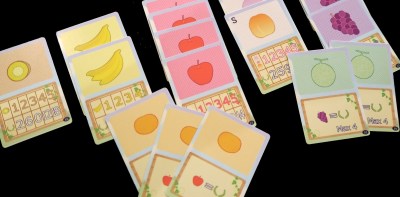
In Fruit Friends, each player starts with a random start or “seed” card, dealt face up. Players are then dealt seven cards which they divide into three piles of two (discarding the final card). Beginning with the player who was dealt the apple start card, players offer the three piles to the player on their left who takes one pair; the next player then chooses from the remaining two piles leaving one pair for the active player. Play continues in this way until everyone’s cards have been taken. The second round is played the same way except cards are offered anti-clockwise and the player with the grapes start card goes first. The final round is clockwise again, and the player with the kiwi start card begins. At the end of the game, each player has eighteen fruit cards, with each type scoring differently.
| 1 card | 2 card | 3 card | 4 card | 5+ cards | |
| Apples | 0 points | 2 points | 5 points | 9 points | 14 points (max) |
| Grapes | 2 points | 5 points | 8 points | 11 points | 11 points (max) |
| Kiwis | 2 points | 6 points | 0 points | 12 points | 18 points (max) |
| Bananas | 3 points | 7 points | 12 points | 0 points | 0 points |
| Peaches | 2 points | 5 points | 9 points | 14 points | 20 points (max) |
There are some catches, for example, peaches come in two colours, yellow and white, but only one of them scores. Oranges score one point per apple card and similarly melons score one point per grape card (both up to a maximum of four points). The scoring intervals also offer some quirks, so while almost everyone scored twelve points for their bananas at the end of the game, Ivory went “Banana Bust” by over-shooting. Otherwise it was close at the top and you could fit the first four players in a fruit-basket with only five points between them. It was Purple, the “Kiwi Queen”, who just had the edge, “pipping” Green by a single point with Pine and Black finishing in joint third.
 |
| – Image by boardGOATS |
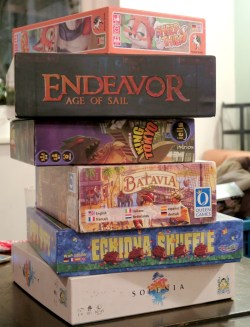
By the time the game came to an end, the eaters had mostly finished, so Black started getting out the “Feature Game”, Imaginarium (also described previously as “the one with the elephant on the box”). Burgundy and Ivory were quick to stake a claim to play it and Purple was equally quick to opt out. Mulberry and Blue made up the five, so Green started to collect together the games he thought the rest might play, which Pine pointed out just made it look like he was playing Jenga with boardgames. It took a while to come to a conclusion, but eventually the trio went for Echidna Shuffle.
 |
| – Image by boardGOATS |
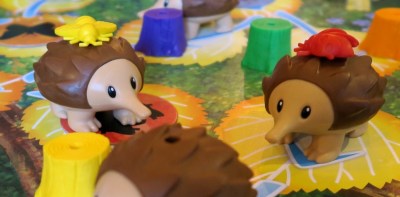
Echidna Shuffle is a game that we first discovered at the UK Games Expo back in June and since then, has been very popular with everyone who has played it. This is partly because of the fabulous, over-produced pieces, especially the lovely echidnas with cute smiley faces. The game is very simple: Players have to get their bugs to their tree-stumps by moving echidnas around the board. On their turn the active player rolls the die, and moves echidnas a total of that number of spaces. The clever part is that players only roll the die on alternate turns with intermediate turns evaluated from the dice board giving a total over two turns of nine moves. Thus, if someone rolls the maximum, a seven, the next turn they get just two. Similarly, if they roll a small number, say a three, then they get a six on the next turn. This means nobody gets screwed over by the dice, but there is still a nice, randomisation effect to the movement.
 |
| – Image by boardGOATS |
There are two sides to the game board: green “Summer” and snowy “Winter”. There was some discussion as to which to play. Pine thought the Summer side of the board rather than the Winter side was more of a challenge. He explained that it was more confusing on the snowy side and that it is not so easy to block people. On the other hand, the first time it was played with the Summer side, the game had become something of an epic marathon as everyone worked together to stop everyone else winning. So this time the group started with the “advanced” Winter board and ended up with a very short game indeed. After only about three rounds, Purple had got one of her bugs home and Green had managed two. Then Pine surprised everyone and with a roll of seven managed to complete all three of his bugs and the game was over, almost before it had begun.
 |
| – Image by boardGOATS |
Echidna Shuffle is really meant to be a children’s game, so perhaps it should not have been a huge surprise that it ended quite so quickly. Maybe Pine had had a point though, so unusually the game got a second chance, this time with the Summer board. This second game, did indeed last longer, but was still relatively quick and before too long everyone had just one bug remaining each. Green was first to get to this point, but Purple and Pine managed to successfully block his route while they also got their second bug home. In the end Pine became the “Kingmaker” as everyone knew how many moves each player would get and he found himself in the position where he could either move the echidna out of purples way and into Green’s or do something else entirely. Either action (or inaction) would result in win for either Green or Purple and in the end he inevitably chose to open the door for Purple.
 |
| – Image by boardGOATS |
It maybe that as a bunch of adult gamers, we have found the limit of this very pretty and lovable game. On the other hand, the number of players also has quite an impact—the full compliment of six seems to have the effect of dragging out the Summer board, but the combination of a small number of players and the complexity of the Winter board appears to make the game too open. Hopefully the company will bring out some new expansions or different board layouts that will give us more to explore, in the meantime, the game may get fewer outings in the weeks to come.
 |
| – Image by boardGOATS |
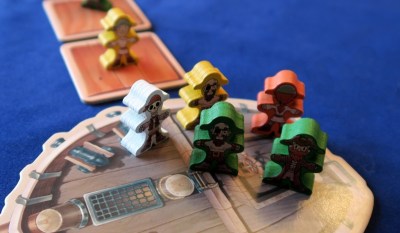
Because of the late start and the fact that Green wanted an early night, there wasn’t enough time for another medium-weight game, but it was still early enough for a short game. After some discussion, the trio agreed upon Walk the Plank!, a cute little programming game with a hefty dose of “take that”. In programming games players choose the cards they are going to play before the round starts and then action them during the round, usually taking it in turns to reveal one card and then carry out the associated action. One of the classic games of this type is Colt Express which won the Spiel des Jahres a few years ago, but Walk the Plank! is a quicker and simpler game. The idea is each player has three pirate meeples on a ship and the last one remaining is the winner. Players start each round by simultaneously choosing three cards and laying them face down in front of them. On their turn, players turn over the top card and action it.
 |
| – Image by boardGOATS |
The cards allow players to do things like “shove” one of the meeples belonging to the player on their left, or to the player on their right. When this is played a meeple that shares a space with one belonging to the active player is moved one step along the plank and thus closer to falling into the depths. There are lots of other actions including “drag to ship”, “drag to sea” and “Charge!”, but the most exciting cards are probably the “retract the plank” cards. At the start of the game the plank comprises three pieces, but usually at least one player removes one of these at the start of the game, heightening the stress levels. We usually play with a couple of house-rules too, firstly we play to the last meeple standing (the rules say the last two share victory) and we allow the plank to be completely removed (the rules say there is always one piece left).
 |
| – Image by boardGOATS |
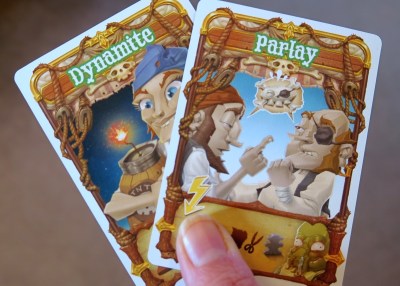
We’ve loved the game for years and have several different editions within the group—this time we played with the “limited edition” which includes some optional extra cards. This time two of the extra single use cards were added to each player’s deck: “Parlay”, which gives a player a chance to turn the tables via a game of Rock-Paper-Scissors, and “Dynamite”, which pushes everyone on one tile one space closer to the sea. After a little shuffling about, Green played his “Dynamite”, but succeeded in sending two of his own men closer to the water as well as the others. Then Purple played a “Charge!” card to try to push Green into the sea. Green used his “Parlay” to see if he could to prevent it, but this ended up in hysterics thanks to a total inability to play the game correctly. It started with Green playing on the count of three as agreed and Purple after the count of three (i.e. on four). After multiple attempts including one where Purple ended up just pointing vaguely at Green everyone was in fits of giggles, but it didn’t look like the tie was anywhere nearer being resolved.
 |
| – Image from theguardian.com |
Pine suggested that perhaps they should try after the count instead. Green duly obliged, but Purple had finally worked out how to play on the count of three and still the problem persisted. Then Green chose stone and Purple also chose stone changing to paper at the last second, but this was spotted by Pine who ruled a “Let” and so they had to try yet again. By this time everyone was laughing so hard that in a fit of confused giggles Purple then chose “none of the above” by using a single finger. Pine suggested Green and Purple put their hands behind their backs, but this time it was Green’s turn to make a mess of things and he just couldn’t get the hang of it. In the end, in an effort to stop Purple from soiling the furniture, Pine suggested they remove the counting element and play with closed eyes which was finally successful. It was largely immaterial by this time, but Green won, so one of Purple’s pirates went charging off the plank into the sea.
 |
| – Image by boardGOATS |
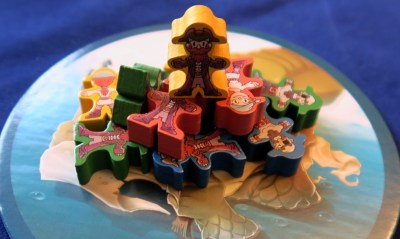
Getting back to the game seemed tame by comparison. Everyone ended up back on the boat and then started moving forward again. With the plank retracted, Green found himself with all three of his pirates on the end when Pine played his dynamite and Green was out in one go taking one of Purple’s and one of Pines own with him. So Green became the Ghost and with two pirates versus one, it looked to be Pines game. Two rounds later, though the Ghost shoved one of Pine’s pirates off the ship to level things up until Purple played her “Dynamite” and managed to get both dumped into the water, bringing the game to a shuddering halt, and on that note, Green headed home.
 |
| – Image by boardGOATS |
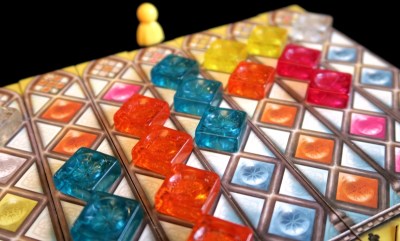
Imaginarium was still underway with no sign of finishing soon, so Pine and Purple decided to give Azul: Stained Glass of Sintra a go as Pine had missed out last time. As in the original game, Azul, players take all the tiles of one colour from a “factory” and put the rest in the middle, or they take all the tiles of one colour from the middle. Tile placement and scoring is rather different however. All the tiles taken in a turn are placed in a single column of the player’s personal player board. This board is modular with the double-sided strips laid out at random so everyone has a different starting setup. Tiles must be placed in the strip immediately below the Glazier meeple, or in a strip to its right. The Glazier is then placed above the strip the tiles were placed in. Instead of taking tiles, players can choose to reset the Glazier’s position, moving him back to the left most strip.
 |
| – Image by boardGOATS |
Players get points when strips are completed scoring the sum of the score depicted below the strip and any strips to the right that have already been completed. There is also a colour bonus—each round has a colour drawn at random at the start of the game, and any tiles that match the colour for the round score extra. Once a strip has been completed, it is flipped over; after it has been filled a second time it is removed. Any left over tiles that cannot be placed yield a penalty with players moving along a negative score track which has small steps at the start that get larger. There are also end-game bonus points with two variants available, one colour dependent and the other rewarding completing adjacent strips.
 |
| – Image by boardGOATS |
This is definitely a game that takes a at least one play to understand how it works and what the best way to score points is. For example, the way the score builds, it is imperative to complete the furthest right strips early as then they score again and again. However, they are relatively low scoring, so this is not the only important strategy. So while Pine started off well, Purple scored more later, especially when she picked up colour bonus point as well. Early in the game, the penalty for picking up the first player token or for having left-over tiles is small, but it quickly increases, and with Pine taking the first player token more than Purple, he finished with more negative points too. All the little extras combined to make it a bit of a landslide in Purple’s favour, but then Purple had the advantage of having played the game several times, so next time will surely be different.
 |
| – Image by boardGOATS |
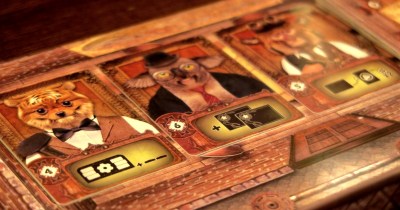
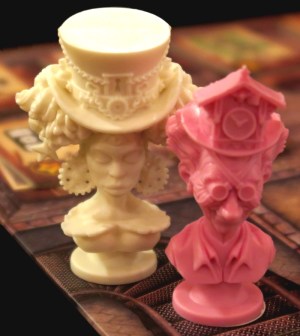
While these games had been going on, the “Feature Game”, Imaginarium was getting an outing. Subtitled “The Dream Factory”, this game is a worker-placement, engine builder with a Steam Punk theme where players are building machines in a factory. Beautifully produced with remarkable artwork, players first take it in turns to choose a position on the factory conveyor-belt. They select either the broken machine card that they are going to buy or a position to collect charcoalium. These are then carried out in “action” order which then also becomes the selection order for the next round. At the end of the round any unused cards move long the conveyor-belt and the early positions are populated with new, exciting cards. As the game progresses, the broken machine cards generally become more expensive, but the machines become more useful, producing more and/or higher value resources.
 |
| – Image by boardGOATS |
On a player’s turn, their existing “machines” first produce resources, then the player must buy the broken machine card they had chosen. The active player finally carries out two actions dictated by an unusual clock mechanism: each player has a board with the six possible actions arranged in a circle and the hands of the clock are fixed such that players are unable to take actions that are adjacent. As the clock hands must be moved every round, players are only able to take repeat one action in consecutive rounds. Possible actions include hiring a character, trading resources, extracting charcoalium, repairing broken machines and reorganising or dismantling existing machines. When a machine card is taken from the conveyor-belt, it is broken, they must be repaired before they will work and produce resources. Once repaired, machines can be combined to make them more efficient, or dismantled to give points, the game ends when one player gets to twenty points.
 |
| – Image by boardGOATS |
One of Ivory’s questions before playing a new game is always, “Where are the points going to come from?” In addition to dismantling machines, points are also available for completing “projects” i.e. satisfying goals drawn at random at the start of the game, or by trading charcoalium. There are also two points available for players who have the most of one of the four resources at the end of the game. As the game was late starting, the group decided to end the game at fifteen points instead of twenty, though to begin with it didn’t look much like anyone was going to get to fifteen points before midnight. Black assured everyone that people would pick up speed as the game progressed and eventually, Ivory got going completing the first of the projects and then Black and Blue followed.
 |
| – Image by boardGOATS |
The game is mostly multi-player solitaire, except when it’s not. There are some machine cards that take resources from the other players. In a game where resources are very tight and players are very reliant on resources for their plans this can be crucial. The game also has a distinctly mean streak, as a player that is unable to pay for the card they have chosen, doesn’t get the card, but also loses all their resources, completely upsetting their plans and forcing them to start again from scratch, potentially losing them the game. This is exactly what happened to Blue—Ivory went earlier in the turn order and bought and then repaired a machine that took all her charcoalium which meant she lost the card she was going to buy and all her resources. She vowed to get her revenge, but the opportunities for that are few and far between. As she waited for her chance, she gathered charcoalium to ensure she would be able to buy the right card when it came up.
 |
| – Image by boardGOATS |
Sadly for her, interaction in the game is minimal so there she never really got her chance. Amassing large amounts of charcoalium wasn’t totally without use though as it enabled her to fulfill one of the projects and as they were playing to a smaller total, she started trading them in for points in an effort to avoid coming last. Meanwhile, Ivory kept amassing points and Mullberry kept doing “the weird goat-head thing” which ensured she always had plenty of charcoalium and was starting to build a productive engine. Black and Burgundy had also just got their engines going and were planning to score heavily when Ivory announced that he’d passed the fifteen point mark. With Blue still to take her turn, she maximised her points and everyone added up their scores. Sadly, for Black, Burgundy and Mullberry this wasn’t a long process as shortening the game had had the unforeseen consequence that the game ended just before their plans had come to fruition. Much to her surprise, Blue had done rather better as she had stuck to short-term targets that lent themselves to the short game.
 |
| – Image by boardGOATS |
There was only one winner though and Blue’s fourteen points flattered her position as the scores did not tell the true story of the game. It’s definitely a game to try again sometime, though perhaps with fewer people which would give players a bit more control over their own destiny. The artwork is somehow both amazing and very disturbing at the same, and it certainly had an unforeseen effect on Blue. She is not normally one to remember dreams or one to design games, but when she awoke the next morning she had a fleeting recollection of dreaming about playing a card only version of Om Nom Nom that she had designed called “Yum Yum Tum”. We will have to see if that ever comes to fruition.
 |
| – Image by boardGOATS |
Learning Outcome: When gamers are hungry they play games about eating.
Boardgames in the News: Does “More Mainstream” = “Less Friendly”?
Modern board gaming has always been a very inclusive and friendly hobby, if niche. For example, people attending conventions often carry games home for friends, but more surprisingly, they also often carry games for complete strangers. This can require trust from either or both parties: sometimes it is the “mule” who pays for the goods, sometimes items are preordered and paid for in advance and then collected by the “mule” and posted on. Similarly trusting are those that take part in the “Maths Trades“. These are multi-person trades which happen in a loop with everyone receiving a game from one person and giving a game to somebody different. Obviously if one person fails to honour their part of the deal, the whole thing breaks down. Yet these things happen on a huge scale with hundreds of people participating, and although there are occasionally problems, most people are very happy with the result and take part again and again.
 |
| – Image from lautapelit.fi |
As the hobby grows, the first signs of change are perhaps becoming visible. For example, earlier this year voting for the Deutscher Spiele Prize was closed four days early due to attempted vote-rigging. It seems an online video blogger claimed he had a special deal with the publishers of one of the games in the running, KLONG! (aka Clank!: A Deck-Building Adventure), Schwerkraft Verlag. He posted a video syaing that if the game won the award, he and all the followers of his YouTube Channel would get a promo card for the game. Schwerkraft denied any involvement, but around a hundred votes were cancelled (about half of which only placed the one game) and other people were unable to vote at all because voting was stopped prematurely. The organisers of the Deutscher Spiele Prize say Azul‘s position at the top was never in doubt and KLONG! would not have won in any case. It might have improved on its eventual seventh place though, perhaps threatening the positions of Heaven & Ale and Pandemic Legacy: Season 2 (which finished in fifth and sixth respectively).
 |
| – Image from kickstarter.com |
Perhaps this could be seen merely as a gamer trying to game the system, but whatever, it leaves a nasty taste in the mouth. More serious was the series of thefts from stalls that occurred at Essen this year. It was not the first time money had been taken from a stand—famously, at Essen in 2016, Ludicreations had a cash box stolen, containing about €3,500. R&R Games were also robbed that day, but the Ludicreations theft is known more widely thanks to their response. Such a loss can be very significant for a small company, so inspired by the theft, they designed a game called Steal this Game and launched it on KickStarter, raising over $50,000. This year the fair grew and so did the thefts. Six companies fell victim this time, Artipia Games, FoldedSpace, Greenbrier Games, Gotha Games, Hub Games and Japanime Games. Reportedly, the thieves got away with a total over €20,000, but not without loss themselves as staff on the Artipia stand (ironically demoing their new game A Thief’s Fortune) realised what was happening. Although they weren’t quick enough to stop the theft, they succeeded in detaining one of the decoys.
 |
| – Image by boardGOATS |
There is no suggestion these crimes were carried out by boardgamers, in fact, the Police have said that they were a professional team. Two people distracted the cashier by bombarding them with questions and a third then swiped the cash-box. Efforts are now underway to recoup the losses which were mostly uninsured. Japanime Games are collecting donations, while Artipia Games have launched a KickStarter campaign for five promo cards. Attention has also turned to trying to prevent the same thing happening next year. There have been calls for more vendors to take card payments, however that is not without its problems. This was amply demonstrated at the UK Games Expo this year which coincided with a Europe-wide Visa systems failure leaving many gamers unable to pay for their purchases. There is also a question mark over whether the infrastructure available at the Messe would be able support everyone moving to card transactions at such a bug fair with such a large commercial component. For these reasons, Merz Verlag (the company who run Spiel) are focussing on increasing security and making it much more visible. Conversation is still on-going and it remains to be seen how much these changes will alter the feel of the show. One thing is clear, however, the wider world has discovered our little hobby and that brings some unpleasant consequences.
 |
| – Image from spiel-messe.com |
Next Meeting – 13th Movember 2018
Our next meeting will be on Tuesday, 13th Movember, at the Horse and Jockey pub in Stanford-in-the-Vale. As usual, we will be playing shorter games from 7.30pm as people arrive, until 8pm when we will start something a little longer.
This week the “Feature Game” will be Imaginarium (also known as “the game with the elephant on the box”). Subtitled “The Dream Factory”, this game is a worker-placement, engine builder with a Steam Punk theme where players are building machines in a factory.
 |
| – Image from kickstarter.com |
And speaking of dreams…
Jeff had been having a lot of strange dreams, so he went to his GP to see anything could be done.
“Doctor, I really need your help,” he said. “Every night for the past two weeks I’ve been dreaming about rats playing football.”
The doctor twirled his moustache thoughtfully for a moment and then said, “I know, I have just the thing for you. If you take these pills just before you go to bed tonight you will be fine.”
Jeff, looked a little conflicted, and after a pause asked, “Can I start tomorrow?”
The doctor was perplexed, “I suppose, but why though?”
“Well,” answered Jeff, “Tonight they play the final….”
30th October 2018
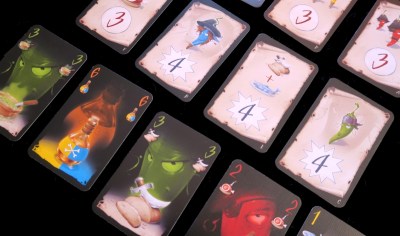
The evening began with the inevitable post-Essen chit-chat and games-mule deliveries (though most of it hadn’t been unpacked so that’s something to look forward to next week too). Burgundy was very pleased with his substantial pile of Concordia expansion maps though (including the new Venus expansion and older Britania/Germania, Gallia/Corsica packs), and Pine was thrilled to hear there was a copy of Echidna Shuffle on its way for him too. With food delayed, and a lot of people already arrived, we decided to get going with the “Feature Game”. Prior to Essen, we had planned to play Key Flow, however, that was still packed and there hadn’t been time to learn the rules, so instead the “Feature Game” chosen was Peppers of the Caribbean. This is a cute little set collecting card game with a very loose pirate theme. Each card features a number, a colour and a type of food. The idea is that there is a face up market and on their turn, players can either take cards from the market, or play cards.
 |
| – Image by boardGOATS |
To take cards from the market the active player must first discard a card and can then take all the cards of that colour or all the cards of that food type into their hand (discarding down to seven if necessary). Alternatively, they can play a set of three or four cards where all the cards have different colours and different food types. Of these, two cards are discarded and the remaining cards are kept for scoring. At the end of the game, players sum up the face value of the cards in their pile of kept cards, and the highest score is the winner. There are one or two fine details, for example, as well as “chilli cards” there are also rum cards which feature two colours and no food. These have a high value (six, compared with one to four for the chilli cards) and can help people make sets more quickly. However, as they have two colours, this means there can only be one rum card in a set and the maximum set size is then three, so only one card can be kept reducing the scoring opportunity. There are also bonus points cards which are drawn largely at random from a pile—some of these are end-game bonuses and others reward the first player to reach a goal (e.g. be the first player to have all four different food types in front of them).
 |
| – Image by boardGOATS |
Blue and Pink had played the game a couple of times in their hotel bar at Essen and on the train home. They had found it a diverting little game with two players and had wondered how it would play with more people. Somehow it is one of those games that is slightly confusing at the start and things were made more challenging as we began with three players and ended up with five as more people arrived, meaning the rules got explained several times from different points. As a result there were slow starters and “fast twitch” players. It was close at the top though with Burgundy and Ivory some way ahead in a tight finish which Ivory took by just three points. Although everyone would probably play it again, it was clear that the game would be better with fewer players where there would be less fluctuation in the market and everyone would have more of a chance to get what they want. It only became clear some time later that there had been a mix-up somewhere along the line and although the side of the box said it was suitable for five, the bottom and the website indicated that the game was only intended to play a maximum of four anyhow…
 |
| – Image by boardGOATS |
Just as the game was coming to an end, Black and Purple arrived in need of some R&R after what had been a trying day. They had also brought some of their Essen Loot (including a copy of Las Vegas for Red), and the Essen discussion began again. Black and Purple had been at the fair for the full four days and felt that a minimum of two was needed to see everything, but three days was a more realistic time. Blue and Pink had been there for just two days as they can’t cope with the crowds for more than that. Even they are considering a Thursday-Friday-Sunday strategy for next year though as there are now six halls (some very large indeed), and they felt they had missed a lot of things that they had wanted to see this year. That said, a lot of games sold out including the expansions for Altiplano and Great Western Trail (Altiplano: The Traveler and Great Western Trail: Rails to the North), Mini Rails (again!), Hanamikoji, Food Chain Magnate, Roll to the Top, Majolica, Spirit Island, Echidna Shuffle, Ceylon and headline releases Teotihuacan: City of Gods, Architects of the West Kingdom, Newton, The River and Everdell. Some of these went ridiculously fast, for example Everdell apparently sold out in six minutes on Saturday despite its not insubstantial price tag of €70.
|
| – Image by boardGOATS |
Purple and Black were particularly pleased with Solenia, which they had played at the fair and then managed to grab one of the last few copies available. A beautiful game with a totally over-produced large yellow airship and cards with a hole in the middle, it wasn’t long before it became clear that it was going to be one of the games to make it to the table. The pretext is that several millennia ago, the tiny planet Solenia lost its day-and-night cycle: its northern hemisphere was forever plunged into darkness, and its southern hemisphere was eternally bathed in bright sunlight. Players travel the world delivering the rarest gems and stones to the “Day People” and take wood and wheat to the “Night People” who need them to survive. In return players receive gold stars and the player with the most of these at the end of the game is the winner.
 |
| – Image by boardGOATS |
In each round, players take it in turns to play one card from their hand onto an empty space on the five-by-five game board. Cards can be played either on a “Floating Island” or a “Floating City”. Cards played on Floating Islands will give as many resources as the value of the card played of the type corresponding to the City. Cards played on Floating Islands enable players to fulfil a delivery tile by delivering the resources depicted on it. Cards must be played adjacent to the airship in the centre of the playing area or adjacent to one of the players previously played cards. When someone plays a zero card, the airship advances one space along the modular board. At the end of that turn, the back piece of the game board is removed and players receive resources based on the cards they have on this strip of the playing area. This strip is then turned over (turning night to day / dawn to dusk or vice versa), and it is placed on the front edge of the game board, and thus the airship moves across the planet. This constantly changing board rolling from day to night and back to day again gives the game a unique feel.
 |
| – Image by boardGOATS |
Although resources were far from scarce (unlike other resource management games), it still has quite a bit of resource management thanks to a strict resource limit on a players personal board. Thus, the real problem came in deciding which were the most important resources to keep, a little bit of area control/route planning, and a few paths to victory points. The constantly changing nature of the game doesn’t lend itself to a developing narrative though having played it before, Black and Purple had an edge over Green. This wasn’t helped when Green misunderstood one of the cards and tried to do something clever to multiply his points. The first attempt failed, but on the second try he thought he had achieved more points and then the misunderstanding came to light—the bonus points only applied to the card itself not to all types of terrain he had cards on. It would not have changed the placings though. It was very tight between Black and Purple until Black managed to gather together three pairs of day and night bonus chits, which hadn’t been looking likely until the last couple of turns. With that, he just sneaked his nose in front, winning by three points. Overall Solenia is a clever game that takes a run through to get a feel for how it works and then you then just want to play again—it certainly won’t be long before it gets another outing.
 |
| – Image by boardGOATS |
Meanwhile the other four were giving Azul: Stained Glass of Sintra a try. This was another Essen release, and one that had generated a lot of “buzz” in advance as it was produced by the same team that originally published this year’s double award winner, Azul. Blue, Purple, Black and Pink had all tried it while in Germany and found the scoring sufficiently different and interesting that they had collectively come back with two copies. Initially the conversation centred around the clear plastic tiles that, largely dependent on age, reminded some people of Spangles (“The sweet way to go gay”) and others of “Tunes” (“Help you breath more easily” and thus “Book a second-class ticket to Nott-ing-ham”) . Once the subject had moved away from 1980s confectionery, attention focussed on the new game and its similarity and contrast with the original Azul. As in the original, players take all the tiles of one colour from a “factory” and put the rest in the middle, or they take all the tiles of one colour from the middle. Tile placement and scoring is rather different however. All the tiles taken in a turn are placed in a single column of the player’s personal player board. This board is modular with the double-sided strips laid out at random so everyone has a different starting setup.
/pic4380570.jpg) |
| – Image used with permission of boardgamephotos |
Above the board each player has a figure, their Glazier, who marks one strip. Tiles must be placed in the strip immediately below the Glazier, or in a strip to the right of the Glazier. The Glazier gives players another option on their turn too, as players can choose to reset his position to the left most strip (instead of taking tiles). Scoring is very different, with players getting points when strips are completed. The number of points scored is the sum of the score depicted below the strip, plus the score for any strips to the right that have already been completed. There is also a colour bonus—each round has a colour drawn at random at the start of the game, and any tiles that match the colour for the round score extra. Once a strip has been completed, it is flipped over; after it has been filled a second time it is removed, reducing the players placement options. This provides a subtle catch-up mechanism that takes effect towards the end of the game. Any left over tiles that cannot be placed yield a penalty (as in the original Azul game), but this is also different. In addition to the positive score track, there is also a negative score track where the steps start off small and then get larger; penalties are accrued for left-over tiles and also for being first to take a tile from the middle (and with it the Start Player token). There are also end-game bonus points with two variants available, one colour dependent and the other rewarding completing adjacent strips. All in all, the game is definitely a step up in complexity, making it more of a challenge for those who have played Azul extensively.
/pic4384582.jpg) |
| – Image used with permission of boardgamephotos |
As most of the group fall into that category, we had high hopes that Stained Glass of Sintra would be a good fit. It certainly offers a new challenge, though it was clear that the fact Blue had played it before gave her a significant advantage. For example, the timing of repositioning the Glazier is very critical. It doesn’t necessarily prevent a player getting a load of tiles they don’t want (as everyone can reposition their Glazier and the problem will come back round), but players don’t want to be stuck with their Glazier far to the right at the start of a new round as that limits their choice when the options are at their best. Similarly, player don’t want to reposition their Glazier too frequently as this reduces the number of tiles they take and therefore affects their score. Behind Blue it was very tight for second place with just five points covering Pine, Burgundy and Ivory. It was Pine who got his nose in front though, by keeping his negative score down and concentrating on his end-game bonuses. Unfortunately, the game is not as nicely produced as the original: the broken glass tower is made of very thin card (more like thick paper) as is the score board. The “glass” pieces are also somehow not as nice as the resin tiles in the original and the colours are less distinct as well. These negatives are a real shame as they take the edge off what would otherwise be a excellent reimplementation of the superb original game.
/pic4380572.jpg) |
| – Image used with permission of boardgamephotos |
Green and went home for an early night leaving five others plus Pine who wanted to play something “in about forty-five minutes”. Deciding what to play took so long that there nearly wasn’t time to play anything at all, but after three new games, everyone was in the mood for something “comfy”, and eventually Bohnanza appeared. Pink’s new “Fan Edition” was still packed, as was the Jokerbohnen mini-expansion that Blue had acquired. She had not brought her Spanish copy either, so it was the “boring” Rio Grande Games edition. Familiarity sometimes has its place though, and this was one of those times. Nobody needed a reminder of the rules (plant the first bean in hand; optionally plant the second; turn over two cards and plant or trade them; trade from hand, and draw cards placed at the back of the hand), but the setup varies for different numbers. It wasn’t long before we were underway, however, and Purple quickly began to amass a crazy number of Red Beans. It felt like nobody else could really compete although Black came very close finishing with thirteen coins, one behind Purple.
 |
| – Image by boardGOATS |
Learning Outcome: New is very exciting, but that comfy pair of old slippers still has its place.
 boardGOATS