Author Archives: nannyGOAT

Next Meeting – 24th July 2018

Our next meeting will be on Tuesday, 24th July, at the Horse and Jockey pub in Stanford-in-the-Vale.  As usual, we will be playing shorter games from 7.30pm as people arrive, until 8pm when we will start something a little longer.

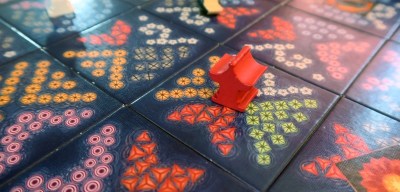
This week the “Feature Game” will be Azul, an abstract game, with a very, very loose theme where players are tile laying artists decorating a wall in the Palace of Evora with “azulejos”.  We have chosen this game to celebrate the fact that it has just received the coveted Spiel des Jahres award.

Azul
– Image used with permission of boardgamephotos

And talking of Palaces…

Jeff was visiting Buckingham Palace.  After a tour of the house and grounds, the visit finished at the Royal Stables.  As he wandered around he saw an elderly lady in a head-scarf and realised he was in royal company.  He was standing quietly admiring a magnificent stallion when suddenly it passed wind so loudly it couldn’t be ignored.

“Oh dear,” said the Queen, “How embarrassing. I’m frightfully sorry about that.”

“It’s quite understandable,” replied Jeff, and after a moment, added, “As a matter of fact I thought it was the horse…”

Spiel des Jahres Winners – 2018

The 2018 winner of the coveted German Game of the Year or Spiel des Jahres award is Azul.  This has been a very popular game within the group and to us has been the stand-out game this year since Essen.  It is very easy to teach with a surprising amount of depth and is beautifully produced, making it a game we are always happy to play.  The Kennerspiel des Jahres was awarded at the same time.  This honours more challenging games and this year was awarded to Die Quacksalber von Quedlinburg.  So far this has only been released in German, so we have not been able to play it yet.  In addition, there was a special award for for Pandemic Legacy: Season 2, which the jury felt was the benchmark against which all other legacy games should be judged.  The Kinderspiel des Jahres award was announced last month and went to Funkelschatz (aka Dragon’s Breath) which is dexterity gem collecting game.

Azul
– Image used with permission of boardgamephotos

10th July 2018

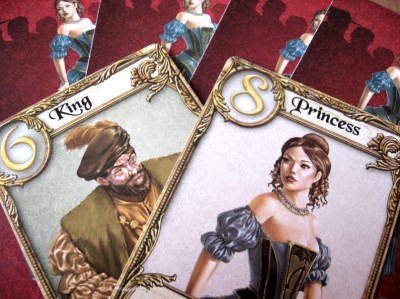
While those eating finished, we welcomed an old friend from the Didcot Games Club on his first visit, and began the evening began with a quick game of an old classic, High Society.  Designed by Reiner Knizia, this is a light bidding game with a catch, in the mold of games like For Sale, No Thanks!, Modern Art, and perhaps our old favourite, Las Vegas.  First released over twenty years ago in the designer’s heyday, a beautiful new edition has recently been published by the Cumnor Hill-based company, Osprey Games.  In High Society, everyone starts with the same set of money cards, each numbering from 1,000 up to 25,000 Francs.  The game is all about correct valuations. Players take it in turns to bid for the luxury objets d’art for sale, however, when they increase their bid, they add money cards to their personal bidding pile, and there is no concept of change.  Thus, as the game progresses, players have fewer and fewer bidding options  as they spend their money cards, and are increasingly forced to big large amounts potentially for relatively low value items.  Some of the objects for sale are not so much art, as artless, and can halve a player’s score, lose them points, or even cause them to discard something they purchased previously and the first person to withdraw, “wins”, while everyone else pays whatever they wagered.
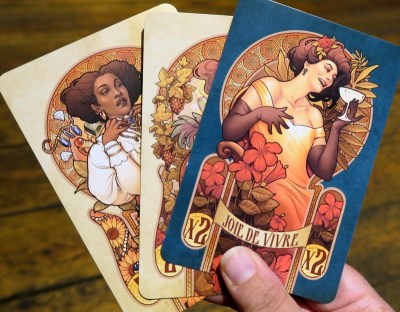
High Society
– Image by boardGOATS

The other twist is at the game end which occurs abruptly when the fourth “end game” card comes out.  At this point, the player with the least money at the end is eliminated regardless of the value of their luxurious objects.  Despite the age of the game, a lot of people were new to it, and as the valuation of the luxuries is the key, some people found knowing how much to bid challenging.  As is the case with this sort of game though though, until the scores were actually calculated nobody knew who was winning, especially as the money was tight at the bottom.  Purple and Black (or “The Dark Destroyer as Ivory called him”) had pots of cash, but Red was just eliminated ahead of Yellow.  That left the final count:  Black was by far the most efficient, with a score of fourteen, two more than ivory – quite remarkable given the amount of cash he had left at the end.  It was Yellow though, who having just escaped elimination, finished some way in front with nineteen points.
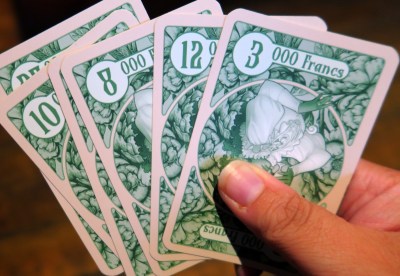
High Society
– Image by boardGOATS

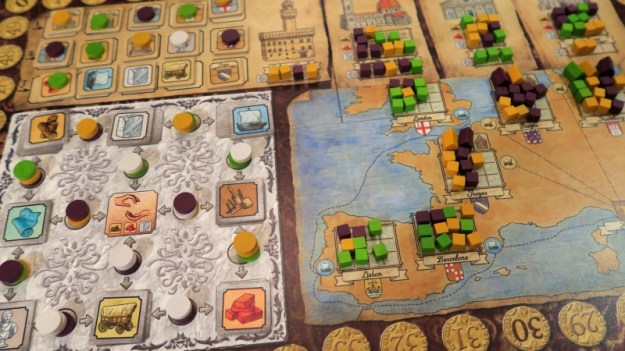
With everyone fed and High Society over, we split into two groups: one to play the “Feature Game” (which was to be Keyflower) and the rest to play something else.  As always, the issue was what the other game was to be and almost everyone was happy to play Keyflower, but for some, the final decision depended what the other game was to be.  The problem was that the choice of the second game depended on who was going to play it.  Eventually, Purple broke the deadlock when she said she would be happy not to play Keyflower.  With Red having requested it in the first place, and it being Blue’s favourite game, it was just a matter of who would fill the remaining seats.  In the end, Pine, Burgundy and Ivory joined Red and Blue, leaving Yellow, Black and Purple to play Calimala, an area-influence driven, worker-placement game set in the Republic of Florence during the Late Middle Ages.
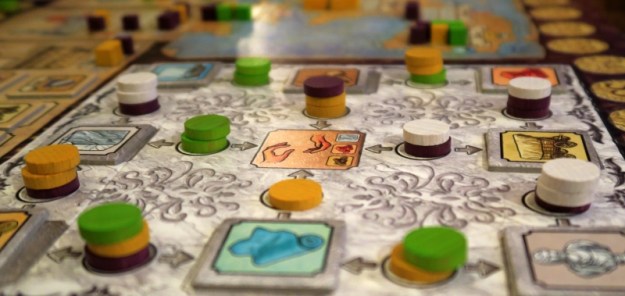
Calimala
– Image by boardGOATS

This is an unusual game with variable setup to keep it fresh.  The idea is that on their turn, players place one of their workers on one of the twelve worker spaces.  Each one of these is adjacent to two of the nine action spaces. If there is already a worker disk present on the space, once the active player has carried out their actions, then the other player gets another turn.  This continues until a player places the fourth disk on a stack: actions are carried out for the top three disks and the fourth is placed on the first available scoring tile which is then triggered.  Each player has some worker disks in their own colour and a small number in white.  Coloured disks give players a maximum of two actions on three occasions (i.e. a total of six), while white disks give four actions when played, but none later in the game.  The actions include acquiring resources (brick, wood or marble), building (ships, trading houses or workshops), create artwork, produce cloth, transport cloth, and contribute to the building of the churches.

Calimala
– Image by boardGOATS

The fifteen scoring phases are built on the actions, rewarding players for the amount of cloth they have shipped to a given city or combination of cities for example, or for their contribution to a specific building, or their contribution to the building effort of a given resource.  In each case, the player with the most scores three points, the player in second place scores two and the player in third gets just one point.  In case of a tie there is a complicated series of tie-breakers.  The game ends when either all fifteen tiles have been scored, or everyone has placed all their workers (in which case any remain tiles are scored).  It was another close game:  “The Dark Destroyer” scored heavily for the cloth in the Port Cities (Barcelona, Lisbon and London), while Purple scored for the trading cities (Troyes, Bruges and Hamburg).  Calimala is one of those games that rewards players who score “little and often”, and it was Yellow who managed to score most frequently.  There were a lot of tie-breaks however, particularly between Yellow and Black and it was probably the fact that Yellow did better in these that tipped the balance, as he finished just ahead of Black with a winning score of forty-five points.
Calimala
– Image by boardGOATS

Keyflower was still under way, so the players looked around for something quick to play and picked one of Yellow’s favourite games, Red7.  On the surface, this is a fairly simple game, but underneath it is much more complex.  The game is played with a deck of forty-nine cards, numbered one to seven and in seven different colour suits.  Each player starts with seven cards in hand and one face up on the table.  The player with the highest value card is “winning” because the rule at the start is that the highest card wins.  On their turn, each player can play one card from their hand into their tableau in front of them, or play a card into the centre which changes the rules of the game (a little like Fluxx), or they can do both.  If they cannot play a card or choose not to, they are out of the round.    In the event that there is a tie and the highest face value is displayed by more than one player, the tie is broken by the colours with red higher than orange and so on through the spectrum to violet.

Red7
– Image used with permission of BGG contributor punkin312

The colours also dictate the rules, so any red card played in the centre will change the rules to “the highest” wins.  Similarly, any orange card played in the centre changes the rules so that the winner is the person with the most cards of the same number.  In each case, if more than one player satisfies the rules, the tie is broken by the card that is highest (taking into account both number and colour).  Thus, if the rule is “the most even cards” and there are two players with the same number of even cards in front of them, the player with the highest even card is the winner.  At the end of their turn, the active player must be in a winning position, or they are out of the round. The round continues until there is only one player left.

Red7
– Image used with permission of BGG reviewer EndersGame

We last played this a few years back when we made rather heavy weather of it.  Part of the problem was that there were several of us and we were all new to it.  This meant we struggled without someone to lead the way.  With Yellow very familiar he was able to show everyone else how to play.  Inevitably, this meant he won (giving him a hat-trick).  The game was played over five rounds and at the end of each round the player who was left at the end kept their highest cards.  With Yellow so much more familiar with the game than anyone else, it was inevitable that he would be able to build on this, and he made the most of it.

Red7
– Image used with permission of BGG contributor punkin312

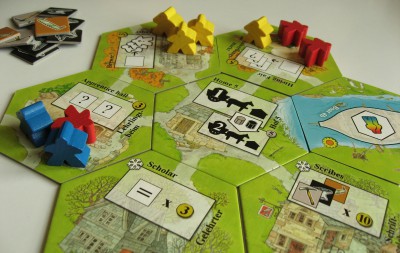
By this time, the next table were just coming to the end of their game of Keyflower, and we had all found it unusually hard going, that is to say we all struggled to find anywhere to score points.  The premise of the game is quite simple:  over four rounds (or seasons) tiles are auctioned using meeples (or Keyples) as currency.  The clever part is that to increase a bid, players must follow with the same colour.  Keyples can also be used to perform the action associated with a tile, any tile, it doesn’t have to be their own, but each tile can only be used three times in each round and, again, players must follow the colour.  The aim of the game is to obtain the maximum number of victory points at the end.  However, the highest scoring tiles aren’t auctioned until the last round (Winter), so players have to keep their options open.  On the other hand, the tiles that are auctioned in Winter are chosen by the players from a hand of tiles dealt out at the start, so players can choose to take a steer from that, or, if things go badly wrong, decide not to include certainly tiles.
Keyflower
– Image by boardGOATS

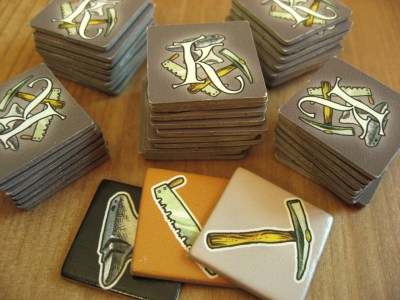
These games are nearly always memorably epic and this was definitely no exception.  The game started of with Ivory declaring that while he loved it, he thought it was maybe “a bit broken” because in his experience, there was one winter tile that would guarantee a win to the player that got it.  Blue and Burgundy thought they knew he was referring to “The Skill Tile Strategy” and agreed it was powerful, but felt it wasn’t over-powerful.  Blue said she thought it was only a guaranteed win if everyone else allowed it.  Pine suggested that playing the game would give Ivory another opportunity to gather evidence to see if this was the case.  As soon as the winter tiles were dealt out, it was clear that Ivory had one of the tiles that rewarded players with lots of Skill Tiles, and everyone knew what his strategy was going to be.
Keyflower
– Image by boardGOATS

Spring started and it quickly became clear that it was going to be a fight.  Initially, Blue went for the Peddler which converts yellow Keyples into Green ones, but Pine thought that sounded good, and outbid her.  Next she went for the Miner which gives two coal, upgradable to three, but Red outbid her on that.  Somewhat in error she tried to get the Woodcutter which gives two wood (upgrading to a wood and a gold), but Burgundy outbid her.  Ivory also got in on the act, beating her to the Keystone Quarry, which meant Blue finished spring with no Village tiles at all.  At least she didn’t over-pay for anything though, and it meant she had plenty of Keyples to bid with for Summer, at least in theory.  The lack of tiles meant she didn’t have a strategy though, while everyone else was beginning to build theirs.

Keyflower
– Image by boardGOATS

With summer came a whole new set of interesting tiles, for Ivory, that included the Hiring Fair which gives two tiles in exchange for one (upgradable to three tiles for one).  Given that Ivory had telegraphed his plans, and that Burgundy took one for the team during Concordia last time (when he took the Weaver and gave everyone else a chance), Blue felt it was her turn and she made it her business to outbid him, even though this gave her a tile she had very little use for.  As the only one with any meeples to speak of, Blue managed to pick up three boats relatively cheaply too.  She didn’t have it all her own way though, as Pine took the Farrier (extra transport and upgrade ability) and Ivory took the Brewer who turns skill tiles into Keyples.

Keyflower
– Image by boardGOATS

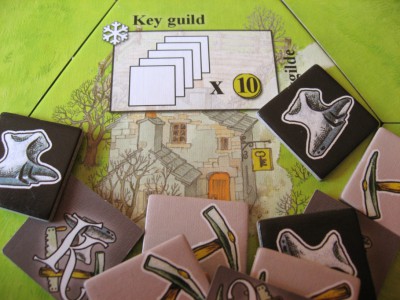
Unusually, there had been a lot of bidding for the end of season tiles and it came to a peak in autumn with everyone jostling for position for the final round.  The other tiles were generally less popular, however, and most people were trying to keep their Keyples to themselves where possible, hoarding them for the final round.  And it was in the final round that it all came to a head.  Everyone had to put in at least one tile, but nobody seemed terribly keen to put any in.  Blue had contrived to win the start Keyple at the end of autumn, and started by bidding for the Key Guild tile which had been put in by Ivory.  Inevitably this descended into a bidding war, which Blue won.  The Key Guild tile gives ten points for any five skill tiles, so Blue was finally able to use her Hiring Fair to get points. Having had his plans scuppered, Ivory moved on to messing with Pine’s plans, while Red engaged Burgundy in a bidding war for the Jeweller tile (which increases the value of gold from one point to two), and lost.
Keyflower
– Image by boardGOATS

It had been a  really tough game with points really hard to get hold of, and that was visible in the scores.  It was very tight with just six points covering Red, Burgundy, Ivory and Pine and all of them in the low to mid forties.  Blue finished with sixty-one however, thanks largely to her twenty points for her skill tiles and sixteen for her boats.  It had been a very stressful game, that led to a considerable amount of discussion.  Ivory felt the fact that Blue had won using skill tiles confirmed that they were over-powered, but Pine and Burgundy were less certain, so the jury is still out.  Blue said that every game was different and the point was that it was up to other players to stop the person who is making a beeline for skill tiles, in fact, that was exactly what she had done to Ivory, as he put that tile out in winter.  The discussion would have continued, however, it was getting late and people began to leave.

Keyflower
– Image by boardGOATS

Pine, Burgundy and Blue felt there was just time for a quick game of NMBR 9.  This little game has been a real success within the group, mostly at the start as a warm-up game, but occasionally as filler too.  Pine took the deck of cards and began turning them over, with everyone else taking the number shaped tiles and adding them to their tableau.  It was another tough, tight game, but Blue managed to squeeze one of her eights on to the fourth level giving her twenty-four points for that tile alone.  Aside from that, the levels and therefore the scores were very similar, so Blue took victory by twenty-one points from Pine in second place.
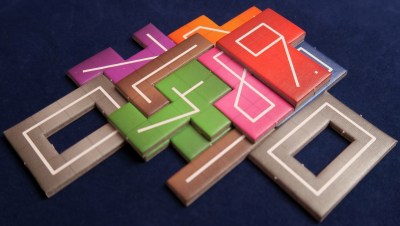
NMBR 9
– Image by boardGOATS

Learning Outcome:  Sometimes it is better to keep your plans to yourself.

Next Meeting – 10th July 2018

Our next meeting will be on Tuesday, 10th July, at the Horse and Jockey pub in Stanford-in-the-Vale.  As usual, we will be playing shorter games from 7.30pm as people arrive, until 8pm when we will start something a little longer.

This week the “Feature Game” will be Keyflower, which is a tile laying game with an unusual auction mechanic implemented using meeples. We’ve chosen Keyflower because it is one of our favourite games, and one particular member keeps asking to play it and then misses out.

– Image by boardGOATS

And talking of auctions…

Jeff went to an auction and bought a Stradivarius and a Rembrandt.  He was very happy with them since the price he paid was remarkably low, and even he had heard the names.  Although he knew they were valuable, Jeff had no idea how much they were actually worth, so he decided ask a valuer to put a number on his windfall.

In response to his query, the valuer explained, “Well sir, this is indeed a Stradivarius and that is a Rembrandt, but it’s a great pity that Stradivarius couldn’t paint and Rembrandt couldn’t build violins…”

Next Meeting – 10th May 2018

Our next meeting will be on Tuesday, 10th May, at the Horse and Jockey pub in Stanford-in-the-Vale.  As usual, we will be playing shorter games from 7.30pm as people arrive, until 8pm when we will start something a little longer.

This week the “Feature Game” will be Keyflower, which is a tile laying game with an unusual auction mechanic implemented using meeples. We’ve chosen Keyflower because it is one of our favourite games, and one particular member keeps asking to play it and then misses out.

– Image by boardGOATS

And talking of auctions…

Jeff went to an auction and bought a Stradivarius and a Rembrandt.  He was very happy with them since the price he paid was remarkably low, and even he had heard the names.  Although he knew they were valuable, Jeff had no idea how much they were actually worth, so he decided ask a valuer to put a number on his windfall.

In response to his query, the valuer explained, “Well sir, this is indeed a Stradivarius and that is a Rembrandt, but it’s a great pity that Stradivarius couldn’t paint and Rembrandt couldn’t build violins…”

26th June 2018

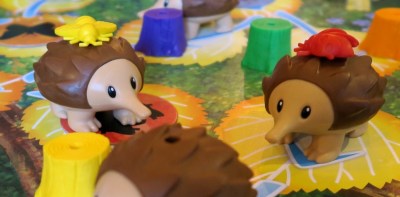
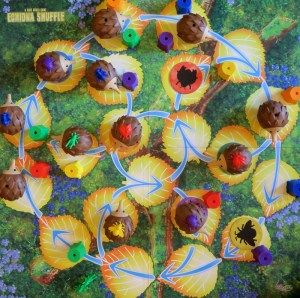
It was an remarkable evening from the very start:  Burgundy had a drink at the pub for the first time in known history, Blue eschewed her usual pizza and chips in favour of the ploughman’s special (both consequences of the heat), and to top it all, a new gamer, Viridian, turned up.  Inspired, while food was still being consumed, we quickly sorted out who was going to play what, and the first game got started with another outing for Echidna Shuffle.  This was a game some of us played at the UK Games Expo and was such a success that Purple and Black brought a copy home.  The game is a very simple, pick up and deliver type game with beautiful pieces.  Basically, each player has a set of three coloured insects and three matching tree stumps.  On their turn, the active player rolls a die and moves the fabulously large echidnas around, trying to use them to pick up their insects and drop them off on their stumps.

Echidna Shuffle
– Image by boardGOATS

We played Echidna Shuffle last time as the “Feature Game”, but instead of taking the expected  half an hour, it took nearer two!  Although it dragged a little towards the end, everyone had enjoyed it, but it was felt that it might not take quite so long when played with fewer people and with the alternative board: the “Winter Snowball Fight” side, rather than the pretty “Summer Leaf” side.  The “Snowball Fight” board is considerably more complex, with arrows going in lots of different directions giving players more options and opportunities to mess up other’s plans.  The game was tight, but didn’t go on anywhere near as long as last time and was all the better for it.  Everyone managed to get home their first bug reasonably easily, and Pine (the winner last time) was the first to get his second bug home with Purple just behind.  With the more complex patterns on this board it was much harder to keep people away from their third tree stump and despite everyone else’s best efforts, Purple managed to ease her way to her third stump and win the game.

Echidna Shuffle
– Image by boardGOATS

On the next table the “Feature Game”, Concordia had started, but still had a long way to go, so the group looked for something else to play, and attention fell on Lanterns: The Harvest Festival.  This is a light, pretty, tile-laying game with the tenuous theme of decorating the palace lake with floating lanterns and competing to become the most honoured artisan.  On their turn, players choose a tile from their hand of three and add it to the central palace lake.  Each tile is divided into four quarters, each of which has a colour, red, orange, blue, green, purple, black and white.  Every player then receives a lantern card corresponding to the color on the side of the tile facing them, with the active player receiving bonus cards for any edges where the colours of the new tile match those of the lake.  At the start of their next turn, players can gain honour tiles by dedicating sets of lantern cards, three pairs, four of a kind or seven different colours. Each tile is worth honour points and the player with the most points at the end of the game wins.

Lanterns: The Harvest Festival
– Image used with permission of boardgamephotos

We’ve played this a few times, so in order to spice things up a little, we added the pavillions from the expansion, The Emperor’s Gifts.  This introduces the concept of the emperor’s pavilion;  players can place up to three pavilions during the game, on “unimproved” lantern tiles.  If the players make a colour match on a pavilion, they earn a gift from the emperor.  Two emperor cards are revealed at the start of each game, so at the start of their turn players can redeem two gifts to activate one of the cards and perform the special action associated with it.  Some of these gifts allow players another avenue to earn more honour whereas other gifts allow players to modify the state of the playing area.  Black, Purple and Pine all went after the highest scoring honour tiles requiring seven cards of different colours, while Green tried to maximise the efficiency of his cards taking the lower scoring combinations instead, but getting more of them.  The addition of The Emperor’s Gifts was a little controversial:  Black in particular was of the opinion that they made a nice little game unnecessarily complicated, while Green felt the base game was quite simple and benefited from the additional elements.

Lanterns: The Emperor's Gifts
– Image by boardGOATS

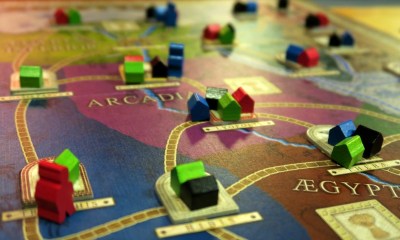
In the end the scoring was close, with a tie between Black and pine on fifty-three, and another tie between Purple and Green on sixty-one.  Even though the others were scornful of Green’s strategy, it nearly worked, but it was Purple, who had managed to get both her temples out and used the extra bonuses to good effect in the last few turns who won the tie-breaker with two favours to Green’s one.  And with it, she took her second victory of the night.  The “Feature Game” was still going on the next table, but Pine was finding it difficult going as he didn’t have his glasses.  Apparently he’d left them on the roof of his car and only realised once he’d got home and discovered them missing (possibly another consequence of the hot weather).  Green also wanted an early night so the group ended up chatting and Black took to spectating the game on the neighbouring table.  This was Concordia, a longer, strategy game of economic development in Roman times,  We’ve played it a few times on Tuesdays and Fridays (at the Didcot Games Club), and enjoyed both the base game and the Salsa expansion.  This time we used the Egypt map from Concordia: Ægyptus / Creta, the latest expansion.

Concordia: Ægyptus / Creta
– Image by boardGOATS

It was Viridian and Ivory’s first game of Concordia, and it was a while since Blue had played it too, so Burgundy explained the rules. Mechanistically, the game is quite simple:  players have a deck of cards and, on their turn, they play one and do what it says.  That’s all there is to it, but how the cards work together is the key.  Each player begins with a hand of Character cards (the same cards), six colonists and a handful of resources. The game is one of resource production and exploration. Notable cities are connected via land and (in the case of the Egypt map) river routes and each produces one resource.  These cards allow players to move colonists and build settlements, trigger production for all settlements in a given region, introduce more colonists etc., however one of the cards enables players to buy extra cards from the market (a face up display). The cards are played into a personal discard pile where they remain until the player plays their “Tribune” card to get all their cards back.

Concordia
– Image used with permission of BGG contributor Space Trucker

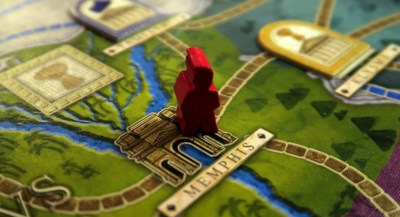
Each player also has a warehouse of a fixed size which will hold a maximum of only twelve items, which at the start of the game includes four of their six colonists (two ships and two “Elvis-meeples” – the third ship and third “Elvis-meeple” start the game in Memphis, Uh-huh). So, managing resources and finances is one of the key parts of the game and it is essential that players have the right resources when they need them as there isn’t space to store excess. Another “pinch-point” is the cards; players can only play each card once before picking them all up. They also get income when they play their Tribune card to recover their cards, but as it is dependent on the number of cards they pick up, it is in the player’s interest to play as many cards as possible before collecting them all again – this also needs planning.

Concordia: Ægyptus / Creta
– Image by boardGOATS

One of the characteristics of the Egypt map is how tight it is, making the game a bit of a knife-fight in a telephone box.  For this reason, it is imperative players get a good start and Ivory did just that, quickly commandeering two of the cities that produced fabric.  Before long he had engaged in a cycle of produce and sell, produce and buy and it was clear that everyone else was in danger of a sever trouncing.  Meanwhile, Viridian was building a strong-hold in the Oasis province and was also looking to be very competitive.  Blue had started off well too, heading for the Red Sea.  This is a new feature specific to the Egypt map, which has the ability to generate five Sestertii every time one of the Red Sea ports produce. In a game where money is so tight, this seemed like a really good idea, but Blue was keen to use her ship to build on all the Red Sea harbours first and needed resources to do that which meant she delayed to long to make best use of it and it took Burgundy to show her how to do it.

Concordia: Ægyptus / Creta
– Image by boardGOATS

All the while though, Ivory was getting ever stronger with his vast amount of cloth and then the Weaver card appeared in the card row.  This enables the owner to produce all their cloth at the same time, rather than having to produce them one province at a time.  There was a flurry of people buying cards and suddenly it was quite cheap, though nobody had any use for it except Ivory, as nobody else had any cities producing cloth.  And so, the Weaver sat there, unloved, until Burgundy took one for the team and bought it, much to Ivory’s disgust.  It was expensive though and cost Burgundy dearly.  Ivory couldn’t believe Burgundy had taken the Weaver, and lamented his failure to get it when he had the chance, possibly due to an uncharacteristic misjudgement, or maybe the heat was getting to him too.

Concordia
– Image used with permission of BGG contributor bkunes

The game continued with players building up their production heartlands; Burgundy had a stronghold in the Valley of the Nile, while Viridian took the Farmer and Smith cards enabling him to produce with his wheat and silver cities.  It was about this point that the other game finished, and Black began spectating.  Ivory asked him how he thought he was doing and Black replied he had no idea, “You can never tell with Concordia.”  Ivory pressed some more and Black took a look at his cards and eventually said no.  The most challenging part of the game is the end-game scoring, which is tied up in the Character cards. In addition to a name and an action, each card is dedicated to a Roman God. Each God rewards the card’s owner with victory points at the end of the game.

Concordia: Ægyptus / Creta
– Image by boardGOATS

For example, Mars delivers points for colonists placed on the board. Each Character dedicated to Mars gives two points per colonist, so a player with all six colonists on the board at the end of the game and five Characters devoted to Mars will score thirty points. Thus, since the cards are effectively multipliers, in general, the strategy is to try to excel in one area rather than try to do a little bit of everything, but that is something that is definitely easier said than done.  Black’s intervention sparked a massive spell of card buying.  Burgundy went for “Mercurius” cards that reward players for having different types of production, while Ivory went for “Saturnus” cards which gave points for each populated province or region.  Blue on the other hand, noticed she already had a few “Jupitus” cards and there were lots on the table so made a beeline them and then started building in as many cities as she could.

Concordia: Ægyptus / Creta
– Image by boardGOATS

When Black came back for a second look and Ivory again asked whether he thought he would win, Black was less negative, but still not exactly positive.  And shortly after that, Blue took the last card (and with it the seven point bonus) and everyone tried to eek out what they could from their last turn.  It was tight, and as the scores for each card type were calculated, the lead changed repeatedly.  It turned out that Black’s reticence was well placed.  Although Ivory’s position looked good it was soon clear that his one hundred and twenty-nine wasn’t enough and the loss of the Weaver card had cost him dear.  Burgundy finished with one hundred and forty-five, scoring highly despite not having one really strong area (unusual in this game).  It was Blue who top scored though, with one hundred and fifty-four, thanks largely to her massive seven “Jupitus” cards.

Concordia
– Image by boardGOATS

Learning Outcome:   Hot weather can have some strange effects…

Boardgames in the News: Playing with Your Food

KickStarter is a crowd-finding platform, where people seek financial support for their latest, greatest idea.  All sorts of bizarre and unusual things can be found there, as well as a lot of boardgames.  One of the more curious projects currently seeking financial support is “The Edible Games Cookbook“.  Designed by a professional game designer cum amateur baker, the hard-back book presents a series of “food experiences to play with friends and family”. The campaign page says that players “might be required to crack a secret code that’s baked into cream puffs; keep a straight face while eating something gross; conjure up a delectable morsel from a mishmash of ingredients; perform “sacred”, food-related rituals; test their memory and taste buds … and that’s only half the games”.  There is a sample chapter available, if you want to have your taste buds tickled, and the project runs until Friday 20th July 2018.

The Edible Games Cookbook
– Image from kickstarter.com

Boardgames in the News: But Emily loved him…

Sadly, Peter Firmin, “father” of Bagpuss and Basil Brush, passed away yesterday after a short illness, aged eighty-nine.  In addition to the old, saggy cloth cat (baggy, and a bit loose at the seams) and the anarchic fox (boom BOOM!), together with Oliver Postgate, Peter brought many other childhood favourites into our homes.  These include, The Clangers, Pogle’s Wood, Pingwings and What-a-Mess.  To gamers though, the most interesting are probably Ivor the Engine, Noggin the Nog, both of which have recently inspired boardgames that Peter Firmin personally illustrated in his unique and beautiful style.  He was a lovely man who will be greatly missed by all who knew him and those who were inspired by him.

– Image by boardGOATS

Next Meeting – 26th June 2018

Our next meeting will be on Tuesday, 26th June, at the Horse and Jockey pub in Stanford-in-the-Vale.  As usual, we will be playing shorter games from 7.30pm as people arrive, until 8pm when we will start something a little longer.

This week, the “Feature Game” will be Concordia: Aegyptus / Creta, the latest expansion for Concordia, a strategy game of economic development in Roman times.  We’ve played Concordia a few times on Tuesdays, and Fridays at the Didcot Games Club; we’ve played both the base game and with the Salsa expansion, and it has always been enjoyed.

Concordia
– Image used with permission of boardgamephotos

And speaking of Romans…

Like Jeff, all his descendants fancied their chances at getting rich.  One in particular, Jefficus Stultus, had thought that being a gladiator was a good way of achieving his dreams.  He did alright on his first visit to the arena, but his second bout was less successful.  First his opponent sliced off both of his arms; Jefficus never wanted for courage, however, and fought on, kicking and biting as furiously as he could. When Jefficus’ opponent lopped off both his feet though, the brave gladiator had no choice but to give up.

He was now both unarmed and defeated…

12th June 2018

The evening started with a couple of quick rounds of Love Letter, while Pine and Burgundy finished off their dinner.  This is the a quick “micro game” played from a deck with only sixteen cards.  Each player starts with just one card in hand drawing a second on their turn, choosing one to play.  The aim is to try to eliminate the other players from the game, with the last player the winner.  Red started the first round and immediately knocked out Burgundy by guessing his hand.  When Pine swapped his Countess card for the Princess though, he took the first round.  The second was also won by the Princess, but this time Red was the beneficiary, despite being side-tracked discussing work with Blue.

Love Letter
– Image by boardGOATS

With food essentially dealt with, it was time to discuss who was going to play the “Feature Game”.  This time it was Echidna Shuffle, a very simple pick-up and deliver game with a couple of clever little quirks and fantastic over-produced pieces.  This was a game Black and Purple played with Blue and Pink at UK Games Expo last week; they liked it so much they nearly came to blows over who was going to get a copy, and it sold out on Friday afternoon as well.  Everyone else had heard about it, and despite the fact that it played six, it was hugely over-subscribed, so Blue, Burgundy and Ivory took themselves off to choose something else to play.  For many, Echidna Shuffle looked like a game with hedgehogs—the wonderfully chunky and gorgeously styled models could be either.  As there are more hedgehogs than echidnas in the UK, that’s what everyone associated them with, so every time someone said “Hedgehogs” there was a chorus of “Echidnas!” in response.

Echidna Shuffle
– Image by boardGOATS

The idea of the game is that each player has three tree-stumps on board, and three insects in-hand; players have to get all three of their insects to their tree-stumps by riding them on the backs of echidnas. Each echidna and each stump can carry just one insect, with stumps removed from the game once they are occupied.  The active player first rolls the dice, and then moves the echidnas.  There are a lot of echidnas and not a lot of free spaces, so players have to shuffle the echidnas round the board, first passing their insect pick-up point, then trying to move that echidna to a tree-stump. Someone commented that “Echidna Skiffle” might have been a better name, but Pine pointed out that while they might look like hedgehogs, none of them looked like Lonnie Donegan

Echidna Shuffle
– Image by boardGOATS

The total number of spaces moved is dictated by roll of a die, and this is perhaps one of the cleverest parts of the game: players only roll the die on alternate turns with intermediate turns evaluated from the dice board giving a total over two turns of nine.  Thus, if someone rolls the maximum, a seven, the next turn they get just two.  Similarly, if they roll a small number, say a three, then they get a six on the next turn.  This clever trick means nobody gets screwed over by the dice, but there is still a nice, randomisation effect to the movement.  There are two sides to the board, the normal “Summer Leaf” side, and the manic “Winter Snowball Fight” side.  On this occasion, we played the “simple” board with a full complement of six players.

Echidna Shuffle
– Image by boardGOATS

Red got one of her bugs home first and it remained that way for several turns, before everyone else caught up quickly, leaving only Green bugless.  Red and Magenta then led the way with their second insect before Green finally got one of his home.  There followed a steady levelling-up with each player getting their second insect home, while everyone took care to make sure that Red and Magenta were prevented from getting their third critter to it’s stump.  Meanwhile Green and Pine were really struggling a second bug home, eventually leaving Pine the only one with only a single safe insect.  By this time, the game had turned into a group calculated effort to stop each other from getting their third insect home.  Consequently, Pine was feeling very left out as his echidnas kept falling victim to everyone else’s attempts to stop the others.

Echidna Shuffle
– Image by boardGOATS

Eventually, Pine joined the party, and everyone was struggling to get one final insect home and put everyone out of their pain.  A move by Purple appeared to leave the door open for Black to trundle his final echidna to his last stump in two moves, but for some reason he moved his echidna in the wrong direction on the first move, leaving it to do another loop before he could get it back, and that was the end of his chance.  The game continued for a while longer, like a never-ending six-player game of chess;  everyone circling each other, with their insects stuck in eternal echidna traffic jams until finally Pine broke through to an open leaf road, and an unstoppable position.  At least three other players were unable to get their insect to their own stump without playing “King Maker” for someone else, so Pine emerged the victor having spent so long stuck at the back of the field early on.

Echidna Shuffle
– Image by boardGOATS

Discussing the game afterwards, we realised that with the “simple” board and six experienced gamers who thought perhaps a little too much about the game, it had ended up in an almost “Tic-Tac-Toe” impasse.  This had lengthened the game, making it take much, much longer than it should have done.  As a result, players vowed to use the more complex board “Snowball Fight” board and maybe look for other ways to prevent the stalemate, like using the “extra moves” variant, especially when playing with lots of people.  It would be well worth finding a way to make it play a little quicker as we all had fun with the game which had very nice pieces. A game we can all share with our non-gaming friends and families too, which gave it a big thumbs up from the group, most of whom don’t really care whether they are hedgehogs, echidnas, or even porcupines

Echidna Shuffle
– Image by boardGOATS

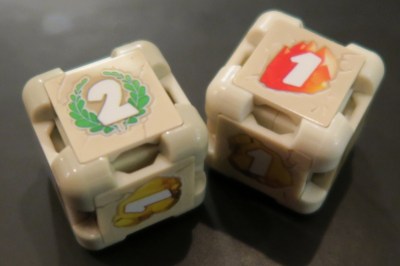
On the next table, Blue, Burgundy and Ivory, had eventually chosen to play Dice Forge, a game they had enjoyed once before but felt they had unfinished business with.  The game is a dice building game, with a similar feeling to deck building games like Dominion and bag building games like Orléans, or cup building games like Roll for the Galaxy.  In these games, the aim is to try to mitigate the effects of luck by stacking the deck, bag, cup to improve the odds; in the case of Dice Forge, it is the dice themselves that players are modifying.  Each player starts with two dice, similar to those in some of the Lego games, where the faces can be removed and changed.  Beyond this, the game is actually quite simple.  On the active player’s turn, everyone rolls both their dice and accumulates resources accordingly.  On their turn, the active player can then also spend their resources to either upgrade dice, or to move their pawn from their central “Starting Portals” to one of the “Islands” on the board and take a “Heroic Feat” card.  Dice upgrades and cards all have a cost, with the best having the highest costs.

Dice Forge
– Image by boardGOATS

One of the key strategy elements is where to put dice upgrades, and how to improve the dice.  For example is it best to save up for the most expensive upgrades, or given the fact that the game only lasts ten rounds, is it better to upgrade dice at every possible opportunity?  Similarly, is it best to upgrade one dice preferentially, to try to ensure that something good will come out every time, or is it best to sprinkle good stuff on both dice and hope that the dice Gods will smile…  On the other hand, cards can be more effective, so it can be better to concentrate on getting them, but only if the means to buy them can be accumulated quickly and efficiently.  This time Blue decided to concentrate on building up one die and try to keep her points tally ticking over.  Burgundy tried a different approach and went for cards, but struggled to get the “Sun Shards” he needed to execute his plan.  Meanwhile, Ivory serenely surfed the resource roller-coaster, buying cards and upgrading his dice seemingly at will.

Dice Forge
– Image by boardGOATS

The game came to a close with the tenth round, finishing just as the echidnas were finishing their elegant waltz.  Blue, who had been working up to a twenty-six point card had he plans quashed when Burgundy caused her to roll one of her dice and she ended up loosing six of her valuable Moon Shards.  This was all the more damaging as she had been waiting patiently for her turn with a full quota wasting any dice rolls that gave her more.  That meant that Ivory could take the last card on his turn, leaving Blue to try to find other ways of making points with her final turn.  And then it was just a case of quickly adding up the scores:  Blue had accrued more than twice as many points with her dice than Burgundy, who had in turn amassed a large pile of cards giving him more than twice as many points as Blue via that route.  It was Ivory though who was the clear winner, the same number of points from his dice as Blue, and almost the same number of points from his cards as Burgundy.

Dice Forge
– Image by boardGOATS

It wasn’t late, but with Green, Red and Magenta heading off for an early night, that left six to play something else.  Ivory had enjoyed his first and only game of Las Vegas so much that he was keen to give it another go and everyone else was happy to join him. It is a very simple game with players rolling their dice and assigning some of them to one of the six numbered casinos.  Once everyone has placed all their dice the player who placed the most dice on a casino takes the highest value currency card.  The really clever bit is that before any money is handed out, any “draws” are removed, which leads to a lot of table talk and “helpful suggestions”.  As usual, we added the Slot Machine (which is like a special seventh casino); some elements from the Boulevard expansion, including extra high value money cards and the large, double weight dice, and house ruled the game to three rounds.  Some people did well on the first round, some well on the second, some on the third, but once, again, it was Ivory who finished with $400,000, just a head of Blue and Purple, proving that last time wasn’t just beginner’s luck…

Las Vegas
– Image by boardGOATS

Learning Outcome:  Some dice games aren’t all about luck.