Author Archives: nannyGOAT

31st December 2016

As is now traditional, we started our New Year’s Eve Party with the gorgeous, dexterity car-racing game, PitchCar, our “Feature Game”.  Everyone had played it before except Pine, and, as one of the first to arrive, he got the job of building the track.  Never having played it before, the track ended up as a single winding path rather than a circuit, but that didn’t matter, especially as there was a really short space after the chequered flag and we instigated a rule that players had to stop before they ran off the end or they would lose flick and distance in the usual way.  The track itself was really quite complex, including the bridge from the first extension, the cross roads from the fifth extension, and the new narrow bend and jump features from the latest extension.
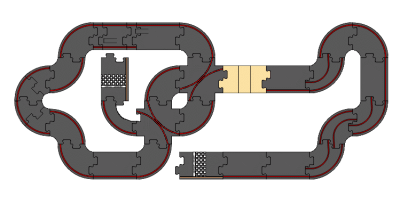
PitchCar Track - 31/12/16
– Image by boardGOATS

Rather than the usual “flying lap” to see who starts, each player had a single flick with the longest going first.  Black went the furthest so started in pole position, but promptly caused a log-jam due to the narrow curve at the start that created a bit of a bottle-neck.  Once everyone else had got stuck, he took the opportunity on his second turn to make his get away and he did it very effectively quickly building up a commanding lead.  Things were a bit tighter in the middle of the field, but it wasn’t long before everyone had spread out a bit and it became a battle between pairs of players for individual places rather than for the race as a whole.  The arrival snacks in the form of crisps with dip and that 1970s stable cheese and pineapple on sticks, failed to distract Black who continued to lead the way, and finished well ahead of the rest despite taking a couple of shots at the finish to make sure he didn’t over-shoot.   He was followed by Green and Pink who had tussled for position briefly before settling into a steady pattern they maintained to the end.

PitchCar
– Image by BGG contributor visard

With the race over, everyone passed the pieces to Blue who packed them in the case before they crammed themselves round the table for supper of red lentil lasagne, accompanied by salad, home-made bread (onion & cheese and tomato & chorizo), pigs in blankets and devils on horse-back.  Once everyone had eaten their fill, we decided to play a second large group game and since Pink had been keen to play it again all Christmas, we went for Ca$h ‘n Guns. This is a simple party game that always goes with a bang.  The idea is that each player has a small deck of cards with three bullets and five blanks.  After choosing a card, players simultaneously point foam guns at each other.  On the count of three players have the opportunity to withdraw, before any “bullet” cards for guns pointing at people are revealed.  Anyone still “in” and not shot, then gets a share of the loot.  The player with the highest value loot at the end of the game wins.

Ca$h 'n Guns
– Image used with permission of BGG contributor punkin312

This is where the game gets just a little tactical:  there are several different types of loot.  There is cash – always good; jewelry – valuable, and the player with the most gets a $60,000 bonus, and paintings – the first isn’t worth much but the average value increases if the player acquires more.  Players can also choose to take the Godfather role (i.e. first player to choose if they are still “in”), medipacks (useful if you have picked up a bullet wound) and extra bullet cards.  There are lots of other options, but although we had extra guns and characters to choose from, with so many people, we decided to stick to the purest form of the game, not even using the character cards (which give special powers).

Ca$h 'n Guns
– Image used with permission of BGG contributor punkin312

There is something about pointing foam guns at each other that is just intrinsically funny and it brings out all sorts of peculiar traits.  The first was that from the start, everyone took the opportunity to have a go at Green which mean that he was knocked out by the end of the third round.  Purple started collecting Jewels while Pine, Magenta and Pink began working on their fine-art collections.  In the end, the battle for second place was very close with Blue taking it with $91,000, just ahead of Magenta.  Pink, however, was miles out in front with more than double the takings of anyone else, finishing with a total of $201,000.  Once Pink had finished counting his huge pile, we extricated everyone from the space they were wedged in, moved the table back and got out the second, folding table to give players a little more space.  Purple was keen to play Ulm, a game she and Black had played at Essen and liked so much they had brought a copy back with them.
Ulm
– Image by boardGOATS

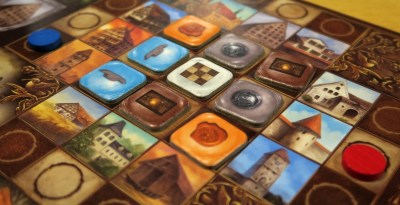
The game play in Ulm is simple enough.  It is played over ten rounds, during each of which players get one turn in which they can do three actions that help them to gain points.  Ultimately players are collecting cards, city coats of arms and descendants, all of which can give them points during the game or at the end. This, in combination with the position of their barge and the number of sparrow tokens owned give the end game score, and the player with highest score wins.  The cathedral area is a three by three grid of action tiles.  On their turn, the active player slides a new action tile, randomly drawn from the bag, from the outside into the grid sliding another tile out. That tile stays in its spot on the outside of the grid and no other player can use that row or column until the tile is removed. The three tiles left in that row or column (two old ones and the new one, just added), represent the active player’s three actions for their turn.

Ulm
– Image by boardGOATS

Thus one of the actions is drawn randomly from the bag, though sparrow tokens acquired during the game enable players to exchange their random tile with one currently on the loading docks.  This is an area on the board where five actions tiles are constantly displayed and where players can get get extra tiles, or exchange tiles.  There are five different actions represented by tiles in different colours.  These are:  clear tiles on one of the four sides of the cathedral area (making more options playable), place a Seal, buy or play a card, move their barge, or take money.  Every time the active player carries out a Seal action, they place one of their Seals in a city quarter and immediately obtain a specific privilege as a bonus. These privileges vary from quarter to quarter.  The river Danube divides the city and the game board north and south.  If a player wants to carry out the Seal action, they can choose either the southern northern city quarter, adjacent to where their barge is.  The river is navigable only in one direction and a river space can’t contain more than one barge, so other players’ barges are jumped over.  This means players can move a surprisingly long way for just one step, if it is timed right.

Ulm
– Image by boardGOATS

Cards can be acquired by exchanging tiles for cards or as a byproduct of buying seals at the Town Hall or Goose Tower quarter.  When played, the active player can either discard the card for the card bonus which they can use during the game, or place the card in front of them, to obtain the points bonus at the end of the game.  Points are scored during the game through cards, Seals and Coats of Arms, but also at the end of the game for any sparrows and for the position of their barge on the Danube.  Perhaps the largest number of points are available for cards with three points per card, but it is the bonus points that are really key.  A set of three different trade cards gets a bonus of three points while three the same gives a six point bonus.  Cathedral cards are the most profitable, however, with a complete set of three cathedral cards netting a eighteen points, but they can also be difficult to get.

Ulm
– Image by boardGOATS

Carrying out a Seal action in the Oath House quarter gives players a Descendant who provides a special ability.  Purple was the only one not to get a Descendant with Black taking the Merchant (allowing him to exchange one of his action tiles for one from the docks) and Pine getting the Councilman (giving him more control over the cards he bought). Violet on the other hand took the City Guard who yielded two points for manipulating the action tiles in the cathedral area such that at least one new line of three in one color is formed in the inner grid of the Cathedral area.  This sound potentially very lucrative, but is actually quite hard to get to work, especially without compromising other scoring opportunities.  To some degree the Descendants dictated the strategies used.  Black tried to build sets of cards but was unlucky and they just didn’t fall for him.  Purple tried to capitalise on the shields and Violet went for Seals.  It was Pine who was the most successful however, very effectively coupling his Councilman with a card strategy with ultimately gave him eight more points than Purple in second place.
Ulm
– Image by boardGOATS

The down side of the random draw component is that the action grid changes constantly with players sliding new action tiles in and sliding old ones out, which makes planning very difficult.  This might explain why Black thought the game shouldn’t take too long, but was still going when midnight struck.  Cue Blue on the next table opening a bottle of fizz and covering the herself and the floor with it.  After watching other villagers setting off fireworks, Ulm continued, as did Tzolk’in on the other table.  They had begun by reminding themselves of the rules.  One of our longer, more complicated games, but one we’ve played a few times, Tzolk’in is a worker placement game built round a sumptuous system of gears.  The idea is that there is a central wheel dictating time, and five others providing actions.  On their turn, players can place workers on the action wheels and at the end of the round, the central wheel turns, moving all the workers round one step making a new action available.  In general, the longer a worker is on a wheel, the better the actions available to the player.  The really key part of the game, however, is the worker placement and removal:  on their turn, players can either take workers and carry out the associated actions, or place workers, but never both.

Tzolk'in: The Mayan Calendar
– Image used with permission of BGG contributor bkunes

There is a cost associated with placing workers:  the first worker is free, but after that, the cost rises considerably the more workers a player places.  Workers can be placed on any of the four wheels, but must be placed in the lowest available space.  Placing on the “zero” space of any wheel is free, but if this is occupied, players can place in the next space.  Since placing in higher spaces yields better rewards or saves time, for every extra space here is an additional fee, which is paid in the currency of the game, corn.  The five wheels, each named after ancient ruined Mayan cities, all provide different actions.  Palenque provides corn and wood while the mountain city of Yaxchilan provides corn, wood, stone, gold and crystal skulls. Uxmal, an ancient commercial centre, provides opportunities for players to hire additional workers , interchange corn and resources, as well as enabling them to carry out certain other actions, like build,  and pay with corn (when normally specific resources would be required).

Tzolk'in: The Mayan Calendar
– Image used with permission of BGG contributor kilroy_locke

Tikal, the ancient centre of architectural and technological development, provides players with opportunities to build monuments and buildings.  It also enables players to enhance the abilities of their workers using technology tracks.  There are four technology tracks, each one giving a bonus when players carry out certain actions.  For example, the Agriculture Technology provides extra corn or wood when a worker carries out an action that provides these items.  To move along a technology track, players typically have to carry out the appropriate action on the Tikal wheel and pay resource cubes (wood, stone or gold).  The benefits are cumulative, so further along the track a player is, the more advantage they have, but the more it costs to get there.

Tzolk'in: The Mayan Calendar
– Image used with permission of boardgamephotos

The final wheel, named after the mythical tollan Chichen Itza (known to us as chicken pizza), is a temple where players are supposed to leave crystal skulls (first obtained by visiting Yaxchilan), in return for which players get points and climb steps in the temples.  There are three temples, and the higher up the temple players are at the more points they get at the end of the ages. The other main source of points at the end of the game are Monuments and Buildings.  At the start of the game a handful of Monument tiles and Buildings tiles are revealed.  Monuments are generally very expensive and typically provide points directly, or conditional on some other factor (e.g. the number of workers a player has) at the end of the game.  Monuments are not replaced when someone takes and builds them, though a new set is put out at the end of the first age (i.e. half way through the game). Buildings, on the other hand, provide an advantage for use during the game or indirect points, are replaced once someone has taken the tile and are generally single use.  Although Farms are a type of building, they are multi-use and provide corn every food day, which can be invaluable.

Tzolk'in: The Mayan Calendar
– Image used with permission of BGG contributor kilroy_locke

Food days occur at the end of every age and again at the half-way point.  They can be crippling as players have to feed all their workers two corn each.  For this reason, a large part of the the first half-age is often spent acquiring corn to make sure nobody starves:  starving workers equals lost points.  In addition to food days, at the beginning of each round, every player must have three corn, if they don’t, they anger the gods which means they have to drop a step on one of the temples.  For this reason, and so that we don’t have to remember to check, we usually just put three corn to one side at the start of the game and then forget about it until the end.  In any case, corn is usually in high demand.  At the end of each round we place a “corn on the cog” to be taken when someone takes the start player.  This is an extra chance to get corn, and one that is usually a bit of a last resort, which means players are always tempted to wait as long as possible before they decide to take it, inevitably leaving someone disappointed.

Tzolk'in: The Mayan Calendar
– Image used with permission of BGG contributor bkunes

Unfortunately, we made a mess of the rules.  Firstly, we forgot to change the Monuments at the start of the second age, only remembering at about half way through.  This was unfortunate and may have inconvenienced Burgundy, but wasn’t the real game-breaker.  We had all played the game before, so it really shouldn’t have happened, but when we were setting up the game, Blue placed the skulls around the wheel in the action spaces.  At the time she wondered why there were so few crystal skulls in the general supply, but with so many other things going on she didn’t question it further.  This meant that instead of getting a skull from Yaxchilan and then taking it to Chichen Itza, players just went to Chichen Itza and got skulls.  At some point Pink asked what the skulls were for, but at the end of the game any left overs are worth three points so that was what we said.  It was only after we had run out of skulls and Green asked whether there was any point in Pink placing his workers on the Chichen Itza and whether the spaces could be re-used that we realised our error.

Tzolk'in: The Mayan Calendar
– Image used with permission of BGG contributor jsper

This rules error undoubtedly skewed the game giving the early adopters of the Chichen Itza wheel early success.  Pink and Burgundy were the first to go for this strategy and Blue quickly realised how effective it was and joined them.  Everyone had the opportunity to capitalise on the rules error, however, Green eschewed the chance and focused on climbing up the temples, but suffered as a result.  Blue managed to pick up a monument that rewarded wood tiles taken from Palenque and netted her thirty-two points for that alone at the end of the game.  Despite being awash with corn throughout the game she hadn’t been able to make the most of it.   Blue finished five points behind Pink and Burgundy (in spite of having almost no corn throughout) who tied for first place with eighty points.

Tzolk'in: The Mayan Calendar
– Image used with permission of BGG contributor aleacarv

Learning Outcome:  Even when you think you know the game, check the rules when things don’t seem right.

Boardgames in the News: Another Year, Another Take-Over

For many, Asmodée is the boardgame equivalent of the Borg, so it should be no surprise that the New Year brings yet another Asmodée take-over story.  This time the targets are the German publisher and distributor Heidelberger Spieleverlag, the French/Spanish company Edge Entertainment, and the Spanish distributor Millennium.  Heidelberger are the German production partner for many companies that are better known in the UK including Fantasy Flight Games, Czech Games Edition, Iello, Indie Boards & Cards and Ferti; they specialise in fantasy, science fiction and horror Games as well as being the distributor for Alea Spiele in Germany.  Edge performs a similar function within the French and Spanish games markets while Millennium is primarily a distributor, but has also produced French versions Citadels and Sutter’s Mill.  The connection between them is that they were all foreign language partners for Fantasy Flight Games who were bought by Asmodée two and a half years ago.  So, these acquisitions give Asmodée complete control of brands like Star Wars: X-Wing Miniatures Game, Android: Netrunner, Cosmic Encounter and Arkham Horror.

Asmodee Partners
– Image from asmodee.de

The list of Asmodée’s “partners” is extensive, so the question is, who will be next?

29th December 2016 – boardGOATS do the Quiz

Our local is the The Horse and Jockey pub in Stanford-in-the-Vale, and we meet there every fortnight on a Tuesday.  Every Thursday, they also hold a pub quiz, so as it was Christmas, we decided to get a special GOATS team together.  Blue, Pink, Pine, Violet and Violet’s mum were all up for it, so we booked a table for 8pm to have dinner first.  Unfortunately, Blue had over-indulged on turkey at lunch so had fallen asleep in the afternoon.  Although Pink had woken her, he failed to do so very effectively, so they were a bit late and by the time they arrived, there was a bit of a queue for food.  Not to worry though, we were nearly finished by the time the quiz started and were quite able to answer the first few questions and eat at the same time.

Quiz
– Image by boardGOATS

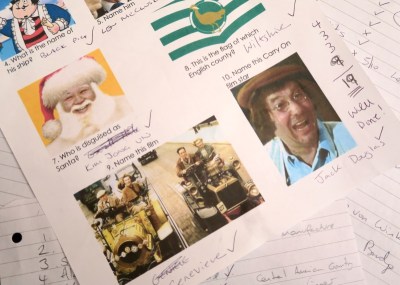
The quiz typically consists of five rounds of ten general knowledge questions, a picture round, a “Who am I” round, and two anagrams.  The “Who am I” round consists of five clues with players giving answers after each clue and teams scoring progressively less as the clues progress.  This and the anagrams (which score three points each) can be quite critical and often sort the sheep from the goats.   Only Pine and Blue had been before, and both had been part of teams that had not really troubled the scorers, so we were more than a little pleased when we got four points for the “Who am I” (Claire Balding, who apparently went to the same school as Miranda Hart) and, mostly thanks to Pine, the full six points for both anagrams!  Correctly identifying Kim Jong Un (obscured by a Santa hat, beard and glasses) as well as most of the others in the picture round meant that we finished strongly.  With a grand total of fifty-four points, we took first place, three points clear of “Something Simple” who finished second.  After a quick chat with a nice couple from Faringdon who had been marking our answers and had played Karuba and Ticket to Ride with their family over the holidays, we took care of the complicated matter of the bill (taking into account our winnings) and Violet and her mum went home.

Quiz
– Image by boardGOATS

Since Pine had his drink to finish and Blue and Pink had taken the precaution of bringing along a couple of small games, we decided to do what gamers do best and play games.  First up was No Thanks!.  This is a great little “push your luck” game where a card is turned over and players have to take the card or pay a mini poker chip to pass the problem on to the next player.  At the end of the round, players add the face values of the cards together and offset this with any remaining points to give their total – the smallest value is the winner.  The really clever part is that if a player has a run of consecutive cards, then only the lowest counts.  Spice is added by the removal of nine cards from the original thirty-two consecutive cards in the deck.  Blue did appallingly badly throughout, and while Pine won both the first two rounds, Pink won the final one by such a large margin that his aggregate total was the lowest overall, making him the winner.

No Thanks!
– Image used with permission of BGG contributor punkin312

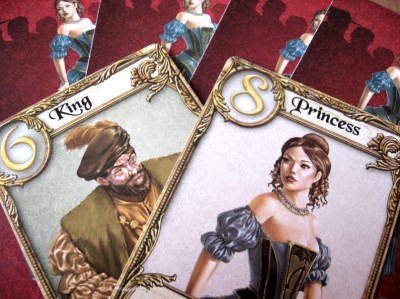
After that we played a few quick rounds of Love Letter.  This simple game played with just sixteen cards is almost the ubiquitous filler game.  Starting with one card, on their turn players draw a second and choose one to play.  Each card has a number and an action and the player left with the highest card at the end is the winner.   Pink tried to insist that Blue was always the Baron, only to get caught out as the Baron himself.  Blue started the next round as the Princess, so swapped cards with Pink and promptly caught him on the next turn.  In contrast, Pine managed to go nearly an entire round as the Princess only to be caught just before the end.  It was close and it all came down the the last game, but in a move that would have drawn allegations of match-fixing in football, Pink drew his second card face up by mistake, and then chose not to play it.  Pine gleefully assassinated Pink’s Baron once again, only to succumb himself a couple of rounds later leaving Blue to finish with three wins (to Pink’s two) and claimed victory.

LoveLetter
– Image by boardGOATS

Learning outcome:  Gamers can be good at quizzes too.

28th December 2016

Being a Wednesday, and with lots of people away for Christmas, we weren’t sure how many to expect. In the event we had a reasonable turn out, and enough for a six player game of Chicago Express (aka Wabash Cannonball), the evening’s “Feature Game“.  This is a fairly simple game, with just three possible actions per turn, but the consequences can be far-reaching.  At the start of the game there are four rail companies B&O (blue), Pennsylvania Railroad (red), C&O (yellow) and New York Central (Green), trying to build routes from the east coat to Chicago.  Unlike most train games, players don’t play the part of the railroads, instead they are investors, speculating in order to accumulate as much cash as possible.   To that end, on their turn players can auction a share of one of the companies, extend a network of a company they hold shares in or “improve” one of the hexes that a rail-line goes through.

Chicago Express
– Image used with permission of BGG contributor kilroy_locke

At the end of each round, there is a dividend where owners of shares get a pay-out.  The game is played over a maximum of eight rounds and the player with the most money at the end of the game wins.  There are a couple of clever parts of the game. Firstly, there are the three action wheels.  Each time a player takes an action, the associated dial is moved on one step. Each dial has a maximum number of steps per round and once this limit has been reached, that action is unavailable for the rest of the round.  Once two action dials have reached their maximum, the the round is over and dividends are handed out.  The dividend depends on the length of the railroad, where it goes, any upgrades along the route and the number of shares held.  The second clever aspect of the game is the economic merry-go-round. When players buy shares, the money is paid to the company and it is this money that is then used to build rail routes.  Money is gradually fed into the game via the dividend which is taken from the bank.  Since the winning condition is solely based on money at the end of the game, there is a strong incentive to minimise the amount paid for shares.  However, this can be a false economy as it can leave the company that short of funds for development.

Chicago Express
– Image used with permission of BGG contributor da pyrate

So, the balance is hard to strike, and as the game progresses, demand increases for the companies with the largest dividends.  In general, there are eight rounds, but if three companies run out of trains or three companies run out of shares, then the game ends early, so players have to watch what they spend to make sure they don’t get caught out. Only money counts at the end of the game, shares are worthless, so players can’t afford to overspend.  Chicago Express was a Christmas gift for Pink, and only Blue and Pink had played it before, and then only with two players. They explained what had happened and, as the game starts with an initial share auction they offered as much of their (albeit limited) experience as they could to help players value the shares, but the suspicion was that the game would play very differently with six.

Chicago Express
– Image used with permission of BGG contributor kilroy_locke

Blue took the first share in the Pennsylvania Railroad (PRR, red), Burgundy placed a stake in the B&O (blue), Pine invested in C&O (yellow), and Purple took the last initial offering, snapping up the New York Central share (green). That left Black and Pink with nothing at the beginning, but with their starting funds untouched.  Because funds are replenished (at least in part) by the dividend at the end of the round, it is very important for players who lose out in the initial auction to ensure they get a stake before the end of the round or they risk having to fight a rear-guard action for the whole game. To this end, Pink started out on a concerted campaign to auction off shares. By the end of the first round, Pink had joined Pine in the yellow C&O and Black had gone into partnership with Blue in the PRR. Blue on the other hand had bankrupted herself by dividing her loyalties and joined Burgundy investing in the B&O.

Chicago Express
– Image used with permission of BGG contributor Mouseketeer

After the first round, everyone could see how things we playing out and it about then that another share in the New York Central was put up for auction. The dividend had been one of the highest; hitherto, Purple had held the only share and she was very keen to keep it that way.  As the price crept up, players gradually dropped out of the bidding, eventually leaving just Burgundy and Purple.  Burgundy pushed her to the limit, but thanks to her slightly higher dividend in the first round, Purple was able to hang on to her monopoly.

Chicago Express
– Image used with permission of boardgamephotos

As the game progressed, more shares were auctioned and railroads gradually progressed westward, though the routes they took varied considerably.  Black and Blue took the PRR by the most direct route as did Burgundy (with little help from Blue, his silent partner), while Green went to the north.  In contrast, Pink and Pine took the C&O along the south coast, where there were lots of cities making it increasingly valuable and consequently, a target for takeover.  There were lots of shares available though, which simply had the effect of diluting the holding and eroding its value.  Nevertheless, Pine and Pink managed to hang on to the majority between them, so all their efforts weren’t totally wasted.  Meanwhile, Purple managed to fight off another unwanted takeover bid, with Blue forcing up the bids this time.

Chicago Express
– Image used with permission of BGG contributor Toynan

It was about this time, at the start of the fifth round that train stocks and share certificates began to run out, and suddenly everyone realised that the game could be close to the end.  Purely by chance, Blue hadn’t spent any money in the previous round having been repeatedly outbid, which meant she had more than anyone else. However, as she only had two shares she had one of the smaller shares of the dividend due, so she needed the game to end before the start of the next round. With this in mind, she began aggressively selling C&O shares, which not only brought the game to an abrupt end, but also led to a dilution of their value as others could see the writing on the wall. The tactic worked though, and after the last dividend had been handed out, everyone added up their profits and the game finished with Blue out in front with forty-two dollars, eleven dollars clear of Purple in second place.

Chicago Express
– Image by BGG contributor damnpixel

As the dust settled, players considered what had happened with the benefit of hindsight.  It was clear that although the game is unquestionably very clever, not everyone appreciated the combination of simplicity and difficulty.  In truth, it really isn’t a “train game”, more an economics game with a train theme, which could be responsible for making it less popular than, say, Ticket to Ride.  It can also be quite unforgiving, especially for players who fail to get shares in the early part of the game.  Since only four shares are auctioned before the game starts properly, the higher player counts pretty much guarantee that someone will have to fight to stay in the game.  On the other hand, if they are lucky, they may be able to get potentially valuable shares relatively cheaply by capitalising on the fact that others might have overpaid to ensure they don’t get left out.  All in all, it definitely left some players with mixed feelings.

Chicago Express
– Image used with permission of BGG contributor da pyrate

With the post-mortem out of the way, we started a game of Las Vegas.  We’ve played this simple game quite a bit, in fact, most times that it comes to games night it gets played, probably because it is an easy option.  The idea is that players begin their turn by rolling their dice and then assign some of them to one of six casinos.  Each casino is numbered one to six and has a jackpot drawn at random from a deck of money.  Players must use all the dice displaying one number to bet on the casino of that number.  Once everyone has placed all their dice the player who placed the most dice on a casino takes the highest value currency card with the person in second place taking the next and so on. The really clever bit is that before any money is handed out, any “draws” are removed, which leads to a lot of barracking.  As usual, we included the Big Dice from the Boulevard expansion and the Slot Machine mini-expansion from the 2015 Brettspiel Advent Calendar.  The Slot Machine acts like a seventh casino, except that it can hold dice of any number, but dice of each number can only be added once (though a player must add all the dice they have of that number).

Las Vegas
– Image by boardGOATS

For some reason, this game always seems to take our group ages. Black commented that it was because we all play the same way, hedging our bets at the start of the round, hoping to be the last player with dice and to be able to use them to greatest effect.  As Black pointed out though, in practice, most of the time, even when the dice roll to leave a player with the most dice at the end, it is rare they can actually use them to great influence.  With that in mind, we tried to play slightly more aggressively, and also decided to play just three rounds instead of the usual four.  In the event, game play was slightly quicker than in previous games, but not much, and in truth nobody really minded.  The thing is, Las Vegas is very relaxing to play because there is are short spells of intense thought interspersed within longish periods while others play. Although this would normally be tedious, somehow watching others roll and the anticipation while they choose what to do is strangely compelling.  This time, the first round was fairly even, but it was the second round where things got interesting. Normal service was resumed for Burgundy who got nothing and Blue didn’t do much better. Black was the real winner though, taking money from several of the casinos, many of which were quite substantial. He was less lucky during the final round, however, and it was Purple, who had been consistent throughout who finished in front with $370,000 just $20,000 ahead of Black in second.

Las Vegas
– Image used with permission of BGG contributor ckirkman

With the fog, and an early start the next day for some, Black, Purple an Burgundy headed off, leaving Blue, Pine and Pink to a game of Finca.  This is a fairly light set collecting game centered around a rondel.  The idea is that players have two options on their turn, the can move a meeple round the rondel to pick up fruit, or deliver sets of fruit to the Mallorcan villages. The rondel movement is the interesting bit: the number of meeples on its start space dictate how far the meeple moves and the number of meeples on the space at the end of its move indicates how many fruit the active player gets.  If the meeple passes one of two markers during its move, the player gets a donkey cart token which can be traded in for the opportunity to make a delivery.

Finca
– Image used with permission of BGG contributor mikehulsebus

The game has a couple of other features. Firstly, in order to stop players hoarding fruit and starving others, if there are insufficient fruit available when needed, everyone returns everything of that type that they have, before the active player gets their due. This also applies to donkey cart tokens an it forces players to deliver frequently. In any case, donkey carts are generally small and hold a maximum of six fruit, so there is rarely good reason for hoarding.  Secondly, the villages each have a pile of demand tokens, face down except for the top one. Each of these depict some number of fruit from one to six.  When a player delivers to a village, they take the demand token and the number of fruit on the token is equivalent to the number of points awarded to the player at the end of the game. Thus, a player could collect one token featuring six fruit, alternatively, they could claim two or more tokens that sum to six (or fewer – donkey carts don’t have to be full).

Finca
– Image used with permission of BGG contributor thepackrat

Finally, bonuses are available for players who collect sets of demand tiles numbering from one to six, and when all the demand tiles are taken for a village, the finca tile is evaluated which gives more points. The game ends when demand tiles have been taken for a set number of villages and points are added up. Pine was new to the game, though Blue and Pink had played it a few times before. So it was that Pink, slightly needled by his poor results in the first two games, showed the way, initially by delivering the first fruit and collecting the corresponding demand tiles, then by collecting a set of six tiles, and with it, seven bonus points.  Blue collected plenty of fruit and turned them into demand tiles, but Pine and Pink between them took all the available “three value” demand tiles preventing her from getting a bonus. Pine quickly got to grips with the game, but his problems were compounded by the fact that he kept drawing with Blue when the finca bonus tiles were evaluated.  So it was Pink led from the start, picking up both finca bonuses and set bonuses as he went and snatching tiles just before the others could take them, and he ran out the worthy winner with fifty-two points to finish the evening on a landslide.

Finca
– Image used with permission of BGG contributor punkin312

Learning outcome:  A game needs more than trains for it to be a “train game”.

Next Meeting – 31st December 2016

As is now traditional, our last meeting of the year will be the New Year party on Monday, 31st December 2016.  As it is New Year’s Eve we will be starting early and will be meeting in a private house in Stanford, with food later.  Please get in touch if you would like to come along so we know how much food to prepare.

The plan is to start off early with the “Feature Game”, which, As has become traditional, will be the gorgeous, dexterity car-racing game, PitchCar.  We will be eating later and maybe set off some fireworks at midnight, depending on how cold and wet it is!

PitchCar
– Image used with permission of BGG contributor garyjames

And talking of cars…

A policeman sees an elderly woman driving incredibly slowly on the motorway, so he pulls along side and notices her knitting in the driver’s seat.  She remains focussed on the road and keeps knitting and driving.

He beeps his horn to get her attention, but she is oblivious and carries on.

Getting more frustrated, the policeman turns his siren on and, as she finally notices him, he signals for her to wind the window down.

After a time she finds the button and down goes the window.

Incensed, the cop yells, “PULL OVER!”

“Oh, no sweetie,” she replies holding up her knitting, “It’s a scarf, see?”

Next Meeting – 28th December 2016

Our next meeting will be on Wednesday 28th December, at the Horse and Jockey pub in Stanford-in-the-Vale.  As usual, we will be playing shorter games from 7.30pm as people arrive, until 8pm when we will start something a little longer.

This week the “Feature Game” will be Chicago Express (aka Wabash Cannonball), which is an economic game with a train theme and zero-luck.  The game is fairly simple, with three possible actions per turn and a maximum of eight rounds.  The player with the most money at the end of the game wins.

Chicago Express
– Image used with permission of boardgamephotos

And speaking of trains…

Jeff decided to visit his sister who was living in France. He assumed that most French would speak English, so didn;t even take a phrasebook with him.  Unfortunately, Jeff fairly quickly discovered that many people spoke only their own language and this included the ticket inspector on the train. He punched Jeff’s ticket, then chatted cordially for a bit, making several expansive gestures. Not wanting to look stupid, Jeff simply nodded from time to time to show him that he was interested.

When he had gone, a pretty American tourist, also on the train, leaned towards Jeff.  Initially, he thought his luck was in, but she just and politely asked if he spoke French.

Jeff blushed, “No,” he admitted.

“Ah, that explains it,” the American answered.

Not wanting to miss his opportunity with a pretty lass when she was a relatively captive audience, Jeff continued the conversation.  “Explains what?” he asked.

“Oh!” she replied, “It explains why didn’t bat an eyelid when he told you that you were on the wrong train.”

13th December 2016

Unsure of who was coming, to get everyone in the mood, we started off with the quick set collecting game, Coloretto.  We’ve played this little filler a few times, but somehow, Red felt she’d missed out. The game is very simple: on their turn the active player either draws a chameleon card and places it on a “truck” or takes a truck (which means they’re out for the rest of the round). The idea is that players are collecting sets of cards, but only three will yield positive points, with the rest scoring negatively.  The really clever part of the game is the scoring which uses the triangular number sequence (one point for the first card, three points for two cards, six points for three cards etc.), which rewards one large set more than two or even three small ones. It was very tight between Blue and Ivory who both picked up sets of six, but Blue finished one point ahead thanks two her second set, three green chameleons.

Coloretto
– Image by BGG contributor SergioMR

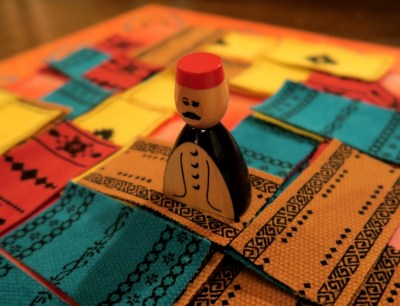
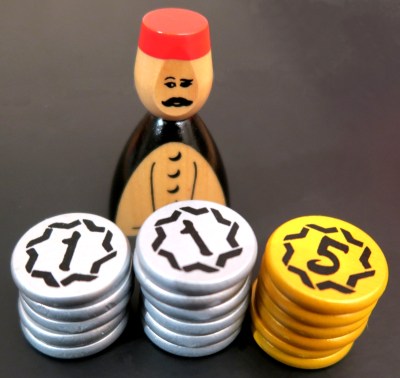
With everyone arrived, we moved on to the evening’s “Feature Game”, Marrakech, a very simple little area control game played through the medium of the Persian rug. Played on a small grid, each player starts with thirty lire and a pile of pieces of carpet.  On their turn the active play can rotate Assam, the master salesman a maximum of ninety degrees left or right, before they roll the die to find out how far he must be moved.  If Assam lands on a carpet square of an opponents colour, then the active player must pay the owner “rent” equivalent to the total size of the carpet.  Once Assam has been moved and any dues paid, the active player places a strip of carpet. The carpet pieces are all the same size (twice as long as they are wide) and cover two squares on the board.  They can also overlap with pieces laid previously, but cannot be placed wholly on top of one single rug.

Marrakech
– Image by boardGOATS

This is where the strategy comes in – is it best to try to make a large contiguous area which will be very lucrative every time someone lands on it (but that players will avoid if at all possible) or is it better to make many small areas that players will be more likely to land on?  The game ends when everyone has played all their pieces of carpet and the winner is the one with the most money (each visible piece of carpet earns its owner one lira).  Marrakech is a nice little game, but what really makes it is the quality of the rendition.  Assam is a beautifully made and painted wooden piece; the “coins” are wonderfully tactile wooden discs and the carpet is well, a strip of coloured fabric.  Without these touches, the game would still be as good, but would be very abstract.

Marrakech
– Image by boardGOATS

We had two copies and plenty of people who were interested in it (to quote one of the GOATS, “I want to play the carpet game!”), so we played two parallel games.  Red, Blue, Ivory and Pine were first to get going with the slightly newer, brighter version of the game.  Pine and Red started out quite aggressively building large areas of carpet, trampling on each other and Blue and Ivory in the process and building a mini-carpet-mountain seven or eight layers high.  Throughout, it felt tight, but in practice, there was only ever going to be one winner and Red finished eleven lira ahead of Blue in second place.  On the next table, playing with the more traditionally “sandy-coloured” version, Green, Ivory, Purple and Black were playing a slightly more strategic and less vindictive game.  The result was a closer game with everyone within four points of each other, but was won by Green, just two lira ahead of Black.

Marrakech
– Image by boardGOATS

With both games finishing almost simultaneously, there was a quick bout of musical chairs, with Green joining Ivory and Blue for a game of Ivor the Engine (its first outing with the “mammy sheep” picked up at Essen).  This is a cute little game with a viciousness that lurks just below the surface and belies the gentle art-work from the Ivor cartoons as drawn by Peter Firmin.  The idea is that players are travelling round Wales collecting sheep and the person with the most sheep at the end of the game is the winner.  A single sheep can be collected whenever you start your turn on a town or village with sheep in it, but more sheep can be collected if you are in a town or village without sheep and perform a task to “help Ivor”.  Helping Ivor comes at a price, however, as in order to do this you have to play one of the dual-purpose cards from your hand, which means you cannot use it to help you in other ways.  At the end of your turn you add one card to your hand from the face up displayed cards, however, when the chosen card is replaced from the draw-pile though mixed in with the errand cards are event cards which can be nice or nasty.

Ivor the Engine
– Image by boardGOATS

Blue got lucky, and started off in Grumbly Town which happened to have only one sheep. Since she also had a card for Grumbly Town, this meant she could pick up the one sheep and then play the card to help Ivor, netting a total of six sheep before Ivory had even had a chance to take a turn.  That was where her luck finished though, and Green soon caught up quickly followed by Ivory.  The cards fell well for Green as he picked up several cards for Tewin as he traveled to the south-east corner of the board picking up lots of sheep as he went.  Ivory had a little poke at him, taking a couple of his sheep when he had the chance, then , out of fairness, he then had a go at Blue, taking both the last sheep and the lost sheep token from her current location. Next turn, Green did the same to Blue and just to compound things, “the game” joined in, giving a total of nine sheep she’d missed out on.

Ivor the Engine
– Image by boardGOATS

Feeling rather “got at”, and in desperate need of time she tried to stop Green from finishing the game by doing the only thing her cards allowed her to do – put sheep in Tewin to slow Green down.  It was all too little too late, and twenty-five sheep is not an awful lot, so it wasn’t long before Green passed the threshold and triggered the last round.  Still with no useful cards and in a position that was not going to trouble the scorers, Blue was forced to do nothing, leaving Ivory to do what he could to catch up.  With some effort he was able to cross the line, but was still some way short of Green who still had his final turn to come.  In the final accounting, Green finished on thirty-five, nine sheep ahead of Ivory, and more than twenty clear of Blue, in what had been a very unforgiving game.

Ivor the Engine
– Image by boardGOATS

Meanwhile, Red, Black, Purple and Pine were looking for something to play. With Burgundy away worrying about his MOT, Pine fancied his chances at Splendor.  We’ve played this little chip-collecting and card development “engine building” game quite a bit, but we all still seem to quite like it when we are looking for a light filler game. Since Black, Purple and Red had also suffered at Burgundy’s hands recently, they were very happy to join Pine in the certain knowledge that, for once, Burgundy wouldn’t win. The idea of the game is that players collect chips to buy gem cards which can, in turn, be used in lieu of chips. More expensive cards are also worth points and the game end is triggered when one player reaches fifteen points (and the round is completed to give everyone the same number of turns). Points are also awarded for “nobles” which go to the first player to get a specific combination of gem cards and the player with the most points at the end is the winner.

Splendor
– Image used with permission of BGG contributor henk.rolleman

Everyone was up for it, and it started out with players taking it in turns to pick up cards, keeping everyone guessing as to who had the edge. Before long, Black, Pine and Red edged ahead, then suddenly, Black declared he had fifteen points and everyone else panicked.  It wasn’t long before someone smelled a rat and there were demands for a re-count.  With the discovery that Black had miscounted and only had fourteen points, there were the inevitable tongue-in-cheek accusations of cheating and a second “final round” began.  Although this gave everyone a second chance, it wasn’t quite enough, and Black won with eighteen (despite “cheating”).  Pine finished in second, three points behind, so he’ll have to wait a little longer to win Splendor. One thing everyone was pleased about, however, was that at least Burgundy hadn’t won, and that was almost as satisfying as beating him, though not quite, obviously.

Splendor
– Image used with permission of BGG contributor henk.rolleman

With Ivory and Green heading off early, that left five players and a debate as to what to play next.  Somewhere in the discussion “Beans” got a mention, and from then on, despite conversation moving onto Christmas music and everyone’s favourite version of “The Bean Rhyme” (“Beans, beans, good for your heart…” – who knew there were so many different versions?), the final game was inevitably Bohnanza.  This game is very simple:  in front of each player are two “Bean Fields” and on their turn, players must plant the first card in their hand and may plant the second.  Once the active player has planted the card(s) from their hand, then they turn over the top two cards from the draw deck:  these must be planted by the end of the turn, though not necessarily in one of the active player’s fields if they can be traded.  Once all these cards have been planted, the active player can then offer to trade any unwanted cards in their hand before their turn ends with them replenishing their hand from the draw deck.

Bohnanza
– Image used with permission of BGG contributor spearjr

The catch is that players are not allowed to change the order of the cards in their hand which must be “planted” in the order they arrive.  However, it is possible to remove unwanted cards by trading them away (either during their turn or with the active player).  This simple mechanic coupled with the different availabilities and values of cards when they are harvested, are the critical parts of the game.  Thus one of the key points is the ability to value a bean and not overpay for it, or equally important, not give it away for less than it is worth.  The problem is that “value” depends on perspective, and this caused an otherwise friendly little game with a bit of bite to become a little bit nasty.

Bohnanza
– Image used with permission of BGG contributor spearjr

Blue had picked up and planted the first two Cocoa beans, so when Purple drew a third, Blue asked whether she would trade.  Blue didn’t have much to offer, but offered what she could and pointed out that there were only four Cocoa beans in the game and since we were less than a quarter of the way through the deck on the first pass, Purple could be waiting a long time.  Purple had other plans though and commented that it was a very valuable card and determinedly planted it.  On her next turn, Blue dug up her pair of Cocoa beans and put both in her money stack.  So it was more than a bit irritating for her when she promptly drew the fourth Cocoa bean card.  Blue was feeling a bit obstreperous after the rough treatment in Ivor and Purple was unable to offer a good trade.  So, much to Purple’s disgust and despite the difficulties it caused both of them, Blue planted the offending bean before immediately digging it up.

Bohnanza
– Image by boardGOATS

This had a couple of consequences.  Firstly, Blue’s plans were now in tatters, and secondlym Purple had to choose whether to get rid of the Cocoa bean (with singles being hard to get rid of) or whether to wait for the second pass through the deck.  Purple doggedly stuck with it, so it was particularly unfortunate when Blue drew the Cocoa bean card almost as soon as the deck was turned.  With little chance to get rid of it and still in a very kamikaze mood, Blue planted it a second time before digging it back up again.  Purple was not impressed.  Fortunately, on the third pass, the Cocoa bean finally landed in the hands of Red.  She wasn’t in a silly mood like Blue, so Purple finally got her second Cocoa bean and was able to harvest them for two coins.  It was only just in time though and she had played nearly the entire game with only one field, and still finished third – quite an achievement.  Red finished in first place, just one coin ahead of Blue who had spent most of the game trying to dig herself out of her self-inflicted mess.

Learning outcome:  Value is dependent on circumstances and very much in the eye of the beholder.

Christmas GOATS – Calendar Update

Snowmen
– Image from ranworthsquareprimary.co.uk

The Calendar has been updated, but here is a quick summary of the key dates for GOATS and Didcot Gamers:

Christmas 2016
Tuesday 13th December 2016
(Last normal meeting of the year)
Games from 7.30pm at the Horse and Jockey pub
in Stanford-in-the-Vale.
Friday 23th December 2016
(Didcot Gamers at Home)
Games, but not at The Loop.
Wednesday 28th December 2016
(Extraordinary Wednesday GOATS)
Games from 7.30pm at the Horse and Jockey pub
in Stanford-in-the-Vale as usual, but on a Wednesday.
Thursday 29th December 2016
(GOATS do the Quiz)
Quiz Night at the Horse and Jockey pub
in Stanford-in-the-Vale from 9pm, with possible
food before hand.
Saturday 31st December 2016
(New Year Party)
Games and food from 7pm at Barney’s House.
Friday 6th January 2017
(Didcot Gamers)
Games at The Loop in Didcot (back to normal).
Tuesday 10th January 2017
(boardGOATS)
Games from 7.30pm at the Horse and Jockey pub
in Stanford-in-the-Vale (back to normal).

Boardgames in the News: How to Beat Your Husband at Boardgames

According to an article published in the Medical Journal of Australia’s Christmas issue,1 the trick to beating your husband at boardgames is to play Australian Rock Music.  The study was carried out in May by Daisy Fancourt and co-workers from the Centre for Performance Science at the Royal College of Music and Imperial College London and won the journal’s “Christmas Crackers” competition.  Three-hundred and fifty-two members of the public were randomly chosen to listen to either the sound of an operating theatre, rock music or classical music while using surgical tweezers to remove three of Cavity Sam’s organs from the game Operation.  Researchers recorded the time taken to remove the pieces; the number of mistakes made in performing the surgery, and any perceived distraction.

Operation
– Image used with permission of BGG contributor IronMoss

The researchers found that rock music (specifically the Australian AC/DC) impairs the performance of men, but not women when undertaking the “complex surgical procedures”.  It leads to increases in the time taken to operate and a trend towards more surgical mistakes. Classical music, on the other hand, was associated with lower perceived distraction during the game, but this effect was attenuated when factoring in how much people liked the music, with suggestions that only people who particularly liked Mozart found it beneficial.  The authors concluded, “Men are advised not to listen to rock music when either operating or playing board games.”

1 Fancourt, D., Burton, T. M. W. & Wlliamon, A. Med J Aust. (2016), 205(11), 515; doi:10.5694/mja16.01045.

Next Meeting – 13th December 2016

Our next meeting will be on Tuesday 13th December, at the Horse and Jockey pub in Stanford-in-the-Vale.  As usual, we will be playing shorter games from 7.30pm as people arrive, until 8pm when we will start something a little longer.

This week the “Feature Game” will be Marrakech, which is a strange, yet very simple little area control game where players take the role of a salesperson who tries to outwit the others by placing pieces of carpet.

Marrakech
– Image used with permission of BGG contributor Ceryon

And speaking of carpets…

Jeff was engaged as a door-to-door vacuum cleaner salesman.  One day, he managed to bully his way into a woman’s home in a rural area.

“This machine is the best ever,” he exclaimed, whilst pouring a bag of dirt over the lounge floor. The woman said she was really worried it may not all come off, so Jeff added, “If this machine doesn’t remove all the dust completely, I’ll lick it off myself.”

“Would you like ketchup on it?” she asked.  “We don’t have electricity out here…”