Author Archives: nannyGOAT

21st March 2017

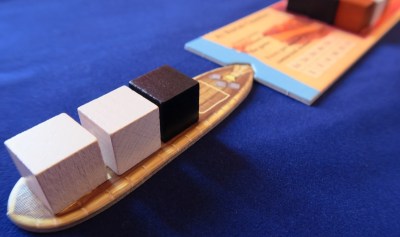
As usual, we started with a debate about who would play what.  Green picked out a load of games he fancied, including The Voyages of Marco Polo which he had only played the once before and fancied playing again.  Blue commented that it was the sort of game that Ivory would probably enjoy and with Black having spent quite a bit of time playing it online, he joined the others to make a trio.  The Voyages of Marco Polo, won the Deutscher Spiele Preis in 2015 and was designed by the same pairing that put together Tzolk’in: The Mayan Calendar, another game we have enjoyed recently and is a game we should play more often.  The game is played over five rounds with players recreating Marco Polo’s journey to China via Jerusalem and Mesopotamia and over the “Silk Road”.  Each player has a different character and special power in the game.  Each round, the players roll their five personal dice and can perform use them to perform one action each per turn.  The actions include:  gathering resources, gathering camels, earning money, buying purchase orders and travelling.  The game ends with players receiving victory points for arriving in Beijing, fulfilling the most purchase orders, and having visited the cities on secret city cards that each player gets at the start of the game.

The Voyages of Marco Polo
– Image used with permission of BGG contributor henk.rolleman

Last time he played, Green had been very successful with Kubilai Khan.  This time, after dice rolling to see who started, Green got to go first, but although he had the opportunity to take Kubilai Khan again, he decided to go for a different challenge.  So this time Green went for Matteo Polo giving him the white dice and the extra contract every round.  Ivory was next and went for Mercator ex Tabriz, a potentially powerful character which would give him an extra resource every time anyone else got one from the favour track or resource selection track. Black, having played often online, opted for Kubilai Khan and starting from Beijing with the immediate ten point bonus, but no other advantage. The fourth character that was rejected by all, was Wilhelm von Rubruk who allowed the player to place houses on cities they passed through without the need to stop (Black commented afterwards that this was a a very difficult character to be successful with).  Next, each player received four destination cards from which to choose two.  With many groans of dismay everyone quickly discarded one card they felt was all but impossible to complete and then had to choose the worst of the remaining cards for the second discard. No one felt very happy with their selections, but the cards dictated the strategies.

The Voyages of Marco Polo
– Image used with permission of BGG contributor jsper

For Green the strategy was simple, get as many contracts completed as possible and not worry too much about travelling.  However, some of the contracts provided extra free movement on completion, so with minimal travelling some of the cities could be completed.  For much of the game Green and Ivory laboured under the false understanding that only one contract could be completed per round. This meant that after he had secured the resources he needed for his one contract, Green was left with some “spare” actions, which he decided to use for travelling and money collection. It was only at the end of the penultimate round that Black corrected their misunderstanding and that although only one contract could be completed per turn, several could be done per round!  It was all a little too late for Green though. The extra free contract he got in the last round was a doozy, giving him another new contract when completed, but only yielding three points. Unfortunately the new contract released was also low value at only two points (although it was then easy to complete).

The Voyages of Marco Polo
– Image used with permission of BGG contributor henk.rolleman

Meanwhile, Black quietly got on with his game, regularly choosing the six camel resource and buying black dice to travel slowly from Beijing, down the board, and releasing the three action city. He used this to good effect gaining lots of purple resource bundles for contracts. It was while activating one of these city actions he revealed that the number on the die used indicated the number of times it could used. Cries of foul play came from Green and Ivory. Green had used a four spot on the “coins for houses” action before and Ivory would have used his six die on it this round instead of the five coin action space. Black scurried to the rules and discovered that for this “coins for houses” action, it was the number of houses which could be claimed for by the die. In other words, he could use a die of two to claim only two houses even if he had three.  A player would need a three spot die to claim for all.  So in the end, nothing changed for Ivory and Green, though it was something to try to remember for next time.

The Voyages of Marco Polo
– Image used with permission of BGG contributor henk.rolleman

Ivory decided that money was important and regularly placed his die in the purse and the “five coin” action. He was able to do because he was gaining so many resources from Black and Green’s actions, thanks to his special character.  This kept his contracts ticking over and he managed to travel around the board and complete all but one of his cities and get to Beijing. This left him with with a dilemma in the final round:  he needed a high value die and used his spare camels to provide a black, but only rolled a one.  Green gave him another camel (thanks to his resource collection).  So Ivory placed in the favour track for two more and bought another black die, this time rolled a three…  In the end he decided to just take coins to try to get an extra point.

The Voyages of Marco Polo
– Image used with permission of BGG contributor punkin312

It was moot in the end.  Green managed seven contracts in all, one more than Ivory and two more than Black, so Green got the seven point bonus after all. With twenty-nine coins at the end he was one short of an extra bonus point, though it wouldn’t have been enough.  Black had made a mistake in his travelling and not got the cities he meant to – he failed to get one of his cards and only built two houses.  Despite this, his ten point bonus for Beijing and several high value contracts gave him second place.  Ivory had had a great game though, picking up six contracts, taking second place in Beijing, completing one city card and taking a full 10 points from four cities in total.  It was more than enough to give him a three point lead and win the game. Ivory decided that Blue was right, he had really enjoyed The Voyages of Marco Polo.

The Voyages of Marco Polo
– Image used with permission of
BGG contributor bovbossi

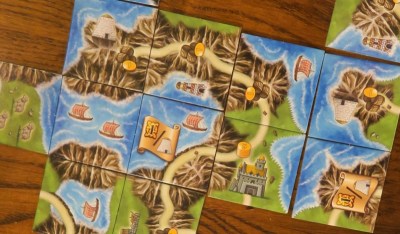
On the neighbouring table, Blue, Burgundy, Purple and Pine had started off with the “Feature Game”, Habitats,  This is a very light tile laying game, which comes with small ceramic animals instead of the more usual wooden player pieces.  There are a lot of tile laying games available, but there are a couple of things that make this one a little different.  Firstly, tiles selection:  there is an array of tiles and on their turn, players move their ceramic animal one step forward, left or right and take the tile it would have landed on and add it to their park.  Players can add their tile almost anywhere they want, so long as it borders at least one other tile.  The second unusual aspect of the game is the scoring:  tiles feature an animal and a terrain, but to score they most be surrounded by a set number of other given terrain tiles.  The game is played over four rounds with bonuses after the first three and final scoring at the end of the game.  Pine, with his orange Camel started out very strongly making him a bit of a target, however, although there is plenty of interaction, it is quite difficult to interfere with their plans a lot.  Burgundy started a little slower, but soon got his “extremely correct little Zebra” picking up tiles he wanted (as Pine said, “All zebras have a Hitler mustache and pink ears, don’t they?”).

Habitats
– Image used with permission of BGG contributor punkin312

Purple and her Penguin got a little trapped in the early stages, but got herself out of the mess quite quickly.  The bonuses were for the most different landscape tiles in the first round, different numbers of areas in the second and for a small compact park in the third.  They didn’t really seem to add much to the scores though, and with hindsight, some players might have done better ignore them completely as it is possible they were more of hindrance than a help since the most anyone got was five points (Pine and his orange Camel).  That said, the final scores were quite tight, with Blue and her yellow Leopard finishing just five points ahead of Pine who took a solid second.  On reflection, the difference was Blue’s effective use of Diagonal Tower tiles which allowed her to double score a lot of her animals.  Interestingly, the most recent edition of Spielbox had had a review of Habitats and they had been decidedly unimpressed.  While we agreed that it was quite a light game and certainly wasn’t long, the over-riding view was positive and Burgundy, summed it up when he commented, “Quite liked that”.

Habitats
– Image by BGG contributor styren

The Voyages of Marco Polo was still underway on the next table, so the group decided there was time for something else.  Pink had wanted to play Cottage Garden at the last Didcot Games Club meeting, but the number of players had been all wrong, so he had played it with Blue over the weekend.  Since it was fresh in her memory, there was a good chance of getting the rules right.  In any case, like Habitats, it is a fairly light tile-laying game, basically the boardgame equivalent of Tetris.  Cottage Garden is similar to the earlier, two-player game, Patchwork, but with a slightly different front-end and scoring mechanism.  The idea is that at on their turn, the active player chooses a tile from the appropriate row of the square “market garden”, and add it to one of their two flower beds.  If they have completed one or both of their flower beds by the end of their turn, then they are scored.

Cottage Garden
– Image used with permission of boardgamephotos

Scoring is a little unusual:  each flower bed (and some flower tiles) feature plant pots and cloches these are scored separately using players personal score tracks.  Each track ends at twenty and each player has three cubes they can use for scoring.  Placing tiles is facilitated by pussy-cats;  each player starts with two sleeping moggy tiles which they can place at any point on their turn to fill up odd spaces and keep the game moving.  The “market garden” is really quite interesting, though with four it can feel a little random.  The gardener moves round the board so that players choose tiles from successive rows, the idea being that players try to take a tile and plan what they might get next time.  This planning is quite difficult with four though as there is a high chance that a player’s next tile will have to be taken from a row diagonal or orthogonal to their previous one which means it is highly likely that someone will have taken what they want.  So, for the most part, the game is quite simple, with a lot of depth.  However, the final round is a little more tricky and jars a bit.

Cottage Garden
– Image used with permission of boardgamephotos

To ensure that anyone who has just started new flower beds doesn’t have a large advantage (due to the number of extra moves they would otherwise get), any beds with two flower tiles or fewer is discarded, and from the start of the final round players painfully lose two points per turn until they finish their final bed.  Again, Pine made the early running picking up two bonus beehive points for being the first player to get one of his markers to twenty points.  Blue wasn’t far behind though and just pipped Purple and Burgundy to the other beehive bonus.  One of the really nice things about this game is its rendition and we all had a good time playing with the little wheelbarrow.  Although Purple had played Patchwork quite a bit, spacial awareness is not really her thing and she and Burgundy struggled a little.  Blue on the other hand, works a lot with symmetry and with the extra experience she soon began to catch Pine and by the end of the game had pushed him into second place.

Cottage Garden
– Image used with permission of boardgamephotos

The most recent edition of Spielbox had also included a review Cottage Garden which had received similar treatment to Habitats.  Although we enjoyed the latter more, weconcluded that Cottage Garden wasn’t a bad game, but the penultimate round dragged a little and the final round felt a bit odd.  There’s also no development of the game over it’s duration, i.e. each player is just trying to fill as many beds as possible doing the same thing over and over again, which can make it feel a little repetitive.  That said, Blue felt she had enjoyed it more as a two-player game over the weekend as there is more scope for planning, so it is possible that four is too many players.  Indeed, nearly 70% of voters on Boardgamegeek are of the opinion that the game is best with three, and that could be a fair conclusion.

Cottage Garden
– Image used with permission of boardgamephotos

With The Voyages of Marco Polo coming to an end as well and lots of people quite tired, there was just time for Blue to have another go at beating Burgundy at Splendor.  This has become and almost fortnightly grudge match, with Burgundy proving to be almost impregnable.  This simple set collecting, engine builder is often derided as boring and trivial, yet it is the simplicity coupled with the subtitles that seem to make it so compelling.  As is so often the way, Blue started off OK, but this time very quickly fell behind.  Burgundy quickly picked up a noble, and although Blue took one as well, and had plans for picking up points, the writing was on the wall long before Burgundy took the third noble and announced he had fifteen points.  Blue will have to bring her A-game if she is ever to beat her “Splendid Nemesis”.

Splendor
– Image used with permission of boardgamephotos

Learning outcome:  Spielbox isn’t always right.

Next Meeting – 21st March 2017

Our next meeting will be on Tuesday 21st March, at the Horse and Jockey pub in Stanford-in-the-Vale.  As usual, we will be playing shorter games from 7.30pm as people arrive, until 8pm when we will start something a little longer.

This week the “Feature Game” will be Habitats, a tile laying game in which players build a big wildlife park without cages or fences.  Animals need their natural habitats: grassland, bush, rocks or lakes.  Points are awarded at the end of the game based on whether an animal’s requirements are satisfied; the player with the most points is the winner.

Habitats
– Image used with permission of BGG contributor punkin312

And talking of wildlife parks…

Starting his new job at a wildlife park, Jeff asked the Head keeper what he should do for his first task.

“Go and clean out the aquarium” he was told.

Arriving at the aquarium, he discovered that all the fish were dead. He rushed back to the head keeper and asked what he should do.

“Throw them to the lions,” said the head keeper, “The lions will eat anything”.

So, Jeff returned to the aquarium, picked up all the dead fish and threw them into the lion’s cage. That done, he was instructed to go and clean out the ape house.  When he got there, he was shocked to discover two of the chimpanzees dead in the cage, so he rushed back for instructions.

“Don’t worry,” said the head keeper, “Just throw them to the lions, the lions will eat anything.”

So Jeff returned to the ape house and threw the dead animals into the lions cage.  Next he was told to go along and help clean up the insect house. Busy cleaning out one off the exotic hives, Jeff noticed that in one hive all the bees had died.

“I know what to do,” he thought to himself, “I’ll throw them all to the lions, as the lions will eat anything.”  So Jeff he swept up all the dead bees and threw them into the lion cage.

The next day, the zoo obtained a new lioness. The lioness was walking around the new cage for the first time, and started asking the other lions what to expect.

“Hows the accommodation?” she asked.

“Fine,” came the reply from one lion.

“And whats the food like?” she asked.

“Not bad,” answered another lion, “Yesterday, we had fish, chimps and mushy bees…”

7th March 2017

This week we had a very late start, largely thanks to Blue falling asleep, Green debating whether he was coming alone or not, and a wine tasting evening at The Jockey which resulted in an unexpectedly long queue for food.  Then there was the inevitably long discussion about what to play.  Eventually, we split into two with the first group playing the “Feature Game”, Citrus.  This is a fairly simple tile laying game with a surprising amount of depth.  The game is played on a  fifteen by ten board, sprinkled with a small number of rocks spaces, a similar number of special landscape tiles, four Fincas and ten Finca sites with three of them prepared for building.  On their turn, the active player has two options, build or harvest.  If they decide to build, they take tiles from the market, paying for them with Pesetas and adding them to the board either expanding an existing area occupied by one of the active player’s workers or beginning a new area. If a new area is established, the active player claims it for their own by placing a worker on it.  Instead of building, the active player may harvest one or more of their areas, which awards them with points and income.

Citrus
– Image used with permission of boardgamephotos

There are a number of clever features which make the game interesting.  Firstly, each player has a maximum of five workers who live in their hacienda until they have been placed.  Income received from harvesting depends how many workers are in their hacienda after they complete their harvest.  For example, if a player has no workers in their hacienda, and on their turn harvests one plantation, they receive two Pesetas. If they chose to harvest another plantation on their next turn, this would then give them a second worker in their hacienda giving them an extra four Pesetas – a total of six Pesetas over the two turn.  Alternatively, they could have harvested both plantations in the first turn, but this would only yield a total of four Pesetas.  Each player has a limited maximum amount of twelve Pesetas, followed using a money track on the bottom of their hacienda player board.

Citrus
– Image used with permission of BGG contributor Toynan

One of the most novel parts of the game is the market.  At the start of the game, twelve tiles are placed on an asymmetric grid consisting of rows of two, three and four tiles.  On their turn the active player chooses a row and and takes the tiles paying one Peseta for each one.  If, after take plantations from the market, there are three or fewer plantations remaining there, the active player must immediately build a new Finca before restocking the market.  They draw the top Finca tile from the stack, choose one of the three building site tiles on the game board, replacing the tile with the new Finca.  This building site tile is removed from the game and a new one drawn from the stack, and placed on the matching space on the game board ensuring that there are always three building sites.  Since the Finca tile is placed on a building site of the active payer’s choice before they place their plantation tiles, timing a purchase to take this opportunity is a key part of the strategy of the game.

Citrus
– Image used with permission of BGG contributor punkin312

There are also a small number of tile placement rules:  new plantations can be created by placing the tile orthogonal to a Finca, on a road, or tiles can be added to the active player’s preexisting plantations.  Each plantation started next to a Finca must be of a different colour.  Tiles cannot be placed over rock spaces, nor can they be placed so they force a merger with another players plantation of the same colour.  Merging with a vacant plantation is not allowed if it is larger than the one belonging to the active player.  When a Finca is completely surrounded (all 8 spaces around it are  occupied), it is scored and the Finca tile is flipped over.  Each Finca depicts two scores: the number of tiles from all plantations adjacent to the Finca are counted and the player who owns most gets the higher score with the second placed player getting the lower number.  Players can also place tiles on spaces occupied by landscape tiles taking the tile which can give special actions or extra points.

Citrus
– Image used with permission of BGG contributor William Hunt

Importantly, all players involved retain their plantations and their workers remain on the board.  This means that large plantations that spread to several Finca’s can be highly effective scoring multiple times and when their reach has been exhausted, the they can be harvested yielding large amounts of points.  Thus, one of the cleverest parts of the game is the aspect of timing: understanding when a plantation has exceeded its usefulness and is ready for harvest, making sure that all large plantations are harvested before the end of the game is key., and our game was no  exception.  It was very cagey at the start with everyone playing for position, but nobody keen to start finishing off Fincas as it was guaranteed to give someone else points.  Eventually, players were forced to complete Fincas as they needed to be able to get cash and to do that, they had to harvest.  Pine took a substantial lead and soon Blue and then Purple left Burgundy far behind with nothing.

Citrus
– Image used with permission of BGG contributor punkin312

Eventually Burgundy got off the mark, but it became something of a running joke how Burgundy was at the back and we were all waiting for some incredible move.  In the end it didn’t really happen like that, but he did gradually bring himself back into contention.  Blue was convinced Pine had it as he had a very large lime plantation that gave him a lot of points as covered a lot of ground connecting several Fincas together, and would give even more when he harvested it.  Everyone made lots of mistakes, taking workers off when they shouldn’t have etc., but some were more costly than others. The game ends when the last plantation tile is bought and placed, so the end of the game, like the beginning was quite cagey with everyone trying to maximise the number of points they could get, and make sure they could harvest as many of their remaining plantations as possible.  In the end it was a very close game, but Pine had not picked up any “Wild Horse” tokens, which proved costly with Blue pushing him into second place in the final scoring.  It was the tussle for third that was tightest though, with Purple just managing to fend off Burgundy.

Citrus
– Image used with permission of BGG contributor punkin312

Meanwhile, on the next table, Black had joined Green and Ivory in a game of Fresco.  This is a game where players are master painters working to restore a fresco in a Renaissance church.  Each round begins with players deciding what time they would like to wake up for the day. The earlier they wake up, the earlier they are in turn order, and the better options they get.  However, if they waking up early too often, the apprentices become unhappy and stop working as efficiently. Players then decide their actions for the turn, deploying their apprentice work force to the various tasks:  buying paint, mixing paint, working on the fresco, raising money to buy paint by painting portraits, and even going to to the opera to increase the apprentices’ happiness and inspire them. Points are scored mostly by painting the fresco, which requires specific combinations of paints.  For this reason, players must purchase and mix their paints carefully and beat the other players to the store to buy the pigments and fresco segments they would like to paint.

Fresco
– Image used with permission of BGG contributor jsper

Green was keen to play with the third and final expansion module (that comes with the base game), and Ivory and Black were happy to give it a go.  This expansion uses the additional paint splodges on the back of the completed paint tiles of the fresco.  If a player gets thee identical splodges (or any three random colours, or indeed even no colours), he can “exchange” them for a Bishops Favour bonus tile.  This reduced his income, but does give an additional paint cube as well as bonus points.  Although Green went first (after a random selection from the bag), he chose to get up later, with both Black and Ivory getting up earlier. Therefore Ivory got first pick in the first round. He hadn’t played it before, but quickly realised that a key aspect of the game is getting the good paint from the market before anyone else can take them.  He combined this strategy with regular trips to the theatre (to make up for his early rising) and portrait painting (to fund his market purchases).

Fresco
– Image used with permission of BGG contributor ckirkman

Unfortunately this strategy left Ivory with fewer apprentices to mix paints and paint the fresco, so he spent most of the game behind Black and Green on the score track. This meant he regularly had first dibs on the alarm clock and could have changed strategy whenever he chose.  He eschewed the Bishops favours for most of the game, favouring the income over the bonus points and “free” paint.  Green used his late rising to grab whatever he could from the market cheaply and paint whatever he could of the fresco, using his spare cash to move the bishop to more favourable locations.  The tiles he accumulated he was able to gain income from , meaning he was never short of cash to buy what he could. The regular painting in the church meant he gained tiles early on and was able to be the first to exchange them for the Bishops Favour, and he maintained a modest lead through most of the game.  Towards the end of the game, Green was able to grab that early morning slot, buy the expensive quality paints he really needed and paint three high value tiles in one turn. This brought about the last round, but he had few resources left to do much in it.

Fresco
– Image used with permission of BGG contributor Toynan

Black played a canny game of “piggy in the middle” most of the time, and was able to get a good turn over in paint, mixing and fresco painting.  He kept pace with Green on the Bishops Favours, gaining the valuable three purple one for ten points and free purple every round (purple being the hardest colour to get as normally it can only be mixed from red and blue).  In the final round, Ivory went first, choosing to mix for some final alter painting.  This left two tiles in the church (either side of the bishop), which left them available to Black along with a three big colour alter job which pushed him ahead of Green.  Green, going last, had little paint and only managed a big alter painting, but it wasn’t enough and he was still four points behind Black.  Converting the remaining money into points, Ivory added a massive ten points to his tally, but with twelve and thirteen coins respectively, Black and Green were equal, picking up an additional six points each giving Black a well deserved victory.  In the final game analysis we decided we enjoyed the Bishops Favour and Black felt it was better than the extra colours expansion.  Green still felt the portrait cards were best, but combining both could make for a very interesting game, one for next time perhaps.

Fresco
– Image used with permission of BGG contributor jsper

With both Fresco and Citrus finishing at much the same time, Ivory and Green went home leaving everyone else to shuffle chairs and decide what to play next.  There wasn’t a huge amount of time and nobody was terribly keen to play anything too “thinky”, so it wasn’t long before Las Vegas came out.  This is a strange game which has masses of downtime, yet seems to get played every time it is brought.  Part of this is probably because it falls into that category of being a game nobody minds playing although, few would say it was a game they actively want to play.  In truth, it is almost more of an activity than a game really, but we find it quite relaxing towards the end of the evening.  The game itself is a very simple betting game.  Players begin their turn by rolling their dice and then assign some of them to one of six casinos (one for each dice face) each of which has a jackpot drawn at random from a deck of money.  Players must place all the dice displaying one number to bet on the casino of that number, and when done, play passes to the next player.

Las Vegas
– Image used with permission of BGG contributor ckirkman

Once everyone has placed all their dice the player who placed the most dice on a casino takes the highest value currency card, with the person in second place taking the next and so on. The really clever bit is that before any money is handed out, any “draws” are removed.  This leads to a lot of barracking when dice are played as opponents try to encourage the active player to choose their favoured option.  As usual, we included the Big Dice from the Boulevard expansion and the Slot Machine mini-expansion from the 2015 Brettspiel Advent Calendar.  The large dice are double weight and count as two in the final  reckoning.  The Slot Machine acts like a seventh casino, except that it can hold dice of any number, but dice of each number can only be added once (though a player must add all the dice they have of that number).  Since we play the game unusually slowly, we generally stop after just three rounds rather than the four recommended in the rules.  This time, the game was tight between first and second, but Purple just pipped Pine to the post, winning by $10,000.

Las Vegas
– Image by boardGOATS

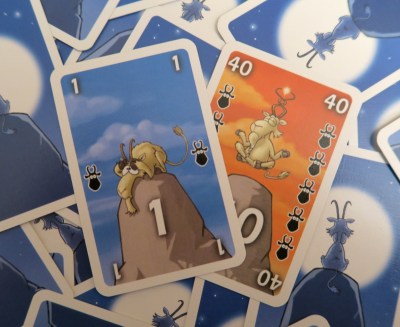
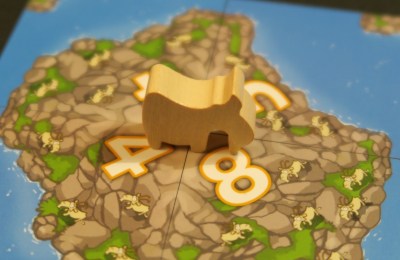
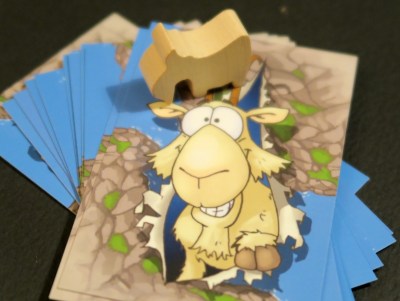
We were almost out of time, but there was perhaps time for something quick.  Since Pine had expressed dismay at missing the “Feature Gamelast time, we decided to give Bokken Schieten (aka Ziegen Kriegen or Cliff Hanger) a quick go, as “it really does only take ten minutes to play”.  It turned out that Black and Purple had also missed out last time, but that didn’t slow things down too much as it is not a complex game.  The idea is that players choose a card from their hand and play it face up in front of them – the person who plays the highest card takes the trick and with it all the cards played in the round.  The player who plays the lowest card plays draws a Goat Island card and places the goat-meeple on one end, choosing which end will become start Goat Island.  The game continues with players playing cards and winning tricks, and the player who plays the lowest numbered card adding to Goat Island, choosing whether to add a large or small amount to the total.  At the end of the game players count the number of goat heads on their cards and the winner is the player with the highest total that does not exceed the sum of the numbers on Goat Island.

Bokken Schieten
– Image by boardGOATS

There were lots of appreciative remarks about the fabulous “goaty” artwork, which features “zen-goat”; “artist-goat”, and even a “bored-goat” (or should it be a “boardGOAT”?).  We started out a little tentatively, but the game as taken by Black who managed to successfully exactly hit the Goat Island target.  Since it really had taken less than fifteen minutes (ten to play and five to explain), since everyone now understood how to play, we decided to give it another go.  As in the first round, Burgundy continued to apply his “winning” 6 Nimmt! strategy, picking up a massive forty-two goat heads.   With a limit of just eleven, however, it was Blue who took the game, with just one head more than Pine.  Much hilarity ensued when Pine, trying to work out how to pronounce Bokken Schieten idly mused wither “kk” in Dutch was actually pronounced like “tt” in English…  On a bit of a roll, with the cards out, we ended up playing a third round.  This one went to Purple, giving her a second victory which made her evening, especially given how thrilled she had been at beating Burgundy in Citrus.

Bokken Schieten
– Image by boardGOATS

Learning Outcome:  A game may take ten minutes, but only if it is played just once…

Next Meeting – 7th March 2017

Our next meeting will be on Tuesday 7th March, at the Horse and Jockey pub in Stanford-in-the-Vale.  As usual, we will be playing shorter games from 7.30pm as people arrive, until 8pm when we will start something a little longer.

This week the “Feature Game” will be Citrus, a tile laying game where players are building citrus plantations.  In order to build, however, it’s essential to harvest plantations from time to time as this is the only way to bring in new income, but when is the timing right? And most importantly, which plantation should be harvested, thus taking it out of the race for the important points during the scoring?

Citrus
– Image used with permission of boardgamephotos

And talking of citrus fruit…

Jeff had been suffering from a cold, so went to the market trying to buy some oranges.  He asked at the first stall he came to, but the stall-holder apologised and explained he had no citrus fruit today.  So, Jeff continued round the market asking everywhere for oranges, but to no avail.  Eventually he came back to the first stall and thought he’d try his luck again, but again, the the stall-holder apologised and explained he had no citrus fruit today.

By this time, Jeff was desperate and begged the stall-holder, who was beginning to get exasperated.  In the end, he said to Jeff, “Answer a three questions and I will get you your oranges from the back.”

Jeff agreed and the man started asking his questions, “First, spell ‘cat’ for me, as in catastrophe.”

Jeff thought for a moment and then replied, “C A T”.

“Very good,” the stall-holder said, “Now spell ‘dog’, as in dogmatic.”

Jeff didn’t hesitate this time, “D O G,” he responded.

Finally, the stall-holder asked, “Now spell, ‘flip’, as in oranges.”

Jeff paused a moment, puzzled. “But there is no ‘flip’ in oranges,” he answered eventually.  The stall-holder replied, “That’s exactly what I’ve been trying to tell you – No Flippin’ Oranges!”

21st February 2017

We started the evening setting up the card games, The Golden Sails and 3 Sind Eine Zu Viel!, but as more players arrived and time was getting on, we abandoned them in favour of the “Feature Game”, Bokken Schieten (aka Ziegen Kriegen or Cliff Hanger).  This is a game that that arguably should be come the group’s signature game as it is very simple little trick taking card game all about goats.  As the rules were explained, Grey (on one of his rare, but much valued appearances), commented that it was like Blackjack (aka Pontoon or Vingt-et-Un) – i.e. play to a limit, but exceed that limit and you are bust.  The idea is that players choose a card from their hand and play it face up in front of them – the person who plays the highest card takes the trick and with it all the cards played in the round.  The player who plays the lowest card plays draws a Goat Island card.  These have two ends with different numbers on them, so the first “loser” takes a card and places the goat-meeple on one end, choosing which end will become part of Goat Island.

Bokken Schieten
– Image by boardGOATS

The game continues with players playing cards and winning tricks, and the player who plays the lowest numbered card adding to Goat Island, choosing whether to add a large or small amount to the total.  At the end of the game, the total of the four cards that make up the island define the limit and players who exceed that value are out.  The catch is that players are not summing the face value of the cards (which go from one to fifty), instead, a little like 6 Nimmt!, they are counting goats head symbols which have little relation to the face value of the cards.  We played the game twice through, since we made a bit of a mess of it the first time.  After a long discussion about whether completed tricks should be placed face down or not, Red who led first misunderstood and thought the cards were played face down, so that screwed up her first turn and lumbered her with a pile of cards she didn’t want.

Bokken Schieten
– Image by boardGOATS

This led to Grey’s comment that the game was poorly designed as once a player is bust their game is over.  In fact though, the game is so short that effective player elimination doesn’t matter that much and in any case, players who are out can still try to take as many others with them as possible.  After the first hand (taken by Grey), we gave it another try.  By this time, Blue had managed to find out who leads after the first trick so instead of passing the honour round the table, we played correctly and the winner led.  The second game went to Red, and was definitely more fun as we began to see what the aim of the game was and how to screw up other people.  We were just beginning to get the hang of it, but felt we should move on to something else now everyone had arrived.  It was genuinely very quick though, so we’ll probably play it again and it might be worth trying some of the variants too.

Bokken Schieten
– Image by boardGOATS

With such a short “Feature Game” and everyone being far too polite, we spent a lot of time deciding what to play next.  Orleans, Terraforming Mars, Viticulture and Agricola were all on the table, but nobody wanted to commit in case something better came along, or perhaps because they genuinely didn’t really mind and were happy to fill in once those who did mind had made a choice. Eventually, Magenta said she would like to play Isle of Skye and several said they’d be happy to play that if others wanted to play something else.  Ivory on the other hand said he was quite happy to play Agricola (which had been brought with him in mind, then Green walked in, making things slightly more complicated as with nine players one game would have to be a five-player which might make it long.  In the end Red got fed up with people being indecisive and started to direct people:  first she made a three player game of Agricola, then she found two to join Magenta playing Isle of Skye which left Blue, Burgundy and Red to find something else to play, which ended up being Imhotep.

Imhotep
– Image by boardGOATS

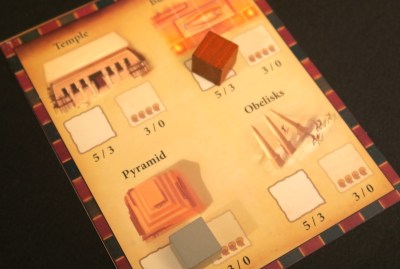
Imhotep is a very simple game that we’ve played a few times since is was nominated for the Spiel des Jahres last year.  On their turn, the active player chooses one of four actions:  procure new stones; load stones on a boat; sail a boat to a monument; or play an action card.  Players can only store a maximum of five stones and when they procure stones they can collect a maximum of three.  Stones are loaded onto ships one at a time, but which of the five possible destinations the boats end up at and the order they are unloaded in is vital, so timing and planning is everything.  What makes it particularly tricky is that the best plans in the world can be crushed by opponents with one small action: when they take a boat to the “wrong place” or “at the wrong time”.  There are four ships and five building locations, so one doesn’t get visited and the round ends when all four boats have sailed.

Imhotep
– Image by boardGOATS

The building locations are double sided so the game can be played with the less complex Side A, the slightly more confusing Side B, or a mixture of the two.  Red had struggled last time she had tried Imhotep since she ended up playing with two people who had tried it before and wanted to play with Side B without fully appreciating how much more complexity it adds.  This time, therefore, we stuck to the simpler Side A, but instead added the Stonemason’s Wager Mini Expansion to give it just a little extra interest.  This little promotional item allows players a one-off, extra option:  the chance to bet on which monument will have the most stones in it at the end of the game.  Otherwise the game is unchanged and there are six rounds in total, as usual, with points scored in different ways for the different buildings; the player with the most points at the end is declared the best builder in Egypt.

Imhotep: The Stonemason's Wager Mini Expansion
– Image by boardGOATS

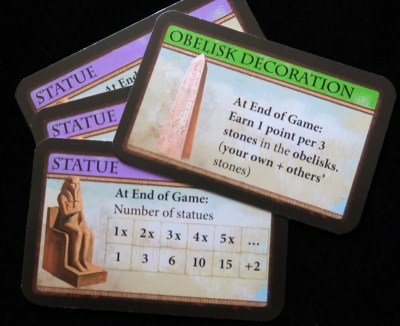
This time, Blue and Burgundy started out visiting the Market picking up statues, but with both in the same market it was always going to be a struggle.  Meanwhile, Red stole an essentially insurmountable lead in the Obelisks.  Blue took a green card that would yield a point for every three stones in the Burial Chamber at the end of the game, so she tried to encourage boats to go there.  Unfortunately, because she also nearly picked up a significant score on the Burial Chamber, but Burgundy was first forced to obstruct her plans and then Red and Burgundy started sending boats to the Temple instead.  In general, it was quite a cagey game with everyone concentrating on not letting anyone take too many points rather than trying to make a killing themselves.  Going into the final scoring, it was all quite close.  Red took the points for the Stonemason’s Wager, and Burgundy took points for statues, but Blue had a lot of bonus points from a range of sources, giving her first place, ten points ahead of Burgundy in second.

– Image by boardGOATS

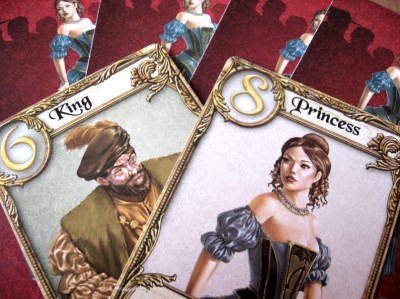
Imhotep finished, but next game was not far behind, so Blue, Red and Burgundy played a couple of quick hands of Love Letter while they waited.  With its quick play, this micro-game is one of our go to fillers.  The idea is that each player has a single card in hand, and on their turn they draw a second and choose one of the two to play.  Each card has an action and a number, one to eight.  Players use the actions to try to deduce information about which cards others are holding and, in turn use that to eliminate them.  The winner is either the last player standing or the player with the highest ranking card at the end of the game.  In the first round, Blue was caught holding the Princess leaving Burgundy to take the round.  The second played out to the final card.  With just two possible cards left and the Princess still hiding, Red took a chance and played the Prince, forcing Blue to discard her hand.  This meant she had to pick up the set-aside card, which was, of course, the Princess, making it a two-way tie.

LoveLetter
– Image by boardGOATS

On the next table, Magenta, Purple and Grey had been playing a game of Isle of Skye: From Chieftain to King.  This won the Kennerspiel des Jahres last year, and has proven to be quite popular with our group.  The game is a sort of upgraded tile laying game with a lot in common with Carcassonne, but with the added feature of an auction at the start of each round and scoring at the end of each round.  The scoring is one of the interesting parts of this game as the four scoring criteria change from game to game and, and each one scores three times during the course of the game.  Choosing how to prioritise these to drive a strategy is one of the keys to playing well.  This time, with points available throughout for completed areas (lakes and mountains), this was a clear target, however, identifying a strategy and making it work are two different things.

Isle of Skye: From Chieftain to King
– Image by boardGOATS

For example, Purple was unlucky that she was unable to get any tiles with cows on roads until the final round, which meant she struggled to build a score early in the game.  Although this meant she picked up the bonus money for being at the back, she still struggled to get the tiles she wanted.  Similarly, Grey was unlucky in that he placed a tile that later became an real obstacle making it difficult for him to place tiles later and get points.  It was Magenta though who had been able to build an early lead, and kept it throughout picking up points every round.  A couple of lucky tile draws gave her good tiles that both Grey and Purple wanted making it a sellers market, and leaving Magenta with lots of cash to spend towards the end of the game.  Going into the final scoring, Magenta had a sizeable lead, but Grey had a large pile of cash which yielded a tidy eight points and very nearly gave him the game.  Magenta managed to fend him off though with the one point she took for her remaining seven coins, making the difference between first place and second.

Isle of Skye: From Chieftain to King
– Image by boardGOATS

With the games on the first two tables complete, Red, Magenta and Grey went home leaving Purple, Blue and Burgundy to play yet another in the long running campaign to beat Burgundy at Splendor.  This simple set collecting, engine builder has proved to be quite intractable.  Blue and Pine in particular have had several attempts to get the better of Burgundy, but so far he has just had the edge.  Sadly this this game was no exception, though the game was very, very tight. There was a shortage of Opals cards available, despite the presence of lots of cards needing them.  Emeralds were also quite scarce at the start, but Burgundy managed to build a substantial collection of Diamonds to keep the threat alive.  Blue thought she had finally got Burgundy trapped but in the final round Purple took a card and the replacement was a sapphire that Burgundy could take and gave him eighteen points, one more than Blue (who was last in the turn order).  Yet another very, very close game – we’ll get him in the end…

Splendor
– Image used with permission of boardgamephotos

Meanwhile, all evening, Ivory, Black and Green had been engaged in an game of Agricola.  This had started out with an extensive effort to disentangle the cards for the base game from the myriad of expansions Blue had somehow crammed into the box.  Once this was sorted though, and the game was set up, a rules explanation was necessary as Ivory hadn’t played it before.  The archetypal worker placement game, players star out with a farming couple and a shack and during the game try to build up their farmstead, livestock and family, the winner being the player with the most successful farm. Actions available include things like upgrading the farmhouse, ploughing and sowing fields, enclosing areas, taking livestock, and, of course, procreating.  One of the clever parts of the game is that each round, an additional action become available, but the order of these is not known in advance.  The stress is provided by harvests that occur at intervals during the game and require players to have enough food to feed their family, or resort to begging (which yields negative points at the end of the game).

Agricola
– Image by boardGOATS

This time, instead of playing the family game, we played the full version which includes occupation and improvement cards.  The challenge with this game is to use the cards effectively, but not to get carried away and try to force the strategy to use cards to its detriment.  Green started with occupations and used them to quickly fenced a large padock for sheep (building one gave him three extras).  He then ploughed and got three fields up and running before going back to enclosing pasture for cattle. Despite only having two family members, he struggled to have enough food until he eventually managed to nab a cartload of clay and used it to build a an oven, which proved invaluable at keeping hunger at bay.  Towards the end, he finally managed to develop his family and added a pig for a total of twenty-nine.

Agricola
– Image by boardGOATS

Black played a quiet game, also didn’t grow his family and farm developed only slowly too.  As he often does, Black instead concentrated on home-making and upgraded his house to clay and then stone in quick succession.  Somehow he didn’t struggle at harvest time as much as Green, probably because he went into building ovens which provided his food.  This was at the expense of his farm, which remained stubbornly small, right until the end.  The unused spaces cost him though, as did his lack of pigs, and he finished with a fine house, but only one child and a score of twenty-three points.

Agricola
– Image by boardGOATS

Ivory went for a different strategy, starting by going for lots of food, and support for getting food later.  In particular he made good use of his Mushroom Picker.  Building his food engine so early enabled him to grow his family early in the game giving him extra actions.  These he used to quietly collect lots of resources, which enabled him to build a large field for sheep.  He then enclosed second pasture and just swiped a field full for boar before Green got them. He only ploughed late (perhaps it was the snowy landscape that delayed him), but his early food strategy really paid off.  All his extra cards were valuable too and added ten points to his score, giving him a total of forty-one points and victory by a sizeable margin, despite Green’s inadvertent cheating!

Agricola
– Image by boardGOATS

Just as Agricola came to an end, Splendor finished too.  So, after helping to shoe-horn the miriad of little pieces back into the boxes, Ivory and Green headed off leaving Black to join the others.  The ever dwindling numbers were boosted with the arrival of Pine, who had been two-timing us with the WI – he said they had the lowest average age of any WI he’d ever come across, so maybe that was the appeal.  The remaining five gamers felt there was time for one more game, as long as we could keep it to about forty-five minutes.  We are not the quickest at playing, or choosing and time was beginning to get tight, so we opted for Bohnanza as it played quicker than other suggestions and it wouldn’t need any rules reminders (like 11 Nimmt! and Port Royal).  The game is one of our old staples, is quick to learn and keeps everyone involved throughout.  The key to the game is that players cannot rearrange the cards in their hand and must play them in the order they arrive.  Thus, on their turn, the active player first plays the first card in their hand with the option of playing the second if they desire.  Once they’ve been planted, two cards are drawn which can be traded, but must be planted by someone.  This can lead to free gifts, but also players being nasty and refusing to take even the apparently most lucrative trades.

– Image by boardGOATS

This time, Pine was making up for lost time, and the well-known good nature of the WI hadn’t rubbed off.  He accused Burgundy of just about everything he could think of, in an effort to persuade everyone else not to trade with him. Black had one of his worst games for a long time with all the wrong cards coming up at the wrong time giving him nothing to work with.  Otherwise it was a very tight game. In the dying turns, despite Black’s protestations, Purple and Pine both gave Blue exceptionally favourable trades (possibly in an effort to square things from earlier, but more likely to ensure that Burgundy didn’t win – again).  Much to Pine’s surprise, that left him in joint first place with Blue, one coin ahead of Burgundy (possibly the most important factor to him).  Feeling she had been gifted a joint win by Pine’s generosity at the end, Blue offered to concede to Pine, but on checking the rules he won anyhow on the tie-breaker, as the player with the most cards in hand at the end.

Bohnanza
– Image used with permission of BGG contributor spearjr

Learning Outcome:  Cheating doesn’t pay.

Boardgames in the News: KickStarting a Boardgame Café with Radio 4

Over the last few years, boardgaming has become increasingly acceptable amongst the general public and one consequence of this has been the continuing rise of the boardgame café.  Boardgame cafés have come a long way since Thirsty Meeples opened in Oxford just three and a half years ago.  In fact, one online map has the number in the UK now totalling over forty.  There have been several articles commenting on their spread too, including an interesting recent article on Radio 4‘s consumer affairs programme, You & Yours covering crowd funding, boardgames and modern café culture.

Some of the boardgameing reports in the media have been quite poor, but this is one of the better articles.  The reporter, Bob Walker visits the two boardgame cafés in Nottingham, Ludorati and The Dice Cup, interviewing both staff and customers who are clearly having a good time playing a range of games including Munchkin Zombies and while Risk as well as the inevitable Monopoly get a mention.  More interesting is an interview with Peter Blenkharn from Inside the Box , a small company who are producing Sub Terra which has just raised £368,256 via KickStarter.  There are a number of other interesting statistics quoted, for example, it is apparently estimated that the board and card game market in US is worth $1.2 billion.  Bob Walker also talks to Matt Jarvis, editor of Tabletop Gaming Magazine, which was originally quarterly, but is now bimonthly due to increasing popularity.  Matt cites a recent Tabletop Gaming Magazine report which claims that tabletop games made over $100 million last year on KickStarter, more than four times what computer games achieved in the same period.  Much of this was raised by miniature games so the recent reprint of Kingdom Death: Monster alone raised over $12 million – the sort of figure that producers of Euro, or family games, would never dare to dream of – even the infamous Exploding Kittens only raised $8.7 million.  Nevertheless, it is clear boardgaming continues to go from strength to strength.

You & Yours
– Image from a2milk.co.uk

Next Meeting – 21st February 2017

Our next meeting will be on Tuesday 21st February, at the Horse and Jockey pub in Stanford-in-the-Vale.  As usual, we will be playing shorter games from 7.30pm as people arrive, until 8pm when we will start something a little longer.

This week the “Feature Game” will be Bokken Schieten (aka Ziegen Kriegen or Cliff Hanger). This is a quick little trick-taking game in which players accumulate goats.  The winner of the game is the player who collected the most goat’s heads without going over the limit dictated by the central hill.

Bokken Schieten
– Image by boardGOATS

And talking of goats…

Jeff was driving round London when a policeman pulled him over.  “What are you doing with that goat?” he exclaimed, pointing to the goat sitting in the passenger seat. “You should take it to the zoo.”

“That’s an excellent idea officer, I will do just that!” replied Jeff and the Policeman waved him on his way.

A week later, the same policeman saw Jeff again, once more with the goat in the passenger seat, but this time both were wearing sunglasses.

As before, the policeman pulled him over, “I thought you were going to take that goat to the zoo!” he said angrily.

Jeff replied, “I did. We had such a good time we are going to the beach this weekend!”

7th February 2017

It was a very quiet night, with work and family commitments and illness decimating our numbers.  In fact, for a long time it looked like there might only be two of us, but we were saved that indignity when Ivory turned up, quickly followed by Green.  After we had cheered Burgundy through his Hawaiian, we settled down to the “Feature Game”, Roll for the Galaxy.  This is a re-implementation of an older card game, Race for the Galaxy, with the addition of dice.  One of the common complaints about Race for the Galaxy is the complexity of the iconography, which was used to limit the amount of text on the cards.  This has been significantly reduced in Roll for the Galaxy (and largely replaced with text), but in its place there is a complex dice economy.

Race for the Galaxy
– Image used with permission of BGG reviewer EndersGame

In summary, players roll the dice in their cup in secret, behind their screen.  They then distribute the dice according to their symbols, matching them up to each of the five phases, Explore, Develop, Settle, Produce and Ship.  Players then, still in secret, re-position one of their dice to use it to choose one action they would like to activate.  Players can also put a die to one side for a turn to “Dictate” the symbol on another die, i.e. reassign it to a different phase.  Once everyone has positioned all their dice, the player screens are removed and players simultaneously carry out the phases that have been chosen in order.  In general, each die is used to carry out an action once, so if a player has multiple dice assigned to the same phase, the action may be carried out several times.  Any dice that are not used (or were used for the Dictate action) are returned to the players’ cups whereas dice that are used must be placed in the player’s “Citizenry”.  Dice in the Citizenry must be transferred back into the player’s dice cup before they can be used again, and this costs $1 per die.

Roll for the Galaxy
– Image used with permission of BGG contributor punkin312

The next natural question is, how do players get money?  Money comes from Trading goods:  during the Ship phase.  Goods are placed on Production Worlds during the Produce phase and can either be Traded for money (where the value depends on the type of World that produced them) or Consumed for victory points (where bonuses are received if the dice colours match that of the Worlds that produced them) during the Ship phase.  There are three types of World on double sided square tiles:  one side is a Development World and the reverse is either a Coloured Production or a Grey Non-Production World.  Worlds are all “built” by spending dice during either the Development phase or Settle phase (for Production and Non-Production Worlds) and the cost is returned in Victory Points at the end of the game.  Players draw World tiles from a bag during the Explore phase.  They choose which side they are going to try to build and therefore which stack to place them in, either the Develop or the Settle pile.

Roll for the Galaxy
– Image used with permission of BGG contributor punkin312

In general, Development Worlds give special powers and or extra points at the end of the game.  In contrast, Production and Non-production worlds give more dice and, in the case of the coloured Production Worlds can also provide Victory Points and/or money.  The clever part is controlling these piles and manipulating the worlds built in order to steer a particular strategy.  The game ends when either one player builds more than twelve Worlds, or the Victory Point chip pile is exhausted, in this way, it is a race and controlling the game length is one important aspect of play.  Inevitably in a dice game, the most important part of the game, is managing and working with luck.  The different dice colours have different distributions of the phase symbols, for example, while red (Military) dice have two Develop and two Settle symbols, blue (Novelty) dice have two Produce and two Ship symbols.  Thus, the game could be compared with a game like Orléans, where players build the contents of their bag in an effort to control luck, rather than the symbols on the dice in their cup.

Roll for the Galaxy
– Image by BGG contributor haslo

It is a game that takes a bit of getting used to and everyone struggled a bit.  Unusually though, it was Burgundy who struggled the most which made a change for the rest of us.  It was all made worse by the inevitable rules confusions though.  Before we started, Green had questioned whether it was compulsory to place one die to choose the phase or whether it was optional.  Only Blue had played before and then only with two players which made it a quite different game, and on that occasion, they had played that it was optional.  It was not glaringly obvious from the rules, though eventually we came to the conclusion that it should not be optional, so we proceeded with the game along those lines.  As the game progressed, it became apparent that this led to a logical inconsistency.  The rules specifically stated that if a player had no dice in their cup after recruiting (i.e.at the end of the round) they must recall any dice left on worlds as goods or in the process of Developing or Settling.  The problem with this was that if a player was then forced to use this die to choose a round, without dice to actually carryout the action they would be forced to spend any assets, but with no way of turning them into anything useful.

Roll for the Galaxy
– Image used with permission of BGG contributor punkin312

For this reason, we returned to playing that choosing an action was optional, which allowed players to take a chance that others would choose the action they wanted.  About half way through the game, Green, who had been fiddling with his phone looking up specifics of a World he’d built, had an “Aha!” moment when he found something on the rules forum.  The thread explained that the die that use to select a phase acts as a worker of that type during the chosen phase.  This is in “Frequently Overlooked Rules”, but somehow the use of the the term “worker” didn’t make it clear.  If the die used to select the action could also carry out that action though, not only did it prevent “single die jeopardy”, but it also meant that players were effectively guaranteed one completely unconstrained move (because the symbol on the die used to choose the action does not have to match the phase).  Even better, a player with three dice, could use the “Dictate” option to give them any two (potentially different) actions.

Roll for the Galaxy
– Image used with permission of BGG contributor punkin312

Although this clarified everything, it had the potential to make such a huge change to the game we decided to carry on playing as we had been.  We could all see how this made much more sense though and would also speed the game up.  By this time it was very clear who was going to win in any case though.  Green had started with the Genetics Lab which turned out to be extremely powerful as it gave him an extra $2 every time there was a Produce phase.  After checking the rules forum (again) it became clear that this was regardless of whether he initiated it, so long as he left his green die on a production world he had an income which effectively meant that he didn’t really need to worry about money.  Eventually, he put us out of our misery by building his twelfth World bringing the game to an end.  Totting up the scores gave a surprising result. Green was inevitably miles in front with forty-four points, but everyone else was caught in a three-way tie on twenty-two points.

Roll for the Galaxy
– Image used with permission of BGG contributor punkin312

It was clear that playing correctly would have a huge impact on game play and, although Green and Ivory had to leave everyone was keen to give it another go in a few weeks time.  Blue had the chance sooner, however.  On Sunday afternoon we had the third of our “Monster Games” sessions, and after a game of Roads & Boats, Blue, Pink, Black and Purple gave it another go.  Black and Purple were completely new to it, and Purple struggled a bit with the dice economy while Black was not sure how to control the worlds available to him.  It was clear to Blue and Pink though that playing by the rules as written, unsurprisingly, made the game work much better.

Roll for the Galaxy
– Image used with permission of BGG contributor punkin312

With Green and Ivory gone, Burgundy was keen to play something a little shorter and lighter and Blue fancied having another go at beating Burgundy at Splendor.  We play this game a lot and beating Burgundy at this game has become something of a Group Challenge, but somehow he always just gets the rub of the green.  This is a game of chip-collecting and card development where players collect chips to buy gem cards which can then be used in lieu of chips.  More expensive cards are also worth points and the game end is triggered when one player reaches fifteen points and the round is completed to give everyone the same number of turns.  Points are also awarded for “Nobles” which go to the first player to get a specific combination of gem cards and the player with the most points at the end is the winner.

Splendor
– Image used with permission of BGG contributor henk.rolleman

This time, the Nobles were opal, diamond & ruby; opal, ruby & emerald; sapphire, emerald & diamond.  At the start of the game rubies were scarce, but sapphires and emeralds in particular were scarcer.  This was not too much of a problem initially as opals and diamonds were needed for the Nobles, but it gradually became more of an issue as the game went on.  Blue and Burgundy were pretty much neck-a-neck for the first half of the game with both players picking up nobles on the same turn.  It was very tight though and the pressure from Burgundy forced Blue to reserve cards giving helpful Gold (which is wild), but is a very inefficient approach.  In the end, the game was painfully close.  Burgundy finished his turn and began re-counting his points.  It was only as Blue claimed seven points (one card and a Noble) to give her a total of sixteen points that he commented that actually he already had fifteen.  Since Blue started, that meant she wasn’t able to claim her final turn.  Normal service resumed then!

Splendor
– Image used with permission of BGG contributor henk.rolleman

Learning Outcome:  Playing by the correct rules can improve a game no end…

Next Meeting – 7th February 2017

Our next meeting will be on Tuesday 7th February, at the Horse and Jockey pub in Stanford-in-the-Vale.  As usual, we will be playing shorter games from 7.30pm as people arrive, until 8pm when we will start something a little longer.

This week the “Feature Game” will be Roll for the Galaxy, which is the dice game of the popular empire building card game, Race for the Galaxy.  The dice represent the players’ populace, which are directed to develop new technologies, settle worlds, and ship goods. The player who best manages his workers and builds the most prosperous empire wins.

Roll for the Galaxy
– Image used with permission of BGG contributor punkin312

And talking of dice…

Jeff was sitting his finals and, for the last multiple choice exam took a handful of dice with him into the hall.  As soon as the exam started, be began furiously rolling the dice to select his answers.  The invigilator gave him a long look as he passed, but it is not uncommon for students to resort to luck when they get stuck.  Jeff soon finished the paper and, tired with all the exertion, pillowed his head on his arms and went to sleep.  After about half an hour, Jeff suddenly sat up, and started furiously rolling his dice again.  The invigilator was curious and suddenly worried that maybe something was going on, so he approached the candidate.

“Excuse me, what are you doing?” he asked.  “Why are you rolling the dice again if you finished the questions earlier?”

Jeff replied, “I’m just double checking my answers…”

24th January 2017

Food was a little delayed, so as it was a relatively quick game (and one that we felt we could play while eating if necessary), we decided to begin with the “Feature Game”, Bohemian Villages.  This is a fairly simple tactical dice-rolling game.  The idea is that on their turn, the active player rolls four dice and uses them to assign their meeples to buildings in the villages of Bohemia.  The dice can be used as two sets of two, a group of three (with one forfeit) or in their entirety as a group of four.  These values correspond to the different types of buildings which appear with different frequency and give different rewards.  For example, if a player rolls a six, they can place their meeple on a Flour Mill.  When the last of the Flour Mills is occupied, everyone gets their meeples back, together with two coins for each one.  Similarly, rolling a seven allows the active player to place their meeple on a Glass Factory, however, when they get them back they get three coins instead of two.

Bohemian Villages
– Image by boardGOATS

Other buildings work differently though, for example rolling a two, three, four or five allows players to put their meeple on a Shop.  There are four different types of Shops and players are rewarded increasingly large amounts of money for the more different Shops they occupy at the end of the game.  A set of four is very valuable, but the snag is that the number of Shops available is very small.  So, once they are all occupied, if another player rolls the right number they can bump someone else off costing them a lot of money in the process.  Players rolling a twelve, place their meeples on Manor Houses which give an immediate reward whereas inns (nine) give a regular income at the start of the active players turn, so long as they remember to claim it!  Farms also provide income during the game with the active player collecting one coin for each farm owned when they add a new one (i.e. roll another eight).  Churches and Town Halls (ten and eleven) provide money at the end of the game with players rewarded for occupying the most Churches or for occupying a Town Hall in a fully occupied village.

Bohemian Villages
– Image by boardGOATS

The game ends when a player runs out of meeples and the winner is the player with the most money.  We were just about to start a five-player game when Green and Ivory pitched up, so Red joined them, leaving Blue, Pine, Magenta and Burgundy to start.  With food arriving just as we started, Blue began by claiming the most lucrative Manor House with all four of her dice before turning her attention to her pizza.  Magenta started collecting Shops, but soon faced competition from Pine.  Meanwhile, Burgundy was sidetracked by his supper, Blue tried to get a regular income stream from a chain of Inns and Pine went into the church.  Somewhere along the line during her rules explanation, Blue had commented that Farms could be quite lucrative, so Magenta took the hint and before long she was engaged in a massive land-grab.  It took everyone else a while to notice, so it was very late before they attempted to reduce her income.   In what was a very close game it just played into Pine’s hands and he finished two coins ahead of Magenta when Burgundy brought the game to a slightly unexpected end.

Bohemian Villages
– Image by boardGOATS

On the next table, the absence of Burgundy meant that Red, Ivory and Green fancied their chances at a game of Splendor.  This engine building game is built on a simple set-collection mechanism.  Players collect gem tokens then use them to buy gem cards.  Gem cards can then be used to buy more cards.  Some gem cards are also worth points, and they also enable players to collect Nobles which are awarded to the first player collect certain combinations of gem cards.  Splendor is one of our group’s “go-to” light filler games and in recent months Burgundy has made the game his own.  With Burgundy otherwise engaged though, he was guaranteed not to win.  With Ivory and Red fighting for the same colours, Green made the fastest progress collecting opals and diamonds and building a valuable collection quickly.  Ivory came off best in the tussle between him and Red, and he was able to pick up two Nobles with his pickings.  It was Green that took the honours, however, taking a Noble himself to bring the game to a close.

Splendor
– Image used with permission of boardgamephotos

Bohemian Villages finished first, so after a trip to the bar, Blue, Magenta, Burgundy and Pine played a few hands of Love Letter to kill time.  We play this quite a bit, because with just sixteen cards, this is a great little game to play while chatting or doing other things (like eating).  Each player starts with a card and, on on their turn, draws a second and chooses one of them to play.  Each card has a number (one to eight) and an action; players use the actions to try to eliminated each other and the player with the highest card at the end, or the last player remaining is the winner.  This time, we managed five hands before Splendor finished and it ended in a tie between Blue and Magenta who won two each.  With nobody wanting a late night we fancied something we could play as a group that wasn’t going to run on.

LoveLetter
– Image by boardGOATS

After a bit of a discussion, we settled on a big game of Between Two Cities, involving everyone.  This is quite popular with our group as it is both competitive, and cooperative and, as such, is totally different to anything else we play.  The idea is that, instead of each player having a personal player board that they work on in isolation, each player sits between two boards which they share with their neighbours.  The game play is based on card drafting games like Sushi Go! and 7 Wonders with scoring taking elements from tile-laying games like Carcassonne and Alhambra.  The game is played over three rounds with players placing building tiles to construct cities consisting of sixteen tiles in a four by four array.  Each player starts the first round with six tiles, of which they secretly choose two and pass the rest to the left.  Once everyone has chosen their two, everyone reveals their choices and then negotiates with their neighbours to try to to ensure they get the tiles they want in the two cities they have a share in.

Between Two Cities
– Image by boardGOATS

Play continues with each player picking up the hand they were passed and choosing another pair of tiles etc. until there are no tiles left.  In the second round players get three double tiles of which they choose two and discard the third.  These double tiles contain two buildings in a vertical or horizontal arrangement.  This is where things can get difficult, as the final city must form a four by four square and the location of buildings can be critical to their scoring.  For example, a housing estate built in a city with lots of other different types of buildings is worth up to five points at the end of the game, unless it is next to a factory in which case it is only worth one point.  The third and final round is played the same way as the first, except that tiles are passed in the opposite direction.  The winner is the player with the highest scoring second city.

Between Two Cities
– Image by boardGOATS

As well as being a nice balance of cooperative and competitive, it also plays well at a wide range of player counts with little change to the overall game time.  With so many people involved, however, one of the down-sides is the fact that it is very difficult to see what players at the other end of the table are doing and near-impossible to influence their game-play.  Despite this, for the most part every city had it’s own distinct character, for example, Red and Magenta reproduced central London with offices surrounded by lots of pubs and entertainment venues while Blue and Burgundy built a flourishing industrial town and Pine and Ivory managed their own little recreation of Thatcher’s Britain.

Between Two Cities
– Image by boardGOATS

In Between Two Cities, the winner is the player who’s lowest scoring city is the scores most, with their other city used as a tie-breaker.  For this reason, it is usual that the player who finishes with two most closely matched cities that wins.  By rights then, the game should have gone to Green or Red who both finished with both their cities scoring exactly fifty-four points.  This was an unusually close game though, with all cities except one finishing within four points of each other.  In the end, Blue who took second place from Burgundy on the tie-break, but it was Pine, sharing cities with Burgundy and Ivory who finished two points clear giving him his second victory of the night.

Between Two Cities
– Image by boardGOATS

With that, Red, Magenta, Ivory and Green headed off for an early night, but Blue, Burgundy and Pine felt it wasn’t yet late and that there was time for something light before bed.  Since Splendor was still out Pine and Blue decided to have another go at Burgundy and see if together, they could finally dethrone him.  It all started well with Pine and Blue successfully inconveniencing Burgundy grabbing gem cards he wanted just before he could get them.  It wasn’t long, however, before Burgundy managed to collect a large number of diamonds which allowed him to just beat Blue to a couple of nobles.  She was still in the fight though, right until she miscounted how many sapphires Burgundy had, and with it handed him the game. Still, we are definitely getting closer to beating him…

Splendor
– Image used with permission of boardgamephotos

Learning outcome:  Competition is essential in games, but working together is fun too.