Author Archives: nannyGOAT

3rd May 2016

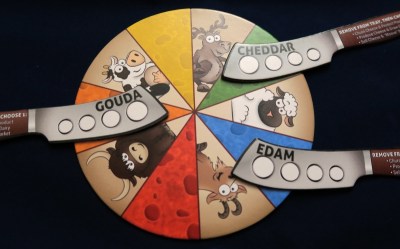
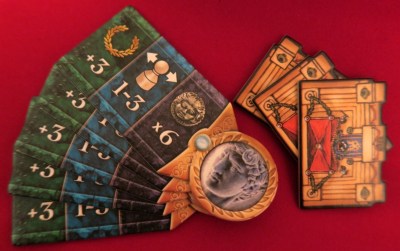
Pine, Magenta, Red and Burgundy were all keen to give the “Feature Game”,  Cheesonomics a go, especially when they saw the eye-catching truckle shaped box.  Pine was especially enthusiastic when he realised that it featured both cheese and goats!  The game itself is a fairly simple, set-collecting and hand management card game based on controlling and manipulating supply and demand of various types of cheese, all seasoned with a sprinkling of dreadful puns.  Players have a hand of five “wedge-shaped” cheese cards each with a colour suit (corresponding to country) and an animal suit (milk type).  On their turn, the active player can carry-out one of three possible actions:  churn, produce or sell.  Churning is a way a player can improve their hand.  First they declare a suit (colour or animal) and everyone else has to pass a matching card to the active player.  Once all the cards are in, the active player chooses five to keep and hands one card back to each player.
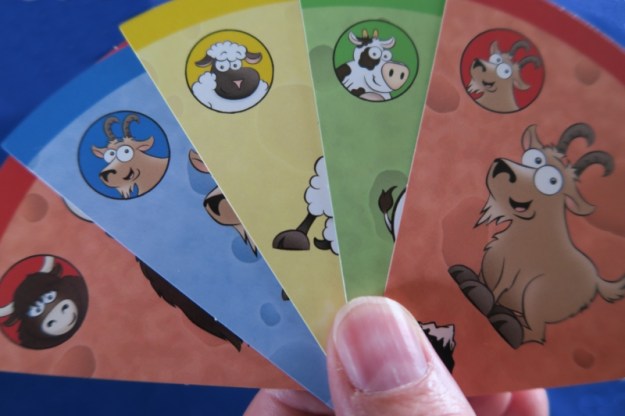
Cheesonomics
– Image by boardGOATS

Players can then place a matching set of cards in front of them to produce cheese; the cards must either have the same colour or the same animal.  The last possible action is to sell cheese:  a maximum of three cheese wedges can be sold at any one time and they must all be the same country (colour).  The cheese is valued at the market rate which is calculated from the number of wedges of that colour displayed in the market.  These wedges are different on both sides, so once a sale has been made, one market “share” is turned over (the market is “mooved”), which reduces the value for the next sale.  The clever part of the game is the scoring:  in addition to money made from selling cheese, players also get bonus points at the end of the game.  The players who sold the most of each cheese type (i.e. animal) get extra points equivalent to the number of wedges sold.  So, cheese is sold by colour, but bonus points are awarded for animals.
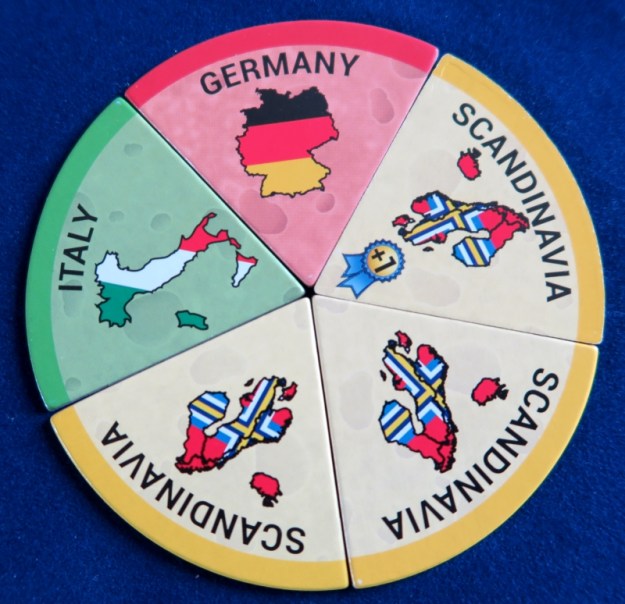
Cheesonomics
– Image by boardGOATS

Only Blue had played Cheesonomics before and that was a two-player game, so nobody really had a feel for how it would play.  Red went first and churned, followed by Pine who asked for goats.  Burgundy got a good starting hand and was able to produce a large batch of German cheese on his first turn, but otherwise we all got carried away churning cheese.  The problem was that since everyone was churning cards furiously, we were all disrupting each other’s hands which meant we ended up having to churn again on the next turn too.  Eventually, this seemed to dawn on us collectively and we all started producing what we had rather than trying to get the perfect hand first.  With a couple of good hands early on Burgundy was also the first to sell and everyone else struggled to catch up.
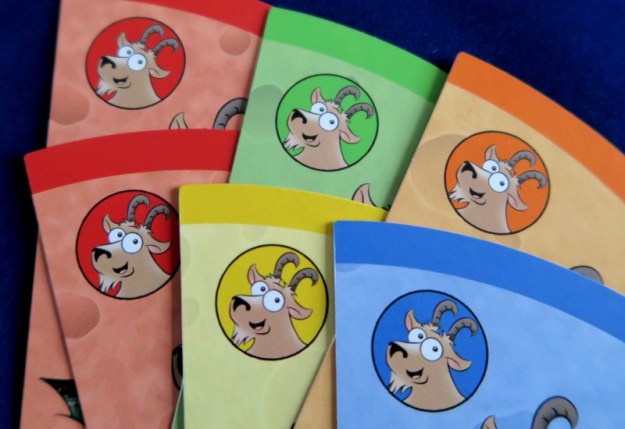
Cheesonomics
– Image by boardGOATS

Pine eventually managed to sell some of his goats and Blue, the last to convert cheese to cash, shifted a large batch of Scandinavian (yellow) cheese and take a massive fifteen curds.  It was all way too little and much too late though:  the game suddenly ended and Burgundy’s excellent start coupled with the fact that he’d managed to focus almost solely on both reindeer and yak yielded huge bonuses at the end.  Pine and Red had eventually spotted this and made a concerted effort to catch him, but Burgundy had just got too far ahead and won by two points with Pine in second.

Mijnlieff
– Image used with permission of BGG contributor thepackrat

Black and Purple had eschewed the opportunity to play Cheesonomics and settled down instead to play Mijnlieff (pronounced Mine-Leaf).  This “fancy noughts and crosses” game is played with beautiful little wooden tiles on a four by four wooden board.  the aim of the game is to form lines of three, but since there are different types of pieces and your opponent controlling where you can play it is much more strategic.  Each Player has eight pieces with two each of four different symbols where the different pieces dictate where the other player can put their next piece.  For example, when a Greek cross (or “+” symbol) is played, the next player must place his piece on an empty square in an orthogonal line from the piece just played.  Similarly, playing a saltire (or “×” symbol) forces the next player to place his piece in a diagonal line from the piece just played.

Mijnlieff
– Image used with permission of BGG contributor thepackrat

Black managed to get a line of three, but Purple took the game with two lines of three and one of four giving her a total of four points to Black’s one.  Since the supposedly quick little “Feature Game” was still going, Black and Purple moved onto another game we know quite well, Splendor.  This is a game of chip-collecting and card development where players collect chips to buy gem cards which can then be used in lieu of chips.  More expensive cards are also worth points and the game end is triggered when one player reaches fifteen points and the round is completed to give everyone the same number of turns.  Points are also awarded for “nobles” which go to the first player to get a specific combination of gem cards and the player with the most points at the end is the winner.

Splendor
– Image used with permission of BGG contributor henk.rolleman

The game was incredibly tight, but when Black was declared the winner, Purple looked slightly crest-fallen.  On closer inspection, they realised that they’d missed scoring one of her nobles.  Purple had managed to take two of the three available picking up both Isabel of Castille (awarded for four each of opals and diamonds) and Anne of Brittany (awarded for three each of emeralds, sapphires and diamonds).  This left them on sixteen all and a draw, though on closer inspection there is a tie-breaker, so arguably Black took it as he had the fewest cards in his display.

Splendor
– Image used with permission of BGG contributor henk.rolleman

Since Cheesonomics had finally come to an end as well, we had a lot of options on what to play next.  Half the group weren’t staying late, so we decided to play something short as a group before splitting up again into two groups (one of “light-weights” and one of “dirty late-night stop-outs”).  Looking for something to play seven, our choices were limited, and as is often the case in our group, we settled on our old favourite, 6 Nimmt!.  In the first round Black and Magenta were vying for the wooden spoon taking a total of twenty-four nimmts each.  Unusually, Burgundy, though high scoring, was some way behind the race for the bottom, only taking fifteen points.  Both Red and Blue kept a clean sheet so the question was which of them were going to be able to keep their score down in the second round too.  In the end though, both quickly started picking up cards and it was Purple who took the glory, finishing with just three nimmts over the two rounds, her second win of the evening (and only robbed of a third by a tie-breaker nobody knew existed).

6 Nimmt
– Image by boardGOATS

With the fun filler over, the “light-weights” looked for a similarly light game to finish, but in the end, settled on Splendor, as it was still out and Magenta and Red were very familiar with it.  This game was a very difficult one as all the cards in the second row needed lots of sapphires which were scarce throughout.  Magenta tried to work round the problem by collecting nobles, but everyone struggled.  For several rounds, Red was very close to the fifteen points needed to end the game and Magenta had four points available on a reserved card, but could not get the last ruby to buy it.  In the end, but it was Pine, who was new to the game, who finally put everyone out of their misery, ending the game with seventeen points, three points clear of Red.

Splendor
– Image used with permission of BGG contributor henk.rolleman

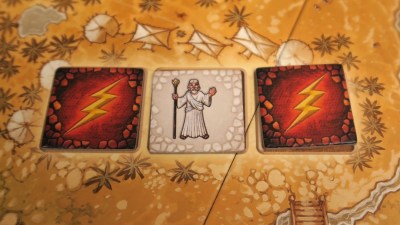
On the neighbouring table, after a short debate, the “late-night stop-outs” settled on Isle of Skye: From Chieftain to King as their longer game.  We’ve played it a couple of times before and it is hugely popular with the group.  Borrowing heavily from tile-laying games like Carcassonne, Isle of Skye is a much deeper game without adding an awful lot to the rules.  The idea is that players draw three tiles from a bag and and then secretly choose one to discard and set prices for the other two.  This is done by placing the tiles in front of a screen and a discard token and money for the player’s stash behind.  The money remains in place for the duration of the round, unless the corresponding tile is purchased by another player.  This mechanism is very clever as if nobody else wants the tile, then the player uses the money to purchase it themselves.  Thus, it is critically important to correctly evaluate the worth of the tile, depending on whether it is most desirable to sell it or keep it.

Isle of Skye: From Chieftain to King
– Image used with permission of BGG contributor henk.rolleman

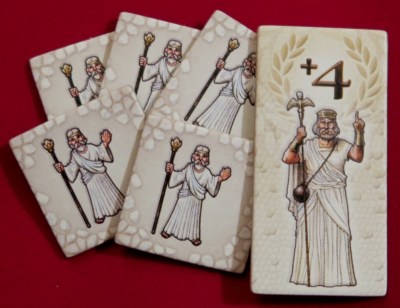
The other clever part of the game is the scoring:  This is mostly carried out at the end of each of the six rounds.  At the start of the game, four scoring tiles are drawn at random and these are used in different combinations at the end of the rounds in such a way that each appears a total of three times, but only one is used in the first round while three are used in the last.  We included the the extra tiles from the 2015 Brettspiel Advent Calendar in the draw mix and one of them  came up. The four tiles were:  points for animals next to farms (A), extra scroll scoring from the Advent Calendar (B), points for each tile with a road that is connected to a castle (C) and points for each enclosed region (D).  Inevitably, everyone started out desperate for animals and farms, but since these scored in rounds one, three and five, all of a sudden they fell out of favour.

Isle Of Skye: From Chieftain to King
– Image by boardGOATS

Despite having loads of cash, Burgundy really struggled to get the tiles he wanted particularly as everyone else kept buying them off him.  In contrast, Blue didn’t do too badly for tiles, but always seemed to be running out of money.  This was exacerbated by the fact that she didn’t get any of the “catch-up cash” given out from the start of round three.  It is only the number of players in front of them that dictates how much money players get (not how far behind they lag), but the amount can really add up: a player who is consistently at the back in a four player game will net an extra thirty sovereigns over the course of the game compared with a player who leads throughout.  Theoretically, the difference in position between the first and last player could remain just one point throughout, so there is an art to being “just behind”, in the same way as there is an art to being at the back in Colosseum (which was our “Feature Gamelast time).  Clearly this time Burgundy had the knack, and Blue didn’t.

Isle of Skye: From Chieftain to King
– Image used with permission of BGG contributor henk.rolleman

While Burgundy and Blue were struggling with their respective finance issues, Purple quietly plugged away collecting barrels and brochs, while Black ended up with ships and when the corresponding scrolls turned up, they looked to be well placed, until Black ran out of money and a critical tile was taken from him in the final round.  Despite her lack of money, however, Blue didn’t over-reach herself and managed to enclose her scrolls early giving her extra points at the end, but also for the Brettspiel Advent Calendar scoring tile during the game.  Nearly bankrupting herself in the early rounds for those animals now proved worth it as she raked in the points for the scrolls she had enclosed.  Enclosing scrolls was the key in this game as the other player to succeed in this area was Purple who finished a highly creditable second after a barn-storming evening.

Isle of Skye: From Chieftain to King
– Image used with permission of BGG contributor henk.rolleman

We had a little over half an hour left, so we decided we could fit in one last game.  We couldn’t afford to spend too long thinking about it.  Since Black expressed an interest in Karuba as he’d heard good things about it and Blue assured everyone that it wouldn’t take the forty minutes claimed on the box, we decided to give it a go.  This is a game that Blue and Pink bought at Essen last year and is very similar to Das Labyrinth des Pharao which they picked up at the same time on behalf of Black and Purple.  In the event, Karuba did take just about forty minutes, but that included setting up and teaching.  The game is a bit of a cross between bingo and a tile-laying solitaire.  The idea is that every player has the same number of numbered tiles which the players simultaneously place when the number is called.  Unlike Das Labyrinth des Pharao, the tiles the orientation is fixed, which narrows down the number of possibilities and helps to reduce “analysis paralysis”.  Both games are loosely themed with explorers, but in Karuba they are crossing the jungle to find treasure rather than exploring a pyramid.

Karuba
– Image used with permission of BGG contributor punkin312

Each player has set of four coloured explorer meeples and matching coloured pyramids, with the aim being to get the explorers to the corresponding pyramids by laying tiles to make a path.  Everyone begins with the same layout (chosen collectively) and players score points for getting their meeples to their matching temples first.  Everyone draws the tiles in the same order, since the “caller” (Blue, in this case), draws their tiles at random and calls out the number for everyone else to play too.  Once the number has been called, each player can either place the tile on the board or discard it and move an explorer along a path where the distance corresponds to the number of exits on the tile discarded (i.e. two, three or four squares).  Some tiles have crystals or gold nuggets next to the path and an explorer who stops on the tile gets to pick up the treasure which are worth points at the end of the game.

Karuba
– Image used with permission of BGG contributor henk.rolleman

Our explorers all ended up a long way from their pyramids, so sharing a common route was essential and it was just the logistics of how to do it that everyone had to work out.  With time at a bit of a premium, Blue didn’t hang about and kept the tile drawing moving quickly.  Burgundy got a bit carried away picking up crystals before getting his explorers in a tangle (the paths are too narrow for meeples to pass each other).  Purple, for whom spacial awareness does not come naturally, unfortunately managed to completely cut off one of her explorers and Black got into a bit of a tangle too before he managed to extricate himself from the mess and bring them home safely.  Blue, the only one to have experience with the game neglected picking up crystals and got three of her explorers home first netting an unassailable fifteen points, in a game that definitely benefits from experience of how to balance crystals and getting to temples.  While packing up, we discussed the game and the fact that it is likely to be one of the nominees for the Spiel des Jahres award this year given the lack of other good competition.

Karuba
– Image used with permission of
BGG contributor henk.rolleman

Learning Outcome:  GOATS like cheese, but they like whisky more…

Boardgames in Faringdon

A free evening of “continental board and card games” is being held monthly at the Pump House on Swan Lane.  The Pump House Project is a community project based in the old theatre in Faringdon, providing a variety of low cost activities for all ages and abilities in the locale.  Amongst other things, it is the first designated Parkour centre in Oxfordshire and has a set of specially designed Parkour equipment, one of the first sets of this kind in the country.  The games evenings will be much more sedentary, however, and are family friendly (children are very welcome so long as they are accompanied by an adult).  The next one is this Friday, 13th May, from 6.30pm until 9pm and free refreshments will be available.

The Pump House Project Games Night
– Image from thepumphouseproject.co.uk

Boardgames in the News: Record-breaking Carcassonne

Hans-im-Gluk recently announced a new record breaking game of Carcassonne.  Three Swedish players laid 10,007 tiles in just twenty-five hours smashing the previous, ten year old German record of 4,194 in forty-three hours.  Paul Sydby, Marie Sydby and Robert Wagman played competitively over two days with Mikaela Lincoln Börjesson acting as stand-in when one of the others needed a break.  The rules were slightly modified for simplicity (for examples, there were no farmers) and everyone played “nicely” to keep things moving along efficiently.  Paul won the epic game with a total of 11,886, a little over one thousand points ahead of Robert in second place.  The biggest city scored eight hundred and fifty-five points and was shared by all three players while Paul took the longest road which was thirty-five tiles long.  The layout covered a massive ninety-two by one hundred and eight rectangle without gaps, and it took Paul approximately two weeks (at about an hour per day) to sort all the tiles back into their original one hundred and thirty-nine boxes!

Carcassonne Record 2016
– Image from FaceBook.com

Spring 2016 Oxford Meeples Big DoG

On Saturday, May 7th, Oxford Meeples is again opening the doors of Wolvercote Village Hall to the general public once more and inviting people to join them for another Big Day of Gaming.  As usual, the Oxford Meeples will be bringing a large number of their games, but everyone is welcome to bring their own too.  The hall opens at 10 am with gaming starts from about 10.30 am and continuing ’til late.  Entry is free, although donations towards rent of the hall and refreshments will be appreciated.  Children are welcome when accompanied by an adult.  Several of the GOATS are hoping to attend, but how many actually make it will depend on other commitments as usual.

Oxford Meeples Spring DoG '16
– Image from oxfordmeeples.org

Next Meeting – 3rd May 2016

Our next meeting will be on Tuesday 3rd May, at the Horse and Jockey pub in Stanford-in-the-Vale.  As usual, we will be playing shorter games from 7.30pm as people arrive, until 8pm when we will start something a little longer.

This week the “Feature Game” will be Cheesonomics, which is a strategic set collecting, hand management card game based on controlling and manipulating the supply and demand of various types of cheese.  It plays quite quickly, so it should give us plenty of time to play something a bit longer once everyone has arrived.

Cheesonomics
– Image by boardGOATS

And speaking of the cheese…

Joe and Jeff were in a bar having drinks when a beautiful young woman approached them and said, “Whoever can use the words ‘liver’ and ‘cheese’ in a creative sentence can be my date for the evening.”

The boys thought their luck was in and Joe, quick off the mark said, “I love liver and cheese!”  Before the woman could reply though, Jeff interrupted, “Liver alone, cheese mine!”


19th April 2016

Our “Feature Game” was to be Colosseum, which several people were keen to play, but there were two issues:  it plays better with four than three, and always seems to take a lot longer than it should so we wanted to get going.  We knew that Green was going to be late, but we didn’t know how late and that made a huge difference to our game plans for the evening; with six present already, should four get going and risk leaving two to play on their own all night if Green couldn’t make it at all in the end, or should we play something short together first and risk not having enough time for Colosseum?  Texts were sent and there was much discussion including the inevitable mention of 6 Nimmt!, but aside from that we seemed to have few genuinely short fillers that would play six.  Before we could actually make a decision, Green turned up and solved the problem for us and Burgundy and Blue started setting out Colosseum eventually joined by Blue, Pine and Magenta.

Colosseum
– Image used with permission of BGG contributor Toynan

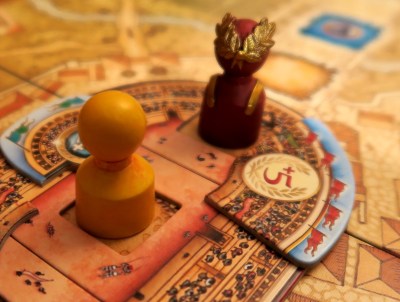
The idea of the game is that each player is a Roman impresario, producing great spectacles in his or her arena in the hopes of attracting the most spectators.  As such, the game comprises elements of auction, trading and planning with the ultimate goal of set collecting, where the sets represent groups of performers that have to match the program chosen.  A complete program will attract its maximum number of spectators, where an incomplete program can cost players severely.   There are several unusual aspects of the game, but the most obvious is the scoring; rather than summing the points during the game, a player’s final score is the number of points they scored for their most successful production, i.e. their most successful of the five rounds.  Each round is broken down into several phases.  First players can invest capital in improving their production, by for example, buying season tickets (which give a guaranteed five additional spectators for each subsequent round) or perhaps investing in a more expansive program which might increase the number of points available if it is completed successfully.  Once all the players have improved their infrastructure, next they attend the market and bid for performers.

Colosseum
– Image by boardGOATS

The auctions are unusual in that each player has an opportunity to initiate an auction (i.e. choose which of the five sets are going to sold) and if they win, then the market is restocked, otherwise the next auction is chosen from fewer options.  We decided to play what we thought was the original variant where each player can only win one auction; once they have won, they are then not able to bid on any later sales.  However, on later inspection we discovered that thanks to the different variants available we had scrambled it slightly.  Rereading the rules indicates that if a player loses an auction they initiated, they have the opportunity to try again, but with a smaller pool to choose from.  In our auctions, each player was able to initiate just one auction, and if they won, the market was restocked and the next player had a go, whereas if they lost, they had to fight it out in a later auction.  Auctions lead to all sorts of interesting dilemmas: is it better to bid and try to force someone to pay more, or is the risk of ending up with unwanted tiles too great?  With our variant, we found that it was also sometimes better to let the initiator win because a better batch of tiles might come out, but failure to win an auction after initiating it was also a problem as it risked getting left with a choice of paying for unwanted tiles or getting nothing, which really added pressure.

Colosseum
– Image by boardGOATS

Given the relative shortage of tiles in the game, coming away with nothing is not really an option, but with a minimum bid of eight, the wrong tiles can be expensive.  That said, the next phase is an opportunity to trade, and occasionally trading away something that is highly prized by others can turn out to be particularly productive.  Like Settlers and Bohnanza, trades do not have to be symmetrical and must go through the active player, but in addition to trading tiles, money can also be used to sweeten a deal, or even buy an unwanted tile outright.  Finally, players take it in turns to produce their spectacle.  In order to do this, they roll a die (annotated with Roman numerals, obviously) which they can use to move one of the dignitaries, the Emperor, two Senators and three Consuls.  These increase a players total for that round if they are in the arena when it is scored.  If on the other hand, a player can move one of these characters onto a special “resting space” they get an “Emperor’s medal” as a reward. These can be traded in for money, the chance to move a dignitary forwards or backwards up to three spaces, three extra spectators or two can be used to get an extra investment opportunity at the start of the round.

Colosseum
– Image by boardGOATS

There are lots of components to the score of each production.  Firstly there is the basic score associated with the program:  this has a maximum potential value with points deducted for missing performers.  To this, bonuses are added for season tickets, podiums (obtained for winning a round), star performers, dignitaries, previously completed event programs and Emperor medals.  If this score is higher than the player’s previous highest total, their marker is moved to this new maximum and they receive that total in money.  Once every player has completed their spectacle, a podium is handed out to the player who is in the lead and the player who is at the back takes a performer of their choice from the leading player’s pool.  Finally, every player discards one performer token used in the round as “natural wastage”.

Colosseum
– Image by boardGOATS

Each player begins the game with two programs, a small one and a larger one.  Pine started out with no performers that matched either of his and some that weren’t even available in the market, but everyone else had at least a small degree of overlap.  The first round was a little tentative and Blue ended up as start player, so went first and invested in a season ticket.  The early investments are critical as they continue to have an effect throughout the rest of the game.  Magenta decided to do something different and expanded her arena, while Pine also picked up a season ticket and Burgundy opted for an Emperor’s Loge (pronounced “Lowj”).  The Loge is an interesting investment as it doesn’t directly yield points.  Instead, it allows the player to roll two dice and move one or two dignitaries just before producing their spectacle, potentially enabling players to gain more points that way.  Burgundy had another plan though and forfeited the opportunity to take extra points, taking an emperors medal instead.  As the most experienced player, he was of the opinion that the medals are really important.

Colosseum
– Image used with permission of BGG contributor kilroy_locke

Blue was forced to produce the larger of her two programs in the first round which gave her a podium to add to her arena, but also cost her one valuable performer – a mistake she decided not to make again.  The other consequence was that she was forced to produce the lower value production in for the second round as her arena wasn’t large enough (she had bought a season ticket in the first round rather than enlarging her auditorium).  In the second round, one of the market stalls unusually had two of the rare “wild” tiles in it.  These are very powerful as they don’t need to be assigned as a particular artist giving players much more flexibility and two was very enticing.  In the first round Blue had got herself into a real mess having gone first and not won her own auction resulting in a messy scrabble to get tiles at the end of the round (a consequence of the rules change).  Having seen this, everyone else decided to play safe and opted to choose a market they needed and then won largely uncontested leaving Blue to go last and take the wilds very cheaply.  Despite this, Pine took the lead which he retained for the next couple of rounds as well.  It was at about this point that Pine commented that he thought there would have been more “gladiatorial fighting”, to which Burgundy replied that there would be plenty of that by the final round…

Colosseum
– Image by boardGOATS

In the third and fourth rounds everyone was trying to get in a position for a big push in the final round. Magenta bought a season ticket instead of expanding her auditorium in the third round and therefore ended up in the same pickle that Blue had found herself in at the start.  With only the one medal Magenta was unable to buy an extra investment opportunity which mean she was forced reproduce a medium event in the final round rather than buy a new large event.  She went into the final round with the most money though which had the potential to guarantee her a good auction.  Blue eschewed a new program in the fourth round, opting for another season ticket instead to try and set herself up for a big final round.  Pine was very keen for a trade with Blue in the penultimate round, but as she had completed her program and still didn’t know what she was going to do in the final round she declined much to his disgust.  Repeating a lower value production in the fourth round also ensured that Blue just finished last and was able to add insult to injury taking a valuable token from Pine who was well in the lead with a massive fourty-nine.

Colosseum
– Image by boardGOATS

With one round to go, Blue questioned whether Burgundy thought the Emperor’s Loge had been worth buying in the first round.  He replied that the wisdom on boardgamegeek.com is that the medals are essential and because the Loge allows players to roll two dice they really help with that strategy.  By this time, the value of the medals was becoming very obvious as trading in pairs enabled both Burgundy and Blue to make an extra investment which enabled Blue (start player again in the final round), to buy the most expensive, largest program (No. 30). Pine promptly followed by taking No. 28 and with his star performers and having so many podiums from the earlier rounds he looked in a good position, though he needed a lot of acts to complete his show.  Blue was in a slightly better position with three “wilds”, but had very few bonuses.Blue went for the market she fancied most and Magenta decided to bid against her.  Having not bought a large program in the final round, Magenta had far more money than anyone else and therefore the upper hand.  Eventually, as money is only significant in a tie-breaker, Blue bid everything she had.  Magenta, seeing other options of at least as great an interest to her decided to let her have it and Magenta took what she fancied, uncontested.

Colosseum
– Image by boardGOATS

While Pine and Burgundy were trying to work out which markets to take in order to do themselves the best favours, Blue looked at her options and Magenta’s.  Since she Pine and Burgundy’s discussions were getting complex and could not involve her, Blue got bored and decided to see if Magenta would be interested in trading one of Blue’s “wilds” and an otherwise superfluous lion for one of her “green men” and a chariot.  This would give both players one extra performer overall, and complete Magenta’s program, so she agreed.  Thus, when Pine and Burgundy had finished thrashing out all the options, Blue and Magenta’s trade went through on the nod and it was only when Pine and Burgundy came to trying to further optimise their situations that they realised that Magenta had things they wanted, but nothing to offer her in return.  Pine tried his best to get Magenta to trade, but she was steadfast that she wasn’t going to help him without getting something useful in return.  Burgundy’s offer of two horses initially looked promising as he thought it would enable Magenta to take the star-turn bonus from Blue, but it would only give a tie, so ultimately, that trade was also unsuccessful.

Colosseum
– Image by boardGOATS

Blue moved a Senator into her arena and scored a total of eighty-two setting the bench-mark for everyone else.  Although it sounded a lot, Blue didn’t think it would be quite enough and indeed it was very, very close, much closer than anyone had thought it would be.  In the end, the Blue just had enough to finish four points ahead of Burgundy who was just two ahead of Pine who came in third.  With the scores so very close, we had the inevitable review of the game and concluded that the the key moment was probably Blue taking the two wilds so cheaply in the second round, which would not have happened without the unintended rules revision.  The other key moment was in the final round of negotiating when Blue and Magenta agreed their critical trade.  Pine was verging on indignant that after playing for two and a half hours, it was essentially up to Magenta to choose the winner and suggested that should be the learning outcome for the week.

Colosseum
– Image by boardGOATS

Meanwhile, on the neighbouring table, Black and Purple had persuaded Green to join them playing one of their old favourites, Vikings.  This is a fast economic game, but despite the nominal “Viking” theme there is  none of the usual Norse Gods, exploration or pillaging involved.  Black and Purple had come across it again recently after a long break and fancied giving it another outing. It is a game that we’ve not really played before in the group and Green was new to it too, but was willing to give it a ago. It is one of those games where the gameplay is not complicated and yet the explanation took ages.  In summary, the game consists of six turns and on each turn, twelve tiles and twelve meeples are randomly drawn, paired together around a rondel. in each round, players take turns selecting a meeple/tile combination until they’re all taken.

Vikings
– Image used with permission of BGG reviewer EndersGame

The tiles are pieces of islands and there are left ends, right ends and middle pieces.  As players acquire these tiles, they are considering which sort of meeple would be placed on that tile, as each tile can hold only one meeple.  The rules for placing these tiles are fairly straightforward, for example, a partial island can’t connect directly to open water, etc.  The meeples come in five different colors and these colors denote their function in the game. For example, the yellow meeples are miners and they bring in money every turn; the red miners are nobles and they bring in two points apiece every time you score points, and so on.  Once the tile selection and placement has been carried out, all the yellow meeples will make the players some money. On even turns, VP will be scored. At the end of the game, players can gain bonus points for completing the most islands and/or completing the largest island.

Vikings
– Image used with permission of BGG reviewer EndersGame

It took Green a couple of rounds to work out how it all worked and ended up making a couple of little errors when laying out of his islands, which included not having an island space to place his gold Viking on and which meant he was able to get income, which was compounded by the bonus tile he had picked up which would enable him to gain an extra two coins for each gold Viking.  In the meantime, Purple had a fair few noblemen who would not only score her well, but also enabled scoring for the large number of gold Vikings and fishermen below. She managed to avoid any ships in the first couple of rounds and so gained all the bonuses available to her.  Black did have a number of ships, but he also had the warrior Vikings placed to combat them, so also gained a healthy bonus income.  Green had a ship and a warrior, but both his scoring and income were low.

Vikings
– Image used with permission of BGG reviewer EndersGame

After the first couple of rounds, the game progressed in pretty much the same pattern, except this time Green had sussed out what he was trying to do and regularly collected boatmen to redistribute his Vikings in time for scoring.  However he was hampered by a lack of funds in the middle rounds, but when he finally got the gold guys out, he suddenly started to rake in the cash.  This meant he was able to buy just what he needed in the final round, much to the others annoyance.  By the end, Purple had a very red and yellow looking board and the longest island (six tiles long giving her five bonus points). Black had a huge fleet of ships, but most were covered by warriors and those that weren’t were not powerful enough to do much damage. He also had the most complete islands (seven which gave him a seven point bonus). Green had a relatively low scoring board, but he did have the most boatmen (giving ten bonus points). It had been a very poor game for fishermen, in fact, almost all the Vikings left in the bag were fishermen, so everyone was underfed, but Purple was less underfed than Black and Green.

Vikings
– Image by BGG contributor dinaddan

So in the final scoring Black had won through, beating Purple into second place (the first time she had not won this game for some time) and Green came in third, though much closer than he thought he would be.  It was then that Black realised that Purple had forgotten to score her bonus island tile, which gave her a massive extra nine points, and with it, the win!  We discussed the bonus tiles after the game and although the rules were not clear, we felt we had probably played it wrong. We only replaced the tiles that had been taken each round, rather than swiping them all and laying out a new lot. Since there were four tiles per round for six rounds and we had two piles of twelve, it looked like what was meant to happen was a new set each round.  This would have made more choices available (and more bonus fishermen which would have been handy).  Green decided that he liked this game very much and would be happy for Black and Purple to bring it again.

Vikings
– Image used with permission of BGG contributor punkin312

The shows were still going on on the next table, so we needed another medium weight game and decided upon the cute Panda game, Takenoko.  While setting up there was a short discussion on the evolutionary dead-end of the Panda and how on earth did such a creature ever evolve in the first place. Although since they are such cute creatures, we were glad they did and they had led to the clever little game.  The play area starts with one single hexagonal “pond” tile with two characters on top:  the Imperial Gardener and the Panda.  On their turns players first determine the weather by a roll of the weather die, then perform their two actions.  These actions must be different and the player can choose freely from the five available:  add a new bamboo plot; take an irrigation channel (which can be played or stored for later use); move one of the characters (either the Imperial Gardener or the Panda), or draw an objective card and add it to their hand.  The aim of the game is to earn points by completing objectives.  When a player completes one of their objectives, they show everyone and the card is placed face up in front of them.  Players can complete as many objectives as they like on their turn and end of the game is triggered when one player full-fills a set number of objectives.

Takenoko
– Image used with permission of BGG contributor nad24
and nonsensicalgamers.com

This game was a slightly unusual one as we all placed tiles in such a way that there was only ever one large field of each of the three colours and by half way, we all had mostly stopped laying tiles at all. In typical British style, the weather was mostly awful; wind; cloud; and rain. It was ages before the sun came out, but thereafter it made enough of an appearance to keep us all happy. Purple was the first to complete a mission card and Green wasn’t far behind, both tile pattern cards. The Panda and Gardener were mostly travelling between the pink and yellow fields, leaving the largely un-irrigated green fields untouched.  This enabled Green and Purple to get some tower and bamboo chomping bonus cards, but Black was beginning to fall behind. His problem was that all his bonus cards were low scoring. He kept using his actions to take more bonus cards, but they always seemed to be low scoring, and unless he could get more points out of it he wasn’t going to win.  He completed a few objectives on the way, but didn’t want to fill all of his eight with low scoring objectives so held back on claiming some.  In the meantime, Green was rapidly claiming bonuses, mostly towers giving a healthy haul of points. Purple made a few miscalculations on which bamboos would grow and by how much and thus failed to get a card or two that she had planned.

Takenoko
– Image used with permission of BGG contributor Oceluna

As the game approached the end, Green and Purple both had claimed six bonus cards and Black still only had four.  But then with a flourish, suddenly Black finished the game.  He had given up on getting higher scoring objectives and decided the best bet would be to get the ones he had got down and stop Green winning any more points, also picking up the two point bonus for finishing first in the process.  Everyone else got one more go which was enough to give Green a seventh and Purple her eighth objectives.  Totalling up the scores showed that Black had been right about not winning with low scoring cards.  That honour went to Green, who finished nearly ten points ahead, with Black just taking second place.  In the post game discussions, Blue commented that although she had always wanted to like the game she felt it just lacked something.  Black said that he had always felt that the game was very Luck based, although Green did point out that if Black had just gone with the low scorers he would not to have wasted as many actions gaining the cards and could have finished the game earlier, before Green was able to amass all his points. However, Green and Burgundy both agreed that the tile layout bonus cards were the weakest as the points were usually low and yet did not seem any easier to get. This debate will probably run and run, much like the one about the Panda’s evolutionary dead-end…

Takenoko
– Image used with permission of BGG contributor ObeyMyBrain

Learning Outcome:  Even after playing for two and a half hours, sometimes Magenta still gets to choose the winner.

Next Meeting – 19th April 2016

The next meeting is on Tuesday 19th April at the Horse and Jockey pub in Stanford-in-the-Vale.  As usual, we will be playing shorter games from 7.30pm as people arrive, until 8pm when we will start something a little longer.

This week the “Feature Game” will be Colosseum, which is an older game where each player is a Roman impresario – producing great spectacles in his or her arena in the hopes of attracting the most spectators.  It has beautiful pieces and is currently out of print though a crowdfunding project has just finished that will hopefully mean it will become available again soon.

Colosseum
– Image by BGG contributor takras

And talking of Romans…

Julius Caesar was addressing the crowd in the Colosseum, “Friends, Romans and countrymen. I have returned from my campaign in France where I killed 50,000 Gauls!”

The crowd rose to its feet cheering, “Hail mighty Caesar!”

At this point Brutus jumped up and yelled, “Caesar lies – I’ve discovered he only killed 25,000!”

Caesar replied, “Yes, but remember that away Gauls count double in Europe.”

5th April 2016

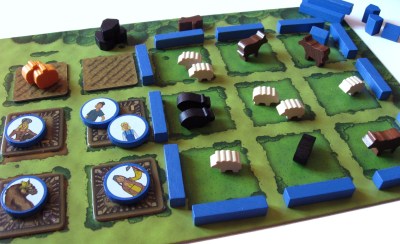
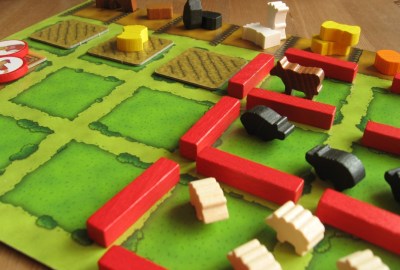
Despite a few regulars being away, there were still enough people for two games and the first group opted for the “Feature Game”, Agricola, a highly regarded game about medieval farming.  Agricola is a worker placement game where players take it in turns to deploy the members of their farming family in activities.  At the start of the game there are very few actions and each  player only has two members of their family, but as the game progresses the number of possible actions increases, but players also have the opportunity to expand their families. Each player has a farm which consists of a three by five grid of spaces and at the start of the game two of them are occupied by a two-room wooden hut.  During the game, players can expand their hut, upgrade their wooden shack to a brick or stone house, they can plough fields, enclose land to keep animals and grow vegetables and wheat.

Agricola
– Image by BGG contributor BeyondMonopoly

The game is played over fourteen rounds with harvests at intervals after which the family must be fed.  Failing to feed the family results in them going hungry and having to beg for vittles which costs points at the end of the game.  Points are awarded for almost everything, but the most successful players are usually those with a thriving farm that makes full use of all the available land and sustains a large family living in a big farmhouse.  The game can be played as a family game, or, for more experienced players, occupation and minor improvement cards can be added.  It had been quite some time since some of us had last played Agricola, and others had never played it, but those of us who were familiar with the game were keen to play with the cards.  When playing with cards it is common to “draft”, i.e. use the primary mechanism found in games like 7 Wonders, Sushi Go! and Between Two Cities where each player chooses a card from their hand before passing it on and choosing the next card from the hand they receive (passing that on until there are no cards left).  The advantage of this approach is that no single player gets all good (or bad) cards by chance, but the disadvantage is that it is very hard to choose cards when players are new to the game and unfamiliar with which cards might work well.  For this reason, drafting wasn’t really an option.  The copy of the game had been “pimped” with shaped wooden resources to replace the original cubes and discs from the base game.  This, combined with three different decks of minor improvements and tight space enhanced our initial confusion, but we did eventually get ourselves sorted and chose the basic “E” Deck.

Agricola
– Image used with permission of BGG contributor henk.rolleman

Green started off by learning a new occupation: Reed Collector; reeds are important for house building.  Having looked at his cards in hand, he had a plan:  he also had the Renovator which would reduce the cost to upgrade his farmhouse, so he thought he could expand his wooden house and then upgrade it on the cheap. He also had the Chiefs Daughter who would give him an additional three points if he successfully upgraded his house to stone. Meanwhile, the others set about collecting resources as a base from which to build their farms.  Indigo quickly learnt the second occupation of the game: the Hedge Keeper which would enable her to build three additional fences each time she built at least one – impressively powerful we thought at the time, especially at end game for filling unused spaces.

Agricola
– Image by BGG contributor lolcese

The first rounds were a lesson in frustration as resources and actions were limited and we all found ourselves unable to get what we needed and do what we wanted, a problem compounded by only having two farmers each.  Progress on the farms seemed slow; Green, Pine and burgundy seemed more interested in home improvements than actual farming and at one point it looked like we should have renamed the game, “Yuppy-ville”.  Green then invested in a canoe and went fishing a lot:  was the price of farming so high he was going into retirement before he got into a financial mess?  Despite her highly prized hedge making ability, it wasn’t Indigo who fenced in their first field but Pine, which he promptly filled with the four sheep that no-one had been able to find a home for previously.  This was especially funny since, as the vegetarian of the group, he had planned to make his and arable farm rather than a pastoral farm.  Still sheep are good for wool, so his moral stance was intact, for the moment, at least. Released from Market, Pine’s sheep quickly produced a nice spring lamb for our intrepid veggie farmer, to keep as a pet in his farmhouse.

Agricola
– Image by boardGOATS

Burgundy meanwhile had made use of his special ploughing skills to turn over two fields in one go, but that was about as far as they went for many rounds.  Although he was forced into a fallow strategy (not one that scores any points or subsidies in this game), he wasn’t complaining. That was reserved for anyone else who took the available wood before he could reach it.  This forced Burgundy into becoming a bit of a clay specialist which meant he was able to build an oven before anyone else, something he desperately needed to feed his family since there was so little actual production going on on his farm.  In keeping with his non-farming, farming strategy, Burgundy was also the first to renovate his home, twice in quick succession to a give him a grand two room stone cottage.  Pine and Green followed and extended their wooden shacks. This gave Green room to grow and he became the first player to gain an extra farmer.  Pine quickly followed suit, but his attempts to grow vegetables was being scuppered by everyone else taking the one available “Plough & Sow” space before him. So, with a tear in his eye, he was forced to build an oven and take some of his precious sheep to the abattoir.

Agricola
– Image by BGG contributor HRune

Our farms were slowly growing.  Green still only had one ploughed field and no pastures, but he had learnt several trades, built a number of improvements to his farm and extended his modest cottage to four rooms.  In one move, he upgraded his house to brick and built a clay oven (the one that Indigo had just returned after trading it in for a better model), which enabled him to bake bread and get enough food to feed his burgeoning family.  By this time, Pine had turned into a hardened livestock farmer, his earlier heartache a mere distant memory.  He enclosed his massive second pasture, moved his sheep around and expanded into cattle.  The Master Hedge Maker, Indigo, still had only one pasture and no animals, but the arable part of her mixed farm was very healthy, overflowing with wheat.  The failure of her livestock attempts did not last long either, and she emulated Pine enclosing a large second pasture and captured a couple of wild boar to place in it.

Agricola
– Image by BGG contributor sufertashu

Back on Green’s farm, he had decided that maybe he should do a little farming and finally having got some wood, he built some fences and acquired some pigs. His skill in ceramics had enabled him to get a free pottery and started turning the now unwanted clay into some strange tasting food.  Green then turned his clay house into a stone mansion and quickly fenced in another pasture and got some cattle.  With the game rapidly drawing to a conclusion he had four farmers to work with, but he was still hampered by the availability of resources and actions, often taken by others.  For example, his plans for a third pasture and some sheep were stymied by Pine who nabbed them to add to his ever growing flock.  Meanwhile, Indigo’s farm was flourishing and when she finally got some sheep, it seemed all she needed to to to be able to say she had a finger in every pie was get some some cattle – one was available and she was so keen on it that she let it live with her in her own house.

RedAgricola
– Image by boardGOATS

In contrast, Burgundy’s whole game seamed to have constantly been scuppered at every turn.  Even taking the start token usually only lasted one round and invariably he then seemed to find himself choosing at the end of the round once more. We don’t quite know how he did it, but somehow by the end of the game he had filled every space on his board – clearly he got that wood and fencing in the end.  With only two rounds left, Pine finally moved into wheat and vegetables.  Discussing the game afterwards he commented that he’d been dealt a poor set of cards at the start and on reflection they did look like a very difficult set to work with.  On the other hand, Black on the next table piped up that the cards were not really all that important.  While that may be the case, in this game Green was the winner primarily thanks to having played a great set of cards. In fact, of his forty-three points, he scored twelve from his cards, which was seven more than anyone else.  In contrast, Indigo’s balanced farm netted her a solid second place, just six points behind.  Were the cards that important?  We’ll play it again sometime soon and maybe find out.

Agricola
– Image by BGG contributor nolemonplease

On the other table, meanwhile, The Voyages of Marco Polo was getting a second outing after its introduction at our last meeting.  The game is played over five rounds with players recreating Marco Polo’s journey to China via Jerusalem and Mesopotamia and over the “Silk Road”.  Each player has a different character and special power in the game.  Each round, the players roll their five personal dice and can perform use them to perform one action each per turn.  The actions include:  gathering resources, gathering camels, earning money, buying purchase orders and travelling.  The game ends with players receiving victory points for arriving in Beijing, fulfilling the most purchase orders, and having visited the cities on secret city cards that each player gets at the start of the game.

The Voyages of Marco Polo
– Image used with permission of
BGG contributor bovbossi

Purple (who also played last time) decided to try the teleporting trader, Johannes Caprini again and work more on getting contracts.  Last time, we realised that taking an action first was a huge benefit because it avoided the problem of having to pay to take actions.  So, after that, Black chose Berke Kahn which would allow him to choose actions already taken without having to pay.   Scarlet, who was new to the game, opted for Wilhelm von Rubruk (played by Black last time) for the extra trading stations.  Also new to the game, Pink, felt that having an extra die and contract each round would give her the edge, and chose with Matteo Polo.

The Voyages of Marco Polo
– Image used with permission of BGG contributor punkin312

Despite her teleporting ability, Purple was unable to get to Beijing, but she was the only one who hadn’t made it across the board for the extra points by the end of the game.  It seemed her extra experience could not help her make full use of her special power as she failed to complete her second destination card as well.  Reading opinion of this character on BoardGameGeek, it seems Purple’s fondness of this character is rather misplaced, as it seems to be universally felt to be a poor one to get to work.  Scarlet had done rather better with his choice it seems, although he just failed to get his extra houses out, which is a tough ask in this game.  Others who play this character seem to get varied results, though perhaps for people that can make it work, it can do really well, but otherwise it can trip players up.  The general opinion on Matteo Polo also appears to be good; sometimes it can work really well, but it is never a hindrance.  Pink, however, just struggled to get the game to work for her and it just didn’t seem to fire her enthusiasm. She failed to complete either of her destinations and only managed to place three “houses” and generally found the game difficult all the way through.

The Voyages of Marco Polo
– Image used with permission of BGG contributor henk.rolleman

Looking back at the last time we played, as well as Johannes Caprini and Wilhelm von Rubrukand, we used Mercator ex Tabriz and Kublai Kahn.  Mercator ex Tabriz (who gives the player a free resource when others use the market) seems to be widely regarded as the best character, however, Pine really struggled with him. In contrast, Kublai Kahn appears to be seen as a middling character, who is very reliant on how the city bonuses fall – last time they fell well for Green who made good use of them, but the character could be a lot less effective if the bonuses were less favourable.  There are two characters we have not yet played, Raschid-ad-Din Sinan and the pairing of Niccolo and Marco Polo.  Even though Raschid-ad-Din Sinan looks good (he allows the player to choose their own dice values), it seems most players only rate him average.  Maybe it’s because poor dice rolls can be compensated for and turn into good ones, so the actual values rolled are of less consequence to the game than might be thought initially.  The pairing of Niccolo and Marco Polo can be difficult to make work as two characters does not mean twice the resources, quite the opposite and they can get stuck in a city, although with less players it is felt they might do better (as there are less opponents to steal the city bonuses first).

The Voyages of Marco Polo
– Image used with permission of BGG contributor henk.rolleman

So clearly, although some characters might have a tendency to be more useful than others, ultimately success depends on circumstances and how well the player uses that character.  This was also the case for this, our second game where Black finished first with a massive fifty-eight points, a combination of a good character played effectively. On the geek there seems to be a general consensus that Berke Khan is one of the top characters in this game, demonstrating others appreciate the power of not having to pay for actions. With Agricola still a few rounds from finishing, there was time for a quick game of Click & Crack, a game of simultaneous action selection game in which the players control two penguins each, walking around on a big ice floe – a cold arctic game to contrast with the heat of the eastern deserts.

Click & Crack
– Image used with permission of BGG contributor aleacarv

Learning Outcome:  Sometimes it is best to put even the most deep-seated moral objections to one side for the duration of a game…

Boardgames in the News: Risking Imprisonment to Play

We are very lucky:  when our little game group meet, the worst anyone risks is a telling off for staying out too late.  In some parts of the world, however, gamers could be risking their liberty or worse.  Just imagine a world in where playing Puerto Rico or Agricola risked imprisonment or torture.  It seems absurd, but for for some people this sort of response is a reality.  In February, police in the Thai resort of Pattaya arrested thirty-two elderly Bridge players when they raided their local Bridge Club.

Bridge
– Image from innontheprom.co.uk

In Thailand, there are strict anti-gambling laws, so despite the fact the Bridge players declared that they were not playing for money, they were arrested for “possessing more than one hundred and twenty unregistered playing cards” in violation of section eight of the Playing Cards Act of 1943.  In this case, the members of the club were released after twelve hours, but Bridge is not the only “risky game”.  According to the Saudi Grand Mufti, Chess is forbidden in Islam, a view which could mean that players in some parts of the world genuinely risks a fate worse than death at the hands of fundamentalists.

We are very fortunate in the UK.

Chess
– Image by BGG contributor unicoherent

Next Meeting – 5th April 2016

The next meeting is on Tuesday 5th April at the Horse and Jockey pub in Stanford-in-the-Vale.  As usual, we will be playing shorter games from 7.30pm as people arrive, until 8pm when we will start something a little longer.

This week the “Feature Game” will be Agricola, which is a highly regarded game about medieval farming   This is slightly heavier game than some of our previous Feature Games, but supports different levels of complexity from the “family” version to more advanced versions, so we can play a level that is appropriate to the people that turn up.

Agricola
– Image by boardGOATS

And talking of farming…

A farm boy accidentally overturned his wagon-load of wheat.

The farmer who lived nearby heard the noise and yelled over to the boy, “Hey Jeff, forget your troubles. Come in and have tea, I’ll help you sort out that wagon later.”

“That’s very nice of you,” Jeff answered, “But I don’t think Dad would like me to.”

“Aw come on Jeff, a bite to eat will give us the strength we need,” the farmer insisted.

“Well OK,” Jeff finally agreed, and added, “But Dad won’t like it.”

After a hearty dinner, Jeff thanked his host. “I feel a lot better now, but I know Dad is going to be very upset.”

“Don’t be silly!” the neighbour said with a smile. “By the way, where is he?”

“Under the wagon.”