Author Archives: nannyGOAT

Boardgames in the News: Where to Buy Modern Boardgames

Occasionally, Euro-games can be found in the high street including charity shops or stores like Waterstones, WHSmiths or even Tesco.  However, for a good selection, it is best to go to a dedicated seller.  There are many online stores, but we also have a few “bricks and mortar” stores in the local area.  In general, shops without a physical shop-front to maintain are often able to maintain lower prices, but the staff at a “bricks and mortar” store can offer advice if you visit in person.  Here are a few suggestions of places to go to and websites to have a look at.

          1. Thirsty Meeples – If you are unfamiliar with modern boardgames and live in the Oxford area, Thirsty Meeples is an excellent place to start.  For a cover charge you can play anything you fancy from their extensive library of games.  Members of their troupe of dedicated “games sommeliers” are there to help you choose what to play and can teach you the rules too, as well as keep you supplied with refreshment during your visit.  They also sell games, so if you really enjoyed it, you can take a copy home afterwards.  Although the shop is small, they have more stock off-site and also take orders online for delivery or collection.  Since Thirsty Meeples has an alternative revenue stream, they are able to sell games at internet prices, though parking in Oxford will add to the cost considerably.
            Thirsty Meeples
            – Image by flickr.com contributor Mac Amazing
          2. The Gameskeeper – A little store on the Cowley Road, The Gameskeeper is Oxford’s oldest games shop.  John and Carol Benney who run it are extremely friendly and love to talk about games of all sorts with beginners and veterans alike.  Although their stock of Euro games is a little more limited, they are always happy to order anything in and specialise in beautiful editions of traditional games.
            The Gameskeeper
            – Image by flickr.com contributor Kake
          3. Eclectic Games – This Friendly Local Games Store won co-owners Darrell and Becky Ottery Reading “Retailer of the Year” in 2014.  Recently moved to larger premises on Union Street, Eclectic Games host gaming nights during the week and also have have plenty of playing space available for demonstrating games.
            Eclectic Games
            – Image from meetup.com
          4. GamesLore – This is another excellent online store, based in Telford and run by Paul Bryant.  Since there is no physical shop-front to maintain, the games are very well priced and the shop is also well stocked with a reliable online inventory.
            GamesLore
            – Image from gameslore.com
          5. BoardGameGuru – Formerly run by Paul Lister organiser of London On Board, this online games store is now run by Angus Abranson and is based in Southampton.
            BoardGameGuru
            – Image from boardgameguru.co.uk
          6. Amazon – Probably the largest online seller is Amazon, however, as well as the UK outlet, it is often worthwhile considering the US and German sites.  Since Amazon can ship items internationally using their own transport network, it is often considerably cheaper to import games, particularly from Germany.  Eurogames in particular are very popular in Germany and many games are a lot cheaper on amazon.de than on amazon.co.uk.  Shipping from Germany can be very reasonable, especially for multiple purchases.  With the new automatic translation, buying from Germany couldn’t be easier, however, care should be taken to ensure the game is genuinely a multi-lingual version, or at that the game parts are at least “language independent” as a lot of manufacturers won’t readily replace foreign pieces if it is your mistake.
            Amazon.de
            – Image from wikipedia.com

boardGOATS: Round & About in Oxfordshire (Again!)

Once again, boardGOATS have featured in the magazine, Round & AboutIn January, the main feature article was a double page spread on hobbies and at the bottom of the second page of the Oxfordshire edition, our little game group got a mention.  Now, almost a year later, we have a whole page dedicated to modern boardgames and boardGOATS features strongly thanks to the involvement of one of our members.  The article covers the difference between traditional games and modern Euro-style games as well as some of the venues in the Oxfordshire area and some suggestions of games to play over the holidays.

RoundAndAbout002
– Image by boardGOATS

Next Meeting – 1st December 2015

Our next meeting will be on Tuesday 1st December, at the Horse and Jockey pub in Stanford-in-the-Vale.  As usual, we will be playing shorter games from 7.30pm as people arrive, until 8pm when we will start something a little longer.

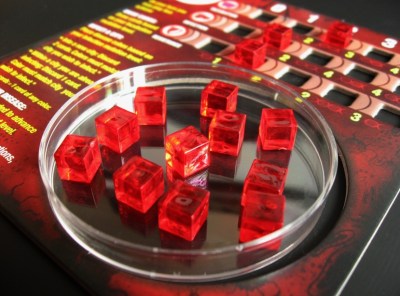
This week the “Feature Game” will be Pandemic: ContagionPandemic is a very well known cooperative game where everyone plays together to defeat the tide of disease that is overcoming the world.  Pandemic: Contagion is a lighter game and almost the complete opposite:  players are the diseases and compete against each other to be the most effective and take over the world – there is no cure.

Pandemic: Contagion
– Image by boardGOATS

And speaking of diseases…

Jeff went to the doctor for the results of his blood test.  When he arrived, the doctor asked him to take a seat, before he took sat down himself and took a deep breath.

Jeff said, “Well, come on then Doc, give it to me straight.”

After a moment, the doctor replied, “OK Mr. Pie, but would do you want the good news or the bad news first?”

Jeff thought a moment before he responded, “Um, give me the bad news first please.”

The Doctor paused again, took another deep breath and said, “Okay well, I’m very sorry, it’s the worst possible news.  There’s nothing we can do for you.  There’s no easy way to say this, but you’ve only got days left to live.”

Jeff was obviously very shocked.  Lip trembling, after a bit he said, “Well, so, what’s the good news?”

The Doctor brightened up a little suddenly and replied, “Well, it’s actually very interesting and we’re naming the disease after you.”

21st Movember 2015 @ “The Mix”

Our second drop in gaming session at The Mix in Wantage was once again, a great success.   As last time, it started very quietly, this time with Green fighting to blow up balloons and Pink and Blue struggling to get the ends to meet when building a nice PitchCar track.  Before long, “Grandma” had arrived with her young grandson in tow and they began with a game of the very intimidating Boom Boom Balloon.  They then moved onto Toc Toc Woodman (aka Click Clack Lumberjack), while another couple began a rather intense game of Carcassone: Winter Edition.

Toc Toc Woodman
– Image used with permission of BGG contributor adamfeldner
and bgpov.com

Meanwhile, PitchCar was attracting the eye of visitors as usual, and other people got engaged in games of Dobble, Roar-a-Saurus, Billy Biber (aka Log Jam) and Maxi Bamboleo.  Before long, lunch beckoned and people began to drift off.  The couple playing Carcassonne asked about other, similar games and so out came Ticket to Ride: Europe and Nordic Countries which they liked the look of.  By this time, Grandma and Grandson had moved onto Escape: The Curse of the Temple, with Green (who had never played it before) and Pink making up the foursome.  After losing the first few games, Pink took a break and was replaced by Blue who had played it a lot and suggested they worked in two pairs.  Despite her experience, it was Blue who was last to the exit and seemed completely incapable of rolling the two keys necessary.  As the stress levels rose, she eventually succeeded with a few seconds to spare.

Escape: The Curse of the Temple
– Image used with permission of BGG contributor rassilonsghost

The session finished with Grandma and Grandson playing a final quick game of PitchCar before going swimming.  As it had quietened down, Blue, Green and Pink persuaded the last of the helpers to participate in a quick game of Splendor, which Green won, but with a very creditable second place for the shyly reluctant new player.  Then it was time to tidy up and go home.  As Green headed off in the car, he happened to catch JACKtivities on the radio, advertising a “Beyond Monopoly session at The Mix in Wantage, with boardGOATS“. “Sounds good,” he thought, “Maybe I should go along…”

Splendor
– Image used with permission of BGG contributor TrashcanCity

17th Movember 2015

While Burgundy, Magenta and Blue were busy feeding, we decided to play something to keep Pine from eating too many of the chips, so for the third games night running, we had a quick mess about with magnets and bells in Bellz!.  It was another close game with some slightly borderline shaking and other sneaky efforts.  Before long though after incredible snatch taking two medium bells as he moved faster than magnetism, Burgundy had only one large bell left.  This solitary bell was very effectively trapped though and he failed to take the opportunity leaving Blue to close out.  Pine followed, despite the fact that he claimed he was no good at dexterity games.

Bellz!
– Image used with permission of BGG contributor SpeedD

With people still finishing, we looked for another light game that people could play while wielding cutlery, and No Thanks! fitted the bill.  This is a very simple game that we used to play quite a lot, but recently has languished in the box, usurped by newer fare.  The game is very simple:  from a shuffled deck of thirty-three cards (numbered three to thirty-five), nine cards are removed and the top card turned face up.  The first player has a choice they can either take the card or pay a chip and pass the problem on to the next player.  This player can either take the card and the chip or pay a chip and so on.  At the end of the game the face values of each player’s cards are totalled (offset by any remaining chips) and the player with the lowest number is the winner.  The catch is that if players have consecutive cards, only the lowest counts, which is where the fun really starts.

No Thanks!
– Image used with permission of BGG contributor msaari

The game is all about keeping your nerve and picking up the right card at the right time.  Burgundy began by picking up some high cards, while Pine started with a few cards in the twenties and teens.  Blue and Magenta stuck it out as long as they could before they were forced to take something.  Somehow Blue managed to avoid anything really horrid until the last card when Magenta persuaded Burgundy to hand it on leaving her with a whopping sixty-nine and last place.  With Burgundy unable to get the cards he needed to extend his run, that left just Magenta and Pine with Pine taking it by four points with just twenty three points.

No Thanks!
– Image used with permission of BGG contributor mikehulsebus

Not expecting anyone else to arrive, we decided to move onto the “Feature Game” which was Isle of Skye: From Chieftain to King.  This is a tile laying game with some similarity to Carcassonne, except that players have their own map and the tiles are auctioned.  Played over six rounds, players start by earning income for their clan’s territory, getting five gold for their castle and one for each whiskey distillery (barrels) connected to their castle by road.  Next, each player draws three tiles from a bag and places them in a row in front of their screen.  In private, the players then allocate piles of coins to two of the tiles and a mattock marker to the third.  The coins represent the cost anyone buying a tile will have to pay, while the mattock indicates which tile will be discarded.

Isle of Skye: From Chieftain to King
– Image used with permission of BGG contributor henk.rolleman

Once everyone has decided the value of their tiles, the screens are removed and the tiles marked with a mattock discarded.  Next, beginning with the start player, each player takes it in turn to buy a tile from one of the other players.  When everyone has either bought a tile or passed, all remaining tiles are bought for the assigned value by the owner.  So, when setting the value, players have to be very careful not to over-price something otherwise they will be left paying over the odds for something they don’t want.  In fact, the problem is worse than that as the difference between being forced to buy your own tile and selling it is twice the assigned value.

Isle of Skye: From Chieftain to King
– Image by boardGOATS

After all the tiles have been bought, players add them to their clan territories following the Carcassonne riles that terrain must match.  However, presumably since all roads on Skye are just dirt tracks, roads do not need to connect, something those of us who suffer with OCD found quite offensive to begin with.  At the end of the round, points are awarded according to the four scoring tiles chosen at random at the start of the game.  In our game the scoring tiles were:

  1. One point for each animal next to a farm;
  2. Three points for each lake with a ship and a lighthouse;
  3. Two points for each cow on a road connected to the castle;
  4. Five points for the person with the most barrels and two for the person with the next most barrels.
Isle of Skye: From Chieftain to King
– Image used with permission of BGG contributor henk.rolleman

At the end of the first round, just scoring tile “A” is scored, at the end of the second, just tile “B”, but at the end of the third, both “C” and “D” are scored so that each tile is scored three times during the game, at the end of different rounds, in different combinations.  At the end of the game, each player turns any residual money into points (at a rate of five to one) and players also score any scroll tiles they may have been able to add to their clan territory.  These give a set number of points for certain items, for example, one point for each pair of ships etc.  These are scored twice it the terrain the scroll is in is “complete”, i.e. it is enclosed.

Isle of Skye: From Chieftain to King
– Image used with permission of BGG contributor Punkin312

Burgundy was the only player who had played the game before and commented that he had been given a bit of a pasting so was hoping to do better, though he thought it was a hard game.  It didn’t sound hard at all, but we quickly discovered what he meant, with everyone struggling from the very beginning.  Pine and Magenta made the best starts getting farms and animals and scoring early, while Blue and Burgundy brought up the rear.  Blue, who never does well in more strategic games drew scroll tiles that rewarded players with barrels.  Unfortunately, as barrel tiles connected to the castle give players money at the start of the game, and scoring tile “D” gave points for them, they were a hot commodity and Blue was quickly left behind.

Isle of Skye: From Chieftain to King
– Image used with permission of BGG contributor henk.rolleman

As he’d found the previous time he’d played, Burgundy could see the tiles he wanted, but was struggling to acquire them or keep them.  As a result he started to drop off the pace and before long, Pine had left Magenta as well and was romping away looking like he might start to lap people.  While everyone else moaned as they struggled to do what they wanted, Pine continued happily collecting lots and lots of cows and sheep which he cleverly added to his growing conurbation of farms so that they counted multiple times.  In the later rounds, however, there is a catch-up mechanism which gives extra money to the players at the back.
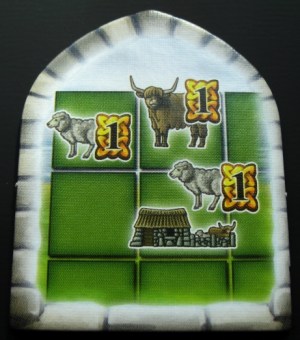
Isle of Skye: From Chieftain to King
– Image by boardGOATS

From round three onwards, at the start of the round, each player gets additional money for each player in front of them.  The amount increases as the game progresses, so the player at the back gets an extra three gold coins at the start of round three, but a massive twelve additional gold at the start of the final round.  Unfortunately, we somehow managed to botch this, half-way through the game switching to handing it out at the end of the round instead of the start, so the additional wherewithal didn’t quite give people the extra buying power intended by the designers.  That said, although Pine was the clear winner by nearly thirty points with a total of eighty-five, Blue managed move from a long way behind everyone else into second place thanks to scroll scoring that capitalised on all the brochs and barrels she had acquired.  For all the moaning, everyone enjoyed the game and agreed that it needed playing again as it would probably be very different with different scoring tiles.
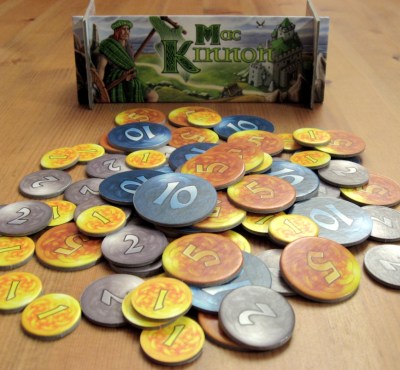
Isle of Skye: From Chieftain to King
– Image by boardGOATS

After some discussion about what to play and flirting briefly with the idea of Aquaretto,  we decided to play Port Royal.  Although we’d played it before, it was one of those games that it is somehow hard to remember and therefore Blue made a bit of a pig’s ear of teaching it.  That said, it isn’t a complicated game:  the game is played in turns with the active player turning over cards.  They can keep turning over cards until either they choose to stop or they draw a second ship card that they cannot repel.  Assuming they choose to stop, they can then take a ship card or buy a character card before the remaining cards are offered round the table with players paying the active player one doubloon if they choose to buy/take a card.

Port Royal
– Image used with permission of BGG contributor msaari

The key is the character cards as they are what enable players to build an engine and get an advantage over the opposition.  Unfortunately for him, Burgundy never seemed to have enough money when the cards he wanted came up.  On the other hand, Magenta took a Jester at just the right moment to give her a steady income exactly when she needed it.  Meanwhile, Blue picked up some good cards, but failed to capitalise and Pine began collecting for contracts, but couldn’t pick up the most cost effective ones.  Then, suddenly, Magenta snuck up on the inside and Pine pointed out that she had eleven points.  Blue then lost the plot a little and let her get the twelfth point which triggered the end of the game.  Nobody could improve their position much, except Magenta who rubbed salt in the wound buying another two cards.

Port Royal
– Image used with permission of BGG contributor jsper

With the evening nearing the end, we decided to give another new game a quick try as it the box said it only took five to ten minutes.  Well, an hour later, we were still playing Red7, and the landlord was subtly reminding us of the time…  So how did it go so wrong?  Well the game is fairly straight forward:  on their turn, each player can play one card from their hand into their tableau in front of them, or play a card into the centre which changes the rules of the game (a little like Fluxx), or they can do both.  If they cannot play a card or choose not to, they are out of the round.

Red7
– Image used with permission of BGG contributor punkin312

The game is played with a deck of forty-nine cards, numbered one to seven and in seven different colour suits.  Each player starts with seven cards in hand and one face up on the table.  The player with the highest value card is “winning” because the rule at the start is that the highest card wins.  In the event that there is a tie and the highest face value is displayed by more than one player, the tie is broken by the colours with red higher than orange, which is high than yellow and so on through the spectrum to violet.  The colours also dictate the rules, so any red card played in the centre will change the rules to “the highest” wins.  Similarly, any orange card played in the centre changes the rules so that the winner is the person with the most cards of the same number.

Red7
– Image used with permission of BGG reviewer EndersGame

In each case, ties are broken by the card that is highest (taking into account both number and colour) from the cards that satisfy the current rule.  Thus, if the rule is “the most even cards” and there are two players with the same number of even cards in front of them, the player with the highest even card is the winner.  At the end of their turn, the active player must be in a winning position, or they are out of the round. The round continues until there is only one player left.  Magenta took the first round with eight points and Burgundy the next with eleven.  When Magenta took the third and Blue the fourth, Pine was beginning to feel a little left out.  After Burgundy took the fifth round which took him to twenty-seven points (more than twice any one else’s total), we decided to give Pine one last chance as clearly Burgundy had it in the bag.  Sadly, for Pine, the last round was taken by Blue with a massive twenty-two points putting her just three points ahead of Burgundy.

Red7
– Image used with permission of BGG contributor punkin312

So why did the game take so much longer than advertised?  Well, obviously we had to read and understand the rules, but that didn’t account for it.  Each round does indeed take about five to ten minutes, but we didn’t feel we had really grasped it after one round and the rules for the advanced game also say that players should continue until one reaches a set number of points.  So we just played another round and then another and another… By the end we were just starting to get the hang of it, but we were also really beginning to appreciate the depth of something so very simple.  Part of the issue is getting into the mindset that enables you to quickly evaluate what cards you can play.  The next level is working out what is the best card to play that keeps the maximum level of options open.  However, by the last round we were just beginning to see that the game was really about using the rules to control what the other players could do, driving the game and ultimately, maximising the number of points won, or minimising the number of points taken by the opposition.  As a game, the structure of this has a lot in common with Love Letter and could another quick filler in a similar vein.

Red7
– Image used with permission of BGG contributor punkin312

Learning Outcome:  Simple games can turn out to be amongst the most complex.

BoardGOATS @ “The Mix” II – Saturday 21st November 2015

Following the success of our first drop-in session in April, The Mix in Wantage town centre is again hosting a gaming session on Saturday from 10.30 am until 2 pm.  Once again, members of the club will be providing games and teaching people how to play them.

The Mix
– Image from thewantagemix.wordpress.com

There isn’t very much space so we won’t be playing long games, in any case, the idea is to show people what modern boardgames are all about by demonstrating shorter games.  We will bring a few eye-catching games like PitchCar, Riff Raff, Bamboleo, Boom Boom Balloon, Toc Toc Woodman, and Saturn, but most of the gaming will be smaller filler games like Dobble, Turf Horse Racing, No Thanks!, Walk the Plank!, Love Letter, The Great Balloon Race and some of our other light favourites.  We will also be bringing some of the classic gateway games like Carcassonne, Ticket to Ride, The Settlers of Catan and Jamaica as well as a small number of deeper games, just to show people what else is out there.

Boom Boom Balloon
– Image used with permission of henk.rolleman

Boardgames in the News: International Games Day 2015

Saturday 21st November is International Games Day.  This event is to highlight the fact that modern libraries are about much more than books.  The annual event was started eight years ago by the American Library Association (ALA) in collaboration with the Nordic Libraries “Nordic Game Day”.  This year over a thousand libraries will be showcasing games, so why not go along to your local library and, if they aren’t participating, suggest they join in next year!

International Games Day
– Image from igd.ala.org

This year, on International Games Day, boardGOATS will be holding a free open gaming session at The Mix in Wantage, demonstrating a wide range of modern boardgames.

Next Meeting – 17th Movember 2015

Our next meeting will be on Tuesday 17th Movember, at the Horse and Jockey pub in Stanford-in-the-Vale.  As usual, we will be playing shorter games from 7.30pm as people arrive, until 8pm when we will start something a little longer.

This week the “Feature Game” will be Isle of Skye: From Chieftain to King, which is a tile laying game with some similarity to Carcassonne, except that players have their own map and the tiles are auctioned in an innovative way.

Isle of Skye: From Chieftain to King
– Image used with permission of BGG contributor henk.rolleman

And speaking of Skye…

Jeff was on holiday in Scotland with his girlfriend, Josephine.  After fifteen years of dating, at last, on one beautiful evening watching the sun set over the beautiful Isle of Skye, Jeff thought it was time to ask the question.

“My love,” he breathed, “Isn’t it about time we were getting married?”

After a heavy silence. Josephine sighed, “Yes, Jeff, think it is.”  Josephine paused and then continued, “Yes, Jeff, it certainly is, but who would have us?”

3rd Movember 2015

Like last time, we started out messing about with the dexterity game, Bellz!.  With Blue, Magenta and Burgundy all familiar with it, it was a very tight game.  As the only person who hadn’t played it before, it took Red a couple of turns to get the hang of it before she developed a devastating new technique and came storming from the back to snaffle first place.  Next time there might be a new house rule…

Bellz!
– Image used with permission of BGG contributor W01FVF

Despite the original prognosis of an hour’s wait for food, the pub kindly rushed us through so while we munched we played a quick game of Turf Horse Racing on a very lumpy course.  It was a while since we last played it, so Green reminded us of the rules.  The idea is very simple, players have three counters to use for betting, two small and one large, double weight one.  In the first stage, players take it in turns to use these counters to bet on horses.  In the second stage, players take it in turns to roll the die and move a horse to determine the outcome of the race.  The game works because the die has three horses heads with one of each of the other icons, and each horse moves a different amount depending on what is rolled.  Since each horse has to move before a horse can be moved again, players can choose to make a positive move for one of their own horses, or nobble someone elses.

Turf Horse Racing
– Image used with permission of BGG contributor franchi

Silver Blaze had a fantastic start so for the next few rounds, but from then on, his progress was slowed by everyone who hadn’t bet on him.  Once the rest of the field had caught him up, the pack stayed together for the rest of the race until Roamin’ Emperor finally broke free with the finishing line in sight.  Then suddenly, Magenta played king-maker giving Red Baron a sudden spurt to win bringing the game to an abrupt finish with Roamin’ Emperor coming in second and Mosstown Boy third, bringing home the rest of the field.  Although Magenta had an investment in Mosstown Boy, Burgundy was the real winner as he had his double bet on the green horse and he finishing ahead of Magenta by several lengths.

Turf Horse Racing
– Image used with permission of BGG contributor franchi

With the arrival of a new player during the game, that gave us six, so we decided to play our the  Halloween-inspired “Feature Game”, Witch’s Brew.  This is a role selection card game with aspects of set collecting and bluffing that has recently been reimplemented as this year’s Kennerspiel des Jahres, Broom Service.  Each player begins each round with a deck of twelve character cards from which they choose five.  The start player then selects a card and places it on the table and declares they are that character by saying, for example, “I am the witch”.  The next player examines their hand of five chosen cards, and if they don’t have the same card, they pass.

Witch's Brew
– Image used with permission of BGG reviewer EndersGame

Play continues until there is a player who is holding the current character card, in which case they then have a choice.  They can object and declare that they are the character instead, saying, for example, “No, I am the Witch”.  In this case, they replace the first player as “the Witch” – the player who is the Witch at the end of the round gets the richest pickings and starts the next round, while everyone else gets nothing.  Alternatively, they can take the “cowardly” option and acquiesce, instead saying “so be it”.  In this case, they immediately take a lesser reward.  Although the decision is a simple binary one, the ramifications are potentially complex and far-reaching, added to which it is a lot of fun to watch player after player declaring their character only to be shouted down by their neighbour.

Witch's Brew
– Image used with permission of BGG reviewer EndersGame

The aim of the game is to collect ingredients for potions and then prepare them.  The more complex the potion, the more it is worth at the end of the game.  Thus, players might use the Snake Hunter to collect snake venom and the Herb Collector to provide them with herb juice which can then be used together to brew a potion in a silver cauldron using the Druid.  Players can also pick up points for potion shelves, but the characters used to claim these (the Cut Purse and the Begging Monk), force all the other players to pay a tithe, which will be used to cover the cost.

Witch's Brew
– Image used with permission of BGG contributor Toynan

Nobody had played it before, but Blue, having read the rules, started out well while everyone else was still working out what to do.  Pine was unlucky just failing to get enough gold/ingredients to pick up potion shelves on several occasions.  Burgundy also struggled to make the game work for him, and when he eventually succeeded in brewing his first potion it felt like a real success.  Working steadily, Blue gradually built up an unassailable lead though Green came from nowhere with his last couple of cards, finishing in second, by just a couple of points.

Colt Express
– Image by boardGOATS

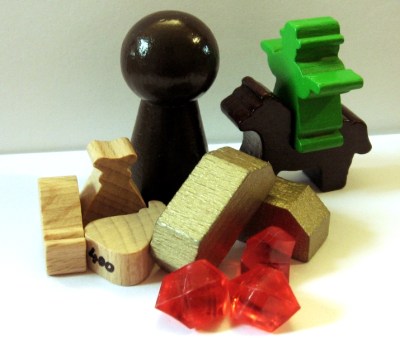
The next game up was Colt Express, newly pimped out with fancy gems, purses and a new large start “poppel” from Essen.  The game itself is quite straight forward, but it usually takes at least  round to see how it works.  The idea is that game play is in two phases:  first players take it in turns to chose which cards they are going to play, then players take it in turns to action the cards they chose in the order they chose them.  Although we’ve played Colt Express quite a bit recently, with Pine new to the game, and the chaotic nature of it, it seemed a little unfair to drop him in the deep end and include the expansion as it adds quite a bit more complexity.  So, after admiring the wooden horses and 3D stagecoach, and discussing the DeLorean mini-expansion, we decided to stick with the base game.

Colt Express
– Image used with permission of BGG contributor sdetavern

The game started out with bullets flying every where and, unusually, mostly finding their targets.  As the game progressed, even the marshal joined in the fun making Ghost (played by Magenta) a real spook for Halloween.  Burgundy (playing Belle) and Red (Cheyenne) started out well with some valuable pickings.  Magenta, starting to look like a piece of Swiss cheese, was seriously hampered by the nine bullet holes she had picked up, and Pine (Doc) was not far behind with seven, though he was giving as well as taking.  Somehow Green (playing Django) who we normally take care to make sure can’t get ahead in games like this, had largely managed to avoid being shot.  This gave him a significant advantage added to which, everyone else  foolishly left him to play his own game.  Before long he was getting away with the strong box (now upgraded to a gold bar) worth $1,000.  This, with the Sharp Shooter Bonus gave him the win, $750 ahead of Blue in second (playing Tuco) who also picked up the bonus for emptying her magazine.

Colt Express
– Image used with permission of BGG contributor punkin312

Magenta and Red were determined that Blue should get an early night to nurse her cold, but she managed to persuade them to one last quick game of one of our current favourites, 6 Nimmt!.  The first round all went according to plan with Burgundy once more picking up more Nimmts than anyone else.  As usual, he did much better in the second round, but couldn’t match Blue and Red who finished in joint first place with a total of just eight each.

6 Nimmt
– Image by boardGOATS

Learning outcome:  Organised chaos is a fun part of lots of different games.

Next Meeting – 3rd Movember 2015

Our next meeting will be on Tuesday 3rd Movember, at the Horse and Jockey pub in Stanford-in-the-Vale.  As usual, we will be playing shorter games from 7.30pm as people arrive, until 8pm when we will start something a little longer.

This week the “Feature Game” will be Witch’s Brew, which is a set collecting and bluffing card game where players have to collect the ingredients for potions and then prepare them.  The game has been reimplemented as this year’s Kennerspiel des Jahres, Broom Service.

Witch's Brew
– Image used with permission of BGG reviewer EndersGame

And speaking of witches…

Jeff and his wife, Josephine were going to a masked Halloween party.  Unfortunately, Josephine had a bad day at work and by the time she got home had a terrible headache.  Not wanting to spoil his fun, she told Jeff to go to the party alone. He, being a devoted husband, protested, but she said she was just going to take some aspirin and go to bed, and so there was no point in his evening being spoiled by not going.  So Jeff took his costume and and Josephine went to bed.

After sleeping soundly for about hour, Josephine awakened without pain, and, as it was still early, she decided to go to the party.  Since Jeff did not know what her costume was, she thought she would have some fun by watching her husband to see how he acted when she was not with him.

Josephine joined the party and soon spotted Jeff in his monster outfit cavorting around on the dance floor, dancing with everyone he could and taking advantage wherever possible.  Josephine went up to him, and being rather seductive herself, Jeff left his partner high and dry and devoted his time to this new person.  She let him go as far as he wished; naturally, since he was her husband and he went all the way sneaking off to one of the bedrooms in the dark.

Just before the unmasking at midnight, Josephine slipped away and went home.  She put the costume away and got into bed, wondering what kind of explanation Jeff would make for his behavior.  So, she was sitting up reading when Jeff came in and she asked him what his evening had been like.

Jeff replied, “Oh, the same old thing. You know I never have a good time when you’re not there.” Slightly surprised by his brazenness, Josephine asked, “Did you dance much?”

He responded, “I tell you, I never even danced one dance. When I got there, I met Pete, Bill Brown and some other guys, so we went into the den and played poker all evening. But you know what?  The guy I loaned my costume to, well, he had a really amazing time!”