Author Archives: nannyGOAT

Boardgames in the News: Bridge is not a Sport, Yet…?

A review began last month following the funding body, Sport England‘s decision not to class Bridge as a sport, and the High Court ruling was announced today.  Mr. Justice Dove declared he was “satisfied that the defendant’s adoption of the definition of “sport” contained in the European Sports Charter was in line with both a proper interpretation of the 1937 Act and also a proper construction of the objects and powers contained with in their Royal Charter”.  He concluded that “the claimant’s application for judicial review must be dismissed.”  The English Bridge Union (EBU) are reported to be “very disappointed”, however, since the organisers of the 2020 Olympic Games in Tokyo have invited both Contract Bridge and Chess to apply for inclusion, this argument may not be over yet.

Bridge
– Image from goodsamchurch.wordpress.com

Autumn 2015 Oxford Meeples Big DoG

On Saturday, November 7th, Oxford Meeples is opening the doors of Wolvercote Village Hall to the general public once more and inviting people to join them for another Big Day of Gaming.  As usual, the Oxford Meeples will be bringing a large number of their games, but everyone is welcome to bring their own too.  Gaming starts at 10:30 am and will be going until late.  Entry is free, although donations towards rent of the hall and refreshments will be appreciated.  Children are welcome when accompanied by an adult.  These are great events, however, whether or not (m)any GOATS are there, will depend on other commitments as usual.

Oxford Meeples Big DoG
– Image from oxfordmeeples.org

Essen 2015

October is the time of year when a boardgamer’s thoughts turn to Germany, specifically, Essen.  Essen is the ninth largest German city and most people in the UK have never heard of it.  Most people who are not gamers that is.  In German, the word “Essen” means “food”, but to gamers it means “Spiel”:  the largest games fair in Europe and, arguably, the world, The Internationale Spieltage is held every year in Essen.  The fair runs for four days every year and is the one of the largest and most significant of all the boardgame conventions.   As such, many of the manufacturers plan their biggest releases for October with their debut at the Fair.  This year, there are lots of exciting new games, including Richard Breese’s new game, Inhabit the Earth, Favor of the Pharaoh, and the highly acclaimed games Codenames and The Voyages of Marco Polo.  There are also a number of expansions for some of our favourite games including Castles of Mad King Ludwig, Evolution, Istanbul, Colt Express etc.  Only two of us are going this year, however, they will almost certainly bring back lots of exciting new toys to share with everyone.

Essen
– Image from merz-verlag.com

Next Meeting – 6th October 2015

Our next meeting will be on Tuesday 6th October, at the Horse and Jockey pub in Stanford-in-the-Vale.  As usual, we will be playing shorter games from 7.30pm as people arrive, until 8pm when we will start something a little longer.

This week the “Feature Game” will be Tokaido, which is a game where players are pilgrims crossing the Japanese “East sea road”, meeting people, tasting fine meals, collecting beautiful items, discovering great panoramas, and visiting temples.

Tokaido
– Image used with permission of BGG contributor henk.rolleman

And speaking of pilgrims…

Two pilgrims were going hunting.  One of them, Joe, was struggling under the weight of the two blunderbusses he was carrying.  After a while, his companion, Jeff, asked, “Why are carrying two guns?”

Joe explained, “I usually miss the first time I shoot. By taking a second gun I have a better chance of hitting it.”

Jeff thought about this for a while and then said, “Why not just take the second gun, and only shoot once?”

22nd September 2015

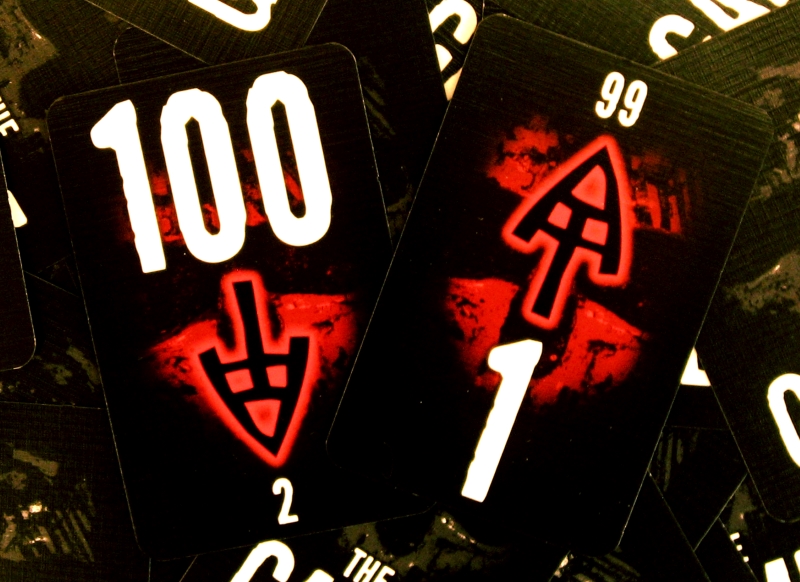
It was a quiet night and, like last time, while we were waiting for people to arrive, we started off with the cooperative card game, The Game.  This time it was only a three-player game and we had a terrible start when Blue’s initial hand had nothing below forty or above sixty.  Things got worse when, a few rounds later she was left with little between ten and ninety.  We struggled on manfully, but we finished with a total of twelve unplayable cards left at the end – we were not even close to matching our recent success.

The Game
– Image by boardGOATS

With the arrival of Black and Purple, we decided to move onto our “Feature Game”, Notre Dame.  This is one of the first games published by the highly prolific game designer, Stefan Feld, who also designed some of our other favourite games including The Speicherstadt and Amerigo.  Feld’s games are often referred to as “point salads” – i.e. games where players can build their score from lots of different sources and Notre Dame is one of these games.  The round starts with the revealing of three character cards which can be hired at the end of the round.  This is followed by drafting three action cards:  each player draws three action cards from a personal deck of nine, keeps one and passes the other two to the player on their left.  From the two they receive, they then choose another one to keep and pass the remaining card on so that everyone finishes with a hand of three cards, one card from each of the two players to their right.

Notre Dame
– Image by boardGOATS

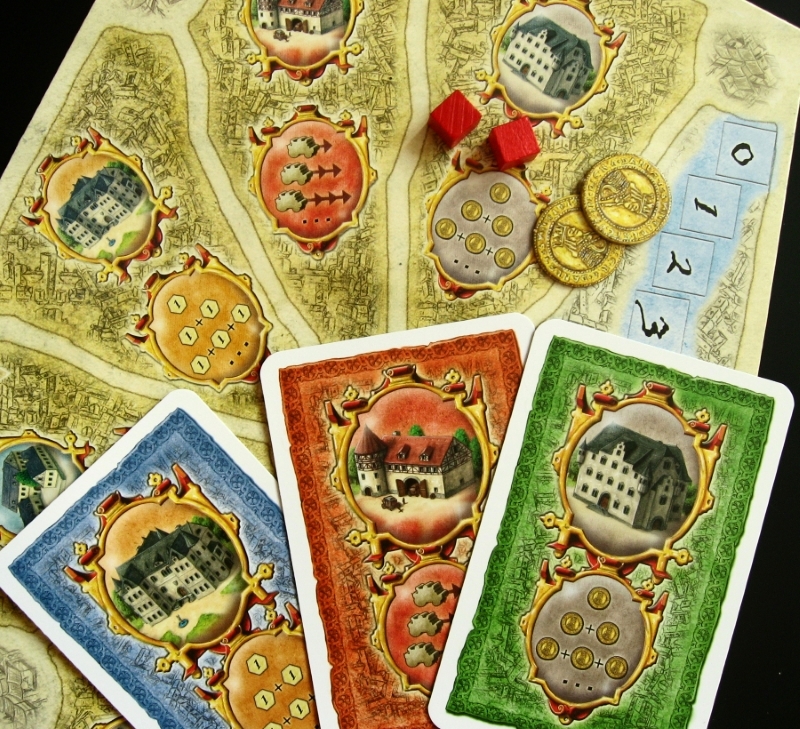
Beginning with the start player, there are then two rounds where each person plays one card, discarding the third.  One way of looking at this is as worker placement where the card drafting is just a novel way of restricting choices.  The actions include things like collecting victory points, collecting money, moving the players carriage and so on.  However, in order to be able to carryout the action, players must place a “worker” (called influence cubes in this game) on the corresponding sector of their map.  The clever part is that the reward yielded (i.e. how many victory points they get, how much money they receive or how far the carriage can move etc.) depends on the total number of influence cubes in the sector.  Thus, for placing the first cube in the banking sector, a player will get one coin, but if they later add a second cube, they get two coins, and so on.

Notre Dame
– Image by boardGOATS

At the end of the round, players can then hire one of the characters for the fixed cost of one coin.  Finally, once everything else has been dealt with, everyone increases their rat population according to the number of rats shown at the bottom of the character cards (which were first displayed at the start of the round).  If a player exceeds nine rats, then nasty things happen including loss of influence cubes and victory points.  Every third round, the cathedral is scored.  This is an area of the board that everyone can place an influence cube in, in exchange for a donation to the church.  When it is scored, a set number of points is divided amongst the players depending on how many influence cubes they have in the Cathedral area.  For example, in a five-player game, twelve points are up for grabs; when four of the players each have one cube in the cathedral, they will get three points a piece, but if there is only one player with a presence in the cathedral, that player will take all the points.

Notre Dame
– Image used with permission of BGG contributor punkin312

Like most good worker-placement type games, players always want to do more things than they can.  For example, if a player does not have sufficient cubes in their personal supply, then they can move them from somewhere else.  That means the original action has one influence cube less, however, and consequently will yield less reward.  So, one of the actions is to get additional influence cubes.  For this reason, players have to try to make sure that they maintain a sufficient supply of cubes by carrying out the corresponding action.  With only two actions per round though, this is difficult.  Similarly, without money players cannot hire one the characters and at the end of the round, the rat population increases so it is essential that players stay on top of that too.  Meanwhile, the winner is the player with the most points at the end of the game, so players also have to try to collect victory points whenever they can.

Notre Dame
– Image used with permission of BGG reviewer EndersGame

Everyone started out a little unsure of what to do, but we got the hang of it quite quickly.  Black started out best, having played before he had an idea of what all the actions could do and how the game would develop.  At the end of the third round, the Cathedral points were shared evenly between Burgundy, Blue, Green and Black.  Meanwhile, Burgundy was trying to collect messages with his carriage with the idea that they would allow him to get points as well as maintain his cube supply and control his rat population.  However, this plan backfired and he got stuck without money which meant he couldn’t hire characters.  Green had a plan to try to alternate between picking up cubes and money, but somehow couldn’t quite make it work.  Blue was just picking up what she could when she could, and then got lucky picking up all the Cathedral points at the end of the sixth round.

Notre Dame
– Image used with permission of BGG contributor GogTad

Totaling up the scores showed that the game was much tighter than we all thought, but ultimately difference was caused by the Plague.  Blue and Green invested heavily in keeping their rat population under control, ensuring the plague never broke out and did best.  There were only eight points between second and last.  Being the sole beneficiary of the second batch of Cathedral points put Blue eight points clear of Green in second which annoyed him as he felt he could have shared the points if he’d spotted it (or listened to Black who had pointed it out just before his last turn).  We all really enjoyed the game, finding it a bit different with very tight  choices, especially at the end.  Definitely a game to try again sometime soon.

Notre Dame
– Image used with permission of BGG contributor punkin312

We finished the evening with a quick game of one of our current favourite “push-your-luck -fillers”, Om Nom Nom.  Burgundy won the first round with fifteen by taking a whole bunch of carrots unchallenged. Green declared that he disliked this sort of game because it was far too luck dependent.  The second round was much tighter; Green decided to try a new strategy – choosing two cards playing the one he least liked, but although this sort of worked for the first card or two, it didn’t after that.  Blue was the clear winner of the final round with sixteen, thanks to a swarm of flies.  This gave her a total of thirty-two, eight more than Burgundy in second and a clean(ish) sweep for the evening.  Green finished last – Luck?  What luck…?

Om Nom Nom
– Image used with permission of BGG contributor msaari

Save the Date: Mixing it in Wantage II

The Mix in Wantage town centre is a community space that can be booked for use by local groups, organisations, businesses and individuals for activities, fund-raising, meetings, workshops, and presentations etc.  This spring, we held a drop-in gaming session there to try to inspire people to play games.  With winter approaching (traditionally “the gaming season”) and Christmas on the horizon, it seemed an excellent time to do it again.

The Mix
– Image from thewantagemix.wordpress.com

We will be there from 10.30 am until 2 pm on November 21st 2015.  There isn’t an awful lot of space so, as before, the idea is to encourage people to drop in and play a short game or two, so we will be bringing along some of most eye-catching games like PitchCar, Colt Express, Dobble, Turf Horse Racing, Cube Quest, The Great Balloon Race and maybe a few of our favourite winter themed games like Snow Tails, Carcassonne: Winter Edition and The Great Downhill Ski Game.

The Mix
– Image used with permission of BGG contributor punkin312

Boardgames in the News: Is Boardgaming a Sport?

A judicial review of the status of Bridge, began earlier this week, following the funding body, Sport England‘s decision not to class the card game as a sport.  Sport England have reportedly claimed that Bridge was no more a sporting activity than “sitting at home, reading a book”.  In contrast, the English Bridge Union (EBU) contests that Bridge is a “mind sport” that exercises the “brain muscle”.

Bridge
– Image from innontheprom.co.uk

Contract Bridge is a trick-taking card game for four players where the two teams bid for how many tricks they will win.  Once the contract has been made, the hands are played out and if the number of tricks agreed is achieved, the team who made the contract win.  The case against Bridge being classed as a sport depends on the definition of a sport:  Sport England defines a sport as an “activity aimed at improving physical fitness and well-being, forming social relations and gaining results in competition”.

Bridge
– Image from goodsamchurch.wordpress.com

The case for Bridge as a sport includes the fact that other EU countries (including the Netherlands, Ireland and Poland) recognise Bridge as a sport, and that Sport England include angling, model aircraft flying, quoits and rambling in their list of sports as well as popular pub games like darts and pool.  Perhaps more importantly, sports are defined in the 2011 Charities Act as activities “which promote health involving physical or mental skill or exertion”.  Lawyers for the EBU are reported to have told the High Court that Bridge was based on rules, fairness and competition – just like other activities classified as sports and Heather Dhondy, winner of three world and five European gold medals made the case in the Independent last year based on the stamina required for tournament play.

Bridge
– Image from bbc.co.uk

The bottom line is that this is all about funding.  If Bridge is classed as a sport they can apply for National Lottery Funding allocated by Sport England.  Sport England has a finite pot and claim it is their job to get the nation fitter, but in reality they are probably concerned they will be heavily criticised by the media and the general public if they give money to a bunch of people “sitting about playing cards”.  Of course, the courts cannot really decide if bridge is a sport, only whether it was reasonable for Sport England to have ruled it was not.  To date, judgement has been reserved and at the end of the High Court hearing, Mr Justice Dove gave no indication as to when he would give his ruling.

Chess
– Image used with permission of BGG contributor duchamp

The final say, however, will perhaps depend on the International Olympic committee (IOC). In 1999, the IOC said that Bridge and Chess should be considered “mind sports”.  If this is taken to its logical conclusion, Bridge, Chess and perhaps other boardgames like Scrabble will eventually become Olympic sports and medals will be awarded every four years.  Indeed, Chess and Bridge are among twenty-six sports that have applied for inclusion in the 2020 Olympic Games in Tokyo.  Since Team GB are the Kings of “sitting-down sports” (cycling, sailing, rowing, equestrian etc.), it seems inevitable that these would be sports we should excel at.  If there were even a small chance of increasing Britain’s tally of Olympic gold medals, Sport England would undoubtedly change their view.

Scrabble
– Image used with permission of BGG contributor Susie_Cat

Next Meeting – 22nd September 2015

Our next meeting will be on Tuesday 22nd September, at the Horse and Jockey pub in Stanford-in-the-Vale.  As usual, we will be playing shorter games from 7.30pm as people arrive, until 8pm when we will start something a little longer.

This week the “Feature Game” will be Notre Dame, which is a slightly older Euro-game, where players juggle the two main resources, influence and money, in an effort to translate them into victory points.  While working to score points players have to carefully manage the threat posed by the rat population and avoid the potentially crippling plague.

Notre Dame
– Image used with permission of BGG reviewer EndersGame

And speaking of the plague…

Jeff had been ill for a couple of days, so, convinced he was dying he went to the doctor.  The doctor ran a whole battery of tests and then him down and said, “I’m afraid you have bubonic plague.”

Jeff was shocked, but after a moment or two, he hopefully asked, “Doctor, can you do something?”

The doctor answered, “Well, you’ll have to stay in the hospital… and we’ll put you on a special diet of flounder, pizza, and pancakes.”

Jeff thought that didn’t sound so awful, but he was curious, “How is that diet going to cure me?”

The doctor replied, “Well, it isn’t, but those are the only foods we can slide under the door!”

8th September 2015

We were late starting and, since we were expecting more, we decided to split into two groups and play something quick and light to start.  By coincidence, both groups began with cooperative card games.  Green, Grey and Cerise started with Hanabi – winner of the Spiel des Jahres a few years ago.  At the time we played it quite a bit, but Grey and Cerise had never been involved.  The idea of the game is very simple:  collectively, the players have to lay five cards in each of five colour-suits in numerical order.  The catch is that players are unable to see their own cards and instead turn their hand round so everyone else can see it.  As a group they then have to use deduction to work out which cards to play and in what order.

Hanabi
– Image used with permission of BGG reviewer EndersGame

On their turn, a player can do one of three things, play a card, give a clue or discard a card.  The number of clues is finite, though discarding cards buys extras.  When a card is played, the player doesn’t have to know what it is they are playing, so long as it can be added to one of the suits.  If it can’t, the group lose one of their three lives.  We have never been able to successfully complete the challenge of laying all twenty-five cards, so the group score is the sum of the highest card placed in each suit, or current maximum being twenty.   As a group we gelled well and through judicious use of efficient clues we were able to get lay all five cards for three colours and three cards for the other two.  This gave a total score of twenty-one, a new club record – definitely deserving of a “Very good! The audience is enthusiastic!”.

Hanabi
– Image used with permission of BGG contributor bovbossi

Meanwhile, Red, Blue, Cyan and Burgundy were playing the altogether less stressful, but equally puzzling, strangely eponymous, The Game.  Similarly, everyone has a hand of cards and they have to be played in numerical order, but in this case every card as to be played on one of four piles, two ascending and two descending.  There are two additional rules:  Players can say anything they want so long as they don’t give specific number information, and if they have a card exactly ten more or less than the top card of the pile they are playing it on, they can ignore the ascending/descending rule.  On their turn, players must play at least two cards before replenishing their hand, but can play as many as they want.

The Game
– Image used with permission of BGG contributor henk.rolleman

This was nominated for Spiel des Jahres this year and we’ve played it a few times since then.  Our best result was in a two player game a couple of months ago, when we had one solitary remaining card, however, we felt at the time that it might have been slightly easier with just two as you can plan better.  This time, it seemed were were doomed from the start with first Red, then Blue having nothing but really, really low cards and no-where to play them.  We managed to survive that though, and with a couple of really effective uses of the “Backwards Rule”, we managed to exhaust the draw deck.  Blue checked out first, quickly followed by Cyan and Burgundy leaving Red to play her last few cards and close out our first victory.  Next time we will have to play with one less card in hand…

The Game
– Image used with permission of BGG contributor joeincolorado

The games finished pretty much simultaneously and then a great debate began as to what to play next and how to split the group given that there were people who didn’t want to stay late.  Green proposed Eketorp, but this is one of Blue’s least favourite games, so she was looking for an alternative when Grey asked whether we had anything that would play everyone.  Blue mentioned Bohnanza, but although Red’s eyes lit up and Cerise looked interested, this time Green was not keen.  Grey wanted to play something with “fighting” and eventually, Green and Grey got fed up with the discussion and decided to play a head-to-head game of Carcassonne.

Carcassonne
– Image by BGG contributor ldaponte

Carcassonne is probably one of the best known of the modern, Euro-games, and is often considered to be “nice” – this is not true when it is played with just two however.  The idea of the game is that players take it in turns to draw and place tiles on an ever-growing map.  They can then add a meeple to any features on that tile before scoring any features that have been completed as a result of placing it.  Players have a finite number of meeples and, with two players, muscling in on someone else’s city is just as effective as building one yourself, making it very definitely, “nasty”.  And so it proved.  Playing with the first expansion, Inns & Cathedrals, Grey started with a few meeples on roads while Green placed a couple of early farmers. Green then took an early lead by completing a city with a cathedral, but then seemed to stutter. Grey continued to plug away eventually catching and passing Green nearly lapping him.  Green was hoping to reap the rewards of the early farmers, but with his last two tiles Grey placed a cheeky farmer and then joined it to the big field.  This cancelled out the huge farm bonus and put the game beyond doubt by sharing Green’s massive thirty-three point farm, finishing forty-one points ahead.

Carcassonne
– Image by BGG contributor Hayzuss

On the other table, discussion had finally ceased an everyone had settled down to one of our current favourite filler games, 6 Nimmt!, another “laying cards in the right order” game.  Somehow, this is a really confusing game, but it is this feeling that you sometimes have control but not being sure why that makes it so compelling.  The game is played with a deck of cards numbered from two to one hundred and four, each of which features a number of “Bulls Heads” (mostly just one, but some have as many as seven).  The idea is that everyone then simultaneously chooses and reveals a card from their hand.  Then, starting with the player who played the lowest card, players add their cards to the four rows on the table.

6 Nimmt
– Image used with permission of BGG contributor punkin312

Each card must be added to the row which has the highest card that is lower than the one to be played, i.e. if rows end with ten, twenty, thirty and forty, then card thirty-five should be added to the row containing number thirty.  If the card played would be the sixth card in that row, then the player “wins” all the cards and the played card becomes the first card in the new row.  The winner is the player with the fewest “Bulls Heads” or “Nimmts” at the end of the game.  We generally play the game in two rounds with half the cards dealt out at the start of the first round and the rest for the second.

6 Nimmt
– Image used with permission of BGG contributor punkin312

With two players new to the game, chaos was inevitable, however, it was Blue who ended most out of synch, collecting twenty-four Nimmts in the first round, and Burgundy who managed to keep it together and escape without picking up a single card.  Roles were reversed in the second round with Blue winning with just six Nimmts while Burgundy picked up thirty-two!  Overall though, it was consistency that won through for Red who finished with a total of nineteen, five ahead of Cyan in second place.

Coloretto
– Image used with permission of BGG contributor punkin312

Carcassonne was still going on the next table, so Cerise mugged Grey for the house keys and headed off with Red and Cyan, leaving Burgundy and Blue to play a quick game of Coloretto.  This push-your-luck set-collecting game has had a few outings recently, and although three or four are much better numbers, we feel it plays surprisingly well with just two.  The idea is very simple, either you draw a coloured chameleon card and add it to a truck, or take a truck.  Players score positively for three sets and negatively for the rest, so the idea is to try to load trucks with coloured cards you want.  This time Blue started badly and from there it just got worse, finishing with Burgundy giving her a comprehensive thrashing, winning by more than twenty points.

Port Royal
– Image used with permission of BGG contributor jsper

Carcassonne and Coloretto finished together and Burgundy, Green and Blue decided there was time to give Port Royal another go.  We played it about a month ago, when it took a surprisingly long time for a quick filler, everyone said they’d like to try it again, and Green worked out a strategy based on Expedition cards that he was keen to try.  In summary, the game is played in turns with the active player turning over cards.  They can keep turning over cards until either they choose to stop or they draw a second ship card that they cannot repel.  Assuming they choose to stop, they can then take a ship card or buy a character card before the remaining cards are offered round the table with players paying the active player one doubloon if they choose to buy/take a card.

Port Royal
– Image used with permission of BGG contributor punkin312

Last time we had found some issues with the rules which we had not really been able to resolve.  The question was, since the Admiral allows a player to take two cards, does that mean they apply the Jester/Governor special powers twice?  On reflection, after the last game we had felt that the way we played (by a strict reading of the rules) was incorrect as it meant the combination was exceptionally powerful.  So for our second try we didn’t allow this and subsequent checking online appears to suggest that we played the way the designer intended this time.

Port Royal
– Image used with permission of BGG contributor punkin312

Another question we’d had was, could a player repel a card if it was the first of a colour to be drawn, or is it only the second card that can be repelled?  Strict reading of the rules appeared to allow this, so this time we played this way.  Blue was the main beneficiary of this rules “change”, as she quickly added not one, but two Admiral cards to her earlier Sailor.  The ability to repel cards before it was essential makes it much more likely that a player is going to be able to draw five cards without going bust.  Since this gave Blue four doubloons every time, it meant she was never short of cash to buy the high value cards. Meanwhile, Green struggled to get his strategy to work with three (partly due to the lack of Expeditions) and Burgundy, who had wiped the floor with everyone else last time round, couldn’t get the cards he needed to get going quickly (not helped by the fact that he initially didn’t use the full power of his Jester).

Port Royal
– Image used with permission of BGG contributor punkin312

This time with just three it was a much, much quicker game and it played quite differently.  In the first couple of hands almost all the tax cards came out giving everyone extra money and it wasn’t until near the end that any of the mission cards were drawn.  It quickly seemed like Blue had the game in the bag although in the event, it wasn’t quite that cut and dried.  Blue brought the game to an end, but Green and Burgundy couldn’t quite get the cards they needed.  The game finished with Blue winning by five points and Burgundy taking second place on a tie-break.

Port Royal
– Image used with permission of BGG contributor msaari

Since Port Royal had played so quickly, we decided to give Zooloretto: The Dice Game a quick go.  This is a game that we’ve got out a couple of times, but then decided not to play because other people have arrived.  It was a while since we’d actually played it so we had to have a quick read through of the rules.  Each player rolls two dice, and like Coloretto or Zooloretto, they then place these on the trucks.  Alternatively, players can take a truck and tick off animals on their score sheet.  Bonuses are awarded for being the first player to complete an animal collection, but if the maximum is exceeded, then players lose points.  The game ends when one player has completed four of their animal collections and have only one space left in the last enclosure.

Zooloretto: The Dice Game
– Image used with permission of BGG contributor kilroy_locke

Burgundy started off well, with Blue and Green struggling to get any really helpful dice.  Burgundy both completed most sets first and also brought the game to a close, so the writing was on the wall:  he finished six points clear.  It was only when we were scoring, however, that we realised that Green hadn’t quite understood – he’d been going for lions assuming the bonus was lots more as you needed more of them to get the set.  Oops; blame the person explaining the rules…

Zooloretto: The Dice Game
– Image used with permission of BGG contributor henk.rolleman

Learning Outcome:  We like deep games, but little games can be a lot of fun too.