Author Archives: nannyGOAT

25th August 2015

It was a very quiet night, so we decided to leave the feature game for another occasion and started with the gorgeously produced Helios instead. This was a new one for all of us, so we had the inevitable long set-up and rules reading – it sounded both complicated and simple.  Players take the role of spiritual Guardians, tasked with forging and evolving the cultures assigned to them by Ahau, the Sun God. During the game, Players will collect resources, explore lands and build temples and other buildings.

Helios
– Image used with permission of BGG contributor punkin312

The power of the sun drives everything in the game as players try to build temples, expand cities, and generally make their civilization flourish.  Players can also harness other realms and use their power and invention to further develop their culture.  Development can only succeed, however, with sufficient raw materials which are limited and become increasingly expensive as players build their temple.  The game’s currency are Glass mana-stones, which can be used to recruit people.  Victory Points are awarded for buildings, the number of recruits, the collected energy (or mana).  Additionally, as the game progresses, the sun moves round the player’s board and bonuses are awarded depending on the way the civilisation has evolved.  The winner is the Guardian that has the most advanced culture after a given number of rounds (i.e. the player with the most Victory Points) and receives full blessing from Ahau.

Helios
– Image used with permission of BGG contributor punkin312

Every part of the game was simple, but how much we had to do and the best order to do them in seemed complicated.  We eventually found it flowed quite well, however, and we found the game easier to follow than we expected.  This did not stop the confusion over what strategies to employ and which actions were best though.  Throughout the game no-one had any inkling as to who had worked it out best and was in the lead.  Purple built many tiles and buildings, while Black eventually went for a small island with temples and thus a fast moving sun to gain the regular rotation points.

Helios
– Image used with permission of BGG contributor duchamp

Burgundy went for a mana strategy from the beginning, giving him the choice of characters.  Inevitably, he took the Treasurer which gave him extra points for remaining mana and resources at the end of the game. meanwhile, Green went for a building strategy as he gained the Architect which gave him extra points for every building and temple. This character alone, netted him twenty-seven points.  This gave a total of one hundred and seven points, just three ahead of Burgundy and six clear of Black.  Everyone was amazed at how close the final results were, and as we put the game away, we decided that we liked it, but had yet to really work out how best to approach it.  We’re all looking forward to an interesting second game.

Helios
– Image used with permission of BGG contributor punkin312

Despite the box claiming it should take less than an hour, we had taken the best part of two hours excluding set-up and rules reading!  So, we decided to play a shorter game next that everyone knew, and chose Splendor.  This is an engine building game that we’ve played quite a bit since last year when it received a Spiel des Jahres nomination.  The idea is very simple – on their turn players can either take chips, or use chips to buy cards from the display drawn from three different decks.  The cards in the display can then be used to help buy other cards and sometimes also yield victory points.  The winner is the player with the most points at the end of the round when one player reaches fourteen.

Splendor
– Image by BGG contributor duchamp

This was an intense game with close scores all the way to the end and amazingly the deck feeding the first row completely exhausted.  In the end, it was a close contest between Black and Burgundy as to who could close out the last few points.  Black just didn’t have enough in his last turn to buy anything, mostly because Green had nabbed the card he wanted.  So Burgundy took the spoils to finish the night.  Just the two games played, but both were close-fought and interesting.

Splendor
– Image used with permission of BGG contributor punkin312

Learning outcome:  Always allow at least two hours for a new game, whatever the box might say!

Boardgames in the News: The Best Games Featuring Maps

The “Brilliant Maps” Blog recently listed what it considered “The 28 Best Map Based Strategy Board Games You’ve Probably Never Played“.  Leaving aside the fact that most dedicated gamers will have played many of them, how valid is this list?  On closer inspection it turns out that the list is really just the top twenty-eight games listed on BoardGameGeek.com (BGG) that happen to have a map for the board.  As such, it makes no subjective judgement on the quality of the map and is simply a list of the best games according to BoardGameGeek that feature a map.

Twilight Struggle
– Image used with permission of BGG contributor killy9999

For example, the game with the highest rating on BoardGameGeek.com is Twilight Struggle which is a Euro/war game hybrid and is therefore played on a map.  The map is not particularly picturesque, however, though for those old enough to remember, its spartan nature is strongly evocative of the Cold War setting.  Is it a great map though?  It certainly captures the theme of the game and perhaps, as such, it is indeed a great map.

Terra Mystica
– Image by BGG contributor Verkisto

Unsurprisingly, many of the games mentioned are war games.  There are a fair number of Euro games too though:  high on the list are Terra Mystica at number two, Brass at four and Power Grid at six.  Number ten on the list is Concordia and eleven is El Grande – a game that is celebrating its twentieth anniversary this year.  Further down are Tigris and Euphrates, Steam, Pandemic, Ticket to Ride: Europe, Carcassonne and finally, just sneaking onto the list, The Settlers of Catan (or Catan as we are now supposed to call it).  All these games indeed include maps of some description, but overwhelmingly, they are also all well-established “classic” games.  Are they the best maps though?

Amerigo
– Image used with permission of BGG contributor Oceluna

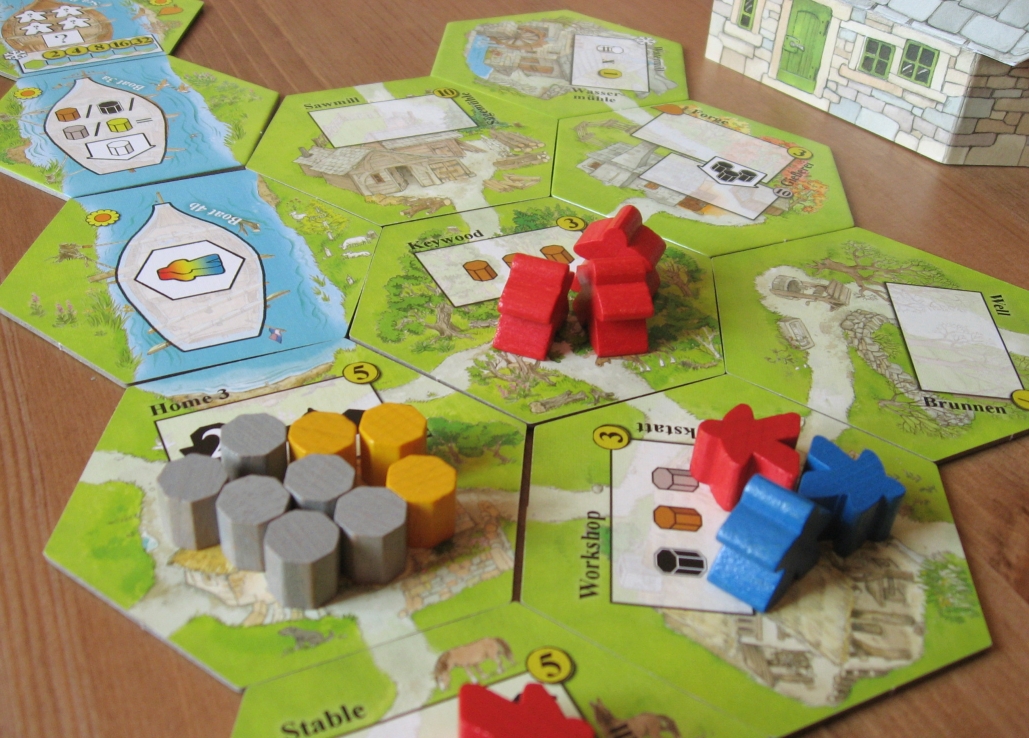
There are some stunningly beautiful games that haven’t made the list, for example, Amerigo is played on a beautiful seascape and Lancaster includes a lovely map of the England.  How do we define “map-based game” however?  Clearly, a map is is a two-dimensional play space so that excludes games where the play-area is predominantly linear i.e. “a track”.  But what about games where the map is produced as the game is played?  If Carcassonne is considered a map game, other games where the board is built during the play should also be included, like Saboteur and Takenoko.  What about one of our favourite games at boardGOATS, Keyflower?  In this game, players buy tiles and then use them to build their own personal little village map.  Should this be included too?

Keyflower
– Image by boardGOATS

Ultimately, none of this really matters of course:  a game is a game and it all comes down to how much people enjoy playing it.  One thing is clear though, while a game can be good in spite of the rendering, playing with beautiful components can only enhance the boardgame experience.

Carcassonne
– Image used with permission of BGG contributor Topdecker

Boardgames in the News: Meeples in the Dictionary

Yesterday, OxfordDictionaries.com announced that together with words like “Grexit” and “Cat café”, they had added “meeple” to their online dictionary.  They define it as  “a small figure used as a playing piece in certain board games, having a stylized human form“.  They add that the origin is “apparently a blend of my and a phonetic respelling of people and first used with reference to the board game Carcassonne“.

Carcassonne
– Image from thirstymeeples.co.uk

Boardgames in the News: The Eight Million Dollar Card Game

Crowd-funding has proven to be a real money spinner – KickStarter projects with lots of miniatures raising loads of money are not uncommon, especially if they include Zombies.  This is a different phenomena though:  in February, a small card game raised $8,782,571 from 219,382 backers, becoming both the most-funded game and the project with the largest number of backers in KickStarter History.  The game? Well, it is called Exploding Kittens and the backers are just beginning to receive their “rewards”.

Exploding Kittens
– Image from explodingkittens.com

Exploding Kittens is described as “a highly strategic kitty-powered version of Russian Roulette”.  The KickStarter project goes on to say, “Players take turns drawing cards until someone draws an exploding kitten and loses the game” – so, not that strategic then.  Clearly it is a light, luck-heavy card game that would probably benefit from the involvement of alcohol and could  be fun in the right circumstances, but why does it have so many backers?  Even more so, why has it been so successful when the cost is $35 per copy for the KickStarter Exclusive deck (excluding postage) and similar games can be had for less than a third of that?

Exploding Kittens
– Image from explodingkittens.com

Obviously the target audience are not dedicated boardgamers – the project wasn’t even posted in the Tabletop Games Category.  The game was created by Elan Lee, Former Chief Design Officer for Xbox Entertainment Studios, and was the lead designer of “The Beast”, a promotional alternate reality game for Steven Spielberg’s movie “A.I. Artificial Intelligence”.  That isn’t the reason for  the game’s overwhelming success though.  The key is the tie in with The Oatmeal, an online comic created by Matthew Inman.  The comic began in 2009 and within a year had an average of 4.6 million unique visitors and more than 20 million page views a month.  With that sort of fan-base it is less surprising that the project was able to get nearly quarter of a million investors to become the third largest fund-raiser in the history of KickStarter.

Exploding Kittens
– Image from explodingkittens.com

Next Meeting – 25th August 2015

Our next meeting will be on Tuesday 25th August, at the Horse and Jockey pub in Stanford-in-the-Vale. As usual, we will be playing shorter games from 7.30pm as people arrive, until 8pm when we will start something a little longer.

The “Feature Game” will be Eketorp, where players build Viking strongholds upon the Swedish island of Öland.  The winner will be the player who does Viking-type things best, including winning battles and pillaging.

Eketorp
– Image used with permission of BGG contributor cuazzel

And talking of Vikings…

A famous Viking explorer returned home from a voyage and found his name missing from the town register. His wife insisted on complaining to the local civic official, Jeff, who apologized profusely saying, “I must have taken Leif off my census…”

Boardgames in the News: Convention Season

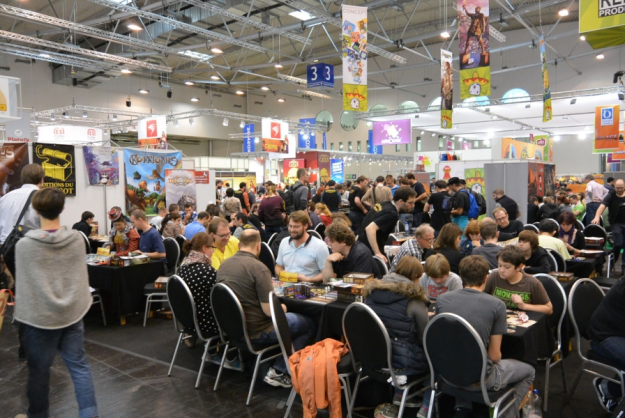
Broadly speaking, June to November is boardgame convention season.  These vary wildly in size, style and location.  Some conventions, like Gen Con, are primarily meetings for people who like playing games, while others are limited access trade fairs, like the SpielwarenMesse.  Similarly, some conventions, like BGG.Con, are focused on boardgames whereas the PAX series, include miniatures, comics and other Geek fayre.  A bit like the film world where the Oscars are later in the year and earlier events tend to give a preview, the biggest boardgame conventions are in the second half of the year.

Essen 2014
– Image used with permission of BGG contributor Sjeng

In fact, the Euro-boardgame calendar is largely constructed around the German market, with the main even held in October, the Internationale Spieltage in Essen.  This is a massive games fair and held in the industrial heartland of Germany and showcases everything from children’s games to the latest Euro-game.  Many (or even most) manufacturers release their games at one of the big conventions like Essen, which is nicely in time for the Christmas market.  Of course this only really catches the most hard-core of gamers as these freshest releases don’t make it in to the wider conciousness.  However, they are perfectly timed for the next major landmark, the Spiel des Jahres.  Games that make it into the nomination and recommendation lists or better still, win an award, are then perfectly placed for a new print run with the “Red Pöppel” on the cover, with plenty of time for Christmas advertising and a second outing at Essen.

Gen Con
– Image from graphicpolicy.com

One of the largest conventions, Gen Con has just concluded.  The name Gen Con is derived from “Geneva Conventions” reflecting both its original location on the bank of Lake Geneva and it’s war gaming heritage, though it is now held in Indianapolis and includes games of all types.  It will be quickly followed by PAX in Seattle in a few days time. PAX, the Penny Arcade Expo, is actually series of gaming festivals held in Seattle, Boston, Melbourne and San Antonio, run by the authors of the Penny Arcade webcomic.  These are shows exclusively developed for gamers and include everything from speeches from industry insiders, to tabletop game tournaments.  One of the defining features of every PAX is the Omegathon which is a festival long tournament consisting of a group of randomly selected attendees competing for a grand prize.

UK Games Expo Logo
– Image from ukgamesexpo.co.uk

Although some of these big events may be half a world away and therefore totally inaccessible without a small fortune, there are a lots of more local events that are easier to get to and often offer excellent value for money.  These vary from smaller local game days (like the Oxford Meeples “Big DoG” events) to large country-wide conventions (like the UK Games Expo held annually in Birmingham).

– Image of unknown origin
Selected Local, National and International Conventions
Convention  Location Month
OxCon Oxford, UK January
LeiriaCon Leiria, Portugal January
SpielwarenMesse Nürnburg, Germany February
UK Games Expo Birmingham, UK June
Origins Columbus, Ohio, USA
June
Gen Con Indianapolis, Indiana, USA August
Penny Arcade Expo – PAX  Seattle, Washington, USA  August
Internationale Spieltage  Essen, Germany  October
BGG.Con  Dallas, Texas, USA  November

11th August 2015

It was a quiet week, so unsure of how many people we would be, we started out with what was supposed to be something quick, our “Feature Game”, Port Royal.  This is a fairly light card game with elements of push your luck and and deck (or rather tableaux) building.  On their turn, the active player turns over the top card from the deck:  this could be a coloured Ship, or a Person.  The player then has two options, they can turn over another card and add it to the row, or take one of the face up cards.  They can continue turning over cards either until they choose to take one or until they go bust because they draw a Ship and the colour matches one that has already been revealed.

Port Royal
– Image used with permission of BGG contributor punkin312

When taken, the coloured Ships are immediately exchanged for money according to the number of coins shown on the card.  They also have a military value which is where the People cards come in.  The People cards cost money, but in general, yield both victory points and special powers.  For example, Sailors and Pirates give players a military strength.  If their strength matches that of a Ship, the active player may repel the Ship to avoid going bust.  There are also Settlers, Captains and Priests which are used to fulfill the requirements of Expeditions.  Expeditions are cards that are immediately put to one side when drawn and allow players to increase their number of victory points by trading People cards for the higher value Expedition card.

Port Royal
– Image used with permission of BGG contributor jsper

There are other People cards too.  For example, the Governor awards players two extra coins if there are five or more cards on the table, and the Admiral allows players to take more than one card. Once the active player has taken their turn, then the next player can choose to take a card from the remaining face up cards, paying the active player one coin for the privilege.  Once everyone has had the chance to take a card, play passes to the next player.  The game end is triggered when one player hits twelve victory points and play continues until everyone has had the same number of active player turns.

Port Royal
– Image used with permission of BGG contributor punkin312

The game has obvious elements of “push your luck card turning” like Incan Gold, dual purpose cards like Bohnanza, tableau building like 7 Wonders and Dominion, and set collecting like Splendor.  However, it also has other interesting features.  One of the most interesting aspects was the way that the appearance of some cards is delayed because they are tied up as currency.  This meant that in our game, the Tax Man didn’t appear at all for the first half of the game and then appeared several times in quick succession.  Similarly to Bohnanza, the composition of the deck also changes.  In Bohnanza, the deck shrinks dramatically and as all the rare cards are turned into money their rarity increases.  In Port Royal, it is the People cards that become rarer as they are played into harbours, and ships, which start off quite scarce, become increasingly common increasing the chances of going bust.

Port Royal
– Image used with permission of BGG contributor msaari

Black and Purple started out collecting Settlers, Priests and Captain cards, hoping for an opportunity to upgrade the victory points with Expedition cards.  Blue and Burgundy eschewed Expeditions and instead went for the expensive People, with powerful actions.  That said, Burgundy struggled at the start, going bust in the first two rounds which left him penniless and hampered his ability to buy anything at all.  Meanwhile, Green was fighting just to get the cards he wanted before someone else pinched them.  Eventually, Purple took her second Expedition card and triggered the end of the game, but nobody else was close enough to threaten her position; Burgundy took second on a tie-break with Green, who both finished with nine victory points .

Port Royal
– Image used with permission of BGG contributor punkin312

The rules booklet was not the best, however, and there were a number of questions we had that went un-answered.  For example, we were unclear on how to combine the Admiral with either the Jester or the Governor.  The question was, since the Admiral allows a player to take two cards, does that mean they apply the Jester/Governor special powers twice?  On reflection, we felt the way we played (by a strict reading of the rules) was incorrect as it meant the combination was exceptionally powerful.  Similarly, could a player repel a card if it was the first of a colour to be drawn, or is it only the second card that can be repelled?  On balance, although it was a long way from being the “quick game” we expected, we all enjoyed it and felt it was a good game.  Green in particular was quite taken with the effect the dual-use of the cards had on the draw deck and everyone had had thoughts on how they could have done better, but it was fitting that the one who currently has to wear an eye-patch won the pirate game!

Snowdonia: The Daffodil Line
– Image used with permission of BGG contributor tonyboydell

After some debate, we decided that we wanted to play a deeper game next which meant we were quite limited as we didn’t have many five-player games.  We all enjoy Snowdonia, so since we’ve all played it before we thought we could fit it into the time we had left despite the prolonged setup time (not helped by the fact that Blue’s box contains most of two copies).  Unfortunately, we got side-tracked by the possibility of playing one of the alternative scenarios.  We started setting out The Daffodil Line and then we realised it only played four, so as the game is very tight anyhow we decided not to try to stretch it to five and broke the shrink-wrap on Britannia Bridge instead.

Snowdonia: Britannia Bridge
– Image used with permission of BGG contributor tonyboydell

Snowdonia is a very tight, worker placement game, where players have just two workers and an optional third if they have the required train and coal.  The game simulates building a railway, with players first choosing actions in turn order, then carrying out the actions in “action order”.  The actions include collecting resources from the stockyard, clearing rubble from the route, building track, and building stations.  There are points for most things, but one of the actions is to take contract cards which give players extra points for completing a set number of given tasks (e.g. laying three sections of track).

Snowdonia
– Image used with permission of BGG contributor ansi

There are a number of interesting aspects to the game.  Firstly, the weather.  Snowdonia is well known for its rain, fog and very occasional sun, and this has an effect on the rate players can perform tasks.  Secondly, the author, Tony Boydell, is known to dislike resource hoarding and has built in a mechanism to discourage it.  At the start of each round, resources are drawn from a bag and placed in the stockyard.  There are also a small number of white cubes in the bag – for each one that is drawn the game carries out an action.  Since resources are limited, if players hoard them, the chance of drawing white cubes increases and the game speeds up, perhaps unpredictably.

Snowdonia
– Image used with permission of BGG contributor winterplum

Britannia Bridge (or Pont Britannia in Welsh) is the bridge across the Menai Strait between the the mainland of Wales and the island of Anglesey and the scenario simulates building a railway from the mainland to Holyhead on Anglesey.  Thus, before players can build any track, they have to build the bridge.  Uncharacteristically the weather remained quite sunny, though as it was Anglesey rather than Snowdonia, perhaps that was to be expected.  This kept the dig rate up and the track-bed was cleared in record time.  However, although four white cubes came out in fairly quick succession, after that, they seemed to lurk in the corners of the bag, so much so that we checked they were there twice.

Snowdonia
– Image used with permission of BGG contributor winterplum

Black and Purple both built locomotives early giving them the distinct advantage of the optional temporary labourer.  Black used his to move his Surveyor collect contract cards and Blue decided to obstruct his plans by taking the some of the most lucrative (but most challenging) contracts.  Everyone else looked at the short track and some of the high scoring options and decided to go for points.  Blue, Green and Burgundy decided to wait until the maintenance was done before buying a train, but since the white cubes were so slow, by the time it happened they all decided the game was too far advanced for it to be worthwhile.

Snowdonia: Britannia Bridge
– Image used with permission of BGG contributor tonyboydell

Although Black got an early train (The Dawn Raider) and made good use of his extra worker, he was unable to used his special ability as it depended on white cubes being drawn.  Purple took the nine point train and also used the extra worker to move her surveyor.  Burgundy scored a massive number of points by building bits of stations and the game sort of stalled with one track left to build and nobody very keen to build it.  Green eventually got fed up and felt everyone else was picking up points faster than he was, so he decided to end the game.  Blue somehow managed to scrape it all together in the last round building the last siding she needed to fulfill her thirty-one point contract for four track sections and grabbed a six point contract which she had already fulfilled.  These, together with other bits and pieces this gave her a total of seventy-nine points, just two ahead of Black (who also completed three contracts) and someway clear of Burgundy who took third place with sixty-six points.

Snowdonia
– Image used with permission of BGG contributor winterplum

Although we enjoyed the variation and the Bridge undoubtedly changed the start, the different scenario didn’t change the game very much:  contract cards were still very powerful and ultimately made the difference though Burgundy did incredibly well just building stations.  In short, the weather and its effect on the “dig rate” together with the lack of white cubes made a much larger impact on the game than the Bridge.   And that can happen in any game of Snowdonia.

Snowdonia
– Image by BGG contributor aleacarv

Learning Outcome:  The weather has a big influence on building a railway, wherever you choose to build it.

Next Meeting – 11th August 2015

Our next meeting will be on Tuesday 11th August, at the Horse and Jockey pub in Stanford-in-the-Vale.  As usual, we will be playing shorter games from 7.30pm as people arrive, until 8pm when we will start something a little longer.

This week the “Feature Game” will be Port Royal, which is a light card game where players are trying to earn as much as they can from the Caribbean Sea, but if they set their goals too high, they might take home nothing for the day.

Port Royal
– Image used with permission of BGG contributor punkin312

And speaking of sailors…

It was a dark, stormy, night at sea and Jeff was on his first assignment on-board ship – guard duty.  The Captain stepped out taking his dog for a walk and Jeff, slightly nervous snapped to attention, made a near-perfect salute, and snapped out, “Good Evening, sir!”

The Captain, who was out for some relaxation, returned the salute and said, “Good evening Seaman, nice night, isn’t it?”  Well it wasn’t a nice night, but Jeff wasn’t going to disagree with the Captain, so Jeff saluted again and replied “Yes sir!”.

The Captain continued, “You know there’s something about a stormy night that I find soothing, it’s really relaxing. Don’t you agree?”  Jeff didn’t agree, but then he was just a seaman, so without hesitation, he responded, “Yes sir!”

Then the Captain, pointing at the dog said, “This is a Golden Retriever, the best type of dog to train.” The Seaman glanced at the dog, saluted yet again and said, ” Yes sir!”  The Captain continued, “I got this dog for my wife.” Without thinking, Jeff replied, “Good trade, sir!”

28th July 2015

We started the evening splitting into three groups, the first of which played Machi Koro.  This was the “Feature Gamea couple of months back when it received a nomination for the coveted German Game of the Year, or Spiel des Jahres Award.  In essence, it is an engine building game with elements taken from The Settlers of Catan and Dominion.  Like Settlers, on their turn players first roll one or two dice, which yield resources, in this case money.  Players then use their money to buy cards like Dominion.  Each card is numbered and provides money, sometimes when the owner rolls, sometimes when someone else does, with the amount sometimes depending on the other cards a player has.

Machi Koro
– Image used with permission of BGG reviewer EndersGame

Players have five special buildings costing varying amounts and the winner is the first player to build all of them.  Red, Yellow, Orange and Cyan started setting up while people finished eating, but Red emigrated to play the hidden traitor game, Saboteur, with Teal and Violet when they arrived.  This is one of those little games that everyone always enjoys playing and plays lots of people well.  With only three players, it’s possible to have one bad dwarf, or none at all which makes everyone very twitchy, and as usual, accusations abounded.  After three rounds, Teal ran out the winner with five gold.

Saboteur
– Image used with permission of BGG contributor mothertruckin

Machi Koro and Saboteur finished together to the two groups coalesced to play Colt Express.  This had been the “Feature Game”, last time, however, none of this group had been available to play.  Red was particularly keen to give it a go as it has a lot in common with one of her favourite games, Walk the Plank!.  This style of game is sometimes refereed to as a “programming game” because players play all the cards and only after everyone has played cards, do they get to action the cards.  The effect of this is semi-organised chaos as players try to make plans to take care of all eventualities, and then find that by the time they get round to carrying out the actions the situation has completely changed and is nothing like they would have predicted.  This time, Orange took the $1,000 for the sharpest shooter and Cyan took the strongbox.  Despite this, the best thief turned out to be Yellow who finished with $2,700 some way ahead of Cyan in second place.

Colt Express
– Image used with permission of BGG contributor henk.rolleman

Meanwhile, everyone else had been playing the “Feature Game”, which was Last Will.  This is basically the boardgame equivalent of the 1985 film “Brewster’s Millions”.  The story goes that in his last will, a rich gentleman stated that all of his millions would go to the nephew who could enjoy money the most.  In order to find out who that would be, each player starts with a large amount of money, in this case £70, and whoever spends it first and declares bankruptcy is the rightful heir, and therefore the winner.

Last Will
– Image used with permission of BGG contributor PaulGrogan

The game is played over a maximum of seven rounds each comprising three phases.  First, starting with the start player, everyone chooses the characteristics of their turn for the coming round from a fixed list.  These include the number of cards they will get at the start of the round, the number of “Errand Boys” they will be able to place, the number of Actions they will get and where they will go in the turn order.  For example, a player may choose to go first when placing Errand Boys, but will then only get one card at the start of the round and crucially, only one Action.  On the other hand, a player may choose to sacrifice position in the turn order, draw no cards, only place one Errand Boy, but receive four Actions.  Since all but two cards are discarded at the end of the round and Actions must be used or lost, this decision is critical.

Last Will
– Image used with permission of BGG contributor Toynan

Next, in the revised turn order, players take it in turns to place one Errand Boy before placing their second if applicable.  Errand Boys are important as they allow players to control the cards they are drawing as well as manipulate the housing market and increase the space on their player board.  The heart of the game is the cards, however, which are played in three different ways:  as a one off (white bordered cards); on a player’s board (black bordered cards) or as a modifier (slate bordered cards) which enable players to spend more when black or white bordered cards.  Thus, White bordered cards are event cards which cost a combination of money and Actions to play, but once played, are discarded.  Black bordered cards cost at least one Action to play, but are kept and can be activated once in each round.

Last Will
– Image used with permission of BGG reviewer EndersGame

Black bordered cards come in three different types: “Expenses” which allow players to spend money; “Helpers” which additionally allow give players some sort of permanent bonus, and “Properties” which are by far the most complex cards in the game.  Properties are an excellent way of spending money as they are bought for a given amount and will either depreciate every round, or will require maintenance which can be expensive. Unfortunately, players cannot declare bankruptcy if they have property and must sell them.  This is where the property market comes in:  one of the possible errands is to adjust the property market, so if a property is bought when the market is high and sold when it is low, this is another possible avenue for losing money.

Last Will
– Image used with permission of BGG contributor bswihart

At the end of the round, everyone reduces their hand to just two cards and loses any left-over actions, which puts players under a lot of pressure as it makes it very hard to plan.  So the game is an unusual mixture of timing, building card combinations, strategy and tactics.  Only Blue had played it before and that was a long time ago, so it took a long time to explain the rules and make sure that everyone understood how the cards worked.  Even then, there were a lot of misunderstandings.  Burgundy had also read the rules quite carefully as well though and mostly managed to keep everyone on track.

Last Will
– Image used with permission of BGG contributor Toynan

Green (as the last person to the bar and therefore the last person to buy something) went first and started out with an “Old Friend” which gave him an extra action.  Burgundy went for a “lots and lots of cards which don’t cost an Action to activate” strategy while Black and Purple went into the properties market.  Meanwhile, Blue’s starting cards favoured buying farms, but by the end of the first round it was becoming clear that the cards she needed weren’t there and an Events strategy would probably be better.

Last Will
– Image used with permission of BGG reviewer EndersGame

Towards the end of the fourth round it was becoming obvious that Burgundy’s preparation (reading the rules) was paying dividends as he was systematically spending more than £12 per round – the amount needed to force an early finish to the game.  Blue on the other hand was trying to work out why her pile of poker chips didn’t seem to be decreasing.  By the end of the fifth round it was clear that Green was pressing Burgundy hard and there would only be one more round.  A quick bit of maths also suggested that there had been a “banking error”.  Although it would normally be in Blue’s favour, unfortunately, as this is game where players are trying to lose money, it didn’t help her.  Since she had been in charge of the poker chips though, it could only have been her own fault.

Poker Chips
– Image by boardGOATS

The game came to an end in round six when Green ran out of chips.  This left him with a final total of zero and everyone else trying to make the best of the final round.  Black and Purple tried selling off their properties and Blue held another couple of expensive parties, but it was Burgundy who spent £20 to finish the winner with £13 of debt.  As we put the game away, we agreed that it was quite an unusual game, though quite complicated, especially on the first play.  We also all felt that it was the sort of game that would benefit from the familiarity with the cards that comes from repeated plays, so it is quite likely that we’ll play it again soon.

Last Will
– Image used with permission of BGG contributor CellarDoor

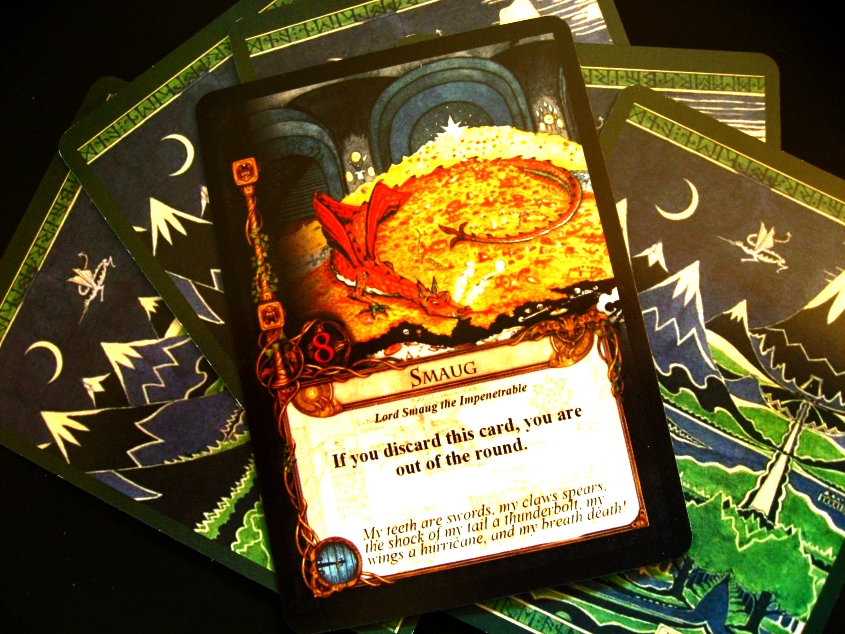
With everyone else gone, there was just time for a few quick rounds of Love Letter.  This is a game we played a lot a year or so ago, but not so much recently.  The first of the so-called “micro games” it is played with just sixteen cards.  Each player starts with one card and on their turn, draws a second card and then plays one of them.  Each card has a value (one to eight) and an action (discard a card, swap cards with another player, compare cards, etc. etc.).  The object of the game is to have the highest card when the deck has been exhausted or, be the last person remaining, which ever is soonest.  For variety, we played with Green’s much loved, very battered, previously lost but recently re-found, home-made, “Hobbit” themed deck, complete with tiny gold rings.  So, the first problem was remembering what all the cards did and then trying to match them to the new characters…  With five, we played until the first player had two rings – everyone got one except Burgundy before Black won a second round and finished as the winner.

Love Letter
– Image by boardGOATS

Learning Outcome:  Spending money is not quite as easy as you think.