Category Archives: Games Night

6th October 2021

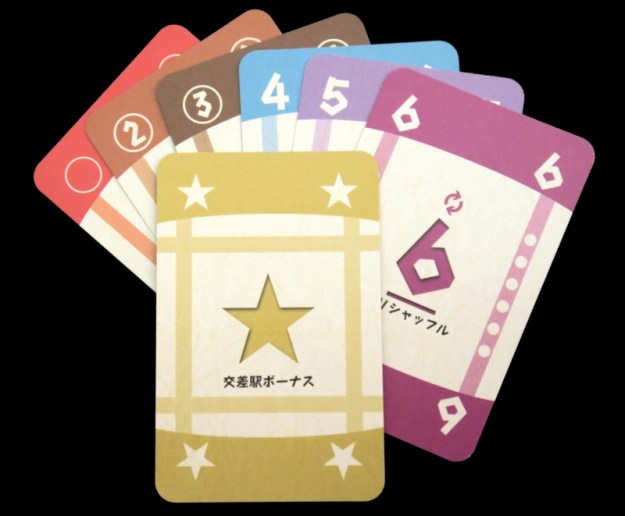
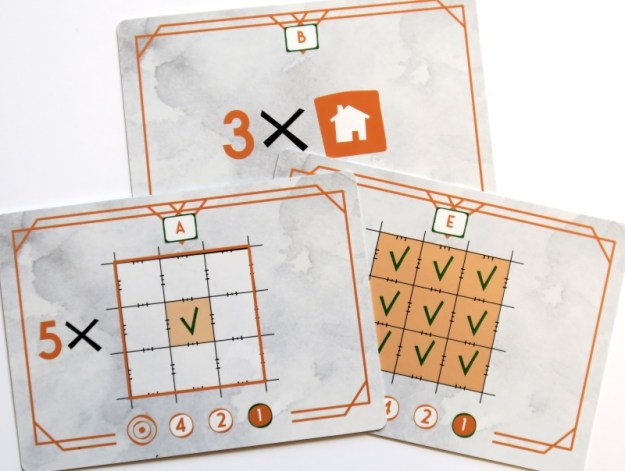
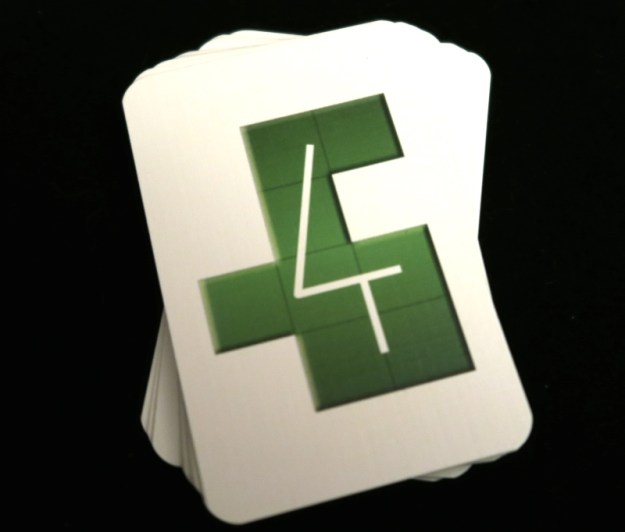
For the first time, the group were meeting on a Wednesday to avoid clashing with the Quiz on Thursday.  As Blue and Pink waited for food they decided to squeeze in a quick game of NMBR9 to celebrate our ninth birthday.  This is a quick little tile-laying game that has almost zero setup time, so is very appealing as a filler in this sort of situation.  The tiles are poly-ominos roughly shaped like the numbers zero to nine and there is a deck of cards featuring each number, zero to nine, twice.  Players take the appropriate number from the box following a flip of a card, and add it to their personal play-space.

NMBR 9
– Image by boardGOATS

Tiles have to be placed in layers with tiles on higher layers being more valuable as the number on the tile is multiplied by the “storey” it is on.  Tiles must be placed adjacent to another tile on the same layer and, when placing tiles on higher layers they must not be wholly over one other tile and must be completely supported (no bridging gaps or overhangs).  This time, Pink managed to make it to four layers putting a seven on the top layer, his third “storey” to give twenty-one points.  As a result he was sure he was going to win.
NMBR 9
– Image by boardGOATS

Pink had fewer tiles on the second and, particularly third levels, though, where Blue had concentrated her efforts.  The effect was very similar, so much so that there was only one point in it, but much to his disappointment, even several recounts couldn’t put the deficit in Pink’s favour.  He was cheered up by the imminent arrival of his pizza though and they were still eating when Green, Lilac, and then Teal turned up.  Since Green and Lilac had missed last time, they introduced themselves to Teal and there was some general chit-chat as everyone else turned up.

NMBR 9
– Image by boardGOATS

Appropriately, as we were celebrating our ninth birthday, there were nine of us to play the traditional birthday “Feature Game“, Crappy Birthday, as we ate meeple decorated chocolate cupcakes.  Crappy Birthday is a silly little party game but is a surprising amount of fun.  As we explained the rules to Teal, we reminisced about last year, when we played it over two sessions (one wrapping our parcels and one giving them) in order to be able to play it online.  Lime expressed his astonishment that it was a year ago, and everyone concurred that it didn’t feel like a year.

2021 Birthday Cupcakes
– Image by boardGOATS

Crappy Birthday doesn’t sound like much: the game is played over one “year” and each player takes it in turns to have their birthday, with everyone else choosing a card from their hand as a “gift”.  The birthday boy or girl then chooses their favourite and least favourite gifts and the givers of these each get a point.  As such, those gifting are trying to avoid the mediocre , in a similar way to Dixit, but “not as good” as Purple opined.  While most people around the table would agree that Dixit is the better game, this group tend to get more fun out of Crappy Birthday because of the really silly gifts on the cards.

Crappy Birthday
– Image by boardGOATS

The silliness of the gifts would get stale if we played the game more frequently, but we only play Crappy Birthday once a year and we usually only use around half the cards, so most cards only come out once every two years.  It is a great way to find out about people though, so being new to the group, everyone thought Teal would be at quite a disadvantage.  This year we found out that Pink was unimpressed by 100lb of raw fish, Lilac quite fancied a trying out a wingsuit and Blue would overcome the creepiness of 3am in the Paris catacombs as apparently they were hard to get to visit.  Ivory, was torn between the opportunity to sing the National Anthem before a Major League Baseball game and getting his earlobes stretched, but went for the latter as his least favourite as it was more permanent.

Crappy Birthday
– Image by boardGOATS

We discovered that Teal likes to keep his feet on the ground, so he eschewed a flight in a fighter jet, but really liked the idea of a Viking helmet.  It was about this point that we were joined by one of the former bar staff who stuck about to help Pink with his gift selection.  It seemed she didn’t really help a lot though as he completely failed to get any of his gifts picked as best or worst.

Crappy Birthday
– Image by boardGOATS

From there, Purple nearly ended up instigating divorce proceedings when she received a set of camera scales from Black (a gift nobody else would have been prepared to give to anyone).  Instead of fully justified revenge, however, Purple gave Black’s his favourite gift a campervan.  Lime having just moved house eschewed recycled newspaper wallpaper, instead opting to decorate his new home with some modern art after some classes.  DIY seemed to be in the air, as Green chose a house that needed renovation, though he volunteered Lilac to fix the roof.
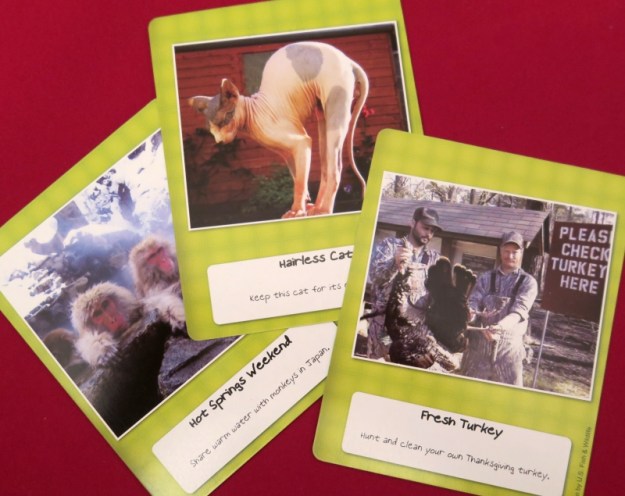
Crappy Birthday
– Image by boardGOATS

As usual, Lime’s amazing gift-giving skills meant he did well, but this time he was beaten into third place by Purple and, remarkably, Teal who tied for first place, with four—it seems Teal knows us all surprisingly well after just a couple of weeks!  As people counted their scores and decided what to play next, the group put together a special selection of gifts for Pine who was running late thanks to a group of over-enthusiastic cubs whom he had been showing round his work.  This special selection was tailor-made for a vegan who doesn’t like horses.
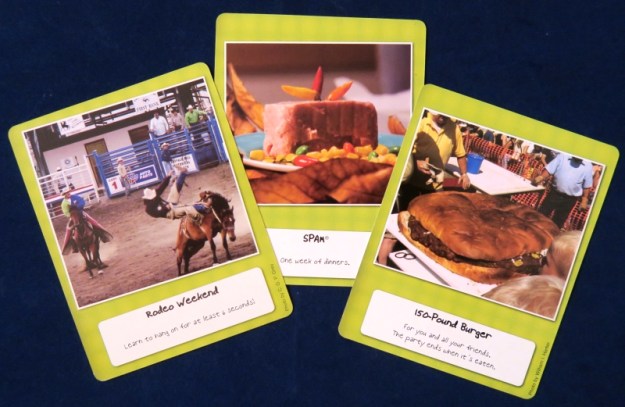
Crappy Birthday
– Image by boardGOATS

From there, the group split into three, one led by Lilac who wanted to play Thurn und Taxis, one led by Ivory who wanted to play Key Flow and one led by Green to play with something short that Pine could join in with when he arrived.  Thurn und Taxis is a slightly older, Spiel des Jahres winning game where players build postal routes connecting cities across Bavaria and surrounding regions.  Routes are built city to city to city, so that each city is adjacent to the next city on the route and there is a road connecting these two cities.

Thurn und Taxis
– Image by boardGOATS

Players are building routes by collecting cards and playing them in front of them.  Every turn, the active player takes a city card from the face-up display (or blind from the top of the deck) and then plays a card for a city connected to either end of their existing route.  The card played, must connect to their route, otherwise they have to discard their route and start again.  Then they can score their route if they choose, but each route must consist of at least three cities and players may build only one route at a time.

Thurn und Taxis
– Image by boardGOATS

If after adding to the route, the length of the route is at least three cities, the player may declare it finished and score it.  Players start with a supply of twenty post offices in their colour, each of which is worth minus one at the end of the game. When they score a route, players place post offices in cities on the board, but they have a choice.  Each city is in a region and each region has a colour, when a route is scored, the active player can either place one post office in one city in each of the region their route visits, or in all the cities on one of the regions their route goes to.

Thurn und Taxis
– Image by boardGOATS

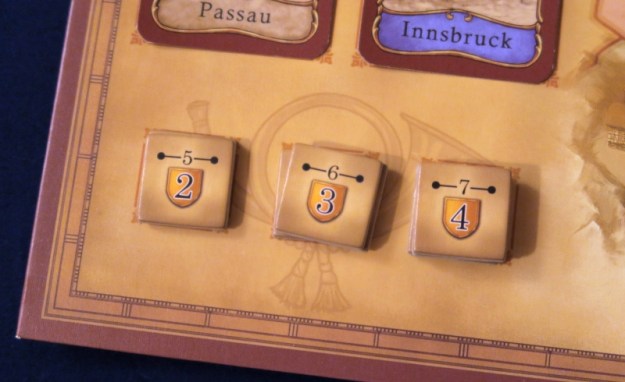
When a route is scored, the active player can take a cart card.  These give points, however, in the general case, the cart card must be one more than the previous one and the route must be longer than the cart number.  Thus, if someone is scoring a six leg route, they can only take a level six card if their previous cart was a level five card.  If they enlist the help of the Wainwright, however, if they have a level five card, they would be able to take a level six card with a route of only four legs.  Once a route is scored, the city cards of that route are discarded, and the player begins a new route on their next turn.

Thurn und Taxis
– Image by boardGOATS

The Wainwright is not the only special character in the game: the Postman, Bailiff and Coachman are all there to offer help, allowing players to take a second card, refresh the card market and play a second card respectively.  Players can only enlist aid once per turn though, so they must choose who they call on carefully. When a player exhausts their supply of post offices or acquires a value seven carriage, the end of the game is triggered with players continuing the round—the player with the most points wins.

Thurn und Taxis
– Image by boardGOATS

In addition to points for cart cards, there are also bonus points available for players to connect all the cities in a region or to have a post office in every outer region, as well as for players completing longer routes and for the player who triggers the end of the game.  In general, bonuses score most for the first player to make the achievement with diminishing returns thereafter.  This is therefore a consideration players must take into account, but the fact that players must add at least one city to their route each turn or lose the whole route is probably the most important aspect of planning in the game.
Thurn und Taxis
– Image by boardGOATS

Although Thurn und Taxis is an older game, Purple had not played it before, and it took her a while to get her head round it.  She got to grips with it eventually, however, it was later in the game and Black and Lilac had already got a head start.  It was very close between them though with the scores neck-a-neck until the last.  Lilac triggered the end of the game by taking a level seven cart card and with it took what turned out to be the decisive bonus point, pipping Black with twenty-seven points to his twenty-six.
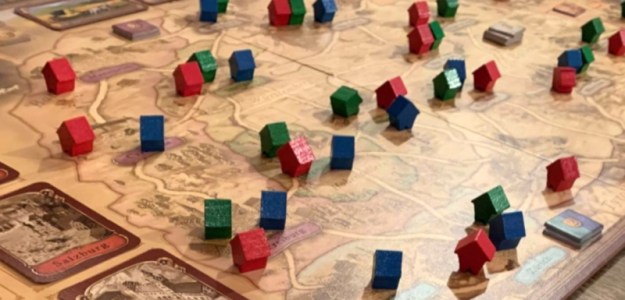
Thurn und Taxis
– Image by Lilac

On the next table, Teal had looked in the game bags and decided Azul was one he’d like to play.  Green, Lime and Teal had just started without Pine when he inevitably arrived a couple of turns in.  He politely eschewed their kind offers to start again, instead concentrating on his healthy supper of crisps and cake and choosing his gift.  In Pine-like fashion, he chose to redefine the rules and decided his favourite gift was a hunting expedition as long as the subjects of the hunt were the people delivering the perkiness training in his other “choice” gift.
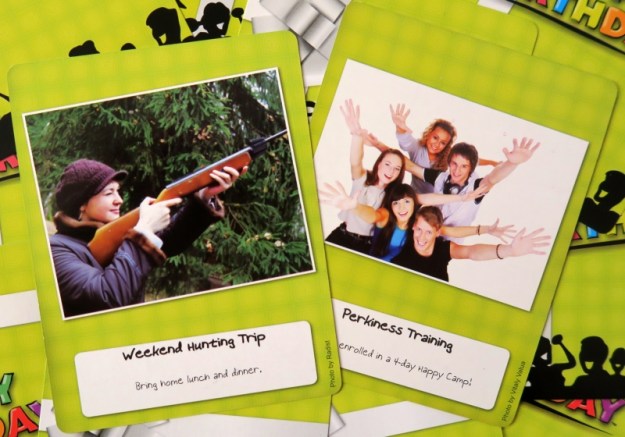
Crappy Birthday
– Image by boardGOATS

We have played a lot of Azul and its derivatives (Stained Glass of Sintra and Summer Pavilion) over the last three years, but the original is probably still the favourite across the group.  It is really very simple, and despite being an abstract game, the pieces are really nice.  On their turn, the active player either takes all the tiles of one colour from one of the “markets” putting the rest in the centre, or they take all the tiles of one colour from the central pool.  They then add the tiles to one of the rows on their player board.  The catch is that all the tiles placed in any row must be the same colour and if they over-flow, they score negatively.  Additionally, each colour can only score in each row once.
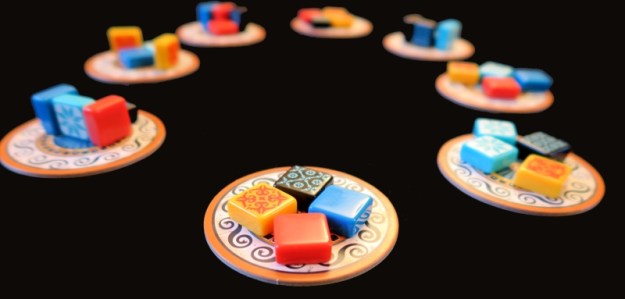
Azul
– Image by boardGOATS

Only complete rows are removed and scored, and then only at the end of the round (when all the tiles in the market and central pool have been taken).  Thus if a player has a nearly complete row at the end of a round, they carry that through to the next round leaving them with less free space to work with.  When a row is scored, one tile is moved to the player’s mosaic and scores for the number of tiles it forms a continuous row/column with.  The game ends when one or more players complete two rows.  This time it was a game of two halves, or rather two games.  It had been a while since we played the original version (or any version for that matter), but it wasn’t long before Teal, Lime and Green were happily playing, filling their boards.

Azul
– Image by boardGOATS

Lime and Teal took an early lead and were soon well ahead of Green as he had concentrated on filling his grid from the bottom up, whereas they had been working from the top down. As the game progressed Green began to catch up.  It was then that he realised that he’d forgotten what the game end trigger was.  He’d thought it was when the markets could no-longer be refilled, but checked the rules to be sure.  Only to find that two full completed rows had happened two turns earlier!  The group decided to finish the round and make it the last.  It was very close between Lime and Teal, with Lime just taking victory by three points.  The other games were still going and it was not yet late, so the group decided to give it another go, and this time finish the game correctly.

Azul
– Image by boardGOATS

In the second game, Green built his grid from the top down and the scores remained fairly similar, until around half way through when Teal began to pull away.  It was at about this point that Green noticed that one row had tiles of a colour he’d already scored for that row.  No-one was quite sure how it had happened, but the mutual decision was that he’d move these tiles down to the next row.  That turn didn’t go quite as expected, but at least it wasn’t a complete disaster.  The following round, he discovered he’d done the same thing again.  This time he worked out what he’d done:  he’d had failed to clear the remaining tiles when he moved one across to the pattern board.  So, on the previous turn, instead of moving tiles, he should have removed them.  It didn’t really matter though as Teal won by a landslide.

Azul
– Image by boardGOATS

Meanwhile, Ivory, Blue and Pink had revised the rules, completed card set up for Key Flow, and had started playing.  Key Flow is the card game of one of the group’s favourite games, Keyflower.  In both games, players are building villages and activating the buildings in their villages by playing meeples (or rather Keyples) to generate resources and score points.  The games have a lot in common including the artwork, the iconography and the fact both take place over four rounds or seasons.  Fundamentally, the underlying game mechanism is different, however, with players acquiring tiles by auction in Keyflower and by card drafting in Key Flow.
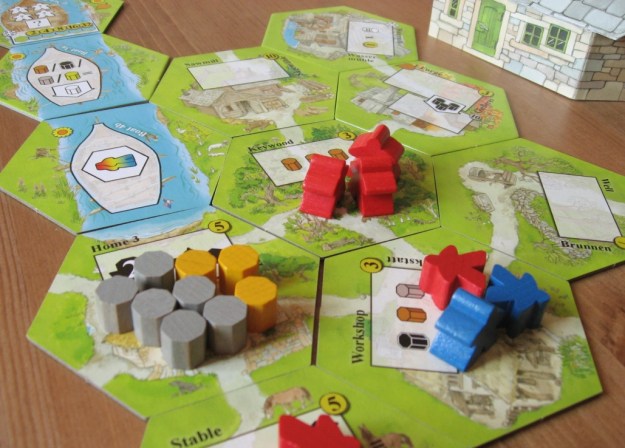
Keyflower
– Image by boardGOATS

Once the card decks have been sorted out, Key Flow is quite straightforward to play, though doing well is a different matter.  Players who start with a hand of cards, choose one and pass the rest on.  They then add their chosen card to their village.  There are three types of card:  Village cards, Riverside cards and “Keyple” cards.  Village cards are buildings that can be activated by playing Keyples above them, while Riverside cards provide instant resources and skill tiles.

Key Flow
– Image by boardGOATS

The cards have to be “connected” together and location can be important.  Buildings for example are more productive if they have been upgraded, but upgrading needs resources and the resources need to be located on the building being upgraded.  Similarly, in autumn there are some buildings which score points for resources they are holding.  Therefore, it is helpful if the building producing the resources is near to the one being upgraded or used for scoring as moving resources can be expensive and sometimes difficult.
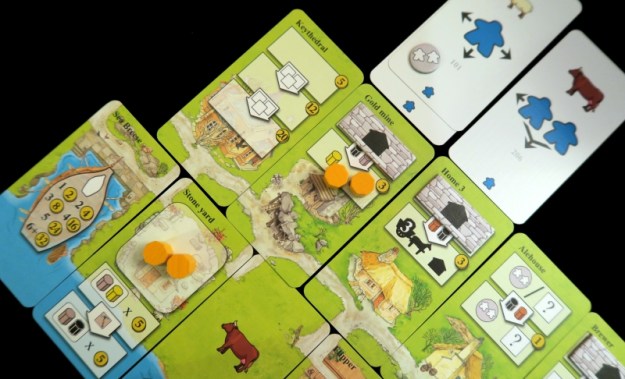
Key Flow
– Image by boardGOATS

At the start of both Keyflower and Key Flow players get some winter tiles/cards which can act as objectives to guide players’ strategies.  Whereas in Keyflower these are just added to the tile draw, in Key Flow, players get to keep one of their winter cards with the rest going into the draft.  At the end of the game, at the end of winter, players score for any autumn cards, any buildings with upgrades as appropriate, any winter cards and finally one point for any otherwise unused gold.
Key Flow
– Image by boardGOATS

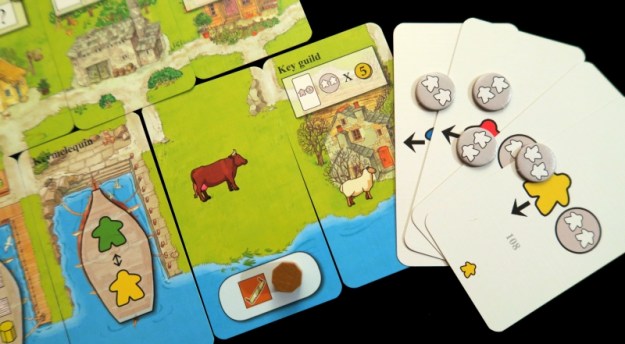
One of the biggest differences between Key Flow and Keyflower is the way Keyples work.  In Key Flow, they are cards and come in singletons and pairs.  Each card has a small Keyple at the bottom of the card, and the number of Keyples needed to activate a building is one more than the number of small Keyples already there.  So if there is one small Keeple already there, a pair would be needed to activate that building.  Further, only one card is can be played each round, so if two small Keyples are already present, the Keyple card must be augmented with a Keyple token (obtained as a bonus with some cards or from some buildings).

Key Flow
– Image by boardGOATS

Further, the Keyple cards also feature arrows which indicate where they can be played.  Some can be played either in a neighbour’s village or the player’s own village.  Other cards can only be played on one side or cannot be played in their own village.  This is why three players is arguably the sweet-spot for Key Flow—with more players there is at least one village players cannot use, adding a level of randomness that it is difficult to deal with.  With three however, everything in play is accessible, though perhaps at a cost.

Key Flow
– Image by boardGOATS

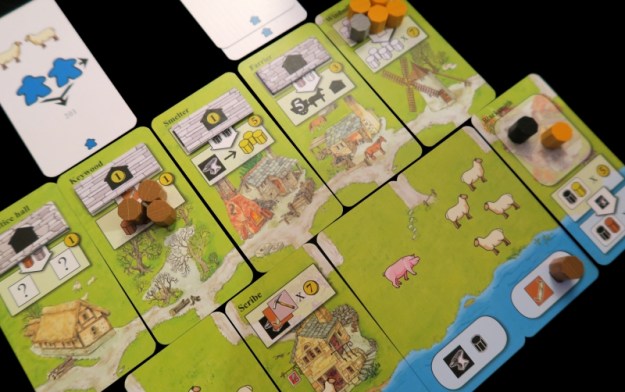
It had been a while since Key Flow had been given an outing, so although game play is functionally straightforward, it took Blue, Ivory and Pink a while to remember the little features and how to make the game work for themselves.  Pink started off early with an obvious strategy of generating stone, stone and even more stone from his Keystone Quarry.  It was very clear, even to Pine who joined in to spectate about halfway through, that Pink had a winter card that would score for stone.  And so it proved when he produced the Trader in the final round.
Key Flow
– Image by boardGOATS

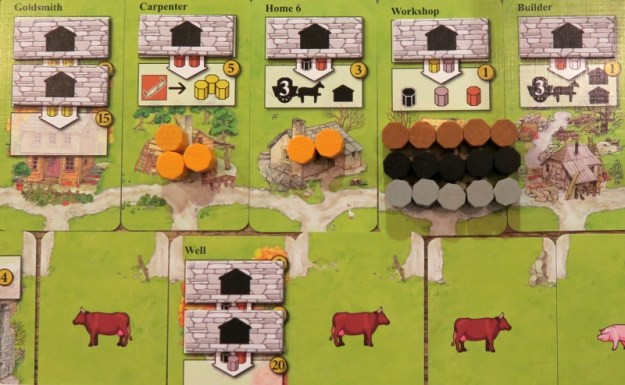
Things were less clear-cut for Blue and Ivory, however.  Blue started by just playing the cards in her hand, which meant she ended up with a lot of cows (just because).  In summer, Ivory picked up a boat that allowed him to convert sheep into pigs and pigs into sheep, which went nicely with his animal scoring winter cards.  Blue, on the other hand, very out of practice with this sort of game, just played tactically, and played for points.  Her Workshop went well with the Mercer’s Guild she had in her winter cards, but the Well and Goldsmith, both fully upgraded gave her thirty-five points alone.
Key Flow
– Image by boardGOATS

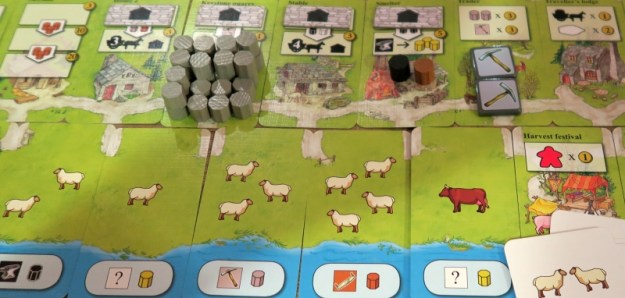
Ivory had a bit of a nightmare and was unable to make the game work for him this time.  This was made worse by a rule we only spotted towards the end which meant each Keyple card could only be used towards one goal and the fact he made a mess of things when he put a Riverside card in the middle of his village and had to make it work retrospectively.  As he said sadly, although he had remembered how to play, he’d forgotten how to win.  Pink, with his massive pile of stone thought he was in with a good chance, but they were actually only worth one and a half points each, so although he had a huge pile, it only gave him thirty-nine points and had taken a lot of work to get them.
Key Flow
– Image by boardGOATS

Pink was a little bit stymied by the fact he was banking on also getting a a sheep scoring card in winter, but Ivory took it before it got round to him.  Blue on the other hand had lucked out when she picked up a lot of Keyple scoring cards that nobody else seemed interested in giving her over a hundred points and a comfortable victory.  With that, Ivory left, as did Lime and Teal, leaving Green, Pink, Blue and Pine waiting for the conclusion of Thurn und Taxis, and time to play a couple of rounds of Love Letter.  In the end, it really was just a couple of rounds and ended with a round a piece for Green and Pink, as the pub was closing and it was time to leave.

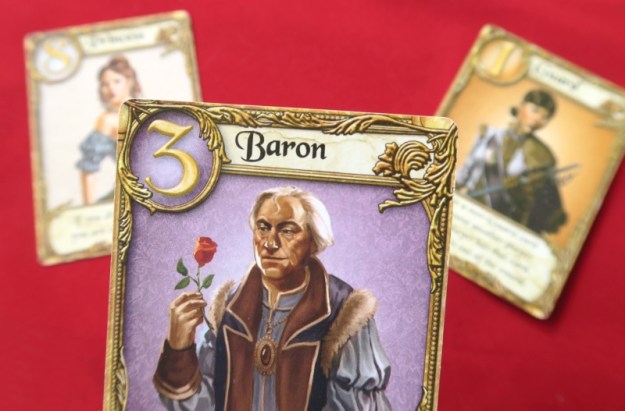
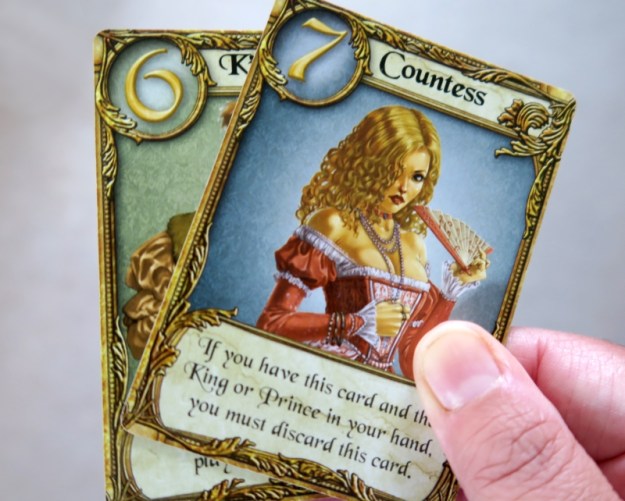
Love Letter
– Image by boardGOATS

Learning Outcome:  While camera scales may seem like a good gift idea, in reality the giver will probably end up sleeping on the couch.

23rd September 2021

Burgundy and Blue were just finishing their supper when Teal introduced himself.  The three were chatting when Lime, who hadn’t been able to come for over a month, also joined the group.  It was expected to be a quiet night with Green and Lilac away on holiday, Pine working late, and Pink stuck somewhere on the Warwick bypass.  So, there was a lot of chat, but eventually, the group decided to play something and settled on Love Letter.

Love Letter
– Image by boardGOATS

This is a very simple little game that we’ve played a lot, but somehow Lime had missed out.  So, there was a very quick rules explanation:  players start with a hand of one card, draw a second and choose one to play and do the action on the card.  The cards are numbered and the aim of the game is to finish the round with the highest card, or more commonly, avoid being knocked out.  There are only sixteen cards in the deck (and one of those is removed at the start of the round), so it doesn’t take long.

Love Letter
– Image by boardGOATS

The group were only three rounds in when everyone else turned up (including Pink who had escaped the roadworks), so Lime was declared the winner with two tokens and everyone else was introduced to Teal and started to discuss what to play.  In the end, Burgundy took matters into his own hands and started a game of Wingspan, so while Pink waited for his pizza to arrive, Blue explained the “Feature Game“, Mini Rails.

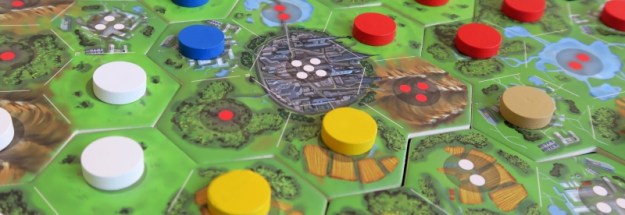
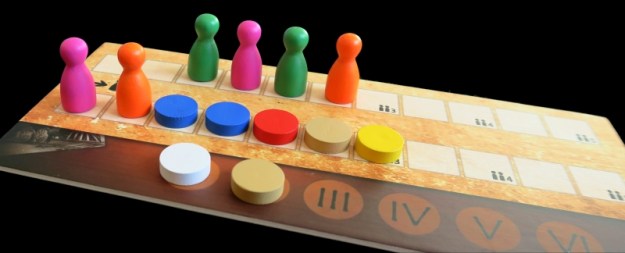
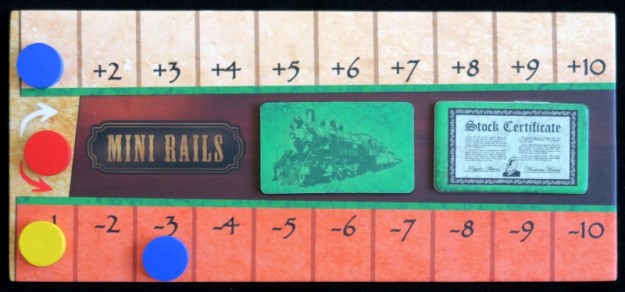
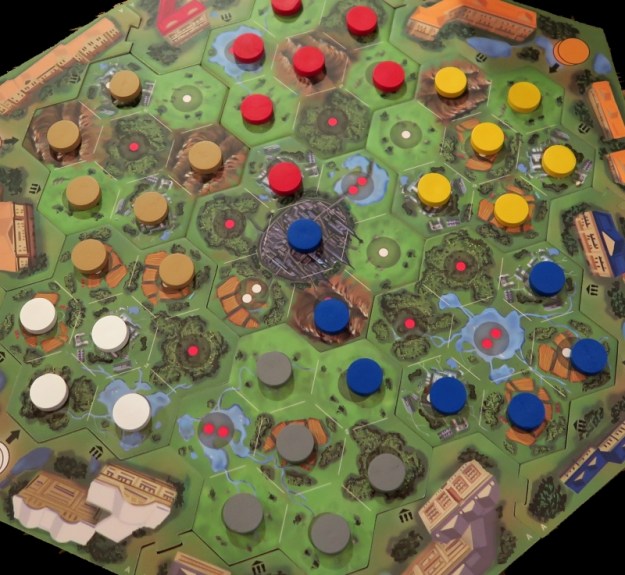
Mini Rails
– Image by boardGOATS

Mini Rails is a very simple little stock-buying and track-laying train game that compresses a lot of the game play of long and complicated games like the 18xx series into under an hour.  Players have two turns in each round, on one they buy shares in one of the companies and on the other they extend the “track” of one of the networks.  If it is built on a white space, players with holdings in that colour increase their value by the marked amount.  If the network is built on a red space, the stocks in that company are decreased in value.

Mini Rails
– Image by boardGOATS

The game is very simple, but there are a couple of clever little tweaks.  Firstly, there are two “tracks”, one is the turn-order track, while the other holds train disks drawn at random from a bag.  On their turn, players choose one of tokens and decide which action to use it for, “build track”or “buy shares”.  The position of the token that is taken dictates where they will be in the turn order in the next round.  Manipulating this turn order is one key aspect of the game, as is deciding whether to buy and then build, or build and then buy.

Mini Rails
– Image by boardGOATS

Perhaps the most complicated aspect of the game is the end-game scoring.  At the start of each round train discs are drawn from a bag; one more than there are turns.  This means everyone always has a choice, but the token the last player does not use is put to one side indicating they have paid “taxes”.  For the companies that have “paid taxes” any negative dividends are erased and positive dividends are counted.  For those companies that have avoided paying their taxes the reverse is true and negative points will be scored while positive points are lost.

Mini Rails
– Image by boardGOATS

This means it is in the interest of players with both large positive or significant negative scores to forgo building track or buying shares and leave a potentially valuable token as taxes.  Similarly, if a player is left with a choice of two tokens, it may be in their interest to buy/build a relatively unfavourable track to deprive other players of points.  With three players, the game doesn’t take too long to play, and with more it would likely become quite random.

Mini Rails
– Image by boardGOATS

Lime took an early lead, though of course lots of early points are… pointless, if the company doesn’t pay taxes.  In the end it was extremely tight, but in the end, Blue just pipped Lime by a single point.  With just three there isn’t much downtime and the game rocks along nicely with plenty of interaction, though as Pink said, “That’s one hell of an abstraction for a train game.”  Blue pointed out that this was what a lot of gamers thought of when someone said “Train Game”.  Pink felt disappointed at the lack of actual trains and tracks so to make it up to him, the group moved on to play Ticket to Ride Demo.

Ticket to Ride Demo
– Image by boardGOATS

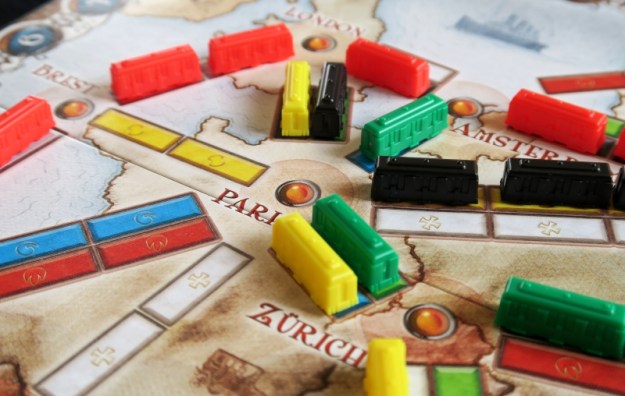
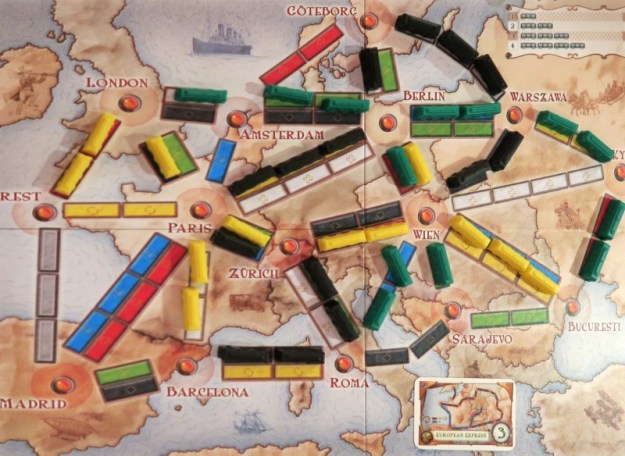
Ticket to Ride Demo is one of the small games based on the Spiel des Jahres winner, Ticket to Ride Europe.  The Demo game has an interesting history—it was designed as a sales tool and had only a small print run.  It was so popular though, that it ultimately spawned a new range of small “City” games, New York, London and Amsterdam.  These games are essentially played the same way as the full-sized versions, but with fewer pieces on a smaller map which means they typically take less than half the time.

Ticket to Ride Demo
– Image by boardGOATS

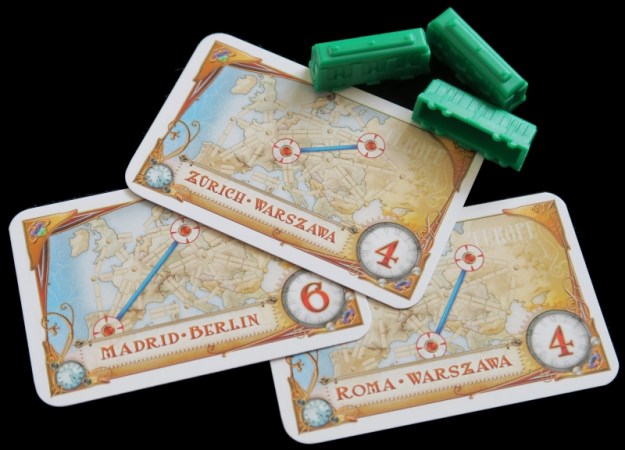
On their turn players can do one of three things:  take cards from the market, spend cards to place trains or take tickets.  Players score points for placing trains, but also for connecting the places on their tickets.  The catch is that any tickets that are not completed score negative points.  The small versions of the game are much tighter with less room for error.  Unlike the others, Ticket to Ride Demo has a double sided map, one USA and one Europe.  This time the group played the Europe map.

Ticket to Ride Demo
– Image by boardGOATS

Compared to the full-sized equivalents, all the little games are like a knife-fight in a phone-box, and this game was no exception.  Lime only completed three of his four tickets as Blue brought the game to a quick and sudden end.  Pink completed all four of his tickets and they were high-scoring too.  Blue’s tickets were less lucrative, but she managed to place all her trains and took the European Express bonus points for the longest continuous route, and with it victory, by just two points.

Ticket to Ride Demo
– Image by boardGOATS

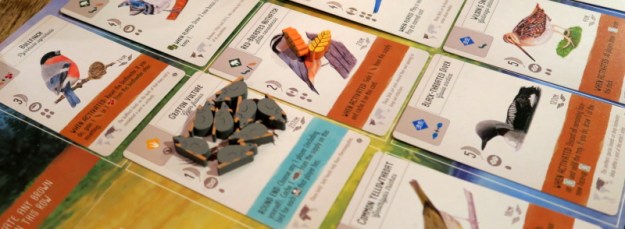
Meanwhile, on the next table an epic, five-player game of Wingspan was underway.  We’ve played Wingspan quite a bit since it came out and always found it very enjoyable.  We’ve played it enough that we’ve also explored the European expansion, but thanks to the restrictions over the last year or so, this was the first opportunity to play the new Oceania expansion.  The base game is a reasonably light, card-driven, combination building game.  On their turn, players can place a bird card from their hand in one of the three habitats, or activate all their cards in one of the habitats and carry out the associated action.

Wingspan: Oceania Expansion
– Image by boardGOATS

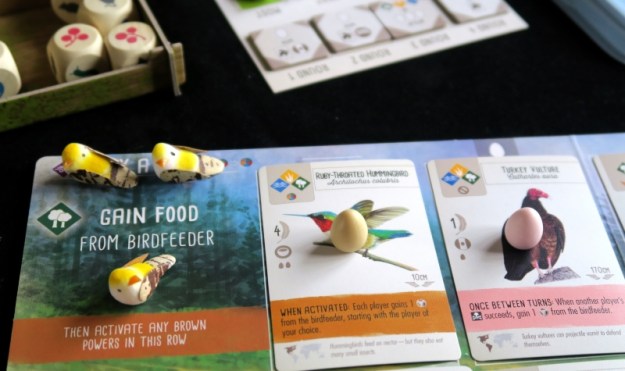
The habitats are Woodland, Grassland and Wetland and the actions associated with them are collecting food, laying eggs or collecting cards (respectively).  Once the action has been carried out, the active player activates each card in the habitat in turn.  The game is played over four rounds, with a decreasing number of actions per round as the game progresses.  At the end of each round there are goals and each player also starts with a personal bonus card which is evaluated at the end of the game.

Wingspan
– Image by boardGOATS

The European expansion really only adds extra cards, though this includes a number of birds with abilities that are activated at the end of rounds, and others that increase player interaction.  The new Oceania expansion also adds more cards, but additionally mixes things up a little more with the addition of a new food type, nectar.  Nectar can be used as wild food type, although some of the new bird cards have nectar specified in the cost.  Whenever players spend nectar though, they don’t put it back in the supply, instead they store it in the habitat they spent it on.

Wingspan
– Image by boardGOATS

At the end of the game, the player with the most nectar stored in each habitat scores five points at the end of the game with the player coming second scoring two points.  Nectar is therefore a very important resource giving a potential fifteen points at the end of the game, although it requires some skill to use it effectively as it can’t be carried over between rounds.  Burgundy and Black really invested in nectar and managed to make good use of it during the game as well as take the lion’s share of the nectar points at the end of the game.

Wingspan: European Expansion
– Image by boardGOATS

Burgundy and Black also prioritised valuable birds and tried to ensure they stayed in the running for the end of round bonuses.  Three out of the four of these involved eggs, which fitted with Ivory and Teal’s strategies which focused on an end-of-game egg rush.  Ivory also picked up a lot of points from his Common Starling which enabled him to discard up to five bits of food and tuck a card for each one.  With a maximum of twenty points, Ivory did well to take eighteen during the game, but it was only enough for third place this time though.

Wingspan
– Image by boardGOATS

It was very close at the top between Black and Burgundy.  Burgundy had four bonus cards one of which proved quite lucrative.  The big difference was in the value of the bird cards, however, while Black edged it in many departments Burgundy had a ten point head start.  This wasn’t simply because he had high value birds, more that he had lots of them.  In the end, Burgundy finished five points ahead of Black with ninety-five, in a good game that had been enjoyed by everyone round the table.

– Image by boardGOATS

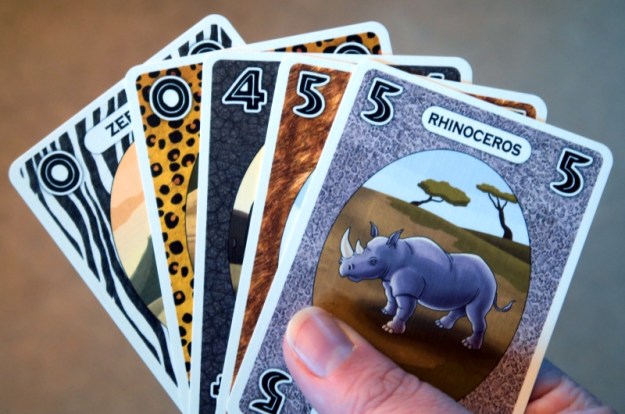
Wingspan was still only on its third round when Ticket to Ride Demo came to an end.  At around the same time, Pine pitched up, so the, now foursome settled down for something else which ended up being a game of Reiner Knitzia’s Botswana (aka Wildlife Safari).  This is an unusual auction-like game made all the better by the inclusion of plastic animals.  Played over several rounds, players are dealt a hand of cards and on their turn play a card and take an animal of their choice.  The cards are numbered zero to five and come in five different animal suits.

Botswana
– Image by boardGOATS

The cards are played in the centre of the table in suits and the game ends when all six cards of one suit have been played.  The top card in any suit is the current value of that animal.  Thus, if the top zebra card is a five, a player that has three zebras will earn fifteen points for them if the game ends.  However, if the zero just before the game ends, the zebras will become worthless.  It is a deceptively simple, yet fun little game.  Blue thought she’d won until a recount docked her ten points and she finished just two points behind a delighted Pink.

Botswana
– Image by boardGOATS

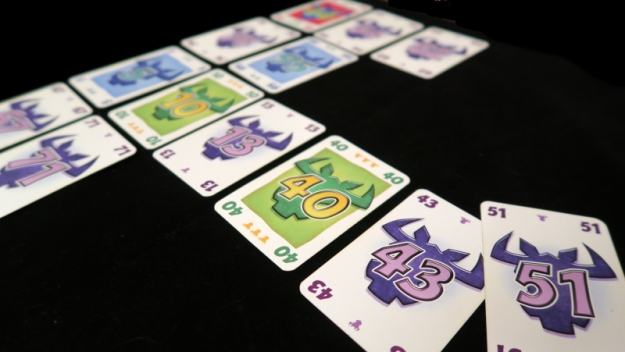
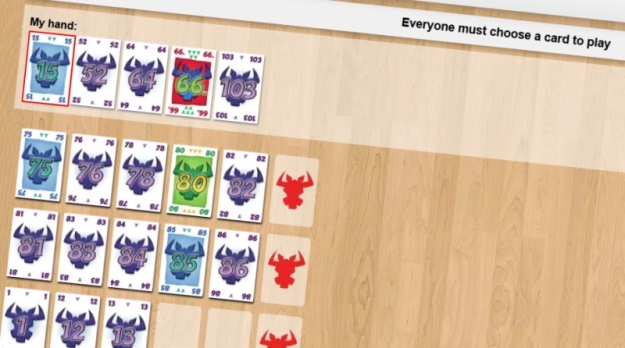
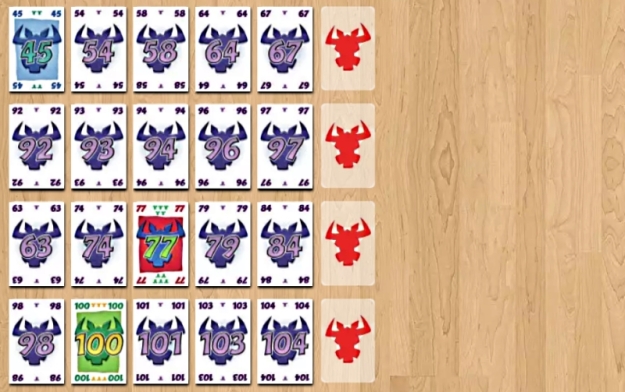
As Botswana came to an end, so did Wingspan, and although time was marching on, and Lime and Ivory took an early night, there was still time for everyone else to play one last game.  After a little discussion, we settled on 6 Nimmt!, a game we all know and love.  Players simultaneously choose a card and these are sequentially added to the end of four rows of cards, specifically the row with the highest number that is lower than the card itself.  If the card is the sixth card in the row, instead, the player takes other five and adds them to their scoring pile.  The player with the lowest score at the end of the game is the winner.

6 Nimmt!
– Image by boardGOATS

We’ve all played this a lot online over the last year, but doing the maths ourselves was a little daunting, so we decided to go back to playing the non-professional version.  We play over two rounds using half the deck in first and the other half in the second.  This time Teal top-scored in the first round with nineteen, while Burgundy kept a clean sheet with Pink just behind.  Blue’s killer thirty-three in the second round gave her a total of forty-eight, but the winner for the second time in the evening was Pink with just four points.  And with that, it was bedtime.

6 Nimmt!
– Image by boardGOATS

Learning Outcome:  Today’s railway industry is no longer about trains and tracks. ☹

9th September 2021

Burgundy, Pink, Blue, Green and Lilac arrived early for food, and while they were waiting squeezed in a very quick game of No Thanks!.  Lilac was new to the game, but it didn’t take long to explain: take the card in the middle and any chips on it, or add a chip to the pile to pass the problem on to the next person.  At the end of the game, players total up the face value of their cards and the winner is the player with the lowest score.  The clever part is that any runs only score for the lowest card, but some cards are removed from the deck before the start.

No Thanks!
– Image by boardGOATS

Blue started off picking up cards, but unfortunately for her she continued picking up cards and was unable to connect them leaving her with a massive score of eighty two.  Lilac finished a very creditable joint second with fourteen, tying with Burgundy.  Green was the eventual winner though with only ten points for his cards and seven chips left over giving a final score of just three.  As the game came to an end food arrived and as they tucked in, everyone else started to arrive too.  It was about then that Pink got himself into a spot of bother, appearing to suggest that Blue should look more like Keira Knightley…

No Thanks!
– Image by boardGOATS

Everyone was aghast, and as Pink tried to explain that he was referring to how organised she was in The Devil Wears Prada, until Burgundy commented, “When you reach the centre of the earth you should stop digging.  It was only some considerable time afterwards that Pink realised that Ms Knightley wasn’t in Devil Wears Prada after all, but it was actually Anne Hathaway (she of cottage fame).

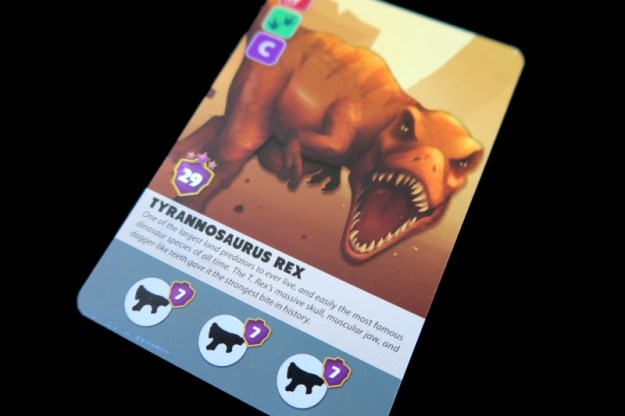
Fossilis
– Image by boardGOATS

After a bit of ribbing and some shenanigans with gnocchi and ice cream, the group split into two and settled down for the “Feature Game“, which was Fossilis.  This is a game with an unusual theme where players are collecting dinosaur fossils for their museum.  It uses an “action point” mechanism which is perhaps best known from the “Mask Trilogy” of games (Tikal, Java, Mexica), but has been widely used over the last twenty years in games as varied as Torres, Bus, Pandemic, Tawantinsuyu, Takenoko, Dinosaur Island and many more.

Fossilis
– Image by boardGOATS

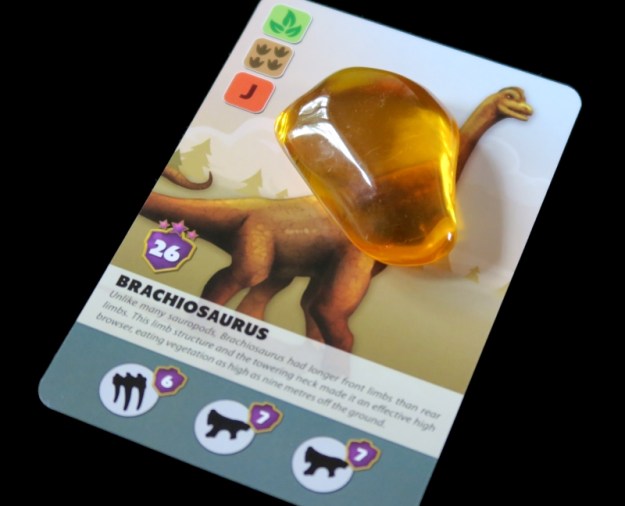
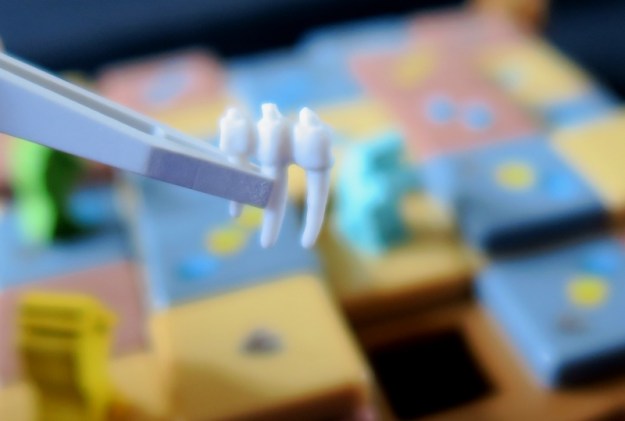
It is a very simple idea: each action has a cost and players have a set number of “points” they can spend doing actions on their turn.  In some games this mechanism is present, but hidden, while in others it is the main driver of the game; Fossilis falls into the latter category.  Players have four action points to spend on their turn, using them to move stone, clay or sand (dig), collect plaster (for making fossils) or use tweezers to fish in a nearby pit (in a manner reminiscent of Operation) to find a hammer or use plaster to claim a fossilised bone.  Once per turn, players can also trade eggs, resin and “footprints” for Tool or resource cards, and take a dinosaur card from the market and add it to their lab.

Fossilis
– Image by boardGOATS

The idea of the dinosaur cards is that they allow players to exchange fossilised bones for identified dinosaur bones which are more valuable.  If a player manages to collect all the bones for a given dinosaur, they are more valuable still.  At any point during their turn a player can claim a dinosaur from the market if they can complete it fully, otherwise, dinosaurs have to go via their lab. This is not the only way to score points though—dinosaurs also have three characteristics and at the end of the game, players who have more than three of a type score points for it.

Fossilis
– Image by boardGOATS

Players also score points for a full set of nine and having the majority of in a characteristic.  The game uses an interesting timer, where a set amount of plaster is made available and when this has been used an event card is revealed.  After the event has been resolved, the pool of plaster is replenished and the game continues.  Once the third event has been revealed, there is one final pool and one last round before the final scoring.  The player with the most points is the winner.  This time we had two games running, one with Pine, Ivory, Green and Lilac, while Burgundy, Blue, Purple, Pink and Black played on the next table.

Fossilis
– Image by boardGOATS

On the first table, Ivory & Pine were new to the game. Pine said he had always been useless at Operation, but liked the dinosaur theme, while Ivory admitted to being initially sceptical about it. Ivory went through the game without any additional hammer bonuses instead concentrating on getting all nine of the dinosaur characteristics using the supplies to good effect.  Pine took an early lead collecting artefacts for tools and supplies.  Green obtained the Jack Hammer power tool and in the later part of the game used it to open up centre of the dig site only to destroy the first skull found in the game and mangle a hammer, thus making that square useless.

Fossilis
– Image by boardGOATS

Lilac had won her previous game of Fossilis (played against Green, Purple and Black a few days earlier) and tried the same strategy of gaining extra points for complete dinosaurs. Unfortunately she got the bonus too late in the game to make it work for her and with Pine and Green targeting the same dinosaur characteristics they ended up cancelling each other out.  That left only one winner, Ivory, who trampled Pine as he passed leaving him in second place.  Although the game clearly took longer than the advertised forty-five minutes the game moved along swiftly and finished well before the other table.

Fossilis
– Image by boardGOATS

Adding the fifth player clearly slowed things down for several reasons.  Firstly, although people tried to plan their turn in advance, inevitably the game state changed meaning players had to start again.  Worse, players struggled to see into the dig site to see what was available in the pits.  This meant players often had to wait for their turn and have the dig site passed to them and plan from there.  The length of the game was exacerbated when the Patronage event card appeared and everyone except Purple took six pieces of plaster.  Purple and Black had played the game a few days before, but Burgundy, Pink and Blue were new to the game, though Burgundy had done some research online.

Fossilis
– Image by boardGOATS

Burgundy’s research suggested that the best strategy was not to focus on completing dinosaurs fully, but to concentrate on getting as many dinosaurs as possible.  This leads to a loss of value for the dinosaurs when they are scored during the game, but can pay off at the end of the game when the bonuses for characteristics are scored.  This is because each dinosaur has three characteristics each of which can score three times:  once if the player has three, twice if they also have the most, and three times if they have a full set of nine.  This can more than make up for points “lost” by failing to complete it fully.

Fossilis
– Image by boardGOATS

Pink had not done any research in advance so tried the opposite and focussed on completing his dinosaurs and took a skill tile that enabled him to pick up the top tool tile for free every time he did so.  Blue took a skill tile which allowed her to move stone for one less action point while Black took a skill which allowed him to work on two dinosaurs in his lab at once.  Purple could have done with a skill tile that would help her stay on the dig site or get back on for free, because people kept pushing he off, but unfortunately there wasn’t anything like that available.

Fossilis
– Image by boardGOATS

In the closing stages, Blue and Pink had a significant advantage, but Burgundy picked up a few more dinosaurs at the end of the game and then started raking in the bonus points.  He finished some twenty points ahead of Blue and Pink who were separated by a single point and took second and third.  There was quite a bit of chit chat about the game as they ended.  Ivory said he liked it, much more than he was expecting and would definitely like to play it again. As for Pine, well, the game has dinosaurs and anything with dinosaurs gets his approval, even if some of them look like they’ve been drawn by that kids, playing that game where they drawing different parts and put them together at the end.

Fossilis
– Image by boardGOATS

Blue was less impressed.  The feeling on the other table was that the scoring was off a little and there wasn’t a strategy that would beat the “get as many dinosaurs as you can” plan.  Certainly five players was too many and perhaps three would be a sweet-spot.  Pink was keen to give it another go, but although everyone else on that table would play it again if someone else wanted to, they all said there were other games they would choose first.  That said, it is a fantastic theme and very unusual and the deluxe edition of the game comes with a lot of expansions to add variety, and it is possible that they might add changes to the balance of scoring too.

Fossilis
– Image by boardGOATS

Green, Lilac, Ivory and Pine finished a long way ahead of the other table, and as Lilac had never played Love Letter, it got its third outing in as many sessions. They were a tired little group though and in the end, Lilac chose to sit it out and watch.  The game is a really simple one where players start their turn with a card, then draw another and choose one to play.  The aim of the game is to be the player with the highest card at the end of the round, or in practice, be the last player standing.  The winner of each round gets a token and the first to a given number is the winner.
Love Letter
– Image by boardGOATS

Pine started well, guessing Green’s card before he even had a chance to play. He went on to win the first two rounds. In the third round, Pine did it again to Green, but Ivory won the round.  There was one more each to both Pine and Ivory and Green was beginning to wonder if he’d ever get a go.  Green then promptly won two rounds on the trot; with three players, the winning line is five tokens, so suddenly Green thought he was in with a chance.  Then Pine won two more rounds to complete his rout, winning his fifth token and with it, the game.

Love Letter
– Image by boardGOATS

Learning Outcome:  The thigh bone is not necessarily still connected to the hip bone…

26th August 2021 (Back at the Jockey!)

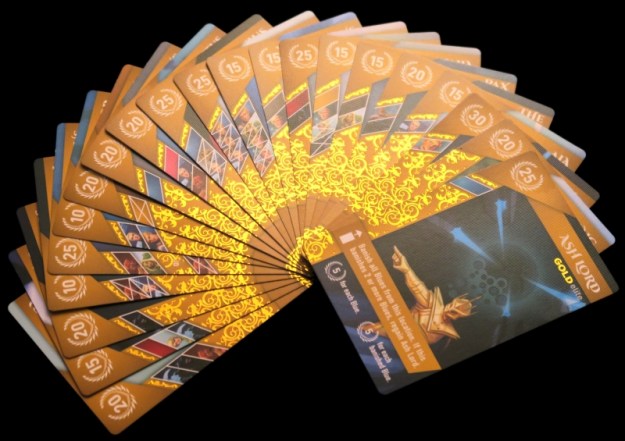
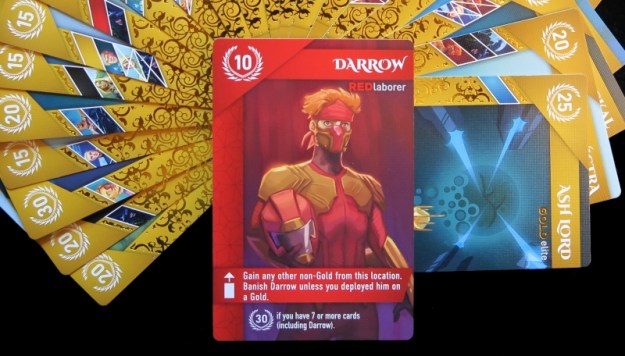
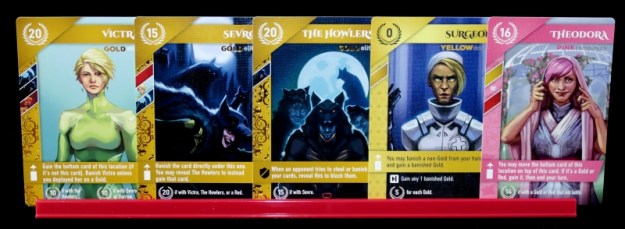
Following the test event at the Horse and Jockey and much discussion, we decided to try meeting in person once again.  As the pub are not currently serving food on a Tuesday, we decided to move to Thursdays, at least in the short term, especially as times are so uncertain.  This week, the “Feature Game” was Red Rising, a new card collecting game inspired by Fantasy Realms and themed round the books by Pierce Brown.  The books are set in a dystopian future on Mars following low-born miner Darrow, a Red, as he infiltrates the ranks of the elite Golds.

Red Rising
– Image by boardGOATS

In the books, society follows a fourteen-colour caste system from Gold at the top to Red at the bottom.  Red Rising the board game takes this colour hierarchy and adds elements of hand-management and card-combo building.  The idea of the game is very simple:  players start with a hand of five cards and on their turn, play one card onto the game board and pick up another.  The aim is to improve the quality of their hand and with it, its value.  Cards are played on one of four locations on the central game board and have an additional deployment action when played, the effect of which can be dependent on the location they are played in or the card they are played on top of.

Red Rising
– Image by boardGOATS

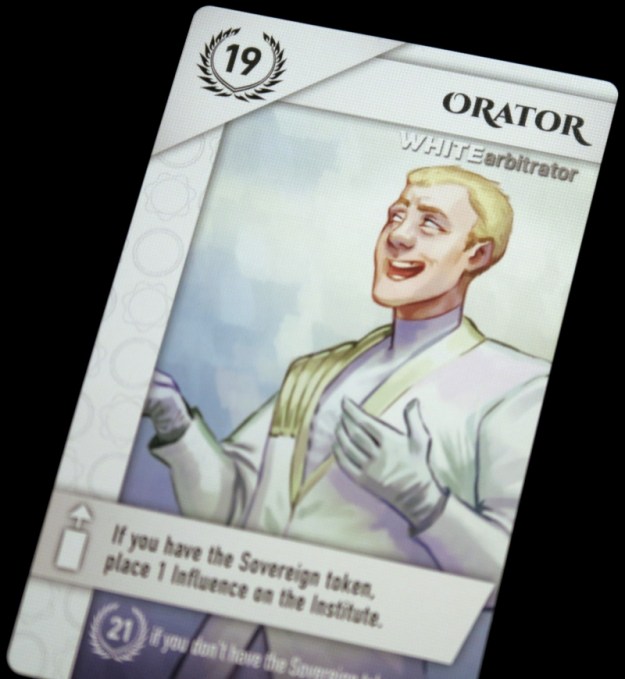
The card picked up must be the top card from another different location except where enabled by the played card.  The location from which the card is collected dictates an additional bonus action:  Move along the Fleet track, Collect helium, Increase one’s presence in the Institute, or Claim the Sovereign token.  There are a couple of other options:  play a card and then take a card blind from the Character deck and roll a die to decide what their bonus action will be.  Alternatively, instead of playing a card, just draw a Character card from the deck and place it, then take the bonus action.  In practice, these two options are relatively rare and only taken if there is nothing to pick up, or the player likes the hand they have.

Red Rising
– Image by boardGOATS

The game ends when either seven is reached in all three of the Fleet track, helium and the Institute, or one player has reached seven in two of them.  At the end of the game, players sum their total score from each card, the scores from combining effects of cards, ten points if they finished with the Sovereign token, three points for each helium, their score for progressing along the Fleet track, and points for each of their tokens in the institute (four per token for the player with the most, two and one for less committed players). Anyone over the seven card hand-limit loses ten points per card over the limit.

Red Rising
– Image by boardGOATS

There is a large deck of cards of which only a relatively small number are seen in each game.  The nature of the game changes dramatically depending on which cards come out.  This time Blue, Pink, Burgundy and Pine made up one table while Ivory, Green, Black and Purple made the other, both playing with the Collector’s Edition.  The first difficulty, was that although beautiful, some of the colours in the Collector’s Edition are difficult to tell apart.  The Influence and Fleet tokens in blue and green, and pink and red, were a particular problem which was made worse in low light.  This was not too much of a problem in practice, however, because influence tokens can be grouped together and we weren’t playing with the maximum number of players so could ditch the worst clashes.

Red Rising
– Image by boardGOATS

A bigger problem was the amount of text on the cards.  Pine and Burgundy both had issues with this, which could be got round by passing cards if people wanted to read them.  Additionally, the cards used in a game tend to circulate with one player playing it and another picking it up before playing it themselves.  So the burden is not as heavy as it seems at first.  Despite it not being complicated, the one table seemed to have a significant issue with rules.  Pine struggled with whether the action was associated with the location a cards was played or the location it was collected from.

Red Rising
– Image by boardGOATS

Pink, meanwhile, developed an inexplicable habit of taking the action at both locations.  Adding insult to injury, Pink also repeatedly distracted Blue by complaining that he couldn’t see a way of increasing the number of cards in his hand and asking advice.  On the next table, however, Green felt he was being got at.  This is actually quite a normal state of affairs because we all love to pick on Green, but in this case that wasn’t what was happening.  Green’s special power that meant he was able to place an Influence token in the institute every time he took the Sovereign token, but he had a card that meant he would lose points if he had the Sovereign token at the end of the game.

Red Rising
– Image by boardGOATS

So, for this reason, Green concentrated on collecting red helium gems instead.  Unfortunately, random draw meant that on this occasion the game had an awful lot of cards that penalised players with the most helium or a player of choice, which Green felt was mostly him.  Worse, the nature of the game is that players play these cards then others pick them up and play them again, which can make it feel like there are more cards like this than there really are.  Black’s influence dominated the Institute, while everyone competed for points on the Fleet track.  It was an extremely close game with four points between first and third.  Purple channelled her inner “Magic: The Gathering” player and with a lot of helium, sneaked ahead of Ivory to take second.

Red Rising
– Image by boardGOATS

Despite struggling to get Gold cards and feeling the game was against him, Green finished just ahead with two hundred and fifty two points.  The other game was nowhere near as close and clearly played out very differently.  Blue, also lost some helium thanks to Burgundy, but it only happened once, there was no real shortage of Gold cards, and the game seemed to take a lot longer.  Part of this was because Pine spent a lot of time checking what he was doing and insisting it wasn’t his sort of game, yet he dominated both the Institute and the Fleet track.

Red Rising
– Image by boardGOATS

There were over a hundred points between first and last in this game, but the scores didn’t feel as disparate while playing.  In spite of his complaints, it was Pine who came out on top with a massive three hundred and nine points.  Overall, both games were a bit of a mixed bag with Burgundy saying it didn’t gel for him, Pine feeling bewildered (not withstanding his success), Green feeling “got at”, and even Pink (who had played it twice before) made a bit of a hash of things. Ivory, Pink and Blue had played it before, and all three had been unconvinced after the first game, but more positive after the second.  So it is definitely a game that benefits from multiple plays, if people are prepared to give it a second chance…

Red Rising
– Image by boardGOATS

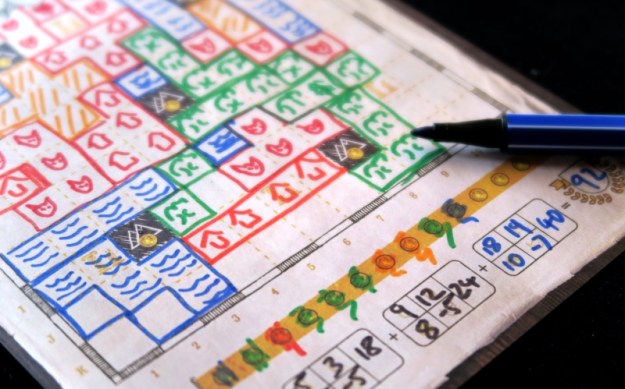
Ivory, Green, Black and Purple finished first and, at the time it looked like the other group wouldn’t finish for ages.  So after some discussion, they started another game and chose Ticket to Ride: Amsterdam.  This is one of the “little” spin-off games based on the original Ticket to Ride.  Themed round a city rather than a country or continent, these are smaller and quicker to play than the bigger games, but lots of fun.  This one is based on the Dutch capital, but the game play is essentially the same as the other editions.

Ticket to Ride: Amsterdam
– Image by boardGOATS

On their turn, players either collect coloured cards from the market, or spend them to place plastic carts and score points.  Players start the game with three tickets (of which they must keep at least two), which depict two locations.  Players who can connect these locations score points at the end of the game; failure to do so leads to negative points.  Each variant has a little tweak.  So, in addition to scoring points from placing pieces and successfully completing tickets, in the Amsterdam edition, players can pick up goods cards when they complete a route marked with carts.

Ticket to Ride: Amsterdam
– Image by boardGOATS

The player with the most of these at the end of the game scores an extra eight points with other players scoring fewer with the amount depending on the number of players.  This time, Purple built her routes through the middle of Amsterdam and to the north.  Everyone else went for the potentially lucrative goods routes in the south, east and west.  The problem with this was the competition, with Green the main casualty.  Although Green managed to get three goods cards he failed to complete his second ticket.
Ticket to Ride: Amsterdam
– Image by boardGOATS

Ivory also went for two tickets and completed them, but managed to add five goods cards giving him the most and adding a valuable eight points to his score.  Both Purple and Black largely eschewed goods cards (collecting just one) and concentrated on finishing their three tickets.  In a tight game, which this was, those solitary tickets and the tie-breaker for them was critical.  It was a tie for second between Black and Ivory, but it was Purple, who just edged in front, winning by a single point.
Ticket to Ride: Amsterdam
– Image by boardGOATS

While the others were playing with their trains carts, the second table had finally finished their game of Red Rising, so they picked up where they had left off last time with another game of the filler, Love Letter.  This “micro game” consists of just sixteen cards.  Players start with one, draw a second and play one of them doing the associated action.  The player with the highest value card, or the last player standing is the winner of the round.  The first player to win three rounds is the winner.

Love Letter
– Image by boardGOATS

Last time, it was all about Blue and Burgundy, with Poor Pine being knocked out every single round.  This time it was a bit different, and it was all about Pine and Blue.  Pink and Burgundy failed to take a single round, but it was tight between Pine and Blue.  There was a bit of ebb and flow with one taking a round and then the other, but it was Pine who took his third round first and with it revenge for last time as he left Blue languishing with just two love tokens.

Love Letter
– Image by boardGOATS

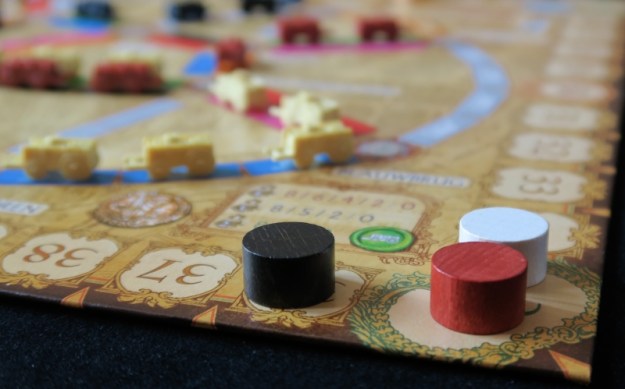
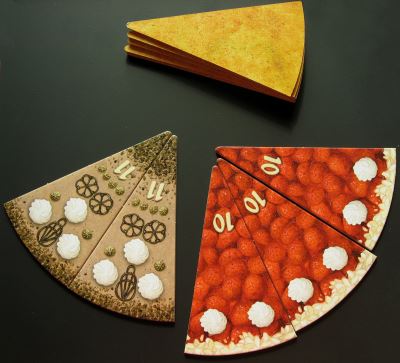
Although Ticket to Ride: Amsterdam and Love Letter finished at about the same time, Purple, Black, Green and Ivory all decided it was time to make a move.  The others felt there was still time for one quick game of …Aber Bitter mit Sahne, a fun little game based on the simple “I divide, you choose” mechanism.  On their turn as Master Baker, the active player constructs a “pie” from pieces drawn at random and divides it into portions, each consisting of several pieces.  Starting with the player to the Baker’s left, each person takes a portion of their choice and decides which pieces to keep and which pieces of cake to eat.

…Aber Bitte Mit Sahne
– Image by boardGOATS

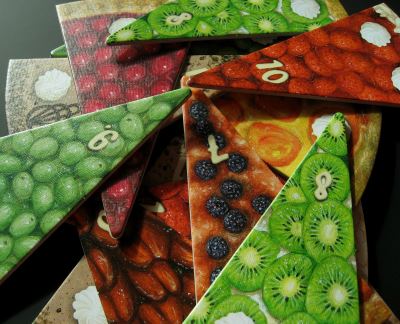
When all the cake has been distributed, the player with the most of each type scores the number shown on that type, while each piece that has been eaten scores for the number of blobs of cream, sahne.  The clever part is that the number of cake pieces of each type in the game is the number shown on the pieces, thus the most common types are the most valuable, but also need the most pieces to score.  Thus the aim of the game is to collect sets, but only the largest of each type scores, everything else is worthless unless it has been eaten.

…Aber Bitte Mit Sahne
– Image by boardGOATS

Players tend to wind up collecting different sets.  This time, Pine won nine points for his gooseberry pie, Burgundy won seven for his blackberry flan and Pink took twenty-one points for his strawberry tart and chocolate gateaux.  That was without counting the cream though.  Pink thought he’d done enough, but was just beaten by Burgundy who, as well as a lot of cream, also shared the points for a lot of the lower scoring cakes. His final total of thirty-four was one more than Pink with Pine and Blue tied for third.  And on that sweet note, it was home time.

…Aber Bitte Mit Sahne
– Image by boardGOATS

Learning Outcome:  It will take a little time to get used to playing face-to-face again.

19th August 2021 – “Unofficial boardGOATS”

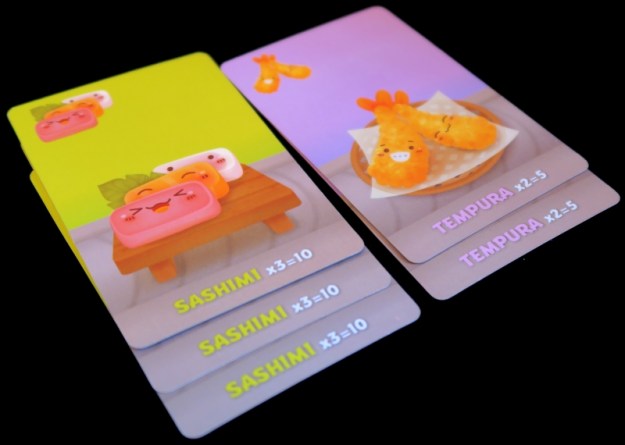
We’d had such fun at the “Post-Covid Test Event” at the Horse and Jockey and some were so disappointed to have missed it, that we decided to have another, this time “unofficial” meeting at the pub before our formal return.  As we chattered away and waited for food to arrive, we told Lime what we’d played last time.  He said he was sorry to have missed Sushi Go! as he really enjoyed it, and in a trice, a real, hardcopy of the game was out and cards were being shuffled and dealt.  We’ve played Sushi Go! plenty of times both online and in person, but as usual, we had a very quick run-through of the rules.

Sushi Go!
– Image by boardGOATS

Players start with a hand of seven cards, and choose one to keep, passing the rest on to the player on their left.  Players repeat this with the aim of the game being to end up with the set of cards that score the most points.  The game is played over three rounds with the player with the highest total winning. The final round was coming to an end when pizza arrived, but we just had time to get to the end.  It was close, but Blue made up for her disastrous showing earlier in the week online with a win, just a single point ahead of Pine (who had missed out completely on the previous game).

Pizza
– Image by boardGOATS

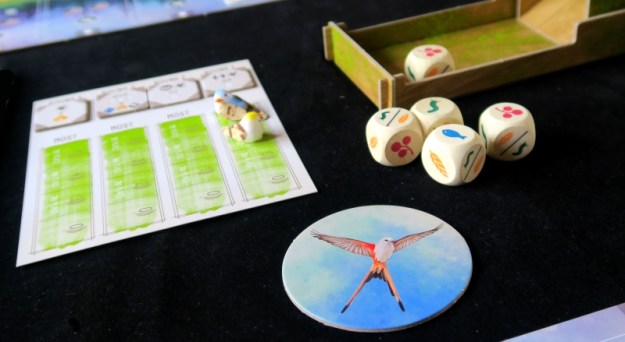
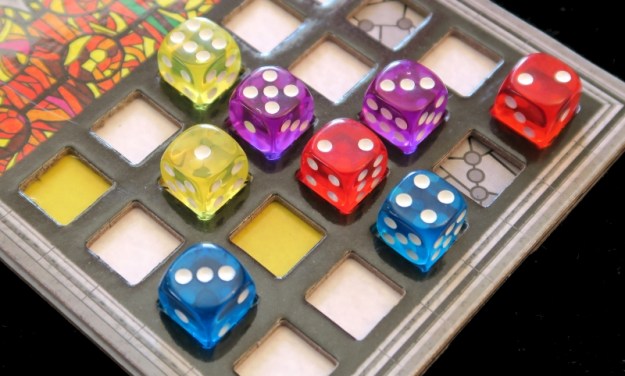
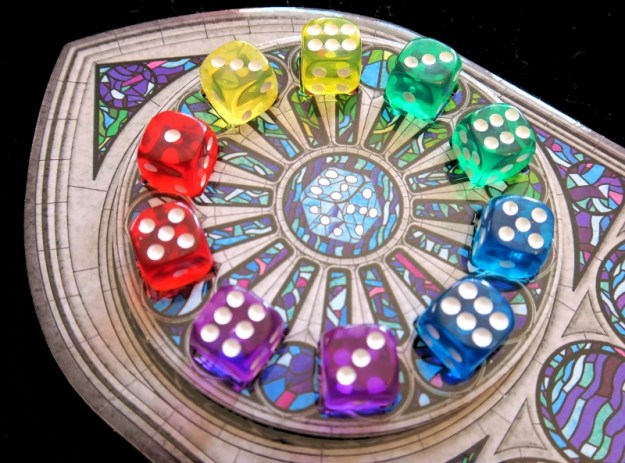
Food was summarily dispatched and Ivory arrived, and after some discussion about what to play and whether to split into two groups, we all settled down together to play the dice-drafting game, Sagrada, with the 5-6 player expansion.  This is another game that most of us are reasonably familiar with and we thought it would be a good game to play to help dust some more of the cobwebs off our gaming skills which had proven to be decidedly rusty at the “Test Event”.  The base game is quite simple:  the starting player draws dice from the bag and players take it in turns to take one and add it to their stained glass window.

Sagrada
– Image by boardGOATS

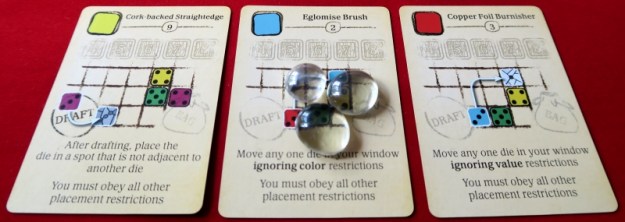
As well as following the restrictions given on the players’ window cards which specify colours and numbers for some spaces, players must place new dice next to already played dice while avoiding placing dice of the same colour or number in adjacent spaces.  Depending on the difficulty of the player’s window card, players get a number of “cheat tokens” which are worth points at the end, or can be spent to use “Tools” to enable players to improve their move dice, change dice numbers and otherwise break the rules.  This time the Tools cards drawn at random were the Eglomise Brush, the Copper Foil Burnisher and the Cork-backed Straightedge.

Sagrada
– Image by boardGOATS

The Eglomise Brush and the Copper Foil Burnisher allowed players to move dice ignoring any colour/number restrictions printed on their window card, while the Cork-backed Straightedge allowed players to place their chosen die in a location not adjacent to another die.  The Tools are really useful as they allow players to improve their scores. These come from individual goal cards, and shared goal cards drawn at random.  This time we drew one objective card rewarding dice of the same colour arranged diagonally and two that scored points for pairs of dice (ones and twos/threes and fours).

Sagrada
– Image by boardGOATS

The 5-6 player expansion, tweaks the rules a little.  In the base game, in each round, the draft goes one way and then returns so that the first player gets to choose first and last with the last player taking two dice one after the other (similar to the initial settlement placement in The Settlers of Catan).  With large numbers of players this can lead to a lot of down-time, partly because of the sheer number of decisions (which are taken sequentially), but also because there are more dice giving players a larger number of options to consider.  To avoid this, players start the game with their own personal dice pool consisting of two of each colour, rolled to give random numbers.  Players then take one die from the draft and one from their personal dice pool.

Sagrada
– Image by boardGOATS

Pink began, drawing seven dice from the bag, but we were only a few rounds in when Lime thought he might have dropped one.  This queued a mad session of dice counting as well as fond recollections of the time Pine dropped a No Thanks! token between the floor boards which is probably still there.  Fortunately, the dice, though small, would not fit through the gap and it turned out nothing had been dropped anyhow.  Meanwhile, Blue and Burgundy discussed how to interpret the “diagonals” in the objective card as it was unclear from the rules.  We decided to use the generous interpretation and score for each diagonal line, counting dice multiple times, but checking online after proved this incorrect and each diagonally adjacent die of the same colour scores just once.

Sagrada
– Image by boardGOATS

Lime was first to use his cheat tokens, though almost everyone else soon joined him.  The exception was Pine who, despite starting with one of the most difficult Window cards, still had all six cheat tokens left at the end.  Ivory pointed out that Pink’s window seemed to have a lot of high scoring green dice, making it likely that green was his personal objective and giving him a high score that would be hard to beat.  And so it proved, though Ivory scored only one less for his personal, purple objective.  Scores for pairs of dice were mostly similar, though Ivory, who started out with a hatful of ones managed to pair these with five twos giving him ten points.

Sagrada
– Image by boardGOATS

In the end, Burgundy and Pink were both close with fifty-six and fifty-eight points, but Ivory was five points clear with sixty-three.  Lime had a horrifically early morning so reduced the numbers to five, and giving the mess we’d made with Bohnanza last time, the rest of the group decided to give it another go.  This is a fantastic trading game where players first plant beans from their hand, then draw two beans from the deck which can be planted or traded (and planted by the recipient) and finally harvest beans.  The key point about the game is that cards in hand must not be rearranged.

Bohnanza
– Image by boardGOATS

There are some really clever aspects to the game, for example, because the beans become money, the distribution of beans in the deck changes as the game progresses, but players can manipulate that by choosing when they harvest.  Harvesting just before the deck is shuffled means more cards of that sort become available in the next round.  With slightly fewer players, this becomes increasingly significant.  This time, Burgundy’s shuffling got the blame when Blue started with a handful of green beans and then turned over more.

Bohnanza
– Image by boardGOATS

Green beans continued to fall into her lap and punctuated by a full set of garden beans, some black-eyed beans and a small number of others, she harvested significantly more than the fourteen cards available.  Pine managed to gather a full set of four cocoa beans, which felt all the more special as they often not in the game because they are removed for many player counts.  Pink repeatedly demonstrated how he was unable count, trying to taking four cards to refill his hand each round instead of three.  A couple of rounds in, Blue, bought herself a third bean field and nearly underpaid for that too (the cost varies depending on the number of players).

Bohnanza
– Image by boardGOATS

As the game came to an end, players tried to maximise their final scores, and then started counting.  Twelve was beaten by thirteen, which in turn was beaten by fourteen and then Ivory’s score of fifteen.  But Blue was still counting, and counting—the green beans and her third bean field had done their job and she finished with a massive twenty-one.  With that, Ivory left leaving four players and just enough time for a quick game of Love Letter, a game that is available online, but we’ve eschewed playing as it loses all it’s fun.

Love Letter
– Image by boardGOATS

One of the most successful of the micro-games, there are just sixteen cards.  Each player starts with one card, draws a second from the deck and then plays one.  The aim of the game is to end with the highest value card, or be the last player standing when the deck is exhausted.  Some cards allow players to assassinate others if they correctly guess what they are holding, or if they compare cards and have the lower value.  The game is played until one wins three rounds.  Burgundy and Blue took the first and second rounds, before Pink took one round and Blue took another and with it, the lead.

Love Letter
– Image by boardGOATS

Pine had been knocked out of every round and when Pink picked him again he protested that Blue would be a better target.  His protests were in vain, however, with Pink correctly suggesting Pine was “The Princess”, he was knocked out once more.  Pink’s comment, “Don’t worry, you’ll always be a princess to me,” received a disgruntled, “Eat my tiara!” in reply.  When Burgundy eliminated Pink, that gave Blue the last card and she went for the jugular taking what was the final round and with it, the game.

Love Letter
– Image by boardGOATS

Learning Outcome:  Anyone can be a princess.

17th August 2021 (Online)

Although the test event at the Horse and Jockey was very successful last week, we decided to continue online for another week.  So, after the usually chatter (mostly centred on the subject of revenge for the drubbing some of us got from Pine in playing the Heart of Africa expansion to Ticket to Ride), we moved on to the evening’s “Feature Game“.  One of the more popular games that we have played online is the “Roar and Write” type game, Welcome to Dino World.  We only played it once and then in “Lite Mode”, but there had been a lot of interest in the more exciting sounding “Danger Mode”, so we decided to give it a try this week.

Welcome to Dino World
– Image by boardGOATS

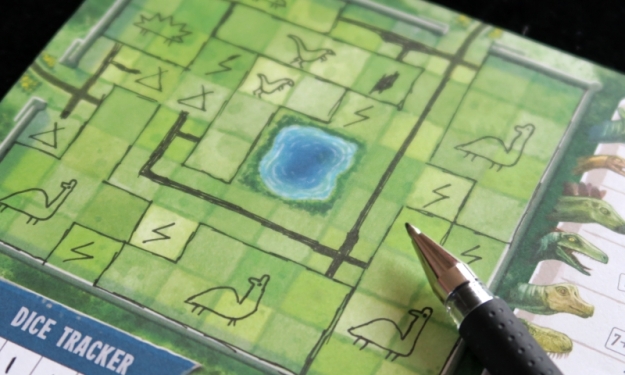
The basics of the game is that three dice are rolled giving a number of “pips” which players can spend on up to three actions.  These actions are to:  build paths; build a dinosaur pen (with generators), or build a facility.  The relatively novel aspect of this is that as well as choosing actions to do, players can also combine two or more dice together and use the increased value to do fewer, more powerful actions.  Thus a roll of one, three, and four can be used to do three separate actions of that level, or two actions of value, four say, or a single action of level eight.

Welcome to Dino World
– Image by boardGOATS

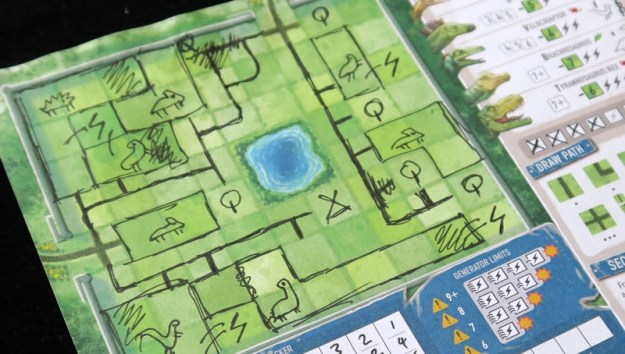
Playing the game with a large number of players (and remotely to boot), instead of players having goal cards that are scored at the end of each round, we use the variant where there are communal goal cards (called “Visitor Cards”) which are scored at the end of the game.  The game lasts just eight rounds, after which everyone adds up their scores for visitors, facilities, unused generators and, of course, each dinosaur pen.  This “Lite” version of the game is made considerably more complex when the game is played on the “Danger” board with the addition of Threat and Security Tracks and a modification to the way generators are built.

Welcome to Dino World
– Image by boardGOATS

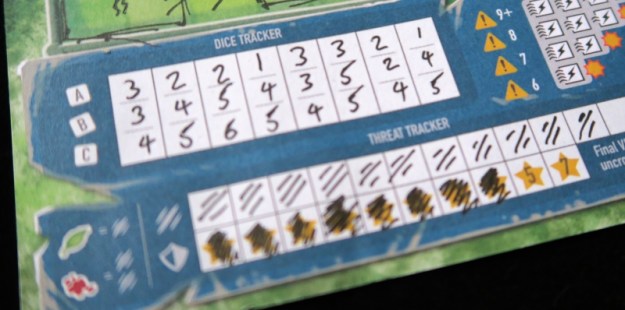
The idea of the Threat Track is that every time a dinosaur pen is added the park, the threat level increases by one for a herbivore and two for a carnivore.  Once per round, players can also increase their Security Level, by crossing off boxes on the Security Track.  These boxes contain points, which if unused at the end of the game, are added to the player’s score.  After the building phase is the malfunction phase when a single six-sided, (d6) “Threat Die” is rolled.  The value of the Threat Die is added to each player’s Threat Level minus the Security Level to give the Danger Level.  If the Danger Level is six or above, disaster strikes, generators malfunction, and dinosaurs start to rampage.

Welcome to Dino World
– Image by boardGOATS

Although both use 4 MW generators, they work slightly differently in the Danger and Lite Modes.  In Lite Mode, each generator will supply a maximum of four pens (the ones sharing a side with the generator), so a pen that requires a total of 3 MW must be adjacent to three different generators.  In Danger Mode, one generator can supply a maximum of 4 MW, but it can supply more than 1 MW to an individual adjacent pen indicated by a power line drawn between the two.  Thus, the amount of power a generator supplies can change during the game—it is the generators that are working closer to full capacity that are most likely to fail…

Welcome to Dino World
– Image by boardGOATS

If the Danger Level in a park reaches six, any generators that are working at maximum capacity fail.  It is a brief power-outage, but as a result, any pens that rely on these generators are affected and one square of these pens is lost (crossed out).  The problem really comes, however, when the final square in a pen is lost and and the pen fails completely, because now the dinosaurs break out and cause damage to all the neighbouring pens causing a cascade reaction.  And any pen that is destroyed completely no longer scores.

Welcome to Dino World
– Image by boardGOATS

Thus, the game is a matter of achieving a fine line between getting the most out of a limited number of generators with the minimum amount of security while still avoiding rampaging dinosaurs.  The rules explanation took longer than expected as there was quite a bit more to Danger Mode, and worse, it was a while since we last played the game in Lite Mode, so we had to revise that too.  Eventually we were going, however, only for a hiatus after the first round for a rules-check.

Welcome to Dino World
– Image by boardGOATS

Burgundy was right to point out that although the rules say players can carry out the three actions in any order, each one could only be carried out once per turn, in particular building dinosaur pens and building facilities.  Around half the players had already built two pens in the first round, so we decided that any player that had not done so, could build a second pen in the second round if they chose, and thereafter we would adhere to the rules “as written”.

Welcome to Dino World
– Image by boardGOATS

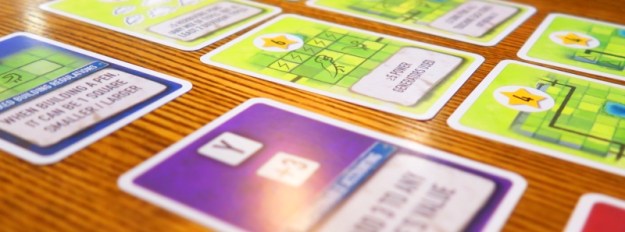
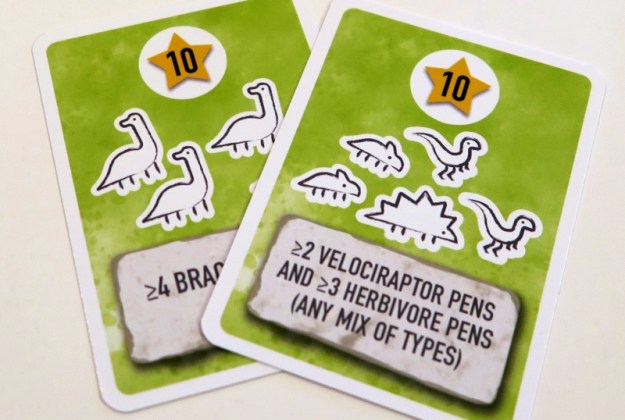
As last time, the first couple of rounds were very slow as players tried to assimilate the Visitor cards and work out a plan to maximise the points they could get from them.  This time they were:

  • ≥3 Protoceratops pens (worth four points);
  • ≥2 Different facilities touching orthogonally (worth four points);
  • ≥1 Protoceratops pen, ≥1compsognathus pen, and ≥1 stegosaurus pen all within four paths of any entrance (worth six points);
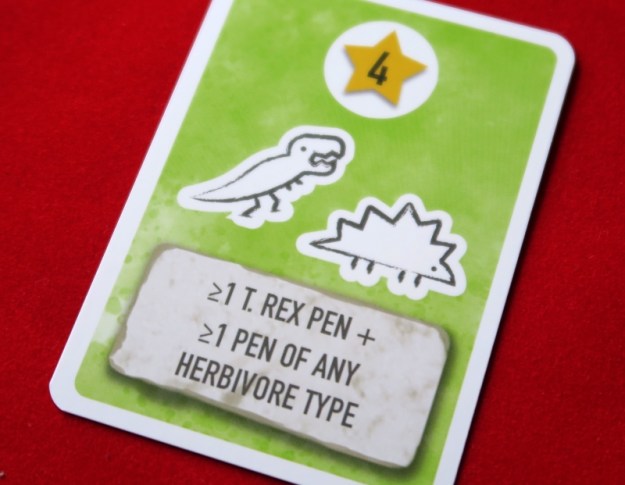
  • ≥1 T. rex pen and ≥1 brachiosaurus pen (worth six points);
  • ≥4 Brachiosaurus pens (worth ten points);
  • ≥2 Velociraptor pens and ≥3 herbivore pens (worth ten points).

The Facilities were the Viewing Platform and the Ranger Lookout which score points equal to the number of undamaged spaces in one neighbouring pen at the end of the game, and one point per pen visible orthogonally (respectively).

Welcome to Dino World
– Image by boardGOATS

In addition to the variety from the Visitor and Facility cards, there are also Research cards which are there to mitigate bad luck.  In Lite Mode, Research is just six opportunities to adjust a die by ±1, but these are replaced by three cards, X, Y, and Z which players can use three times, twice and once respectively.  This time, these were:

  • Calculated Risk: When building a carnivore pen, only add one to the threat track but add one damage to the pen (X);
  • Alternate Funding: Use one die as if it were any value (Y);
  • Docile Gene Editing: Do not increase the threat when building a pen this round (Z).

While minimising generators and security gives players more points at the end of the game, there is no benefit in not using their Research, so while most players kept some back in case of emergencies, others started using them from the very beginning.

Welcome to Dino World
– Image by boardGOATS

Although we were slow to get started and the first few rounds were also very slow, once we got going the rounds were much quicker.  And then came the maths.  Without Ivory to set an early (usually unbeatable) target, Pine stepped up with a score of one hundred and seven.  This was soon topped by Burgundy with a hundred and twenty-seven, then by Black with a hundred and twenty-nine.  However, on recount, Burgundy excitedly announced that he also had a hundred and twenty-nine, while Black sadly revised his score down to a hundred and twenty-seven.  All was not lost as both players recounted again and Black’s score returned to one hundred and twenty-nine while Burgundy’s third and final count proved to be the lowest at a hundred and twenty-six, “Bah!”.

Welcome to Dino World
– Image by boardGOATS

At this point, Black and Burgundy gave in as Pink’s verified score was a hundred and thirty, and it was clear they were battling for the minor places.  Pink, who thought he had won, however, was decidedly unimpressed when he was beaten by two points by Blue.  There must have been something in the air, or maybe it was the fumes from the vast amount of Tipp-Ex that Blue had used.  Pink’s check of Blue’s score initially increased her tally by six, only for him to reduce it again on a second recount, but the changes weren’t enough to give Pink victory.

Welcome to Dino World
– Image by boardGOATS

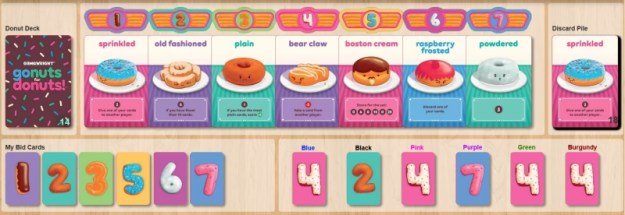
Pine was suffering with screen-eyes so took an early night leaving six to move onto Board Game Arena.  Six is an important number as a lot more games become available, but after some discussion where people expressed the desire to play something different yet light, we chose Go Nuts for Donuts!, which Pine had said he had been playing and had found light and entertaining.  It was indeed very, very simple:  each donut has a number and players simultaneously choose a card to “bid” for them.  The catch is that a bit like Om Nom Nom, if more than one person chooses the same donut, it cannot be shared and nobody gets it.

– Image used with permission
of boardgamephotos

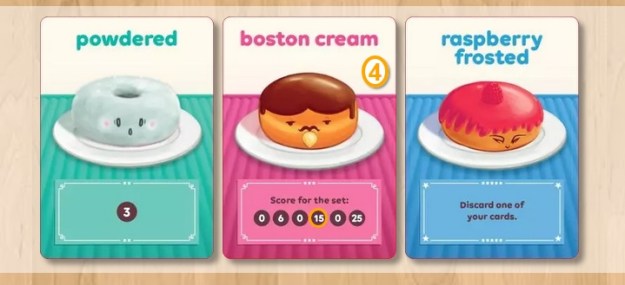
The different types of donuts score points in different ways and the player with the most points after all seventy cards in the deck have been exhausted is the winner.  Some just give points, others score if you have more (or less) than a certain number of one type of cards, while others allow players to take cards from the deck or discard pile.  The clever part is the simple decision, however:  which card to choose.  It is not as simple as it first seems.  Sometimes a player wants the card that gives the most points, but then other players may want that, so perhaps it is better to choose something else, even a card someone else wants simply to stop them getting it.  And which one is best if there is more than one donut of the same type?

Go Nuts for Donuts! on Board Game Arena
– Image by boardGOATS from boardgamearena.com

Go Nuts for Donuts! is quite a brutal game in that it is perfectly possible to end up with no cards much less cards you actually want.  It is a lot of fun though, and would probably be even more fun in person when players get to see the whites of each other’s eyes and read their body-language.  This time, although Purple got the most cards with eleven, it was only enough for second place.  Burgundy’s six cards worked better together, and thanks largely to his fine set of four Boston Cream donuts, Burgundy’s score of eighteen just gave him victory by a single point.

Go Nuts for Donuts! on Board Game Arena
– Image by boardGOATS from boardgamearena.com

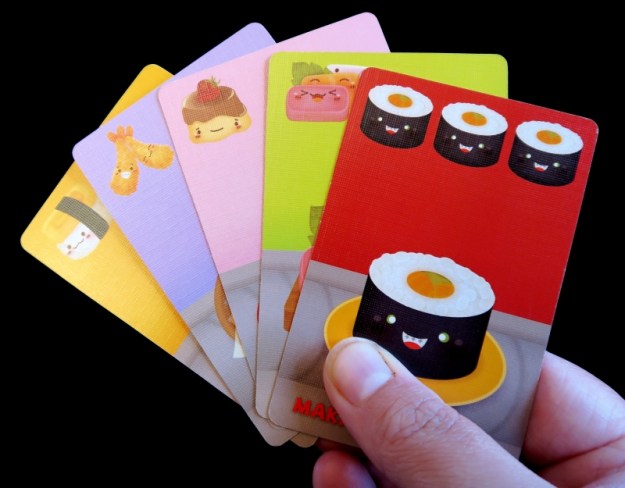
The appearance, style and set-collection nature of Go Nuts for Donuts! is very reminiscent of Sushi Go!, so with Green’s departure, the rest of the group settled down for one last food-related game.  We’ve played Sushi Go! quite a bit, mostly because it is very quick and simple.  The archetypal card drafting game, players start with a hand of cards and pass the rest on, trying to collect sets to give them the most points at the end of the game.  Played over three rounds, we played with a widdershins draft in the second round, and included the Soy Sauce mini-expansion for extra flavour.

Sushi Go!
– Image by boardGOATS

Pink took the first round largely thanks to a full set of three sashimi cards (which give ten points).  Players always fight for the wasabi cards as these can give a significant points boost, multiplying the next nigiri by three, but Purple was the only one to get any and she couldn’t make the best use of it as she had to pair it with egg nigiri (only worth one point).  The second round was pretty much a repeat of the first with Pink taking another sashimi trio and Blue scoring the egg nigiri with wasabi.

Sushi Go! on Board Game Arena
– Image by boardGOATS from boardgamearena.com

With Pink well ahead with thirty-six, the final round was really about limiting losses.  Purple took a full six for her puddings and Pink took six points for his maki rolls, but overall, the takings in the final round were pretty similar.  The rest of the group were actually quite close together with Purple (again) the best of the rest, but despite losing three points for tying for the least puddings, Pink’s final total of forty-two was unbeatable.

Sushi Go! on Board Game Arena
– Image by boardGOATS
from boardgamearena.com

Learning Outcome:  If the fences of dinosaur pens lose power, things can go very wrong (though perhaps that was already well known).

12th August 2021 (Post-Covid Test Event)

After some discussion, we had decided to have a “test visit” to The Jockey.  As they are not doing food on Tuesdays at the moment, this was a Thursday and we decided to make it a fairly light event filled with some of our favourite games.  Those that arrived early started with food and Burgundy was able to order Ham, Egg and Chips for the first time in over a year.  There was a boisterous atmosphere amongst the gamers who were all clearly over the moon to be back, bolstered by the wake on the other side of the room which had been going full-swing since lunchtime.

Ticket to Ride: Nordic Countries
– Image by boardGOATS

While we waited for food to arrive, the group revelled in the delight of face-to-face meeting discussing the meaning of the word “MILF” and whether or not there was such a thing as a “DILF”.  Poor Ivory had been waiting well over a year to play the Japanese map for Ticket to Ride and it had been scheduled at least three times since and had been postponed thanks to “events”.  As it was starting to become a bit of a harbinger, we decided to make the “Feature Game” the generic Ticket to Ride to ensure that the evening wasn’t jinxed again, but there was plenty of opportunity to give it an outing as two copies arrived.

Ticket to Ride Map Collection: Volume 7 – Japan & Italy
– Image by boardGOATS

There were lots of other map choices and while we discussed the real options, lots of new variants were invented.  The pick of these were perhaps the Beeching Variant (loads of the routes get ripped up halfway through the game leaving people with tickets they can’t make) and “Ticket to Row”, the “Climate Change Edition” (as the game progresses, coastal routes disappear due to erosion and flooding).  Ivory was obviously keen to play the Japanese map and was joined by Green, Lilac and Burgundy.  The other map ended up being the Heart of Africa and after some discussion about the best number of players for this map (which has reputation of being brutal), Burgundy moved over to join Blue, Pink and Pine.

Ticket to Ride: Germany
– Image by boardGOATS

Ticket to Ride is a relatively simple game, often referred to as a “Gateway Game” because it has a reputation of drawing people into playing modern board games.  The decision space on each turn is relatively small, but still meaningful and although a lot of the group like more challenging fare too, we all have a soft-spot for this one.  The idea is that players are building track, by playing coloured cards that match the colour and number of the line shown on the map.  So on their turn, they can draw cards, or place trains by playing cards.  Points are scored for placing trains with longer the routes, giving more points.

Ticket to Ride Map Collection: Volume 6 – France & Old West
– Image by boardGOATS

Things are not quite as simple as that though, because players also have tickets:  if they can fulfil their tickets using routes they have claimed, they score points.  If, on the other hand, they have unfulfilled tickets at the end of the game, these score negative points.  Thus, instead of picking up cards or placing trains, players can also collect tickets to try to increase their score that way.  The game end is triggered when one player has only two of their little plastic train pieces left.  One of the things that gives Ticket to Ride its remarkable continuing appeal is the incredible variety in expansions available, each of which add interest with a different layout and slight variations to the rules.

Ticket to Ride: Nordic Countries
– Image by boardGOATS

For example, the Japan expansion has routes reserved for Bullet Trains, which are marked by a single Bullet Train miniature.  When a route is claimed, it can be used by all players to complete destination tickets.   Instead of scoring points for such a route, players progress on the separate Bullet Train track with players receiving a bonus at the end of the game: whoever has contributed the most to this shared project receives the largest bonus, with the player who contributes least being penalized.

Ticket to Ride Map Collection: Volume 7 – Japan & Italy
– Image by boardGOATS

In contrast, the Heart of Africa expansion adds new terrain cards which can be picked up instead of train cards which can be used to score extra points when placing trains.  The terrain cards come in three different colour sets representing Desert/Savanna, Jungle/Forests, and Mountains/Cliffs.  When a player places trains of the corresponding colours, if they have at least as many of that terrain card as every other player, they may additionally spend terrain cards to double the points value of their route.  One of the consequences of the different terrain types having fixed colours is that routes of one colour tend to be clumped together.

Ticket to Ride Map Collection: Volume 3 – The Heart of Africa
– Image by boardGOATS

This means that players need lots of cards of the same colour to connect routes together.  This, combined with the fact that there are no “double routes” in the centre of the map, mean the Heart of Africa expansion has a reputation of being particularly savage and unforgiving.  It was also much slower to get going, indeed, the Japan expansion players were well into their game before the Africa players had really started, and they had nearly finished before the others had got halfway through.  In Japan, Ivory went for the Bullet Trains to get the bonus, but also in order to help complete his tickets.  Although nobody really engaged in the building of the Tokyo subway, Kyushu Island was well catered for by Lilac who built a very fine connection from Kokura to Miyazaki.

Ticket to Ride Map Collection: Volume 7 – Japan & Italy
– Image by boardGOATS

In the dying moves of the game, Lilac effectively gave Green fifteen points and with it, the game.  Things were rather different on the next table, however.  Blue and Burgundy got stuck with tickets that meant they had little choice but to go through the jungly centre of Africa.  With Pine having accidentally picked up a large pile of jungle terrain cards, there was no chance of either of them getting double points.  Worse, as Blue struggled she could see there was one single train route that she simply had to take and Burgundy was heading straight for it.

Ticket to Ride Map Collection: Volume 3 – The Heart of Africa
– Image by boardGOATS

When Blue took the critical route from under Burgundy’s nose, it started a cascading chain reaction of events where they continually messed up each other’s plans.  Meanwhile, Pine sniggered from the sidelines as he built his routes round the south coast largely unopposed—even on the odd occasion that someone else managed to get in his way, it was on a double route.  Pink was getting it largely his own way too, as he was going round the west and north edges of the map.

Ticket to Ride Map Collection: Volume 3 – The Heart of Africa
– Image by boardGOATS

Pine picked up handfuls of tickets most of which seemed to lie on the routes he’d already connected, and then Pink suddenly moved to end the game leaving Burgundy with no other choice but to take tickets and hope for a miracle (to no avail).  As the last trains were placed, Pine had a substantial lead which only increased when he added his ticket scores and Globetrotter bonus for having the most complete tickets.  Although it was all built on extreme good fortune in his starting tickets, Pine had put together a fantastic game finishing with a massive one hundred and seventy-five points, forty points ahead of Pink in second.

Ticket to Ride: Europe
– Image by boardGOATS

As the depths of deepest darkest Africa were being slowly explored, the other three decided to take advantage of Burgundy’s preoccupation to play Splendor without him to guarantee one of them a rare victory in a game that we haven’t played for over a year.  The game is very simple:  on their turn, players either collect gems, or use the gems to buy cards.  The cards then act as permanent gems, while the more expensive cards also give victory points as well.  A player reaching fifteen points triggers the end of the game, and the player with the most points wins.  Although we have played it a lot, this time was with Green’s brand new copy, with the wrapper still on.

Splendor
– Image by boardGOATS

Once the cellophane had been removed and cards well shuffled, the group settled down to play.  Maybe it was poor shuffling or perhaps just luck, but diamond cards (whites) were slow to come out at the start.  In addition to points on cards, players can also get points for collecting Noble tiles.  This time, Ivory suddenly claimed two Nobles in quick succession which, together with a high-scoring card pushed him over the line.  Green was able to claim a third Noble, but it wasn’t enough and he finished one point behind Ivory in what had been a close game.

Splendor
– Image by boardGOATS

The Explorers of Africa finished at around the same time as the gem dealers.  So, as Ivory headed off to get ready for his weekend away, Pink suggested a game of our old favourite, Bohnanza.  Everyone had played it a lot except Lilac, so as Blue explained the rules, Pine and Burgundy prepared and shuffled the deck.  The game is a simple enough trading game, but depends on the vital rule that players must not change the order of the cards in their hand.  On their turn, the active player must play the first card in their hand, and may play the second if they choose.

Bohnanza
– Image by boardGOATS

Then, the player turns over the top two cards from the central deck.  They can plant these in their two been fields if there is space, but fields can only hold beans of one type, and beans on the table must be planted, so most often these are traded to other players.  Once the two cards on the table have been dealt with, the active player can finally trade cards from their hand, but again, all cards traded must be planted.  When they are done, they draw cards to go into their hand.  The aim of the game, once again is to collect sets.  At any point, players can trade in their planted beans, getting coins at the rate indicated by the “Bean-o-meter”.

Bohnanza
– Image by boardGOATS

And this is one of the clever parts of the game—when a player sells their beans, they take the relevant number of cards and turn them over, turning them into money.  One side effect of this is that rare cards become increasingly rare, while the more common cards become increasingly common.  The deck also gets progressively smaller as fewer cards are recycled making the rounds shorter as the game goes on.  The game lasts three rounds, but as a result of this, the last round is usually very short indeed. There are a lot of other nuances, which Green and Blue tried to explain so Lilac wasn’t too disadvantaged.

Bohnanza
– Image by boardGOATS

The others expressed their disapproval by referring to them all as “Team Trio”.  However, while Lilac was getting the hang of it and everyone was doing what they could to be nice to her, Blue lost the plot and sold several fields of beans without taking her reward.  It seemed to be contagious, because in the final round Burgundy’s pile of coins somehow became the draw pile.  Chaos reigned and hilarity ensued as Blue, Pine, Pink and Burgundy tried to work out what had happened and variously blamed each other.  Burgundy probably got most of his coins back, but there wasn’t really much doubt that the winner was Lilac with fifteen coins.

Bohnanza
– Image by boardGOATS

Although it was late there was still much chatter, about how it wasn’t the same without Black, Purple and Lime, and what we were going to do going forwards.  It got quite a lot later too, because as we headed out someone pointed out the clear skies and how it should be possible to see the Perseid Meteor Shower.  As we stood in the car park, someone spotted a “shooting star”, but everyone else missed it.  So we waited for another, and another, and another.  Eventually, everyone had a crick in their neck and rather than spend the whole night there, we decided it was time to go.

Perseid Meteor Shower
– Image from wikimedia.org

Learning outcome:  It’s great to be back.

3rd August 2021 (Online)

Last time, we had decided to have a “test visit” to The Jockey, with the hope that we’d be back this week.  Sadly, since then, the pub has been closed, so we were online for another week.  Lime, Pine, Black and Purple were the first to join the meeting, quickly followed by Burgundy, then everyone else eventually joined the chatter.  We had hoped to mark The Games of the XXXII Olympiad in Tokyo and our return to The Jockey by playing Ticket to Ride with the Japanese map.  However, circumstances meant that this was the third unsuccessful attempt to play that game.  So instead, this week, the “Feature Game” was the Ishikawa map for MetroX.

MetroX
– Image by boardGOATS

MetroX is a simple little “Roll and Write” type game that seems easy at first, but is difficult to play well.  The game is driven by a deck of number cards, where the simple ones dictate how many sections can be marked on a route:  Players fill the boxes along the lines with “zeros”, with the number on the card dictating the number of boxes filled.  In general, if the line comes to an end, or some of the boxes had already been filled (because they were part of another line for example), then any excess are lost.  So the game is all about efficiency, as there is a limit to the number of cards that can be used on each line (as shown by the indicator boxes at the start of each one).

MetroX
– Image by boardGOATS

There are a small number of special cards as well, which break the rules.  For example, there are number cards with a circle, which allow players to skip any filled spaces and and help avoid wastage.  There are also special “star” cards, which allow players to fill a box with a number equal to the number of tracks passing through the space—this number contributes to the player’s final score.  There is also a “free” card which allows players to fill in a single space anywhere on the map.  Cards are turned until all the indicator boxes on the map have been filled or until the six is drawn, in which case, the deck is shuffled and drawing (both of cards and routes) continues.

MetroX
– Image by boardGOATS

Points come from the “star” bonuses, but also from line completion bonuses.  These are scored similar to the rows and columns in Noch Mal! or the bonuses in Welcome To…, where the first player to complete a line scores a higher amount than those who complete it later in the game.  This is off-set with a negative score for the number of unfilled boxes at the end of the game.  This time we were playing with the Ishikawa promo map, which is remarkably simple, however, the fact there are very few indicator boxes not only makes it a very short game but also leaves very little room for manoeuvre.  With only eleven rounds (plus any free cards) we were all worried that if we didn’t get a six we might struggle to complete lines.  That concern turned out to be baseless, however, with every line being completed by someone during the game.

MetroX: Ishikawa Promo Map
– Image by boardGOATS

Green’s mind was clearly elsewhere as he missed a number and spent a couple of minutes trying to work out what he’d done and then asked for clarifications on the negative scoring.  For reasons that weren’t entirely clear, everyone struggled to calculate their scores, with a long delay before scores came in, and with a large number of corrections.  Ivory led the scores with nineteen points.  After a brief spell in second behind Pink and Purple, a couple of recounts later it was confirmed as a four-way tie between Ivory, Pink, Burgundy and Purple all with nineteen.  So, following the example of the high jumpers, Mutaz Essa Barshim and Gianmarco Tamberi, they agreed to share the Gold Medal.

– Video from youtube.com

The Japanese are very fond of their railways, so as the Ishikawa map was so quick to play, we decided to follow it with another train game, the new Railroad Ink Challenge, which we first played a month ago.  This is another relatively simple “Roll and Write” game, where players have to draw the road/rail depicted when four dice are rolled.  All four must be drawn and they must connect to an “entrance” or something already drawn on the player’s map.  There are also special cross-roads which can be used a maximum of once per round and only three can be used in the whole game.  Each game lasts for just seven rounds, so again efficiency is vital.

Railroad Ink Challenge: Shining Yellow Edition
– Image by boardGOATS

The Challenge edition adds extra features on the maps which in effect give players bonuses when they fill those spaces, and also adds a set of three “goal” cards that give players more points when they complete them.  These work in the same way as the line bonuses in MetroX, except that there are three sets of points available:  one for the first player(s) to complete them, one for the second set of players to complete them and one for everyone else.  Last time, we played the Shining Yellow edition, but this time, although we used the yellow boards, we used challenge cards from the Lush Green edition, randomly drawing cards A, B and E.

Railroad Ink Challenge: Lush Green Edition
– Image by boardGOATS

Goal A gave points for players filling five of the nine central spaces; B gave players points for completing three of the “village” spaces and E gave points for completing all nine of the central area.  Ivory’s printer refused to play ball, so he gave up and took an early night.  We were all sorry to see him go of course, but it did give everyone else a chance to win.  The first round included one of the especially awkward back-to-back curves, but it turned out to be the only one, though.  This time there were a lot of T-junctions and fly-overs, with very few straight segments and simple corners. As a result, people started using their “specials” quite early rather than saving them to the end.

Railroad Ink Challenge: Shining Yellow Edition
– Image by boardGOATS

As is often the case, there were a lot of reports of huge numbers of “hanging ends” meaning that players were variously taking chances and keeping options open, but hoping upon hope for helpful dice rolls.  As the game progressed, people started claiming the Goals, with B going first.  Some players had decided to use different colours for road, rail and stations, which ultimately seemed to slow them down as they not only had to choose what to do but also make sure they used the right colour.  That just gave more thinking time to everyone else though, so nobody really minded.

Railroad Ink Challenge: Shining Yellow Edition
– Image by boardGOATS

Without expansions, the game only takes seven rounds, so it wasn’t long before people were starting to worry that they were running out of time.  Burgundy said he could really have done with one more round and there were several others who felt the same, but the rules are the rules, so Burgundy posted his score, setting an initial target of fifty-one.  When Green gave his score of seventy-seven, however, he was so far ahead of Burgundy that photographic evidence was requested by everyone else.  While his score was being verified as correct, Blue and and Pink were confirmed as the winners of silver and bronze respectively.

Railroad Ink Challenge: Lush Green & Shining Yellow Editions
– Image by boardGOATS

Time was marching on, so we moved onto Board Game Arena for something light and easy, and sensing that this might be the last chance online, we opted for our go-to game, 6 Nimmt!, with the Professional Variant.  In this simple game, players simultaneously choose a card and, once revealed, starting with the lowest card, they are added to one of the four rows—the one ending in the highest number that is lower than the number on the card.  The player who adds the sixth card to any row, instead takes the five cards and the number of bulls heads on the cards make part of their score.

6 Nimmt!
– Image by boardGOATS

Face-to-face, these are summed and the lowest scores wins, however, on Board Game Arena, everyone starts with sixty-six points and the scores are subtracted from their running total.  Thus, the game ends when someone falls below zero and the winner has the most points at the end of the game.  In the Professional Variant, players can add cards to the either end of the row, with cards going at the start of a row if they are lower, than the first card in the row and the difference is smaller than it would be if they were to go elsewhere.  This really adds a new dimension to the game, but there is serious mathematical upkeep giving us reservations about playing it with real cards, face-to-face.

6 Nimmt! on Board Game Arena
– Image by boardGOATS from boardgamearena.com

This time, Blue picked up first and enthusiastically started the race for the bottom.  It looked like she was a certainty to end the game very quickly until she had competition from Burgundy.  Everyone else had picked up some cards and Burgundy was the last person to maintain his starting total of sixty-six nimmts, when he suddenly shipped a landslide of points going from the lead to vying for last with Blue in just a handful of turns.  Both Blue and Burgundy managed to steady the ship, albeit briefly, before Blue grabbed enough points to end the game.

6 Nimmt! on Board Game Arena
– Image by boardGOATS from boardgamearena.com

Everyone else was actually quite close, and once again we had a tie for the Gold Medal, this time between Purple and Pine (who always does well in this game); both finishing with thirty-eight, just two ahead of Black.  From there, Green wished everyone else a good night leaving just six.  With lower numbers the options abound, but everyone was in the mood for something that didn’t require too much thought, and someone suggested giving L.L.A.M.A. (aka L.A.M.A) a go.  Although it was still in beta testing and we’d not played it online before, we felt there was “no cause for alarm-a”, as we’d played it before (albeit a long time ago) and found it to be a very easy game

L.A.M.A.
– Image by boardGOATS

Nominated for the Spiel des Jahres two years ago, L.A.M.A. has a reputation of being a bit of an “UNO killer”, that is to say, it is a similar game to UNO, but perceived to be better.  L.A.M.A. is an abbreviation for “Lege alle Minuspunkte ab”, which roughly translates as “get rid of your negative points”, and indeed this is what players do, in a similar way to UNO. Players start with a hand of cards and, on their turn can, add a single card face up to the pile in the middle as long as it has the same face value, or the same plus one.  The cards are numbered one to six, with the Llama card simultaneously being above six and below one providing a bridge between the high and low numbers.

L.A.M.A.
– Image by boardGOATS

Alternatively, players can pick up a card or pass.  When players pass, their score is the total of the face values of their cards, but if they have multiple cards of the same face value, they only count once.  So if a player has five cards with a value of two, they would score two points, however, just one card with a higher face value would score more and Llama cards score ten points.  The round ends when either everyone passes, or when someone gets rid of all their cards and everyone takes chips equal to their scores.  Players who succeed in checking out get the bonus of being able to return one chip, which is important because the game ends when someone reaches forty points and the winner is the player with the fewest points.

L.A.M.A. on Board Game Arena
– Image by boardGOATS from boardgamearena.com

Burgundy spent a lot of time moaning about being given poor options by Purple who was sitting on his right. Based on the effect this had, he might have had a point as he was rapidly picking up chips and was the one to make it to forty and trigger the end of the game.  Further, Purple was doing really well, finishing with just nine, twenty-five fewer than anyone else except Black, who just pipped her to victory with only six.  With everyone keen to play another game, but nobody enthusiastic about making a decision on what to play, and medals only awarded once for each “event”, a second round meant the Gold was still up for grabs.

L.A.M.A. on Board Game Arena
– Image by boardGOATS from boardgamearena.com

This time, Blue joined the moaning when Pine did the same to her as Purple had done to Burgundy, changing the number when she didn’t want and not changing it when she did.  Burgundy did better this time finishing in joint second with Black with twenty-eight points.  The winner of the second round finishing with just a single chip was Purple.  This made her the L.A.M.A. champion taking the final Gold medal of the evening.

L.A.M.A.
– Image by boardGOATS

Learning outcome:  As with the Olympics, everyone who takes part in playing games is a winner.

20th July 2021 (Online)

Since last time, there had been quite a bit of debate about returning to the Horse and Jockey, but there was a little hesitancy and with the extremely hot weather, staying at home this week turned out to be the right choice all round.  As the decision had been just a little bit last-minute, we chose to keep the “Feature Game” simple and opted for the Skills Mini Expansion for Cartographers.  We have played Cartographers several times and everyone has really enjoyed it.  With the Spiel des Jahres winners announced this week, this was also the nearest we could get to playing a game to mark the occasion (it received a nomination for the Kennerspiel award last year).

Cartographers: A Roll Player Tale
– Image by boardGOATS

Cartographers is a “Roll and Write” type of game, but one with more of a “gamery” feel than most.  It is based on Tetris, with shapes revealed on the flip of a card in a similar way to other games we’ve played this year like Second Chance and Patchwork Doodle.  However, the thing that makes Cartographers more “gamery” than these is the addition of terrain and players usually have to make a choice, either of the shape or the terrain.  The terrains are tied in with goal cards, four of which are revealed at the start of the game.  Two goals are then scored at the end of each of the four seasons, in a similar way to another game we like, Isle of Skye.

Cartographers: A Roll Player Tale
– Image by boardGOATS

There are lots of other little aspects of the game that make it interesting—the presence of Ruins and Ambush Cards in the deck, for example, deliver a curved ball, just when players feel they are in control.  Players can also build their income by surrounding mountain ranges and choosing to play certain shapes; this gives more points at the end of each round.  The Skills expansion gives players a way to offset this income for special actions which potentially give players other ways of achieving their goals, further adding to the decision space.

Cartographers: A Roll Player Tale
– Image by boardGOATS

One of the most impressive things about Cartographers is the amount of variety that is built into the game, which means every play feels different and the game stays remarkably fresh.  So, there are two different player maps and four of each type of goal card.  This variety is carried through to the Skills expansion; there are eight cards of which three are chosen at random.  This time we chose the B side of the map (with empty “wasteland” spaces marked) and drew the Greenbough, Mages Valley, Wildholds and Borderlands goal cards together with the Search, Negotiate and Concentrate skills cards.  These skills cost anything from free (like Search) to three (like Concentrate), and each can be played multiple times per game although only one can be played each Season.

Cartographers: Skills Mini Expansion
– Image by boardGOATS

We quickly realised that the expensive skills like Concentrate are only likely to be played in the final round, as the cost is in “income” and that income is generated at the end of every round.  So, playing Concentrate at the start of the game will ultimately cost a player twelve points, while playing it in the final round will cost three just three points.  For this reason, the free Search skill was always likely to be used by almost everyone in almost every season (and so it proved).  Of course, the higher tariff reflects the increased power though:  Search allows players to increase the size of the shape they are drawing by a single square; Negotiate (which costs one) allows players to draw a two-by-two shape, and Concentrate allows players to draw the shape a second time.

Cartographers: A Roll Player Tale
– Image by boardGOATS

As well as the skills which we had not played with before, several of the goal cards were new to us as well, including Greenbough (which rewards gives players one point per row and column with at least one Forest square in it) and Mages Valley (which gave points for each space next to a Mountain—two points for each Lake and one point for each Arable).  We’d played with the Wildholds goal before though (which gives six points for each Village of six or more spaces) and, although Borderlands was new to us (which give points for each completed row or column), we’d played The Broken Road goal which is similar (giving points for completed diagonals).

Cartographers: A Roll Player Tale
– Image by boardGOATS

The game began much as usual, and Pink, who was watering the tomatoes in the “mini-market-garden”, commented that he could hear Burgundy muttering, sighing and generally sounding stressed from outside.  Although we had played with “Wastelands” before, we had all focussed on how the fact some of the spaces were already full would help.  We had all forgotten how much the Wastelands obstruct plans and generally make life considerably more difficult.  Blue made a bit of using the ruins spaces to give her more flexibility later, but had forgotten that it would reduce the number of spaces she would be able to fill later in the game.

Cartographers: Skills Mini Expansion
– Image by boardGOATS

It was clear after the first round that Ivory was going to be tough to beat, a feeling that was cemented after the second round.  Unusually, Burgundy was the first to post a score, with a total of one hundred and forty-one.  Although this was high enough to earn him second though, when Ivory’s score came through he was a massive twenty-five points ahead.  Once again, it had been a very enjoyable game, and as we tidied up there was a little bit of chit-chat about the skills and what they added to the game.  Since they are not compulsory, the consensus  was that we should add them every time, though it was clear that they had been widely used because of the presence of the free Search skill, which everyone had used, and some in every round.

Cartographers: Skills Mini Expansion
– Image by boardGOATS

With Cartographers over, we had a bit of a discussion about moving back to our much loved and greatly missed, Horse and Jockey.  We’d conducted some anonymous surveys over the preceding week to try to gauge opinion trying to ensure that nobody felt under pressure to do anything they weren’t comfortable with.  Some of the group had been back on occasional Thursdays, playing old favourites like The Settlers of Catan, Wingspan, and Roll for the Galaxy and new games like Red Rising, Mercado de Lisboa, Ticket to Ride: Amsterdam, Tapestry (with the Plans and Ploys expansion), Ginkgopolis, Everdell, and Draftosaurus (aka “Sushi Go with Dinosaurs”).  Others, however, had not been to the pub for nearly eighteen months.  After some discussion, we decided that we’d schedule a trial visit in ten days time, so that those who had not been out could see how they felt without committing, and those that went could report back to those that were feeling a little more reticent.

The Horse and Jockey
– Image by boardGOATS

After that, we moved onto Board Game Arena.  It was a quiet night without both Pine and Lime, and once Green and Ivory had left as well, we were down to five which gave us a lot of options.  Coloretto was one, but in the end we chose Niagara, a game we’ve all played quite a bit, but never online, and we were keen to see the new Board Game Arena implementation and whether losing the tactile moving river would leave the game lacking.  A strong element of the game is the element of simultaneous play, however, and this was a large part of the appeal this time.  Players simultaneously choose a Paddle Tile which dictates how far their canoe will move in the round.  Then, in turn order, players move their canoe up or down the river, paying two movement points to pick up a gem from the bank (or drop one off).

Niagara
– Image by BGG contributor El_Comandante
adapted by boardGOATS

The winner is the player to get four gems of the same colour, five gems of different colours, or any seven gems safely home and into the shallows.  On the face of it, this is relatively simple, but the really clever part of the game is the movement of the river.  In general, the river moves at the speed of the slowest boat—if the lowest numbered Paddle Tile is a two, then the river moves two spaces and all the boats move with it.  However, one of the Paddle Tiles is a weather tile which enables players to increase or decrease the rate to make life harder or easier.  Since everyone has to play all their Paddle Tiles before they can recycle them, the timing of their weather tile is critical: players who leave it to the end run the risk of the river running fast and losing boats over the cascade because they can’t do anything about it.

Niagara on Board Game Arena
– Image by boardGOATS
from boardgamearena.com

And it wasn’t long before that’s exactly what happened, when both Blue and Black got their timing wrong and lost boats over the falls, so had to pay hard earned gems to get new ones.  Then, to add insult to injury, Pink sneakily crept up on Blue and stole another gem from her.  Players can only steal if they land on the same space as another boat while travelling upstream, and even then it is a choice.  There was much ill feeling especially from Blue, but she wasn’t the only one.  And with that, the gloves came off and everyone tried to redress the balance and ensure that such bad behaviour would not go unpunished.

Niagara on Board Game Arena
– Image by boardGOATS from boardgamearena.com

Pink was abreast of that though and had a plan.  Knowing his bad behaviour would make him a target he collected gems in one boat letting others take them while he stole the gems he wanted and got them to shore quickly.  Much to everyone’s disgust, he soon had five different gems and there was nothing anyone could do to stop him getting them home.  Burgundy actually had more gems giving him a nominally higher score, but his set of six did not include five different colours and Blue’s set of five included three nuggets of amber.  The victims of Pink’s grand larceny were unimpressed with his terrible behaviour, and as it was getting late, we decided to call it a night.

Niagara on Board Game Arena
– Image by boardGOATS
from boardgamearena.com

Learning Outcome:  Theft is totally unforgivable.

6th July 2021 (Online)

After the usual pre-game chatter (this time focussed largely on the village of Standlake—north of The River, Tut!), we settled down to play the “Feature Game“.  This was the new Railroad Ink Challenge: Shining Yellow Edition.  We have played Railroad Ink: Deep Blue Edition several times, both with and without the mini expansions and have really enjoyed it.  This new version steps it up a little with several new “Challenges” to add to the base game.

Railroad Ink: Deep Blue Edition
– Image by boardGOATS

The basic idea is very simple:  four dice are rolled and players have to draw all four pieces of track on their player board.  These must either extend a previous section of road or track, or start at one of the red entrance “arrows”.  Three times during the game, players can, additionally, draw one of six special intersections with only one per turn.  Players score points for the longest sections of road and track, connecting red entrance “arrows” and for filling the central nine squares, losing points for any unconnected, “hanging ends”.

Railroad Ink: Deep Blue Edition
– Image by boardGOATS

The “Challenge” editions of Railroad Ink add special spaces which represent villages, factories and Universities (though we referred to them as “Houses”, “Spectre Octopi” and “Fingers  Pointing Up”).  These give extra point scoring opportunities and a chance to get an extra “special” section.  It also includes goal cards which give players even more chances to score more points.  These work a bit like the scoring in Noch Mal!, where the first players to complete a “Challenge” score maximum points and others who achieve it later score less.  These provide a lot of variety to the game, especially when combined with the additional mini expansions that each game comes with.

Railroad Ink: Shining Yellow Edition
– Image by boardGOATS

The first thing we noticed was that the dice we had didn’t seem to make sense—there weren’t enough simple straight and simple bend sections.  It quickly became apparent that we had the wrong dice in the box.  Fortunately, we also had the Lush Green Edition, so we stole the dice from that and carried on.  It quickly became apparent that somehow this was much more difficult than the original Blue Edition that we had played so many times.  It wasn’t clear whether this was just an unfortunate series of dice rolls, or whether it was a function of the fact players were trying to do more things which forced them to compromise more, or even the new back-to-back corners.

Railroad Ink Challenge: Shining Yellow Edition
– Image by boardGOATS

Either way, it was clear that people had a lot of “hanging ends” and were desperately hoping for “good rolls” (perhaps cheese and pickle rather than egg and cress…).  Most people managed to make something out of their spaghetti-like network though, and before long it was time to compare scores.  Ivory was in charge of the Tusk-lets, so in his absence it was left to Pine to set the target score.  When Pine reported his fifty-three, everyone knew it was a good score from Burgundy’s response of “Bugger.”

Railroad Ink Challenge: Shining Yellow Edition
– Image by boardGOATS

Black matched Pine, and Pink thought he’d pipped them by one point with his fifty-four, but Blue had the beating of all of them finishing with fifty-seven points.  The score survived Pink’s recount, in what had actually been quite a close game.  It had been a reasonably quick game, so we moved on to play Take it Easy!, a tile-laying game we played back in February, but had really enjoyed.  Each hexagonal tile has three pipes crossing it, in three different colours.  Tiles are drawn from a stack one at a time, and each player adds them to their personal player board.

Take it Easy!
– Image by boardGOATS

The tile placement rules are simple:  the tiles can be placed anywhere on the board but must be placed the right way up which fixes the directions of the nine different coloured pipes.  Players score points for any pipes that contain only the one colour, and that score is the number of tiles in the pipe multiplied by the number on the pipe. Thus, the highest scores are achieved by locating the high value pipes so they go through the middle.  Although there are a maximum of fifteen pipes, it is almost impossible to complete all successfully, especially as there are some tiles that are not used.  So, there is an element of chance as well as hedging bets.

Take it Easy!
– Image by boardGOATS

It quickly became clear to Blue that she wasn’t going to be in the running this time, and others felt the same, knowing they had not done as well as they felt they should have done.  Pink, however, once again thought he’d got it in the bag with his score of one hundred and forty-five, ten more than the hitherto next score, by Black.  That was until Green reported a massive score of one-hundred and seventy-three.  Everyone else, some thirty points behind struggled to believe it, but he’d simply made better use of the tiles as everyone else had been waiting for yellow (nine point) tiles to come out.

Take it Easy!
– Image by boardGOATS

With that, we decided to move onto Board Game Arena.  There were lots of options, but Green was keen to share a game he had recently discovered called Hugo: Das Schlossgespenst (aka Escape from the Hidden Castle).  This is a light, family roll-and-move type game, where players take on the role of guests at a party, trying to escape from “Hugo the ghost”.  Hugo starts in the cellar, but quickly moves up to the gallery, chasing any guests that have not been able to escape into one of the side rooms.

Hugo: Das Schlossgespenst
– Image by BGG contributor duchamp

The catch is that even when apparently safe in a room, if another guest guest rolls exactly the right number the resident can be evicted, inevitably right into Hugo’s path.  When Hugo catches someone, they go into the basement and, the deeper they go, the more “Fright Points” that player gets.  The aim of the game is to finish with the fewest “Fright Points” after Hugo has been round the gallery seven times is the winner.

Hugo: Das Schlossgespenst
– Image by boardGOATS
from boardgamearena.com

Although the game seems like it is just a simple roll-and-move game, there is a little bit more to it than that.  Players are in charge of more than one guest, so they have to choose which one to move on each turn.  This decision will depend on where their pieces are with respect to Hugo, but also which rooms are closest, which rooms are empty and whether they can get one of their guests into one of the two “safe rooms” that give players negative “Fright Points”.  In practice, this isn’t much of a decision because after a couple of rounds, Hugo is moving so quickly, escape is the only thing on the players’ minds.

Hugo: Das Schlossgespenst
– Image by boardGOATS
from boardgamearena.com

Although the game didn’t take the five minutes advertised, it didn’t take too long.  There was much humour when one of Blue’s guests stuck its head up Pine’s frock, and likewise, when one of Pine’s stuck its head up Burgundy’s frock.  It was very clear to everyone that Green’s prior experience was the explanation for why he very nearly won—it is a game that is all skill of course.  In the event, however, Pine pipped him to the line by just one “Fright Point”.  And with that strangeness over, and this possibly being the last online game session, it seemed fitting to end with the reigning Golden GOAT winner, 6 Nimmt!.

6 Nimmt!
– Image by boardGOATS

Over the last year or so, we’ve played 6 Nimmt! more than anything else, way more, simply because it is fast, fun, and skirts the fine line between tactical masterpiece and unpredictable luck-fest.  Players simultaneously choose cards that are placed at the end of one of four rows. The player who places the sixth card in a row, instead picks up the other five and their card becomes the first card in the row.  In the Board Game Arena version of the game, players start with sixty-six “Nimmts”, losing some each time they pick up.  The winner is the player with the most “Nimmts” or points when one player’s tally falls below zero.

6 Nimmt! on Board Game Arena
– Image by boardGOATS from boardgamearena.com

Playing with the “Professional Variant”, cards can be added to both ends of the rows, simultaneously adding control and chaos in equal measure.  This time, Burgundy was the first to pick up cards, but Green was the first to begin the race to the bottom in earnest.  His personal roller-coaster ride hit maximum speed when he picked up a remarkable eighteen “Nimmts” on one turn.

6 Nimmt! on Board Game Arena
– Image by boardGOATS from boardgamearena.com

For most of the game, everyone was very, very close, except for Green, but then everything went wrong for everyone and the scores plummeted.  Green inevitably triggered the end of the game though, but the final scores were surprisingly close aside from him.  Despite picking up fifteen points on his final card, Burgundy finished with six “Nimmts” more than Pine and Blue who tied for second place.  And with that, it was time for bed.

6 Nimmt!
– Image by boardGOATS

Learning Outcome:  Watch out, watch out, there’s a Hugo about!