Category Archives: Games Night

10th February 2015

Getting into the mood for Saturday (St. Valentine’s Day), we started out with just a couple of quick hands of the old favourite, Love Letter.  Blue took the first hand and Grey the second, however, we were still expecting a few more, so we decided to play another quick game and after a little discussion, we went for Coup.

Love Letter
– Image used with permission of BGG contributor henk.rolleman

This is a light little card game with a lot of similarities to Mascarade, which we played last time:  on their turn, players declare they are going to take an action and other players can either claim they are a specific character and counter or challenge the active player to prove that they are who they say they are.  Basically, the actions are either: take money in various different amounts (with different risks); spend money to assassinate or perform a coup, or trade a card with the deck.  Players have two character cards face down in front of them, and when challenged correctly or assassinated/subjected to a coup, they turn one face up.  When both of a player’s cards are face up, they are out;  the winner is the last man standing.

Coup
– Image by BGG contributor jerome75

Unfortunately, Blue, who had played it quite a bit in the past got horribly muddled with the rules, largely due to the similarity between this and Mascarade, so consequently, forgot a small but quite critical rule:  when a challenge is made and the challenge is unsuccessful, the player should exchange their card with one from the deck.  Although this obviously had an impact, since everyone was playing by the same rules, it wasn’t too drastic.

Coup
– Image used with permission of BGG reviewer EndersGame

Before long, Cerise and Grey were outed as Dukes and Indigo was claiming to be a Captain and was stealing from Cerise.  “Burgundy the Brave” kept challenging, but unfortunately was wrong more than right and was soon out of the game.  When Cerise claimed to be the yet another Duke nobody believed her.  Meanwhile, Indigo was building up quite a store of cash, so Green decided it was imperative that her money supply should be cut off and assassinated Cerise proving that she had been holding two Dukes at the start.  Green’s unsuccessful attempt to assassinate Blue (who was the Contessa) left just Indigo, Grey and Blue in the game.  Indigo’s successful coup was rewarded by a prompt assassination of her final character by Blue, leaving just Blue and Grey.  Grey, as a captain was trying to collect enough money for a coup, while Blue needed just one more coin for the assassination.  So, Blue kept taking two coins in Foreign Aid and Grey immediately stole them.   It looked like Grey had it, but since Blue still had two character cards, that gave her an extra chance to collect money the game ended when she mercilessly stabbed Grey’s captain in the back.

Takenoko
– Image used with permission of BGG contributor nad24
and nonsensicalgamers.com

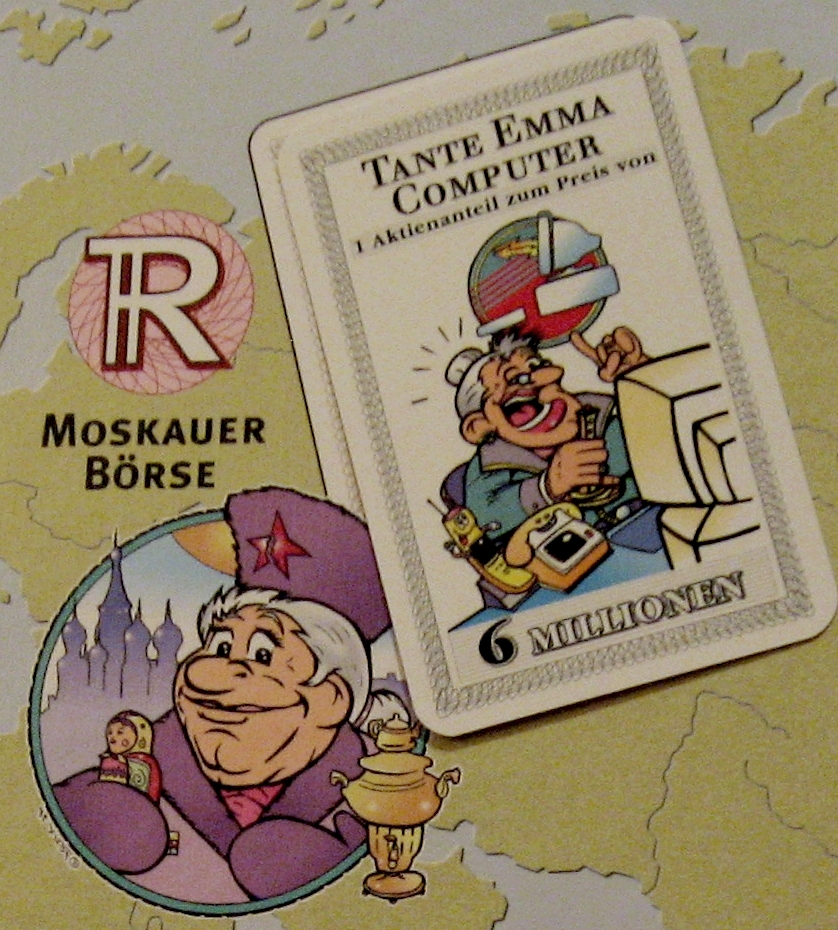
We then split into two groups with the first playing the “Feature Game”, Takenoko.  The back-story for this game is that a long time ago, the Chinese Emperor offered a giant panda bear as a symbol of peace to the Japanese Emperor.  Since then, the Japanese Emperor has entrusted the members of his court (the players) with the difficult task of caring for the animal by tending to his bamboo garden.  So the players have to cultivate the different plots of land, irrigate them and grow one of the three species of bamboo (Green, Yellow and Pink) with the help of the Imperial Gardener.  The winner is the player who grows the most bamboo, managing his land plots best while feeding the Panda.

Takenoko
– Image by BGG contributor woodenbricks

The play area starts with one single hexagonal “pond” tile with two characters on top:  the Imperial Gardener and the Panda.  On their turns players first determine the weather, then perform their actions.  The weather is determined by a roll of the weather die, which give the active player some sort of bonus.  For example, when the sun shines, the payer gets an extra action, and rain stimulates the bamboo of their choice to grow.

Takenoko
– Image used with permission of BGG contributor Oceluna

Once the weather has been determined, the player can perform two actions.  These must be different and the player can choose freely from the five available.  Firstly, the player can add a new bamboo plot, by drawing three hexagonal tiles from the face down stack and choosing one to place.  This tile must be placed next to the starting “pond” tile or adjacent to two plots already in play.  There are also “improvements” which are sometimes built into the plot, but can also be obtained by rolling the weather die and can be played at any time.  The second option is to take an irrigation channel.  These can be played straight away or stored for later use, but bamboo only grows on irrigated plots.  The main way to irrigate a plot is by connecting them to the pond via channels.

Takenoko
– Image by BGG contributor woodenbricks

Alternatively, a player can move one of the characters, either the Imperial Gardener or the Panda.  Both move over any number of plots, in a straight line, but when they reach their destination, their action is different.  The Panda cannot resist bamboo, so will eat one segment of bamboo from the plot he lands on (the pieces are stored on the player’s individual board); the Imperial Gardener encourages the bamboo to grow, and the bamboo on the plot he lands on grows by one segment as does every adjacent tile growing bamboo of the same colour (as long as they are irrigated).

Takenoko
– Image used with permission of BGG contributor lacxox

Finally, the active player can draw an objective card and add it to their hand;  there is a hand-limit of five and these are the only way to score points.  There are three types of objectives, those related to Plots, the Gardener and the Panda.  Plot objective cards yield points to players when certain plot configurations are irrigated; Gardener cards are achieved when bamboo of given height are grown in the right spaces and points for Panda cards are awarded when a player has managed to encourage the Panda to eat the requisite number of coloured bamboo segments.

Takenoko
– Image used with permission of BGG contributor ObeyMyBrain

When a player completes one of their objectives, they show everyone and the card is placed face up in front of them.  They can complete as many objectives as they like on their turn and end of the game is triggered when one player full-fills a set number of objectives, after which, everyone gets one last turn.  The game was really tight from start to finish and every time one player got a nose in front, the others seemed to catch up and over-take, only to be leap-frogged themselves.  The game finished with just three points separating first and last place, with Burgundy just pipping Indigo.

Lancaster
– Image used with permission of BGG contributor punkin312

While half the group were Playing with Pandas, Green persuaded everyone else to give Lancaster another go.  This is a longer game which embodies a few very clever ideas and that we played for the first time a few weeks ago.  The basics of the game are that players take it in turns to place their knights in the shires, in their castle or send them off to war.  They then vote on and evaluate “the Laws” which give players a benefit.  They then get their their rewards for knight placement.  After five rounds, the player with the most points wins.

Lancaster
– Image used with permission of BGG contributor kilroy_locke

One of the clever things about the knight placement is the way that players can usurp a knight that has already been placed, by supplementing him with a number of squires.  So, a knight of level two can be replaced by a night of level one with two squires.  However, squires are “single use”, so should the original player decide to respond with a level four knight, the other player’s squires are lost.  This is a very clever way of speeding up the bidding.  For example, in Keyflower, two players can keep bidding in increments of one which means it may take several turns for the outcome to be resolved.  In Lancaster, a failed bid that is repeated at a higher level may turn out to be considerably more costly than bidding higher the first time round.  This encourages players to be a smarter about their bidding and changes the dynamics a little too.

Lancaster
– Image used with permission of BGG contributor punkin312

One of the key parts of Lancaster is “the Laws” and managing them.  On our previous play, we didn’t really get to grips with them at all.  Although it is now clear to us how important they are, we are still only just getting to grips with them.  The game starts with a set of three Laws, with three to be voted on during the round.  Since there is a conveyor-belt system, it is possible that some Laws will remain in place for several rounds.  This means even if a particular Law does not reward a player during the round it becomes active, they may benefit in subsequent rounds.

Lancaster
– Image used with permission of BGG contributor kilroy_locke

This game was quite different to the last:  firstly, as a group, we had a better idea of rules, and secondly, there were only three of us compared with five before.  Blue was too busy worrying about the game on the next table to concentrate on the rule-reminder, and paid for it in the first round when her plan relied on the rewards coming before the Laws.  Green tried to increase his force and then generate benefits by fighting the French, however, with fewer players, it is much more difficult to win the battles which means your knights are tied up for a lot longer.  Having screwed up the first round, Blue didn’t bother trying to increase all her knights to full force and tried to be a bit more canny about how she used them instead and pick up upgrades by other means.  Meanwhile, Grey, who had not played the game before, tried to build up his stack of noblemen and played the laws.  Blue and Green were far too bothered with their own games to notice, but Grey managed to get the eight point Law for having three knights in the shires voted in.  More importantly, he managed to keep it there, and this combined with a respectable number of nobles and a few uncontested visits to Somerset (giving him six victory points each time) eventually gave him the game by a sizeable margin from Blue.

Coloretto
– Image used with permission of BGG contributor punkin312

Meanwhile, the Panda Players had finished so Burgundy and Cerise squeezed in a quick two player game of Coloretto.  Cerise and Burgundy had played this last month with Blue and Indigo, but it is not generally thought of as a good two player game.  Nevertheless, they gave it a go and found it much more enjoyable than expected.

Taluva
– Image used with permission of BGG contributor Bizowikc

With Grey and Cerise’s departure, that left just time for one last, shortish game, Taluva. This is a fairly simple tile laying game with a surprising amount of depth.  The idea is that on their turn, players place their tile, then place a building then replenish their hand.  This procedure is to that of Carcassonne, but that is where the comparison ends.  The tiles are a strange dodecagon made of three hexagonal regions or fields, one of which is always a volcano.  When placing tiles, they can be adjacent or on top of other tiles so long as the volcano sits on top of another volcano (the tile must also cover more than one tile and there cannot be an overhang).

Taluva
– Image by BGG contributor Purple

Buildings can be placed anywhere, provided that they obeys certain rules.  Unfortunately, although the game is beautiful, the theme is a bit sparse making these rules appear very arbitrary which has the consequence that they are quite difficult to remember.  A hut can be built on any unoccupied level one terrain that isn’t a volcano.  On the other hand, an existing settlement can be expanded by placing huts on all adjacent terrains of one type, with more huts placed on the higher levels (two on the level two etc.).  There are also three temples and two towers to place which can only be added to existing settlements:  temples must be added to settlements covering at least three fields, while towers must be placed on a level three field adjacent to a settlement of any size.

Taluva
– Image by BGG contributor Moviebuffs

The game ends when there are no tiles left and the winner is the player to have placed the most temples at the end of the game.  In case of a tie, the number of towers built counts and then the number of huts.  However, if a player succeeds in building all buildings from
two out of the three different types before the game end, then he immediately wins the game.  On the other hand, any player who squanders his building pieces and is unable to build any more is immediately eliminated.

Taluva
– Image used with permission of BGG contributor punkin312

We played this a while ago as a two player game, so it was interesting to see how it played with more.  As last time, we had a thorough going through of the rules with all the weird exceptions and special cases (e.g. players cannot build a temple in a settlement that already has one, however, it is OK to join two settlements with temples together; you can place a tile on top of huts, but not towers or temples etc.).  The game was very close and it looked like Blue was going to make it, however, Green and Burgundy ganged up on her and Green managed to sneak the win with the last tile.

Taluva
– Image by BGG contributor Moviebuffs

Learning Outcome:  Two three-player games are sometimes better than one six-player game.

27th January 2015

We started off with our “Feature Game”, which was the card game, SaboteurWe’ve played it a few times before, but basically the idea is that the group is split into two teams:  Dwarves and Saboteurs.  The aim of the game for the Dwarves is to lay cards forming a tunnel that leads to the gold, whereas the Saboteurs job is to stop them.  So players take it in turns to play cards.  These cards could be tunnel cards, which are added to the play area and, although they generally extend the tunnel, there are also dead-ends which can be used by Saboteurs to upset the Good Little Dwarves’ plans.  Alternatively, there are action cards, which come in several types.  There are broken tool cards, which allow players to prevent other players from laying path cards (useful if you suspect there is a Saboteur about); mended tools which are used to repair broken tools (useful when a Saboteur has been trying to slow everyone down by smashing up their tools); map cards (useful when a nasty Saboteur has been misleading everyone telling them the gold is in the wrong place), and rock-fall cards which can be used to remove tunnel cards (useful when an evil Saboteur has been causing havoc).  The round ends when the draw deck is depleted and gold cards are allocated to the winning side.

Saboteur
– Image used with permission of BGG contributor mikehulsebus

As people arrived, Blue explained the game to the people unfamiliar with it and pointed out that, despite his protestations, Green was always a Saboteur.  At which point, in walked Green, commenting, “Whatever Blue may have said, I’m NOT always the Saboteur…!”  Needless to say, it quickly became apparent that Green was very definitely a Saboteur, but despite his best efforts (assisted by Yellow and Cerise), the dwarves found the gold, though it was pretty close at the end, coming down to the last few cards.  The second round was under-way with Burgundy indicating that the central target card was gold (a fact disputed by Grey) when Black and Purple arrived.  Since they’d missed the start they began a game of Patchwork.  This is a recently released two-player game where players compete to build the most aesthetic (and high-scoring) patchwork quilt, buying Tetris-like patches with buttons.  The patches are laid out in a circle round the central time board, with a cotton reel marking the start.  On their turn players can purchase one of the three patches immediately following the cotton reel; they then pay the cost in buttons shown on the patch, and then add it to their personal “quilt board”.  In addition to the cost in buttons, the player must also advance their time token on the central time track: if the active player’s time token is behind or on top of the other player’s time token, then they take another turn, otherwise play passes to the opponent.

Patchwork
– Image used with permission of BGG contributor Percatron

Instead of purchasing a patch, players can also pass, in which case, they move their time token to the space immediately in front of their opponent’s time token and take one button from the bank for each space moved.  Players can place their patches anywhere on their quilt so long as it doesn’t overlap any other patches.  This is not the only way to get buttons; in addition to a button cost and a time cost, each patch also features 0-3 buttons.  When a player moves their time token past a button marker on the time track, they sum the number of buttons on their quilt and get this number of buttons from the bank.  The game ends when both players are in the centre of the time track.  Each player then loses two buttons for each blank square on his game board and whoever has the most buttons wins.

Patchwork
– Image used with permission of BGG contributor
greetingsfrombergen

Meanwhile, on the first table, the second and final (third) round of Saboteur had both finished with the Saboteurs making almost no impact on Dwarves’ ability to find the gold.  When the teams are drawn, there is always one card more than there are players, so one card is always left out.  The idea is that this introduces an element of ambiguity, however, we felt that this also unbalanced the teams.  For example, with eight players, the teams go from five Dwarves and three Saboteurs to six Dwarves and two Saboteurs, making it almost impossible for even a vaguely competent team of Dwarves to lose.  We discussed the options including whether it would be better to have a set-up phase where the everyone closes their eyes and the Saboteurs open them and look at each other (similar to Werewolf or The Resistance), but we felt this would give a large team of Saboteurs too much power.  In the end, we decided it would be better to remove the spare card and ensure there was the maximum number of Saboteurs.  Since Black and Purple were still going, we decided to play one extra round.  This worked much better, and thanks to a horrid distribution of cards for the Dwarves and some brilliant play by the team of Saboteurs led by Burgundy, there was nothing the Dwarves could do.  It was fitting therefore, that Burgundy finished one gold ahead of his closest competition.  On reflection, we decided there were definitely a couple of House Rules we would implement next time we play.  Firstly, we would remove the extra card when allocating players to teams, this definitely seemed to create a much more balanced game.  Secondly, we would probably also play several separate rounds and not worry about allocating gold at the end of the game.  This way, we could play one or two rounds and stop when the game had outstayed its welcome, rather than feeling that we should play to the end.

Saboteur
– Image by BGG contributor ckhiew

Patchwork was also coming to a close; scores there were quite close until the final scoring, when it turned out that Purple had more “gaps” in her quilt which lost her more points, leaving Black to take the victory.  With both games finishing we had a slight shuffling of seats, with the first group playing Mascarade.  This is a “micro” game, albeit with big cards.  The idea is that each player begins the game with a character card, but after a brief spell with them face up, everyone turns them face down and that’s the way they remain for the rest of the game.  So, the game is all about deducing which player everyone is, while trying to collect enough money to win the game.

Mascarade
– Image used with permission of BGG contributor henk.rolleman

After some initial trading, on their turn, each player can do one of three things.  Firstly, the active player can declare that they are a particular character, say, The King.  If nobody objects they can then carry out the action associated with The King, unmolested (in this case, take three coins).  On the other hand, another player may protest and claim that they are actually The King, in which case all players claiming to be The King must show their cards and whoever is correct, gets to take three coins from the bank, and all the others pay a fine of one gold coin.  A player’s second option is to “swap” their card with that of another player; since the actual exchange is done under the table, it is possible that there is no swap at all, and only the active player will know either way (or not, since everyone always seems to immediately forget which card is which).  The final option a player has, if all is complete confusion, is to look at their own card.

Mascarade
– Image used with permission of BGG contributor henk.rolleman

It always takes a little while to get the hang of the characters in play, and with people unfamiliar with the game, it was slow to get going. Orange was happy to be The Queen and collect her two gold each round, as did The King.  After a couple of turns, however, Red realised the power of The Witch and swapped her somewhat diminished fortune with that of Blue, who, as The King had managed to build a reasonably sized pile.  Meanwhile, the fines had built up and then the Judge became of interest and suddenly, the game clicked with everyone around the table, and people tried to manipulate the card they got and call others on their declarations.  Gradually, some of the piles started to get perilously close to the magic thirteen coins, especially since The Cheat was in play (if declared correctly, that player needs only to have ten coins to win).  The game finished somewhat abruptly, when Red declared that she was The Bishop and, as everyone knew she was right, there was nothing we could do.  And then it was home time for some.

Mascarade
– Image used with permission of BGG contributor pan_satyros
and pelnapara.znadplanszy.pl

Meanwhile, the second game was still going.  They were playing Colors of Kasane, one of our “Essen Specials”, but one we’ve not got round to playing until now.  It is a Japon Brand game, and they have a bit of a reputation for creating little, yet interesting games:  as Black commented, “They have a different way of thinking.”  They also have a bit of a reputation for rules that are difficult to understand; even when they seem clear, it often turns out that they aren’t, and we’ve fallen foul of this one before, most noticeably with Secret Moon (the sequel to Love Letter).  Colours of Kasane was no exception in this regard which may go some way to explaining why its taken so long to play it!

Colors of Kasane
– Image used with permission of BGG contributor punkin312

Nevertheless, the game itself is reasonably simple and beautifully rendered with pretty little Japanese fabric buttons used as player markers, reflecting the theme of a festival held at the Emperor’s court for which the players must make their own beautiful robe.  The game play is a mix of hand management and set collection.  The idea is that players take one card from the four available, and then, from their hand the active player may lay cards.  However, the cards can never be rearranged (similar to Bohnanza) and sets can only be laid from the most recent end (i.e. a “last in, first out” system) and may also include the last card laid.  Any cards laid must meet the requirements shown on one of the target cards, which also indicate the amount scored:  the more challenging the target, the more it is worth.  These target or scoring cards allow players to place of groups of even numbered cards, groups of odd numbered cards, melds with the same number, ascending or descending sets of cards, cards summing to ten etc. etc..  The key thing is that once a specific combination has been played, a glass bead is placed on it and no other player can score it.  This means it becomes increasingly difficult to play cards and score points, worse, someone else might claim something you have been building towards and render all the hard-work useless.  This is one way that players can mess with each-other’s plans, another is when picking up cards:  cards are laid out in columns so that players can see all the cards, but only the card at the bottom of each column is available to take.  Since the cards laid must necessarily include the card just picked up, a player’s plans can easily be blown out of the water by an opponent who watches carefully.  The winner is the player with the most points, with bonuses awarded for players who succeed in playing more than eight cards and either used a lot of different colours or who colour coordinated their “robe” and also for any players who managed to play all twelve of their cards.

Colors of Kasane
– Image used with permission of BGG contributor punkin312

The game began with everyone groping their way through the the first round trying to get an idea of how the game played and how players and cards interacted and what strategies should be employed.  By the time Blue joined to sneeze and spectate, it was clear that all the best plans had gone horribly awry.  Black, who had brought the game and taught everyone the rules, was struggling, but he was not alone in that.  Green and Purple were also finding other players obstructing their plans, and even Burgundy (the eventual winner) was having difficulty placing the cards he wanted.  The challenges posed by the game were reflected in the fact that nobody got the bonus for playing all twelve cards:  definitely a game that requires a second try.

Colors of Kasane
– Image by BGG contributor matador

We finished with Istanbul, a game we’ve played a couple of times recently, so didn’t require too much in the way of rule revision.  Since Burgundy was the only person who  had not played it before and everyone else had previously played it with the “short track layout”, this time we used the “large number layout”.  This puts all the Warehouses together and a long way from the Mosques, and puts the money making a long way from the Wainwright.  Black started and went straight to the Post Office before expanding his cart with a trip to the Wainwright.  Purple also made several visits to the Post Office, coupled with a few trips to the Warehouses while Burgundy and Blue attempted to improve their success rates with visits to the Mosques.  Green on the other hand, paid several trips to the Caravansary to collect bonus cards in the hope that a few of these would help him out later on.  It is unquestionably a more interesting game with five players and useful things further apart, but that didn’t stop Black delivering the rest of us a sound thrashing.  All of a sudden, he ended the game as he collected his fifth gem when nobody else had more than two.  On inspection, other players were closer than it seemed:  Green collected his third gem on his final turn, Burgundy had loads of Lira and everyone else was well on the way to getting everything they needed, however, they needed several more turns to do it.

Istanbul
– Image used with permission of BGG contributor duchamp

Learning Outcome:  It’s true, Green always IS a Saboteur!

13th January 2015

With several new people, we started with two sets of parallel games.  The first group began with Zombie Dice, a very quick dice game where players are zombies and the dice are their victims.  On each turn, players first roll three dice:  a brain symbol is worth one point at the end of the round, while footsteps allow that die to be re-rolled.  On the other hand, shotgun blasts are bad, and collecting three ends the players turn and they forfeit any points they’ve collected. After rolling their first three dice, players can then decide if they want to score their current set of brains or whether they fancy pushing their luck by grabbing a new set of three dice and rolling again.

Zombie Dice
– Image used with permission of BGG contributor zombiegod

With Grey taking his first win, Red convinced the group to play one of her favourite games, Walk the Plank!.  This is a very silly game that we’ve played a lot over the last year and everyone seems to enjoy.  There were the usual hoots of delight as kamikaze pirates committed mass suicide and everyone enjoyed it so much, that after Grey had taken his second win, they played it again.

Walk the Plank!
– Image by boardGOATS

While Cerise was chalking up her first victory, the second group were finishing their game of King of Tokyo, the “Feature Game”.  This was a “Black Friday Special” and is another fun dice rolling game.  The idea is that players are mutant monsters, gigantic robots, and strange aliens – all of whom are destroying Tokyo and attacking each other in order to become the one and only King of Tokyo.  Each player has a stand-up monster, a counter and everyone sits round a board depicting Tokyo.  On their turn, players roll the six oversized dice with four possible outcomes: numbers (potentially leading to points), attack (a paw print), healing (a heart) and energy (lightening bolts).  In order to score victory points, the active player must roll at least three of the same number.  Thus, three “twos” will score two points, but each additional “two” will deliver an extra point (so four “twos” would score three points etc.).

King of Tokyo
– Image used with permission of BGG contributor henk.rolleman

Any attacks rolled are delivered to the monster who is currently in Tokyo unless that is the active player, in which case, everyone else receives the damage.  Each player starts with ten lives and each attack die costs one.  Whenever the player in the middle is attacked, they have to take the damage, but can then chose to leave the middle, to be replaced by the player who attacked them.  Moving into Tokyo has its advantages and disadvantages:  players score a point on going in (with two more if they are still there at the start of their next turn) and they can cause everyone else a lot of damage, however, they cannot using healing dice while in Tokyo which makes it risky to stay.

King of Tokyo
– Image by BGG contributor rothkorperation

Finally players can also collect energy tokens which are a sort of currency and allow players to buy cards which give their monster special powers.  The winner must either destroy Tokyo (by collecting twenty victory points), or be the only surviving monster once all the fighting has ended and all the others have died.  Green started off well, with Burgundy and Indigo in hot pursuit.  Blue seemed unable to get anything she wanted, so took great delight in seeing everyone else reduced to a very small number of lives.  Burgundy was two points ahead of Green, but it was Green’s turn and he ended the game with a gambol rolling five “threes” and finish as the King of Tokyo.

King of Tokyo
– Image used with permission of BGG contributor dekedagger

With the end of both games and the arrival of Purple and Black, we had a quick shuffle of seats and Cerise replaced Green to play another game that has been popular recently, Splendor.  This is a simple set collecting game where players collect gems that they can then use to buy cards which in turn allow them to buy more cards which are worth points and help them to collect “nobles” which give even more points.  The game started slowly with all the basic cards gone and nobody looked close to winning.  However, Blue knew she’d done something right when there was a chorus of disappointment from Cerise and Burgundy when she reserved a high scoring opal card, a trick she repeated the following round.  Buying one of the opal cards enabled her to win two nobles giving her nine points in one turn and putting her over the finishing line, with Indigo finishing just one point behind after a last minute surge.

Splendor
– Image used with permission of BGG contributor henk.rolleman

Meanwhile, the other group were playing Stimmt So!.  Although we’ve not played this for a while, we have played the closely related game, Alhambra which uses the same mechanic.  The idea is that players have a choice of actions:  they can buy commodities, or they can go to the bank for money.  There are four different legal tenders and the cost of each commodity must be paid in the specified currency.  When making purchases (of shares in Stimmt So! or of buildings in Alhambra), players can always over-spend, but if they pay the exact amount they can have an extra turn.  Thie extra turn can be used to either buy another item or to take money from the bank.  If they chose to make a second purchase, they can again pay the exact amount and get another turn.  Play continues in this way until the player no-longer qualifies for another turn or all the available stock has been purchased after which, the stock is refilled for the next player.  Thus, the game is a balance between collecting small denominations of the different currencies (which are more versatile) and collecting larger denominations (that are worth more).  The points are awarded at stages during the game to players with the most of each commodity.

Stimmt So!
– Image by boardGOATS

It was a slow start as people built a stock and cash and very few shares were bought. Then, as each person built up a usable amount of money the game took off.  Black quickly took control of the Petrol market with three shares and everyone else built a small portfolio. Grey followed Black’s lead and went for an early lead in Banking.  The first scoring round came along quite quickly and with almost nothing in it and then the game was really afoot.  Purple decided to challenge Black’s dominance in Petrol and Grey added to his Banking stocks.  Airlines, Computing and Entertainment were all hotly contested, but Automobiles remained obstinately absent despite an interim shuffle!  The second scoring came with a range of winners and losers and Black, Grey and Red stretched a small, but significant lead over Yellow and Purple with Green at the back who had been refusing to overpay for anything, plenty of cash, but few shares!  Going into the last round, there were several cards that nobody wanted as they could no longer even share the lead, but eventually people started buying and Automobiles finally made an appearance.  This got the game moving and the final shares came and went in short order.  Black managed to shrug off falling oil prices and finish just ahead of Red, a canny second, demonstrating that not putting all your eggs in one basket can be a good idea.  Grey was not far behind demonstrating that putting all your eggs in one basket is still a not a bad strategy though!

Stimmt So!
– Image by boardGOATS

Splendor finished first, and Indigo was persuaded to play one more game before she had to leave.  As we wanted something fairly quick, we opted for a card game and chose Coloretto.  This is a cute little set-collecting game that inspired, the perhaps better known, Zooloretto.  The aim of the game is to collect sets of cards with the largest three sets scoring positively, and the reset all giving negative scores.  Thus, on their turn, the active player can either draw a coloured chameleon card, or take a “truck” and all the chameleons on it.  If they draw a card, they have to choose which truck to put the chameleon on, trying to make the trucks contain a combination of colours that suit them, but not everyone else.  Alternatively, they can choose take a truck, trying to match the colours on the truck with the sets they already have and  minimise their losses.  This was quite a close game until suddenly, in the final round Indigo drew an orange chameleon which we hadn’t realised had been hitherto missing from the game.  We inevitably blamed the shuffler as all the orange cards turned up together.  Blue managed to avoid picking any up however, and finished just two points ahead of Burgundy.

Coloretto
– Image by BGG contributor SergioMR

In the meantime, Green, Grey, Black and Purple started a game of Click & Crack.  This is one of last year’s “Essen Specials” and has proven to be a fantastic little filler game.  Each player has two penguin counters.  They take in turns to place them on an ice floe made from twenty-five tiles arranged to form a five by five array.  Each player also has two tiles depicting an arrow.  Once the penguins have been placed, players choose a direction for their arrow tiles and reveal them simultaneously. Then, starting with the first player, each player picks a penguin and applies one of their direction tiles.  They can either move the chosen penguin in the specified direction, or the penguin stamps on the ice and causes the floe to crack in the specified direction.  When a crack has been completed so that it divides the floe into two, the player who played the final crack wins the smaller piece of ice and takes the tiles and any penguins caught on it.  Each floe tile is worth one point at the end of the game and each trapped penguin is worth minus one point.

Click & Crack
– Image by BGG contributor thir_teen_

The game ends when one player has at least seven points, or when the main floe is less than seven tiles in size or if there are three penguins left on the floe.  The game went all Purple’s way.  First she broke off a massive piece of ice and trapped a few penguins in the process.  Then before anyone else could do very much, she broke off another large piece capturing a few more penguins and finished the game with eight points and only Black scoring: a paltry two.

Click & Crack
– Image by BGG contributor smn1337

While the penguins were busy finishing up, Cerise (aided by Burgundy), gave Blue a sound thrashing at Dobble (an old favourite that we’ve not played for ages) before the late night brigade started the last game of the evening, Lancaster.  As it was his new game, Green had been absolutely desperate to play it, so despite the lateness of the hour, we gave it a go.  The game is a worker placement game themed around the House of Lancaster, played over five rounds, each consisting of several phases.  First, players take it in turns to place their knights.  Knights can be placed in the counties, or in the a player’s private castle or they can be sent off to fight against the French.  Knights have a rank (one to four).

Lancaster
– Image used with permission of BGG contributor henk.rolleman

When knights are placed in the counties, this rank can be augmented by the addition of squires, but once a knight has been placed, it can be usurped by a higher ranking knights (or a knight with sufficient squires to give it a higher rank).  In this case, the knight is returned to the player, but any squires are returned to the supply.  This means that players might be quite cavalier about knights, but tend to be much more parsimonious when assigning squires.  Winning a county enables players to choose either to recruit a noble, or to perform a one off action associated the county, or, alternatively, on payment of three coins, they can do both.

Lancaster
– Image used with permission of BGG contributor Toynan

If they win a war, the knights sent off to fight the French win points, with the largest contributors (highest combined rank) scoring most heavily.  However, they also receive an immediate benefit which can be monetary or in the form squires or nobles etc..  Knights placed within the castle also give a one off benefit, although it is received later.  The knight’s rank is immaterial for castle placements (as they cannot be usurped) and there is no possibility of victory points.

Lancaster
– Image used with permission of
BGG contributor kopernikus

Once all the knights have been placed, it is time for Parliament to vote on changes to the laws.  The laws basically provide scoring bonuses and other benefits.  At the start of the game there are three laws in place and three new laws that players will vote on.  These three new laws are considered one at a time and the group votes on whether they should be kept (pushing out one of the old ones) or rejected.  Players get one vote each for each law, but can reinforce their vote with votes provided by nobles (and via other means).  After the voting, the other rewards are handed out:  for occupying the counties, for knights placed in castles and for winning wars.

Lancaster
– Image used with permission of BGG contributor punkin312

Although everyone broadly understood what they could do, nobody really fathomed how everything fitted together.  So, different players tried different strategies.  Blue decided that the she couldn’t turn down the thirty-six points awarded at the end of the game for a complete set of nobles, so went for that.  Burgundy was more canny, however, he also went for the nobles, but picked up a lot of them through the one off reward provided by going to war with the French.  This way he also got victory points as he went along.  Green also tried to pick up points in the battles, but focused on trying to build up the strength of his knights and manipulate parliament. Black tried to reinforce his castle to deliver regular rewards with little input, while Purple tried a little bit of everything, just doing as much as she could on each turn.

Lancaster
– Image used with permission of BGG contributor kilroy_locke

Burgundy led the charge with Green, Black and Purple close behind.  Since Blue was focusing on collecting her set of nobles, she hardly shifted from zero for the first four rounds.  Going into the final round however, it was suddenly everything to play for.  Everyone had got the hang of how to use their knights and how the laws worked and knew what they wanted in the final round, but that did not mean they were going to get it!  Knights were placed and then unceremoniously stomped on by more powerful knights with several high ranking knights being placed with four or five squires in reinforcement. Blue and Burgundy both picked up their full compliment of nobles (just) and Green was outvoted when he tried to get his preferred law through.  Black scored for his castle and Purple managed to change the law to convert her mass of coins into points so that she scored heavily.  With her full set of nobles, Blue surged forward into second place, just ahead of Purple, but it was all way too little too late; nothing could match Burgundy’s commanding lead and he finished nearly sixteen points clear of the field.  Although there were a number of rules that we played incorrectly and a number of points that need clarifying, it was Burgundy’s superior strategy, played out to perfection that won the game.

Lancaster
– Image used with permission of BGG contributor kilroy_locke

Learning Outcome:  We really need to learn how to shuffle.

31st December 2014

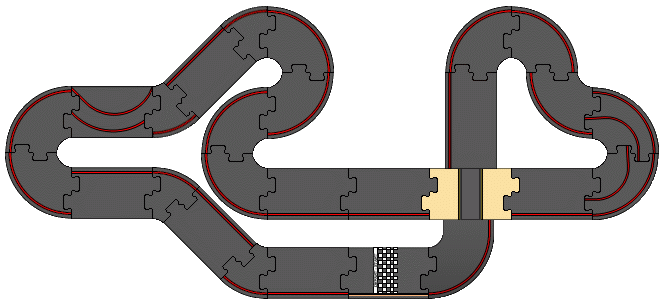
The first challenge of the evening was to set up a track for our “Feature Game”, the gorgeous, dexterity car-racing game, PitchCar.  We started with getting pieces out of the box, then we decided the table needed to be expanded, then we struggled to make the ends of the track meet!  After a bit of pantomime, we eventually resorted to one of the suggested tracks, including chicanes and the bridge/tunnel from the first expansion.

PitchCar Track 31/12/14

Once the track is set up, the game itself is very straight-forward, with players taking it in turns to flick their little wooden “cars”, and the winner the first to complete (in our case) two laps of the track.  The rules are simple: a flick must be a flick (not a push), and cars must end their turn the right way up on the track.  Leaving the track is allowed, but cars must not fly more than two track sections or touch the table.  The leading player always plays first in each round.  Anyone who violates the rules forfeits stroke and distance, but any consequential moves to cars that stay on the track are valid.

PitchCar

Blue missed out on the practice lap as she was preparing food, so started from the back of the grid.  Black got off to a flying start and led round the first couple of corners before the rest of the pack caught up. Blue and Pink had caught up by the bridge, but Black held them off through the chicanes before they finally passed going into the bridge.  It was short-lived however, with Black retaking the lead before Pink passed and took a commanding lead going into the second lap with a disputed two wheels off the track.  Even with an eventually agreed penalty of a missed turn, his position turned out to be unbeatable.  Meanwhile, Blue and Black tussled before Blue got stuck on the bridge on her second pass and Black romped away, finishing second.  That left Blue and Purple to fight it out for the honour of the wooden spoon.  This was a competition they both seemed determined to win, with a series of miss-flicks, and over-flicks, but Blue eventually made it across the line first, with a cloud of smoke.

PitchCar

While tea was cooking, we played a couple of quick games of Belisha. This is a Rummy-based game with cards that depict a trip from London to Oban.  The game was a Christmas present and appears to be an original 1937 edition which probably makes it the oldest game we’ve played.  The cards run one to thirteen in four colour suits, but each card also has a road sign.  Like Rummy, players first draw a card from the face down draw deck or the face up discard pile.  They then play any runs or melds they want, with the difference being that the melds can be in numbers or road signs.  Turns end when the active player discards a card.   The game itself is fairly straight forward, though we still managed to play it wrong!  When laying runs of cards, we were playing any cards in sequence, whereas they are (of course) supposed to be the same colour/suit.  With this game it is usual to play several rounds and the game ends when a player to reaches a pre-agreed total, however, as we were only filling time, we just played a couple of hands with honours going to Black and Pink.

Belisha

After we’d eaten, we decided to play CO2.  This was the Feature Game two weeks ago, but we didn’t get round to playing it.  As only two people had played it before (and that was a long time ago), we spent quite a long time reminding ourselves of the rules, to say nothing of punching out all the pieces!  The game itself is quite an unusual one as it is cooperative, but also competitive.  The idea is that players have to cooperate to save the planet, but the player who is the most successful wins.  Alternatively, if players don’t cooperate, then the greenhouse effect will overpower the planet and everybody loses.

CO2

Each player is the CEO of an energy company responding to government requests for new, environmentally friendly power plants.  There are three stages to building a power plant:  proposing a project; installing the infrastructure for a project, and building the power plant.  Proposing a plant is rewarded by the local government grants (money, technical resource cubes or scientific sponsorship).  On the other hand, installing infrastructure has an environmental cost:  at the start of the game, each region starts with a certain number of Carbon Emissions Permits (CEPs, granted by the United Nations).  These CEPs are spent whenever the region needs to install the energy infrastructure for a project. Building a power plant earns victory points, but also has a cost associated with it which is paid in money and technical resource cubes.  This cost varies depending on the nature of the plant and also changes throughout the game.

CO2

The game is played over five decades and each decade comprises three rounds.  In these three rounds, the players need to try to satisfy the energy demand of the different continents.  At the beginning of each new decade, the energy demand of each region is evaluated and if they don’t have enough power plants, they have to build a fossil fuel plant to supply the deficit.  These are drawn at random from a pile and correspond to gas, coal and oil.  Each of these cost the region one CEP, but more importantly, they contribute to the burden of CO2 in the environment.  When the level of CO2 reaches 350 ppm, the world starts to suffer environmental disasters and at 500 ppm, the game is over and everyone loses.

CO2

At the beginning of each decade, money is awarded to each company based on their scientific expertise.  Each company starts with a scientist, though they can get more if they choose when proposing a new project.  The CEO of the company can assign their scientists to project, which earns them expertise in one of the associated scientific technologies each turn.  When a power plant is built, if there is a scientist working on the project they get the opportunity to do what scientists like to do best: travel to a conference to present their work.  When the conference has its full compliment of scientists, more expertise is awarded and they all return to the company.  Thus, through the scientists, the companies gain wealth which can be used for building power plants, however, they also need a given level of scientific expertise in each technology before they can build power plants of that type.

CO2

The game is quite fiddly and there are a lot of things to consider.  For example, a player may propose a solar power station or install its infrastructure, but they cannot build one unless they have sufficient scientific expertise.  Similarly, the location of solar power plants is also restricted to certain continents, so a solar project can only be proposed in certain regions.  The player who builds the most different power plants in a region gains control of that region and (more importantly) its CEPs.  CEPs are used when building the infrastructure to build a power plant, but are also worth points at the end of the game.  CEPs can be bought and sold on a market, and their price fluctuates throughout the game, with the final value affecting the number of victory points they are worth.  Points are also awarded to players who successfully complete their company’s personal goal (which is depicted on cards handed out at the start), or for achieving goals set out by the UN (which are cards laid out near the board and are available to players throughout the game).

CO2

We were very, very lucky with the set up.  Each region gets one fossil fuel power plant drawn at random and the total CO2 sets the initial CO2 level in the environment.  In our case, we had a lot of gas-fired power stations which are relatively environmentally friendly, so we started off well.  Purple started building in Oceania and Black in North America.  Meanwhile Blue started building up her expertise in solar and Pink just looked puzzled. Although were were unable to satisfy the worlds power demands, for the first couple of decades, we continued to be lucky and avoid the most highly polluting fossil fuel plants, which gave us a chance to start to get a feel for the game.

CO2

After a brief break to admire everyone else’s fireworks and sharing a bottle of dodgy rosé champagne, we continued playing.  Pink was now somehow in the lead, despite having to be woken up for his turn each round.  Blue suddenly realised that she’d proposed a couple of nuclear fusion projects that weren’t allowed in those regions, but everyone just shrugged and carried on with Black commenting that it “was that sort of game”.  Eventually, the CO2 level reached critical and disaster struck North America.  As Blue was the only player without a power plant in the region, she had to pay the price (a valuable technical resource cube).

CO2

It was then that Black claimed a UN goal card, to choruses of, “Oooo!  What did you do there?  What does that do!?!?” as Black surged along the score track taking the lead.  Inevitably, everyone suddenly looked to see what power plants they had built and tried to match them to the cards that had been sat quietly beside the board for the whole game, totally ignored.  Then there was a flurry of people claiming them as the game came to an end.  It was only then that Pink noticed how many CEPs Blue had amassed – with her company goal card giving her extra points for each CEP she had in hand.  Black’s company goal on the other hand, gave him points for achieving UN goal cards, which explained how he knew what they did and had paid so more attention to them than anyone else.  As the people reading the rules, Black and Blue had a better grasp of the game and it was not surprising that they finished fighting it out for the lead, but in the end it was Blue who took the first win of 2015, albeit having mess-up in the middle.

CO2

Learning Outcome:  Late at night is not the best time to learn to play long and complicated games…

16th December 2014

This week we stuck to “old favourites” and started off with the quick fun and very silly game that is Walk the Plank!.  We’ve played this a few times before, and we always play to the “last pirate standing”.  Since Red had chosen the game and White had not played it before, Blue started off by shortening the plank and pushing Red off the end.  This set the tone for the game with Red taking her revenge on Blue and then White joining in the fray.  A few rounds in and with one Blue and a couple of Red pirates down, it was Blue’s turn to start.  All three of White’s pirates were perched precariously on the end of the plank with Red’s one remaining pirate, so the game ended suddenly with a very loud splash when Blue inevitably shortened the plank…

Walk the Plank!

With the arrival of Purple and Black (and their pizza), we decided to play another of Red’s favourite games, Bohnanza. It’s amazing how a game that so many people feel is such good fun, sounds so totally uninteresting when it’s explained.  True, as White pointed out, this applies to quite a few games, but Bohnanza is definitely the “poster child”.  After a quick rundown of the rules, we began. Purple was very generous, offering beans for free at regular intervals, though of course she had an ulterior motive. However, otherwise, as Black commented, “It’s a tough crowd tonight,” as deals were pushed and even turned down.  It was fitting therefore, that such a tight game should end with a draw, with Red and Blue sharing the honours.

Bohnanza

Next, we decided to play something a little deeper and, after some discussion, we opted for one of this years most popular games: Ivor the Engine. Although we’ve played “Ivor” a lot at games night, Red and White were both new to it. It’s a cute little game, though it has a sharp edge if you want to play it that way. With a full compliment of players, it was always going to be a fairly tight game, and although Blue started well with a couple of jobs at Mrs Porty’s House, everyone else struggled as Purple got in their way.  Blue was promptly penalised for her good start though, when the first event card came out and caused the leader to lose sheep.   Since everyone else had now cleared sheep from the locations that corresponded to their cards, Blue was then suddenly left behind.  As everyone galloped on, Red, managed to pick up eleven sheep with one visit to Tewyn!  Black was closing in on the finishing line, when Blue managed to complete a couple of jobs at Dinwiddy’s Goldmine and use the gold to buy a couple of event cards.  That tipped the balance in her favour and she finished just ahead of Black.

Ivor the Engine

We finished the evening with a few rounds of No Thanks!.  This is another game we used to play quite a bit, but hadn’t played for six months.  It is such a simple, push your luck game that experience isn’t necessary, and it really brought out White’s vindictive streak.  After three games, honours finished about even and it was home time.

No Thanks!

Learning Outcome:  Old favourites are still favourites, and for a good reason.

2nd December 2014

We were very late starting, but after a short discussion we decided to go with the “Feature Game” which was Grog Island.  This is an “Essen Special” that we’ve not played at the group before, but it has turned out to have been a bit of a hit elsewhere due largely to its innovative bidding mechanism.  The game revolves around retiring pirates who aer trying to work out how to spend their ill-gotten gains. This game is played on a board that represents the five peninsulas of “Grog Island”, which is where pirates that have survived to retirement can go to invest their spoils by buying pirate-like properties.

Grog Island

The idea is that each player receives a hand of end-game victory point condition cards, a number of pirate meeples and markers, eight gold coins, a treasure card (containing an undisclosed amount of gold) and a parrot card.   On their turn, the active player rolls five coloured dice, and then places their first bid.  Bids are placed by selecting any number of the dice with the value of the bid equal to the sum of the number of pips on the upper-most face of the dice.  The bid must be less than the players total amount of gold (including hidden treasure cards).

Grog Island

The clever part of the bidding is that the dice that form the bid are placed in descending order, with each dice placed in one of the five available spaces, starting on the left with the highest value dice. If they can afford it, the next player may increase the bid, by increasing the total number of pips visible on the dice.  To do this they can add dice, replace dice, even completely rearrange the order of the dice, so long they do not change the number on any die and the dice remain arranged in descending order starting from the left.

Grog Island

The position and colour of the dice have a number of consequences, both for the eventual winning bidder, and for players who withdraw from the round early.  The player who eventually wins the bid gets to carry out the actions associated with the dice according to their final position.  These include placing pirates on the island and blocking spaces on the island, but the peninsula is restricted to the colour of the die placed in the location associated with that action.  Pirates positions on the island are important, because these are the primary way players can get points during the game, but since those points depend on the victory cards handed out at the start, everyone has a different combination of goals.

Grog Island

Players who drop out of the bidding either because they can’t or choose not to increase its value, get resources corresponding to the colours of the dice in the current bid.  Thus, if the current bid is comprised of the yellow, blue and green dice, the player receives lemons (yellow), fish (blue), and coconuts (green).  These resources can then be used to carry out one of the options on the shipping track.  For each resource, there are two options available:  the top option costs a single resource and varies as the game progresses, while the bottom option is always the same and allows players to place a single pirate on the peninsula of that colour.

Grog Island

We eventually got going, and after some rules confusion (despite extensive discussion before we began), Blue won the first round so had almost no money and very little to show for it.  Purple and Green both managed to win a couple of rounds while Black, struggled to win anything.  Victory points are awarded at the end of the game depending on the conditions on the victory point card, so every turn that Black didn’t win an auction, he ominously took a card.  Now in this game, the dice cannot be freely placed:  they must be placed in descending order (and are locked so the value cannot be changed).  This, coupled with the fact that the bid must always increase (but players don’t want to spend more than they have to) means there are restrictions on where the dice can go.  Black tried everything, he even used Parrot cards to change the number on dice, but unfortunately, somehow, when he eventually did win an auction, he couldn’t do much with it.  Meanwhile, Blue (who hadn’t been feeling at all well), just collected resources and Purple and Green carried on winning auctions and accruing a lot of money.

Grog Island

Blue had spent most of the game checking things with the rules as she seemed completely incapable of remembering what was going on, but despite this, she eventually managed to win a second auction and then suddenly realised that she had collected enough resources to start to place pirates without winning having to win auctions, which meant she didn’t need any money. Purple and Green both also had pirates left to place when three rounds later, Blue brought the game to an end by placing her final pirate.

Grog Island

Black went first with the scoring, and woefully shook his head saying, “I’m screwed,” as he revealed his goal cards and the fact he’d succeeded in almost none of them.  As we moved on to score Green, Black added, “You need to be somewhere round here,” gesturing at the thirty-five point mark; we all muttered disbelievingly.  Green also thought he’d done badly, but in actual fact had nearly double the number of points Black had achieved and was within one point of Purple.  Much to everyone’s surprise, possibly Blue’s most of all, she ran out the clear winner with thirty-five points.

Grog Island

Because of the late start and the inordinate amount of time it had taken to explain and then play Grog Island, we only had time to play one other quick game.  Purple nipped out for a moment and, in her absence, the rest of us elected to play Indigo.  This is a pretty game that we’ve played before on a Tuesday, and was described by Black as, “Like Tsuro in reverse.”  The idea of Tsuro is that players start with a stone on the edge of the board, and they take it in turns to play tiles that extend the path their stone is sitting on and the winner is the one who keeps their stone on the board the longest.

Indigo

In Indigo, the stones start on the board and players have to build paths to guide the stones into their gate.  The really clever part of Indigo is that each gate is shared by two players, making it a sort of semi-cooperative game.  In the four player game, each player shares one gate with every other player, so three out of the four players have two gates next to each other and one on the opposite side of the board.  The final player, in this case Green, has a gap between each of his three gates, spreading them evenly around the board.

Indigo

The game started quickly with Purple and Blue teaming up to bring a yellow stone home, giving them one point each.  Then it was Green’s turn, but from then on, Blue and Black teamed up to build a highly lucrative gate pulling in a handful of green stones and the three-point blue stone.  There was only a single point between first and second and, unsurprisingly, it was Black and Blue who were in the running, with Blue edging it by a nose giving her a clean sweep for the evening.  Path laying games are definitely Blue and Black’s sort of games, and equally certainly, not Purple’s favourites although she doesn’t mind Tsuro.  Green commented that he felt it was much harder with the gates spread out, though Blue was less sure, as she felt it should be easier as stones were never very far away.  Well, we’ll just have to play it again sometime to find out, though as Purple is not so keen it may be a little while…

Indigo

Learning Outcome:  You don’t have to feel 100% to win.

18th Movember 2014

Unusually, both Blue and Green were there early, so decided to get a in quick game.  After a bit of discussion, they decided on Blueprints, a cute little dice rolling and building game.  They had set up and Blue had just finished explaining the rules when Black and Purple walked in, so it quickly became a four player game.  The idea is quite simple:  each player has the blueprint of a building and on their turn, they take one die from the central pool, add it to their construction and then replenish the used die from a bag.  Dice must be placed within the two-by-six footprint and any stacked dice must have the same number or higher than the one below.

Blueprints

Each building is scored depending on the dice used and their position.  Thus, orange dice (wood) scores highly if surrounded by other dice, whereas black dice (stone) score for being higher in a stack.  In contrast, green (recycled material) scores well the more it is used, and clear colourless dice (glass) score the face value.  At the end of the round, each building is scored and points awarded for Bronze, Silver and Gold, scoring one, two and three victory points respectively. Prizes (worth two victory points) are given out for buildings that comprise all six numbers, buildings that have four or more of the same number, buildings that are five or more dice high, and buildings that have five or more dice of one colour (they are more aesthetically pleasing, obviously).  All ties are broken by two dice that are drawn out of the bag at the start of the round.

Blueprints

Blue was the only player familiar with the game, so unsurprisingly got off to a flying start, winning Gold for the highest scoring building and a prize for a building with four dice of the same number.  Purple picked up Silver and Black took the Bronze.  As is normal with this game, after the first round there was a pleasing “Ah! Moment” as everyone suddenly simultaneously realised how it all fitted together, what the point was, and how clever the game is.  Consequently, the second round was much more keenly fought and positions were completely reversed with Blue coming out with nothing and Green, Black and Purple winning the Gold, Silver and Bronze awards respectively.

Blueprints

So it was into the final round with all to play for, and this time it was very tight indeed.  Green and Black jointly top-scored, but Black took it on a tie-breaker.  Green lost out on a second tie-breaker with Blue for the award for four dice of the same number.  With an extra prize for using five “glass” dice, Blue finished in joint first place with Black, which necessitated a quick rules check find the tie-breaker in favour of the player with the most prizes, in this case, Blue.

Blueprints

Next, we decided to play our  “Feature Game”, which was Caverna: The Cave Farmers.  Caverna is by the same designer and is closely related to Agricola, which is a game we’ve all played quite a bit.  In fact, Caverna is often described as “Agricola 2.0”, so we’ve all been quite keen to give it a go and see how the two games compare.  In Agricola, players start with two people and a hut and have to build their small-holding with points awarded at the end of the game for the most balanced farm.  Caverna has a new skin, but is a similar game:  players start with two dwarves and are trying to develop their cavern in the hillside while chopping down the forest for use for farming.  There are a lot changes to the game play, some small and some larger.  One of the biggest differences is the absence of cards.  In the advanced version of Agricola, you can start with a hand of cards, which contain “improvements” that you can choose to build to enhance your small-holding.  These add variation to the game and force players to come up with different combinations of buildings and adapt their strategies to match.  In Caverna, these cards are replaced with tiles that are available to everyone to buy; as it was our first game, we chose to use the smaller set.

Caverna: The Cave Farmers

Another one of the key differences between the games is that dwarves can go on expeditions in Caverna.  These can be highly lucrative, but also introduce challenges of their own.  The idea is that players use ore at the Blacksmith’s to forge weapons for one (or more) of their dwarves.  Some of the actions also have an expedition associated with them, so when a dwarf with weapons carries out an action with an expedition, he can also go looting.  The loot he comes back with depends on two things, the level of the expedition and the level of the dwarf’s armoury.  The dwarf’s level dictates what he comes back with and the expedition level dictates how many items.  Thus, a well armed dwarf sent on the right mission can bring back a lot of loot, but more importantly, players can mix and match the loot to suit their purpose which makes them very versatile.  Added to that, every time a dwarf goes on an expedition, he gains experience, so on his return, his level increases by one.  The disadvantage of arming dwarves is that the better armed a dwarf is, the later it goes in the turn order.  This means that players have to choose whether to play a lower level dwarf on expeditions, or whether to take a chance and hope no-one else uses that action and wait until they can play a more experienced dwarf.

Caverna: The Cave Farmers

There are a lot of smaller differences too, for example, the game has two currencies, gold and rubies.  At the end of the game, everything is converted into gold and the player with the most wins.  However, during the game, rubies are more useful as they can be used to buy other resources at any time.  They can also be used for playing dwarves out of turn, but as they are worth one gold in their own right, they are quite valuable.  Rubies and ore can be obtained with certain actions, but players can also build mines in their caverns which not only enhance their supply, but are also worth gold at the end of the game.  There are also new and different animal, principally dogs and donkeys and with them, new animal husbandry rules which we never completely got our heads round (e.g. sheep can now be kept in an unfenced meadow looked after by dogs at a rate of one more sheep than there are dogs; donkeys can be kept in mines; only pigs can be kept in a shed in the forest, but any animal can be kept in sheds in pasture or meadow-land etc.).

Caverna: The Cave Farmers

Purple, who was still suffering with her post Essen lurgy, went first and began by collecting ore, while Green went into agriculture.  Blue meanwhile, started off with wood while Black, who was the only one with a very firm plan, began collecting rubies.  Blue and Black then began to build up a stock of ore and it was only a matter of time before Blue made her first visit to the Blacksmith and Green followed in the next round.  By this time, there were harvests at the end of most rounds and Purple was beginning to struggle to feed her people (good job she picked up the Writing Chamber!).  Green had built an agricultural empire and a Cooking Cave, and Blue was feeding her people on prime Aberdeen Angus, but without a reliable, continuous food supply, Purple had to use her grain to prevent starvation, which meant she didn’t have any to plan to provide a continuous food supply…

And all the while, Black just kept collecting rubies.

As the game drew to a close, Blue had managed to develop and fill her pastures, arm all three of her dwarves, and had managed to furnish her cave with a room for Weapons Storage when Green wasn’t looking (he went to build it in the final round only to be sorely disappointed).  Green had four dwarves, plenty of spare grain and had filled all available space and include mines and other improvements.  Purple had managed to complete her cavern and develop her woodland, but was missing a lot of animals.  Black was also missing some animals and had a lot of unused spaces, but he had managed to pick up both a Ruby Supplier and, in the last round, a Weaver to make the most of his sheep.  We had been really pushed for time, so people counted points individually as others packed up.  Despite initial appearances (namely Black’s HUGE pile of rubies that double scored), it turned out to be a really close game with only a handful of points separating the first three players.  In fact, after several recounts, the game finished in another draw between Blue and Black, and, after another hasty check of the rules, we declared both to be winners.

Caverna: The Cave Farmers

As we left, we had a quick discussion about what we thought of the game and how it measured up to Agricola.  We concluded that it felt longer, possibly because of the fiddling with the expeditions, though that could also be due to our lack of familiarity with the game.  Despite that, we felt that Caverna was probably less complex, though it felt like there were more options which meant there were more ways to do what you wanted.  This meant the game was less pressured than Agricola, which might not be a good thing, though it probably makes it more forgiving for new players.  On the other hand, the extra options also makes it very confusing for the first play.  The lack of cards and the fact the same tiles are available every time meant we felt it also didn’t have the variety that Agricola offered and therefore was less deep and, probably ultimately has less replay-ability.  However, we will have to try it again a few times before coming to any real conclusions.

Caverna: The Cave Farmers

Learning Outcome:  Tie-breakers can have a large impact on both the feel and the outcome of a game.

4th Movember 2014

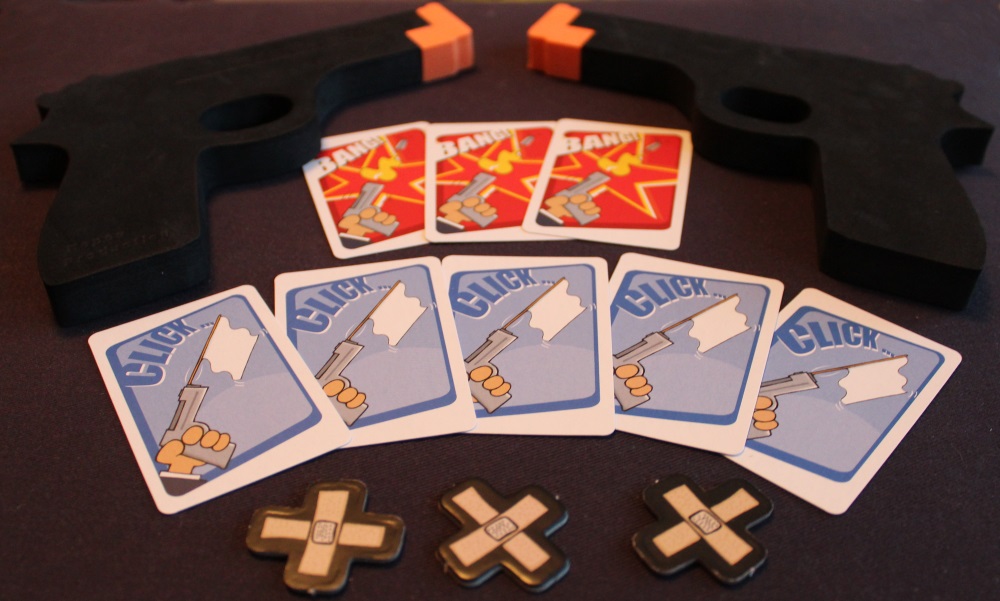
We were a little hesitant about pointing guns at each other in the pub, even foam ones, but that didn’t stop us starting the evening with a game of Ca$h ‘n Guns. This is a fun and silly game that we’ve not played before with the group.  It is based on the premise that the players are gangsters trying to split up the spoils of a robbery and being gangsters, they play a game of chicken to decide who gets the loot.  So, enough loot cards are set out in the middle of the table for one each, and each player starts with a magazine of bullet cards.  Most of the bullets are blanks, but a small number are “live” and everyone secretly loads their “gun” with a single bullet.  One player, “The Boss” begins a countdown that ends with everyone simultaneously pointing their gun at another player.  The Boss (being The Boss) can then order one player to point his gun at someone else, after which, everyone gets a chance to back out (also simultaneously after a countdown).  Backing out means they won’t get shot, but also won’t get any money.   Players who backed out unload their gun in secret, while everyone else reveals their bullet cards.  Players who had a live gun pointed at them get a bit of sticking plaster and are out of the round so don’t get any loot.

Ca$h 'n Guns

We were playing the new, second edition of the game, so those that didn’t chicken out and survived (i.e didn’t get shot) then divide up the loot by taking it turns to choose the choicest pickings from the loot cards on display.  The players continue to take cards until they are all gone, so if a lot of people back out or get shot, the spoils are all the richer for those that remain.  Green started off collecting art-work, while Red and Blue went for jewellery.  Yellow and Cyan concentrated on money, but seemed quite determined to take each other out and both suffered as a consequence.  Aside from when Cyan aimed for Green and  accidentally “shot” the pub landlord, the game went without hitch; Red and Blue finished with the same amount of jewellery so neither got a bonus, which left Green to take the cream of the loot with his vast art collection (on the other hand, selling stolen art is risky, so he’ll certainly get caught by the police first!).

Ca$h 'n Guns

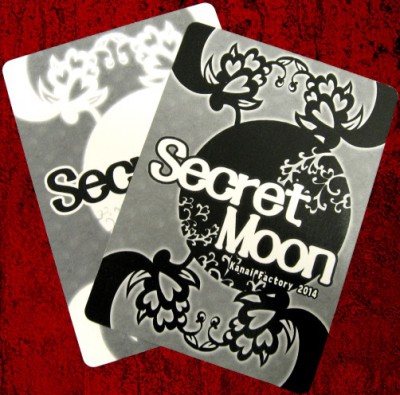
Next, we gave the “Feature Game”,  a try.  This was a new, Japanese game, called Secret Moon.  It is a small quick card game that is the sequel to one of our most played games, Love Letter, and tells the story about what happens when the Princess receives her message and goes out to meet her young man by the light of the Secret Moon.  From the rules:

One day, by chance, a letter reached her. The letter was not filled with vibrant words of love, or poem after poem praising the fair Princess and her beauty… as one might have wished. However, the contents did touch the princess’ heart.  “I have heard of you, and travelled from faraway in search of you. If I may ask, I would like to see you and tell you the tale of my travels here.”

The Princess made her decision, wrote her reply and entrusted it to a kind priestess.  “On the next night of the new moon, I will open the back door to the garden. If you please, could you retell your tale to me there?”

But someone overheard the exchange. The castle Minister. He feared that the Princess he had worked so hard to find the perfect groom for, would have her heart stolen by some wayward, suspicious Wanderer, so he ordered the Guards to watch her closely.  What fate awaits them? Will the Princess be able to hear the Wanderer’s tale, or will the Minister and the Guards get in their way?

Secret Moon

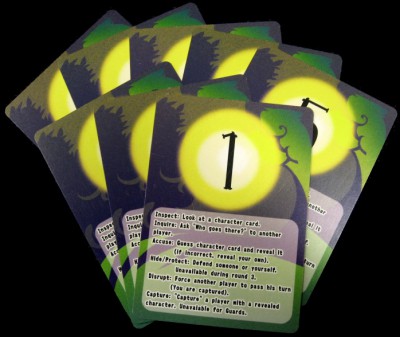
So, this game has a lot in common with Werewolf, in that there are two teams: those on the side of the Princess, and those on the side of the Minister, but while everyone knows which side they are on, only the Wanderer and the Princess know each other.  The idea is that there are three rounds i.e. each player gets three turns.  On their turn, players can inspect anyone’s card.  This means that they know definitively who that person is, but only they know.  Players can also ask, “Who goes there?”  Different characters respond in different ways, thus the Minister replies, “You fool! I’m the Minister!” whereas the Guards respond, “It’s just me!” and the Princess and the Wanderer remain silent.  The Priestess is a curious character: When the Princess asked her for help, she was quick to accept, but officially, she is helping the Minister.  So, in reality, the Priestess is the third member of the Princess’ team, but if asked, she says the same thing as a Guard.  This allows her to buy time for the Princess by masking her whereabouts e.g. by hiding in the first round to draw false suspicion or she can accuse the Guards like the Wonderer might.

Secret Moon

We played a total of three games of this in the end.  The game begins with one player dealing out turn order cards and character cards, so Green got to go first.  The game is supposed to be played with no table-talk, but in the first game, we chatted a bit to try to understand what was going on.  The Princess’ team trapped the Minister (Green), and since he was the start player, there was nothing he could do about it.  One of the features of this game is that, like Love Letter, a card is is put to one side in order to make the game a little more unpredictable.  So, in the second game, imagine her consternation when Cyan, as the Princess found she was all on her own.  Things came to a head when she was asked, “Who goes there?” and, with no-one to hide behind, was quickly captured.  But there was something that was not right.  After some discussion we came to the conclusion that it seemed very deterministic in that it all depended on the round order.  That precipitated a quick re-reading of the rules and there, in black and white it clearly said, “Go back to step 1 with shuffling the turn order cards and play another round.”  So we gave it a third try…

Secret Moon

This time, things started badly when the Red was the first player to be asked, “Who goes there?”, thus identifying herself as either the Princess or the Wanderer.  She managed to hide for a round or so, but the Minister eventually succeeded in capturing the Princess (who was indeed Red).  It was definitely much improved with the change to the turn order every round though, but it was clear that most people were a bit unconvinced.  In truth, it is probably one of those games that needs the right group of players and most of them know what they are doing for it to really sing.  Since it is so small, however, it is a game that will be carried around readily, but it may be difficult to persuade people to play it again.

Secret Moon

Red, Cyan and Yellow had an early start so headed off, leaving the rest to discuss the viability of the group without Azure and Orange who are no longer able to make Tuesdays.  The discussion rambled on for a while getting no-where, until Black suggested we played something.  So, after a number of options were (literally) put on the table, we decided to have another go at Istanbul.  We played this last time, but only Green had been involved in the game as everyone else had been playing Castles of Mad King Ludwig.  Since we didn’t have long, we played the “short routes” like last time.

Istanbul

This time, Black tried Azure’s strategy of making money in the Tea House and buying Diamonds.  Green started the same way, with a visit to the Small Mosque to pick up the tile that allows players to alter their dice rolls.  However,  he then decided to try something different and ended up wandering around the Great Mosque/Post Office area with Purple, who had started out well, collecting enough goods to get a tile from the Great Mosque, but then lost her way a little.  Meanwhile, Blue started out avoiding everyone else with a quick trip to the Post Office then made a visit to the Wainwright to expand her cart to hold three of each goods type.  She then got very lucky in the Black Market picking up three lots of jewellery (blue goods) on each of her two visits.  This left her with a lot of collateral to trade at the Sultan’s Palace and the Large Market as well as being able to pick up both tiles from the Great Mosque quite cheaply and her first gemstone with it.

Istanbul

While all this was going on, Black was picking off the early gems at the Dealer, moving back and forth between the Tea House to collect money and the Wainwright to expand his barrow it looked like the game was his to lose.  For his fourth gem, he needed more money than he could easily get in one round, and Blue was just behind with a decision to make.  She needed sixteen Lire and an assistant, but could she get them before Black, who went before her in turn order?  If she went to the Tea House to get the money, she would have enough, but since Black’s Merchant was already there, she would have to give him two Lire which was sufficient for him to go to the Gem Dealer and end the game.  So, she went to the Post Office and then popped into the Police Station to free her Family Member and send him to the Jewellers in her stead, bringing the game to a close one gem ahead of Black.  Last time everyone enjoyed it, but this time it had a more mixed reception:  while Blue liked it, Purple actively disliked it, and everyone else agreed that it needed to be played with the more challenging layouts to make it more interesting.

Istanbul

Learning Outcome:  Games work better when you play them according to the rules!


23rd October 2014: A Post Essen Special

This was a special Thursday night meeting because we’d had to cancel Tuesday (because the pub was holding a Chinese Night) and everyone who went to the Spieltage in Essen couldn’t wait to show off their new toys!  As it was a Thursday, we couldn’t use the pub, so we spent the evening at a private house in the village, something we used to do routinely after the fire, but haven’t done since the pub reopened.

Essen 2014

Typically, almost everyone came which meant we needed a second table!  While people arrived and drinks were found, Essen was discussed and the games played and bought were presented.  New games were the order of the day, so one table opted for Castles of Mad King Ludwig, while the other began with Istanbul, the 2014 Kennerspiel des Jahres.  It was exciting to break new games out of their shrink wrapping, but something that hadn’t been appreciated, was the time it would take to punch the components and learn the rules.

Frames

Although Castles of Mad King Ludwig had a lot of components to remove from their cardboard frame, at least the rules didn’t need to reading as one of the players had played it at Essen and was prepared to teach it.  Time was also saved someone the punching by using poker chips – although the components and box are generally really nice, the small cardboard money tokens are a little fiddly.

Poker Chips

The game itself is quite a simple game in many ways:  the idea is that players buy rooms to add to their castle.  A deck of cards is used to determine which rooms are available, and game ends when this deck has been exhausted.  The active player, or Master Builder then chooses the respective value of each room.  The clever part is the sale, an idea which appears to have been borrowed from Goa, where all monies are paid to the active player except for those spent by the active player, which go to the bank.  Thus, the idea is that the Master Builder wants to arrange the tiles such that rooms desired by the other players are expensive, but generally not too expensive, and similar to Goa, having a lot of money is powerful, but when you spend it, you generally give that advantage to the active player.

Castles of Mag King Ludwig

So, each room has a cost, but also a points value when placed, a size, and some sort of bonus for “completing” it.  A room is considered complete when every door leads to another room and this is where there is a spacial element to the game, since it is necessary to ensure that doors are laid out in such a way that rooms can be completed if appropriate.  The bonuses vary from an extra turn to money to extra victory point cards that are applied at the end of the game.  Some rooms also yield bonuses for “adjacency” which is determined on a room by room basis when the room is placed.

Castles of Mad King Ludwig

Ably assisted by Purple, Black explained the rules to Blue and Pink and then play began.  All was apparently proceeding well, when we discovered that despite the fact she was in the lead, Blue was unsure when the room bonuses applied – on placing, or to rooms added after placing.  This confusion was duly rectified (it is on placing) when we discovered that Pink hadn’t quite got a complete grasp of the rules either.  And then Purple, who was suffering with post-Essen lurgy, took her turn to have a fuzzy-rule moment.  Meanwhile, Black, who was concentrating on keeping everyone else on the straight and narrow found his castle was suffering a little and was starting to fall behind, so he quickly took measures to improve his situation by building a couple of Red rooms which yield a lot of points, though have some significant penalties if you get things wrong.

Castles of Mad King Ludwig

As the game headed towards the conclusion, Black was clearly in front and pulling away, but that was without the final scoring.  At the end of the game there are points available for any bonus cards held by players as well as for winning the King’s Favour.  The King’s Favours are scored separately with points potentially available for the everyone as players are ranked and score points accordingly.  There are four competitions that change with each game, and in the four player game, first place earns eight points, with four, two and one for second, third and fourth place respectively.  In this game, the King favoured castles with the largest footprint of living and utility space, as well as those with a lot of corridors and circular rooms.   Having picked up a lot of orange utility rooms early in the game, Blue had a lot of bonus points to score as well as coming first in two of the Kings Favour competitions, taking her well clear of Black in second place.

Istanbul

Meanwhile, Green, Azure, Red and Orange battled their way through learning the rules to Istanbul.  This is also a fairly simple game where players are trying to lead their Merchant and his four Assistants through the Turkish bazaar.  There are sixteen locations each with an associated action, but to carry out an action, the Merchant needs an Assistant to help out.  The problem is, once an action has been completed, the Merchant must move on, however, the Assistant remains to complete the details of the transaction.  The play-area is made up of tiles representing each stall, so there are four possible layouts:  “Short”, where the distances between places that work well together are small making game-play easier; “Long”, where places that work well together are far apart, which forces players to plan ahead more; “Challenging”, where similar places are grouped together, and “Random”.  As nobody had played it before, we didn’t know quite what to expect, so for this game, we chose “Short”.

Istanbul

Thus, a player’s turn consists of moving their stack of pieces (with the Merchant on top) one or two stalls around the bazaar.  If the stack ends on a space where there is already an Assistant of the same colour, then the stack is placed on top of that Assistant, otherwise, the bottom Assistant in the stack is removed and placed next to the stack.  Then, if the play wants he can perform an action at that stall, for example, buy goods at the fabric, spice or fruit warehouses, sell goods at one of the markets, or buy gemstones from the dealer etc..  If the player does not have an Assistant to collect or leave, then the players turn ends straight away, similarly, if a player meets someone else’s Merchant, they must pay them two Lira each, and forfeit the right to an action.  Meeting one of the other characters in the game also has consequences:  the Governor allows players to buy bonus cards; the Smuggler allows players to buy or trade goods, and a family member can be captured and sent to the Police Station in return for a reward.  The game ends when a player has five rubies.

Istanbul

Each player tried different strategies and tactics and to begin with, everyone was quite close and before long, everyone had with two or three of the five required rubies.  At this point, Green and Red looked at the gem dealer and felt that his gems were very expensive and that it was going to be a while before anyone could get enough to end the game.  However, Orange was buying goods and then selling them in the market and then used his double buy bonus card to jump from two rubies to four. Meanwhile, Azure had gained a special bonus token that allowed her to change a dice roll and then set about visiting the “Tea House” and gambling on dice rolls.  With the ability to change dice rolls, it meant she could call higher and therefore win more money which she took next door to buy her rubies.  By the time Green and Red realised that Azure had enough to buy her remaining rubies, it was too late and Azure had secured the win.

Istanbul

Despite having to learn the game from scratch, Istanbul finished long before Castles of Mad King Ludwig, so they decided they liked the gem-stone theme and went on to play a game that is already quite well known within the group, but has been so popular that a copy was also purchased at Essen – Splendor.  From the group who had finished, only Green was familiar with it, so he took the responsibility of teaching.  Red started out collecting rubies, while Green bought onyx and diamond and Azure and Orange went for  across section.  Orange built up a stack of chips which enabled him to quickly build a good stack of non-scoring gem cards, these, in turn rapidly led to a lot of low level scoring cards. Red continued to concentrate on Rubies, but branched out a little and gaining some of the high scoring cards.  Then suddenly, one player remembered the option to reserve a card and take a gold token and before long everyone was doing it!  Green thought he was about to win and activated his saved five-point diamond card to claim three points for one of the Nobles (four onyx and four diamond) only to realise that he already had enough diamonds and it was onyx that he needed!  Meanwhile, Azure quietly got on with building a mixed set of gems cross-colour starting with low value, moving on to middle and finishing with high values and with it took the game.  No-one secured the patronage of a Noble, though Green came closest as he took second place.

Splendor

Azure and Orange, Green and Pink headed home leaving Blue, Red, Black and Purple with just time for a quick game of the Romeo and Juliet themed card game, Council of Verona.  This is another new game, but it has a lot in common with Love Letter, a quick little game that we’ve all played a lot and are very familiar with.  The idea of Council of Verona is that on their turn, they play a card (a Montague, a Capulet or a Neutral)  either in Exile or in Council.  Broadly speaking, the cards come in two categories:  cards with an action and cards with an agenda.  So once they’ve played a card, players then they choose whether to perform any action associated with that card and, if they wish, they may then play an influence token on any agenda cards in play.  Each player has three influence tokens, a zero, a three and a five.  At the end of the game, the influence tokens are evaluated for any agendas that have been successfully fulfilled and the scores totalled up accordingly.

Councils of Verona

The rules suggest that you play three rounds and draft the cards at the start, but since we were all unfamiliar with the game, all tired and two of us were suffering from post-Essen-lurgy, we decided to play just one quick game and deal the cards out randomly and try to get a feel for it.  Blue and Purple played Romeo and Juliet (who want to be together) into Council and added influence tokens, while Red played Prince Escalus (Neutral who wants council to be balanced) and added a token.  Blue then played Lord Montague (wants more Montagues on Council than Capulets) and Black, Red and Purple retaliated by shuffling things around.  Blue who went last, played Lady Montague allowing her to swap two influence tokens giving her a winning score.

Council of Verona

Learning Outcome:  New games are a lot of fun!

7th October 2014

Blue’s dinner had just arrived when two new gamers walked in, closely followed by Black and Purple.  While Blue munched her burger and chips, at Purple’s request, the others played a quick couple of rounds of Dobble.  This is a game that used to be one of our “go to” fillers, but has been somewhat neglected over the last year or so.  Being basically, glorified “Snap”, it is a good game to warm up or finish with and is very easy to teach.  Not hampered by the fact that they’d never played it before, the wins were shared between Azure (well, it’s a shade of green) and Orange.

Dobble

While we waited for Green to arrive we played a quick five player game of the “Feature Game”, Love Letter.  This small card game is supposed to play a maximum of four, but we thought we’d try it with five. The basic idea of the game is to be the player with the highest numbered card at the end of the game.  So, each player starts with a card in hand and on their turn draws a second and then chooses one to play.  Since each card has an effect and there are only sixteen cards in the deck, by playing a card, players are both gaining information about what cards other people have as well as giving away information about their remaining card.  Used correctly, this information allows players to attack others and potentially eliminate them from the game.  Everyone had won a round and we’d already concluded that although we were enjoying playing it wasn’t really a five-player game.  So, the arrival of Green meant we decided to stop when the first player reached two, which happened to be Blue.

Love Letter

Next we had the inevitable debate about what to play and whether to split into two groups.  Azure and Orange commented that they liked worker placement games which put Keyflower in the mix, one of our favourite games and one we’ve played quite a lot.  It plays six, but several of us thought it might drag, especially with players who had not played it before.  Various other options were offered, but Blue is always happy to play Keyflower and others followed, so it quickly became a single six player game.

Keyflower

The premise of the game is quite simple:  over four rounds (or seasons) tiles are auctioned using meeples (or Keyples) as currency.  The clever part is that to increase a bid, players must follow with the same colour.  Keyples can also be used to perform the action associated with a tile, any tile, it doesn’t have to be their own, but each tile can only be used three times in each round and, again, players must follow the colour.  The aim of the game is to obtain the maximum number of victory points at the end.  However, the high scoring tiles aren’t auctioned until the last round (Winter), so players have to keep their options open.  On the other hand, the tiles that are auctioned in Winter are chosen by the players from a hand of tiles dealt out at the start, so players can choose to take a steer from that.  However, for that to work, you have to win the tile at the end…

Keyflower

With six players, almost all of the tiles are used, which makes it very different to playing with the smaller numbers we are more familiar with.  Somehow, with so many players keen to to get involved from the start, the Spring tiles were highly contested and Blue lost out finishing with none.  During Summer and Autumn, players strategies started to emerge.  Green was collecting green Keyples, while Black was collecting Yellow Keyples.  Meanwhile, Azure was collecting resources, and Orange, Purple and Blue were concentrating on trying to upgrade the tiles they had.  Purple struggled because everyone else seemed to want her coal and generally managed to get there first while Blue struggled because she needed a pick-axe skill tile and couldn’t get it.

Keyflower

Winter arrived and the Apothecary and Village Hall tiles came out for Black, the Key Market tile came out for Green, the Scribe and Scholar tiles came out for Blue and Orange who had collected quite a pile of skill tiles between them.  Blue had secured the start player at the end of Summer and went first with a free choice of tiles and a massive pile of red meeples to fight with.  Although she only had one set, she decided to chance it and went for the higher earning potential of the Scribe tile which yields ten points for every set of three.  Orange went for the Scholar, Black bid for the Apothecary and Green went for the Key Market with one of his massive pile of green Keyples, leaving Purple and Azure to fight for the rest of the tiles, including the Watermill (which rewards groups of five resources) and the Keythedral (which gives a straight twelve points) amongst others.

Keyflower

Players were beginning to pass, but Green was still increasing his stock of green Keyples, leaving Blue with a decision:  keep her now much smaller supply of remaining red Keyples to defend the important Scribe tile, or try to improve her position by trading in one last tile to see if she could get another set or two.  After a quick (mis)estimate of Green’s score Blue decided she had to go for the extra points, which increased her number of sets of skill tiles from two to five.  While she popped out for a moment, Green under the impression that Blue had more remaining red Keyples, decided to use his two remaining reds to challenge for the Scribe tile in the hope that it would deplete her supply allowing him to win his choice of boats.  Unfortunately, although Blue could match his bid, she didn’t have enough to beat it.  Although Green did not fully appreciate it at the time, this did far more damage to Blue than to him and it told in the final scores.   Green finished with sixty-six points, well clear of the pack, and Blue who (without the Scribe lost fifty points), finished just ahead of Black in second place.  Despite our skepticism, Keyflower was very enjoyable with six and it turned out to be one of the best games we’ve played.

Keyflower

Learning Outcome:  Don’t over-estimate the position of the other players.