Category Archives: Games Night

23rd September 2014

We were late starting (again), though by the time we began we knew we were going to be short of people, so we started with Mr. Jack.  This is an asymmetric, two-player game where one person takes on the role of “Jack” who is trying to escape, and the other tries to catch him before the escapes.  We’ve played the pocket version a couple of times before, but this was the first outing on for the big version on a Tuesday evening at the pub.

Mr. Jack

The idea is that four of the characters are active in each round, with the four chosen at random in the first round, then the remaining four are played in the second round before the characters are shuffled and drawn randomly at the start of the third round.  In the first round, the “Detective” chooses one character and plays it straight away; then Jack chooses and plays two from those left;  finally the Detective finishes the round by playing the last character available.  In general, on their turn, a character is moved one to three spaces around the board.  However, each character also has a special ability which may be used to modify their action.  For example, Miss Stealthy, can move up to four spaces and may move through buildings if she wishes, on the other hand, Inspector Lestrade can only move a maximum of three, but must move one of the barriers during his turn.

Mr. Jack

Thus, each character is moved in turn and at the end of each round, the question is asked, “Is Jack in the Light or the Dark?”  If Jack is immediately adjacent to any other character, next to a street lamp, or in line with Dr. Watson’s lamp, he is in the Light, otherwise, he is in the Dark.  The player playing Jack must respond truthfully, thus allowing the detective to eliminate some characters.  If he is in the Light, Jack has survived another round, but may not actually escape until he is in the Dark again.

Mr. Jack

The game began with Green (playing “Jack”) choosing his alter ego at random from the eight possibilities:  Sergeant Goodley, Miss Stealthy, Sherlock Holmes, Jeremy Bert, Inspector Lestrade, John Smith, Sir William Gull and Dr. Watson.  Meanwhile Blue set up the board.  Blue had played it a number of times before, and although Green had played the pocket version once, this version was entirely new.  So, Blue felt really bad when she had eliminated half of the characters by the end of the first round, leaving just four possibilities.  Green had a much better second round however, and going into the third, still had three characters left.

Mr. Jack

It was then that Black and Purple walked through the door.  With only two possible characters left, the ultimate conclusion of the game wasn’t really in any doubt, but rather than keep Black and Purple waiting, Blue decided to add a little spice to it the end of the game and guess and got it wrong…  But then, who would suspect Sherlock Holmes’ sidekick Dr. Watson…?

Mr. Jack

With Black and Purple, we decided to play something a little longer that would take up most of the rest of the evening.  After some discussion and presentation of likely candidates, we eventually decided to play Amerigo.  This is a game that we had all played before though you wouldn’t have believed it if you’d been listening to the “table talk”.

Amerigo

In this game players are exploring the islands of South America, securing trading routes, and building settlements.  The game board is made up of a four by four grid of large tiles that make an archipelago.  Players then have two ships each which they sail through the maze of islands, mooring at natural harbours to build trading posts, and then expanding settlements.

Amerigo

The actions available to players are determined through the use of a special cube tower that contains lots of buffers and butresses. The idea is that each of the seven actions has an associated set of coloured cubes:  blue for sailing, black for loading cannon, red for buying buildings, green for settling etc.  At the start of the game, all the cubes are put into the top of the tower a small number get stuck and remain inside the tower to be potentially knocked out at a later point in the game.

Amerigo

There are four rounds and each round consists of seven phases, corresponding to each action where all the cubes available of that colour are poured into the tower.  Most of these cubes come out again, but some dislodge cubes previously caught in the baffles, while others others get stuck themselves.  Of the cubes that come out, the colour that is in the majority dictates the number, while all the colours dictate the actions.  Thus, if five blue, one green and one black come out, players can choose between sailing, building settlements or loading cannon, and in each case, they have five “action points”.  So, the actions that are available are largely predictable, with a slightly random element meaning there is a tactical element (taking advantage of the actions currently available in the best way possible) as well as a strategic (long term plan) element to the game.

Amerigo

Points are available throughout the game for all sorts of things, including being the first person to land on an island and establish a trading post; building settlements on an island; completing an island by settling on its last available space; collecting gold, and moving along the progress and special action paths.  At the end of each round, however, the pirates attack and players have to fire their cannon to repel boarders.  Anyone who has not loaded sufficient cannon to fend off the pirates, loses points and it’s nasty, because these players lose as many points as they would if they’d had no cannon, and they also have to fire the cannon they had loaded!

Amerigo

It was the point-scoring for completing islands that really confused Blue, however and she never really quite got the hang of it.  The islands are divided into two classes:  small islands and large islands.  Building on large islands always scores more points than building on small ones and these points are awarded at the time.  Completing a large island wins the player a treasure chest which they can turn into gold, but there is much more to it than that.  Anyone with a trading post on the completed island scores points determined by multiplying the number on the time marker for that round (which decreases by one each round during the game), by the number from the triangular series that corresponds to the number of trading posts they have (i.e. 1, 3, 6, 10, 15 & 21 for one to six trading posts respectively).  Thus, completing an island on which you have a lot of trading posts scores a significant number of points, but you don’t have to be the player to complete the island and the earlier it is completed, the more everyone scores.

Amerigo

Black started out well managing to get an entire large island all to himself, by blocking off all the trading posts and proceeded to buy some large settlement tiles and build them on his large island.  Meanwhile, Green had a bit of a nightmare as every plan he made got stamped on by Blue.  It was clearly completely unintentional, as Blue had barely enough understanding of the game to manage her own plans never mind upset someone else!  Green got his revenge, however, by picking up the “everyone else needs two extra cannon to fight off the pirates” progress tile.  Nobody else was very impressed, especially purple who had just acquired the “fight off the pirates and get two gold” progress token.

Amerigo

Everyone was quite convinced that Black was the run-away leader as he’d been able to buy two of the valuable neutral settlement tiles every turn instead of just one and a large island all to himself.  However, somehow, Black’s plan to fill the large island hadn’t quite come off and he’d been out maneuvered when building his largest settlements by Green and Blue who carved up the largest free space between them, so by the end of the game it turned out that he’d not actually been able to capitalise on a lot of the buildings he’d bought.  Blue had also had problems building enough having picked up two progress tiles early which gave her two extra action points when sailing and two when buying settlement tiles (planning), but she had decided to get round the problem by sacrificing a turn and moving up the special action track to land on a green space.  This gave her additional opportunities to build whenever white cubes came out of the tower and she ended the game with almost no unused tiles.  This proved invaluable in the dying stages of the game as, despite a late charge from Green (who had a huge pile of “sticks”), she finished eight points clear.

Amerigo

Learning Outcome:  You don’t have to understand a game to win it.

9th September 2014

It was a very quiet night possibly exacerbated by the closure of the A417, which impeded everyone who comes from the south.

Taluva

We started out with a filler game called Taluva.  This is really a thinly veiled abstract, but is very pretty for all that.  On the face of it, it has a lot in common with Carcassone:  players take it in turns to play tiles and then place a meeple.  However, the tiles are twelve sided and comprise three hexagonal regions or fields, one of which is always a volcano.  When placing tiles, they can be adjacent or on top of other tiles so long as the volcano sits on top of another volcano (the tile must also cover more than one tile and there cannot be an overhang).

Taluva

The meeples are the real difference though:  in this game, they represent buildings rather than characters, and the rules for placing them are a bit arbitrary.  Players can place their building anywhere (buildings do not need to be put on the tile they’ve just placed), but the type of building dictates where you can put it and how many you can place.  Thus, a single “hut” can be placed on any level one field (excluding volcanoes) to form a settlement, that is to say, the hut cannot be placed on a tile that sits on other tiles.  On the other hand, an existing settlement can be expanded by adding huts to all adjacent fields of the same type, but in this case, the number of huts added depends on the level.  So, a level two field (i.e. one that sits on top of one other tile) would get two huts and a level three field (one that sits on top of two other tiles) would get three.

Taluva

Each player also has three temples and two towers to place, and these must be placed adjacent to settlement containing at least three huts (and no other temples) and on a level three tile in a settlement of any size respectively.  The game ends when all players but one are eliminated because they are unable to place a building, or when one player wins by exhausting two of their type of building or when there are no tiles left.  In the last case, the winner is the one who placed the most temples, then the most towers and finally the most huts.

Taluva

We started at a leisurely pace before Blue remembered that we should have started with a subset of tiles and then it all became a little more frenetic.  Having played it a few times before, Blue should have had the edge over Green, however it is one of those games that Blue has a bit of a blind spot for.  So although Green felt he was stymied at every turn, he was only ever one or two tiles from taking the lead.  The game finished with Blue and green level on towers and temples, but Blue had placed more huts, so just kept her nose in front.  We concluded that we liked it, though there was nothing in  the theme to assist remembering the rules.  We also thought is would play very differently with more players.

Darjeeling

After much debate (which ended in rolling the dice) we decided to play our “Feature Game”, Darjeeling.  This is a game about collecting and shipping crates of tea.  Each player has a tea-collector meeple which moves around an array of tiles, picking up tea.  When they have a set of complete tea chests, they can choose to ship them.  Bonuses are awarded for shipping larger loads and for shipping the type of tea that is in the greatest demand and the game ends when a player gets to a hundred points.  The demand indicator is very clever – it consists of a double set of wooden disks lined up on a sloping track:  when a tea is shipped the corresponding coloured disk is moved from the bottom to the top and the bonus is awarded according to the number of discs between the two discs of the same colour.  So, if there are two discs of the same colour at the top of at the ramp, shipping that colour will give no bonus.  As other teas are shipped, however, these two discs will gradually move down the ramp together until they are at the bottom when they will give the maximum bonus possible.

Darjeeling

The other clever part of the game is the scoring for shipping:  points are awarded at the beginning of a players round according to the number of crates still on ships multiplied by their position in the boat-stack.  When crates are shipped, they go onto a boat at at the top of the boat-stack, so a boat still at the top of the boat-stack at the start of a players turn will score points equivallent to three times the number of crates on the boat.  When Purple, Black, Blue, Green and Pink played this game a while ago and Green managed to ship six crates and unfortunately nobody was able to ship anything for at least two rounds which meant for a while Green scored eighteen points every time at the start of each of his turn and consequently gave the rest of us a bit of a hiding.  There was no way Blue was going to let that happen again…

Darjeeling

Blue started, but Green was the first to ship with four crates.  Blue followed immediately with four of her own.  Since Green had just shipped, he was not in a position to ship again for a couple of rounds and as soon as he did, Blue shipped again straight away knocking Green off the top spot.  Blue persisted with this strategy for several rounds, shipping immediately after Green even if the timing was suboptimal for her, but preventing Green from building up a commanding lead.  In fact, before long, Blue was building a sizable lead of her own and it wasn’t long before she passed one hundred points, bringing the game to a close.  A couple of poor final moves meant the score was closer than it should have been, but Blue ran out the clear winner.

Darjeeling

We were a bit tired, so we finished off with a game we’ve played before, but haven’t played for a while, Citadels.  The idea of this game is that players are trying to build a city and the game ends when the first player builds their eighth building.  To do this, players choose character cards and  then each character is called in the prearranged order.  Thus, when the late characters are played, the situation may have changed significantly from when they were originally chosen.  On a character’s turn, the active player first takes money or cards, and then (if they can) they build one of the building cards from their hand.  There are bonuses available for players who get one of each building colour, the player who gets to eight buildings first (triggering the end of the game) and any others who finish the game with eight or more buildings.

Citadels

With so few players, we included the Witch and the Wizard from the The Dark City expansion. Blue started quickly and built a valuable purple building, while Green started with cheaper buildings collecting a range of colours.  Blue then built a very cheap red building which Green promptly destroyed using the Warlord.  As the game came to a close, Green had a building of every colour while Blue had more buildings but was missing red and no matter what she did, could not replace the one that got zapped.  Blue finished first with another high scoring purple building and Green finished with the Architect building two buildings to bring him up to eight.  Blue’s valuable buildings and the extras for finishing first offset the bonus points Green picked up for a full set of colours and all eight buildings.  So the game ended thirty-three all.

Citadels

Learning Outcome:  Sometimes games play very differently with the minimum number and maximum number of players possible.

26th August 2014

We started the evening with a big bowl of chips, some ice-cream and a game of Hanabi.  This is a a co-operative game where everyone works together to try to achieve a common aim.  The idea is very simple:  everyone has a hand of tiles which are turned to face away, so that players can see everyone else’s tiles, but not their own.  On their turn, players then either play a tile, give a clue about the colour or number of the tiles in front of a player, or discard a tile (and recover a clue).  The aim is to lay twenty-five tiles in order within their suits.

Hanabi

Everyone had played the game before, but never together as a group, so we had a quick discussion of conventions.  The game can be played very strictly in complete silence with “poker faces”, but given how hard the game is, we’ve always played it in a fairly relaxed way.  Some groups have a lot of extra ways of giving clues, for example, if a player has three green tiles, they point to them in a prearranged order, say, from lowest to highest, however, within the group we’ve always felt this is a step too far.  We typically play with a conveyor-belt, where new tiles are generally placed at one end and, in the absence of other information,  should it be necessary, the oldest tiles are discarded.  This not only helps the players giving clues ensuring that tiles stick about for as long as possible and makes sure people know which tile is “in the hot seat”, but also helps the owner remember which tile is which.  In the past, we’ve also used some element of the active player talking through their thought process so that other players can learn how people think.  This is nice when learning, but does have the tendency to give away a little too much information, so this time, with more experienced players, we tried to keep that to a minimum.

Hanabi

We started off well with one player beginning with three ‘ones’ all of different colours, but then the trouble set in.  The absence of “twos” meant that nobody could really find any really good clues to give and before long we were forced to discard tiles which led to the inevitable consequence of throwing away both white “threes”.  Although it limited our highest possible score, it had the advantage that people could freely discard white tiles and recover clues.  Doors opened a little and we managed to play complete blue, green and red fireworks.  The total of nineteen gave us an excellent crowd pleasing display, though it would be interesting to see if the same group could do as well, or even better next time, playing a little more strictly.

Hanabi

Meanwhile a couple of other players arrived and, seeing that the game had some way to go, decided to start a quick game of The Little Prince:  Make Me a Planet.  This is a pretty little game based on the book, The Little Prince, by the French writer, Antoine de Saint-Exupéry.  We’ve not played it before on a Tuesday, though many of us have played it on other occasions.  The idea is that each player is trying to build a planet from a total of sixteen square tiles.  The tiles have one of four different motifs: characters, up edges, down edges and middles and when four of each are combined, they make a picture of a planet with the four corner spaces occupied by the characters.

The Little Prince:  Make Me a Planet

On their turn, the active player chooses a motif, draws one tile per player and keeps one.  They then choose another player and pass on the remaining tiles for them to select one, then pass remaining tiles on etc.   The final player gets no choice and gets to keep the last tile, but to make up for that, this player becomes the start player for the next round.  Each tile features a number of items:  lamp posts, sheep stars, strange-looking foxes, elephants, baobob trees, cobras etc. which are used for scoring.  The score for each item depends on the characters, however, and items will score highly for one planet and poorly, or even negatively for another.  The game was tight all the way through, but Purple finished ahead with a lead of seven points.

The Little Prince:  Make Me a Planet

The games came to an end and we decided to start two simultaneous games of The Speicherstadt, our “Feature Game” for the week.  This is an unusual auction card game where players compete for victory points, which come mainly from contracts (sets of resources) and special cards.  The game is set in Hamburg around 1900 where there was a unique complex of storehouses (Speicherstadt) and a network of canals and bridges forming a terminus for spices, coffee, tea and carpets from all over the world.  Players act as wholesaler at the heyday of the Speicherstadt acquiring shiploads for the storehouses and making profits selling selling them.  We played this game quite a bit a few months back, but somehow seemed to have forgotten how to play it.  After a period of staring blankly at the rules, we remembered that each player starts with three meeples which they use for bidding, and bid by placing them above their chosen card (and any meeples already there).  Once everyone has declared their interest, the first card is auctioned:  the person at the front of the queue has the first chance to buy and the price is set by the total number of meeples in the queue.  If they choose to buy at that price, they pay up and the auction is over.  If they choose not to buy (or are unable to), then they forfeit their opportunity, remove their meeple and the next person has a chance (and the cost is reduced accordingly).  The deck is stacked so that contracts mostly come out first, then “schiffs” which carry the goods used to fulfil the contracts.  There are also firemen (or feuerwehrmenn) and a smattering of other interesting and valuable cards.

The Speicherstadt

In the first game, Blue failed to acquire any firemen and was duly punished by losing a total of ten points during the game.  Because Orange and Red had not played before, they had neglected contracts in the early stages, which meant goods were plentiful and were mostly sold.  Blue picked up the most contracts, but it was nowhere near enough.   On the other hand, Orange took all ten points, so the question was whether the contracts and Counting Houses held by Red were enough.  It came right down to the wire and the game finished with just one point in it, in Red’s favour, by just two points.  Meanwhile, the second game was playing in a completely different way.  In contrast to the first where contracts had gone unclaimed and all the “schiffs” were bought and goods sold, in the second game, most of the contracts had been snapped up, but with a shortage of money, some of the ships had not been bought.  In the second game, Green had picked up most of the firemen points and finished thirteen points clear of Black, his nearest challenger.

The Speicherstatd

A couple of people left early and those remaining played decided to play Montego Bay.  This is a game we’ve played a few times before, that features simultaneous card selection, which are then played in a predefined order.  Cards are numbered one to five and each player chooses two to move their big docker and their little docker round a circular track.  If they land on a space that is already occupied, then the piece that was there, moves to the other side of the track if that space is available.  If that space is also occupied, then the active piece moves as far as it can and then stops.  Each space corresponds to a cellar that contains some number of barrels which players then take it in turns to load into boats.   When a boat is full (or if it is the first boat in line at the end of the round), it sails and players score points for having the most barrels in boats when they go.  Beware the broken barrels though, if a player lands on a cellar with some of these they must remove the corresponding number of barrels from the boats rendering the best laid plan in tatters.

Montego Bay

Black started off really well with excellent timing on a couple of boats and catching lots of points as a result.  Then Purple joined in before Green took a commanding lead.   Blue made some in-roads, but proved her own worst enemy when she landed her big man on a cellar with broken barrels and then, to add insult to injury, landed her little man on the same space, moving the big man to the other side where there were even more broken barrels waiting for her.  Green ran out the winner with forty-four points to Blue’s thirty-eight in second place.

Montego Bay

Learning Outcome:  If fire is inevitable, ignore it at your peril.

12th August 2014

It was a quiet night tonight with just the two games and not many more people.  We started out with the Feature Game, 7 Wonders, which is a card drafting game.  Basically, each player starts with a hand of cards and, simultaneously, each player chooses a card to play, a card to keep and then a passes the rest to the next player.  The cards are played with various different aims, you might try to build up a set of city and erect an architectural wonder, or attempt to have a superior military presence to neighbouring players.  The game consists of three rounds, the first and third passing cards to the left, with the middle round passing cards to the right.  We’ve played this a couple of times before – the first time, there were seven of us and it was just completely disorganised chaos.  Nobody had any idea of what was going on and changing direction in the second round just caused even more confusion;  it seemed to last for ever.  We played it again a few weeks later, this time with fewer and got through two games in the time it took the other half of the group to get through one.  This time, with just three players, it went OK, but the conclusion was that it works best with four or five, three is too few, and seven is definitely too many!  Green won, but Yellow’s comment, “I want to like it, but find it difficult to work out all the scoring combinations,” pretty much summed up everyone else’s view.

7 Wonders

The second game was a new game that two players had played several years ago, Kaigan.  It seemed that four years was “beyond living memory” as nobody could remember how to play and it took ages to work out the rules.  The game is set in 1800 when, at fifty-five years of age, Tadataka Ino started his journey to make the first scale map of Japan’s coast (Kaigan) using modern surveying techniques. After twenty-one years, Ino had a beautiful 1:36000 scale map that remained the definitive map of Japan for over a century.  In the game, the players oversee teams of surveyors and compete against each other to map the coast of Japan. Players generate income which they use to dispatch their surveyors around the island of Japan in an effort to map its different regions.  Then they improve their artistic skills and develop relationships with local governments in an effort to contribute the most to mapping Japan, gaining the most honour thus winning the game.

Kaigan

The game consists of five rounds that represent the twenty-one years Ino took to map Japan.  It didn’t take too long to play (certainly didn’t feel like twenty-one years!), but when we finished, we still felt as though we had played it wrong some-how. Purple bluntly said,”I didn’t like it then, and I don’t like it now,” while Yellow (who won) commented that he still didn’t really get it.  Green who had not played it before opined that it was not one he’d particularly wanted to play again as he didn’t like the fact that he kept losing his action choices, however he thought it might play a bit differently a second time.

Kaigan

Learning Outcome:  Sometimes, your first impression, really is the right one!

29th July 2014

After a bite to eat, we started late with our first game, Indigo and immediately in walked a two more gamers.  It is a quick game though, and Yellow in particular was quite fascinated watching.  It is a really beautiful and simple yet clever game, based on tile laying and path building.  The idea is players have to direct glass pebbles and catch them in their “gates”; different coloured stones are worth different numbers of points.  Each player has a single tile and on their turn, they place that tile anywhere on the board in almost any orientation.  If the tile extends the path of one of the stones or connects it to another bit of path, the stone is moved along the path to the new end.  If a stone arrives in a gate, the owners of the gate get to keep the stone; each stone have a value and the player with this highest total at the end wins.

Indigo

In the four player game, players have three gates each, sharing one with each player, so there is a certain degree of team-work.  This was White’s first visit, and it became clear early on that this was not the best game for her as, without her glasses, working out where the blue ribbons go was challenging!  Nevertheless, she did remarkably well, especially in helping us make sure Green didn’t win!   Red and Blue led the charge and, when Red brought home the blue stone (which is worth a valuable three points), the writing was on the wall – a draw!

Indigo

With a few more arrivals, we decided to play our “Feature Game” next, which was 6 Nimmt! (aka Category 5 amongst other things).  This is a much older game (celebrating its 20th anniversary this year), though is also quite simple to play.  There are four cards on the table forming the start of four rows and players start with ten cards in their hands.  Each card has a face value between one and one hundred and four and features a number of “Bulls Heads” (mostly just one, but some have as many as seven).  Basically, players secretly choose a card to play, and then simultaneously show them.  The lowest card is then placed after the highest card on the table that has a face value lower than the card they are playing.  In this way, four rows are formed.  The rows are full when they contain five cards and when the sixth card should be added, the active player instead takes all the cards in the row and places their card down to start a new row.  A player scores the number of Bulls Heads on the cards and winner is the one with the fewest at the end.  Since the number of cards in the rows increase (making it harder to play safely) and the number of cards in hand decrease on each turn (players don’t pick up after each turn), the decisions get increasingly agonising, especially when the number of Bulls Heads in the rows starts to increase.

6 Nimmt

We checked that Red understood that she wasn’t supposed to be collecting cards and she assured us that she understood this aspect of the rules, however, it wasn’t a surprise when she finished with nearly twice as many Bulls Heads as anyone else!  So we decided to play a second round and work our way through the second half of the deck to give her a chance to improve things.  Green decided that it was time to “nobble” Blue as she had finished the first round with one Bulls Head, however, he had no idea how to go about doing it, nevertheless, everyone was delighted when Blue was the first to pick up.  Red seemed to have got the hang of it this time and managed to get through the whole round without picking up a single card which meant she finished in joint second with Green.

6 Nimmt

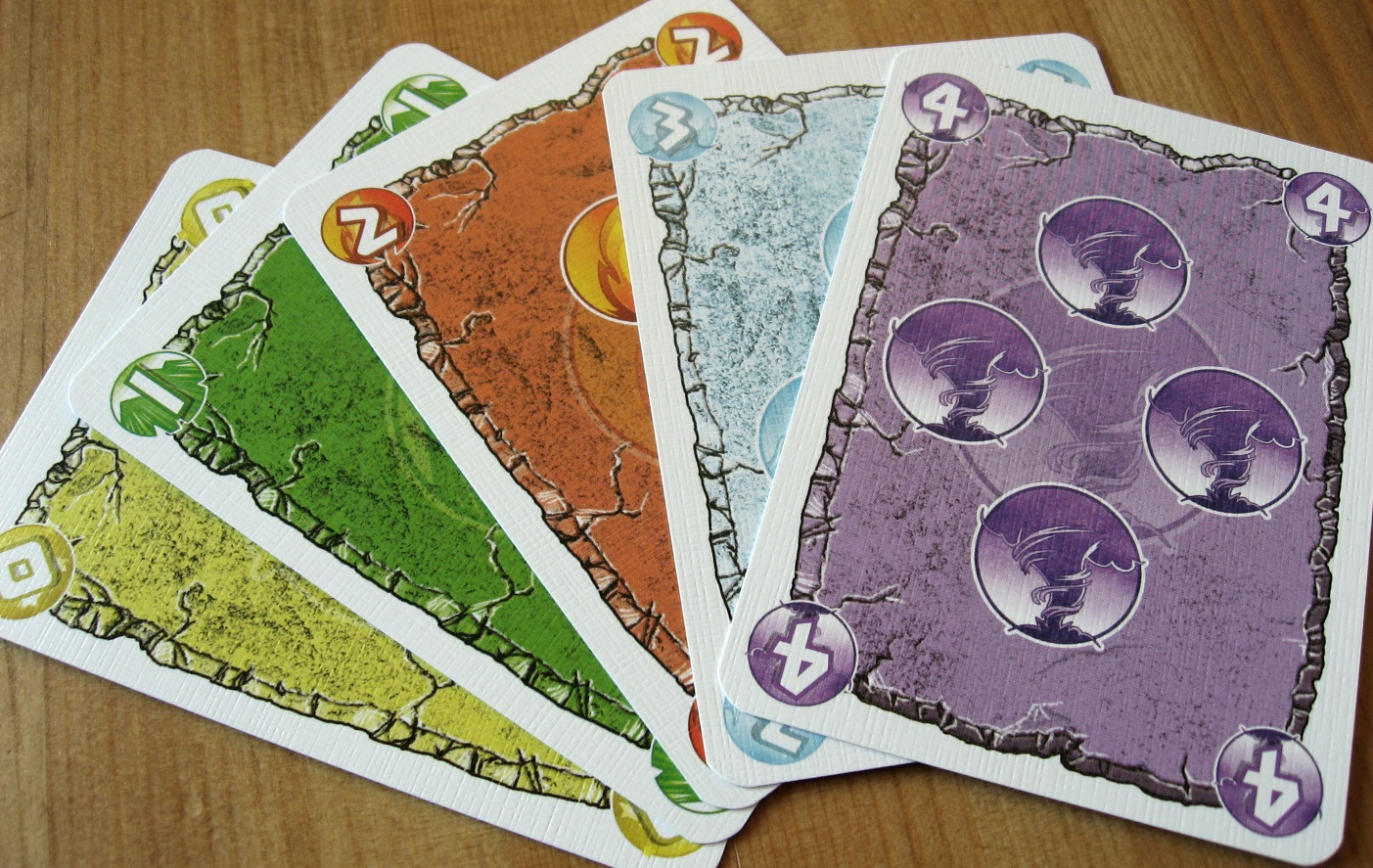
We didn’t have long before people had to leave,  so we played a game of one of our new favourite fillers, Dodekka, which has a lot in common with another game we like, Parade.  This is a simple little push-your-luck card game, with five different suits, Fire, Earth, Air, Water or Ether each with cards numbered 0-4. The game starts with three random cards placed in a line from the draw deck.  On a player’s turn they can either take a card from the deck and add it to the end of the row of cards, or take the card nearest the deck.  If the total of the face values of the cards in the row exceeds twelve, then the player has to take the whole row.  At the end of the game, players choose a scoring suit and add up the face value for that colour, then they subtract the penalty points – one for every card not in their scoring suit.

Dodekka

Yellow was the first to pick up a handful of cards, but it quickly became clear that he had a strategy and, as a substantial number of the cards were blue he was hoping to collect enough to offset any penalties.  Red, Green and Blue, meanwhile tried to delay picking up cards and then minimise the number they got so they could leave the decision until they were forced to choose.  Purple was forced to choose quite early on, but ran out the winner with a grand total of five, just one ahead of Green and three ahead of Yellow.  Remarkably, nearly everyone finished with a positive score, which we felt was much better than last time!

Dodekka

Next up was another recent favourite in Ivor the Engine.  We played this only a few weeks ago, but Yellow has won every game he’s played, so we all felt we couldn’t let this record stand…  Yellow started out well early on, with a lucrative job in Llangubbin, but it stayed close.  Purple carried out a lot of jobs at Mrs. Porty’s House and then picked up the matching event card to add more points.  Green collected a lot of sheep in the Grumbly Town area and then played a handful of cards to do several jobs one after another.  When an event card came up that moved everyone to Tewyn, we all payed a sheep except Yellow who followed the move with an ominous number of jobs in Tewyn Beach.  Meanwhile, Blue had picked up a lot of cards for Dinwiddy’s Gold mine, but without help was unable to clear the sheep efficiently.  So when the matching event card came and went, she changed her strategy and collected a couple of tasty looking jobs in Grumbly Town.  When it looked like Yellow was about to finish the game, Blue gave him a lost sheep card, immediately followed by Purple who forced him to lose a couple more sheep.  Blue turned her Goldmine cards into gold, then into coal enabling her to move and carryout a couple of jobs bringing her sheep flock to twenty-five, and as the last player in the round, brought the game to an abrupt end.  With her extra sheep event card, she finished with thirty, just ahead of Green who pushed Yellow into third, for the first time.

Ivor the Engine

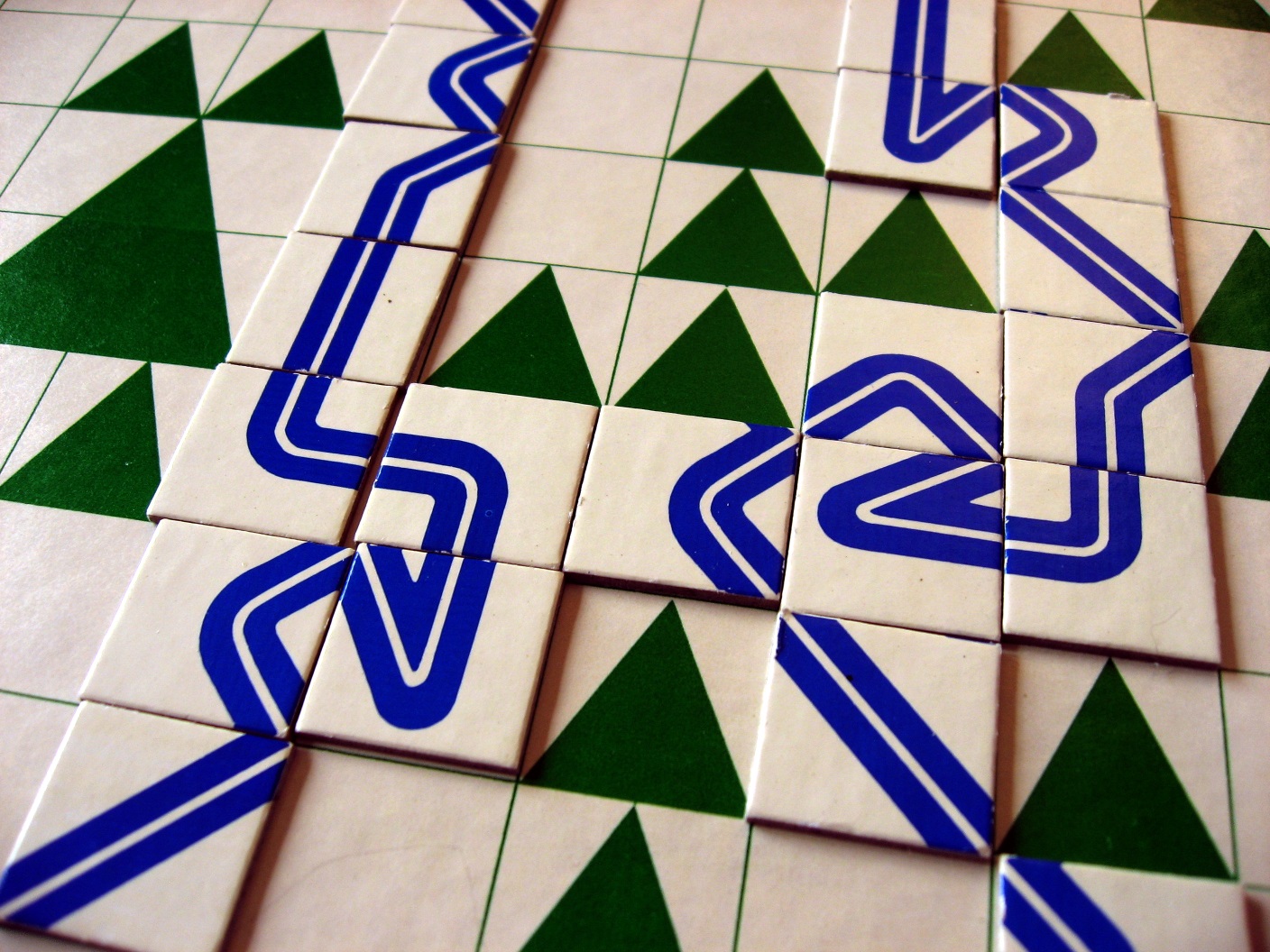
With only half an hour left, we decided to play what looked like a quick game in The Great Downhill Ski Game.  This is is an old game dating back to over forty years, but was ahead of its time.  Basically, players have a hand of ten tiles and on their turn they lay as many of them as they can to create a continuous path avoiding all the trees.  At the end of their turn they draw tiles from a face down pool to bring their hand back up to ten.  The game ends when one player makes it to the bottom of the run and players get points for finishing the course, but also for the tiles they lay, with points for corners and more points for sharper corners or crossing a track.

The Great Downhill Ski Game

Yellow started followed by Blue and Purple, so by Green’s turn he was squeezed into a corner and had to wriggle between the edge and Yellow’s track, as well as avoid the trees.  Purple was lucky with the space she had as Blue had left her with a lot, but didn’t get the tiles she needed.  Meanwhile, Blue started well and made a run for the line, but trying to weave in as many of her higher scoring tiles as she could.  It looked like Blue was miles ahead, but Yellow crossed the line first, leaving everyone one turn to finish.  Purple was the only one who couldn’t quite make it, though she managed to use nearly all her tiles.  Blue was hampered by drawing a high scoring, but high penalty tile in the penultimate round that she couldn’t get rid of, and came joint second with Green who did remarkably well considering his difficult start.  The gold medal went to Yellow though, who was not only first down the course, but was also left with the fewest penalties at the end.

The Great Downhill Ski Game

Learning Outcome:  Old games are sometimes still good games.

15th July 2014

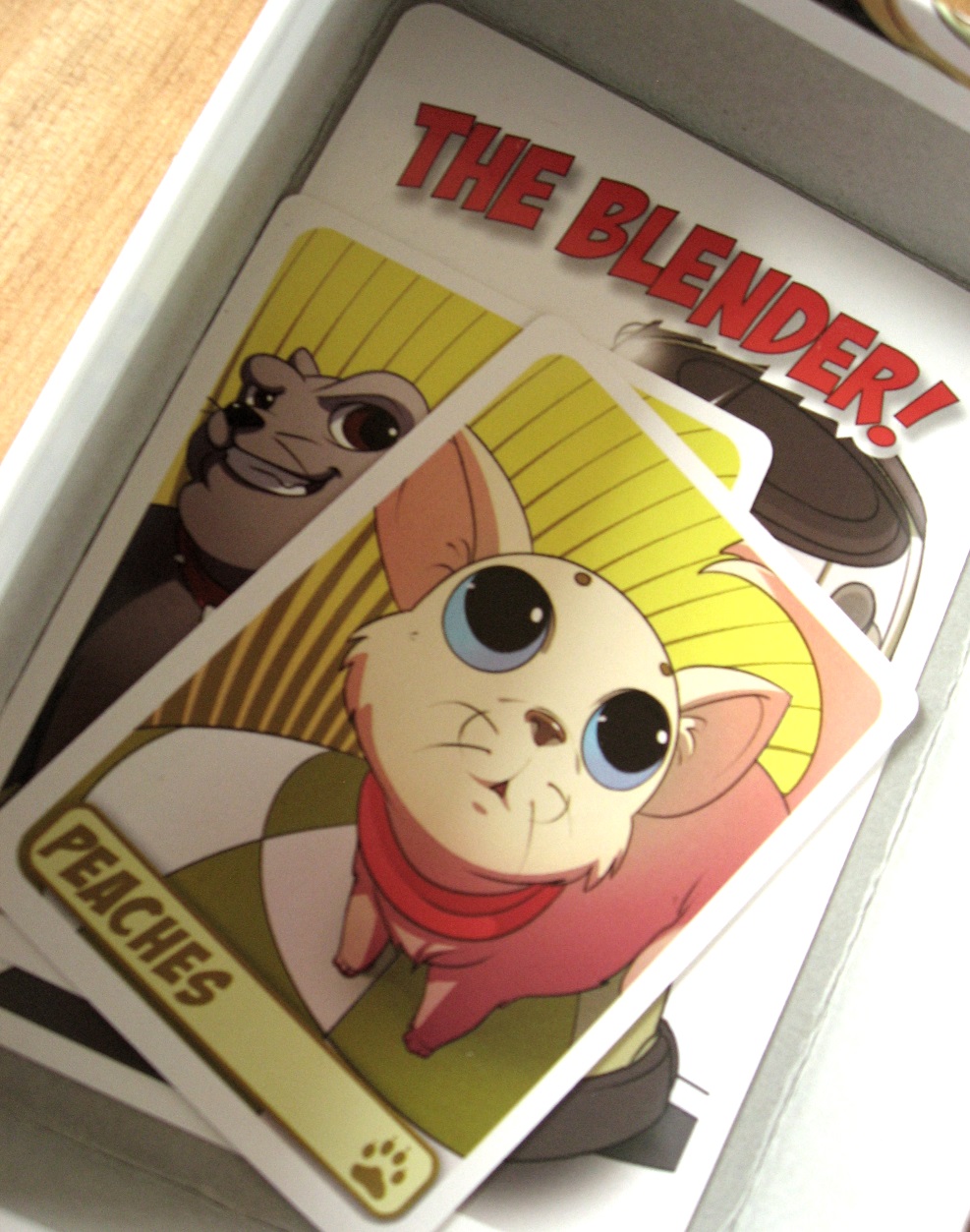
This week we started with a quick game of Kittens in a Blender.  This is a light card game, if one with a slightly ghoulish theme.  The idea is that on their turn, players must play two cards from their hand of six cards.  If they choose to play a kitten card it can go onto the counter in the middle of the table; into the relative safety of the box, or straight into the blender to await its fate.  Other cards allow Kittens to be moved one space from the box to the counter or the counter to the blender vice versa.  And then there are the blend cards, which cause any kittens in the blender to be blitzed, the kittens in the box to be permanently rescued and the kittens on the counter to move to the blender to become the next in line for “kitten smoothy” (if they aren’t rescued in time).  Players score points for every kitten of their own colour that they rescue, and lose points for those that meet a less pleasant end.

Kittens in a Blender

Yellow started out picking on Blue and Orange kittens and, well, Red ones too.  So before long, everyone retaliated and the fur began to fly as it all got ugly quite quickly.  Orange managed to do the least to offend everyone else and finished miles ahead of everyone else with fourteen points while everyone else struggled (or failed) to finish in paw-sitive figures.

Kittens in a Blender

Everyone else was here by now, so next up was our “Feature Game”, the new Spiel des Jahres winner, Camel (C)Up.  There has been much debate about the correct name as the box is ambiguous.  It was originally released as “Camel Cup”, presumably to reflect the Australian camel race, however, the Spiel des Jahres citation clearly calls it “Camel Up”, which at first sight seemed strange, however, once we started playing it became clear why this name was appropriate.  The game consists of a race of five camels and players effectively bet on the leader and eventual outcome of the race.  Thus, on their turn players can do one of four things:  use the cool pyramid dice shaker to move a camel; bet on which camel will be in the lead at the end of the round; bet on the final outcome of the race (i.e. which camel will cross the line first triggering the game end, or which will be in last place when that happens), or place their oasis tile which can earn the owner money as well as help or hinder a winning/losing camel.

Camel Up

There are a couple of clever things about the game.  Firstly, the dice shaker:  this is a pyramid-shaped device, made out of card and held together with an elastic band.  The idea is that players shake it, turn it upside down and push the slider to let out just one die.  Although it malfunctioned a couple of times, in general, it works well.  As there are five dice (one per camel) and when a die is “rolled” it is removed from the shaker for the rest of the round,  this is used to determine the length of the round (or “leg”).  Next, when a camel moves onto another camel’s space it is stacked on top of it, then if the bottom camel moves, the top camel takes a ride.  This means that a riding camel can get an extra move, and stacks can contain any number of camels, so if a camel is lucky it can pick up a lot of extra moves.  Finally, the way the betting is handled means that players don’t have to worry about stakes and odds.  To bet on the outcome of a leg, players simply take a tile of the appropriate colour.  Since these are stacked with the highest value first, if that camel comes home first, that player gets more at the end of the round.  Similarly, the betting on the end of the race is done by players choosing a card from their hand of five (one per camel) and placing them in the “to win” stack or the “to lose” stack.  The earlier they are placed, the more the player wins (if they get it right of course!).

Camel Up

The game began with the the Blue and White camels getting a slight head start.  White made a surge forward and everyone made a dash for the White betting tiles, until one player put a mirage in front of it…  For some reason, although all the other camels had no difficulty jumping the mirage, the White one really struggled and quickly went from the front to the back, a problem exasperated as every other space now had a mirage tile on it.  The Yellow Camel managed to catch a couple of rides, and before anyone could do much about it, it was across the line, with it handing the win to the only two players who had played it before.

Camel Up

Time was getting on and we only had time for a short game before some of us had to leave, so we played Incan Gold.  This is a game we played quite a bit a year or so ago, but hasn’t  made it to the table in a while.  Basically it is a push your luck game, where players are mining for gold and gems.  Each player enters the mine and a card is drawn and placed to make a path; the value of the gems on the card is split equally amongst the players in the mine with any left overs placed on the card.  Players then get the option to leave the mine (sharing all the left-overs as they go), or stay in the hope of getting more treasure.  The snag is that in addition to gem cards of varying values, there are also “nasty cards”.  You can draw lots of different nasty cards, but if s second of the same time type is drawn, the mine collapses and anyone left in loses whatever they had collected in that round.  In this game, it was a tale of “nasty cards” as the first three rounds had at least two nasty cards in the first five every time.  So it was all a bit scrappy with everyone nervously leaving early.  Then, somehow, Orange managed to pull off a bit of a coup and got out of the mine with lots of booty, just before it collapsed.    It turned out the lead was unassailable and Orange pulled off her second victory of the night.

Incan Gold

Now much depleted in numbers, we decided to continue with the Spiel de Jahres theme and finished with a game of Splendor (one of the runners up).  We played this a few weeks ago and like  Camel Up, it is quite a simple game, but is much more strategic.  The idea is that players are gemstone dealers and can use gem-chips they have collected to purchase cards.  In turn, these cards allow players to buy more cards of a higher value, some of which come with extra prestige points.  The end of the game is triggered when the first player reaches fifteen points.  Black ran off with an early lead, however, while Purple struggled a little, Blue managed to catch up with a couple of high scoring cards.  By this time Green had got his engine working properly and started to catch Black.  It finished a very close game, but Black just managed to hold on, beating Green and Blue by one and two points respectively.  Inevitably we finished with a discussion as to whether we Camel Up or Splendor was the better game.  We concluded that while Camel Up was fun, with seven it was too chaotic so that the “sweet-spot” was probably four or five and it would probably be great fun with a family under those conditions.  For us, however, we enjoyed Splendor much more and it will no-doubt make a return.

Splendor

Learning Outcome:  Camel racing is fun, but trading gems is Splendid!

1st July 2014

Pizza was the order of the day, so while we were waiting for it to arrive, we played a quick game of Walk the Plank!.  This is a very short game of kamikaze pirates that we’ve played a few times before and is great fun so long as everyone plays it in the right spirit.  We started by shortening the plank, so everyone had no choice…  Very quickly, most people had lost a pirate and the plank was only one square long.  Red had all three of her pirates perched precariously on the end of the plank when the inevitable happened and in they all went and out went Red.  Yellow quickly followed, then Green,  leaving Orange and Blue to fight it out with their last remaining pirates (although the rules say the last two players share the victory, we play hard-core and stick it out to the end).  Blue had the advantage of going first, but with both Pirates on the ship one remaining piece of plank between them and certain doom, it needed a bit of thought before she could finally secure victory.

Walk the Plank!

By this time, pizza had arrived and so had more players, so we decided to play our “Feature Game”, Spanish Bohnanza which we could do while munching.  We’ve played this a lot before and always enjoy it, even though it sounds really unpromising when you explain it.  With two players new to the game, we played nicely and before long everyone was happily planting “Judías” and trading “Cafeterías” for “Hippies” and “Bills” for “Booms” – and we had all thought the names were funny in English!  It was a very tight game with Blue finishing only one point ahead of Black and Red who were joint second.  Whenever there are new players in a game, we usually let the experienced players go first as it takes the pressure off a little and means that they get to see how it is done.  Unfortunately, this meant that the last two players, who were also new to the game got one fewer turn which could have made quite a large difference given how close it was and, on reflection, it was an effect that was exaggerated with so many players.  So, if we remember, perhaps we’ll house rule it in future and turn over the draw pile one last time and make sure everyone gets the same number of turns.

Bohnanza

An early start for work the next day meant a few players left early and the rest played Ivor the Engine.  This is a clever little game that features the iconic art-work from the Ivor cartoons as drawn by Peter Firmin.  We’d not played it before in the group, although several players had played it at the UK Games expo where it was first released and we talked about it a few of weeks ago.  The idea is that players are travelling round Wales collecting sheep and the person with the most sheep at the end of the game is the winner.  A single sheep can be collected whenever you start your turn on a town or village with sheep in it, however, more sheep can be collected if you are in a town or village with NO sheep and perform a task to “help Ivor”.  Helping Ivor comes at a price, however, as in order to do this you have to play one of the dual-purpose cards from your hand, which means you cannot use it to help you in other ways.  At the end of your turn you add one card to your hand from the face up displayed cards, however, when the chosen card is replaced from the draw-pile, the game has a sting in the tail:  mixed in with the errand cards are event cards, and these can be nice, or nasty…

Ivor the Engine

Once the game had been set up and sheep sprinkled liberally over the Welsh hillside, players carefully chose the starting points for their waggons.   Within two turns however, the first event card came out and moved everyone to Tewyn.  As almost nobody had any sheep, most of us had no choice, much to the chagrin of Green who had chosen to start in Tewyn and, by the time his turn came round, all the sheep had gone and everyone else’s waggons were in his way.  Nevertheless, Green started well with a couple of very lucrative errands, followed by Black.  Purple meanwhile, was the only player who had been able to avoid the enforced relocation to Tewyn, and was making good progress in the “Grumbly” area of the board.  Blue was feeling more than a little hard-done-by, when she found herself stuck in Ivor’s shed by a nasty, vindictive move from Green, who helped himself to a couple of “lost sheep she’d been eyeing up at the same time.  He couldn’t afford to stick about for long though, and eventually Blue managed to cash in three errands, finally getting going at last.

Ivor the Engine

As the game progressed it became clear that the excellent start made by Green was gradually being eroded by Black who, with extra experience, was clearly the player to beat.  Purple picked up a very lucrative event card giving her lots of extra sheep at the end of the game and Blue carried out a couple of errands and Mrs. Porty’s House, keeping them both in the game.  Green meanwhile got in Black’s way and managed to prevent him from picking up his critical twenty-fifth sheep, thus prolonging the game for an extra round, giving everyone else a chance to play that last card.  That last turn made the game very close, but Green and Blue failed to catch Black and who won on a tiebreak.  Next time…

Ivor the Engine

Learning Outcome:  Spanish judías and German böhns are funnier than English beans.

17th June 2014

Well, some of us had food at the pub first, others stopped off for food on the way and then we had a bit of a gossip about what games are high on our “want to play list”, the end result?  We started late again!  We were all keen to play the “Feature Game”, Snowdonia though, and agreed it was way too long since its last outing.  This was amply demonstrated by the number of rules we’d forgotten – despite the fact that we’d all played it before, running through the rules and setting up took at least half an hour and even then, Blue didn’t have a clue what was going on.

Snowdonia

In summary, the game is a worker-placement game about building the rack-railway up Mount Snowdon. Players have two labourers each and take it in turns to choose which of the following actions they will carry out in the round:  A) Collect resources from the stockyard; B) Excavate and remove rubble to create trackbed; C) Go to the building works to convert iron into steel or rubble into stone; D) Lay track on excavated trackbed; E) Build a station or an engine; F) Go to the site office and collect a new contract, and G) Move your surveyor further up the mountain.  Once everyone has placed all their labourers, the actions are performed in order A to G (thus, any special actions on a Contract card cannot generally be used in the same round).

Snowdonia

As in real life, the weather on Mount Snowdonia can be a real pain, work slows when the rain comes and trackbed cannot be excavated and track cannot be laid at all when the fog sets in.  Although these are random events, the weather forecast is unusually reliable and you can see the bad weather coming and plan accordingly.  At the end of each round, the resources in the stockyard are replenished by drawing them blind from a bag.  This is very clever as it adds a small amount of randomness but, as there is a limited number of each type available, if there is a glut of stone, there will be a shortage in the bag making it more likely that other resources will be drawn.  In addition to resources, “Events” can also be triggered:  although the sequence of events is known in advance, the timing is uncertain as they only occur when a white cube is drawn from the bag.  These events affect almost all aspects of the game, including laying track, completing stations and excavating trackbed.  Scores are calculated at the end of the game and points awarded for track laid and contributions to stations, however, the largest points are awarded for any contracts fulfilled.

Snowdonia

Yellow and Purple were most familiar with the game so went first, and Yellow started by snapping up a nice, tasty contract rewarding him for collecting rubble.  Purple then visited the stockyard and started hoarding coal and iron while Green started surveying.  Blue still had no idea what she was doing, so in the first few turns collected a couple of contract cards, foolishly choosing them based on the special action rather than the end-game points.

Snowdonia

Yellow then added a contract to build track to his contract for rubble and made a concerted effort to excavate and build while the weather was nice.  Purple and Green decided to use their hard earned iron to build an engine while Blue faffed about and collected yet more contracts.  As soon as Purple and Green had built their engines however, an event cube was drawn and engine maintenance was due.  As Green could not pay, he had to return his engine to the shed unused, effectively costing him the both the resources and the actions, all for no gain.  To add insult to injury, Blue pounced on Green’s engine, with it adding 9 points to her final score.

Snowdonia

Engines allow players to pay one lump of coal per turn to entice one labourer out of the pub to work for one turn.  So, in a sudden flurry of activity, Blue used her engine to provide an extra worker for the next round and sent all three to the stockyard, which with a special action that provided two extra resources for that round, set her up with enough iron for the rest of the game.  Meanwhile, Purple used her stockpile of coal and her engine to great effect and Green followed suit once he’d managed to get the resources together to buy a replacement engine.  Yellow carried on organising his rubble collecting and track laying round the vagaries of the Welsh weather while Green’s Surveyor continued up the mountain. By this time, Blue was just about starting to get to grips with the aim of the game and was belatedly trying to contribute to enough stations and build a bit of track in order to fulfill two of her contracts.  Having a large number to choose from helped here, as it meant she could match the contracts to what was achievable.

Snowdonia

The game has a tendency to end rather suddenly, as the number of resources in the bag drops so that the frequency of the events increases.  This game was no exception and Yellow was scrabbling to complete all the track he needed for his contracts, while Blue would have been completely scuppered without her last station contribution.  As she was losing badly, Blue decided to gamble that the events would not end the game, and collected resources and laid track, rather moving her Surveyor.  She got lucky and in the last turn, Purple picked up the last of the Rubble and moved her Surveyor up the mountain, Yellow did a little retrospective surveying and Blue used one of her special actions to great effect to take 14 points by contributing two iron bars to the final station, making her final score presentable.   In contrast the extra turn did nothing for Green as he couldn’t build anything and his Surveyor had been at the top of the mountain for several turns.  With his careful planning and efficiency throughout, it was no surprise that Yellow ran out the winner, however, it was initially surprising that he was only two points ahead of Purple.  On closer inspection it became apparent that Yellow had done it without the use of an engine and had relied on careful planning and a targeted strategy.  In contrast, Purple had made good use of her engine and the extra worker it had provided and scored lots of points in each aspect of the game.

Snowdonia

Learning Outcome:  Two very different strategies can sometimes give very similar scores.

he swing doors of the Wild West saloon crashed open and in came Little Pete, black with fury. “All right!” he raged, “all right! Who did it? What goldarned varmint painted my horse blue?” The huge figure of Black Jake, notorious gunfighter and town baddie rose from a chair by the door. “It was me, shrimp,” he drawled, bunching his gigantic fists, “what about it?” “Oh, well, er,” stammered little Pete wretchedly, “all I wanted to say was. . .when are you going to give it another coat?” – See more at: http://www.funnymail.com/jokes/swing-doors-wild-west-saloon#sthash.TruYgllK.dpuf

3rd June 2014

This week, we started late partly due to illness and delayed arrivals and then we got side-tracked by the latest haul from the UK Expo over the weekend.  These included The Little Prince: Make Me a Planet, Tsuro of the Seas (an expanded version of one of our favourites, Tsuro), a little card game called Dodekka and most exciting of all, a new game based on the old childrens’ classic, Ivor the Engine, complete with the original artists drawings.

Ivor the Engine

We decided to start with Dodekka, as it had been played at the show. This is a short card game played with five different suits, Fire, Earth, Air, Water or Ether each numbered 0-4. The game starts with three random cards placed in a line from the draw deck. On their turn, a player may choose to take the card closest to the deck into their hand or take a new card from the deck and add it to the end of the row. Players score the total face value of the highest set, minus one point for each additional card and the highest score wins.   As long as the row totals twelve or less (or the new card is the same number as last one) everything is fine, but if the active player chooses to “twist” and goes “bust”, then they must take all the cards on the table into their hand and this can lead to a lot of negative scores!  The game started fairly evenly, but White was the first to succumb to the bust.  It seemed that every time it came round to White, she had to choose between taking a card she didn’t want or taking a chance that she would not go bust from 11!  So yes, the inevitable happened again and just as we were beginning to wonder if this game was flawed, Red went bust and shifted the cycle.  Green (who had not played it before) somehow managed to hang on till the end of the game without going bust and won with the handsome score of 9.

Dodekka

As the theme of the evening was new games and old favourites, next we played Alhambra, but with a couple of new, unplayed modules:  the Characters and Military Encampments from the City Gates expansion.  We’ve played Alhambra a few times as well as its predecessor, Stimmt So!.  Basically, on your turn, you buy coloured tiles with different coloured money cards and add them to your Alhambra. If you can pay with exactly the correct amount, you can buy another tile, but if you over-pay, you get no change and your turn ends. While this all sounds simple enough, there is the little problem that most of the tiles have walls along one, two or three edges, and when placed, these must match up without partitioning the Alhambra.  These walls are critical as poor play in the early stages means that it is possible to get yourself backed into a corner later in the game.  The Military Encampment tiles are placed alongside and outside the Alhambra walls and score points dependent on the number of tiles within that row.  The Characters can do a variety of  things:  some help end-game scoring, some provide a one off bonus, and others give a bonus of some sort every turn.  These cards are in the money deck and are immediately auctioned off when they appear.

Alhambra

The game progressed steadily through to the first scoring round, with White and Green matching tile for tile and Red just a couple behind. After totting up at the first scoring round, Red was only two points.  As the second round progressed, things began to get interesting as the characters started appearing.  Red picked up the first two, which enabled him to swap exchange a tile on the market board if he wanted, or get extra money if he got low.  Green got the third Character, which was a tie breaker for one tile colour at scoring. White then got in on the action with a card which would increase her wall score, and since her wall was looking good already, seemed like a wise investment.  Meanwhile, Red’s Alhambra was looking good for the high scoring tiles and the wall, although building was going to become more challenging.  White was also getting a little boxed in to the west, but built up a few camps improving her score.  Green did not have the long wall, but was really boxed in due to the hap-hazard nature of his city.  So, when the next character card to appeared gave an additional city re-arrangement action for placing a new building, Green did everything he could to get it, and fortunately for him, the others did not try very hard to stop to him.

Alhambra

In the second scoring round Green’s tie breaker character gave him a boost and White’s wall bonus gave her a few extra points, but it was all to no avail as Red soared into the lead.  Moving into the third round and the game picked up intensity as Ruth left the building (i.e. the game became “Ruth”-less!).  The final character to appear enabled the player to get a money card if he bought a high value tile, although looking at what was already on the table there did not seem to be many (if any) left and only Green thought it was worth money.

Alhambra

So the fight was on, White was trying to make her wall as long as possible and added camps as often as she could.  Green and Red fought to get the most of the highest scoring, purple tiles, while Green frantically set about re-arranging his city, turn by turn, often over-paying simply to buy a tile and unlock the re-arrange action, so that he could to get more tiles in. Red won the battle for purple and green tiles, Green just about got his city re-arranged and nabbed a couple of white buildings at the last to give him the lead in that class.  In the scoring, Green then used his tie breaker to take the lead in brown tiles ahead of White, adding them to the lead in red tiles, meanwhile, Red sneaked ahead in the lowest scoring blue tiles.  Both White and Red scored well for camps and walls, but Green had managed to pull his city together and link up his walls to give a respectable score.  In the end, the game was quite close, but Red won the day with 146 points, just seven points ahead of Green in second.  We all agreed that the character cards really added an interesting twist to the game, and will likely remain a feature of our Alhambra games from now on.

Alhambra

This game had taken a very long time, and, even though it was only supposed to be only an hour, according to the game cube timer it had taken over an hour and a half excluding setting up and auctioning!  There was still time for another crack at Dodekka though and this time Green went bust very early on, while Red remained card-less and White went bust next.  Red did not survive and right at the end, Green took a gamble and went bust to finish the game.  As we’d found earlier this is a generally low scoring game and this was no exception, with Red running out the winner on 1 point!  Even so it was agreed that this was a good game, worth playing again… and again… and again…

Dodekka

Learning Outcome:  To win you don’t always have to score highly!

20th May 2014

This week we started out with our “Feature Game”, Walk the Plank!.  This is a fun, light-hearted little game with a lot of chaos and not a few kamikaze pirates.  The board is set up with a “ship”, three plank segments and “the sea” and each player starts with three pirate meeples on the ship.  At the start of a round, everyone chooses three cards from their hand and places them face down, in front of them.  Each card has an action:  “Shove Anybody”, “Retract the Plank” and “Extend the Plank”, for example, enable a player to push another persons meeple closer to the sea, shorten and extend the plank respectively.  Each round then consists of each player taking it in turns to turn over the top card and do what card says.  Because players choose the cards and the order they will play them in at the start of the round, by the end of the round everyone is just trying to make the best of an increasingly worsening situation, and rounds often end with a lot of pirates perched on the end of the plank waiting for the last card to seal their fate.

Walk the Plank!
– Image by BGG contributor TheBoardGameFamily

Blue and Green’s fate was sealed first in a manic pirate suicide pact, shortly followed by Red.  With a two pirates to one advantage, newcomer Orange always had the advantage over Yellow.  As Yellow shortened the plank, the end became inevitable and, although Yellow took one of Orange’s meeples with him, Orange chalked up her first victory.

Walk the Plank!
– Image by BGG contributor onorc

After a lot of debate about what to play next, Blue suggested Ra, as she’d never played it and it is a classic and is supposed to be one of the best (if not the best) of the auction games available.  Green said he’d played it once, a very, very long time ago and hadn’t liked it, but was happy to give it another go and see if that opinion was justified.

Ra
– Image by BGG contributor Stas

This game is an unusual and very clever auction game.  Basically, players take it in turns to pull tiles from a bag and tiles can be good, bad, or they can be “Ra” tiles which start an auction.  The auctions themselves are curious affairs: each player has three tokens that they use for bidding, each with a unique number.  Thus, the person with the highest value can always win if they choose to, but once the auction is over, the token is placed in the middle and effectively becomes part of the stash for the next auction.  The game comprises three rounds, each with ten to twenty auctions, however, each player can only win a maximum of three  in each round (i.e one with each token).

Ra
– Image by BGG contributor blakstar

Those who had played it before had a better appreciation of the importance of the high value tokens.  Blue didn’t and squandered the higher tokens she started with.  With little or no choice in the auctions, she resorted to “turtling”, which in this context involved trying to minimise the effect of the higher tiles.  Instead of drawing a tile from the bag, the active player can also call “Ra!” and start an auction and this is what Blue did.  A lot.  An awful lot.  As the bidding starts with the next player, this meant blue would bid last, but Blue was committed to bidding if no-one else did.  With some of the lowest tokens, she had little to lose if forced to bid, and set her sights low, going for a “try not to loose points” strategy coupled with a small number of river tiles and trying to stay ahead with green Pharaoh tiles.

Ra
– Image by BGG contributor Stas

Moving into the final round, Red was collecting monuments, Yellow had built up a sizeable river, Green was going for Civilisation tiles and Orange was trying to do a little bit of everything.  Meanwhile, Blue was still calling “Ra!” at almost every opportunity, hoping to win something useful with her “one”.  Thanks to Yellow failing to get a “flood” tile to activate his enormous river (there was one left in the bag at the end), Yellow didn’t accrue the massive score expected and surprisingly, Blue nearly made it.  However, although her strategy had overall not been a bad one, on reflection, the game was probably ruined by Blue’s repeated small auctions.  Although Green was slightly more enamoured by the game than he was the first time he played it, the overwhelming opinion seemed to be in favour of not playing it again soon.

Ra
– Image by BGG contributor usagi-san

We cheered ourselves up by finishing with an old favourite, Bohnanza.  Also universally known as “The Bean Game”, we’ve played this quite a bit, so it was relatively quick to get started.  Only Orange was new to it, and as the rest of us know it so well, it was a very close game.  Blue started off strongly but slowed towards the middle of the game when Orange got the hang of it and Yellow and Red started trading efficiently.  The game finished with only a couple of points between the places and Green ran out the winner, only one point ahead of Red and Orange who tied for second.

Bohnanza
– Image by boardGOATS

Learning Outcome:  Sometimes an otherwise good strategy can ruin a game for everyone.