Category Archives: News

Save the Date: Mixing it in Wantage II

The Mix in Wantage town centre is a community space that can be booked for use by local groups, organisations, businesses and individuals for activities, fund-raising, meetings, workshops, and presentations etc.  This spring, we held a drop-in gaming session there to try to inspire people to play games.  With winter approaching (traditionally “the gaming season”) and Christmas on the horizon, it seemed an excellent time to do it again.

The Mix
– Image from thewantagemix.wordpress.com

We will be there from 10.30 am until 2 pm on November 21st 2015.  There isn’t an awful lot of space so, as before, the idea is to encourage people to drop in and play a short game or two, so we will be bringing along some of most eye-catching games like PitchCar, Colt Express, Dobble, Turf Horse Racing, Cube Quest, The Great Balloon Race and maybe a few of our favourite winter themed games like Snow Tails, Carcassonne: Winter Edition and The Great Downhill Ski Game.

The Mix
– Image used with permission of BGG contributor punkin312

Boardgames in the News: Is Boardgaming a Sport?

A judicial review of the status of Bridge, began earlier this week, following the funding body, Sport England‘s decision not to class the card game as a sport.  Sport England have reportedly claimed that Bridge was no more a sporting activity than “sitting at home, reading a book”.  In contrast, the English Bridge Union (EBU) contests that Bridge is a “mind sport” that exercises the “brain muscle”.

Bridge
– Image from innontheprom.co.uk

Contract Bridge is a trick-taking card game for four players where the two teams bid for how many tricks they will win.  Once the contract has been made, the hands are played out and if the number of tricks agreed is achieved, the team who made the contract win.  The case against Bridge being classed as a sport depends on the definition of a sport:  Sport England defines a sport as an “activity aimed at improving physical fitness and well-being, forming social relations and gaining results in competition”.

Bridge
– Image from goodsamchurch.wordpress.com

The case for Bridge as a sport includes the fact that other EU countries (including the Netherlands, Ireland and Poland) recognise Bridge as a sport, and that Sport England include angling, model aircraft flying, quoits and rambling in their list of sports as well as popular pub games like darts and pool.  Perhaps more importantly, sports are defined in the 2011 Charities Act as activities “which promote health involving physical or mental skill or exertion”.  Lawyers for the EBU are reported to have told the High Court that Bridge was based on rules, fairness and competition – just like other activities classified as sports and Heather Dhondy, winner of three world and five European gold medals made the case in the Independent last year based on the stamina required for tournament play.

Bridge
– Image from bbc.co.uk

The bottom line is that this is all about funding.  If Bridge is classed as a sport they can apply for National Lottery Funding allocated by Sport England.  Sport England has a finite pot and claim it is their job to get the nation fitter, but in reality they are probably concerned they will be heavily criticised by the media and the general public if they give money to a bunch of people “sitting about playing cards”.  Of course, the courts cannot really decide if bridge is a sport, only whether it was reasonable for Sport England to have ruled it was not.  To date, judgement has been reserved and at the end of the High Court hearing, Mr Justice Dove gave no indication as to when he would give his ruling.

Chess
– Image used with permission of BGG contributor duchamp

The final say, however, will perhaps depend on the International Olympic committee (IOC). In 1999, the IOC said that Bridge and Chess should be considered “mind sports”.  If this is taken to its logical conclusion, Bridge, Chess and perhaps other boardgames like Scrabble will eventually become Olympic sports and medals will be awarded every four years.  Indeed, Chess and Bridge are among twenty-six sports that have applied for inclusion in the 2020 Olympic Games in Tokyo.  Since Team GB are the Kings of “sitting-down sports” (cycling, sailing, rowing, equestrian etc.), it seems inevitable that these would be sports we should excel at.  If there were even a small chance of increasing Britain’s tally of Olympic gold medals, Sport England would undoubtedly change their view.

Scrabble
– Image used with permission of BGG contributor Susie_Cat

Boardgames in the News: Are Games a Good Investment? Part II…

We recently discussed the high price some boardgames fetch on the second hand market and some of the factors that influence this, including availability, popularity and likely-hood of a reprint.  It seems this topic has also been occupying the folks at Geek and Sundry, since they have put together a list of their top Ten Rare Board Games to Snap Up the Second You Can.  Their list doesn’t feature any of the games we mentioned, largely because we are primarily interested in Euro games and their list is much more wide-ranging.  Nevertheless, it is well worth a look and, given the prices some of these command, finding one would be nice too!

War of the Ring Collector's Edition
– Image by BGG contributor Tanakor

Boardgames in the News: What are the Best KickStarter Games?

The Dice Tower trio of Tom Vasel, Sam Healey, and Zee Garcia recently released their list of top ten KickStarter games.  During the podcast, the three reviewers discuss their personal lists excluding those from Eagle & Griphon Games and Queen.  Their lists include:

  1. Viticulture, Blood Rage & Arcadia Quest
  2. Among the Stars, Alien Frontiers & Blood Rage
  3. Viticulture, Viceroy & Run Fight or Die
  4. Artifacts Inc., Xia: Legends of a Drift System & The Ancient World
  5. Kings of Israel, Evolution & Alien Frontiers
  6. Viceroy, The Manhatten Project & Dead Men Tell No Tales
  7. Alien Frontiers, Catacombs & Freedom: The Underground Railroad
  8. Freedom: The Underground Railroad, The Ancient World & Police Precinct
  9. Stockpile, VivaJava: The Coffee Game: The Dice Game & Xenoshyft: Onslaught
  10. Star Realms, Paperback & The Manhatten Project

The nature of the production and the risk associated with backing crowd-funding projects inevitably means that these are relatively unknown games.  Indeed, only one of them has been played on a Tuesday at boardGOATS, because in many cases nobody owns a copy and they are not so easy to obtain.

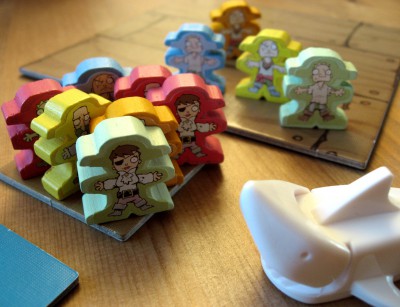
Walk the Plank!
– Image by boardGOATS

It’s not that we are averse to KickStarter games, it is just that the risk a game will have problems is much higher.  Sadly, KickStarter games often have poor rules and/or turn out to be a little rough round the edges and it is not always possible to tell from the project description. For example, Formula E looked like it would be a great racing game in the mold of Ave Caeser.  Unfortunately, although we’ve had fun with it, it has massive gaps in the rules and consequently has not had as many outings as it otherwise might have had.  On the other hand, Walk the Plank! has turned out to be one of the group’s all time favourite, silly-filler games and has more than justified the initial outlay.

Boardgames in the News: Twenty Awesome Games according to The Guardian

The Guardian boardgame section has produced a number of interesting articles over the last few months, including one about a French Scrabble champion who doesn’t speak French; an article discussing the impact of political boardgames, and a review of the cooperative war game, 7 Days of Westerplatte, where players take on roles of Polish defenders trying to save their city from attack in September 1939.

7 Days of Westerplatte
– Image used with permission of BGG contributor henk.rolleman

Their latest article is entitled, “20 Awesome Board Games You May Never Have Heard Of” and as well as the inevitable usual suspects, there are indeed a number of even less widely known games.  Popular franchise games are included like spin-offs from A Game of Thrones and Firefly to catch the eye of the general public, but these have a good reputation amongst gamers too.  Twilight Struggle also makes its second newsworthy appearance in a month, as well as the slightly less well known gateway games, Dominion and 7 Wonders.

Twilight Struggle
– Image used with permission of BGG contributor killy9999

More interesting are some of the other inclusions.  For example, Survive: Escape from Atlantis! is an excellent game that is very easy to teach, but has a nasty edge, with players trying to save their meeples while encouraging monsters to attack everyone else’s.  Although it is a great game to play with teenagers and students, for some reason it very rarely makes this sort of list.  Similarly, newer games like the 2014 Pandemic spin-off, Pandemic: Contagion and this years’s Spiel des Jahres winner, Colt Express also get a mention.

Colt Express
– Image used with permission of BGG contributor punkin312

It’s not all light family fare either and games like the well regarded semi-cooperative game, Dead of Winter, make an appearance as well as older “Geek Fayre” like Netrunner and Civilisation.  Perhaps the biggest surprises though are Antiquity and Euphoria: Build a Better Dystopia.  These are both much more obscure games:  Antiquity is produced in very small numbers by Splotter (and is currently out of print), and Euphoria is the product of a very successful KickStarter campaign by Stonemaier Games.  The inclusion of games off the beaten track, shows that the Guardian boardgames coverage is from people who know their subject matter much better than those at the Telegraph!  As such, these Guardian articles are always well worth a look and it will be interesting to see what comes of their quest to find the worst games people have played.

Dead of Winter: A Crossroads Game
– Image used with permission of BGG contributor mikehulsebus

Boardgames in the News: Twenty Awesome Games according to The Guardian

The Guardian boardgame section has produced a number of interesting articles over the last few months, including one about a French Scrabble champion who doesn’t speak French; an article discussing the impact of political boardgames, and a review of the cooperative war game, 7 Days of Westerplatte, where players take on roles of Polish defenders trying to save their city from attack in September 1939.

7 Days of Westerplatte
– Image used with permission of BGG contributor henk.rolleman

Their latest article is entitled, “20 Awesome Board Games You May Never Have Heard Of” and as well as the inevitable usual suspects, there are indeed a number of even less widely known games.  Popular franchise games are included like spin-offs from A Game of Thrones and Firefly to catch the eye of the general public, but these have a good reputation amongst gamers too.  Twilight Struggle also makes its second newsworthy appearance in a month, as well as the slightly less well known gateway games, Dominion and 7 Wonders.

Twilight Struggle
– Image used with permission of BGG contributor killy9999

More interesting are some of the other inclusions.  For example, Survive: Escape from Atlantis! is an excellent game that is very easy to teach, but has a nasty edge, with players trying to save their meeples while encouraging monsters to attack everyone else’s.  Although it is a great game to play with teenagers and students, for some reason it very rarely makes this sort of list.  Similarly, newer games like the 2014 Pandemic spin-off, Pandemic: Contagion and this years’s Spiel des Jahres winner, Colt Express also get a mention.

Colt Express
– Image used with permission of BGG contributor punkin312

It’s not all light family fare either and games like the well regarded semi-cooperative game, Dead of Winter, make an appearance as well as older “Geek Fayre” like Netrunner and Civilisation.  Perhaps the biggest surprises though are Antiquity and Euphoria: Build a Better Dystopia.  These are both much more obscure games:  Antiquity is produced in very small numbers by Splotter (and is currently out of print), and Euphoria is the product of a very successful KickStarter campaign by Stonemaier Games.  The inclusion of games off the beaten track, shows that the Guardian boardgames coverage is from people who know their subject matter much better than those at the Telegraph!  As such, these Guardian articles are always well worth a look and it will be interesting to see what comes of their quest to find the worst games people have played.

Dead of Winter: A Crossroads Game
– Image used with permission of BGG contributor mikehulsebus

Boardgames in the News: The Best Games Featuring Maps

The “Brilliant Maps” Blog recently listed what it considered “The 28 Best Map Based Strategy Board Games You’ve Probably Never Played“.  Leaving aside the fact that most dedicated gamers will have played many of them, how valid is this list?  On closer inspection it turns out that the list is really just the top twenty-eight games listed on BoardGameGeek.com (BGG) that happen to have a map for the board.  As such, it makes no subjective judgement on the quality of the map and is simply a list of the best games according to BoardGameGeek that feature a map.

Twilight Struggle
– Image used with permission of BGG contributor killy9999

For example, the game with the highest rating on BoardGameGeek.com is Twilight Struggle which is a Euro/war game hybrid and is therefore played on a map.  The map is not particularly picturesque, however, though for those old enough to remember, its spartan nature is strongly evocative of the Cold War setting.  Is it a great map though?  It certainly captures the theme of the game and perhaps, as such, it is indeed a great map.

Terra Mystica
– Image by BGG contributor Verkisto

Unsurprisingly, many of the games mentioned are war games.  There are a fair number of Euro games too though:  high on the list are Terra Mystica at number two, Brass at four and Power Grid at six.  Number ten on the list is Concordia and eleven is El Grande – a game that is celebrating its twentieth anniversary this year.  Further down are Tigris and Euphrates, Steam, Pandemic, Ticket to Ride: Europe, Carcassonne and finally, just sneaking onto the list, The Settlers of Catan (or Catan as we are now supposed to call it).  All these games indeed include maps of some description, but overwhelmingly, they are also all well-established “classic” games.  Are they the best maps though?

Amerigo
– Image used with permission of BGG contributor Oceluna

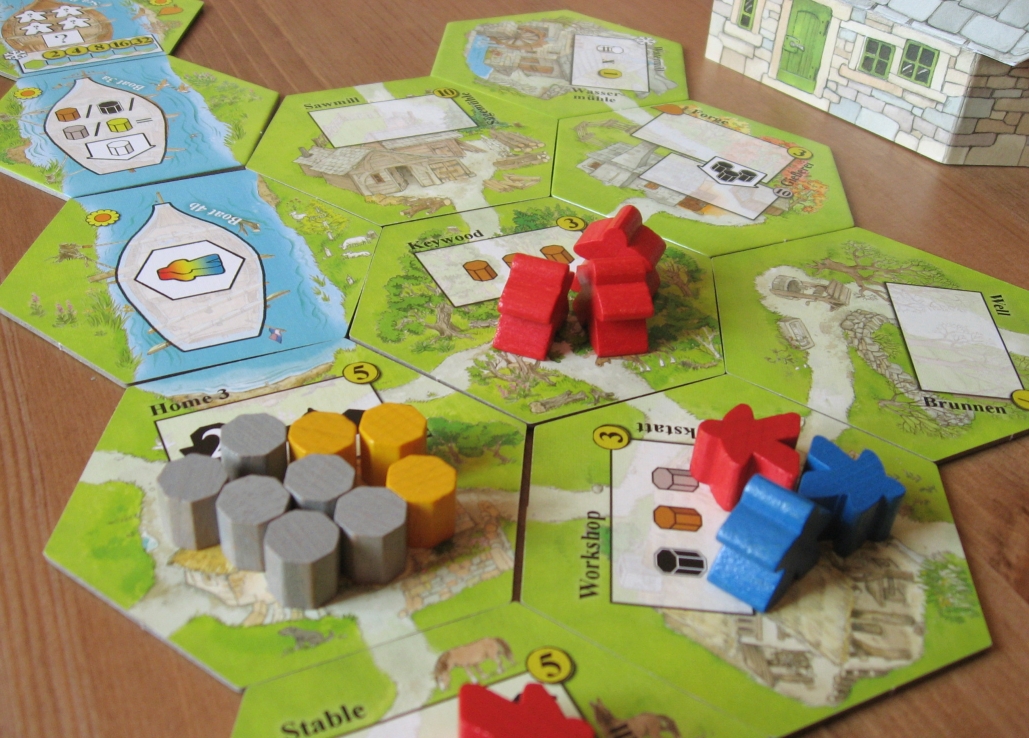
There are some stunningly beautiful games that haven’t made the list, for example, Amerigo is played on a beautiful seascape and Lancaster includes a lovely map of the England.  How do we define “map-based game” however?  Clearly, a map is is a two-dimensional play space so that excludes games where the play-area is predominantly linear i.e. “a track”.  But what about games where the map is produced as the game is played?  If Carcassonne is considered a map game, other games where the board is built during the play should also be included, like Saboteur and Takenoko.  What about one of our favourite games at boardGOATS, Keyflower?  In this game, players buy tiles and then use them to build their own personal little village map.  Should this be included too?

Keyflower
– Image by boardGOATS

Ultimately, none of this really matters of course:  a game is a game and it all comes down to how much people enjoy playing it.  One thing is clear though, while a game can be good in spite of the rendering, playing with beautiful components can only enhance the boardgame experience.

Carcassonne
– Image used with permission of BGG contributor Topdecker

Boardgames in the News: Meeples in the Dictionary

Yesterday, OxfordDictionaries.com announced that together with words like “Grexit” and “Cat café”, they had added “meeple” to their online dictionary.  They define it as  “a small figure used as a playing piece in certain board games, having a stylized human form“.  They add that the origin is “apparently a blend of my and a phonetic respelling of people and first used with reference to the board game Carcassonne“.

Carcassonne
– Image from thirstymeeples.co.uk

Boardgames in the News: The Eight Million Dollar Card Game

Crowd-funding has proven to be a real money spinner – KickStarter projects with lots of miniatures raising loads of money are not uncommon, especially if they include Zombies.  This is a different phenomena though:  in February, a small card game raised $8,782,571 from 219,382 backers, becoming both the most-funded game and the project with the largest number of backers in KickStarter History.  The game? Well, it is called Exploding Kittens and the backers are just beginning to receive their “rewards”.

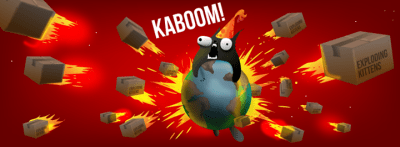
Exploding Kittens
– Image from explodingkittens.com

Exploding Kittens is described as “a highly strategic kitty-powered version of Russian Roulette”.  The KickStarter project goes on to say, “Players take turns drawing cards until someone draws an exploding kitten and loses the game” – so, not that strategic then.  Clearly it is a light, luck-heavy card game that would probably benefit from the involvement of alcohol and could  be fun in the right circumstances, but why does it have so many backers?  Even more so, why has it been so successful when the cost is $35 per copy for the KickStarter Exclusive deck (excluding postage) and similar games can be had for less than a third of that?

Exploding Kittens
– Image from explodingkittens.com

Obviously the target audience are not dedicated boardgamers – the project wasn’t even posted in the Tabletop Games Category.  The game was created by Elan Lee, Former Chief Design Officer for Xbox Entertainment Studios, and was the lead designer of “The Beast”, a promotional alternate reality game for Steven Spielberg’s movie “A.I. Artificial Intelligence”.  That isn’t the reason for  the game’s overwhelming success though.  The key is the tie in with The Oatmeal, an online comic created by Matthew Inman.  The comic began in 2009 and within a year had an average of 4.6 million unique visitors and more than 20 million page views a month.  With that sort of fan-base it is less surprising that the project was able to get nearly quarter of a million investors to become the third largest fund-raiser in the history of KickStarter.

Exploding Kittens
– Image from explodingkittens.com