This has just been spotted – it wasn’t us, honest!
 |
| – Image by Twitter user @Vague_Inkling |
This has just been spotted – it wasn’t us, honest!
|
| – Image by Twitter user @Vague_Inkling |
Every few days there is a new boardgame launched on KickStarter, but it is rare that such a perfect theme is used…
 |
| – Image from kickstarter.com |
We look forward to giving it a go if/when it gets funded.
Every few days there is a new boardgame launched on KickStarter, but it is rare that such a perfect theme is used…
|
| – Image from kickstarter.com |
We look forward to giving it a go if/when it gets funded.
Each year a jury of German-speaking board game critics (from Germany, Austria, Switzerland), review all the games released in Germany in the preceding twelve months. Their job is a really important one amongst gamers, because they award the coveted Spiel des Jahres, the German Game of the Year. There are also other awards including the Kinderspiel and Kennerspiel des Jahres (Childrens’ and Connoisseurs’ Games of the Year). These awards are highly lucrative for the winners as many German families look for the red logo when choosing games to buy at Christmas.
 |
| – Image from spieldesjahres.de |
The criteria used by the judges include:
The announcement of the Spiel and Kennerspiel des Jahres awards will be made early in July. Last year, the winner was Camel Up with Splendor as runner-up and Istanbul taking the Kennerspiel des Jahres award. The nominees for this year have just been announced and this year, unusually, we haven’t played any of them in the group yet. However, one of our more popular two-player games, Patchwork was included as a recommended game and we are planning to play one of the nominees, Machi Koro, this week.
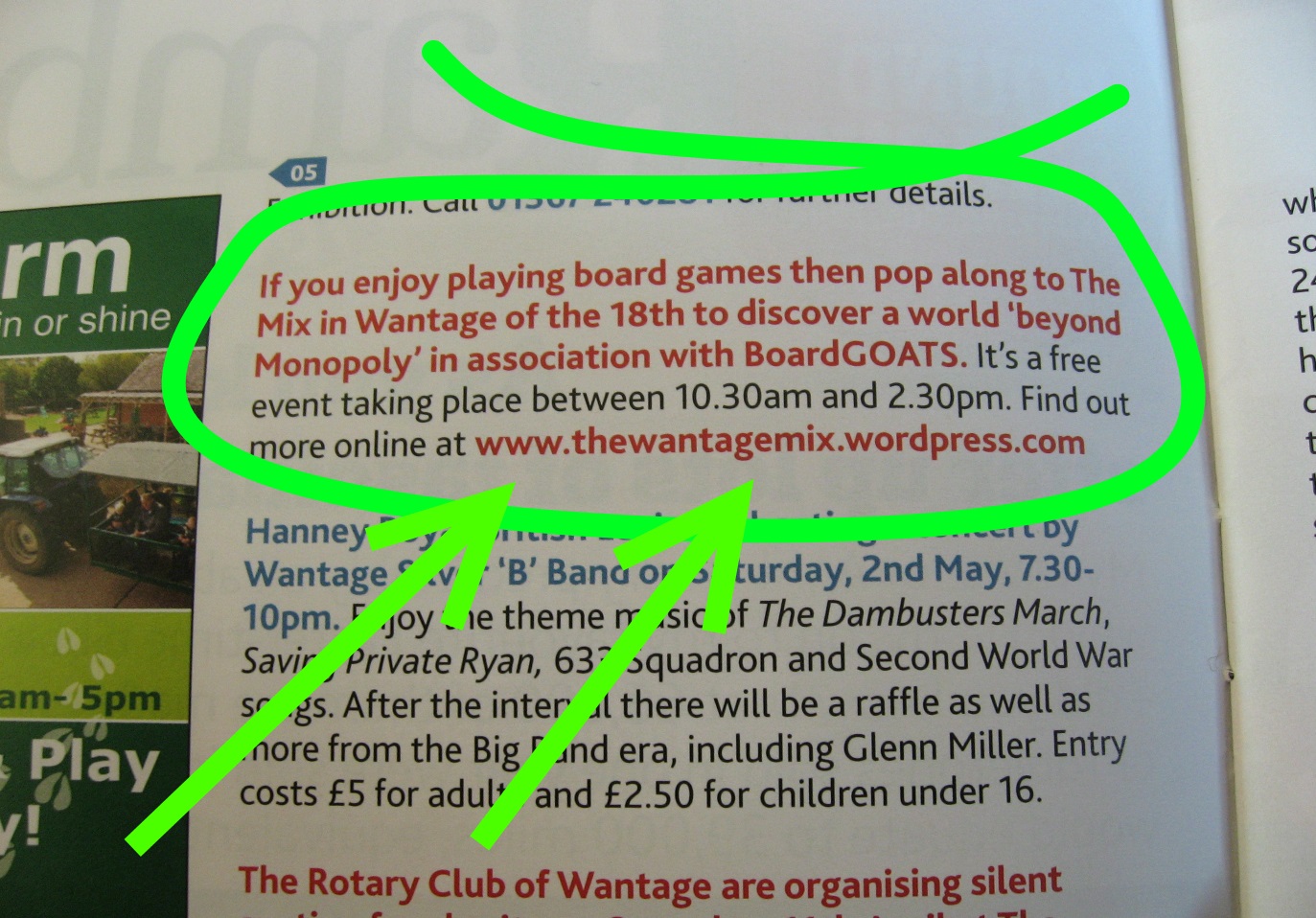
The Mix in Wantage town centre is holding a drop-in gaming session on Saturday from 10.30 am until 2.30 pm. Members of the club are providing games and will be teaching people how to play them.
 |
| – Image from thewantagemix.wordpress.com |
There isn’t an awful lot of space so the idea is to encourage people to drop in and play a short game or two. We are planning to bring a few eye-catching games like PitchCar, Riff Raff, Bamboleo, Toc Toc Woodman, and Saturn, but most of the gaming will be smaller filler games like Dobble, Turf Horse Racing, No Thanks!, Walk the Plank!, The Great Balloon Race and some of our other light favourites. We will also be bringing some classic gateway games like Carcassonne, Ticket to Ride, The Settlers of Catan and Jamaica as well as a small number of deeper games, just to show people what else is out there.
 |
| – Image by boardGOATS |
The event has been well advertised and was mentioned in the Ramblings section of the April edition of the local magazine, “Round and About”, so we are hoping for a decent turn-out. Please pop in if you are in the area on Saturday.
International TableTop Day was founded three years ago as a way for the world to celebrate tabletop gaming together. Every spring, gamers host thousands of events all over the world and every year, the event grows. Last year over 3,000 events were held in 80 countries, over all 7 continents.
 |
| – Image from tabletopday.com |
Although boardGOATS are not doing anything specifically for International Tabletop Day this year, we will be holding a gaming day next Saturday at The Mix in Wantage.
The growing interest in boardgames continues with an item on the Chris Evans Breakfast show on Radio 2 featuring Simon Read from Thirsty Meeples (starts at 1:47:30). Sara Cox was sitting in for Chris Evans and conducted the short telephone interview discussing the Oxford games Cafe. Unfortunately she was a bit obsessed with “classics” like Monopoly, Scrabble, Cluedo, Connect 4 and Mouse Trap. Simon did his best to talk about Survive: Escape from Atlantis! and The Settlers of Catan, but in truth, while it was a nice little bit of advertising for the Thirsty Meeple, Sara was too determined to move onto Cold Play…
 |
| – Image from bbc.co.uk |
The rise of the internet has changed everything. When UK designers like Alan R. Moon and Richard Breese first started publishing their small numbers of “designer games”, these were often mostly advertised through magazines and by word of mouth. Now we have boardgamegeek.com (or BGG for short), which provides an extensive database of boardgames as well as an active community of users who discuss, argue about, buy, sell, trade and play board games. Their database contains over 76,000 board games each with its own entry that includes general information about the game, user ratings, forums for discussion and user reviews amongst other things. There are also websites devoted to online versions of boardgames, where players can try new games to see if they like them (before spending money) and hone skills by playing against other people from all over the world.
 |
| – Image from boardgamegeek.com |
The UK boardgamer also now has a wealth of possible vendors: they might start with Amazon to get a baseline price, then perhaps try one of the excellent specialist online sellers like BoardGameGuru, Games Lore, or Infinity Games. Importing games is also an option: many international editions are cheaper in continental Europe than here, even when shipping is factored in. Alternatively, there are a number of excellent UK shops which also have an online presence like Shire Games and Spirit Games. People in the Oxford area also have a couple of local choices that they can visit too, including Thirsty Meeples and The Gameskeeper. And this is before you include the fact that high street stores like Waterstones and WHSmith often stock a small selection and even The Works has has some Rio Grande Games available recently.
 |
| – Image from indiegogo.com |
In the last few years though, there has also been the internet phenomenon of crowd funding. There are several crowd funding websites that enable designers of all sorts of things to propose projects, however, the two main sites used by boardgamers are Indiegogo and KickStarter. These provide an entirely new model where a designer advertises their design and anyone can pledge to support them financially. Typically this works through a system of pledges and associated rewards. For example, if a supporter pledges $5 they may be rewarded with a novelty meeple, whereas if they pledge $50 they are rewarded with the whole game and for $500 they might get the signed first copy. This is distinct from a pre-order as there is no contract between the designer and supporter. Also, each project is usually advertised for a set period time with a given financial target, if this is not reached, then the project is cancelled. If it exceeds its goal, then additional “stretch goals” may be set out which can lead to improvements in the game when it is produced.
 |
| – Image from iconfinder.com |
So, the advantage of this approach is that the risk is spread out amongst all the supporters enabling many people to produce games in a way that would not otherwise be possible. There are also a number of disadvantages of crowd funding, however. There are very long delays involved, with some games taking eighteen months to two years or more longer than projected. There are also a lot of gamers who admit that they have become addicted to supporting projects which has led to a lot of people paying over the odds for rubbish. Primarily though, the biggest problem is that supporters feel a sense of entitlement: they are used to buying a game and if their reward does not materialise, they feel aggrieved. Most projects end with supporters getting a reward of some kind even if it is not as originally envisaged.
/pic2346186.jpg) |
| – Image used with permission of BGG contributor The Carmen |
Some games have been hugely successful, raising eye-watering sums of money. For example, Zombicide Season 3: Rue Morgue yielded nearly $3 million with over 12,000 backers. However, there have been a number of high profile “problem projects”. For example, when costs spiraled for the production of Glory to Rome, most backers got their game, but the project leader, Ed Carter lost his house. In the case of Up Front, the boot was on the other foot, though. This was a remake of an old card-based WWII war game and 2,407 backers pledged a total of $339,848 to get it made, more than ten times its modest $30,000 funding goal. Unfortunately, the companies involved in its production, Valley Games and Radiant Gaming, became mired in a legal dispute with their financier, so their assets were frozen and all other sources of funds were used to line the lawyers’ pockets. Although the case is still making its weary way through the courts, it seems unlikely that there will be enough money or inclination to actually make the game once everything has been resolved. There have also been cases that appear to be blatant theft, for example Seth Nemec allegedly took over $20,000 to produce a reprint of the Kosmos game, Odin’s Ravens, and then disappeared. Fraudulent cases have become such a concern that in the case of Asylum, the Washington State Attorney General Bob Ferguson stepped in, filing a law suit against the producer.
/pic162086.jpg) |
| – Image used with permission of BGG contributor Lord_Prussian |
These are not the only crowd funded projects that have had problems by any stretch of the imagination, however, the vast majority end happily, with happy supporters happily playing their rewards (if a little late). But is the boom in crowd funding here to stay or just a flash in the pan? Well, to date, there have been over 16,000 projects listed in the “games” category on KickStarter alone, with a success rate of about 1/3, raising over $334 million. “Games” is one of the largest categories on the site and is the most lucrative, however, it includes much more than just boardgames. In 2014, there were 454 successful board and card games on KickStarter raising a total of $26.1million dollars. This is a 40% increase in the number of games, but is accompanied by a 10% drop in the total spent from the previous year. It is hard to draw any meaningful statistics from something that has been going for such a short amount of time and is highly cyclical, but it would seem that these statistics reflect a change that many backers have been feeling.
/pic2290269.png) |
| – Image used with permission of BGG contributor mgcoe |
With prices increasing, gamers are getting more cautious about spending over $100 on a game that they won’t see for months and may never see at all. So the number of the really expensive (mostly miniatures) games is decreasing, and even the medium sized games are becoming less abundant. Postage is also undoubtedly a factor and the games that are most successful now tend to be the mini and micro games where costs are much lower. For example, Tiny Epic Kingdoms and Tiny Epic Defenders raised $440,000 between them last year and Tiny Epic Galaxies (their sequel) raised over $400,000 alone when it funded last month. Thus, although the total amount raised is falling, the number of backers and games produced is increasing.
 |
| – Image from queen-games.de |
There is much more to this however. There are a number of companies that are using KickStarter as glorified pre-order system that allows the backers to shoulder the burden of risk. These proven companies are not seen as risky by gamers and are still proving highly productive. For example, Queen Games (who are also part of the ever growing Asmodée group) raised over $100,000 earlier this year on their Lancaster: Big Box project and most of their smaller projects fund successfully at around $30,000. It is clear why the KickStarter model is appealing to such companies as it allows them to sell directly to their consumers enabling them to pass some of the savings on. However, these are quite controversial as most of these projects have very little in the way of stretch goals and are often seen simply as a way to sideline distributors and game stores.
/pic2405005.jpg) |
| – Image used with permission of BGG contributor dukelander |
It is undeniable that KickStarter has had an impact on the way people purchase games, but hitherto it has only affected a small part of the market. However, if the “Queen model” continues to grow and is taken up by other companies, then KickStarter will begin to have a much more significant impact on gamers as it could start to put games vendors out of business and that is bad news for everyone.
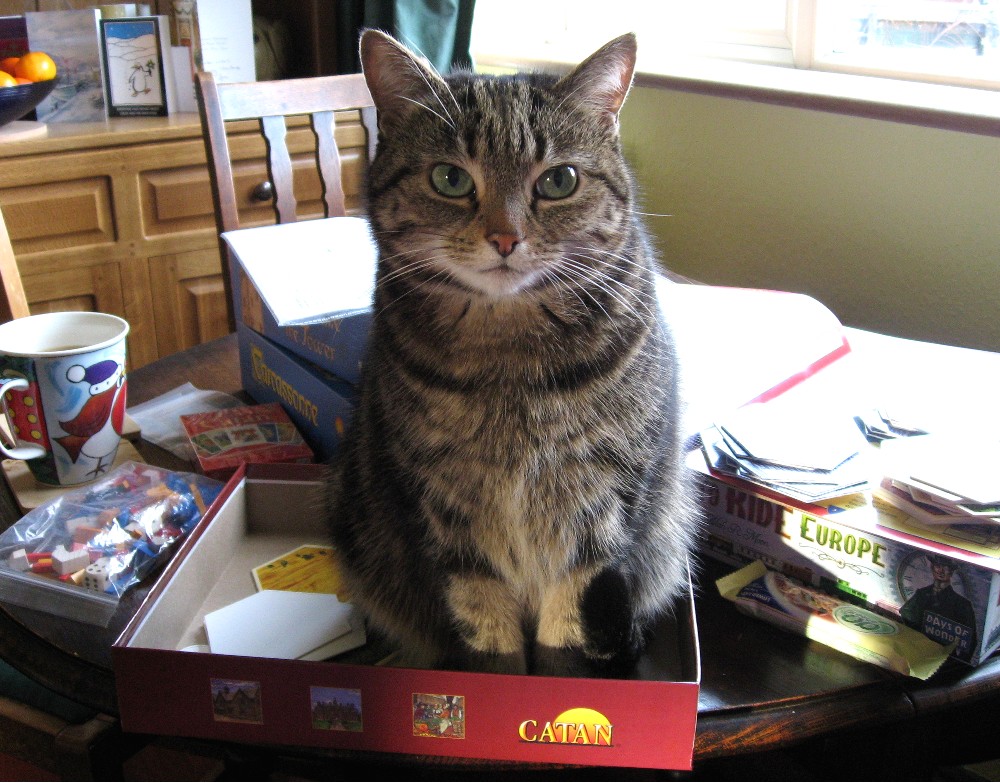
Anyone who came to meetings while the pub was closed (due to the fire), will remember Susie. She was the grumpy little cat who grudgingly put up with our visits and, in time became almost friendly with people. Sadly, Susie passed away this morning, at home in the arms of her faithful servant.
 |
| – Image by boardGOATS |
Asmodée is the French translation for Asmodeus, and according to Binsfeld’s classification of demons, Asmodeus is the demon of lust and is therefore responsible for twisting people’s sexual desires. In the boardgame world though, Asmodée (originally known as Siroz) are a small French game publishing and distribution company, specialising in the family market. For example, they are well known for Dobble, Dixit, Time’s Up! and Ca$h ‘n Guns, but they also publish some more challenging games including Snow Tails, Mr. Jack, Formula D, Takenoko and 7 Wonders.
/pic888678.jpg) |
| – Image used with permission of BGG contributor kilroy_locke |
Asmodée was started in 1995 by Marc Nunès, a self-trained entrepreneur developing role-playing games, but quickly became France’s foremost games publisher and distributor. One of the big early successes was Jungle Speed, launched in 1998, which has since gone on to be one of the top-selling titles in France, rivalling Monopoly, Trivial Pursuit and Pay Day. The real turning point came in 2003, however, when Asmodée obtained the French licence to distribute Pokémon collector cards, which opened up the mass retail sector. This development led to an 18% investment from Naxicap in 2005. Naxicap’s stake was bought out two years later by Montefiore who acquired 60% of the company as part of a deal with management worth €40-50 million. Montefiore invested €120 million to finance Asmodée’s international growth, funding the acquisition of the Belgian game distributor Hodin in 2008, the Spanish games developer Cromola and the German Proludo in 2009, followed by the purchase of a 60% stake in the UK-based distributor, Esdevium Games in 2010. Asmodée also strengthened it’s portfolio with the acquisition of Abalone and partnership with Libellud (leading to the distribution rights for Dixit) in 2010.
/pic1159907.jpg) |
| – Image used with permission of BGG contributor msaari |
In 2012, Asmodée branched out further, setting up a subsidiary in Shanghai, China, with the intention of expanding “into a new market taking advantage of Asmodee’s extensive line-up of games and the existing relationships with partners, thus promoting the brand in mainland China, Hong Kong and Taiwan”. This ambition brought Asmodée to the attention of the Eurazeo, a European investment company and a deal was announced in November 2013 that valued Asmodée at €143 million. In January, 2014, almost exactly a year ago now, Eurazeo bought 83.5% of Asmodée through an equity investment of €98 million while Asmodée’s management team and original founders reinvested €14 million of their own money.
/pic115214.jpg) |
| – Image used with permission of BGG contributor garyjames |
With the backing Eurazeo provided, Asmodée then went big: in August last year it was announced that Days of Wonder would be “merging into the Asmodée Group of game companies”. Days of Wonder are one of the biggest names in modern boardgaming, and are often credited with the growth of the modern boardgame industry, thanks largely to their flagship Ticket to Ride games, which have sold well over two million copies to date. This is not the only “big game” in their catalogue either, they are also responsible for Memoir ’44 and Small World, both of which are popular games, demonstrated by the number of expansions they support and which take Days of Wonder’s total number of games sold to over five million since their founding in 2002.
/pic605953.jpg) |
| – Image used with permission of BGG contributor crosenkrantz |
According to Forbes, Days of Wonder generates between $10 million and $20 million in revenue annually, not bad in such a niche market. From Eurazeo/Asmodée’s point of view, such an acquisition makes sound financial sense, not just because of the commercial value, but because they already provided a lot of the distribution for Days of Wonder games. This wasn’t enough for Asmodée however, and three months later, they acquired the U.S. publisher Fantasy Flight Games.
/pic2387968.jpg) |
| – Image used with permission of BGG contributor adamfeldner |
This was a bit of a change of direction for Asmodée: hitherto, all the acquisitions had been firmly in the family boardgame and distribution markets. Fantasy Flight games are a very different animal and their headline games, Twilight Imperium and Arkham Horror are much less family friendly. Even their X-Wing Miniatures Game which is very popular with fathers and sons, is a long way outside the normal scope of Asmodée, since it is essentially a two-player war game with a Star Wars theme. However, there are considerable benefits for both parties, since the merger will enable Fantasy Flight to improve its distribution in Europe, while simultaneously giving the growing Asmodée Group access to Fantasy Flight’s North American sales and marketing teams.
/pic2214371.jpg) |
| – Image used with permission BGG contributor Toynan |
Asmodée weren’t stopping there, however, with Ystari Games, Asterion Press and Pearl Games also becoming “part of the Asmodée family” late last year. The link with Ystari Games almost certainly comes from their mutual interest in Space Cowboys. Space Cowboys is a game creation studio created in 2013 by Marc Nunès (who started Asmodée way back in 1995, remember?), Philippe Mouret and Croc (both of Asmodée), Cyril Demaegd (Ystari) and Sébastien Pauchon (GameWorks). Space Cowboys is a very small outfit, but already has one Spiel des Jahres nomination under its belt in Splendor and looks to be trying for a second with Black Fleet, the gorgeous pirate game released at Essen last year.
 |
| – Image from eurazeo.com |
So, what are Asmodée up to? The concern is that gamers generally like the current diversity in the market and fear that this succession of mergers and partnerships will mean a homogenisation of the games available. The November 2014 Eurazeo “Investor Day” report spelled out the current state of Asmodée in detail and the good news is that this does not seem to be Eurazeo/Asmodée’s intention. The report states, “Each studio has its own DNA,” and goes on to say, “Repeated success lies in the full independency granted to these studios, to keep innovating.” So it seems the diversity is valued, however, by acquiring mid-sized publishers like Days of Wonder and Fantasy Flight, Asmodée is positioning itself to compete more effectively with multinational toy giants like Hasbro and Mattel, who publish top board game brands including Monopoly and Scrabble.
 |
| – Image from eurazeo.com |
So, is it a good thing that Asmodée are setting themselves up to rival the big boys? Well, Asmodée is not the only company to engage in mergers: in 2011 Filosofia purchased the U.S. publisher Z-Man Games, and U.S. publisher FRED Distribution (which releases games under the Eagle Games and Gryphon Games brands), acquired U.S. publisher Face2Face Games. More recently, in late 2013, Mayfair Games (the U.S. partner for Catan) bought a controlling interest in Lookout Games (the company who first brought Agricola, Caverna, Le Havre and Ora et Labora to the market).
 |
| – Image from escapistmagazine.com |
Clearly a large stable company provides security for designers, as well as providing support for the individual studios who know that one poor decision is no-longer likely to bring about the end of the company, both of which have to be A Good Thing. However, companies like Eurazeo invest for only one reason: financial return. With an effective monopoly, Asmodée are now in a position to squeeze the market, indeed we may already be seeing the evidence of this in the price rises announced at the start of the year. With this in mind, it will become clear in due course whether Asmodée is good for boargaming in the UK or whether it is genuinely the demon of lust responsible for twisting our gaming desires…
 boardGOATS