Category Archives: News

It’s the Year of the Goat – Happy New Year!

Although China has used the Gregorian calendar since 1912, Chinese New Year is based on the ancient Chinese lunar calendar, and it falls on the second new moon after winter solstice – somewhere between 21st January and 19th February (which means it changes from year to year).  So, Thursday was the first day of the new Chinese year, and 2015 is the year of the goat!

The Year of the Goat
– Image from feng-shui-consultants.com

So, Happy New Year, or “Gong Hey Fat Choy”!

Boardgames in the News: 20 Years of Catan and El Grande

It seems to be the year for anniversaries: arguably 2015 celebrates significant anniversaries for two of the greatest games in boardgaming history.  We are not talking about Monopoly here (though there has been a lot written about the 80th anniversary of the brand).  The games in question were both released in Germany in 1995:  The Settlers of Catan and El Grande.   The first of these, Klaus Teuber’s The Settlers of Catan, is widely known amongst gamers and many non-gamers, and is often cited as being responsible for the “gaming revolution”.  The base game of “Settlers” (or “Die Siedler”) and its expansions have appeared in thirty languages and sold more than twenty-two million copies worldwide.  At Spielwarenmesse, The International Toy Fair at, Nürnberg, Kosmos and Mayfair unveiled a new look for the entire line of Catan games.

The Settlers of Catan
– Image used with permission of BGG contributor kilroy_locke

The press release explains, “The new look will strengthen the Catan brand both domestically and internationally.  The new cover art utilized by all partners will provide a visual continuity throughout the world.  This new look is more vibrant and alluring with overall improved presentation and splendidly clean branding. The new packaging cries out… CATAN!”  It goes on to say, “As part of the growing expansion of the Catan® family of products, the base game will simply be called CATAN® in all countries and languages, along with a unification of the game’s graphic design in all territories and languages.”

The Settlers of Catan
– Image by BGG contributor herman_the_german

There are a couple of curious things about this, firstly, when Kosmos released the game twenty years ago, it was just going to be called “The Settlers” (or rather “Die Siedler” since it was released in German first).  That was until Blue Byte published a computer game by the same name, so Kosmos decided they wanted something more unique and identifiable and made up “Catan”.  Secondly, aside from the the editions released in English by Mayfair Games (who went its own way with original art and component design), the brand has already been “unified” in its look!

The Settlers of Catan
– Image by BGG contributor degamer

The second of the games mentioned above is El Grande, which was first published in Germany by Hans im Glück.   Like “Settlers” the year before (or “Catan” as we must now call it), in 1996, Wolfgang Kramer and Richard Ulrich’s El Grande was awarded both the Spiel des Jahres and the Deutscher Spiele Preis.  Although it is less widely known than its predecessor, El Grande is hugely respected by gamers often cited as “still the best area control game”.  It is so highly thought of that it continues to be higher on the BoardGameGeek ranking than The Settlers of Catan and many other well known and hugely popular games including Carcassonne, Ticket to Ride, Pandemic and Dominion.  These games are all continuously reprinted, but sadly, the nature of boardgames means that many good titles go out of print.  Unfortunately, El Grande is one such game; it had fallen out of favour with its publishers and has not been reprinted in English or German since the Decennial Edition, ten years ago.

El Grande
– Image used with permission of BGG contributor garyjames

There are a number of reasons why games like this go out of print.  Firstly, much as we hate to admit it, boardgaming is a niche market:  Hasbro recently proudly announced that Monopoly has sold 275 million copies over the eighty years, but compare this with the estimated 450 million Harry Potter books sold in a fraction of the time.  In turn, these make Catan’s 22 million copies look positively paltry by comparison and for games that fail to make the jump to the wider market, the first print run is often only a few thousand.  Whether or not one of these games gets a second print run depends on demand and sale-speed of the first impression, and ultimately, whether or not the publisher thinks it can secure a good return.  Factors that affect this, obviously include the mark-up and the Recommended Retail Price (or RRP, sometimes known as Manufacturer’s Recommended Sale Price or MRSP).  Games that have language dependent components usually suffer here.

El Grande
– Image used with permission of BGG contributor DrGrayrock

There are two main markets:  Germany and USA.  We in the UK benefit from the fact that the USA nominally speak the same language as us, but otherwise, the UK boardgame market is relatively small-fry.  Anyhow, for this reason, games are commonly released primarily in English and German, however, the margins are clearly much larger if the same game can be released to both markets with minimal reworking, and companies like Z-Man Games have made a name for themselves translating the best European games for the English market.  Other companies (e.g. Zoch, Queen and R&D Games) release games as “international” editions which include language independent components and rule booklets in multiple languages.

El Grande
– Image by BGG contributor Domostie

Obviously, it is much more difficult to release a multi-lingual edition if key components include significant text.  It is also much easier to translate a game if the only change needed is the box and the rules; El Grande clearly fell foul of this.  However, so did The Settlers of Catan, and that didn’t do so badly.  So there are obviously other factors, including game play, accessibility, approachability, appearance and marketing.  There is no question that the trading dynamic and controlled randomness in Catan are key parts of its success as they keep everyone involved between turns, but timeliness is probably the real key:  it was perhaps just the right time for a family game that felt a bit different.  So, by the time El Grande came along, well, everyone was playing Settlers, and as a result, El Grande didn’t make quite the same impact.

El Grande
– Image by BGG contributor Bernaar

That doesn’t mean it is less of a game though, so it is great news that Hans im Glück has recently announced the long-awaited return of El Grande, this time in the form of a Big Box with upgraded components.  The Big Box is a collection that, like the Decennial Edition ten years ago, will contain all the expansions that have been officially released over the years.  Z-Man Games has also confirmed that it will release a parallel Big Box in English; Dutch publisher 999 Games will be doing the same in Dutch and have also mentioned a “Jubileumuitbreiding”, or “anniversary extension”.  Clearly anniversaries are to be celebrated, especially if it means older, well-loved games become available once more.

Save the Date: Mixing it in Wantage

The Mix in Wantage town centre is a community space that can be booked for use by local groups, organisations, businesses and individuals for activities, fund-raising, meetings, workshops, and presentations etc.  For four days a week The Mix is used as a ‘hot desk’ area for local people to use as a space to work from in town, however, Saturdays and evenings are available for local groups and community events.

The Mix
– Image from thewantagemix.wordpress.com

We will be holding a gaming session from 10.30 am until 2.30 pm on April 18th 2015.  There isn’t an awful lot of space so the idea is to encourage people to drop in and play a short game or two, so we will be bringing along things like PitchCar, Riff Raff, Dobble, Turf Horse Racing, No Thanks!, Walk the Plank!, The Great Balloon Race and some of our other favourite filler games.

Riff Raff
– Image used with permission of
BGG contributor punkin312

Boardgames in the News: How Old is Monopoly Really?

There have been a number of articles in the popular press regarding the 80th Anniversary of Monopoly this year, but what are the origins of Monopoly and how old is it really?

Monopoly
– Image used with permission of
BGG reviewer EndersGame

The boardgame, Monopoly is actually based on a 1904 game called “The Landlord’s Game” designed by Elizabeth J. Magie.  Magie was inspired by American political economist Henry George, who championed progressive property taxes and the game was meant to illustrate the harm caused by land monopolies.  The game, which Magie released herself, spread by word of mouth, becoming popular in the Delaware community of Arden.

The Landlord's Game
– Image by BGG contributor sfessy

Thus, Upton Sinclair and Scott Nearing came across the game and introduced it to others throughout the north-east USA.  Nearing began calling it “Monopoly”, later writing, “the game was used to show the anti-social nature of monopoly.”  The Landlord’s Game continued to sell, and concurrently, Monopoly spread as well, with other players players making changes along the way.  For example, in the 1920s, after buying miniature houses on a trip to the Ukraine, Daniel Layman and brothers Ferdinand and Louis Thun at Williams College in Massachusetts, introduced the idea of using physical houses to mark one’s ownership.  They had a go at marketing their version of the game which they called “Finance”.  Charles Darrow heard about it from his friend Charles Todd, and further developed the game.  Darrow eventually released his version of “Monopoly“, in 1933, using materials from his own home for the pieces:  cards were handwritten, a piece of oilcloth covered the board and the original houses and hotels were made from wooden molding scraps.

Monopoly
– Image by BGG contributor zitt

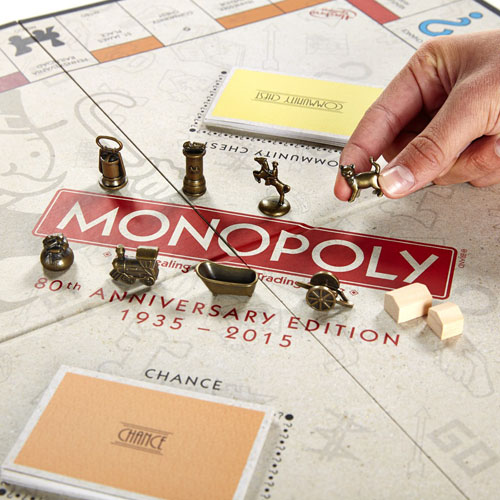
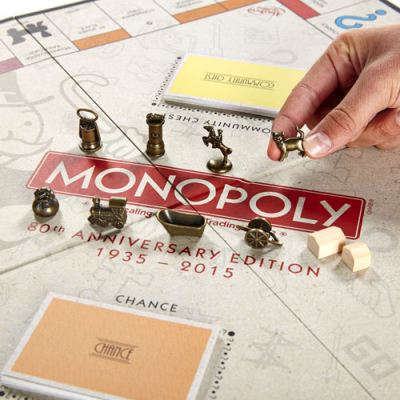
Die-cast tokens were suggested by Darrow’s niece who recommended that charms from a metal charm bracelet were used instead.  The original set included ten tokens:  the iron, the purse, the lantern, the racing car, the thimble, the shoe, the top-hat, the battleship, the cannon, and the rocking horse.  Since then, there have been more than twenty different tokens with the cat the most recent addition.
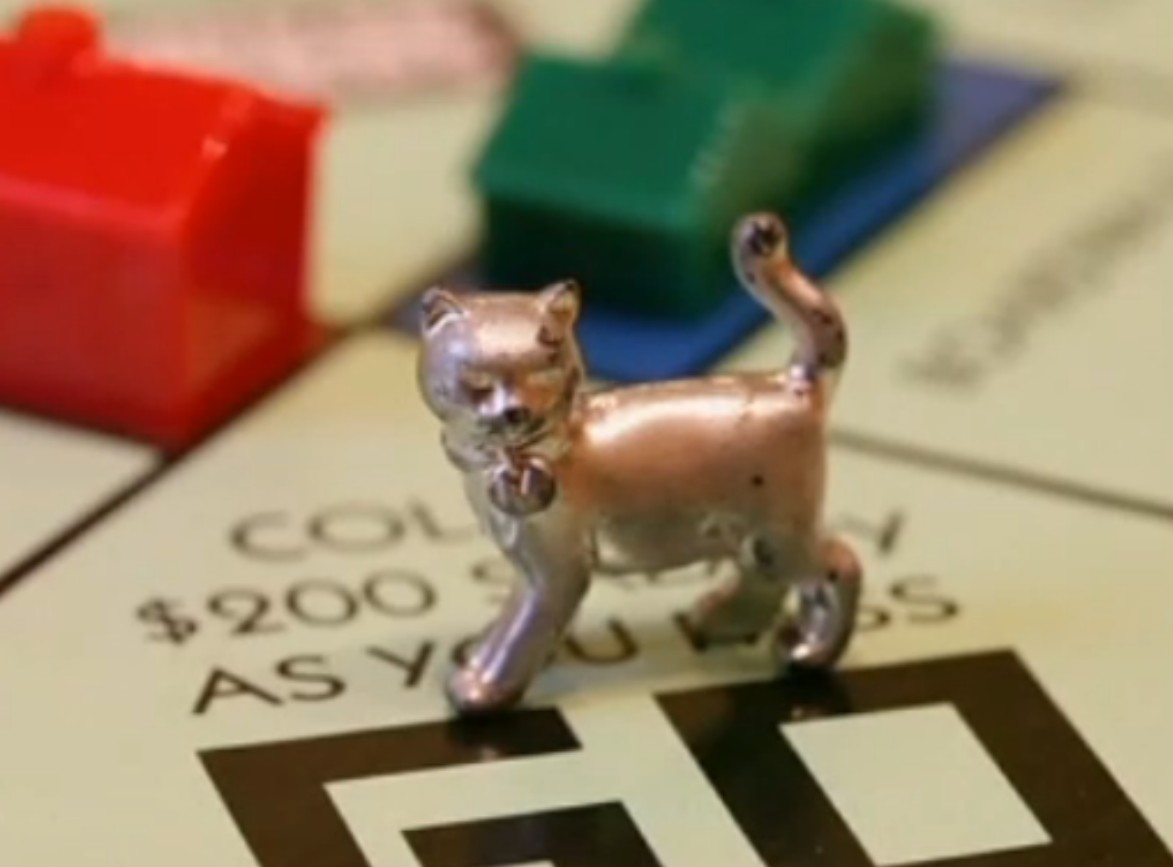
Monopoly Cat Token
– Image of unknown origin

In the early 1930s, in need of money with a young son left brain-damaged by scarlet fever, Charles Darrow presented the game to Parker Brothers.  Parker Brothers promptly rejected it because of its length, theme, and complexity, but reconsidered their decision to purchase rights to market the game after its success in local Philadelphia stores over Christmas period of 1934.  Parker Brothers acquired the rights to the game on March 19th, 1935 and their first editions were published later that year.  Almost immediately, their investment was rewarded as, within a year, they were making 35,000 copies of the board game per week.

Monopoly Flyer
– Image by BGG contributor loopoocat

In 1935, Waddingtons, received the license to distribute Monopoly in Britain who released the well known London edition.  Perhaps a more interesting edition was manufactured by Waddingtons during the second world war.  Paper maps wear out quickly and someone in MI5 suggested printing maps on silk as it’s durable, can be screwed-up folded and unfolded as often as necessary making no noise at all.  At the time, Waddingtons was the only company that had the ability to print on silk.  Since “games and pastimes” was a category of item qualified for insertion into Red Cross parcels, a plan was then hatched to mass-produce escape maps that could be folded so small that they would actually fit inside a Monopoly playing piece.  While they were at it, they also added a two piece metal file hidden in the board, a playing piece containing a tiny magnetic compass and significant amounts of genuine high-denomination German, Italian, and French currency, hidden within the piles of Monopoly money.  These special sets could be identified by a tiny red dot, one cleverly rigged to look like an ordinary printing glitch, located in the corner of the Free Parking square.
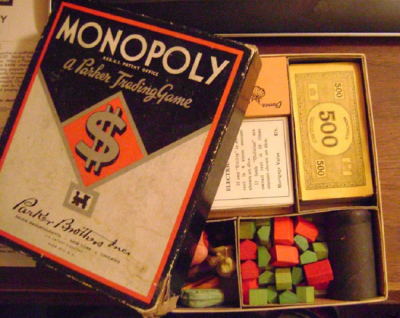
Monopoly
– Image of unknown origin

Parker Brothers secured the Monopoly trademark and Darrow became rich and famous as Monopoly’s creator;  Elizabeth Magie and the others who contributed were all but forgotten.  Then, in the 1970s, Ralph Anspach, an economics professor, brought out Anti-Monopoly. When Parker Brothers sued, the resulting lawsuit required Anspach to track down the game’s past.  After almost ten years of legal warfare, an appeals court eventually ruled in Anspach’s favour, rejecting the Monopoly trademark.  As a result, Parker Brothers lobbied the United States Congress leading to a revision of trademark legislation.
Monopoly
– Image of unknown origin

So the Monopoly Brand  is 80 this year the though the game itself is older and in turn is based on games that are much older still.  In any case, to celebrate the 80th Anniversary of the Monopoly Brand, Hasbro (who now own it) have released a list of “80 things you didn’t know about Monopoly“, as well as the inevitable special edition.


boardGOATS: Round & About in Oxfordshire

First published in April 1994, Round & About is a free monthly magazine that covers within seven counties: Berkshire, Buckinghamshire, Gloucestershire, Hampshire, Oxfordshire, Surrey and West Sussex.  Their editorial objective is to bring as much local information as possible to the reader.  In addition to their “Ramblings” column, each edition carries features on food, fashion, health, eating out and walks and more.  It also supports a range of charities, providing an outlet for information on their events, activities and fund-raisers.

Round & About
– Image from roundandabout.co.uk

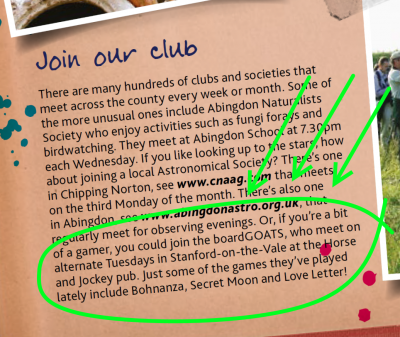
The January edition main feature is a two-page article on hobbies.  They comment on five things to try in 2015, including musical theatre, painting, volunteering, exercise and joining clubs.  So, we were absolutely thrilled to find that at the bottom of the second page of the Oxfordshire edition, our little game group gets a mention – fame at last!

Round & About
– Image by boardGOATS

Boardgames in the News: The Hobby Grows and Grows

In the UK in the 1960s and 1970s, boardgames were only available from toy shops, and the range was limited to a relatively small number of “traditional” games, like Chess, Monopoly, Game of Life or Cluedo.  With the appearance of bigger, supermarket-like stores like Toys “R” Us in the 1980s and 1990s, a wider range became available and, occasionally, games like the early Spiel des Jahres winner, Rummikub, made their way onto our shelves.  As children grew up, they might graduate into playing Risk and eventually move onto longer, more complex games like those produced by Avalon Hill.  However, if you liked playing games, but war themes were not for you, it was quite difficult to find good alternative games to play.  They were there though:  games like Acquire and the 18xx railway games had been about for a long time, but these were the exception rather than the rule and were still an acquired taste.

Rummikub
– Image by BGG contributor OldestManOnMySpace

In contrast, in Germany, games like Scotland Yard were starting to become readily available and genuinely very popular.  The success of the Spiel des Jahres, which rewarded good games like Ra, El Grande, Tikal, and the 1995 winner, The Settlers of Catan, meant that boardgames were receiving a lot of publicity in Continental Europe.  The characteristics of these “German Games” (or “Euro Games”) typically include balance, with only a small amount of luck, and lack of player elimination.  As the market developed, beautiful boards and lots of wooden pieces also became an essential component.  Unlike war games, “Euro Games” tend to be less confrontational and much more suitable for family gaming.

The Settlers of Catan
– Image used with permission of BGG contributor kilroy_locke

In the 1990s, UK designers like Alan R. Moon and Richard Breese started publishing small numbers of “designer games”.  These were often largely assembled by hand and generally had a limited print run.  For example, only 1,200 copies of Elfenroads (precursor to the later, Spiel des Jahres winner Elfenland) were ever made and Keywood, the first of the highly acclaimed “Key Series“, was hand-made and had a print-run of just 200.  Given the exclusive nature of these games, it was not surprising then, that many teenagers either gave up on boardgames or moved on to collectable card games, like Magic: The Gathering or Role-Playing Games.

Elfenroads
– Image by BGG contributor dougadamsau

So it was with the growth of the internet that “Euro Games”, or designer boardgames became available to people in the UK.  Firstly, this was because it enabled people to find out about the games that were available, with sites like UseNet and eventually BoardGameGeek in 2000, providing a valuable source of information.  Secondly, internet shopping made “German Games” much more accessible.  The growth of the hobby meant an increase in boardgame publishers, and the appearance of designers like Reiner Knizia who were sufficiently prolific and successful to make a living from designing games.  Over the last fifteen years or so, the hobby has grown and grown and games like Carcassonne and The Settlers of Catan are now available in Waterstones and WHSmith, there are regular comments in The Guardian, there are repeatedly TV appearances, and boardgame cafés are sprouting up all over the place.  The question is, will it continue to grow, or have we reached a high water line?

Ernie
– Image from boardgamegeek.com

Boardgames in the News: Are Games About to get More Expensive?

There were a number of very good deals available before Christmas as a result of Black Friday and an Amazon Marketplace malfunction, however, the tide now appears to be turning.  At the start of January, the newsletter from one of the UK’s leading specialist online retailers, BoardGameGuru commented:

“The UK’s largest games distributor has changed its discount structure for hobby games that are not best sellers. This is, in effect, a price increase and will result in a lot of older titles increasing in price when I restock them. For new releases there is an initital discount at launch, however prices may increase after launch stock has sold out. I will be doing my absolute best to keep prices down.”

Esdevium
– Image of unknown origin

The distributor in question is Esdevium. Esdevium essentially have a monopoly within the UK and have recently been bought out by Asmodee who have, in turn, have merged with Fantasy Flight Games and Days of Wonder.  Paul Bryant from GamesLore, another leading online seller confirmed that they are “being forced to do exactly the same” and commented that “the rise is considerably higher than our nett margin or we’d be tempted to try and ride it out”. Paul Lister from BoardGameGuru has indicated that most top titles will be unaffected as the discount structure for them remains broadly the same, however, the more niche items (e.g expansions and less popular games) won’t have the same discount structure as in 2014, so their price will increase.  It seems that although there will be an initial discount during the launch period, costs will go up on restocking and this will inevitably be passed on to customers.

Boardgames
– Image from mumwhoruns.com

So, what effect will this have on the UK boardgame market?  It appears that the discounts available from online games stores will decrease, which means the price difference will narrow between them and “bricks and mortar stores” (which generally sell at the Recommended Retail Price or RRP). Does this mean that it is good news for games shops?  Well, probably not.  It is very difficult for sellers to charge over the RRP, so all that will happen is that the margins on a business with already tight margins, will be further squeezed.

What effect will this have on the boardgame market in the UK then?  The good news is that the price of new releases from the main producers (e.g Fantasy Flight, Days of Wonder, Z-Man etc.) probably won’t change much; it will be the older games that will be most affected.  Since older games will become relatively more expensive, it will probably bolster the second-hand market for “good games”.  There will also probably be an increase in the number of language independent games that are imported from Germany by gamers “in the know”.  Sadly, increasingly small margins and more buyers importing games privately may mean the end of the some smaller games stores.  This is a great shame as the hobby is just on the verge of becoming more mainstream.

Rising Prices Ahead
– Image of unknown origin

Boardgames in the News: Last Tango in Halifax

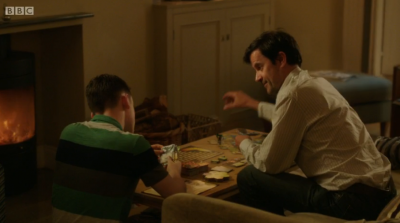
There have been a lot of comments here and elsewhere about how modern, “designer” games are becoming more widely known:  our little hobby is no-longer a secret.  We’ve had the rise of the boardgame café, various reports on the news and in the press, there’s even been an episode of The Apprentice!  One of the signs that games are becoming less niche is their increasing appearance on “normal” television programs, the latest being Last Tango in Halifax, starring Derek Jacobi, Anne Reid, Sarah Lancashire and Nicola Walker.  In this case, the boardgame was entirely incidental to the scene and almost any game would have done.  The programme makers could easily have used something more widely known like Monopoly or Risk, but instead they used Mage Knight.

Last Tango In Halifax
– Image from bbc.co.uk

Boardgames in the News: Are Games Getting Cheaper?

There have been a lot of good deals about recently.  First there was Black Friday.  This traditionally American festival of consumerism occurs on the Friday after Thanksgiving, and this year even affected some of the online Boardgame sellers in the UK – anyone for Grog Island at £15?  Then there were the Amazon “Lightening Deals”.  These are deals that are advertised in advance with a specific start time and a limited stock.  This year, we’ve had King of Tokyo and Dominion at £15 each.

The latest one beats all these though.  Thanks to a malfunction in the software used by third-party sellers to ensure their products are the cheapest on the market, prices were reduced to as little as 1p.  Reports suggest that one buyer bought ninety-five board games that should have cost £12.99 each for 99p each!  Ooops.

Amazon Glitch
– Image from theguardian.com