Essen 2022

Known to gamers worldwide simply as “SPIEL” or “Essen”, the Internationale Spieltage, the annual German games fair is the largest in Europe and arguably the world.  The fair is of particular significance as many new releases are scheduled to coincide with the event just in time for Christmas sales.  In 2020, like many other events, SPIEL was cancelled.  The online event that replaced it was not as successful, and in 2021 there was a return to the in person fair albeit with restrictions and much smaller than that in 2019.  Today is the first day of this year’s SPIEL which runs from Thursday to Sunday every October.

Essen 2022
– Image from spiel-messe.com

Although many of the Covid restrictions have been lifted, medical grade surgical masks covering mouth and nose are still mandatory for all visitors and exhibitors.  So while SPIEL will likely be larger this year than last, it probably won’t reach pre-pandemic proportions.  The maths trade is back though, a crazy event where hundreds of people agree multiple trades and sales online in advance and then all meet up at 3pm and try to find the people they have made contracts with and make the exchanges.  Remarkably, it works, and very well too, with some people selling hundreds of euros worth of games through this means.

Essen Maths Trade
– Image by Friedhelm Merz Verlag

Despite the number of people involved, the exchanges only take a few minutes and it is usually almost all over in half an hour making it a surprisingly efficient way of making space for the new arrivals.  In addition to the Maths Trade, there will be the usual exhibitors showcasing their wares.  The Spiel des Jahres and Deutscher Spiele Preis winners will also all be available and there will also be lots of games making their SPIEL debut.  These include Uwe Rossenburg’s latest game, Atiwa, and the top of “The Essen Hotness” games:  Tiletum, Revive, Woodcraft, Lacrimosa and Hamlet: The Village Building Game.  Games like Flamecraft, Turing Machine and War of the Ring: The Card Game will be for sale too.

Atiwa
– Image by BGG contributor W Eric Martin

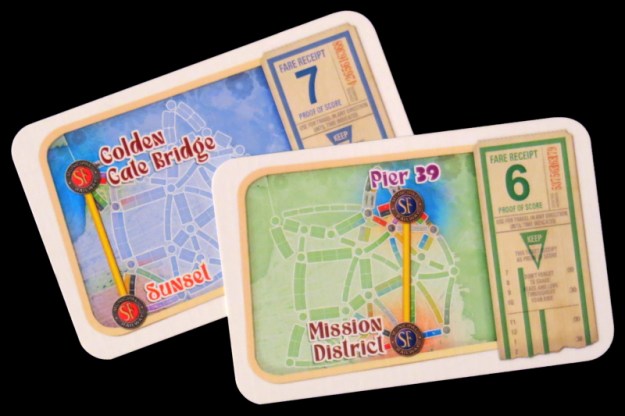
There will be re-implementations, like Richard Breese’s reworking of his 1998 game, Keydom’s Dragons (formerly Keydom), Clever 4Ever (extending Ganz Schön Clever), Skymines (a redevelopment of Mombasa), Amsterdam (formerly Macao) and of course, Ticket to Ride (San Francisco).  Expansions will also be on show for games like The Red Cathedral (Contractors), Galaxy Trucker (Keep on Trucking), Meadow (Downstream), Sagrada (The Great Facades – Glory) and two of our favourites, Viticulture (World) and Wingspan (Asia).  Sadly, no-one from boardGOATS will be there to see them though; maybe next year…

Wingspan: Asia
– Image from stonemaiergames.com

Next Meeting, 4th October 2022

Happy Birthday to Us!

Our next meeting will be Tuesday 4th October 2022, when we will be celebrating our tenth birthday.  We will be eating together to celebrate at 6.30pm with cake and games afterwards.

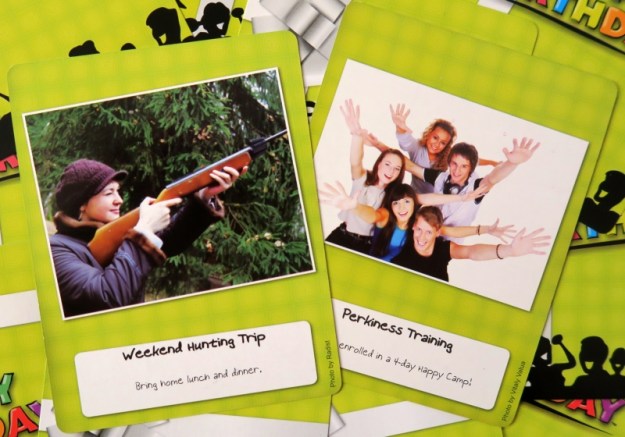
As is now traditional on our birthday, the “Feature Game” will be Crappy Birthday.  This is a party game where players give each other comedy birthday presents and the recipient has to decide who gave the best and worst gifts.

Crappy Birthday
– Image by boardGOATS

And speaking of birthdays…

Jeff was at the surgery.  “Doctor, I get heartburn every time I eat birthday cake,” he explained.

The doctor asked him to open his mouth and say “Ahhh.”

After a few moments examination, the doctor said, “Next time, take the candles off.”

Then we were Ten – Happy Birthday to Us!

Ten Today

BoardGOATS is Ten Years Old Today!

Ten years ago today, six people met in the back room of The Horse and Jockey pub in Stanford-in-the-Vale and played games.  Since then, we’ve survived, closure of the pub after the fire, eighteen months of gaming online, the loss of one of our stalwarts, and recent uncertainties at the pub.  We are still going though, and will be meeting this week and celebrating with chips and cake.

20th September 2022

Blue and Pink were the first to arrive to the news that The Jockey was under new management.  Pine soon followed and after a bit of chatter, the three of them settled down to the first “Royal Themed” game, Love Letter.  This is a very quick little game played with a deck of just sixteen cards.  The idea is that players have a hand of one card and, on their turn draw a second and choose which one to play.  The cards each have a special action and a number—the actions allow players to eliminate each other and the player with the highest number at the end is the winner.

Love Letter
– Image by boardGOATS

Powerful cards can lead to early gains, but are risky as they make players targets, however, relying on weaker cards for too long will give a guaranteed loss.  This time, Pink was taken out twice in consecutive rounds by Guard cards with Pine and Blue sharing the spoils.  In the third round, it was down to Blue and Pine again and Pine ran out the winner.  Although with three players the winner is usually the first to win five rounds, as Green and Lilac arrived with Orange and Lemon, the trio called it a halt there.

Love Letter
– Image by boardGOATS

Ivory, Black and Purple turned up as well and as they arrived, everyone remarked on the new smart table decor.  We were only waiting for Lime, but when Pine suggested he might not be coming, his text enquiry was met with the response, “OMG, it’s Tuesday not Monday, will be there in twenty minutes!”  So, while the group were waiting, they decided to start with the “Feature Game“.  To mark the passing of Her Majesty Queen Elizabeth II, this was Corgi Dash, a re-theme of the 1986 Spiel des Jahres winner Heimlich & Co..  Corgi Dash was published as a “Jubilee Souvenir” earlier this year, by Tony Boydell; although we had a copy picked up at the UK Games Expo, as it was a special occasion we had enlarged the board to make it easier to play in a large group.

Corgi Dash
– Image by boardGOATS

The game is very simple:  on their turn, players roll a die and distribute the pips amongst the “corgis” to move them round the board.  When one of the corgis reaches the throne (either in the Throne Room or the Kennels), each dog scores with the one that triggered the scoring getting nothing.  The Throne then moves to the next location, and the corgis continue to dash towards the Throne.  Each player secretly “owns” one of the dogs and after one dog reaches a score of thirty, everyone secretly guesses which dog belongs to which player.  The game ends when one dog reaches forty points.  Players then score for their dog and receive five additional points for each identity they guessed correctly.

Corgi Dash
– Image by boardGOATS

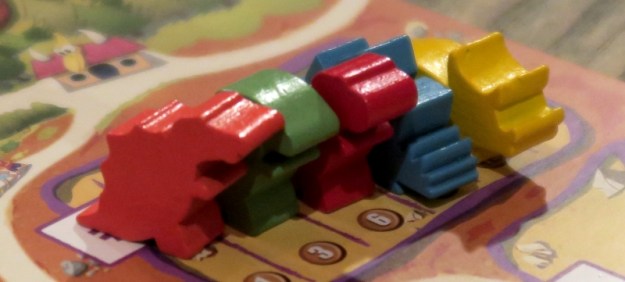
Blue, Pink, Ivory, Purple and Pine got going first.  In their game, the blue dog (well, meeple actually) got picked on early which marked it out as the dog with no owner.  Unfortunately, the blue dog turned out to belong to Pine and it was the grey dog who had no owner, which became more apparent towards the end when everyone concentrated on their own hounds.  The black dog was the first to get to thirty and then the only one to get to forty too.  Ivory was the only one to guess more than one owner correctly, but it didn’t make any difference as the black dog’s score was twenty more than any other, making it’s owner, Pink, the clear winner.

Corgi Dash
– Image by boardGOATS

On the neighbouring table, Green (who had played Heimlich & Co. a very long time ago, explained the rules to Lilac, Orange, Lemon and Purple. They finished their game early, guessing after two scoring rounds and scoring after the third.  Green’s dog did by far the best picking up thirty-two points, twelve more than any other hound.  Orange did exceptionally well at guessing who had each dog, getting three right, but it wasn’t quite enough to take the lead and he finished two points behind Green, both some way clear of the field with Lemon a distant third.

Corgi Dash
– Image by boardGOATS

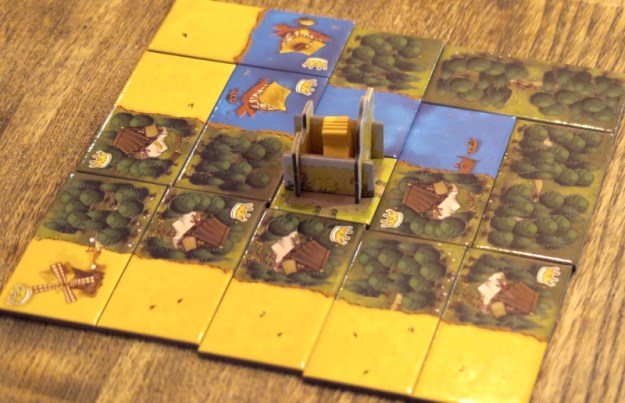
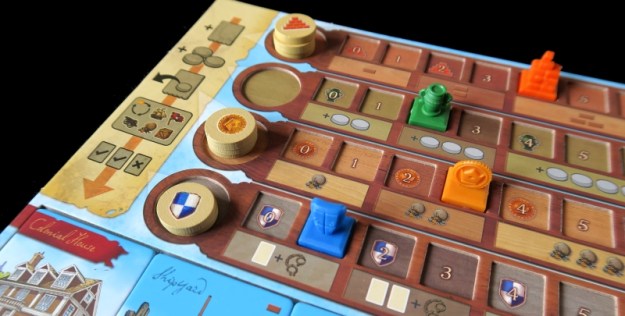
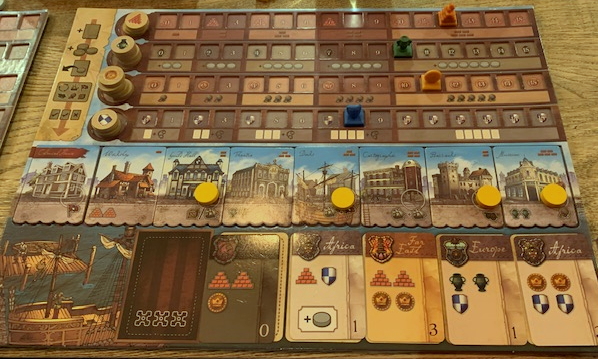
Corgi Dash was very quick to play leaving plenty of time for other games.  With all the happenings around Buckingham Palace and Westminster over the last week, “London themed” games seemed appropriate, so while everyone else played Ticket to Ride: London, Ivory, Blue and Lime took themselves off to the other side of the room to squeeze in a game of Key to the City: London.  This is a reimplementation of one of Blue’s favourite games, Keyflower.  Lime, however, had not played either game, so Blue and Ivory had to explain the rules first.

Key to the City - London
– Image by boardGOATS

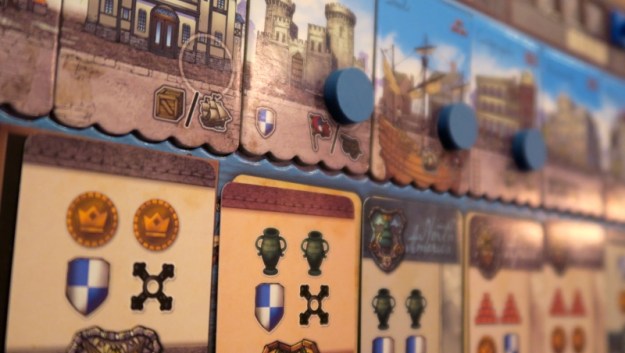
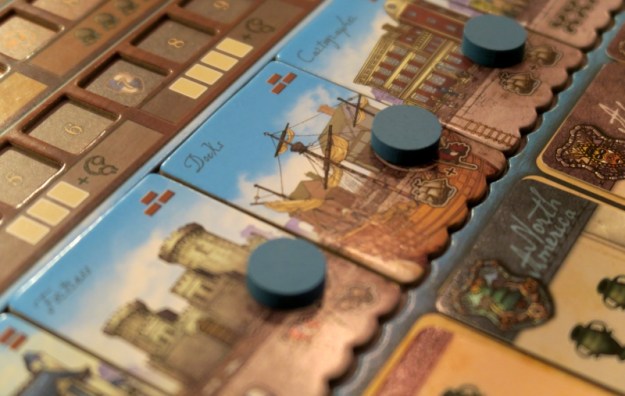
Like Keyflower, Key to the City: London is based on an a series of tile auctions where players bid with meeples.  The rules for bidding are simple:  players can bid on any tile, but if there is already a bid, they must follow with the same colour and increase the value.  In addition to bidding for tiles, players can also activate a tile in their Borough, a tile in someone else’s Borough or even a tile that is currently up for auction.  Again though, players must follow colour if the tile has already been activated or has an active bid, further, every time it is activated it costs one additional meeple.

Key to the City - London
– Image by boardGOATS

At the end of each round, all meeples in winning bids return to the bank and players take any tiles they’ve won and add them to their Borough.  All meeples on tiles in a player’s Borough go back to that player, and any meeples used to activate tiles up for auction go to the winner of the tile.  Tiles are worth points at the end of the game.  Some are just worth points out-right while others are dependent on tiles they are connected to and all are worth more if they are upgraded.  Connections are acquired by activating specific tiles; tiles are also upgraded by activating them and paying any associated cost.

Key to the City - London
– Image by boardGOATS

The winner is the player with the most points at the end of the game.  While the mechanics of the game are fairly straight forward, like Keyflower the art of the game is combining them to score well.  The Connections are the main difference between Key to the City and Keyflower, but there are several other smaller differences like the round endings, for example.  In Keyflower, players bid for boat tiles which dictate how many meeples they get at the end of each round, but in Key to the City, when players choose to end their round place their boat in a position on the river.  The earlier a player “checks out”, the earlier they can place their boat and the more meeples they can get—and meeples are scarce, very scarce, in both games.

Key to the City - London
– Image by boardGOATS

This time, Ivory with the Buckingham Palace player screen and start tile, went first.  He began by winning Paddington Station which gave him telecoms (black) and electricity (grey) cable connections.  He went on to couple this with St. Pancras, Kings Cross and the Royal Academy which gave points when connected with electricity cables and Marble Arch and Monument which gave points for telecoms cable connections.  Lime understood the fundamentals, but was struggling with how to fit them into the game, so when he picked up Battersea Power Station which provided water (blue) and gas (yellow) pipe connections, he was encouraged to pick up the London Eye and Canary Wharf to go with it which ultimately proved good choices.

Key to the City - London
– Image by boardGOATS

Blue lost out in a couple of early bidding wars, so ended up with the Barbican instead, giving her underground tunnels (red) and waste pipe (brown) connectors and later Charing Cross (more underground tunnels and grey electricity cables).  Maybe she’s spent too long with Pink, but she mostly chose to eschew sewage pipes and electricity pylons, instead focusing on trains, using them to make connections with the Royal Opera and the Globe Theatre.  Unfortunately, there was a little “rules malfunction” in the early part of the game with a misunderstanding of one of the scoring icons.  Instead of players scoring for connectors of the colour indicated connected directly or indirectly to a tile, players should only score for each tile connected to the scoring tile.

Key to the City - London
– Image by boardGOATS

The “rules malfunction” was spotted quite early, so although it added a little to Lime’s confusion, everyone had enough time to correct things before scoring took effect.  In the final round, Ivory bid for the Natural History Museum which gave him points for monuments, and London Zoo giving him two points for each blue meeple he was left with at the end of the game.  He then activated a few last tiles and set sail.  Lime engaged in making lots of utilities connections, and bid for the British Museum and the Royal Festival Hall (giving two points for each tile won in the final round and three points for each tile connected by all six utilities respectively).

Key to the City - London
– Image by boardGOATS

Blue took the V & A Museum (giving points for sets of skills tiles) and the Science Museum (giving points for tiles with six connections).  Then she made a mistake:  with Ivory out and Lime running low on meeples, she had the opportunity to either out bid Ivory for London Zoo, or compete with Lime for the British Museum and in a fit of stupidity went for the latter.  Blue’s error might have proved critical though as winning the zoo would not only have given her twelve points, but also taken twelve from Ivory.  As it was, in the final count, Ivory took victory with a hundred and seventeen to Blue’s ninety-six and Lime’s seventy-eight.

Key to the City - London
– Image by boardGOATS

Meanwhile, on the other side of the room two games of Ticket to Ride: London were underway.  Ticket to Ride is one of our current favourite games and the London variant, being one of our “local” editions is particularly popular.  The game plays in the usual way with players taking cards from the market, using them to pay to place trains on the map and claim routes, or taking Tickets which give points at the end of the game if the two destinations are connected.  Each map has an extra rules “tweak” and in case of the London edition players get bonus points if they visit all the places in a borough.

Ticket to Ride: London
– Image by boardGOATS

When Pink asked Pine who the people were on the box there was a general aura of shock when he claimed not to recognise Emma Peel (though he did correctly identify Her Majesty Queen Elizabeth II).  Their game with Purple and Black started off very confrontationally in the centre of the board and carried on in much the same vein as the game developed from there.  Pink took Pine’s dubious advice to take more tickets, but failed to score them.  Pine got his comeuppance though when Black just pipped him to the line beating him into second place by a single point, while Purple took third.

Ticket to Ride: London
– Image by boardGOATS

The other group managed to rattle through the game really quickly too as everyone knew what they were doing.  Orange completed all his Tickets and triggered the end of the game.  For everyone else it was a more frustrating game. Lilac was convinced she was going to lose as she had failed to complete one of her tickets finding herself blocked, but in the end finished second, significantly ahead of Green and Lemon.  Green had tried the “gamers tactic” (espoused by Black on previous occasions) said all the best Ticket to Ride players do, namely  collecting more tickets at the start of the game.

Ticket to Ride: London
– Image by boardGOATS

This went OK until about half way through when he got blocked on his best route, then while trying to re-route got blocked again, forcing him to try a third option. This was blocked too and he was locked out of his key station, finishing with three incomplete Tickets.  Lemon had tried the same strategy (collecting tickets first), but also ended up with a couple not completed.  As a result, Orange wiped the floor with everyone else finishing with a score nearly three times that of his nearest competitor: a convincing victory.

Ticket to Ride: London
– Image by boardGOATS

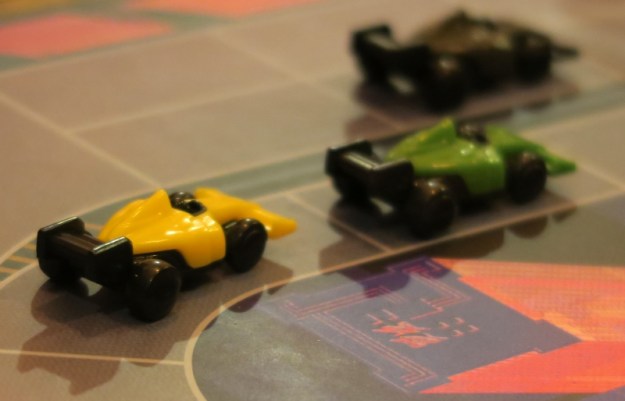
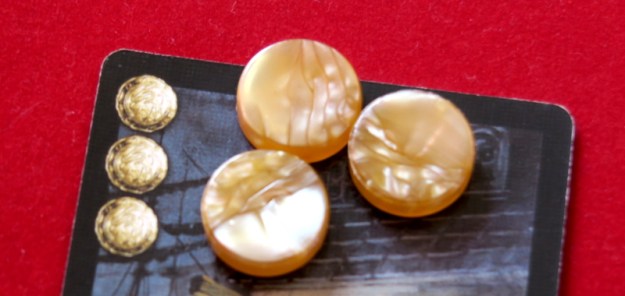
Key to the City: London was still underway, so, given Her late Majesty’s well known love of the gee-gees, the two groups got together to play Turf Horse Racing.  It was a while since anyone in the group played it, so Green reminded everyone of the rules.  The idea is very simple, players have three counters to use for betting, two small and one large, double weight one.  In the first stage, players take it in turns to use these counters to bet on horses.  In the second stage, players take it in turns to roll the die and move a horse to determine the outcome of the race.

Turf Horse Racing
– Image by boardGOATS

The game works because the die has three horses heads with one of each of the other icons, and each horse moves a different amount depending on what is rolled.  Since each horse has to move before a horse can be moved again, players can choose to make a positive move for one of their own horses, or nobble someone else’s.  Although the rules as written give the maximum number of players for Turf Horse Racing as six, the group thought it would stretch to more due to the way it is played.  And given the hilarity that ensued, that seemed a really good decision.

Turf Horse Racing
– Image by boardGOATS

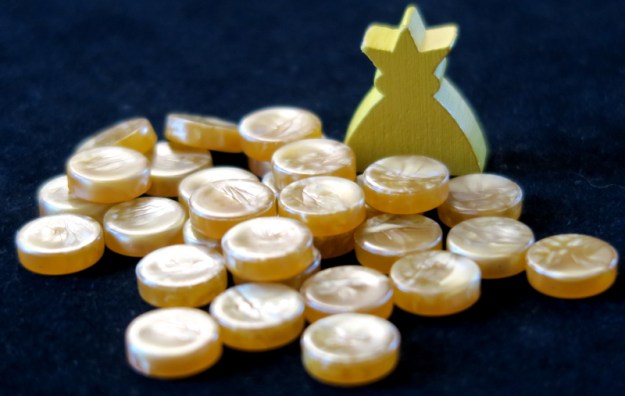
It was decided that due to there being so many players, perhaps three bets per player would create too many horses with multiple bets, so it was house-ruled to two bets only each: one big and one small.  The extra bet tokens needed were taken from Ticket to Ride: a scoring disc and a bus.  Pine was the sole “investor” in Roamin’ Emperor’s fortunes.  Pink, trying to get his revenge for being misled in Ticket to Ride, cajoled everyone to choose this purple horse to move only one space, much to Pine’s annoyance.  Pink got his way, but then got his comeuppance when someone made his chosen horse, Lagoon Lady, also move only one.

Turf Horse Racing
– Image by boardGOATS

After the first round it was Silver Blaze blazing a trail up front, closely followed by Mostown Boy and Raven Beauty.  This theme kept repeating with Lagoon Lady and Roamin’ Emperor moving only one space a turn, until finally Pine struck gold and was able to shoot his horse forward by a massive fifteen spaces and get it into the leading group.  It was a close race, and eventually Silver Blaze was overhauled and brought back into the pack.  As the race entered it’s final furlongs Lagoon Lady was still languishing behind.  Although it had made up some ground, Roamin’ Emperor was making better progress but also starting to fall back.  One more “mega surge” would have been enough to put it within spitting distance of a win, however, that was not to be.

Turf Horse Racing
– Image by boardGOATS

In the end it was The Red Baron who crossed the line first, with Silver Blaze second and Desert Prince third. Adding up the betting totals, Lemon took home the biggest winnings with eight, with Lilac just one behind in second and Black a comparatively distant third.  The conclusion was that Turf Horse Racing can definitely be played with eight, but maybe a little more tinkering is needed. Perhaps keeping the three bets, but with seven horses, the start player moved around the table very slowly—something to think on and investigate further perhaps.

Turf Horse Racing
– Image by boardGOATS

Learning Outcome:  Her Majesty had a point—dogs and horses can be a lot of fun.

Deutscher Spiele Preis – 2022

The Deutscher Spiele Preis awards recognise the “Best Children’s Game” and a top ten list of the “Best Family and Adult Games”, the results of an open vote by games clubs, gamers and people in the industry.  They are awarded annually at the Internationale Spieltage in Essen and the winners are announced in advance.  As annual awards, the games named in the Deutscher Spiele Pris lists often intersect with the winners and nominees of Spiel des Jahres Award, but in many other ways, the awards differ.

Deutscher Spiele Pries 2022
– Image from
spiel-messe.com

The Spiel des Jahres winners are chosen by a committee with a list of strict criteria whereas the Deutscher Spiele Preis is more a list of the most popular games of the preceding year.  As such, games that are not eligible for the any of the Spiel des Jahres Awards often feature in the top ten list of “Best Family and Adult Games”.  For example, games that were considered at the time to be too complex or aggressive for the Spiel des Jahres awards have ranked number one in the Deutscher Spiele Preis list.  These include Tigris & Euphrates (1998), Puerto Rico (2002), Louis XIV (2005), Caylus (2006), The Pillars of the Earth (2007), Agricola (2008), Terra Mystica (2013), Russian Railroads (2014), Voyages of Marco Polo (2015), Mombasa (2016) and Terraforming Mars (2017).

Terraforming Mars: Hellas & Elysium
– Image by boardGOATS

Of all these great games, only Terraforming Mars even received a nomination for the Kennerpiel des Jahres award (though Agricola did receive a special “Complex Game Award”).  In contrast, over the last few years, there has been much more overlap with games like Azul (2018), Wingspan (2019) and The Crew (2020) all ranking highest in the Deutscher Spiele Preis list and winning either the Spiel or Kennerspiel des Jahres award.  Further, all the other winners of both awards including MicroMacro, Cartographers, Paleo, Lost Ruins of Arnak have featured high on the Deutscher Spiele Preis list and/or received Spiel/Kennerspiel des Jahres nominations.

Ark Nova
– Image by boardGOATS

This year, while there is still a lot of overlap between the lists, the top ranked game on the Deutscher Spiele Preis list is a bit of a throwback, being too complex even for the Connoisseur or Kennerspiel des Jahres award.  The Deutscher Spiele Preis winner, Ark Nova has been extremely popular amongst gamers creating a lot of “buzz”, so it is no surprise that it did well.  The strategy revolves round building card combinations and the theme, zoo building is very appealing—everyone loves animals.

The full Deutscher Spiele Preis list is:

  1. Ark Nova
  2. Cascadia (Spiel des Jahres Award Winner)
  3. Dune: Imperium (Kennerspiel des Jahres Award Nomination)
  4. Living Forest (Kennerspiel des Jahres Award Winner)
  5. The Red Cathedral
  6. Witchstone
  7. Beyond the Sun
  8. SCOUT (Spiel des Jahres Award Nomination)
  9. Golem
  10. Terraforming Mars: Ares Expedition
Ark Nova
– Image by boardGOATS

Boardgames in the News: The Evils of Cheating

Amongst gamers and friends, intentional cheating is a heinous crime—it is totally unacceptable.  But why?  On the face of things it is very simple, cheating is a betrayal of the contract, it is against the rules of the game, and without rules, there is no point, no game.  It runs deeper than that, however:  cheating violates our fundamental sense of fairness.  Everyone understands that life isn’t fair, but games are an abstracted version of life, where players can, for example, experience the thrill of taking chances, engage in complex plans, even take on a different persona and characteristics, or perhaps even Cheat.  With other things shifting, a key part of this gaming world is its fairness.

Cheat
– Image from hobbylark.com adapted by boardGOATS

Amongst friends, it is usually well understood that people are fallible and make mistakes, so when errors are noticed, the culprit is usually highly embarrassed and typically tries to rectify things in everyone else’s favour.  Intentional cheating is something else though and is seen as a violation of trust that can cause a deep, never to be healed, rift between erstwhile friends.  Added to this, amongst friends, there is little to be gained by cheating and so much to lose that it is remarkably rare.  It is perhaps largely because of this, that the current Chess cheating scandal is making headline news.

Chess
– Image by Unsplash contributor sk

The current furore surrounds a third round match between the Norwegian Magnus Carlsen and American Hans Niemann in the invitation only event, the Sinquefield Cup.  In the case of the Grand Tour Chess events (of which the Sinquefield Cup is one), while there is still much to lose, there is also a lot to gain, both financially and in reputation—reputation is currency as it gives access to invitation only events.  In the match in question, the Norwegian, Carlsen, world champion since 2013, who had been unbeaten in his previous fifty-three matches and with the advantage of playing white was beaten by the nineteen year-old American, Niemann, who was the lowest-ranked player in the tournament.

– from twitter.com

Despite having another six rounds left to play, Carlsen then withdrew from the tournament.  Although a Tweet raised suspicions of cheating, Carlsen made no substantive allegation or presented any evidence.  However, a couple of days later, Chess.com (one of the largest online chess sites) confirmed that Niemann had been removed from their site for cheating.  While Niemann himself admitted cheating during online games by using computer assistance, he denied cheating when playing face to face.  Opinions seem to be split, with analysis of the game by Chess Grand Masters showing no evidence of cheating, while circumstantial evidence suggesting Niemann was not able to analyse his own moves without electronic assistance.

– from twitter.com

This is not the only instance of accusations of cheating at Chess—nearly twenty years ago Veselin Topalov‘s manager accused then world champion Vladimir Kramnik of cheating during his allegedly “strange, if not suspicious” trips to the toilet, and in the late 1970s Viktor Korchnoi’s team alleged world champion Anatoly Karpov’s team were cheating by sending their player a fruit yoghurt with carefully arranged blueberries.  The current outcry from both sides, some supporting Carlsen in his actions and others accusing him of making unsubstantiated allegations, show how divisive cheating can be, even amongst professional circles.  Amongst friends, though less public, cheating can be even more destructive ending long-held friendships, and this is why intentional cheating is such a crime and considered totally unacceptable by gamers.

Chess
– Image by Unsplash contributor Felix Mittermeier

Next Meeting, 20th September 2022

Our next meeting will be Tuesday 20th September 2022.  As usual, we will start playing shorter games from 7.30pm as people arrive, until 8pm when we will start something a little longer.  Please note that the pub will not be serving food on Tuesdays for the foreseeable.

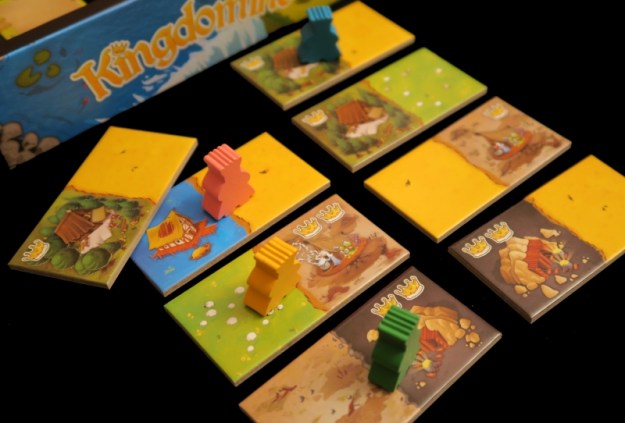
To mark the passing of Her Majesty Queen Elizabeth II, the “Feature Game” will be Corgi Dash.  This is a retheme of Heimlich & Co., which was published as a “Jubilee Souvenir” earlier this year, by Tony Boydell.  Other games we’ll be playing will have a Queen, King, or otherwise royal-related theme, for example, Queen’s Necklace, Sleeping Queens, Kingdomino, Key to the City: London.

Corgi Dash
– Image by boardGOATS


6th September 2022

Plum and Pine were the first to arrive, shortly followed by Blue with Orange and Lemon.  With nobody eating, the group were in a position to start thinking about games straight away.  Plum had offered to lead Wingspan, with Lime in mind as he had recently acquired a copy of Wingspan and was keen to give it another go.  Pine commented that although he loves birds, he’d never really got on with the game-play of Wingspan so, sadly he’d prefer to play something else.  The “Feature Game” was to be Project L, a sort of Tetris-like, engine-building game and it sounded much more his thing.

Project L
– Image by boardGOATS

So, Plum took herself off to the other side of the pub to set up Wingspan with the European expansion.  The European expansion adds more cards including end of round cards, but doesn’t add any extra mechanisms (like the Oceania expansion), so it was felt that including it wouldn’t cause too much confusion.  As the others rolled up, there was much surprise as Teal and Ivory said they would rather give Project L a go.  Then Pine changed his mind and joined Wingspan (along with Purple and Lime), allowing Black to play the “Feature Game” as he had played Wingspan recently at Burgundy’s Birthday Event.  That left six to play Project L: Orange, Lemon, Blue, Ivory, Teal and Black.

Project L
– Image by boardGOATS

Project L is a very simple game:  players start with two small plastic pieces and use them to complete Puzzles winning more pieces enabling them to complete more complex Puzzles and thus build an engine.  On their turn the active player can do three actions from a list of five things:  upgrade a piece to a larger one, take a Puzzle from the display, recycle the Puzzle display, place a piece in a Puzzle they own, or place one piece in each of their Puzzles (or in as many different Puzzles as they can).  This last, “Master Action” can only be carried out once per turn, and is clearly very powerful once players can get it going, however, to make it work they need lots of Puzzles and lots of pieces.

Project L
– Image by boardGOATS

With six, to reduce the amount of down time there is the “Line Clear Variant” available.  In the normal game, there are two rows of four Puzzles, one of White backed Puzzles and one of slightly more advanced and therefore more rewarding, Black backed Puzzles.  In addition to winning pieces for completing Puzzles, players can also get  points—the player with the most points at the end of the game is the winner.  The game end is triggered when the draw deck of Black backed Puzzles is exhausted at which point the round is then finished and one more, final, round is played.  In the Ticket to Ride: Switzerland, there are two rows of each colour, each containing three Puzzles.  One pair of Black and White Puzzle rows are marked with a dark stone and the other pair with a colourless stone.

Project L
– Image by boardGOATS

The idea of the Line Clear Variant is that two players play simultaneously with the active players marked by a dark and a colourless stone that are passed round.  When it is their turn, players can only recycle or take Puzzles from the rows that match the colour of their their stone.  Ivory was picked as the start player (he drew the player aid marked with the start player symbol) and he began with the dark stone, so Orange, sitting opposite, started with the light stone.  Everyone began a little tentatively, but before long players were filling their Puzzles with gay abandon.  The game end is slightly less clear with the Line Clear Variant.  Still triggered by exhausting the Black Puzzle Deck, the game continues until the first player has been passed both of the markers again, in any order).

Project L
– Image by boardGOATS

The Black Puzzles ran out quite quickly—Project L really is just a “Filler Game“, but players still had to finish things off.  The start player was Ivory, which meant that Orange was a little caught out.  Once the game has finished, everyone can place any pieces they have left, but at the cost of a point for each one.  Orange was unlucky, and unable to complete any of his remaining Puzzles, neither could could Lemon.  Teal had managed to finish off all his Puzzles in his last turn, but everyone else placed three of their pieces to finish things off.  It was quite close for a first game:  Blue finished with eighteen points, but Ivory and Black tied with fifteen apiece with Ivory sneaking second place on the tie breaker (the player with the most completed Puzzles).

Project L
– Image by boardGOATS

A lot of the comment was about how nicely produced the game is and it had been enjoyable to play too although not very memorable.  It was time to move on to something else though and with six, the obvious and usual choice would be Bohnanza, but Ivory had other ideas and suggested New York Slice.  This is a reimplementation of …aber bitte mit Sahne which we played recently, but with a pizza theme instead of a cake theme.  In both games, the idea is that one player makes the cake (or pizza) and divides it up into segments equal to the number of players, then players take it in turns to choose one of the segments.

New York Slice
– Image by boardGOATS

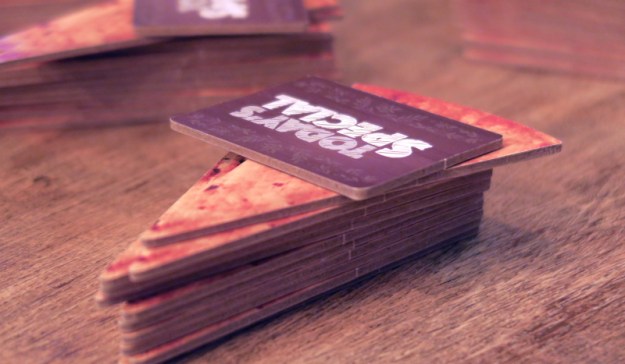
When a player takes a segment, they can either eat slices or store them for later.  Those they will eat are worth points at the end of the game with the number dependent on the number of blobs of cream (or pepperoni slices) on top.  The pieces players keep are scored depending on who has the most of each type at the end of the game.  Each piece of cake (or pizza) has a number on it which tells players the number of that type in the game and also what the player with the most will score at the end of the game.  There are a few things that are different about New York Slice, however, which make it a little more competitive and slightly more of a “Gamers’ Game”.

New York Slice
– Image by boardGOATS

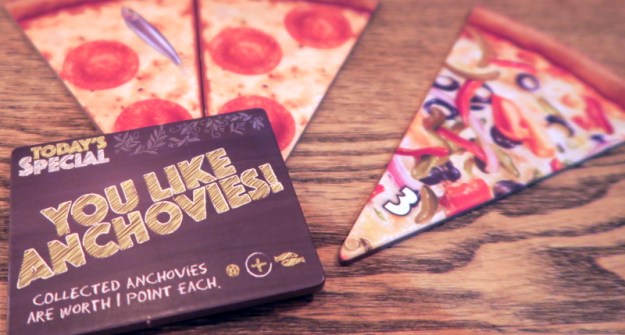
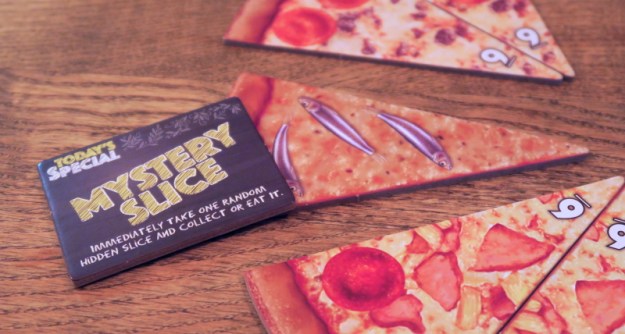
Firstly, in the case of a tie for who has the most pieces of a type of pizza, in …aber bitte mit Sahne all players score points whereas in New York Slice nobody gets anything.  Secondly, some of the pizza slices have anchovies on them and any of these that are visible at the end of the game are worth minus one (because everyone hates anchovies on pizzas right?  Well, everyone except Teal it seems…).  Probably the biggest change though, is that in New York Slice, each pizza is served with a Special—a bonus tile with rule-breaking powers.  In most cases, these are added to one of the segments for players to choose. They can be enticing and helpful, or they can be unhelpful and make players’ lives more difficult.

New York Slice
– Image by boardGOATS

Ivory cut the first pizza, leaving Blue to be the first to choose.  The first Special was “Cut in Line”, which Blue took straight away and then promptly forgot about it until the final round.  Ivory went into battle for mushroom pizza, but lost out to Teal.  The front-runner looked to be Black who stored the most BBQ and veggie pizza slices, largely thanks to his “Supersize Combos” Special which meant his two half slices became two whole slices of each type.  That only gave him joint second however, with Lemon who turned out to be quite the carnivore and finished with the most beef and meat feast pizzas.

New York Slice
– Image by boardGOATS

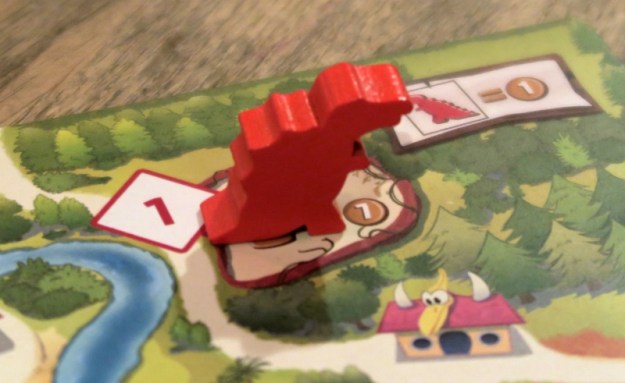
The winner, however, and by a single point, was Blue who picked up a lot of anchovies along with her “You Like Anchovies” Special and coupled that with winning the most lucrative pizza (pepperoni).  Full of pizza, Teal and Ivory decided it was time, leaving Black and Blue with Orange and Lime and a decision to make as to what to play next.  With Wingspan something over half-way through, they were looking for something substantial to play, but not too long.  Blue’s suggestion was Wsiąść do Pociągu: Polska, the Poland map for Ticket to Ride.  This was one that nobody around the table had played before though it had been played in the group two and a half years ago, shortly after it was released at Essen.

Wsiąść do Pociągu: Polska
– Image by boardGOATS

The Poland map works in much the same way as all the Ticket to Ride games; players collect coloured train cards and spend them to place plastic train pieces on the central map scoring points for placing trains, but also completing the route “Ticket” cards that they chose at the start of the game and maybe later too.  In addition to the usual rules, the base game maps all have a little something extra.  As well as the usual city locations, the Poland map also has countries, but unlike the Swiss map, these are not simply locations to connect to.  Instead when a player connects two countries, they collect one Country Card corresponding to each.  These are worth points at the end of the game.

Wsiąść do Pociągu: Polska
– Image by boardGOATS

When a third country is added to the “network”, the player again collects Country Cards, one for each country in the network. When Blue explained the rules, Black commented that that aspect was interesting and he was curious to see how it affected the game.  Blue started and was followed by Orange, Lemon and then Black.  Black started by collecting more Tickets—this was a tactic that was discussed briefly at Burgundy’s Birthday Memorial event.  Black had commented then that this was the way all the best players did it.  The idea is that by collecting Tickets early, players are best placed to make the most efficient use of their trains and know what coloured cards they might need.

Wsiąść do Pociągu: Polska
– Image by boardGOATS

However, it is a bit of a “Go Big or Go Home” strategy because if something critical goes wrong early, the player could get left with an armful of unfulfilled Tickets leaving them with lots of negative points.  And with the Poland map, this was far from impossible as it turned out to be quite a scrap for the centre of the board.  Lemon asked what she should do when someone had just taken a track she wanted, clearly meaning Orange who had just nabbed a critical route from Bydgoszcz to Płock.  “Kill them,” was the instant reply to much hilarity.  Lemon commented that she would get her revenge, though it was unclear whether that was planned for the game or sometime later…

Wsiąść do Pociągu: Polska
– Image by boardGOATS

Eventually, Blue claimed the first Country Cards, connecting Belarus to Germany.  When she added Russia and Lithuania, it was clear how these could add significant points to a player’s tally.  Further, the repeated nature of collecting Country Cards each time the network grew provided a good source of points of a similar magnitude to those gained from Tickets, but without the associated jeopardy.  The Country Cards are stacked in descending order of value so that the ones earnt early in the game are worth more, but although the value decreases, as more countries are added to  player’s network more tickets are picked up.  As a result, value of each additional card pick up (and therefore each country when added) remains fairly constant depending on how many players are fighting for Country Cards.

Wsiąść do Pociągu: Polska
– Image by boardGOATS

This time, Blue stole a bit of an early march on the Country Cards in the north, while Black acquired loads of Tickets and Orange got in everyone’s way.  While Blue’s primary route was in the north running east-west, Black and Orange focused on north-south and Lemon had two separate smaller networks which she unfortunately failed to connect together.  As everyone else saw how lucrative Country Cards could be, they joined in, connecting countries to the south.  Lemon pointed out the route they had taken from Ukraine through south Poland to Warsaw where they got a flight to the UK.  It was about then that the pub became an attraction in itself when one of the locals pointed out that the lease was for sale once more.

Wsiąść do Pociągu: Polska
– Image by boardGOATS

The game came to a slightly sudden end when Lemon ran out of trains—the Poland map is played with just thirty-five trains per player instead of the more usual forty-five.  Actual game play time isn’t much shorter than usual because, like the India map, there are fewer longer routes so players have to take more turns placing trains.  At the end of the game though, it was close with Lemon in the lead thanks largely to the fact she had concentrated on the lucrative long routes where possible.  Orange and Black had completed a lot of Tickets though, and when they were added on together with the Country Cards, they tied for second place with eighty-two points.  The winner was Blue, however, thanks to the huge pile of Country Cards.

Wsiąść do Pociągu: Polska
– Image by boardGOATS

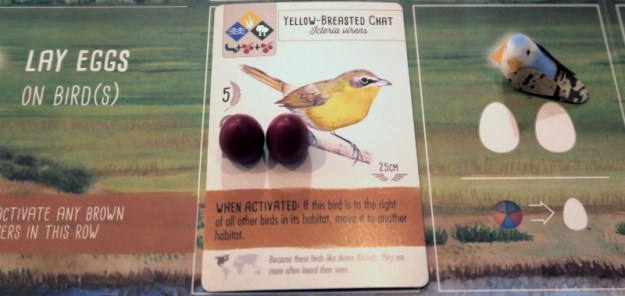
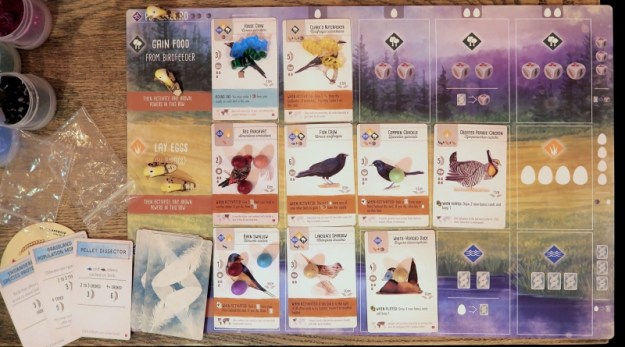
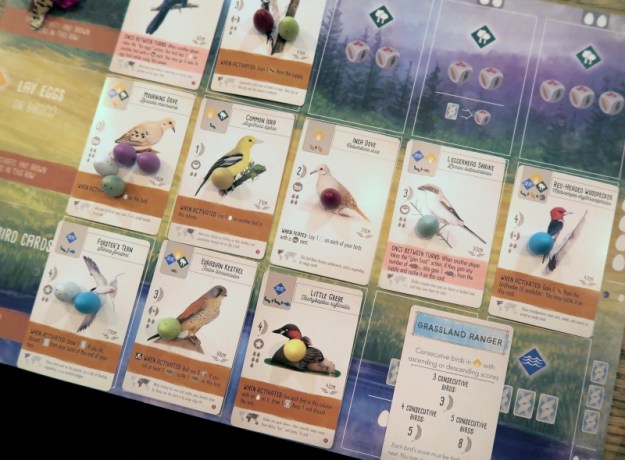
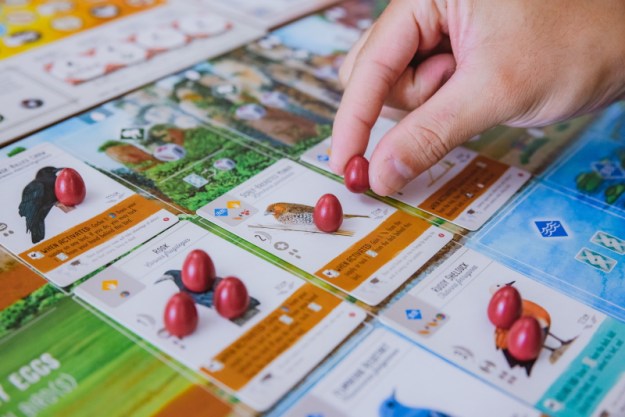
Meanwhile, over the other side of the room, Plum, Pine, Lime and Purple were playing Wingspan with Blue’s pimped out set.  Wingspan is a beautiful bird-themed game where players are collecting birds in three different habitats.  On their turn, they can “plant” a bird card in one of these habitats, or activate one of the three habitats to collect food, lay eggs or collect more cards.  The clever part of the game is that when players activate a habitat, they also activate any birds within that habitat—in this way, the game is card driven. Played over four rounds, there are bonus points at the end of each round (dependent on tiles drawn at the start of the game).  Otherwise, players score for birds, eggs, tucked cards, and personal bonus cards at the end of the game.

Wingspan
– Image by boardGOATS

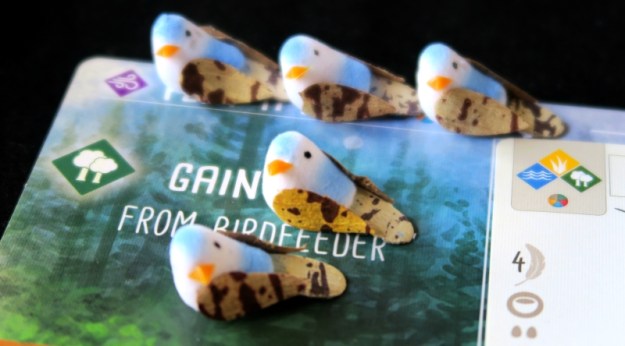
Players start with eight actions in the first round, but that decreases by one each round as the game progresses.  However, because players add birds to their habitats during the game, although they get fewer turns in later rounds, they are actually doing more things in each turn as they are activating more cards.  In Blue’s pimped out copy, she had replaced the wooden action cubes with little fluffy birds which are cute, but led to some initial confusion with the phrase “playing a bird” meaning variously take an action (playing a fluffy little bird) or play a bird card into a habitat.

Wingspan
– Image by boardGOATS

This time, everyone was slow to start—the start is almost always slow in Wingspan as players need cards to play and food so they can pay the cost, but this time it was especially true as players found their feet.  Lime began with a woodland bird that gave an extra food after re-setting the bird-feeder, which really helped him out throughout the game.  He also had a once-between-turns card which was triggered when another player tucked a card.   Since Purple had a bird with a tucking action, that looked like a good call.  Considerable merriment was derived from the tucking action:  who was tucking the most, watching out for people tucking etc..  Unfortunately however, Purple’s action required the tucked card to be taken from Purple’s hand so she often passed up the chance meaning she was not the most prolific tucker…

Wingspan
– Image by boardGOATS

Plum’s first two were wetland birds with one-off powers.  As her bonus card rewarded her for having cards left in hand at the end of the game, the fact these early birds increased her card drawing powers from the very start meant they could help towards that too.  Pine’s bonus card rewarded him for having birds with geographical names which he pretty much had in his starting hand. Lime’s bonus was for birds with tucked cards, but he only realised later that it meant multiple birds with tucked cards not the number of cards tucked.  He was able to pick up another bonus card later in the game, which worked slightly better for him though.

Wingspan
– Image by boardGOATS

Pine’s bird hunting for rodents largely went hungry in the early part of the game, though it did better in the later rounds.  Plum, instead of sharing her latest kitty pictures, mimicked her favourite kitty behaviour, and watched hawk-like for a successful hunt to trigger once-between-turns action.   She had a killer “three birds in one go move” set up ready to go—two birds both with a “play a second bird in the grasslands” action.  Although she was a little disappointed to have been unable to deploy it in time for the worms they ate to count towards the second round goal of most eaten worms.  This increased her egg laying power though and the final third bird allowed her to a sacrifice an egg for two new bird cards ensuring she achieved her bonus in the final round.

Wingspan
– Image by boardGOATS

With the game finally coming to an end, all that was left was the scores.  Plum and Lime took the most points for their birds while Purple and Pine had the most eggs.  While everything else was fairly close, Lime had his nose in front in most areas and this showed in the final scores which were moderately spread out.  Lime’s score of eighty-seven points was some ten points ahead of Plum in second, who was similarly ahead of Pine.  As always with Wingspan, it had been fun, though it had sadly confirmed to Pine that while he adores the theme, the game play just isn’t for him.  And on that sad note, with everyone else also finished, it was time for home.

Wingspan
– Image by boardGOATS

Learning Outcome:  Everyone loves Pizza.

Boardgames in the News: What are “Filler” Games?

To most people, games come in two types, board games and card games.  Modern board gamer, however, have many other classifications.  For example, board gamers make the distinction between Strategy Games and Family Games.  Strategy Games typically are more complex than Family Games, which is not to say that Family Games don’t involve strategy, simply that the strategies are more involved.  Typically, a “Light Family Game” will be relatively simple in concept and take around forty-five minutes to an hour to play, where “Heavy Strategy Games” tend to take at least a couple of hours and sometimes several or more.

Niagara
– Image by boardGOATS

Examples of Family Games include Niagara, Downforce and Escape: The Curse of the Temple, while Altiplano, Keyflower and Concordia might be described as Strategy Games.  There is a third category which, can be harder to describe, Filler Games.  These are typically shorter games that often also fit the Family Game criteria, but have sufficient challenge that players of heavier Strategy Games enjoy playing them between other games.  “Shorter” is obviously in the eye of the beholder—to people who often play games that last several hours, any game that lasts less than an hour and a half might be a “Filler game”.

– Image by boardGOATS

However, if a games night lasts around three hours, a Filler Game might be one that lasts no more than around thirty minutes or so.  More importantly, and in order to save time, they have minimal setup time and are usually well known amongst gamers or at least are very quick to teach.  Popular Filler Games include card games like No Thanks! and Love Letter, but also tile laying games like NMBR9 and board games like Tsuro and Draftosaurus.  All these fit the basic criteria, but additionally are good fun and are great for warming up or down at the start or end of an evening, as well as for playing between games and while waiting for other games to finish.

No Thanks!
– Image by boardGOATS

Next Meeting, 6th September 2022

Our next meeting will be Tuesday 6th September 2022.  As usual, we will start playing shorter games from 7.30pm as people arrive, until 8pm when we will start something a little longer.  Please note that the pub will not be serving food on Tuesdays for the foreseeable.

This week the “Feature Game” will be Project L (rules, review & rules run through video).  Project L is a sort of Tetris-like, engine-building game, where players start with two pieces and use them to complete more puzzles and win more pieces enabling them to complete more complex puzzles and so on.

– Image by BGG contributor SynapticAcid

And speaking of Tetris…

Jeff was writing a novel based on Tetris, but was really struggling to make progress.  He explained to his wife, Jane, that he felt he really wasn’t getting anywhere and was finding it very depressing.

Jane asked what the problem was and why he was struggling.

Jeff replied, “I don’t know, but every time I complete a line it disappears…”