26th August 2021 (Back at the Jockey!)

Following the test event at the Horse and Jockey and much discussion, we decided to try meeting in person once again.  As the pub are not currently serving food on a Tuesday, we decided to move to Thursdays, at least in the short term, especially as times are so uncertain.  This week, the “Feature Game” was Red Rising, a new card collecting game inspired by Fantasy Realms and themed round the books by Pierce Brown.  The books are set in a dystopian future on Mars following low-born miner Darrow, a Red, as he infiltrates the ranks of the elite Golds.

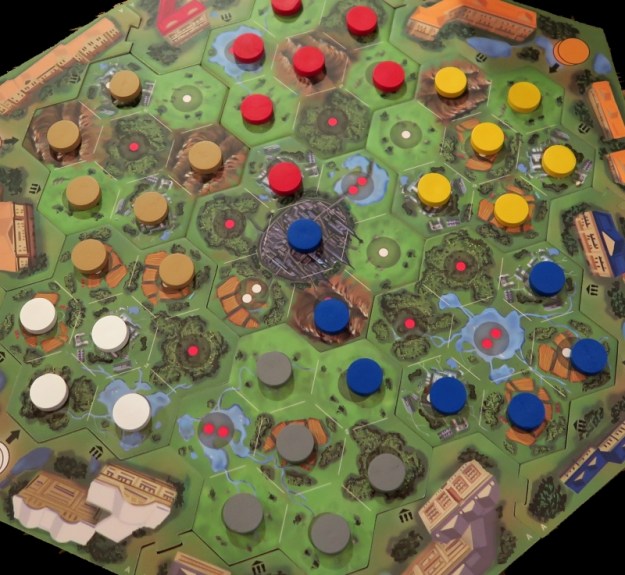
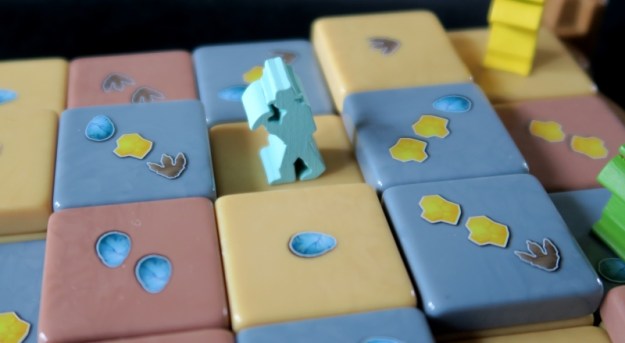
Red Rising
– Image by boardGOATS

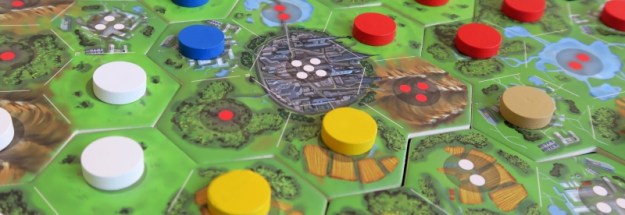
In the books, society follows a fourteen-colour caste system from Gold at the top to Red at the bottom.  Red Rising the board game takes this colour hierarchy and adds elements of hand-management and card-combo building.  The idea of the game is very simple:  players start with a hand of five cards and on their turn, play one card onto the game board and pick up another.  The aim is to improve the quality of their hand and with it, its value.  Cards are played on one of four locations on the central game board and have an additional deployment action when played, the effect of which can be dependent on the location they are played in or the card they are played on top of.

Red Rising
– Image by boardGOATS

The card picked up must be the top card from another different location except where enabled by the played card.  The location from which the card is collected dictates an additional bonus action:  Move along the Fleet track, Collect helium, Increase one’s presence in the Institute, or Claim the Sovereign token.  There are a couple of other options:  play a card and then take a card blind from the Character deck and roll a die to decide what their bonus action will be.  Alternatively, instead of playing a card, just draw a Character card from the deck and place it, then take the bonus action.  In practice, these two options are relatively rare and only taken if there is nothing to pick up, or the player likes the hand they have.

Red Rising
– Image by boardGOATS

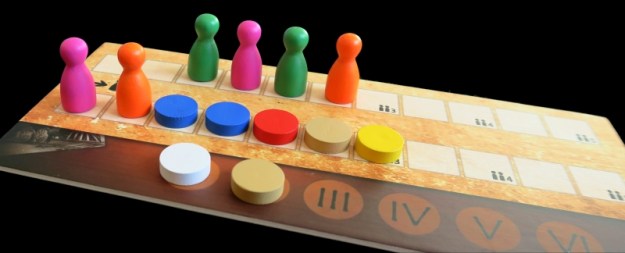
The game ends when either seven is reached in all three of the Fleet track, helium and the Institute, or one player has reached seven in two of them.  At the end of the game, players sum their total score from each card, the scores from combining effects of cards, ten points if they finished with the Sovereign token, three points for each helium, their score for progressing along the Fleet track, and points for each of their tokens in the institute (four per token for the player with the most, two and one for less committed players). Anyone over the seven card hand-limit loses ten points per card over the limit.

Red Rising
– Image by boardGOATS

There is a large deck of cards of which only a relatively small number are seen in each game.  The nature of the game changes dramatically depending on which cards come out.  This time Blue, Pink, Burgundy and Pine made up one table while Ivory, Green, Black and Purple made the other, both playing with the Collector’s Edition.  The first difficulty, was that although beautiful, some of the colours in the Collector’s Edition are difficult to tell apart.  The Influence and Fleet tokens in blue and green, and pink and red, were a particular problem which was made worse in low light.  This was not too much of a problem in practice, however, because influence tokens can be grouped together and we weren’t playing with the maximum number of players so could ditch the worst clashes.

Red Rising
– Image by boardGOATS

A bigger problem was the amount of text on the cards.  Pine and Burgundy both had issues with this, which could be got round by passing cards if people wanted to read them.  Additionally, the cards used in a game tend to circulate with one player playing it and another picking it up before playing it themselves.  So the burden is not as heavy as it seems at first.  Despite it not being complicated, the one table seemed to have a significant issue with rules.  Pine struggled with whether the action was associated with the location a cards was played or the location it was collected from.

Red Rising
– Image by boardGOATS

Pink, meanwhile, developed an inexplicable habit of taking the action at both locations.  Adding insult to injury, Pink also repeatedly distracted Blue by complaining that he couldn’t see a way of increasing the number of cards in his hand and asking advice.  On the next table, however, Green felt he was being got at.  This is actually quite a normal state of affairs because we all love to pick on Green, but in this case that wasn’t what was happening.  Green’s special power that meant he was able to place an Influence token in the institute every time he took the Sovereign token, but he had a card that meant he would lose points if he had the Sovereign token at the end of the game.

Red Rising
– Image by boardGOATS

So, for this reason, Green concentrated on collecting red helium gems instead.  Unfortunately, random draw meant that on this occasion the game had an awful lot of cards that penalised players with the most helium or a player of choice, which Green felt was mostly him.  Worse, the nature of the game is that players play these cards then others pick them up and play them again, which can make it feel like there are more cards like this than there really are.  Black’s influence dominated the Institute, while everyone competed for points on the Fleet track.  It was an extremely close game with four points between first and third.  Purple channelled her inner “Magic: The Gathering” player and with a lot of helium, sneaked ahead of Ivory to take second.

Red Rising
– Image by boardGOATS

Despite struggling to get Gold cards and feeling the game was against him, Green finished just ahead with two hundred and fifty two points.  The other game was nowhere near as close and clearly played out very differently.  Blue, also lost some helium thanks to Burgundy, but it only happened once, there was no real shortage of Gold cards, and the game seemed to take a lot longer.  Part of this was because Pine spent a lot of time checking what he was doing and insisting it wasn’t his sort of game, yet he dominated both the Institute and the Fleet track.

Red Rising
– Image by boardGOATS

There were over a hundred points between first and last in this game, but the scores didn’t feel as disparate while playing.  In spite of his complaints, it was Pine who came out on top with a massive three hundred and nine points.  Overall, both games were a bit of a mixed bag with Burgundy saying it didn’t gel for him, Pine feeling bewildered (not withstanding his success), Green feeling “got at”, and even Pink (who had played it twice before) made a bit of a hash of things. Ivory, Pink and Blue had played it before, and all three had been unconvinced after the first game, but more positive after the second.  So it is definitely a game that benefits from multiple plays, if people are prepared to give it a second chance…

Red Rising
– Image by boardGOATS

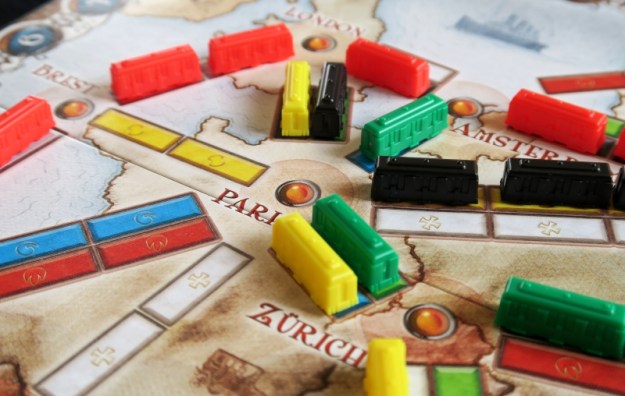
Ivory, Green, Black and Purple finished first and, at the time it looked like the other group wouldn’t finish for ages.  So after some discussion, they started another game and chose Ticket to Ride: Amsterdam.  This is one of the “little” spin-off games based on the original Ticket to Ride.  Themed round a city rather than a country or continent, these are smaller and quicker to play than the bigger games, but lots of fun.  This one is based on the Dutch capital, but the game play is essentially the same as the other editions.

Ticket to Ride: Amsterdam
– Image by boardGOATS

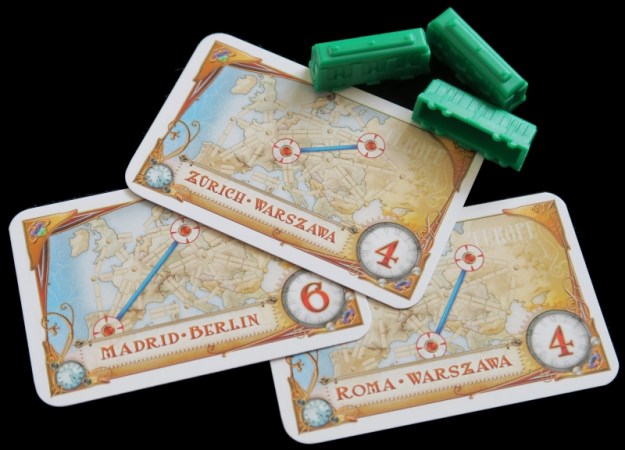
On their turn, players either collect coloured cards from the market, or spend them to place plastic carts and score points.  Players start the game with three tickets (of which they must keep at least two), which depict two locations.  Players who can connect these locations score points at the end of the game; failure to do so leads to negative points.  Each variant has a little tweak.  So, in addition to scoring points from placing pieces and successfully completing tickets, in the Amsterdam edition, players can pick up goods cards when they complete a route marked with carts.

Ticket to Ride: Amsterdam
– Image by boardGOATS

The player with the most of these at the end of the game scores an extra eight points with other players scoring fewer with the amount depending on the number of players.  This time, Purple built her routes through the middle of Amsterdam and to the north.  Everyone else went for the potentially lucrative goods routes in the south, east and west.  The problem with this was the competition, with Green the main casualty.  Although Green managed to get three goods cards he failed to complete his second ticket.

Ticket to Ride: Amsterdam
– Image by boardGOATS

Ivory also went for two tickets and completed them, but managed to add five goods cards giving him the most and adding a valuable eight points to his score.  Both Purple and Black largely eschewed goods cards (collecting just one) and concentrated on finishing their three tickets.  In a tight game, which this was, those solitary tickets and the tie-breaker for them was critical.  It was a tie for second between Black and Ivory, but it was Purple, who just edged in front, winning by a single point.

Ticket to Ride: Amsterdam
– Image by boardGOATS

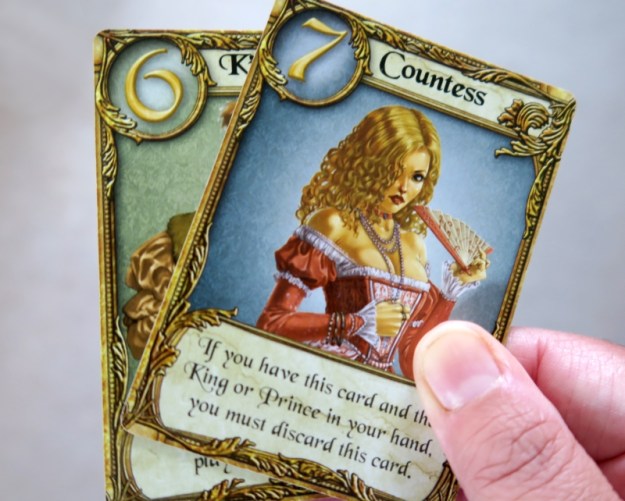
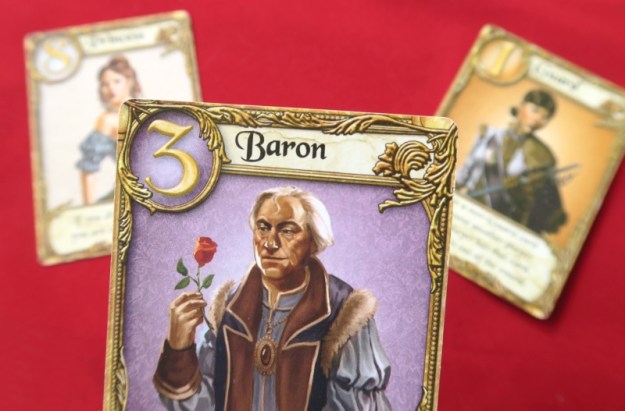
While the others were playing with their trains carts, the second table had finally finished their game of Red Rising, so they picked up where they had left off last time with another game of the filler, Love Letter.  This “micro game” consists of just sixteen cards.  Players start with one, draw a second and play one of them doing the associated action.  The player with the highest value card, or the last player standing is the winner of the round.  The first player to win three rounds is the winner.

Love Letter
– Image by boardGOATS

Last time, it was all about Blue and Burgundy, with Poor Pine being knocked out every single round.  This time it was a bit different, and it was all about Pine and Blue.  Pink and Burgundy failed to take a single round, but it was tight between Pine and Blue.  There was a bit of ebb and flow with one taking a round and then the other, but it was Pine who took his third round first and with it revenge for last time as he left Blue languishing with just two love tokens.

Love Letter
– Image by boardGOATS

Although Ticket to Ride: Amsterdam and Love Letter finished at about the same time, Purple, Black, Green and Ivory all decided it was time to make a move.  The others felt there was still time for one quick game of …Aber Bitter mit Sahne, a fun little game based on the simple “I divide, you choose” mechanism.  On their turn as Master Baker, the active player constructs a “pie” from pieces drawn at random and divides it into portions, each consisting of several pieces.  Starting with the player to the Baker’s left, each person takes a portion of their choice and decides which pieces to keep and which pieces of cake to eat.

…Aber Bitte Mit Sahne
– Image by boardGOATS

When all the cake has been distributed, the player with the most of each type scores the number shown on that type, while each piece that has been eaten scores for the number of blobs of cream, sahne.  The clever part is that the number of cake pieces of each type in the game is the number shown on the pieces, thus the most common types are the most valuable, but also need the most pieces to score.  Thus the aim of the game is to collect sets, but only the largest of each type scores, everything else is worthless unless it has been eaten.

…Aber Bitte Mit Sahne
– Image by boardGOATS

Players tend to wind up collecting different sets.  This time, Pine won nine points for his gooseberry pie, Burgundy won seven for his blackberry flan and Pink took twenty-one points for his strawberry tart and chocolate gateaux.  That was without counting the cream though.  Pink thought he’d done enough, but was just beaten by Burgundy who, as well as a lot of cream, also shared the points for a lot of the lower scoring cakes. His final total of thirty-four was one more than Pink with Pine and Blue tied for third.  And on that sweet note, it was home time.

…Aber Bitte Mit Sahne
– Image by boardGOATS

Learning Outcome:  It will take a little time to get used to playing face-to-face again.

Next Meeting, THURSDAY 26th August 2021 – Back at the Jockey!

Following the test event at the Horse and Jockey and much discussion, we have decided to try meeting in person again.  As the pub are not currently serving food on a Tuesday, we have decided to move to Thursdays for the time being.  Therefore, our next meeting will be on THURSDAY 26th August 2021.  We will start playing shorter games from 7.30pm as people arrive, until 8pm when we will start something a little longer (table is booked from 6.30pm for those who would like to eat first).

This week, the “Feature Game” will be Red Rising, which is a new card collecting game themed round the books by Pierce Brown.  The books are set in a dystopian future on Mars following lowborn miner Darrow, a Red, as he infiltrates the ranks of the elite Golds.

Red Rising
– Image by boardGOATS

And speaking of colours…

Jeff was showing Joe his new pen. “It’s magic, see?” Jeff explained, “It can can write any colour. Red, Pink, Brown, Orange, Violet, Yellow, Blue, Gold…  And even words that aren’t colours…!”

19th August 2021 – “Unofficial boardGOATS”

We’d had such fun at the “Post-Covid Test Event” at the Horse and Jockey and some were so disappointed to have missed it, that we decided to have another, this time “unofficial” meeting at the pub before our formal return.  As we chattered away and waited for food to arrive, we told Lime what we’d played last time.  He said he was sorry to have missed Sushi Go! as he really enjoyed it, and in a trice, a real, hardcopy of the game was out and cards were being shuffled and dealt.  We’ve played Sushi Go! plenty of times both online and in person, but as usual, we had a very quick run-through of the rules.

Sushi Go!
– Image by boardGOATS

Players start with a hand of seven cards, and choose one to keep, passing the rest on to the player on their left.  Players repeat this with the aim of the game being to end up with the set of cards that score the most points.  The game is played over three rounds with the player with the highest total winning. The final round was coming to an end when pizza arrived, but we just had time to get to the end.  It was close, but Blue made up for her disastrous showing earlier in the week online with a win, just a single point ahead of Pine (who had missed out completely on the previous game).

Pizza
– Image by boardGOATS

Food was summarily dispatched and Ivory arrived, and after some discussion about what to play and whether to split into two groups, we all settled down together to play the dice-drafting game, Sagrada, with the 5-6 player expansion.  This is another game that most of us are reasonably familiar with and we thought it would be a good game to play to help dust some more of the cobwebs off our gaming skills which had proven to be decidedly rusty at the “Test Event”.  The base game is quite simple:  the starting player draws dice from the bag and players take it in turns to take one and add it to their stained glass window.

Sagrada
– Image by boardGOATS

As well as following the restrictions given on the players’ window cards which specify colours and numbers for some spaces, players must place new dice next to already played dice while avoiding placing dice of the same colour or number in adjacent spaces.  Depending on the difficulty of the player’s window card, players get a number of “cheat tokens” which are worth points at the end, or can be spent to use “Tools” to enable players to improve their move dice, change dice numbers and otherwise break the rules.  This time the Tools cards drawn at random were the Eglomise Brush, the Copper Foil Burnisher and the Cork-backed Straightedge.

Sagrada
– Image by boardGOATS

The Eglomise Brush and the Copper Foil Burnisher allowed players to move dice ignoring any colour/number restrictions printed on their window card, while the Cork-backed Straightedge allowed players to place their chosen die in a location not adjacent to another die.  The Tools are really useful as they allow players to improve their scores. These come from individual goal cards, and shared goal cards drawn at random.  This time we drew one objective card rewarding dice of the same colour arranged diagonally and two that scored points for pairs of dice (ones and twos/threes and fours).

Sagrada
– Image by boardGOATS

The 5-6 player expansion, tweaks the rules a little.  In the base game, in each round, the draft goes one way and then returns so that the first player gets to choose first and last with the last player taking two dice one after the other (similar to the initial settlement placement in The Settlers of Catan).  With large numbers of players this can lead to a lot of down-time, partly because of the sheer number of decisions (which are taken sequentially), but also because there are more dice giving players a larger number of options to consider.  To avoid this, players start the game with their own personal dice pool consisting of two of each colour, rolled to give random numbers.  Players then take one die from the draft and one from their personal dice pool.

Sagrada
– Image by boardGOATS

Pink began, drawing seven dice from the bag, but we were only a few rounds in when Lime thought he might have dropped one.  This queued a mad session of dice counting as well as fond recollections of the time Pine dropped a No Thanks! token between the floor boards which is probably still there.  Fortunately, the dice, though small, would not fit through the gap and it turned out nothing had been dropped anyhow.  Meanwhile, Blue and Burgundy discussed how to interpret the “diagonals” in the objective card as it was unclear from the rules.  We decided to use the generous interpretation and score for each diagonal line, counting dice multiple times, but checking online after proved this incorrect and each diagonally adjacent die of the same colour scores just once.

Sagrada
– Image by boardGOATS

Lime was first to use his cheat tokens, though almost everyone else soon joined him.  The exception was Pine who, despite starting with one of the most difficult Window cards, still had all six cheat tokens left at the end.  Ivory pointed out that Pink’s window seemed to have a lot of high scoring green dice, making it likely that green was his personal objective and giving him a high score that would be hard to beat.  And so it proved, though Ivory scored only one less for his personal, purple objective.  Scores for pairs of dice were mostly similar, though Ivory, who started out with a hatful of ones managed to pair these with five twos giving him ten points.

Sagrada
– Image by boardGOATS

In the end, Burgundy and Pink were both close with fifty-six and fifty-eight points, but Ivory was five points clear with sixty-three.  Lime had a horrifically early morning so reduced the numbers to five, and giving the mess we’d made with Bohnanza last time, the rest of the group decided to give it another go.  This is a fantastic trading game where players first plant beans from their hand, then draw two beans from the deck which can be planted or traded (and planted by the recipient) and finally harvest beans.  The key point about the game is that cards in hand must not be rearranged.

Bohnanza
– Image by boardGOATS

There are some really clever aspects to the game, for example, because the beans become money, the distribution of beans in the deck changes as the game progresses, but players can manipulate that by choosing when they harvest.  Harvesting just before the deck is shuffled means more cards of that sort become available in the next round.  With slightly fewer players, this becomes increasingly significant.  This time, Burgundy’s shuffling got the blame when Blue started with a handful of green beans and then turned over more.

Bohnanza
– Image by boardGOATS

Green beans continued to fall into her lap and punctuated by a full set of garden beans, some black-eyed beans and a small number of others, she harvested significantly more than the fourteen cards available.  Pine managed to gather a full set of four cocoa beans, which felt all the more special as they often not in the game because they are removed for many player counts.  Pink repeatedly demonstrated how he was unable count, trying to taking four cards to refill his hand each round instead of three.  A couple of rounds in, Blue, bought herself a third bean field and nearly underpaid for that too (the cost varies depending on the number of players).

Bohnanza
– Image by boardGOATS

As the game came to an end, players tried to maximise their final scores, and then started counting.  Twelve was beaten by thirteen, which in turn was beaten by fourteen and then Ivory’s score of fifteen.  But Blue was still counting, and counting—the green beans and her third bean field had done their job and she finished with a massive twenty-one.  With that, Ivory left leaving four players and just enough time for a quick game of Love Letter, a game that is available online, but we’ve eschewed playing as it loses all it’s fun.

Love Letter
– Image by boardGOATS

One of the most successful of the micro-games, there are just sixteen cards.  Each player starts with one card, draws a second from the deck and then plays one.  The aim of the game is to end with the highest value card, or be the last player standing when the deck is exhausted.  Some cards allow players to assassinate others if they correctly guess what they are holding, or if they compare cards and have the lower value.  The game is played until one wins three rounds.  Burgundy and Blue took the first and second rounds, before Pink took one round and Blue took another and with it, the lead.

Love Letter
– Image by boardGOATS

Pine had been knocked out of every round and when Pink picked him again he protested that Blue would be a better target.  His protests were in vain, however, with Pink correctly suggesting Pine was “The Princess”, he was knocked out once more.  Pink’s comment, “Don’t worry, you’ll always be a princess to me,” received a disgruntled, “Eat my tiara!” in reply.  When Burgundy eliminated Pink, that gave Blue the last card and she went for the jugular taking what was the final round and with it, the game.

Love Letter
– Image by boardGOATS

Learning Outcome:  Anyone can be a princess.

17th August 2021 (Online)

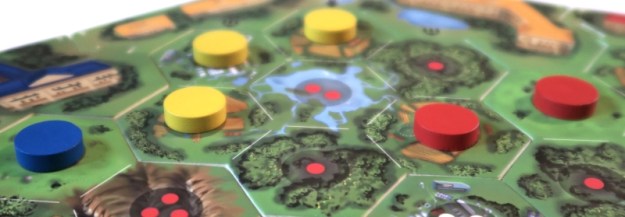
Although the test event at the Horse and Jockey was very successful last week, we decided to continue online for another week.  So, after the usually chatter (mostly centred on the subject of revenge for the drubbing some of us got from Pine in playing the Heart of Africa expansion to Ticket to Ride), we moved on to the evening’s “Feature Game“.  One of the more popular games that we have played online is the “Roar and Write” type game, Welcome to Dino World.  We only played it once and then in “Lite Mode”, but there had been a lot of interest in the more exciting sounding “Danger Mode”, so we decided to give it a try this week.

Welcome to Dino World
– Image by boardGOATS

The basics of the game is that three dice are rolled giving a number of “pips” which players can spend on up to three actions.  These actions are to:  build paths; build a dinosaur pen (with generators), or build a facility.  The relatively novel aspect of this is that as well as choosing actions to do, players can also combine two or more dice together and use the increased value to do fewer, more powerful actions.  Thus a roll of one, three, and four can be used to do three separate actions of that level, or two actions of value, four say, or a single action of level eight.

Welcome to Dino World
– Image by boardGOATS

Playing the game with a large number of players (and remotely to boot), instead of players having goal cards that are scored at the end of each round, we use the variant where there are communal goal cards (called “Visitor Cards”) which are scored at the end of the game.  The game lasts just eight rounds, after which everyone adds up their scores for visitors, facilities, unused generators and, of course, each dinosaur pen.  This “Lite” version of the game is made considerably more complex when the game is played on the “Danger” board with the addition of Threat and Security Tracks and a modification to the way generators are built.

Welcome to Dino World
– Image by boardGOATS

The idea of the Threat Track is that every time a dinosaur pen is added the park, the threat level increases by one for a herbivore and two for a carnivore.  Once per round, players can also increase their Security Level, by crossing off boxes on the Security Track.  These boxes contain points, which if unused at the end of the game, are added to the player’s score.  After the building phase is the malfunction phase when a single six-sided, (d6) “Threat Die” is rolled.  The value of the Threat Die is added to each player’s Threat Level minus the Security Level to give the Danger Level.  If the Danger Level is six or above, disaster strikes, generators malfunction, and dinosaurs start to rampage.

Welcome to Dino World
– Image by boardGOATS

Although both use 4 MW generators, they work slightly differently in the Danger and Lite Modes.  In Lite Mode, each generator will supply a maximum of four pens (the ones sharing a side with the generator), so a pen that requires a total of 3 MW must be adjacent to three different generators.  In Danger Mode, one generator can supply a maximum of 4 MW, but it can supply more than 1 MW to an individual adjacent pen indicated by a power line drawn between the two.  Thus, the amount of power a generator supplies can change during the game—it is the generators that are working closer to full capacity that are most likely to fail…

Welcome to Dino World
– Image by boardGOATS

If the Danger Level in a park reaches six, any generators that are working at maximum capacity fail.  It is a brief power-outage, but as a result, any pens that rely on these generators are affected and one square of these pens is lost (crossed out).  The problem really comes, however, when the final square in a pen is lost and and the pen fails completely, because now the dinosaurs break out and cause damage to all the neighbouring pens causing a cascade reaction.  And any pen that is destroyed completely no longer scores.

Welcome to Dino World
– Image by boardGOATS

Thus, the game is a matter of achieving a fine line between getting the most out of a limited number of generators with the minimum amount of security while still avoiding rampaging dinosaurs.  The rules explanation took longer than expected as there was quite a bit more to Danger Mode, and worse, it was a while since we last played the game in Lite Mode, so we had to revise that too.  Eventually we were going, however, only for a hiatus after the first round for a rules-check.

Welcome to Dino World
– Image by boardGOATS

Burgundy was right to point out that although the rules say players can carry out the three actions in any order, each one could only be carried out once per turn, in particular building dinosaur pens and building facilities.  Around half the players had already built two pens in the first round, so we decided that any player that had not done so, could build a second pen in the second round if they chose, and thereafter we would adhere to the rules “as written”.

Welcome to Dino World
– Image by boardGOATS

As last time, the first couple of rounds were very slow as players tried to assimilate the Visitor cards and work out a plan to maximise the points they could get from them.  This time they were:

  • ≥3 Protoceratops pens (worth four points);
  • ≥2 Different facilities touching orthogonally (worth four points);
  • ≥1 Protoceratops pen, ≥1compsognathus pen, and ≥1 stegosaurus pen all within four paths of any entrance (worth six points);
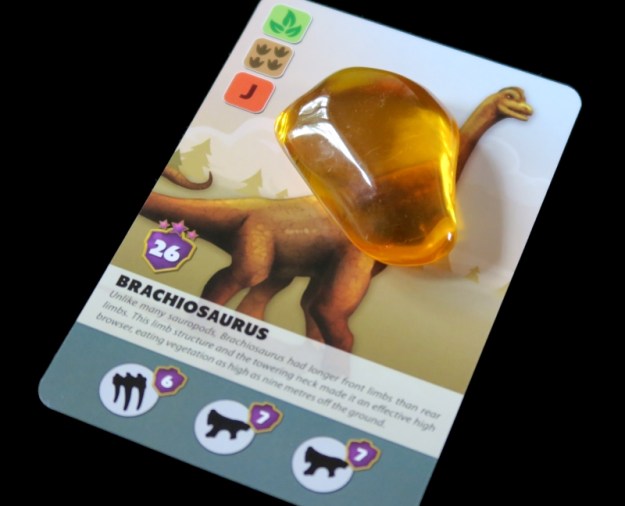
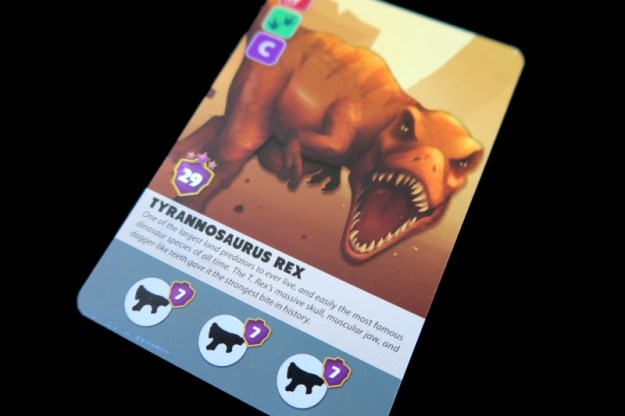
  • ≥1 T. rex pen and ≥1 brachiosaurus pen (worth six points);
  • ≥4 Brachiosaurus pens (worth ten points);
  • ≥2 Velociraptor pens and ≥3 herbivore pens (worth ten points).

The Facilities were the Viewing Platform and the Ranger Lookout which score points equal to the number of undamaged spaces in one neighbouring pen at the end of the game, and one point per pen visible orthogonally (respectively).

Welcome to Dino World
– Image by boardGOATS

In addition to the variety from the Visitor and Facility cards, there are also Research cards which are there to mitigate bad luck.  In Lite Mode, Research is just six opportunities to adjust a die by ±1, but these are replaced by three cards, X, Y, and Z which players can use three times, twice and once respectively.  This time, these were:

  • Calculated Risk: When building a carnivore pen, only add one to the threat track but add one damage to the pen (X);
  • Alternate Funding: Use one die as if it were any value (Y);
  • Docile Gene Editing: Do not increase the threat when building a pen this round (Z).

While minimising generators and security gives players more points at the end of the game, there is no benefit in not using their Research, so while most players kept some back in case of emergencies, others started using them from the very beginning.

Welcome to Dino World
– Image by boardGOATS

Although we were slow to get started and the first few rounds were also very slow, once we got going the rounds were much quicker.  And then came the maths.  Without Ivory to set an early (usually unbeatable) target, Pine stepped up with a score of one hundred and seven.  This was soon topped by Burgundy with a hundred and twenty-seven, then by Black with a hundred and twenty-nine.  However, on recount, Burgundy excitedly announced that he also had a hundred and twenty-nine, while Black sadly revised his score down to a hundred and twenty-seven.  All was not lost as both players recounted again and Black’s score returned to one hundred and twenty-nine while Burgundy’s third and final count proved to be the lowest at a hundred and twenty-six, “Bah!”.

Welcome to Dino World
– Image by boardGOATS

At this point, Black and Burgundy gave in as Pink’s verified score was a hundred and thirty, and it was clear they were battling for the minor places.  Pink, who thought he had won, however, was decidedly unimpressed when he was beaten by two points by Blue.  There must have been something in the air, or maybe it was the fumes from the vast amount of Tipp-Ex that Blue had used.  Pink’s check of Blue’s score initially increased her tally by six, only for him to reduce it again on a second recount, but the changes weren’t enough to give Pink victory.

Welcome to Dino World
– Image by boardGOATS

Pine was suffering with screen-eyes so took an early night leaving six to move onto Board Game Arena.  Six is an important number as a lot more games become available, but after some discussion where people expressed the desire to play something different yet light, we chose Go Nuts for Donuts!, which Pine had said he had been playing and had found light and entertaining.  It was indeed very, very simple:  each donut has a number and players simultaneously choose a card to “bid” for them.  The catch is that a bit like Om Nom Nom, if more than one person chooses the same donut, it cannot be shared and nobody gets it.

– Image used with permission
of boardgamephotos

The different types of donuts score points in different ways and the player with the most points after all seventy cards in the deck have been exhausted is the winner.  Some just give points, others score if you have more (or less) than a certain number of one type of cards, while others allow players to take cards from the deck or discard pile.  The clever part is the simple decision, however:  which card to choose.  It is not as simple as it first seems.  Sometimes a player wants the card that gives the most points, but then other players may want that, so perhaps it is better to choose something else, even a card someone else wants simply to stop them getting it.  And which one is best if there is more than one donut of the same type?

Go Nuts for Donuts! on Board Game Arena
– Image by boardGOATS from boardgamearena.com

Go Nuts for Donuts! is quite a brutal game in that it is perfectly possible to end up with no cards much less cards you actually want.  It is a lot of fun though, and would probably be even more fun in person when players get to see the whites of each other’s eyes and read their body-language.  This time, although Purple got the most cards with eleven, it was only enough for second place.  Burgundy’s six cards worked better together, and thanks largely to his fine set of four Boston Cream donuts, Burgundy’s score of eighteen just gave him victory by a single point.

Go Nuts for Donuts! on Board Game Arena
– Image by boardGOATS from boardgamearena.com

The appearance, style and set-collection nature of Go Nuts for Donuts! is very reminiscent of Sushi Go!, so with Green’s departure, the rest of the group settled down for one last food-related game.  We’ve played Sushi Go! quite a bit, mostly because it is very quick and simple.  The archetypal card drafting game, players start with a hand of cards and pass the rest on, trying to collect sets to give them the most points at the end of the game.  Played over three rounds, we played with a widdershins draft in the second round, and included the Soy Sauce mini-expansion for extra flavour.

Sushi Go!
– Image by boardGOATS

Pink took the first round largely thanks to a full set of three sashimi cards (which give ten points).  Players always fight for the wasabi cards as these can give a significant points boost, multiplying the next nigiri by three, but Purple was the only one to get any and she couldn’t make the best use of it as she had to pair it with egg nigiri (only worth one point).  The second round was pretty much a repeat of the first with Pink taking another sashimi trio and Blue scoring the egg nigiri with wasabi.

Sushi Go! on Board Game Arena
– Image by boardGOATS from boardgamearena.com

With Pink well ahead with thirty-six, the final round was really about limiting losses.  Purple took a full six for her puddings and Pink took six points for his maki rolls, but overall, the takings in the final round were pretty similar.  The rest of the group were actually quite close together with Purple (again) the best of the rest, but despite losing three points for tying for the least puddings, Pink’s final total of forty-two was unbeatable.

Sushi Go! on Board Game Arena
– Image by boardGOATS
from boardgamearena.com

Learning Outcome:  If the fences of dinosaur pens lose power, things can go very wrong (though perhaps that was already well known).

Boardgames in the News: Harshad Gothankar’s Flicking Amazing Feet

Harshad Gothankar from Mumbai was born without arms, so he does everything with his feet—including playing Carrom.  Carom is a flicking game played in south Asia that is similar to the north American/Canadian game Crokinole and more modern descendents like Flick ’em Up!, ICECOOL, Subbuteo and PitchCar (or Carabande).

Harshad Gothankar
– Image by Mumbai Games on facebook.com

Harshad Gothankar has always been a remarkable young man with a passion for playing the national sport of cricket and is now also a state Carrom champion.  He recently became an internet phenomenon, however, when cricket superstar Sachin Tendulkar highlighted his determination in a post on his social media feed.

– From twitter.com

Next Meeting, 17th August 2021 – Online!

Although the test event at the Horse and Jockey was very successful last week, we have decided to continue online this week.  Therefore, our next meeting will be on Tuesday 17th August 2021; we will gather from around 7.30pm, and start playing at 8pm.

One of the more popular games that we have played online was the “Roar and Write” type game, Welcome to Dino World.  We have only played the “Lite” version, so this week, the “Feature Game” will be “Dinos in Danger Mode”.  This is much nastier and altogether more likely to lead to an Isla Nublar type incident…

Welcome to Dino World
– Image by boardGOATS

And speaking of Dinosaurs…

Jeff and Joe had just finished watching Jurassic World and as they watched the credits, Joe said commented that he thought it was a fantastic film.  Jeff was less impressed.

Joe enthused, “But just look at what they made those dinosaurs do!”

Jeff replied, “Yeah, it’s great—they were able to train raptors. Still, that’s not as impressive as the Flintstones convincing a bird to be their record player…”

12th August 2021 (Post-Covid Test Event)

After some discussion, we had decided to have a “test visit” to The Jockey.  As they are not doing food on Tuesdays at the moment, this was a Thursday and we decided to make it a fairly light event filled with some of our favourite games.  Those that arrived early started with food and Burgundy was able to order Ham, Egg and Chips for the first time in over a year.  There was a boisterous atmosphere amongst the gamers who were all clearly over the moon to be back, bolstered by the wake on the other side of the room which had been going full-swing since lunchtime.

Ticket to Ride: Nordic Countries
– Image by boardGOATS

While we waited for food to arrive, the group revelled in the delight of face-to-face meeting discussing the meaning of the word “MILF” and whether or not there was such a thing as a “DILF”.  Poor Ivory had been waiting well over a year to play the Japanese map for Ticket to Ride and it had been scheduled at least three times since and had been postponed thanks to “events”.  As it was starting to become a bit of a harbinger, we decided to make the “Feature Game” the generic Ticket to Ride to ensure that the evening wasn’t jinxed again, but there was plenty of opportunity to give it an outing as two copies arrived.

Ticket to Ride Map Collection: Volume 7 – Japan & Italy
– Image by boardGOATS

There were lots of other map choices and while we discussed the real options, lots of new variants were invented.  The pick of these were perhaps the Beeching Variant (loads of the routes get ripped up halfway through the game leaving people with tickets they can’t make) and “Ticket to Row”, the “Climate Change Edition” (as the game progresses, coastal routes disappear due to erosion and flooding).  Ivory was obviously keen to play the Japanese map and was joined by Green, Lilac and Burgundy.  The other map ended up being the Heart of Africa and after some discussion about the best number of players for this map (which has reputation of being brutal), Burgundy moved over to join Blue, Pink and Pine.

Ticket to Ride: Germany
– Image by boardGOATS

Ticket to Ride is a relatively simple game, often referred to as a “Gateway Game” because it has a reputation of drawing people into playing modern board games.  The decision space on each turn is relatively small, but still meaningful and although a lot of the group like more challenging fare too, we all have a soft-spot for this one.  The idea is that players are building track, by playing coloured cards that match the colour and number of the line shown on the map.  So on their turn, they can draw cards, or place trains by playing cards.  Points are scored for placing trains with longer the routes, giving more points.

Ticket to Ride Map Collection: Volume 6 – France & Old West
– Image by boardGOATS

Things are not quite as simple as that though, because players also have tickets:  if they can fulfil their tickets using routes they have claimed, they score points.  If, on the other hand, they have unfulfilled tickets at the end of the game, these score negative points.  Thus, instead of picking up cards or placing trains, players can also collect tickets to try to increase their score that way.  The game end is triggered when one player has only two of their little plastic train pieces left.  One of the things that gives Ticket to Ride its remarkable continuing appeal is the incredible variety in expansions available, each of which add interest with a different layout and slight variations to the rules.

Ticket to Ride: Nordic Countries
– Image by boardGOATS

For example, the Japan expansion has routes reserved for Bullet Trains, which are marked by a single Bullet Train miniature.  When a route is claimed, it can be used by all players to complete destination tickets.   Instead of scoring points for such a route, players progress on the separate Bullet Train track with players receiving a bonus at the end of the game: whoever has contributed the most to this shared project receives the largest bonus, with the player who contributes least being penalized.

Ticket to Ride Map Collection: Volume 7 – Japan & Italy
– Image by boardGOATS

In contrast, the Heart of Africa expansion adds new terrain cards which can be picked up instead of train cards which can be used to score extra points when placing trains.  The terrain cards come in three different colour sets representing Desert/Savanna, Jungle/Forests, and Mountains/Cliffs.  When a player places trains of the corresponding colours, if they have at least as many of that terrain card as every other player, they may additionally spend terrain cards to double the points value of their route.  One of the consequences of the different terrain types having fixed colours is that routes of one colour tend to be clumped together.

Ticket to Ride Map Collection: Volume 3 – The Heart of Africa
– Image by boardGOATS

This means that players need lots of cards of the same colour to connect routes together.  This, combined with the fact that there are no “double routes” in the centre of the map, mean the Heart of Africa expansion has a reputation of being particularly savage and unforgiving.  It was also much slower to get going, indeed, the Japan expansion players were well into their game before the Africa players had really started, and they had nearly finished before the others had got halfway through.  In Japan, Ivory went for the Bullet Trains to get the bonus, but also in order to help complete his tickets.  Although nobody really engaged in the building of the Tokyo subway, Kyushu Island was well catered for by Lilac who built a very fine connection from Kokura to Miyazaki.

Ticket to Ride Map Collection: Volume 7 – Japan & Italy
– Image by boardGOATS

In the dying moves of the game, Lilac effectively gave Green fifteen points and with it, the game.  Things were rather different on the next table, however.  Blue and Burgundy got stuck with tickets that meant they had little choice but to go through the jungly centre of Africa.  With Pine having accidentally picked up a large pile of jungle terrain cards, there was no chance of either of them getting double points.  Worse, as Blue struggled she could see there was one single train route that she simply had to take and Burgundy was heading straight for it.

Ticket to Ride Map Collection: Volume 3 – The Heart of Africa
– Image by boardGOATS

When Blue took the critical route from under Burgundy’s nose, it started a cascading chain reaction of events where they continually messed up each other’s plans.  Meanwhile, Pine sniggered from the sidelines as he built his routes round the south coast largely unopposed—even on the odd occasion that someone else managed to get in his way, it was on a double route.  Pink was getting it largely his own way too, as he was going round the west and north edges of the map.

Ticket to Ride Map Collection: Volume 3 – The Heart of Africa
– Image by boardGOATS

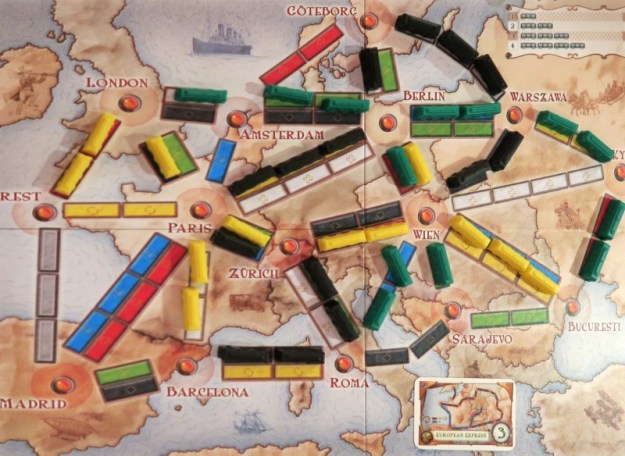
Pine picked up handfuls of tickets most of which seemed to lie on the routes he’d already connected, and then Pink suddenly moved to end the game leaving Burgundy with no other choice but to take tickets and hope for a miracle (to no avail).  As the last trains were placed, Pine had a substantial lead which only increased when he added his ticket scores and Globetrotter bonus for having the most complete tickets.  Although it was all built on extreme good fortune in his starting tickets, Pine had put together a fantastic game finishing with a massive one hundred and seventy-five points, forty points ahead of Pink in second.

Ticket to Ride: Europe
– Image by boardGOATS

As the depths of deepest darkest Africa were being slowly explored, the other three decided to take advantage of Burgundy’s preoccupation to play Splendor without him to guarantee one of them a rare victory in a game that we haven’t played for over a year.  The game is very simple:  on their turn, players either collect gems, or use the gems to buy cards.  The cards then act as permanent gems, while the more expensive cards also give victory points as well.  A player reaching fifteen points triggers the end of the game, and the player with the most points wins.  Although we have played it a lot, this time was with Green’s brand new copy, with the wrapper still on.

Splendor
– Image by boardGOATS

Once the cellophane had been removed and cards well shuffled, the group settled down to play.  Maybe it was poor shuffling or perhaps just luck, but diamond cards (whites) were slow to come out at the start.  In addition to points on cards, players can also get points for collecting Noble tiles.  This time, Ivory suddenly claimed two Nobles in quick succession which, together with a high-scoring card pushed him over the line.  Green was able to claim a third Noble, but it wasn’t enough and he finished one point behind Ivory in what had been a close game.

Splendor
– Image by boardGOATS

The Explorers of Africa finished at around the same time as the gem dealers.  So, as Ivory headed off to get ready for his weekend away, Pink suggested a game of our old favourite, Bohnanza.  Everyone had played it a lot except Lilac, so as Blue explained the rules, Pine and Burgundy prepared and shuffled the deck.  The game is a simple enough trading game, but depends on the vital rule that players must not change the order of the cards in their hand.  On their turn, the active player must play the first card in their hand, and may play the second if they choose.

Bohnanza
– Image by boardGOATS

Then, the player turns over the top two cards from the central deck.  They can plant these in their two been fields if there is space, but fields can only hold beans of one type, and beans on the table must be planted, so most often these are traded to other players.  Once the two cards on the table have been dealt with, the active player can finally trade cards from their hand, but again, all cards traded must be planted.  When they are done, they draw cards to go into their hand.  The aim of the game, once again is to collect sets.  At any point, players can trade in their planted beans, getting coins at the rate indicated by the “Bean-o-meter”.

Bohnanza
– Image by boardGOATS

And this is one of the clever parts of the game—when a player sells their beans, they take the relevant number of cards and turn them over, turning them into money.  One side effect of this is that rare cards become increasingly rare, while the more common cards become increasingly common.  The deck also gets progressively smaller as fewer cards are recycled making the rounds shorter as the game goes on.  The game lasts three rounds, but as a result of this, the last round is usually very short indeed. There are a lot of other nuances, which Green and Blue tried to explain so Lilac wasn’t too disadvantaged.

Bohnanza
– Image by boardGOATS

The others expressed their disapproval by referring to them all as “Team Trio”.  However, while Lilac was getting the hang of it and everyone was doing what they could to be nice to her, Blue lost the plot and sold several fields of beans without taking her reward.  It seemed to be contagious, because in the final round Burgundy’s pile of coins somehow became the draw pile.  Chaos reigned and hilarity ensued as Blue, Pine, Pink and Burgundy tried to work out what had happened and variously blamed each other.  Burgundy probably got most of his coins back, but there wasn’t really much doubt that the winner was Lilac with fifteen coins.

Bohnanza
– Image by boardGOATS

Although it was late there was still much chatter, about how it wasn’t the same without Black, Purple and Lime, and what we were going to do going forwards.  It got quite a lot later too, because as we headed out someone pointed out the clear skies and how it should be possible to see the Perseid Meteor Shower.  As we stood in the car park, someone spotted a “shooting star”, but everyone else missed it.  So we waited for another, and another, and another.  Eventually, everyone had a crick in their neck and rather than spend the whole night there, we decided it was time to go.

Perseid Meteor Shower
– Image from wikimedia.org

Learning outcome:  It’s great to be back.

3rd August 2021 (Online)

Last time, we had decided to have a “test visit” to The Jockey, with the hope that we’d be back this week.  Sadly, since then, the pub has been closed, so we were online for another week.  Lime, Pine, Black and Purple were the first to join the meeting, quickly followed by Burgundy, then everyone else eventually joined the chatter.  We had hoped to mark The Games of the XXXII Olympiad in Tokyo and our return to The Jockey by playing Ticket to Ride with the Japanese map.  However, circumstances meant that this was the third unsuccessful attempt to play that game.  So instead, this week, the “Feature Game” was the Ishikawa map for MetroX.

MetroX
– Image by boardGOATS

MetroX is a simple little “Roll and Write” type game that seems easy at first, but is difficult to play well.  The game is driven by a deck of number cards, where the simple ones dictate how many sections can be marked on a route:  Players fill the boxes along the lines with “zeros”, with the number on the card dictating the number of boxes filled.  In general, if the line comes to an end, or some of the boxes had already been filled (because they were part of another line for example), then any excess are lost.  So the game is all about efficiency, as there is a limit to the number of cards that can be used on each line (as shown by the indicator boxes at the start of each one).

MetroX
– Image by boardGOATS

There are a small number of special cards as well, which break the rules.  For example, there are number cards with a circle, which allow players to skip any filled spaces and and help avoid wastage.  There are also special “star” cards, which allow players to fill a box with a number equal to the number of tracks passing through the space—this number contributes to the player’s final score.  There is also a “free” card which allows players to fill in a single space anywhere on the map.  Cards are turned until all the indicator boxes on the map have been filled or until the six is drawn, in which case, the deck is shuffled and drawing (both of cards and routes) continues.

MetroX
– Image by boardGOATS

Points come from the “star” bonuses, but also from line completion bonuses.  These are scored similar to the rows and columns in Noch Mal! or the bonuses in Welcome To…, where the first player to complete a line scores a higher amount than those who complete it later in the game.  This is off-set with a negative score for the number of unfilled boxes at the end of the game.  This time we were playing with the Ishikawa promo map, which is remarkably simple, however, the fact there are very few indicator boxes not only makes it a very short game but also leaves very little room for manoeuvre.  With only eleven rounds (plus any free cards) we were all worried that if we didn’t get a six we might struggle to complete lines.  That concern turned out to be baseless, however, with every line being completed by someone during the game.

MetroX: Ishikawa Promo Map
– Image by boardGOATS

Green’s mind was clearly elsewhere as he missed a number and spent a couple of minutes trying to work out what he’d done and then asked for clarifications on the negative scoring.  For reasons that weren’t entirely clear, everyone struggled to calculate their scores, with a long delay before scores came in, and with a large number of corrections.  Ivory led the scores with nineteen points.  After a brief spell in second behind Pink and Purple, a couple of recounts later it was confirmed as a four-way tie between Ivory, Pink, Burgundy and Purple all with nineteen.  So, following the example of the high jumpers, Mutaz Essa Barshim and Gianmarco Tamberi, they agreed to share the Gold Medal.

– Video from youtube.com

The Japanese are very fond of their railways, so as the Ishikawa map was so quick to play, we decided to follow it with another train game, the new Railroad Ink Challenge, which we first played a month ago.  This is another relatively simple “Roll and Write” game, where players have to draw the road/rail depicted when four dice are rolled.  All four must be drawn and they must connect to an “entrance” or something already drawn on the player’s map.  There are also special cross-roads which can be used a maximum of once per round and only three can be used in the whole game.  Each game lasts for just seven rounds, so again efficiency is vital.

Railroad Ink Challenge: Shining Yellow Edition
– Image by boardGOATS

The Challenge edition adds extra features on the maps which in effect give players bonuses when they fill those spaces, and also adds a set of three “goal” cards that give players more points when they complete them.  These work in the same way as the line bonuses in MetroX, except that there are three sets of points available:  one for the first player(s) to complete them, one for the second set of players to complete them and one for everyone else.  Last time, we played the Shining Yellow edition, but this time, although we used the yellow boards, we used challenge cards from the Lush Green edition, randomly drawing cards A, B and E.

Railroad Ink Challenge: Lush Green Edition
– Image by boardGOATS

Goal A gave points for players filling five of the nine central spaces; B gave players points for completing three of the “village” spaces and E gave points for completing all nine of the central area.  Ivory’s printer refused to play ball, so he gave up and took an early night.  We were all sorry to see him go of course, but it did give everyone else a chance to win.  The first round included one of the especially awkward back-to-back curves, but it turned out to be the only one, though.  This time there were a lot of T-junctions and fly-overs, with very few straight segments and simple corners. As a result, people started using their “specials” quite early rather than saving them to the end.

Railroad Ink Challenge: Shining Yellow Edition
– Image by boardGOATS

As is often the case, there were a lot of reports of huge numbers of “hanging ends” meaning that players were variously taking chances and keeping options open, but hoping upon hope for helpful dice rolls.  As the game progressed, people started claiming the Goals, with B going first.  Some players had decided to use different colours for road, rail and stations, which ultimately seemed to slow them down as they not only had to choose what to do but also make sure they used the right colour.  That just gave more thinking time to everyone else though, so nobody really minded.

Railroad Ink Challenge: Shining Yellow Edition
– Image by boardGOATS

Without expansions, the game only takes seven rounds, so it wasn’t long before people were starting to worry that they were running out of time.  Burgundy said he could really have done with one more round and there were several others who felt the same, but the rules are the rules, so Burgundy posted his score, setting an initial target of fifty-one.  When Green gave his score of seventy-seven, however, he was so far ahead of Burgundy that photographic evidence was requested by everyone else.  While his score was being verified as correct, Blue and and Pink were confirmed as the winners of silver and bronze respectively.

Railroad Ink Challenge: Lush Green & Shining Yellow Editions
– Image by boardGOATS

Time was marching on, so we moved onto Board Game Arena for something light and easy, and sensing that this might be the last chance online, we opted for our go-to game, 6 Nimmt!, with the Professional Variant.  In this simple game, players simultaneously choose a card and, once revealed, starting with the lowest card, they are added to one of the four rows—the one ending in the highest number that is lower than the number on the card.  The player who adds the sixth card to any row, instead takes the five cards and the number of bulls heads on the cards make part of their score.

6 Nimmt!
– Image by boardGOATS

Face-to-face, these are summed and the lowest scores wins, however, on Board Game Arena, everyone starts with sixty-six points and the scores are subtracted from their running total.  Thus, the game ends when someone falls below zero and the winner has the most points at the end of the game.  In the Professional Variant, players can add cards to the either end of the row, with cards going at the start of a row if they are lower, than the first card in the row and the difference is smaller than it would be if they were to go elsewhere.  This really adds a new dimension to the game, but there is serious mathematical upkeep giving us reservations about playing it with real cards, face-to-face.

6 Nimmt! on Board Game Arena
– Image by boardGOATS from boardgamearena.com

This time, Blue picked up first and enthusiastically started the race for the bottom.  It looked like she was a certainty to end the game very quickly until she had competition from Burgundy.  Everyone else had picked up some cards and Burgundy was the last person to maintain his starting total of sixty-six nimmts, when he suddenly shipped a landslide of points going from the lead to vying for last with Blue in just a handful of turns.  Both Blue and Burgundy managed to steady the ship, albeit briefly, before Blue grabbed enough points to end the game.

6 Nimmt! on Board Game Arena
– Image by boardGOATS from boardgamearena.com

Everyone else was actually quite close, and once again we had a tie for the Gold Medal, this time between Purple and Pine (who always does well in this game); both finishing with thirty-eight, just two ahead of Black.  From there, Green wished everyone else a good night leaving just six.  With lower numbers the options abound, but everyone was in the mood for something that didn’t require too much thought, and someone suggested giving L.L.A.M.A. (aka L.A.M.A) a go.  Although it was still in beta testing and we’d not played it online before, we felt there was “no cause for alarm-a”, as we’d played it before (albeit a long time ago) and found it to be a very easy game

L.A.M.A.
– Image by boardGOATS

Nominated for the Spiel des Jahres two years ago, L.A.M.A. has a reputation of being a bit of an “UNO killer”, that is to say, it is a similar game to UNO, but perceived to be better.  L.A.M.A. is an abbreviation for “Lege alle Minuspunkte ab”, which roughly translates as “get rid of your negative points”, and indeed this is what players do, in a similar way to UNO. Players start with a hand of cards and, on their turn can, add a single card face up to the pile in the middle as long as it has the same face value, or the same plus one.  The cards are numbered one to six, with the Llama card simultaneously being above six and below one providing a bridge between the high and low numbers.

L.A.M.A.
– Image by boardGOATS

Alternatively, players can pick up a card or pass.  When players pass, their score is the total of the face values of their cards, but if they have multiple cards of the same face value, they only count once.  So if a player has five cards with a value of two, they would score two points, however, just one card with a higher face value would score more and Llama cards score ten points.  The round ends when either everyone passes, or when someone gets rid of all their cards and everyone takes chips equal to their scores.  Players who succeed in checking out get the bonus of being able to return one chip, which is important because the game ends when someone reaches forty points and the winner is the player with the fewest points.

L.A.M.A. on Board Game Arena
– Image by boardGOATS from boardgamearena.com

Burgundy spent a lot of time moaning about being given poor options by Purple who was sitting on his right. Based on the effect this had, he might have had a point as he was rapidly picking up chips and was the one to make it to forty and trigger the end of the game.  Further, Purple was doing really well, finishing with just nine, twenty-five fewer than anyone else except Black, who just pipped her to victory with only six.  With everyone keen to play another game, but nobody enthusiastic about making a decision on what to play, and medals only awarded once for each “event”, a second round meant the Gold was still up for grabs.

L.A.M.A. on Board Game Arena
– Image by boardGOATS from boardgamearena.com

This time, Blue joined the moaning when Pine did the same to her as Purple had done to Burgundy, changing the number when she didn’t want and not changing it when she did.  Burgundy did better this time finishing in joint second with Black with twenty-eight points.  The winner of the second round finishing with just a single chip was Purple.  This made her the L.A.M.A. champion taking the final Gold medal of the evening.

L.A.M.A.
– Image by boardGOATS

Learning outcome:  As with the Olympics, everyone who takes part in playing games is a winner.

Boardgames in the News: TMG on the Brink

One of the leading designer games companies, Tasty Minstrel Games (aka TMG) is reportedly on the brink of demise. Working closely with the Reiner Stockhausen’s dlp Games, they have been responsible for the US editions of Orléans, Yokohama, Citrus and Bohemian Villages.  Well known for their “Deluxified” editions of games, they’ve also collaborated extensively with many other European companies leading to US editions of Village, Belfort , Gùgōng, Gentes, Guilds of London, Eminent Domain and The Oracle of Delphi, and re-releases of popular games like Luna, Colosseum and At the Gates of Loyang. They have not been simply “partners” reproducing other games, developing Scoville, Captains of Industry, and Crusaders: Thy Will Be Done.

Orléans
– Image by boardGOATS

A few years ago, TMG controversially raised over $150,000 selling shares online, but it seems these funds have now run out.  According to an email sent out by TMG to stock holders discussed on a recent Dice Tower News, their “book value is in the negative” which they describe as “virtual bankruptcy”.  As a result, in an attempt to save the company they are laying off staff and have called a halt to game development for the next “two to three years”.  The most recent KickStarter campaign is also being abandoned with backers receiving a refunds.  In the immediate future, the company will be focusing on selling its existing stock hoping that they will “eventually being able to start up again”.

-Video by the Dice Tower

Indications that TMG have been struggling have been there for a while, with allegations they delayed payment to some of their designers and most recently when they failed to renew the publishing rights to their highest rated game, Orléans.  The question is, why has this happened?  Of course, the global pandemic will have played its part, as will the recent sudden increase in shipping costs.  However, these are probably only another nail in the coffin.  The underlying cause is almost certainly the increased pressure caused by a market saturated with high quality games and a lot of noise generated by a conveyor-belt of crowd-funded products.  Sadly, it looks like TMG simply ran out of road, and money.

– Image from playtmg.com

Next Meeting, 3rd August 2021 – Online!

With the Jockey closed last week, we have decided to postpone our planned to return to the Horse and Jockey.  Therefore, our next meeting will be on Tuesday 3rd August 2021; we will gather from around 7.30pm, and start playing at 8pm.

We had hoped to mark The Games of the XXXII Olympiad in Tokyo and our return to The Jockey by playing Ticket to Ride with the Japanese map.  However, circumstances mean that this is the third unsuccessful try for that game.  So instead, this week, the “Feature Game” will be the Ishikawa map for MetroX.  The Japanese are very fond of their railways, so as the Ishikawa map is quick to play, we will follow it with another game of the new Railroad Ink Challenge, which we first played a month ago.

MetroX
– Image by boardGOATS

And talking of the Olympics…

Jeff had been out shopping and bought some new condoms.  When he got home, his wife noticed the brand. “Olympic condoms? What makes them so special?” she asked.

“They come in three colours,” Jeff replied. “Gold, silver and bronze.”

“What colour are you going to wear tonight?” his wife asked.

“Gold, of course,” answered Jeff.

“Really?” his wife responded. “Why don’t you wear silver?  It would be nice if you came second for a change…”