Next Meeting, 27th January 2022

We are still meeting on Thursdays for the time being, so, our next meeting will be on THURSDAY 27th January 2022.  As usual, we will start playing shorter games from 7.30pm as people arrive, until 8pm when we will start something a little longer (the table is booked from 6.30pm for those who would like to eat first).

Following the sad passing of Mike Parker (aka Burgundy), this week the meeting will be dedicated to his memory.  The “Feature Game” will therefore be “Burgundy’s Favourites” and will include games like Concordia, Orléans, Bohnanza, Wingspan, Ticket to Ride (particularly with the UK map as it was one especially liked), Killer Bunnies and the Quest for the Magic Carrot, Dominion, 6 Nimmt! and Splendor.

Burgundy had supper at the pub before every games night and always had the same thing, so was known as “Ham, Egg & Chips Man” by the staff at The Jockey.  Therefore, some of us will be gathering early to reminisce and celebrate his gaming life, sharing his favourite supper.  All welcome of course, though it would be helpful to know numbers in advance for catering purposes.

Mike Parker
– Image by Pushpendra Rishi

And speaking of Ham, Egg & Chips…

The landlord was tending the bar at the local pub when Jeff walked in with Ham, Egg & Chips on his head.  Jeff sat at the bar and ordered a beer, quietly drank it, paid, and then left.

The next day, at around the same time, Jeff came in again, complete with a fresh portion of Ham, Egg & Chips on his head.  Again, he ordered a beer, drank it, paid, and then left.

On the third day, the landlord decided he really had to ask Jeff about his unusual head gear. So, after pouring the beer, and setting it down on the bar in front of him, he said, “It’s not really any of my business, and don’t feel obliged to answer, but you know seeing someone with Ham, Egg & Chips on his head isn’t exactly an every day thing.  So I have to ask, what’s the deal?”

Jeff replied, “Oh, no problem, I don’t mind you asking at all.  Basically, I tried sausage, hard boiled egg and potatoes, but they kept rolling off…”

13th January 2022

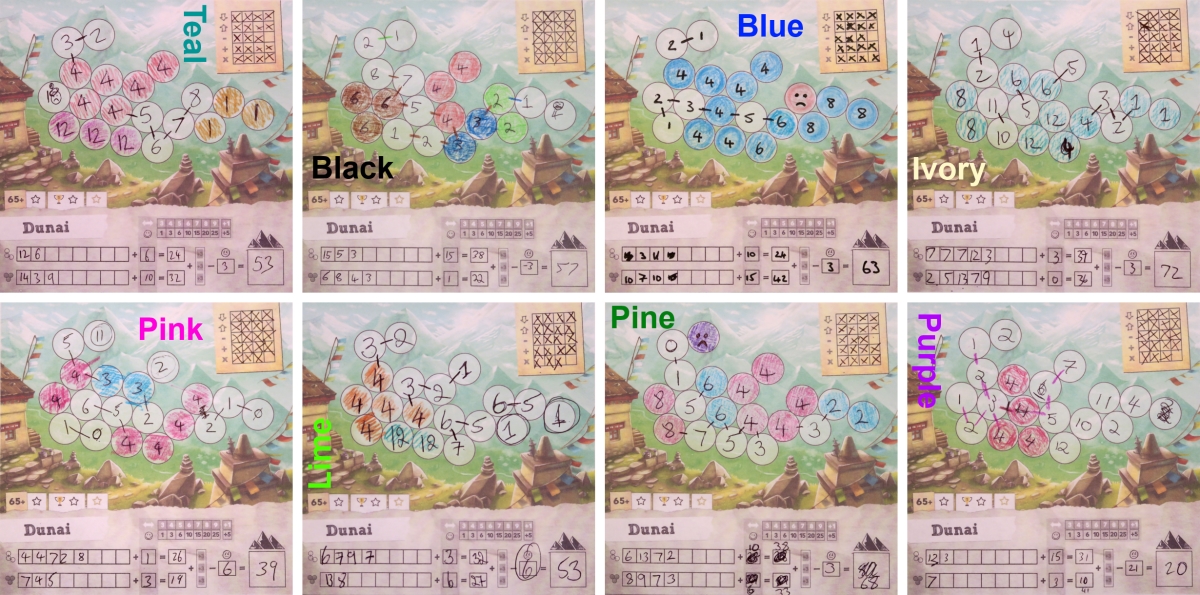
Blue and Pink were the first to arrive, soon joined by Black and Purple.  Others quickly rolled up and before long, everyone was discussing what they’d been doing over the holiday.  Teal produced a new “Roll and Write” game that everyone could play together, called Trek 12: Himalaya, a game where players are climbing a mountain.  He gave a quick summary and demonstrated how he’d raided the stationary cupboard so everyone quickly agreed to give it a go.

Trek 12: Himalaya
– Image by boardGOATS

The game has some prima facie similarities to On Tour which we played remotely a couple of times, in that two dice are rolled and their results combined.  In On Tour, the results are simply combined to make a two digit number, so a two and a three can make a twenty-three or a thirty-two.  In Trex 12, the numbers are combined by addition, subtraction or multiplication and additionally players can pick either the larger or the smaller individually, with each option available a total of four times during the game.

Trek 12: Himalaya
– Image by boardGOATS

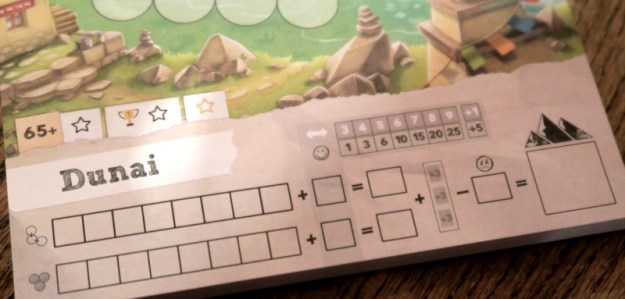
Players are trying to make chains of consecutive numbers and groups of the same number—runs and melds, which represent ropes and camps respectively.  At the end of the game, players score for the highest number in the rope (or camp), plus one additional point for every other connected point (which must be connected when they are played).  Additionally, players score bonus points for the longest rope they make, and the largest camp, and penalties for any isolated numbers that are not part of a rope or a camp.
Trek 12: Himalaya
– Image by boardGOATS

It took a couple of turns to get going, but thereafter it was quite quick.  The game has a sort of legacy element with alternative maps and envelopes that can be opened once certain challenges have been met, but we played the Dunai map and without any complications.  Teal pointed out that although the first number can go anywhere, thereafter numbers must be written next to other numbers so it was wise to keep options open.  Pink therefore started at one end, immediately demonstrating how to make the game more challenging.
Trek 12: Himalaya
– Image by boardGOATS

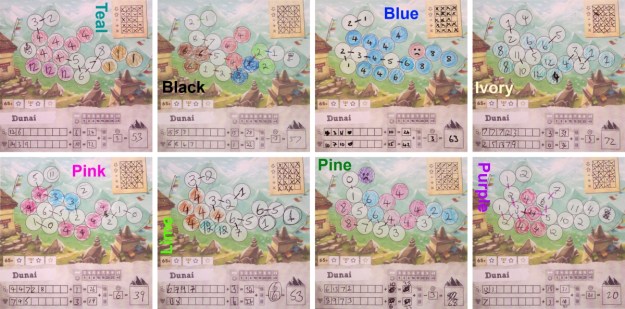
Pine and Blue seemed to be working to very similar strategies with a long rope and a large “Four” camp in the middle, though Pine made a better fist of it and finished in second place with sixty-eight.  Ivory was the overall winner though, with lots and lots of short bits of rope of high value and a final score of seventy-two, well clear of the total needed to beat the game.  Trex 12 had been both quick and enjoyable, so after that aperitif everyone was ready to move on to something a little more filling, and the group split into two, the first playing the “Feature Game“, Streets.
Streets
– Image by boardGOATS

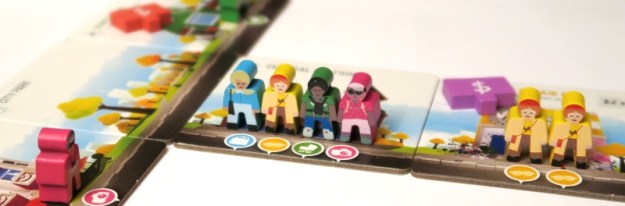
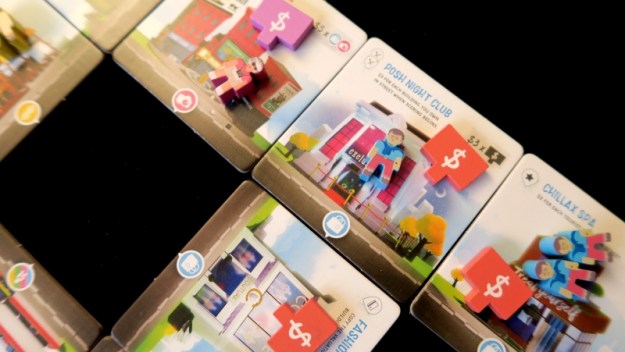
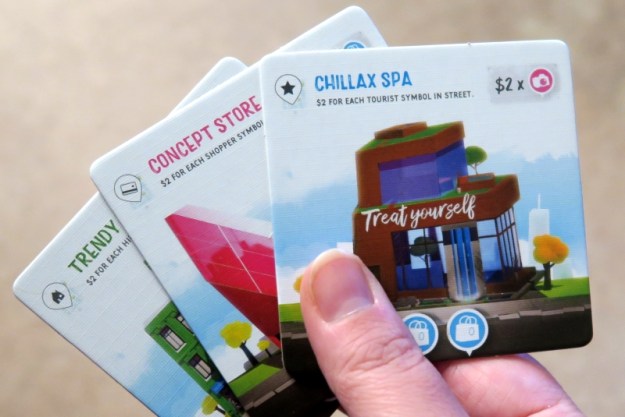
Streets is a tile laying game by the same people as the very enjoyable Villagers.  It is, perhaps, a little lighter and, rather than developing the occupants of a village, players are building a city, transforming it street by street, from a small town into a centre of culture and commerce.  The turn structure is similar to more familiar games like Carcassonne: On their turn, the active player chooses a building tile, adds it to the town, places an ownership marker on it and then scores any completed features, in this case, Streets.
Streets
– Image by boardGOATS

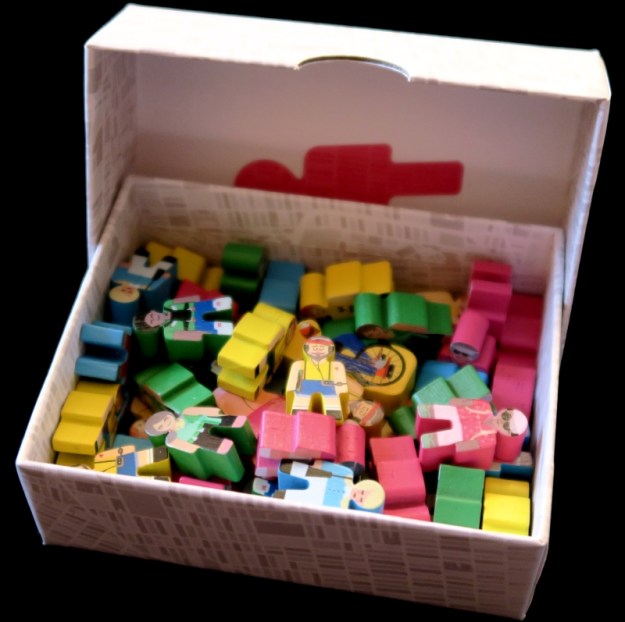
Although there are similarities, there are a lot of differences: players have a hand of three tiles all of which represent buildings; as well as ownership tokens, the active player also places people on the building, then there are the tile placement and scoring rules.  The building tiles have a road at the bottom and sky at the top and can be placed such that a Street, a row of houses, is extended by adding the tile to it in the same orientation, or terminated so that the road is perpendicular forming a junction.  When both ends of a Street finish in a junction, the Street is closed and scored.

Streets
– Image by boardGOATS

Different buildings score in different ways, for example some tiles give points for people in the Street and others for the number of building symbols in the Street.  There are a few little niggly little rules.  For example, when scoring a Street players include the symbols on the street itself, but also any on a tile that terminates the Street and points towards it.  There are other ways of scoring buildings as well, for the number of adjacent tiles or copying another building of choice in the Street for example.  In addition to the money won for the building itself, players also score for the number of people on the tile scored.
Streets
– Image by boardGOATS

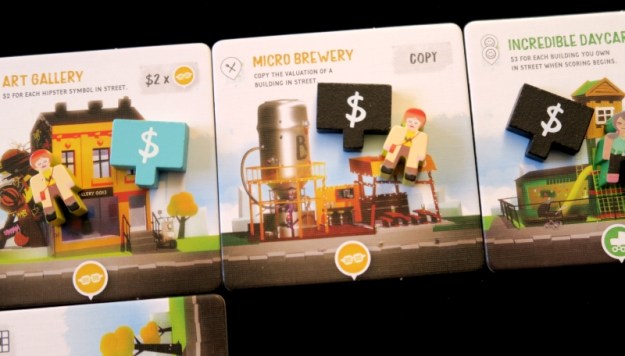
When a building is scored, the active player moves the people on to different building in another, open Street.  This encourages players to terminate Streets even though they might not score themselves, because they can move people onto their own buildings elsewhere which means they will score more later in the game.  There are a few other things that contribute to the decision making dilemmas.  For example, players only have five ownership tokens, and if they run out, they have to take them from another building without scoring it.
Streets
– Image by boardGOATS

The game ends when all the tiles have been played and any remaining Streets are scored, but for half points (similar to Carcassonne).  The basic game is quite straight forward, but although most people got to grips with it, the combination of small text, symbols, a little confusion of terminology and general tiredness meant others struggled with planning effective moves.  Black took what was obviously an early march when he played his micro-brewery tile to “copy” another high-scoring tile in the same street, but Purple, Blue and Pine had their moments too.

Streets
– Image by boardGOATS

In the end, Black won with a cricket score of a hundred and twenty (well, a score that would have beaten England in the recent Ashes series anyhow).  Blue, Purple and Black quite enjoyed the game and could see the its potential for adding expansions too.  Definitely one to be played again, though Pine might need some persuading.  Meanwhile, on the next table, Ivory, Pink and Teal were getting to grips with a game of Key Flow (Lime having taken an early night after another very early morning).

Key Flow
– Image by boardGOATS

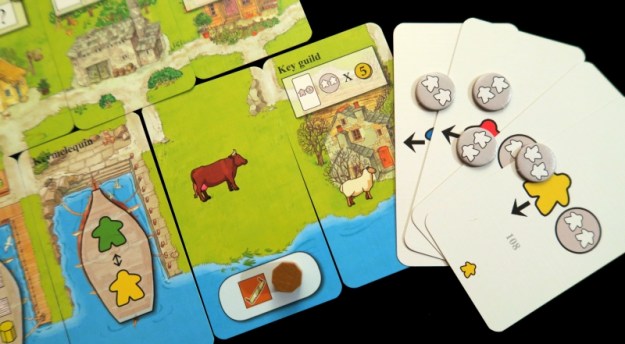
Ivory and Pink have played Key Flow and its big brother, Keyflower, many times before (including relatively recently in October), but Teal was new to the game though he’d heard good things.  In both games, players are building villages and activating the buildings in their villages by playing meeples (or rather Keyples) to generate resources and score points.  The games have a lot in common including the artwork, the iconography and the fact both take place over four rounds or seasons, but the underlying game mechanism is different.  In Keyflower, players acquire tiles by auction where in Key flow players gain cards by drafting.
Key Flow
– Image by boardGOATS

Key Flow is surprisingly straightforward to play, though doing well is a completely different matter.  Players who start with a hand of cards, choose one and pass the rest on, adding their chosen card to their village before they get their next, slightly smaller hand.  There are three types of card:  Village cards, Riverside cards and “Keyple” cards.  Village cards are buildings that can be activated by playing Keyples above them, while Riverside cards provide instant resources and skill tiles.

Key Flow
– Image by boardGOATS

The cards have to be “connected” together and location can be important. Buildings for example are more productive if they have been upgraded, but upgrading needs resources and the resources need to be moved to the building being upgraded. Similarly, in autumn there are some buildings which score points for resources they are holding. Therefore, it is helpful if the building producing the resources is near to the one being upgraded or used for scoring as moving resources can be expensive and sometimes difficult.

Key Flow
– Image by boardGOATS

Simlar to the Keyples in Keyflower, the Keyple cards are used to activate buildings and produce resources.  Some can be played either in a neighbour’s village or the player’s own village.  Other cards can only be played in the village one side or cannot be played in one’s own village.  This is why three players is arguably the sweet-spot for Key Flow—with more players there is at least one village players cannot use, adding a level of randomness that it is difficult to deal with.  With three however, everything in play is accessible, though perhaps at a cost.
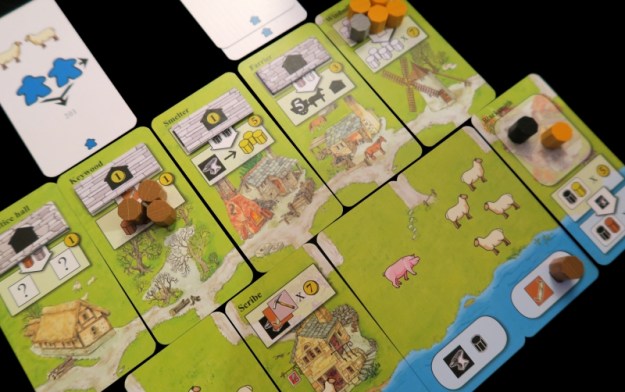
Key Flow
– Image by boardGOATS

At the start of the game players get some winter cards which can act as objectives to guide players’ strategies; at the start of the final round players get to keep one of these with the rest going into the draft.  At the end of the game, players score for any autumn cards, any buildings with upgrades as appropriate, any winter cards and finally one point for any otherwise unused gold.
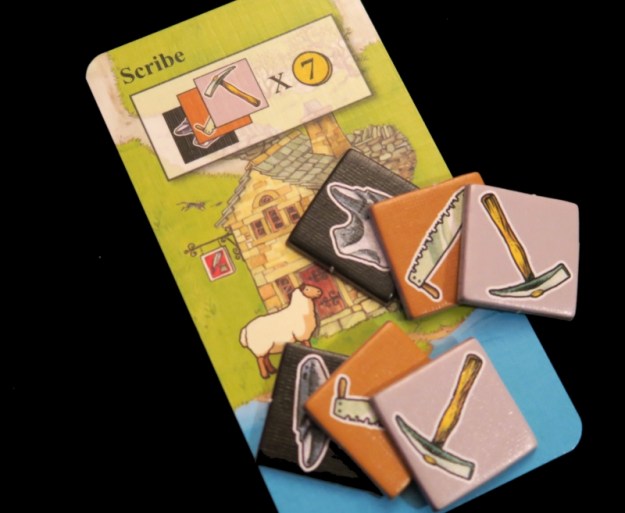
Key Flow
– Image by boardGOATS

This time, Pink went for a “Scholar Strategy”, but changed his mind at the last minute to go for the Ranch instead.  Teal went for a gold strategy with the Jeweller to double his score, and picking up both the Gold Mine and the Smelter, the latter of which he upgraded so he could exchange one skill tile for three gold.  Unfortunately, Pink found that useful too and therefore got in his way somewhat.  Ivory didn’t appear to have a strategy early on, but made sure he had plenty of resources he hoped would be useful later in the game.

Key Flow
– Image by boardGOATS

In the final round, Pink got his Scholar anyhow then lucked out and got the Trader too, while Teal’s flotilla of boats gave him a lot of options, but somehow he struggled to convert them into points.  Ivory who had been keeping all his options open with a scatter-gun approach, managed to finish with a smorgasbord of points from pigs, Keyples, travel, and of course resources.

Key Flow
– Image by boardGOATS

It was not a surprise Ivory won as he always does well in this game, but Pink was very pleased to have run him close finishing just five points behind.  With that, people started to drift off, a few people hung about for a while, just chatting, amongst other things, discussing what “Cotton Clouds and White Cashmere” smells like and whether the new soap in the Ladies really did smell of it…

Key Flow
– Image by boardGOATS

Learning Outcome:  “Roll and Write” games aren’t only the preserve of “Remote Gaming”.

Sad News about Burgundy

It is with great sadness that we mark the passing of Burgundy.  A long-standing gamer in the local area, Burgundy (63) had been involved with Didcot Games Club and Oxford Meeples long before he became a much valued regular at boardGOATS about seven years ago, and more recently at Gweeples.  We will all hugely miss his grumbling, muttering and moaning, especially during his favourite games like Concordia, Orléans and Bohnanza.  We’ll even miss being beaten by him at Splendor, which was pretty much guaranteed even after we eventually broke his two year winning streak.  Known as “Ham, Egg & Chips Man” by the staff at The Jockey, he will be greatly missed by everyone who knew him, and we plan to dedicate our next meeting to him.

The funeral service is to be held at 4pm on Friday 28th January at South Oxford Crematorium, Garford.

Burgundy GOAT
– Image by boardGOATS

Boardgames in the News: The Effects of Covid-19 Continue into 2022

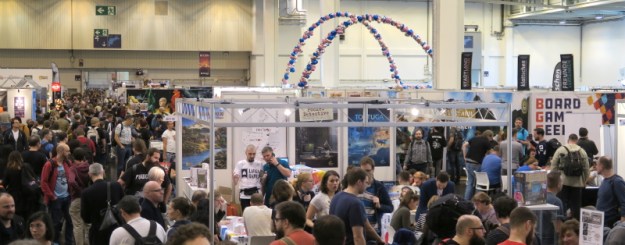
The global pandemic has had a huge impact on every area of life, including gaming.  Although a lot game groups have been forced to move their activities online or even close and manufacturers have struggled, there was also a reported increase in games sales (including games as diverse as Monopoly, Dobble and Warhammer) as families searched for activities to keep them amused while stuck at home.  Many games conventions were cancelled or moved online in 2020 and were reduced in size with restrictions put in place for 2021.

Essen 2019
– Image by boardGOATS

It was hoped that 2022 would bring the end of such things, however, it has recently been announced that both the New York Toy Fair and Spielwarenmesse (aka the Neuremburg Toy Fair) have been cancelled.  The company that runs Spielwarenmesse also now also run the International Spieltage, SPIEL (at Essen), but it is not yet clear what effect this will have on that if any.

Next Meeting, 13th January 2022

We are still meeting on Thursdays for the time being, so, our next meeting will be on THURSDAY 13th January 2022.  We will start playing shorter games from 7.30pm as people arrive, until 8pm when we will start something a little longer (table is booked from 6.30pm for those who would like to eat first).

This week, the “Feature Game” will be Streets.  This is a tile laying game by the same people as Villagers.  It is, perhaps, a little lighter and, rather than developing the occupants of a village, players are building a city, transforming it street by street, from a small town into a centre of culture and commerce.

Streets
– Image by boardGOATS

And speaking of city folk and villagers…

Jeff, a city boy taking a break in the country was staying on a farm.  The weather was lovely and he was taking a gentle stroll round the farmyard when he saw the farmer in a barn and went in for a bit of a chat.

Looking for an in, he asked the farmer, “Excuse me, why does that cow have no horns?”

“Well sir,” the farmer began, “There’s many reasons why some cows don’t have horns.  Some breeds don’t have horns;  Angus cows don’t have them for example.”

The farmer continued, “In some breeds and in some individuals, the horns may grow towards the head, eventually causing injury, so we remove them with as little pain as possible.  And in some cases we don’t want them to grow horns, so when they are calves, we can put a little acid where the horns would grow, the buds, and then they never grow horns.”

“I see,” said Jeff.

The farmer, paused and then finished, “The reason why THAT cow doesn’t have horns though, is because THAT cow is a horse!”

30th December 2021

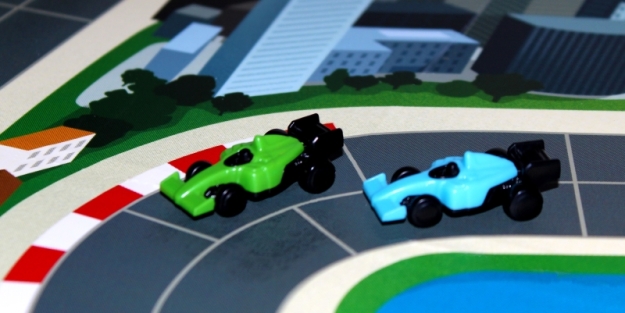
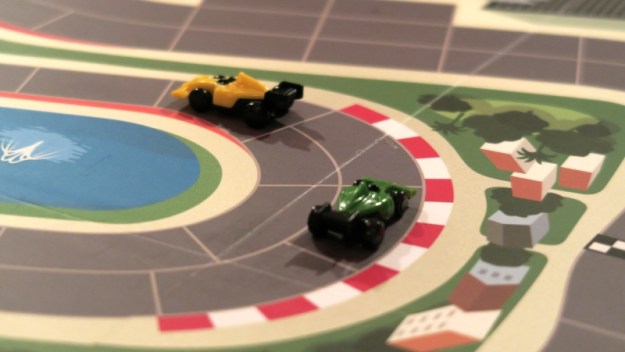
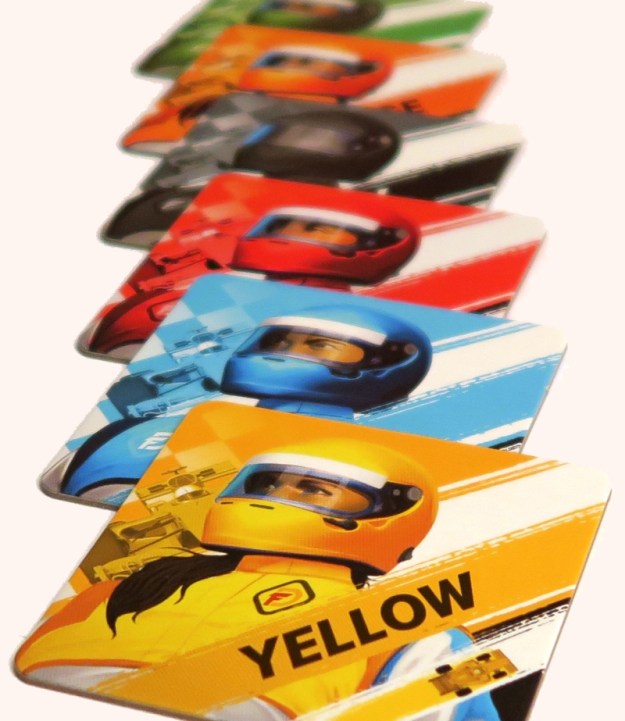
It was a quiet night, but nonetheless very enjoyable.  Blue and Pink were just finishing their dinner when Lime arrived, and after some chit-chat, they were joined by Pine.  In previous years, we’ve held a New Year Party where we play the gorgeous puck-flicking, racing game, PitchCar, so in the absence of this, the “Feature Game” was another classic car racing game, Downforce.

Downforce
– Adapted from image by BGG contributor kalchio

We played this at New Year last year, but that was remotely (through Board Game Arena).  The online rendering of the game is really very good with lots of brilliant sweary graphics when a driver finds their way blocked and we all enjoyed playing it.  Although playing online is infinitely better than not playing at all, it is a poor substitute for the real thing.  So, Pink in particular, was really looking forward to giving an outing to his brand-spanking new Christmas copy, courtesy of the Board Game Geek Secret Santa (great choice Santa—thanks!).

Downforce on Board Game Arena
– Image by boardGOATS from boardgamearena.com

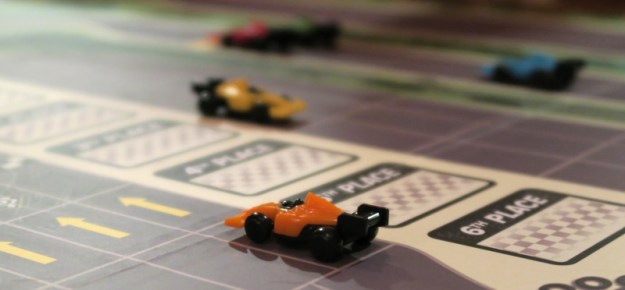
Game play is quite simple, but also very clever.  Players have a hand of cards and on their turn play one and move the cars shown.  The game begins with a car auction, so the card may show their own car, but more than likely shows several and may or may not include their own.  Starting with the fastest card (the one at the top) players then move the cars one at a time.  The player with the winning car wins money, but players also have three opportunities to bet during the race.  The player with the most money at the end of the game is the winner.

Downforce
– Image by boardGOATS

There are a lot of variants and “House Rules” for Downforce, including substituting the auction for random (secret) draw, changing or omitting the betting, and including special power cards (either drawn at random or included in the car auction).  There are also several maps available, two in the base game and two in each of the Danger Circuit and Wild Ride expansions (which also have special rules).  This time we played essentially with the “Rules as Written”, and included the special power cards (auctioned with the cars at the start) and began with the River Station track from the base game.

Downforce
– Image by boardGOATS

The first hurdle was everyone trying to think up a name for their team—there was a strong feline element with Nikki Meowda, David Cat-tard and Stirling Meowss all being suggested.  Dick Dastardly, Penelope Pitstop and Pat Pending came up as people reminisced about Wacky Races and Pine-erton Fittipaldi, the Green Cross Code Man and Staying Alive all raced too during the evening.  Blue and Pine put their paws in their respective pockets and bought themselves two cars with a choice of special powers, and hoped to dominate the race.

Downforce
– Image by boardGOATS

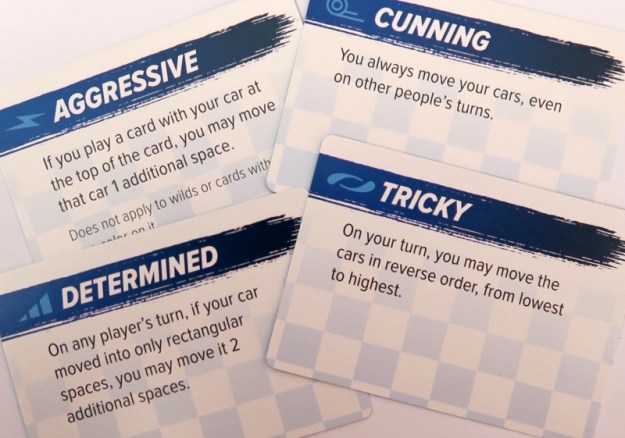
Blue had the Cunning power and made good use of it during the game, though in truth it was rare that she really had a meaningful decision to make.  Pink made better use of his Tricky power which enabled him to move cars in reverse order on his turn—he only used it a couple of times, but made them count.  Lime’s Determined power was also really helpful enabling him to move an extra couple of spaces when he finished on a straight.  Pine, however, was less fortunate and despite winning two auctions was left with an uninspiring special power.

Downforce
– Image by boardGOATS

Crossing the first betting line in front encourages people to bet on your car and then, invested in its outcome, they tend to help it along for the rest of the race.  This is a game where a little help goes a long way so a good start is really important.  Lime’s single car and one of Blue’s two cars got away well and competed for that all important early lead.  Blue led across the first betting line, but Lime was only just behind leaving it all to race for.  And they continued to battle for the lead, leaving the others to fight it out in their wake.  Lime was the first to the all important finish line, but Blue took both the remaining podium places with her two cars, which meant it was all down to the betting and initial expenditure.

Downforce
– Image by boardGOATS

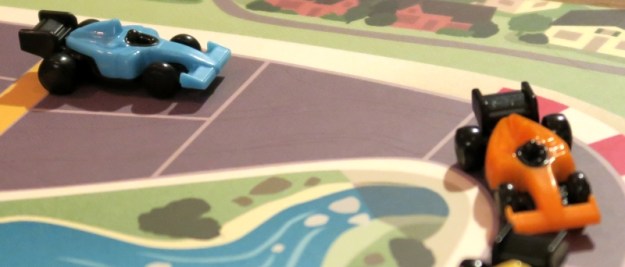
Despite professing to have failed to understand the betting rules, Lime took the magnum of champagne and twenty million, just two million more than Blue.  Pink played a blinder to take the final place on the podium with seventeen million despite his car coming in last, a total helped by his minimal initial outlay and betting on the eventual winner at every opportunity.  It had been fun, and when Lime suggested playing again, everyone was quite happy to oblige, so the map was flipped over to give the Marina Bay track a go.

Downforce
– Image by boardGOATS

Pine again picked up two cars in the auction, but this time Lime joined him with Pink again taking the last car and getting the Determined special power.  Lime once again took an early lead and used his Tricky special power to great effect at key moments.  It was clear in spite of the hidden betting that Lime was likely to be the one to beat.  There was some discussion about whether he should be helped or hindered, but eventually he crossed the line first.  Pink’s solitary, but very Determined car made it home in second and with him betting on himself that left them both of them with a final purse of twenty million and a tie for first place.

Downforce
– Image by boardGOATS

Pine’s second car was still cruising round the final corner while a steward’s inquiry established that Lime was the winner by virtue of his higher placing in the race.  It had been a lot of fun, but undoubtedly, a car that takes an early lead has a big advantage.  There are lots of “House Rules” available to try to mitigate this effect (modifying the betting, blind dealing of cars, and restrictions on when players can play their super-speed card for example), so we might try some of those next time to mix things up.  That said, the expansion maps will change things as well, so we will see.  It is certainly a game that will come out again and again for some time to come.

Downforce
– Image by boardGOATS

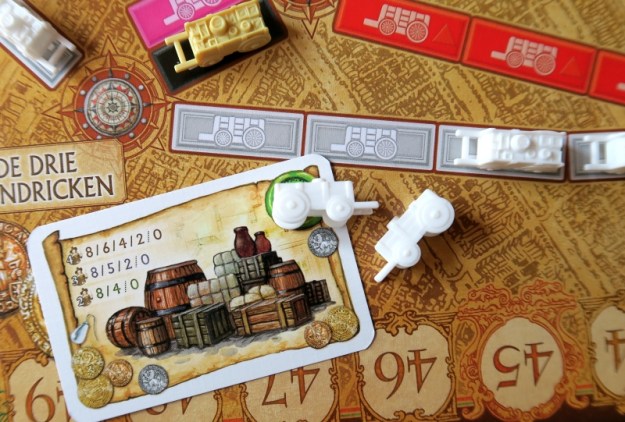
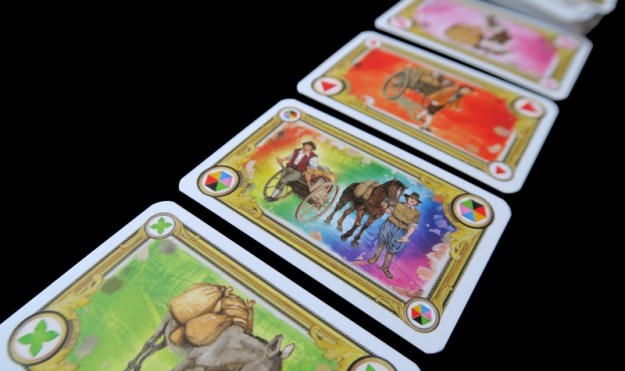
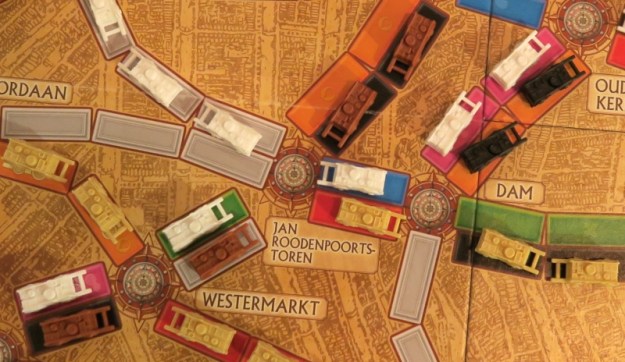
Time was marching on and Lime was concerned that the drawbridge over the Thames might be raised if he left too late, but there was just time for a quick game of Ticket to Ride: Amsterdam.  Everyone in the group loves Ticket to Ride and the little city versions are great in that they capture all the flavour of the full versions, but in a smaller, quicker package.  As in every other edition, on their turn, players can take cards, play cards to place pieces (in this case carts), or take new tickets.  Players score points for placing carts and for completing the routes depicted on their tickets (with any unfulfilled tickets giving negative points).

Ticket to Ride: Amsterdam
– Image by boardGOATS

Each map has its own special little feature and in the Amsterdam version has extra goods cards awarded for completing specific sections of track; these give bonus points for players with more of these at the end of the game.  Pink, Lime and Pine started hard, but Blue soon caught up making for a tight game.  Blue skirted round the north leaving the others to fight over the city centre and particularly Lime and Pine to curse when Pink grabbed a singleton and obstructed their plans from the very first turn.

Ticket to Ride: Amsterdam
– Image by boardGOATS

Towards the end of the game, Pink started picking up tickets and was quickly followed by everyone else except Lime who stuck with his starting hand and concentrated on completing them.  Pine debated whether or not to pick up tickets and in the end went for it only for Blue to promptly trigger the end of the game.  Blue had a significant lead, but as always, tickets would be critical and everyone was in with a shout.  Sadly it was not to be:  Blue had completed all hers and also finished with the most goods cards giving her the bonus for that too and with it a total of forty-five points, eight more than Pink in second place.

Ticket to Ride: Amsterdam
– Image by boardGOATS

Learning Outcome:  Santa is Awesome.

Goats in the News: How to Deal with Christmas Tree Remains

Goats can provide a great solution for environmental problems—a couple of years ago we reported how flocks of goats visit the Lawrence Berkeley National Laboratory (LBNL) in California to clear scrub and help prevent fires.  This week, an interview on BBC Radio 5 Live with staff at Kentish Town City Farm, the UK’s oldest city farm, explained how their goats are helping to dispose of unwanted Christmas trees.

Kentish Town City Farm Goats
– from bbc.co.uk

– from twitter.com

Boardgames in the News: Management Changes SPIEL at Essen

The International Spieltage, SPIEL, sometimes known simply as “Essen”, began in 1983 as the “Deutsche Spielertage” (German Games Fair), a gathering of readers of a specialized gaming magazine.  At the time there were just twelve invited exhibitors and the event was held at the Essen College of Further Education.  The following year, however, there were fifteen thousand visitors and in 1985 the event moved to the “Gruga” Messe Essen Exhibition Center.  It has been there ever since, and in 2019 there were a reported one thousand two hundred exhibitors and over two hundred thousand visitors.

Essen 2019
– Image by boardGOATS

After the partition of Germany, in 1949, four toy manufacturers held a German toy fair in Nuremberg. The following year the exhibition committee and forty-six firms established a cooperative to run the fair, called Spielwarenmesse.  It has recently been announced that the Spielwarenmesse cooperative has now acquired Friedhelm Merz Verlag GmbH, the company that runs SPIEL, the largest games fair in Europe, with the deal taking effect from the start of 2022.  Spielwarenmesse is currently run by around a hundred and fifty companies and has been developing its portfolio recently having also acquired the Internationale Spieleerfindermesse or Game Inventors’ Fair. The company additionally manage trade fairs in China, India and Russia.

Spielwarenmesse Logo
– Image by spielwarenmesse-eg.de

In the press release, Spielwarenmesse state they intend to preserve the character of SPIEL which will remain at the Messe in Essen with Dominique Metzler continuing as director with Florian Hess from Spielwarenmesse, as a co-director.  Christian Ulrich, Spokesperson for the Executive Board of Spielwarenmesse is quoted as saying, “With SPIEL, we are expanding our responsibilities in the business area for games, without changing the typical character of the fair.”

Essen 2022
– Image from spiel-messe.com

Next Meeting, 30th December 2021

Our next meeting, and the last of the year, will be on Thursday 30th December 2021.  We will start playing shorter games from 7.30pm as people arrive, until 8pm when we will start something a little longer (the table is booked from 6.30pm for those who would like to eat first).

Normally, we hold a New Year party in a private house, but with the current situation it feels more sensible to meet a day early in the more spacious environment of The Jockey.  Normally at this time of year, we play the gorgeous puck-flicking, racing game, PitchCar, but it seems a little unreasonable in the pub.  So this time, the “Feature Game” will be another car racing game, Downforce.  We played this at New Year last year, but that was online, this time we will hear players swearing in person.

Downforce
– Adapted from image by BGG contributor kalchio

And speaking of driving at Christmas…

Jeff was driving home from a Christmas party, but his car was swerving all over the road, so a traffic officer pulled him over.

“Can you step out of the car please, sir,” said the policeman, “I am going to have to ask you to take a breathalyzer test.”

“I can’t,” Jeff responded. “You see I have very bad asthma, that could set off an attack.”

“OK sir,” said the constable, “Then I’m afraid we will have to do a blood test—you’ll have to come with me to the nearest police station…”

“Sorry officer, I can’t do that either,” Jeff replied.  “I am a hemophiliac, so if a wound is opened, I won’t stop bleeding, and could bleed to death.”

“Well, we could do a urine sample then,” suggested the police officer getting a little exasperated, “We’d have to do that at the station too though.”

Jeff paused and then answered, “Sadly, I also have diabetes and that could push my sugar count really low.”

By this time, the traffic officer was really losing patience and snapped back, “Fine, in that case just get out of the care and walk a straight line for me.”

“Oh, I can’t do that…” answered Jeff.

“Why ever not?” demanded the exasperated copper.

“Well ossifer,” replied Jeff cheerfully, “That’d be because I’m drunk!”

Golden GOAT Award Winners – 2021

Just before Christmas, the boardGOATS meet for food, have a bit of a party, and decide the winners of the GOAT Awards.  Sadly, that wasn’t possible last year, so this year we made up for it with lots of crackers, cards, and lots of festive treats.  While waiting for food, the group voted for our favourite game of the year.  As in previous years, we awarded two prizes:  the Golden GOAT for our favourite game and the “GOAT Poo” award for our least favourite.

Dingo's Dreams
– Image by boardGOATS from boardgamearena.com

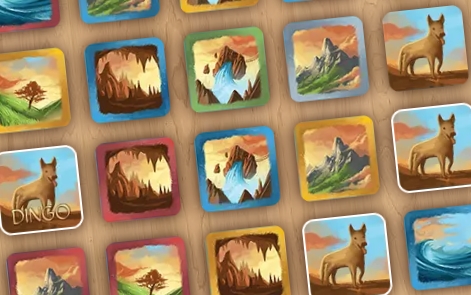
As usual, everyone had three points to hand out for the Golden GOAT Award plus a bonus if wearing Festive Attire, but we limited each person to a maximum of two points per game (after a little controversy over the voting last time).  Everyone could also nominate up to two individual games for the GOAT Poo Prize.  This year, there were several nominations for  GOAT Poo, but the clear winner was Dingo’s Dreams.  This is probably quite a clever game that we would normally enjoy, but we played it online with lots of people, none of whom had any idea what they were trying to do.  As a result, the complete chaos made for a very un-fun experience all round.

Golden GOAT - 2021
– Image by boardGOATS

With all the online games, there was less competition than usual, but the 2019 winner, Wingspan, was very nearly the first game to win the Golden GOAT award twice.  In the event, it was just pipped to victory by Praga Caput Regni – quite an achievement given that only four people in the group had played it.  While discussing possible candidates for Moment of the Year everyone fondly reminisced about the time Lime accidentally joined an online game of 6 Nimmt! with a bunch of Frenchmen, but that was last year.  The GOATS have long memories though, and it would seem that they still haven’t forgiven Pink for stealing everyone else’s gems in Niagara, despite his repeated assertions that he was “just following the rules”.

Niagara
– Adapted by boardGOATS from image by
BGG Contributor El_Comandante