Next Meeting, 22nd December 2020 – Online!

It is at times of stress that people need social contact more than ever, and board games are a great medium for that.  Despite the limitations of “remote gaming”, the overwhelming impression is that everyone feels it is important to stay in touch, so we are persisting with online meetings.  Therefore, our next meeting will be on Tuesday 22nd December 2020; we will gather from around 7.30pm, and start playing at 8pm.

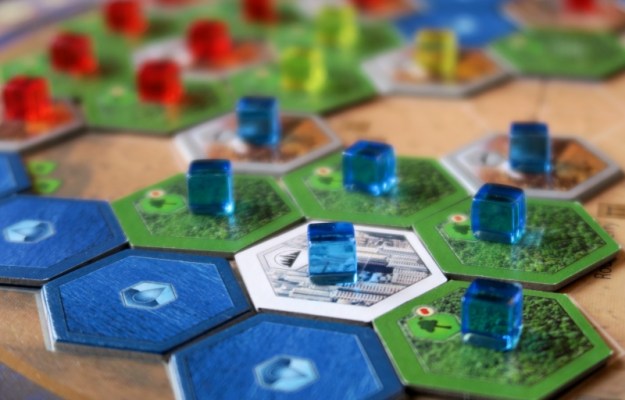
This week, to celebrate the Festive Season, the “Feature Game” will be the Winter Wonderland edition of Welcome To….  This is a variant on the “Roll & Write” style game where players plan and build 1950s housing estates in the USA.  This game includes the addition of festive artwork and fairy lights.

Welcome To... Winer Wonderland
– Image by boardGOATS

And talking of Christmas lights…

Jeff and his wife, Jane, were putting were putting up Christmas decorations around the festive  Grotto, helped by children from the local primary school, all dressed as Santa’s helpers.

After several hours getting things just right, they were just about to start the big switch on when Jane said, “Hold on a second, I’m going to get some gaffer-tape.”

Jeff was puzzled and asked, “What for?  Everything’s very secure…”

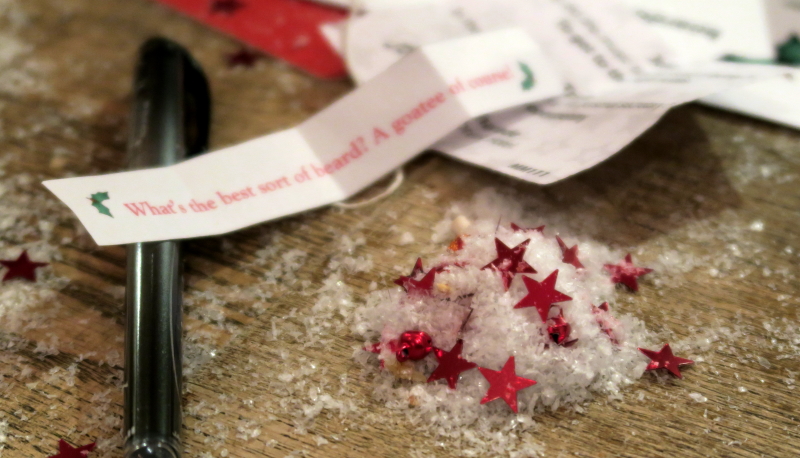
Jane responded, “I’ve just spotted that the power cable is lying across the entrance—we’d better tape it down because it’s a bit of an elf hazard…!”

8th December 2020 (Online)

The evening started off with players discussing pirate copies of games, inspired by a copy of The Game of Life (slightly reluctantly provided by Little Lime).  From there, Green popped in just long enough for everyone to sing “Happy Birthday” to him, and for him to tell people about his new car before putting up with lots of comments about how nice his new Alfa Romeo would look on the side of the road while he was waiting for the AA to turn up…

The Game of Life
– Image by boardGOATS

Once Green had left to open the last of his birthday pressies and eat his Birthday tea, everyone else settled down to start the “Feature Game“, the River Expansion for the “Roll and Write” game Railroad Ink.  This is a fairly simple game that we’ve played a couple of times and really enjoyed.  The idea is that four dice are rolled and players have to add all the features rolled to their map.  These features include straight and curved sections of rail and road as well as flyovers and road/rail interchanges.

Railroad Ink: Deep Blue Edition
– Image by boardGOATS

The game lasts seven rounds and players earn points for connecting together the entrances marked on the edge of the map, but also for their longest sections of road and rail, and for filling the nine spaces in the centre of the board.  The River is one of two expansions that come with the Deep Blue Edition of Railroad Ink, and adds rivers to the railway, road and intersection options.

Railroad Ink: Deep Blue Edition
– Image by boardGOATS

Unlike the white dice in the base game which have to be used, the two blue dice are optional.  They also do not have to be connected to the main network.  Pine asked why anyone would use the river because it just restricts what you can do with the rest of your network, but as Burgundy pointed out, it has the potential for giving extra points.  Most obviously this is because points are awarded for the longest section of river each player makes.

Railroad Ink: Deep Blue Edition
– Image by boardGOATS

Additionally though, some of the faces of the river dice include road and rail sections (crossing the river).  Using these can help the main network reach more of the entrances, something that is important because the game is one round shorter when played with the expansion.  However, any unconnected river sections, like any unconnected road or rail sections, i.e. any “hanging ends”, cost points, one per unconnected end.  So, players who decide to ignore rivers do so at a cost.

Railroad Ink
– Image by boardGOATS

The game hadn’t been going long before someone said, “I’ve just created a junction”.  This was almost inevitably followed by the reply, “You never thought that would happen…” and the response, “What, with you and the girl from Clapham…?”  After a couple of verses and the odd chorus of the Squeeze hit, the conversation segued smoothly on to the fact that “Those Were the Days” was actually originally a folk song.  The game only resumed after Pine had shared a version called Davni Chasy by The Wedding Present.

Railroad Ink
– Image by boardGOATS

With only six rounds with the expansion, the game did not really take very long, and everyone seemed to enjoy the added challenge of including the river.  It was a tight game with just three points covering the three podium positions, Ivory just sneaked victory, two points ahead of Pink and Pine in third.  Lime had been up since 4am and had another early start the following day, so went for a well earned early night, but everyone else carried on to give Patchwork Doodle another outing.

Patchwork Doodle
– Image by boardGOATS

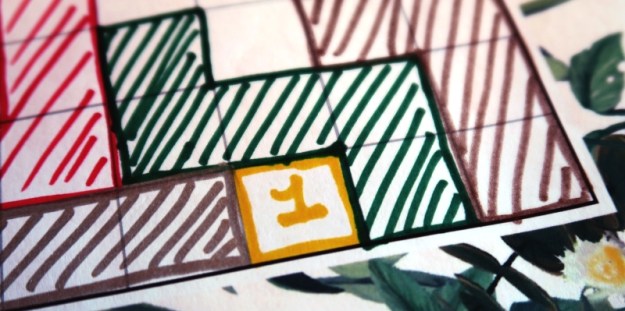
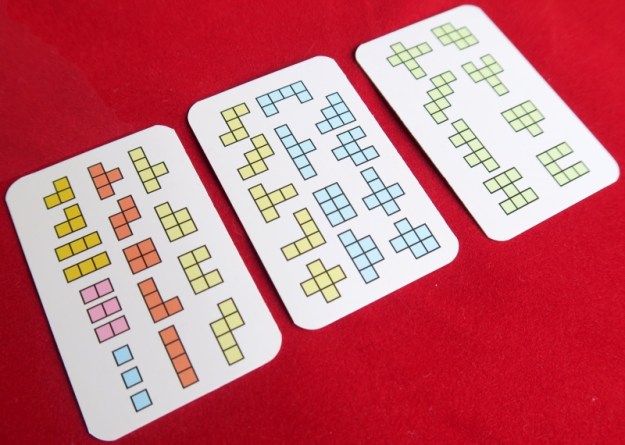
Patchwork Doodle is a fairly simple game Tetris-based game where players try to fill their player player-board with Tetris shapes shown on cards.  Although the game is similar to Second Chance, it is played over three rounds with eight cards displayed at the start of each round with six played according to a die roll.  This means that players know which cards are coming up, but not the order they will appear in.

Patchwork Doodle
– Image by boardGOATS

Each player begins with their own individual shape.  Black had the embarrassing one, which led to a discussion about how a photographer had taken revenge on Philip Green for his poor behaviour towards a journalist.  Everyone had a good laugh once someone had found the photo and shared it, then we began playing.  The end of round scoring also makes the game a little more challenging than Second Chance with players scoring most of their points for the largest contiguous square area at each point during the game.

Patchwork Doodle
– Image by boardGOATS

Pink and Ivory got off to a flying start with five-by-five squares, giving them twenty five points in the first round.  As the rounds progressed, other players started to catch up, but those early points were hard to off-set.  Blue, remarkably managed to fill every square of her grid giving her eighty-one points in the final round.  Unfortunately for her, it wasn’t quite enough to catch Pink who took victory with one hundred and thirty-seven.  That didn’t stop Blue claiming the “moral victory” for the perfect finish though, even if she was three points short.

Patchwork Doodle
– Image by boardGOATS

With that, Ivory took his leave, and everyone else moved to Board Game Arena.  As people logged on, they all received “Trophies” to mark six months active on the platform.  While this is clearly an achievement of sorts, it was bitter-sweet as it also highlighted just how long we’ve been playing online.  We decide not to stop and think about it though, and moved on to choosing a game.  With six players, there were several options.  Pine didn’t want to finish too late, while Blue was keen to play something a little different and with help from others, persuaded him to play Alhambra.

Alhambra
– Image by BGG contributor garyjames

Alhambra is a classic gateway, tile laying game, based on the slightly older title, Stimmt So!.  The idea is that on their turn, players can either buy buildings (or shares in the original), or take a money card.  The catch is that there are four currencies in the game.  Players pay with whatever cards they have, but if they don’t have the exact amount they must overpay.  Obviously, it is advantageous to pay with the exact amount, but not only because they save money.  Players doubly gain when they pay with the right amount, because they get an extra turn and can make another purchase (again getting yet another turn if they pay exactly) or take money.

Alhambra
– Image by BGG contributor garion

There are two scoring phases during the game, and one at the end.  In these, players with the most buildings of each of the different types score points, with the number of points depending on the type of building and the frequency of it in the game.  There is one significant difference between Alhambra and Stimmt So! that goes beyond the theme.  Some of the buildings have a wall along one, two or three sides.  Players score points for their longest external “wall” section within their complex, but the wall also has a big impact on how a player places their tiles.

Alhambra
– Adapted from Image by BGG contributor Zoroastro

Players must be able “walk” from their starting tile to all the other tiles in their complex, so walls are placed round the outside.  If a player is not careful, this can severely limit their ability to place other tiles and get them into a terrible mess.  The Board Game Arena implementation ensures that players can’t inadvertently make mistakes, but that makes the game quite unforgiving.  There is a get out clause—players can place tiles in their reserve or move tiles at a later date, but as the game is all about efficiency, this can be very costly.

Alhambra on Board Game Arena
– Image by boardGOATS from Board Game Arena

The game started very cautiously with people feeling their way.  Pink tried to build a long wall and got himself into a tangle with a very small complex surrounded by a tight wall; Blue just failed to score any points until the end of the game.  It was quite close in the fight for second place, but the runaway winner with eighty-one points was Purple.  She had the most Garden buildings and Palaces outright, shared the lead in Seraglios and Chambers and scored points in almost every other category too, positively storming to victory.

Alhambra on Board Game Arena
– Image by boardGOATS from Board Game Arena

Unfortunately, Alhambra is not at its best with six and, although the game can trot along at quite a pace with players that know what they are doing, it took quite a lot longer than it really should.  Although some had played the game before, others were new to it and even those familiar with the game were a little rusty.  The game would have been a lot quicker if people hadn’t insisted on thinking too, but as a result, it finished a lot later than planned and when it was over that was pretty much it for the evening.

Alhambra on Board Game Arena
– Image by boardGOATS
from Board Game Arena

Learning Outcome:  If you buy an Alfa Romeo you should expect jokes about it.

Boardgames in the News: A Case Study of a Counterfeit Game

With Christmas just round the corner, there is a rush to buy gifts while wallets are squeezed and time is short—exactly the circumstances where counterfeiters flourish.  Previously, we commented on how reports of counterfeit games had been increasing and highlighted some of the key features to look out for.  Counterfeiting is a problem that affects a wide range of games including family friendlies like Ticket to Ride: Europe, Azul and 7 Wonders, but also more specialist fare like Terraforming Mars and Deep Sea Adventure.  Since then, a member of the boardGOATS group accidentally acquired a counterfeit copy of The Game of Life, which we thought would make a useful case study of some of the things to look out for and provide a timely reminder of the problem.

The Game of Life
– Image by boardGOATS

The Game of Life is of particular interest because there are have been many different versions and editions over the years.  This means it can be hard to spot whether a copy is a fake even if there is a genuine copy to hand.  In this particular case, the first and most obvious problem is the complete lack of a brand name or logo anywhere on the box or the components.  The English edition is published by Milton Bradley (now Hasbro), or Winning Moves in the USA, but none of this appears anywhere on the box.  Presumably this is to avoid falling foul of “Brand Piracy” laws, but if the counterfeiters think that makes their products legal, they are very wrong.

The Game of Life
– Image by boardGOATS

This is not the only indicator with this copy.  In this example, the font on the cards use western characters from a Chinese font set—these almost look like old fashioned type-writer script without serifs.  This is very unlikely to be a design choice for a genuine western board game and also don’t match the fonts elsewhere.  Additionally, the cards have squared off corners, which is now relatively unusual for modern cards in western games.  In contrast, the rules card has cut corners (and a western font), but has “nibs” where it has been punched from a larger piece of card.  The corners and “nibs” are not confirmation of a counterfeit in themselves, but would not be expected in quality product.

The Game of Life
– Image by boardGOATS

Other aspects that make this copy of The Game of Life look suspicious are associated with component quality.  For example, the game board is very thin card stock, poorly folded and the edges are not wrapped with tape or similar.  Again, these do not necessarily mean that this is a counterfeit copy: component quality does sometimes change between print-runs and it is very possible that the publisher has decided to make changes for this edition.  It is often indicative though and shows how counterfeit copies, which this certainly is, can be of inferior quality.

The Game of Life
– Image by boardGOATS

This copy of The Game of Life was bought in good faith, but came from an online auction seller.  Some of these sellers have been trading for many years and provide great deals and an excellent service, others not so much and it is not always easy to tell the difference.  The bottom line though, is the only way to guarantee that a product is genuine, is to buy from a reputable seller.

Next Meeting, 8th December 2020 – Online!

It is at times of stress that people need social contact more than ever, and board games are a great medium for that.  Despite the limitations of “remote gaming”, the overwhelming impression is that everyone feels it is important to stay in touch, so we are persisting with online meetings.  Therefore, our next meeting will be on Tuesday 8th December 2020; we will gather from around 7.30pm, and start playing at 8pm.

This week, the “Feature Game” will be the River Expansion for Railroad Ink.  This is the expansion to the “Roll and Write” game and comes with the Deep Blue Edition the game, adding rivers to the railway, road and intersection options.  The group have really enjoyed playing Railroad Ink, so it is time to give it another outing and maybe increase the challenge a bit.  Although it is more complex than some of the games we’ve played it is definitely not as much of a challenge as the “Feature Game” last time.

Railroad Ink: Deep Blue Edition
– Image by boardGOATS

And talking of railways and intersections…

Jeff was out walking when he come across an un-gated level crossing where the railway and the road crossed. Seeing a beautiful woman playing with her mobile phone on the other side, he decided he would try to impress her and walked to the middle of the crossing.

As he did so, there was a rumble of a train in the distance.

“Shouldn’t you come away from there?” the beautiful lady asked.

Jeff (being Jeff), was thrilled at having caught her attention and decided to impress her further by ducking out of the way of the train at the very last second. So, as the train appeared round the corner, he readied himself to jump out of the way. Then, as soon as the driver saw the idiot standing in the way of the train, he slammed on the brakes and the train began to slow down, stopping just before the level crossing where Jeff was standing.

Jeff was delighted, “Look at that,” he said to the woman with a big grin, “The train stopped for me!”

It was then that he was hit by a speeding car

24th Movember 2020 (Online)

As people signed in, Blue, Pink and Burgundy shared some feelings about the “Feature Game” which was to be Troyes Dice.  This is back to the “Roll and Write” style games and is a very recent release, based on the well regarded game Troyes (a game about a medieval city, the name of which is pronounced a bit like “trois”, the French for the number “three”).  When Pine joined the group he made his feelings known about the awful joke at the bottom of the reminder page, and said it was old when he was at school back in the middle ages…

Rue Émile Zola in Troyes
– Adapted from image by Zairon on wikimedia.org

Troyes Dice is a planning and resource management game with an interesting rondel mechanism at its heart.  Although the fundamentals are not overly complex, the number of options players have make the game very challenging.  The game is played over eight days, each with a morning and afternoon phase.  At the start of each phase, four dice are rolled and placed on the four available coloured plazas.  The clear dice then adopt the colour of the plaza they are placed on, while the black die “destroys” its plaza making it unavailable.

Troyes Dice
– Image by boardGOATS

Players then choose one of the coloured dice to use, and pay the associated cost shown in the centre of the dial.  Dice bought in this way can be used to buy resources or to construct a building of the same colour and number.  Buildings come in two types: Worker buildings which ultimately give points and Prestige buildings which provide special effects.  There are three colours red, yellow and white representing the Noble, Civil and Religious districts respectively, and there are different resources and special effects associated with the different districts.

Troyes Dice
– Image by boardGOATS

Although this is fairly straight forward, the number of options players have and the interplay between them make the game one of the most complex that we have played since the group has been forced to play online.  All the Worker buildings get players workers which equate to points at the end of the game.  However, more points are available to players that build Cathedrals (Religious Prestige buildings) as Cathedrals give points to players for building other buildings.

Troyes Dice
– Image by boardGOATS

So, a player who has built the left-most Cathedral (i.e. number one) will get points for the number of Noble Prestige buildings they have built.  The amount of points each one of these is worth depends on when the player builds that particular building:  if it is the first or second, they will be worth just one point, but if it is built later in the game and is the fifth or sixth, each Noble Prestige building will be worth three points.  Thus a player who builds all six buildings of one type and then manages to build the associated Cathedral will score six, twelve, or eighteen points depending on when the Cathedral was built.  So timing is critical.

Troyes Dice
– Image by boardGOATS

The Civic Prestige buildings give players resources depending on the number of dice of the relevant colour currently available.  Resources are essential.  Money (the Civic Resource) is essential for buying dice and the higher value dice cost more.  The other two resources, red pennants and white bibles are useful because they allow players to alter the number of the die to be used, or its colour.  This is adds hugely to the number of possible options available.

Troyes Dice
– Image by boardGOATS

The third set of Prestige buildings in the red, Noble district, is the most difficult to understand.  Building one of these protects all the buildings of the same number from the black die.  From the third round, the black die not only makes its plaza unavailable, but also makes any buildings of that colour and number that have not yet been built, unbuildable for the rest of the game.  If a player builds, say, the sixth Noble (red) Prestige building, that means that any subsequent black sixes rolled will have no  effect on that player.

Troyes Dice
– Image by boardGOATS

There are a number of obvious strategies that arise.  For example, to get the maximum protection, Noble Prestige buildings should be built as early as possible.  In contrast, since the Religious Prestige buildings that are built later give more points, trying to build some other scoring buildings first is a good idea.  This is risky though, as failing to build the target building will score nothing.  Although the rules are quite complex, in practice they are not as bad as they may seem at first.  Simply put, players choose one of the three available dice and use it to collect resources or build a building in one of the three districts.

Troyes Dice
– Image by boardGOATS

It is dealing with the number of options available that is the real challenge though.  There are only three active dice, but using a combination of pennants and bibles, the numbers and colours of the dice can be changed to almost anything people want, which gives lots to think about.  That said, even this is not as difficult as it seems at first because resources are valuable so unless the action is mission critical, most options will rule themselves out as they are too expensive.

Troyes Dice
– Image by boardGOATS

First time through though, the number of options can seem bewildering and planning a strategy can seem daunting.  That said, for the first couple of rounds, Blue and Pink talked through the options people had available and almost everyone did the same thing, starting by building protective fortresses because these were good value and early in the game seemed to give the best chance to use them.

Troyes Dice
– Image by boardGOATS

Playing games remotely can be a bit of a solitaire experience and it is generally very hard to follow what others are doing.  As a result, players often take more information from throw-away comments than they would usually do.  From this, Green seemed to think that he and Burgundy were following very similar strategies.  The game is also a slow burner, and Ivory repeatedly commented that he couldn’t see where he was going to get any points from.  This unsettled Pine, because this sort of game is usually meat and drink to Ivory, so if he was struggling, that meant Pine felt doomed.

Troyes Dice
– Image by boardGOATS

About half-way through, Black and Purple went silent and didn’t respond when people asked if they were OK.  Someone pointed out to them that their microphone was on mute, but there was still no reply and even text messages didn’t get a response.  Eventually they rejoined the group and Purple got a bit of a telling off for muting the mike, though she was adamant it wasn’t her fault.

Troyes Dice
– Image by boardGOATS

There are only eight days, or sixteen rounds in the game, so it didn’t last over-long.  It wasn’t long before players were adding up their scores and Ivory was finding that he had more points than he’d thought.  It wasn’t surprising that Pink top-scored with Blue in second place, as they had both played it it before.  What was more surprising was how close together everyone else was.  Ivory was a very close third with forty-four and Green was just two points behind him, but everyone else was within ten points of Blue too.

Troyes Dice
– Image by boardGOATS

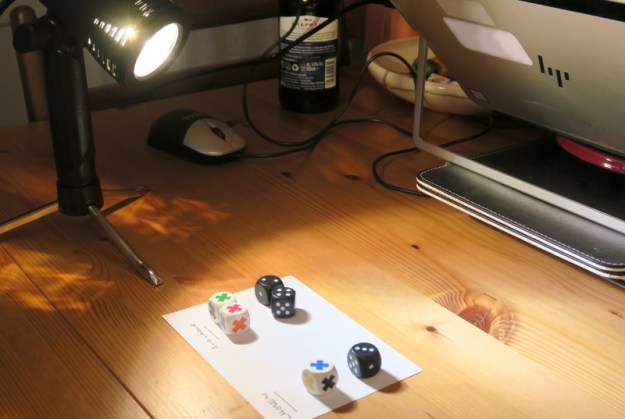
With that done, it was definitely time for something lighter. We haven’t played Noch Mal! (aka Encore!, or Boardgamers Bingo as some of the group call it) for a while and since we have some new player boards, we thought we’d give it another outing.  The idea of the game is that six dice are rolled, three showing numbers one to five and a question mark, and three showing five different colours and a cross.  The active player chooses one colour die and one number die to use and everyone else gets to pick one of each of those that remain.

Noch Mal!
– Image by boardGOATS

Players use their dice to cross of blocks on their player boards with players scoring points for completing columns and for crossing all of one colour off.  The question marks and crosses are wild, but players can only use total of eight during the whole game—any that remain unused by the end of the game score a point.  Players also score negative points for any stars that have not been crossed by the time one player has completed all of two colours and brings proceedings to a close.

Noch Mal!
– Image by boardGOATS

In this game, the first target is to end with a positive score.  The first time we played, everyone really struggled with that, but more recently people seem to have got the hang of things a little.  We decided to play Zusatzblock I, which is a pink colour.  This time, although it was not obvious why, playing with the new board seemed to really upset things.  For some, it was clear that the pink background messed up their ability to see the difference the colours (we dealt with people’s difficulty distinguishing colours on camera by placing the coloured dice on a home-made, quickly-cobbled-together play mat).

Noch Mal!
– Image by boardGOATS

Pine in particular really struggled with the colours and got his plans completely screwed up when he confused orange with red.  Others did not have that excuse though, and many still failed to get a positive result.  In a remarkably low scoring game thanks to the game “finishing early”, Green looked to have it with a score of just eight.  That was until Pink, who had triggered the end of the game as part of his plan, announced he’d managed a massive ten points and took his second victory of the night.

Noch Mal!
– Image by boardGOATS

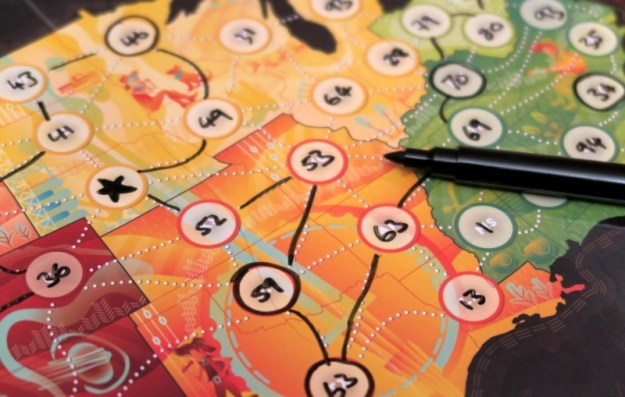
Time was marching on, but HexRoller had gone down really well last time and was almost over before it had begun, so the group decided to give it another go.  This is a completely abstract game where players write numbers rolled to write on a grid.  There are eight dice rolled each round and players choose two of the numbers rolled and write them on their grid the number of times they appear.  Numbers must be written in spaces adjacent to numbers (of the same value) that already appear on the board.

HexRoller
– Image by boardGOATS

Points are scored for filling the coloured regions, connecting the two preprinted numbers, for not using the special actions etc..  Although it is not very easy to understand from the description, it is actually quite easy to play, so much so, that Pine, who had missed out last time picked it up really quickly.  Also, as the game is played over just seven or eight rounds (depending on the board used), so doesn’t really have time to outstay its welcome.

HexRoller
– Image by boardGOATS

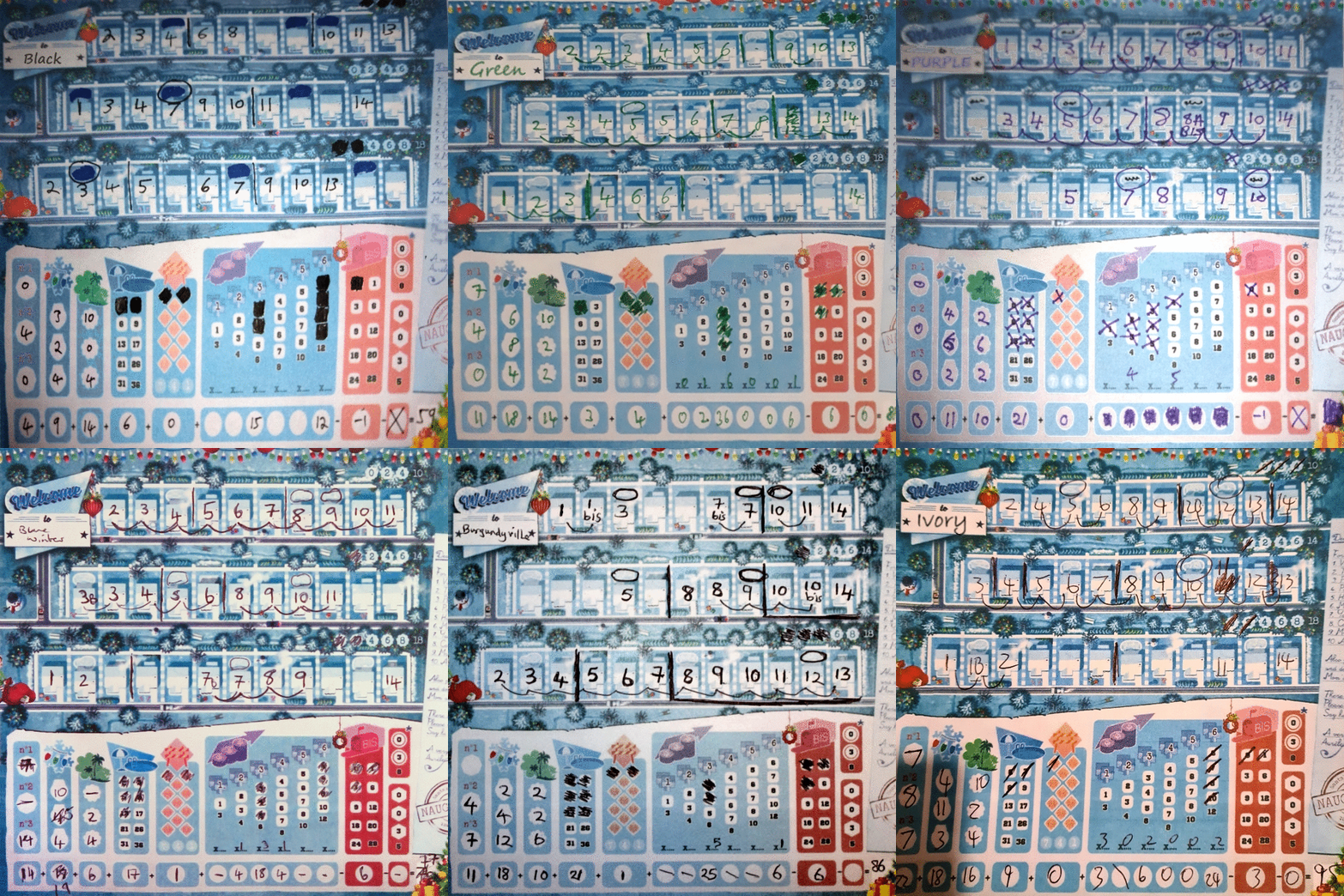
Despite its simplicity, Black managed to make a meal of it and somehow missed out a number.  Although everyone else really enjoyed the game last time, it seems it is not his favourite.  Pink tried to claim a “moral score” of fifty-four because he only needed one more number to fill one of his coloured areas, but nobody else was buying into that.  It wouldn’t have been enough for him to win his third game of the night though, as victory went to Burgundy who finished with sixty-three points.

HexRoller
– Image by Burgundy

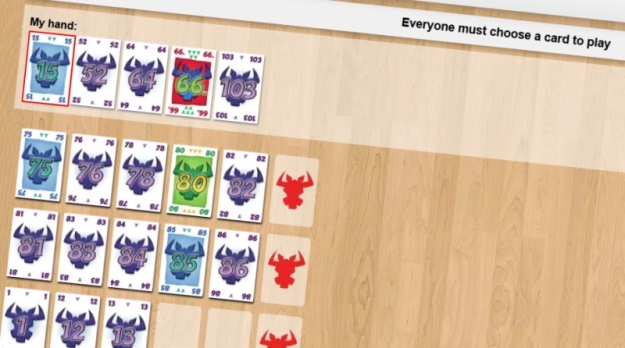
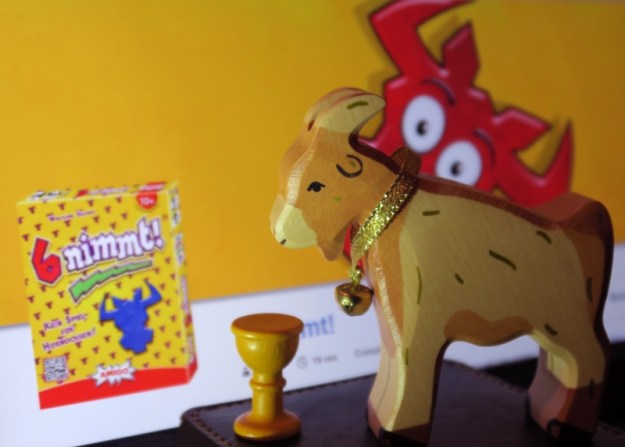
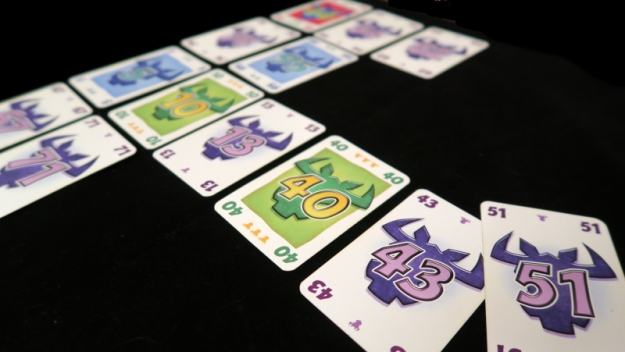
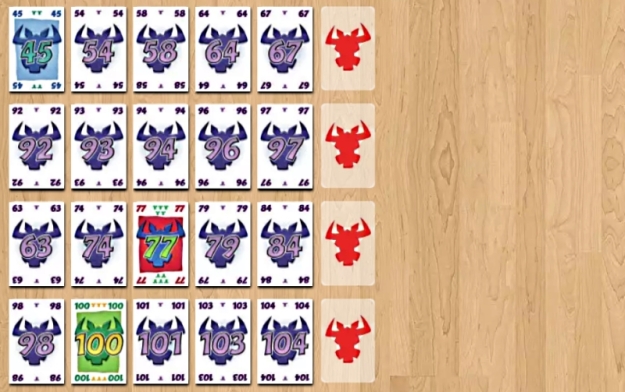
Everyone was feeling a little jaded so we decided to play just one more game, our old favourite, 6 Nimmt! (on Board Game Arena).  This pops up almost every games night, and after the new-lease of life given to it by the “Professional” variant, we thought we’d give the “Tactical” variant a go.  The idea of the game is that players start with a hand of ten cards and simultaneously choose one to play.  Starting with the lowest card played, these are then added to the end of one of the four rows of cards (in the case of the “Professional” variant, to either end).

6 Nimmt! on Board Game Arena
– Image by boardGOATS from boardgamearena.com

When a player’s card is the sixth card added to a row, the player takes the other five into their scoring pile.  Normally, the cards have a face value between one and a hundred and four, with typically around half in play in any given round.  This means that if a row has three cards in it and ends with a eighteen, playing the nineteen is guaranteed to be safe.  Playing higher numbers, say low to mid twenties, though is increasingly risky, but is often a good gamble.

6 Nimmt! on Board Game Arena
– Image by boardGOATS from boardgamearena.com

The “Tactical” variant changes the number of cards in the deck so that the highest card is ten times the number of players plus the four on the table.  In other words, every card is present in every round and now, there really is nowhere to hide.  This makes the game much more stressful, but as it progressed, we came to the slow realisation that it actually wasn’t as much “fun”.  We decided this was probably because there wasn’t as much chance in the game, which effectively reduced the excitement of finding out whether you were going to “get away” with a risky card.

6 Nimmt! on Board Game Arena
– Image by boardGOATS from boardgamearena.com

Furthermore, if the cards were not in your favour, it very much felt that it was game over—yes it might be possible to reduce the number of nimmts picked up, but in most cases, there wasn’t much you could do about it.  So in a way, reducing the chance almost made it feel like the game was more random, rather than less.  Some things don’t change though.  Purple was still the main instigator of the race to the bottom, although this time her main competitor was Black who actually got their first and triggered the end of the game.  As usual, Pine came in the top three, this time beaten only by Burgundy.  And with that, everyone signed off for an early night.

6 Nimmt!
– Image by Burgundy

Learning Outcome:  If at first you don’t succeed, Troyes, Troyes, et Troyes again!

Boardgames in the News: The Truth about Covid and Board Games at Christmas

Over the last couple of days, the Government’s  Scientific Advisory Group for Emergencies (SAGE) are widely reported to have advised people to avoid playing board games this Christmas.  This has been covered by Metro, The Mirror, and The Sun, but also more reputable sources including The Evening Standard, Sky News and The BBC.  This is obviously very bad news for an industry at a time when they would be expecting to maximise their annual sales and instead are struggling.  It would also seem to be at odds with the WHO advice from April this year, which encouraged the playing of games while people were confined to their homes.  So, did SAGE really say that playing games at Christmas will put older people at risk,?

Dixit on Killing Eve
– Image from bbc.co.uk

It is hard to find, but the original article (archived) seems to be one published on 26th November entitled, “EMG and SPI-B:  Mitigating risks of SARS-CoV-2 transmission associated with household social interactions“.  It is sixteen pages long and is a report summarising current evidence on how to mitigate risks of transmission of SARS-CoV-2, with a particular focus on activities in the home when hosting a small number of visitors or larger family celebrations.

Article on Christmas Games & Covid
– Image by boardGOATS from gov.uk

The report extensively analyses the risks in such gatherings and ways these can be mitigated, including avoiding physical contact, and the difficulties associated with gatherings in a crowded, potentially poorly ventilated area, where people are sharing facilities.  The section that covers games is in the appendix, where there is a table covering “Behaviours and Activities”.  This examines a range of scenarios and how transmission may occur.  Games get a mention under “Activities involving fomites” (objects which are likely to carry infection):

“Games that may be traditionally played such as board games, cards, etc, giving of gifts, sharing of objects and vessels during religious observances. Direct evidence for fomite transmission is limited, however viral RNA has been found on high touch surfaces in close proximity to infected people and there is evidence that shared cigarettes and drinking vessels are associated transmission.”

It continues:

“Risks can be reduced through substituting activities for those that minimise sharing of objects, for example through playing quiz-based games rather than those which involved lots of shared game pieces. Any objects which are likely to have direct contact with the mouth pose a particularly high risk.”

So, far from suggesting people should avoid playing board games, the original document indicates the chance of transmission by playing games is small as most people don’t suck the pieces.  Further, this is in the context of people spending a significant amount of time in the same household, in a small space, and sharing other facilities and food so there are many, much higher risks.  Therefore, the bottom line is that if you are sharing Christmas with someone who has the virus, you are likely to caught from them it long before you get out your copy of Pandemic.

Pandemic: Contagion
– Image by boardGOATS

Next Meeting, 24th Movember 2020 – Online!

It is at times of stress that people need social contact more than ever, and board games are a great medium for that.  Despite the limitations of “remote gaming”, the overwhelming impression is that it is important to stay in touch, so we are persisting with online meetings.  Therefore, our next meeting will be on Tuesday 24th Movember 2020; we will gather from around 7.30pm, and start playing at 8pm.

This week, the “Feature Game” will be Troyes Dice.  This is back to the “Roll and Write” style games and is a very recent release, based on the well regarded game Troyes (pronounced a bit like the French for the number “three”, trois).  It is a planning and resource management game with an interesting rondel mechanism.

Troyes Dice
– Image by boardGOATS

And talking of Troyes…

Jeff had been learning French when he acquired two kittens.  To help him with his language skills he called one of them “One-two-three” and the other “Un-deux-triois”.  As the kittens grew up, they became increasingly competitive.  One day, the kittens had a race across the lake.  “One-two-three” won the race, because “Un-deux-trois” cat sank…

10th Movember 2020 (Online)

With Blue and Pink otherwise engaged, the early arrivals were left to talk amongst themselves to begin with.  Eventually, everyone joined the table talk and admired the new, very yellow arrival that was the Oceana Expansion for Wingspan.  Sadly it will likely be a while before it gets an outing with the group, but it gives us something to look forward to.

Wingspan: Oceania Expansion
– Image by boardGOATS

Once the yellow eggs had been put away, it was time to start the “Feature Game” which was to be HexRoller.  This is another of the “Roll and Write” style games and is a relatively recent release.  The game is quite simple in concept, though the scoring is quite involved and it is quite different to anything else we have played in this vein.  The idea is that a handful of dice are rolled and “binned” into according to value.  Players then choose two numbers rolled and write those numbers on their player board as many times as that number was rolled.

HexRoller
– Image by boardGOATS

This means if three and five are chosen and they appear once and twice respectively, the player will write three down once and five twice.  The game is played on a pre-printed sheet with a play area made of hexagons (because they are the bestagons, obviously).  Some of these have numbers written on them.  Once a player has chosen a number, they start writing in a hexagon next to a number already on the board, with every subsequent number written next to the previous, making a chain.

HexRoller
– Image by boardGOATS

Once per turn, players can also use one of three special actions, each of which can only be used once per game.  These allow players to write one of their chosen numbers an extra time; write a two anywhere, and choose a third set of dice from the pool.  At the end of the game players score from a smorgasbord of opportunities.  There are points for filling all seven hexagons in one of the coloured groups; for filling all the orange hexes in the central area; for connecting pairs of pre-printed numbers, and any left over, unused special actions.

HexRoller
– Image by boardGOATS

Additionally, every round a player picks two numbers and one is written in a box in the top row in the bottom left corner with the other written in the bottom row.  At the end of the game, a “straight” starting from three, score points equating to the highest number in the straight.  In other words, a set of two threes, a five, a four, a six, and a couple of eights would score six points.

HexRoller
– Image by boardGOATS

Explained, the game sounds extremely complex, however the scoring is outlined on the sheet and in practice, it is actually quite easy to play, though challenging to play well.  That said, it is very different to any of the other games we’ve played and nobody really had much idea how it would pan out.  There are two different boards and with different layouts.  We started with the slightly more challenging, “seven dice” board, but only realised we were using eight dice after we’d already started, and that probably made it quite a bit easier.

HexRoller
– Image by boardGOATS

With only seven rounds, the game rocked along quite quickly and was over in about twenty-five minutes.  Some people did better than others, but it was tight at the top with Green and Ivory tied for first place with sixty-seven and Burgundy just two points behind.  Everyone had really enjoyed it though, and we were all very keen to play the second, “Eight Dice” layout.  This layout is nominally the easier of the two, though we didn’t realise that before we started otherwise we’d have played it first.

HexRoller
– Image by boardGOATS

It has a larger central area, though, and is played over one extra round.  Some of the scoring is also very slightly different, which some people didn’t notice until the end when they came to calculating their score which led to quite a lot of recalculations.  Burgundy was third again, and Blue took second with fifty-seven.  Although Pink was insistent that because he was unable use a single die in the final round, he had a “moral score” of seventy-three his total of fifty stands.  That left Ivory the winner for the second time with a score of sixty-one.

HexRoller
– Image by boardGOATS

HexRoller is a really quick little game, and even playing it twice, there was still time for something else.  As we had struggled a little with Tiny Towns last time, we had planned to give it another go, this time with a new set of buildings.  The idea of the game is clever but quite simple:  players place resources on the spaces on their four-by-four town grid, and then, when the have the right resources in the the correct arrangement, they can replace them with a building.

Tiny Towns
– Image by boardGOATS

Different buildings are built from different combinations of resources in different arrangements and, ultimately give different numbers of points.  We play using the Town Hall Variant where two resources are drawn at random, and then players choose their own for every third.  So, the key to the game is careful planning, but also  keeping options open in case the required resources don’t come up.  And luck also helps of course.

Tiny Towns
– Image by boardGOATS

This time we drew buildings from the alternative cards adding the Granary, Millstone, Bakery, Trading Post, Cloister and Almshouse to the Cottage.  These change the game considerably.  For example, the Granary feeds eight cottages (rather than the four of the Farm we used last time), but they must be in the eight surrounding spaces.  Similarly, the Millstone is worth two points if next to a red or yellow building (in this case a Granary and the Bakery), rather than a single point for each adjacent cottage.  The resources always take up more space than the buildings though and if players aren’t careful they can easily end up building on a space that makes it impossible to work with what’s left.

Tiny Towns
– Image by boardGOATS

Several players including Green, Blue and Pink picked up on the fact that the Cloister had the potential to be highly lucrative, scoring one point for each cloister in a corner.  Blue explained (several times) that this meant that two Cloisters both in corners would score two points each, whereas if one were in a corner and the other were not they would score one point each.  Pink decided that they were too difficult to build to get the most from them as they required four different resources, but Purple, Blue, Green and Lime were braver and decided to give it a go.

Tiny Towns
– Image by boardGOATS

Meanwhile, Pink and Burgundy went heavily for Almshouses.  The larger the number of these, the more points they score, but while an odd number of these scores positively, an even number scores negatively.  So this strategy was not without risk, although as players are not obliged to build buildings, they could always wait, and only build when they know they have a second ready to go.

Tiny Towns
– Image by boardGOATS

Lime was the first to be unable to do anything.  One of the down sides of playing games like this remotely is that players can’t watch what other players are doing, so as players dropped out, nobody else knew how they had done until the scores started to come in.  This time there was quite a spread with scores covering a range of nearly fifty points from minus fifteen upwards.  Burgundy had managed to avoid the pitfalls of the Almshouse and finished with twenty-eight points.

Tiny Towns
– Image by boardGOATS

Blue, however, had made the Cloister strategy work building a total of six, including one in each corner.  It was at this point that Green realised he could have built another two Cloisters, but had thought they wouldn’t score.  Worse, he hadn’t realised the empty spaces would score negatively, leaving him some eight points worse off.  He insisted that he wouldn’t concede, that there should be a recount as the rules hadn’t been clear, and that a lawsuit would clear it up…

Tiny Towns
– Image by boardGOATS

As in Pennsylvania, however, nobody listened to the litigant.  It was getting late though, so Lime, Lilac and Ivory left everyone else to play For Sale.  This is a great game for six players and the rendering of Board Game Arena is really good, making it really quick and fun to play.  The game itself comes in two parts:  buying properties and then selling them—the player who finishes with the most money wins.

For Sale
– Image by boardGOATS

Everyone starts with $14,000 dollars and the bid must increase by at least $1,000 each time with players who pass taking the lowest numbered property available and getting half their stake returned.  There are two ways to play this, with the money returned rounded up or down – this time we chose to give every player the maximum amount of money with their returns rounded up.

For Sale
– Image by boardGOATS

This time, all the high cards came out in the final round.  This meant Burgundy paid just $1,000 for his castle (number twenty-eight) and Purple paid just $2,000 for the sky-scraper (number twenty-nine), although Green still paid $7,000 for the most valuable property (the space station).  As a result, most people had acquired some nice properties for a very good price.

For Sale on Board Game Arena
– Image by boardGOATS from boardgamearena.com

It was a three-way tie between Black, Burgundy and Green for the player who managed to sell their properties for the most money, with all three taking $48,000.  However, it is the total, including any money left from the starting funds.  In this, Pink and Blue had only spent $3,000 so had $11,000 left.  This enabled Blue to just beat Burgundy into second place and take victory with $53,000.  At this point, Pine, who had been unable to join in earlier as he was staying with his poorly mother.  Inevitably, the game of choice with seven, was 6 Nimmt!

6 Nimmt!
– Image by boardGOATS

6 Nimmt! is one of the group’s favourite games, and we really enjoy the additional madness that the “Professional Variant” gives.  In the original game, players simultaneously choose a card from their hand and then, starting with the lowest value card, cards are added in order to one of the four rows of cards on the table.  Each card is added to the row that finishes with the highest number that is lower than the number on the card.  Placing the sixth card instead causes the player to take the five cards into their scoring pile.

6 Nimmt!
– Image by boardGOATS

The “Professional Variant” allows players to add cards to the other end of the rows, as long as the difference is smaller.  This has the effect of making otherwise be “safe” plays, decidedly “unsafe”, and makes low value cards much more interesting to play.  It can have far more catastrophic effects on the game though, and this time was one of those games.

6 Nimmt! on Board Game Arena
– Image by boardGOATS from boardgamearena.com

Purple was the first to pick up cards, immediately followed by Green.  It wasn’t long before others joined in the race to the bottom.  Purple was leading the pack, though when Burgundy picked up seventeen nimmts, shortly followed by another fifteen and several other smaller totals, he overtook her, finishing with a magnificent minus forty-two!  The winner was largely incidental, but was Blue, who had only picked up fifteen in the whole game some twenty less than Pine, who always does well in this game, in second place.

6 Nimmt! on Board Game Arena
– Image by boardGOATS from boardgamearena.com

With that over, Green and Pink signed off, leaving five to continue, and the game of choice was Coloretto.  This is a very simple set collecting game, that we played from time to time when we were at the Jockey, but has become one of our staples this year.  The game is so simple and plays very quickly: players take a card from the deck and add it to a truck, or they take a truck and sit out until the end of the round.

Coloretto
– Image by boardGOATS

Players score points for their sets, with the three most lucrative sets scoring positively and any others scoring negatively.  Last time we played, we used the “Difficult” scoring, but that hadn’t been as interesting as, say, the “Professional Variant” for 6 Nimmt!, so this time  we used the standard scoring, according to the Triangular Number Series.

Coloretto
– Image by boardGOATS

With everyone very familiar with the game, it is often quite close and this was one of those games.  Indeed Pine and Black tied for second place with twenty-five points, but were beaten by Burgundy who finished just two points clear.  There was just time for one more game, and Sushi Go! has become one of our recent favourites in such circumstances, as it plays very quickly and the rendering on Board Game Arena is really good, though it would be really nice if they could add some of the extra options available in Sushi Go Party!.

Sushi Go!
– Image by boardGOATS

As it is, we played with the Soy Sauce mini expansion.  The game is very simple and we find that a little bit of Soy does add a little extra flavour.  The game is one of card drafting and set collecting, with players choosing one card from their hand to keep, passing the rest on.  Some cards score for sets of two or three (Tempura and Sashimi), while the Nigiri score more if played after Wasabi for example.  Soy goes well with everything, so scores if the player also has the most variety on their plate at the end of the round.

Sushi Go! on Board Game Arena
– Image by boardGOATS from boardgamearena.com

The game changers Maki Rolls and the Puddings which give points for the player with the most at the end of the round and game respectively.  The Puddings can be the real game-changers though as the player with the most gets six points and the player with the fewest loses six points.  In a close game that can make all the difference.

Sushi Go! on Board Game Arena
– Image by boardGOATS from
boardgamearena.com

This time, Blue and Pine took an early lead at the end of the first round while the others built up their Pudding supply for the end of the game.  Black took the lead after the second round though.  Burgundy put in a storming final round taking the six points for the most desserts, but with a three-way tie for the fewest, the negative points were split between Blue, Pine and Black.  Burgundy didn’t quite catch the leaders though, and he finished two points behind Pine and Black, who tied for first place.  And, well fed, it was time for bed.

Sushi Go! on Board Game Arena
– Image by boardGOATS from
boardgamearena.com

Learning Outcome:  Listening to the rules explanation usually gets you more points.

Next Meeting, 10th Movember 2020 – Online!

It is at times of stress that people need social contact more than ever, and board games are a great medium for that.  Despite the limitations of “remote gaming”, the overwhelming impression is that it is important to stay in touch, so we are persisting with online meetings.  Therefore, our next meeting will be on Tuesday 10th Movember 2020; we will gather from around 7.30pm, and start playing at 8pm.

This week, the “Feature Game” will be HexRoller.  This is back to the “Roll and Write” style games and is a relatively recent release.  It is a path building, abstract game played on a hexagon-based board, because hexagons are bestagons!

HexRoller
– Image by boardGOATS

And talking of hexagons…

Jeff had been trying to teach his pet parrot to speak, but was struggling as the parrot liked learning what it wanted rather than what Jeff was teaching.

“Repeat after me,” said Jeff, “Five sides is a pentagon.”

The parrot sat silently, so Jeff continued, “Six sides  is a hexagon.”

The parrot just looked at him, so Jeff tried again, “Eight sides is an octagon.”

With that the parrot said, “Five sides is a hexagon!” then gave a loud squawk, fell off his perch and landed on the floor of his cage stone dead.

Jeff just stood and stared in horror.  His wife, hearing the noise came in from the other room.

“What on earth happened?” she asked.

Jeff replied, “Polygon.”