Next Meeting – 19th February 2019

Our next meeting will be on Tuesday 19th February, at the Horse and Jockey pub in Stanford-in-the-Vale.  As usual, we will be playing shorter games from 7.30pm as people arrive, until 8pm when we will start something a little longer.

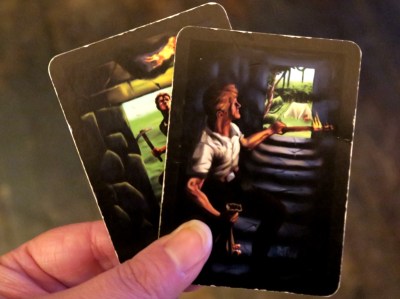
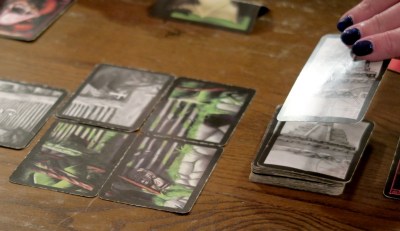
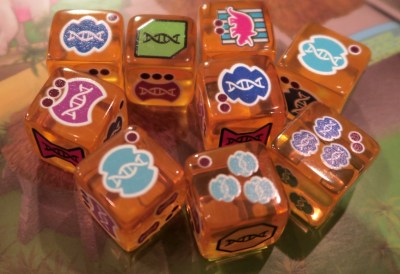
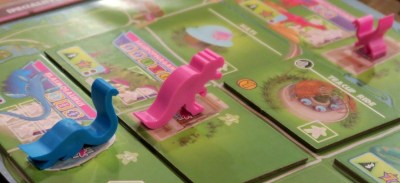
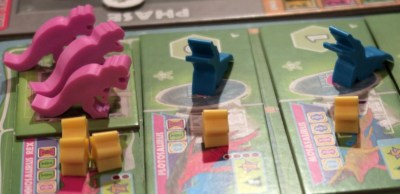
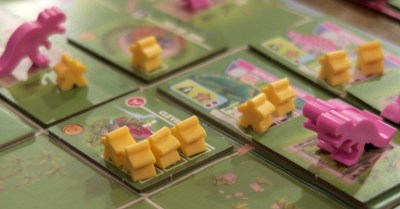
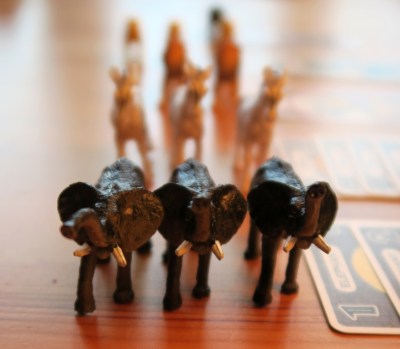
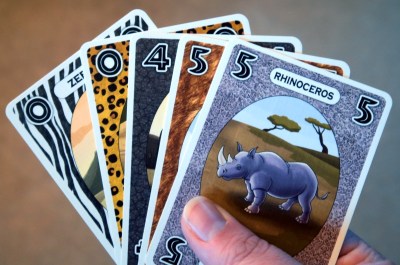
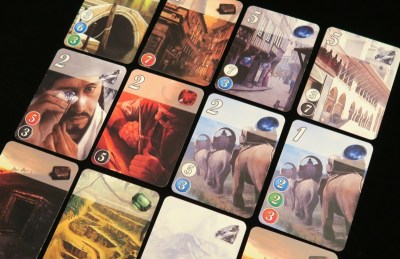
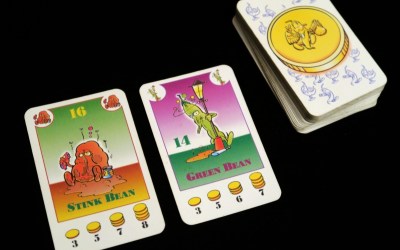
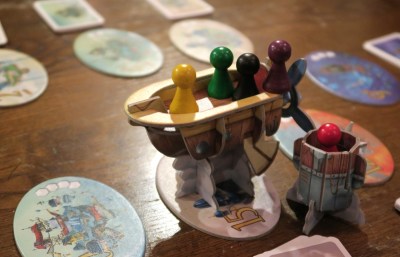
This week the “Feature Game” will be Celestia (a remake of Cloud 9), players take on the roles of adventurers exploring the cities of Celestia by airship.  At the beginning of each round, the captain rolls the dice to discover the challenges he will face.  Before he does so, however, each player must decide whether to stay on board, or leave and forfeit the potential riches to come.

Celestia
– Image used with permission of boardgamephotos

And speaking of airships…

An airship was carrying passengers from all over the world. Suddenly everybody heard a noise and the airship began to lose height. The stewardess approaches the passenger closest to her, a Frenchman, and said, “There is a hole in the airship and we are losing height. Please jump out, sir, the airship will be less heavy and you will save a lot of people.”

The Frenchman thought it over, looked at his beautiful wife and decided to do the honourable thing: he knocked back a whole bottle of wine and shouting, “Vive la France!” jumped over the side.

Unfortunately, it didn’t help; the airship was still losing height, now even more rapidly than before. So the stewardess went to the next passenger, a Scandinavian and said, “Please, sir, the airship is falling from the sky and we will all die, unless you jump out of the airship.”

The Scandinavian thought it over, looked at his young family and felt he had no choice. He took a deep breath, knocked back a bottle of aquavit, then shouted “Vikings rule the world!” and jumped.

Sadly, the airship was still falling out of the sky. And so, the stewardess went to the next passenger, a Scotsman and explained the situation, “There is a hole in the airship, we are going to crash, please sir, if you jump out of the airship and save everyone.”

“Ach, no way, lady!” the Scot replied.

“Please, sir, I beg you,” the stewardess pleaded, “If you jump you will will be a hero!”

The Scotsman looked over the side at the rapidly approaching ground and thought it over quickly. With just a slight hesitation, he knocked back all remaining alcohol, then shouted “Long live St George” and threw the Englishman next to him over the side…

5th February 2019

Far from being over-run by new people flocking to games night in response to our advert in the Parish Newsletter, it was one of the quietest weeks for ages.  With Ivory still on “sabbatical”, Mulberry in the States, and Pine, Pink and Red all having something better to do, for the first time in ages, we were down to just five and a single game.  Burgundy was just finishing eating and Blue was waiting for the imminent arrival of her pizza, so the group decided to play something short that could be played while feeding.  After a brief discussion the group began a game of Walk the Plank!, and inevitably, Blue’s pizza arrived just as it started.

Walk the Plank!
– Image by boardGOATS

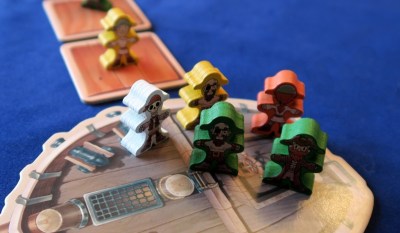
Walk the Plank! is an old favourite that has been somewhat neglected by the group of late.  It is a very silly programming game where players control pirate meeples who try to push each other off the ship and, when plans go wrong, occasionally jump overboard.  The idea is that each player begins with a hand of action cards and simultaneously everyone chooses three cards to play and the order they are going to play them in, placing them in a stack with the first card on top.   Once everyone has chosen their cards, the players take it in turns to take the top card off their pile and carry out the action using one of their three “pirate-eeples”.  Actions include shoving other players meeples closer to the end of the plank (or into the sea); running towards the ship; retracting or extending the plank, and even changing along the plank pushing another player closer to the sea.  As we were playing with the Limited Edition which comes with some extra cards, so for a bit of variety, we added the Dynamite and Ghost Pirate cards.

Walk the Plank!
– Image by boardGOATS

The first of the extra cards, “Dynamite”, pushes everyone on a given piece of plank one space closer to the sea. The other, the “Ghost Pirate”, scares everyone on a a piece of plank so much that they run away, half towards the sea and half towards the ship.  The newly bespectacled Green was of the opinion that the extra cards were generally a little over-powered, so we house-ruled it so that they could only be played once each.  When we play this game we include a couple of other house rules too:  according to the rules as written, the last piece of the three piece plank should not be removed when shortening the plank and the game is supposed finish when there are two meeples left.  While we understand why these rules exist, we find that sharing victory means the game feels a little unresolved so we play through to the bitter end.  Similarly, we quite like the madness removing the last plank adds, and in such a short game, crazy chaos seems entirely appropriate.

Walk the Plank!
– Image by boardGOATS

And chaos there was aplenty this time round too:  Burgundy was quickly out of the game when the third and final of his meeples was banished to the deep.  As the first person to be eliminated, Burgundy was given the slightly dubious honour of returning as a Ghost.  In this mini-expansion, the player returns as a white pirate-eeple doomed to haunt the ship and generally cause mayhem for everyone else by playing one shove card per round.  When the last of Black’s pirates joined Burgundy’s there was some discussion about a second ghost, but we decided it would just prolong the game.  It wasn’t long before he had company on the sidelines though, leaving just Blue and Purple.  With both of them perched precariously on the end of what was left of the plank and Blue set to go first the game was her to take.  However, she decided she couldn’t take advantage of the position and instead retracted the plank unceremoniously pitching both of them into the drink.

Walk the Plank!
– Image by boardGOATS

With Blue finished with her pizza, and it clear that nobody else was coming, the group decided to move on to the “Feature Game” which was to be Through the Desert.  This is an old game, but one that is very simple to play, though difficult to play well.  It is an area control game with pastel camels that many feel is reminiscent of the classic game, Go.  The game begins with players placing one camel in each colour on the board.  Each of these has a rider (Leader) in their own colour, so these camels are the start of the player’s camel trains or Caravans.  After the initial placements, on their turn, players take any two camels from the general supply and add them to the board.  There are a few rules about placement – each one must be placed next to camels of the same colour to become part of one of that player’s caravans, and must not be placed next to a caravan of the same colour belonging to another player (as this would cause them to join).

Through the Desert
– Image by boardGOATS

The aim of the game is to gain points through via the four sources.  Firstly, there are several oases marked with green plastic palm trees; players who connect a caravan to an oasis get five points.  There are also watering hole tokens—players who place a camel on these spaces can claim these tokens which are worth up to three points.  Players who finish with the longest Caravans in each of the colours are also rewarded with points at the end of the game.  The most lucrative source of points, but also the most risky is enclosing areas.  It is in this way that it is most like Go.  Go is a very ancient game played on square grid with black and white stones.  People often try to compare it to Chess, though in truth, beyond the facts one play plays black, the other white and the game is played on a rectilinear grid and both are very old, the two games have almost nothing in common.

Chess
– Image by Unsplash contributor sk

Chess is a game with a very rigid structure where players control armies that are lined up to face each other.  Each piece has a clearly defined role and movement pattern and games develop in a very particular way.  The highly structured nature of the game means strategies are developed by analysing all the possible or likely moves which makes it highly programmable.  In contrast, Go is all about territory and pattern analysis, which has traditionally made it much more challenging for computer programmers and it is only recently that software engineers have been able to use machine learning algorithms that have the ability to beat Go champions.  In Go, players place their stones on the intersections of a rectilinear grid with the aim of marking out territory.  There is a lot of psychology in the early moves with players declaring their space; if a player is too aggressive at the start, they won’t be able to defend their position, if they are too timid with their opening they will have lost before they’ve begun.

Go
– Original image by Tomasz_Mikolajczyk on pixabay.com

Ultimately however, Go is a complex game of strategy where players are trying to capture their opponent’s stones and with i,t territory.  A single empty space inside a group is called an eye; for a group to remain alive it must contain at least two eyes.  Creating eye spaces in a player’s groups and trying to prevent their opponent from making eyes is one of the key aspects of Go.  It is in regard to building territory that Through the Desert is similar to Go, however, there are two significant differences.  Firstly, and perhaps most obviously, the game is played on a hexagonal rather than a square grid.  The main difference is in the game-play though:  in Through the Desert pieces must be added to an existing caravan and surrounded pieces are not removed from the board.  Nevertheless, despite the differences it is unquestionably true that the Through the Desert is reminiscent of Go and was likely inspired by it.

Go
– Original image by Przemek Pietrak on flickr.com

With five players, everyone starts the game with Leaders mounted on four of the five different colours of camel.  Starting placement was quite difficult because nobody really knew constituted a good starting position, though some claimed to know what a bad one was.  Maybe there was an advantage in going last, or perhaps Black had a better idea than everyone else, but it quickly became apparent that that he had a large corner of the board all to himself.  This put Burgundy in a very difficult position as he was the only one who could do anything at all about it, but he had other plans.  In the end, Burgundy decided to do his own thing because the damage he could do to Black was minimal and it would be a significant expense to himself.

Through the Desert
– Image by boardGOATS

Elsewhere, Burgundy was in a four-way tussle with Purple, Green and Black for access to an oasis and Green and Burgundy combined to prevent Blue from connecting two of the oases.  Meanwhile, Purple collected a pile of watering-hole tokens, and Burgundy was attempting to enclose an enormous space in the middle, while Green and and Blue were hoping to fly under the radar and get away with discretely annexing small areas at the edge of the board.  It wasn’t long before the number of pale blue camels was dwindling and Black was left trying to decide whether it was in his interest to bring the game to an end.

Through the Desert
– Image by boardGOATS

When Blue reduced the handful to one lonely looking camel, Black could resist no longer leaving Burgundy’s audacious attempt to claim on the large central area incomplete and looking temerarious as a consequence.  Everyone had thought Black was so far in front that they were playing for second place, however, it turned out that the game was much closer than expected.  Green had scored slightly more for his oases and the length of his Caravans than Black and Black’s large corner hadn’t given him quite as much territory as it had first appeared.  It was very close, but Green took it by just two points.  As the group packed away, feelings were generally positive, but everyone was agreed that they’d play it differently next time, so we’ll have to give it another Go sometime soon.

Through the Desert
– Image by boardGOATS

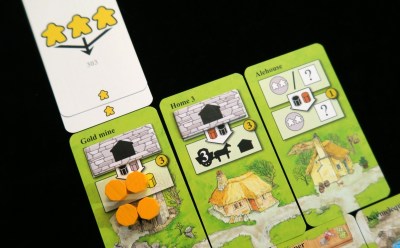
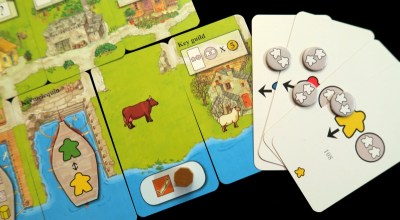
With five players, the options were limited – we generally try to avoid two-player games and we were a bit short on good five-player ones.  In the end, it was either yet another game of Bohnanaza, or the 2016 Kennerspiel des Jahres winner, Isle of Skye, and Isle of Skye won easily.  Although this is a game we’ve played quite a bit and know reasonably well, we decided not to add the new Druids expansion as it is a while since we last played the base game and we felt we could do with a reminder.  The game is a sort of upgraded tile laying game with a lot in common with Carcassonne, but with an auction at the start of each round and scoring at the end of each round.  The scoring is one of the interesting parts of this game as the four scoring criteria change from game to game and, and each one scores three times during the course of the game.  Choosing how to prioritise these to drive a strategy is one of the keys to playing well.

Isle of Skye: From Chieftain to King
– Image by boardGOATS

This time, points were available for cows in the largest field; brochs; completed areas, and lighthouse-longboat combos.  The game proceeded along its usual course:  Burgundy had stacks of money but no tiles because everyone kept buying them while Blue and Black had plenty of tiles, but no money.  Black with a very linear kingdom was reminded by Purple that the goal for that shape wasn’t in use this time.  It didn’t seem to matte as he stormed off into the lead with a large field full of cattle, but it wasn’t long before others gave chase.  The winner in this game often comes from the back, because there is a “catch-up mechanism” where players get money in the later rounds, with those at the back getting more.  So, when Green and Blue eventually caught up with Black, the positions were important and Green looked ideally placed one point behind Black who was one point behind Blue.

Isle of Skye: From Chieftain to King
– Image by boardGOATS

Although the points awarded at the end of the rounds are valuable, it is usually the end game scoring through the scrolls that is critical.  These provide personal targets for each player, and score twice where terrain is “completed” (i.e. completely enclosed).  So towards the end of the game everyone scrabbled to maximise their points.  Green took a tile Blue wanted to keep, so Blue took one that Burgundy had priced very highly giving him even more money, but not the one tile that was really crucial to his plans.  Black added a couple more farms, while Green went for ships Purple went for light-houses and Blue tried to get both.  Burgundy and Blue were also working on the communal, end of round scoring for the brochs (prehistoric circular stone towers found in the highlands and islands of Scotland).  In the case of scoring for brochs though, one would give one point, two would give three and three six points.

Isle of Skye: From Chieftain to King
– Image by boardGOATS

With two players fighting for them brochs were scarce, but by the final round both Blue and Burgundy had managed to get their quota of six.  They were less than impressed when Black pointed out that the brochs only scored if they were in the same mountain region.  Although Black had read the scoring in full, somehow it had failed to make it to the end of the table as both Blue and Burgundy had missed it.  Green pointed out that anyone affected should be called out for cheating, but Burgundy was in such dire need of points nobody was going to contest him claiming them.  The scoring at the front was a bit closer though.  As the points were calculated though it was clear that Green needn’t have worried.  Although he was only one point behind Black, Blue’s fleet of ships meant she was twelve points clear, and it was obvious that even allowing for the extra points, she would still have won.

Isle of Skye: From Chieftain to King
– Image by boardGOATS

Learning Outcome:  If the rules are that important to your game-plan, clarify them first.

Next Meeting – 5th February 2019

Our next meeting will be on Tuesday 5th February, at the Horse and Jockey pub in Stanford-in-the-Vale.  As usual, we will be playing shorter games from 7.30pm as people arrive, until 8pm when we will start something a little longer.

This week the “Feature Game” will be Through the Desert, an area control game with pastel camels that many feel is reminiscent of the classic, Go.  During the game, players try to score the most points by snaking caravans of camels through the dunes, trying to reach oases and blocking off sections of the desert.

Through The Desert
– Image by BGG contributor haslo

And speaking of camels…

Jeff was working for the army in a remote part of Iraq. When he arrived, he was given a tour of the site and towards the end, he noticed a particularly mangy old camel tied up behind the barracks, so he asked his guide what it was for.

The young soldier looked extremely embarrassed, but eventually said, “Well sir, there are over two hundred men here far and no women. Sometimes the men get… urges.”

“Oh right,” replied Jeff, now equally embarrassed, “I see.”

Six weeks later, Jeff was coming to the end of his stay in Iraq. He’d spent almost all of the time in camp and was starting to feel very… frustrated. Lying in bed early one morning, he suddenly remembered the camel and no matter what he did he couldn’t get the idea out of his mind.  So after an hour, he got out of bed and sneaked out of the building to the back of the barracks where the camel was quietly minding it’s own business.

Jeff, who by this time had only one thing on his mind, dropped his trousers, grabbed a conveniently nearby stool, clambered up, and proceeded to vent his frustration by giving the poor unfortunate camel the ride of its life. He was so engrossed, he didn’t see the soldier who had given him the tour and was on his way to guard duty. The young man stopped and stared; as Jeff finished and dressed, he suddenly realised he had an audience.

Jeff felt he had to break the oppressive silence. He pointed at the stool, “Is that how the others do it?” he asked.

“Well, no sir,” replied the soldier slightly awkwardly, “They normally just use the camel to ride to the nearest brothel…”

22nd January 2019

Green was delayed, so once food had been dealt with, we started with the “Feature Game”, Auf Teufel komm raus.  This is a fun, push-your luck game with a betting element, in the vein of games like Incan Gold.  “Auf Teufel komm raus” literally translates as “On Devil come out“, but roughly means “by hook or by crook” or according to rule book, “The Devil with it” (as the title is officially translated).  None of these really give any information about the game though they inspire the lovely artwork.  The game itself is fairly straight-forward though:  everyone simultaneously places bets on the maximum value of coal that will be drawn out of the fire by one player in the round.  Players then take it in turns to draw coals, either stopping when they choose or going bust if they draw a piece.

Auf Teufel komm raus
– Image by boardGOATS

The player who draws the highest total value coals without going bust gets a fifty point bonus, as does the player who draws the most pieces of coal without drawing a Devil token.  Everyone whose bet was exceeded by the maximum value keeps their stake and wins the equivalent value from the bank.  If the player with the highest bid was successful, they win double their stake money.  This is key as it means the largest stakes are very lucrative making it in everyone else’s interest to stop once their stake has been met, unless they are in the running for the largest total or the most coals of course…  The game ends when one player passes one thousand six hundred at the end of the round and the winner is the player with the highest score.

Auf Teufel komm raus
– Image by boardGOATS

The game is beautifully produced with lovely poker chips, nice wooden coal tokens, a colourful board and chunky score tokens, but it is the little things in the game play that make it enjoyable.  Bizarrely though, it took the group several rounds to really get the hang of what decisions they were making.  Firstly, players had to work out what a reasonable level for bidding was.  There are approximately the same number of tens, twenties, twenty-fives, fifties and Devil coals with a smattering of seventy-fives and hundreds, but it took a round or so for people to get a feel for the statistics.  Then there was an understanding of the tactics when drawing coal—it took most of the game for players to realise that once the highest bid had been matched, players might as well keep drawing until they win something as there was no penalty as long as nobody had “made a pact with the Devil”.

Auf Teufel komm raus
– Image by boardGOATS

Making a pact with the Devil is not something one generally chooses to do; it is simply a catch-up mechanism, but significantly changes the dynamic of the game.  Basically, a player alone at at the back is given fifty points by any player who draws a Devil token.  This prevents the “devil may care” attitude once the maximum bid has been met.  It only happens rarely though (especially with six), as players don’t reveal their precise score, only the range of their score.  As Black put it, players only know the rough size of each other’s “wad”.  The aspect that makes the game fun though, is the encouraging, discouraging and general barracking as players try to manipulate others to their own ends.

Auf Teufel komm raus
– Image by boardGOATS

With the “wad” scoring and everyone feeling their way, it wasn’t entirely clear how people were doing to begin with, but Mulberry suffered from a huge unsuccessful overly optimistic bid in the first round.  Making a pact with the Devil helped Mulberry catch up, while Pine pulled away at the front.  Burgundy, Black and Blue weren’t going to let him get away with that and started pushing the boundaries with their bids and their draws.  As players began to get a feel for what was a safe bid and what was a risky bid, everyone joined in with lots of “Ooos” and “Aaahhs” as coal was drawn from the Devil’s cauldron.  Purple seemed to have an unerring knack of finding Devil tokens, but despite languishing at the back, the fact she had Mulberry for company meant neither of them could benefit from making a pact with Lucifer (maybe something that could be “House Ruled” in future).  In the final round everyone put in large bids, but Blue’s was the largest, a hundred and fifty.  Purple had gone bust while trying to meet Blue’s target, but the slightly more modest bids from Burgundy, Pine and Black had all been achieved, leaving all or nothing for Blue as the last player to draw.

Auf Teufel komm raus
– Image by boardGOATS

When the first token Blue turned over was one of the scarce hundreds, Black commented in jest that Blue had “marked it”.  The reason for Blue’s slightly indignant reply of “Hardly!” became clear in the post-game chit-chat.  There are several online reports of the coal tokens being identifiable.  Blue had therefore looked carefully at the tokens that had arrived covered in tiny specks of white paint which she had spent an hour scraping off.  This wasn’t entirely successful leaving some small scratch marks, so she had then carefully spent another hour inking the backs to try to homogenise them.  This had left the coals with a wide variety of glossy sheens, so she had carefully spent another hour rubbing them all with carnuba wax to try to make them all similarly shiny.  Unfortunately, the grain meant the pieces looked more even more varied with white wax deep inside the grain for some tokens and others smooth and glossy.

Auf Teufel komm raus
– Image by boardGOATS

Blue had then spent another hour rubbing all the tokens with oil which finally had the desired effect – there was still variety in the pattern of the grains, but there wasn’t an obvious trend.  Once Blue had explained that she’d spent most of Sunday evening on the exercise, trying hard not to identify any of the pieces while getting inky, waxy, oily, numb fingers, the Irony of Black’s comment was appreciated by everyone.  With Blue having drawn a hundred, everyone was on tenterhooks to see if she could draw the fifty she needed to make her bid successful.  Pine’s successful bid meant he had just exceeded the sixteen hundred needed to end the game; draw a Devil and Blue would lose a hundred and fifty and finish some way down the rankings.  It wasn’t to be though, with a flourish she produced a fifty, giving her three hundred points for the bet plus a fifty point bonus and with it, the game.

Auf Teufel komm raus
– Image by boardGOATS

Everyone had enjoyed the game though all were agreed that they’d start differently next time.  It had been a lot of fun once we’d got going though, so it will probably get another outing soon.  Poor Green had missed out, arriving about half-way through.  That left us with seven though, and a conundrum as to what to play next.  Time was getting on, but Green was keen to play something a little meatier.  Although Burgundy was happy to join him in Endeavor: Age of Sail with the new Exploits, nobody else was in the mood and it is a game that really needs at least three.  Blue was tempted, but with her fuzzy, “fluey” head wasn’t up to something new (she hadn’t played with the Exploits before) and Black was of a similar mind.  Inevitably Bohnanza got a mention, and as Mulberry hadn’t played it before, it was looking a likely candidate.  Pine wasn’t enthusiastic, but was even less keen on Endeavor.  In the end, the group split into two with Blue, Burgundy and Purple opting to teach Mulberry “The Bean Game”, while Pine and Black joined Green in a game of Marrakech.

Marrakech
– Image by boardGOATS

Strictly speaking, Marrakech is a game about selling Rugs, but the group just couldn’t stop themselves calling them Carpets.  The game itself is a very clever little abstract game made all the better by the addition of fabulous fabric “Carpets”, wooden coins, a large chunky bespoke die and a cool salesman who goes by the name of Assam.  The idea of the game is that players take it in turns to roll the wooden die and then turn Assam zero or ninety degrees and move him the given number of spaces.  If Assam finishes on an opponent’s coloured piece of Carpet (or Rug), the player must pay rent equal to the size of the contiguous area.  Finally, the active player places on piece of Carpet covering one square adjacent to Assam (and one other square as the Rugs are rectangular), before passing the problem on to the next player.  The player who ends with the most money and visible squares of Carpet combined, is the winner.

Marrakech
– Image by boardGOATS

After the first few placements it felt very obvious which direction the seller would have to be facing and then it was luck of the die.  Green quickly built a nice large area in one corner of the board, but thereafter game-play resolutely remained in the other areas of the board.  This was a bit of a mixed blessing as it meant Green kept his high Rug count, but did not receive any earnings from it.  This was compounded when he made a tactical error, turning the faceless Assam into the path of everyone else’s Rugs. From there on, Pine and Black made regular visits to each others Rug areas, although Pine seemed to be coming off slightly better from the exchange.

Marrakech
– Image by boardGOATS

Eventually, with the Green and Black down to their last three Rugs in hand, for some reason Pine had an extra and still had four left.  The group decided that he must have failed to place one at some point, so let him to place two on the next turn.  It wasn’t clear how much that affected the outcome, but on final count, Pine had just one more Rug visible than Green, but had a advantage in coins so was declared the winner.  With Bohnanza ongoing on the next table, the group looked for something short-ish and familiar and settled on Splendor, but decided to add The Orient module (from Cities of Splendor expansion), for no better reason than the fact that one of Pine’s favourite football teams is Leyton Orient.

Splendor
– Image by boardGOATS

Splendor is a very simple game: on their turn, players take gems (rubies, sapphires, opals, diamonds and emeralds, in the form of special poker-like chips), buy a gem-card, or reserve a gem-card taking a wild, gold chip as a bonus.  When taking chips, players must take three different chips, or, if there are enough chips in the stack, they can take two the same.  Each card features a gem which acts as a permanent chip (i.e. where chips are spent when buying cards, gem-cards remain in the player’s display).  Some cards also give points, and the first player that achieves a set combination of gem-cards also gets points for “attracting a Noble”.  The winner is the player with the most points at the end of the round where one player reaches fifteen.  The Orient expansion module adds an extra three decks of cards (one for each tier), which have special powers, like double bonus cards or joker cards which help players entice Nobles to their store.

    Cities of Splendor
– Image by boardGOATS

This time all the randomly drawn Noble tiles required ruby cards; three of them also needed opals and three needed diamonds as well.  When laying out the Level One cards, all four came out as white diamonds and a quick check on the rest of the deck showed this was no fluke, and the deck really did need shuffling further!  Once the cards had been randomised, the usual cat and mouse game ensued until Green took one of the Level Two Orient cards.  This meant he was able to reserve one of the Nobles, much to Black’s chagrin, as he then had to change tac.  The extra gold and additional gems that the Orient cards gave were used a few times to add a new twist to the classic game and Pine managed to use the ability to choose any Level One card he wanted to good effect as well.  When Green managed to reserve a second Noble, the writing was on the wall.

Splendor
– Image by boardGOATS

With only two Nobles remaining for Pine and Black to fight over, Pine decided that he would also go the reserve route and took the third, leaving Black floundering with just the high scoring cards as targets.  Green managed to get his first Noble to take a one point lead, and very soon after completed his second reserved Noble to jump to a very good score of nineteen. Neither Black nor Pine could reach the fifteen in their final turns, although Pine was only a turn or two away from completing his Noble.  Although we’ve played this expansion has been before, the question arose as to whether the ability to reserve a noble is to powerful.  The conclusion was “possibly”, and there was some discussion about a “House Rule” to limit players to holding one Noble in reserve at a time.

Splendor
– Image by boardGOATS

Meanwhile, on the neighbouring table, Mulberry was learning the delights of “Bean Farming” in Bohnanaza from Blue, Purple and Burgundy.  The game is really simple, but very engaging as players are involved even when it isn’t their turn.  The really key part of the game is that players cannot rearrange the cards in their hand, playing them in the order they draw them.  Thus, at the start of their turn, they must “plant” the first card in their hand into one of the two fields in front of them, and may plant the second if they choose.  Two cards are then turned over from the central draw deck, which these must be planted, but not necessarily by the active player.  These cards can be traded or even given away, but must be planted in one of the fields on the table.  Once these cards have been dealt with, the active player may trade some (or all) of their cards with others round the table, before they draw cards to refill their hand.

Bohnanza
– Image by boardGOATS

Fields can only hold one type of bean at a time, but can be harvested at any point.  Harvested beans give money according to the “Beanometer”, and the rarer the card, the more money it yields when harvested.  Thus for Garden beans (of which there are only six), three beans will earn three coins whereas it will require ten of the twenty-four available Coffee beans to give the same return.  The coins are taken from the harvested beans (the card is turned over to show the coin on the reverse), so the number of common cards reduces as the game progresses, but the rare cards become ever more scarce.  The winner is the player with the most points after three trips through the deck.

Bohnanza
– Image by boardGOATS

The game followed the usual flow with some players trying to persuade others to take unfavourable trades.  Blue spent much of the first part of the game alternately drawing Green bean and Wax bean cards; with two substantial fields and a hand full of them she then benefited from lots of donations and nobody else fancied grubbing their plantations when Blue already had the majority of the cards.  All in all, it was a very generous game with everyone giving away cards left, right and centre.  Everyone benefited; Purple did particularly well with her Garden beans, but Burgundy got a couple of cheap Soy beans and Mulberry did well too.  It was Blue who benefited the most though and it showed in the final scores…

Bohnanza
– Image by boardGOATS

Splendor was still on-going, so Blue persuaded Mulberry to stick about for one more short game, NMBR 9.  This was another one she’d not played before and Blue felt it would appeal to her natural spacial awareness.  The idea is that one player turns over cards in the deck one at a time, and everyone takes the indicated card and adds it to their tableau, ensuring that the edge touches one of the other tiles. Once a few tiles have been placed to form a base layer, then tiles can be placed on top of other tiles as long as there are no overhanging parts, and the tile sits squarely on more than one other tile and it shares an edge with at least one other tile on that level.  The higher the tiles are placed the more they score (tile value multiplied by the “floor” number).

NMBR 9
– Image by boardGOATS

It was late, and Mulberry got into a bit of a tangle with the higher levels, but the generosity of spirit from Bohnanza lingered and everyone else let her rearrange her tiles so they conformed to the rules.  And quick as it is, it wasn’t long before everyone was adding up their scores…  With that over, Mulberry headed off while everyone else chewed the cud, discussed “Monster Games” at the Weekend (Food Chain Magnate or a repeat of The Gallerist) and whinged about Brexit.  When the Landlord suggested we moved away from controversial subjects and tried Religion and Politics instead, we knew it was home time.

NMBR 9
– Image by boardGOATS

Learning Outcome:  Some combinations of games and groups benefit from “House Rules“.

Boardgames in the News: What are “House Rules” and are they a Good Thing?

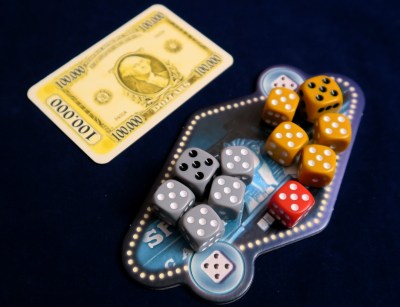
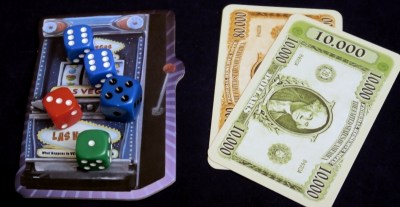
Occasionally, our game reports refer to “House Rules”.  These are slight alterations to the game rules which our group introduce when we play.  For example, the GOATS are quite slow players and, although we love Las Vegas, we find that it drags a little if the full four rounds are played, so we have a “House Rule” which means we stop after three.  Similarly, for us Saboteur sometimes drags and we find the scoring element a bit pointless.  For this reason, we usually skip the scoring and play each round as a short, independent game, which means we can play for as long as we want and just stop when we’ve had enough without worrying about overall winners.  The group also recently discussed allowing two players to make a pact with the Devil in Auf Teufel komm raus when playing with six, to help those players bringing up the rear catch-up, and perhaps make the decisions a little more interesting for the other players too.

Las Vegas
– Image by boardGOATS

“House Rules” are frequently quite controversial though, and the reason is largely philosophical:  the game designer’s vision is based on “The Rules as Written”.  Tampering with the rules can be seen as showing anything from a lack of respect for the designer, to ignorance.  This is because the designer, publisher and development team will have the best understanding of the game through extensive play-testing, and that will be reflected in the rules. There is a point here, famously, many people play Monopoly “wrong”, for example, which changes the character of the game significantly making it overly long and often extremely tedious (especially for players at the back).

Carcassonne
– Image by boardGOATS

When asked, most games designers will encourage experimentation though. This is for two main reasons.  Firstly, most game designers enjoy experimenting themselves: to them there is no “one true rule set”, only the “current rule set”.  This is true for the rest of us too, as some games change when new editions are published—for example, Carcassonne, where the first, second and third editions all have different scoring, or Orléans, where the rules for the Bathhouse changed between the first and second edition.

Orléans
– Image by boardGOATS

Secondly, most designers understand that different groups have different characteristics and dynamics, and therefore enjoy different aspects of playing games.  Designers also want people to get the maximum enjoyment out of their game and sometimes that means tweaking the rules slightly.  So ultimately, they want people to play the way that makes them happiest.  For the avoidance of arguments, it is clearly important to make any “House Rules” very clear to everyone playing, as there is an expectation that games will be played with “The Rules as Written” except by prior arrangement.  However, if playing a game in a particular way is enjoyable, there is clearly absolutely nothing wrong with using “House Rules” as long as everyone knows they are doing it.

Las Vegas
– Image by boardGOATS

Boardgames in the News: A UK Games Company in Trouble

Et Games is a small Hampshire games company that is in trouble largely thanks to red tape.  The company started life as Pucket Enterprises in 2009 and since then have won investment through the investment TV program Dragons’ Den and have published three wooden dexterity-type games, Pucket, Bridget and Rollet.  These games are made in India out of sheesham wood (Dalbergia sissoo) from managed plantations.  Unfortunately, sheesham wood looks similar to some endangered rosewoods, so a recent change in the rules means Et Games now require an import permit for each shipment.

Bridget
– Image from etgames.co.uk

According to Et Games’ website, delays by the Indian authorities in providing the necessary export permit for a recent shipment, meant Et Games were unable to apply for a UK permit until shortly before the goods arrived. The UK Animal Plant and Health Authority (APHA) say this was too late, so they have confiscated the whole shipping container worth £20,000 which will probably end up being destroyed.  With other costs and forgone profits, this small business has effectively lost up to £40,000, putting the company in peril.  In an effort to save the business, Et Games are trying to get the support of their local Member of Parliament, Damian Hinds, and persuade him to write to the relevant junior minister (Therese Coffey) to refer the matter to the Parliamentary Health Service Ombudsman.  Anyone who wishes to support Et Games and help to raise the profile of their plight can sign their petition on change.org.

Petersfield Post
– Image from etgames.co.uk

Next Meeting – 22nd January 2019

Our next meeting will be on Tuesday 22nd January, at the Horse and Jockey pub in Stanford-in-the-Vale.  As usual, we will be playing shorter games from 7.30pm as people arrive, until 8pm when we will start something a little longer.

This week the “Feature Game” will be Auf Teufel komm raus, a fun, push-your luck game with a betting element.  “Auf Teufel komm raus” literally translates as “On Devil come out“, but roughly means “by hook or by crook” or according to rule book, “The Devil with it” (as the title is officially translated).  None of these really give any information about the game though where players are betting on how many coals they can pull out of the fire without getting caught by the Devil.

Auf Teufel komm raus
– Image by boardGOATS

And speaking of the Devil…

St. Peter and Satan were planning a football match, but there was a bit of a dispute.  The Devil wanted home advantage, but St. Peter felt the brimstone would be a significant disadvantage for anyone from Heaven.  In the end they agreed the match would be played on neutral turf between a select team from the heavenly host and a band of Satan’s hand picked players.

“Very well,” said the gatekeeper of Heaven. “But you realize, I hope, that we’ve got all the best players and the smartest coaches.”

“I know, and that’s all right,” Satan answered unperturbed. “We’ve got all the referees.”

8th January 2019

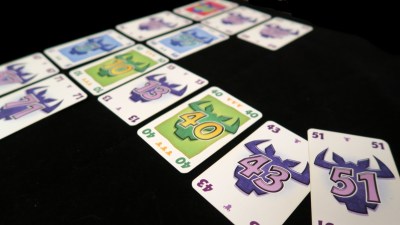
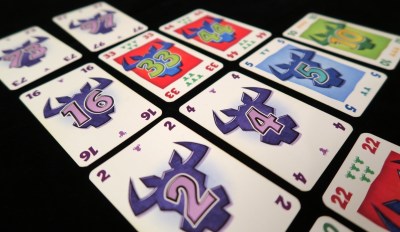
The evening began with everyone comparing lurgies:  Blue and Burgundy were blaming Purple for theirs (contracted in Didcot last week), while Purple and Pine blamed Lilac (contracted at New Year).  With food delayed we decided to play a quick game of one of our old favourites while we waited, 6 Nimmt!.  Unbelievably, this fun little card game is celebrating its twenty-fifth birthday this year, yet its still just as popular as ever with our group.  That said it was a little while since we last played it, and with our guest, Maroon (Mulberry’s Daughter), new to the game we had a quick rules summary first.  It’s very simple, with players simultaneously choosing a card to play which are then simultaneously revealed.  Starting with the lowest number played, players add their cards to one of the four rows in the central display.

6 Nimmt!
– Image by boardGOATS

Each card is added to the row that ends with the highest number that is lower than the card they played.  If the card should be the sixth card, then instead of adding the card to the row, the active player takes the row into their scoring pile and their card replaces the row, becoming the first card.  The aim of the game is to end with the lowest score, but that is much easier said than done.  With so many people involved it was guaranteed to be mayhem and there were only enough cards in the deck for one round instead of the two that we usually play.  The game is all about timing.  Usually there is one player who gets their timing wrong, and once it starts to go wrong, it tends to go very, very wrong.  With so many people we were expecting absolute carnage, but perhaps because there were so many of us, the damage was spread out and the highest score was Red with a reasonably respectable twenty-nine.

6 Nimmt!
– Image by boardGOATS

It was close at the front though with five players within six points.  Unusually for 6 Nimmt!, Burgundy managed to avoid picking up piles of cards, and he finished in first place with eight nimmts, just two ahead of Black with ten.  Food hadn’t quite arrived, and largely out of inertia, we decided to give it another go.  Something went a bit wrong with the first deal as there weren’t enough for everyone to get the eleven cards they’d got the first time round.  To begin with, Pine got the blame for misdealing, but it quickly became clear it was not his fault and some cards were missing.  There was a lot of confusion for a moment, until Blue revealed that she had a stash of cards that she’d forgotten to return.

6 Nimmt!
– Image by boardGOATS

This time, the game followed the more usual pattern, with Purple managing to collect a massive pile of cards some with lots of high-scoring, pretty colours, totalling a massive forty-seven points.  Lots of players thought they were in with a chance of winning though, Blue and Mulberry both finished with eight, but they were beaten by Green with two.  It was then that Burgundy revealed that he’d managed to avoid picking up any cards at all this time, giving him victory in the second game too.  It was time to decide who would play what, in particular, who was going to play the “Feature Game”, Hare & Tortoise.  Although Blue had finished eating by this time, and Burgundy was coming to the end of his enormous pile of ham, egg and chips as well, they had played the game at the recent Didcot meeting so they left everyone else to play it.  After lots of discussion, they were eventually joined by Pine and had to decide what they were going to play.

Hare & Tortoise
– Image by boardGOATS

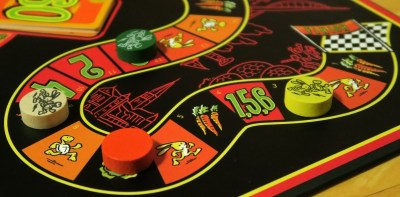
Hare & Tortoise was much quicker to get started though.  This is a relatively old game which won the inaugural Spiel des Jahres award in 1979 and was first released in 1973, making it over forty-five years old.  The game is a very clever racing game where players pay for their move with Carrots, but the further they move the more it costs.  Thus, to move one space it costs one Carrot, but to move five spaces it costs fifteen and to move ten it costs fifty-five.  On their turn the active player pays Carrots to move their token along the track; each space has a different effect, but will only hold one player’s token at a time.  It is this that makes the game something of a knife-fight in a phone box, as players obstruct each other (often unintentionally) causing other players to move more or less than they would wish.  The icing on the cake are the Lettuces though:  each player starts with a bunch of Carrots and three Lettuces—players cannot finish until they have got rid of all their Lettuces and nearly all of their Carrots.

Hare & Tortoise
– Image by boardGOATS

To get rid of a Lettuce, a player must land on one of the “Lettuce Spaces”,  and then spend the next turn eating the Lettuce before they can move on again.  With only four of these spaces available and players needing to land on three of them and spend two turns there on each visit, they are always in high demand, but especially with high player counts.  As well as enabling players to get rid of Lettuces, these spaces also help them replenish their Carrot supply.  And this is another clever trick this “simple little race game” uses that makes it special:  the number of Carrots a player gets is dependent on their position in the race.  This means a player who is in the lead benefits from having an unobstructed path in front of them, but they only get ten Carrots on leaving a Lettuce Space.  In contrast, the player in last place in a six-player game gets sixty Carrots, and Carrots are scarce so this difference is not to be snuffled at.

Hare & Tortoise
– Image by boardGOATS

Lettuce Spaces are not the only opportunity to get Carrots though.  A player on a “Carrot Space”, for example, will earn ten Carrots for every turn they wait on that space.  Another way of getting Carrots are though the number spaces—a player who is on one of these at the start of their turn will get Carrots if the number matches their position in the race.  Of course, the game would not be complete without “Hare Spaces” and “Tortoise Spaces”.  The latter are the only way a player can move back along the track, and this can be invaluable when trying to get rid of Lettuces.  Moving backwards also gives Carrots, with players getting  ten Carrots for every space regressed.  Hare Spaces are completely different, with players landing on these drawing a “Hare Card”.  These are “Chance Cards”, some good, some not-so-good and some really, really bad.  The aim of the game is to be the first to cross the finishing line, but even this is unconventional, with players having to have eaten all their Lettuces, consumed almost all their Carrots, and make the exact number of moves.

Hare & Tortoise
– Image by boardGOATS

For those who were new the game it only took a round or so to realise the subtle cleverness of it, the ability to choose one’s own position on the track is vastly tempered by the usefulness of the available squares with so many other players taking up the first few spaces.  Red started the game and immediately went for a Hare card. That didn’t do a lot except tell everyone exactly how many Carrots she had, which was not difficult to work out after just one turn.  Green also decided that the Hare cards were also worth a go, but his was a bad one, and he lost half his Carrots!  For his second turn he decided he had not taken enough punishment and went for the next Hare as well and also got the “Show your carrots” card.  As the first three had all been bad, the odds had to right themselves, so when Maroon went for the fourth Hare card it was much nicer to her.  Purple, who knew the game, understood the importance of having eaten all her Lettuces and started munching on the very first available Lettuce space.  Green and Red hadn’t fully understood the rules, so did not realise until they were a long way round the board; Red thought she only had to get rid of one Lettuce and Green had missed it completely.

Hare & Tortoise
– Image by boardGOATS

By that time Green only had three lettuce squares available and Red had only two, so was going to have to use the Tortoise spaces to move backwards.  Meanwhile, Purple’s early pit stop for Lettuce put her near the back at the start of the game, but slow and steady she moved through the pack and then began to charge ahead as everyone else had to manoeuvre for that penultimate Lettuce Space.  So in the early part of the game, Green and Purple were languishing at the back, but that meant they soon had Carrots a-plenty (from the multiplication factors) and were soon racing to join the pack.  Mulberry found herself in a pickle with a Hare card when she had to give ten Carrots to each other player.  Suddenly she had very few Carrots left and really needed to get something from the next Carrot space, but Green had his eye on it too.  Green was just about to make the leap, but, much to Mulberry’s relief, found something better to do.  Although she got her Carrots, they weren’t coming in very quickly at just ten a turn, until someone pointed out that she could go backwards to a Tortoise space and collect several more in one go.

Hare & Tortoise
– Image by boardGOATS

Eventually, luck changed for Green who had ended up with a fistful of Carrots and he joined Purple near the finishing line and the last Lettuce space.  But who was going to be able to rid of their excess Carrots first and get across the line?  Both Green and Purple had rather too many Carrots and were left pootling about at the front of the race, while Red and Black were languishing at the back still trying to get rid of their Lettuces.  Maroon was steadily moving along, but it was Mulberry, who charged back through the pack and, without any lettuces left, hared past the Purple and Green tortoises to snatch the victory.  Nobody could really be bothered playing for the minor places, but a quick check suggested that that Purple would have been next in what is still showing a worthy game, and might still be in the running for a Spiel des Jahres even now were it a new publication.

Luxor
– Image by boardGOATS

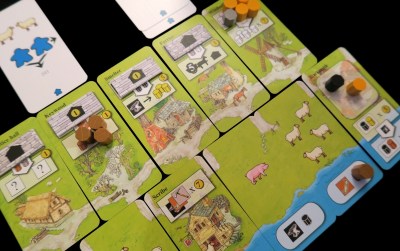
Meanwhile, Pine, Burgundy and Blue had eventually decided what to play, opting for one of the 2018 Spiel des Jahres nominees, Luxor.  This is a clever hand management and set collecting race game from Rüdiger Dorn, designer of a wide variety of games including The Traders of Genoa, Goa, Istanbul, Karuba and one of our all time favourites, Las Vegas.  These games have very little in common with each other and Luxor is different again. In this game, players exploring the temple of Luxor collecting treasure as they go.  Players start with two “Indiana-Jones-eeples” and move them round the board by playing cards from their hand.  The clever part of this is that players have a hand of five cards, but like Bohnanza, must not rearrange the order.

Luxor
– Image by boardGOATS

On their turn, the active player can play one of the cards at either end of their hand, i.e. the first or last card.  They use this to move one of their meeples, along the twisting corridor towards the tomb at the centre of the temple.  If they can, they carry out an action based on the space they land on, then replenish their hand from the draw deck, adding the card to the middle of their hand.  This hand-management mechanism is one of several clever little touches that elevate this game beyond the routine.  Another is the movement mechanism:  players move, not from space to space but from tile to tile.  Some of the tiles are in place throughout the game, but when a player claims a treasure tile, these are taken from the board into the player’s stash.  This therefore provides a catch-up mechanism as the path to the tomb effectively gets shorter as the game progresses.

Luxor
– Image by boardGOATS

Players can claim treasure tiles when they have enough of their “Indiana-Jones-eeples” on the tile.  Each tile gives points individually, but there are three different types of treasure and players score points for sets; the larger the set, the more points they score at the end of the game.  Treasures aren’t the only tiles players can land on though.  There are also “Horus” tiles (which allow players to add more interesting cards to their hands or take key tokens), Osiris tiles (which move players forward) and Temple tiles (which give players a special bonus).  These non-treasure tiles are never removed providing stepping stones as the treasure tiles disappear.

Luxor
– Image by boardGOATS

Players strive to be the first to enter the temple chamber which will win them one of the two sarcophagi.  When the second player enters the temple chamber, they win the second of the sarcophagi and trigger the end of the game with play continuing to the end of the round before scoring.  There is a smorgasbord of points available with players scoring for how far their meeples have made it towards the temple, for scarabs they may have collected en route, and any left over keys or sarcophagi they have, as well as for the sets of treasure they collected.  The balance of these points change dramatically with player count – with two, treasure is everything, but with more, there is increased competition.
Luxor
– Image by boardGOATS

Burgundy shot out of the blocks like a hare, with Blue and Pine doing their best to try and follow.  Burgundy had got a set of three necklaces before Pine had managed a single treasure and despite the fact that the game was hardly started, he was already hoping that “slow and steady” might win the race.  It wasn’t long before Blue collected a few jewelled statues and Pin had a couple of fine vases, and finally the treasure hunt was on its way.  Burgundy’s “Indiana-Jones-eeples” were stealing a march  and making rapid progress, while Blue had managed to get one left one behind.  Despite the built-in catch-up mechanisms, it seemed there was little Blue or Pine could do to arrest the inexorable march of Burgundy.

Luxor
– Image by boardGOATS

Eventually, Blue sent a scout in ahead, and she was the first to enter the temple chamber, picking up the first sarcophagus.  It wasn’t long before Burgundy followed though taking the second and triggering the end game.  Blue and Pine tried to make as much as they could out of their last turns, but it was too little too late.  Each treasure token comes with a small number of points which are supposed to be scored when the treasure is collected.  Previous experience suggests players are so excited at finding treasure that they forget to collect these points, so we added a house-rule, and saved collecting these until the end of the game.  Since the points are similar in value, they give a rough idea of how players stand.  It was only when these were counted that Blue and Pine realised just how far behind they really were, with Burgundy taking forty-one compared with Pine’s twenty-eight and Blue’s twenty-two.
Luxor
– Image by boardGOATS

From there matters only got worse.  Burgundy’s “Indiana-Jones-eeples had made it further into the temple than anyone else’s and he had larger treasure sets too.  His final score was a massive one hundred and eighty-three, nearly fifty more than Blue and seventy-five more than Pine.  It’s all about getting the right cards Burgundy explained as the group tidied up.  “Mmmm, I had the right cards, just not in the right order,” muttered Pine in response, a comment that pretty much summed up the entire game.  It was much, much later however, that we realised we’d got the scoring very wrong.  Players are supposed to score for the number of complete sets of three treasures, rather than for the the magnitude of each set.  While this would have made a huge difference to the game of course, it probably would not have changed the overall outcome as Burgundy was in total control throughout.  Nevertheless, we should give it another try soon, this time with the correct rules…

Luxor
– Image by boardGOATS

With both games finishing pretty much simultaneously,the question was what to play next.  Mulberry and Maroon went home to nurse their jet-lag taking Red with them, leaving six.  Pine said he would stay for something short (and short didn’t include Bohnanza), but would be happy to watch if others wanted to play something longer; Green said he could also do with an early night and didn’t mind watching either.  Inevitably, that created indecision and it was only when Green decided to go and Pine started a two minute countdown that Blue eventually made a decision and got out No Thanks!.

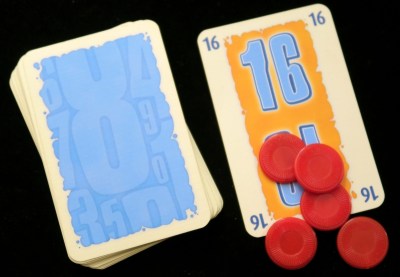
No Thanks!
– Image by boardGOATS

No Thanks! is one of our oldest, “most favourite-est” games that we’ve sort -of rediscovered, giving it a few outings recently; as Blue shuffled she considered how clear and simple the cards were, and how well they were holding up given their age.  The game is very simple too:  the first player turns over the top card and chooses to either take it or pay a red chip and pass the problem on to the next person.  The player with the lowest total face value of cards is the winner.  There are two catches, the first is that when there is a run, only the lowest card counts, and the second is that nine cards are removed from the deck of thirty-four before the game starts.

No Thanks!
– Image by boardGOATS

Burgundy, Purple, Pine and Blue were in the business of collecting cards hoping to build substantial runs.  It was just as the game was coming to a close that Pine collected a card and a handful of chips fumbling as he did so and thought he’d dropped one.  He was sat on a bench between Black and Burgundy, so rather than disturbing everyone immediately, there were only a couple of cards left so he decided to leave finding it until the end of the game.  Blue and Pine fared better in their card-collecting than Burgundy and Purple, but Black had kept his head down and finished with just one run and with it the lowest score,  We recounted all the chips a couple of times and there was definitely one missing, sop as Blue packed away everyone else started playing Hunt the Game Piece.  It’s not often that we play this, but, we have had a couple of epic games, including one where a token ended up some thirty feet from where we were playing and the other side of a pillar.  This edition, the “No Thanks! Red Chip Version”, was particularly special.

No Thanks!
– Image by boardGOATS

After about five minutes hunting, one of the bar-staff asked, “Oh, what are you looking for?” and then added, “I love it when you play this!” and joined in.  Fifteen minutes later, there was still no sign despite looking in lots of nooks and crannies, checking trouser turn-ups and shoes, and emptying all the bags in close proximity.  Then Purple said, “I can see something red down here…” as she shone the light from her mobile phone between the cracks in the floor-boards.  And there indeed, nestling about half an inch below the suspended floor, only visible when the light was exactly right, was the small red chip.  It was exactly where Pine had been sitting and must have dropped straight through the gap between the floorboards and fallen over so it was lying flat, nestling in the fluff and totally inaccessible.  So Purple won, but it was Game Over for the time being.

No Thanks!
– Image by boardGOATS

Learning Outcome:  Sometimes Bohnanza is quicker than that other “short” game…

Next Meeting – 8th January 2019

Our next meeting will be on Tuesday 8th January, at the Horse and Jockey pub in Stanford-in-the-Vale.  As usual, we will be playing shorter games from 7.30pm as people arrive, until 8pm when we will start something a little longer.

This week the “Feature Game” will be Hare & Tortoise, an older game that was the first ever winner of the Spiel des Jahres award in 1979.  It is a cunningly designed race where the farther a player moves, the more fuel (carrots) they have to spend.  Thus, the winner will be the player who uses their carrots most efficiently, but they must also have got rid of any lettuce cards and make sure they don’t have a surfeit of carrots as they cross the finish line…

Hare & Tortoise
– Image by boardGOATS

And talking of the hare and the tortoise…

Jeff the hare loved running, but he also loved winning.  One sunny day, he saw a tortoise  peacefully minding his own business in a field, so he asked him if he fancied a race.  After some discussion, they eventually agreed to race to the nearest tree. It wasn’t far, but the hare was easily there first.

“Not fair!” said the tortoise, “My legs are only little and take a while to warm up, please can we try again?”

The hare had enjoyed his win, so was happy give the tortoise another chance; this time they raced to the river. The hare was off first, and again, won by a huge margin.

“Just once more, I’m sure I can do it this time,” the tortoise pleaded.
While the hare liked winning, winning is no fun without a credible challenger, but he could see it mattered to the tortoise so he reluctantly agreed.
“Oh alright then, but this will be the last one, and then I have to go home,” said the hare.
“Well, let’s just have a race to see who gets home first then,” suggested the tortoise.

The hare agreed and they got ready to race.

“3…. 2… 1… GO!” said the hare, and paused to  give the tortoise just a little head start.

The tortoise retreated into its shell.

“I win.”