Boardgames in the News: Gaming & Mental Health

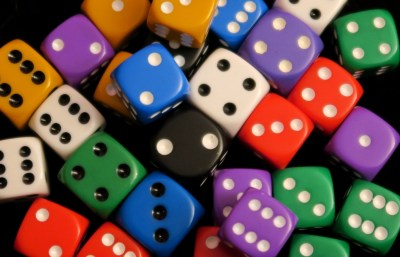
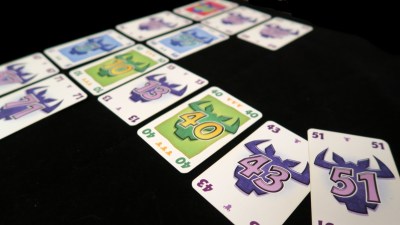
According to the World Health Organisation (WHO), one in four people in the world will be affected by mental or neurological disorders at some point in their lives and around half a billion people suffer from such conditions at any one time.  A year ago, the WHO announced their 11th International Classification of Diseases was to include the condition “gaming disorder“.  This is characterised by “increasing priority given to gaming over other activities to the extent that gaming takes precedence over other interests and daily activities, and continuation or escalation of gaming despite the occurrence of negative consequences.”  Although there is no doubt that there are some boardgamers to whom this might be applied, the WHO specifically meant “digital-gaming” or “video-gaming”; in fact, anecdotally there’s lots of evidence that boardgames can help with depression.

Asmodee
– Image from who.int

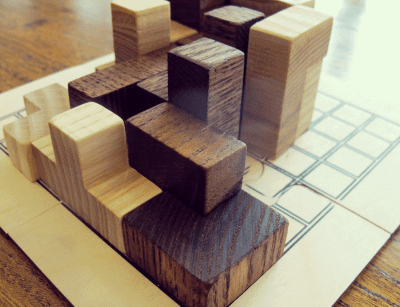
There is more evidence, indeed research by Colin Camerer, of the California Institute of Technology, suggests that when players are doing the best that they can to “win” their brains tend to show a high degree of co-ordination between the “thinking” and the “feeling” regions.  A boardgame group at a mental health recovery centre is reported to have had a positive impact on its clients, building their social and communication skills as well as their self-esteem and helping to reduce social isolation. Now, Billy Brown is taking this one step further. Billy was an agoraphobic who spent seven years in his dressing gown just sitting at his computer, only going outside for doctor’s appointments.  Now he is designing a role-playing game to help young people build their social skills.  So, it would seem that as every boardgamer knows, playing boardgames really is good for you.

– Image from bbc.co.uk

31st December 2018

The evening began with Pine’s arrival, and he helped Pink rearrange the furniture for PitchCar while Blue added the finishing touches to supper.  PitchCar is a brilliantly simple, dexterity car racing game—players take it in turns to flick their wooden cars, and the first one to get round the track three times is the winner.  Before long Burgundy, Purple and Black had arrived and pieces from the base game and five of the first six expansions were all over the place and everyone was diving in trying to make an interesting looking track.  There was a problem though, the problem we always have, which is a shortage of straight sections.  It was then that Blue produced another expansion from under the sofa:  the “Long Straights“.  These are exactly what they sound like, two, very long, plank-like, straight sections that are a pain to store and difficult to transport, so rarely get used.  They have the potential to add a very fast section to the track though, so this time we used both with a tight hairpin in between them to add interest.
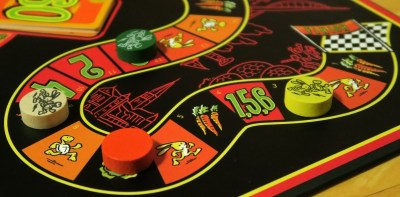
PitchCar Track 31/12/17
– Image by boardGOATS

Like last year, instead of making a circuit, we made a single long race track weaving around plates of crudites, mugs of tea, and trays of “pigs in blankets”.  There was a big debate whether to use The Cross as a cross-roads or back-to-back corners.  In the end, the double corners won, the track was complete and we had a push off to see who would start at the front of the grid.  Black won with a magnificent flick, followed closely by Purple.  Blue stalled on the grid and the only one to come off worst was Burgundy who came off the track and defaulted to the back of the grid.  The race began:  Black and Purple continued strongly and everyone else shuffled about in the middle order with Burgundy bringing up the rear.  Then Burgundy adjusted is driving style slightly and gradually began to work his way through the field.  Meanwhile the wheels dropped off for Purple who had briefly taken the lead, but suddenly seemed to lose the knack of flicking, and gradually, the rest of the pack overtook her one by one.

PitchCar
– Image by boardGOATS

Almost everyone had trouble going over the bridge, but particularly Blue, Pink and Purple.  Eventually they made it over though and shot down the rail to the hairpin some failed to make the corner, but the long straights added a bit of speed and excitement.  The tunnel ended up being a relay race with Black getting stuck under the bridge, only to be pushed out by Blue, who in turn also got stuck and was freed by Pink.  Similarly, he was freed by Burgundy and Burgundy was liberated by Pine.  And that order was maintained all the way to the finishing line, despite Blue needing several shots at crossing it without overshooting.  Green and his lady-friend, Lilac, had been held up though were expected any second; food wasn’t quite ready either so we ran the race in reverse starting with Purple, the last player to cross the line in  the first race.
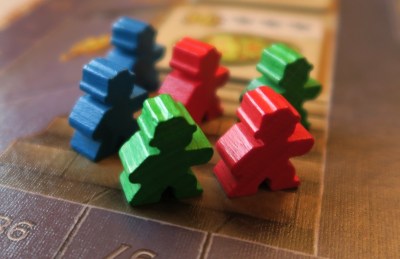
PitchCar
– Image by boardGOATS

Inevitably, we’d only just started when Green and Lilac arrived, so they just joined in.  In fact by this time, Blue had actually managed to go backwards and was further behind the line than others were in front of it.  With the larger pack, this time round the race was even more eventful with Black managing to park his car in a plate of crudites just missing a bowl of salsa and Pink repeatedly bouncing off the edge of the mouth of the tunnel obstructing everyone else behind him.  Bizarrely, although the tunnel caused mayhem, the bridge was much less of a problem this time though with Pine leading the way by deftly bunny-hopping over it and almost everyone else just following his example.  Leading over the bridge was a huge advantage, and though Blue threatened to catch him, he maintained his position to the finish.  With food ready and waiting, the track was progressively dismantled as those bringing up the rear made their way to the finish line.  Although it only gets an outing two or three times a year, PitchCar is always great fun and the seventh expansion, “The Loop” which is due in the new year, looks like it will add even more madness to the game.

PitchCar
– Image by boardGOATS

With PitchCar over and the track in a heap in the corner, food swiftly appeared in the guise of enchiladas with corn on the cob, nachos and some strange yellow, habanero salsa that reminded Pine of wallpaper paste.  Supper was accompanied by more special crackers, little parcels, Herb Alpert and the Tujuana Brass, and finished with ice cream, and then it was on with the games; after a little debate first up was Ca$h ‘n Guns.  This is push your luck game with a gangster theme played over a series of eight multi-player duels over their ill-gotten spoils.  The player with the largest haul after eight rounds is the winner, as long as they are still alive of course.  Each player has a character standee, a foam gun, and a clip of three bullet cards and eight blank cards.

Ca$h 'n Guns
– Image by boardGOATS

At the start of each round, everyone simultaneously chooses a whether to “load” their gun with a bullet or a blank, and on the count of three, points it at one of the other players.  On a second count of three, they choose whether to remain in, or withdraw taking their shot with them.  Anyone whose target is still standing reveals whether their gun was loaded with a live bullet or a blank.  Anyone who received a shot takes a plaster signifying their wound and is out of the rest of the round; three wounds and they are eliminated from the game.  All players remaining then take it in turns to take a loot card from the centre of the table—there are eight cards, so the number of cards each player gets depends on how many players have survived the “duel”.

Ca$h 'n Guns
– Image by boardGOATS

The game can be quite brutal, and this was no exception, indeed, Black was out in the second round and Green quickly followed.  Pine pointed out that everyone on his side of the table had been injured while Blue, Pink and Burgundy were all uninjured.  Purple decided to fix that and faced off with Burgundy, both ending up injured as a result.  Lilac proved a dangerous adversary as she collected extra bullets from the loot and ended up with a full set going into the final rounds.  Blue injured Burgundy and coped a bullet in return.  After Black’s and Green’s dismissal, everyone was more circumspect and didn’t gamble as readily with their lives, so all the other players survived to the end of the game.  That just left the small matter of the scores.

Ca$h 'n Guns
– Image by boardGOATS

Pine and Purple had both been collecting gems, but had finished up with the same number so neither picked up the $60,000 bonus for having the most.  Blue had started out collecting artwork, but there wasn’t much available.  It became clear why, when the loot for the final round was revealed:  almost all of it was art.  It was tough in the final round; Blue was taken out by Burgundy, which effectively removed her from the running.  Pink had been doing well as the Godfather, but had taken a couple of hits in the latter stages and was also taken out of the final round.  Pink finished with $110,000 and second place.  The final round was attritional and there were few people left to share the swag.  Most of the artwork ended up going to Pine and with it first place overall thanks to a final total of $123,000 worth of loot.

Ca$h 'n Guns
– Image by boardGOATS

There was still time till midnight, and it was a toss-up between two of our favourite light games, 6 Nimmt! and Las Vegas, in the end we went for dice over cards and played Las Vegas.  This is a very simple game, but a lot of fun. The play area is made up of six casinos, each numbered one to six with a jackpot drawn at random from a deck of money cards.  With eight players, each jackpot totals at least $90,000 and comprises one or more notes.  On their turn, players must use all the dice of one number to bet on the casino of that number by placing them on that casino tile.  Once everyone has placed all their dice the player who placed the most dice on a casino takes the highest value currency card. The player with the most money after four rounds is the winner.  The snag is that before any money is handed out, any dice leading to a draw are removed. It is this rule that makes the game interesting, raising the decisions above the trivial.

Las Vegas
– Image by boardGOATS

We usually play with a few “House Rules”:  we replace one of each player’s dice with a big, “double weight” die from the Las Vegas Boulevard expansion; we include the Slot Machine, and only play three rounds.  The Slot Machine is a little different to the Casinos as players place all their dice of one number on the tile, but each number can only be placed once.  Unlike the Casinos, if there is a draw, then the player with the total number of pips wins, and if it’s still a tie, then the player with the highest value die wins.  The game is very robust to interruptions which is just as well as we took a break at midnight for toasts to the new year and to Ivory’s new arrival (we are looking forward to his return in March).  Prosecco and sparkling apple juice were accompanied by the village fireworks, an exceptional panettone and mince pies and eventually everyone made it back to the table and the game resumed.

Las Vegas: The Slot Machine
– Image by boardGOATS

Perhaps it was the interruptions, but Black’s game went almost as badly as it had in Ca$h ‘n Guns, and he won nothing at all in the first two rounds and not much in the third.  It turned out that Purple and Burgundy didn’t do any better as all three finished with just $100,000.  That was better than Green however, who made a paltry $20,000.  Pink started off really well, but at the start of the second round we realised he was using one more die than anyone else.  After paying a $10,000 penalty, he finished with $240,000, $10,000 more than Blue.  Lilac, on the other hand, took more in the first round than Blue or Pink took in the whole game and finished with $410,000.

Las Vegas
– Image by boardGOATS

Normally $410,000 would be more than enough to guarantee a win, but Pine, who took three $70,000 notes in the final round alone finished with a massive $510,000, a personal and probably group record.  With the game over, Green took Lilac home to nurse her sore throat and everyone else finished their drinks and chatted for a while, watching Pink and Pine demolish a bottle of Bavarian whisky picked up in Essen during the Spiel.  Everyone who had been there commented how much they had enjoyed The Gallerist at the ninth “Monster Game” session a few days earlier.  Although it had taken ages and was very complex, it wasn’t a real brain-burner and everything had been done well.  The rule book was good, the board was clearly laid out, the player-aids were helpful, the pieces were great and the box was really top quality—in fact, it was almost the complete opposite of Agra, which struggled through at the previous “Monster Games” event.  The second game, Reef, had also gone down well, but everyone was particularly keen to give The Gallerist another go.

Las Vegas
– Image by boardGOATS

Learning Outcome:  GOATS enjoy a good party just as much as the next ruminant.

Next Meeting – 31st December 2018

Following the success of last year’s New Year party, we are having another one this year be on Monday 31st December.  As it is New Year’s Eve and the pub have their own event, we will be meeting at a private house in Stanford and starting slightly earlier at 7pm with food served sometime around 8pm.  Please get in touch if you would like to come along so we know how much food will be needed.

The plan is to start off early with the “Feature Game”, which, as has become traditional, will be the gorgeous, dexterity car-racing game, PitchCar.  After that, we will be eating, pulling more crackers, popping party poppers, playing more games and maybe set off some fireworks at midnight, depending on how cold it is!

PitchCar
– Image by BGG contributor visard

And talking of cars…

A policeman sees an elderly woman driving incredibly slowly on the motorway, so he pulls along side and notices her knitting in the driver’s seat.  She remains focused on the road and keeps knitting and driving.

He beeps his horn to get her attention, but she is oblivious and carries on.

Getting more frustrated, the policeman turns his siren on and, as she finally notices him, he signals for her to wind the window down.

After a time she finds the button and down goes the window.

Incensed, the cop yells, “PULL OVER!”

“Oh, no sweetie,” she replies.  “It’s a scarf, see?”

27th December 2018 – boardGOATS do the Quiz

As we meet at The Jockey every week, for the last two years, we’ve decided to enter a team for their Quiz Night between Christmas and New Year.  Blue, Black, Purple and Pink rolled up at 7pm to give them time to play some games before food at the advertised 8pm.  They’d just started a game of くだものフレンズ aka Fruit Friends, a little card drafting and set collecting game when Pine joined them.  It’s a quick little game so, Pine perused the menu while the others finished playing.  Fruit Friends was an Essen Special, picked up by Black and Purple on the last day of the fair this year.  We played it a few weeks ago and it went down really well, so we were keen to give it another outing.  Pink and Blue had missed out on that occasion, but it’s not a complicated game as it is essentially it is Sushi Go! with a twist in the card drafting stage which is based on the “I divide, you choose” mechanism.

Fruit Friends
– Image by boardGOATS

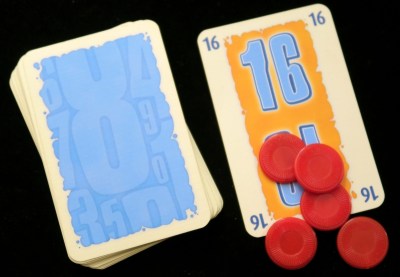
It was a really tight game with a two-way tie for second place between Blue and Pink.  Maybe it was Black’s additional experience, or perhaps he played better or was simply luckier, but he took victory by just two points with his total of sixty.  With that game concluded, but people needing time to consider their food options, we opted for a quick five-player game that everyone knows, No Thanks!.  Despite having played it before, Purple wanted a reminder of the rules:  take the card, or pay a chip to pass the problem on—the person with lowest face-value total is the winner.  The catches (which are what make the game clever of course), are that for runs, only the lowest card counts, but nine out of the thirty-three cards are removed from the deck at random adding a sense of jeopardy.

No Thanks!
– Image by boardGOATS

Perhaps Purple didn’t get the rules, or maybe it was a combination of bad luck and perhaps over-reached herself, or even an extreme gamble that didn’t pay off, but holding both the thirty and the thirty-five was always going to be a difficult gap to bridge.  Adding cards in the twenties made it even worse and despite holding almost half the chips at the end of the game she managed what was possibly an epic top-score of eighty-six—quite some distance from Blue’s winning score of sixteen.  Black who finished second with twenty points commented, “Second place is a good place to be.”  By this time food had been ordered and the question was whether there would be time to play again.  Of course, as soon as we began, inevitably food arrived, so the rest of the game was played between bites of pizza, tagliatelle and avocado salad.

No Thanks!
– Image by boardGOATS

This second game was much, much closer.  Purple got it right this time with what might otherwise have been a winning score of seven and was just pipped by Blue with six.  It wasn’t to be for either of them though, as Black managed the extremely rare feat of finishing with a negative score.  It’s not the first time we’ve seen it, but last time was a while ago, nearly two years ago in fact, when Magenta also finished with minus one.  With the game over, people focused on finishing off their food and then there was just time for a trip to the bar before the Quiz started.  We managed a satisfactory eight in the first round and full-house in the second; the picture round started well too (“We all adora Kia Ora”), but petered out towards the end.  We got all three of the anagrams (including “Frosty the Snowman” and “Puppet on a String”) and got the Who-am-I? on the third try (William Webb-Ellis) which put us in a strong position, but sadly it was not strong enough to make up for the round where we failed to get more right than wrong, and we ended up with a creditable total of fifty-seven points.  That gave us second place (“a good place to be, but not as good as first”), six points behind the winners, the team At the Bar.

Quiz December 2018
– Image by boardGOATS

After a bit of chit chat about “Monster Games” and New Year, there was still time for one more game and, since Pink had dodged Bohnanaza at the Christmas party, it was only right that he should have the chance to play it once more in 2018.  We’ve played this game loads, but although he clearly enjoys himself at the time, Pink always claims to dislike it.  This is odd as he owns more copies than anyone else including English, Spanish, German, and Dutch language copies as well as a special limited edition with “fan” artwork.  With everyone so familiar with the rules, it should have been quick to start except that the version Pink had with him was the Spanish edition.  The basic rules weren’t a problem, but the set up varies with player count and Blue’s linguistic skills were sorely tested as a result.  The game was very close with a four way tie for second place (certainly not a bad place to be).  Ironically, first place, by just one point, went to Pink, so he won’t be able to argue that he’s rubbish at Bohnanza any more.

Bohnanza
– Image by boardGOATS

Learning Outcome:  Second is a good place to be, but first place is better.

Golden GOAT Award Winners – 2018

The inaugural Golden GOAT award was announced at the boardGOATS annual “Un-Christmas Dinner”.  There was also an award acknowledging the worst game of the year, known as the “GOAT Poo” award.  The rules were quite simple, only games played at a GOATS games night in 2018 (i.e. appearing in the log book) could be nominated, and everyone got just one vote in each category.  It was clear from the audience response that many of nominees were very popular choices, including Yokohama and Keyflower: The Farmers.  A couple of games managed the feat of appearing in both lists winning the unofficial “GOAT Marmite-factor” Award, namely Endeavor and Yardmaster.  The winner of the “GOAT Poo” award was Queendomino, with one third of the group nominating it (remarkable since only four people had actually played it).  There was also a special award for “possibly the best and worst moments of the year” which went to Purple and Green’s inability to play Rock-Paper-Scissors (during Walk the Plank! a few weeks back), and Burgundy appearing as the perennial Saboteur at the end of November.  The deserving winner of the “Golden GOAT 2018”, however, was Altiplano which turned out to be a very popular choice.

Golden GOAT - 2018
– Image by boardGOATS

11th December 2018

Since this was the last meeting before Christmas, we did what we did last year and arranged to eat a little earlier so we could all share an “Un-Christmas Dinner” together, complete with festive crackers and party poppers.  Plans were nearly derailed by gridlock in Oxford that delayed Blue (and by extension the crackers, party poppers, cards and the “Feature Game”), and motorway traffic that slowed Pink in his long trip from the frozen north.  Between their arrival and food appearing, there was just time to play a little game of “Secret Christmas Cards” – the idea being that everyone got a suitably festive goaty card and a name, and write the card to that person signing it on behalf of the group.  Once we’d got over the lack of pens, the “game” seemed to go very well, though a lot of people didn’t open their card, saving the excitement for later.  Green arrived and his announcement that his divorce had come through was greeted with a round of applause.

Pizza at the Horse and Jockey
– Image from horseandjockey.org

Once the cards, pizza, “half a side of pig with egg and chips”, burgers and ice-cream had been dealt with, it was time for crackers.  We had been just about to pull them when food arrived, and knowing what was in them, Blue suggested they’d be better left till the end of the meal as people might not want cracker contents as a topping to their pizza!  It was just as well, because when everyone finally grabbed a couple of cracker ends and pulled, there was an explosion of dice, mini-meeples, wooden resources, tiny metal bells, bad jokes, party hats and festive confetti that went everywhere.  The table went from mostly ordered to complete devastation at a stroke, to which party popper detritus was quickly added.  It was immediately followed by everyone trying to work out where the bits from their cracker had ended up and as some people ferreted under the table, others began to read the jokes (which turned out to be quite repetitive).  While the table was being cleared, subject of the “Golden GOAT” award came up.  This had first been mentioned a few weeks back by Ivory who had suggested we should have a game that we’d played during the year that deserved an award (presumably he was completely unaware that “Golden Goat” is also a strain of marijuana).

"Un-Christmas Party" 2018
– Image by boardGOATS

Pine suggested that there should also be an award acknowledging the worst game of the year, which eventually became the “GOAT Poo” award.  Unfortunately there wasn’t really a plan for how to go about doing this.  In the end, Ivory and Green tore up some slips of paper and passed them round with the book so everyone could “vote”.  The rules were quite simple, only games played at a GOATS games night in 2018 (i.e. appear in the log book) could be nominated and everyone got just one vote. There was real concern that we were just going to end up with a list of different titles and two nine-way ties, but surprisingly, that did not happen.  As the votes were read out, it became clear from the appreciative noises round the table that many of the picks were very popular choices, including Yokohama and Keyflower: The Farmers.  A couple of games managed the feat of appearing in both lists winning the unofficial “GOAT Marmite-factor” Award, namely Endeavor and Yardmaster.  The winner of the “2018 Golden GOAT” however was AltiplanoQueendomino took the “GOAT Poo” award with a third of the group nominating it (remarkable since only four of the people present had actually played it).

Golden GOAT - 2018
– Image by boardGOATS

There was also a special award for “possibly the best and worst moments of the year” which went to Purple and Green’s inability to play Rock-Paper-Scissors (during Walk the Plank! a few weeks back) and Burgundy, the perennial Saboteur name last time.  Eventually, the table was cleared and the inaugural “Golden GOAT” awards had been announced, so people’s thoughts turned to playing games.  This year Ticket to Ride: Nordic Countries was a hot choice and with two copies, two games were quickly underway.  This is a variant of the very popular train game, but with a nice tight map designed specifically for two or three players and featuring a snowy festive theme.  The game play is almost exactly the same as the other versions, with players taking it turns to either draw carriage cards, or spend sets of carriage cards in appropriate colours to place plastic trains on the map.  There are a couple of things that really make the Ticket to Ride games work:  firstly, the longer the route, the more points it gets.  This often makes the longer routes very enticing, but this has to be set against the desirability of tickets (the second thing).

Ticket to Ride: Nordic Countries
– Image by boardGOATS

At the start of the game everyone chooses from a handful of ticket cards each depicting two cities and a value: players who manage to join routes together to connect the two cities get the depicted number of points at the end of the game.  The catch is that any tickets that players keep that are not completed successfully score negatively, and the swing can be quite devastating.  Ticket to Ride is a game everyone knows well and although we don’t play it often it is always enjoyable (perhaps because we don’t play it too frequently).  The familiarity means that everyone always fancies their chances at it though, which tends to make for very competitive games and the group really benefits from the variation that the different maps and versions offer.  On the first table, the game started out in much the same way as all Ticket to Ride games.  Ivory placed trains first, but Mulberry and Green followed soon after.  It wasn’t long before Ivory was drawing more ticket cards (instead of taking carriage cards or placing trains) and Green soon followed with Mulberry taking a little longer.

Ticket to Ride: Nordic Countries
– Image by boardGOATS

As is usual, the colour cards that players wanted, just seemed to refuse to come up and everyone’s individual hand of cards grew even as the board filled with more tickets taken at regular intervals.   In the early stages the trio were fairly well matched.  Green was starting to pull ahead and then for some reason abruptly stopped and his hand of cards grew and grew.  He had said that he was going for it and it would either pay off or he would lose abysmally. Mulberry and Ivory had nearly twice as many points as Green when he finally laid a train:  the nine-carriage route giving him twenty-seven points and propelling him into the lead by more than his previous deficit.  Everyone still had lots of trains left though, so the game was far from over.  Eventually, Mulberry brought the game to a sudden halt when she placed her last three trains, catching the others by surprise.

Ticket to Ride: Nordic Countries
– Image by boardGOATS

With their last turn they scrabbled for the longest route they could manage.  Since Green still had a handful of cards he was able to take a six-carriage route for a healthy fifteen points, however, that meant he had to abandon his twenty-four point ticket as he still needed two, very small routes to complete it.  The group decided to forgo recounting the points for placing trains and decided to assume they had kept on top of the scores during play.  Green was ahead in points for train placement by quite a margin, but Ivory and Mulberry had completed more tickets and Green was crippled by the forty-eight point swing caused by his incomplete ticket.  Mulberry took bonus for the the most completed tickets (by only one) and ended just one point behind Ivory.  With the score at the top so close they decided they had to double check all the scores and after a complete recount, there was a reversal and Mulberry edged Ivory out by one solitary point.

Ticket to Ride: Nordic Countries
– Image by boardGOATS

On the next table the story was a little different, with Pink, the “Prophet of Doom” goading Pine offering him advice to give in before he’d even started as he was in for a torrid time playing against Blue and Burgundy.  Pine didn’t see it like that however, and as he likes the game, he really fancied his chances.  Fortune favours the brave, and he was out of the blocks like a greyhound with a fifteen point placement in just his second turn.  From then on, it was fast and furious with players fighting to secure the routes they needed to complete their tickets.  Blue and Pine kept fairly level and began to pull away from Burgundy, but neither of them dared to get complacent as he usually has a master-plan that he’s waiting for the perfect moment to enact.

Ticket to Ride: Nordic Countries
– Image by boardGOATS

Pine drew more ticket cards and Blue followed, keeping pace every step of the way while Burgundy kept drawing carriage cards.  Eventually Blue drew ahead in the “taking tickets” race, but it was one set of tickets too far for her as she drew three moderate to high scoring cards that were all unplayable.  Fearing she’d pushed her luck one step too far, she kept the lowest scoring card (i.e. the one with the fewest negative points) and pondered her options.  Pine took tickets and it was clear he had hit a similar problem though at least two of his were playable, if difficult.  In the end, he took a twenty-one point ticket that needed a little work, giving Blue an interesting choice.  In addition to the unplayable ticket, she had one low-ish scoring ticket left that she only needed one card to complete.  She’d been waiting for that single yellow carriage for a while though and persisting could allow Pine time to complete his new ticket.

Ticket to Ride: Nordic Countries
– Image by boardGOATS

Although she didn’t know the value or difficulty of Pine’s final ticket Blue felt sure it was high scoring and that he would need a few turns to complete it.  With a large set of pink cards and not many trains left, it gave her a chance; by placing a largely arbitrary route she triggered the end of the game.  Burgundy squeaked, although it had looked for all the world like he was trying for the long route, in fact he was really hunting for a locomotive (wild) card or a single orange carriage to complete his route into Narvik (though he came very close to getting nine cards necessary for the long route by accident).  The irony was that Blue had picked up loads of locomotive cards in her hunt for the single yellow, but hadn’t wanted them and had been unable to find yellow cards because Burgundy had them all!  In his penultimate turn, Burgundy had finally drawn his last orange card enabling him to finish his final, long ticket on his very last go.  Pine on the other hand was less fortunate and fell short, taking a swing of forty-two points which more than off-set Blue’s incomplete tickets.

Ticket to Ride: Nordic Countries
– Image by boardGOATS

The group recounted the train points and found a few extra points for Blue, but it was still very close and all down to the tickets.  Blue had mostly low-scoring cards; where Pine had one fewer, they were more valuable.  In the end, Blue finished twenty-three points ahead of Pine, but she had managed to complete one extra ticket which had given her the ten point bonus – had it gone to Pine there would have been a twenty point swing and the second group might have had a recount too.  Both Ticket to Ride games finished at much the same time and while the third game was finishing off, the two groups compared notes.  It was then that the first group realised they had not played quite correctly, as there is a rules change in this version that means locomotive cards can only be used as wilds on tunnel and ferry routes, not on ordinary routes.  This explained why Green had managed to succeed at his long route when Burgundy had failed. While playing correctly would have changed the game, there was no accusation of cheating as Ivory and Mulberry who had been playing that game had played by the same rules.

Christmas Tree
– Image by boardGOATS

Meanwhile, while the two ends of the table were playing with their train-sets, the trio in the middle were decorating their Christmas Tree.  This game is a cute little card drafting game that originated in Hungary.  The game takes place over three rounds during which Christmas decoration cards are drafted. After each card is chosen, the player puts it anywhere they like on their tree.  After seven cards, the round ends and the trees are evaluated.  Decorations include gingerbread men, glass ornaments in different shapes, wrapped sweets and, of course, festive lights.  The gingerbread men have different markings on their hands and feet and the more that match the adjacent decorations, the more points they score.  Some glass ornaments and all the sweets score points directly; lights only score if both halves match.

Christmas Tree
– Image by boardGOATS

The decorations only score at the end of the game though;  objective cards are evaluated at the end of each round.  At the start of the game each player receives four objective cards and at the start of each round everyone chooses one; these are shuffled and before the round begins.  The trees are therefore evaluated at the end of each round according to these objectives.  and then decorations score at the end.  One of the things about this scoring mechanism is that it’s often not obvious who is in the lead during the game as there are so many points awarded at the end.  This game was no exception, and was ultimately very close as a result.  It is one of those games that benefits from experience, and Black and Purple’s who had both played before took first and second, in that order.

Christmas Tree
– Image by boardGOATS

There was time for something else.  Inevitably, we threatened Pink with Bohnanza (he has possibly the smallest amount of love for the game per copy owned), but it’s lack of festiveness, meant it was a hollow threat.  We still had the “Feature Game” to play anyhow, which was Giftmas at Dungeon Abbey.  This is a mad game by a local gamer and member of the Didcot Games Club, Rob Harper set in a world that is a sort of cross between Downton Abbey and the Adams Family.  The artwork is suitably gruesome, though it was very clear from the start who the Countess D’Ungeon was a caricature of!  Played over several short rounds, each player takes the role of one of the various eccentric and unpleasant family members grasping for whatever feels like the best present.  To this end, players begin with a character card and a couple of gift cards, all face down on the table in front of them.  On their turn, the active player may either swap one of their face-down cards with one elsewhere on the table, or turn a card face-up, possibly activating a special action on the gift cards.

Giftmas at Dungeon Abbey
– Image by boardGOATS

The round ends when all a player’s cards are face up at the start of their turn or a bomb is revealed, at which point everyone scores points if they have collected the gifts wanted by their characters.  With six people playing nobody had a clue what was going on and mayhem reigned.  Ivory and Pine jointly took the first round giving them a point each, but after that, the gloves were off.  Purple took one round and Pine and Ivory took another each, so it was all down to the last round.  Green had spent most of the game trying to furnish Little Eugenia with two bombs, so when Blue realised he had the cards he needed to win the round, she made it her business to try to obstruct his plans.  Needless to say he spent the round getting his cards back.  With Blue and Green playing silly beggars in the corner, everyone else fought it out, but there was nothing everyone else could do to stop Ivory taking the point he needed to win.

Giftmas at Dungeon Abbey
– Image by boardGOATS

There was still time to play something else, but nobody was really in the mood so, instead, Blue and Ivory drooled over the fabulous pink dinosaurs from Ivory’s new arrival, Dinosaur Island.  Blue had nearly KickStarted the second edition, but had withdrawn when she’d heard Ivory was already committed to the project.  Needless to say, Ivory had brought his copy to show it off at the earliest opportunity, including plastic goats as well as dinosaurs.  And of course it will undoubtedly be a “Feature Game” sometime in the new year.

Dinosaur Island
– Image by boardGOATS

Learning Outcome:  Christmas Crackers can make an awful lot of mess.

Next Meeting – 11th December 2018

Our next meeting will be on Tuesday, 11th December, at the Horse and Jockey pub in Stanford-in-the-Vale.

As this is our last meeting before Christmas
we will be meeting early at 7pm for pizzas and Christmas festivities.

This week, the “Feature Game” will be Giftmas at Dungeon Abbey followed by a range of Christmas and winter themed games like Christmas TreeSnow Tails, The Great Downhill Ski Game, Snowboard, Antarctica, Carcassonne: Winter Edition and Ticket to Ride: Nordic Countries.  Giftmas at Dungeon Abbey is a short game set in a world somewhere between Downton and The Adams Family, designed by a local gamer and member of the Didcot Games Club, Rob Harper.

Giftmas at Dungeon Abbey
– Image by boardGOATS

And speaking of Christmas…

Jeff wasn’t in a festive mood.  He was in a lot of pain, so he went to see his doctor to get the problem looked at.

“What seems to be the problem?” Jeff’s GP asked.

Jeff looked a bit shifty and uncomfortable, and not just due to his ailment.  “I’ve, er… got um…” he mumbled.

“Speak up, I can’t help you if I don’t know what’s the matter,” interrupted the doctor.

Jeff tried again, “I’ve, um…” but again his voice faded away to silence.

The doctor took pity on him and gently coaxed him on, “Is it something to do with an intimate area?  You know there’s nothing to be ashamed of, we’re all the same really.  Now what’s bothering you? You can tell me.”

Jeff took a deep breath “Doctor…” then he blurted out, “I seem to have a mince pie stuck up my bottom!”

“Oh, you’re in luck,” answered the Doctor, “I’ve got some cream for that!”

Christmas GOATS 2018 – Calendar Update

Merry Christmas!
– Image from imagefully.com

The Calendar has been updated, but here is a quick summary of the key dates for GOATS and Didcot Gamers:

Christmas 2018
Tuesday 11th December 2018
(Last normal meeting of the year)
“Un-Christmas Dinner” meeting at 7pm;
Festive and Wintery games from 8.00pm(ish) at the
Horse and Jockey pub in Stanford-in-the-Vale.
Friday 21st December 2018
(Didcot Gamers)
Games, at The Loop.
Thursday 27th December 2018
(GOATS do the Quiz)
Quiz Night at the Horse and Jockey pub
in Stanford-in-the-Vale from 9pm, with
food from 8pm.
Saturday 29th December 2018
(Monster Games)
Something longer
in the afternoon at Barney’s House.
Monday 31st December 2018
(New Year Party)
Games and food from 7pm until
the early hours at Barney’s House.
Friday 4th January 2019
(Didcot Gamers)
Games at The Loop in Didcot
(back to normal).
Tuesday 8th January 2019
(boardGOATS)
Games from 7.30pm at the Horse and Jockey pub
in Stanford-in-the-Vale (back to normal).

27th Movember 2018

With the Festive Season now apparently upon us, the pub was once again packed and food was later than usual.  For this reason, we started with a quick game of No Thanks!.  This used to be one of our “go-to” filler games, but has been somewhat neglected of late, so was surprisingly unfamiliar to some people.  It is very simple though and very easy to learn on the fly:  everyone starts with eleven red chips and the first player turns over the top card—they can take it, or pay a chip for the privilege of passing the problem on to the next player.  The player with the lowest summed card total when the deck expires is the winner.

No Thanks!
– Image used with permission of BGG contributor msaari

There are are two catches, firstly, where a player has a run of consecutive cards only the lowest is counted and secondly, a small number of cards are removed from the deck at random.  Top scorer looked to be a toss up between Blue, Red and Mulberry, but Red took the dubious honour in the end, with forty.  It was tight between Pine and Burgundy, however, both of whom had a large pile of chips and a substantial run of high cards (between them they had nearly forty of the fifty-five chips and the cards numbered twenty-eight to thirty-five).  There were only two points in it in the end and it was Pine who took the honours.

No Thanks!
– Image used with permission of
BGG contributor ronster0

The group had been just about to start playing when Black, Purple and Green had walked in.  Since No Thanks! only plays five, so pre-empting a discussion of options, Blue chucked over a copy of Dodekka which the group obligingly settled down to play.   This is another light set collecting game where the aim is to get the highest score possible from one of the five colour suits, while ideally scoring nothing in all the other suits.  Gameplay is very simple:  take the first card on display, or reveal a card from the deck and add it to the end of the row (thus “passing”).  If the sum of the cards on display now totals more than twelve, the active player must pick up all of the cards on display. When the deck runs out, the winner is the player with the highest score (the total face value of one suit minus one for each other card).  It was very close at the top, with only one point separating Black and Purple, and much to Purple’s chagrin, it was Black who came out on top.

Dodekka
– Image by boardGOATS

Just as No Thanks! was coming to an end, food arrived, along with Ivory.  Dodekka was still going, so while some munched, those remaining decided to give The Game an outing (played with a copy of The Game: Extreme, but ignoring the special symbols).  This is a surprisingly popular game within the group, which is remarkable because it is cooperative and we generally prefer competitive games.  Another simple game, the idea is that the team have a deck of cards from two to ninety-nine and they must play each card on one of four piles:  two where the card played must be higher than the top card, and two where it must be lower.  There are just three rules:  on their turn, the active player can play as many cards as they like (obeying the rules of the four piles), but must play at least two cards before replenishing their hand, and players can say anything they like but must not share “specific number information”.  Finally, there is the so-called “Backwards Rule” where players can reverse a deck as long as the card they play is exactly ten above or below the previous card played on that pile.

The Game: Extreme
– Image by boardGOATS

Red started and it quickly began to go wrong with with Pine holding a “nice mid-range hand”.  With the help of everyone else he battled through though, and it wasn’t long before he had a “nice extreme hand” while all the piles were offering “nice mid-range options”.  It perhaps wasn’t surprising with this that the group didn’t win (i.e. play all their cards onto the four decks), but given that they had such a poor run of luck, they did well to exhaust the draw deck and ultimately have only eight cards they were unable to play.  Inevitably, Dodekka finished just after The Game started, so Black, Purple and Green killed time with a quick game of Love Letter.  This is the original “micro game”, consisting of just sixteen cards.  The idea is that each player starts with a single card, draws a second card and chooses one of the pair to play.  The cards are numbered one to eight (with more of the lower numbers), and each number has an action associated with it.  The aim is to eliminate all opponents, as the last man standing is the winner.

Love Letter
– Image by boardGOATS

Rounds only take a minute or two, so elimination is not a problem.  This time, each player won a round.  So with honours even and with the other game and food coming to an end, it was sudden death.  This time it was Purple’s turn to come up trumps, taking the final hand and with it, the game.  This started a big debate as to who was going to play what.  As it was likely to be Ivory’s last chance for a meaty game for a few weeks (with Christmas and his impending arrival), the “Feature Game” was Ambition, the expansion to one of his favourite games, Roll for the Galaxy.  With Burgundy fed-up with the feeling of confusion that Roll for the Galaxy always gave him and Black feeling that he’d played it a couple of times recently, for a while it looked like it was only going to be Blue and Ivory.  Eventually Black saw sense, and Green joined in, despite the fact that he felt he’d not played the base game enough to appreciate the expansion.

Roll for the Galaxy
– Image used with permission of BGG contributor punkin312

Roll for the Galaxy is the dice game of the popular empire building card game, Race for the Galaxy.  Both suffer from the same “iconography confusion”, but that aside, neither are actually complicated games.  The idea builds on the Puerto Rico/San Juan idea of different phases or activities that only happen if or when players want them to.  Roll for the Galaxy is almost a “worker placement” game where dice are the workers and have a say in what sort of work they do with players “spending” these dice to make actions happen.  Each player starts with a dice in their cup which they roll and assign, in secret behind a screen.  When dice are used they are placed into the player’s Citizenry and it costs a dollar to move them from the citizenry to back into the cup.  Each face of the worker dice corresponds to one of the five different action phases:  Explore, Develop, Settle, Produce, Ship.  Each player uses one die, any die, to select a single phase that they want to “happen”.  All the other dice are assigned to the Phase that corresponds to the face rolled.  Any that do not correspond to the chosen phase can only be used if another player chooses those phases to happen.  Any that are used move into the player’s Citizenry, any that are not used go back into the cup.

Roll for the Galaxy
– Image used with permission of BGG contributor punkin312

As such everyone is reliant on other players to help them out and the player who best piggy-backs other players’ choices usually does well.  It is not only about second-guessing what other players are going to do though: success also requires a good strategy, a complementary tiles (Worlds), an understanding of probability, the ability to effectively manipulate the dice rolled, and a modicum of luck.  Luck is everywhere, but there are ways to mitigate its effect.  For example, in Phase I (“Explore”), players draw tiles out of a bag.  These are double-sided with one side being a Development World and the other a Production World.  These are “Built” in Phases II & III (“Develop” and “Settle”) and the cost is paid in dice, anything from one to six (with expensive Development Worlds generally partnered with cheap Production Worlds).  These tiles are drawn at random in Phase I and a side chosen and the Worlds added to the bottom of their personal Development or Settle pile as appropriate.  The top World tile is the one that will be built first and if there is not enough to complete a building, that means there will be fewer dice available for the following rounds, until it is finished.

Roll for the Galaxy
– Image used with permission of BGG contributor punkin312

This may seem very harsh, with players potentially getting stuck with a high value building and a shortage of dice so that they struggle to complete it in a timely fashion.  However, clever use of the Explore Phase can ensure that this is not a problem, despite the luck involved.  Players can discard as many tiles as they like, drawing one extra from the bag.  Thus, an early round committing lots of dice to the Explore phase can enable lots of tiles to be recycled as better ones are drawn.  Dice assigned to Phase IV (Produce) are moved to Production Worlds where they will stay until Phase V (ship) happens and that player has dice assigned to it.  In this way, dice can get “stuck” in a similar fashion to dice involved in Developing or Settling.  Thus dice management is one of the key skills to the game.  Points come from building (a building that requires five dice is generally worth five points at the end of the game); from bonus points Development buildings which give points for some particular feature (e.g. one extra point for a particular type of Production World), and from victory points generated during Phase V (Shipping) by using the “Consume” option.

Roll for the Galaxy: Ambition
– Image used with permission of BGG contributor dotKeller

The Ambition expansion doesn’t change the game very much, simply adding a very small number of Worlds, some extra Starting Worlds, some in game Objective tiles and replaces one of each player’s starting white dice with a black “Leader” die.  The first player (and only the first player) to achieve each of the objectives receives “Talent” counters; these can be treated as single-use workers or as victory points at the end of the game.  There are also orange “Entrepreneur” dice—these and the “Leader” dice have some faces with two symbols allowing players to choose which of these Phases to assign them to and giving them the magic power of automatically switching to the alternative Phase if the initial nomination does not happen.  There are a couple of other little twists, for example on some faces the second symbol is a dollar sign signifying that if the die is used for its intended Phase then the die goes back into the Cup (not into the Citizenry) after use, making it effectively free to use.

Roll for the Galaxy
– Image used with permission of BGG contributor punkin312

Ivory was fastest out of the blocks with a large amount of liquidity from his “Doomed World” that gave him $8 start up.  Furthermore, his “Alien Artefact Hunters” start-world gave him $2 each time he consumed Alien goods, and Victory points (from Consuming).  For everyone else it looked like it was going to be over before it had begun when Ivory  was the first to achieve an Objective, adding the associated Talents to his already growing pile of victory points.  Although they were a little less obvious , everyone else’s Start Worlds were quite useful too however.  Black for example received extra cash every time he developed, Green had the ability to reassign two of his white dice as Explorers or Settlers and Blue could reassign any two dice to explore.  These special abilities were slower to take effect, but gradually, these, together with the lack of production on the “Doomed World” meant the group began to haul back Ivory’s rapid head-start.

Roll for the Galaxy
– Image used with permission of BGG contributor punkin312

Blue, and to a lesser extent Green, spent a lot of time Exploring (using their special abilities), carefully choosing which Worlds to build and stacking the deck to control the order, a tactic that paid dividends later in the game.  In Blue’s case, she used the Objectives as a target and then used the Talents to finish off Worlds quickly enabling her to grab a couple from under Ivory’s nose.  Green more or less ignored the Objectives as he was too busy trying to remember how to play the base game while fiddling with his phone.  Black was less fortunate, and really struggled with the luck of the dice and found it difficult to make use of his special ability to get his engine going.  Then suddenly it looked like Ivory might end the game as the Victory Point reserve rapidly depleted.  He couldn’t make it on the first attempt though and there were a couple more things he wanted to do in any case.  In the end it was Blue who ended it—building not only her twelfth World, but also an extra one giving her a massive forty points for that alone.

Roll for the Galaxy
– Image used with permission of BGG contributor punkin312

Although Blue had a couple of Victory Point chips and a handful of Talents left over, it paled into insignificance compared with the massive pile of chips in front of Ivory—the question was whether it would be enough though.  It was very close, but Blue’s last round just tipped it in her favour and she won by five points.  With that, Ivory and Green took their leave, leaving Black and Blue to consider their options.  While they had been playing with their dice, the others had played a full four rounds of Saboteur and moved on to their next game.  Saboteur is a fun little hidden traitor game where players are either Dwarves trying to find the treasure or Saboteurs trying to stop them.  We’ve played it quite a bit and in truth it plays best with more than six players, as the number of Saboteurs varies and there is an element of doubt.  With five their can be either one or two Saboteurs, and the odds are heavily stacked against a lone Saboteur, but in favour of a pair.  Nevertheless, the group were keen to introduce Mulberry to it.

Saboteur
– Image used with permission of BGG contributor mothertruckin

It is another quite simple game:  On their turn, players can play a tunnel card onto the grid in the centre, play a special card (a broken or fixed tools card on another player or a map card to look at the destination cards), or discard a card face down and then draw a replacement.  If the Dwarves don’t get to the treasure before the cards run out, the Saboteurs win.  In the first round, Burgundy was isolated as the Saboteur and despite his best efforts, he failed to disrupt an organised team of Dwarves.  In the second round Burgundy was joined by Pine, and with two of them the odds were much better and the pair took the opportunity to prevent the Dwarf team from getting to the gold.  As a group, we normally only play a couple of rounds, but everyone wanted to see if luck would deal Burgundy a Dwarf card.  The immediate answer was no, and in the end it turned out that the third rounds was a direct replay of the second with Pine joining Burgundy on the Saboteur winning team.

Saboteur
– Image used with permission of BGG contributor mikehulsebus

By this time the group had decided they would keep playing until Burgundy wasn’t the Saboteur, and in the fourth round they finally got their way when Mulberry was a lone Saboteur.  Inevitably she failed to break the will of the “gang of four” who easily found the treasure.  Normally we don’t bother sharing out the “gold” scoring cards as it is very arbitrary who goes first and in a low number of rounds it is purely luck who wins overall which takes some of the fun out of the game.  This time though, the group played the rules as written.  With Burgundy and Pine winning two rounds and sharing the spoils two ways (instead of three) it was inevitable that they would score well.  In the end it was Pine who did lightly better, thanks to the fact he had been on the winning Dwarf team in the first round.  As Roll for the Galaxy was still going (and Red and Mulberry had gone home for an early night), the group looked round for something else to play and Purple’s beady eye lit on Steam Donkey.

Steam Donkey
– Image by boardGOATS

Steam Donkey is a card game that involves building a seaside resort consisting of a four by three grid of attraction cards. The three rows represent the different parts of the resort:  beach (yellow), town (pink) and park (green).  Similarly, the four columns correspond to the different types of building: amusements, lodgings, monuments and transport.  In order to place a feature, it must go in the correct location and must be paid for using cards of the same type, as such it has similarities with games like Race for the Galaxy and San Juan.  As players build their resort, visitors arrive at the station and come to see the attractions. Each attraction can take a certain number of visitors, which are actually a row of face down cards that are used to replenish the cards in players’ hands. Thus, on their turn players carry out one of the following actions:  choose a colour and build as many attractions in that colour as they can/want paying with other cards from their hand; choose a colour and start taking cards in that colour from the “station” (a row of face down cards), or if there are no visitors of the chosen colour (or there are no spaces for the visitors to go), they can add visitor cards to their hand and refill the station platform with four new visitors.

Steam Donkey
– Image by boardGOATS

The colour of the visitor side of cards does not reflect the colour of the attraction on the other side, however, the type of attraction is indicated.  There is a hand limit of twelve though and this can actually be quite a serious impediment for players collecting cards to build the more valuable attractions.  At the end of the game, points are scored for each unique attraction built as well as for fulfilling individual goals and bonuses depicted on players’ resort posters.  It was a long time since anyone in the group had played it, and Pine hadn’t played it at all, so it took a while to get going.  It was close at the top with Burgundy and Pine scoring pretty evenly for their buildings and taking almost exactly the same number of bonus points too.  Burgundy just had the edge however, and took the game by three points, with a grand total of seventy.

xSteam Donkey
– Image by boardGOATS

When Roll for the Galaxy finally finished and Green and Ivory left Blue and Black alone it was clear that they were going to be waiting for a while, so they looked round for something that wasn’t too long and played well with two.  In the end, they settled on Kingdomino, but decided to add the new Age of Giants expansion acquired at Essen.  Kingdomino is a tile-laying game with a couple of clever mechanics.  Players take it in turns to choose a “domino” and add it to their “Kingdom”.  The clever part of the game is that the tiles are numbered with players who choose the high numbered (and therefore more valuable) dominoes taking their turns later in the next round.  In the two player game, players get two turns per round, so their first turn can be used to try to set up the second turn.  In the two-player game, each player is building kingdoms consisting of 7×7 arrays of “squares” rather than 5×5 arrays, which makes the game much more strategic.

xKingdomino
– Image by boardGOATS

The game ends when there are no more tiles to place.  Scoring is by multiplying the number of tiles in each terrain by the number of crowns in that terrain.  Thus a moderate sized area with plenty of crowns is worth more than a large area with very few crowns.  The Age of Giants expansion doesn’t change things as much as Queendomino, which we found managed to take all the fun out of the game and add a whole load of unnecessary complexity instead.  This expansion adds a small number of tiles that feature either a Giant or a Giant’s footprints.  When a Giant Tile is drawn, a large wooden giant meeple is placed on it.  When this is taken, the Giant is taken too and is placed over one of the crowns anywhere on that player’s area.  When a footprints tile is taken, a Giant of their choice moves from their Kingdom to another player’s Kingdom.

xKingdomino: Age of Giants
– Image by BGG contributor kalchio

There are two problems with this little addition, firstly, there is a rules tweak that means five tiles are drawn in the two player game and one is discarded.  Blue and Black found that this meant they just chose not to take tiles with Giants on them except when forced to right at the end.  Secondly, even when forced to take a Giant, there was almost always somewhere it could be poked that caused minimal damage, so it wasn’t really a big issue.  This was a real shame as the Giants are lovely.  As well as adding a fifth player there is also a a small pile of bonus-point tiles; both Blue and Black really liked these as they thought that they added a nice twist.  This time, they ended up with bonus points for Sea tiles adjacent to the castle and Marsh land on the corners.  Both players tried to accommodate these, though Black did a much better job than Blue.

xKingdomino
– Image by boardGOATS

It may have been that Black was focussing too much on the bonuses however, as he ended up unable to place all his tiles.  And although he scored well on the bonuses and for Sea and Pasture, he scored very little for Woodland, Marshland and Mountains.  In contrast, while Blue completely failed to score for Pasture, she scored well in every other terrain and made a killing with her Wheat fields, giving her a total of two-hundred and thirty-three, some sixty more than Black.  With that done and the epic game of Steam Donkey finally over, there was just time to arrange some of the details for the Christmas Party nest time before everyone went home.

xKingdomino
– Image by boardGOATS

Learning Outcome:  We like simple games: they can be quick to learn, but take time to master.