UK Games Expo 2018

This weekend, 1st-3rd June, gamers will be converging on Birmingham for a three days of fun and games for the UK Games Expo (sometimes known as UKGE, or simply Expo).  The event has a very different feel to Essen in October, as it is focussed on gamers playing games rather than publishers selling new games.  In addition to Euro Games, there are lots of role/cos players, miniatures games, and war games, with tournaments as well as plenty of “open gaming” space, talks and play testing.  The event is now in its twelfth year and every year is bigger than the last: this year it will be occupying three halls in the of the NEC as well as the NEC Hilton Metropole.  Several of the GOATS are planning to go this year, some for just a day, others for the duration, and it is certain that it will be a fun weekend.

UKGE 2018
– Image from
ukgamesexpo.co.uk

Next Meeting – 29th May 2018

Our next meeting will be on Tuesday, 29th May, at the Horse and Jockey pub in Stanford-in-the-Vale.  As usual, we will be playing shorter games from 7.30pm as people arrive, until 8pm when we will start something a little longer.

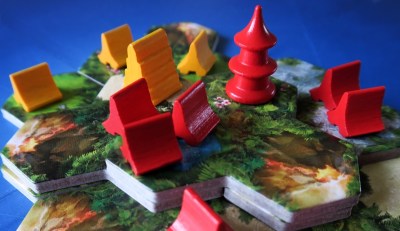
This week, the “Feature Game” will be Taluva with the Extension, a tile laying and area control game where players attempt to successfully settle a South Sea island slowly emerging from the ocean waters as volcano after volcano erupts.  Players take it in turns to first place a tile, and then place a hut, temple, tower or sailing boat.  Winning is unusual as it is the player who’s placed most temples wins with ties broken by towers, then boats, then huts.

Taluva
– Image used with permission of BGG contributor punkin312

And speaking of volcanoes…

Most volcanoes, like mountains, get their names from the surname of the first person who reaches the top of them. One exception is Iceland’s infamous Eyjafjallajokull, which got its name from the last words uttered by the first person to fall into it…


15th May 2018

As Blue and Burgundy finished their dinner, everyone else arrived and we began the “Who wants to Play What” debate, and particularly, the “Who wants to play the “Feature Game” tonight” discussion.  The “Feature Game” was to be Caverna: The Cave Farmers, a game that is so similar to Agricola, that it is often referred to as “Agricola 2.0”.  In Agricola, the idea of the game is that players start with two farmers, a large field and a wooden hut and try to build a farm, by planting wheat and vegetables, buying and breeding animals, extending and upgrading their hut, and expanding their family.  It is a worker placement game which takes place over a set number of rounds and in each one, each family member takes one action.  The actions that are available are very limited at first, but more are added as the game progresses.

Caverna: The Cave Farmers
– Image by BGG contributor MisterC

There are three main differences between the Caverna and Agricola, and the first (and most obvious) is the theme.  Instead for medieval farmers, players are dwarves living in the mountains, building a dwarfish community with dogs and donkeys.  This means players are developing their cave system (rather than their hut) and cultivating forest land rather than pasture.  The game play is very similar though with players taking it in turns to place one of the dwarves from their community on one of the action spaces and then carrying out that action.  Again during the game, the number of actions available increases.  Many of the actions are different though as players cultivate the forest in front of their cave and dig into the mountain, furnishing caves for their clan as well as mining for ore or ruby.  This leads to another obvious differences:  Expeditions.  In order to go on expeditions dwarves need ore to forge weapons, and the better armed the dwarf, the more exciting the adventures they can go on and the better the rewards.

Caverna: The Cave Farmers
– Image by BGG contributor saksi

These features are largely cosmetic though, and the real differences are in the game play.  In the advanced game of Agricola, each player is dealt a hand of fourteen cards at the start, which are used to add variety and interest to the game.  There are hundreds of possible cards available and players can either choose from their starting hand, or to make the game fairer, they can be drafted.  The problem with this is that for players who are unfamiliar with the game, choosing which cards might be useful or will work together is a very painful process.  In Caverna, the depth is introduced by the addition of forty-eight different buildings tiles which laid out so players can see what the options are throughout the game.  Critically, there is one set of tiles and they are all used in the advanced game.  This means Caverna doesn’t have the infinite variety of Agricola, but the buildings deliver a more balanced game with a lot of options that are available every time.

Caverna: The Cave Farmers
– Image by BGG contributor saksi

The games also feel very different:  with Agricola the game is always a struggle, with players fighting to balance feeding the family and developing the farm.  At the end of the game, a large proportion of players scores come from fulfilling a checklist of animals and vegetables.  This means that there are one or two main strategies and successful players are generally those who are most efficient in these. In Caverna, there is more variety in the strategies available, but without the feeding mechanism and associated peril of starvation, there is a lot less stress in the game.  All in all, it is generally a lot easier to build a productive engine and more difficult to make a total mess of it in Caverna, while still providing a lot of the same sort of challenges.

Caverna: The Cave Farmers
– Image by BGG contributor haslo

Both Agricola and Caverna take up a lot of table space and a while to set up. As Ivory had never played it before, and even Burgundy, Magenta and Green had not played it in nearly four years, we decided to play the introductory game.  It turned out that this was just as well, as it still took the best part of three hours to play.  By random selection Burgundy got to go first and effectively choose his own strategy, while Green went last and was more or less forced to let his strategy be dictated by what was left over.  The first few turns were the inevitable resource grab—anything and everything that players could get hold of.  Being a cave based game, stone and ore were particularly popular to such an extent that Green found he was struggling to get any by the time his turn came round, which pushed him towards a more Agricola-style farming strategy.

Caverna: The Cave Farmers
– Image by BGG contributor haslo

Although Magenta had played Caverna once before she had little recollection of it as it had been at 3am one Christmas Holiday.  As a result, the game was all a bit of a mystery at the start.  Nevertheless, she got into sheep farming early, but did not neglect her mountain either, regularly chipping away giving her ample opportunities for rooms and mines.  She was struggling outside though:  she managed to get some more animals, but couldn’t get the pastures to keep them in, and without crops she was constantly struggling for food.  She was able to build an oven, but this meant that as fast as her flock grew she had to slaughter them to keep her hungry dwarves fed.  With her lack of outdoor enclosures though, this might actually have been a help.  In the end, it was her mining and interiors that helped give her the best scores and she did eventually manage to cover her whole player board by the end of the game to avoid negative points.

Caverna: The Cave Farmers
– Image by BGG contributor haslo

Ivory and Green were the first to grow their families and, fed up with being last in the turn order, Green used his larger family to good effect and nabbed the start player marker. So the very next turn he was able to grab a wheat and veg while planting a field and pasture at the same time.  Then, with his second dwarf he immediately planted another field and pasture to plant that self same wheat and veg, and thus started his crops growing. He then supplemented this with an improvement tile which enabled him to convert a wheat and a veg into five food which meant he was never short of food to feed his family and was free to expand whenever he was able to mine the mountain and build extra rooms. With crops aplenty, he then set about acquiring animals and fencing in fields, leaving his mining for the last few turns in a frantic dash to increase his final score.

Caverna: The Cave Farmers
– Image by BGG contributor saksi

Burgundy and Ivory, both decided to bet heavily on arming their dwarves and sending them on expeditions to bring back lots of exciting goodies. Several times, Ivory exchanged a precious ruby to play his fighting dwarf out of turn and grab the four-goods expedition before Burgundy could. This strategy served them both well, especially as they were able to keep mining in order to locate more and more ore to help weaponise more dwarves.   Burgundy held on to his gems and managed to build a special room to help them score him more points. He also managed to also cover his whole area and “discovered” two ruby mines.  Ivory neglected his farming and failed to plant anything till right at the end of the game.  Ultimately, that counted against him as he was left him with empty spaces that lost him six points.

Caverna: The Cave Farmers
– Image by BGG contributor saksi

The last two harvests were both interrupted by the special tiles which caused everyone a few problems and in the end it was really quite close. It was Burgundy who took the glory though, a handful of points ahead of Green who was a single point ahead of Ivory.  It was a good game though and everyone enjoyed it—Burgundy professed to prefer it over Agricola too, a game where he reckons he always struggles to do well in.  Meanwhile, the next table started with a big debate about what to play.  Several games were considered, but Black made the mistake of mentioning Keyflower, which is one of Blue’s favourites and thereafter, there was only one game she wanted to play.  Other games were suggested, but for the most part, there was a good reason why these were not ideal, and, in the end, Black pointed out Blue’s interest in Keyflower, and everyone else agreed to play it.

Keyflower
– Image by boardGOATS

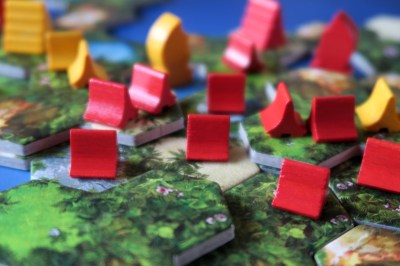
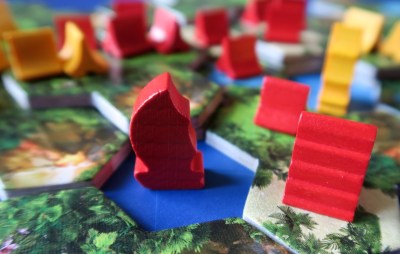
Everyone had played the game before, but it was a while ago and Pine had little recollection, so a rules run-through was necessary first.  The rules of the game are not terribly difficult to understand, but combine to make a complex game.  Played over four rounds (or Seasons), players bid on hexagonal tiles which are added to the winners’ village at the end of the round.  Bidding is carried out with coloured meeples (or Keyples as they are known in this game), and counter-bids must follow colour, usually red, blue or yellow.  Most tiles are action spaces, so as well as currency for bidding, Keyples can also be used to activate spaces.  Any space can be activated at any time by any player when they place one of their Keyples on a tile, any tile, one in their own village, one in someone else’s, one still being auctioned.  At the end of the round, Keyples used in winning bids are lost, while those involved in losing bids return to their owners and any used to activate tiles are adopted by the tile owners.

Keyflower
– Image used with permission of
BGG contributor punkin312

Essentially, that is really all there is to the game, but there are lots of consequences of this simple mechanism and a lot of complexity underlies what players can do with the actions on the tiles.  In Spring, most of the tiles available provide resources of some description, in Summer there are more advanced resource and related tiles, while in Autumn the first of the scoring tiles arrive.  The majority of the scoring comes from the Winter tiles though, and these are selected by the players, who are dealt a small number at the start of the game and choose which to introduce at the start of the final round.  This is particularly clever as it provides players with possible strategies if they choose to follow them.  Invariably, though, the best laid plans go completely awry and players are left choosing which of their tiles will be the least useful to their opponents and hope that others will be forced to play something more helpful.

Keyflower
– Image used with permission of BGG contributor punkin312

Once we’d run through the rules, we laid out the Spring tiles and began.  Keyflower plays two to six players and unusually, it plays well acrioss the whole range, but is different at each number due to the fact that different numbers of tiles are used during the game.  With two players nearly half the possible tiles are removed from play, so the game becomes very tactical rewarding players who can keep their options open and change their plans like a politician changes policy, when they find the tiles they need are not available.  With six players, all the tiles are available, however, with so many opponents lots of competition is guaranteed.  Black pointed out that Keyflower is particurly good with four though as almost all tiles are in play, and there is lots of competition as well.

Keyflower
– Image used with permission of BGG contributor punkin312

There are other consequences of changes in player number.  For example, at the start of each Season, ships arrive delivering Keyples and Skill tiles; players bid to have first choice of these.  The number of arrivals is dependent on the number of players, however, no matter how many arrive it is never enough, worse, as the game year progresses the number of Keyples arriving steadily decreases.  This is because players are spending less on buying tiles and instead are reusing workers that have been activating tiles.  Regardless, having a means to get extra Keyples is invaluable and it was with this in mind that Black began bidding for the Ale House.  This tile generates another Keyple, each time it is activated, two once it has been upgraded.  Largely on the principle that if someone else wants something, they should not be allowed to have it, Blue started a bidding war.

Keyflower
– Image used with permission of BGG contributor punkin312

Unfortunately for her, Blue won, but at a cost.  This was very much counter to her usual strategy, as she usually avoids overpaying at all costs, often leaving her with the fewest tiles at the end of Spring, sometimes none at all.  Pine on the other hand, fancied the Pedlar, a tile that turned yellow Keyples into green ones, and green ones are Special.  Green Keyples behave in exactly the same way as red, yellow and blue Keyples, except there are none in the game at the start so their extreme scarcity means they are very powerful, especially when bidding. Pine also went for gold and Purple took the Keywood, which gave her substantial wood producing capability and the Workshop which allowed her to produce any resources she wanted.

Keyflower
– Image used with permission of BGG contributor punkin312

Summer and Autumn proceeded in a similar fashion, except that everyone started out much more careful with their Keyples, which meant everyone ended Summer with lots of stuff they didn’t want.  Black finally got his Keyple generating tile when he took the Brewer, however, that needed Skill Tiles and he didn’t have a source of them.  Blue was worse off finishing Summer with a random assortment of boat tiles she didn’t really need.  Pine and Purple did slightly better, taking tiles that convert Skills into resources and transport/upgrade tiles and adding to their gold producing ability.  Autumn saw the advent of round two of the bidding war when Blue started bidding for the Sculptor and Sawmill and Black decided to join in.  It ended with honours even, but there was more to follow.

Keyflower
– Image used with permission of BGG contributor punkin312

In the final round, some of the strategies became clearer, when the Jeweler, Craftsman’s Guild and the Windmill appeared.  Everyone was hustling for the tiles they wanted, trying to maximise their points for the end of the game.  It was then that Black finally finished the bidding war, taking the Sea Breese boat tile, which gave him only one point, but cost Blue nearly twenty points.  Pine who had struggled throughout the game suddenly found he had lots of points, sixty in total, just two behind Black who finished in first place, thanks largely to the vast number of Keyples he finished with.  On the next table, Caverna still had some way to go and there was still time for one more game, so Pine dipped into Burgundy’s back and brought out Splendor—at least with Burgundy occupied elsewhere, everyone else had a chance of winning for a change…

Splendor
– Image used with permission of boardgamephotos

We’ve played Splendor a lot within the group, an awful lot, and have just begun exploring the Cities of Splendor expansion, but after the last game, everyone wanted something they were very familiar with, so we stuck to the base game.  And it is a simple game of chip collecting and engine-building with a very loose gemstone theme. Basically, on their turn, players can take gemstone poker chips, or use chips to buy a card. Some cards have points on them and all can be used like the poker chips to buy cards (but without having to return them). The cards also give players access to “Noble tiles” which also give points. The winner is the player with the most points after someone reaches fifteen points.

Splendor
– Image used with permission of boardgamephotos

The game play was very unusual this time, because the black Opals came out very late, and on the odd occasion that they did appear Blue pounced on them and immediately reserved them.  This had two effects as it both prevented anyone else from getting them and also ensured that she had a plan each time she had to pick up gemstone poker chips.  The problem was made worse by the fact that three of the Nobles required Opals.  With the strangle-hold she had on the game, it was not surprising that she was the only one to get any Nobles and quickly brought the game to an end finishing with eighteen points, well clear of Pine in second place.

Splendor
– Image used with permission of boardgamephotos

Learning Outcome:  Sometimes winning a bid can be worse than losing.

Next Meeting – 15th May 2018

Our next meeting will be on Tuesday, 15th May, at the Horse and Jockey pub in Stanford-in-the-Vale.  As usual, we will be playing shorter games from 7.30pm as people arrive, until 8pm when we will start something a little longer.

This week, the “Feature Game” will be Caverna: The Cave Farmers, a worker placement game that reimplements the game Agricola.  Players take on the role of the bearded leader of a small dwarf family that lives in a little cave in the mountains. Everyone begins the game with a farmer and his spouse, and each member of the farming family represents an action that the player can take each turn. The families cultivate the forest in front of their cave and dig deeper into the mountain, furnishing the caves as dwellings, as well as working spaces for small enterprises.

Caverna: The Cave Farmers
– Image by BGG contributor saksi

And speaking of dwarves…

Jeff was walking through town late one evening when he bumped into a dwarf.  He didn’t see the diminutive chap, and stepped very heavily on his foot and snagged his belt buckle in his beard and knocked off his hat.

The dwarf hopped up and down cursing under his breath and, after extricating himself and picking up his hat, eventually yelled, “I really ain’t happy!”

Jeff replied, “Oh,” he said, “So which dwarf are you then?”

1st May 2018

When we played Mini Park a couple of weeks ago, we had all found it a little underwhelming.  At the time we had felt it might be better with fewer people, so as it was a very short game, while we were waiting for food to arrive, we decided to give it another try. The game is a hexagonal tile-laying game where players choose one character which dictates the end game scoring.  We played the “advanced” game which has slight changes to the scoring and pairs each scoring character at random with a second character.  The latest version of the rules suggest that these subsidiary characters should be kept secret, but we felt that would make things a little bit too random.  We did adopt the simpler in-game scoring though.

Mini Park
– Image by boardGOATS

This time there were only three players, so everyone got two characters instead of one:  Burgundy took the people (Man and Child); Blue took the wildlife (Fish and Bird), and Magenta got everything else (Cyclist and Cat).  Unquestionably it was better this time round.  The Fish was still very powerful, but this time it was largely luck of the draw as Blue took it early and then managed to draw lots of pond tiles, netting her a massive forty-five points, with Magenta getting twenty-two.  The Cyclist was a lot less powerful this time though, and combinations of main character and subsidiary had a much stronger effect as well.  For example, while Blue had two of the strongest main characters, her subsidiaries were the weakest; on the other hand, Magenta and Burgundy had a much more even distribution of points across the board.  The end score was much closer this time, and despite the obvious high Fish score, it wasn’t the foregone conclusion of last time.  Nevertheless, wildlife won in the end with Blue finishing on eighty-six, ten ahead of Magenta in second place.

Mini Park
– Image by boardGOATS

With Mini Park and food over, it was time to play something more serious, and we moved on to the “Feature Game”, Lords of Xidit.  This is a reimplementation of the simultaneous programming game, Himalaya, which has a very unusual scoring mechanism.  The game is set in the fantasy land of Xidit, which is under attack.  The last hope for restoring peace lies with the Kingdom’s noble heirs, the Idrakys, who must travel the Kingdom recruiting brave soldiers and restoring the threatened cities.  The game board is a map of Xidit, depicting the cities, on which double-sided tiles are placed, showing either recruitment or threats.  The game is played over twelve years with each year consisting of players giving their Idrakys six secret orders using a special player board, and then executing them in order.  There are three possible orders for the Idrakys:  moving along one of the three road types; in a city, either recruit a Unit or eliminate a threat (depending which side the tile is showing); or wait.

Lords of Xidit
– Image used with permission of BGG contributor punkin312

The catch is that if the action is possible, it must be carried out, so if the order is move along a green road, that is what it must do.  Similarly, if a player’s Idrakys is in a city where the tile is recruitment face up, they must recruit a Unit.  The Units come in five different types, in order of increasing power: Peasant Militia; Archers; Infantry; Clerics, and Battle Mages which are orange, green, grey, white and purple respectively.  When the city tiles are Recruitment side up, they hold five Units, in predetermined colours, and when recruiting, players can only take one Unit and it must be the least powerful available.  These Units can then be used to defeat a Threats in exchange for Gold Sovereigns, placing their Bards or add Stories to the city’s Sorcerers’ Guild Tower if it is their own.  When a Threat or Recruitment tile is removed, another is drawn from the respective stack and placed on the appropriate city.  If there are insufficient tiles in the Treat stack, then the Titan tiles are turned over, to the Raging Titan’s side—these are super-aggressive Threats that are not associated with a city and can be eliminated in a similar way to other Threats.

Lords of Xidit
– Image used with permission of boargamephotos

At the end of the fourth, eighth and final (twelfth) year, there is a Military census where, beginning with the Peasant Militia (and continuing with the others in turn), players secretly hold a number of Units in their hands before a simultaneous reveal.  The player with the most of Units receive a reward; players are not obliged to reveal all their Units of that type, indeed, bluffing can be a good idea when trying to mislead players at the end of the game.  This is because the final census is followed by a series of assessments, where the weakest player in each one is eliminated until one player is left.  Each assessment ranks the players based on either their Wealth, their level of Influence with the magical community, or their Reputation across the Kingdom.  The last player remaining at the end of the assessment stage is the winner.

Lords of Xidit
– Image used with permission of BGG contributor punkin312

The game looks complicated, but was actually surprisingly easy as long as the Threat/Recruitment piles are managed effectively.  Game play is also very quick, much to everyone’s surprise: it never took too long to work out what the six actions were going to be and even when someone took a bit longer than usual it was never excessive.  Carrying out the actions was very quick too—players barely had time after completing one action before it was time for the next.  As such this game does not suffer from “Analysis Paralysis” and there never seemed to be any down time, unusual for a game like this and a welcome change.  The other curiosity was that even though there is never anything hidden (although items are hidden behind a players screen, they are collected in the open, so it is entirely possible for players to keep track of how each other are doing) no-one had any real idea of who was actually winning.

Lords of Xidit
– Image used with permission of BGG contributor punkin312

There were the occasional blunders as someone miscalculated and carried out the wrong action (such as going to a city to recruit just after someone took the last unit), or as in the case of Pine towards the end, looking at the wrong Idrakys counter when working out route and actions for the turn.  On the whole though, everyone was were able to plan the sequence of commands each “year” without difficulty.  The key to this game, however, is probably keeping a close eye on which Threat/Recruitment tiles are due to come out in the next couple of turns to try to plan an efficient route and arrive at the right city at the right time.

Lords of Xidit
– Image used with permission of BGG contributor punkin312

The unique elimination based scoring system worked well, keeping everyone guessing who would win right to the end. By the end of the game, Green and Black had both managed to build all their towers (the final round of elimination scoring), while Pine had the least. The Bard tokens (the penultimate elimination round) seemed relatively close, but Burgundy and Pine had both been fighting over the hidden central citadel so that outcome was unknown.  Before these two assessments could be addressed, players have to survive the elimination round for gold coins, and these are hidden.  Green had got off to a good start and gained a lot of gold at the beginning of the game; given his strong position in with respect to towers and bard tokens on the board he looked like the front runner. Unfortunately, he had neglected to collect gold later in the game and ended up with the least, just one less than Black, so was out in the first elimination round.

Lords of Xidit
– Image used with permission of BGG contributor duchamp

Then there was a discussion as to whether Green’s Bard tokens should be taken off the board and disregarded now he had been eliminated.  The answer didn’t seem to be in the rules, but it was at that point that we realised we should have scored everything first and then gone through the elimination checks so Green’s bard tokens remained.  Towards the end of the game, there had been a flurry players placing Bard tokens and, as a result Green again had the lowest Bard score, but since he had already been eliminated, Black was the next to go, leaving only Pine and Burgundy in the Sorcerers’ Guild Tower elimination round.  We knew that Black and Green had the most, but as they had both been eliminated it the best of the rest, and that was Burgundy. This was a surprise to everyone as he and Pine would have been knocked out much earlier, demonstrating that playing to win (i.e. concentrating on the final elimination) is not the way to play this game.

Lords of Xidit
– Image by BGG contributor JackyTheRipper

Overall everyone really enjoyed it:  it was fast, fun and there were a few surprises too. Nobody of us felt it was award-winning, but it was certainly one we would play again, and probably more than once.  Meanwhile, on the neighbouring table, everyone else was playing Castles of Mad King Ludwig, a tile laying game where players are building an extravagant castle for King Ludwig II of Bavaria, one room at a time.  Rooms selected randomly are sold off in batches with one player, the Master Builder, setting the prices for each room in the batch.  Payment is made to the Master Builder (similar to the auctions in Goa), but as they are the last player to buy, there is a large element of “I divide, you choose” (similar to games like …Aber Bitte Mit Sahne).  Thus, the idea is that the Master Builder wants to arrange the tiles such that rooms desired by the other players are expensive, but generally not too expensive, and similar to Goa, having a lot of money is powerful, but when you spend it, you give that advantage to the active player.  The other interesting mechanism is controlling the room layout so that rooms that work well together are daisy-chained yielding the most points.

Castles of Mad King Ludwig
– Image used with permission of
BGG contributor punkin312

When a room is placed, points are scored for that room, but also the room it is attached to.  Most of the points are dependent on the type of room they are connected to, so, a large purple living room with (say) six doors, will score every time a room is added to it.  If it scores two points for every “blue sleeping room” that is connected to it, it will score two points when it is first placed (next to a sleeping room, but four when the next is added to it, then six and so on.  However, the difficult part is trying to find six blue rooms that also score when they are placed next to a purple living room.  Balancing the synergistic effects are really what make the game interesting.  When a room is completed, there is a bonus, this can be extra points or some other advantage like an extra turn or money etc..

Castles of Mad King Ludwig
– Image used with permission of BGG contributor punkin312

At the end of the game there are also bonus points for the player who best fulfils the requirements for the “King’s Favours” as well as points for personal bonuses.  The game uses a card-deck to determine which rooms are drawn and when it is exhausted it triggers the end-game.  One last round is played before all the bonuses are calculated and the winner is the player who finishes with the most points.  Although we played this quite a bit a couple of years ago, it has been neglected of late, and as a result, we had to recap the rules.  The problem with it is, the scoring when rooms are placed is a little counter intuitive, so a bit like Roll for the Galaxy, it is a game we often struggle with at first.  In fact, when it first came out, Blue and Magenta played it a few times, but only realised how the game “worked” when they played with a new player who just intuitively understood how to score heavily, and gave them a trouncing.  Although Blue had somehow forgotten again, it turned out that Magenta had not.

Castles of Mad King Ludwig
– Image used with permission of
BGG contributor punkin312

Blue started off buying a tile in error and thereafter was forced down a orange utility room strategy:  these tend to give fewer points when placed, but give bonus cards that score at the end of the game.  Clearly it was a game that wasn’t going to go well for Blue as, forced to which card to keep, the first card she discarded gave bonus points for money, and after a couple of rounds, it was clear this would have scored heavily for her if she had kept it. Purple had also played the game a few times before and also suffered the mental block associated with scoring.  She tried to build a lot of downstairs rooms and gardens, but again wasn’t able to get the room placement scoring to work for her.  Ivory was completely new to the game, and could be forgiven for not grasping the subtleties, but he was still in second place before the end game scoring and was clearly collecting blue sleeping rooms for an end-game bonus.

Castles of Mad King Ludwig
– Image used with permission of boardgamephotos

Early on, Magenta had managed to place a large purple Vestibule that scored four points for every adjoining yellow food room.  The key is, not only does each food room score four points, but they score every time another room is added.  With four doors and three of them leading to food rooms, this room alone scored her more than twenty-five points, which might have explained why Magenta was nearly twenty points clear before the end game scoring.  The final round was triggered when we ran out of room cards and that was followed by the Favour scoring.  Purple scored best here, picking up points in every category, but doing particularly well for her downstairs rooms.  The final scoring was the orange bonus cards.  Everyone thought that this was where Blue would make up ground as she had a fist full of them.  Unfortunately for her, none scored very well and some didn’t score at all.  Magenta had managed to pick up a few at the end of the game which scored well, meaning she finished some twenty-five points clear of everyone else who finished in a little group with a spread of just three points, with purple just beating the other two to take second place.

Castles of Mad King Ludwig
– Image used with permission of BGG contributor punkin312

Both games finished at around the same time, and there was just enough time for something fun and not too long, so we opted for another game of one of our favourite, relaxing, light dice-chuckers, Las Vegas.  Despite the fact that we play this game a lot, Ivory had somehow missed out.  We thought it might be because he often leaves early and we often play it at the end of the evening.  Since he was sticking about this time, we all felt an introduction was essential.  The rules do not sound inspiring, and Ivory didn’t look terribly impressed.  On their turn, each player begins by rolling their dice, then assigning some of them to one of the six casinos.  Each casino is numbered one to six and has a jackpot drawn at random from a deck of money that comprises anything from one to eight notes; the player with the most dice in a casino takes first choice, then the second and so on.

– Image by boardGOATS

There are two little rules that make the game work: firstly, players must place all the dice of one number, and secondly, before any money is handed out, any dice involved in a draw are removed.  It is these rules that make the game interesting, raising the decisions above the trivial.  Although the base game only plays five, we add the Boulevard expansion, which adds more players, more high value notes, and big dice, which are “double weight” so increase the stress when bidding.  We also add the Slot Machine, where each number can be placed once, but only once, so it gives players another nice alternative to the conventional casinos.  The rules the player with the most money after four rounds is the winner, but the fourth round often drags, especially if you don’t feel you are in with a chance, so we generally house-rule it to three rounds. Despite his obvious misgivings, it wasn’t long before Ivory was chucking dice with everyone else and having great fun.  Unusually, Green, Blue and Burgundy scored quite well, but Pine thought he had it with his $370,000 until Ivory revealed is massive $440,000.  Definitely beginners luck…

Castles of Mad King Ludwig
– Image used with permission of BGG contributor ckirkman

Learning Outcome:  Sometimes experience pays, other times beginners benefit.

Spiel des Jahres Nominations 2018

Almost every time we’ve played Azul, the topic of conversation has moved on to the Spiel des Jahres and how it would be a travesty if it did not receive at least a nomination. It was with this in mind that we read the Spiel des Jahres nominations when they were announced this morning.  There are three nominees in each of the three awards:  a children’s game award (Kinderspiel des Jahres), the “Advanced” or “Expert” Kennerspiel des Jahres, and the main Spiel des Jahres (often interpreted as the “Family Game” award).  In addition, for the first time since 2010, there is also a special award for Pandemic Legacy: Season 2 by Matt Leacock & Rob Daviau, reflecting Pandemic, Forbidden Island and Pandemic Legacy: Season 1 that were all nominated, but failed to win a prize, and have had a significant influence on cooperative and legacy games as a whole.  The other nominees are:

  • Kinderspiel des Jahres
    Kinderspiel des Jahres 2018Emojito! by Urtis Šulinskas
    Funkelschatz (aka Dragon’s Breath) by Lena & Günter Burkhardt
    Panic Mansion (aka Shaky Manor) by Asger Harding Granerud & Daniel Skjold Pedersen
  • Spiel des Jahres
    Spiel des Jahres 2018Azul by Michael Kiesling
    Luxor by Rüdiger Dorn
    The Mind by Wolfgang Warsch

Firstly, more than half of the nominees were designed by either Wolfgang Warsch, or Michael Kiesling, so huge congratulations to them.  In our view, Azul richly deserves it’s nomination and it would be no surprise if it ultimately wins the award.  Of the other two nominations for the “red pöppel”, The Mind has received quite a lot of attention, and is a bit like a cross between Hanabi and The Game (both of which have been acknowledged by the Jury in the past, in 2013 and 2015 respectively).  Luxor has a good pedigree as it is designed by Rüdiger Dorn (also designer of The Traders of Genoa, Goa, Istanbul, and one of our group favourites, Las Vegas), but it is a bit more of an unknown as it has only just come out.  Usually the Kennerspiel Prize winners are a good fit to our group, but this year they are also largely unknown to us, so there is clearly a lot to discover before the winners are announced in Berlin on 23rd July (Kinderspiel des Jahres winners will be announced in Hamburg on 11th June).

Spiel des Jahres
– Image from spieldesjahres.de


Boardgames in the News: Asmodee For Sale‽

Over the last few years Eurazeo have developed Asmodee from a small French games company primarily known for a clever little kids game called Dobble, into an industrial conglomerate swallowing up the likes of Days of Wonder, Fantasy Flight Games, Z-man Games, Mayfair, and Lookout Spiele.  In the process, Asmodee added some of the most high profile modern boardgames to their portfolio, including Ticket to Ride, Carcassonne, Pandemic, Agricola, Star Wars X-Wing Miniatures Game, SplendorDead of Winter, Settlers of Catan (now known simply as “Catan”) and as of this weekLove Letter.  Speculation as to the end result has been rife, here and elsewhere.  Indeed, three months ago we raised the question:

…it would seem that Eurazeo is not looking to hold onto Asmodee for the long haul, instead they will be looking to maximise Asmodee’s growth and then make their exit, probably in the next two to five years.  So the big question is, how are Eurazeo going to make their “controlled exit”?

Reuters now reports that according to un-named sources, the answer is, “Sell Asmodee”.  Apparently, investment bankers have been hired to run a sale process which they claim could value the company at over €1.5 billion (quite a return for Eurazeo who originally paid €143 million for Asmodee in November 2013).  As yet, there is no credible information as to who the potential buyers may be, but if the news that Asmodee is to be sold is true, there will no doubt be plenty of speculation over the coming weeks and months.  Possibilities range from a major toy manufacturer like Hasbro or Mattel wanting to add expand their range of boardgames, to venture capitalists companies going for maximum short term profits, leading to reduced quality and increased prices.  No doubt, time will tell…

Asmodee Logo
– Image from
escapistmagazine.com

Next Meeting – 1st May 2018

Our next meeting will be on Tuesday, 1st May, at the Horse and Jockey pub in Stanford-in-the-Vale.  As usual, we will be playing shorter games from 7.30pm as people arrive, until 8pm when we will start something a little longer.

This week, the “Feature Game” will be Lords of Xidit, a simultaneous programming game with a very unusual scoring mechanism.  The game is set in the fantasy land of Xidit which is under attack.  The last remaining hope for restoring peace lies with the Kingdom’s noble heirs, the Idrakys, who must travel the Kingdom recruiting brave soldiers and restoring the threatened cities.

Lords of Xidit
– Image used with permission of BGG contributor punkin312

And speaking of heirs…

Jeff’s father was ill, very ill and had been given only weeks to live.  He was very wealthy however, and Jeff was due to inherit a fortune when his sickly, widower father passed on.

One day, Jeff was sitting in a café when in walked a woman whose beauty took his breath away.

“I’m only an ordinary man,” Jeff said, walking up to her, “But in just a few weeks, my father will die and I’ll inherit twenty million dollars.  I could really do with a gorgeous woman like you to enjoy it with.”

The beautiful lady fluttered her eye-lashes at Jeff, and, after he’d bought her a couple of drinks, went home with him.

A couple of days later, she became Jeff’s stepmother.

17th April 2018

With Burgundy and Blue waiting for food, they decided to entertain Red with a quick game of NMBR 9, making it’s appearance at four consecutive games nights and starting three, something of a record.  Somehow despite this extended run, Red had managed to avoid playing it, so after a very quick run-down of the rules, we started.  The game is really very simple indeed, with players simultaneously drawing tiles and adding them to their tableau. Tiles can be placed on top of other layers as long as they don’t overhang and overlap more than one tile.  Each tile depicts a number and the more tiles it sits on, the more points it scores.  The whole game is typically over in about ten to fifteen minutes, and in this case it was quite tight between Blue and Burgundy, though Blue finished on ahead thanks to a lot of high-scoring tiles on her third level.

NMBR 9
– Image by boardGOATS

Although it has proved to be a highly popular filler thanks to it’s simplicity and minimal set up time, Red was not so impressed because she felt it had seemed to offer more when she had watched everyone else playing.  She struggled to explain what she meant, but it was clear that she was a little disappointed though that was probably largely due to her expectations.  By this time, food had been dealt with and everyone else was arriving, and as the “Feature Game” was to be be Mini Park, another quick filler, we got on with deciding who would play it.  When Ivory’s comment, “I’ll play that, but it depends on what else is on offer really…” was challenged, he added, “Well, if the alternative is Kingdomino, I’d rather try Mini Park!”  Since Black had chosen that moment to wave Kingdomino around, that pretty much settled them as the two games and uncharacteristically, almost everyone jumped on the Mini Park band-waggon, leaving Black and Purple to play Kingdomino alone.

Kingdomino
– Image by boardGOATS

The group doesn’t usually go for two-player games and as Black and Purple get lots of opportunity to play games like this together, normally someone would join them.  However, in this case, both games were short and Kingdomino can be a bit variable with three due to the tiles that are left out, so we just got on with it.  Kingdomino was the Spiel des Jahres in 2017 and has been very popular within the group as a light filler, so has hit the table quite a bit in the last year.  The game is quite simple in that players take it in turns to choose a “domino” and add it to their “Kingdom”.  The clever part of the game is that the tiles are numbered with players who choose the high numbered (and therefore more valuable) dominoes taking their turns later in the next round.  In the two player game, players get two turns per round, so their first turn can be used to try to set up the second turn.

Kingdomino
– Image by boardGOATS

Unfortunately, Black and Purple forgot about the other key difference when playing a two player game:  instead of 5×5 arrays, each player is building kingdoms consisting of 7×7 arrays of “squares”.  They suddenly noticed they had more tiles left than they had spaces and realised their error, so decided to carry on playing anyhow.  Purple concentrated on getting corn fields and then sea and finally forests, while Black just tried to build areas of everything and make sure he was able to place all his tiles.  It was very, very close, but despite the fact that she had to forfeit some tiles and failed to pick up her bonus for completing her grid, Purple just pinched it by a single point.

Kingdomino
– Image by boardGOATS

Meanwhile, on the neighbouring table, everyone else was learning the “Feature Game”, Mini Park, another quick-playing, tile-laying game.  On the face of it, this has a lot in common with Carcassonne, played with two face up tiles to choose from.  In contrast, however, the tiles are hexagonal which gives a little more variability and once during the game, players choose one character which dictates the end game scoring.  We played the “advanced” game which has slight changes to the scoring and pairs each scoring character at random with a second character.  In our game, for example, the Black Man in the Smart Hat was paired with the Yellow Fish, so the player who chose the Man (Ivory), got half the points that the player who chose the Fish got for that character (Blue).  It was felt that this would add an interesting dynamic to the game as it would take on some aspects of a semi-cooperative game.

Mini Park
– Image by boardGOATS

Unfortunately, nobody realised at the start just how powerful (or not) each of the characters were and in that game it turned out that some were really very powerful indeed.  For example, at the start of the game everyone was encouraged to place fish next to other fish, as this was the only way to make them pay when they were being placed.  However, this left a large fish pond with lots of fish and when Blue (who was the first to get to the Yellow Fish Marker) and then Ivory added to it, it yielded a massive twenty-four points.  Although this was the most lucrative character, the Green Man on a Bicycle (claimed by Pine) was not far behind with eighteen points.  This was thanks largely to the fact that Pine and Blue (who had the Bicycle as her subsidiary character) kept drawing road tiles and extending the road the Bicycle was on, trying to scupper Ivory’s plans to build roads with benches.

Mini Park
– Image by boardGOATS

Although Burgundy picked up the most points for tile placement, the majority of the points come at the end of the game and, as he was last to pick his character, Burgundy was penalised when he ended up with the relatively low scoring White Bird (ironically partnered with the Orange Cat that also failed to score highly).  Pine scored well for his Green Cyclist, but did not pick up enough subsidiary points from the White Bird.  Ivory’s subsidiary scored highly (Yellow Fish), but much to his chagrin the scoring for his Black Man in a Smart Hat was severely restricted by Pine and Blue’s tactics. Blue, however, did well on both her primary goal (Yellow Fish) and her subsidiary (Green Cyclist), giving her more than enough compensate for a poor score on the tile placement, and she finished some way in front.  If everyone had realised the implications of how the scoring worked, it was quite likely that they would have played differently and it would not have been such a landslide, and chatting afterwards, it was obvious that that aspect coloured people’s opinion of the game.

Mini Park
– Image by boardGOATS

The fact that everyone had only one shot at a character was meant it felt that all a player’s eggs were in one basket.  This was made worse by the fact that with only one shot, the challenge was when to choose a character:  too early and everyone else would be able to obstruct, too late and only the dross is left with not enough time to improve the situation.  That said, it was not a long game and with only three players it would be very different as each player gets two opportunities to take character cards.  Furthermore, it seems the rules are still being developed, for example, the latest version of the online rules state that the subsidiary character cards are placed face down and thus kept secret until the end of the game and the tile placement scoring has been simplified too.  Given that it is such a short game, we should certainly give this one another go sometime, perhaps with the new rules-set.

Mini Park
– Image by boardGOATS

Kingdomino and Mini Park finished at much the same time, which meant i was possible to re-balance the number of players a little, but not before the usual shenanigans regarding who wanted to play what.  Although neither mentioned it by name, Burgundy and Ivory clearly had an eye on giving Yokohama another go.  Time was marching on though and Yokohama isn’t a short game, and even without any rules explanation there is a lot to setup.  The 10th Anniversary Edition of Puerto Rico was also available though, and there was just time to squeeze in a game provided it started straight away.  So as Ivory had somehow managed to avoid playing it thus-far, we felt it was essential that we rectified the situation and Burgundy and Ivory started setting it up.  With Blue joining Burgundy and Ivory, that left four people looking for something interesting to play, so Blue suggested Bärenpark.  This another fairly light tile laying game, this time set in a bear park.

Bärenpark
– Image by boardGOATS

Each player starts with a plot that will become their park, and the idea of the game is that on their turn, players place a tile from their personal supply on this plot.  Each starting plot has a different array of symbols on some of the spaces, indicating different types of tiles.  When these symbols are built over, the player takes more of the appropriate tiles from the general supply to add to their personal holdings.  Some of these are small animal houses, some are larger enclosures and some are very small amenities like toilets and children’s play areas.  Each tile also has a Construction Crew and a Pit providing the foundations for a Bear Statue.  The Construction Crew allows the player to take an expansion board for their park, providing a new plot which they place next to their park.

Bärenpark
– Image by boardGOATS

In contrast to the rest of the spaces, the Pit cannot be built upon in the usual way and is the last space to be covered in each plot; once every other space in a plot is covered, the owner can claim a statue from the display and place it over the Pit.  These statues provide points, with the statues providing a diminishing number as the game progresses.  Other sources of points include the animal houses and enclosures, but the number of these are limited and again, the earlier tiles are worth more.  The small amenity tiles do not score points, but they allow players to fill in those awkward, difficult-to-fill, small gaps, enabling them to finish a plot and build a statue.  Even these are limited, though to a lesser extent, so players need to be on the watch in case they are caught out.  The game ends when one player fills all of their four plots and then everyone adds up their scores.

Bärenpark
– Image by boardGOATS

After a little grumbling about koalas not being bears (the rules explain that “people like koalas, so we will be including them in our park!”), and a brief explanation from Blue, everyone started building.  It was a fairly close game, but Black finishing with eighty-eight, seven points ahead of Pine in second place.  Asked what he thought of it, Black’s comment was that it was a very simple game, but the group had been playing the basic game.  The “Expert Variant” has achievement tiles which provide another source of points and make the game far more interesting for experienced gamers.  Red, on the other hand, enjoyed the game much more, somehow finding in it the tessellation building thing that she had struggled to describe, but she had felt was missing in NMBR 9.

Bärenpark
– Image by boardGOATS

Puerto Rico was still going, so the group moved on to one of Purple’s current favourites, Cat Lady.  This is a light card game that got an outing last month as well.  The game is a very simple a card drafting game, similar in feel to Sushi Go!, though with a very different drafting mechanism.  On their turn, the active player takes all thee cards from one row or column in the three by three grid, marking the row they took with a kitty meeple.  The cards are replaced from the draw deck and the next player then takes a different row or column.  Cat cards go in front of the owner who must feed them before the end of the game or they score negative points.  Any food cards yield cubes which can then be placed on the face-up cat cards to show they are being fed.  Similar to Sushi Go!, there are also cards that score for the player with the most cards (cat “costumes”) and give players with the fewest negative points and sets that players can collect (toys).

Cat Lady
– Image by boardGOATS

Players can also collect catnip cards which score minus two if the player only has one at the end of the game, or one or two points per cat if they have more.  There are also lost cat cards, and discarding a pair allows players take a two victory point token or one of the three stray cat cards which are particularly useful because they have special powers.  The tricky part is making sure that the food a player gets matches the cards, because cats are fussy creatures and some like tuna, while others will only eat chicken…  At the end of the game, players score points for each happy well-fed cat and for their toy collection with extras if they have the most cat costumes.  Unfed cats, having the fewest costumes, and the largest surplus of food will give players negative points.

Cat Lady
– Image by boardGOATS

This time everyone went for different approaches with differing degrees of success.  For example, Purple went for costumes and Pine went for toys; Black and Red both went for lots of cats and catnip, but Black failed get enough catnip to score, and actually ended up with negative points.  It was very close between Pine and Red in the end, but Pine who had fewer cats (but very contented ones thanks to all the toys they had to play with), just beat Red with her larger number of cats that were all high on catnip.  Time was getting on and Puerto Rico was just coming to an end giving them just enough time to watch the last few rounds.

Cat Lady
– Image by boardGOATS

Puerto Rico was the number one rated game on the BoardGameGeek website for over five years and still commands a lot of respect though it has significant flaws.  The problem is that there is very little randomness in the game which is great, but when a game like that is played a lot people become “experts” and there is a perception that there are right and wrong moves.  In Puerto Rico, this point is exacerbated because of the way the game is played.  In each round, beginning with the Governor, players take it in turns to chooses an action.  Every player carries out the action, but the player that chose it gets a “privilege”, i.e. a bonus.  The catch is that players that players need to watch what everyone else is doing in order not to give an advantage to an opponent, or worse, give one opponent an advantage while making life difficult for someone else (also known as “King making”).

Puerto Rico
– Image by boardGOATS

In Puerto Rico, players are plantation owners in seventeenth century Puerto Rico growing up to five different kind of crops: corn, indigo, sugar, tobacco, and coffee. Each plantation owner must try to run their business more efficiently than their competitors. First they must grow their crops then they must store them efficiently. Finally, players must sell their crops at the right time or ship their goods back to Europe for maximum benefit. In order to do this most effectively, the plantation owners must make optimal use of the arriving colonists and develop the capital city, San Juan, building useful amenities.  Thus, the aim of the game is to get victory points which are awarded for buildings and for shipping goods. However, to build, players need money, and before they can ship goods, players need to be able to produce the goods with a plantation, and where necessary process them in the appropriate building.

Puerto Rico
– Image by boardGOATS

As Ivory had not played the game before, Burgundy was Governor for the first round and Blue went second, giving him a little thinking time before he had to choose an action.  This has consequences for the setup, with Blue and Burgundy starting with an indigo plantation and and Ivory starting with a corn field.  At first, Ivory couldn’t see why corn might be useful as selling it doesn’t give any money, however, he quickly realised that it doesn’t need a production building and therefore is quicker and easier to produce, making it ideal for shipping.  Blue joined him and the pair were soon filling boats as often as they could.  Burgundy meanwhile, had gone for the high value coffee.  This took him a little while to get going, but once he had a coffee roaster he was able to sell his first batch of coffee and for a short while looked like he was going to storm ahead as he added sugar to his portfolio.  Unfortunately, for him, once he had spent his coffee profits, Burgundy got a little stuck as Blue and Ivory worked together very efficiently to make life difficult for him.

Puerto Rico
– Image by boardGOATS

To begin with, Burgundy was able to ship his coffee, but as it is a high value produce, he really wanted to sell it and use the profits to build.  That wasn’t possible though as the Trading House already had a coffee crate in it and until there were four different commodities there, no more coffee could be sold.  Burgundy had been able to commandeer a ship for coffee, but once that was full, Burgundy was in an even worse position, because between them, Blue and Ivory were able to make it very difficult for Burgundy to ship two different goods types.  The reason why this caused him problems was because of the Boston Tea Party Rule:  after shipping, players are only able to keep one crate and anything else is lost over the side.  Thus, to begin with, Burgundy was forced to ship when he didn’t want to, and then lost valuable stock when he couldn’t ship.  And all the while, Blue and Ivory were collecting victory points for shipping their corn and a little sugar or indigo.

Puerto Rico
– Image by boardGOATS

Ivory had got off the mark quite quickly buying a Hacienda early on.  It wasn’t till much later in the game when Blue bought a second that we realised we’d been playing it wrong and instead of choosing which extra plantation tile he got, he should have been drawing them blind.  This had two consequences:  firstly it gave Ivory a small, but potentially significant advantage, and secondly, it meant we didn’t run out of plantation tiles quite as quickly as we would otherwise have done.  It couldn’t be fixed though, so we just carried on and as long their strategies were aligned, Blue and Ivory were worked well together.  It wasn’t long before Ivory moved on to the next stage of his development and first built a Factory and then started raking in the cash every time he produced.  Blue then built herself a Warehouse and upped her shipping rate and starting raking in the victory points.

Puerto Rico
– Image by boardGOATS

The game was coming to a close when the Big Question came up:  Burgundy asked whether players were allowed to buy more than one large building.  Both Burgundy and Blue had a vague recollection of the rule, but it couldn’t be found in the booklet.  Ivory graciously switched his strategy and did something else, though checking later proved that was wholly unnecessary.  The game came to a close as we ran out of  on victory point chips and colonists (something that would have happened a lot earlier had we realised there should always be a minimum number arriving on the Colonists Ship), and all that was left was to tally up the scores and it was very tight indeed.  Although he had lots of buildings, Burgundy’s shipping had been effectively stymied by Blue and Ivory and the shortage of colonists had also made things a lot more difficult for him than it should have been, despite all that though, he wasn’t far behind Blue and Ivory.  In the end, Ivory won by a single point.  There was no need to re-count as he would have undoubtedly won by far more if he had built that second large building, though perhaps that off-set some of the advantage he had received early on with his Hacienda.

Puerto Rico
– Image by boardGOATS

Learning Outcome:  Sometimes it is best to play the “basic” game to get a feel for it before trying the advanced rules, but other times, it just feels trivial.

Boardgames in the News: Osprey Plays Games at Blackwell’s

On 28th April 2018, Blackwell’s Bookshop in Oxford are holding their second games night in collaboration with Osprey Games, a small games publisher based up Cumnor Hill.  Originally owned by Berkshire Printing, part of Brooke Bond, the tea company, Osprey was formed in 1969 to publish “Aircam Aviation“, a series of books that grew out of the aviation illustrator Richard Ward’s work on the collectable tea cards.  In 1998, Osprey became an independent company and moved from London to Oxford and began focusing exclusively on publishing on warfare and military history books.  Over the last ten years, Osprey has been publishing the Bolt Action rules used for World War II simulation games, but more recently has also engaged in reprinting some of the lesser classic board/card games.  This includes Martin Wallace’s London, Reiner Knizia’s High Society and Patrick Reid’s semi-cooperative game, Escape from Colditz.

Osprey Games
– Image from tabletopgamingnews.com

Blackwell’s is a very well known independent Oxford bookshop, but given the increasing popularity of board gaming in Oxford, they have jumped on the band-waggon and now stock a moderate range of modern board games including staples like Ticket to Ride and Carcassonne.  Last October when London was re-released, Blackwell’s had copies available for pre-order for significantly less than they were being sold for at Essen a couple of weeks later.  Since then, Blackwell’s have had good deals available for other Osprey games as well, including Star Cartel and The Lost Expedition.  It is clear that Blackwell’s and Osprey Games are building a strong working relationship which was consolidated back in February when they held their first joint board games evening at Blackwell’s Bookshop on Broad Street.  This was clearly very successful, as there is now a second games evening planned for Saturday 28th April, 7pm-10pm.  There is a £4 entry fee, but that includes a free drink at the bar.

Blackwell's Bookshop Oxford
– Image from theguardian.com