Tag Archives: 6 Nimmt!

31st December 2023

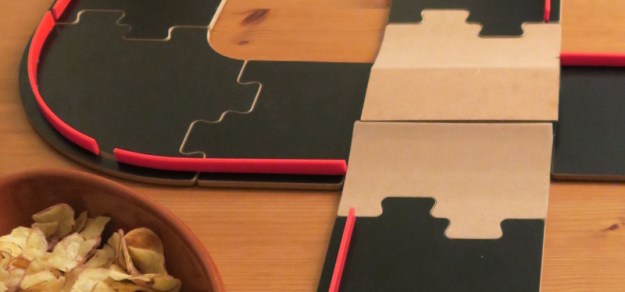
First to arrive, on the dot of 7pm, were Purple and Black together with Black’s mum, Sable.  So they got the dubious honour of setting up the PitchCar track for the “Feature Game”.  They chose one of the standard tracks from the second Extension (number five, which includes the tunnel from the first extension), and re-christened it, “Purple’s Hatch”.  They hadn’t finished setting up when Jade arrived as a scout on behalf of the party from Swindon, checking they’d got the right house.  In due course, Sapphire, Plum and Byzantium found their way round the back, eventually followed by Pine making a total of ten, and leaving so many shoes by the back door that it looked like a millipede was visiting.

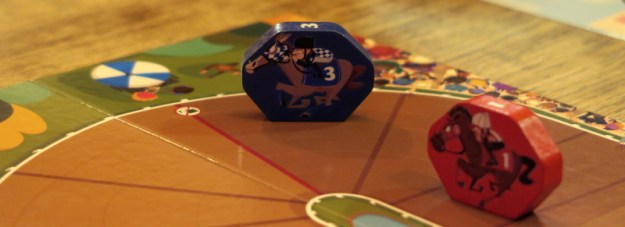
PitchCar Track 31/12/23
– Image by boardGOATS

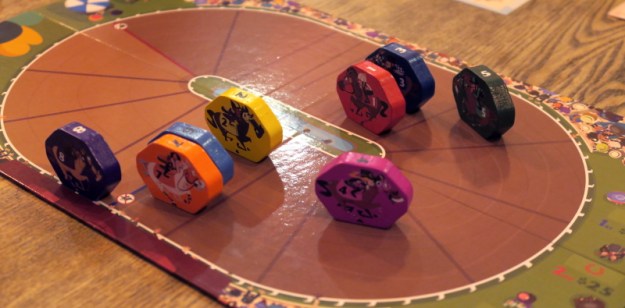
Over picky bits (Devils-on-Horseback, Pigs-in-Blankets, crisps, crudites and dips), the group began playing PitchCar.  A simple race game, starting with the player at the front, players take it in turns to flick their wooden puck-car.  The first player to cross the finish line after a set number of laps (in this case, two), is the winner.  If a player “offs it” or finishes wheel-side up, they go back to where they were (losing stroke and distance), however, if they knock someone else, the victim gains the distance, regardless of where they land or whether they are rolled.  To decide the order on the grid, there was a flick off, which was won by Sable on her debut.

PitchCar
– Image by boardGOATS

Unfortunately, although Sable started really well with a super-flick to give her pole position, she was soon over-taken as her inexperience told.  In fact, starting at the front of the grid seemed to be a bit of a poison chalice this time, and Purple who started second and Plum who started third were also quickly overtaken by the rest of the field.  Amid the mayhem, Byzantium started fourth and somehow remained in fourth place for pretty much the whole race.  Similarly, Jade started in sixth and gained a single place finishing just behind him.  The battle for the lead was therefore between Pine, Black and Sapphire the latter two starting from the very back of the grid.

PitchCar
– Image by boardGOATS

At the half-way point, Sapphire had the lead with Black in second and Pine in third, but by the end of the second lap, Black had caught and passed Sapphire to take the chequered flag, soon followed by Sapphire and Pine.  The rest of the pack eventually all crossed the line, with Purple, some way behind who suddenly started playing brilliantly after everyone else had finished, ending the game with the longest and best distance past the finish line.  By then, food was pretty much ready, so everyone engaged in the close-packing problem of re-packing PitchCar into its flight cases before settling down for Moroccan themed stews served with couscous, millet, roast cauliflower, meatballs and bread.

PitchCar
– Image by boardGOATS

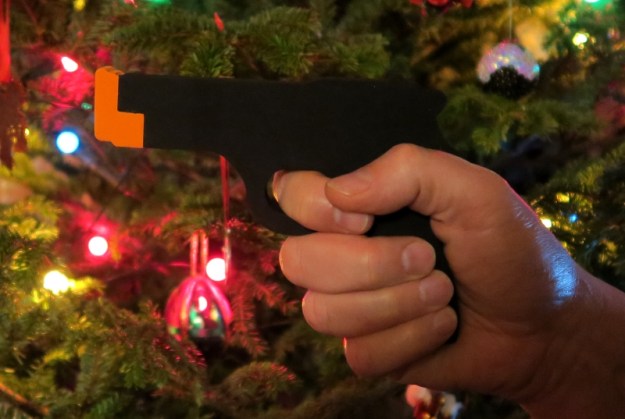
After tea there was a bit of chatter, but with an hour or so to midnight, Pink was keen to play one of his favourite party games, Ca$h ‘n Guns.  This is a silly game where players are a mafia gang dividing up their ill-gotten gains by playing a variant on “Chicken“.  After loading their guns with either blanks or live bullets, on a count-down from the Godfather, players simultaneously point their foam guns at each other.  The Godfather then gives another countdown, after which, people can back out, avoiding any bullets, but also withdrawing their claim to the loot for the round.  The remaining players reveal their bullet cards and anyone still standing after the shoot-out takes their share of the loot.  The player with the most after eight rounds is the winner.

Ca$h 'n Guns
– Image by boardGOATS

Pink started off as the Godfather, but soon lost that advantage and discovered that although people don’t gang up on the Mafia Leader, it’s shocking how they turn on you once you are no longer in power.  Black began building his art collection, until people spotted that was what he was trying to do, and then targeted him as well.  He was the first to be knocked out, taking his third and final hit in the penultimate round, round seven.  Sapphire soon followed and was taken out in the final round—it later became apparent that was not something he was going to forget quickly!  Purple and Pink amassed substantial totals, enough to give them second and third respectively.

Ca$h 'n Guns
– Image by boardGOATS

It was Pine, however, who won by a bit of a landslide, though.  He was helped along by the Gem Dealer bonus of $60,000, however, which made the majority of the difference between him and Purple, though he would have just pipped her to mafia-stardom without it.  By this time, it was just ten minutes to midnight, so Pink went to find the champagne (generously supplied by Jade), while everyone else packed away the foam firearms.  The GOATS countdown to midnight was slightly off compared to Jools Holland (who was on iPlayer and therefore lagging behind somewhat) and everyone toasted the new year and remembered those who were not able to be with us (in particular Green, Lilac, Lime and Burgundy).  Plum marked new year by fighting her way into the chocolate piñata with a ladle.

New Year 2023
– Image by boardGOATS

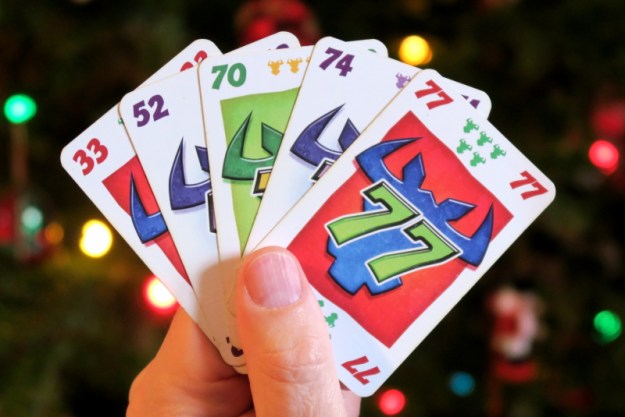
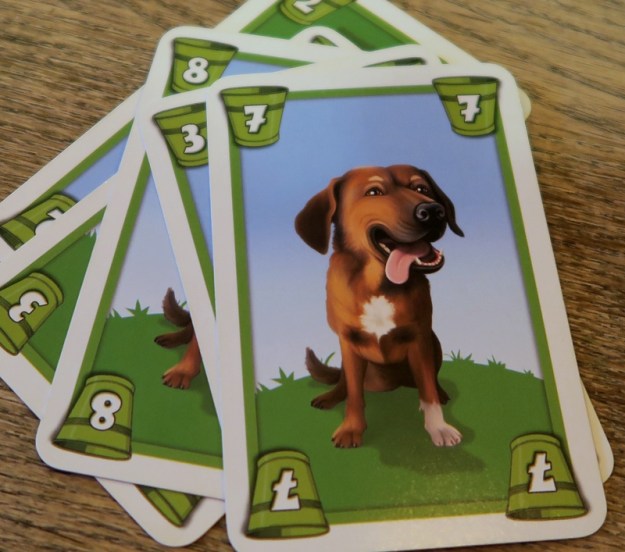
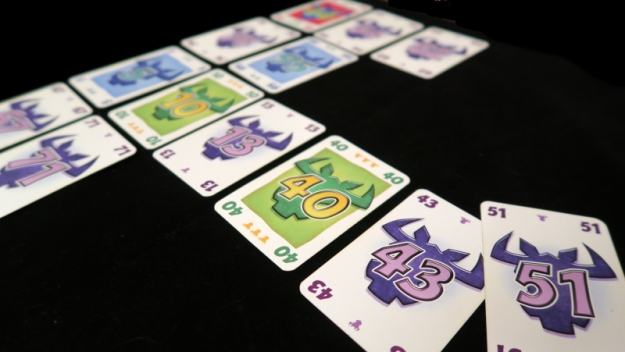
Blue and Plum stood outside on the step watching for fireworks, but although they heard some, there was a disappointing lack spectacle.  At the time, they thought they had just missed them, but it later turned out that this was at least in part due to anonymous, slightly threatening letters, from someone worried about their pooch.  Eventually, Plum and Blue gave up and came in from the cold and everyone played a mad and quite random game of 6 Nimmt! together as the first game of 2024.  In this game, everyone simultaneously chooses and then reveals a card from their hand.  In order from lowest to highest, these cards are then added to the four rows in the centre of the table.

6 Nimmt!
– Image by boardGOATS

Each card is added to the row that ends in the highest value card that is still lower than the card played.  The addition of this card makes the row longer—if it is the sixth card added, the owner takes the first five into their scoring pile.  Each card has a number of Bulls Heads (or “Nimmts”) on it, and the aim of the game is to be the player with the fewest.  Normally we play two rounds, but with so many players, we played one round with everyone starting with ten cards.  This turned out to be a strange combination of very random and slightly predictable as players could count cards, and it would probably have been better to start with hands of nine instead.

6 Nimmt!
– Image by boardGOATS

Jade and Purple competed for the highest score, but both lost out when the wooden spoon went to Black.  Blue and Pink did well only picking up five Nimmts apiece, while Pine did slightly better with four.  The clear winner was Plume, however, who somehow managed to avoid picking up any Nimmts at all, and on her first try too.  As the evening wound up, there was a lot of gentle chatter, nibbling of chocolate and sweets, and finishing off drinks, before  everyone eventually headed off to their beds having given 2024 a very warm welcome.

6 Nimmt!
– Image by boardGOATS

Learning Outcome:  GOATS can party like it’s 1999 every year.

Golden GOAT Award Winners – 2023

The boardGOATS love a good party, so once again, they met just before Christmas for their annual Un-Christmas Dinner and to decide the winners of the GOAT Awards.  After food, crackers and writing GOAT Christmas Cards, the group voted for two awards:  the Golden GOAT for our favourite game played during the year and the “GOAT Poo” award for our least favourite.  Everyone had the usual three points to hand out for the Golden GOAT Award (plus a bonus if wearing Festive Attire), though a maximum of two points could be given to any individual game.  Everyone could also nominate up to two individual games for the GOAT Poo Prize.

7 Wonders
– Image by boardGOATS

This year, there were a handful of games that received the unofficial “Marmite Award”, that is to say they received nominations for both the Golden GOAT and the GOAT Poo prizes.  These included Challengers!, Kites and SCOUT.  For the GOAT Poo Prize itself, this year there were no outstanding candidates, with a tie between 2019 winner 7 Wonders and Dice Hospital, with two votes each.  Nominations for “Moment of the Year included the game of Challengers!, which was likened to “Speed Dating”, and the massacre in Survive: Escape from Atlantis!, but the winner was the three way tie in the epic game of Tapestry with the Fantasies & Futures expansion.

Survive: Escape from Atlantis!
– Image by boardGOATS

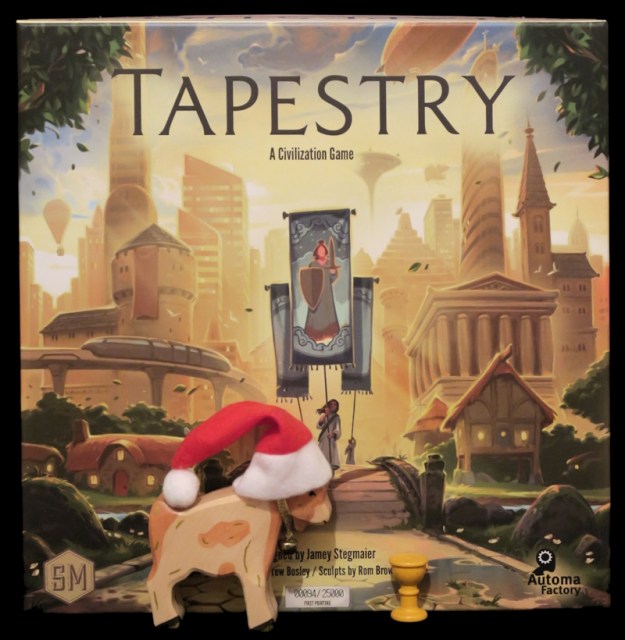
And finally, there was the Golden GOAT Award for the best game played in the year.  Previous winners including Wingspan and 6 Nimmt! were ruled out, but there were plenty of options remaining. Earth, Fantastic Factories, SCOUT and Zoo Break all received three votes, but the clear winner was Tapestry.  Over the years, we’ve played this quite a bit, but it is a game that doesn’t suit a significant number of the group.  This year, however, with a slight shift in those eligible to vote, heavier games were in with a better chance and Tapestry was the beneficiary.  We will have to make sure it gets another outing in the new year.

Golden GOAT - 2023
– Image by boardGOATS

2nd May 2023

Blue and Pink were the first to arrive and were just finishing their supper when Magenta walked in—sadly not to join in the games as she was there for a Scout meeting.  After a quick chat, she left and as Blue recapped the rules for the “Feature Game“, Zoo Break, Teal arrived and then Purple and Black.  The group had just decided to play Alles im Eimer (aka The Bucket King), when Ivory rocked up to make the full compliment of six.  Purple explained the rules with help from Black.  The idea is very simple:  each player builds a pyramid of ten bucket tokens with two of each of five colours.

Alles im Eimer
– Image by boardGOATS

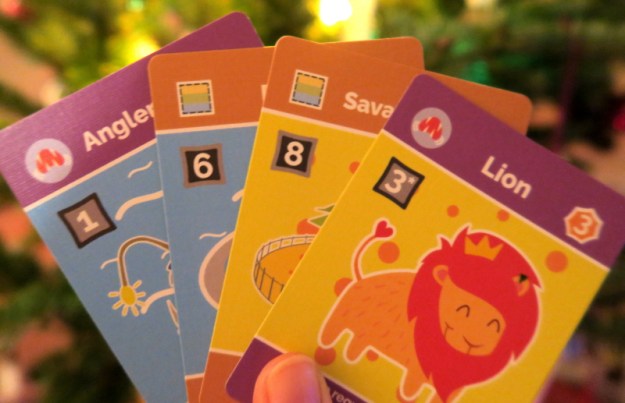
One player starts, playing a coloured, numbered, animal card and each player has to follow with the same colour and a higher number before picking up a card.  Players can play multiple cards to make the total, but they only ever receive a single replacement card.  If they can’t, or choose not to follow, they lose a bucket of that colour, and any buckets above it.  Worse, if they split their pile of buckets in two, they lose one part as players can only ever have one pile.  On the plus-side, if a player can’t play (or chooses not to), they then lead with a free choice of colour and number.  The last player with buckets still standing is the winner.  With Purple shuffling, Ivory was the first to play.

Alles im Eimer
– Image by boardGOATS

It turns out that there are two things that are really critical in this game.  Firstly, how players stack their buckets—it is not as simple as playing to their hand strengths; the smart player also spreads the colours out a bit so they aren’t forced to take buckets from low down when the unexpected happens.  Secondly, as Ivory pointed out, like 6 Nimmt!, it is all about timing, which is something players may not have control of.  A few rounds in, Black spotted that Pink to his left still had a complete stack where bucket piles had been falling all over the place everywhere else.  So, Black made it his business to make Pink’s life difficult.  From there, it was gloves off and the buckets really started to tumble.  Purple was the first player to kick the last of her buckets over which left Blue to do what she could to damage Ivory’s largely unscathed pile.

Alles im Eimer
– Image by boardGOATS

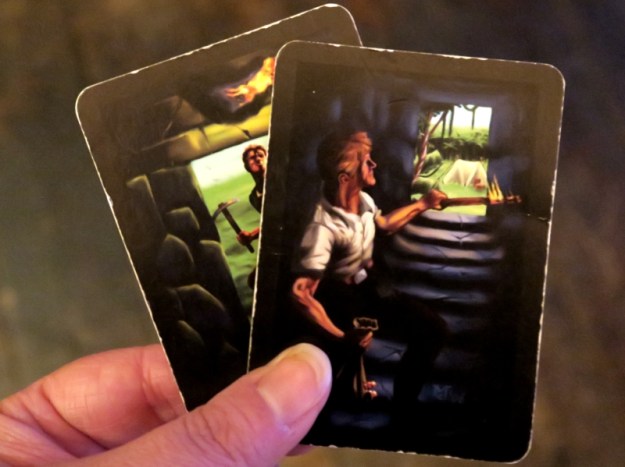
Black, then Blue, then Teal, all fell, leaving just Pink and Ivory to fight it out.  With Pink’s dwindling pile, it always looked an uphill task, and so it proved, with Ivory taking victory with five buckets still standing.  By this time though, Lime and Green had arrived and with eight, the group split into two tables of four, the first for the “Feature Game“, Zoo Break.  Pink was nearly lured away at the suggestion that the alternate might be Takenoko, but despite being very torn by his love of pandas, he stuck with his original panda driven choice and was joined by Blue, Lime and Black as Keepers at Bedlam Zoo.

Zoo Break
– Image by boardGOATS

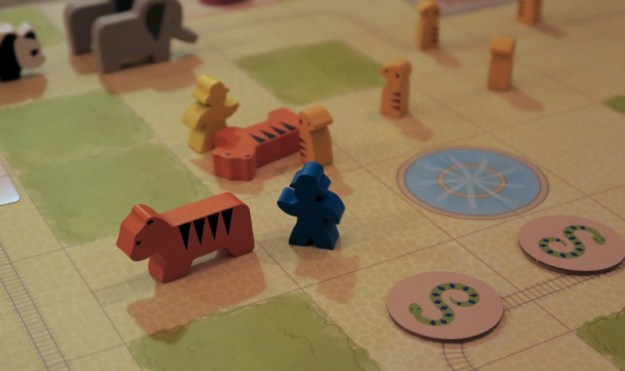
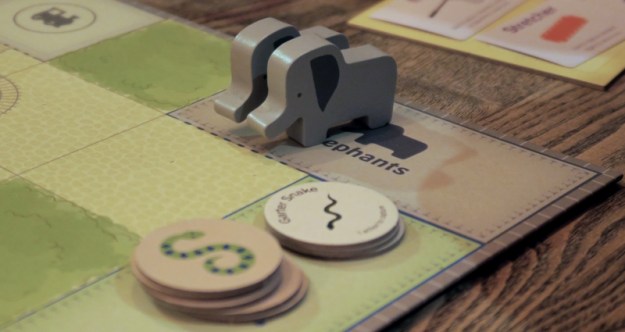
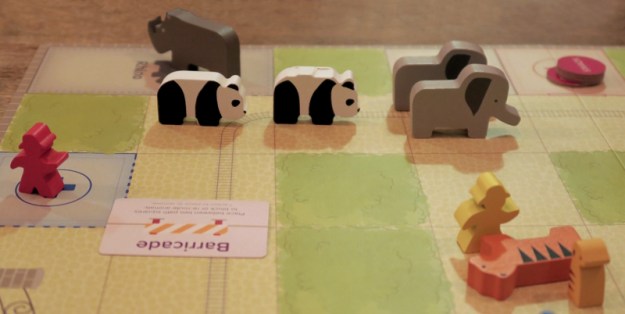
Zoo Break is an apparently light cooperative game where players are a team of zoo-keepers trying to prevent a mass break-out.  The mechanism is quite simple:  the active player rolls a die to decide how many Action Points they get, then they carry out actions, before drawing an Escape card and a Move card (to see what animals escape and move).  The game ends when either a dangerous animal (tiger, elephant, or dangerous snake) escapes, or when the fifth cute animal (panda, Capuchin monkey, meerkat or harmless snake) exits the zoo, or when there are no animals roaming about and all the cages are locked up.

Zoo Break
– Image by boardGOATS

Although the mechanism of Zoo Break is very straight-forward and the art-work implies it is a simple kiddies game, nothing could be further from the truth.  The rule book is twenty pages long, and there are a lot of details regarding escaping and recapturing animals.  For example, when an animal escapes, it doesn’t just move to the space immediately outside its Enclosure, it moves to the nearest “open” space.  Also, different animals are recaptured using different tools which have to be acquired from the supply by the Keepers.  For example, a Net can be used to capture meerkats or monkeys, while a Leash is required for pandas and elephants, and tigers need to be Tranquilised and Stretchered home (very carefully, obviously).

Zoo Break
– Image by boardGOATS

Each Keeper has a different skill.  This time, Blue had the ability to reveal snakes and capture animals from adjacent spaces (especially useful for dealing with snakes); Pink could run faster than anyone else, moving two spaces for each action point (instead of the usual one); Black, the Gardener, could move through and hide in bushes, and Lime could re-roll the die twice to try to get additional actions.  From experience with games like Forbidden Island and Forbidden Desert, the key is almost always to make good use of these special powers.  So Blue suggested she made it her business to concentrate on dealing with the snakes since she could do so without being bitten.

Zoo Break
– Image by boardGOATS

Pink with his Panda obsession, was always going to go after them, and everyone else was happy to let him get on with it.  Before any of that could happen though, the Keepers needed Supplies.  Pink started, and went straight to the Supply shed and started revealing tools.  These are drawn from a face down pile, but Keepers only have space to carry four tools in their backpack, so can choose only to take the ones they want.  This was probably the team’s first mistake:  instead of the few players just searching the whole Supply pile and making a discerning choice while taking as much as they could carry, players grabbed a couple of items and headed off.

Zoo Break
– Image by boardGOATS

This became a problem later in the game when the Keepers realised they didn’t have tools and were now on the other side of the board.  Black who had drawn the meerkat enclosure key headed off to the far corner to lock it quickly.  Lime captured the only roaming meerkat (which had been playing in the fountain) and Black was just about to lock the cage when another one escaped.  As he didn’t have a Net, despite being in the same space as it, he was left chasing about trying to grab it unsuccessfully.  And then more meerkats got out.  So Lime, Keeper without portfolio (but with both a Net and a Leash), waged war on the disobedient meerkats, while occasionally taking time out to catch an elephant or a monkey.

Zoo Break
– Image by boardGOATS

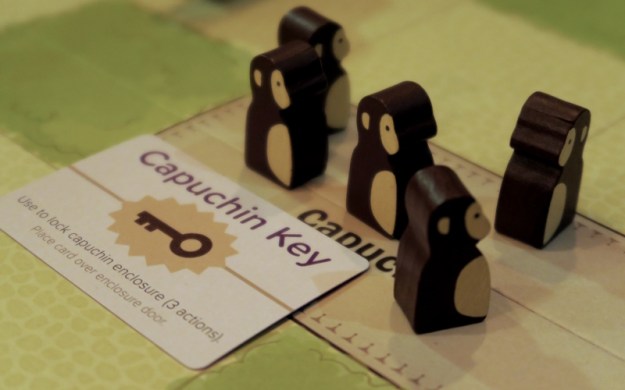
Pink, meanwhile, had his panda enclosure Key and a Leash and was trying to do something about them, but was inconvenienced by a pair of elephants, one of which knocked him flying necessitating a visit to the Medic.  Lime captured the last of the Capuchin monkeys and Blue who was close at hand with the enclosure Key managed to slam the door shut before any more got out—just as well, as the snakes were beginning to get out of hand, and as for the meerkats, well, these little blighters were causing mayhem.  Twice the Keepers had them under control before more escaped, and as they formed a long queue, the queue kept getting longer and longer as they marched inexorably towards the exit.

Zoo Break
– Image by boardGOATS

Pink used the Barricade to delay the escape of a couple of pandas and the pair marauding elephants, but it failed to hold when the Broken Barricade Move card appeared.  The rhino’s occasional charges weren’t much of an issue as they were very predictable, but once animals started to get close to the exit the rhino became more of a problem as players stayed out of its path wasting Action Points.  By this time, the tigers were becoming a problem, but Pink and Black put their Tranquiliser darts to good effect and soon the zoo was littered with sleeping tigers.  Lime had a Stretcher, but never actually used it, briefly loaning it to Blue for the only tiger returned to its enclosure (and left to peacefully sleep off the after-effects, as per one of the new variants).

Zoo Break
– Image by boardGOATS

There was a bit of a debate over whether it was more important to work on the rogue pandas or let them and meerkats escape and focus on the dangerous animals (in particular tigers and elephants).  Slowly but surely, however, the animals were taking over as there was a little procession of Keepers at the Medic’s tent, with only Lime avoiding injury.  Black was the only player to make use of the Train, because it didn’t really go where people wanted it to and players dealt with the issues nearest to them.  That was probably a good strategy; like it says in the advice, it is also important to lock stuff up early—the team didn’t.  They dealt with the monkeys, but the only other enclosure they managed to lock was the pandas, just before two meerkats and a cobra made a run for it in a single turn.

Zoo Break
– Image by boardGOATS

Although the mass escape had caused the zoo to be closed down and Pink hadn’t actually been cuddled by a panda, everyone had really enjoyed themselves.  On reflection, working in pairs might have worked better (as with Flash Point and Escape), because then the team can do things much quicker, get on top of things and lock cages making life easier all round.  Black was curious about the variants available.  The group had played on “Standard” difficulty with two “Phew!” Escape cards (where nothing gets out), but thanks to a rules malfunction, had also included the blank cards in the Move deck which provided quite a bit of respite, so everyone had a good laugh at the idea of making the game harder.

Zoo Break
– Image by boardGOATS

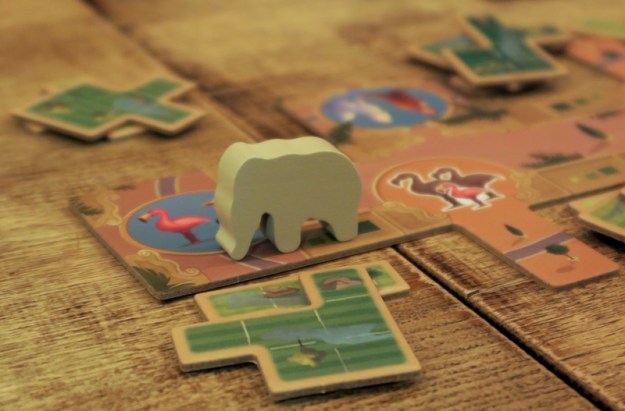
Despite the fact the group rarely plays cooperative games, everyone was keen to give Zoo Break another outing soon.  Zoos were popular elsewhere too—the next table had been playing New York Zoo.  This is a tile-laying game that got its first Tuesday outing only a few of weeks ago, but had been enjoyed by all.  In this game, players add pens to their zoo, populating them with animals, and building attractions.  Like Uwe Rosenberg‘s other similar games (including Cottage Garden, Spring Meadow, Indian Summer and Patchwork), it is Tetris-like but what makes this one unique and interesting is the Market.

New York Zoo
– Image by boardGOATS

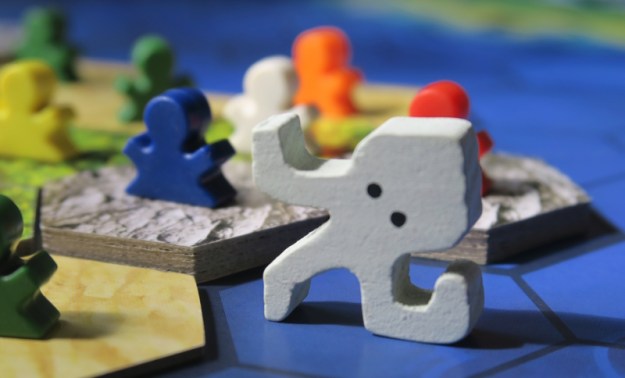
Players move the Marker Elephant one to four spaces round the Market, landing either on an Enclosure tile space (taking the top one and adding it to their zoo) or on an animal space (taking one or both of the animals depicted). Enclosure tiles can be placed anywhere in the player’s Zoo, then one or two identical Animals from elsewhere in their Zoo must be moved to occupy the Enclosure.  Each Enclosure can only hold one type of Animal.  When there are two or more Animals in an Enclosure together they breed when the Elephant passes the Market’s breeding spaces.

New York Zoo
– Image by boardGOATS

When an Enclosure is full, all the animals are removed and the player takes an Attraction tile of their choice and adds it to their Zoo.  Attraction tiles are useful because they fill additional spaces, and at its heart, New York Zoo is a race game—the winner is the first to fill all the spaces in their Zoo.  Purple had played last time, and Green had played elsewhere, however, Ivory and Teal were new to the game and the rules needed explanation.  That didn’t take long though, and the Elephant was soon touring the market and everyone was building their zoo and adding animals.

New York Zoo
– Image by boardGOATS

Purple was quick to get going, as was Green.  New York Zoo is really a tactical game, but there are a couple of broad strategies—fill the zoo with large Enclosures that are harder to fill, but occupy more space, or fill it with smaller Enclosures which are easier to fill with animals giving bonus Attraction tiles.  Purple went for the latter approach, getting some of the large attractions early in the game.  Teal however, opted for the former strategy, which is harder to get to work, but can be extremely effective, as indeed it was this time, making him the first to finish his zoo, and with no Attractions at all.  Purple was the best of the rest with for spaces left to fill, with Green a little way behind.

New York Zoo
– Image by boardGOATS

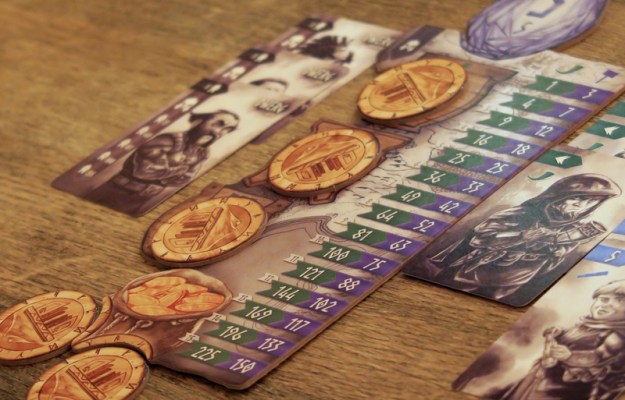
The Keepers in Bedlam Zoo on the next table were still trying to get the marauding beasts back in their pens (largely unsuccessfully) so the others had to decide what to play.  Green decided to go home, and couldn’t be persuaded to stay by the opportunity to play Nidavellir despite having been very keen to play it previously.  That left Purple, Ivory and Teal, who decided to play it anyhow.  Nidavellir is a card set-collection and bidding game inspired by Norse myths. The game was created by French designer Serge Laget (who sadly passed away in January this year after a lifetime of producing some great games) and the striking black and white artwork by Jean-Marie Minguez which nicely contrasts with the coloured cardboard components.

Nidavellir
– Image by boardGOATS

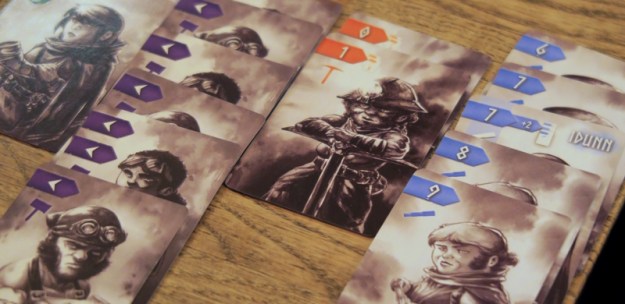
The story behind the game is that the kingdom of Nidavellir is under threat from the stirrings of the Dragon Fafnir and players are tasked by the King to recruit the best army to defeat it. Appropriately for our venue, the action takes places in three Dwarvish pubs where the players must use their coins to bid for the most skillful Dwarves (in a concealed auction), recruit the most prestigious Heroes, and build the best Battalion they can to defeat the Dragon.  Players hire five different professions of Dwarves into their growing army – Warriors, Hunters, Miners, Blacksmiths and Explorers.  Each player starts with five coins with the values: zero, two, three, four and five. Players place one of their coins against each pub space on their player mat.  The coins are revealed and cards are taken from each pub starting with the highest bidder.
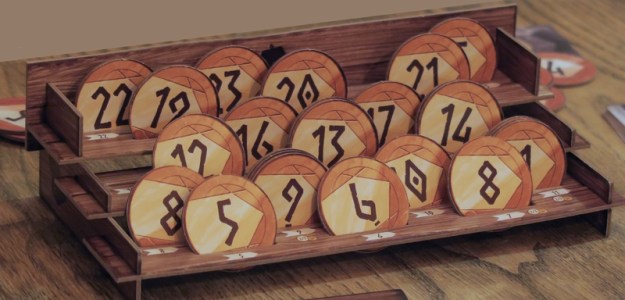
Nidavellir
– Image by boardGOATS

Ties are broken in favour of the player with the the highest jewel token (randomised at the start) and then these players swap jewels so the losing player has an advantage next time there is a draw. Once the three pubs have been resolved, players take back their coins, and place their cards in their tableaux.  At the game end, points are awarded in different ways for each group of Dwarves.  For example, Hunters provide points based on the number of cards squared, Blacksmiths score according to the triangular sequence (as used in Coloretto), while the Navigators are simply a total of the number of points printed on the card, and so on.  Each round of the game, random face-up dwarf cards are lined up by each pub (equal to the number of players) and players bid for their order of selection.

Nidavellir
– Image by boardGOATS

If a player plays their “zero” coin, the values of the two unused coins are added together, the highest of the pair is discarded and a new coin of the same total is added to their stash from the Royal Treasure. Thus, players can gradually increase the value of their coins, which is useful for out-bidding others, but also adds value as the total coin hoard is added to their final score.  Hero cards, which supply additional points bonuses in a variety of ways are awarded when a player manages to have five cards of different type and then each time a new set of five is achieved. Heroes are selected from, a separate deck which allows for further point scoring combinations.  The start was a little slow as Purple and Ivory were both new to the game and had to figure out what to do.

Nidavellir
– Image by boardGOATS

Teal and Ivory both started by upgrading their coins.  Ivory was the first to get a set of five cards and claimed one of the Dwerg Brothers as his Hero giving him the target of collecting the other brothers which greatly crank up the points the more that are collected.  Teal, who had played the game before, chose more complex Heroes.  Half way through the game, Purple took the King’s Hand and the King’s Great Armourer Heroes for having the most Warrior and Blacksmith cards, while Teal took the Hunting Master and Crown Jeweler (for the most Hunters and Miners respectively), leaving Ivory just the Pioneer of the Kingdom (for the most Explorers).

Nidavellir
– Image by boardGOATS

The second age (played with a new deck of cards), was similar to the first, with particular tight battles around getting cards to complete sets.  Ivory had a slight advantage in this, having upgraded his coins more aggressively early in the game, and used this to get more of the Dwerg Brothers.  In contrast, Purple and Teal focused on collecting Dwarves of one kind with Teal using his Heroes to add to their “count” in particular colours when completing a set.  In the end, Purple and Teal scored best for Blacksmiths and Hunters, while Teal also took lots of points for his Miners—something he had focused on from the start.

Nidavellir
– Image by boardGOATS

Ivory however, had more Warriors and having the majority of them meant he could add the value of his most valuable coin to his score.  Despite that and over a hundred points for his Dwergs, Ivory finished just shy of Teal’s winning total of two-hundred and seventy-seven.  The downside of his victory—the winner has to face the Dragon Fafnir!  All agreed it was a good game, not overly complex, but with lots of decisions to make; a game that didn’t out stay its welcome finishing within the forty-five minutes advertised (even with two first-time players).

Nidavellir
– Image by boardGOATS

Learning outcome: Always keep a close eye on your meerkats.

4th April 2023

While Blue was off getting fish and chips for people, Pink chatted with Pine and Green and his family as they arrived.  Green had just got out Incan Gold and was explaining the rules, when food arrived, so it was hastily put away while food was consumed, only to be got out again as soon as the chips had disapparated.  Incan Gold is a very simple “push your luck” type game where players are exploring a mine and trying to get out with treasure before disaster strikes.  Each round a card is revealed and players simultaneously choose whether to stay or leave and share what spoils they already have.  There are three types of card:  Treasure, Artifact, and Disaster.

Incan Gold
– Image by boardGOATS

The contents of the Treasure cards are simply divided equally between players when they leave the mine, or as equally as possible leaving behind any left-overs.  Artifacts can only be taken if there is only one player leaving the mine, all alone.  Disaster cards are the problem—Spiders, Snakes, Zombies, Lava and Rock Falls.  Each one is present in the deck three times, and when the third is drawn, the mine collapses leaving everyone in it without any treasure.  This time, though, the group didn’t get off to a very auspicious start.  The first card out was a Rock Fall, the second was Fire and the third was another Fire!

Incan Gold
– Image by boardGOATS

So the group decided it was such a bad start that they would shuffle and try again.  On the second attempt, the first two cards out were again Disasters, but the third delivered some Treasure. It wasn’t very much and nobody felt it was worth leaving for. That was a good choice as there was a little more treasure to come.  Still not very much, but more littered the floor of the tunnel, and it eventually proved too enticing for Emerald and Violet who managed to net about five gems each for their tents.  For the rest of the group, they pushed it a little too far and promptly lost everything as they got caught in a devastating fire.

Incan Gold
– Image by boardGOATS

The second tunnel explored also lured in too many explorers before collapsing the ceiling on everyone.  The third tunnel brought the first glint of Gold—an Artifact.  Eying each other up everyone elected to stay, which was fine, but on the next turn, Lilac decided she would chance it and run. Luckily for her she was the only one and managed to net the Golden treasure on her way out, and left everyone else to die at the hands of a rather midget-like Zombie.  Lilac managed to repeat the feat on the fourth tunnel, collecting the Gold treasure as she made a run for it, although everyone else managed to collect more treasure and eventually decided to save what they had found instead of dying a horrible death.

Incan Gold
– Image by boardGOATS

The final tunnel brought some nice treasure, and another Artifact, but with too many people leaving, they had to leave it where it lay.  Pine was the one who held his nerve and safely collected the Golden treasure this time, before a Disaster as those remaining were overrun by Spiders.  In the final reckoning it was neck & neck between Pine and Lilac on thirty-six points, but Lilac just edged it by dint of having two gold artifacts to Pine’s one.  It was close for third, though Lime was the best of the rest with twenty-four, just ahead of Emerald and Violet.  The least effective was Greedy Green, who’d stayed just too long just too often, eager for more treasure only to be bashed and burned and brutally murdered time after time.

Incan Gold
– Image by boardGOATS

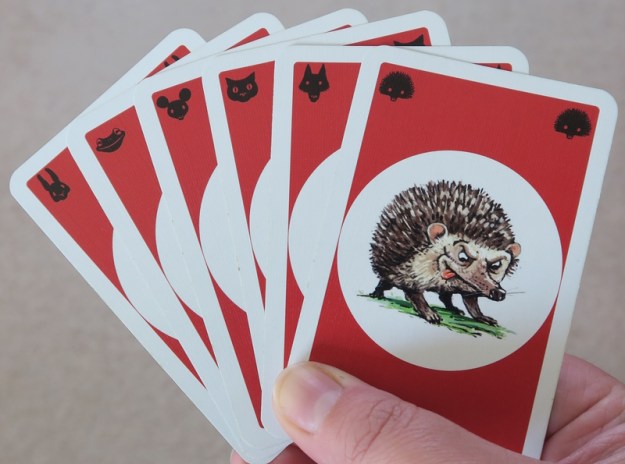
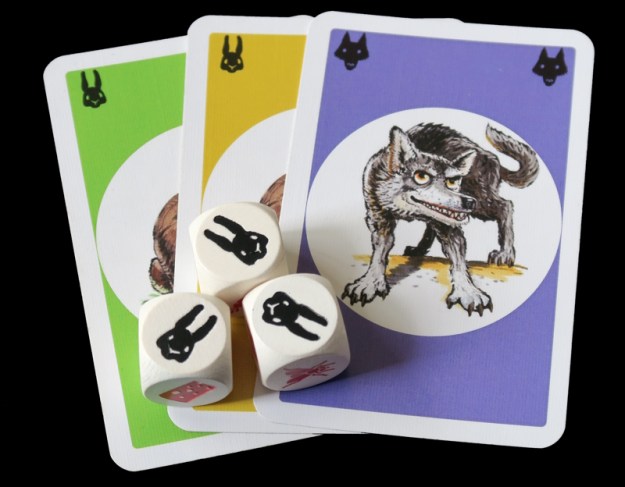
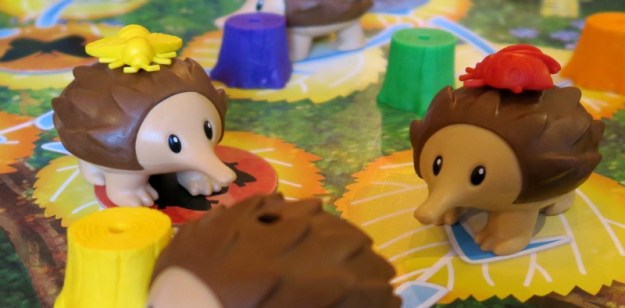
Meanwhile, everyone else played the “Feature Game“, the filler Om Nom Nom.  This is a fun and light little game of think and double-think where players are trying to eat without getting eaten.  The game is set up by seeding the board with cute dice, rolled to give cheese, carrots and flies for the bottom of the food chain, and mice, rabbits and frogs for the middle of the food chain.  Players then receive a deck of six cards representing the animals for the middle of the food chain and the top of the food chain, cats, wolves and hedgehogs.  With game play reminiscent of 6 Nimmt!, players simultaneously choose a card to play which are then evaluated.

Om Nom Nom
– Image by boardGOATS

Players who played cards at the top of the food chain eat anything below, so long as there is enough for everyone who played the same card.  Thus, if there are four mice (including any cards played) and two cats, the owner of the cats take two cards each and get to keep their cat cards too with them all going on their scoring pile.  If however, there was only one mouse, both cats go hungry and neither player scores anything.  Cards played for the middle of the food chain eat the dice at the bottom of the food chain as long as there are enough dice for everyone who played the same card, but also as long as they don’t get eaten by anyone playing a card at the top of the food chain.

Om Nom Nom
– Image by boardGOATS

Thus, playing a card in the middle of a food chain is all about timing:  there is a higher risk, but also a higher reward as the dice showing red faces are worth two points instead of the usual one for a card or a die showing a black middle of the food chain critter.  Although we’ve played Om Nom Nom several times before, it was new to both Teal and Lime.  Teal started off well though taking a massive fifteen points in his first round.  Unfortunately for him, that turned out to be beginner’s luck and he didn’t do so well in the next round.  Purple’s game, on the other hand, went the other way, starting with nothing in the first round and taking sixteen points in the second.

Om Nom Nom
– Image by boardGOATS

With others being more consistent, in particular Blue who scored a seven and an eight in each of her first two rounds, it was all down performances in the final round.  In the event, Black and Pink both did well in the final round, and Teal improved on his score in the second round too.  It was Purple that won the final, albeit low-scoring round, taking ten points, giving her a winning total of twenty-six, three more than Teal in second with Black and Blue tying for third place some six points behind him.  It had been a quick fun game, one that is always good value and definitely deserves another outing soon.

Om Nom Nom
– Image by boardGOATS

Both games, Incan Gold and Om Nom Nom, finished at much the same time, so everyone decided what to play next.  Teal had brought Nidvelilir at Green’s request, but this wasn’t the night for that.  Eventually, Purple traded places with Pine and Lime leaving five players, in one group which picked out a lot of possible five-player games.  Since Violet was here only for the a brief visit they let her choose.  Her selection was Zooloretto or King of Tokyo, however Purple made a face at both choices and suggested Carcassonne instead. Violet was less keen as she felt she had played that a lot recently, so Green made an executive decision to play Boomtown—a fun little bidding game that hasn’t had an outing for a long time and doesn’t take too long.

Boomtown
– Image by boardGOATS

Unfortunately, at this point Emerald was really beginning to feel the heat of the pub and felt he couldn’t participate.  He went off for a wander to get some fresh air, ironically just before the back door was opened to cool everyone down a little.  As he had decided to sit this one out, the rest of the group revised the rules which were simple enough on the face of things.  A deck of sixty cards is shuffled and placed face-down in the middle of the table, along with two dice, a pile of Mayor pawns (one in each of five different colors) and Town tokens (two each of the same colours).  One card per person is turned face up and each player begins the game with $10 starting funds to bid for the card they want.

Boomtown
– Image by boardGOATS

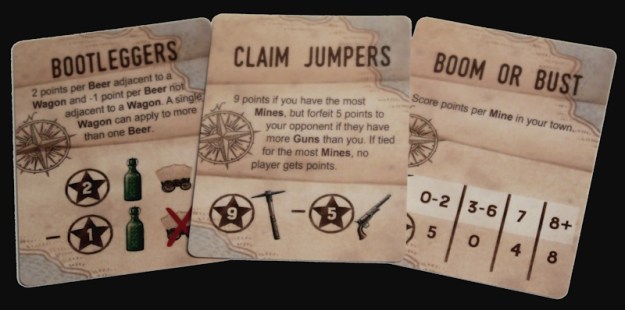
Each player has to increase the bid or pass, until there is one winner.  And this is the clever bit of the game—the winner, pays the player to their right, who passes on half of the money to the player on their right and so on until either there is nothing left to give or the winner is reached (they don’t get any of their own money back).  Everyone then gets a card in clockwise order.  There are Mine, Dynamite, Saloon, Hold-up, Governor and Special cards, each of which has an effect.  Mines and Saloons give players gold and the player with the most Mines in any Town/colour takes the matching Mayor token which forces others to give them money.

Boomtown
– Image by boardGOATS

Dynamite cards allow players to destroy other players’ mines, while Hold-up cards allow players to steal from other and the Governor allows players to upgrade a Mayor so their mines are worth double. Once the cards have been allocated, the dice are rolled and players receive income for their mines.  The game ends when the deck is depleted and all the cards have been sold.  The player with the largest total from their their points, money, the production value of all the mines they control, and five bonus points for each Mayor, is the winner.

Boomtown
– Image by boardGOATS

Maybe it was the heat, but aside from Green, no-one was quite sure how Boomtown would play out, and it took a few rounds for everyone to get the hang of things.  The group didn’t get off to a great start, even when they adjusted the draw deck to make sure there was enough mines for everyone by replacing the action cards that came out.  The second round brought out two sets of Dynamite though, and both Green and Purple ended up destroying each others mine.  The bidding never got very high in the first half of the game, mostly because nobody knew what they were doing, and did not necessarily want to choose first.

Boomtown
– Image by boardGOATS

However, by about half way and when the Mayor pieces had all been claimed and the Saloons were built everything started to hot up.  Although Lilac had a lot of red Mines, which netted her a little money from players forced to take the last few remaining, every time they found gold, she had to pass most of her claim to Purple who had a red saloon along with Saloon girls!  Violet managed to claim a couple of Mayors along the way, and although she lost one of them, she managed to avoid the attraction of the Saloon, so kept everything she collected. With some judicial rolling on the Card Shark Dice, she managed to rob some of the others blind.

Boomtown
– Image by boardGOATS

By the time the last cards had been claimed and the final Mines had given up their gold, it was Purple who had become the master Miner, by something of a landslide.  Violet was a respectable second with Lilac, having passed on so much of her wealth to Purple, just managing to stay whisker ahead of Green for third.  Meanwhile, on the next table, with so many players Survive: Escape from Atlantis had seemed a good choice as it plays six with the expansion.  This was released to mark the thirtieth anniversary of two very similar, much older games, Survive! and Escape from Atlantis, and is an agglomeration of them both.

Survive: Escape from Atlantis!
– Image by boardGOATS

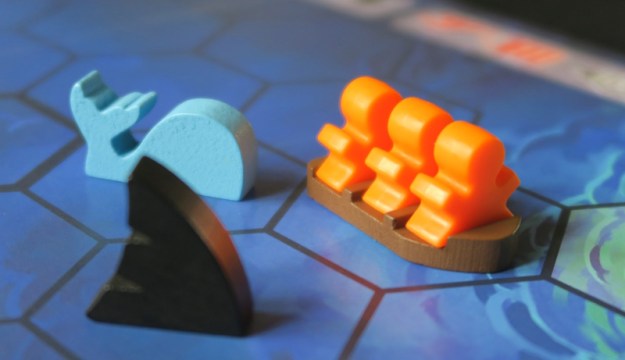
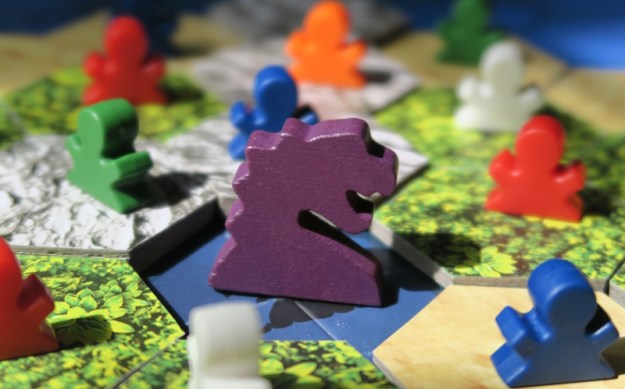
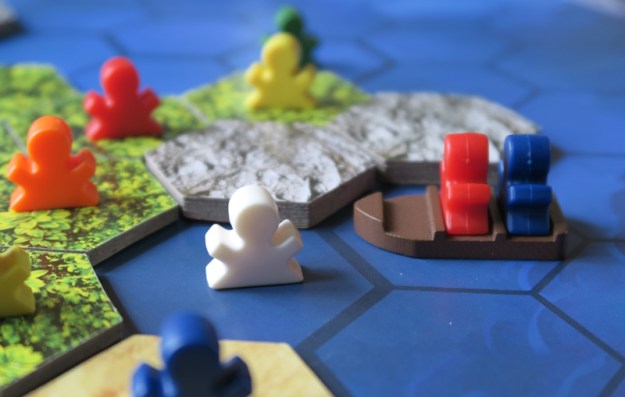
The idea is that players rescue their meeples from the central Island of Atlantis before it sinks beneath the waves.  The original Escape from Atlantis had a fabulous sculpted plastic central Island, with lots of Sea Monster miniatures, however, although the thirtieth anniversary edition is arguably a nicer production, the Island is made up of thick card hex-tiles, and the Sea Monsters are made of wood.  This version has safe land shown on the corners of the board each initially guarded by a Sea Monster, with randomly placed hexes forming the Island and a fifth Sea Monster in a central lagoon.

Survive: Escape from Atlantis!
– Image by boardGOATS

The new edition varies from its predecessors only a very little in game play.  On their turn, the active player has three movement points, and then they remove one tile from the Island of Atlantis before rolling the Attack Die which dictates which of the Sharks, Whales or Sea Monsters the player moves.  Sharks and Whales are introduced as the Island sinks: when players remove a hex from the Island, the underside has either an immediate effect (bordered with green) or a delayed effect with the tile stored, usually to be played before a later turn, though a small number can be used reactively.

Survive: Escape from Atlantis!
– Image by boardGOATS

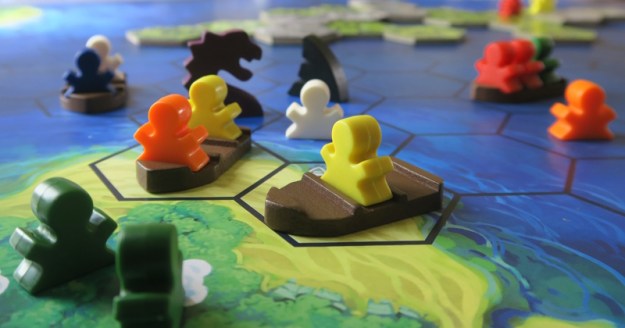
There was a lot of discussion about whether to include the Giant Squid and Dolphin mini expansions and what they did, but in the end, the group decided against it this time.  In addition to placing their meeples on Atlantis, during the set up, players also place boats.  These can hold a maximum of three meeples and are moved by whoever has the majority in the boat.  It costs one movement point to climb into or out of a boat, either to or from a neighbouring land space or the water next to the boat.  Meeples in the water can only swim one space per turn because it is tiring.  Once in a boat, however, movement is easier and they can move as far as they want and are able.

Survive: Escape from Atlantis!
– Image by boardGOATS

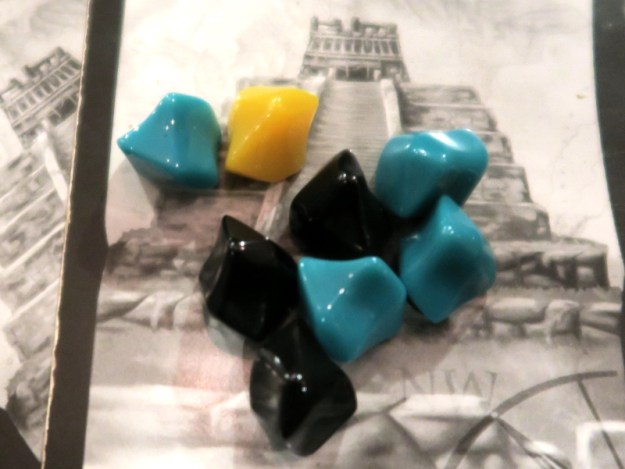
Thus, the priority is to get meeples into boats, but the decision players have is whether to try to put all their meeples in one boat or whether to hedge their bets.  Pine and Pink tried the former.  Pine managed to get two of his meeples in one boat and then, before he could get any passengers, set sail.  Being early in the game there weren’t many Whales or Sharks about, and with only a short distance to safety, Pine’s pair made it there safely.  From there, the game got quite savage with players preferentially taking land tiles with meeples on them, turning them into Swimmers with a long way to safety—one was unlucky enough to end up in the drink when a Shark dropped into the space next to him and swallowed him whole.

Survive: Escape from Atlantis!
– Image by boardGOATS

Pink tried to emulate Pine’s success, but was a mite more greedy putting three of his meeples with a total value of eight in one boat.  Although he had a plan to get the boat to shore, he reckoned without the appearance of a Whale which was promptly moved to the same space and proceeded to turn his boat into matchwood and transform his sailors into Swimmers.  Whales aren’t interested in Swimmers though, so once his meeples were in the water, it left them alone.  Pink then had ample opportunity to separate them out a little, and indeed was advised to by everyone else, but he choose not to.  So, although everyone felt slightly sorry for him, it wasn’t long before the little clutch of Swimmers proved far too tempting a target and a Shark rocked up and ate them all.

Survive: Escape from Atlantis!
– Image by boardGOATS

From there, there was a steady trickle of boats making landfall, with players trying to work together without doing the lion’s share of the work themselves.  For every boat that made it to safety, however, there was at least one Swimmer that was eaten by a Shark or boat that was attacked by a Whale or a Sea Monster making it a bit of a war of attrition.  But with six players, the game moves quite quickly and players don’t get many turns so collaboration is essential if players are to get anyone to dry land.  Blue and Black cooperated effectively to get a couple of Sailors each home, as did Teal and Pine.  Although for a long time, Lime was the only one not to have any of his meeples eaten, he was also the last to get one safe.

Survive: Escape from Atlantis!
– Image by boardGOATS

With six players, the end of the game came round quite quickly.  The game ends immediately when the Volcano is revealed under one of the last eight Mountain tiles and with so many players once the Woodland tiles have been exhausted the game can end any time, so one extra turn can make all the difference.  And so it proved for many.  It was Lime who turned over the Volcano tile, much to his disgust as he had a boat with two meeples ready to disembark on his next turn.  Pink also had two in a boat near shore (total value nine) and Blue was equally unimpressed as it was her turn next and she needed just one move for her most valuable meeple to crawl up the beach.

Survive: Escape from Atlantis!
– Image by boardGOATS

With Atlantis gone beneath a combination of waves and lava and every meeple that had not made dry land perished in the boiling sea, it was time to score.  Each meeple has a value printed on the bottom, and although players knew what these were when they were placed, they were not allowed to look at them again.  Teal had attempted to codify which meeple was which in their location on the spaces they were placed on, however, Blue quickly called him on this and like everyone else, over the course of the game he had mostly lost track of which was where. Pink and Lime had only got one meeple ashore a piece, but although they were relatively high scoring ones, everyone else had a similar value one home and at least one additional one too.

Survive: Escape from Atlantis!
– Image by boardGOATS

Blue, Black and Teal managed to get three meeples ashore each, with Black totalling six points and Blue totalling seven.  The winner was Teal, however, with a total of eight, though even one more turn or a slightly different turn of events earlier in the game would have made a huge difference to the final placings.  It had been a lot of chaotic fun, but unquestionably, with so many players, there wasn’t much chance to plan and the game  changed hugely between a player’s turns.  With fewer players it is definitely a more strategic game, but with more, the onus is on players to work together more—indeed the players that did this this time, were the most successful.

Survive: Escape from Atlantis!
– Image by boardGOATS

Learning outcome:  Just when you thought it was safe to fall into the water…

10th January 2023

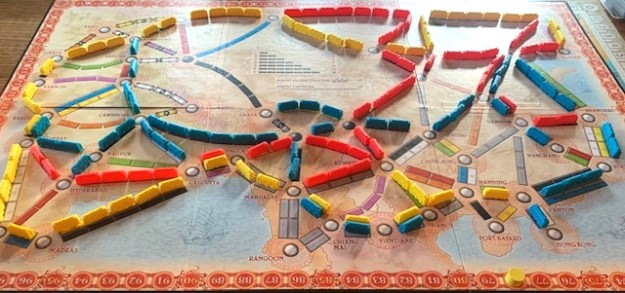
One of the first to arrive was Yellow, and it was delightful to see him after such a long time.  He was especially welcome as he was bringing a copy of Paris that he’d been looking after since UK Games Expo in August 2021.  Before long though, there were eight all ready and lined up to play the “Feature Game“, Long Shot: The Dice Game, when two more arrived and a debate began to work out who would play what and where.  As Long Shot was supposed to be quite short, eventually, Plum, Pine, Purple and Lime took themselves off to play Ticket to Ride: London, with Blue, Green, Yellow, Black, Ivory and Teal sticking around to play Long Shot:  The Dice Game.

Long Shot: The Dice Game
– Image by boardGOATS

Based on the party game Long Shot, Long Shot: The Dice Game is a light horse racing and betting game in a similar mould to that of Turf Horse Racing, that featured on several people’s lists of top games from 2022.  As it is relatively quick to play, the idea was that it would leave plenty of time to play some of our other old favourites and Ticket to Ride: London was thought to be a good match in terms of length.  Inevitably, that was not quite how things turned out, however.  Long Shot (Dice) is quite simple, and Blue, assisted by Green, was explaining the necessary to the runners and riders.  Ticket to Ride is well known within the group though and was therefore quicker to get started.

Long Shot: The Dice Game
– Image by boardGOATS

The idea of Long Shot (Dice) is that the active player rolls two dice which dictate which horse moves and how far (one to three spaces).  Everyone (including the active player) then chooses an action from their card, carries it out and crosses it off.  The actions include:  placing bets, buying a horse, buying a riding cap, buying a riding jersey, crossing a horse off the concession chart to get a bonus action once a row or column has been completed.  In general, the action depends on the horse that has been rolled, i.e. if horse number two is rolled, players can bet on that horse, buy that horse, get a cap or jersey for that horse’s rider or cross that horse off the concession grid.  However, each player has three “wilds” which are opportunities to choose any horse.

Long Shot: The Dice Game
– Image by boardGOATS

At the end of the game, players score if they own or bet on a horse that is placed and for any cap/jersey combo for the same horse.  This time, Green started and rolled the blue horse number three which moved three spaces.  As did Teal.  By the time it had moved on three out of four opportunities (and a total of nine spaces), it was starting to look like the dice were loaded and this did not appeal to everyone’s sense of fair play.  The group more or less divided into those that wanted the blue horse wearing number three to win (because they had invested in it) and those who didn’t and preferred the red number one horse.

Long Shot: The Dice Game
– Image by boardGOATS

As Ticket to Ride progressed, the route planners asked how the race was going, and the gamblers, felt it would not be long, given the progress the blue number three horse had made and the lead it had built up.  After its early spurt, a few other horses managed to start to make a bit of ground and, with players starting fill out their bonus grid, players began to take bonus actions which leveled the course somewhat.  The bonuses included taking a free $7 (quite a lot of money in this game); a free $3 bet; free riding cap/jersey, but by far the most interesting were the options to move horses.

Long Shot: The Dice Game
– Image by boardGOATS

Each player has the following four bonuses:  they can move one horse three spaces (once forwards and once back) and they can move two horses two spaces (also both forwards once and both backwards once).  It was as the blue number three horse approached the three-quarters mark (after which players could no longer bet on it) that players showed their allegiance, moving it forwards, or backwards.  And with six players, everyone had potentially several bites of the cherry.  Just as it seemed that one horse had an unassailable lead, one or two players would upset the apple cart and push the leader back and something else forward.  Even the the three-legged purple number eight horse looked like it might be in with a chance of placing at one point (albeit not for long).

Long Shot: The Dice Game
– Image by boardGOATS

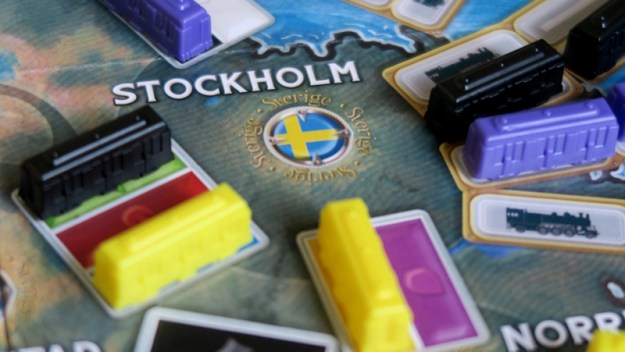
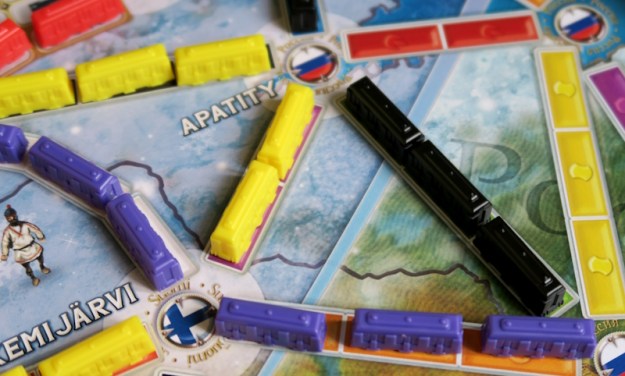
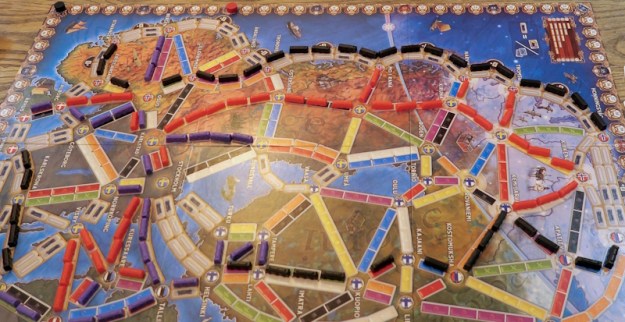
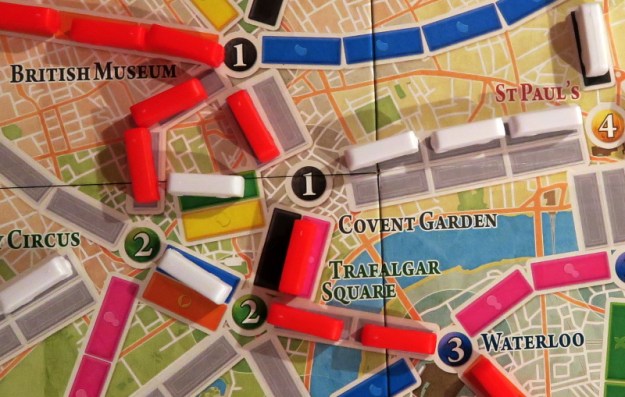
Ticket to Ride made more rapid progress.  Although Purple succeeded in completing one of her tickets (for three points), she failed to finish her other two.  That cost her ten points (effectively twenty, which is what she’d have got if she’d completed them), and she blamed Lime.  Lime had troubles of his own though as he was in a very tight battle with Pine.  Perhaps it was his comeuppance for the trouble he’d caused Purple (real or only perceived), but Pine pipped him to victory by a single point, gained when he completed one of the single carriage routes in the centre of the board in the dying moments of the game.

Ticket to Ride: London
– Image by boardGOATS

It became a bit of a running joke that the Purple/Plum/Pine/Lime group playing with their train-set asked how things were doing when they finished, and again as they packed away, and again after they’d been to the bar, and again after they’d consumed their drinks and been to the bar again, and each time were told that it was nearly done.  Eventually, Purple, Lime and Pine resorted to playing Love Letter to kill time, winning one round each.  Although Long Shot (Dice) was great fun and everyone was quite amused by the shuffling of horses backwards and forwards, Pine had a point when he commented that when gamers play a light silly game they can play it to destruction—a bit like Echidna Shuffle, which we all adored though it outstayed its welcome when one game lasted two hours!

Echidna Shuffle
– Image by boardGOATS

As players ran out of bonuses, the Long Shot horses ran out of track, and eventually, the red horse number one crossed the line, followed by the blue horse number three and finally, the pink horse number four.  Unlike in Downforce for example, however, although winning the race is useful, the betting has much, much more of an influence on the final result.  For example, the two horses Ivory had bet on, numbers five and six, didn’t come in making a severe dent in his score.  In spite of this, it was quite close—Green and Yellow tied for third  with $109 while Teal took second place with $114.  Blue claimed victory though, finishing with $122.

Long Shot: The Dice Game
– Image by boardGOATS

It was only when Green and Pine pointed out that Teal hadn’t scored his horse which gave him $2 per horse he had a bet on, and in his case, an extra $12.  Recalculating his final score, much to her chagrin, Teal just pipped Blue to victory.  From there it was simply a case of tidying up and working out what people wanted to play next.  Ivory had suggested Roll for the Galaxy at the start of the evening and there were lots of takers now, so he went off to set up with Teal, Green and Plum.  Although Teal had played Race for the Galaxy online, Roll for the Galaxy was new to him so the group started with a quick rundown of the rules.

Roll for the Galaxy
– Image by boardGOATS

The idea is that everyone starts with a couple of “Worlds” and some dice representing their population.  Players roll their dice with the faces dictating different actions.  In secret, players allocate their dice to the five different phases: Explore, Develop, Settle, Produce and Ship.  Players choose one phase that they want to happen then everyone simultaneously reveals their choices.  All the phases selected will happen, with dice that players have allocated to other phases returned to their cup and recycled.  The game is a combination of “engine builder” and “population builder” (similar to games like Orléans), with players needing the right combination of Worlds to provide their engine, and then building the right combination of dice to make them work effectively.

Roll for the Galaxy
– Image by boardGOATS

With the lighting being less than perfect, some of the dice colours were a little difficult to distinguish, particularly purple and brown.  Plum came to the rescue though, with her new Christmas present:  a portable folding lamp.  The magic of the LED gave a good strong light, enough for everyone without taking up too much room on the table.  Everyone was very impressed and many rapidly came round to the idea that it was a must have gamers’ accessory!  After a faltering start for a couple of turns, Teal soon got the hang of how to select actions and where the dice should go.

Roll for the Galaxy
– Image by boardGOATS

The first clarification needed was that players can only choose one action (though everyone’s choice will be activated), and the second was that the die used to select that action does not need to show a face that matches it. The rest of Teal’s game was one of learning:  with his mining industry, he was able to ship goods for victory points while still gaining some credits, and gained a couple of useful purple die. Unfortunately being new to the game meant he was unable to mount a serious challenge for victory points.  Plum, on the other hand, started out with a couple of red military dice and managed to obtain one more during the game along with the New Galactic Order tile which gave her a couple of extra points for those red dice.

Roll for the Galaxy
– Image by boardGOATS

Plum also made good use of her Terraforming Robots which gave her an extra credit for each World she built and two extra if it was a brown world. She managed to get three brown Worlds.  Ivory also managed to obtain the useful purple die, but his real bonus was from the Alien research ship which gave him a white and a yellow explore action whenever it was chosen.  This meant he was able to keep his credits topped up and have plenty of new tiles on the go without the expenditure of a die. As a result he was able to concentrate on building worlds and shipping/trading.

Roll for the Galaxy
– Image by boardGOATS

Green, meanwhile, quietly built his tableaux concentrating on blue worlds due to his Consumer Market which gave him an extra credit if at the end of the produce round he had  goods on a blue world. He also obtained a green and a yellow world. His Galactic Recycler meant he gained a credit every time he managed to complete a tile. He was the first and only player to build all twelve tiles which gave him the largest score for Worlds. Combined with his Free Trade Association he scored extra points for his three blue worlds and with the victory points he’d collected along the way he finished with forty-four points and a healthy lead, ahead of Ivory’s thirty-eight, just ahead of Plum thanks to his two yellow and two green worlds.

Roll for the Galaxy
– Image by boardGOATS

Meanwhile, at Purple’s request, everyone else was playing Saboteur.  This is a hidden traitor game where players take it in turns to either place tunnel cards or to play action cards.  The Good Dwarves are trying to find gold, while the Evil Saboteurs are trying to obstruct them.  In the rules as written, the game is played over several rounds with gold handed out at the end of each round.  The way the gold is distributed doesn’t really necessarily reflect the player who made the biggest contribution, so we play with the “House Rule” that each round is treated as an individual game, then we can play as many “games” as we like and/or time allows.

Saboteur
– Image by boardGOATS

This time, the group played three games.  The first one began with lots of people suspiciously checking and double-checking where the treasure was buried by playing map cards.  Purple was accused of being an Evil Saboteur, quickly followed by Black, Lime and Blue, all of which made no sense as there could only be a maximum of two.  In the end apologies were required when Pine found the gold and Blue and Purple were revealed as the Actual Saboteurs.  The second round followed a similar pattern, only this time pretty much everyone was accused of “Saboteury behaviour”.

Saboteur
– Image by boardGOATS

This time there was a Solitary Saboteur, which meant poor black had a really uphill battle and had really lost before he’d begun.  Once again, Pine was the Dwarf that found the gold, with Lime setting him up.  In the final round, things went a little differently though, particularly when Pine’s dubious behaviour signaled that he might not be trying to find the gold this time.  When Blue distracted the Dwarves by causing a massive rock-fall, it was up to Lime to try and patch the tunnel.  Things had just settled when Blue played another rock-fall and Lime patched that too.  When Blue brought down a third and fourth tunnel collapse, Lime was able to patch them too.

Saboteur
– Image by boardGOATS

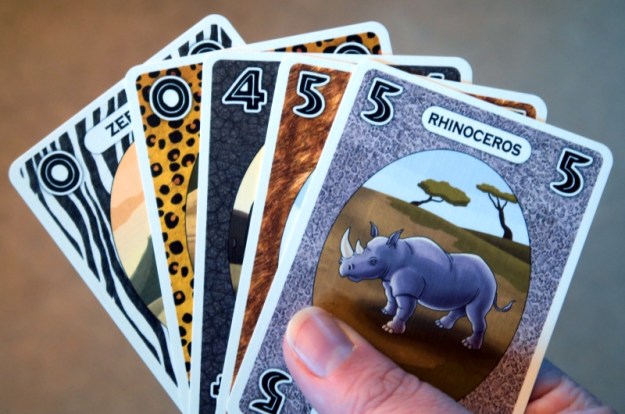
It took so much effort though, that when Pine pushed the tunnel past the gold card, although it only needed a couple of extra tunnel segments, the Dwarves couldn’t make it giving a rare victory for the Saboteurs.  As Roll for the Galaxy was still going and there was a little time left till last orders, there was just time for a quick game of 6 Nimmt!, an old favourite. Blue commented that the name was one of the infamous German joke game titles, and Yellow added that “Nimmt” was the imperative of the German verb, nehmen, to take, thus when the sixth card is played on a row, that player takes the other cards.  The player with the fewest bulls heads wins.  We’ve played it quite a bit recently with the professional variant where cards can be added to the low or high end of the rows.

6 Nimmt!
– Image by boardGOATS

This time, however, as time was pressing the group decided to stick with the simple maths.  We play over two rounds with half the deck in each.  Lime had a complete nightmare in the first round, with twenty-seven “nimmts” in the first round; Pine in contrast managed a clean sheet and Black only picked up two points, so it was all to play for, for some at least.  Lime did much better in his second round giving him a total of thirty-three, only slightly more than Yellow, while Blue managed nearly that in the second round alone, top-scoring with a nice round fifty.  Black picked up just five, but there wasn’t much anyone could do to compete with Pine, who picked up just one solitary point in the second round, his only one in the whole game.

6 Nimmt!
– Image by boardGOATS

Learning Outcome:  Betting can be a mugs game.

27th December 2022

It was a quiet night with everyone still recovering from Christmas.  Black and Purple arrived at the advertised 7pm, soon followed by Lime and then Pink, Blue and Pine.  After a bit of chatter about Christmas and the “To Let” sign outside the pub, the group eventually settled down to play the “Feature Game“, Zuuli.  This is a light, family friendly, card drafting game that is a bit like Sushi Go! or 7 Wonders, but with animals.  Similar to Sushi Go! or 7 Wonders, players choose a card from their hand before passing it on to the next player.

Zuuli
– Image by boardGOATS

In contrast to Sushi Go!, however, instead of using cards at the end of each turn, players save them until the end of the round and then try to make sure they have all the animals housed.  The game is played over three years (“Really?” commented Lime, “I thought you said it was a short game—I had no idea we were going to be here until 2025!”).  In the rules as written, there is scoring at the end of each of the three rounds (or years), but it was clear that everyone was struggling with the rules a little at the start, so we “House Ruled” it so for the first game, we only scored at the end of the final year.

Zuuli
– Image by boardGOATS

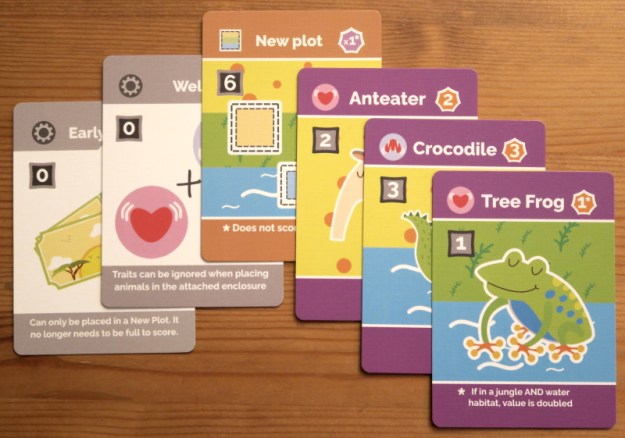
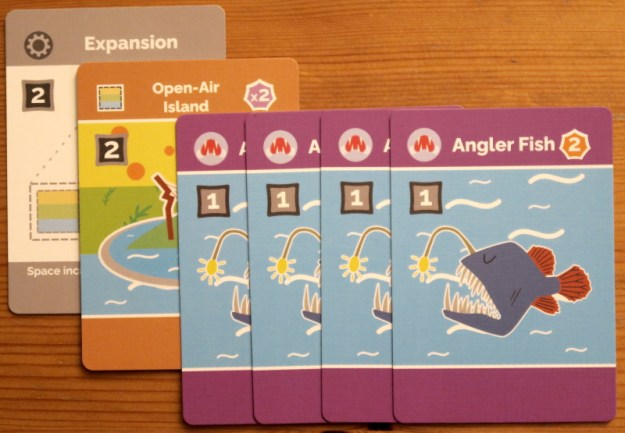
The idea is that each enclosure has a size, habitat type and a satisfaction multiplier while each animal has a space requirement, habitat and satisfaction.  To score, for each enclosure, players simply add together the satisfaction value of the animals and multiply the total by the value for the pen.  There is a catch, however.  As well as ensuring the animals have enough space in the right habitat, players also have to make sure that animals don’t eat each other: animals are either fierce or friendly, friendly animals can share an enclosure, but fierce animals can only live in an enclosure with their own kind.

Zuuli
– Image by boardGOATS

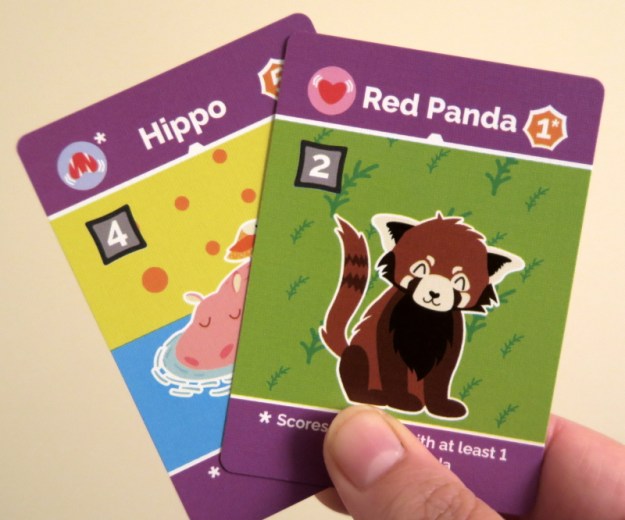
Additionally, some animals and some enclosures have special conditions, for example, tree frogs score double if they are in both water and jungle habitat, and the starting enclosure (the “New Plot”), only scores if it is fully occupied.  There were lots of rule clarifications:  the first concerned why you would want more land expansions which add no additional space (answer, because they add terrain type).  Then some of the animal conditions needed clarifying, and finally whether an expanded New Plot needs to be full (including the expansion). This was not helped by the fact we were including the extra cards from the mini expansion (now included in the second edition, namely hippos and red pandas).

Zuuli
– Image by boardGOATS

As a result, it was a bit of a messy first game, made worse by the fact that the Christmas spirit meant people were struggling to concentrate.  The end result was quite tight though with a single point between first and second as Pink just pipped Blue with Black not far behind.  It was no surprise, when Lime suggested giving Zuuli a second try now we all knew what we were doing.  As it turned out, this was more a case of, “now Lime knew what he was doing.”  This time, we played with the rules as written, including the scoring at the end of each year.

Zuuli
– Image by boardGOATS

By the end of the second year, it was very clear that Lime was going to be the winner, the only question was by how much.  In the end he beat Pink into second by a massive twenty points as he finished with seventy-one, though Pink felt he deserved a bonus points for failing to kill his red pandas with hypothermia (unlike Longleat who managed to kill their two cubs born to much fanfare over the summer).  Blue and Pine were not far behind Pink fighting it out for third, but this time it was all about Lime whose scores in the second and final year were well ahead of everyone else’s.

Zuuli
– Image by boardGOATS

With six, the question was then whether to play as two groups of three, or stick with a larger group of six.  As a sociable group, especially at Christmas and other festivals, we tend to go for the latter, and this time was no exception.  Whenever there are six players, Keyflower always gets a mention and Pink had put it in the bag, but it was too late to start it really.  That left either a couple of much shorter, filler-type games, or Niagara.  Mostly people have refused to play Niagara with Pink since, in a “Moment of the Year” he infamously won a game by daring to play by the rules, stealing gems from several others including Burgundy and Blue who never forgave him.

Niagara
– Image by boardGOATS

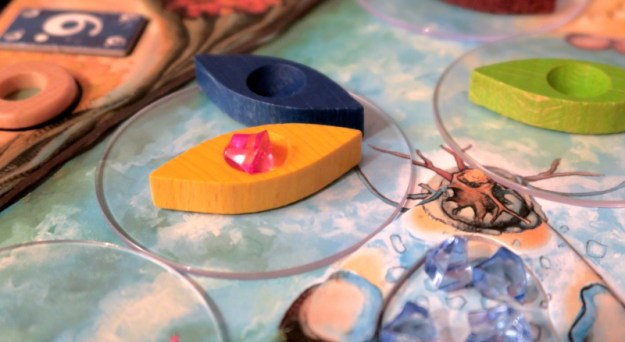
Lime felt that with five against one it was a good opportunity for the group to get their collective revenge and Niagara duly made it to the table.  This is an older game which won the Spiel des Jahres Award nearly twenty years ago, but is still a lot of fun.  It is a sort of programming game where players simultaneously choose which Paddle tile they are going to play and then take it in turns to activate that action (mostly move their canoe).  Players begin with two canoes which they use to collect gems and attempt to return them to the starting jetty; the winner is the first player to get home four identical gems, one of each of the five varieties or any seven gems.

Niagara
– Image by boardGOATS

The game is really made, however, by the really cool moving river, which is essential to the game play.  After each round, the river moves, with the movement equal to the movement of the slowest canoe.  In addition to moving canoes somewhere between one and six spaces (depending on the Paddle tile played), players can also adjust the speed of the river by playing a Cloud Paddle Tile.  This adds a little extra jeopardy, especially as players cannot reuse Paddles until they have used them all and when they play their cloud, their canoes don’t move and therefore risk their craft plummeting over the cataract.

Niagara
– Image by boardGOATS

It costs two movement points to pick up a gem (or drop one off).  However, if traveling up stream and the boat finishes its movement on the same space as another loaded boat, the player can steal from other players on the same space, as long as they have space in their boat.  Native, Niagara only plays five, however, with the Spirits of Niagara expansion, it plays six, though with a few rules tweaks.  These include replacing one single canoe with a double canoe that can hold two gems which makes stealing easier and more likely.  There are also new Paddle cards, the introduction of a Whirlpool, the Bathing Beaver and the Hurried Elk.

The Spirits of Niagara
– Image by boardGOATS

Most of these just make things more complex.  So Blue made the executive decision to only include an extra Paddle Tile (value seven) and replace the slowest Paddle Tile (value one) with the 1/2/3 (which allows the player to decided how many they can move, but they can only move one boat).  This seemed to maintain the simplicity of the original game while ensuring there wasn’t too much carnage.  That said, almost everyone ended up with at least one boat going over the falls, Lime lost several.  All that proved was that crime doesn’t pay, however, as he repeatedly nicked gems from poor Pine.

Niagara
– Image by boardGOATS

Following the ill-feeling last time, Pink announced his strategy up front—to win, by whatever means was necessary within the rules, including stealing gems.  However, when fate chose him to go first, he garnered opprobrium (and a rules check) when he began by playing his seven and picked up two purple gems on his first turn.  Pine also tried stealing gems from others, but as they were immediately pinched by Lime who followed him in turn order, he commented that it felt just like pay day—there one moment and gone the next!  Blue was the first to get a gem home, though it was a colourless one, one of the easiest to claim and it wasn’t long before others followed.

Niagara
– Image by boardGOATS

There was a bit of group-think going on, with players generally playing their higher value Paddle Tiles at the start, making the river run fast before it slowed down later when everyone played slower Paddle Tiles.  Black and Blue increased the flow of the river to its maximum, but Lime slowed it down again at the first opportunity.  We had just got through the Paddle Tiles the first time when Lime commented on his plans.  Black responded that he wasn’t going to get another as he was going to end it, and if he didn’t Pink would.  In the event, Black, Pink and Blue all achieved the winning condition with four gems of the same kind but Blue and Pink had collected a fifth so rejoiced in their shared victory.

The Spirits of Niagara
– Image by boardGOATS

There was just time for one last game, of an old favourite, 6 Nimmt!.  This is one of our most played games and slightly controversially won the Golden GOAT Award in 2020 largely for keeping us sane while playing games online.  Online we played a lot of the “Professional Variant”, but this time we chose to keep it simple.  Players simultaneously choose a card from their hand and then, in ascending numerical order, the cards are added to one of the four rows.  Each card is added to the row ending with the highest number that is lower than the face value of the card played; if it is the sixth in a row, it becomes the first card instead and the player adds the other five cards to their scoring pile.  The lowest score is the winner.

6 Nimmt!
– Image by boardGOATS

We play a variant that has two rounds and sees all (or almost all, depending on player count) of the hundred and four cards in the deck.  This time, the first round was quite attritional as everyone picked up cards.  Aside from Pink who picked up twice as many points as anyone else, it was all quite close though.  The second round was more variable however.  It was Black who top-scored this time, giving him a total of thirty-two, one more than Pink’s final score.  Most of the other scores averaged out giving totals in the high teens, however, Purple’s second round clean sheet gave her a winning score of nine.

6 Nimmt!
– Image by boardGOATS

And with last orders called, that was it.  There was a little bit of chat about the New Year Party, but otherwise it was a sad farewell.  With more uncertainty surrounding the pub, it is a little unclear whether it will still be open for the group’s next scheduled meeting (10th January), so we will see.  With that very much in mind, we waived good night to the staff, wished them a Happy New Year and hoped to see them in January.

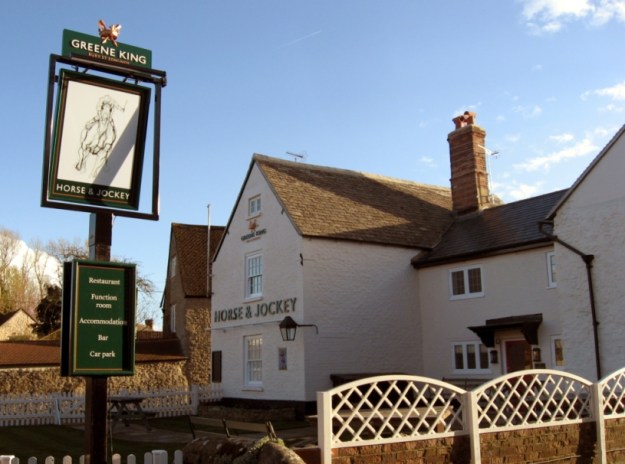
The Horse and Jockey
– Image by boardGOATS

Learning Outcome:  Don’t leave red panda cubs out in the cold.

Golden GOAT Award Winners – 2022

As usual, the boardGOATS met just before Christmas for a party and to decide the winners of the GOAT Awards.  After pizza and crackers and the usual mayhem, the group voted for two awards:  the Golden GOAT for our favourite game and the “GOAT Poo” award for our least favourite.  Everyone had the usual three points to hand out for the Golden GOAT Award (plus a bonus if wearing Festive Attire), though a maximum of two points could be given to any individual game.  Everyone could also nominate up to two individual games for the GOAT Poo Prize.

Dice Hospital
– Image by boardGOATS

This year, there were a few games that received the unofficial “Marmite Award”, that is to say they received nominations for both the Golden GOAT and the GOAT Poo prizes.  These included Dice Hospital, Azul, Modern Art and Viticulture.  For the GOAT Poo Prize itself, there were several games that received two or three nominations, but the clear winner was Villainous – The Worst takes it All which received six nominations—quite an achievement since only five people played it and one of those wasn’t present for the vote!  Villainous is a beautiful, asymmetric card game, but one that we struggled with for several reasons, not least the fact that players had to work out how to play their own character, and we were playing it with five people which is two or three more than it needs.

Disney Villainous: The Worst Takes it All
– Image by boardGOATS

Nominations for Moment of the Year included two epic games, one of Viticulture and the other of Tapestry.  The latter nomination included the citation:  “I thought I was doing well until Ivory lapped me… twice!”  Pine also recalled Lilac nobbling him in Turf Horse RacingThe most poignant moment however, with hindsight, was last year’s UnChristmas Dinner, which was the last meeting attended by Burgundy, who very sadly, suddenly passed away just a few days later.  We all still miss him, but the fact we were joined by Jade and Plum and their partners this year is his legacy, and one we think he would have been proud of.

Mike Parker
– Image by
Pushpendra Rishi

And that just left the Golden GOAT Award for the best game of the year.  Previous winners including Wingspan, Altiplano and 6 Nimmt! were ruled out, but there were plenty of options remaining.  Lots of games received three nominations including Endeavor, Cascadia, Old London Bridge, Splendor, Tapestry and Die Wandelnden Türme  But this year, the clear winner was Everdell. This card-driven game was only played for the first time a few weeks ago, but it is planned to play it again soon with one of the expansions being the “Feature Game” early in the new year.

Golden GOAT - 2022
– Image by boardGOATS

Remembering Burgundy on his Birthday

Burgundy (also known as Mike Parker) was an Oxfordshire gamer who sadly passed away at the end of December 2021 and is much missed.  He would have been sixty-four on Saturday 27th August and a small group decided that we couldn’t let his birthday pass unmarked.  So, at the South Oxford Crematorium, in Garford (where his ashes had been scattered), six people met to remember him and set light to a 6 Nimmt! card in his honour. The idea was a nice one, however, it turned out that a lighter would have been better than matches in the slight breeze, and 6 Nimmt! cards are not as flammable as we thought:  Burgundy would have been highly amused watching or perhaps he was teasing us by blowing out the flames.

6 Nimmt!
– Image by boardGOATS

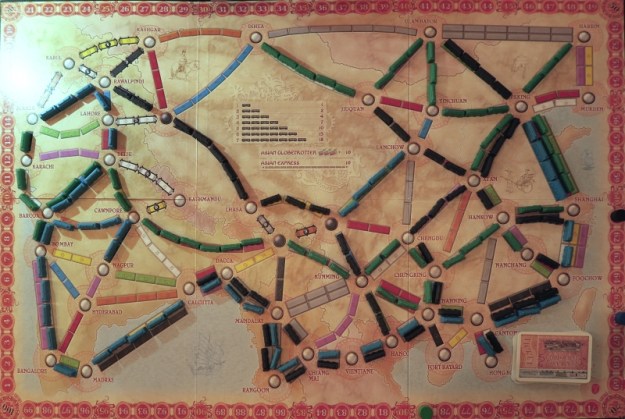
Eventually though, card number sixty-four was successfully burned, or rather charred (or at least most of it was), without doing too much damage to anybody’s fingers or setting fire to the tinder-dry countryside.  From there, the group went to The Fox in Steventon to honour Burgundy’s memory by playing some of his favourite games.  With six, the choices were limited without splitting into two groups, but one of Burgundy’s favourites was Ticket to Ride and the Team Asia expansion allowed everyone to play together.  It was a much tighter game than it had been earlier in the week and everyone played in the “Spirit of Burgundy” with lots of moaning when they picked up a card they didn’t want.  Team Purply-Black ran out the winners, just three points ahead of Team Pinky-Blue (who would have won had Pink let Blue take a chance and draw tickets on her last turn).
Ticket to Ride - Team Asia
– Image by Lilac

The group were going to squeeze in a quick game of 6 Nimmt! while waiting for food, but the cards (now one short of course) had barely been shuffled when food arrived.  Black, who missed out on on Ham, Egg & Chips at Burgundy’s wake, made up for it this time and then the group had to decide what to play next.  Bohnanza and 6 Nimmt! were options of course, but Green and Black were keen to play something heavier, though that would have meant splitting into two groups which somehow just didn’t seem right.  Concordia was another of Burgundy’s favourites and might have been an option with the Venus expansion, but that was moot as we didn’t have it.
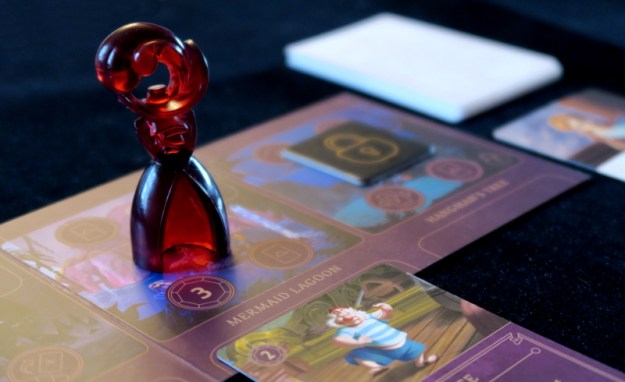
Wingspan
– Image by boardGOATS

In the end, the group settled on Wingspan with the European expansion.  Although this only plays five, with two copies the group was able to make it work with an extra player.  This overpowers the “once per turn” (pink) cards, and leads to a lot of down time, but it felt the right thing to do for the occasion.  As a result of the slight unbalancing of the game, Blue got a lot of wheat, Green got an awful lot of worms, Pink and Purple Tucked a lot of cards, and Lilac was left at a bit of a disadvantage as she didn’t get a pink card at all.  Green was the eventual winner by some fifteen points, though it was very close for second with Blue just pipping Purple by a single point.  With the bar closing it was time to go home, but everyone felt that Burgundy would have approved, and would have enjoyed the evening too.

Mike Parker
– Image by Pushpendra Rishi

23rd August 2022

The evening started badly when Purple, Black, Plum and Pine all turned up hungry to a pub that wasn’t serving food and Blue was delayed taking her last opportunity to play with her hosepipe.  Eventually, Blue arrived and suggested getting food from Darren at “The Happy Plaice“, who delivers chips around the area and is in Stanford-in-the-Vale Village Hall car park on a Tuesday.  Blue and Plum nipped off to place an order and returned five minutes later with a collection time of 8pm, which left just enough time for a game of Azul.

Azul
– Image by boardGOATS

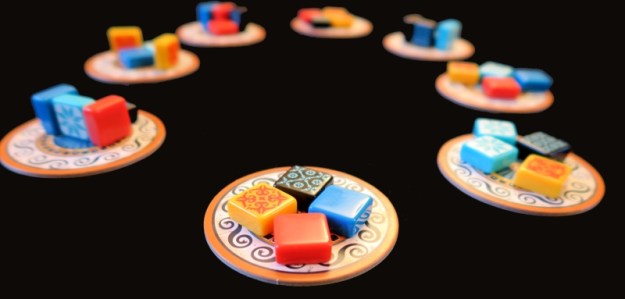
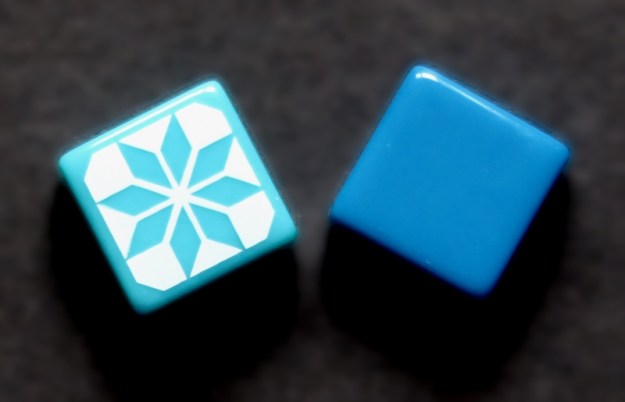
Azul is a simple, largely abstract game that we’ve had a lot of fun with since it came out at Essen five years ago.  The idea is that there is a market place where are a number of Factories are selling tiles.  Players can take all the tiles of one colour from one of these Factories and sweep the rest into the Remainders Bin in the centre of the table, or take all the tiles of one colour from the Remainders Bin.  These tiles are added to their one row in their display, but the catch is that they must be added to the same row and match any tiles already there with any left-overs scoring negative points.

Azul
– Image by boardGOATS

At the end of the round, any completed rows are scored:  one tile is moved across to the Mosaic taking its place in the row it was collected in and scoring points for any rows and columns they become part of.  The game ends when one player fulfills one entire row in their Mosaic, and since the mosaic is a five by five square, that means after a minimum of five rounds.  With bonuses added for completed rows, completed columns and sets of five of the same colour, the player with the most points is the winner.

Azul
– Image by boardGOATS

Pine started taking tiles from the bag and started debate about what colour the patterned pale blue tiles were.  He referred to them as “green”, when clearly they were blue.  However, when he pointed out that the blue tiles were blue, it made a bit more sense, though really, they were not green.  Plum opined that they might be cyan and Blue suggested turquoise, but pretty much everyone agreed that they weren’t green.  Pine continued to call them green though, probably partly to slightly annoy and confuse everyone else, but also because to him it was just easier and less confusing.

Another kitty picture of Plum's
– Image by Plum

Plum did unexpectedly well, unexpected because she was distracted when someone mentioned kittens, and for a while she took her turns very quickly so she could return to finding more kitty snaps to pass round.  Perhaps others found them equally distracting or maybe the kittens just gave Plum a bit of extra good luck.  Certainly luck played its part, when for example, she had the first player token and one of the factory tile had three of the cyan/turquoise/green tiles that she had fallen into collecting.  We don’t generally “play nasty” and in general, nobody really engages in hate drafting and the same was true this time, so luck played its part a few times.  Plum finished some way ahead of all the others scoring eighty-two, over twenty more than Pine in second place.

Azul
– Image by boardGOATS

Blue disappeared about half way through to collect the chip order and, on her return, Azul was over and almost everyone else had arrived.  So while the now very hungry folk tucked in, Green and Lilac started the “Feature Game” which was Scotland Yard.  The food was worth the wait though, because as Black commented, it was some of the best fish he’d had for a long time.  Orange, Lemon, Teal and Lime joined in setting up Scotland Yard, which is a semi-cooperative social and logical deduction game where one side is a team of detectives are trying to catch one player who is Mr. X and is on the run.  Mr. X moves around London taking taxis, buses or subways while the detectives, who nearly always know his mode of transport, work together to try to locate and then catch him.

Scotland Yard
– Image by boardGOATS

At the start of the game, the detectives are given a set number of tickets allowing them to travel by taxi, bus and on the underground.  In addition to taxi, bus and Tube tickets, Mr. X (in this case Green, as he was most familiar with the game) also gets two “Double move” tickets and five “Black tickets” which can be used on any service, but can also be used to travel along the Thames by River Boat.  Players can only move between locations if they are connected by a line with the colour dictating the transport type.  Only one player at a time can be at any station so Detectives must work together to not block each other off.

Scotland Yard
– Image by boardGOATS

Detectives can never share tickets with each other, and cannot hide their remaining tickets from Mr. X.  Once a Detective runs out of a certain type of ticket, they cannot use that service again.  Mr. X always moves first followed by the Detectives, and he writes down the destination of his next move in the next free space in the log book, then covers it with the ticket he used.  Mr. X must surface after his third, eighth, thirteenth, eighteenth and twenty-fourth (final) move, by making his move as normal and then placing his pawn where he is for that round. The Detectives win if they are on the same location at any time as Mr. X, whereas Mr. X wins if he evades the detectives until they run out of tickets.

Scotland Yard
– Image by boardGOATS

Since it wasn’t until the third round that Mr. X first appears, not a lot happened in the first couple of rounds and everyone just milled around their starting positions, edging towards the interchange stations.  When Mr. X duly appeared in round three, it was at Bank station, but Green decided not to hang around and played his double turn with a black ticket to disappear again, leaving everyone uncertain as to where he had travelled to.  There was much discussion and Lime was certain he had taken the Tube line to Kings Cross. Not everyone was in much position to travel far, so Lime took himself in that direction since he was already in the area, Lilac was closest to Mr X’s last known location and headed by taxi that way.

Scotland Yard
– Image by boardGOATS

Everyone else tried their best to head towards East London, some north of the river and some south.  Although Lime’s suggestion was a good one, and later Green admitted that he had missed that as an escape route, he had in fact taken a taxi towards the bridge in the hope of out-foxing everyone by staying somewhat close to his last known position.  For the next few turns, only Green knew that Lilac was actually tracking Mr. X only one space behind for most of the next several turns, until Lemon had arrived and then was also only one space behind.  In the second appearance, Green again did a double turn with a black ticket, but this time he only had a taxi or a bus as an option.

Scotland Yard
– Image by boardGOATS

Lime felt somewhat out of the game as he had chased a wild goose on his own towards Regents Park, but everyone else was closing in and it was looking extremely tight for Mr. X.  This time Mr. X used the bus, but the consensus amongst the detectives was that he had used another taxi and was close by.  As a result Green slipped past them and crossed the river.  There then followed a cat and mouse game in the south east corner. Green was unable to (secretly of course) get to another bus station as the detectives were too close, and he was left relying on taxis to shuffle around the streets.  Amazingly, he managed to keep just out of reach of the detectives, but when he had to reveal his location again, everyone knew what they had to do.

Scotland Yard
– Image by boardGOATS

By this time, Lime had managed to double back and was able to rejoin the action.  The detectives debated where Mr. X could possibly be with much discussion and gesticulation of locations on the board. As the end of the game neared and time was running out, the game seemed to swing away from the Detectives’ grasp. They started tripping over each other and then realised they had used far too many Taxis and ran out. Left with only buses and tubes, it became difficult to close the net and Mr. X was able to just flit around doubling back regularly to stay just out of reach and win the game.

Scotland Yard
– Image by boardGOATS

Everyone had enjoyed that game and nobody wanted to go home just yet, so as the other games were still ongoing, the group settled on a quick game of 6 Nimmt! as a short one for six players.   The game is very simple and everyone knows how to play:  simultaneously choose a card to play which is added to one of the four rows on the table.  They are added to the rows starting with the card with the lowest face value; each card is added to the row ending in the highest number card that is lower than the value of the card played.  If the card is the sixth card, instead the player picks up the five old cards.  The player with the fewest “nimmts” (bulls’ heads) is the winner.

6 Nimmt!
– Image by boardGOATS

6 Nimmt! did not fail to deliver it’s usual mix of lucky escapes and unfortunate catches to the amusement of all.  No-one escaped cards in the first round, but both Orange and Teal succeeded in being “nimmt free” in the second.  As a result it was these two who finished with the lowest score taking first and second place respectively.  Lilac and Lemon were less fortunate, and top-scored with the most nimmts overall.  That was enough for Lime and Teal who decided to head home. Green and Lilac considered leaving too, but eventually decided on a quick four player with Lemon and Orange, and Tsuro was the choice.

Tsuro
– Image by boardGOATS

Quite quickly, Orange, Lemon and Lilac moved quite close to each other, leaving Green to wind his own path on the other side of the board. A couple suitable tiles later, Orange and Lemon avoided a collision and headed off in different directions and away from Lilac. Everyone was able to meander their own way for a few more turns until Lilac realised she was headed to a dead end and in two tiles turn was guaranteed to run off the board.  Orange and lemon managed to survive for only one turn more, when Lemon was forced to play a tile that sent them both off the board. This was a lucky escape for Green as he would also have had to head off the board on his next tile.

Tsuro
– Image by boardGOATS

Meanwhile, as the five chip-eaters finished their supper (and made the rest of the pub clientele jealous with the smell),  Ivory and Blue tried to come up with something to play—either a game that played six or two smaller games.  Usually, the group would go down the route of two small games, but this time, Blue found the Asia expansion map for Ticket to Ride in Ivory’s bag, and as the Team Asia variant plays six and everyone loves Ticket to Ride, it wasn’t long before the decision was made.  This version of the game has only a few small rules tweaks, but the feel is completely different to every other version as players are working in pairs and teamwork is essential.

Ticket to Ride - Team Asia
– Image by boardGOATS

The basic rules are still the same:  players take it in turns to either take Train cards, or use the Train cards to pay to place Trains on the map with the number and colour of the cards matching that of the route claimed.  As usual, players are trying connect the locations marked on their Tickets for which they get extra points for completing and lose points if they fail.  The difference in the Team Asia variant is that players work in teams, and unusually for a game played in pairs, players sit next to their partners.  This is very clever and really makes the game work as it means one player can set up their partner.

Ticket to Ride - Team Asia
– Image by boardGOATS

The other rules tweaks are centered round cards that the players in a team share and cards players keep private.  At the start of the game, players place one of their Ticket cards into the shared area, so that both players can see them, other cards are kept private (though players can choose to take a turn to reveal two of their hidden cards to their partner).  When a player draws Train cards, one of these must be placed in the shared area with the other placed in their private hand—a decision players have to make when before they draw their second card.  Similarly, should a player draw more Ticket cards, only one can be shared while the others are kept private.

Ticket to Ride Demo
– Image by boardGOATS

Players also have separate pools of Train pieces (albeit with teams having the same colour), which is critical, because if one player runs out of pieces, they are significantly restricted in what they can do.  The game ends when one Team has only four Train pieces left (or fewer), at which point every player gets one more turn.  The game starts with everyone getting four Train cards and five Tickets from which they must choose at least three, a difficult choice, and one to share, another difficult choice.  The looks on everyone’s faces as their partner’s chosen Ticket was revealed told the tale for each pair.  While Blue and Ivory were reasonably satisfied, Pine and Plum were decidedly unimpressed and Black and Purple just shrugged.

Ticket to Ride - Team Asia
– Image by boardGOATS

After several attempts to drop just one Train piece in a random selection sort of way, Team Piney-Plum went first. Pine placed the first Train and everyone else groaned as they seemed to hit the ground running.  Everyone started placing trains in the south east corner of the map, with the teams moving out in different directions.  When Pine was clearly unimpressed with the Train cards available in the Market and shrugged taking anything, Ivory delightedly pointed out that he should have taken the one off the top of the pile when it turned out to be a Locomotive (wild) card.  Pine equally delightedly pointed out the same to Ivory when he did the repeated the feat couple of turns later.  From then on, it seemed that almost every time someone had the same decision, the same thing happened and, as a result, “Should have taken the one from the pile” became a frequent chorus.

Ticket to Ride - Team Asia
– Image by boardGOATS

Team Piney-Plum took the lucrative red line into Cawnpaw giving them fifteen points and an early lead which they never really reliquished during play.  In contrast, Team Bluey-Ivory got stuck with lots of single Train lines and lagged at the rear.  After some grunting, muttering and non-specific pointing, Ivory commented that they’d “take the coastal route”.  When Pine pointed out everyone who was listening knew where they were going, Blue pointed out all the possible coastal routes, but nobody was really fooled.  There were two things that stopped anyone from interfering: firstly, the group rarely plays “nasty”, but mainly, everyone was too worried their own issues to give anyone else more problems.  Indeed, when Ivory pointed out the singleton white route between Chunking and Nanning threatening to take it to block Team Purpley-Black, nobody really thought he was serious.

Ticket to Ride - Team Asia
– Image by boardGOATS

That didn’t stop people messing up each other’s plans however.  For example, when Blue spotted Pine had picked up two orange cards, she nipped in quickly and nabbed the line from Cawnpaw to Bombay with a pawful of Locomotive (wild) cards—this wasn’t out of spite though, it was simply critical to Team Bluey-Ivory’s plans and without it, they would have been very stuck.  Team Piney-Plum also had a bit of a tussle with Team Purpley-Black in the south east quadrant of the map, and then got in a bit more of a tangle with Team Bluey-Ivory around the Punjab.  However, with only two teams getting in each other’s way each case, everyone was mostly able to work round it and get to where they wanted to be.

Ticket to Ride - Team Asia
– Image by boardGOATS

Black was the first to take more Tickets (four, choose at least one, with won in the shared area) and then Ivory did the same.  And then Ivory had another go too, keeping a Ticket that made Blue squawk, but Ivory was right when he said he thought it could be done.  So much so that a couple of rounds later, Blue took a punt on Tickets too, and although she got unlucky, she did at least get a nice short route they could bin with little loss.  In contrast, Team Piney-Plum eschewed the option of taking Tickets as they were to busy struggling to complete their starting set and were focused on building a ridiculously roundabout route that covered almost all four corners of the map.

Ticket to Ride - Team Asia
– Image by boardGOATS

Towards the end of the game, Team Purpley-Black made a late dash to the north west, including a brave, and ultimately successful effort to build a Tunnel into Rawalpindi.  They were the only ones with the courage to try digging with all the Tunnel routes being high risk, low reward.  Indeed, Blue’s Ticket attempt gave her Team an opportunity for eighteen points, but she decided discretion was the better part of valour because even though it only needed one Train piece, it was a Tunnel section potentially needing up to seven cards.  As the game drew to a close, there was the usual scrabbling to get points at the end; Pine ran out of trains, but Plum still had a handful so didn’t trigger the end of the game until the next round.

Ticket to Ride - Team Asia
– Image by boardGOATS

At this point, Team Piney-Plum had a huge lead, and after the obligatory recount they increased their lead by taking the Asian Express bonus for the longest continuous route (with forty-five Train pieces).  Tickets were then added, starting with Team Purpley-Black.  They had lots of Tickets and quickly took the lead.  Team Bluey-Ivory were next—they also had a lot of completed Tickets, on average of a slightly higher value and one more than Team Purpley-Black as it turned out, which meant they just took the Asian Globetrotter Bonus and with it, the lead.  That left Team Piney-Plum, and although they completed all their tickets, they didn’t have as many and, were unable to overhaul Team Bluey-Ivory’s lead taking a valiant second.

Ticket to Ride - Team Asia
– Image by boardGOATS

The differences in strategies was interesting though.  Team Piney-Plum’s starting Tickets didn’t match at all so they went the round-about route almost everywhere, they mostly stuck to longer track sections and had a lot of cards in hand.  Team Bluey-Ivory built loads of short track sections to connect the end stations for their starting Tickets together and had a permanent shortage of Train Cards with just enough to complete their short term goal.  Team Purpley-Black prioritised getting tickets built a branched track to ensure they were all completed.  The one thing everyone agreed on though was how different the Team experience was to the usual game—not one to be played too often, but it made a nice change.

Ticket to Ride: Europe
– Image by boardGOATS

Learning Outcome:  You should always take the cards from the top of the pile…

26th July 2022

Blue and Pink were first to arrive and were just finishing their supper when Ivory joined them soon followed by Pine.  Ivory and Pink were keen to play Ark Nova which is longer than our usual fare and therefore needed a quick and early start.  So, when Black and Purple arrived, they grabbed Black and headed over to the other side of the room.  Everyone else conformed to more typical hesitant behaviour and were a lot slower to get going.  This wasn’t helped by Blue who was explaining how Pink had managed to find the “Only Panda Themed Village in Cornwall” and when Lemon and Orange queried it, she felt the need to find the photos to prove it.

The Lanivet Inn
– Image by boardGOATS

Eventually, the group split into two with Purple, Blue, Pine and Teal playing the “Feature Game“, the Spiel des Jahres nominee, SCOUT.  Although this has a nominal and very tenuous “circus theme”, it really is well hidden and “pasted on” to what is otherwise a relatively traditional, though clever little Rummy-esque card game with a Bohnanza-type twist—players cannot change the order of the cards in their hand.  The idea is that players have a hand of cards and on their turn takes an action:  they play a run or a meld (set of cards of the same value à la Rummy), or take a card from the active set (the previously played set).  The first of these actions is called “Show” and players can only Show the set they want to play beats the previously played set (called the Active Set).  A set wins if it has more cards or the same number, but a higher value, and a meld always beats a run.

SCOUT
– Image by boardGOATS

When Showing, the cards played must be consecutive in the player’s hand, so a player can, for example, take a four, five and six from the beginning, middle or end of their hand.  It must beat the current Active Set, and it then becomes the new Active Set with the old one turned face down and added to its owner’s scoring pile.  In this way, the quality of the the Active Set is ever increasing—this mechanism makes SCOUT a ladder-climbing game, of which Tichu and Haggis are probably the best known.  The problem is that of course it will become progressively difficult to play cards (especially with the consecutive constraint), so players can also use the Scout action and take a card from the Active Set, for which it’s owner gets a Scout token as a reward.

SCOUT
– Image by boardGOATS

When Scouting, players can only take a card from the end of the Active Set, ensuring that runs retain their integrity and just become shorter and maybe of lower value.  A card that has been Scouted goes into the player’s hand, anywhere they like, so they can use this to connect two cards in a run, or enhance an already existing meld for example.  The really clever part of the game is that the cards have two values, and which value they take depends on which way up the cards are.  This is clever because it adds just enough flexibility to make the game work, while not making things trivial.

SCOUT
– Image by boardGOATS

At the start of the game, players are dealt a hand of cards and choose which way up the hand goes—not the individual cards, the whole hand.  From this point on, the hand stays the same way up, but when cards are added to a player’s hand (and only then), the added card can be rotated.  The game ends when either, one player runs out of cards, or when it gets to a player’s turn and they were the last person to Show.  In addition to Scout and Show, once during the game, players can also “Scout & Show” which is often used to bring about or prevent the game coming to an end.  Players then add up the number of scoring cards and tokens and subtract the number of cards in the their hand and the player with the most is the winner.

SCOUT
– Image by boardGOATS

The game is one of those games that is a bit odd to understand at first, so Purple (who started), began tentatively, but it wasn’t long before people were Scouting and Showing happily.  There was a bit of confusion when it came to Teal’s turn and he Scouted one of his own cards—a rules check didn’t answer the question of whether he should get a token (we called them Cadbury’s Chocolate Bars because of their colour) or not, so we decided not.  It was only later that we realised that of course players could not Scout from their own set, as a round of Scouting triggers the end of the game.  Pine was the clear winner with fourteen points, more than twice Blue in second, and in spite of forgetting he could Scout & Show which would have given him victory earlier.
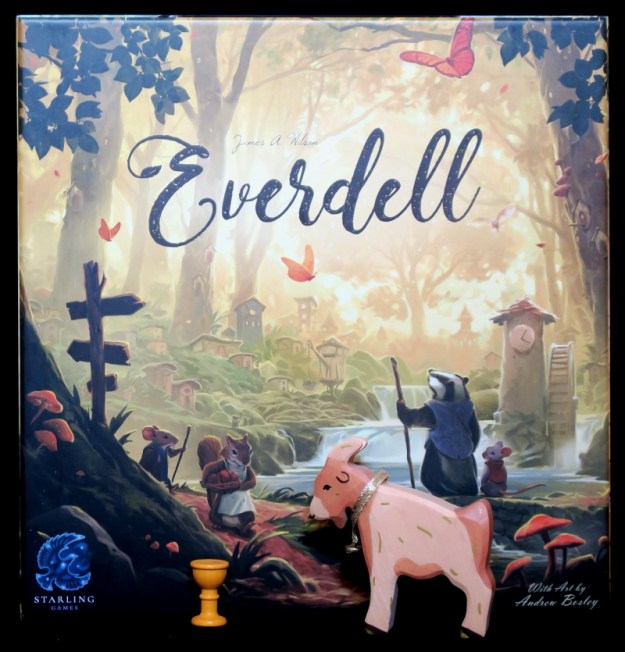
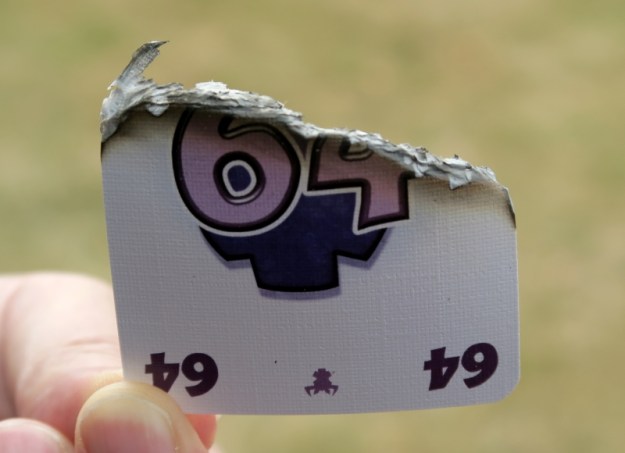
SCOUT
– Image by boardGOATS

The game can be played in campaign mode where players get scoring tokens and add up the total after several rounds, however, we tend to prefer to play games like this as single, short, one-off games.  And this time, everyone wanted to “do a Lime” and give it a second go now they understood what they were doing.  It was about this time that Pine checked his phone for the first time and reported that the England versus Sweden semi-final in the Women’s European football championships was goalless, but that “Sweden were playing well”.  There was a general slightly pessimistic noise around the table and Teal began the second round.

SCOUT
– Image by boardGOATS

A cheer from the bar prompted Pine to check his phone again and everyone relaxed a little when he reported that England had scored their first goal.  This second game of SCOUT was much closer than the first with scores of eleven, twelve, thirteen and fourteen, with Blue the victor, just ahead of Teal.  It had been a lot of fun and everyone really appreciated the cleverness of such a simple little game and found it had really grown on them from the two rounds they’d played.  There were other games people fancied playing, however, so the group moved on to Trek 12: Himalaya, a Roll and Write game we first enjoyed playing a few months ago and was given a “Recommendation” by the Spiel des Jahres Award committee.

Trek 12: Himalaya
– Image by boardGOATS

Trek 12 is similar to On Tour which we played several times online, but is a little more complex.  In On Tour, two d10 dice are rolled and players combine them to make a two digit number, so a five and a four can be combined to make a forty-five and a fifty-four, one of which is then written in a location on the map.  Locations are connected by “roads” and players are aiming to make the longest continuous route of numbers that only increase.  Trek 12 does something similar in that two dice are rolled and the numbers combined to give one, but as the sum, difference, or product, alternatively players may choose one single die (either the larger or the smaller).

On Tour
– Image by boardGOATS

The catch is that each of these operations can only be used just four times each during the game.  The resultant number is then written on the map, but the theme is trekking so chains of ascending or descending numbers represent ropes while groups of the same number represent camps.  Another difference is that in On Tour player can write their numbers anywhere on their map, whereas in Trek 12 numbers have to be added next each other.  This means that it is advisable to start in the centre and work out, advice that Pink eschewed at his cost last time we played.  Scoring is more complex as well, since players score for the highest value in each rope/camp plus one for each other number in the rope/camp with bonuses for the longest rope/largest camp and negative points for any isolated numbers.

Trek 12: Himalaya
– Image by boardGOATS

This time the group  used the Kagkot map, rather than the Dunai map used last time.  Teal, Purple and Pine all started at much the same place putting a five in the middle, but from there things quickly diverged despite the plague of fives that were rolled.  Blue decided to do something different and started with a zero in the middle.  Everyone got themselves into a bit of a tangle, but Purple struggled the most.  Part of the reason might have been distraction caused by the updates on the football as, during the second half of the match, there was a second goal, then a third.  Everyone was still digesting the third which was described as “Outrageous” when a fourth went in just eight minutes later to leave the final score four-nil to England.

Trek 12: Himalaya
– Image by boardGOATS

Teal gambled on getting the high dice rolls he wanted, and jammily got them.  However, the game was won by Blue who put together lots and lots of very short ropes and small camps to give her high base scores, with one long rope to give a decent bonus and a final total just above the target set for the map in campaign mode.  While all this was going on, Lilac and Green were introducing Orange and Lemon to Carcassonne, an older, now classic Euro game that won the Spiel des Jahres award over twenty years ago.  The game is perhaps one of the best known tile-laying games and was the inspiration for the term “Meeple“.

Carcassonne
– Image by boardGOATS

On their turn, players draw a tile and add it to the central map.  The tiles feature some combination of Roads, Cloisters, City and Fields.  Once the tile has been placed, the player can then add a single Meeple from their supply to the tile placing it on one of the features so it becomes a Thief, Monk, Knight or Farmer (respectively).  Finally, any features that are completed are scored and the players gets their Meeples back.  In this context, completed means Roads that end with a junction at both ends, Cloisters that are completely surrounded by other tiles, and Cities without gaps where the wall is closed).  Fields or Farms are only scored at the end of the game.

Carcassonne
– Image by boardGOATS

In this way, players score one point for each tile in a completed Road, nine points for a completed Cloister and two points for each tile in a completed city (plus two for any Pennants).  Although players can’t add a Meeple to a feature that is already occupied, it is possible to end up with shared features.  This happens when two separately owned Roads (say) are joined together.  In this situation, the player with the most Meeples scores the points, or, if there is a tie, both players get the points.  And this is really the crux of the game—players can play nicely or nastily, working together to build big Cities, or muscling in and stealing them from other players just before they score, or even playing tiles to make Features difficult to complete.

Carcassonne
– Image by boardGOATS

At the end of the game, Farms and any still incomplete Features are scored (though they only give only one point for each tile and Pennant in a city and one point for each tile in a Cloister array).  A Farm is a continuous Field, i.e. a green space that a Meeple could “walk” around that might be bordered by Roads, City walls, River or the edge of the map.  Each Farm then scores three points for each City that it “feeds”, i.e. that borders the Farm.  Since Farms can be very high scoring, early Farmers in the right place can be very valuable as they mean other players have to work hard to join fields together if they want to share the points.  On the other hand, an early farmer can be cut off and left scoring very few points.

Carcassonne
– Image by boardGOATS

Additionally, since they are not recovered during the game, Farmers placed early are not scoring points during the game, so part of the skill of the game is timing when to place Farmers to maximise their value.  Scores are kept on a track, and the player with the most points at the end is the winner.  This time, although there were a number of expansions available, with Lemon and Orange were new to the game, the group only added the River expansion, which consists of a small number of tiles played at the start and helps to prevent the formation of one massive Field.  Lilac explained the rules: although it is mostly a simple game, the Farmers always cause a little confusion, in particular where the edges of the Fields were and how you might end up with more than one Farmer in a field.

Carcassonne
– Image by boardGOATS

Lilac placed the second river tile and with little other option available to her placed the first Farmer.  For the next few turns of placing River tiles, the question of when another player could place a farmer was often repeated, until Orange was able to get one with a road and bridge tile.  The River started running along the length of the table, expecting the board to develop more in the that direction than to the edges of the table. Unfortunately, fairly early on the river shifted sideways and the whole board developed across the table rather than along, so they had to shift the tiles a couple of times to make room (this was not meant to be the Discworld!).

Carcassonne
– Image by boardGOATS

Lilac took an early commanding lead on the score board, with Orange next to start scoring. It seemed to take ages before Lemon got her first points and even longer for Green to get going.  However, Lilac’s lead soon disappeared as Green, Lemon and Orange shared the points for one enormous city—they thought they would never complete it, but with three people after one particular tile, it was almost inevitable really.  Lilac meanwhile was after the single bend road tile to complete a roundabout with her Meeple on it.  Everyone else got that tile, everyone except Lilac of course.  It looked like it would never happen, but in the dying moments of the game, she finally got the tile she needed. It was only worth four points, but it gave her a spare Meeple.

Carcassonne
– Image by boardGOATS

With the Farmers now understood, with his last tile, Orange was able to complete a City and then place a Meeple on the field part of that tile to be sole farmer for one complete city. It was only three points, but more than the couple he could have scored by using the tile to complete a Road. Having spotted this useful use of a final Meeple, Lemon and then Lilac both did the same.  In the mêlée of farmers, Orange came out on top, managing to knock out Lilac’s and Green’s farmers, and Lemon scored a few too.  The end result was a victory for Orange, a close second for Lemon, with the veterans of Green and Lilac well behind.  Perhaps they did not play quite as aggressively as they could have done, but mostly they just didn’t get the right tiles and were simply out-played.

Carcassonne
– Image by boardGOATS

Meanwhile, on the other side of the room, Black, Pink and Ivory were playing Ark Nova, but as it was showing no sign of finishing soon, with both Carcassonne and Trek 12 finished, the two groups had a decision to make:  play two games (maybe with a quick game of Musical Chairs first) or play one large game.  Las Vegas was suggested as a possible large game (it plays eight with the Boulevard Expansion), and Living Forest (winner of the Kennerspiel des Jahres this year) was an option if breaking into two groups.  Time marched on, and nobody in the group is very good at decision making and before long it was too late to play Living Forest and Las Vegas can take a while to play.  So in the end, the group decided to introduce Orange and Lemon to an old favourite, 6 Nimmt!.

6 Nimmt!
– Image by boardGOATS

Although 6 Nimmt! didn’t win the Spiel des Jahres Award, we certainly think it should have done; it did get a recommendation from the Jury though and of course it won the Golden GOAT in 2020 (a very difficult year for everyone).  Teal had to play taxi for his family, so headed off leaving seven to play.  The game is very simple:  players simultaneously choose a card from their hand and play it face down in front of them.  Once everyone has chosen a card, the cards are revealed and played in order from lowest to highest.  The cards are added to one of the four rows on the table—they are added to the row that ends with the highest number that is lower than the card itself.

6 Nimmt!
– Image by boardGOATS

If the card added would have been the sixth card, instead the player takes the cards in the row and their card becomes the start of the new row.  If the card is lower than all the cards at the end of the rows, instead the player chooses a row and their card replaces that row.  At the end of the game, players sum the total of Bull’s heads or “Nimmts” shown on the cards in their scoring pile and the player with the least is the winner.  There are a hundred and four cards in the deck, and we play a variant where the game is played over two rounds, each with half the cards.

6 Nimmt!
– Image by boardGOATS

The delicious thing about 6 Nimmt! is that everyone feels that they are in control, until the moment when they aren’t.  Some people argue that it is a random game, but as the same players (like Burgundy) often seem to do well, it can’t be.  That said, and it is especially true for those that often do well (like Burgundy), when it goes wrong it can go catastrophically and spectacularly wrong.  As a result the suspense is murder and the game is loads of fun yet never seems to outstay its welcome.  Orange quickly got to grips with it and clearly quickly appreciated the jeopardy.

6 Nimmt!
– Image by boardGOATS

This time we played without the “Professional Variant” that had become so popular online, partly because it would not be fair on the people new to it, but mostly because everyone was tired and nobody was up to the mathematical gymnastics it required.  This time the first round was unusual, because everyone had similar scores.  Usually, at least one player manages to keep a clean or cleanish sheet and at least one player picks up lots of pretty coloured cards, but the range of scores at half way were between seven and thirteen.  That meant it was all to play for in the second half.

6 Nimmt!
– Image by boardGOATS

The second half was a little more varied with Green only collecting four Nimmts and Blue and Lilac collecting sixteen, but the net effect largely offset the differences in the first round.  Blue top-scored with twenty-seven, Pine was just behind with twenty-six and Lilac after him with twenty-three (she really is going to have to try harder if she is going to compete with the really high scorers).  The winner though was Purple with fifteen, one Nimmt less than the runner up, Green, in what had been a tight game, but a lot of fun, as always.

6 Nimmt!
– Image by boardGOATS

Ark Nova was still on-going, so Orange, Lemon and Lilac killed a few minutes with a quick round of Dobble.  This Snap-a-Like game is simple, but a lot of fun.  This time, players started with a single card and called a match with the central pile and grabbed a card.  Despite playing in English which is not his first language, Orange is remarkably good at this game, taking twenty-two cards, beating Lemon into second place.  From there, that side of the room just deteriorated into random chatter about random pub-type things (including the Voice of Jack and the demise of Frosts at Millets) as people ran out of steam and waited for Ark Nova to finish.

Dobble
– Image by boardGOATS

By this time, Black, Pink and Ivory were rapidly running out of time as last orders had been called some time ago.  Ark Nova is a much longer game than we usually play with an advertised playing time of upwards of two hours and reputedly considerably more with inexperienced players and setup time included.  It is all about planning and designing a modern, scientifically managed zoo—when this was first mentioned at the start of the evening, Pine looked all interested in the theme, but was quickly put off when Ivory added it was “a bit like Terraforming Mars with animals”.  That said, although it is quite complex, functionally it is not difficult to play on a turn by turn basis, though there is quite a lot to manage and keep a track of.

Ark Nova
– Image by boardGOATS

On their turn, players take one of six possible actions:  activating one of the five action cards (Cards, Build, Animals, Association and Sponsor) with a strength equal to the number above the card, or move a card back to the first space and take a cross token instead.  When activating a card players perform the action based on its power level.  The power level is dictated by its position in the row, with the level one power to the left and the level five to the right.  Once a card has been played, it is moved the first space in the player’s five card row (i.e.to the lowest power position on the left) moving the other cards to the right to replace the card removed, effectively incrementing their power by one.  During the game, players can upgrade and turn over the action cards to a more powerful second side using various bonuses.

Ark Nova
– Image by boardGOATS

The Cards action is the simplest action, which lets players draw cards from the deck (the number depending on strength) then advance the marker two spaces along the break track which defines when the round ends.  The Build action allows players to pay to construct one building on their zoo map.  Players can build basic enclosures with a size of one to five, but they can also build a petting zoo for animal storage or pavilions and kiosks (which give players appeal and money respectively based on adjacent filled enclosures).  With the upgraded build action, players can build multiple different buildings and have access to the large bird aviary and reptile house which allow the storage of multiple animals.

Ark Nova
– Image by boardGOATS

There’s no point of having enclosures without animals, and that’s where the animals action comes in:  it allows players to add animals into enclosures in their zoo. Some animals have a special requirement and need a symbol in their tableau and/or the upgraded animal card. Adding an animal to an enclosure has a cost, and then the player turns over the empty enclosure of at least the size needed or places the listed cubes into a special enclosure (an aviary or a reptile house).  The player then adds the animal card to their tableau and resolves the abilities on it and receives ticket sales along with possibly conservation points and reputation.

Ark Nova
– Image by boardGOATS

The association action allows players to take one task on the association board with different tasks available based on their power level.  This allows people to gain reputation points, acquire a partner zoo they don’t already own, gain a partner university, or support a conservation.  Finally the sponsor action allows players to play exactly one sponsor from their hand which offer ongoing abilities.  They can allow players to place unique tiles in their zoo and offer end game conservation point opportunities. Some Sponsor cards have conditions on their play similar to the animal cards.

Ark Nova
– Image by boardGOATS

Players take it in turns to take actions, resetting every time a break occurs, until the end game has been triggered.  There are two tracks, Appeal (Tickets) and Conservation that follow the same course, but in opposite directions.  The game end is triggered when one player’s pair of scoring markers cross, after which, everyone gets one more turn and then the end-game cards are scored.  The player with the largest overlap between their Conservation and Appeal values is the winner.  A player’s tokens can meet and pass at any point, but Conservation points are much harder to get than Appeal, so to compensate, each step on the early part of the Conservation track is equivalent to two Tickets on the Appeal track, while each Conservation step is worth three Tickets.

Ark Nova
– Image by boardGOATS

Pink started hard and fast with a simple animal strategy concentrating on upgrading his action cards to get the more powerful actions and getting extra workers.  In contrast, Ivory and Black started a little slower and focused on getting larger (Size five) pens, like the reptile house and the aviary.  These are more difficult to get, but are also more valuable.  Ivory then added a Stork and a Condor, while Black collected a Horse and engaged the services of a European Hobbit-like Expert.  The game was about half-way through when the other table heard a howl of delight from all three of them:  The Panda card had come out.  From this point forward, Pink’s primary aim was to get the Panda and find it a nice, cosy, bamboo-filled space in his zoo where he could love it and hug it at leisure.

Ark Nova
– Image by boardGOATS

Although Pink got a lot of Tickets early, his Conservation was very low which made him look like he wasn’t a threat.  Maybe Ivory and Black took their eye off him because of this, as they seemed surprised when Pink suddenly got ten Conservation points very quickly using the Association action which triggered the end of the game quite abruptly.  In a similar way to the recent game of Viticulture where Teal did the same thing, this meant everyone else had to make the best of things.  It was probably for the best, however, as by this time it was a real race against the clock.

Ark Nova
– Image by boardGOATS

In the end game scoring, Ivory also managed to get his Appeal and Conservation pieces to cross over, but Black was less fortunate finishing with a negative score.  It was close between Pink and Ivory, but Ivory scored more in the end-game scoring and took victory by a single point.  Even though it finished in a bit of a rush, they had all really enjoyed the game; Black commented that rather than being like Terraforming Mars, to him it felt more like Wingspan, which was probably just as well as he’s not very fond of Terraforming Mars.   As they rushed to pack the game away, Pink gave his Panda one last hug before putting him back in the box and going home.

Ark Nova
– Image by boardGOATS

Learning Outcome:  Pink Likes Pandas.