Tag Archives: Bohnanza

26th January 2016

Supper had just arrived for Burgundy and Blue, so Green and Red set up our first game of the evening which was Ca$h ‘n Guns.  We last played it at our New Year games night, though only Blue and Burgundy who had been at that game had made it this time as Cerise and Grey are “still waiting” and Purple has work issues.  Green, Magenta and Red knew how to play though and gave Pine a quick run-down.  It’s not a particularly challenging filler, so set up and teaching didn’t take long, in fact the longest part was probably the debate about who was the eldest and therefore would start.  Pine lost the debate (and won the right to start).

Ca$h 'n Guns
– Image used with permission of BGG contributor punkin312

The idea is that each player has eight bullet cards, five of which are blank.  Simultaneously, everyone chooses one bullet card and, on the count of three, chooses a target by pointing their foam gun at them.  Then, The Godfather may enact his privilege by redirecting one of the guns pointing at him before he gives a count of three on which any cowards (or astute tacticians) may withdraw.  All remaining players reveal their bullet cards and the target of any live cards are out for the rest of the round and pick up a wound token.  All players still standing then take it  in turns to choose one of the face up loot cards (or the Godfather token) from the centre of the table, continuing until there is nothing remaining.  The winner is the wealthiest player who is still alive at the end of the  game.

Ca$h 'n Guns
– Image used with permission of BGG contributor punkin312

Meanwhile, Blue finished her pizza in record time, just in time to join in.  She got off to a good start going for pictures, but that made her an early target.  Magenta also picked up some potentially valuable artwork, while Green and Red traded The Godfather role a few times.  Going into the last round, it was all quite tight, especially as it is a game where players can have a hugely successful round or completely bomb out.  Pine had the hugely successful final round, as did Green, while Blue, with two wounds and a gun pointed at her head chickened out.  This meant she had a null round and finished in second with $130,000 (after a recount).  Green took the $60,000 Diamond bonus giving him $161,000 total, some way clear of the rest, and leaving Blue ruing the fact that she had made the snap decision to withdraw from the last round when she had a live bullet pointed at him.  That said, had she stayed in and taken out Green, one of the others would have taken the huge Diamond bonus and as they had more than Green without it, they could have won by an even larger margin.

Ca$h 'n Guns
– Image used with permission of BGG contributor punkin312

With Magenta wanting to leave early, we didn’t want to leave anyone stranded without a game, so decided to play something shorter as a large group first and leave our slightly longer, “Feature Game” for after.  With six, the options were limited, but there were still plenty of possibilities.  Red’s eyes lit up at the thought of Bohnanza, and although it can run on a little, we felt we could finish it and leave plenty of time for Endeavor.  After a little debate, Red got her way, and then pointed out that 2016 is “International Year of Pulses“, a fact that pleased Pine as a vegetarian who makes a mean dal.

Bohnanza
– Image used with permission of BGG contributor spearjr

Pine was the only one unfamiliar with “The Bean Game”, so Green gave him a brief run-down of the rules while Red and Magenta handed out cards.  A simple, old favourite, albeit one we’ve not played for a while, the game is largely based on the fact that players have a hand of cards that they must play in strict order.  On their turn, the active player must play (plant) the first bean card in their hand (the one that has been there the longest) and may plant the second if they wish.  Then they draw two cards and place them face up in the middle of the table so everyone can see, at which point the bidding starts with players offering trades for cards they like.  Once both cards have been planted (either in the active player’s fields or somewhere else), then the active player can trade cards from their hand too.  All traded cards must be planted before the active player finished their turn by drawing three cards and putting them into their hand in strict order.  And it is the strict order that is the key to the game, however difficult it is for players to refrain from rearranging their cards.

Bohnanza
– Image used with permission of BGG contributor spearjr

The game started with some accusations of dodgy shuffling which the guilty parties strongly refuted, but led to a strange start, with chilli beans getting sort of stuck.  Red spent nearly the whole game with no cards, yet everyone wanted to trade with her, an ominous sign, it is the player who trades most and best who wins.  Meanwhile, Green sat on a black-eyed bean field for a while, then they all came all at once, the product of more dodgy shuffling perhaps?  It was a close game with Burgundy ending with thirteen and Blue just ahead with fourteen, but the signs were true and Red won with a grand total of fifteen “beangeld”.
Bohnanza
– Image by boardGOATS

Red and Magenta left for an early night so Magenta could nurse her cold and the rest of us moved onto the, “Feature Game” which was Endeavor, a game that Green has been desperate to play for a very long time.  It is nominally about exploring, however, the slightly dry artwork, though clear, does give it a bit of an abstract feel, though ours was seasoned with a little bit of international atmosphere as we were playing with Dutch Buildings.  The game is played over seven rounds, each of which consists of four phases:  Building, Population, Income and Action.  The idea is that players have four status tracks which correspond to Industry, Culture, Finance and Politics, which roughly correspond to the four phases and dictate what players are allowed to do at each stage.

Endeavor
– Image by boardGOATS

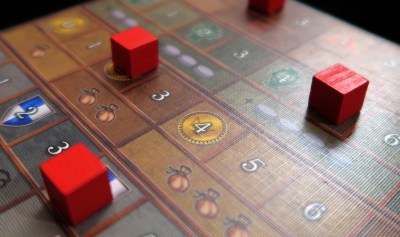
Players begin by choosing a building from the range allowed by the player’s current industry level.  Some buildings provide an increase in one (or more) of the four status tracks, some provide actions, while some of the most others do both.  Once everyone has taken it in turns to to choose a building, they then move population markers from their general supply to their harbour according to their current culture level.  A strong population is important because that ultimately limits the number of actions players can take on their turn.  The income phase allows players to move some of their workers from buildings back into their harbour as dictated by their current level on the income track.  These add to the population players have available to do things with, while also making space on the buildings so that the action is available for re-use.
Endeavor
– Image by boardGOATS

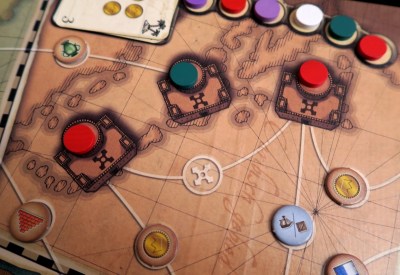
The first three phases of each round are mostly just preparation and book-keeping; the guts of each round are in the final phase, where players take it in turns to carryout an action of their choice.  There are five basic actions: Taking Payment, Shipping, Occupying, Attacking, and Drawing Cards.  In order to carryout an action, players must activate an appropriate building by moving a population marker from their harbour to the building.  In the case of shipping, occupying and attacking, the actions are carried out on the central, communal player board.  To ship, after activating an appropriate building, players can move one of the population markers to one of the six shipping tracks and take the token that was on the space.  These tokens are useful as they add to the status tracks, but some also give a free action.  Shipping is also important as it gives players a presence in a region which is necessary for occupying, attacking and drawing cards.

Endeavor
– Image by boardGOATS

When a player places the last token on a shipping track, he takes The Governor card off the top of the pile in the region and the region is considered “open”.  This means that players who already have a presence in the region can also occupy the cities within the region. This gives both tokens and victory points, but where a player occupies a city that is connected to another city they already occupy, they get an extra token, which can be very valuable, as well as providing extra points at the end of the game.  This makes position very important, but if someone occupies a city that another player wants, one option is attacking.  This is carried out in the same way as occupying, but is a separate action and costs an additional population marker.  Occupying a region also adds to a players presence in the region: players can also draw the top card from a region’s stack and add it to their player-board, so long as their total presence in the region is higher than the card number.  Cards are important as they also add to the status tracks as well as provide victory points, however there is a card limit which is enforced when a player passes at the end of the round and any status track points gained with the card are lost when cards are discarded.

Endeavor
– Image used with permission of BGG contributor henk.rolleman

Once everyone has completed one action phase players continue taking it turns until everyone passes.  Thus, the final possible action is taking payment which is the simplest action and allows players to move one of their population markers back to the harbour so that they can re-use the building in the same round. In addition to the five basic actions, some of the more expensive buildings provide a choice or even a combination of two of the basic actions.  After seven rounds, points are awarded for cities, for connections between cities, for progress up status tracks, cards, some special buildings, and any left-over population markers.
Endeavor
– Image by boardGOATS

Although the game was more complex than many that we play, and only Green had played it before, so it took a while to explain.  In the event, it was not actually as complex as we all thought at the start, but it took most of us a while to work out what we were trying to do.  The first few rounds are quite quick as there aren’t a lot of options, however, they are very important as they set the foundations for the later rounds.  With people new to it though, we mostly had no idea what we were doing at the start, but quickly picked up the rhythm of the game.
Endeavor
– Image by boardGOATS

Pine struggled at the start having had a bad day, but he made reasonable ground going down the slavery route and finished just behind Blue and Green.  It was Burgundy, however, who had managed to build his culture early in the game and capitalised on it later finishing twelve points clear with sixty seven.  While packing up, Blue, Green and Burgundy reviewed the game a little and tried to see where Burgundy had really picked up his additional points.  First we noticed that Blue couldn’t count and had missed ten points putting her second.  This meant that although we had finished with similar points for the status tracks, it was really the cities that Burgundy had occupied and connections he’d made that made the difference.  We had enjoyed the game though and thought we needed to play it again.  Although the game has essentially the same ingredients (the region cards and buildings are the same every time), we felt the starting token layout would actually have a much larger impact on game play than we had originally thought and would give it a surprising amount of replay value.
Endeavor
– Image by boardGOATS

Learning Outcome:  Some people need to take their shoes and socks off to count to more than ten!

31st December 2015

As people arrived, we began setting up the “Feature Game”.  This, as has become traditional at these New Year events, was the gorgeous, dexterity car-racing game, PitchCar. Burgundy and Pink built a fantastic figure-of-eight track that made good use of the ⅛ turns from the second expansion and made a really fast compact circuit. Before long, Black and Purple had arrived and had introduced themselves to the furry host, followed by Grey and Cerise who were armed with Champagne and Polish delicacies.

PitchCar
– Image by boardGOATS

The game is quite simple, players take it in turns to flick their small wooden cars once, starting with the player at the front of the pack. If the car leaves the track or rolls over, the player forfeits stroke and distance (though any collateral gains by other players stand).  We usually have a single solo lap to determine the order on the start grid and to allow new players to get their eye in, before racing two laps of the track.  While Blue and Pink occupied themselves in the kitchen, everyone else began their practice run.

PitchCar
– Image used with permission of
BGG contributor kilroy_locke

Cerise went first and set a very competitive bench-mark of ten flicks mastering the bridge from the first expansion on her second attempt. Asked whether she’d played it before, she replied, not since she was tiny, playing with bottle-tops. It turned out that Grey had also had a similarly mis-spent childhood and this with his competitiveness made him a formidable opponent. Black and Burgundy gave them a run for their money, but Grey took the lead and held off the competition to take first place, with Cerise close behind, a worthy second.

PitchCar
– Image used with permission of BGG contributor garyjames

With pizza already over-cooked, everyone helped to quickly pack up and then sat down for dinner. Once everyone had eaten their fill, Pink began tidying while everyone else began the next game, Ca$h ‘n Guns. This game combines gambling with a little chance and a dash of strategy, based round the theme of gangsters divvying up their ill-gotten gains by playing a sort of multi-player Russian Roulette. For some reason, setting up degenerated into a discussion about the offensive weapons act and Tony Martin and the debate was still going by the time Pink had finished what he was doing, so he joined in.

Ca$h 'n Guns
– Image used with permission of BGG contributor punkin312

Black, (playing “The Hustler”), chose to enact his special power by trading a bullet card for one of Blue’s blanks, much to her delight. Then, Pink (playing “The Doctor”), started as the Godfather, so acted as caller. So, once everyone had “loaded” their weapon with blanks or bullets, on, the count of three, everyone pointed their foam gun at someone. Pink chose to invoke the Godfather’s Prerogative and decided Purple looked most threatening, so directed her to point her gun at Burgundy.  The Godfather then counted to three to give everyone a reasonable chance to withdraw from “The Game”, but also relinquish their claim to a share of the loot for that round.

Ca$h 'n Guns
– Image used with permission of BGG contributor punkin312

Throughout, everyone was feeling quite brave, but it was Burgundy (“The Cute”) who had a particularly strong incentive to stay in, as his special power allowed him to take $5,000 before anyone else got a look in.  It was a power he used to great effect taking an early obvious lead.  Meanwhile, Blue (“The Vulture”) was the first to draw blood, defending her property against Grey (“The Greedy”).  Like The Vulture she was, when Grey picked up a second wound, Blue finished him off and took two pictures from his still warm, lifeless hands. With, Burgundy clearly in the lead, Blue had help taking him down, and Pink got caught in the cross-fire.

Ca$h 'n Guns
– Image used with permission of BGG contributor punkin312

Picking the pockets of two corpses in the same round made her something of a target and in the next round she found the staring down all three remaining barrels which effectively put her out of the game.  Purple (“The Collector”), began collecting diamonds, but, it was Cerise (“The Lucky Man”)’ who picked up the $60,000 for getting the most diamonds.  As “The Collector”, Purple managed to score a staggering five pictures netting her $100,000 giving her a cool $156,000, $6,000 ahead of Black in second place, with Cerise a close third with $146,000.

Ca$h 'n Guns
– Image used with permission of BGG contributor punkin312

With seven of us, we’d normally split into two groups, but the party atmosphere had got to us a little, and with limited table space we were keen to stick together.  With the majority of Blue and Pink’s not inconsiderable game collection at our disposal, we eschewed the usual go-to seven player game, Bohnanza, and decided to play play Between Two Cities. We played this a few weeks ago, but in essence, it is a draughting game, but one that has the depth of 7 Wonders, but with the simplicity of Sushi Go!.  As before, we didn’t use any of the seating randomisers, but since we were all sat in different places and three players were new to it, this didn’t matter.

Between Two Cities
– Image by boardGOATS

Burgundy and Black began to build up a large number of factories and thought they were in with a chance of scoring heavily with them, but didn’t notice that Grey and Pink, had more, as did Blue and Pink. Blue and Black began with a complete row of shops, and followed it with extensive white collar employment opportunities, but were unable to expand the park as much as they wanted.

Between Two Cities
– Image by boardGOATS

Meanwhile, Grey and Cerise had developed a retail outlet centre with no fewer than seven shops and a number of conveniently situated houses and office blocks. Cerise’s other city, shared with Purple began as a paradise with parks and entertainments, until they added a factory to increase the value of their housing stock. Parks had been popular at the start of two other cities too, with Purple starting her other city the same way with Burgundy, and Blue and Pink doing something very similar.

Between Two Cities
– Image by boardGOATS

After three rounds we began the complicated matter of the scores. It was quite close, but Blue and Pink’s City was disproportionately ahead, a problem that was rectified with a quick recount that left two cities jointly leading on sixty. In the normal way, the winning city can only ever be important as a tie-breaker since it is the city with the fewer points that makes each players’ score. In this case, however, Pink owned both, with Blue and Grey. Since Blue’s other city (shared with Black) had fifty-nine points, that put her a close second.

Between Two Cities
– Image by boardGOATS

A quick interlude followed for non-alcoholic Champagne, alcoholic Prosecco, white chocolate, pistachio and Diaquiri fudge, with the chimes of Big Ben and fireworks. Once the New Year greetings were complete, it was onto the important matter of what to play next. Such a large number of players meant the choices were limited, so we went with a couple of old favourites.  Tsuro was first, a quick fun game that we all know well and that featured on our list of ten great games to play with the family at Christmas.

Tsuro
– Image used with permission of BGG contributor kilroy_locke

A game that anyone can play, in Tsuro each player has a “stone” dragon and on their turn places a tile in front of it and moves the dragon along the path. As the board becomes increasingly crowded, the tiles form a maze of paths that the stones must navigate, staying on the board without colliding with anyone else while trying to eliminate everyone else.  Grey and Cerise were the first to go out by collision, followed by Burgundy who was ejected from the board by Purple. Black eliminated both Pink and Blue with one tile, before winning the game by dealing with the only remaining competitor, Purple.

Tsuro
– Image used with permission of BGG contributor zombiegod

With that over, there was just time for another of our favourite games of 2015, 6 Nimmt!.  For a reason none of us understand, this mixture of barely controlled chaos is strangely compelling, so it is a game we keep coming back to again and again. Despite the number of times we’ve played it as a group, somehow Grey had missed out, so we had a quick summary of the rules: players simultaneously choose a card, then starting with the lowest value card the players take it in turns to add their card to the four rows on the table in ascending order. The player who adds a sixth card, instead takes the first five cards to score and the sixth becomes the first card in the new row. As well as the face value of the cards, they also have a number of bulls’ heads (Nimmts) mostly one or two, but some as many as five or even seven.

6 Nimmt
– Image by boardGOATS

The aim is to minimise the number of Nimmts picked up, so things went horribly wrong from the start, with everyone picking up plenty in the first round, though it remained close aside from Purple who picked up nearly twice what anyone else took. The second round was made especially difficult by the fact that three of the four rows were effectively out of commission. Blue struggled with four cards with a value below ten as well as the highest card in the deck. Purple managed to exceed her score in the first round, giving her a near record- breaking fifty-one. Grey and Burgundy both managed a clean sheet in the second round, so it was Burgundy’s better score of just seven, that gave him the win. So with 2016 started in fine style, we decided it was time for bed.

6 Nimmt
– Image by boardGOATS

Learning outcome:  Although seven is a difficult player count, there are some excellent games available when everyone is in the right mood.

Boardgames in the News: Ten Great Games to Play with the Family at Christmas

With the nights drawing in and the weather becoming increasingly wet and wintery, what could be nicer than an afternoon playing board games in front of the fire?  If you are new to the hobby, here are ten great modern boardgames to play over the Christmas holidays.  These are all readily available online and/or in dedicated boardgame shops.

  1. PitchCar – This superb car racing game is guaranteed to get kids of all ages playing together; the winner is the person who manages to flick their car round the track first. The game plays six people, but you can get more cars from the Ferti website and play a pursuit type game which is also good fun.  You can also get expansion packs to make your track longer and more interesting if you really like it.
    Target Audience: Families & parties; ages 2 to 102…
    Game Time: From half an hour tailor-able to the group, plus time to build the track.
    Price:  Approximately £45 from amazon.co.uk for the base game (also available in a slightly cheaper mini-version for those without a large table).

    PitchCar
    – Image used with permission of BGG contributor garyjames
  2. Tsuro – Players take it in turns to build a path for their “dragon”, creating a maze for everyone else at the same time. The game lasts just fifteen to twenty minutes and plays up to eight people.  It combines just enough strategy and luck that if you get knocked out early, there is always time to try again.  Don’t be tempted to get Tsuro of the Seas though, it takes all the really good things about Tsuro and makes them slightly less good.
    Target Audience: Friends & Families with ages 8+
    Game Time: 15-20 mins with almost no set up time.
    Price:  £20-25 from amazon.co.uk.

    Tsuro
    – Image used with permission of BGG contributor aleacarv
  3. Bohnanza – This one sounds really uninspiring on reading the rules:  players have to trade beans to make the most money from the biggest and best bean fields.  Despite the unpromising sound, you only need to play it once with a couple of other people and before you’ve gone far you will agree it is one of the best games ever made – never has bean farming been so much fun!
    Target Audience: Older children and adults; ages 10+
    Game Time: 45-60 mins
    Price:  Readily available for around £15-20.

    Bohnanza
    – Image used with permission of BGG contributor spearjr
  4. Dobble – With five games in the tin, this Snap-inspired game is excellent value.  Since it relies on reactions, it is also one of those games where children are often genuinely better than adults.  And it is so quick to play that it is an ideal game to squeeze in while the kettle is boiling or tea is brewing.
    Target Audience: 3 and up
    Game Time: 2 mins per round
    Price:  Readily available for around £10 or less.

    Dobble
    – Image used with permission of BGG contributor msaari
  5. Escape:  The Curse of the Temple – While most Euro Games don’t use dice, in this game players have five each.  This is a team game that is played against the clock, so has the advantage that everyone wins or loses together.  The team of five players simultaneously roll dice to explore the temple and activate gemstones and then try to escape together before the temple collapses around their ears.  This is also ideal for children to play with adults as they can work in pairs or groups learning communication and team working skills.  If the game seems too difficult for the group, it can also be made a little easier by reducing the number of gems the group have to activate.
    Target Audience: age 5+ as long as there are understanding adults playing
    Game Time: 10 mins per game plus a few minutes setting up
    Price:  approximately £25-30 from amazon.co.uk.

    Escape: The Curse of the Temple
    – Image used with permission of BGG contributor mikehulsebus
  6. Survive: Escape from Atlantis! – This is good fun and really, really nasty.  Not quite so easy to learn, but really not that difficult either and great fun with four people who have a competitive streak.  Each player has a number of pieces that they are trying to get from the central island to the mainland.  Players take it in turns to move a person or boat, then they take a piece from the island, finally they roll a die to move a whale, shark or sea-monster, with potentially devastating consequences…
    Target Audience: Teenagers; not recommended for children under 12 or people who can’t take getting picked on
    Game Time: 40-60 mins
    Price:  Approximately £25-30 from amazon.co.uk; a 5-6 player expansion is also available which makes things even nastier…

    Survive: Escape from Atlantis!
    – Image used with permission of BGG contributor ckirkman
  7. Dixit – This is a great game to play with the mums and grannies in the family.  Players take it in turns to be the “story teller” who chooses a card from their hand and gives a clue that everyone else tries to match.  Everyone then has to guess which card belonged to the story teller, with points awarded for good guesses as well as cards that mislead other players.  The original base game plays six well, but Dixit: Odyssey plays up to twelve with a slight tweak to the rules.  Extra decks of cards are also available.
    Target Audience: Friendly groups and parties.
    Game Time: 30-45 mins
    Price:  Approximately £15-30 from amazon.co.uk, depending on the version.

    Dixit
    – Image used with permission of BGG contributor lacxox
  8. Colt Express – For older children and younger adults, this game is a glorious mixture of controlled chaos.  Players are bandits attacking and looting a fantastic 3D train.  Rounds are broken into two parts, first players take it in turns to choose the cards they will play placing them in a communal pile the centre of the table.  Then, once everyone has chosen, players carry out the action on each card in turn.  The problem is by the time they get to the end, the plans they had at the start have gone terribly awry…  A similar feel can be got from the pirate themed Walk the Plank! which is a cheaper, smaller, easier game that packs a lot of fun into a shorter playing time.
    Target Audience: Young, and not-so-young adults.
    Game Time: 30-60 mins
    Price:  Approximately £25 from amazon.co.uk; Walk the Plank! is available for £15-20.

    Colt Express
    – Image used with permission of BGG contributor henk.rolleman
  9. Ticket to Ride: Europe – Players are collecting coloured cards and spending them to place plastic trains on map/board with the aim of trying to build routes across Europe.  This game has been around a little while now and is available in several different flavours:  for the typical UK family, the Europe edition is probably best (plays up to five players), but for a couple, the Nordic edition with its gorgeous festive artwork might be more appropriate (only two to three players though).  If it is popular, there are also a number of expansion maps available.
    Target Audience: Age 10+.
    Game Time: 30-60 mins
    Price:  Readily available for available for £25-40 depending on the version and vendor.

    Ticket to Ride: Europe
    – Image used with permission of BGG contributor kilroy_locke
  10. No Thanks! – A quick and simple little betting game anyone can play.  The game consists of a deck of cards and some red plastic chips.  The first can take the top card, or pay a chip and pass the problem onto the next player.  The aim of the game is to finish with the lowest total face value of the cards, but if woe-betide anyone who runs out of chips as they will be left at the mercy of everyone else.
    Target Audience:  Friends and families; children aged 8+.
    Game Time: 10-15 mins
    Price:  Readily available for approximately £10.

    No Thanks!
    – Image used with permission of BGG contributor ckirkman

8th September 2015

We were late starting and, since we were expecting more, we decided to split into two groups and play something quick and light to start.  By coincidence, both groups began with cooperative card games.  Green, Grey and Cerise started with Hanabi – winner of the Spiel des Jahres a few years ago.  At the time we played it quite a bit, but Grey and Cerise had never been involved.  The idea of the game is very simple:  collectively, the players have to lay five cards in each of five colour-suits in numerical order.  The catch is that players are unable to see their own cards and instead turn their hand round so everyone else can see it.  As a group they then have to use deduction to work out which cards to play and in what order.

Hanabi
– Image used with permission of BGG reviewer EndersGame

On their turn, a player can do one of three things, play a card, give a clue or discard a card.  The number of clues is finite, though discarding cards buys extras.  When a card is played, the player doesn’t have to know what it is they are playing, so long as it can be added to one of the suits.  If it can’t, the group lose one of their three lives.  We have never been able to successfully complete the challenge of laying all twenty-five cards, so the group score is the sum of the highest card placed in each suit, or current maximum being twenty.   As a group we gelled well and through judicious use of efficient clues we were able to get lay all five cards for three colours and three cards for the other two.  This gave a total score of twenty-one, a new club record – definitely deserving of a “Very good! The audience is enthusiastic!”.

Hanabi
– Image used with permission of BGG contributor bovbossi

Meanwhile, Red, Blue, Cyan and Burgundy were playing the altogether less stressful, but equally puzzling, strangely eponymous, The Game.  Similarly, everyone has a hand of cards and they have to be played in numerical order, but in this case every card as to be played on one of four piles, two ascending and two descending.  There are two additional rules:  Players can say anything they want so long as they don’t give specific number information, and if they have a card exactly ten more or less than the top card of the pile they are playing it on, they can ignore the ascending/descending rule.  On their turn, players must play at least two cards before replenishing their hand, but can play as many as they want.

The Game
– Image used with permission of BGG contributor henk.rolleman

This was nominated for Spiel des Jahres this year and we’ve played it a few times since then.  Our best result was in a two player game a couple of months ago, when we had one solitary remaining card, however, we felt at the time that it might have been slightly easier with just two as you can plan better.  This time, it seemed were were doomed from the start with first Red, then Blue having nothing but really, really low cards and no-where to play them.  We managed to survive that though, and with a couple of really effective uses of the “Backwards Rule”, we managed to exhaust the draw deck.  Blue checked out first, quickly followed by Cyan and Burgundy leaving Red to play her last few cards and close out our first victory.  Next time we will have to play with one less card in hand…

The Game
– Image used with permission of BGG contributor joeincolorado

The games finished pretty much simultaneously and then a great debate began as to what to play next and how to split the group given that there were people who didn’t want to stay late.  Green proposed Eketorp, but this is one of Blue’s least favourite games, so she was looking for an alternative when Grey asked whether we had anything that would play everyone.  Blue mentioned Bohnanza, but although Red’s eyes lit up and Cerise looked interested, this time Green was not keen.  Grey wanted to play something with “fighting” and eventually, Green and Grey got fed up with the discussion and decided to play a head-to-head game of Carcassonne.

Carcassonne
– Image by BGG contributor ldaponte

Carcassonne is probably one of the best known of the modern, Euro-games, and is often considered to be “nice” – this is not true when it is played with just two however.  The idea of the game is that players take it in turns to draw and place tiles on an ever-growing map.  They can then add a meeple to any features on that tile before scoring any features that have been completed as a result of placing it.  Players have a finite number of meeples and, with two players, muscling in on someone else’s city is just as effective as building one yourself, making it very definitely, “nasty”.  And so it proved.  Playing with the first expansion, Inns & Cathedrals, Grey started with a few meeples on roads while Green placed a couple of early farmers. Green then took an early lead by completing a city with a cathedral, but then seemed to stutter. Grey continued to plug away eventually catching and passing Green nearly lapping him.  Green was hoping to reap the rewards of the early farmers, but with his last two tiles Grey placed a cheeky farmer and then joined it to the big field.  This cancelled out the huge farm bonus and put the game beyond doubt by sharing Green’s massive thirty-three point farm, finishing forty-one points ahead.

Carcassonne
– Image by BGG contributor Hayzuss

On the other table, discussion had finally ceased an everyone had settled down to one of our current favourite filler games, 6 Nimmt!, another “laying cards in the right order” game.  Somehow, this is a really confusing game, but it is this feeling that you sometimes have control but not being sure why that makes it so compelling.  The game is played with a deck of cards numbered from two to one hundred and four, each of which features a number of “Bulls Heads” (mostly just one, but some have as many as seven).  The idea is that everyone then simultaneously chooses and reveals a card from their hand.  Then, starting with the player who played the lowest card, players add their cards to the four rows on the table.

6 Nimmt
– Image used with permission of BGG contributor punkin312

Each card must be added to the row which has the highest card that is lower than the one to be played, i.e. if rows end with ten, twenty, thirty and forty, then card thirty-five should be added to the row containing number thirty.  If the card played would be the sixth card in that row, then the player “wins” all the cards and the played card becomes the first card in the new row.  The winner is the player with the fewest “Bulls Heads” or “Nimmts” at the end of the game.  We generally play the game in two rounds with half the cards dealt out at the start of the first round and the rest for the second.

6 Nimmt
– Image used with permission of BGG contributor punkin312

With two players new to the game, chaos was inevitable, however, it was Blue who ended most out of synch, collecting twenty-four Nimmts in the first round, and Burgundy who managed to keep it together and escape without picking up a single card.  Roles were reversed in the second round with Blue winning with just six Nimmts while Burgundy picked up thirty-two!  Overall though, it was consistency that won through for Red who finished with a total of nineteen, five ahead of Cyan in second place.

Coloretto
– Image used with permission of BGG contributor punkin312

Carcassonne was still going on the next table, so Cerise mugged Grey for the house keys and headed off with Red and Cyan, leaving Burgundy and Blue to play a quick game of Coloretto.  This push-your-luck set-collecting game has had a few outings recently, and although three or four are much better numbers, we feel it plays surprisingly well with just two.  The idea is very simple, either you draw a coloured chameleon card and add it to a truck, or take a truck.  Players score positively for three sets and negatively for the rest, so the idea is to try to load trucks with coloured cards you want.  This time Blue started badly and from there it just got worse, finishing with Burgundy giving her a comprehensive thrashing, winning by more than twenty points.

Port Royal
– Image used with permission of BGG contributor jsper

Carcassonne and Coloretto finished together and Burgundy, Green and Blue decided there was time to give Port Royal another go.  We played it about a month ago, when it took a surprisingly long time for a quick filler, everyone said they’d like to try it again, and Green worked out a strategy based on Expedition cards that he was keen to try.  In summary, the game is played in turns with the active player turning over cards.  They can keep turning over cards until either they choose to stop or they draw a second ship card that they cannot repel.  Assuming they choose to stop, they can then take a ship card or buy a character card before the remaining cards are offered round the table with players paying the active player one doubloon if they choose to buy/take a card.

Port Royal
– Image used with permission of BGG contributor punkin312

Last time we had found some issues with the rules which we had not really been able to resolve.  The question was, since the Admiral allows a player to take two cards, does that mean they apply the Jester/Governor special powers twice?  On reflection, after the last game we had felt that the way we played (by a strict reading of the rules) was incorrect as it meant the combination was exceptionally powerful.  So for our second try we didn’t allow this and subsequent checking online appears to suggest that we played the way the designer intended this time.

Port Royal
– Image used with permission of BGG contributor punkin312

Another question we’d had was, could a player repel a card if it was the first of a colour to be drawn, or is it only the second card that can be repelled?  Strict reading of the rules appeared to allow this, so this time we played this way.  Blue was the main beneficiary of this rules “change”, as she quickly added not one, but two Admiral cards to her earlier Sailor.  The ability to repel cards before it was essential makes it much more likely that a player is going to be able to draw five cards without going bust.  Since this gave Blue four doubloons every time, it meant she was never short of cash to buy the high value cards. Meanwhile, Green struggled to get his strategy to work with three (partly due to the lack of Expeditions) and Burgundy, who had wiped the floor with everyone else last time round, couldn’t get the cards he needed to get going quickly (not helped by the fact that he initially didn’t use the full power of his Jester).

Port Royal
– Image used with permission of BGG contributor punkin312

This time with just three it was a much, much quicker game and it played quite differently.  In the first couple of hands almost all the tax cards came out giving everyone extra money and it wasn’t until near the end that any of the mission cards were drawn.  It quickly seemed like Blue had the game in the bag although in the event, it wasn’t quite that cut and dried.  Blue brought the game to an end, but Green and Burgundy couldn’t quite get the cards they needed.  The game finished with Blue winning by five points and Burgundy taking second place on a tie-break.

Port Royal
– Image used with permission of BGG contributor msaari

Since Port Royal had played so quickly, we decided to give Zooloretto: The Dice Game a quick go.  This is a game that we’ve got out a couple of times, but then decided not to play because other people have arrived.  It was a while since we’d actually played it so we had to have a quick read through of the rules.  Each player rolls two dice, and like Coloretto or Zooloretto, they then place these on the trucks.  Alternatively, players can take a truck and tick off animals on their score sheet.  Bonuses are awarded for being the first player to complete an animal collection, but if the maximum is exceeded, then players lose points.  The game ends when one player has completed four of their animal collections and have only one space left in the last enclosure.

Zooloretto: The Dice Game
– Image used with permission of BGG contributor kilroy_locke

Burgundy started off well, with Blue and Green struggling to get any really helpful dice.  Burgundy both completed most sets first and also brought the game to a close, so the writing was on the wall:  he finished six points clear.  It was only when we were scoring, however, that we realised that Green hadn’t quite understood – he’d been going for lions assuming the bonus was lots more as you needed more of them to get the set.  Oops; blame the person explaining the rules…

Zooloretto: The Dice Game
– Image used with permission of BGG contributor henk.rolleman

Learning Outcome:  We like deep games, but little games can be a lot of fun too.

11th August 2015

It was a quiet week, so unsure of how many people we would be, we started out with what was supposed to be something quick, our “Feature Game”, Port Royal.  This is a fairly light card game with elements of push your luck and and deck (or rather tableaux) building.  On their turn, the active player turns over the top card from the deck:  this could be a coloured Ship, or a Person.  The player then has two options, they can turn over another card and add it to the row, or take one of the face up cards.  They can continue turning over cards either until they choose to take one or until they go bust because they draw a Ship and the colour matches one that has already been revealed.

Port Royal
– Image used with permission of BGG contributor punkin312

When taken, the coloured Ships are immediately exchanged for money according to the number of coins shown on the card.  They also have a military value which is where the People cards come in.  The People cards cost money, but in general, yield both victory points and special powers.  For example, Sailors and Pirates give players a military strength.  If their strength matches that of a Ship, the active player may repel the Ship to avoid going bust.  There are also Settlers, Captains and Priests which are used to fulfill the requirements of Expeditions.  Expeditions are cards that are immediately put to one side when drawn and allow players to increase their number of victory points by trading People cards for the higher value Expedition card.

Port Royal
– Image used with permission of BGG contributor jsper

There are other People cards too.  For example, the Governor awards players two extra coins if there are five or more cards on the table, and the Admiral allows players to take more than one card. Once the active player has taken their turn, then the next player can choose to take a card from the remaining face up cards, paying the active player one coin for the privilege.  Once everyone has had the chance to take a card, play passes to the next player.  The game end is triggered when one player hits twelve victory points and play continues until everyone has had the same number of active player turns.

Port Royal
– Image used with permission of BGG contributor punkin312

The game has obvious elements of “push your luck card turning” like Incan Gold, dual purpose cards like Bohnanza, tableau building like 7 Wonders and Dominion, and set collecting like Splendor.  However, it also has other interesting features.  One of the most interesting aspects was the way that the appearance of some cards is delayed because they are tied up as currency.  This meant that in our game, the Tax Man didn’t appear at all for the first half of the game and then appeared several times in quick succession.  Similarly to Bohnanza, the composition of the deck also changes.  In Bohnanza, the deck shrinks dramatically and as all the rare cards are turned into money their rarity increases.  In Port Royal, it is the People cards that become rarer as they are played into harbours, and ships, which start off quite scarce, become increasingly common increasing the chances of going bust.

Port Royal
– Image used with permission of BGG contributor msaari

Black and Purple started out collecting Settlers, Priests and Captain cards, hoping for an opportunity to upgrade the victory points with Expedition cards.  Blue and Burgundy eschewed Expeditions and instead went for the expensive People, with powerful actions.  That said, Burgundy struggled at the start, going bust in the first two rounds which left him penniless and hampered his ability to buy anything at all.  Meanwhile, Green was fighting just to get the cards he wanted before someone else pinched them.  Eventually, Purple took her second Expedition card and triggered the end of the game, but nobody else was close enough to threaten her position; Burgundy took second on a tie-break with Green, who both finished with nine victory points .

Port Royal
– Image used with permission of BGG contributor punkin312

The rules booklet was not the best, however, and there were a number of questions we had that went un-answered.  For example, we were unclear on how to combine the Admiral with either the Jester or the Governor.  The question was, since the Admiral allows a player to take two cards, does that mean they apply the Jester/Governor special powers twice?  On reflection, we felt the way we played (by a strict reading of the rules) was incorrect as it meant the combination was exceptionally powerful.  Similarly, could a player repel a card if it was the first of a colour to be drawn, or is it only the second card that can be repelled?  On balance, although it was a long way from being the “quick game” we expected, we all enjoyed it and felt it was a good game.  Green in particular was quite taken with the effect the dual-use of the cards had on the draw deck and everyone had had thoughts on how they could have done better, but it was fitting that the one who currently has to wear an eye-patch won the pirate game!

Snowdonia: The Daffodil Line
– Image used with permission of BGG contributor tonyboydell

After some debate, we decided that we wanted to play a deeper game next which meant we were quite limited as we didn’t have many five-player games.  We all enjoy Snowdonia, so since we’ve all played it before we thought we could fit it into the time we had left despite the prolonged setup time (not helped by the fact that Blue’s box contains most of two copies).  Unfortunately, we got side-tracked by the possibility of playing one of the alternative scenarios.  We started setting out The Daffodil Line and then we realised it only played four, so as the game is very tight anyhow we decided not to try to stretch it to five and broke the shrink-wrap on Britannia Bridge instead.

Snowdonia: Britannia Bridge
– Image used with permission of BGG contributor tonyboydell

Snowdonia is a very tight, worker placement game, where players have just two workers and an optional third if they have the required train and coal.  The game simulates building a railway, with players first choosing actions in turn order, then carrying out the actions in “action order”.  The actions include collecting resources from the stockyard, clearing rubble from the route, building track, and building stations.  There are points for most things, but one of the actions is to take contract cards which give players extra points for completing a set number of given tasks (e.g. laying three sections of track).

Snowdonia
– Image used with permission of BGG contributor ansi

There are a number of interesting aspects to the game.  Firstly, the weather.  Snowdonia is well known for its rain, fog and very occasional sun, and this has an effect on the rate players can perform tasks.  Secondly, the author, Tony Boydell, is known to dislike resource hoarding and has built in a mechanism to discourage it.  At the start of each round, resources are drawn from a bag and placed in the stockyard.  There are also a small number of white cubes in the bag – for each one that is drawn the game carries out an action.  Since resources are limited, if players hoard them, the chance of drawing white cubes increases and the game speeds up, perhaps unpredictably.

Snowdonia
– Image used with permission of BGG contributor winterplum

Britannia Bridge (or Pont Britannia in Welsh) is the bridge across the Menai Strait between the the mainland of Wales and the island of Anglesey and the scenario simulates building a railway from the mainland to Holyhead on Anglesey.  Thus, before players can build any track, they have to build the bridge.  Uncharacteristically the weather remained quite sunny, though as it was Anglesey rather than Snowdonia, perhaps that was to be expected.  This kept the dig rate up and the track-bed was cleared in record time.  However, although four white cubes came out in fairly quick succession, after that, they seemed to lurk in the corners of the bag, so much so that we checked they were there twice.

Snowdonia
– Image used with permission of BGG contributor winterplum

Black and Purple both built locomotives early giving them the distinct advantage of the optional temporary labourer.  Black used his to move his Surveyor collect contract cards and Blue decided to obstruct his plans by taking the some of the most lucrative (but most challenging) contracts.  Everyone else looked at the short track and some of the high scoring options and decided to go for points.  Blue, Green and Burgundy decided to wait until the maintenance was done before buying a train, but since the white cubes were so slow, by the time it happened they all decided the game was too far advanced for it to be worthwhile.

Snowdonia: Britannia Bridge
– Image used with permission of BGG contributor tonyboydell

Although Black got an early train (The Dawn Raider) and made good use of his extra worker, he was unable to used his special ability as it depended on white cubes being drawn.  Purple took the nine point train and also used the extra worker to move her surveyor.  Burgundy scored a massive number of points by building bits of stations and the game sort of stalled with one track left to build and nobody very keen to build it.  Green eventually got fed up and felt everyone else was picking up points faster than he was, so he decided to end the game.  Blue somehow managed to scrape it all together in the last round building the last siding she needed to fulfill her thirty-one point contract for four track sections and grabbed a six point contract which she had already fulfilled.  These, together with other bits and pieces this gave her a total of seventy-nine points, just two ahead of Black (who also completed three contracts) and someway clear of Burgundy who took third place with sixty-six points.

Snowdonia
– Image used with permission of BGG contributor winterplum

Although we enjoyed the variation and the Bridge undoubtedly changed the start, the different scenario didn’t change the game very much:  contract cards were still very powerful and ultimately made the difference though Burgundy did incredibly well just building stations.  In short, the weather and its effect on the “dig rate” together with the lack of white cubes made a much larger impact on the game than the Bridge.   And that can happen in any game of Snowdonia.

Snowdonia
– Image by BGG contributor aleacarv

Learning Outcome:  The weather has a big influence on building a railway, wherever you choose to build it.

24th February 2015

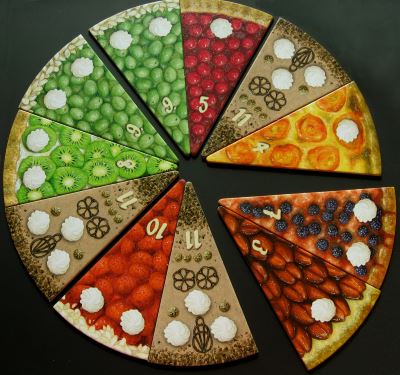
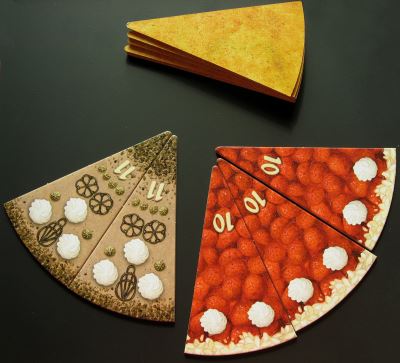
We started out with a game that was new to the group, …Aber Bitte Mit Sahne (which means “…But Please, With Cream”, although the game is also known as “Piece o’ Cake” in English).  This is a quick little set collecting game we’ve not played before with very simple rules.  The game uses an “I divide, you choose” mechanism with points awarded to players with the most slices of the each different types of cake.

…Aber Bitte Mit Sahne
– Image by boardGOATS

The first player (the Baker) bakes a cake with the types determined at random.  Each slice has a number of blobs of cream on it and a numeral demonstrating how many of that type there are in the game.  The Baker then divides the cake up (usually so that there are sufficient pieces for everyone to have one), with each piece containing any number of slices of any type.  Next, the player to the left of the Baker selects a piece of cake and chooses what to eat and what to keep.  They can eat or keep as many slices they want.  Any cake they choose to eat is turned face down and the total number of blobs of cream in the pile contributes that number of points to the the final score.  Thus, each player takes a piece of cake and chooses what to eat and what to keep, finishing with the Baker.  Then the next player takes a turn as the Baker and so on.  The game continues for five rounds.

…Aber Bitte Mit Sahne
– Image by boardGOATS

At the end of the game, each type of cake is assessed and the player who has collected the most slices of a variety receives points.  The number of points obtained is the same as the number of slices in the game and is written on each slice of that type of cake.  For example, there are eleven pieces of chocolate cake in the game and the player with the most slices will win eleven points at the end.  Crucially, in case of a tie, all tied players score the points.  In general, players can only eat fresh cake (i.e. cake just served), the exception is that they can forfeit the opportunity to take fresh cake and instead eat all the stale cake of one type in front of them.  This might be a good idea if a player can see that they cannot win a category and the number of blobs of cream will give them more points than they would get from the fresh cake.

…Aber Bitte Mit Sahne
– Image by boardGOATS

Burgundy started off as the Baker.  Blue began modestly keeping a slice of apricot cake and eating her chocolate cake (having given up chocolate and cake for Lent, this was very appealing).  Meanwhile, Cerise began collecting strawberry and chocolate, Grey went for gooseberry leaving Red and Burgundy to fight it our for cherry, blackberry and plum.  In the second round, Burgundy set the tone by pinching the a slice of apricot cake from under Blue’s nose handing her a load of relatively worthless slices in the process.  From then on, it was more about stopping other people from getting what they wanted than about collecting something useful, which meant that those who had picked up the start of a set in the first round were in the best position.  The game ended with players sharing the top spot for a lot of the categories, but the strawberry and chocolate that Cerise had picked up early on gave her a massive number of unshared points.  The title of Master Baker went to Burgundy, however, winning by a single point.

Niagara
– Image used with permission of BGG contributor GeoMan

By this time, Green, Black and Purple had arrived, so we split into two groups with the first starting off with the “Feature Game”, Niagara.  This is one of the first games we played in the group back in October 2012, and it was certainly long overdue another outing.  The idea of the game is that players are travelling up and down the Niagara River in canoes collecting gems.  The river is the feature of this game as it is made up of plastic discs that actually move during the game carrying the players boats towards the falls.  Each player has a set of “paddle cards” with numbers 1-6 and a cloud on them and each card must be played one can be reused.

Niagara
– Image used with permission of BGG contributor Marsh

Simultaneously, all players choose a paddle card, then they take it in turns to resolve their card.  Each player has two canoes which can either be on the bank or on the river.  Any boat on the river must be moved and a boat on the bank can be moved if the player wants to (though if they are both on the bank, only one can be moved).  Movement is exactly the number shown on the chosen paddle card, no more and no less (except when bring a boat home with a gem on board) and the boats cannot change direction during the turn.  In addition to moving, players can also load or unload a canoe, which costs two movement points and must be done at the start or end of a move.  An empty boat that is travelling up-stream and lands on a space occupied by another boat laden with a gem may also steal it for no charge.

Niagara
– Image used with permission of BGG contributor erfalucho

At the end of the round, after everyone has taken their turn moving their boats, then the river moves.  It’s movement is dictated by the smallest canoe movement, modified by the weather.  Each player has a weather paddle card and as one of their options, they can alter the weather setting from sunny (-1) to very rainy (+2).  Thus if the lowest paddle card played was a three and the weather was very, very wet, the river would move five spaces.  The winner is the player who has either four gems of the same colour, five of different colours or seven of any colour at the end of the game.

Niagara
– Image used with permission of BGG contributor William Hunt

The game started well, and “just to demonstrate to everyone how it was done”, Blue nicked one of Burgundy’s gems and then increased flow rate of the river.  She got her comeuppance since she promptly ended up with two yellow gems.  Meanwhile, Cerise had collected two clear gems and Red followed Blue’s example and increased the weather flow to it’s maximum.   By the time everyone had been through their paddle cards once, everyone had moved on to trying to get the difficult pink and blue gems that are perilously close to the cataract.  The inevitable happened then, when everyone played a “6” and one of Cerise’s precious canoes went sailing over the waterfall.  Despite turning one of her boats into match-wood, she was still the first to get a complete set of five different coloured gems, giving her the win.

Niagara
– Image used with permission of BGG contributor cmessenger

Meanwhile, the other group were showing no signs of finishing, so since Cerise had never played it, the group moved on to one of Red’s favourite games, Bohnanza.   Cerise was very generous which meant everyone else followed suit and the game wasn’t as tough as it has been when we’ve played it recently.  Burgundy went for the “high value” market, but suffered and Red and Blue’s mixed bean strategy and Blue finished just two coins ahead of Red.

Bohnanza
– Image used with permission of BGG contributor spearjr

The other group were still what seemed like hours from finishing, so the first group tried decided to move onto their third game.  Burgundy expressed an interest in playing Blueprints, a cute little dice stacking game.  However, just as Blue was getting it out, Black suddenly commented that their game was coming to an end.  Blueprints can be a little lengthy, so it was quickly replaced with Tsuro, which turned out to be just the right length.

Tsuro
– Image used with permission of BGG contributor aleacarv

Tsuro is a very simple tile laying, path making game, that has the advantages of playing a range of numbers reasonably well, as well as being very quick to play and extremely easy to teach.  The idea is that players have a stone which is located on the board and a hand of three tiles.  On their turn, they have to place one of the tiles on the board next to their stone such that it extends it’s path and remains on the board, then they replenish their hand.  Players continue until their stone collides with another player’s stone or it is forced off the board (by another player or because they have no choice because of the tiles they have), in which case they are out.  The game started slowly, but Red was the first to go, when she lost a tussle with Burgundy.  Burgundy didn’t last much longer, leaving just Cerise and Blue to tough it out.  Blue was forced to place a tile that left her at the mercy of Cerise, but Cerise had no choice and collided with Blue, ending the game.

Village
– Image used with permission of BGG contributor henk.rolleman

By this time, the other group were just adding up their scores, but what was it that they had been playing that took so long?  Well, they had been playing Village with The Port expansion.  In Village, each player takes the reins of a family striving for fame and glory.  The game is full of difficult decisions, however, it feels like it moves quite quickly.  What is particularly unique though, is the way the game uses the delicate subject of death as a natural and perpetual part of life in the village and a mechanism for dictating the flow and duration of the game.

Village
– Image used with permission of BGG reviewer EndersGame

Each player starts the game with a personal farmyard board and the four members of the first generation of their family.  There is also a central village game board which depicts the different locations players can go to carry out different actions.  At the start of the game/round influence cubes are drawn at random from a bag and placed on these locations.  During the round, players take it in turns choosing a location and taking one of the cubes and then (optionally) carrying out the action. There are a range of actions, from “building a family”, to “crafting goods” or “going to market”.  Some of these (like visiting the “well”) give resources of some kind, while others (like going “travelling” or “entering the church”) are primarily a means to obtain points.

Village
– Image used with permission of BGG reviewer EndersGame

While the action is optional, taking a cube is mandatory.  If there isn’t a cube available at the location, then the action cannot be taken.  Cubes are then used to pay for some of the actions.  In addition to the cube cost, some actions also have a “time” cost:  around the edge of the players farmyard, there is a time track and once a player’s token has been round the board one of their meeples dies.

Village
– Image used with permission of BGG reviewer EndersGame

When one of their meeples dies, the player has to choose one of their oldest generation family members (i.e. those numbered “1”, or in the event that they are all deceased, one numbered “2”) kill them off.  These meeples are then either laid to rest in the Village Chronicle or in one of the anonymous graves behind the church.  Family members placed in the Chronicle will score victory points at the end of the game, however, if there is no room in the relevant section of the Chronicle, the family member is placed anonymously in the unmarked graves behind the church where they do not score.  The game will end when either the last empty space in the Village Chronicle is filled, or the last anonymous grave is filled.  The winner is the player with the most points at the end.

Village
– Image by BGG contributor jardeon

It took a little while to set up and revise the rules and to work out how the new Port expansion fitted in.  Basically this replaces the original travelling option with the ability to board ship and travel the seven seas. Players hire a captain, and then use the ship to sell domestic goods and pick up foreign commodities. Family members can be sent as missionaries to far away islands and dig up treasure chests.

Village Port
– Image by BGG contributor Grovast

Eventually the game began.  Black started out collecting green cubes, aiming for a market based strategy.  Grey was attracted by the large number of points provided by the expansion and decided to pop down to the port and start sailing almost immediately.  Meanwhile, Purple and Green were a little less certain of their initial direction and just built up a small stock of tiles (namely ox and plough to maximise wheat production).  By the end of the first round, both Purple and Green had sent family members into the church bag, and, by pure chance, both Green’s came out.  In the second round Purple joined yellow at sea, Green fumbled over getting his first meeple to work a second time in the craft halls without dying while Black (a hard task master) worked his first meeple into an early grave without shedding a tear!

Village
– Image used with permission of BGG contributor Club Amatent

Blue was also heading deeper into the town hall, piling up extra bonus green cubes and tiles to enhance his market buying opportunities.  Grey continued a balancing act at home while slowly filling his boat.  Green joined Grey and Purple and took to the seas with the highest level captain and rapidly made his way round to collect the various goodies. Purple decided that she did not like the apparent slight by the God(s) and placed even more into the church, and paying for them to be taken out and so gaining the end of round church bonus.

Village
– Image used with permission of BGG reviewer EndersGame

Everything was looking rosy for Black, producing quite a pile of market chips, until the sailors began to return, and were able to swap their bounty for lots of points, saoring into the lead on the victory point track. Black was still confident, if a little nervous now, especially since Green had managed to plant one of his meeples in the far corner of the sea for a huge haul of points at the end.  The books of remembrance were slowly filling, as was the grave yard.  Black then took a late plunge into the waters, while Green started sending family members to join the local council in the Town Hall.  Purple collected cubes a plenty (enabling her to make some free actions of her own choice to her advantage) and Grey was really getting to grips with the game and was making good use of his second trip to sea and happily killing meeples left, right and centre, like mad despots!

Village
– Image used with permission of BGG contributor henk.rolleman

There was a close finish in the final round.   Initially everyone thought it was going to be the last round, but then it started to look like the grave spaces would not be filled after all and another round would ensue.  Then, out of the blue, Green used three cubes to visit the market place, which had otherwise been empty of action cubes.  Buying twice killed off another meeple, which filled the last space in the graveyard and the game was suddenly over (leading the other group to change from Blueprints to Tsuro).  With one last turn each, only Black was able to do anything to increase his score at this point.  Before the final scoring it was very unclear who had won:  Green and Grey were far in front on the victory point track, but Black had a lot of market chips.  It turned out, Black had just done enough, pipping Green by a couple of points with Grey and Purple not far behind in what had been a very close and enjoyable game.

Village
– Image used with permission of BGG reviewer EndersGame

Learning Outcome:  Killing meeples is great fun, if a little time consuming!

27th January 2015

We started off with our “Feature Game”, which was the card game, SaboteurWe’ve played it a few times before, but basically the idea is that the group is split into two teams:  Dwarves and Saboteurs.  The aim of the game for the Dwarves is to lay cards forming a tunnel that leads to the gold, whereas the Saboteurs job is to stop them.  So players take it in turns to play cards.  These cards could be tunnel cards, which are added to the play area and, although they generally extend the tunnel, there are also dead-ends which can be used by Saboteurs to upset the Good Little Dwarves’ plans.  Alternatively, there are action cards, which come in several types.  There are broken tool cards, which allow players to prevent other players from laying path cards (useful if you suspect there is a Saboteur about); mended tools which are used to repair broken tools (useful when a Saboteur has been trying to slow everyone down by smashing up their tools); map cards (useful when a nasty Saboteur has been misleading everyone telling them the gold is in the wrong place), and rock-fall cards which can be used to remove tunnel cards (useful when an evil Saboteur has been causing havoc).  The round ends when the draw deck is depleted and gold cards are allocated to the winning side.

Saboteur
– Image used with permission of BGG contributor mikehulsebus

As people arrived, Blue explained the game to the people unfamiliar with it and pointed out that, despite his protestations, Green was always a Saboteur.  At which point, in walked Green, commenting, “Whatever Blue may have said, I’m NOT always the Saboteur…!”  Needless to say, it quickly became apparent that Green was very definitely a Saboteur, but despite his best efforts (assisted by Yellow and Cerise), the dwarves found the gold, though it was pretty close at the end, coming down to the last few cards.  The second round was under-way with Burgundy indicating that the central target card was gold (a fact disputed by Grey) when Black and Purple arrived.  Since they’d missed the start they began a game of Patchwork.  This is a recently released two-player game where players compete to build the most aesthetic (and high-scoring) patchwork quilt, buying Tetris-like patches with buttons.  The patches are laid out in a circle round the central time board, with a cotton reel marking the start.  On their turn players can purchase one of the three patches immediately following the cotton reel; they then pay the cost in buttons shown on the patch, and then add it to their personal “quilt board”.  In addition to the cost in buttons, the player must also advance their time token on the central time track: if the active player’s time token is behind or on top of the other player’s time token, then they take another turn, otherwise play passes to the opponent.

Patchwork
– Image used with permission of BGG contributor Percatron

Instead of purchasing a patch, players can also pass, in which case, they move their time token to the space immediately in front of their opponent’s time token and take one button from the bank for each space moved.  Players can place their patches anywhere on their quilt so long as it doesn’t overlap any other patches.  This is not the only way to get buttons; in addition to a button cost and a time cost, each patch also features 0-3 buttons.  When a player moves their time token past a button marker on the time track, they sum the number of buttons on their quilt and get this number of buttons from the bank.  The game ends when both players are in the centre of the time track.  Each player then loses two buttons for each blank square on his game board and whoever has the most buttons wins.

Patchwork
– Image used with permission of BGG contributor
greetingsfrombergen

Meanwhile, on the first table, the second and final (third) round of Saboteur had both finished with the Saboteurs making almost no impact on Dwarves’ ability to find the gold.  When the teams are drawn, there is always one card more than there are players, so one card is always left out.  The idea is that this introduces an element of ambiguity, however, we felt that this also unbalanced the teams.  For example, with eight players, the teams go from five Dwarves and three Saboteurs to six Dwarves and two Saboteurs, making it almost impossible for even a vaguely competent team of Dwarves to lose.  We discussed the options including whether it would be better to have a set-up phase where the everyone closes their eyes and the Saboteurs open them and look at each other (similar to Werewolf or The Resistance), but we felt this would give a large team of Saboteurs too much power.  In the end, we decided it would be better to remove the spare card and ensure there was the maximum number of Saboteurs.  Since Black and Purple were still going, we decided to play one extra round.  This worked much better, and thanks to a horrid distribution of cards for the Dwarves and some brilliant play by the team of Saboteurs led by Burgundy, there was nothing the Dwarves could do.  It was fitting therefore, that Burgundy finished one gold ahead of his closest competition.  On reflection, we decided there were definitely a couple of House Rules we would implement next time we play.  Firstly, we would remove the extra card when allocating players to teams, this definitely seemed to create a much more balanced game.  Secondly, we would probably also play several separate rounds and not worry about allocating gold at the end of the game.  This way, we could play one or two rounds and stop when the game had outstayed its welcome, rather than feeling that we should play to the end.

Saboteur
– Image by BGG contributor ckhiew

Patchwork was also coming to a close; scores there were quite close until the final scoring, when it turned out that Purple had more “gaps” in her quilt which lost her more points, leaving Black to take the victory.  With both games finishing we had a slight shuffling of seats, with the first group playing Mascarade.  This is a “micro” game, albeit with big cards.  The idea is that each player begins the game with a character card, but after a brief spell with them face up, everyone turns them face down and that’s the way they remain for the rest of the game.  So, the game is all about deducing which player everyone is, while trying to collect enough money to win the game.

Mascarade
– Image used with permission of BGG contributor henk.rolleman

After some initial trading, on their turn, each player can do one of three things.  Firstly, the active player can declare that they are a particular character, say, The King.  If nobody objects they can then carry out the action associated with The King, unmolested (in this case, take three coins).  On the other hand, another player may protest and claim that they are actually The King, in which case all players claiming to be The King must show their cards and whoever is correct, gets to take three coins from the bank, and all the others pay a fine of one gold coin.  A player’s second option is to “swap” their card with that of another player; since the actual exchange is done under the table, it is possible that there is no swap at all, and only the active player will know either way (or not, since everyone always seems to immediately forget which card is which).  The final option a player has, if all is complete confusion, is to look at their own card.

Mascarade
– Image used with permission of BGG contributor henk.rolleman

It always takes a little while to get the hang of the characters in play, and with people unfamiliar with the game, it was slow to get going. Orange was happy to be The Queen and collect her two gold each round, as did The King.  After a couple of turns, however, Red realised the power of The Witch and swapped her somewhat diminished fortune with that of Blue, who, as The King had managed to build a reasonably sized pile.  Meanwhile, the fines had built up and then the Judge became of interest and suddenly, the game clicked with everyone around the table, and people tried to manipulate the card they got and call others on their declarations.  Gradually, some of the piles started to get perilously close to the magic thirteen coins, especially since The Cheat was in play (if declared correctly, that player needs only to have ten coins to win).  The game finished somewhat abruptly, when Red declared that she was The Bishop and, as everyone knew she was right, there was nothing we could do.  And then it was home time for some.

Mascarade
– Image used with permission of BGG contributor pan_satyros
and pelnapara.znadplanszy.pl

Meanwhile, the second game was still going.  They were playing Colors of Kasane, one of our “Essen Specials”, but one we’ve not got round to playing until now.  It is a Japon Brand game, and they have a bit of a reputation for creating little, yet interesting games:  as Black commented, “They have a different way of thinking.”  They also have a bit of a reputation for rules that are difficult to understand; even when they seem clear, it often turns out that they aren’t, and we’ve fallen foul of this one before, most noticeably with Secret Moon (the sequel to Love Letter).  Colours of Kasane was no exception in this regard which may go some way to explaining why its taken so long to play it!

Colors of Kasane
– Image used with permission of BGG contributor punkin312

Nevertheless, the game itself is reasonably simple and beautifully rendered with pretty little Japanese fabric buttons used as player markers, reflecting the theme of a festival held at the Emperor’s court for which the players must make their own beautiful robe.  The game play is a mix of hand management and set collection.  The idea is that players take one card from the four available, and then, from their hand the active player may lay cards.  However, the cards can never be rearranged (similar to Bohnanza) and sets can only be laid from the most recent end (i.e. a “last in, first out” system) and may also include the last card laid.  Any cards laid must meet the requirements shown on one of the target cards, which also indicate the amount scored:  the more challenging the target, the more it is worth.  These target or scoring cards allow players to place of groups of even numbered cards, groups of odd numbered cards, melds with the same number, ascending or descending sets of cards, cards summing to ten etc. etc..  The key thing is that once a specific combination has been played, a glass bead is placed on it and no other player can score it.  This means it becomes increasingly difficult to play cards and score points, worse, someone else might claim something you have been building towards and render all the hard-work useless.  This is one way that players can mess with each-other’s plans, another is when picking up cards:  cards are laid out in columns so that players can see all the cards, but only the card at the bottom of each column is available to take.  Since the cards laid must necessarily include the card just picked up, a player’s plans can easily be blown out of the water by an opponent who watches carefully.  The winner is the player with the most points, with bonuses awarded for players who succeed in playing more than eight cards and either used a lot of different colours or who colour coordinated their “robe” and also for any players who managed to play all twelve of their cards.

Colors of Kasane
– Image used with permission of BGG contributor punkin312

The game began with everyone groping their way through the the first round trying to get an idea of how the game played and how players and cards interacted and what strategies should be employed.  By the time Blue joined to sneeze and spectate, it was clear that all the best plans had gone horribly awry.  Black, who had brought the game and taught everyone the rules, was struggling, but he was not alone in that.  Green and Purple were also finding other players obstructing their plans, and even Burgundy (the eventual winner) was having difficulty placing the cards he wanted.  The challenges posed by the game were reflected in the fact that nobody got the bonus for playing all twelve cards:  definitely a game that requires a second try.

Colors of Kasane
– Image by BGG contributor matador

We finished with Istanbul, a game we’ve played a couple of times recently, so didn’t require too much in the way of rule revision.  Since Burgundy was the only person who  had not played it before and everyone else had previously played it with the “short track layout”, this time we used the “large number layout”.  This puts all the Warehouses together and a long way from the Mosques, and puts the money making a long way from the Wainwright.  Black started and went straight to the Post Office before expanding his cart with a trip to the Wainwright.  Purple also made several visits to the Post Office, coupled with a few trips to the Warehouses while Burgundy and Blue attempted to improve their success rates with visits to the Mosques.  Green on the other hand, paid several trips to the Caravansary to collect bonus cards in the hope that a few of these would help him out later on.  It is unquestionably a more interesting game with five players and useful things further apart, but that didn’t stop Black delivering the rest of us a sound thrashing.  All of a sudden, he ended the game as he collected his fifth gem when nobody else had more than two.  On inspection, other players were closer than it seemed:  Green collected his third gem on his final turn, Burgundy had loads of Lira and everyone else was well on the way to getting everything they needed, however, they needed several more turns to do it.

Istanbul
– Image used with permission of BGG contributor duchamp

Learning Outcome:  It’s true, Green always IS a Saboteur!

16th December 2014

This week we stuck to “old favourites” and started off with the quick fun and very silly game that is Walk the Plank!.  We’ve played this a few times before, and we always play to the “last pirate standing”.  Since Red had chosen the game and White had not played it before, Blue started off by shortening the plank and pushing Red off the end.  This set the tone for the game with Red taking her revenge on Blue and then White joining in the fray.  A few rounds in and with one Blue and a couple of Red pirates down, it was Blue’s turn to start.  All three of White’s pirates were perched precariously on the end of the plank with Red’s one remaining pirate, so the game ended suddenly with a very loud splash when Blue inevitably shortened the plank…

Walk the Plank!

With the arrival of Purple and Black (and their pizza), we decided to play another of Red’s favourite games, Bohnanza. It’s amazing how a game that so many people feel is such good fun, sounds so totally uninteresting when it’s explained.  True, as White pointed out, this applies to quite a few games, but Bohnanza is definitely the “poster child”.  After a quick rundown of the rules, we began. Purple was very generous, offering beans for free at regular intervals, though of course she had an ulterior motive. However, otherwise, as Black commented, “It’s a tough crowd tonight,” as deals were pushed and even turned down.  It was fitting therefore, that such a tight game should end with a draw, with Red and Blue sharing the honours.

Bohnanza

Next, we decided to play something a little deeper and, after some discussion, we opted for one of this years most popular games: Ivor the Engine. Although we’ve played “Ivor” a lot at games night, Red and White were both new to it. It’s a cute little game, though it has a sharp edge if you want to play it that way. With a full compliment of players, it was always going to be a fairly tight game, and although Blue started well with a couple of jobs at Mrs Porty’s House, everyone else struggled as Purple got in their way.  Blue was promptly penalised for her good start though, when the first event card came out and caused the leader to lose sheep.   Since everyone else had now cleared sheep from the locations that corresponded to their cards, Blue was then suddenly left behind.  As everyone galloped on, Red, managed to pick up eleven sheep with one visit to Tewyn!  Black was closing in on the finishing line, when Blue managed to complete a couple of jobs at Dinwiddy’s Goldmine and use the gold to buy a couple of event cards.  That tipped the balance in her favour and she finished just ahead of Black.

Ivor the Engine

We finished the evening with a few rounds of No Thanks!.  This is another game we used to play quite a bit, but hadn’t played for six months.  It is such a simple, push your luck game that experience isn’t necessary, and it really brought out White’s vindictive streak.  After three games, honours finished about even and it was home time.

No Thanks!

Learning Outcome:  Old favourites are still favourites, and for a good reason.

1st July 2014

Pizza was the order of the day, so while we were waiting for it to arrive, we played a quick game of Walk the Plank!.  This is a very short game of kamikaze pirates that we’ve played a few times before and is great fun so long as everyone plays it in the right spirit.  We started by shortening the plank, so everyone had no choice…  Very quickly, most people had lost a pirate and the plank was only one square long.  Red had all three of her pirates perched precariously on the end of the plank when the inevitable happened and in they all went and out went Red.  Yellow quickly followed, then Green,  leaving Orange and Blue to fight it out with their last remaining pirates (although the rules say the last two players share the victory, we play hard-core and stick it out to the end).  Blue had the advantage of going first, but with both Pirates on the ship one remaining piece of plank between them and certain doom, it needed a bit of thought before she could finally secure victory.

Walk the Plank!

By this time, pizza had arrived and so had more players, so we decided to play our “Feature Game”, Spanish Bohnanza which we could do while munching.  We’ve played this a lot before and always enjoy it, even though it sounds really unpromising when you explain it.  With two players new to the game, we played nicely and before long everyone was happily planting “Judías” and trading “Cafeterías” for “Hippies” and “Bills” for “Booms” – and we had all thought the names were funny in English!  It was a very tight game with Blue finishing only one point ahead of Black and Red who were joint second.  Whenever there are new players in a game, we usually let the experienced players go first as it takes the pressure off a little and means that they get to see how it is done.  Unfortunately, this meant that the last two players, who were also new to the game got one fewer turn which could have made quite a large difference given how close it was and, on reflection, it was an effect that was exaggerated with so many players.  So, if we remember, perhaps we’ll house rule it in future and turn over the draw pile one last time and make sure everyone gets the same number of turns.

Bohnanza

An early start for work the next day meant a few players left early and the rest played Ivor the Engine.  This is a clever little game that features the iconic art-work from the Ivor cartoons as drawn by Peter Firmin.  We’d not played it before in the group, although several players had played it at the UK Games expo where it was first released and we talked about it a few of weeks ago.  The idea is that players are travelling round Wales collecting sheep and the person with the most sheep at the end of the game is the winner.  A single sheep can be collected whenever you start your turn on a town or village with sheep in it, however, more sheep can be collected if you are in a town or village with NO sheep and perform a task to “help Ivor”.  Helping Ivor comes at a price, however, as in order to do this you have to play one of the dual-purpose cards from your hand, which means you cannot use it to help you in other ways.  At the end of your turn you add one card to your hand from the face up displayed cards, however, when the chosen card is replaced from the draw-pile, the game has a sting in the tail:  mixed in with the errand cards are event cards, and these can be nice, or nasty…

Ivor the Engine

Once the game had been set up and sheep sprinkled liberally over the Welsh hillside, players carefully chose the starting points for their waggons.   Within two turns however, the first event card came out and moved everyone to Tewyn.  As almost nobody had any sheep, most of us had no choice, much to the chagrin of Green who had chosen to start in Tewyn and, by the time his turn came round, all the sheep had gone and everyone else’s waggons were in his way.  Nevertheless, Green started well with a couple of very lucrative errands, followed by Black.  Purple meanwhile, was the only player who had been able to avoid the enforced relocation to Tewyn, and was making good progress in the “Grumbly” area of the board.  Blue was feeling more than a little hard-done-by, when she found herself stuck in Ivor’s shed by a nasty, vindictive move from Green, who helped himself to a couple of “lost sheep she’d been eyeing up at the same time.  He couldn’t afford to stick about for long though, and eventually Blue managed to cash in three errands, finally getting going at last.

Ivor the Engine

As the game progressed it became clear that the excellent start made by Green was gradually being eroded by Black who, with extra experience, was clearly the player to beat.  Purple picked up a very lucrative event card giving her lots of extra sheep at the end of the game and Blue carried out a couple of errands and Mrs. Porty’s House, keeping them both in the game.  Green meanwhile got in Black’s way and managed to prevent him from picking up his critical twenty-fifth sheep, thus prolonging the game for an extra round, giving everyone else a chance to play that last card.  That last turn made the game very close, but Green and Blue failed to catch Black and who won on a tiebreak.  Next time…

Ivor the Engine

Learning Outcome:  Spanish judías and German böhns are funnier than English beans.

20th May 2014

This week we started out with our “Feature Game”, Walk the Plank!.  This is a fun, light-hearted little game with a lot of chaos and not a few kamikaze pirates.  The board is set up with a “ship”, three plank segments and “the sea” and each player starts with three pirate meeples on the ship.  At the start of a round, everyone chooses three cards from their hand and places them face down, in front of them.  Each card has an action:  “Shove Anybody”, “Retract the Plank” and “Extend the Plank”, for example, enable a player to push another persons meeple closer to the sea, shorten and extend the plank respectively.  Each round then consists of each player taking it in turns to turn over the top card and do what card says.  Because players choose the cards and the order they will play them in at the start of the round, by the end of the round everyone is just trying to make the best of an increasingly worsening situation, and rounds often end with a lot of pirates perched on the end of the plank waiting for the last card to seal their fate.

Walk the Plank!
– Image by BGG contributor TheBoardGameFamily

Blue and Green’s fate was sealed first in a manic pirate suicide pact, shortly followed by Red.  With a two pirates to one advantage, newcomer Orange always had the advantage over Yellow.  As Yellow shortened the plank, the end became inevitable and, although Yellow took one of Orange’s meeples with him, Orange chalked up her first victory.

Walk the Plank!
– Image by BGG contributor onorc

After a lot of debate about what to play next, Blue suggested Ra, as she’d never played it and it is a classic and is supposed to be one of the best (if not the best) of the auction games available.  Green said he’d played it once, a very, very long time ago and hadn’t liked it, but was happy to give it another go and see if that opinion was justified.

Ra
– Image by BGG contributor Stas

This game is an unusual and very clever auction game.  Basically, players take it in turns to pull tiles from a bag and tiles can be good, bad, or they can be “Ra” tiles which start an auction.  The auctions themselves are curious affairs: each player has three tokens that they use for bidding, each with a unique number.  Thus, the person with the highest value can always win if they choose to, but once the auction is over, the token is placed in the middle and effectively becomes part of the stash for the next auction.  The game comprises three rounds, each with ten to twenty auctions, however, each player can only win a maximum of three  in each round (i.e one with each token).

Ra
– Image by BGG contributor blakstar

Those who had played it before had a better appreciation of the importance of the high value tokens.  Blue didn’t and squandered the higher tokens she started with.  With little or no choice in the auctions, she resorted to “turtling”, which in this context involved trying to minimise the effect of the higher tiles.  Instead of drawing a tile from the bag, the active player can also call “Ra!” and start an auction and this is what Blue did.  A lot.  An awful lot.  As the bidding starts with the next player, this meant blue would bid last, but Blue was committed to bidding if no-one else did.  With some of the lowest tokens, she had little to lose if forced to bid, and set her sights low, going for a “try not to loose points” strategy coupled with a small number of river tiles and trying to stay ahead with green Pharaoh tiles.

Ra
– Image by BGG contributor Stas

Moving into the final round, Red was collecting monuments, Yellow had built up a sizeable river, Green was going for Civilisation tiles and Orange was trying to do a little bit of everything.  Meanwhile, Blue was still calling “Ra!” at almost every opportunity, hoping to win something useful with her “one”.  Thanks to Yellow failing to get a “flood” tile to activate his enormous river (there was one left in the bag at the end), Yellow didn’t accrue the massive score expected and surprisingly, Blue nearly made it.  However, although her strategy had overall not been a bad one, on reflection, the game was probably ruined by Blue’s repeated small auctions.  Although Green was slightly more enamoured by the game than he was the first time he played it, the overwhelming opinion seemed to be in favour of not playing it again soon.

Ra
– Image by BGG contributor usagi-san

We cheered ourselves up by finishing with an old favourite, Bohnanza.  Also universally known as “The Bean Game”, we’ve played this quite a bit, so it was relatively quick to get started.  Only Orange was new to it, and as the rest of us know it so well, it was a very close game.  Blue started off strongly but slowed towards the middle of the game when Orange got the hang of it and Yellow and Red started trading efficiently.  The game finished with only a couple of points between the places and Green ran out the winner, only one point ahead of Red and Orange who tied for second.

Bohnanza
– Image by boardGOATS

Learning Outcome:  Sometimes an otherwise good strategy can ruin a game for everyone.