Tag Archives: Carcassonne

5th February 2019

Far from being over-run by new people flocking to games night in response to our advert in the Parish Newsletter, it was one of the quietest weeks for ages.  With Ivory still on “sabbatical”, Mulberry in the States, and Pine, Pink and Red all having something better to do, for the first time in ages, we were down to just five and a single game.  Burgundy was just finishing eating and Blue was waiting for the imminent arrival of her pizza, so the group decided to play something short that could be played while feeding.  After a brief discussion the group began a game of Walk the Plank!, and inevitably, Blue’s pizza arrived just as it started.
Walk the Plank!
– Image by boardGOATS

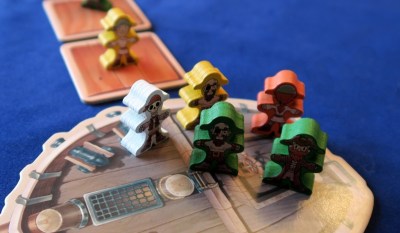
Walk the Plank! is an old favourite that has been somewhat neglected by the group of late.  It is a very silly programming game where players control pirate meeples who try to push each other off the ship and, when plans go wrong, occasionally jump overboard.  The idea is that each player begins with a hand of action cards and simultaneously everyone chooses three cards to play and the order they are going to play them in, placing them in a stack with the first card on top.   Once everyone has chosen their cards, the players take it in turns to take the top card off their pile and carry out the action using one of their three “pirate-eeples”.  Actions include shoving other players meeples closer to the end of the plank (or into the sea); running towards the ship; retracting or extending the plank, and even changing along the plank pushing another player closer to the sea.  As we were playing with the Limited Edition which comes with some extra cards, so for a bit of variety, we added the Dynamite and Ghost Pirate cards.

Walk the Plank!
– Image by boardGOATS

The first of the extra cards, “Dynamite”, pushes everyone on a given piece of plank one space closer to the sea. The other, the “Ghost Pirate”, scares everyone on a a piece of plank so much that they run away, half towards the sea and half towards the ship.  The newly bespectacled Green was of the opinion that the extra cards were generally a little over-powered, so we house-ruled it so that they could only be played once each.  When we play this game we include a couple of other house rules too:  according to the rules as written, the last piece of the three piece plank should not be removed when shortening the plank and the game is supposed finish when there are two meeples left.  While we understand why these rules exist, we find that sharing victory means the game feels a little unresolved so we play through to the bitter end.  Similarly, we quite like the madness removing the last plank adds, and in such a short game, crazy chaos seems entirely appropriate.
Walk the Plank!
– Image by boardGOATS

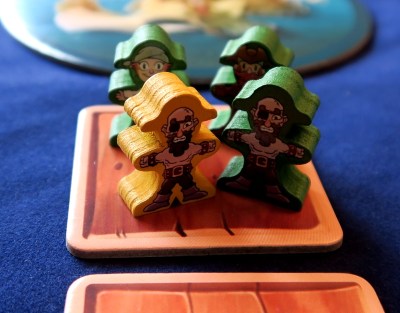
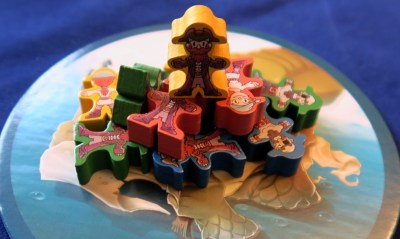
And chaos there was aplenty this time round too:  Burgundy was quickly out of the game when the third and final of his meeples was banished to the deep.  As the first person to be eliminated, Burgundy was given the slightly dubious honour of returning as a Ghost.  In this mini-expansion, the player returns as a white pirate-eeple doomed to haunt the ship and generally cause mayhem for everyone else by playing one shove card per round.  When the last of Black’s pirates joined Burgundy’s there was some discussion about a second ghost, but we decided it would just prolong the game.  It wasn’t long before he had company on the sidelines though, leaving just Blue and Purple.  With both of them perched precariously on the end of what was left of the plank and Blue set to go first the game was her to take.  However, she decided she couldn’t take advantage of the position and instead retracted the plank unceremoniously pitching both of them into the drink.
Walk the Plank!
– Image by boardGOATS

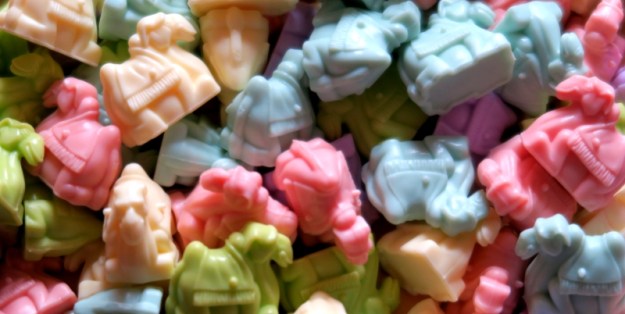
With Blue finished with her pizza, and it clear that nobody else was coming, the group decided to move on to the “Feature Game” which was to be Through the Desert.  This is an old game, but one that is very simple to play, though difficult to play well.  It is an area control game with pastel camels that many feel is reminiscent of the classic game, Go.  The game begins with players placing one camel in each colour on the board.  Each of these has a rider (Leader) in their own colour, so these camels are the start of the player’s camel trains or Caravans.  After the initial placements, on their turn, players take any two camels from the general supply and add them to the board.  There are a few rules about placement – each one must be placed next to camels of the same colour to become part of one of that player’s caravans, and must not be placed next to a caravan of the same colour belonging to another player (as this would cause them to join).

Through the Desert
– Image by boardGOATS

The aim of the game is to gain points through via the four sources.  Firstly, there are several oases marked with green plastic palm trees; players who connect a caravan to an oasis get five points.  There are also watering hole tokens—players who place a camel on these spaces can claim these tokens which are worth up to three points.  Players who finish with the longest Caravans in each of the colours are also rewarded with points at the end of the game.  The most lucrative source of points, but also the most risky is enclosing areas.  It is in this way that it is most like Go.  Go is a very ancient game played on square grid with black and white stones.  People often try to compare it to Chess, though in truth, beyond the facts one play plays black, the other white and the game is played on a rectilinear grid and both are very old, the two games have almost nothing in common.
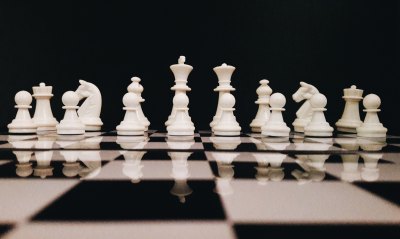
Chess
– Image by Unsplash contributor sk

Chess is a game with a very rigid structure where players control armies that are lined up to face each other.  Each piece has a clearly defined role and movement pattern and games develop in a very particular way.  The highly structured nature of the game means strategies are developed by analysing all the possible or likely moves which makes it highly programmable.  In contrast, Go is all about territory and pattern analysis, which has traditionally made it much more challenging for computer programmers and it is only recently that software engineers have been able to use machine learning algorithms that have the ability to beat Go champions.  In Go, players place their stones on the intersections of a rectilinear grid with the aim of marking out territory.  There is a lot of psychology in the early moves with players declaring their space; if a player is too aggressive at the start, they won’t be able to defend their position, if they are too timid with their opening they will have lost before they’ve begun.

Go
– Original image by Tomasz_Mikolajczyk on pixabay.com

Ultimately however, Go is a complex game of strategy where players are trying to capture their opponent’s stones and with i,t territory.  A single empty space inside a group is called an eye; for a group to remain alive it must contain at least two eyes.  Creating eye spaces in a player’s groups and trying to prevent their opponent from making eyes is one of the key aspects of Go.  It is in regard to building territory that Through the Desert is similar to Go, however, there are two significant differences.  Firstly, and perhaps most obviously, the game is played on a hexagonal rather than a square grid.  The main difference is in the game-play though:  in Through the Desert pieces must be added to an existing caravan and surrounded pieces are not removed from the board.  Nevertheless, despite the differences it is unquestionably true that the Through the Desert is reminiscent of Go and was likely inspired by it.

Go
– Original image by Przemek Pietrak on flickr.com

With five players, everyone starts the game with Leaders mounted on four of the five different colours of camel.  Starting placement was quite difficult because nobody really knew constituted a good starting position, though some claimed to know what a bad one was.  Maybe there was an advantage in going last, or perhaps Black had a better idea than everyone else, but it quickly became apparent that that he had a large corner of the board all to himself.  This put Burgundy in a very difficult position as he was the only one who could do anything at all about it, but he had other plans.  In the end, Burgundy decided to do his own thing because the damage he could do to Black was minimal and it would be a significant expense to himself.
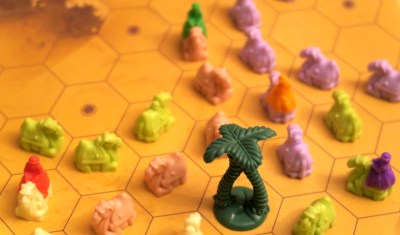
Through the Desert
– Image by boardGOATS

Elsewhere, Burgundy was in a four-way tussle with Purple, Green and Black for access to an oasis and Green and Burgundy combined to prevent Blue from connecting two of the oases.  Meanwhile, Purple collected a pile of watering-hole tokens, and Burgundy was attempting to enclose an enormous space in the middle, while Green and and Blue were hoping to fly under the radar and get away with discretely annexing small areas at the edge of the board.  It wasn’t long before the number of pale blue camels was dwindling and Black was left trying to decide whether it was in his interest to bring the game to an end.

Through the Desert
– Image by boardGOATS

When Blue reduced the handful to one lonely looking camel, Black could resist no longer leaving Burgundy’s audacious attempt to claim on the large central area incomplete and looking temerarious as a consequence.  Everyone had thought Black was so far in front that they were playing for second place, however, it turned out that the game was much closer than expected.  Green had scored slightly more for his oases and the length of his Caravans than Black and Black’s large corner hadn’t given him quite as much territory as it had first appeared.  It was very close, but Green took it by just two points.  As the group packed away, feelings were generally positive, but everyone was agreed that they’d play it differently next time, so we’ll have to give it another Go sometime soon.
Through the Desert
– Image by boardGOATS

With five players, the options were limited – we generally try to avoid two-player games and we were a bit short on good five-player ones.  In the end, it was either yet another game of Bohnanaza, or the 2016 Kennerspiel des Jahres winner, Isle of Skye, and Isle of Skye won easily.  Although this is a game we’ve played quite a bit and know reasonably well, we decided not to add the new Druids expansion as it is a while since we last played the base game and we felt we could do with a reminder.  The game is a sort of upgraded tile laying game with a lot in common with Carcassonne, but with an auction at the start of each round and scoring at the end of each round.  The scoring is one of the interesting parts of this game as the four scoring criteria change from game to game and, and each one scores three times during the course of the game.  Choosing how to prioritise these to drive a strategy is one of the keys to playing well.

Isle of Skye: From Chieftain to King
– Image by boardGOATS

This time, points were available for cows in the largest field; brochs; completed areas, and lighthouse-longboat combos.  The game proceeded along its usual course:  Burgundy had stacks of money but no tiles because everyone kept buying them while Blue and Black had plenty of tiles, but no money.  Black with a very linear kingdom was reminded by Purple that the goal for that shape wasn’t in use this time.  It didn’t seem to matte as he stormed off into the lead with a large field full of cattle, but it wasn’t long before others gave chase.  The winner in this game often comes from the back, because there is a “catch-up mechanism” where players get money in the later rounds, with those at the back getting more.  So, when Green and Blue eventually caught up with Black, the positions were important and Green looked ideally placed one point behind Black who was one point behind Blue.
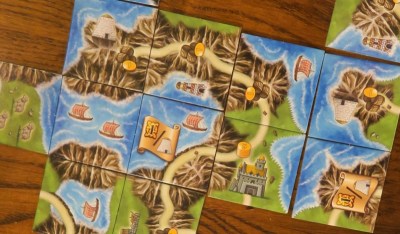
Isle of Skye: From Chieftain to King
– Image by boardGOATS

Although the points awarded at the end of the rounds are valuable, it is usually the end game scoring through the scrolls that is critical.  These provide personal targets for each player, and score twice where terrain is “completed” (i.e. completely enclosed).  So towards the end of the game everyone scrabbled to maximise their points.  Green took a tile Blue wanted to keep, so Blue took one that Burgundy had priced very highly giving him even more money, but not the one tile that was really crucial to his plans.  Black added a couple more farms, while Green went for ships Purple went for light-houses and Blue tried to get both.  Burgundy and Blue were also working on the communal, end of round scoring for the brochs (prehistoric circular stone towers found in the highlands and islands of Scotland).  In the case of scoring for brochs though, one would give one point, two would give three and three six points.

Isle of Skye: From Chieftain to King
– Image by boardGOATS

With two players fighting for them brochs were scarce, but by the final round both Blue and Burgundy had managed to get their quota of six.  They were less than impressed when Black pointed out that the brochs only scored if they were in the same mountain region.  Although Black had read the scoring in full, somehow it had failed to make it to the end of the table as both Blue and Burgundy had missed it.  Green pointed out that anyone affected should be called out for cheating, but Burgundy was in such dire need of points nobody was going to contest him claiming them.  The scoring at the front was a bit closer though.  As the points were calculated though it was clear that Green needn’t have worried.  Although he was only one point behind Black, Blue’s fleet of ships meant she was twelve points clear, and it was obvious that even allowing for the extra points, she would still have won.

Isle of Skye: From Chieftain to King
– Image by boardGOATS

Learning Outcome:  If the rules are that important to your game-plan, clarify them first.

Boardgames in the News: What are “House Rules” and are they a Good Thing?

Occasionally, our game reports refer to “House Rules”.  These are slight alterations to the game rules which our group introduce when we play.  For example, the GOATS are quite slow players and, although we love Las Vegas, we find that it drags a little if the full four rounds are played, so we have a “House Rule” which means we stop after three.  Similarly, for us Saboteur sometimes drags and we find the scoring element a bit pointless.  For this reason, we usually skip the scoring and play each round as a short, independent game, which means we can play for as long as we want and just stop when we’ve had enough without worrying about overall winners.  The group also recently discussed allowing two players to make a pact with the Devil in Auf Teufel komm raus when playing with six, to help those players bringing up the rear catch-up, and perhaps make the decisions a little more interesting for the other players too.

Las Vegas
– Image by boardGOATS

“House Rules” are frequently quite controversial though, and the reason is largely philosophical:  the game designer’s vision is based on “The Rules as Written”.  Tampering with the rules can be seen as showing anything from a lack of respect for the designer, to ignorance.  This is because the designer, publisher and development team will have the best understanding of the game through extensive play-testing, and that will be reflected in the rules. There is a point here, famously, many people play Monopoly “wrong”, for example, which changes the character of the game significantly making it overly long and often extremely tedious (especially for players at the back).

Carcassonne
– Image by boardGOATS

When asked, most games designers will encourage experimentation though. This is for two main reasons.  Firstly, most game designers enjoy experimenting themselves: to them there is no “one true rule set”, only the “current rule set”.  This is true for the rest of us too, as some games change when new editions are published—for example, Carcassonne, where the first, second and third editions all have different scoring, or Orléans, where the rules for the Bathhouse changed between the first and second edition.

Orléans
– Image by boardGOATS

Secondly, most designers understand that different groups have different characteristics and dynamics, and therefore enjoy different aspects of playing games.  Designers also want people to get the maximum enjoyment out of their game and sometimes that means tweaking the rules slightly.  So ultimately, they want people to play the way that makes them happiest.  For the avoidance of arguments, it is clearly important to make any “House Rules” very clear to everyone playing, as there is an expectation that games will be played with “The Rules as Written” except by prior arrangement.  However, if playing a game in a particular way is enjoyable, there is clearly absolutely nothing wrong with using “House Rules” as long as everyone knows they are doing it.

Las Vegas
– Image by boardGOATS

Boardgames in the News: Who are PAI Partners and what do they want with Asmodee?

A couple of months ago, Reuters reported that according to un-named sources, investment bankers had been hired to run the sale of Asmodee.  The claim was that the sale “could value the company at over €1.5 billion”, but there was no credible information as to who the potential buyers were.  This mystery has now been solved with the announcement that PAI Partners have entered into exclusive discussions to acquire Asmodee, a company with an enterprise value of €1.2 billion.  So, who are PAI Partners and what do they want with Asmodee?  Well, PAI is a European private equity company, that grew out of the merger between the French banks, BNP and Paribas in 1993, with a management buyout completed in 2001.  They have invested in a wide range of companies covering everything from yoghurt (Yoplait) to tyres (Kwik Fit) to cargo handling (Swissport).  Obviously PAI are interested in making money from Asmodee, but at this time there is no evidence to suggest that would by by asset stripping.  Price increases would be almost inevitable however, as the Studios would be under pressure to provide a good return on the investment.

PAI Partners
– Image from paipartners.com

Boardgames in the News: Concentric Eccentric Carcassonne

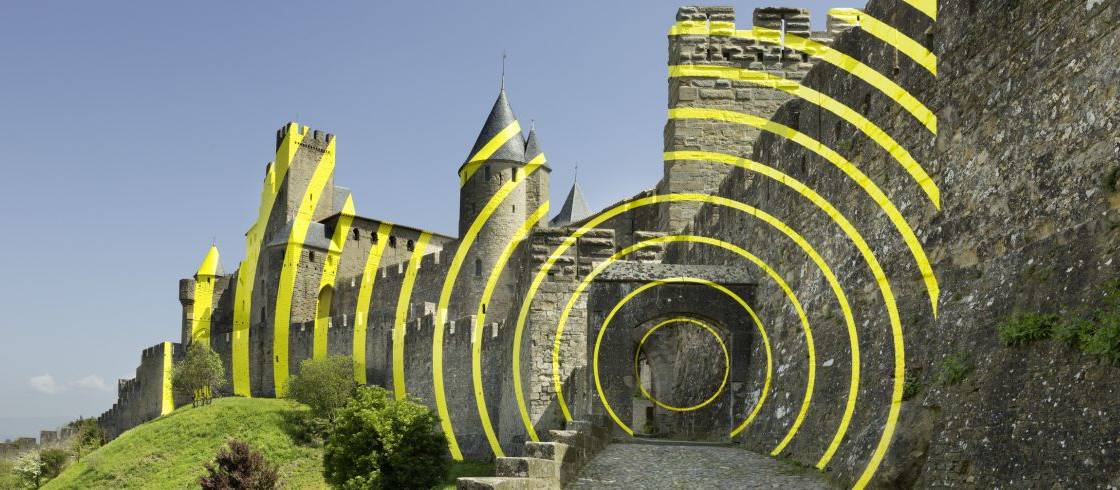
People playing Carcassonne in and around the walled city of Carcassonne, are a common sight and the locals are very tolerant.  However, the residents have been less impressed by the new art installation adorning the medieval fortress.  Selected by the Centre des Monuments Nationaux to celebrate the 20th anniversary of Carcassonne’s inscription on the UNESCO World Heritage List, the installation is also part of the IN SITU Heritage and Contemporary Art, a summer event in the Occitanie / Pyrenees-Mediterranean region focusing on the relationship between modern art and architectural heritage.

Concentric Eccentric Carcassonne
– Image from france.fr

The work was designed by Felice Varini and comprises thin, painted aluminium sheets laid on the walls and towers of the west side of the medieval city, to form a succession of yellow “concentric eccentric circles” drawing visitors into the city.  The installation was officially inaugurated on 4th May and will be visible until the end of September.

29th May 2018

Two of our more sporadic members arrived early and were keen to get as many games played as possible, so the first game was squeezed in between ordering food and its arrival.  As something quick was required and Turquoise hadn’t played it before, NMBR 9 was the perfect choice.  A quick rules explanation was necessary, but there isn’t much to explain so it didn’t take long:  one player turns over the card deck, one at a time and everyone takes the indicated card and adds it to their tableau, ensuring that the edge touches one of the other tiles.  Once a few tiles have been placed to form a base layer, then tiles can be placed on top of other tiles as long as there are no overhanging parts, and the tile sits squarely on more than one other tile; the higher the tiles are placed the more they score.  It was a  tight game, well, tight between three players, but Pink romped away with it, twenty points clear, thanks to building one more level than everyone else.

NMBR 9
– Image used with permission of BGG contributor punkin312

Food was a little delayed, so there was time for another short game, this time an old favourite, 6 Nimmt!.   This is a game that gives players the illusion of control while everything is going well, and then shatters that illusion when it all goes wrong.  It is one of those games that is more difficult to explain than to play, but essentially players simultaneously choose a card from their hand, then simultaneously, everyone reveals their card.  Beginning with the lowest, each card is added in turn to the end of one of the four rows of cards on the table.  If a card is the sixth to be placed in a row, the first five are “won” and the card becomes a new starting card.  The player with the fewest “nimmts” is the winner, though almost as much kudos goes to the person for whom the game goes most wrong  and ends up with the most “nimmts”.  As usual, we played two rounds, and Magenta won the first with a duck, while Purple top-scored with twenty-six.  Purple picked up more “nimmts” than anyone else in the second round too and bravely took the wooden spoon, but the winner is the lowest over two rounds, and when Magenta picked up thirteen in the second round, she left the door open for Turquoise who finished with a very creditable total of six.

– Image by boardGOATS

While Pink, Blue, Magenta and Turquoise munched their pizzas, and Burgundy was attacked his ham, egg and chips, there was just time for those not eating to play a quick game of Love Letter. This game is very, very simple and can be as long or as short as necessary, in fact we hardly ever actually play it to the bitter end (three wins for one person).  Players start with a one card in hand and, on their turn draw a second, then choose which to play.  Each card has a special action and the aim of the game is to be the last player remaining or, in the case of more than one player left standing, to finish with the highest value card.  The first round went to Ivory came out on top, but in the second, Green made a lucky guess and knocked out Ivory in the first turn.  Then Green lost on a comparison, leaving Black and Purple to battle it out to the last card, with Purple the victor.  The third (and as it turned out, final) round ended up in a very unusual situation of being a tie between Green and Purple who both had the same high card.  While checking the rules, Blue shouted across that the winner was the one who had the highest total in front of them, which gave victory to Green.  With one-a-piece (except for Black) it was declared a three-way tie, though Purple was able to claim a moral victory with one win and a lost tie-break.

Love Letter
– Image by boardGOATS

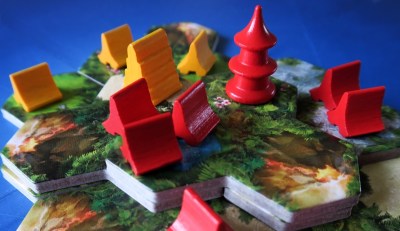
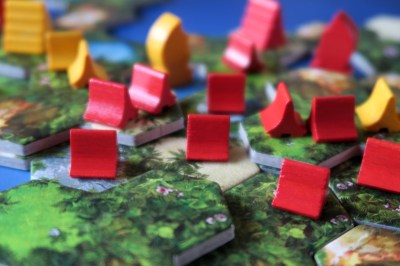
Burgundy was still wading through his ham, egg and chips, but everyone else was finished, so it was time to negotiate who was going to play the “Feature Game”.  This was to be Taluva, a game we’ve played before, but this time it was to include the Extension.  The base game is a fairly simple tile laying game with a surprising amount of depth.  The idea is that on their turn, players place their tile, then place a building then replenish their hand.  This procedure is to that of Carcassonne, but that is where the comparison ends.  The tiles are a strange dodecagon made of three hexagonal regions or fields, one of which is always a volcano.  When placing tiles, they can be adjacent or on top of other tiles so long as the volcano sits on top of another volcano (the tile must also cover more than one tile and there cannot be an overhang).  Buildings can be placed anywhere, provided that they obeys certain rules. Unfortunately, although the game is beautiful, the theme is a bit sparse making these rules appear very arbitrary which has the consequence that they are quite difficult to remember.

Taluva
– Image by boardGOATS

A hut can be built on any unoccupied level one terrain that isn’t a volcano. On the other hand, an existing settlement can be expanded by placing huts on all adjacent terrains of one type, with more huts placed on the higher levels (two on the level two etc.). There are also three temples and two towers to place which can only be added to existing settlements: temples must be added to settlements covering at least three fields, while towers must be placed on a level three field adjacent to a settlement of any size.  The game ends when there are no tiles left and the winner is the player to have placed the most temples at the end of the game. In case of a tie, the number of towers built counts and then the number of huts. However, if a player succeeds in building all buildings from two out of the three different types before the game end, then he immediately wins the game. On the other hand, any player who squanders his building pieces and is unable to build any more is immediately eliminated.

Taluva with Extension
– Image by boardGOATS

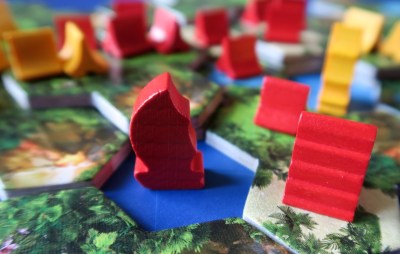
Adding the Extension adds four optional modules:  pieces for a fifth player; two ships per player; a small number of double-hex tiles (rather than triple-hex tiles), and a board that provides a boundary for the building area.  We added all four modules, though we used the largest boundary area so it had only a small impact on the game.  The double-hex tiles are laid out face up and each player can only use one during the game, but as all tiles must be used unless a player checks-out early, the decision when to take play one can be quite important as nobody wants to be left with a tile they can’t use effectively.  Perhaps the most interesting module, though, is the ships.  These are played on “lagoons”, but critically, there is  a limit of one ship per lagoon, and the ships do not connect other areas.

Taluva with Extension
– Image by boardGOATS

From the very start, everyone seemed to get carried away with the idea of trying to build lagoons and place their ships.  Everyone that is except Burgundy, who got his first settlement illegally removed by Blue and spent most of the rest of the game trying to catch up.  Meanwhile, Pink stalled as his computer overheated, trying to come up with a strategy to compete with Ivory’s ever-growing empire.  It quickly became apparent that it would require everyone else cooperating to bring it down.  Burgundy and Blue tried to hatch a plan, but Black couldn’t see a way to prevent Ivory placing his last ship, and wasn’t prepared to spend as long thinking about things as Pink.  And with that, Ivory brought the game to an end; definitely far more “thinky” than such a simple little game really had a right to be.

Taluva with Extension
– Image by boardGOATS

Meanwhile, those who did not want to play long or heavy games chose a light game of Best Tree House, an easy game to learn (or so we thought).  This is a fairly simple little card drafting game, but with the rules in German, it was down to Purple to try and remember how to play it and Magenta to attempt some translation.  Players start with a hand of six room cards, and simultaneously choose one to add to their tree, passing the rest of their hand on to their neighbour.  There are some rules about building: firstly, treehouses must be built in such a way that each new level has one more card than the last (giving the tree its shape).  Each card represents a type of room and these are colour-coded to one of six colours. When a player is adding a card of a colour they don’t have in their treehouse yet, it can go anywhere, but if a player is placing a colour that already exists in their treehouse, it must connect to at least one card of matching colour. In this way players have to consider their card placements over the course of the game and try to avoid locking themselves out of options as play develops.  The clever part is the Balance Marker which limits the placement options.  It has three positions and when it is not central, the player cannot build on that side of their treehouse, indeed, they have to build to the other side of center in order to move their Balance Marker back to open up their placement options again.

Best Treehouse Ever
– Image used with permission of
nonsensicalgamers.com

At the end of each round, players score their treehouse based on the trophies on display.  We stumbled through the first game not entirely sure who should chose the scoring alteration cards after each round.  It wasn’t till the end of the game, when Black had found a copy of the English rules online for us that we realised we had made a few mistakes in the way we played. Some of us had also re-used a colour that should not have been used as it had already been blocked by other rooms.  Although the game was a tie between Purple and Turquoise on thirty-four each, we felt we had made such a mess of it that we needed to try again, but properly this time—it was only a short game after all.  The second time round, the game made more sense and everyone made better choices. The choosing of the score alteration cards was certainly trickier this time, but that felt more like a game challenge.  This time the victory went to Magenta, but everyone felt better after the second try and the game seemed a lot fairer too.

Best Treehouse Ever
– Image used with permission of nonsensicalgamers.com

Although time was getting on, it still wasn’t that late, and the “Feature Game” looked like it might be drawing to a close soon, therefore we picked another short one, Dodekka.  This is a simple little push-your-luck card game, with five different suits, Fire, Earth, Air, Water or Ether each with cards numbered 0-4. The game starts with three random cards placed in a line from the draw deck.  On a player’s turn they can either take a card from the deck and add it to the end of the row of cards, or take the card nearest the deck.  If the total of the face values of the cards in the row exceeds twelve, then the player has to take the whole row.  At the end of the game, players choose a scoring suit and add up the face value for that colour, then they subtract the penalty points – one for every card not in their scoring suit.  Purple and Green are old hands at this one, but Turquoise and Magenta had not played it before. Green made a good show of demonstrating how not to play this game as he managed to collect a vast array of cards of all colours.  His positive score was not bad, but he had a shockingly high negative score giving an overall minus one.

Dodekka
– Image by boardGOATS

It was much closer between the other three.  Turquoise got to grips with the idea quite quickly and managed to amass a high positive score of 16, but ended up with a few too many other colours.  In a game that is often won with a score of two or three, her score of nine was excellent and remarkably tied with Purple who scored.  Eclipsing them both, however, was Magenta, who scored positive thirteen like Purple, but amazingly had avoided the traps and ended up with only two other cards to give an unheard-of total score of eleven.  By this time, Taluva had finished, and that group had moved onto another quick game that we’ve not played for a while, The Game.  This was played with the blue cards from The Game: Extreme, but we just ignored the additional extra icons.  In this game, players must try to cooperatively play every card from the deck (numbered two to ninety-nine) onto four piles.  On their turn, the active player must play two cards from their hand on any of the four piles:  for two of the card must be of higher value than the current top card, while for the other two it must must be of lower value.

The Game: Extreme
– Image by boardGOATS

Players can discuss anything they like so long as nobody discloses any specific number information and they can play as many cards as they like on their turn so long as they play at least two (until the deck has been depleted, after which they must play one).  To help eveyone out, there is also the so called “Backwards Rule” which allows players to push a pile back so long as the difference between the card they are playing and the card they are covering is exactly ten.  Once the active player has played their cards, they replenish the missing cards.  The game ends when all cards have been played or the active player is unable to play a card.  This time, a lot of players started with mid-range cards, but once those had been cleared, things progressed quite satisfactorily.  Inevitably, when Burgundy was forced to trash a pile, things began to go wrong, but once he’d played all his cards, with a bit of careful organisation all of a sudden it looked possible, and indeed, as Ivory played his last cards, a four and a three, we beat The Game for the first time in a very long while.

The Game: Extreme
– Image by boardGOATS

While all this excitement was going on, Green had left for an early night and the last three decided to give NMBR 9 another go.  This time, all three players only managed two scoring layers, and, as a result, there was just one point between second and third.  It was Turquoise, however, who had really got a handle on the game this time though, and finished more than ten points ahead of the others with a creditable score of sixty-four.  There was still time left for something shortish, and with six people there wasn’t an awful lot to choose from, so in the end, we went for an old favourite, Bohnanza, also known as “The Bean Game”.  Because most people have played this a lot, in general, it was only a few minor points that really needed clarifying though reminders are always helpful:  hands must NOT be rearranged; active players MUST play the first card from hand and may play the second; the two cards turned over from the deck must be planted before any other trading can be done; fields with only one bean in them cannot be harvested unless all fields only have one bean in them; draw FOUR cards at the end of players turns, and third bean fields cost only TWO coins…

Bohnanza
– Image by boardGOATS

The game was very close.  Purple was clearly doing well with lots of lucrative Soy beans, while Black-eye beans were unusually popular.  Black was stuck with a precession of coffee and wax beans, while Blue kept digging up stuff just before she acquired more of them. Burgundy kept complaining that he had a very small pile, but by the end it looked just as healthy as anyone else’s.  Blue bought herself a third bean field at her first opportunity, and, controversially, Ivory followed about two thirds of the way through the second round.  This drew lots of surprised gasps and sucking of teeth, as the received wisdom is that with large numbers of players, the extra field is rarely worth it.  It was impossible to tell whether Ivory would have done better without it, but it was a game of small margins.  In the end, it was a tie, with Blue and Purple both finishing with thirteen points, largely thanks to a very dodgy trade on the final turn.

Bohnanza
– Image used with permission of BGG contributor spearjr

Learning Outcome:  Great games can come from a simple rule set.

Boardgames in the News: Asmodee For Sale‽

Over the last few years Eurazeo have developed Asmodee from a small French games company primarily known for a clever little kids game called Dobble, into an industrial conglomerate swallowing up the likes of Days of Wonder, Fantasy Flight Games, Z-man Games, Mayfair, and Lookout Spiele.  In the process, Asmodee added some of the most high profile modern boardgames to their portfolio, including Ticket to Ride, Carcassonne, Pandemic, Agricola, Star Wars X-Wing Miniatures Game, SplendorDead of Winter, Settlers of Catan (now known simply as “Catan”) and as of this weekLove Letter.  Speculation as to the end result has been rife, here and elsewhere.  Indeed, three months ago we raised the question:

…it would seem that Eurazeo is not looking to hold onto Asmodee for the long haul, instead they will be looking to maximise Asmodee’s growth and then make their exit, probably in the next two to five years.  So the big question is, how are Eurazeo going to make their “controlled exit”?

Reuters now reports that according to un-named sources, the answer is, “Sell Asmodee”.  Apparently, investment bankers have been hired to run a sale process which they claim could value the company at over €1.5 billion (quite a return for Eurazeo who originally paid €143 million for Asmodee in November 2013).  As yet, there is no credible information as to who the potential buyers may be, but if the news that Asmodee is to be sold is true, there will no doubt be plenty of speculation over the coming weeks and months.  Possibilities range from a major toy manufacturer like Hasbro or Mattel wanting to add expand their range of boardgames, to venture capitalists companies going for maximum short term profits, leading to reduced quality and increased prices.  No doubt, time will tell…

Asmodee Logo
– Image from
escapistmagazine.com

17th April 2018

With Burgundy and Blue waiting for food, they decided to entertain Red with a quick game of NMBR 9, making it’s appearance at four consecutive games nights and starting three, something of a record.  Somehow despite this extended run, Red had managed to avoid playing it, so after a very quick run-down of the rules, we started.  The game is really very simple indeed, with players simultaneously drawing tiles and adding them to their tableau. Tiles can be placed on top of other layers as long as they don’t overhang and overlap more than one tile.  Each tile depicts a number and the more tiles it sits on, the more points it scores.  The whole game is typically over in about ten to fifteen minutes, and in this case it was quite tight between Blue and Burgundy, though Blue finished on ahead thanks to a lot of high-scoring tiles on her third level.

NMBR 9
– Image by boardGOATS

Although it has proved to be a highly popular filler thanks to it’s simplicity and minimal set up time, Red was not so impressed because she felt it had seemed to offer more when she had watched everyone else playing.  She struggled to explain what she meant, but it was clear that she was a little disappointed though that was probably largely due to her expectations.  By this time, food had been dealt with and everyone else was arriving, and as the “Feature Game” was to be be Mini Park, another quick filler, we got on with deciding who would play it.  When Ivory’s comment, “I’ll play that, but it depends on what else is on offer really…” was challenged, he added, “Well, if the alternative is Kingdomino, I’d rather try Mini Park!”  Since Black had chosen that moment to wave Kingdomino around, that pretty much settled them as the two games and uncharacteristically, almost everyone jumped on the Mini Park band-waggon, leaving Black and Purple to play Kingdomino alone.

Kingdomino
– Image by boardGOATS

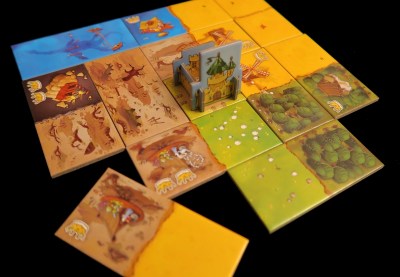
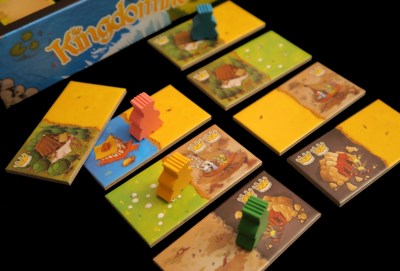
The group doesn’t usually go for two-player games and as Black and Purple get lots of opportunity to play games like this together, normally someone would join them.  However, in this case, both games were short and Kingdomino can be a bit variable with three due to the tiles that are left out, so we just got on with it.  Kingdomino was the Spiel des Jahres in 2017 and has been very popular within the group as a light filler, so has hit the table quite a bit in the last year.  The game is quite simple in that players take it in turns to choose a “domino” and add it to their “Kingdom”.  The clever part of the game is that the tiles are numbered with players who choose the high numbered (and therefore more valuable) dominoes taking their turns later in the next round.  In the two player game, players get two turns per round, so their first turn can be used to try to set up the second turn.

Kingdomino
– Image by boardGOATS

Unfortunately, Black and Purple forgot about the other key difference when playing a two player game:  instead of 5×5 arrays, each player is building kingdoms consisting of 7×7 arrays of “squares”.  They suddenly noticed they had more tiles left than they had spaces and realised their error, so decided to carry on playing anyhow.  Purple concentrated on getting corn fields and then sea and finally forests, while Black just tried to build areas of everything and make sure he was able to place all his tiles.  It was very, very close, but despite the fact that she had to forfeit some tiles and failed to pick up her bonus for completing her grid, Purple just pinched it by a single point.

Kingdomino
– Image by boardGOATS

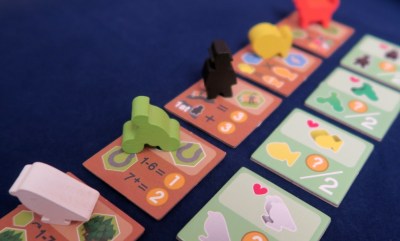
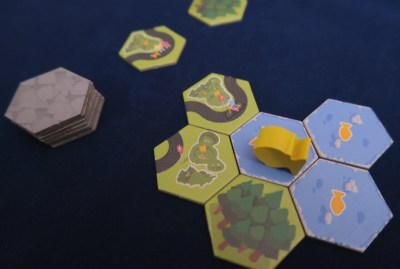
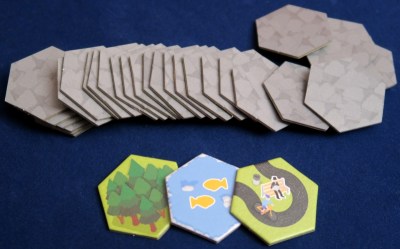
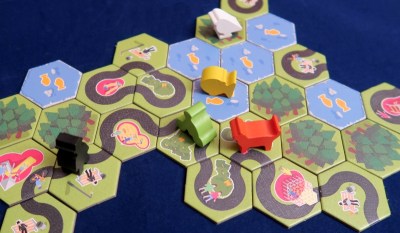
Meanwhile, on the neighbouring table, everyone else was learning the “Feature Game”, Mini Park, another quick-playing, tile-laying game.  On the face of it, this has a lot in common with Carcassonne, played with two face up tiles to choose from.  In contrast, however, the tiles are hexagonal which gives a little more variability and once during the game, players choose one character which dictates the end game scoring.  We played the “advanced” game which has slight changes to the scoring and pairs each scoring character at random with a second character.  In our game, for example, the Black Man in the Smart Hat was paired with the Yellow Fish, so the player who chose the Man (Ivory), got half the points that the player who chose the Fish got for that character (Blue).  It was felt that this would add an interesting dynamic to the game as it would take on some aspects of a semi-cooperative game.

Mini Park
– Image by boardGOATS

Unfortunately, nobody realised at the start just how powerful (or not) each of the characters were and in that game it turned out that some were really very powerful indeed.  For example, at the start of the game everyone was encouraged to place fish next to other fish, as this was the only way to make them pay when they were being placed.  However, this left a large fish pond with lots of fish and when Blue (who was the first to get to the Yellow Fish Marker) and then Ivory added to it, it yielded a massive twenty-four points.  Although this was the most lucrative character, the Green Man on a Bicycle (claimed by Pine) was not far behind with eighteen points.  This was thanks largely to the fact that Pine and Blue (who had the Bicycle as her subsidiary character) kept drawing road tiles and extending the road the Bicycle was on, trying to scupper Ivory’s plans to build roads with benches.

Mini Park
– Image by boardGOATS

Although Burgundy picked up the most points for tile placement, the majority of the points come at the end of the game and, as he was last to pick his character, Burgundy was penalised when he ended up with the relatively low scoring White Bird (ironically partnered with the Orange Cat that also failed to score highly).  Pine scored well for his Green Cyclist, but did not pick up enough subsidiary points from the White Bird.  Ivory’s subsidiary scored highly (Yellow Fish), but much to his chagrin the scoring for his Black Man in a Smart Hat was severely restricted by Pine and Blue’s tactics. Blue, however, did well on both her primary goal (Yellow Fish) and her subsidiary (Green Cyclist), giving her more than enough compensate for a poor score on the tile placement, and she finished some way in front.  If everyone had realised the implications of how the scoring worked, it was quite likely that they would have played differently and it would not have been such a landslide, and chatting afterwards, it was obvious that that aspect coloured people’s opinion of the game.

Mini Park
– Image by boardGOATS

The fact that everyone had only one shot at a character was meant it felt that all a player’s eggs were in one basket.  This was made worse by the fact that with only one shot, the challenge was when to choose a character:  too early and everyone else would be able to obstruct, too late and only the dross is left with not enough time to improve the situation.  That said, it was not a long game and with only three players it would be very different as each player gets two opportunities to take character cards.  Furthermore, it seems the rules are still being developed, for example, the latest version of the online rules state that the subsidiary character cards are placed face down and thus kept secret until the end of the game and the tile placement scoring has been simplified too.  Given that it is such a short game, we should certainly give this one another go sometime, perhaps with the new rules-set.

Mini Park
– Image by boardGOATS

Kingdomino and Mini Park finished at much the same time, which meant i was possible to re-balance the number of players a little, but not before the usual shenanigans regarding who wanted to play what.  Although neither mentioned it by name, Burgundy and Ivory clearly had an eye on giving Yokohama another go.  Time was marching on though and Yokohama isn’t a short game, and even without any rules explanation there is a lot to setup.  The 10th Anniversary Edition of Puerto Rico was also available though, and there was just time to squeeze in a game provided it started straight away.  So as Ivory had somehow managed to avoid playing it thus-far, we felt it was essential that we rectified the situation and Burgundy and Ivory started setting it up.  With Blue joining Burgundy and Ivory, that left four people looking for something interesting to play, so Blue suggested Bärenpark.  This another fairly light tile laying game, this time set in a bear park.

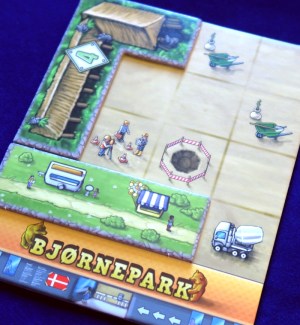
Bärenpark
– Image by boardGOATS

Each player starts with a plot that will become their park, and the idea of the game is that on their turn, players place a tile from their personal supply on this plot.  Each starting plot has a different array of symbols on some of the spaces, indicating different types of tiles.  When these symbols are built over, the player takes more of the appropriate tiles from the general supply to add to their personal holdings.  Some of these are small animal houses, some are larger enclosures and some are very small amenities like toilets and children’s play areas.  Each tile also has a Construction Crew and a Pit providing the foundations for a Bear Statue.  The Construction Crew allows the player to take an expansion board for their park, providing a new plot which they place next to their park.

Bärenpark
– Image by boardGOATS

In contrast to the rest of the spaces, the Pit cannot be built upon in the usual way and is the last space to be covered in each plot; once every other space in a plot is covered, the owner can claim a statue from the display and place it over the Pit.  These statues provide points, with the statues providing a diminishing number as the game progresses.  Other sources of points include the animal houses and enclosures, but the number of these are limited and again, the earlier tiles are worth more.  The small amenity tiles do not score points, but they allow players to fill in those awkward, difficult-to-fill, small gaps, enabling them to finish a plot and build a statue.  Even these are limited, though to a lesser extent, so players need to be on the watch in case they are caught out.  The game ends when one player fills all of their four plots and then everyone adds up their scores.

Bärenpark
– Image by boardGOATS

After a little grumbling about koalas not being bears (the rules explain that “people like koalas, so we will be including them in our park!”), and a brief explanation from Blue, everyone started building.  It was a fairly close game, but Black finishing with eighty-eight, seven points ahead of Pine in second place.  Asked what he thought of it, Black’s comment was that it was a very simple game, but the group had been playing the basic game.  The “Expert Variant” has achievement tiles which provide another source of points and make the game far more interesting for experienced gamers.  Red, on the other hand, enjoyed the game much more, somehow finding in it the tessellation building thing that she had struggled to describe, but she had felt was missing in NMBR 9.

Bärenpark
– Image by boardGOATS

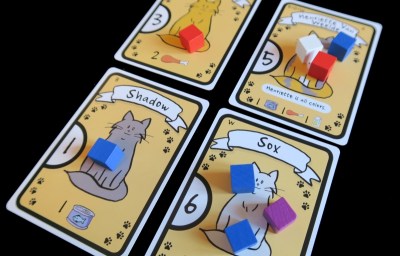
Puerto Rico was still going, so the group moved on to one of Purple’s current favourites, Cat Lady.  This is a light card game that got an outing last month as well.  The game is a very simple a card drafting game, similar in feel to Sushi Go!, though with a very different drafting mechanism.  On their turn, the active player takes all thee cards from one row or column in the three by three grid, marking the row they took with a kitty meeple.  The cards are replaced from the draw deck and the next player then takes a different row or column.  Cat cards go in front of the owner who must feed them before the end of the game or they score negative points.  Any food cards yield cubes which can then be placed on the face-up cat cards to show they are being fed.  Similar to Sushi Go!, there are also cards that score for the player with the most cards (cat “costumes”) and give players with the fewest negative points and sets that players can collect (toys).

Cat Lady
– Image by boardGOATS

Players can also collect catnip cards which score minus two if the player only has one at the end of the game, or one or two points per cat if they have more.  There are also lost cat cards, and discarding a pair allows players take a two victory point token or one of the three stray cat cards which are particularly useful because they have special powers.  The tricky part is making sure that the food a player gets matches the cards, because cats are fussy creatures and some like tuna, while others will only eat chicken…  At the end of the game, players score points for each happy well-fed cat and for their toy collection with extras if they have the most cat costumes.  Unfed cats, having the fewest costumes, and the largest surplus of food will give players negative points.

Cat Lady
– Image by boardGOATS

This time everyone went for different approaches with differing degrees of success.  For example, Purple went for costumes and Pine went for toys; Black and Red both went for lots of cats and catnip, but Black failed get enough catnip to score, and actually ended up with negative points.  It was very close between Pine and Red in the end, but Pine who had fewer cats (but very contented ones thanks to all the toys they had to play with), just beat Red with her larger number of cats that were all high on catnip.  Time was getting on and Puerto Rico was just coming to an end giving them just enough time to watch the last few rounds.

Cat Lady
– Image by boardGOATS

Puerto Rico was the number one rated game on the BoardGameGeek website for over five years and still commands a lot of respect though it has significant flaws.  The problem is that there is very little randomness in the game which is great, but when a game like that is played a lot people become “experts” and there is a perception that there are right and wrong moves.  In Puerto Rico, this point is exacerbated because of the way the game is played.  In each round, beginning with the Governor, players take it in turns to chooses an action.  Every player carries out the action, but the player that chose it gets a “privilege”, i.e. a bonus.  The catch is that players that players need to watch what everyone else is doing in order not to give an advantage to an opponent, or worse, give one opponent an advantage while making life difficult for someone else (also known as “King making”).

Puerto Rico
– Image by boardGOATS

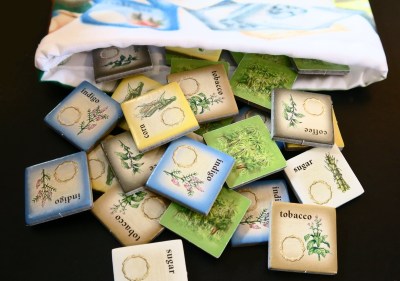
In Puerto Rico, players are plantation owners in seventeenth century Puerto Rico growing up to five different kind of crops: corn, indigo, sugar, tobacco, and coffee. Each plantation owner must try to run their business more efficiently than their competitors. First they must grow their crops then they must store them efficiently. Finally, players must sell their crops at the right time or ship their goods back to Europe for maximum benefit. In order to do this most effectively, the plantation owners must make optimal use of the arriving colonists and develop the capital city, San Juan, building useful amenities.  Thus, the aim of the game is to get victory points which are awarded for buildings and for shipping goods. However, to build, players need money, and before they can ship goods, players need to be able to produce the goods with a plantation, and where necessary process them in the appropriate building.

Puerto Rico
– Image by boardGOATS

As Ivory had not played the game before, Burgundy was Governor for the first round and Blue went second, giving him a little thinking time before he had to choose an action.  This has consequences for the setup, with Blue and Burgundy starting with an indigo plantation and and Ivory starting with a corn field.  At first, Ivory couldn’t see why corn might be useful as selling it doesn’t give any money, however, he quickly realised that it doesn’t need a production building and therefore is quicker and easier to produce, making it ideal for shipping.  Blue joined him and the pair were soon filling boats as often as they could.  Burgundy meanwhile, had gone for the high value coffee.  This took him a little while to get going, but once he had a coffee roaster he was able to sell his first batch of coffee and for a short while looked like he was going to storm ahead as he added sugar to his portfolio.  Unfortunately, for him, once he had spent his coffee profits, Burgundy got a little stuck as Blue and Ivory worked together very efficiently to make life difficult for him.

Puerto Rico
– Image by boardGOATS

To begin with, Burgundy was able to ship his coffee, but as it is a high value produce, he really wanted to sell it and use the profits to build.  That wasn’t possible though as the Trading House already had a coffee crate in it and until there were four different commodities there, no more coffee could be sold.  Burgundy had been able to commandeer a ship for coffee, but once that was full, Burgundy was in an even worse position, because between them, Blue and Ivory were able to make it very difficult for Burgundy to ship two different goods types.  The reason why this caused him problems was because of the Boston Tea Party Rule:  after shipping, players are only able to keep one crate and anything else is lost over the side.  Thus, to begin with, Burgundy was forced to ship when he didn’t want to, and then lost valuable stock when he couldn’t ship.  And all the while, Blue and Ivory were collecting victory points for shipping their corn and a little sugar or indigo.

Puerto Rico
– Image by boardGOATS

Ivory had got off the mark quite quickly buying a Hacienda early on.  It wasn’t till much later in the game when Blue bought a second that we realised we’d been playing it wrong and instead of choosing which extra plantation tile he got, he should have been drawing them blind.  This had two consequences:  firstly it gave Ivory a small, but potentially significant advantage, and secondly, it meant we didn’t run out of plantation tiles quite as quickly as we would otherwise have done.  It couldn’t be fixed though, so we just carried on and as long their strategies were aligned, Blue and Ivory were worked well together.  It wasn’t long before Ivory moved on to the next stage of his development and first built a Factory and then started raking in the cash every time he produced.  Blue then built herself a Warehouse and upped her shipping rate and starting raking in the victory points.

Puerto Rico
– Image by boardGOATS

The game was coming to a close when the Big Question came up:  Burgundy asked whether players were allowed to buy more than one large building.  Both Burgundy and Blue had a vague recollection of the rule, but it couldn’t be found in the booklet.  Ivory graciously switched his strategy and did something else, though checking later proved that was wholly unnecessary.  The game came to a close as we ran out of  on victory point chips and colonists (something that would have happened a lot earlier had we realised there should always be a minimum number arriving on the Colonists Ship), and all that was left was to tally up the scores and it was very tight indeed.  Although he had lots of buildings, Burgundy’s shipping had been effectively stymied by Blue and Ivory and the shortage of colonists had also made things a lot more difficult for him than it should have been, despite all that though, he wasn’t far behind Blue and Ivory.  In the end, Ivory won by a single point.  There was no need to re-count as he would have undoubtedly won by far more if he had built that second large building, though perhaps that off-set some of the advantage he had received early on with his Hacienda.

Puerto Rico
– Image by boardGOATS

Learning Outcome:  Sometimes it is best to play the “basic” game to get a feel for it before trying the advanced rules, but other times, it just feels trivial.

Boardgames in the News: Osprey Plays Games at Blackwell’s

On 28th April 2018, Blackwell’s Bookshop in Oxford are holding their second games night in collaboration with Osprey Games, a small games publisher based up Cumnor Hill.  Originally owned by Berkshire Printing, part of Brooke Bond, the tea company, Osprey was formed in 1969 to publish “Aircam Aviation“, a series of books that grew out of the aviation illustrator Richard Ward’s work on the collectable tea cards.  In 1998, Osprey became an independent company and moved from London to Oxford and began focusing exclusively on publishing on warfare and military history books.  Over the last ten years, Osprey has been publishing the Bolt Action rules used for World War II simulation games, but more recently has also engaged in reprinting some of the lesser classic board/card games.  This includes Martin Wallace’s London, Reiner Knizia’s High Society and Patrick Reid’s semi-cooperative game, Escape from Colditz.

Osprey Games
– Image from tabletopgamingnews.com

Blackwell’s is a very well known independent Oxford bookshop, but given the increasing popularity of board gaming in Oxford, they have jumped on the band-waggon and now stock a moderate range of modern board games including staples like Ticket to Ride and Carcassonne.  Last October when London was re-released, Blackwell’s had copies available for pre-order for significantly less than they were being sold for at Essen a couple of weeks later.  Since then, Blackwell’s have had good deals available for other Osprey games as well, including Star Cartel and The Lost Expedition.  It is clear that Blackwell’s and Osprey Games are building a strong working relationship which was consolidated back in February when they held their first joint board games evening at Blackwell’s Bookshop on Broad Street.  This was clearly very successful, as there is now a second games evening planned for Saturday 28th April, 7pm-10pm.  There is a £4 entry fee, but that includes a free drink at the bar.

Blackwell's Bookshop Oxford
– Image from theguardian.com

Boardgames in the News: What is Asmodee’s Grand Plan?

Four years ago, Eurazeo bought a small French games company called Asmodee from the investment firm, Montefiore.  Asmodee were a small company hitherto primarily known for a clever little kids game called Dobble.  With the financial might of their parent company behind them, over the next few years, Asmodee proceeded to gobble up many larger, well-established companies, including Days of Wonder, Fantasy Flight Games, Z-man Games and most recently, Lookout Spiele.  Those companies produced some of the best known modern games including Ticket to Ride, Carcassonne, Pandemic, Agricola and Star Wars X-Wing Miniatures Game.  Not content with that, they also acquired the rights to the English language version of the Settlers of Catan (now known simply as “Catan”) and all the related Catan games as well as gobbling up a number of smaller and/or newer companies like Space Cowboys (producers of Splendor and Black Fleet) and Plaid Hat Games (producers of Dead of Winter and Mice and Mystics) and entering into a distribution agreement with many others.  There are now very few games companies of any substance that are not somehow tangled in the Asmodee web.

Star Wars: X-Wing Miniatures Game
– Image used with permission of BGG contributor adamfeldner

The last major purchase was F2Z Entertainment in 2016, and since then it has been relatively quiet.  With the new year comes a new wave of acquisition, however, so at the end of January Asmodee announced that they were in exclusive negotiations with Rebel.  Rebel is a relatively small, Polish company responsible for games like K2 as well as Polish editions of many popular games like 7 Wonders and Codenames.  Perhaps more importantly, Rebel also produces the Polish language versions of many of the Asmodee games and is the largest distributor in Poland.  And Poland is a big country, smaller than France or Germany, but bigger than Italy and the UK,  globally Poland is the thirty-forth largest country by population.  That is a lot of Poles and they do like playing board games in Poland.

K2
– Image used with permission
of boardgamephotos

This announcement was almost immediately followed by the bombshell that Asmodee had acquired all the residual assets from Mayfair and with it, Lookout Spiele. Although this is by far the largest deal in recent months, Asmodee have not been resting on their laurels and there has been a lot going on behind the scenes.  In December last year they announced that Esdevium was to be renamedAsmodee UK” bringing them in line with the “Asmodee North America” and “Asmodee Canada” brands.  At around the same time, Eurazeo announced that French publisher Purple Brain Créations would be joining the Asmodee Group.  Furthermore, they have also been streamlining their distribution network in North America.  Having reduced the number of distributors they deal with to five in 2015, in June last year Asmodee North America announced an exclusive distribution deal with Alliance Game Distributors, effectively creating a monopoly of supply within the USA.  This coupled with their Minimum Advertised Price policy (or MAP) gives them a stranglehold on the US market in a way that would never be allowed in Europe.  Whether they are planning to take that one step further and acquire Alliance themselves still remains to be seen, but that looks like a real possibility.  Finally, they have been pushing in a new direction, developing electronic versions of some of the most popular games through their studio, “Asmodee Digital“.

Asmodee Logo
– Image from
escapistmagazine.com

So what is Asmodee‘s Grand Plan?  Where will it all end?  Well, there are still a couple of other large manufacturers out there that are not yet part of Asmodee.  Looking at the companies they have already absorbed there is a clear trend: they typically have one particular feature that Asmodee are interested in.  In the case of Days of Wonder, that was the Ticket to Ride series, with Z-man Games it was Pandemic and Carcassonne, and with Rebel, it was probably their distribution network that caught the eye of the executives at Asmodee.  Going forward, the most obvious targets are probably Rio Grande Games, Czech Games EditionQueen GamesHans im Glük and maybe 2F, or Pegasus Spiele (who have just announced a partnership with Frosted Games).  For example, it would be surprising if Rio Grande Games have not been approached given the popularity of games like Dominion and Race/Roll for the Galaxy.  Similarly, Czech Games Edition are a small company with some very juicy morsels including Galaxy Trucker, Dungeon Lords/Petz, and the hugely successful Spiel des Jahres winner, Codenames.

Codenames
– Image by boardGOATS

Ultimately they may or may not add some or all of these to the Greater Asmodee Empire, but it is clear that at some point, eventually, there will be nothing left worth taking over and growth of the company will plateau, so what happens then?  And this is the crux of the matter. Some have speculated that the aim is to add Hasbro to Asmodee’s ever growing dominion, but Hasbro has a market value of $11.9 billion—Asmodee are mere minnows in comparison.  On the other hand, the parent company, Eurazeo are worth approximately $5.7 billion, which at least puts them in the same ball park, although even they are small by comparison.  According to the “Vision” page on the Eurazeo website:

The purpose of Eurazeo is to identify, accelerate and enhance the transformation potential of the companies in which it invests, even long after its exit. An active and committed shareholder, Eurazeo assists its holdings in the long term – 5 to 7 years – with control over exit timing. An extensive role enabling it to combine business development and corporate social responsibility.

So, it would seem that Eurazeo is not looking to hold onto Asmodee for the long haul, instead they will be looking to maximise Asmodee’s growth and then make their exit, probably in the next two to five years.  So the big question is, how are Eurazeo going to make their “controlled exit”?  With this in mind it seems unlikely that acquiring Hasbro is on the agenda, but making Asmodee attractive to Hasbro just might be…

Hasbro Logo
– Image from stickpng.com

8th August 2017

With Burgundy and Blue still finishing their supper, Black, Red Purple and Pine decided to play a quick game of Coloretto.  Pine and Red needed reminding of the rules, and by the time that was done Blue was ready to join them, but Burgundy was still wading through his pizza.  When he commented that he was struggling because it was “really very cheesy”, Pine responded that, “You can’t order a four cheese pizza and then complain that its too cheesy!”  Most people agreed it was a fair point, but it didn’t speed him up.  In the end Blue and Burgundy joined forces and played together, not because it is a complicated game, quite the opposite – the game is very simple.  On their turn the active player either draws a chameleon card and places it on a “truck” or takes a truck (which means they’re out for the rest of the round). The idea is that players are collecting sets of cards, but only three will yield positive points, with the rest scoring negatively. The really clever part of the game is the scoring which uses the triangular number sequence (one point for the first card, three points for two cards, six points for three cards etc.), which rewards one large set more than two or even three small ones.

Coloretto
– Image by BGG contributor SergioMR

Blue & Burgundy started out collecting blue, and Black orange.  Purple on the other hand ended up with nearly every possible colour, which really isn’t the point!  In contrast, Red managed to restrict herself to just three colours, but didn’t really manage to get enough cards in each to compete with the big hitters, Black and Pine.  Black collected a full set of orange cards, but Pine had four purple cards and a joker to score highly.  In the end, Black took the game, just three points ahead of Pine.  With the first game over and Burgundy finally having finished his very cheesy pizza, it was time for the “Feature Game”.  This necessitated splitting into two groups, and that couldn’t be done until a second game had been chosen.  There was much debate, but Pine and Burgundy were keen to play Kerala.  Purple was reluctant, she said because everyone had been nasty to her last time.  Eventually, she was persuaded to play when Pine promised to be nice, and for the most part, everyone was very nice.

Kerala
– Image by boardGOATS

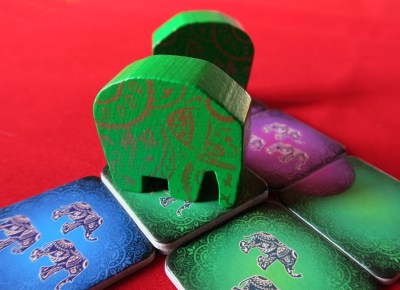
Kerala is one of the games Blue and Pink picked up at Essen last year. It is a fairly simple tile-laying game where each player starts with a single tile in their own colour with two wooden elephants perched precariously on it.  On their turn, the active player draws the same number of tiles from the bag as there are players and then chooses one before everyone else takes it in turns pick one.  Players then simultaneously place their tiles next to a tile with an elephant on it and move the elephant onto the new tile.  The tile can be placed in an empty space, or on top of a tile previously laid.  Thus, over the course of the game the elephants ponderously move over their play-area while players messing with the opponent to their left by leaving them with tiles they don’t want.  There are three types of tiles, Elephant tiles, Edge tiles and Action tiles.  Elephant tiles score points at the end of the game with players receiving one point for each elephant visible.”Edge” tiles have one side with a different colour; if these are adjacent to the correct colour the player scores an additional five points otherwise they can be ignored.  There are also two sorts of action tiles, which score no points but allows the player to move either a tile or an Elephant.

Kerala
– Image by boardGOATS

Everyone was very nice and offered everyone else advice on where to place tiles.  It wasn’t always helpful advice, but no-one was obviously hostile.  It was only as the game came to a close that everyone realised that they had forgotten some of the most important aspects of the scoring.  At the end of the game players require precisely one contiguous region of each colour (with two allowed for their own colour).  Somehow in the rules recap the bit about losing five points for each missing a colour had been missed.  It didn’t matter though, because everyone had all the colours so nobody was in danger of losing points even though some players picked up their last colour in the final round.  In the end it was a close game, but it was burgundy’s very stripey layout that had the edge and he finished four points ahead of Purple who took second.

Kerala
– Image by boardGOATS

Meanwhile, Black, Purple and Blue played the “Feature Game”, Honshū.  This is a light trick-taking, map-building card game loosely set in feudal Japan – almost like an oriental mixture of Pi mal Pflaumen and something like Carcassonne or Kingdomino.  The idea is very simple:  from a hand of six numbered map cards, players take it in turns to choose one and play it.  The player who plays the highest numbered card then chooses one, then the next player and so on until every card has been taken.  The players then add the cards to their city.  Each card is divided into six districts, each of which scores in a different way at the end of the game.  For example, the for every district in their largest city, players score a point.  Similarly, any forest districts also score one point.  More interestingly, the water district is worth nothing, but water district connected to it after that is worth three points.  Perhaps the most interesting are the factories which only score if they are supplied with the appropriate resources, wooden cubes that are placed on resource producing districts.

Honshū
– Image used with permission of BGG contributor msaari

Resources can also be used increase the value of cards when they are played allowing players to manipulate their position in the turn order.  Like Pi mal Pflaumen, this is a key part of the game as it enables players to ensure they get the card they want.  One of the biggest challenges is choosing the cards though.  When the cards are placed, players must take care to make sure that they either partially cover (or are covered by) at least one other card.  This, together with the fact that players are trying to expand their largest city and any lakes makes choosing and placing a card really difficult as there are many options to explore.  Nobody really had much of a clue as to what strategy they were trying to employ, and for the first three rounds, everyone ended up picking up the cards they’d played as these were the ones they’d thought about.  After the first three rounds, players pass their remaining three cards left and add another three; his is repeated after nine rounds when the cards are passed right.  So when at the start, when Black commented that he had lots of good cards and Red and Blue answered that they had lots of poor ones, in actual fact nobody really had much idea what good and bad cards were.  That quickly changed when Blue passed her left over cards on and Black discovered what a bad hand really looked like.

Honshū
– Image used with permission of BGG contributor William Hunt

Everyone found the game very strange, and a real brain-burner, dressed up in such an innocent sounding game.  There were more spells of players choosing the cards they had just played, so Red was really mifffed when Blue broke the tradition and took the one she had played and wanted for herself.  Towards the end, Black pointed out that while he had built a very compact island Red and Blue both had long thin islands.  This was the first time either of them had looked at anyone else’s island – a demonstration of how absorbed they had been in choosing cards.  After lots of turning cards round trying to decide where best to place them, it was time to add up the scores.  It didn’t really matter who won as everyone felt they were fighting to get to grips with the game, though it was Blue who’s island scored the most points, and Black and Red tied for second place.  Both games finished simultaneously and the Honshū crowd were in need of some light relief so we resorted to 6 Nimmt!.  This is a game that we have played a lot on Tuesday evenings, but seems to have been neglected of late.

Honshū
– Image used with permission of BGG contributor msaari

We reminded ourselves of the rules:  players simultaneously choose a card, then simultaneously reveal them before playing them in ascending order placing each on on the highest card that is lower than the card being played.  When the sixth card is added to a row, the first five are taken and the number of heads contributes to the player’s score, lowest score wins.  We tend to play a variant over two rounds with half the deck in each round and not resetting the table in between which tends to result in a cascade of points in the second round, and this time was no exception.  Purple and Blue started out well, but quickly made up for that in the second round.  Red and Mike started badly in the first half and Mike got worse in the second – they tied for highest scorers. Black started out low and although Pine did better than him in the second round, Black’s aggregate score of nine was seven points lower.  Black was the only one to stay in single figures and was therefore a worthy winner.  6 Nimmt! finished quite quickly and we were all feeling quite sociable, so despite having played it last time, we gave in to Red, the “Bean Queen”, who fluttered her eye-lashes and we agreed to play Bohnanza.  While people sorted out refreshments, we compared Bean rhymes, Pine came out with the best, borrowed from Bart Simpson,  “Beans, beans, the unusual fruit, the more you eat, the more you toot!”

Bohnanza
– Image used with permission of BGG contributor spearjr

Bohnanza is a card game where the key element is the fact that players have a hand of cards that they must play in strict order.  On their turn, the active player must play (plant) the first bean card in their hand (the one that has been there the longest) and may plant the second if they wish.  Then they draw two cards and place them face up in the middle of the table so everyone can see, at which point the bidding starts with players offering trades for cards they like.  Once both cards have been planted (either in the active player’s fields or somewhere else), then the active player can trade cards from their hand too.  All traded cards must be planted before the active player finished their turn by drawing three cards and putting them into their hand in strict order.  And it is the strict order that is the key to the game, however difficult it is for players to refrain from rearranging their cards.

Bohnanza
– Image used with permission of BGG contributor spearjr

This time, the game proceeded with lots of trading and everyone warning everyone else who dangerous it was give Red any favourable trades.  Nevertheless, everyone seemed to be forced to give her free-bees as she was the only person who could take them. In the dying stages of the game Pine was desperate to get his paws on some of Blue’s Wax Beans and was offering all sorts of lucrative trades, but they all evolved round Blue’s now complete field of Green Beans.  When she pointed this out he grumped that it was her own fault for building up the field to capacity, ” adding “That’s hardly sustainable farming now, is it?!?!”  With the last trade done, everyone began counting their takings. During the game everyone had given Red loads and loads of cards, mostly because they were forced to.  When the Bean Queen was inevitably victorious, Black commented that it was fine as we had all contributed so much that everyone could rejoice and share in the joy of her win.

Bohnanza
– Image by boardGOATS

Learning Outcome:  Beanz meanz fun.