Tag Archives: Crappy Birthday

Next Meeting, 14th October 2025

Happy Birthday to Us!

Our next meeting will be Tuesday 14th October 2025, when we will be celebrating our thirteenth birthday.  We will be eating together to celebrate at 7pm, with cake and games afterwards.

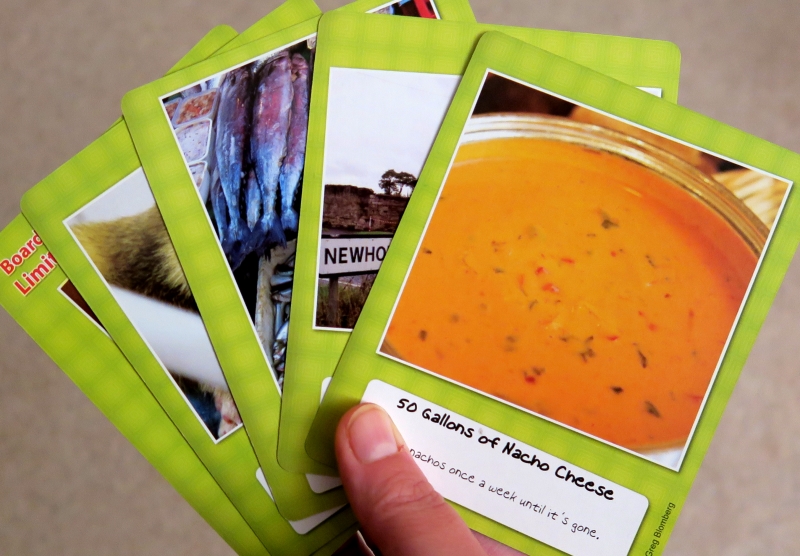
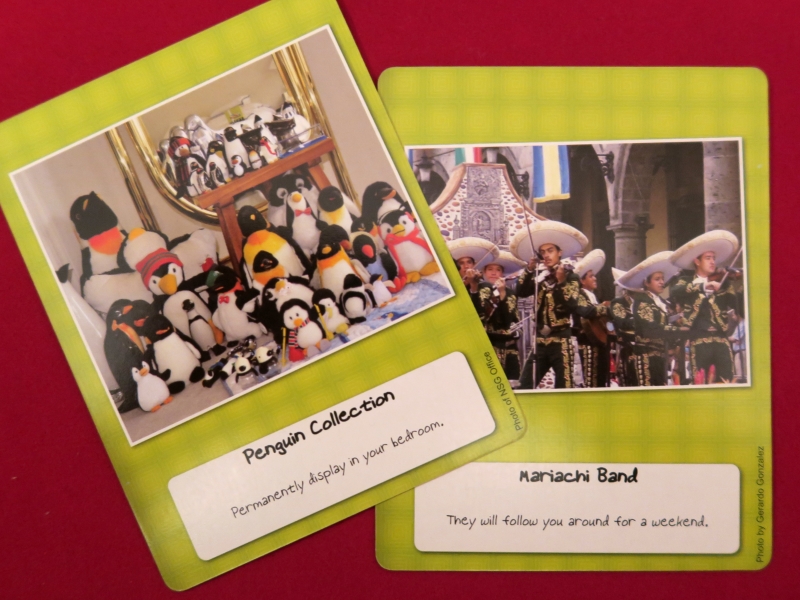
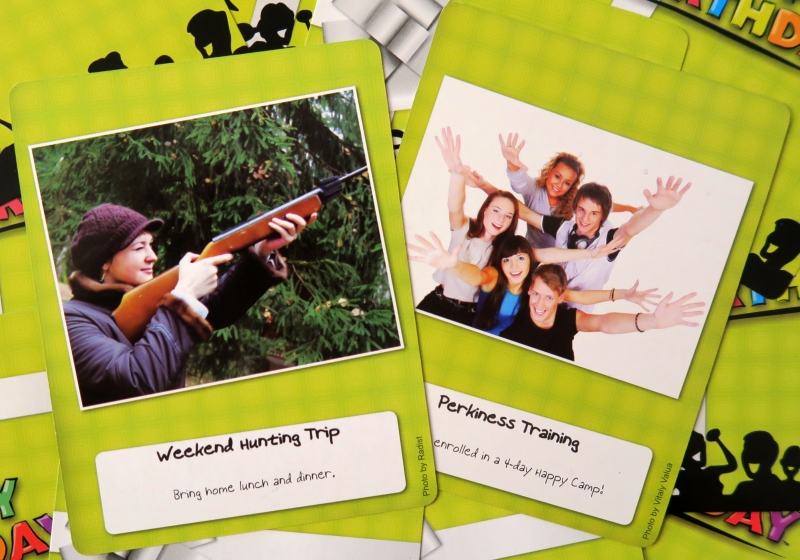
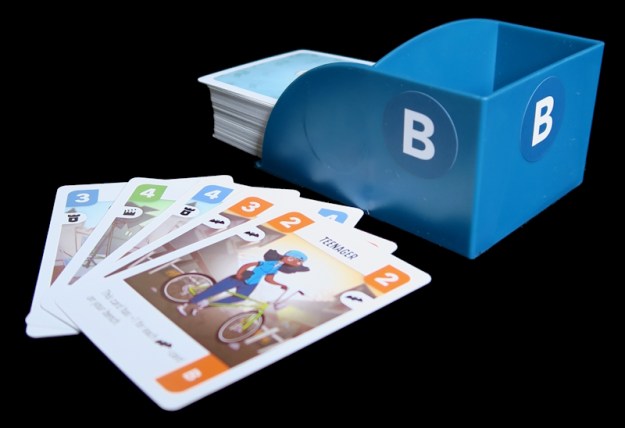
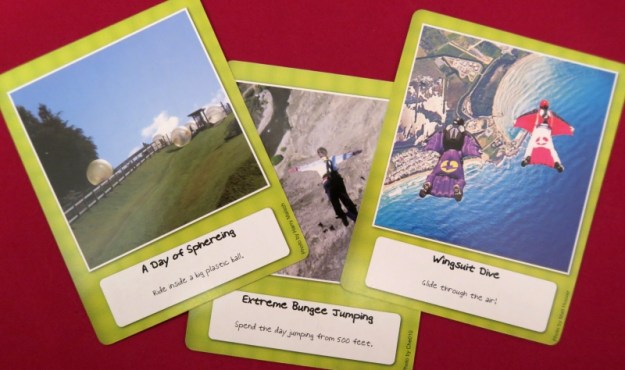
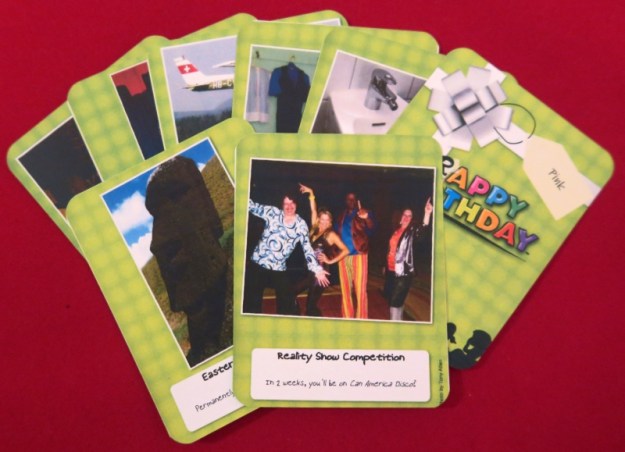
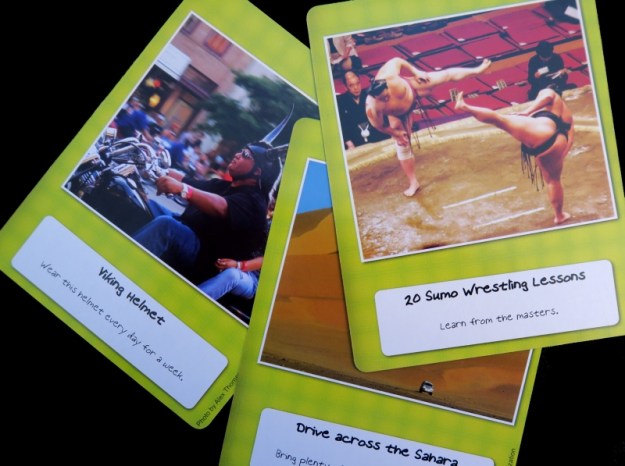
As is now traditional on our birthday, the “Feature Game” will be Crappy Birthday.  This is a party game where players give each other comedy birthday presents and the recipient has to decide who gave the best and worst gifts.

Crappy Birthday
– Image by boardGOATS

And speaking of birthdays…

Jeff was at the surgery.  “Doctor, I get heartburn every time I eat birthday cake,” he explained.

The doctor asked him to open his mouth and say “Ahhh.”

After a few moments examination, the doctor said, “Next time, take the candles off.”

8th October 2024

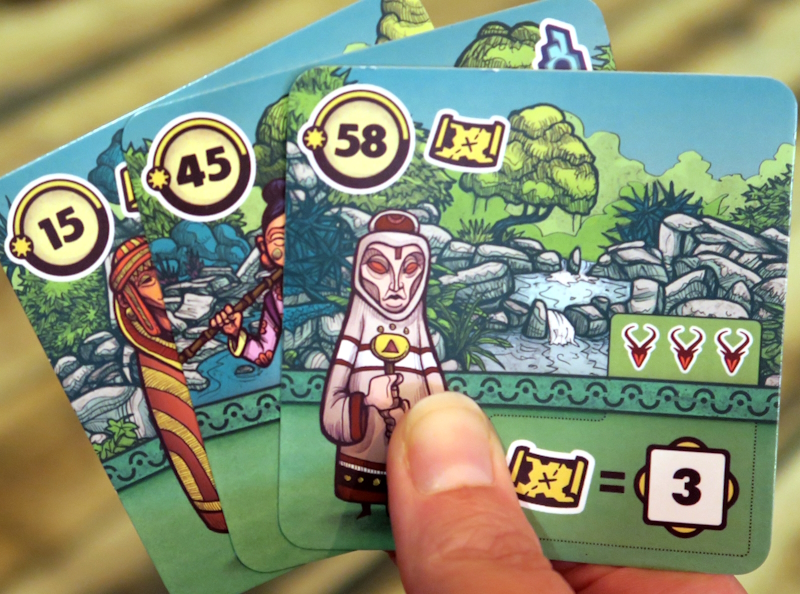
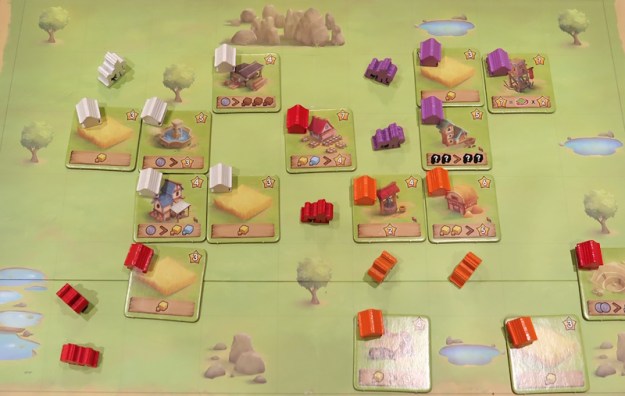
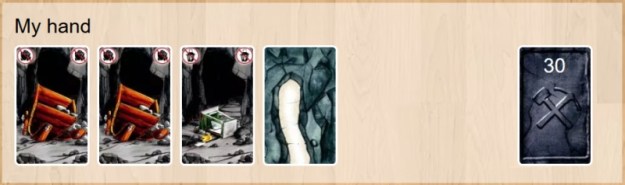
As it was our twelfth birthday party, lots of people arrived early for pizza (or an amazing Mixed Grill in the case of Lime and some lovely veggie curry and fiery chilli for Pine), followed by GOAT cupcakes.  While everyone waited for food, arrivals from Essen were handed out, including Nucleum, Faraway and Flamme Rouge expansions; Let’s Go! To Japan and Cascadia mini expansions, and Die Wandelnden Türme (aka Wandering Towers), Keyflower and Dixit promotional items.   There was a lot of chatter too, about flooding, pot holes, the 34 road closure, full car parks and water leaks, as well as Essen.  Indigo and Navy weren’t eating, so had a play with Villagers while the others entertained themselves.  This is a card game where players “Draft” Villager cards from a market (called the Road) and then add them to their Village.

Villagers
– Image by boardGOATS

Some Villagers have prerequisites before they can be “Built”.  These are cards that must exist in the player’s Village before the Villager can be added on top to make a chain, cards that must be unlocked by paying money to other Villagers in their own Village, someone else’s Village or the Bank.  Some cards allow players to draft extra cards, while others enable players to Build extra Villagers and Special Villagers give powerful special actions.  Twice during the game there “Market” Phases when players get income from their cards, and the player with the most money at the end of the game is the winner. Somewhere along the lines, Indigo and Navy had a bit of a rules malfunction, and as everyone else had already started the now traditional birthday “Feature Game“, Crappy Birthday, they abandoned Villagers.

Crappy Birthday
– Image by boardGOATS

Crappy Birthday is a party game where players give each other comedy birthday presents and the recipient has to decide who gave the best and worst gifts.  We play a slight variant of rules as written, where we play a single year of birthdays with each gamer getting one turn to receive gift cards from everyone else from their hand of five cards.  With lots of players the pile of gifts can get quite substantial and this time everyone was getting thirteen gifts to decide which was the best and which was the worst.  The players who gave these then received a point for knowing the recipient so well and the player with the most points at the end of the year is the winner.

Crappy Birthday
– Image by boardGOATS

One of the reasons this game is so fun is that we learn a bit about each other.  Pink went first as his real birthday was next.  He liked the idea of an Easter Island Mo’ai for the garden (not that Blue was so impressed with the idea), but disliked the idea of cave scuba diving.  Plum chose a haunted castle as her favourite (because she loves castles), but pulled a face at the idea of earlobe stretching rings.  Purple had the matching neck rings, but these weren’t her least favourite gift, that was a giant swing ride, while she loved the idea of a penguin collection.  Byzantium showed his environmental credentials by picking a Global Warming Study as his favourite, while eschewing Jade’s wing suit dive gift.

Crappy Birthday
– Image by boardGOATS

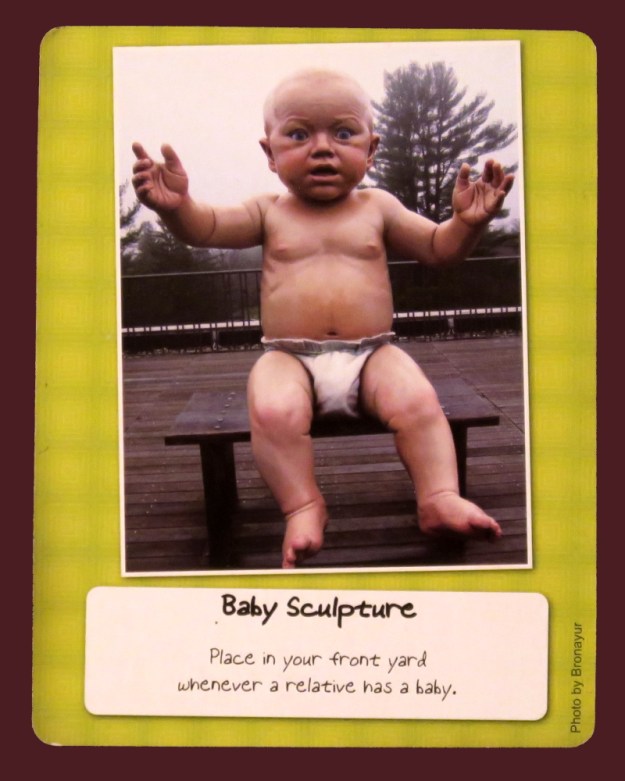
Teal felt that trees were quite beautiful enough without being carved, but really liked the idea of a ride-on bike mower.  Jade wasn’t a fan of Cobalt’s offering of Polka lessons, but loved the idea of trip to Mars from Sapphire, while Sapphire felt “perkiness training” wasn’t something he really needed, but the thrill-seeker loved the reciprocal gift from Jade, a roller-coaster ride.  Lime fancied a three day festival trip, but wasn’t keen on a week eating nothing but Spam.  Blue didn’t fancy the creepy baby sculpture to go with the Mo’ai, but fancied Pink’s gift of a Safari (provided she had time to train for the walking element).  Ivory didn’t feel his life would be improved by a free satellite TV dish, but always one to send his meeples into space in Tapestry, grasped the opportunity to join them with a space walk.

Crappy Birthday
– Image by boardGOATS

It turned out that Navy has a problem with bees, so Teal’s gift of a bee keeping which he personally would have loved, didn’t go down well, but much to Pink’s surprise, his gymnastics camp was received really well.  Indigo was quite abrupt in her negative response to the idea of paparazzi following her about, but liked the idea of exploring a volcano while Cobalt didn’t feel he needed his soul to be searched, but fancied flying lessons.  The final birthday of the year was Pine, who didn’t get his usual pile of horses and meat, instead getting the opportunity to run with the bulls, which having known someone who had done it and been gored, wasn’t something he fancied.  Pine’s favourite was Larry the Lobster (not that he has space in his garden for him), one of the Big Things of Australia, that Pink and Blue happened to see on their visit there last year.

Crappy Birthday
– Image by boardGOATS

Lime was the last to break his duck and was very pleased not to end the game without scoring any points, indeed, nobody finished with the dreaded bagel, which was nice.  The runniest of run-away winners was Teal though, with five successful (or unsuccessful) gifts, with Pink and Cobalt joint runners up with three.  It was interesting though, this time there were quite a lot of gifts that people gave “in error” where as Teal commented, he “Gave pressies he thought people would like, but they all hated them!”  With the birthday formalities dealt with, there was time for something relatively short.  First up was Jade who was very keen to give his new Faraway expansion, Le Peuple du Dessous (aka The People Below).

Faraway
– Image by boardGOATS

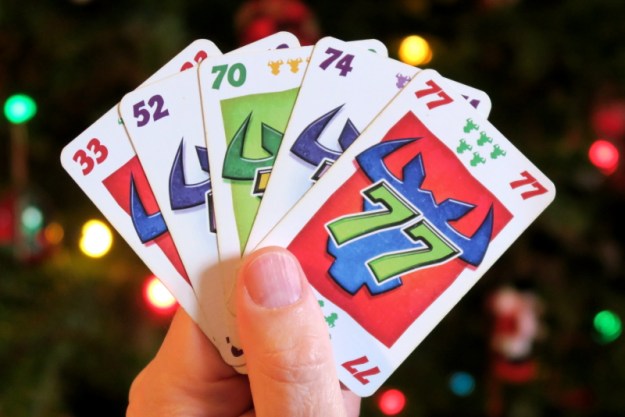
Faraway is a fairly simple little game, but one that really messes with your head:  players play cards from their hand of three, adding them to a row of cards, left to right, but at the end of they score the eight cards from right to left.  The Peuple du Dessous expansion adds just seventeen cards, but these include the Guides and the Three-Eyed Ones, two new Peoples with more opportunities to score, as well as giving enough cards to play with seven people.  This time there were only five though, with Sapphire, Byzantium, Indigo and Navy joining Jade.  Navy and Indigo were new to the game and, as usual, it took a little bit of getting used to.  That said, the both did really well with Indigo ending up with seventy-seven points, four more than Sapphire in second with Navy taking third, just one point behind.

Faraway
– Image by boardGOATS

Navy and Indigo headed off and took an early night, but the other three had to wait for Plum who’s game on the other side of the room was ongoing.  Faraway is a fun little game though and the expansion adds a little more, so the trio decided to give it another go.  This time, Byzantium was the victor with seventy-three with Sapphire the runner up again.  Meanwhile, Blue, Pink, Pine and Teal, got out Bohnanza.  This is a game that is generally popular with the group, though Teal had somehow only managed to play it the once almost six months ago.  This is a very simple card game, albeit slightly convoluted and very unpromising when explained, but the key is that players must not rearrange the cards in their hand.

Bohnanza
– Image by boardGOATS

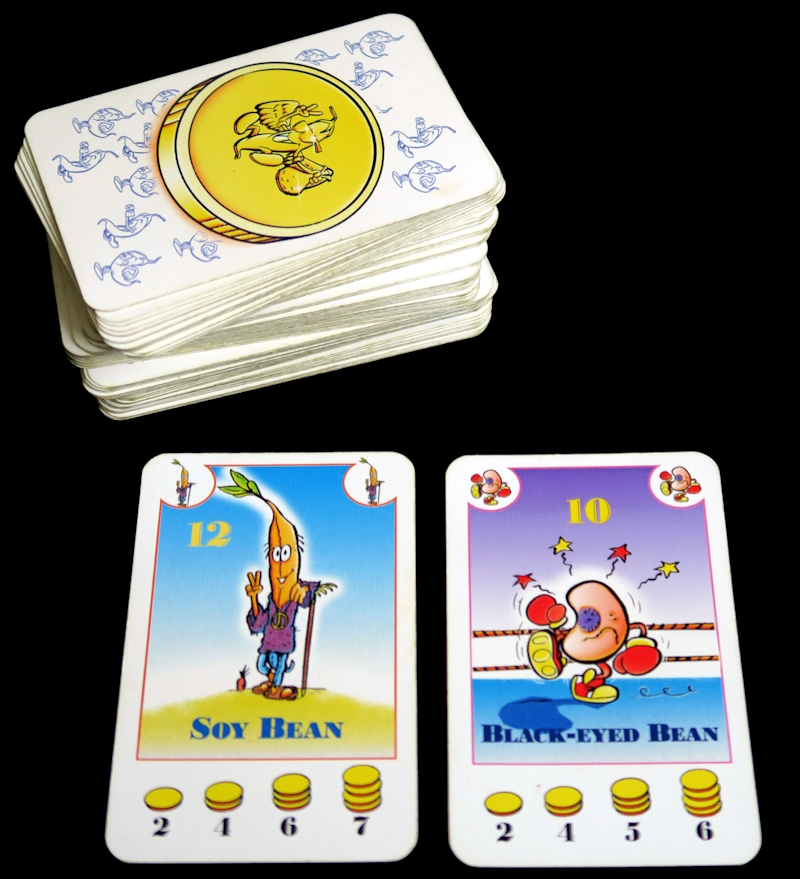
On their turn, players must plant the first card in their hand in one of their two been fields and may plant the second if they choose.  They then turn over two cards from the deck, which must be planted before the player can move on.  Fields can only contain one bean type, but beans can be traded, or even gifted, and it is the trading and negotiation that makes the game such fun.  Once the two cards on the table have been planted, players can trade from their hand, but again all traded cards must be planted.  Players can harvest Fields at any time with some of the bean cards dug up becoming money and larger Fields giving more money and at a better rate.

Bohnanza
– Image by boardGOATS

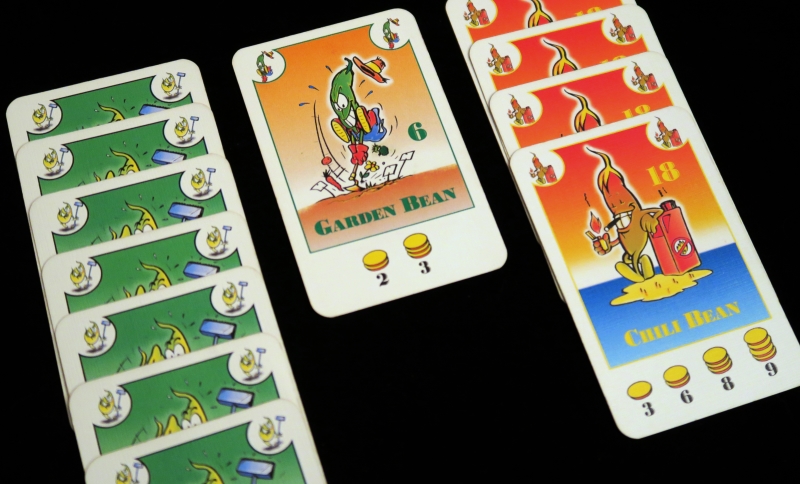
Blue took some high valued Garden Beans and then sold them off to buy a third Bean Field, causing a lot of confusion for Pink who couldn’t believe it when they kept appearing even though there were only six in the deck.  Teal scored well from his Chilli and Wax and Soy beans, while Pine and Blue ended up in competition for Green Beans.  This time with just four, the scores were a little more varied, but Blue was the clear victor with twenty-five Bohn Thaler, five more than Pine who came second.  The final game of the evening was Villagers, which was getting another outing on the other side of the room with Cobalt leading Ivory, Purple and Plum.

Villagers
– Image by boardGOATS

After a reminder of the rules, Purple started and grabbed the Carpenter then Cobalt went next taking the Blacksmith.  Both of these guaranteed their owners an income of coins (and hence points) at the expense of other players paying to use them. However, this did mean that they fell behind on building an engine to Draft and Build more cards (which Plum and Ivory focused on).  From there, the first half of the game went quite quickly with everyone focusing on building their engine. Ivory managed to get a Wine Trader using a Monk as a Graper, as well as playing a Scavenger, enabling him to take slender lead after the first scoring, although the scores were all very close.

Villagers
– Image by boardGOATS

In the second half of the game, Purple and Cobalt were beginning to have to make tough choices, being unable to play as many cards as they would like and not having the building cards they needed, which were also hard to come by. However, they continue gaining coins from all players. Purple had to discard quite a few cards to get starter cards which slowed her down a little, though Plum and Ivory were able to quickly get to the position to Draft and Build the max number of cards allowed; Plum in particular seemed to always have a fist full of cards.  As the game progressed, more people began taking cards that others might want, with Cobalt taking Wool cards that might have been of use to Purple or Ivory.  Ivory, however, was actually more focused on getting a second Vintner, already having a second Wine Trader in hand.

Villagers
– Image by boardGOATS

Towards the end of the game, there was face down Grape card which Ivory debated taking a gamble with, but decided not to take the risk.  Inevitably, when it was flipped over it turned out to be Vintner and Plum grabbed it. Ivory got very lucky during his next draft though, taking a face down Special card that was Monk, which he could then play as Vintner. Elsewhere, Purple played some Wool cards, getting two Weavers, Plum picked up some good end-game scoring cards in the Locksmith and Freemason. Cobalt focused on Solitary cards and Silver end game scoring, doing well from his Priests, Agent and Blacksmith combo. Ivory ended up focusing on the Hay cards, which scored well and that plus the two Wine Traders (and a second Scavenger), gave him a hundred and twenty-six and a two point victory over Cobalt.

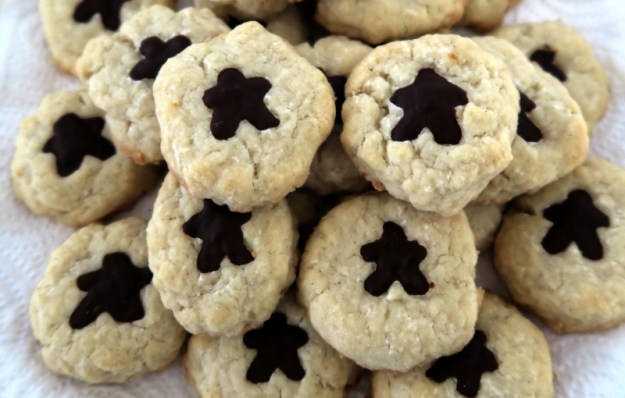
2024 Birthday Cupcakes
– Image by boardGOATS

Learning Outcome:  Getting old is not necessarily a bad thing.

3rd October 2023

Black, Purple, Byzantium, Plum, Blue and Pink all arrived early for food, and were soon joined by Pine, Lime and finally Ivory.  The “Feature Game“, was to be Crappy Birthday, a party game where players give each other comedy birthday presents and the recipient has to decide who gave them the best and worst gifts.  A bit like the better known game, Dixit, the idea is to be the master of non-mediocrity, with the best and worst gifts netting points for the person who gave them.  It was our birthday party, so as is now traditional, everyone shared cake (this year, meeple topped carrot cup cakes), before Plum started off the year of GOATS crappy birthdays, receiving her first gift from Byzantium.

2023 Birthday Cupcakes
– Image by boardGOATS

This year we discovered that Plum fancied a custom chopper, Byzantium liked the idea of visiting a radioactive swamp (so long as it wasn’t too active) and Lime would gratefully accept a gift Monster Truck weekend.  Unusually, Pine didn’t get horses and a pile of meat, and picked skiing in Alaska (finding the Alaska bit more appealing than the skiing), and Black chose a Safari as his favourite gift.  Plum picked a chick-flick marathon over a litter of puppies and Ivory opted for a catapult over several space-based options.  Finally, much to everyone’s surprise, Blue picked a garden chess set and Pink chose a set of cuddly penguins over a pet vulture (who is very friendly, but stares at you while you are sleeping).

Crappy Birthday
– Image by boardGOATS

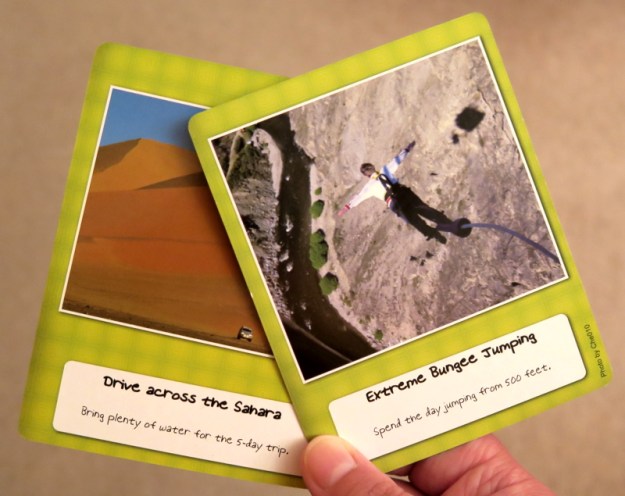
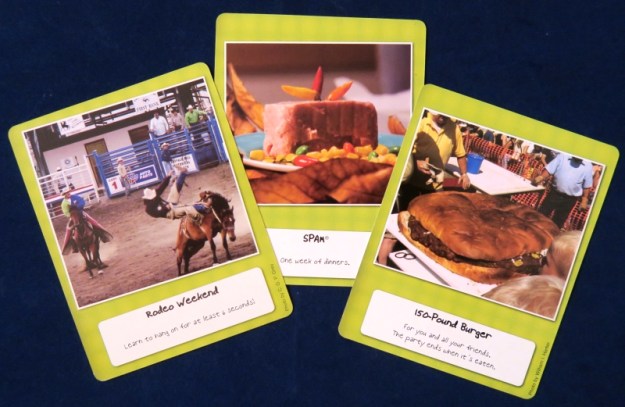
Less popular were singing the national anthem a the baseball, extreme bungee jumping, face piercing, a flexible trainer, and perkiness training.  The horrific baby sculpture was pretty much guaranteed to be rejected (and Lime had the opportunity for a second time), but others were more specific.  For example, Purple eschewed the drive across the Sahara because she dislikes the heat while others felt they would quite like a visit to the desert.  Similarly, Pink couldn’t imagine anything worse than mime camp, although most of the others couldn’t really see his problem.  Most people managed at least one or two loved or loathed gifts, nobody came close to matching Plum, who took a massive six points—a remarkable seventy-five percent of her potential maximum, quite a record for a worthy winner.

Crappy Birthday
– Image by boardGOATS

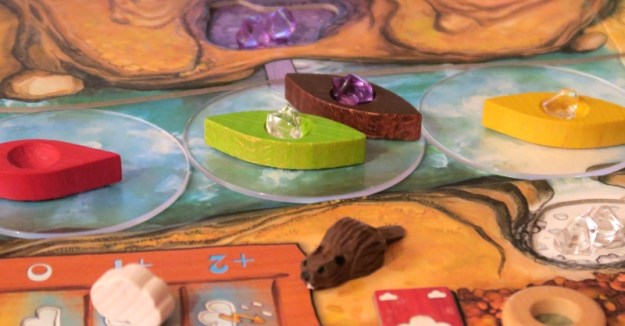
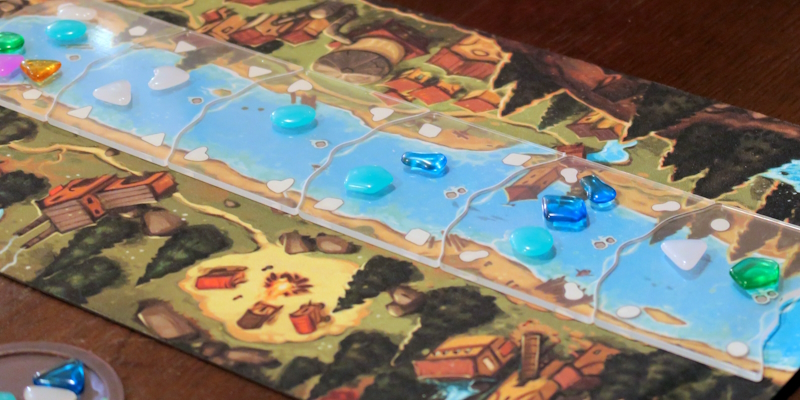
With our birthday suitably marked, the question was whether to continue to play light, large-group games or to break the group up and play something slightly more serious.  Pink suggested Niagara, and although Blue, Black and Purple warned against it, Plum showed an interest and that suckered in Byzantium, Lime and Pine.  The idea of Niagara is that players are rowing their canoes along the river to collect gems and then safely row them back to shore.  Players do this by simultaneously choosing a Paddle tile to play, then taking it in turns to activate their chosen Paddle to move their canoe (or canoes), trying to avoid losing them over the cataract and turning them into match-wood.  The winner is the player who manages to get seven different coloured gems or five gems of the same colour safely to shore.

Niagara
– Image by boardGOATS

The reason for the warnings and large amount of reticence form some of the group was after an online game some two years ago when Pink had the temerity to steal gems from everyone else and collective punishment failed to correct his appalling behaviour, winning the game in spite of it all.  This time, fore-warned and fore-armed the game started mean and got meaner, with the gem stealing starting in the very first round.  As a result, three out of the five finished the game with nothing.  Although Pink ended the game with two red gems, at least he didn’t win—that honour went to Byzantium, who by hook or by crook (mostly crook to be honest), managed to get five purple gems and ended the game.

Niagara
– Image by boardGOATS

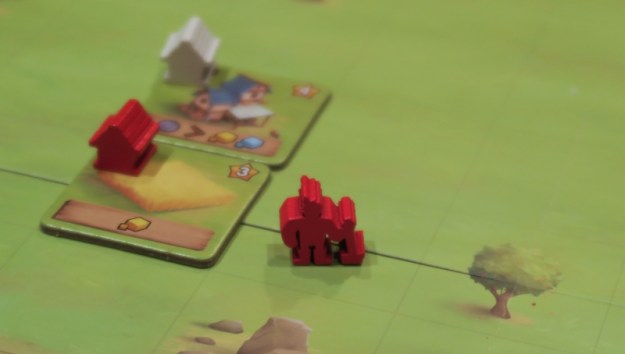
Meanwhile, on the next table, Black and Purple were introducing Blue and Ivory to Little Town.  Despite the similarity in names (and inevitable resulting confusion), this is nothing to do with Tiny Towns. In this game, players acquire resources like wood, stone, fish, and wheat from the surrounding squares by placing workers on the board. When a worker is placed, the owner acquires the resources available from all eight surrounding spaces. They can then build buildings by using these resources, and the owner (or indeed any other player), can gain the effect of the building when they place a worker next to it, although when claiming a resource from a building owned by another player, they must pay a them a coin.

Little Town
– Image by boardGOATS

The game is deliciously tight—each player gets one action per turn, three turns per round and the game lasts just four rounds. Players collect victory points by using the powers of buildings, by constructing buildings taken from the market (which is not refilled), and by achieving goals dealt to them at the beginning of the game. After the fourth and final round, whoever has the most victory points wins.  Ivory started building an engine based on turning money into points, but then he realised the flaw in his plan:  there was no additional source of money in the game, so once he’d spent his cash, he was reliant on others paying to use his facilities, a source that rapidly diminished.  So he moved on to collecting wheat instead.

Little Town
– Image by boardGOATS

Blue built an engine to turn fish and wheat into points.  Black also built a wheat into points engine and pinched the last wheat field that both Blue and Ivory had their eye on.  Purple on the other hand did something completely different, converting resources into other resources to satisfy her goal card.  Ultimately though, none of it really mattered as the game was really, really tight and all four players finished within three points of each other.  Black’s experience with the game told and his thirty-two points just edged him one point clear of Blue who took second and she in turn finished one point ahead of Ivory.  It had been an enjoyable game though, definitely deserving of another outing, especially as the variety in the buildings would make it play very differently every time.

Little Town
– Image by boardGOATS

While the Little Town was being explored, Niagara had already finished and Lime, Plum and Byzantium rowed their respective ways home, leaving Pine and Pink to play a quick game of the new mini-version of Ticket to Ride, Berlin.  This is the latest in the “City Series”, smaller versions of the game that play more quickly, but still keep the essence of the original game.  Each game (full-sized or smaller), has some unique “hook” as well as a new map and features designed to bring a flavour of the new location.  Like all the other game, players have a choice on their turn to either take coloured cards from the market, or pay cards to place pieces on the map.

Ticket to Ride: Berlin
– Image by boardGOATS

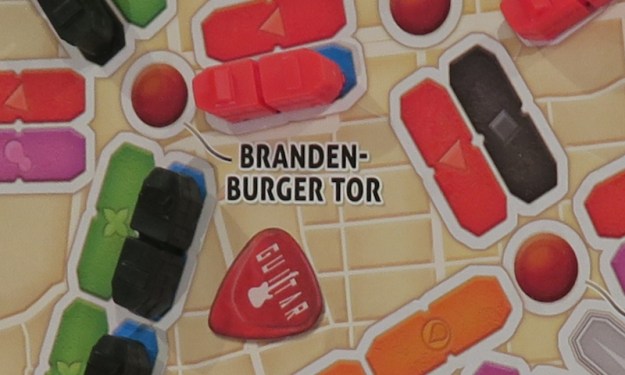
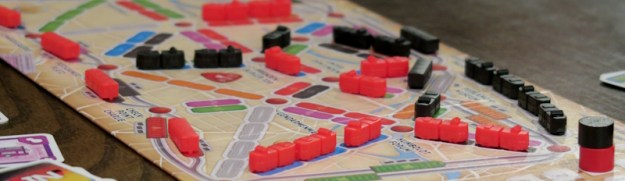
In the Berlin version, players have both subway trains and trams to place. Tram routes are claimed in the usual way, but only one underground carriage is placed to claim a Subway or U-bahn route. When a player has one or none of their pieces left in their supply (either Tram or U-bahn carriages), each player, including that player, gets one last turn, then tickets are scored as usual.  One of the differences between this game and the other variants is the shape of the map, with it being very elongated in the east/west direction.  Pine built his routes along the north side and into the centre while Pink stretched his network along the south bank and into the centre.

Ticket to Ride: Berlin
– Image by boardGOATS

It was a very enjoyable game, and both Pink and Pine said they would definitely play this one again.  Perhaps part of the reason was that it was very close, but neither player realised how close until the final scoring.  In fact, it was so close that they double checked the score and confirmed that it was a tie with both players finishing with fifty-four points.  After a bit of chat, they had a rummage through the rules to find out what the tie breaker was, only to discover that it was the number of completed tickets, and both had finished with five.  So remarkably, it was a real tie, but while they shared victory this time, there will almost certainly be a rematch in the not too distant future.

Ticket to Ride: Berlin
– Image by boardGOATS

Learning Outcome: Everyone loves a nice birthday gift.

25th July 2023

After Blue and Pink had sampled the new pizza menu at The Jockey, people started to roll up and join them for the usual chatter.  There were a total of nine, which was one more than  required for the “Feature Game“, the recently announced Kennerspiel des Jahres winner, Challengers!.  This is a deck-building, dueling “capture the flag” game where players battle head-to-head to find the winner.  It is a very light game, with a largely random element, at least on the face of it, so it was always going to be a bit of a “Marmite” game.  Green commented that he wasn’t very interested in it, but as everyone else was quite keen to give something novel a go, he sportingly joined in.

Challengers!
– Image by boardGOATS

The game is very simple, and seems, at first glance to be quite random.  Players start with a hand of cards, and then draw five more and choose a set number to add to their hand.  The clever part is that (with eight players) the game is played over seven rounds, and each round the decks players draw from and/or the number of cards they can keep changes.  There are three decks, A, B and C, and the cards become increasingly powerful as the game progresses.  Once players have fettled their deck, they duel against their designated opponent by drawing the cards from their deck.  In this, one player starts by playing a card and taking the Flag, then the other plays cards until their total equals or exceeds that of their opponent.

Challengers!
– Image by boardGOATS

This initially seems quite random in that players have no agency in this element of the game.  There is a suggested variant that can change this by allowing players to draw two cards and choose one to play—this was an option for later in the game, but in the end, the group stuck to the rules as written.  The game focuses on this duel aspect, but really it is more about building card combinations during the first part of the game and deciding what cards to shed and how many.  Shedding cards is just as important as acquiring cards as, as the winner of a duel is the last player with the flag, so running out of cards can lose a match.

Challengers!
– Image by boardGOATS

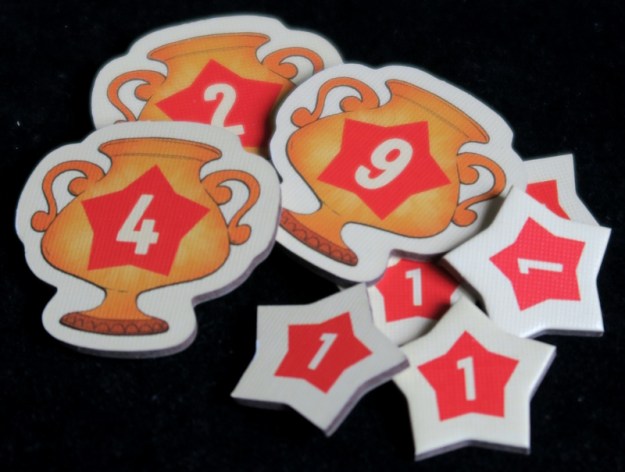
Having too many cards can be a problem as well though—when they take the Flag, players move all their cards except the last played to the “Bench”.  The Bench has six seats, and when a card needs a seat and there isn’t one, that player loses.  The winner of the match, the last player with the Flag, then takes a winner’s token which is worth points at the end of the game.  The game is all about the cards which make it less random than it seems at first; some cards have special powers, while others give points.  Additionally, identical cards can share a seat on the Bench, so effectively allow players to have more cards, however, those tend to be weaker cards from the A deck.

Challengers!
– Image by boardGOATS

As such, Challengers! should perhaps be thought of more as a programming game, more in the mold of games like Colt Express, rather than a dueling “capture the flag” game.  After each match, players play musical chairs and after seven rounds (with eight players), the players with the most points duel for overall honours.  Although the idea is very simple, it took a little while for people to get to grips with the procedure.  Blue, who was suffering with the after-effects of a bad cold, acted as much needed umpire and guide, explained the rules and demonstrated how the duel worked using Pink’s hand of cards.

Challengers!
– Image by boardGOATS

Possibly thanks to her fuzzy head, but Pink despite the fact that he was sat in front of her, was onto the second round before Blue realised that something wasn’t right.  Instead of taking his starting hand back after the demo, he had just drawn five blind cards from the A deck, making his hand immensely over-powered.  There were the usual tongue-in-cheek cries of “Cheat!”, but it was a genuine error, albeit one that wasn’t easy to fix by this time.  As a result, the quickest and easiest solution was for him to forfeit the first round and fix his hand before re-starting the second round.

Challengers!
– Image by boardGOATS

One of the nicest aspects of the game was the way everyone played against everyone else.  The GOATS are a nice, friendly group, and although some people end up playing together more often, the group always makes a point of trying to avoid cliques caused by the same people playing together all the time.  The Musical Chairs element of the game meant everyone played against everyone else which gave it a fun, party feel that we usually only experience in October (when we play Crappy Birthday).  It was clear that some people enjoyed it more than others though.  Ivory, Teal and Black, really got to grips with the deck-building element and found the game exceeded their expectations, Ivory in particular really enjoyed it.

Challengers!
– Image by boardGOATS

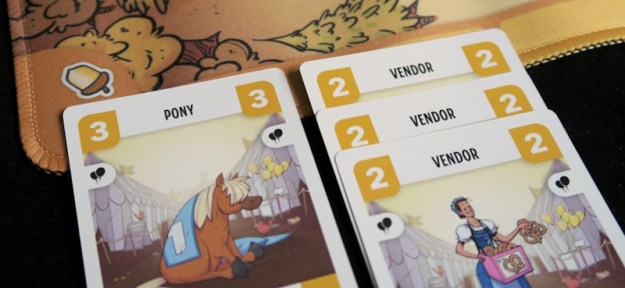
Lime, Pink, Pine and Purple were a little less enthusiastic, while Green felt it was a clever little game enjoyable for a short while, but that it out-stayed it’s welcome—too long for the game-play within it, he couldn’t wait for it to finish.  It wasn’t much of a surprise, therefore, that Ivory, Teal and Black were the winners of the “Round Robin” tournament phase, finishing with thirty-five, thirty-three and thirty-one points respectively (some way ahead of Lime in fourth with twenty-three).  The play off between Ivory and Teal, therefore, was quite close and tense, but Ivory ran out the eventual winner, largely thanks to his handful of yellow Vendor cards.

Challengers!
– Image by boardGOATS

From there, everyone was keen to play something they were familiar with, but it had to be something quite quick.  Teal suggested SCOUT, which Blue was keen to give another try (having played appallingly last time) and Ivory and Purple were very happy to join them.  This is a very simple, but clever hand management game that was nominated for the Spiel des Jahres award last year.  The theme is almost non-existant (something to do with circus performers), and isn’t even reflected in the card art, which is not unpleasant, but very functional (and therefore useful).  The idea is that players have a hand of cards which, like in Bohnanza, they cannot rearrange.

SCOUT
– Image by boardGOATS

Unlike Bohnanza, on their turn players may play any set of adjacent cards from their hand as long as they beat the current winning set, taking any cards they beat into their scoring pile.  Cards can be a a run of cards with consecutive numbers, or a meld of the same number.  Sets are ranked by size and value and a meld always beats a run of the same size.  Players take it in turns to play, and if they can’t or choose not to “Show” a set of cards that beats the current winning set, they instead “Scout”, taking one of the two cards from either end of the set on the table, adding it to their hand (paying the former owner a point from the supply).

SCOUT
– Image by boardGOATS

And this is where the game gets clever:  all the cards have two values, one for each end, so players can add any cards to their hand anywhere they like and either way up (i.e. making either value active).  In this way, players can manipulate their hand making larger melds or longer runs.  The round ends when either every body “Scouted” in succession, or where one player has run out of cards.  Players then score points for each card in their scoring pile and for each chip for cards taken by “Scouting” with negative points for any cards left in hand.  The first time we played this with the group, it had all been a bit of a voyage of discovery, and last time, Ivory gave everyone a bit of a spanking, so Teal and Blue were keen to prevent that from happening again.

SCOUT
– Image by boardGOATS

Things started off well, with Blue beating Ivory in the first round, though Teal and Purple did less well ending up with a hand of cards.  The second and third rounds went better with everyone taking positive points and it was very close going into the final round leaving it all to play for.  Sadly for everyone else, Ivory brought his A-game to the last round ending the round swiftly leaving Purple and Teal with a hand that more or less off-set their takings and Blue with a positive score, though one with fewer points than Ivory.  The end result wasn’t really very close, though it felt less of a stomping than last time:  Ivory finished with fifty-five points and Blue took second with forty-one, ahead of Purple and Teal who tied for third.

SCOUT
– Image by boardGOATS

On the next table, Green, Pink, Pine and Black played a close fought enjoyable game of Les Aventuriers du Rail Express, a variant of the Spiel des Jahres winning Ticket to Ride series, but one that is a sort of half-way house between the original full versions of the game and the mini “city” games (like Ticket to Ride: London).  The game only plays four and takes less time, but is quite a nice variant and has a couple of differences to the original, being shorter without losing too much of the main game’s challenge.  As in the original, players can either take two cards from the market (face up cards, or the draw deck), or pay cards to place trains on the board.  Unusually, however, the Locomotive “wild” cards are kept in a single pile and therefore are always available.  This is quite a nice variation, as it means that players never feel forced to take blind cards because what they need isn’t available.

Les Aventuriers du Rail Express
– Image by boardGOATS

This effectively means players are guaranteed to get at least one train card they want.  The other major difference is the presence of the long route ticket.  This is one route that everyone can claim, however the highest scores go to the first to claim it.  It additionally means that failing to complete it does not lead to negative points, so players can ignore it and concentrate on normal short route tickets if they prefer.  There was a moment when the group had three identical coloured cards in the face up market which made them whether they should be scrubbed (as with three Locomotive cards in the base game).  It couldn’t be found in the rules and it was pointed out that in the original games it is possible to have five cards of the same colour, so they stayed and someone eventually found a use for them.

Les Aventuriers du Rail Express
– Image by boardGOATS

Pine took an early point lead which he maintained for quite a while until Green and Pink caught up, and not long after, Black too.  However, as the game neared its conclusion Pine pulled ahead again. Pink had completed the long route already and, at the cost of not being able lay his last two trains, Green decided to get the game finished before anyone else managed it. That long route helped Pink finish in front with sixty-four points, while Black’s slow start demonstrated that getting trains down early is no guarantee of success.  That said, he managed to pull into the station in second place with sixty-one points. Green and Pine fought to not be last and ended up tied just a couple points behind with fifty-nine points.

Ticket to Ride: Europe
– Image by boardGOATS

Learning Outcome:  Winning the Spiel des Jahres award means a game is good, but doesn’t mean it will suit everyone.

4th October 2022

To mark the tenth anniversary of our first meeting, this week was a bit of a party. We started with a fish and chip supper (courtesy of Darren at The Happy Plaice) and followed it with cake, complete with “marzimeeples”. There was also a special “solo game” of Carcassone, where everyone chose a tile, wrote their name on it and stuck it on a board to be framed as a keepsake to mark the occasion. Unfortunately, Lilac was unwell and not able to come, and the chaos on the A34 (due to a burst water main on the Oxford ring road and an accident) conspired to delay Black, Purple, Orange and Lemon. Everyone else made it though, and after a quick round of Happy Birthday and some cake, the group moved on to play the now traditional “Feature Game“, Crappy Birthday.

2022 Birthday Cupcakes
– Image by boardGOATS

Crappy Birthday is a party game where players give each other comedy birthday presents and the recipient has to decide who gave the best and worst gifts. We house-rule the game to play a year so that everyone has one birthday, so on their turn, they receive a gift from everyone else. They then look through the gifts and choose the best and worst, and the givers of those gifts get a point each. The winner is the player with the most points at the end of the year. Written like this, the game sounds very dry, but there are three things that make the game a lot of fun.

Crappy Birthday
– Image by boardGOATS

Firstly, the gift cards are fantastic; the pictures are great and the texts that accompany them are just enough to give a flavour while also allowing interpretation. Secondly, the way we play, the Birthday Boy or Girl goes through the gifts reading them out. It is not so much this, as the disgust, excitement or other response as people “open their gifts” that makes everyone smile. Playing board games can be very impersonal—for many people this is a good thing as it allows people who are shy or private to control what they reveal about themselves because everyone focuses on the game. As a result, gamers often don’t really know an awful lot about each other. In playing Crappy Birthday, however, players reveal just a little bit more of their likes and dislikes, helping everyone to get to know each other that little bit better.

Crappy Birthday
– Image by boardGOATS

Finally, we only play Crappy Birthday once a year. This is really key, as without this constraint, the cards would get repetitive and the element of surprise would be lost. In terms of game play, it isn’t a very strategic or challenging game, so playing more frequently would likely mean it would quickly outstay its welcome. As it was, Pink started (his birthday was soonest), and he set the tone for the year. As usual, we discovered lots of interesting things about people in the group. Pink surprised everyone with his delight at receiving some Monopoly money toilet paper, though it was a close-run thing between that and a road trip across the Sahara as he’d always fancied participating in the Paris-Dakar Rally. He was much less impressed with the bungee-jump however.

Crappy Birthday
– Image by boardGOATS

Pine was next and this time didn’t get his usual pile of equine and meat flavoured gifts. His choice of a giant lobster sculpture for his front yard was also unexpected, and he explained that it would be interesting to see where it ended up when the kids and drunks in the village decided to move it. On Plum’s turn we discovered that she liked the idea of a one-armed bandit and Chess lessons (no cheating, obviously), but preferred Flying lessons. Pink proved he knew Blue best when she picked a non-electric iron as her favourite gift, while Ivory was disappointed that when Teal eschewed his generous gift of a trip on the first trip to Mars. We discovered that Teal used to play the bagpipes, and that Lime was quite disgusted by the thought of a giant baby sculpture for the front of his house (to be fair, it looked quite hideous and not a little creepy).

Crappy Birthday
– Image by boardGOATS

Leaping off or out of things seemed to be generally quite unpopular, with a parachute jump being Black’s least favourite gift, though he was delighted by tickets to a live metal music gig. Ivory complained that he kept drawing perfect gifts for people just after their birthday. On his birthday, Pink thought he had a winner when he gave Ivory a snow machine, and everyone else felt the same knowing how much he loves Christmas, but surprised everyone by choosing a space walk as his best gift and a permanent barbed wire fence as his worst. Pine showed his approval when Lemon picked bird watching as her choice gift, and most people could see her point when she ranked her deer-foot lamp as her least favourite.

Crappy Birthday
– Image by boardGOATS

There was more surprise on Purple’s turn when she chose a custom chopper as her best gift, but her dislike of a trip on a submarine was less of a shock. The final birthday of the year was Orange who picked throat rings as his best gift. There was a lot of taxidermy-based gifts so it was perhaps fitting that his less surprising choice of worst gift was a good luck bat (not particularly good luck for the bat if the picture is anything to go by). Not that it really mattered, but everyone knew who the winner was long before the end of the year, as Lemon had managed to get a point in half of the rounds and finished with five points. The race for second place was much closer though with three people taking two and Black and Purple tying with three points apiece.

Crappy Birthday
– Image by boardGOATS

There was a lot of chatter, some tidying up and more chatter, before Lime and Teal wished everyone else a good night and enjoyable rest of the party, and those remaining tried to decide what to play. Everyone was very indecisive, so eventually Blue made the executive decision that one group would play New York Slice while the others played Ticket to Ride, and Pink went out to the car to collect the rest of the games that had been left in the car when everything else was brought in.  After some four-player, five-player, no definitely four-player shenanigans as Lemon shuffled from one game to the other, Ivory, Orange, Plum and Pink eventually got going with New York Slice.

New York Slice
– Image by boardGOATS

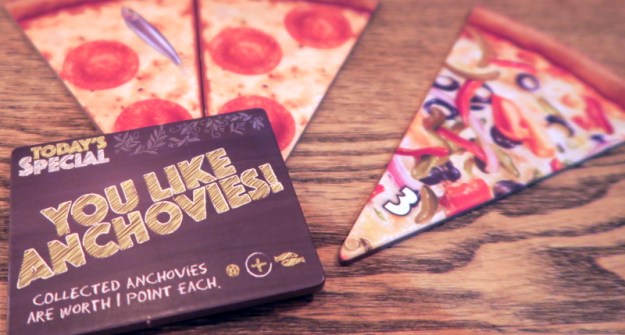
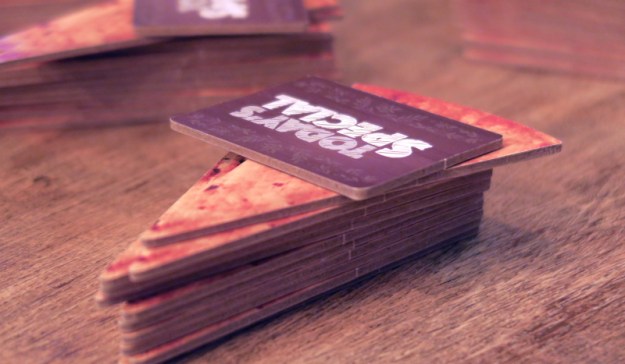
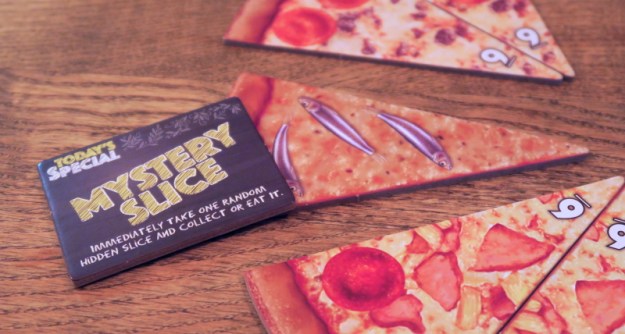
New York Slice is a re-implementation of …aber bitte mit Sahne, a game we’ve played a couple of times over the summer.  Having enjoyed the pizza version last month, it definitely deserved another outing.  The idea is that one player makes the pizza and cuts it into segments equal to the number of players, then players take it in turns to choose one of the segments.  When a player takes a segment, they can either eat the individual slices or store them for later. Those they will eat are worth points at the end of the game with the score dependent on the number of pepperoni slices on top. The pieces players keep are scored depending on who has the most of each type at the end of the game.

New York Slice
– Image by boardGOATS

Each piece of pizza has a number on it which tells players the number of that type in the game and also what the player with the most will score at the end of the game.  Some of the pizza slices have anchovies on them and any that are visible at the end of the game are worth minus one.  Each pizza is also served with a Special—a side order bonus tile with rule-breaking powers which accompanies one of the portions.  These can be good or bad, and add something to the decision making all round.  This time, the game was very close with just four points between first and last.

New York Slice
– Image by boardGOATS

As often happens, most people didn’t compete for the majority in the lucrative Meat Feast pizza, instead gobbling up the pepperoni straight away giving Orange the eleven points relatively cheaply.  The most valuable pizzas were collected by Orange and Ivory, whereas Plum made most of her points from her Specials:  “The Everyone-Else Diet” and “Seconds”.  The Everyone-Else Diet” was handy because it gave negative points to everyone else for every two slices eaten.  It was perhaps “Seconds” that just gave her the edge though, as it allowed her to eat one set of slices just before scoring, enabling her to see what she wasn’t winning and eat that.  As a result, she finished a single point ahead of Ivory with Orange taking third.

New York Slice
– Image by boardGOATS

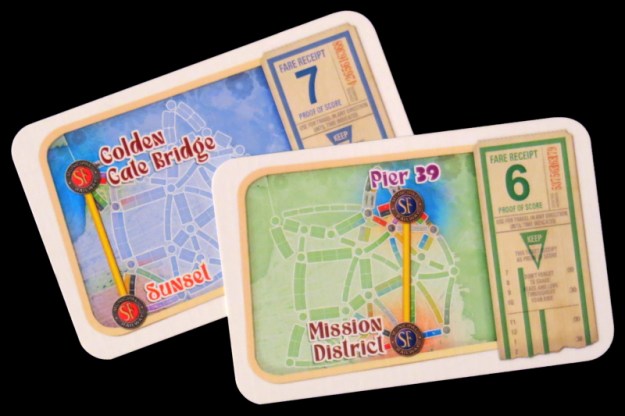
Meanwhile, on the next table, Blue, Black, Purple and Lemon settled down to a game of the new Ticket to Ride: San Francisco.  This is the latest in the Ticket to Ride series and is making its debut at Essen this year.  The games all follow the same basic pattern:  on their turn players draw coloured cards, or spend them to place trains on the central map.  They score points for trains placed, but also for completing any tickets they kept at the start of the game or picked up and kept during it.  One of the smaller games, Ticket to Ride: San Francisco only plays four and has fewer pieces so games are shorter.

Ticket to Ride: San Francisco
– Image by boardGOATS

Like all the other versions of the game, however, San Francisco also has a small rules tweak:  when players make a connection to a tourist destination, they can collect a token.  They can only collect one per turn and one from each location.  Each tourist destination has different tokens, and players score bonus points at the end of the game for each different token they have collected.  These points are significant, varying from nothing to twelve, with the number of points increasing exponentially as players add more to their collection.  Otherwise, the map is different and instead of trains, players have cable tram-cars to place, but otherwise it is similar to the other versions of Ticket to Ride.

Ticket to Ride: San Francisco
– Image by boardGOATS

Black’s starting tickets both went north-south, but one was on the east side and the other the west side.  So he picked one and immediately went fishing for a more.  Everyone else was slightly better off, and although Blue’s were better aligned they were fairly low scoring so once she had made a little progress she also took more tickets.  Black and Purple went for the potentially lucrative Tourist tokens, while Lemon kept forgetting to pick them up and ended up collecting a handful at the end.  Although the more a player has, the more they are worth, it turns out that getting the last couple is really difficult, and they are the ones that are worth the most points.

Ticket to Ride: San Francisco
– Image by boardGOATS

Blue tried to claim the long route from Fort Mason to the Golden Gate Bridge, but couldn’t get the multi-coloured-wild or the last yellow card she needed despite the draw deck apparently being stuffed with them.  In the end, she ran out of time as Black brought the game to a swift end.  In the end, it was a really close.  Black had the most points from placing trains on the board, closely followed by Purple, who was also very close to running out.  Blue had the most completed tickets though so it all came down to the Tourist tokens which meant Black edged it by a single point from Blue with Purple just a couple of points behind that.

Ticket to Ride: San Francisco
– Image by boardGOATS

Ticket to Ride was still going on when people had finished their pizzas, so although Ivory headed home, Plum was tempted to stay for one last game of Draftosaurus.  This was new to Orange, so while Pink set up, Plum explained the rules.  Draftosaurus is similar to games like Sushi Go! or Go Nuts for Donuts except that instead of drafting cards, players draft wooden dino-meeples, which players then place in their Dino Park.  Unfortunately, Orange wasn’t familiar with either of those games, so Plum explained that drafting is where players start with a handful of dino-meeples, take one and pass the rest on.

Draftosaurus
– Image by boardGOATS

So, in Draftosaurus, each player begins the round with a handful of wooden dino-meeples and a player board for their dinosaur amusement park.  Everyone chooses one meeple from their handful to place in their park and passes the rest to the next player.  Each turn, one of the players roll a die which adds a constraint on which pens players can place their dinosaur in.  The different pens have different scoring criteria and some also have restrictions.  The game is played over two rounds, with players passing meeples clockwise in the first round and anti-clockwise in the second, ending with twelve meeples in their park.

Draftosaurus
– Image by boardGOATS

The parks boards are double-sided, but this time the group played just one round on the summer side.  The game rocked along quite nicely, though Plum struggled to find mates for the dinosaurs in her Prairie of Love, while Pink and Orange had fun with the Forest of Sameness and Meadow of Differences (which have to have either all the same or all the different dinosaurs in them).  A few scaly beasties ended up being thrown into the river because of the dice restrictions, but everyone did a good job of picking the right King for their Dino Park.  Orange was king of the King of the Dinosaurs with the most Tyranosaurus rex, but he wasn’t the king of Draftosaurus—that was Pink who finished with thirty-nine points and a lot of Hadrosaurs.

2022 Birthday Cupcakes
– Image by boardGOATS

Learning outcome: It’s great to be ten, but bring on eleven!

6th October 2021

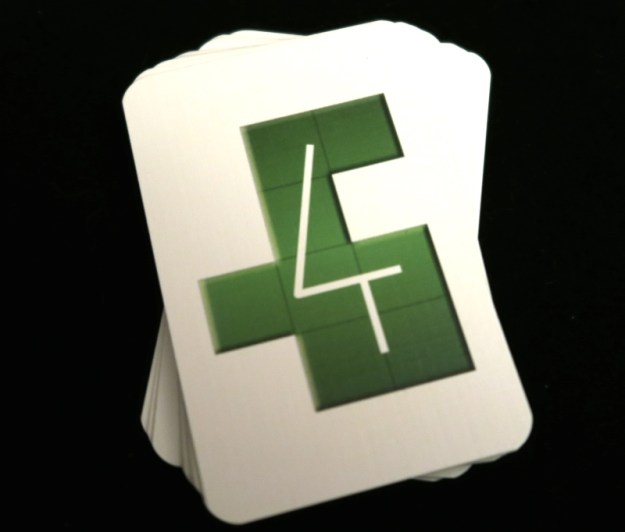
For the first time, the group were meeting on a Wednesday to avoid clashing with the Quiz on Thursday.  As Blue and Pink waited for food they decided to squeeze in a quick game of NMBR9 to celebrate our ninth birthday.  This is a quick little tile-laying game that has almost zero setup time, so is very appealing as a filler in this sort of situation.  The tiles are poly-ominos roughly shaped like the numbers zero to nine and there is a deck of cards featuring each number, zero to nine, twice.  Players take the appropriate number from the box following a flip of a card, and add it to their personal play-space.

NMBR 9
– Image by boardGOATS

Tiles have to be placed in layers with tiles on higher layers being more valuable as the number on the tile is multiplied by the “storey” it is on.  Tiles must be placed adjacent to another tile on the same layer and, when placing tiles on higher layers they must not be wholly over one other tile and must be completely supported (no bridging gaps or overhangs).  This time, Pink managed to make it to four layers putting a seven on the top layer, his third “storey” to give twenty-one points.  As a result he was sure he was going to win.
NMBR 9
– Image by boardGOATS

Pink had fewer tiles on the second and, particularly third levels, though, where Blue had concentrated her efforts.  The effect was very similar, so much so that there was only one point in it, but much to his disappointment, even several recounts couldn’t put the deficit in Pink’s favour.  He was cheered up by the imminent arrival of his pizza though and they were still eating when Green, Lilac, and then Teal turned up.  Since Green and Lilac had missed last time, they introduced themselves to Teal and there was some general chit-chat as everyone else turned up.

NMBR 9
– Image by boardGOATS

Appropriately, as we were celebrating our ninth birthday, there were nine of us to play the traditional birthday “Feature Game“, Crappy Birthday, as we ate meeple decorated chocolate cupcakes.  Crappy Birthday is a silly little party game but is a surprising amount of fun.  As we explained the rules to Teal, we reminisced about last year, when we played it over two sessions (one wrapping our parcels and one giving them) in order to be able to play it online.  Lime expressed his astonishment that it was a year ago, and everyone concurred that it didn’t feel like a year.

2021 Birthday Cupcakes
– Image by boardGOATS

Crappy Birthday doesn’t sound like much: the game is played over one “year” and each player takes it in turns to have their birthday, with everyone else choosing a card from their hand as a “gift”.  The birthday boy or girl then chooses their favourite and least favourite gifts and the givers of these each get a point.  As such, those gifting are trying to avoid the mediocre , in a similar way to Dixit, but “not as good” as Purple opined.  While most people around the table would agree that Dixit is the better game, this group tend to get more fun out of Crappy Birthday because of the really silly gifts on the cards.

Crappy Birthday
– Image by boardGOATS

The silliness of the gifts would get stale if we played the game more frequently, but we only play Crappy Birthday once a year and we usually only use around half the cards, so most cards only come out once every two years.  It is a great way to find out about people though, so being new to the group, everyone thought Teal would be at quite a disadvantage.  This year we found out that Pink was unimpressed by 100lb of raw fish, Lilac quite fancied a trying out a wingsuit and Blue would overcome the creepiness of 3am in the Paris catacombs as apparently they were hard to get to visit.  Ivory, was torn between the opportunity to sing the National Anthem before a Major League Baseball game and getting his earlobes stretched, but went for the latter as his least favourite as it was more permanent.

Crappy Birthday
– Image by boardGOATS

We discovered that Teal likes to keep his feet on the ground, so he eschewed a flight in a fighter jet, but really liked the idea of a Viking helmet.  It was about this point that we were joined by one of the former bar staff who stuck about to help Pink with his gift selection.  It seemed she didn’t really help a lot though as he completely failed to get any of his gifts picked as best or worst.

Crappy Birthday
– Image by boardGOATS

From there, Purple nearly ended up instigating divorce proceedings when she received a set of camera scales from Black (a gift nobody else would have been prepared to give to anyone).  Instead of fully justified revenge, however, Purple gave Black’s his favourite gift a campervan.  Lime having just moved house eschewed recycled newspaper wallpaper, instead opting to decorate his new home with some modern art after some classes.  DIY seemed to be in the air, as Green chose a house that needed renovation, though he volunteered Lilac to fix the roof.
Crappy Birthday
– Image by boardGOATS

As usual, Lime’s amazing gift-giving skills meant he did well, but this time he was beaten into third place by Purple and, remarkably, Teal who tied for first place, with four—it seems Teal knows us all surprisingly well after just a couple of weeks!  As people counted their scores and decided what to play next, the group put together a special selection of gifts for Pine who was running late thanks to a group of over-enthusiastic cubs whom he had been showing round his work.  This special selection was tailor-made for a vegan who doesn’t like horses.
Crappy Birthday
– Image by boardGOATS

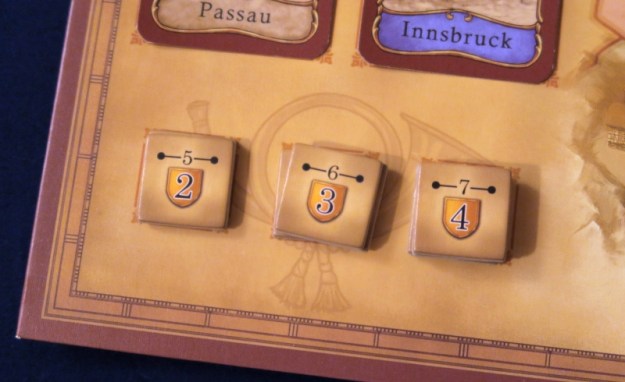
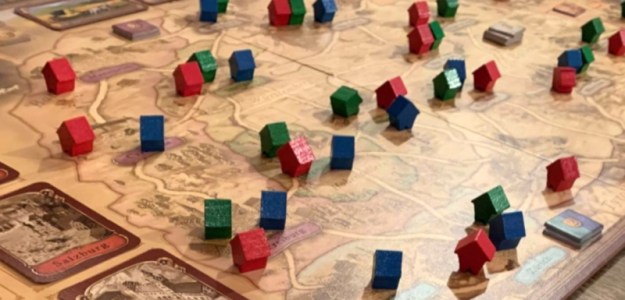
From there, the group split into three, one led by Lilac who wanted to play Thurn und Taxis, one led by Ivory who wanted to play Key Flow and one led by Green to play with something short that Pine could join in with when he arrived.  Thurn und Taxis is a slightly older, Spiel des Jahres winning game where players build postal routes connecting cities across Bavaria and surrounding regions.  Routes are built city to city to city, so that each city is adjacent to the next city on the route and there is a road connecting these two cities.

Thurn und Taxis
– Image by boardGOATS

Players are building routes by collecting cards and playing them in front of them.  Every turn, the active player takes a city card from the face-up display (or blind from the top of the deck) and then plays a card for a city connected to either end of their existing route.  The card played, must connect to their route, otherwise they have to discard their route and start again.  Then they can score their route if they choose, but each route must consist of at least three cities and players may build only one route at a time.

Thurn und Taxis
– Image by boardGOATS

If after adding to the route, the length of the route is at least three cities, the player may declare it finished and score it.  Players start with a supply of twenty post offices in their colour, each of which is worth minus one at the end of the game. When they score a route, players place post offices in cities on the board, but they have a choice.  Each city is in a region and each region has a colour, when a route is scored, the active player can either place one post office in one city in each of the region their route visits, or in all the cities on one of the regions their route goes to.

Thurn und Taxis
– Image by boardGOATS

When a route is scored, the active player can take a cart card.  These give points, however, in the general case, the cart card must be one more than the previous one and the route must be longer than the cart number.  Thus, if someone is scoring a six leg route, they can only take a level six card if their previous cart was a level five card.  If they enlist the help of the Wainwright, however, if they have a level five card, they would be able to take a level six card with a route of only four legs.  Once a route is scored, the city cards of that route are discarded, and the player begins a new route on their next turn.

Thurn und Taxis
– Image by boardGOATS

The Wainwright is not the only special character in the game: the Postman, Bailiff and Coachman are all there to offer help, allowing players to take a second card, refresh the card market and play a second card respectively.  Players can only enlist aid once per turn though, so they must choose who they call on carefully. When a player exhausts their supply of post offices or acquires a value seven carriage, the end of the game is triggered with players continuing the round—the player with the most points wins.

Thurn und Taxis
– Image by boardGOATS

In addition to points for cart cards, there are also bonus points available for players to connect all the cities in a region or to have a post office in every outer region, as well as for players completing longer routes and for the player who triggers the end of the game.  In general, bonuses score most for the first player to make the achievement with diminishing returns thereafter.  This is therefore a consideration players must take into account, but the fact that players must add at least one city to their route each turn or lose the whole route is probably the most important aspect of planning in the game.
Thurn und Taxis
– Image by boardGOATS

Although Thurn und Taxis is an older game, Purple had not played it before, and it took her a while to get her head round it.  She got to grips with it eventually, however, it was later in the game and Black and Lilac had already got a head start.  It was very close between them though with the scores neck-a-neck until the last.  Lilac triggered the end of the game by taking a level seven cart card and with it took what turned out to be the decisive bonus point, pipping Black with twenty-seven points to his twenty-six.
Thurn und Taxis
– Image by Lilac

On the next table, Teal had looked in the game bags and decided Azul was one he’d like to play.  Green, Lime and Teal had just started without Pine when he inevitably arrived a couple of turns in.  He politely eschewed their kind offers to start again, instead concentrating on his healthy supper of crisps and cake and choosing his gift.  In Pine-like fashion, he chose to redefine the rules and decided his favourite gift was a hunting expedition as long as the subjects of the hunt were the people delivering the perkiness training in his other “choice” gift.
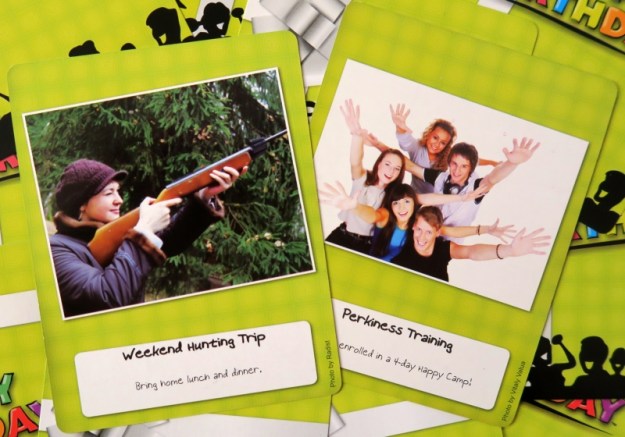
Crappy Birthday
– Image by boardGOATS

We have played a lot of Azul and its derivatives (Stained Glass of Sintra and Summer Pavilion) over the last three years, but the original is probably still the favourite across the group.  It is really very simple, and despite being an abstract game, the pieces are really nice.  On their turn, the active player either takes all the tiles of one colour from one of the “markets” putting the rest in the centre, or they take all the tiles of one colour from the central pool.  They then add the tiles to one of the rows on their player board.  The catch is that all the tiles placed in any row must be the same colour and if they over-flow, they score negatively.  Additionally, each colour can only score in each row once.
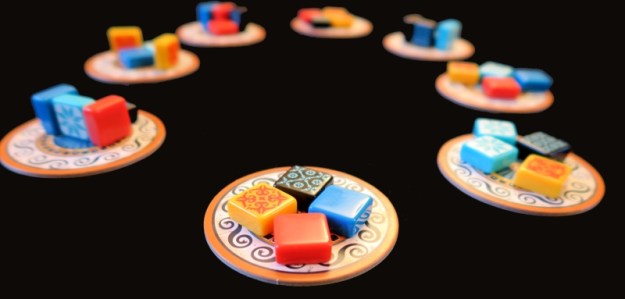
Azul
– Image by boardGOATS

Only complete rows are removed and scored, and then only at the end of the round (when all the tiles in the market and central pool have been taken).  Thus if a player has a nearly complete row at the end of a round, they carry that through to the next round leaving them with less free space to work with.  When a row is scored, one tile is moved to the player’s mosaic and scores for the number of tiles it forms a continuous row/column with.  The game ends when one or more players complete two rows.  This time it was a game of two halves, or rather two games.  It had been a while since we played the original version (or any version for that matter), but it wasn’t long before Teal, Lime and Green were happily playing, filling their boards.

Azul
– Image by boardGOATS

Lime and Teal took an early lead and were soon well ahead of Green as he had concentrated on filling his grid from the bottom up, whereas they had been working from the top down. As the game progressed Green began to catch up.  It was then that he realised that he’d forgotten what the game end trigger was.  He’d thought it was when the markets could no-longer be refilled, but checked the rules to be sure.  Only to find that two full completed rows had happened two turns earlier!  The group decided to finish the round and make it the last.  It was very close between Lime and Teal, with Lime just taking victory by three points.  The other games were still going and it was not yet late, so the group decided to give it another go, and this time finish the game correctly.

Azul
– Image by boardGOATS

In the second game, Green built his grid from the top down and the scores remained fairly similar, until around half way through when Teal began to pull away.  It was at about this point that Green noticed that one row had tiles of a colour he’d already scored for that row.  No-one was quite sure how it had happened, but the mutual decision was that he’d move these tiles down to the next row.  That turn didn’t go quite as expected, but at least it wasn’t a complete disaster.  The following round, he discovered he’d done the same thing again.  This time he worked out what he’d done:  he’d had failed to clear the remaining tiles when he moved one across to the pattern board.  So, on the previous turn, instead of moving tiles, he should have removed them.  It didn’t really matter though as Teal won by a landslide.

Azul
– Image by boardGOATS

Meanwhile, Ivory, Blue and Pink had revised the rules, completed card set up for Key Flow, and had started playing.  Key Flow is the card game of one of the group’s favourite games, Keyflower.  In both games, players are building villages and activating the buildings in their villages by playing meeples (or rather Keyples) to generate resources and score points.  The games have a lot in common including the artwork, the iconography and the fact both take place over four rounds or seasons.  Fundamentally, the underlying game mechanism is different, however, with players acquiring tiles by auction in Keyflower and by card drafting in Key Flow.
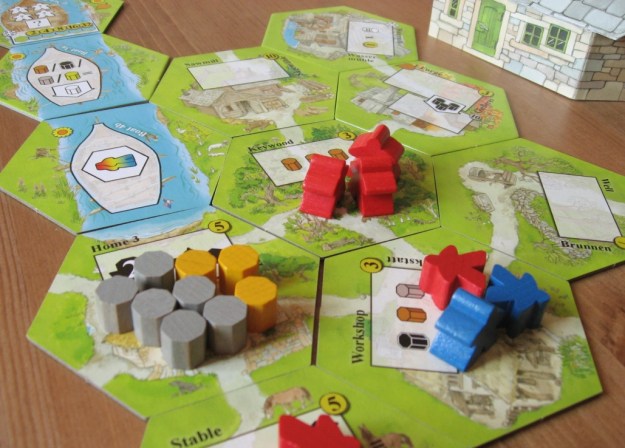
Keyflower
– Image by boardGOATS

Once the card decks have been sorted out, Key Flow is quite straightforward to play, though doing well is a different matter.  Players who start with a hand of cards, choose one and pass the rest on.  They then add their chosen card to their village.  There are three types of card:  Village cards, Riverside cards and “Keyple” cards.  Village cards are buildings that can be activated by playing Keyples above them, while Riverside cards provide instant resources and skill tiles.

Key Flow
– Image by boardGOATS

The cards have to be “connected” together and location can be important.  Buildings for example are more productive if they have been upgraded, but upgrading needs resources and the resources need to be located on the building being upgraded.  Similarly, in autumn there are some buildings which score points for resources they are holding.  Therefore, it is helpful if the building producing the resources is near to the one being upgraded or used for scoring as moving resources can be expensive and sometimes difficult.
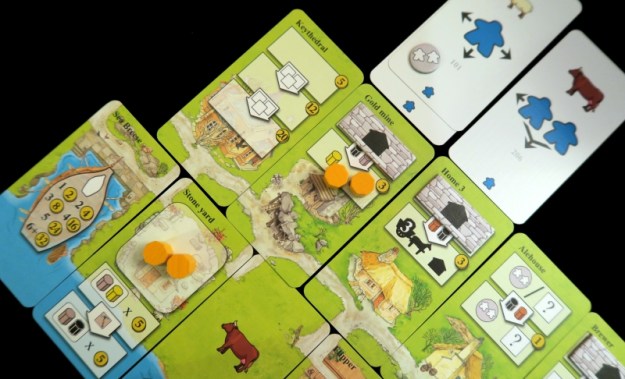
Key Flow
– Image by boardGOATS

At the start of both Keyflower and Key Flow players get some winter tiles/cards which can act as objectives to guide players’ strategies.  Whereas in Keyflower these are just added to the tile draw, in Key Flow, players get to keep one of their winter cards with the rest going into the draft.  At the end of the game, at the end of winter, players score for any autumn cards, any buildings with upgrades as appropriate, any winter cards and finally one point for any otherwise unused gold.
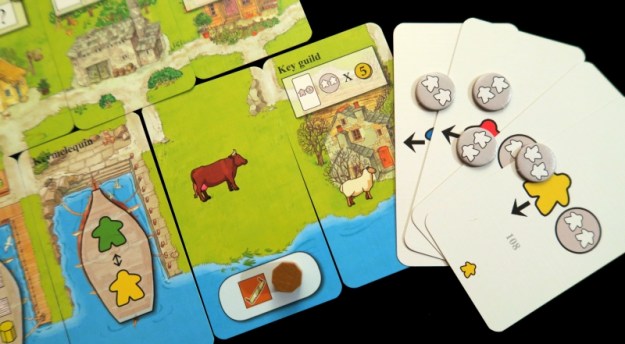
Key Flow
– Image by boardGOATS

One of the biggest differences between Key Flow and Keyflower is the way Keyples work.  In Key Flow, they are cards and come in singletons and pairs.  Each card has a small Keyple at the bottom of the card, and the number of Keyples needed to activate a building is one more than the number of small Keyples already there.  So if there is one small Keeple already there, a pair would be needed to activate that building.  Further, only one card is can be played each round, so if two small Keyples are already present, the Keyple card must be augmented with a Keyple token (obtained as a bonus with some cards or from some buildings).

Key Flow
– Image by boardGOATS

Further, the Keyple cards also feature arrows which indicate where they can be played.  Some can be played either in a neighbour’s village or the player’s own village.  Other cards can only be played on one side or cannot be played in their own village.  This is why three players is arguably the sweet-spot for Key Flow—with more players there is at least one village players cannot use, adding a level of randomness that it is difficult to deal with.  With three however, everything in play is accessible, though perhaps at a cost.

Key Flow
– Image by boardGOATS

It had been a while since Key Flow had been given an outing, so although game play is functionally straightforward, it took Blue, Ivory and Pink a while to remember the little features and how to make the game work for themselves.  Pink started off early with an obvious strategy of generating stone, stone and even more stone from his Keystone Quarry.  It was very clear, even to Pine who joined in to spectate about halfway through, that Pink had a winter card that would score for stone.  And so it proved when he produced the Trader in the final round.
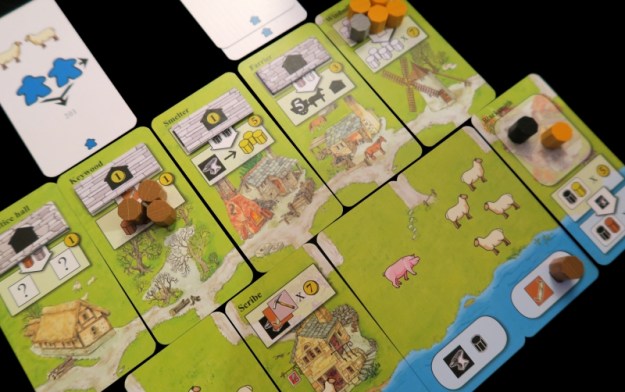
Key Flow
– Image by boardGOATS

Things were less clear-cut for Blue and Ivory, however.  Blue started by just playing the cards in her hand, which meant she ended up with a lot of cows (just because).  In summer, Ivory picked up a boat that allowed him to convert sheep into pigs and pigs into sheep, which went nicely with his animal scoring winter cards.  Blue, on the other hand, very out of practice with this sort of game, just played tactically, and played for points.  Her Workshop went well with the Mercer’s Guild she had in her winter cards, but the Well and Goldsmith, both fully upgraded gave her thirty-five points alone.
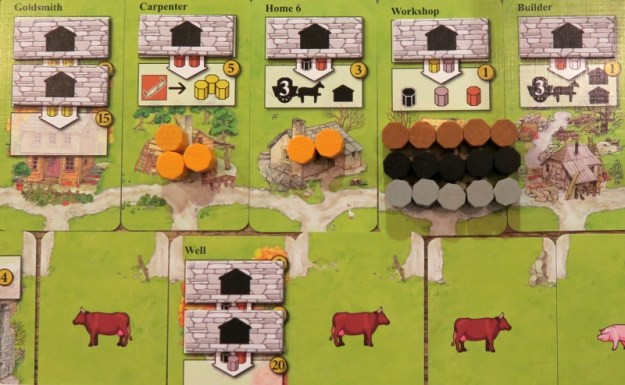
Key Flow
– Image by boardGOATS

Ivory had a bit of a nightmare and was unable to make the game work for him this time.  This was made worse by a rule we only spotted towards the end which meant each Keyple card could only be used towards one goal and the fact he made a mess of things when he put a Riverside card in the middle of his village and had to make it work retrospectively.  As he said sadly, although he had remembered how to play, he’d forgotten how to win.  Pink, with his massive pile of stone thought he was in with a good chance, but they were actually only worth one and a half points each, so although he had a huge pile, it only gave him thirty-nine points and had taken a lot of work to get them.
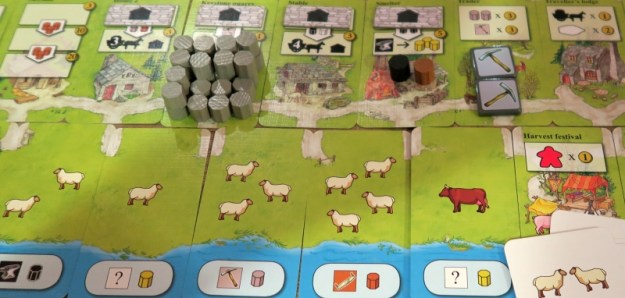
Key Flow
– Image by boardGOATS

Pink was a little bit stymied by the fact he was banking on also getting a a sheep scoring card in winter, but Ivory took it before it got round to him.  Blue on the other hand had lucked out when she picked up a lot of Keyple scoring cards that nobody else seemed interested in giving her over a hundred points and a comfortable victory.  With that, Ivory left, as did Lime and Teal, leaving Green, Pink, Blue and Pine waiting for the conclusion of Thurn und Taxis, and time to play a couple of rounds of Love Letter.  In the end, it really was just a couple of rounds and ended with a round a piece for Green and Pink, as the pub was closing and it was time to leave.

Love Letter
– Image by boardGOATS

Learning Outcome:  While camera scales may seem like a good gift idea, in reality the giver will probably end up sleeping on the couch.

Next Meetings, 6th & 7th October 2021

After much discussion, in August, we moved our meeting to Thursdays.  However, the Horse and Jockey have recently brought back their quiz on the first Thursday of the month, so this week we will be meeting on WEDNESDAY 6th October 2021.  As usual, we will start playing shorter games from 7.30pm as people arrive, until 8pm when we will start something a little longer (table is booked from 6.30pm for those who would like to eat first).

Some of the group are also keen to do the Quiz on Thursday 7th October.  So, we have booked a table from 6.30pm for those who would like food, and we’ll be playing games until the quiz starts at 9pm.

Last weekend was our nineth birthday, so as is now traditional, the “Feature Game” on Wednesday will be Crappy Birthday.  This is a silly little filler/party game that we can mess about with while people are eating cake allowing us to play something longer once everyone has arrived and finished food.

Crappy Birthday
– Image by boardGOATS

And speaking of birthdays…

It was Joe’s birthday, and his mum wanted to do something special.  She called him on the phone, but his housemate, Jeff, answered.  When Joe’s mum said she wanted to bring round a cake, Jeff was very excited.

“Oh, Mrs. Wilson,” Jeff said, “What a lovely idea – that would be great!”

That afternoon, Joe’s mum drove to the house and rang the doorbell. Jeff answered the door, but when he saw the cake, his face fell.

“Oh,” he said, clearly very disappointed. “I thought you said ‘keg’.”

Goats in the News: Goats on Zoom Make a Mint

Back in October, boardGOATS celebrated our 8th birthday.  We always have a bit of a party and play Crappy Birthday, but the current situation meant that this year it had to be held online.  So, to make it a bit more memorable, we had a special guest:  Elizabeth from Cronkshaw Fold Farm.  As well as entertaining people with yoga, Elizabeth and her friends from Rossendale in Lancashire are TV stars from The Great Staycation.

Elizabeth
– Image from cronkshawfoldfarm.co.uk

Back in April, when everyone was stuck at home and so many meetings moved online, Cronkshaw‘s Chief Goat-Wrangler, Dot McCarthy, came up with the idea of hiring out members of the flock to “butt in” on conference calls.  What started off as a joke has now resulted in thousands of calls, all over the world, earning over £50,000.  When so many people have been furloughed, this has enabled the farm to keep on two employees full-time.  And the goats have brought a little bit of much needed fun into so many people’s lives; certainly, Elizabeth made a valued contribution to our birthday celebrations.

13th October 2020 (Online)

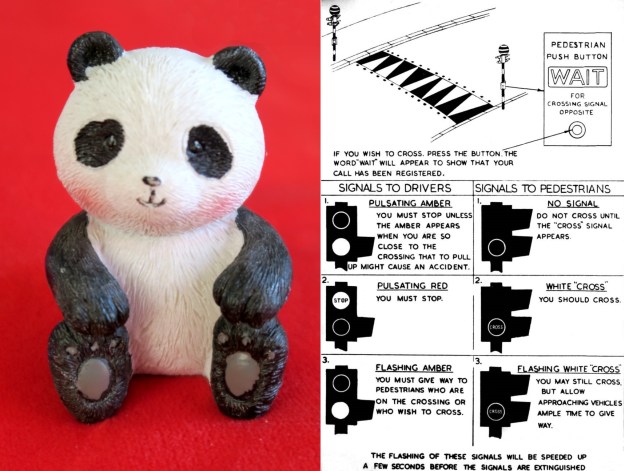
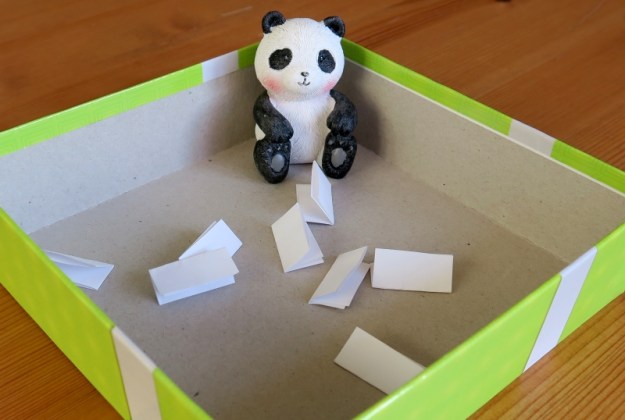
The evening began slowly, with people signing in and confirming they had their parcels and had not yet opened them.  There was a bit of chatter about isolating, and about Green and Lilac’s new house (which had very similar decor to the previous one).  Pink had acquired yet another Panda and proudly had it on display.

A Panda not crossing, with details of a Panda Crossing
– Image by boardGOATS

From there the conversation took a bizarre turn on to the subject of Panda Crossings, which really did exist (along with the other “Animal Crossings”), in the 1960s.  It was no surprise they were phased out after just five years, though, given how complicated they were, and the fact that safe operation relied on the difference between a “Pulsating” Amber and a “Flashing” Amber…

Elizabeth
– Image from cronkshawfoldfarm.co.uk

At 8pm, the Special Guest arrived; Elizabeth and some of her buddies from Cronkshaw Fold Farm in Lancashire joined the meeting.  Elizabeth is very talented and has a particular penchant for yoga.  So much so, in fact that she and her friends have been the subject of a half hour documentary filmed last summer.  As Elizabeth and friends galloped about and showed us their delightful home, everyone sang “Happy Birthday” and then opened their boxes.

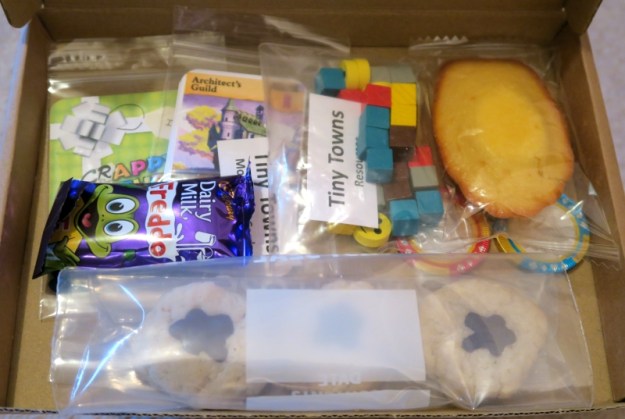
2020 Birthday Box
– Image by boardGOATS

The boxes were part of the celebration of our eighth birthday.  As is now traditional, the “Feature Game” was Crappy Birthday, a silly little filler/party game that is great fun when played very occasionally (and about once a year is perfect).  The idea is that each player takes it in turns to receive gifts from everyone else and then they choose the best and the worst; the players who gifted the selected presents get a point.  So in this game players are aiming for extremes making it almost the opposite of games like Dixit or Just One where players are aiming for the centre-ground.

Crappy Birthday
– Image by boardGOATS

With the current challenge of “remote gaming” we had to play Crappy Birthday a little differently this year.  So, everyone “wrapped their parcels” last time we met and this time everyone took it in turns to unwrap them.  While people ate their treats, names were drawn out of the Crappy Birthday box lid and everyone took it in turns to “open their gifts”, while everyone else ate their cake, biscuits and chocolate.

2020 Birthday Biscuits
– Image by boardGOATS

Blue went first to show those that hadn’t experienced a GOATS birthday party how to play.  As always, it was a learning experience all round.  This time, we learnt that Blue would quite like a trip to the middle east (complete with riding camels), but that Monopoly toilet paper might block her drain and everyone else was concerned about the possibility of paper cuts.  Green and Lilac both dislike smoking and have been to a Star Wars wedding and Lilac would like a ferret.  Black quite fancied unicycle lessons and Purple thought a giant fake bear rug would really add to the ambience in their living room.  Although Black likes fish, a hundred pounds is a lot especially when raw, but as he could put it in the freezer, he decided that the persistence of his own Mariachi band would be worse.

Crappy Birthday
– Image by boardGOATS

Ivory disliked the sound of “Organ Holiday by Ethel Smith”, and would not be swayed even by Pine’s hurt protest that it had pride of place in his collection.  Then he saw the hideous living room tapestry, and although he loves the game (and had really enjoyed playing it with the Plans and Ploys Expansion and Pink and Blue recently), he said it was also not for him.  Since the LP would be for just a year and the tapestry was permanent, the wall covering was therefore rejected as his least favourite.

Crappy Birthday
– Image by boardGOATS

A lot of people seemed to think that Burgundy would really appreciate physical extreme sports but the one he rejected was bungee jumping.  Unlike everyone else who seemed to reject any long term, life-changing experiences, his Burgundy’s preferred gift was a an eagle as a life-long companion, though Blue was concerned it might interfere with Games Night.

Crappy Birthday
– Image by boardGOATS

Mulberry calling in from California fancied a fighter jet ride and rejected a bus ride to Florida, and not only because it was such a long way away.  Meanwhile, animal gifts were quite popular and although Pine would have loved the opportunity to be licked by a giraffe or go on an African safari, those gifts were received by Violet, calling in from Aberystwyth.  She accepted the safari, but, not being a child of the 70s, was unimpressed by the fluffy dice.

Crappy Birthday
– Image by boardGOATS

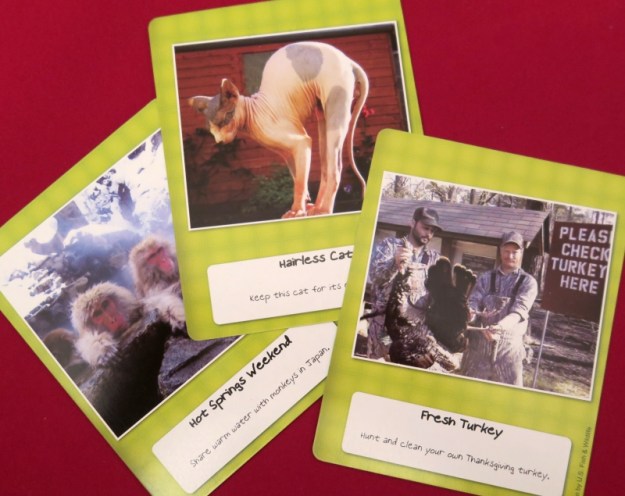
Pine’s wildlife gifts were in the form of hairless cat, a weekend with some monkeys in a hot spring and the chance to hunt and and clean his own Thanksgiving turkey.  Having had a landlady with a cat with galloping alopecia, Pine spurned the unfortunate moggy.  Then, despite the fact the turkey was the vegetarian’s obvious least favourite, that was Pine’s preferred choice as there was nothing to say he couldn’t give it it’s freedom once it’d had a wash.

Crappy Birthday
– Image by boardGOATS

After some rude comments about his taste in clothing, Pink explained that being on the reality show “Can America Disco” was his idea of a nightmare and that he quite fancied an Easter Island moʻai statue for his front garden.  And then, the last player, Lime, also rejected publicity in the form of his own personal paparazzi posting hourly updates on his doings.  Like Pink, he also chose the garden ornament, as Lime wanted a new patio and thought a giant chess board would be just the job.

Crappy Birthday
– Image by boardGOATS

And with that, all that was left was the scores.  This time, we found that Team Greeny-Lilac and Pink were particularly good at this game, but it was Lime who seemed to take a point every time, taking seven out of a possible eleven points.  That said, it was remarkable how many people gave gifts they thought people would like that ended up winning a point for being the most disliked.  That’s half the fun though.  With the birthday celebration dealt with, we then moved on to playing other games.  We are getting better at this, though our repertoire is still quite limited.  There had been a few requests to play Railroad Ink again, however, so we started with that.

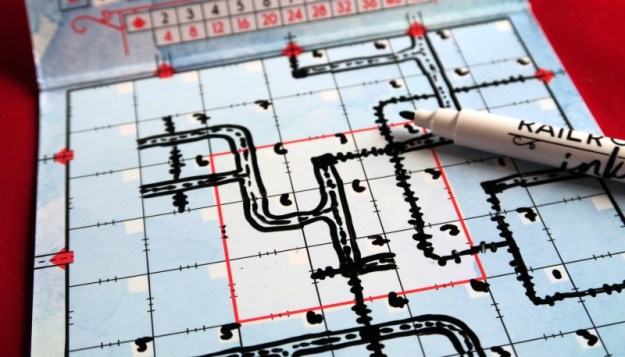
Railroad Ink: Deep Blue Edition
– Image by boardGOATS

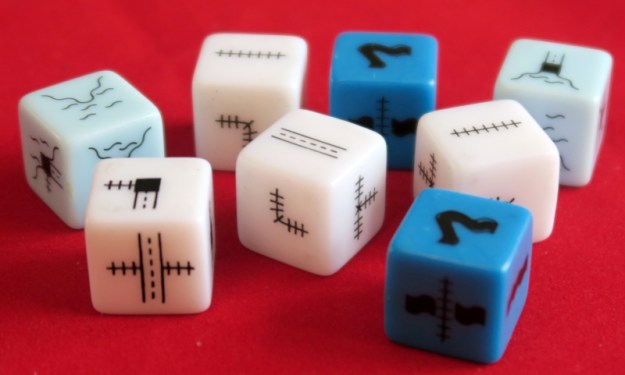
Railroad Ink is a very simple “Roll and Write” route planning game.  The idea is that four dice are rolled and everybody adds all four to their map.  Three of the dice show straight and curved sections and T-junctions for road and rail.  The other, the fourth die shows stations connecting road to rail, and a fly-over (crossing, but not connecting).  The game is played over seven rounds, after which players score points for their longest road segments, their longest rail segments, the number of locations on the edge of the board have been connected, and the number of spaced in the central grid that have been filled.

Railroad Ink: Deep Blue Edition
– Image by boardGOATS

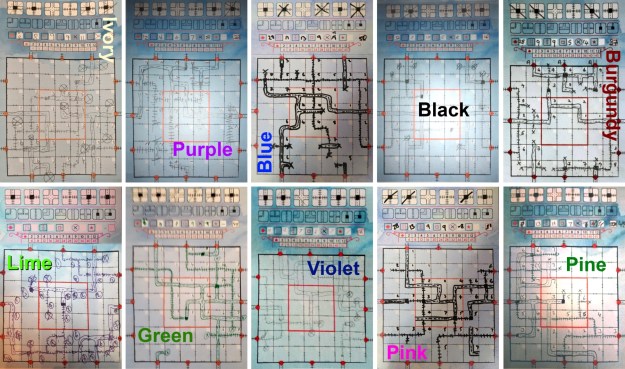
Having played it before, it didn’t take too long to get going and there was a sort of focussed silence as everyone concentrated, punctuated by occasional moans when the dice didn’t give people what they wanted.  Sadly, these games are very much “multiplayer solitaire”, and we really only found out how people did when adding up the scores.  This time, it was really close with just five points separating the top six players.  Initially it looked like it was a tie between Blue and Pink, but a recount pushed Blue into second just ahead of Green and then Pine.

Railroad Ink: Deep Blue Edition
– Image by boardGOATS

Ivory and Lime followed Mulberry taking their leave, and everyone else settled down to something quick and light in the form of Second Chance.  This is a very simple Tetris-style game where two cards are revealed and players chose one of the two shapes to add to their tableau.  Players can add shapes anywhere and in any orientation.  If they can’t use either of the shapes they get a second chance—another card is revealed, but if they can’t add that shape either, then they are eliminated.

Second Chance
– Image by boardGOATS

The winner is the player with the fewest unused spaces, so the winner is not necessarily the player that stays in the longest.  This and the fact that the game is not over-long means that player elimination is not a huge problem.  This time, all the large and awkward shapes came out first which meant there was sudden and catastrophic collapse as almost everyone crashed out together.  As a result, the scores were really close.  Lilac’s beautiful colouring earned her a worthy second place and she was unfortunate to be beaten by the very jammy Pink, who sailed through with several second chances and finished with just three unfilled spaces.

Second Chance
– Image by boardGOATS

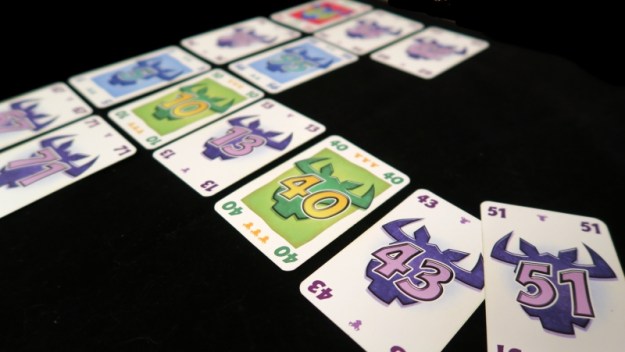
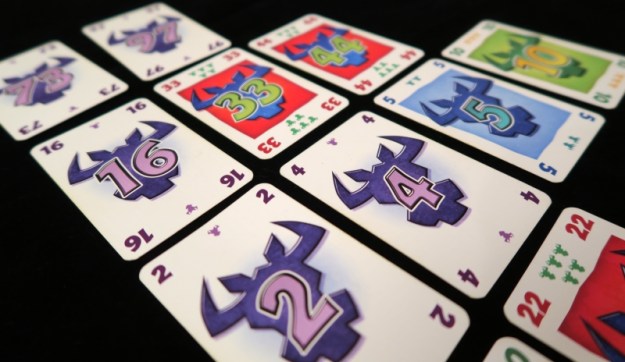
By this time, it was starting to get late and people drifted off leaving just five for our, now regular, game of 6 Nimmt! on Board Game Arena.  It is very simple:  simultaneously, players choose a card, then starting with the lowest value, these are added to one of the four rows.  The player who adds the sixth card takes the other five and the player with the most “nimmts” at the end loses.  It is very random, but somehow gives the illusion of control, right until the wheels drop off…

6 Nimmt!
– Image by boardGOATS

We play this so much because it is light and great fun, with no downtime.  And with the “Professional Variant” that we now use where cards are added to both ends of the rows, the game has had a new lease of life for us.  It works really well with fewer players too.  This time, Black was first and second to pick up, and it didn’t get much better as the game wore on and it wasn’t a surprise when he triggered the end of the game leaving Burgundy to taste victory, just ahead of Green.

6 Nimmt! on Board Game Arena
– Image by boardGOATS from boardgamearena.com

Then, Green said good night leaving just four.  Having enjoyed several games of Sushi Go! last time, we decided to give it another try, this time with the Soy Sauce mini expansion.  This is one of the simplest of the card drafting games—players have hand of cards, keep one and pass the rest on.  With Sushi Go!, players are collecting sets with a sushi theme and trying to collect the most points over three rounds.

Sushi Go!
– Image by boardGOATS

This was another close game.  Burgundy and Blue tied the first round, one devoid of puddings, but Black and Purple weren’t far behind.  The second round was much less even though and was taken by Blue with a massive eighteen points.  She wasn’t able to keep it up for the final round which Black took with sixteen points.  It wasn’t quite enough, to overtake Blue though and she finished with a total of forty-three, just two ahead of Black, in a game where there just wasn’t enough dessert to go round.

Sushi Go! on Board Game Arena
– Image by boardGOATS from boardgamearena.com

There was just time for one more game, so after a brief discussion, the group opted for another set collecting game, Coloretto.  This is another very simple game where players have the simple choice:  Take a card and add it to a truck, or take a truck and add the cards to their collection.  Players score positive points for their three top scoring sets, and negative points for all the others.  Normally, the scoring is according to the Triangular Number Series, where more cards score increasingly more points (one, three, six, ten, fifteen and twenty-one).

Coloretto
– Image by boardGOATS

This time we decided to play with the alternative, “Difficult” scoring, where small sets score the most and their value peaks at eight points for three cards, falling gradually for larger sets.  This changes the game significantly, as taking a fourth or fifth card has the same impact on a player’s score as starting another set.  And everyone has fewer points to play with…  It took a couple of rounds for people to realise the implications of this change to scoring.  Then players started taking trucks when they were almost empty and when a “+2” card came up it was taken straight away.

Coloretto on Board Game Arena
– Image by boardGOATS from boardgamearena.com

As a result, there were more rounds and the game became one of avoiding things going wrong.  And for most people, once it started going wrong, things generally went from bad to worse.  First was Purple, then Black, then just before the end, Blue was landed with pile of cards she didn’t want.  So, it wasn’t a huge surprise that Burgundy, who had managed to avoid falling off the precipice, finished with the most points.  Purple was by far the best of the rest though having been most successful at stemming the flood of unwanted cards.  Then it was time for the last of the birthday boys and girls to go to bed.

Coloretto on Board Game Arena
– Image by boardGOATS from boardgamearena.com

Learning Outcome: A gift’s worth is in the eye of the recipient.

29th September 2020 (Online)

This week it was Ivory’s turn to share his pizza with everyone, while Blue and Pink shared ice creams with Purple and Black.  With the food over, Blue explained how we were going to prepare for our birthday next time, by “wrapping parcels” for Crappy Birthday.  This is a silly party game that we play every year to celebrate the anniversary of our first meeting in 2012.  Basically, players take it in turns to have their birthday, and everyone else chooses a gift from a hand of five cards.

Crappy Birthday
– Image by boardGOATS

Unfortunately, this doesn’t really lend itself to playing online, but as so many things have been cancelled this year, we didn’t want this to be one of them.  So, to get round the difficulties, we decided to play it over two evenings:  firstly wrapping cards, then opening them two weeks later.  Each player had a set of electronic files containing cards.  Everyone opened the first file and chose a card to give to the player whose name was drawn out of the box lid, making a note of what they were giving and to whom.

Crappy Birthday
– Image by boardGOATS

When people had gifted two parcels, they closed the file and opened the next one which included the same cards as the first file and a couple of new ones, thus simulating drawing two more cards.  Once everyone’s name had been drawn, everyone emailed the list of gifts to Blue for her to arrange delivery ready for next time.  And then it was on to the “Feature Game” which was Welcome To….

Welcome To...
– Image by boardGOATS

Welcome To… is another “Roll and Write” style game, though without the colouring-in element of some of the games we’ve played recently, and as a result is a bit more complex.  In this game, players are planing and building housing estates in 1950s USA.  This time, the player board depicts three rows of houses and a scoring table.  The idea is that there are three decks of double sided cards with a house number on one side and an action on the other.  At the start of each round, the top card is turned over to show the action side.  Players then choose one of the three house number/action pairs to use.

Welcome To...
– Image by boardGOATS

Players must write a house number on any one of the three streets, but the numbers can only feature once on each, and must be ascending from left to right.  Players may then carry out the associated action, which could be building a fence, building a swimming pool or park, adding a number a second time (“Bis!”), modifying the number by one or two (using the Temping Agency) or increasing the value of houses on “Estates” of certain sizes.

Welcome To...
– Image by boardGOATS

At the end of the game, players score points for building swimming pools and parks, having used the “Temping Agency” the most, and also for different sized “Estates”.  An Estate is a continuous group of houses (i.e. no gaps) with a fence at each end.  Estates of size one up to six score different numbers of points and one of the actions players can use is selectively increase the value of some of these.

Welcome To...
– Image by boardGOATS

Additionally, players score points for completed “City Plans”.  These are three cards revealed at the start of the game. which give points to people who complete their requirements.  The catch is, a bit like Noch Mal!, the first person (or people) to be successful get more points, usually around double that of anyone who finishes them later in the game.  This is also one of three “game timers”, with the game ending when someone completes all three Plans.

Welcome To...
– Image by boardGOATS

The game also ends if someone manages to fill in all the houses in all three streets, which is not easy.  More likely, players are going to find they cannot build any of the three houses being offered.  If this happens, players player take a “Building Permit Refusal”—when someone takes their third, that also triggers the end of the game.

Welcome To...
– Image by boardGOATS

There are lots of little rules that make the game more complex than most of the “Roll and Write” games we’ve played.  For example, players can build fences anywhere, but parks must be on the street they built their house on, and pools can only be built in the garden of the house if it was on the plan.  That said, it is not actually difficult, but there is a lot to think about and if players are going to score well.

Welcome To...
– Image by boardGOATS

There were a lot of questions from the group, and people clearly found it difficult to understand, not helped by the difficulties of learning a game over MS Teams.  Nevertheless, teaching and learning through a computer is a skill lots of school teachers, pupils, university lecturers and students have had to develop this year, and it turns out it is useful for gamers too.  So eventually, Pink finished shuffling and turned over the first set of cards to start the game.

Welcome To...
– Image by boardGOATS

Everything went quiet as people put their “Game Face” on and concentrated.  It wasn’t long before the silence was broken by Burgundy sighing, Pine grumbling and Blue checking how people were getting on.  To reduce the waiting and questions whether everyone was ready, we used the “hands up” function to indicate when players had finished writing.  This was really helpful to keep track of things with so many people playing.

Welcome To...
– Image by boardGOATS

The City Plans in play were all from the basic game (and we weren’t playing with roundabouts either), so all three were based on estate sizes:  1) two of size four; 2) a six and three ones; 3) a four and a three.  Green was first to complete a City Plan taking number three, and was soon followed by Pink and Ivory taking the lucrative second Plan giving them eleven points each.

Welcome To...
– Image by boardGOATS

Gradually, as the game progressed others claimed more City Plans and there was a feeling that the game was coming to a close.  Increasingly, people found their choices were becoming more limited adding to the tension.  This feeling was heightened when Purple became the first to be unable to play, and took a Building Refusal Permit.  A few rounds later, and Mulberry ended the game by completing her third City Plan and everyone started adding up their scores.

Welcome To...
– Animation by boardGOATS

Despite people finding it difficult at first, the scores were surprisingly close with a winning score of ninety-five and most of the group not far behind.  It is definitely a game that rewards a little experience especially as it is quite different to the other games we’ve been playing recently, so it wasn’t surprising that Pink ran out the winner.  Green ran him close though, with an excellent ninety-two.  There was a bit of chatter while some said their “good byes” and the rest of the group decided to play Saboteur on Board Game Arena.

Saboteur
– Image by boardGOATS

The game is easy to play and everyone knows what they are doing, so it is always quick to get started.  Each player has a hand of cards and take it in turns to either play a tunnel card, or play an action card.  The aim of the game is to help the team build a tunnel to whichever of the three terminal cards holds the gold.  Unless you are a Saboteur of course, in which case, your aim is to hinder the efforts made by everyone else, but without being spotted…

Saboteur
– Image by boardGOATS

Saboteur is usually better with more players, but the group had sort of decided they were going to play it before they realised how many people there were left.  With just six there were either one or two Evil Saboteurs and the rest were Lovely Dwarves.  This makes it hard for the Saboteur team and they have to get their act together quickly to make the most of what little time they have.

Saboteur
– Image by boardGOATS

In the first round, Pine made it very clear he was going to make the most of his time and bluntly said he thought Blue was a saboteur and broke her pick axe for her, preventing her doing any tunnelling.  This was apparently in response to her playing a map card in her first turn which he decreed was “A very Saboteury Move”.  Everyone else felt that Pine’s move was much more “Saboteury” and jumped on him in response.  Everyone except Purple that is, who ran to his aid.

Saboteur on Board Game Arena
– Image by boardGOATS from boardgamearena.com

It wasn’t long before Purple’s true colours were flying when she joined Pine and blocked the tunnel with dead-ends.  However, the Dwarves, now knowing there wasn’t a traitor hiding in their midst, got their act together, dealt with the blockage and headed for the gold.  Before long, it was 1-0 to the Dwarves.

Saboteur on Board Game Arena
– Image by boardGOATS from boardgamearena.com

The Evil Saboteurs were a little more cagey in the second round.  Purple looked at the bottom card and indicated it was Gold.  After last time, nobody trusted her so first Pink and then Pine double checked and all concurred.  The Dwarves were one card away from an easy run to the Gold when Burgundy’s rockfall card told everyone else which side he was on.  It was too little too late, however, and nothing he or his partner in crime, Black, could do could prevent the Brave Dwarves repainting the tunnel and finding the gold.

Saboteur on Board Game Arena
– Image by boardGOATS from boardgamearena.com

Early in the third and final round, Burgundy started by looking at the middle card which he claimed was coal.  By this time, suspicion was a currency everyone was rich in, so Pink double-checked and concurred, then checked the bottom target card.  Burgundy claimed suspicion and immediately verified that they’d found Gold.  Purple announced that she thought Pink was behaving suspiciously and broke his pickaxe for him—an extremely Saboteury move!

Saboteur on Board Game Arena
– Image by boardGOATS from boardgamearena.com

Burgundy attempted to redeem his behaviour in the previous round by repairing Pink’s tools, while Black repaid Purple by smashing Purple’s lamp.  Although Purple was able to fix it herself, it looked like the Dwarves were home safe and sound until Pine’s turn.  As discussed with the team, he played a card between the middle and bottom cards, but when it connected the carefully dug tunnel to the middle, coal, everyone was sure that they’d found the second Saboteur.

Saboteur on Board Game Arena
– Image by boardGOATS from boardgamearena.com

Pine protested that it was incompetence rather than malice that meant he’d put the card in upside down.  The Dwarves had to fix his “mistake” though, and their cards were running out.  Black discarded a card and Blue had no choice but to smash some more of Purple’s tools, leaving it down to Pink to finish things.

Saboteur
– Image by boardGOATS

In the end, it turned out that the Saboteurs were Black and Purple, and Pine just had a sausage-finger-moment.  That left Blue as the “winner”, but the scoring is very random and highly dependent on turn order, so really all that can be said is that it was 3-0 to the Loyal Dwarves.  There was time for something else before Pink’s bedtime, and given the shortage of time, the group bowed to the inevitable and moved on to 6 Nimmt!.

6 Nimmt!
– Image by boardGOATS

This has become one of our favourite games, especially since we’ve been forced to play online as it is light and fun and fast to play, and helps us to forget the current situation.  The game is so simple, and yet so much fun, with almost no downtime.  Players simply choose a card and Board Game Arena does the rest.  Of course, everyone like to think they have control and their strategy is working, right up until it isn’t.

6 Nimmt!
– Image by boardGOATS

The idea is that the card chosen is played on the end of one of four rows, with players trying to avoid placing the sixth card as that means the points on the other five cards are deducted from their total.  So the aim of the game is to try to second-guess what everyone else is doing and stay safe.  Recently, we’ve been playing the “Professional” variant which allows players to add cards to either end of the rows, adding more “strategy” and more chaos, and a whole lot more fun.

6 Nimmt!
– Image by boardGOATS

Things started to go wrong Blue first, when she cheered thinking she’d got away without a pick-up, only to discover she’d got nine “nimmts”.  Purple picked up nine in the same turn, however, while Blue managed to stabilise her game, Purple’s went from bad to worse when she managed what might be a new record, picking up nineteen nimmts in a single turn!

6 Nimmt! on Board Game Arena
– Image by boardGOATS from boardgamearena.com

Fairly inevitably, Purple triggered the end of the game, but the other end was less clear.  That was until the end of the game, when Blue, who had somehow managed to avoid picking up anything else, just pipped Burgundy to the win.  With that, Pine and Pink bade everyone else good night and the remaining foursome looked for something else to play.

6 Nimmt! on Board Game Arena
– Image by boardGOATS from boardgamearena.com

There were a few options, but they were limited by the fact that nobody wanted to play anything long or too intense. In the end, they decided to give Sushi Go! a try.  This is a game we’ve all played before, but nobody had played on Board Game Arena.  is a pure card drafting game: players start with a hand of cards and keep one and pass the rest on.  The aim is to collect cards in combinations to give them points.

Sushi Go!
– Image by boardGOATS from boardgamearena.com

In Sushi Go!, it is all about collecting the right cards at the right time.  For example, three Sashimi cards are worth ten points, but two are worthless.   There is also a significant “hate drafting” aspect though.  This is where players take cards to inconvenience others rather than to benefit one’s own game.  This is mostly because Maki Roll and Pudding points are awarded to those with the most cards, but can also be because causing another player to finish with worthless cards can sometimes be as effective as scoring points oneself.
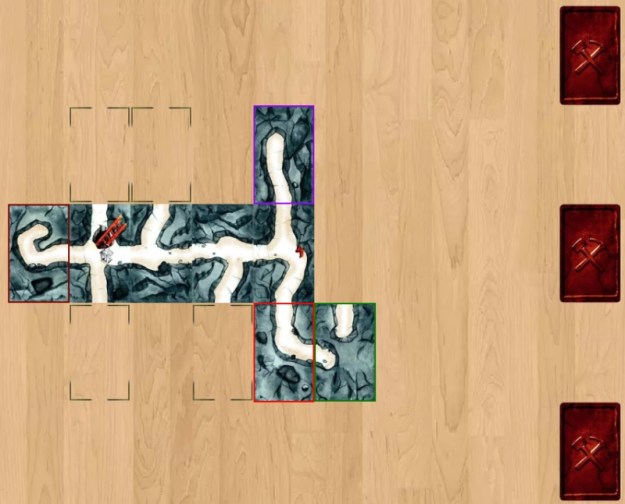
Sushi Go!
– Image by boardGOATS

The first round was one of rediscovery since it was a very long time since anyone had played it.  Blue rediscovered the perils of trying to collect Sashimi, when she got stuck with only two which scored her nothing.  Burgundy, on the other hand, just before her in turn order, collected three and claimed ten points.  Purple collected lots of Nigiri and Black made hay out of Maki Rolls.  So, going into the second round it was pretty much a three-way tie with all to play for.

Sushi Go! on Board Game Arena
– Image by boardGOATS from boardgamearena.com

In the second and third rounds, Black and Purple made a lot of points from playing Nigiri cards after wasabi cards which is a multiplier and can be very lucrative.  Although Black was in the lead going into the final round, the fact Burgundy took two Wasabi/Nigiri combos meant he took a fine victory.  The game plays so quickly though and the Board Game Arena rendition is so good that everyone fancied trying giving it another go.

Sushi Go! on Board Game Arena
– Image by boardGOATS from boardgamearena.com

The second game was much closer, the competition for Wasabi and Maki Rolls got more intense with everyone now well aware of how lucrative they could be.  Although it was very close, in the end, Burgundy just managed to keep his crown, beating Black into second place by a single point and everyone else just a couple of points behind.  With such a tight finish, a third game was inevitable.  Blue who had come last in the previous two games was determined not to this time.  However, a grotty starting had meant she was forced to start with lot of puddings.

Sushi Go! on Board Game Arena
– Image by boardGOATS from boardgamearena.com

By this time, everyone was looking more carefully at what they were passing on, so Blue finished with a bit of hate-drafting, ensuring that Burgundy couldn’t get a full set of Sashimi and that ensured she avoided the wooden spoon.  Purple and Black started out with Wasabi and really managed to make their cards count.  In the end, there were still only two points in it, but this time it was Black and Purple fighting out for first place, which Black just took.  And then it was definitely time for bed.

Sushi Go! on Board Game Arena
– Image by boardGOATS from boardgamearena.com

Learning Outcome: Swimming pools are not as common as you might think.