Tag Archives: For Sale

22nd July 2025 (Report)

This being the summer, Lime brought LIttle Lime to join in the evening, but as there is a curfew for under-eighteens (due to licencing restrictions), the first game had to get off the mark quickly.  Together with Pink and Plum, they quickly got going with the well known favourite and Spiel des Jahres winning game, Azul.  This is known to everyone, so needed little clarification, though they group decided to use one of the alternate boards from the Crystal Mosaic expansion (the one with the cross pattern).  The game is very simple with players taking tiles of one colour from a factory and putting the remains in the centre, or taking all the tiles of one colour from the central pool.
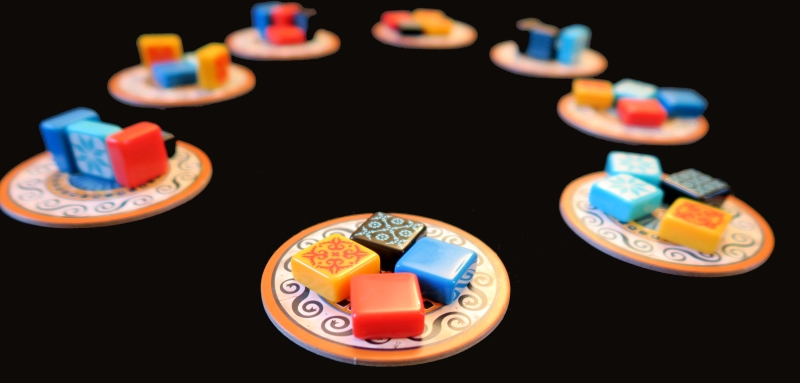
Azul
– Image by boardGOATS

In either case, players have to add them to their conveyor and if, at the end of the round the conveyor is full, one tile is slid across to be added to the mosaic and the rest disposed of. If the added tile is isolated it scores a single point, but if placed next to other tiles, then more points are scored with larger groups scoring more points.  In this way, tiles grouped together keep scoring points.  Thus, a player who starts well can build a lot of points, which both Little Lime and Plum managed to do.  In the end, Big Lime ended the game, leaving Plum with a single point advantage—The moral of the story:  Don’t end the game too early (as Big Lime commented regretfully).

Azul
– Image by boardGOATS

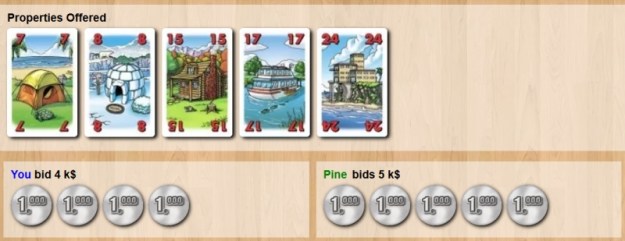
On something of a roll, the group moved on to one of Pink’s favourite quick fillers, For Sale.  Dating from the end of the last century, this game is now nearly thirty years old, but isn’t really showing its age, despite that.  The game comes in two halves:  Buying Properties at Auction, then Selling Properties by Blind Bid.  This game was really really close with a single point between Plum and Little Lime, but they were a a few points behind Big LIme who, as an accountant might be expected to perform well in a financial game.  The winner, however, was Pink, who, despite it being one of his favourite games had never won, until now.  And with that, it was time for Family Lime to head off.
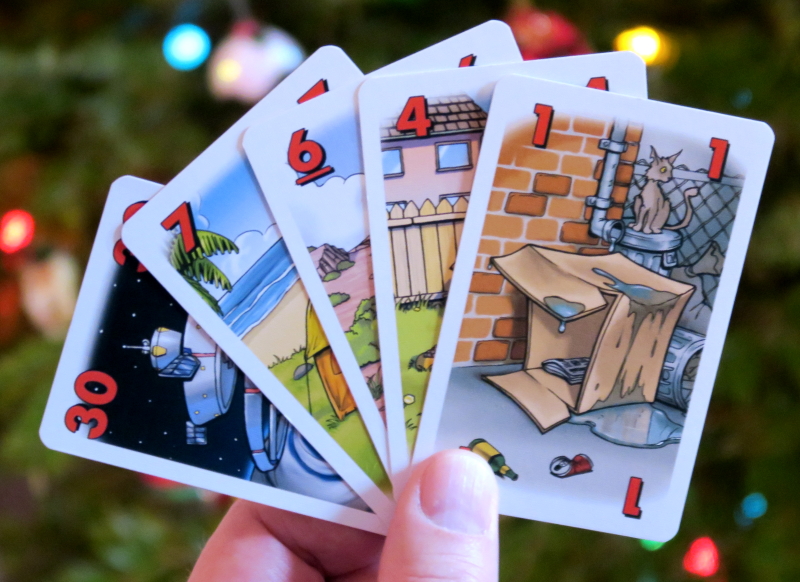
For Sale
– Image by boardGOATS

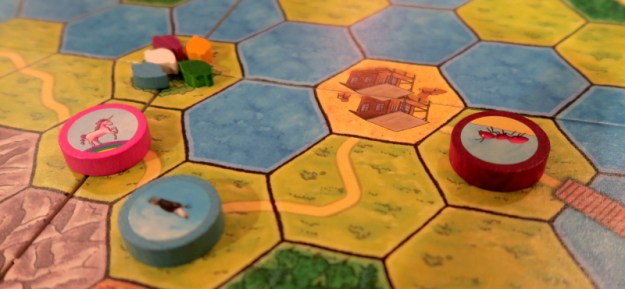
Meanwhile, the rest of the group were engaged in the two tables of the “Feature Game“.  To mark the recent announcement of the Spiel des Jahres winners, this was  Looot.  Although Loot was not actually one of the winners, it, along with Faraway, had recieved a nomination for the Kennerspiel des Jahres and, as it had proved popular within the group (also like Faraway) we decided to make it the Feature.  Although its nomination was in the Expert or Connoisseur category, the game is not overly complex.  The game is played over a series of rounds where each player places one of their Viking workers—the game ends when everyone has run out of Vikings.

Looot
– Image by boardGOATS

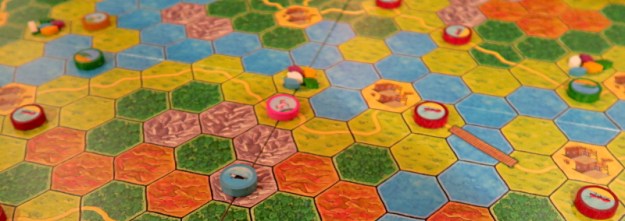
On their turn each player places one of their Vikings on the central playerboard.  This is is made up of hexagons: the Viking must be placed on an empty space next to another Viking (of any colour).  Each hexagon gives a resource which can be used to purchase Longships, and if the Viking fulfills certain conditions, it’s owner can capture a house, Watchtower or Castle.  The player with the most points at the end of the game is the winner.  This time there were two tables playing the same game, with Black leading the first table comprising Purple, Byzantium, and Cobalt.

Looot
– Image by boardGOATS

This game turned into a a bit of a battle for Castles between Byzantium and Cobalt.  Cobalt did rather better in the end though thanks to his Long-ship bonuses.  This was because Byzantium kept revealing them and everyone else eschewed them until it came to Cobalt who snapped them up.  Byzantium’s frustration was increased somewhat because Cobalt was just before him in turn order so it looked like they miight make it round to him until they didn’t…  quite…  In the end, Cobalt’s were worth forty-two while Byzantium’s gave him just twenty-eight, despite the fact he actually had more.

Looot
– Image by boardGOATS

It was still close between them, but fairly inevitably, Cobalt had the edge finishing with one-hundred and twenty-eight, ten more than Byzantium in second place.  This was a much higher scoring game than the second table, although that was much closer.  Jade led this game with Mint, Sapphire, and Blue making up the group.  The strategies were very varied, with Jade going for Castles, Mint for Watchtowers, Sapphire for Gold, and Blue who was new to the game, going for a balanced strategy so she could change her tactics as required.

Looot
– Image by boardGOATS

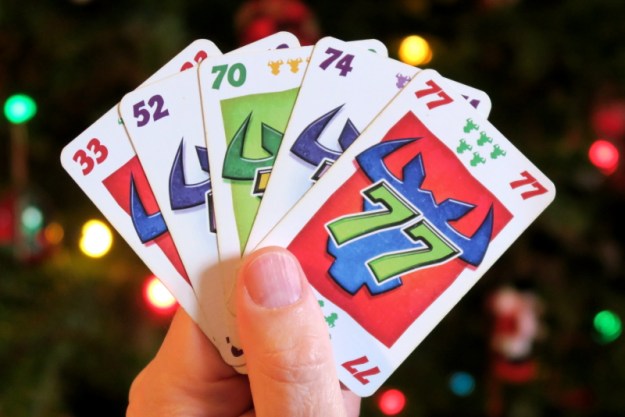
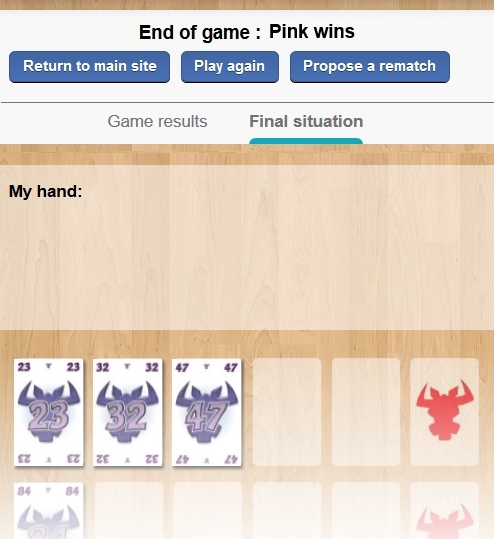
In the end, Blue’s “points from everything” approach just had the edge giving her victory with eighty-eight points, two more than Mint who had one more than Jade with Sapphire close behind. With the games of Looot coming to an end at the same time as For Sale and with Family Lime heading off, the rest of the group split into two.  The first, larger group, consisted of Jade, Sapphire, Blue, Pink, Mint, Plum and Byzantium who decided to give a simple and supposedly quick little game called Tacta an outing.  This is a sort of “card placing” game where players have a hand of cards and place them on the table to cover up spots on other players’ cards.  At the end of the game, the player with the most spots visibleis the winner.
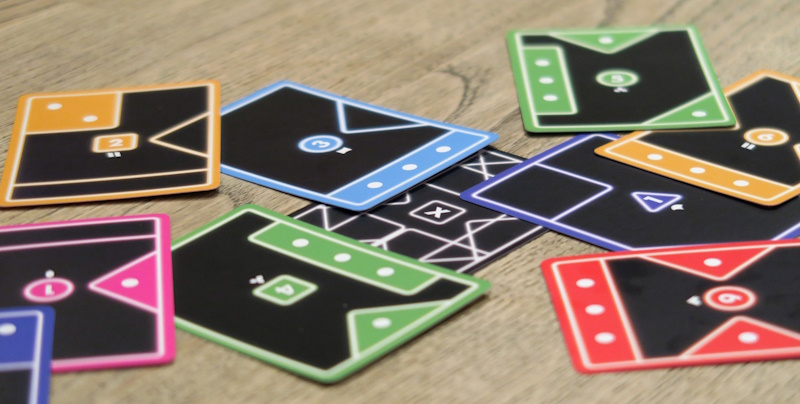
Tacta
– Image by boardGOATS

Unfortunately, game time is proportional to the number of players, so with the six players (Plum and Byzantium shared a hand and worked together), the game was always going to take twice as long as it would with three.  Worse, this was one of those games where gamers take even longer as they want to make sure the find the best placement option and push the rules boundaries.  It is a very clever little game though and a lot of fun, though perhaps playing with fewer cards or fewer players would avoid it outstaying its welcome.
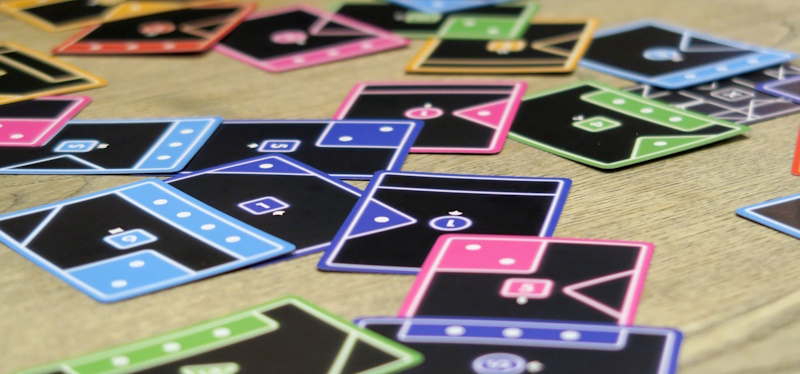
Tacta
– Image by boardGOATS

It was made worse by the fact that everyone helped everyone else and therefore, the victor was quite obvious from fairly early in the game  Although Blue made a dash to come from zero to finish in a more respectable last place, nobody looked like they were seriously going to challenge the Byzantium-Plum team.  Mint took second one point ahead of Pink who was one point ahead of Jade who was one point ahead of Sapphire.  Definitely one to try again, but with fewer people next time.  The supposed quick card game ended up finishing some time after the supposed longer game, Ticket to Ride: Paris that Black, Purple and Cobalt chose.
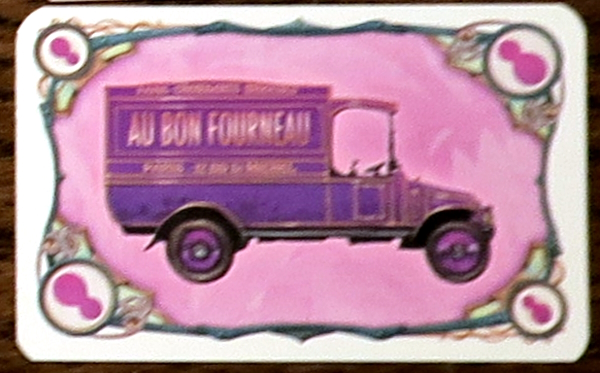
Ticket To Ride: Paris
– Image by boardGOATS

One of the small, “City Editions” of the popular, Spiel des Jahres winning Ticket to Ride games, we’ve played Paris quite a bit since it was released last year.  Following the same pattern as all its brethren, the game involves collecting coloured carriage cards and spending them to place metro carriage pieces on the board to connect regions of the city, while trying to also complete tickets.  Each edition has its own extra little rule, and in the Paris edition, this is centred on the colours of the tricolor.  When players build a red, white or blue route, they keep one of the cards, when they complete a set of three they discard the cards and claim bonus points.
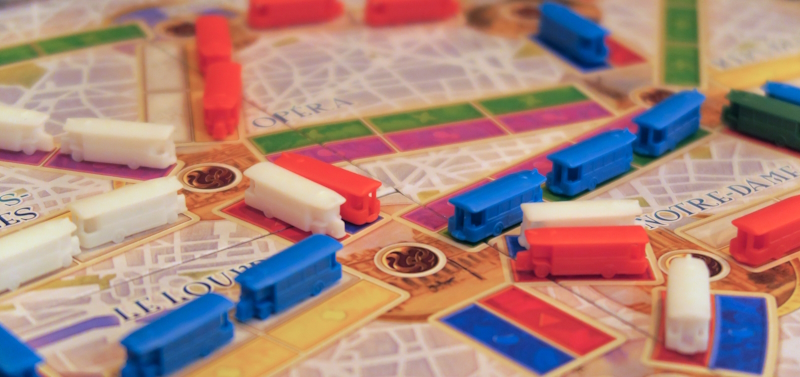
Ticket To Ride: Paris
– Image by boardGOATS

Purple started and game play was rapid.  Before long, players were running out of pieces, with Blake miles ahead of the other two.  But that was without the addition of scores for Tickets. Purple took got nine points for her three completed Tickets thanks to her misplaced bravery in picking up tickets at the end and not being able to complete her last one.  Cobalt took sixteen points for completing all four of his Tickets, though that was with a bit of jiggery pokery (i.e. retaking his last turn) in order to complete one ticket when he realised he had actually failed to complete it. It was therefore perhaps fair that Black who only scored ten points for completing his pair of tickets just managed to keep his nose in front, taking victory by a single point.
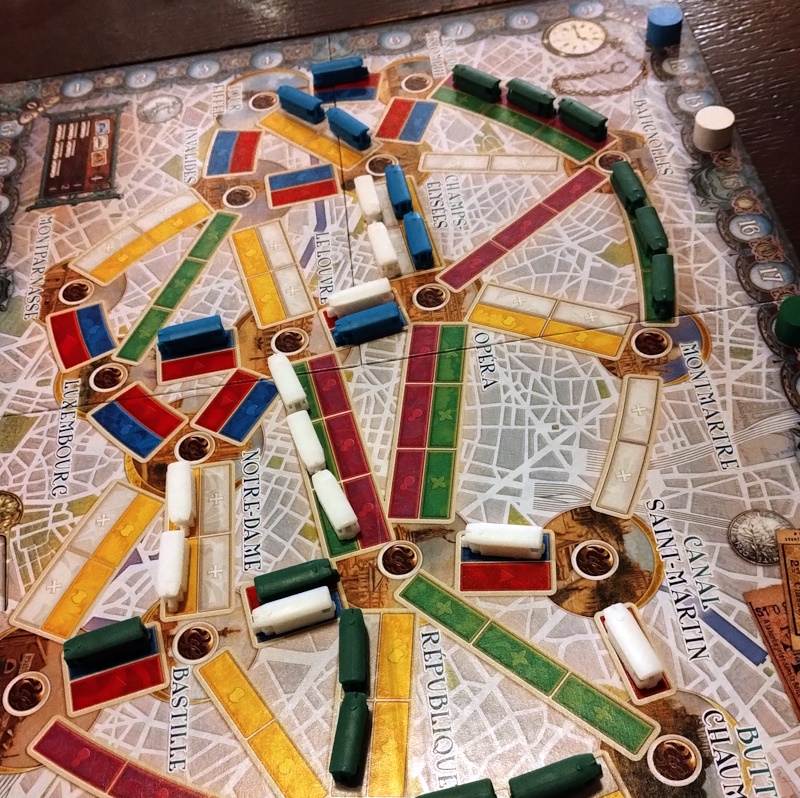
Ticket To Ride: Paris
– Image by boardGOATS

Learning Outcome:  There is something for almost everyone in the Spiel des Jahres lists.

2nd April 2024

While Blue, Pink and Cobalt were finishing their supper, Plum led a quick game of Draftosaurus with Black, Purple and Cobalt (who had already finished his pizza).   Cobalt was new to the game, so after a quick rules explanation the group were passing dino-meeples left and right and building themselves exciting dino-parks.  The game is really quick and simple:  players start with a handful of wooden dino-meeples, and on each turn, they draft one, that is to say, they choose one and pass the rest on.  The chosen dino-meeples are then placed in the players’ parks, obeying the rules on the Die (the active player who rolled the Die excepted).

Draftosaurus
– Image by boardGOATS

The Die roll forces players to choose from locations in one half of the board, or restricts them to playing in an empty pen or one without a T-rex, making things considerably harder.  Players draft a hand clockwise, and then a second hand anti-clockwise, after which, points are scored for each pen and totalled up to find the winner.  This was Plum’s fiftieth game—it was one of their group’s go-to warm-up and filler games played remotely during the global pandemic on BoardGameArena.  Although her 24% success rate seems really good at first, at four players, one out of four could be seen as about par.

Draftosaurus
– Image by boardGOATS

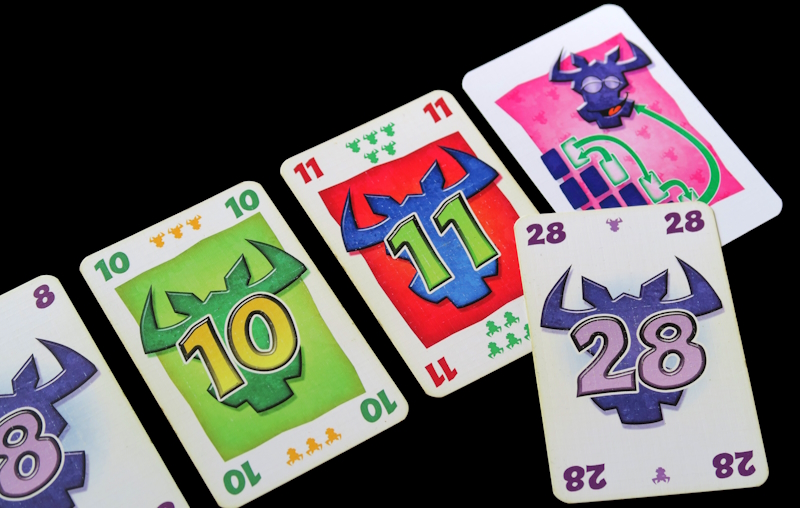
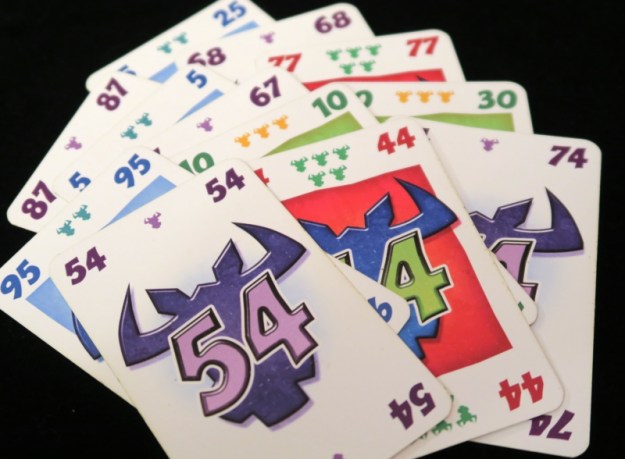
Plum marked her milestone with a change of strategy, forced by the Dice to go for the most T-rexes, but it worked giving her victory with forty-one points.  Purple took a very respectable second with thirty-five points—one of her best scores in this game.  From there, Cobalt headed off to play Meadow with Blue, Jade and Sapphire, while everyone else joined Plum, Black and Purple to play the “Feature Game“, which to mark the thirtieth anniversary of 6 Nimmt!, was the new Jumping Cow mini-expansion.  6 Nimmt! is one of the group’s favourite games and was arguably responsible for keeping us sane when we were stuck at home in 2020 and as a result, won the Golden GOAT Award.

6 Nimmt!
– Image by boardGOATS

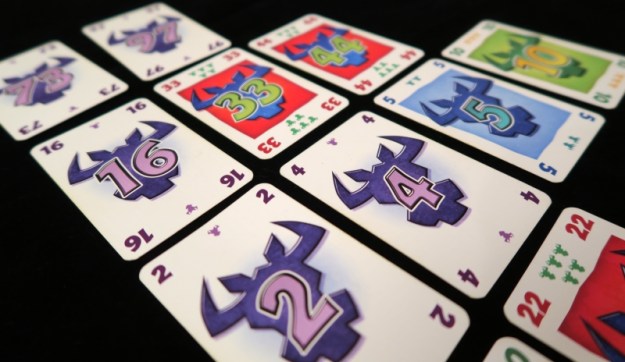
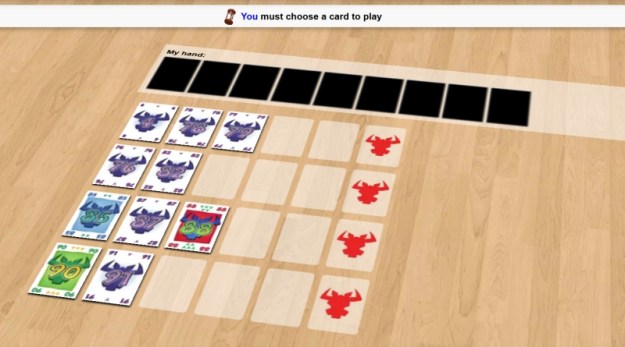
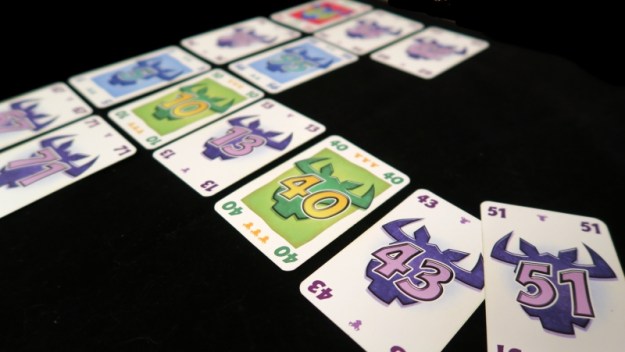
The game is super-simple:  players simultaneously choose a card from their hand and then, starting with the card with the lowest face value, they are added to one of four row.  Each card is added to the row that ends with the highest value card that is lower than the card to be placed.  If that means the row now has six cards, the active player takes the first five cards in the row into their scoring pile, with their card becoming the new first card.  The new Jumping Cow expansion is a single additional card that lurks at the end of the row.  Cards are added as normal, however, when one is added to the Jumping Cow row, the Cow jumps to another row, the one with the lowest face value at the end.

6 Nimmt!: The Jumping Cow
– Image by boardGOATS

The Jumping Cow Card does not have a value itself, but it does add to the number of cards in the row.  So if the card added is the sixth, the player takes the other four cards and then the Cow jumps.  If the row the Cow jumps to has five cards in it, the active player takes four of those too before the Cow jumps again…  Thus, as Plum discovered this time, multiple jumps can lead to collecting a lot of points!  The game was the usual entertaining fun, but although the Jumping Cow expansion adds more madness, 6 Nimmt! is a near perfect game that needs little to no improvement (although we have found the Professional Variant an occasional worthwhile addition).
6 Nimmt!
– Image by boardGOATS

This time, the top scorer (aided by the Jumping Cow) was Plum with sixty-one, closely followed by Ivory with fifty-seven.  Purple did very well to limit her takings to nineteen, but she was beaten into third place by Pink who just kept his to single figures with nine.  The winner was Teal, however, with just four from the first hand and a clear round from the second.  From there, with six, the options were limited, but the group decided to stick together and, after eschewing Bohnanza, opted for another golden oldie: For Sale.  Remarkably, Ivory had somehow not played this before, and was really taken with it, so much so that he immediately looked to see if he could get a copy and everyone was shocked to find it was out of print and the only copy available was for forty pounds on ebay!

For Sale
– Image by boardGOATS

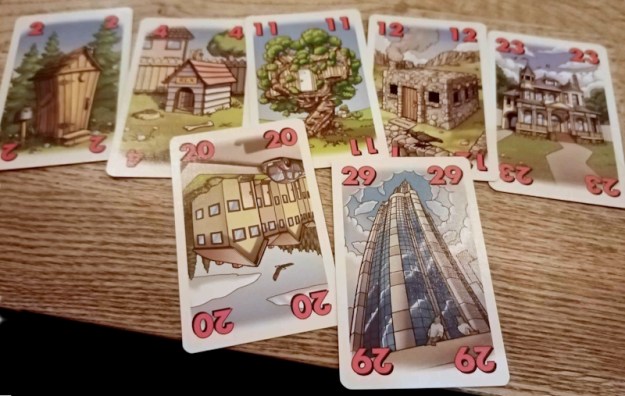
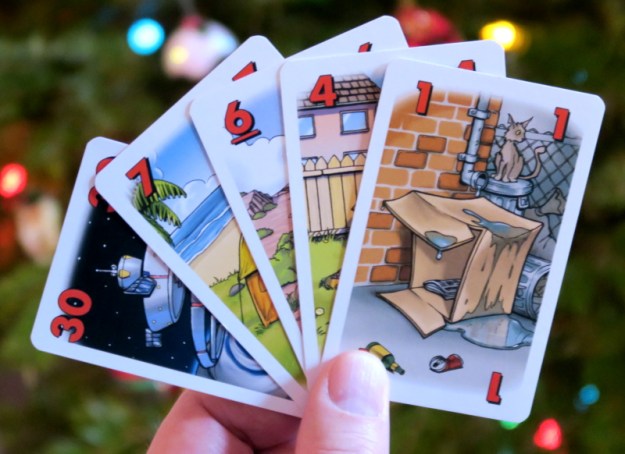
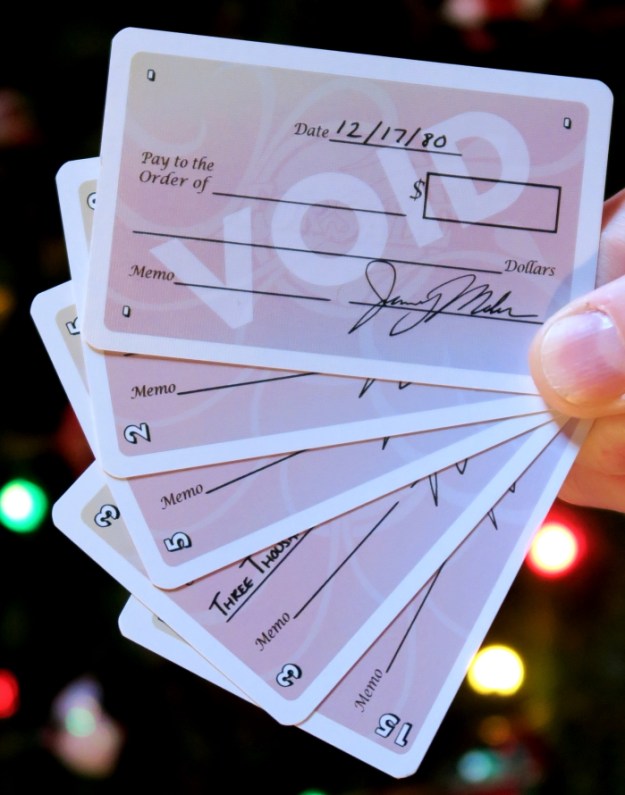
For Sale is really simple:  Players start with a hand of cash and use this to bid for buildings, with a face value from one to thirty.  In the second half of the game, cheques are revealed and players have to choose one of their properties—the player with the highest value building then takes the highest value cheque, thus the idea is not to waste high value buildings when the takings available are low.  Pink, Plum and Teal were all really close and ended in a three-way tie for third place.  Ivory and Purple were some way in front, but separated by a single point with Purple just taking victory, with a final taking of fifty-six thousand dollars.

For Sale
– Image by boardGOATS

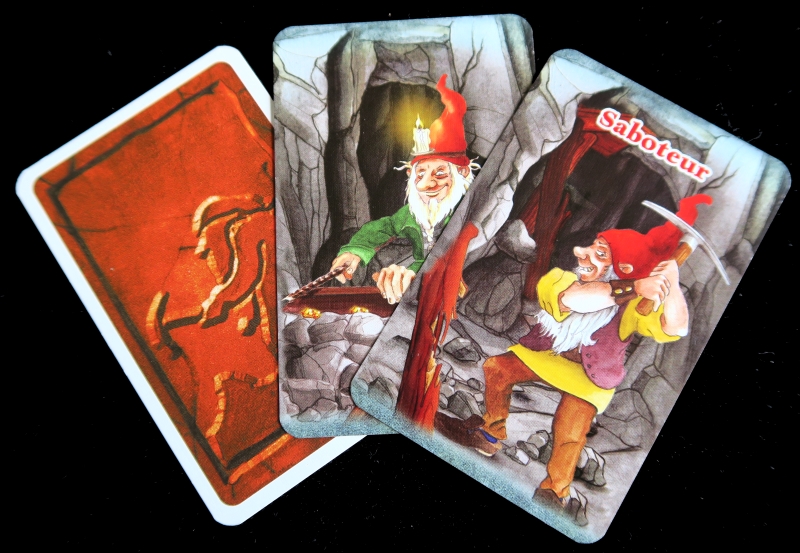
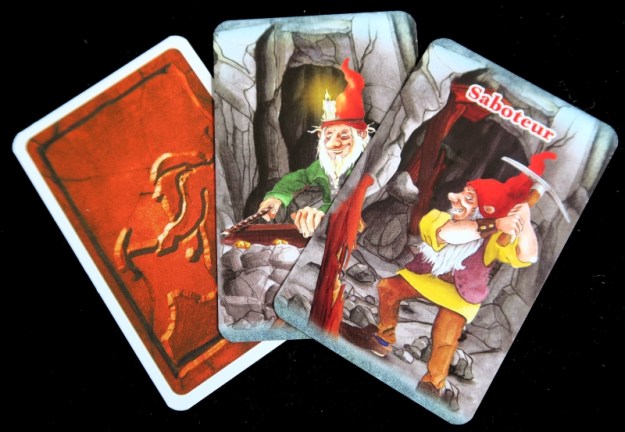
Casting about for another game that plays well with six, Bohnanza was passed over once again, this time in favour of Saboteur.  Saboteur is a hidden traitor game where players are Dwarves tunneling to find gold.  With six players, the rules have either one or two Saboteurs, however, as the game is always difficult for the Saboteurs and impossible alone, the group chose to forgo the ambiguity and go for a guaranteed two Saboteurs.  Once the Saboteurs knew who they were, everyone got a hand of cards: a mixture of tunnel cards and special cards.  On their turn, players play a card and draw a new one.  Tunnel cards extend the network, while special cards allow players to break or mend tools stopping other players from building tunnels (or reinstating that ability).

Saboteur
– Image by boardGOATS

Additionally, there are Treasure Map cards which allow players to look at one of the three potential gold cards to see if it is gold or coal, and Rockfall cards which allow players to collapse the tunnel by removing one card.  Usually, the Saboteurs hide for as long as possible in an effort to acquire some good “Saboteury cards” and play them with a lot of impact.  Choosing the right time for that reveal is really critical though, leaving it too late means there isn’t time to do enough damage.  This time then, Black announced his position very early by playing an obviously obstructing tunnel card and was swiftly followed by Pink who compounded the poor Dwarves’ problems by playing a Rockfall card.

Saboteur
– Image by boardGOATS

The Evil Criminal Masterminds were aided by the fact that when the Dwarves played their Treasure Map cards they struggled to find the gold.  The game turned out to be quite epic, but success just fell to the Saboteurs, giving them a rare victory.  As Teal and Ivory waved farewell, the others looked for something else to play.  Saboteur is a great game, and although it is not as old as 6 Nimmt!, this year is also Saboteur’s anniversary year. It is celebrating twenty years, as is another old favourite, No Thanks!.  In choosing this, those that had played all five games had played over a hundred years of popular games in one evening.

No Thanks!
– Image by boardGOATS

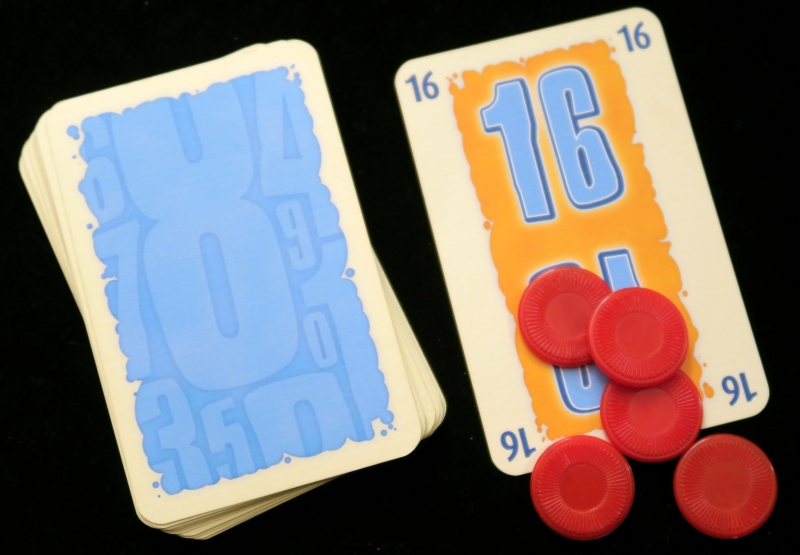
No Thanks! is a super simple, push-your-luck game, where players are trying to finish with the lowest score from the total face value of their cards minus any chips they have.  On their turn, players either take the top card and any chips on it, or pay a chip to pass the problem on to the next player.  There are thirty-three cards in the deck (numbered three to thirty-five), but nine are removed at random, which is what makes the game really tick—when scoring, players only count the lowest card of a run.  This time. Pink top-scored with forty-nine points.  Plum and Purple both took forty-eight points for their cards, but in Plum’s case this was off-set by her enormous pile of chips, leaving her with just twenty.

No Thanks!
– Image by boardGOATS

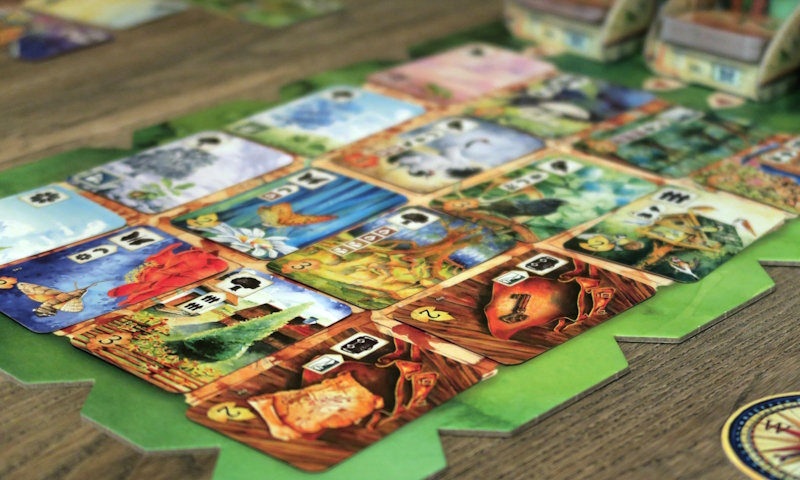
It wasn’t enough though. Black managed to just scrape through with only a single chip left at the end, giving him a total of thirteen points, and with it, victory.  While everyone else had been sampling a smorgasbord of golden oldie games, Jade, Blue, Cobalt and Sapphire were revisiting the relatively new Meadow, which they’d missed out on playing last time.  This is a fairly simple game, where the complexity is in choosing and placing tokens to get cards that combine well together.  Players take it in turns to play an Action Tokens either in the Market or round the Campfire, and complete the associated Actions. The Market consists of a four by four grid of face up cards.
Meadow
– Image by boardGOATS

Players play an Action token in the market to define a row or column with the number on the token dictating which card they will take from that row or column.  They then place a card in their play area.  This can be the card just collected or one from the player’s hand, but the prerequisites must be satisfied. Playing around the Campfire gives a special action and the option to additionally place a bonus point token on a tree-stump between any pair of symbols currently displayed in the player’s area.  At the end of the game, the total score for the cards played is added up together with any bonuses and the winner has the most points.

Meadow
– Image by boardGOATS

Last time, the general feeling was that the game dragged a little with four, so Blue suggested that instead of playing with the full eight rounds, maybe playing with six (as for the three player game) would make things easier.  Jade interpreted that as the suggestion to play with the three player board, but as quickly became apparent, the campfire circle is smaller with three, leaving fewer bonus spaces available making that element of the game very competitive.  Blue and Sapphire were already committed to their strategy as placing later bonus tokens give more points, so they went for the bonuses doubly hard.

Meadow
– Image by boardGOATS

Jade kept getting Cobalt’s name wrong in a way reminiscent of Blue with Ivory’s name some ten years ago—that lasted the best part of a year, but hopefully Jade will sort it out before then.  It didn’t seem to put Cobalt/Chromium/Cadmium off his game though.  From early on, he focused on building some Landscape cards adding some valuable Observation and Discovery cards.  Sapphire’s starting hand included a Wolf icon for his card from the North deck, and he played that nice and early giving him the opportunity to use it to claim a couple of the bonus spots giving him all three and a total of nine points.  Blue also claimed her third quite early leaving only two for Jade and Cobalt/Chromium/Cadmium to share between them.

Meadow
– Image by boardGOATS

Although she couldn’t see it, going into the final couple of rounds it was tight between Blue and Cobalt/Chromium/Cadmium.  The game is very tight though, with only four turns per round, so it is important to make sure they all count.  In the final round, Blue was fortunate in going first and was able to grab and play a couple of high value cards.  Jade and Sapphire also added a couple more cards to their tableau all of which made it really hard to call.  In the end, Jade (who had the most valuable tableau) pipped Sapphire by a single point (after a couple of recounts) and Cobalt/Chromium/Cadmium was two points clear, finishing with forty points.  The winner, however, perhaps thanks to those final couple of cards, was Blue with a total of forty-three.

Meadow
– Image by boardGOATS

Learning Outcome:  Golden Oldies are golden for a reason.

8th August 2023

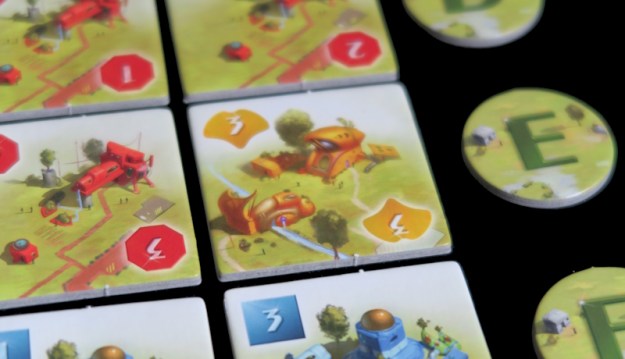
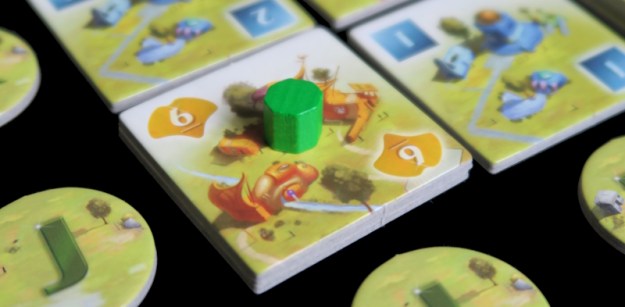
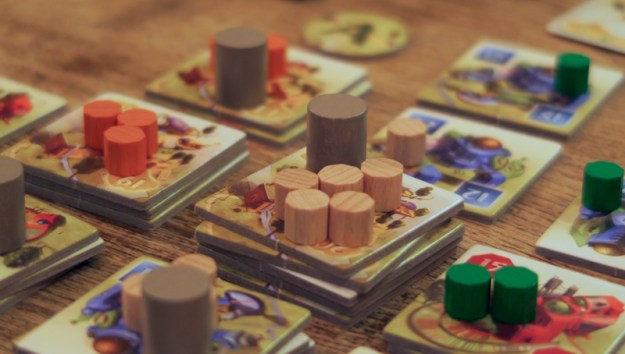
Blue and Pink were first to arrive, and, as they finished their pizza, others began to turn up too.  It was a slow start on a relatively quiet night, but eventually Blue Ivory, Black and Jade were settling down to play the “Feature Game“, Ginkopolis.  This is a medium weight tile-laying game with an area control element.  Blue explained that it was one of those games that had been through a phase of being very out of print and therefore inevitably in high demand, though now was much more available.  The game is set in 2212 where players are urban planners trying to building the eco-city, Ginkgopolis, though the theme is quite loose and in reality, it is much more more abstract that that.

Ginkgopolis
– Image by boardGOATS

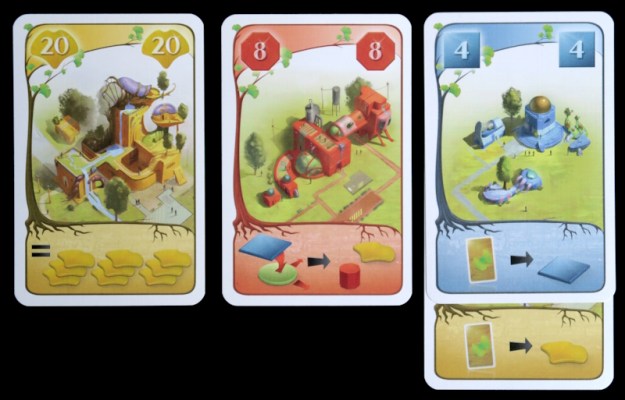
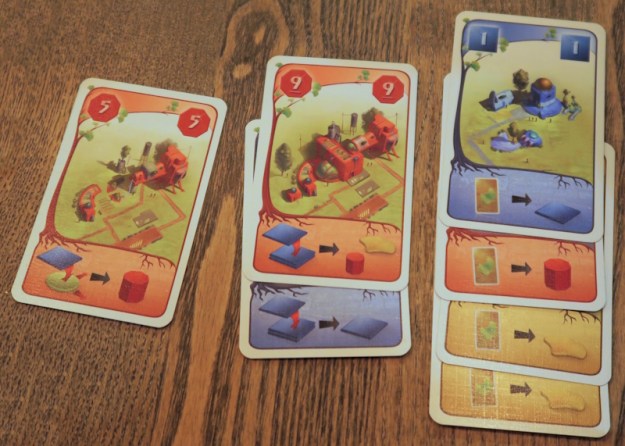
The game is card-driven, with players simultaneously choosing a card and any tiles they are going to play with it, and then, starting with the first player, taking it in turns to carry out one of three possible actions: Urbanise, Construct or Exploit.  There are two different sorts of cards in the game, Urbanisation cards which feature a letter, and Construction cards which come in three different colour suits, red, blue and orange, and are numbered one to twenty. When choosing either an Urbanise action or a Construct action, players additionally choose a Tile to play from their personal stash.  Urbanising involves placing a tile in the space matching the letter on their Urbanise card, adding a wooden Resource block in their colour to claim it.

Ginkgopolis
– Image by boardGOATS

There is a little upkeep, in that they move the Urbanisation letter marker to a space orthogonally adjacent to the Tile they placed and mark it with a grey cylinder.  As a reward for urbanising, players get to Activate all orthogonally adjacent buildings.  This is claiming a number of  Tiles, Resources or Ginkgo Points (a sort of currency used in the game), with the item dependent on the colour and the number received equal to the height of the Building activated.  Constructing is similar, except the Tile chosen is placed on top of another Tile, returning any Resources on the tile to their owner and claiming Ginkgo Points from the bank for each one.

Ginkgopolis
– Image by boardGOATS

In addition to this immediate reward, there are also costs:  if the Constructed Tile has a lower number than the tile it is built on, they must pay the difference in Ginkgo Points and if the colour is different, they must also pay one Resource to the general supply.  In addition to these potential costs, the active player must also place Resources from their stash on top of the newly expanded building to claim it (with the number equal to the height).  This can make Constructing expensive, though as the game progresses, they get Resources back as other players build on buildings they have Urbanised or Constructed.  Still, particularly early in the game, players can find themselves running out of supplies, in which case, they can Exploit.

Ginkgopolis
– Image by boardGOATS

Exploiting involves playing cards (without a tile) to gain Tiles, Resources, or Ginkgo Points.  How they Exploit depends on whether the card they are Exploiting is an Urbanisation card or a Construction card.  For Urbanisation cards, players just take either a Resource or a Tile from the supply, whereas for Construction cards, players Activate the building on the card to receive Tiles, Resources or Ginkgo Points equal to the height of the building. This is not the only way to get resources, however.  Once a player has carried out their chosen action, they either recycle the card (if they Urbanised or Exploited) or, if they Constructed, they keep it in front of them.  Each Construction card has an action as well as a number and a colour, and these are activated during the game, most after carrying out actions, with some providing end-game Points.

Ginkgopolis
– Image by boardGOATS

And scoring is where the game gets tricky.  The winner is the player with the most Ginkgo Points at the end of the game, but in addition to chips acquired during the game and end-game points from Construction cards, the majority of the points come from the area control element of the game.  The city is divided into districts with districts defined as areas containing at least two buildings of the same colour.  The player with the most Resources in the district wins control and takes Ginkgo Points equal to the total number of Resources in the district.  The player to take second gets Ginkgo Points equal to the number of their Resources in the district.  Ties are broken in favour of the player with the highest building.

Ginkgopolis
– Image by boardGOATS

There is quite a lot of critical upkeep in the game, but the most important it to remember to put a grey construction cylinder on buildings during Urbanisation and Construction.  This is because at the end of each turn, players top their hand back up to four cards drawn at random—when the draw deck is empty, however, the discard deck is recycled and topped up with cards that correspond to the newly constructed buildings.  Since cards that correspond to buildings are kept when the building is over-built, and everything else is recycled, the draw deck (and the cards in hand) comprise all the buildings currently visible, together with all the Urbanisation cards, and nothing else.

Ginkgopolis
– Image by boardGOATS

Getting this wrong, breaks the game spectacularly, as Blue and Ivory had found out on the one other occasion they played it (with Pink, during one of the sporadic meetings in the pub late in the Summer of 2020).  This time, they were aware of the importance of placing the grey markers and mostly managed to stay on top of that so everything went a bit smoother, allowing players to concentrate on the nuances of the game.  And there are lots of nuances.  For example, over-building can help a player to take control of a district, or, if they change its colour, break one up, but it also gives Resources to the previous owner.  Similarly, Urbanising expands the city, but provides a cheap way for other players to expand districts and perhaps muscle in.

Ginkgopolis
– Image by boardGOATS

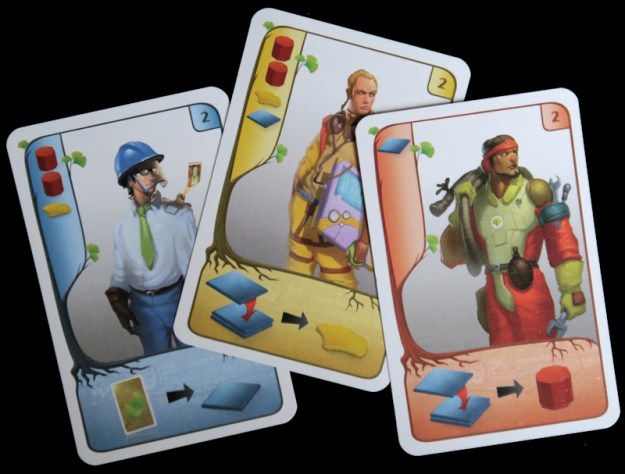
The game started with everyone feeling their way, trying to make the most of the Character cards they were dealt at the start of the game.  These give bonuses to players to get them going in the early stages of the game.  It is possible to draft these character cards, but the group began with the preconstructed sets:  Ivory got set one, Black got set six, Jade got set two and Blue got set five.  These give players a strategy steer in the early part of the game, for example, Blue and Black’s cards gave them two bonuses for Exploiting while Jade and Ivory both benefited twice for Constructing.  Quite early in the game, it became clear that there was one building towards the middle that was going to be quite critical in the area control battle and Blue, Black and then Ivory all over-built and tried to claim it for their own.

Ginkgopolis
– Image by boardGOATS

The game has the ability to feel very swingy, and lacking in control, and yet it is actually an extremely smart, tactical game—one clever tile placement can completely change the game by breaking up a district or joining two districts together and totally change the balance of power.  This game was no different in that regard, though it took a little time for everyone to really start to see its potential.  There were other elements of the game that players gradually came to appreciate.  For example, Black ran into the unexpected difficulty of running out of Resource markers, because he had a lot in the city.  This gave the others a problem—building over his buildings relieved that pressure, but because he had so many on the board, it was hard to avoid doing it.

Ginkgopolis
– Image by boardGOATS

Jade also had difficulties getting the tiles he wanted to match his cards, while Ivory had difficulties getting the cards he wanted (and was the only one to spend one of his refresh hand tokens, which cost him two points in the end-game scoring).  The game ebbed and flowed, and although it vastly exceeded its advertised forty-five minutes, it wasn’t long before the stack of tiles dwindled and triggered the end of the game.  At this point, players could choose whether to add tiles from their hand back into the game.  Jade was aghast at the idea having struggled to get tiles throughout, but Ivory had an enormous stack and put a few back into the supply to keep things going for another couple of rounds.

Ginkgopolis
– Image by boardGOATS

As the game drew to a close, the question was whether anyone would be able to make a move on the largest districts.  The highest building that had been long fought over now belonged to Ivory, but had been cut off, leaving it pointless, which left two large red and one large blue district as well as some smaller efforts.  Key was the number of Ginkgo points picked up during the game—everyone thought Ivory had a lot, but it turned out Black was the king of the Ginkgo tokens with a massive thirty-six. Blue was a little way behind him, but made up for this with her city scoring, which ultimately gave her victory with sixty-six points, nine more than Black in second who was well clear of Jade and Ivory who tied for third.

Ginkgopolis
– Image by boardGOATS

Meanwhile, on the next table, Purple, Green and Pink were deciding what to play while they waited for Pine who was running late.  Green commented that he didn’t want to play something new, so in the end the group settled on Splendor.  This is an old favourite, though one with poignant memories for most in the group as it was a favourite of Burgundy who sadly passed away eighteen months ago—it would have been his sixty-fifth birthday at the end of the month.  As always, with Burgundy in mind, the trio set the game up.  It is a very simple, tactical engine builder, where players take it in turns to either take chips from the supply, use chips to buy a face up card from the market or, occasionally, reserve a card.

Splendor
– Image by boardGOATS

Players win points for the higher value cards, or for collecting enough cards of specified colours to claim a Noble.  This time, Pink tried a strategy that concentrated on going for cheap cards with the primary aim of scoring for Nobles.  This had the benefit of giving him lots of cards which builds the engine quickly making other cards cheaper.  The strategy worked well, but not as well as Pink needed it to for him to beat Green who ended the game, with a lead of three points.  As Splendor came to a close, Pine rocked up, so the newly expanded, now quartet looked for something fairly light to play, and Pink suggested one of his favourites, For Sale.

For Sale
– Image by boardGOATS

As Pink described it, like football, For Sale is a game of two halves.  In the first half, players bid for properties which they then sell in the second half of the game.  This time, Purple became a bit of a tent specialist (with tents of various quality), which turned out not to work so well for her.  Pine ended up with the outside netty (one of the lowest value cards), but one that you are almost guaranteed not to loose money on.  Once again, however, the winner was Green with Pink taking his second second place.  So the question was, could anything upset that pattern?

For Sale
– Image by boardGOATS

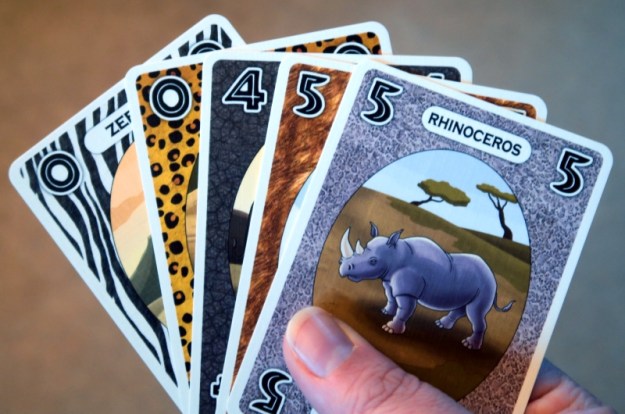
The group moved on to Botswana, a sort of set collection stock-holding card game that it is really hard to get your head round despite actually being very simple.  The five animal suites each have six cards, which are shuffled together and dealt out.  Players then play a card from their hand, and take any one of the animals on the table.  The round is over when any one of the five animals has the sixth card played, at which point players score points for each animal they have, equal to the final card played.  After three rounds, the player with the most points is the winner.

Botswana
– Image by boardGOATS

This time, all three rounds were remarkably even.  Purple was just one point behind green going into the final round, though Pink had some ground to make up if he was going to continue his run of second places.  In the end, Green made it three from three, and relatively poor final rounds from both Pink and Purple left Pine to take second with Purple just behind.  Green decided three was enough, and didn’t fancy tarnishing his winning streak, so headed off while Purple and Pink waited for their other halves to finish Ginkopolis, and looked round for a suitable filler.

Coloretto
– Image by boardGOATS

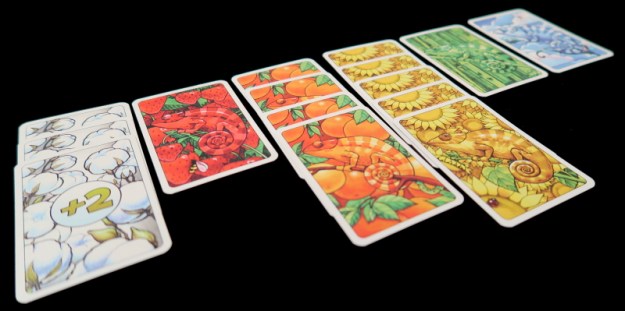
Coloretto is another old favourite, and one that plays really well with three.  A really simple set collecting game, on their turn, players either turn over a coloured chameleon card and place it on a truck, or take a truck.  At the end of the game (when the draw deck has been mostly depleted), players score points for each coloured set of cards.  In general, the larger sets score more, but only the largest three score positively, everything else gives negative scores.  For a bit of variety, the group used the scoring card from the Limit Cards/Extra Cards mini expansion (but without any of the other rules and cards).  This gives low scores for the small groups, but very high scores for the large sets.

Coloretto: The Extra Cards
– Image by
boardGOATS

Aside from a query about the Golden Joker (which like the normal multi-coloured Joker can be added to any set at the end of the game, but additionally gives an extra card drawn at random from the deck), there was no real need to revise the rules.  It was a good game, though Pink blotted his copy book with quite a lot of negative points and wasn’t able to improve on his two second places as a result.  The run-away winner was Purple though, who finished with forty-eight points, eight more than Pine in second place.  And with Ginkopolis coming to an end too, that was it for another week.

Coloretto
– Image by boardGOATS

Learning Outcome:  In some games, you have to start building right from the gink-go…

10th Movember 2020 (Online)

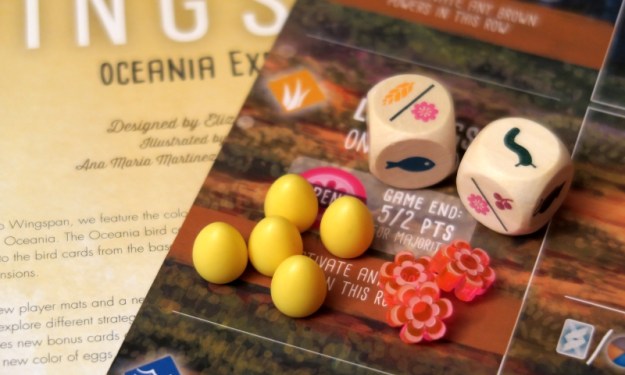
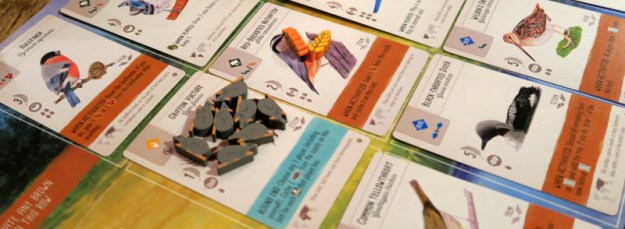
With Blue and Pink otherwise engaged, the early arrivals were left to talk amongst themselves to begin with.  Eventually, everyone joined the table talk and admired the new, very yellow arrival that was the Oceana Expansion for Wingspan.  Sadly it will likely be a while before it gets an outing with the group, but it gives us something to look forward to.

Wingspan: Oceania Expansion
– Image by boardGOATS

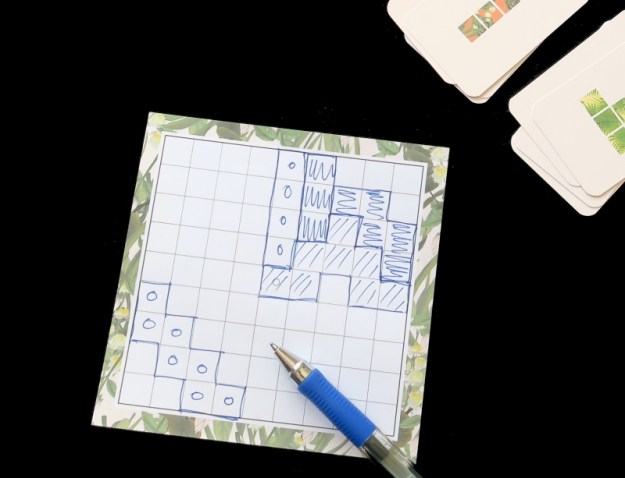
Once the yellow eggs had been put away, it was time to start the “Feature Game” which was to be HexRoller.  This is another of the “Roll and Write” style games and is a relatively recent release.  The game is quite simple in concept, though the scoring is quite involved and it is quite different to anything else we have played in this vein.  The idea is that a handful of dice are rolled and “binned” into according to value.  Players then choose two numbers rolled and write those numbers on their player board as many times as that number was rolled.

HexRoller
– Image by boardGOATS

This means if three and five are chosen and they appear once and twice respectively, the player will write three down once and five twice.  The game is played on a pre-printed sheet with a play area made of hexagons (because they are the bestagons, obviously).  Some of these have numbers written on them.  Once a player has chosen a number, they start writing in a hexagon next to a number already on the board, with every subsequent number written next to the previous, making a chain.

HexRoller
– Image by boardGOATS

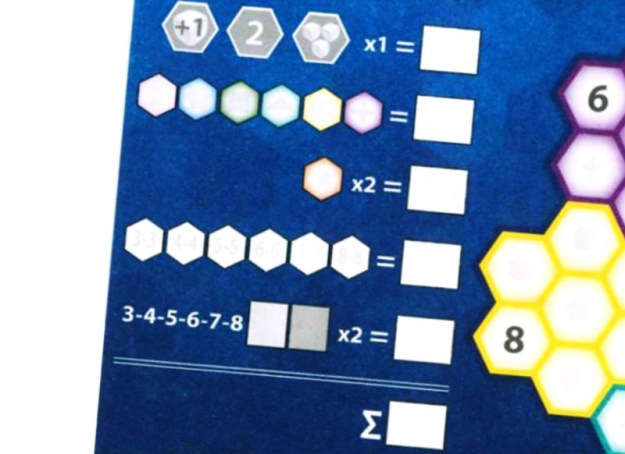
Once per turn, players can also use one of three special actions, each of which can only be used once per game.  These allow players to write one of their chosen numbers an extra time; write a two anywhere, and choose a third set of dice from the pool.  At the end of the game players score from a smorgasbord of opportunities.  There are points for filling all seven hexagons in one of the coloured groups; for filling all the orange hexes in the central area; for connecting pairs of pre-printed numbers, and any left over, unused special actions.

HexRoller
– Image by boardGOATS

Additionally, every round a player picks two numbers and one is written in a box in the top row in the bottom left corner with the other written in the bottom row.  At the end of the game, a “straight” starting from three, score points equating to the highest number in the straight.  In other words, a set of two threes, a five, a four, a six, and a couple of eights would score six points.

HexRoller
– Image by boardGOATS

Explained, the game sounds extremely complex, however the scoring is outlined on the sheet and in practice, it is actually quite easy to play, though challenging to play well.  That said, it is very different to any of the other games we’ve played and nobody really had much idea how it would pan out.  There are two different boards and with different layouts.  We started with the slightly more challenging, “seven dice” board, but only realised we were using eight dice after we’d already started, and that probably made it quite a bit easier.

HexRoller
– Image by boardGOATS

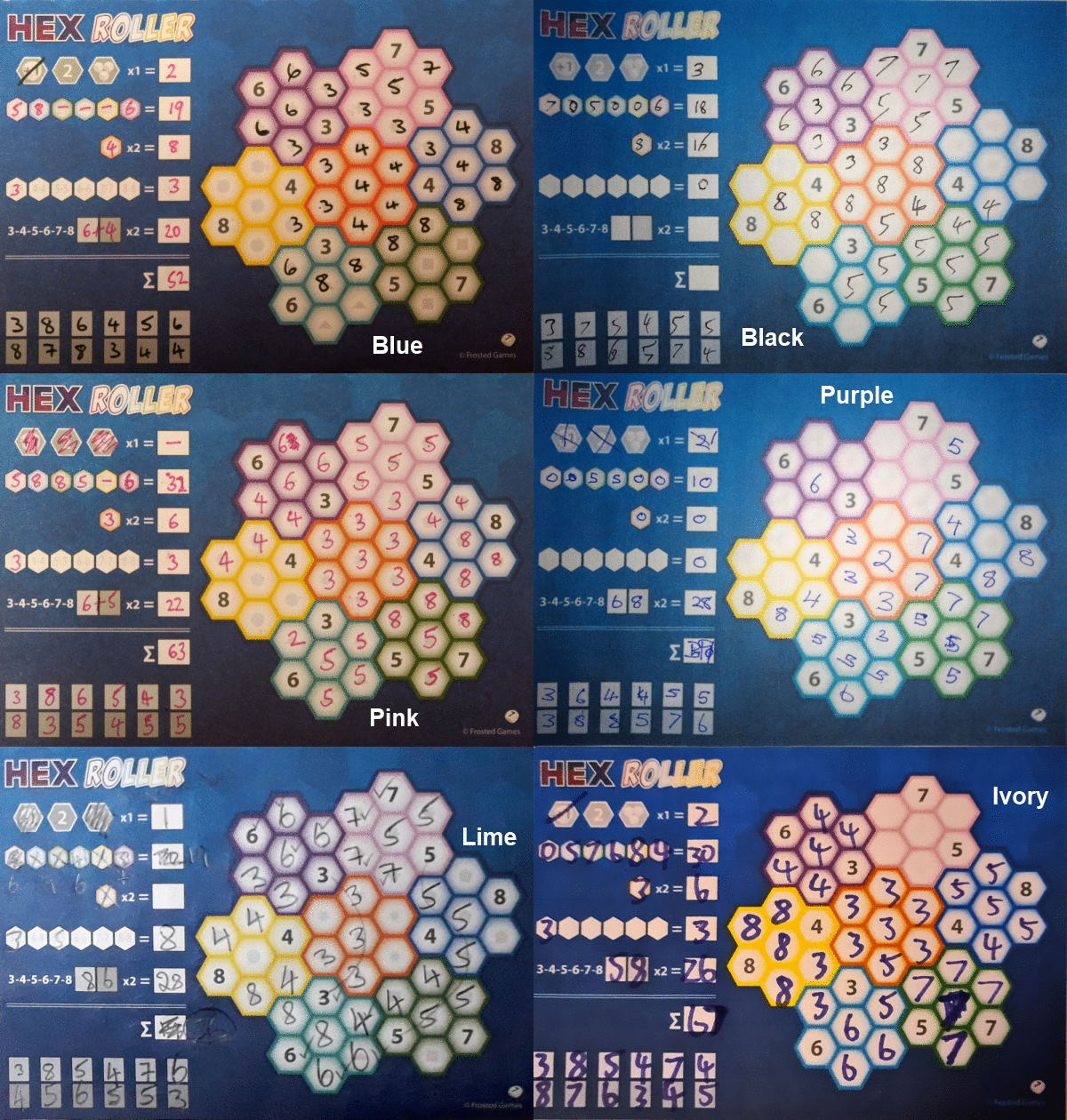
With only seven rounds, the game rocked along quite quickly and was over in about twenty-five minutes.  Some people did better than others, but it was tight at the top with Green and Ivory tied for first place with sixty-seven and Burgundy just two points behind.  Everyone had really enjoyed it though, and we were all very keen to play the second, “Eight Dice” layout.  This layout is nominally the easier of the two, though we didn’t realise that before we started otherwise we’d have played it first.

HexRoller
– Image by boardGOATS

It has a larger central area, though, and is played over one extra round.  Some of the scoring is also very slightly different, which some people didn’t notice until the end when they came to calculating their score which led to quite a lot of recalculations.  Burgundy was third again, and Blue took second with fifty-seven.  Although Pink was insistent that because he was unable use a single die in the final round, he had a “moral score” of seventy-three his total of fifty stands.  That left Ivory the winner for the second time with a score of sixty-one.

HexRoller
– Image by boardGOATS

HexRoller is a really quick little game, and even playing it twice, there was still time for something else.  As we had struggled a little with Tiny Towns last time, we had planned to give it another go, this time with a new set of buildings.  The idea of the game is clever but quite simple:  players place resources on the spaces on their four-by-four town grid, and then, when the have the right resources in the the correct arrangement, they can replace them with a building.

Tiny Towns
– Image by boardGOATS

Different buildings are built from different combinations of resources in different arrangements and, ultimately give different numbers of points.  We play using the Town Hall Variant where two resources are drawn at random, and then players choose their own for every third.  So, the key to the game is careful planning, but also  keeping options open in case the required resources don’t come up.  And luck also helps of course.

Tiny Towns
– Image by boardGOATS

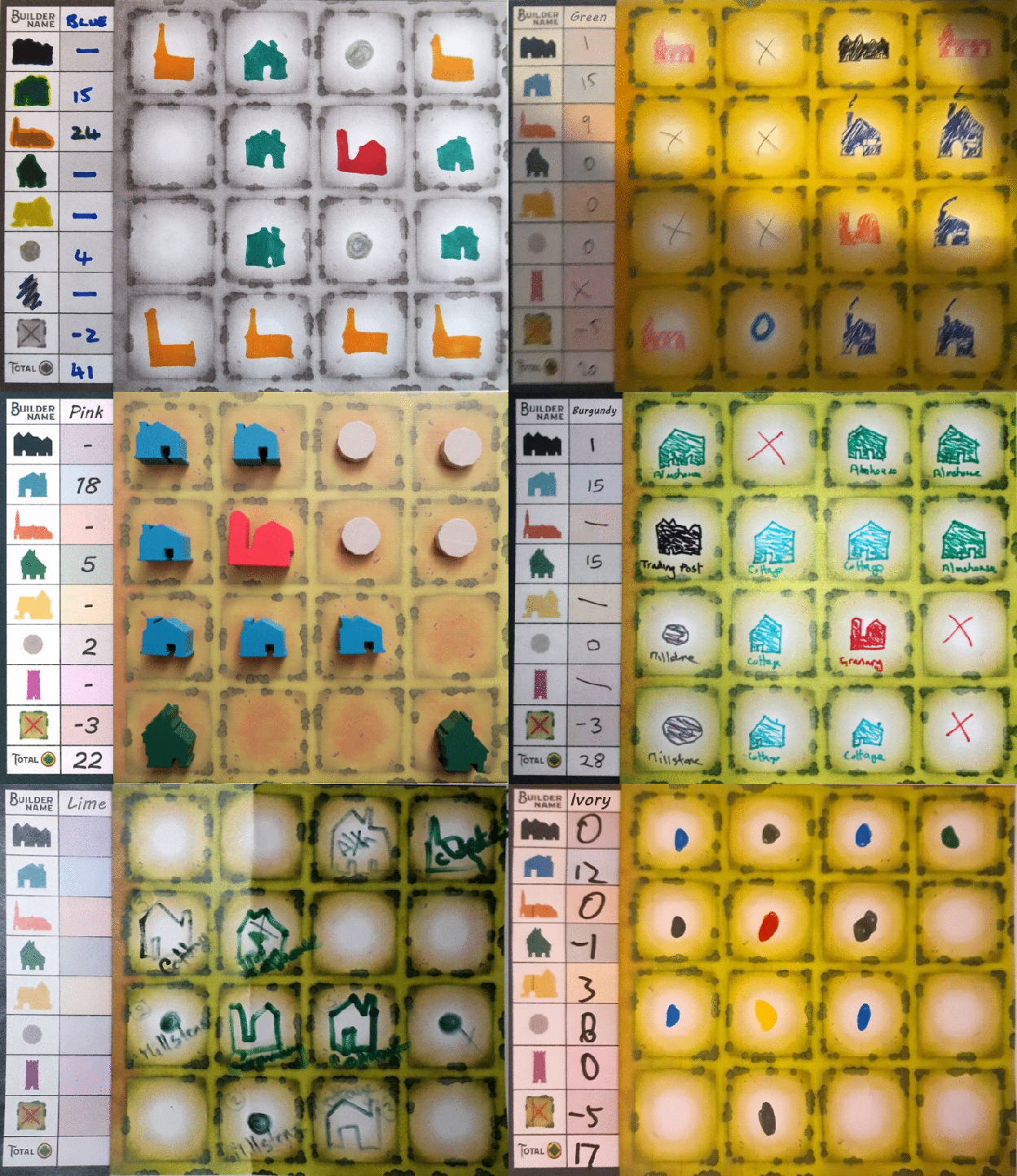
This time we drew buildings from the alternative cards adding the Granary, Millstone, Bakery, Trading Post, Cloister and Almshouse to the Cottage.  These change the game considerably.  For example, the Granary feeds eight cottages (rather than the four of the Farm we used last time), but they must be in the eight surrounding spaces.  Similarly, the Millstone is worth two points if next to a red or yellow building (in this case a Granary and the Bakery), rather than a single point for each adjacent cottage.  The resources always take up more space than the buildings though and if players aren’t careful they can easily end up building on a space that makes it impossible to work with what’s left.

Tiny Towns
– Image by boardGOATS

Several players including Green, Blue and Pink picked up on the fact that the Cloister had the potential to be highly lucrative, scoring one point for each cloister in a corner.  Blue explained (several times) that this meant that two Cloisters both in corners would score two points each, whereas if one were in a corner and the other were not they would score one point each.  Pink decided that they were too difficult to build to get the most from them as they required four different resources, but Purple, Blue, Green and Lime were braver and decided to give it a go.

Tiny Towns
– Image by boardGOATS

Meanwhile, Pink and Burgundy went heavily for Almshouses.  The larger the number of these, the more points they score, but while an odd number of these scores positively, an even number scores negatively.  So this strategy was not without risk, although as players are not obliged to build buildings, they could always wait, and only build when they know they have a second ready to go.

Tiny Towns
– Image by boardGOATS

Lime was the first to be unable to do anything.  One of the down sides of playing games like this remotely is that players can’t watch what other players are doing, so as players dropped out, nobody else knew how they had done until the scores started to come in.  This time there was quite a spread with scores covering a range of nearly fifty points from minus fifteen upwards.  Burgundy had managed to avoid the pitfalls of the Almshouse and finished with twenty-eight points.

Tiny Towns
– Image by boardGOATS

Blue, however, had made the Cloister strategy work building a total of six, including one in each corner.  It was at this point that Green realised he could have built another two Cloisters, but had thought they wouldn’t score.  Worse, he hadn’t realised the empty spaces would score negatively, leaving him some eight points worse off.  He insisted that he wouldn’t concede, that there should be a recount as the rules hadn’t been clear, and that a lawsuit would clear it up…

Tiny Towns
– Image by boardGOATS

As in Pennsylvania, however, nobody listened to the litigant.  It was getting late though, so Lime, Lilac and Ivory left everyone else to play For Sale.  This is a great game for six players and the rendering of Board Game Arena is really good, making it really quick and fun to play.  The game itself comes in two parts:  buying properties and then selling them—the player who finishes with the most money wins.

For Sale
– Image by boardGOATS

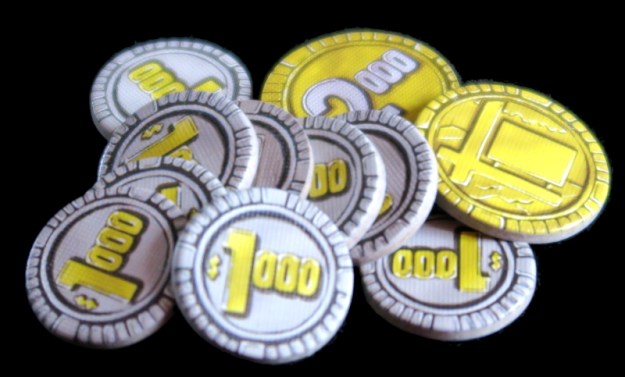
Everyone starts with $14,000 dollars and the bid must increase by at least $1,000 each time with players who pass taking the lowest numbered property available and getting half their stake returned.  There are two ways to play this, with the money returned rounded up or down – this time we chose to give every player the maximum amount of money with their returns rounded up.

For Sale
– Image by boardGOATS

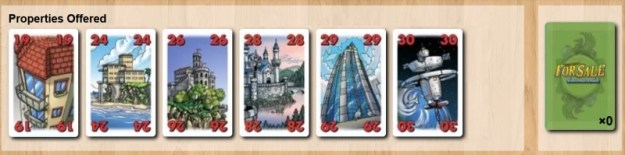
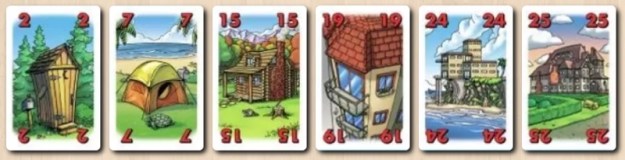
This time, all the high cards came out in the final round.  This meant Burgundy paid just $1,000 for his castle (number twenty-eight) and Purple paid just $2,000 for the sky-scraper (number twenty-nine), although Green still paid $7,000 for the most valuable property (the space station).  As a result, most people had acquired some nice properties for a very good price.

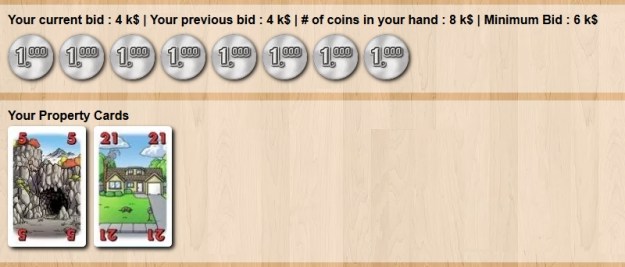
For Sale on Board Game Arena
– Image by boardGOATS from boardgamearena.com

It was a three-way tie between Black, Burgundy and Green for the player who managed to sell their properties for the most money, with all three taking $48,000.  However, it is the total, including any money left from the starting funds.  In this, Pink and Blue had only spent $3,000 so had $11,000 left.  This enabled Blue to just beat Burgundy into second place and take victory with $53,000.  At this point, Pine, who had been unable to join in earlier as he was staying with his poorly mother.  Inevitably, the game of choice with seven, was 6 Nimmt!

6 Nimmt!
– Image by boardGOATS

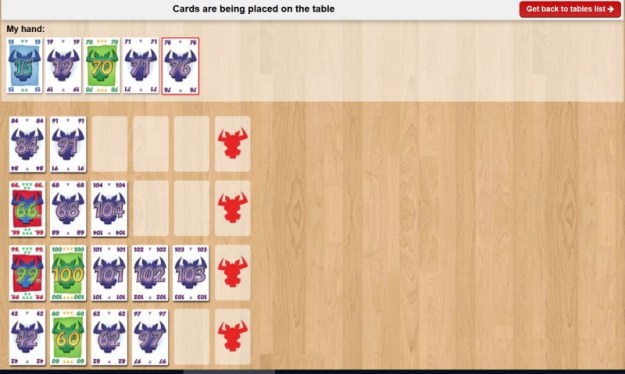
6 Nimmt! is one of the group’s favourite games, and we really enjoy the additional madness that the “Professional Variant” gives.  In the original game, players simultaneously choose a card from their hand and then, starting with the lowest value card, cards are added in order to one of the four rows of cards on the table.  Each card is added to the row that finishes with the highest number that is lower than the number on the card.  Placing the sixth card instead causes the player to take the five cards into their scoring pile.

6 Nimmt!
– Image by boardGOATS

The “Professional Variant” allows players to add cards to the other end of the rows, as long as the difference is smaller.  This has the effect of making otherwise be “safe” plays, decidedly “unsafe”, and makes low value cards much more interesting to play.  It can have far more catastrophic effects on the game though, and this time was one of those games.

6 Nimmt! on Board Game Arena
– Image by boardGOATS from boardgamearena.com

Purple was the first to pick up cards, immediately followed by Green.  It wasn’t long before others joined in the race to the bottom.  Purple was leading the pack, though when Burgundy picked up seventeen nimmts, shortly followed by another fifteen and several other smaller totals, he overtook her, finishing with a magnificent minus forty-two!  The winner was largely incidental, but was Blue, who had only picked up fifteen in the whole game some twenty less than Pine, who always does well in this game, in second place.

6 Nimmt! on Board Game Arena
– Image by boardGOATS from boardgamearena.com

With that over, Green and Pink signed off, leaving five to continue, and the game of choice was Coloretto.  This is a very simple set collecting game, that we played from time to time when we were at the Jockey, but has become one of our staples this year.  The game is so simple and plays very quickly: players take a card from the deck and add it to a truck, or they take a truck and sit out until the end of the round.

Coloretto
– Image by boardGOATS

Players score points for their sets, with the three most lucrative sets scoring positively and any others scoring negatively.  Last time we played, we used the “Difficult” scoring, but that hadn’t been as interesting as, say, the “Professional Variant” for 6 Nimmt!, so this time  we used the standard scoring, according to the Triangular Number Series.

Coloretto
– Image by boardGOATS

With everyone very familiar with the game, it is often quite close and this was one of those games.  Indeed Pine and Black tied for second place with twenty-five points, but were beaten by Burgundy who finished just two points clear.  There was just time for one more game, and Sushi Go! has become one of our recent favourites in such circumstances, as it plays very quickly and the rendering on Board Game Arena is really good, though it would be really nice if they could add some of the extra options available in Sushi Go Party!.

Sushi Go!
– Image by boardGOATS

As it is, we played with the Soy Sauce mini expansion.  The game is very simple and we find that a little bit of Soy does add a little extra flavour.  The game is one of card drafting and set collecting, with players choosing one card from their hand to keep, passing the rest on.  Some cards score for sets of two or three (Tempura and Sashimi), while the Nigiri score more if played after Wasabi for example.  Soy goes well with everything, so scores if the player also has the most variety on their plate at the end of the round.

Sushi Go! on Board Game Arena
– Image by boardGOATS from boardgamearena.com

The game changers Maki Rolls and the Puddings which give points for the player with the most at the end of the round and game respectively.  The Puddings can be the real game-changers though as the player with the most gets six points and the player with the fewest loses six points.  In a close game that can make all the difference.

Sushi Go! on Board Game Arena
– Image by boardGOATS from
boardgamearena.com

This time, Blue and Pine took an early lead at the end of the first round while the others built up their Pudding supply for the end of the game.  Black took the lead after the second round though.  Burgundy put in a storming final round taking the six points for the most desserts, but with a three-way tie for the fewest, the negative points were split between Blue, Pine and Black.  Burgundy didn’t quite catch the leaders though, and he finished two points behind Pine and Black, who tied for first place.  And, well fed, it was time for bed.

Sushi Go! on Board Game Arena
– Image by boardGOATS from
boardgamearena.com

Learning Outcome:  Listening to the rules explanation usually gets you more points.

1st September 2020 (Online)

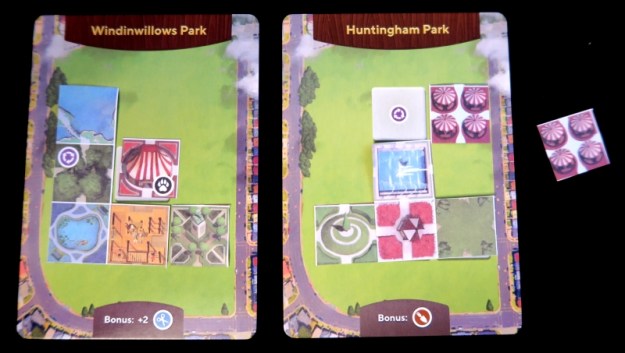
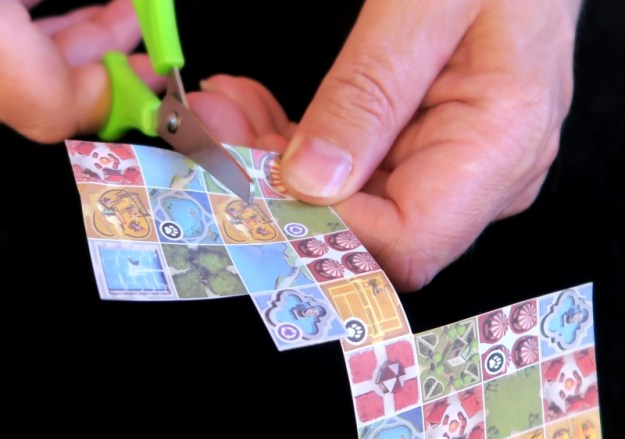
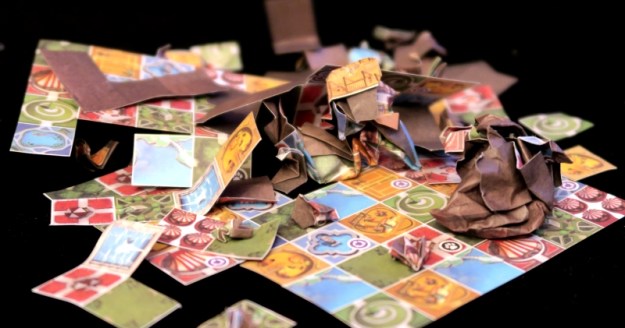
This week, the evening started with Purple and the “Silent Black” sharing their ice creams, and, as people started joining the meeting, they began preparing for the evening’s “Feature Game“.  This was to be ClipCut Parks.  This is a variant on the the recent “Roll and Write” style games that have been so successful when played remotely.  Like Second Chance and Cartographers, this is a Tetris-style game, but this time, instead of pens, players use scissors.  The idea of the game is that players have a sheet of paper which they cut pieces off, matching the shape, colour and any special features on their park cards.

ClipCut Parks
– Image by boardGOATS

The game comes with a pad of printed paper sheets, a deck of cards, one special red die, and four pairs of scissors.  Players start with two cards each, one paper sheet and a pair of scissors.  On their turn they roll the special die which tells everyone how many cuts they must make and and of what length.  Any pieces that are separated from their main sheet must be placed on one of that player’s pair of park cards, taking care to match any colours and symbols on the card.  When a player completes a park card, they get any bonuses associated with it and draw a new card from the deck.  Any pieces that cannot be placed, are screwed up and set aside to be used as a tie-breaker.  The first player to finish five parks is the winner

ClipCut Parks
– Image by boardGOATS

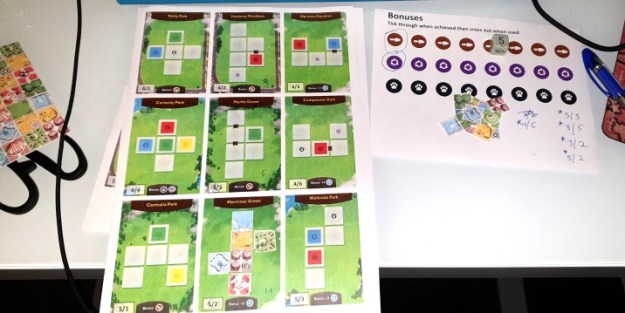
Clearly deck of Park cards was going to be a problem when playing remotely, so a few minor modifications were made to make the game work in our current circumstances.  Each player had a print-out including a numbered array of cards and one of each of the four different sheets (also numbered).  They then used a six-sided die to choose which sheet they were going to use and which Park cards they were going to start with.  So, as people arrived, this was explained and players began rolling dice and cutting out their chosen sheet.

ClipCut Parks
– Image by boardGOATS

Mulberry complained that the die that Blue had dropped round that morning appeared to be loaded as it kept giving her sixes, but otherwise, everyone had their starting pieces ready shortly after 8pm and were ready to start.  Once the rules had been explained, Pink began rolling the special red die and everyone else started scratching their heads.  Those with good spacial awareness are inevitably at an advantage in this game, and not cutting any fingers off helps too of course.

ClipCut Parks
– Image by boardGOATS

Amidst the quiet concentration, there were a lot of distressed comments at unhelpful die rolls together with plenty of moaning and general complaining as people struggled to make optimum cuts to give pieces of a useable size and shape.  Everyone seemed to struggle to get recycling and wildlife symbols where they needed them.  It wasn’t long before people were calling out as they completed their first parks though, and then, people were finishing their second and third, while some others were still struggling to complete their first Parks.

ClipCut Parks
– Image by Mulberry

Mulberry was quick to get her nose out in front, although others’ careful planning did help to reduce the deficit.  Pink, Green, Ivory and the Silent One were all close to finishing with some just one snip away when Mulberry called her fifth completed Park all too soon, and to the complete disbelief of some who were still a long way behind.  All in all, ClipCut Parks had a very different feel to the other games we’ve played, though it worked just as well.  Some people clearly felt they were just getting the hang of it when it ended, and in general, although everyone seemed happy to give it another go, the consensus was “some other time”.

ClipCut Parks
– Image by boardGOATS

Lime had had a really rough day, so took his leave and Mulberry headed off too.  Everyone else was keen to play something else though, so since Second Chance had just missed out last time, we decided rectify that.  This is another Tetrissy game, but this time with colouring in.  It is very simple:  players start with a nine-by-nine grid and a starting shape which they draw on their grid.  Then, two cards from a deck are turned over and everyone draws one of the two shapes anywhere on their grid.  If they can’t use either shape, then another card is turned over, just for them, and if they can’t use that either, they are eliminated.

Second Chance
– Image by boardGOATS

This time, a lot of the small pieces came out early.  This made things difficult for everyone because these pieces are best used for filling in the gaps left by the larger pieces.  As a result, there was a lot of moaning and then Ivory was the first to need a second chance.  Sadly, it was unhelpful and after the bonus for finishing first, he was knocked out leaving him unable to improve on his nineteen points.  Burgundy and Pine soon followed and eventually the game boiled down to a battle between Purple and Blue.

Second Chance
– Image by boardGOATS

Avoiding elimination is obviously helpful, but it isn’t everything:  the winner is the the player with the fewest empty spaces.  Purple and Pine finished with what might normally be a winning score of ten, however, somehow, the pieces had aligned for Blue and she finished with the remarkably low score of three to take victory.

Second Chance
– Image by boardGOATS

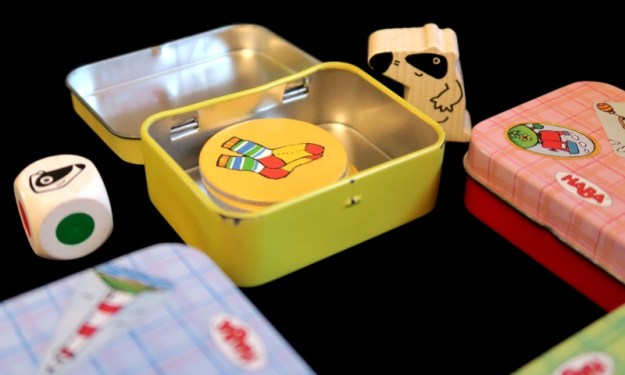
Pink was keen to play Crafty Badger, a recent arrival delivered from the US by Mulberry.  It has a very cute badger, but was ruled out for several reasons.  Firstly, the game is a memory game suitable for anyone above the age of three, but it wouldn’t play terribly well over Microsoft Teams.  Secondly, even with Ivory taking his leave, there were six players and the game only played four.  So, instead, we decided to play For Sale.

Crafty Badger
– Image by boardGOATS

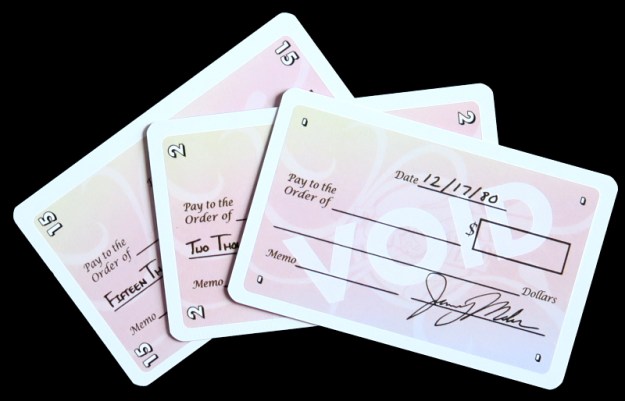
For Sale is a fairly simple game that we’ve played a lot this year, initially in real life, but more recently, online through Board Game Arena.  The idea is that players first buy property cards through auction, then sell them trying to make as much profit as possible.  The cards are numbered one to thirty, with the higher the number the more desirable the property.  Once the properties have all been auctioned, fixed value cheques are revealed and players choose which property they are going to sell—the cheques are handed out with the largest going to the most desirable, and everyone trying to avoid the worthless void.

For Sale
– Image by boardGOATS

Players who pass during the auction stage, take the lowest available card and get half their bid returned, while the player who wins the auction pays their full bid.  Until last time, we have played by the more recent, Überplay rules where the returned money is rounded down.  Last time, however, we played using the original Ravensburger/Schmid, rules where the money returned was rounded up.  This gave everyone a little bit more money to spend and made passing early a little bit more lucrative.

For Sale
– Image by boardGOATS

Burgundy usually does really well in For Sale, but last time we played it, he had a really bad time which we partly blamed on this change to the rules. So this time, to give everyone else a chance again, we decided to stick with the new rules.  Despite this, normal service was resumed and although he ran out of money during the buying phase, Burgundy managed to pick up some very desirable properties including the most valuable, the space station.

For Sale
– Image by boardGOATS

The game isn’t only about buying; timing when selling is very important too.  So, the fact that Burgundy managed to take the largest cheque in three of the five rounds was partly the result of having good properties but also the result of playing them at the right time.  Either way, winning more than half the selling rounds was the main reason he ultimately finished with fifty-four points, four more than Black who took second place ahead of Pink in third.

For Sale on Board Game Arena
– Image by boardGOATS from boardgamearena.com

The night was still young and there was time for our now almost inevitable couple of rounds of 6 Nimmt!.  We now almost exclusively play with the crazy “Professional Variant”, which adds a whole new level of madness:  players simultaneously chose a card to play, then starting with the card with the lowest face value they add them to one of the four rows.  What makes this variant special is that the card is added to either end of the rows, whichever gives the smallest difference.

6 Nimmt!
– Image by boardGOATS

This adds a new layer of complexity, and, importantly, means that cards with low numbers are much more useful and can even be used to stymie others.  It also means that rows with the highest value cards are no-longer “dead” and can eventually get picked up when someone’s plans go awry.  Some say the game is pure luck, but there is definitely more to it than that, and with the “Professional Variant”, even more so.  The fact that some players generally do well and others generally do not so well, is proof of this.

6 Nimmt!
– Image by boardGOATS

Although he always claims it’s not the case, Pine is one who usually does well at 6 Nimmt!; while wins are definitely hard to come by, it is rare that he isn’t in the top three.  Purple, on the other hand, is often a bit of a card magnet.  This time she was first to pick up, and second.  In fact she was only saved from three in a row by Blue who had a bit of a nightmare too this time.  Inevitably perhaps, Purple triggered the end of a tough game in which Black ran out the winner with just seventeen.

6 Nimmt! on Board Game Arena
– Image by boardGOATS
from boardgamearena.com

Once is rarely enough with 6 Nimmt!, and a rematch is so east to set up on Board Game Arena.  This time, Black went from hero to zero, easily winning the race to the bottom and finishing with a spectacular minus fourteen.  Blue and Pink went the other way, with Pink remaining almost unscathed, finishing with sixty-one and Blue taking second place.  There was a little bit of chatter, but everyone was tired, so it was a (relatively) early finish.

6 Nimmt! on Board Game Arena
– Image by boardGOATS
from boardgamearena.com

Learning Outcome:  All public parks should have wildlife and recycling facilities.

18th August 2020 (Online)

The evening started with a bit of chit-chat about happenings in the village and the big hole in the A417 which had a large number of Thames Water employees staring into it and had closed the road to Wantage.  Since nobody is travelling very far to games night these days, nobody was inconvenienced.  Every cloud…  Although nobody was inconvenienced by the road closure, that didn’t mean nobody had been travelling: Green and his family all called in from Aviemore and shared their picture of “little Nessy” and their plans to visit her big sister the following day.

Little Nessie
– Image by Green

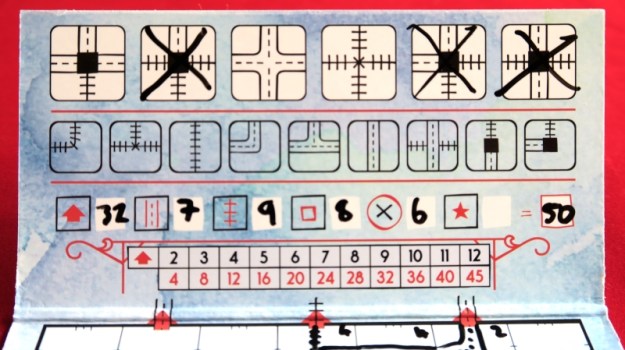
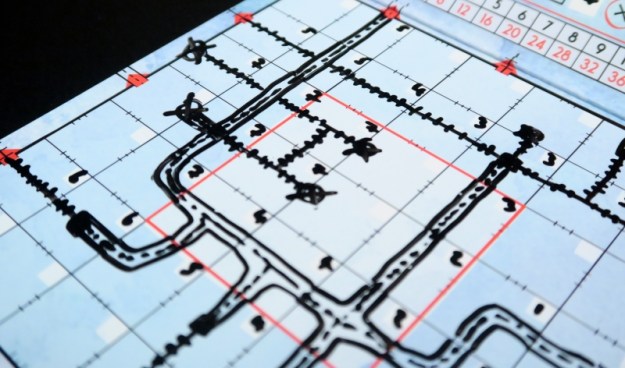
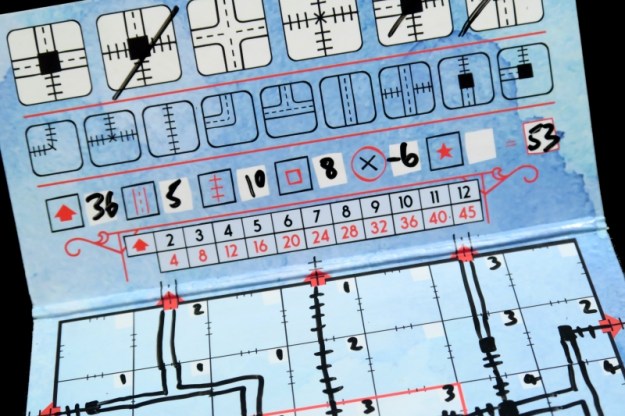
While Mulberry (now recovered from her jet-lag) encouraged her computer to play ball, Green “shared” a glass of whisky with everyone and people reminisced about a certain New Year Party and a particular bottle of the “finest” Bavarian whisky.  Eventually, we finally started the “Feature Game“, Railroad Ink: Deep Blue Edition.  We’ve found “Roll and Write” style games work really well under the current constraints, so we thought we’d try another one.  Rather than a communal colouring fest like Second Chance or Cartographers, in this game players are planning a road and rail network where players score points for connecting, generating a long road and a long track, and using the middle of their board, but lose points for “hanging ends”.

Railroad Ink: Deep Blue Edition
– Image by boardGOATS

The idea is very simple:  each round, all the dice are rolled and everyone adds all of the features to their map.  Three of the dice feature roads and rails (straight sections, bends and T-junctions) while one features interchange stations (straight and on a bend) and an flyover.  There are seven rounds and everyone scores their map once at the end.  The game comes with a couple of expansions, but as this was the first try for most people, this time we stuck to the base game with just the four white dice.

Railroad Ink: Deep Blue Edition
– Image by boardGOATS

When players add features they must “grow” their network from one (or more) of the entrances to the map and they make notes of the round in the corner of each square to try to avoid confusion. A continuous road, railway line or network is not interrupted by stations, but a rail and a road that cross at a flyover are not connected.  In addition to the seven rolls of four dice that everyone must add to their board, players may, optionally, also add special cross-roads to their map, given in white on the print-outs above the play areas.  A maximum of one per round can be added, up to a total of three during the game.

Railroad Ink: Deep Blue Edition
– Image by boardGOATS

At the end of the round players score points for several things.  Firstly, they score points for each separate network they have built, with networks scoring points for the more exits they are connected to according to a table.  Points are then scored for each players’ longest stretch of road and longest section of rail, taking one point per segment.  Next, players get bonus points for each square they’ve filled in the centre of their board.  Finally, players lose points for each “hanging end” i.e. ends that do not connect correctly.

Railroad Ink: Deep Blue Edition
– Image by boardGOATS

Pink rolled and then the questions and clarifications started.  Eventually though, everyone was happy, or at least happy enough and had scribbled things on their board.  Pink and Blue showed their boards to help explain and then Pink rolled for the next round.  This inevitably led to more clarifications, before Pink could roll again.  And so it continued.  Everyone seemed to have got the hang of what they were doing, and by this time everyone was lamenting the lack of junctions and blaming Pink for his poor rolling, while Pine and Green were complaining about their “Hanging Ends”.

Railroad Ink: Deep Blue Edition
– Image by boardGOATS

Just before the fifth round, Pink reminded everyone about their special spaces, saying that if they wanted to use all three and hadn’t used any yet, they would need to use one per round from this point forward.  This distressed Mulberry as she couldn’t find a way to use any of them without messing things up.  It took a while for everyone else to realise her plight and point out that it was a good idea to use them if you could, but they were optional.

Railroad Ink: Deep Blue Edition
– Image by boardGOATS

Before long, everyone was adding up their scores and checking what was and wasn’t valid.  It was only then that Green realised that he’d connected roads to some of his rail entrances and rails to some of his road entrances.  He tried to say that it hadn’t been clear at the start, but as everyone else had managed to get it right, nobody was feeling very charitable (it was Green, after-all).  So his score of forty-six was duly reduced to twenty-one.

Railroad Ink: Deep Blue Edition
– Image by boardGOATS

It was quite close at the front with Blue, Ivory and Black (now known as “The Silent One”) all vying for second place, but Burgundy just took the runner-up position.  Pink, however, was a few points in front and finished with a fine fifty-three.  Although Pine had really enjoyed it and some of the others were happy to play again, there were some who had found it very challenging and wanted a change.  Lime took his leave as he’d had a rough week.  Mulberry didn’t have any other print-outs, so being the brave millennial that she is, she said she would edit the pdf on her tablet using a stylus.

Noch Mal!
– Image by Mulberry

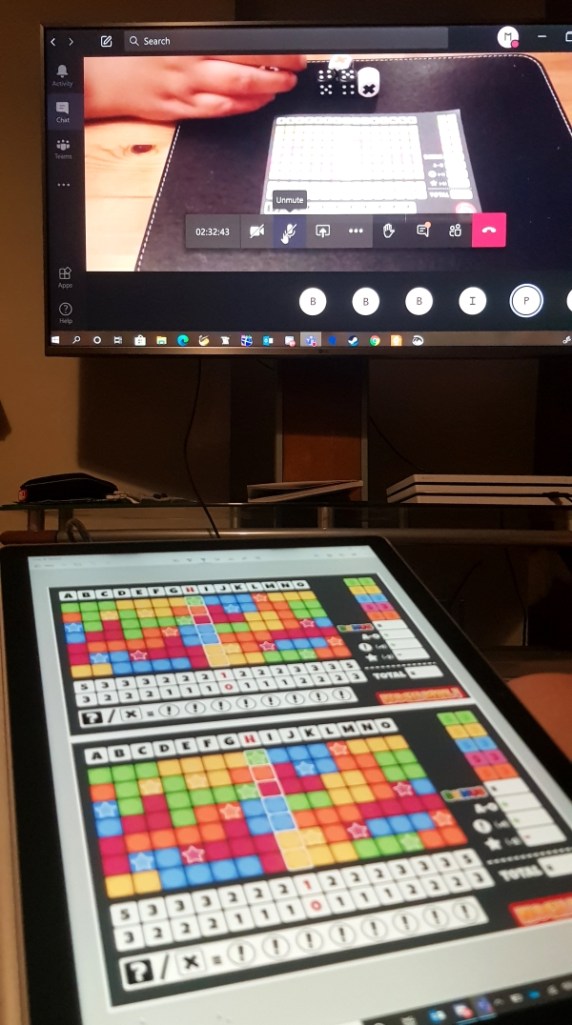
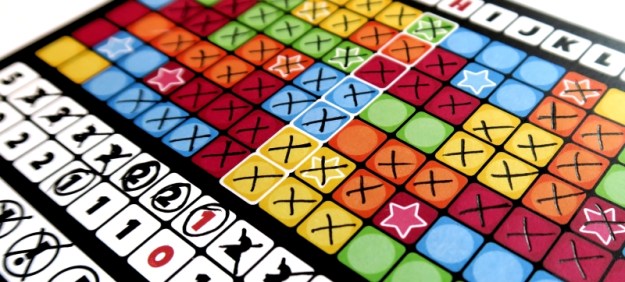
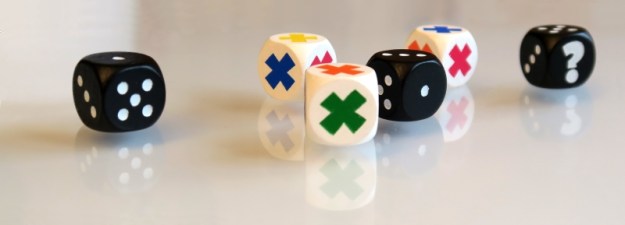
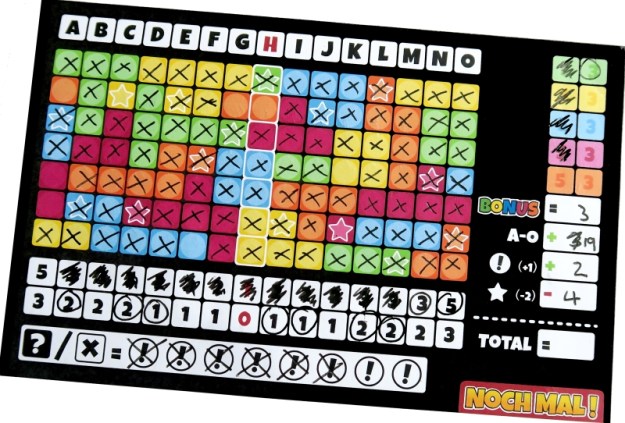
Although opinions had hitherto been divided about what to play, Noch Mal! (aka Encore!) would likely be easier for her than Second Chance, so that decided it.  Noch Mal! has become known as “Board Gamers’ Bingo” by some members of the group, and certainly it has a bit of a feel of that about it.  Three colour and three number dice are rolled and the active player chooses one of each and crosses off the number of squares in that colour.  Everyone else chooses from the colours and numbers left.  The catch is that players must cross off exactly that right number of that colour, they must be in a continuous block and adjacent to something already crossed off in the starting column.

Noch Mal!
– Image by boardGOATS

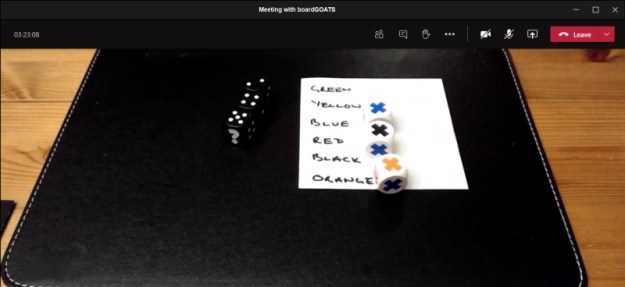
Points are scored during the game for completed columns and crossing off all of one colour with the game ending when one player crosses off all of their second colour.  The first thing we noticed was that red and orange looked the same and yellow was nearly invisible on screen.  So, after Pink threatened to rearrange the furniture and crawl under the sofa to get to the plug so he could move the light, Blue took the easy option and wrote the colours on a bit of paper to act as labels and the game began.

Noch Mal!
– Image by boardGOATS

For those that hadn’t played before, and even those that had, Ivory was startlingly quick to be the first to complete a column, even more so given that it was almost as far to the right as he could go.  After that it was a gentle trickle as players called out that they’d finished columns.  Before long, Green called that he’d finished the first colour, appropriately enough, green.

Noch Mal!
– Image by boardGOATS

All the columns were completed and others started to finish colours and everyone knew the end was nigh when Green took his second colour and with it ended the game.  As players began to call out their totals, Mulberry was completely aghast that people had actually managed to score points since she’d finished with minus two.  She wasn’t alone with a low score and everyone else tried to reassure her that they’d all been there – the first time the group played, three players finished with negative points and the average score was one!

Noch Mal!
– Image by boardGOATS

This time Green’s father who had joined in from Scotland, top scored with nineteen, but Green felt he hadn’t quite been playing right.  It was close at the top with Ivory finishing with ten, Pine with twelve and Blue with thirteen.  The winners were Green and The Silent One, tied on fourteen points.  With that, the Scottish Connection went to bed as they had an early start in the morning for their Nessy hunt.  Ivory and Mulberry also took their leave, leaving six to play on.  Playing games on Board Game Arena is just that bit easier and enables a wider variety of games so everyone moved there.

"Tomato" Whisky
– Image by boardGOATS

Pink is very fond of For Sale, so he suggested that, and, as it is a very quick and relatively easy game, everyone else quickly concurred.  This game is played in two halves, buying and then selling.  In the first half, in each round enough cards are revealed for one per player.  Players then bid to stay in, taking the lowest value card when they pass.  Once all thirty property cards have been auctioned off, players sell them.  In this phase, in each round, cheques are revealed and players choose one of their properties to sell.  The cheques are then shared out with the highest value cheque going to the player who sold the most desirable (highest numbered) property.  The wealthiest player at the end is the winner.

For Sale
– Image by boardGOATS

One of the key rules that makes the auctions interesting is that players who pass, get half their bid returned, while the player who wins the auction pays their full bid.  In the original Ravensburger/Schmid editions, where a bid was an odd value, the money returned was rounded up.  However, in real life, we play with the more recent, Überplay version where the returned money is rounded down, so this is the way we play online too.  For a bit of variety, this time we decided to play with the original rule, which would give everyone a little bit more money to spend and make passing early a little more lucrative.

For Sale
– Image by boardGOATS

Burgundy normally does really well at this game setting standards others seek to achieve.  The change to the rules seemed to really cramp his style though, and he just couldn’t find his rhythm.  Pine and Purple were similarly afflicted, where, in contrast, Blue, Pink and Black seemed to flourish where they usually struggled a bit.  Most of the high cards came out towards the end of the first half, so the players who hadn’t spent too much in the early rounds were able to capitalise, often getting high value cards without having to pay their full bid.

For Sale on Board Game Arena
– Image by boardGOATS from boardgamearena.com

In the end Purple had managed to spend only $3,000, but that meant her properties didn’t give her a great return.  In contrast, everyone else had spent most of the their starting pot, and Burgundy had no spare change at all.  Pink felt sure he had the game in the bag, but it was much tighter at the top than he thought with Black snapping at his heels, and Blue beating him by a single point with fifty-three.  It was clear that the change in the rules had unbalanced some people’s game so we decided to give it another go and give Pink another chance.

For Sale
– Image by boardGOATS

The artwork on the property cards is one of the things that makes the game special and fortunately it has been ported to the online version of the game too.  The most valuable property, number thirty, is a space station while the least valuable, number one, is a cardboard box.  There are some lovely intermediates though and offering them to people always adds to the atmosphere.  This time, Purple commented that “Burgundy’s on the Bothy,” only for Pine to respond, “Burgundy’s on the toilet, you’re on the bothy and Black’s on the banjo-shack!”

For Sale on Board Game Arena
– Image by boardGOATS from boardgamearena.com

This time, Burgundy and Purple still struggled, though Pine did much better.  It was still tight, and remarkably the end result was almost exactly the same as before with Blue winning again.  This time she had a margin of two points and a total of fifty-two, but the placings were a bit different.  Black moved one place up on the podium and took second, with Pine taking third place, leaving Pink a little crest-fallen.  There is one thing guaranteed to cheer up any disappointed gamer, however, and that is to play 6 Nimmt!.

6 Nimmt!
– Image by boardGOATS

Since we discovered the “Professional” variant a few weeks back, it has given 6 Nimmt! a new lease of life for the group.  The game is so simple and yet so much fun with the illusion of control until everything goes wrong.  In the basic game game players simultaneously choose cards and then, starting with the lowest, add them to the end of one of four rows, picking up cards if the card they chose was the sixth card added to a row.  In the “Professional variant, cards can be added to either end of the rows making the decision space that bit more complex, dramatically increasing the madness.

6 Nimmt! on Board Game Arena
– Image by boardGOATS from boardgamearena.com

As people moved to the table, someone commented that it was now playable in 3D, though why anyone would want to play a card game in 3D was anybody’s guess.  Inevitably, there was a pause while everyone tried the 3D option.  Unfortunately, most people found it was difficult to operate and, everyone seemed to have issues with either cards not showing or not sitting where they should.  Still, it’s only in “beta” testing, and we love 6 Nimmt! just as it is.  So everyone returned to the 2D mode and got on with playing.

6 Nimmt! on Board Game Arena
– Image by boardGOATS from boardgamearena.com

This time, Black, who had done so well in all the other games, seemed determined to lose and to do so spectacularly.  The only thing that seemed likely to prevent it was Purple who has a remarkable knack of picking up cards a skill that is only increased by the new variant.  While she didn’t do quite as well as last time, she did manage to pick up fourteen.  She wasn’t the only one to pick up lots of “Nimmts” in one turn, Pine managed thirteen in one turn and Burgundy twelve.

6 Nimmt! on Board Game Arena
– Image by boardGOATS from boardgamearena.com

Winning in 6 Nimmt! always requires a combination of good play with a healthy slice of good fortune.  For this reason, we usually celebrate the looser, the person who has been most generous in picking up cards for others, as much as the winner.  This time, Black’s generosity of spirit was very much in evidence, but Purple was the most altruistic.  At the other end, Burgundy had put an end to his poor run in For Sale, coming second, but it was Pink who book-ended the evening with his second win.

6 Nimmt! on Board Game Arena
– Image by boardGOATS
from boardgamearena.com

Learning Outcome:  An integrated transport policy is a Good Thing.

9th June 2020 (Online)

It’s been over three months since we were last officially at the Horse and Jockey, and it is clear everyone is really missing it.  When people joined the meeting from 7.30pm and everyone asked how people were doing, most people had nothing much to say.  Pine is still furloughed, Blue is back at work from time to time, as is Green; Ivory never left, while Pink and Black are still working from home.  Otherwise though, everyone is just getting used to the way things are now.  This week, the “Feature Game” was to be Noch Mal!.  This is a “roll and write” game by Inka and Markus Brand, designers of Village, Rajas of the Ganges and the award-winning EXIT: The Game series.  Although Noch Mal! was first released in 2016, it has only recently been released in English (as Encore!), although the game itself is language independent.

Noch Mal!
– Image by boardGOATS

Noch Mal! is quite similar to the 2018 Kennerspiel des Jahres nominee Ganz Schön Clever (aka That’s Very Clever), where one player rolls the dice and then chooses some to use to cross off boxes on their player card, leaving the left over dice for the other player(s) to use.  The player sheet for Noch Mal! is simpler than the one in Ganz Schön Clever though, and there is less structure to the dice rolling making it more suitable for more players.  Indeed, although it is only supposed to play six, we felt it could easily play more, and this is important to us at the moment because the social aspect is the main reason for these online meetings.

Ganz Schön Clever
– Image by boardGOATS

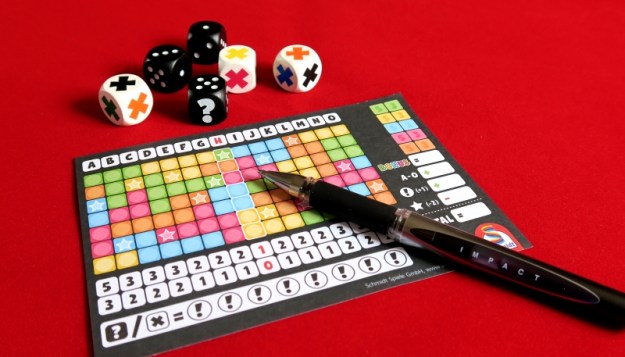
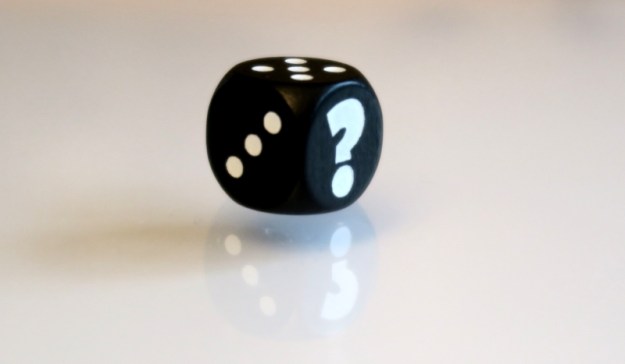
The idea of Noch Mal! is that the active person rolls the dice and then chooses two of the six dice to use.  Three of the dice are relatively normal d6 dice (numbered one to five with a “question mark” replacing the six), while the other three dice are “colour dice” with coloured crosses instead of numbers (red, green, blue, orange, yellow and black).  The player cards depict a rectangular array of square boxes, in groups of different colours.  Players choose two dice, a colour and a number and “spend” them to cross squares off on their sheet.  Thus, if they choose green and five, they must cross off exactly five green squares.  The catch is that these must be in a clump together and must include a square in the starting row (H) or one that is orthogonally adjacent to a square already crossed off.

Noch Mal!
– Image by boardGOATS

Players get points for completing columns, or crossing off all the squares of one colour, with the first player to do so scoring a bonus.  The “question mark” and “black” faces are “wild” and can be used as any number or colour (respectively), but each player can only use a total of eight wilds during the game.  Points are scored for completed columns (those furthest from the central starting column score more), crossing off all of one colour, and any unused wilds.  Some of the squares also feature a star—each one of these that is not crossed off earns a two point penalty.  The game ends when one player crosses off all the squares of two colours and the player with the most points is the winner.

Noch Mal!
– Image by boardGOATS

Everyone had three dice and we began by rolling to see who would go first.  Ivory won, but there were lots of roll-offs to settle tie breaks, so determining the order was in danger of taking longer than the game itself!  To keep people involved and give them a feeling of agency everyone rolled their own number dice, while Blue and Pink rolled the colours and displayed everything on one of their cameras.  For the first three rounds the active players (Ivory, Burgundy and Pink) don’t choose dice and everyone else can choose from the full six, so Pine was the first to play a “proper turn”.

Noch Mal!
– Image by boardGOATS

Pink was quick out of the traps and was first to score a column, and then taking points for a second too.  This meant he was three points up before anyone else had scored.  Worse, nobody else could score anything for the starting column (H), and only one point was available now for column G too.  Ivory had other plans though and had expanded to the right of the table and was soon picking up some of the higher scoring columns further away from the centre.  Others tried the same strategy, some with success, others less so.

Noch Mal!
– Image by boardGOATS

The general feeling was a little bit like Bingo with dice with players calling out when they completed a column.  This feeling was accentuated when lots of people called “House” for a load of columns on the right, all at the same time.  Eventually players started claiming colours; inevitably, Ivory was first, and also the first to discover what a curate’s egg it was as he was then forced to pass.  It wasn’t long before someone completed their second colour and everyone then had to work out their scores.

Noch Mal!
– Image by boardGOATS

It was no real surprise that Ivory top scored with what seemed like an enormous ten points, though Black ran him very close with eight.  Pink, Lime Blue and Green felt they had done well to avoid finishing with negative points and Purple would have done a lot better if she hadn’t lost sixteen points for her eight remaining stars.  It had been interesting though and now everyone felt they had a better understanding of how the game worked, it seemed a good idea to give it another try.

Noch Mal!
– Image by boardGOATS

This time, Lime was the first to score points, claiming column H so fast that it seemed impossible.  Having finished with zero last time though, he was keen to get points on the board straight away.  It was then that the IT gremlins began their attack.  First Lime had problems with the camera freezing, then Ivory as well.  It seemed that the problem was somehow specific to Lime and Ivory and when one left, that seemed to sort out the problem for the other one.  When Green looked at the text chat channel, he commented that it was a very long stream of “Lime has left”, “Lime has joined”, “Ivory has left”, “Ivory has joined”, “Lime has left”…

Noch Mal!
– Image by boardGOATS

Inevitably, we decided it was the French (again) trying to get their revenge for our invasion of their game of 6 Nimmt! a few weeks back—they have very long memories do the French!  Obviously, we weren’t going to let them win, so Lime and Ivory took it in turns to duck out when necessary and Blue and Pink took it in turns to let them back in, and the game carried on.  This time, everyone had a better idea of what strategies were available and players made a better job of completing columns.

Noch Mal!
– Image by boardGOATS

More players completed one colour and almost everyone had a near full grid by the end.  This meant it was down to rolling low numbers and those who hadn’t used up all their “wild” tokens.  This turned out to be really quite important with Burgundy and Pink among others, running out and therefore unable to make use of turns that others could.  It was slow at the end, but eventually Black completed his second colour and everyone tallied up the scores.

Noch Mal!
– Image by boardGOATS

Everyone except Ivory had improved their score, and this time everyone finished in the black.  Purple took the award for the most improved player, improving her score by twenty-three points having made an effort to clear up her stars.  As the scores came in, Pink really thought he had it with eighteen, but he’d failed to look across the table to see Blue had twenty, and with it victory.  Noch Mal! had worked really well which shows how our tastes have changed:  in the pub, we would never had played a game like this with so many, however, as Pine pointed out, playing a real game through a camera felt more like game night than playing an virtual game, so we’ll keep that in mind for future events.

6 Nimmt!
– Image by boardGOATS

With that, Pine and Lime finally gave in to the French Gremlins and left for an early night, and eventually, Green joined them.  The others were up for something else though, and as Pink was wearing his new 6 Nimmt! socks, that seemed like a good idea.  So everyone logged into Board Game Arena for one of our favourite games.  The game needs little real introduction: players simultaneously choose a card from their hand and everyone reveals them.  Starting with the lowest, the cards are added in turn to one of the four rows—when a sixth card is added the owner instead takes the five cards and starts a new row with their card, scoring the number of bulls’ head points (or “Nimmts”) depicted on the card.

6 Nimmt!
– Image by boardGOATS

On Board Game Arena, the player with the most points when one player’s score falls below zero is the winner.  There was the usual moaning about how bad everyone’s hand was and how badly everyone always did, but Burgundy pretty much nailed it when he said nobody is going to do well, the aim is just to do less badly than anybody else.  In that sense, the game is a bit like escaping a bear, you don’t need to run fast, just faster than everyone else.  This time, Pine started off as the slowest runner being the first to pick up, but was soon followed but Black, Purple and then Burgundy.

6 Nimmt! on Board Game Arena
– Image by boardGOATS from boardgamearena.com

For a long time, it looked like it was going to be a “two bull race” between Blue and Pink, but six is a critical number in 6 Nimmt!, so with six players strange things can happen with players becoming synchronised and picking up lots of points on multiple turns.  It looked like it was going that way for Blue, but she managed to stem the flow and was tied for second with Pine for quite a while before he started picking up cards again.  It looked like Pink’s Lucky 6 Nimmt! Socks were working their magic, but when Black (who had been looking like bear-fodder for the whole game) ended the game, Pink had just picked up, leaving Blue one point ahead.

6 Nimmt! on Board Game Arena
– Image by boardGOATS from boardgamearena.com

There was still time for one more quick game, and with six, the perfect quick game (and one that is available on Board Game Arena), is For Sale.  This is an old game that we dug out about six months ago, before all the current strife, and it got a couple of outings.  Since all games have been online, it is one of the games we can still play, and, as a result, it’s had several outings recently.  It is a game of two halves, first players buy property cards, then they sell them, and the player who makes the most money is the winner.

For Sale
– Image by boardGOATS

The properties are numbered one to thirty, with the number indicating the relative value.  Buying properties is through auction, with players increasing the bid or passing and taking the lowest value property available and paying half of their bid for the privilege.  The last player then takes the highest value property, but pays their full bid.  In the second part of the game, cheques are revealed and players choose a card to play, with the cheques assigned according to the value of the property played.

For Sale
– Image by boardGOATS

Thus the game consists of two auctions: a variant of an all-pay auction and a sealed bid auction.  In the first auction, a key tactic is predicting what other players will bid so passing can be timed in such a way as to get the best value for money.  Whereas previously, most players increased the bid by the minimum increment, this time it was clear that people were playing a little more tactically, with higher starting bids and increments of $2,000 that pushed other players into paying more.

For Sale on Board Game Arena
– Image by boardGOATS from boardgamearena.com

Black’s and Purple’s strategies were different however:  Black spent a total of just $2,000 on properties, mostly just passing and taking the property offered, and Purple spent only $3,000.  In contrast, Blue spent $13,000 and Pine spent $12,000, i.e. nearly all of their starting $14,000.  There is strategy in the second part of the game too though, and getting the timing right for selling each property is key.  For example, although Blue’s profits of $37,000 were larger than Black’s, his rate of return of $21,000 for just $2,000 outlay was better, matched only by Purple’s return of $32,000 for her $3,000 investment.

For Sale on Board Game Arena
– Image by boardGOATS from boardgamearena.com

That superb return was enough to give Purple third place.  It is not all about rate of return though:  it is the player who makes best use of all their funds that wins.  In this case, this meant we had a tie for first place between Pine and Burgundy, both finishing with a massive $59,000.  The tie break is the player with the most cash at the end, which just gave it to Burgundy who had achieved his $55,000 from properties bought for $10,000.  And with that, it was time for bed.

For Sale
– Image by boardGOATS

Learning Outcome:  A lot of fun can be had with a handful of dice and a few sheets of paper.

26th May 2020 (Online)

As people signed in, the evening began with a lot of comments about visits to Durham and driving to “Barney’s Castle” to in lieu of eye-testing and, after his unexpected “French connection” last time, Lime said he’d sent a coachload of Gallic gamers to visit Pink and Blue.  By 8pm, everyone had joined the Microsoft Teams meeting and had signed into the online platform, Board Game Arena ready to start our first game.  This was to be the “Feature Game“, Saboteur.  The game is fairly simple:  players have a hand of four cards and take it in turns to play one.  The aim of the game depends on which side they are on:  the Dwarves, or the Saboteurs.

Saboteur
– Image by boardGOATS

The Dwarves are digging a tunnel trying to find the gold buried in them there hills, while the Saboteurs are trying to stop them.  There are a limited number of cards in the deck, and when the cards run out, time us up—if the Dwarves have not reached the gold, the Saboteurs win.  In addition to playing tunnel cards, players have the ability to delay obstruct each other’s plans by breaking their tools.  These can be repaired, but players only want to repair tools belonging to members of their own team, and here’s the catch:  nobody knows who is a Saboteur, leading to distrust and chaos.

Saboteur
– Image by boardGOATS

The game began with Pink saying he didn’t know how to play and extending the tunnel in a strange direction (very Saboteur-like behaviour).  Green and Mulberry played map cards and said all they could see was coal – this was eventually confirmed by Blue who said the top card was the gold.  Although that suggested all three were likely to be Good Dwarves, it quickly became apparent that Mulberry was in fact an evil Saboteur, casting doubt on the other two as well.  When Burgundy and Purple both started to exhibit treacherous behaviour it was clear they couldn’t all be Saboteurs.

Saboteur on Board Game Arena
– Image by boardGOATS from boardgamearena.com

Unusually, it turned out that Green was innocent, a point he accentuated with hurt dignity.  When Mulberry was questioned about why she hadn’t lied about the whereabouts of the gold when she had the chance, she replied, “You don’t lie about facts that are verifiable…”:  a comment that gave everyone else food for thought.  Despite a very good effort from Mulberry, Burgundy and Purple, It wasn’t long before Lime set up Pink to claim the gold.

Saboteur on Board Game Arena
– Image by boardGOATS from boardgamearena.com

When we play this in real life, we usually play single rounds and not worry too much about sharing out gold and having an “overall” winner.  Playing through Board Game Arena though, we didn’t really have much option and were suckered into a three round game with gold cards handed out to the winning team each time.  Ivory started the next round and Pine was the first to use a map to look for the treasure with Green and Black following soon after.

Saboteur
– Image by boardGOATS

Lime started off discarding a card which looked a trifle suspicious, and his first real play didn’t allay everyone’s concerns.  Their worst fears were confirmed when he played a rock-fall card on a key cross-roads in the centre of the map announcing his affiliation with Team Saboteur.  There was a little confusion over the difference between “Gold” and “Coal” which sounded very similar over the sound channel, though some of the confusion may have been deliberate, especially as Green and Black (who’d had all the map cards), joined the wicked Saboteurs.

Saboteur on Board Game Arena
– Image by boardGOATS from boardgamearena.com

Inevitably, Burgundy and Pine jumped on Lime and smashed his mining lamp and trolley, while Purple repaired the damage and Mulberry extended the tunnel, but only found coal for her efforts.  Then there was a race between the Evil Saboteurs and the Good Dwarves, with Black and Green trying to repair Lime’s broken tools as fast as everyone else was breaking them.  In between, progress on the tunnel was slow, but eventually Blue struck gold, and it was another victory to the Dwarves.

Saboteur on Board Game Arena
– Image by boardGOATS from boardgamearena.com

The third round didn’t feel as close as the first two.  Burgundy, Blue and Mulberry were the  Saboteurs and really spent too much effort convincing everyone they weren’t evil and, as a result, took too long to actually do any sabotage.  The problem wasn’t helped by Mulberry breaking Burgundy’s pick-axe and the fact that Blue didn’t want to reveal her allegiance by fixing it for him.  By the time they’d sorted themselves out, it was way too late; the Dwarves had made a beeline for the gold and Pine had completed the tunnel with the deck barely depleted.

Saboteur on Board Game Arena
– Image by boardGOATS from boardgamearena.com

With that, it was only the final reckoning to work through.  Anyone who had been an unsuccessful Saboteur was out of the running, leaving Ivory, Pine and Pink in the podium positions.  At the end of each round, three gold cards were drawn at random with a face value between one and three.  These were allocated to players on the winning side with the last two players to receiving two cards and everyone else getting one card with the value decreasing in reverse player order.  Therefore, there wasn’t much to choose between the top three:  Pink just edged it, with seven gold, one more than Ivory and Pine who tied for second with Lime and Blue the best of the rest, finishing with five apiece.  With that, the game degenerated into a chorus of “Gold” by Spandau Ballet, “Ahhhhh…!”

Saboteur
– Image by boardGOATS

Although some online implementations considerably reduce the upkeep in games, unquestionably, playing online is considerably more taxing than playing in real life.  Somehow, the additional effort needed to keep track of what’s going on and follow the verbal chatter and the written banter on the two written chat threads.  So, although Saboteur had barely taken an hour and there was plenty of time for more games, with laziness the order of the day, 6 Nimmt! was the popular choice.

6 Nimmt!
– Image by boardGOATS

6 Nimmt! is one of the group’s favourite games, mainly because of the fine line it walks between control and total chaos.  Each player has a hand of cards and, simultaneously, everyone chooses one to play.  Starting with the card with the lowest face value, in turn, the cards are added to one of the four rows: the row ending with the highest card that is lower than the fave value of the card played.  When the card to be added to a row would be the sixth, instead, the player takes the five cards and the card becomes the new first card in the row.

6 Nimmt!
– Image by boardGOATS

The number of bull’s heads or “nimmts” depicted on the cards becomes the players score, and the player with the lowest score is the winner.  In the Board Game Arena implementation, everyone starts with sixty-six points and everyone keeps playing until someone’s score falls below zero.  The more players, the more mad the game becomes, so with ten, it was guaranteed to be disorganised chaos.

6 Nimmt! on Board Game Arena
– Image by boardGOATS from boardgamearena.com

This time, Ivory was the first to pick up cards, but Black and Burgundy soon started the race to the bottom in earnest, picking up cards almost every turn.  It wasn’t long before Lime joined the chase though, and before long nobody was unaffected.  Blue, Pine and Pink managed to avoid too many expensive pick ups and as Burgundy triggered the end of the game, it was a three horse race.  Pine managed to duck and dive best at the end of the game and won by a nose.

6 Nimmt! on Board Game Arena
– Image by boardGOATS from
boardgamearena.com

Sadly, Green had been struggling with his internet connection which kept dropping out, so he ducked out leaving everyone else to start another game.  This time it was Lime’s turn to keep picking up, ending with thirty-nine cards and zero points.  It was quite close at the top though, with seven players within a range of twelve points, and a three-way tie for first, between Pink, Ivory and remarkably Purple, who can usually be relied on to collect cards with gay abandon.  By this time, people were tiring, but once Mulberry, Ivory and Lime had said goodnight, there were six—just enough for a quick game of For Sale.

For Sale
– Image by boardGOATS

For Sale is a very clever little auction game that plays really well with six players.  Each player starts with $14,000, which they use to bid for properties numbered one to thirty.  The auction is unusual though, in that players must increase the bid, or pass and and take the lowest value property available, paying half their stake.  Bidding continues until the winner takes the most valuable property in the batch.

For Sale
– Image by boardGOATS

Once all the properties have been sold, players then sell off their properties.  In this phase of the game, six cheques are revealed and players simultaneously choose a property.  The properties are ranked, with the most valuable taking the largest cheques.  The winner is the player who has made the most of their starting capital, turning it into the largest total cheques.

For Sale on Board Game Arena
– Image by boardGOATS from boardgamearena.com

There was considerable amusement when Pink (who normally resides in Durham) took “Barney Castle”;  inevitably, he was asked whether he needed his eye-sight testing…  Otherwise, the game was a fairly uneventful, tense affair which ended with just $5,000 separating five of the players.  Burgundy was the winner though, with $47,000, $1,000 more than Pine who had $1,000 more than Blue.  The game was so quick, and is one where players sometimes need to “get their eye in”, to be able to value properties.  So, everyone was happy to give it a second try.

For Sale on Board Game Arena
– Image by boardGOATS from boardgamearena.com

Somehow Burgundy got lost between the two games though, ended up spectating someone else’s game.  This time they weren’t French though and he was only watching; the problem was spotted quite quickly too, so could be rectified quite easily.  It didn’t put Burgundy off his game, and he finished with $51,000.  Although it wasn’t quite as close as the first game, the top three were the same, but this time it was Blue who finished $1,000 behind Burgundy.  And with that, everyone had had enough.

For Sale
– Image by boardGOATS

Learning outcome:  Not all Dwarves work for Snow White…

12th May 2020 (Online)

Having spent the last few meetings playing online using Tabletop Simulator shared through Microsoft Teams, this time we decided to do something a little different.  One of the group’s most popular games is 6 Nimmt!, which also plays lots of people.  It has unavoidable hidden information, but is available through the online platform, Board Game Arena.

6 Nimmt!
– Image by boardGOATS

On our first online game night, a small group had had a difficult time playing Port Royal on Yucata.  Some of the group had also played rather challenging games of Snowdonia and San Juan, and, as a result, had moved to Board Game Arena for three more recent, epic games of Keyflower.  The graphics and playing environment on Board Game Arena are more up to date than those for Yucata, but like most other platforms, the servers have been struggling at peak  times with the load caused by the recent influx of new online gamers.  The folks at Board Game Arena have done a lot of work on that in the last couple of weeks though, and the performance has improved significantly as a result.  So much so, that we felt reasonably confident it would be stable enough to be the focus of games night.

Board Game Arena Logo
– Image by boardgamearena
on twitter.com

So, this week, the “Feature Game” was to be 6 Nimmt! played on Board Game Arena.  This is a game that everyone knows well, though there are a couple of minor tweaks to the rules.  The idea is that everyone starts with a hand of cards, ten on Board Game Arena (we usually play with the hand size that is dependent on the number of players).  Simultaneously, everyone chooses a card, and then, starting with the lowest numbered card, these are added to the four rows in the display.  Each card is added to the row that ends with the card with the highest number that is lower than the card played.

6 Nimmt!
– Image by boardGOATS

Placing the sixth card in the row causes the active player to take all the cards in the row, replacing them with their played card.  The clever part is that the score is the not the face value of the cards, but the number of “bull’s heads” shown on the cards.  The aim of the game is to finish with the lowest score.  When the group usually play, we split the deck into two halves and play just two rounds.  On Board Game Arena, however, everyone starts with sixty-six points and the game end is triggered when someone’s score falls to zero.

6 Nimmt!
– Image by boardGOATS

From 7pm, players began logging onto Board Game Arena and joined the MS Teams meeting.  Lime was one of the first and his chat with Blue and Pink was interrupted by a phone call from one of Blue’s relatives trying to source a set of drain rods.  Blue and Pink were quite convinced they didn’t have any, but that didn’t stop Pink having to spend the next hour hunting for some without success (so Lime kindly offered to lend his if required).  While Pink rummaged in the garage, everyone else joined the meeting and chatted.  Mulberry unfortunately wasn’t able to join us, but she was replaced by Ivory on his first online meeting.  It was great to “see” him again after so long, and good to hear that Mrs. Ivory, Little Ivory and Littler Ivory were all doing well and might be interested in OKIDO.

6 Nimmt!
– Image by boardGOATS

Eventually, Pink finished ferreting and returned to the chair kept warm by his panda and everyone settled down to play.  The Board Game Arena implementation worked nicely and everyone was able to chat in the background using MS Teams, but also through the game’s “chat” channel.  There was the usual moaning about the quality of cards and comments about how badly things were going:  it was almost like playing together in the pub, though not quite.

6 Nimmt! on Board Game Arena
– Image by boardGOATS from boardgamearena.com

Green and Purple managed to avoid picking up any cards for the first round or two, but it wasn’t long before their natural collecting mania began.  The disease spread and soon Pine, Ivory and Black were picking up lots of cards too.  It wasn’t long before Lime triggered the end of the game, and Burgundy managed to avoid picking up anything in the final round to win, ten points clear of the rest of the field.

6 Nimmt! on Board Game Arena
– Image by boardGOATS from boardgamearena.com

There is a lot of luck in the game, especially with so many players, but everyone was happy to play again and it is very easy to engage in a re-match, or so we all thought.  It wasn’t until the second game had started that we realised we’d “lost” Lime somewhere along the way.  He seemed to be playing a game, but then it dawned on him, that he’d somehow got himself involved in somebody else’s game by mistake.  He was very embarrassed and was keen to extricate himself, but Blue worked out where he’d gone and shared the link.  So, to the complete mystification of the four French gamers involved, the Brits all joined their game as excitable spectators.

6 Nimmt! on Board Game Arena
– Image by boardGOATS

Everyone boisterously cheered on our British Representative, to the blissful ignorance of the French and huge embarrassment of poor Lime.  Meanwhile, Black worked out how to abandon the incomplete game and Blue started a new one which everyone joined while still following Lime’s progress against the French.  Lime played really well and was in the lead for much of the game, but sadly, one of the French finished strongly and just beat him.  Still, we all felt he’d done an excellent job keeping the British end up, and he finished a very creditable second (especially since he was somehow also playing the group’s game and working!).

6 Nimmt! on Board Game Arena
– Image by boardGOATS from boardgamearena.com

After all that excitement, our game was something of an anticlimax.  Nobody was really paying much attention for the first part as they were distracted by Lime’s stellar performance.  But when everyone focussed on the game again, Pine, Blue, Ivory and Green were fighting it out to at the top while Pink was doing his best to end the game nice and quickly.  There were the usual smutty comments (Green: “Ivory’s got a big one there…!”) and other banter (Pine: “I had the lead for all of two seconds…!”), but eventually, Pink put everyone out of their misery, somehow leaving Blue just ahead of Pine.

6 Nimmt! on Board Game Arena
– Image by boardGOATS
from boardgamearena.com

Nobody was desperate for an early night, so everyone chose the rematch option again, and this time, everyone ended up in the same game.  It started quite close, but Black soon found the cards irresistible and quickly amassed an unassailable pile of brightly coloured cards.  At the other end, Pink went from “zero” to “hero”, going from last place to first place, with Pine and Lime tying for second place.  Nobody seemed keen to play another round and the evening degenerated into chatter.  Pink shared how to customise backgrounds on MS Teams including a selection he had downloaded from the BBC, with one from Blake’s 7 and another from Multi-coloured Swap Shop.

The Goodies Album Cover
– Image from youtube.com

This led to a discussion as to which was better: Swap Shop or ITV‘s offering, TISWAS.  From there, Pine shared some of his album collection with a quick blast of The Goodies’ Funky Gibbon and everyone started sharing weird things on YouTube including sheep playing on roundabouts; a fluffy sheep with no facial features, and the world’s biggest dogs. Pine offered Pink a copy of the soundtrack to The Sound of Music on orange vinyl, a generous offer that was politely declined.

For Sale
– Image by boardGOATS

With Lime, Ivory and Green gone, and everyone else clearly not ready for bed yet, but running out of chat, someone suggested another quick game.  Once Blue’s maths had been corrected several times (ruling out all the five-player games), the group started a game of For Sale.  This is a simple auction game of two halves.  First, there is the property sale, where players take it in turn to bid for a building or pass and take the least valuable available.  Then, players choose which properties to sell when the “buyers” reveal their offers (cheques).

For Sale
– Image by boardGOATS

The clever part of this game is that the property cards are numbered (one to thirty), so they have a relative value with those numbered close to thirty more valuable than those around one.  Everyone starts with $14,000 and bids are in $1,000 increments, but anyone passing takes the lowest value property available, but takes a rebate equal to half the value of the bid (rounded down).  This adds an interesting level of decision making towards the end of each bidding round.  In the second phase, cheques are revealed with values between zero (void) and $15,000.  The player with the highest value of cheques and any left over money once all properties have been bought and sold, is the winner.

For Sale
– Image by boardGOATS

Board Game Arena have a very nice implementation of For Sale, faithfully reproducing the original, quirky card art.  There were a lot of controversially high bids, not least from Burgundy who paid $9,000 for the space station, the highest value property.  It worked though, as Burgundy just pipped Pine to win by a mere $1,000, in what was a very tight game.  It is a game where valuing property is key, both for buying and selling, and as it plays quickly, the group decided to give it a second try.

For Sale on Board Game Arena
– Image by boardGOATS from boardgamearena.com

This time, aside from Pink propping up the table again, everyone who had done well, did badly, and everyone who had done badly did well.  So, Blue, Black and Pink were at the top this time, with Blue pushing Black into second place by $5,000.  With that, Pine left the others to decide what long and drawn-out game they were going to play over the next fortnight, and everyone else eventually settled on Tokaido and set up the table to start the next day.

Tokaido on Board Game Arena
– Image by boardGOATS from boardgamearena.com

Learning Outcome:  6 Nimmt! est imprévisible dans toutes les langues.

4th February 2020

Blue and Pink were first to arrive and, while they waited for others and their pizzas to arrive, they tried to squeeze in a quick game of Ganz Schön Clever (a.k.a. That’s Pretty Clever).  This is a “Roll and Write” game, that is to say, players roll dice and use the values they roll to fill in spaces on their score sheet.  So, it is an abstract game where the active player, rolls all six coloured dice and chooses one to keep and use, discarding all dice with lower pip values.  They then roll any remaining dice, again keeping and using one and discarding the rest before rolling the rest one last time keeping and using one final die.  The other players can then use one of the discards, before play passes to the left.

Ganz Schön Clever
– Image by boardGOATS

Filling in some of the boxes gives a bonus action, enabling players to fill in other boxes or gain the opportunity to re-roll their dice or even use an extra die.  The player who wins is therefore the player who makes the best use of the dice they roll and usually, the player who manages to build the most combinations to take advantage of the bonuses available. This time both Blue and Pink started off slowly, but as they were coming to the last couple of rounds, both food and people arrived and their focus drifted a bit.  Pink managed to keep it together better though and as a result finished with a nice round hundred and fifty, some twenty more than Blue.

Ganz Schön Clever
– Image by boardGOATS

As they finished eating, Green, tried to organise players in an effort get a group together to play Terraforming Mars.  It was quickly clear that it was not going to happen, as Burgundy, Black, Pink, Pine and Mulberry expressed an interest in playing the “Feature Game”, Fast Sloths.   This is a race game where players are sloths travelling around a holiday resort on the backs of other animals.  The rules are quite straight forward:  on their turn the active player takes cards from the face up piles that make the market; optionally play cards, and then discard down to conform to the hand-limit (which varies depending on how players are progressing).  When taking cards, they must all be different animals, and the number they can take depends on their position in the race.

Fast Sloths
– Image by boardGOATS

The game is a pick-up-and-deliver type of game, but unusually the sloths are the cargo being delivered.  Movement on the central board is the heart of the game and each player must try to optimize their movement to win.  When playing cards, they must all be of the same animal – the player then moves the animal corresponding to the cards played towards their sloth, so they can pick it up and drop it somewhere else on the map.  Each animal has their own characteristics, the type of terrain they can cross and how they move etc..  The aim of the game is to collect leaves and the first sloth that can gather eight leaves wins.

Fast Sloths
– Image by boardGOATS

Burgundy got off to a flying start – by both playing first and (even though he was last to pick) securing a good corner tree as his starting location, with a ready-made parade of ants he could bounce over on his way to the next tree.  It was a very tight game, which, after the first few turns while people built up their hand of cards, progressed rapidly with players aiming for a new leaf every turn, or at worst every two turns.

Fast Sloths
– Image by boardGOATS

There was much discussion about the accuracy of the terrains allocated to each transport animal. Donkeys, for example – in Fast Sloths they can’t travel in the mountains or through water, but surely the reasons why donkeys make such good pack animals is that they are great at climbing mountains and wading rivers?  Pink suggested that as this was a “game” perhaps such comparisons weren’t relevant?  However, this suggestion was not received well and went down like a donkey in a river…  Attention then turned to “how true to life” was the representation of unicorn transport.

Fast Sloths
– Image by boardGOATS

The game carried on, with only an occasional call of “Summon the Eagles!” from Mulberry (just imagine Brian Blessed in the film Flash Gordon).  Despite being the first time most people had played the game, all players had clearly got to grips with the mechanism and made speedy progress through the forest – a compliment to the designer it was felt.  In the end, with everyone so closely matched, it came down to marginal differences and Burgundy, after his initial flying start, stayed out in front to win after collecting eight leaves. Hot on his heals were Mulberry, Black and Pine with seven.

Fast Sloths
– Image by boardGOATS

Meanwhile, on the next table, Green and Ivory had settled on Wingspan, and were eventually joined by Purple and Blue.  Since it won the Kennerspiel des Jahres award last year, this has proved a very popular game within the group.  The copy belonged to Burgundy, and he had integrated the European Expansion and Swift-Start Cards, as well as “pimped his bits”; the artwork on the cards is beautiful and the additional pieces just add to the aesthetics.  The game is  functionally very simple, though playing well requires planning and just a little bit of luck.

Wingspan
– Image by boardGOATS

On their turn, the active player can place an action cube to do one of two things:  pay food to play a bird card from their hand, or activate one of their three habitats and all the birds in it.  The three habitats, allow players to collect food, lay eggs or add more bird cards to their hand.  At the end of each round there are bonus points available for players who are most successful with the targets set out; at the end of the game players score points for each bird card they’ve played (value dependent on the bird), food and eggs on their cards, and flocking birds.   The difficult part is to efficiently build combinations of birds with synergistic special powers that will ultimately yield the best score.

Wingspan
– Image by boardGOATS

This time, Blue started by playing a White Wagtail in her Wetland, which gave the opportunity to place a bird card at the end of the round so long as she had activated all three habitats and placed a card during the round.  She still had to pay the food needed, so she concentrated on making sure she had all the bits required to make it work for her every round.  Ivory focused on first playing his Savi’s Warbler and then using it to acquire a lot of cards, many from the face-down draw pile, hoping to draw something good.  Green struggled a bit from the start, partly because he was arguably the player with the least experience, but the fact he was distracted by a bird of a different sort tweeting by phone certainly didn’t help.  Purple on the other hand, quietly concentrated solely on her game, and made excellent use of her Double-Crested Cormorant which allowed her to tuck two cards in exchange for one fish.

Wingspan
– Image by boardGOATS

As the game progressed, Green increasingly needed prompting to take his turn, and explained that he was getting side-tracked because Blue, playing immediately before him, was taking so long on her turn.  While it was true that Blue’s turns were getting longer, this was almost entirely because the number of birds in her reserve was increasing faster than anyone else’s, largely thanks to her White Wagtail which she was busy putting to good use.  The contrast was quite stark Green’s rather meager reserve and Blue’s, although by this time, both Ivory and Purple, also had a good sized reserves.  As the game entered the final round, Fast Sloths was coming to an end and those players wondered over, so the last few turns were played with an audience.

Wingspan
– Image by boardGOATS

At this point, the Wingspan players were putting the finishing touches to reserves.  Green kept commenting how he knew he was coming last and it was clear who had won, but Ivory was not so sure.  In the final accounting every bird in Purple’s reserve had a good point value adding to her points from the tucked birds and Ivory did best in the end of round goals.  Blue had the most birds giving her the same amount of points as Purple (though the individual cards were not as good) and she scored slightly fewer points that Ivory in the end of round goals.  In every other area, however, Blue led the pack giving her the lead overall with ninety-eight points.   Ivory was twenty points behind, and just pipped to second place by Purple.

Wingspan
– Image by boardGOATS

Mulberry, Pine and Ivory Ieft to get an early night, leaving everyone else to play something short;  the game that fitted the bill and was on the top of the pile was For Sale.  This is a very clever property auction game that we played for the first time in years at New Year. The game comes in two parts:  buying properties and then selling them.  So, each player starts the game with $14,000 to spend on property cards.  There are thirty properties, numbered to reflect their relative value and these are auctioned in groups equal in size to the number of players.  The clever part of the auction is that when a player passes and withdraws, they pay half the value of their final bid and take the property with the lowest value; the winner takes the most valuable property, but pays their final bid in full.

For Sale
– Image by boardGOATS

In the second part of the game, cheque cards equal in number to the number of players are laid out, with values from zero to $15,000.  Each player then chooses one property card from their supply and everyone reveals them simultaneously: the highest value property earns the highest value cheque with the second most valuable property earning its owner the second largest cheque and so on.  The winner is the player with the highest total from the sum of their cheques and any left-over cash.  This time, Black took the most valuable property, the space station and with it, on of the $15,000 cheques while Burgundy took the other.

For Sale
– Image by boardGOATS

At the other end of the scale, Pink took both the void cheques, but despite this still managed $33,000 for the rest of his properties.  This was nothing compared to the winner, Green, who finished with $53,000, $2,000 more than Burgundy in second.  The night was still young, however, and there was still time for one of our favourite games, 6 Nimmt!.  Although this is often derided as a game of chance, it is clear that it is not pure luck.  The idea is that everyone has a hand of cards from a deck numbered one to a hundred and four.  Simultaneously, everyone chooses a card from their hand, and, starting with the lowest value card, these are then added to one of the four rows of cards.

6 Nimmt!
– Image by boardGOATS

Each card is added to the row with the highest end card that is lower than the card they have played.  If the card is the sixth card, they take the five cards in the row and their card becomes the first card in the new row.  Each card has a number of bull’s heads on it—this is the number of points they score.  The player with the fewest points at the end of the game wins.  We play with a variant that half the cards are dealt out for the first hand and the rest for the second, which gives us a score at half-time.

6 Nimmt!
– Image by boardGOATS

This time Burgundy and Black were in the lead at the half-time with a single nimmt, with Blue a couple of points behind.  Pink set the competitive high score of thirty-one.  Black picked up a handful of cards in the second half, indeed, only Purple, Blue and Burgundy managed to keep their second half scores to single figures.  In the end, it was Blue who just had the edge, beating Burgundy by three nimmts.  At the other end, however, Pink had no competition finishing with a very respectable high score of forty-five, not a record, but a substantial total nonetheless, and a good end to a fun evening.

6 Nimmt!
– Image by boardGOATS

Learning Outcome:  Donkeys are not as versatile as you might think.