Tag Archives: Forbidden Desert

Boardgames in the News: Role-playing Climate Resilience

It was nearly ten years ago that Stuart West, a Professor of Evolutionary Biology in the Department of Zoology, Oxford, used playing board games as a teaching tool to understand evolution and published his results in the prestigious scientific journal, Nature.1 Now, Matt Leacock‘s new game, Daybreak has been reviewed in the journal Science.2

Daybreak
– Image from amazon.com

Matt Leacock is best known for the cooperative game, Pandemic.  However, while thirty of his forty-seven published games are cooperative (including the well popular Forbidden Games series), he has also been instrumental in the innovation of legacy games, co-designing both the Pandemic Legacy series of games and the recent Ticket to Ride Legacy: Legends of the West.

Daybreak
– Image from amazon.com

Daybreak is cooperative game about climate action where players controls a world power, Europe, the United States, China, and the Majority World, each of which has different energy demand and sources, emissions, resilience, and vulnerable populations.  The idea is that players deploy policies and technologies to deal with the engine of global heating and to try to build resilient societies that protect people from life-threatening crises.

Daybreak
– Image from amazon.com

The author of the article is Science‘s books and culture editor, Valerie Thompson who concludes that the trade-offs in the game reflect those seen in real life.  Most importantly, however, where climate change is concerned, we only stand a chance if we work together.

1 West, S., Nat. (2015), 528, 192; doi:10.1038/528192a.
2 Thompson, V., Science. (2023), 382(6673), 890; doi:10.1126/science.adl4244.

11th July 2023

Blue and Pink were really late arriving, and were much amused by the cheers and applause when they came through the door.  Slightly embarrassed, and after a quick explanation, everyone started splitting into groups.  First was the “Feature Game“, the Fantasies & Futures expansion for one of our more popular, heavier games, Tapestry. On the surface, Tapestry has simple mechanisms, but they combine to make a complex game.  Basically, on their turn, players move one step along one of the four Civilisation tracks around the board: Science, Exploration, Military, Technology and carry out the action (or actions associated with it).  Each space requires payment of resources, and the further along the track, the more expensive the spaces become.

Tapestry: Fantasies & Futures
– Image by boardGOATS

If a player cannot afford to pay (or chooses not to), then they instead take income, which gives them more resources.  They also gain points and play a tapestry card, which usually provides a power for the next round.  So, at its heart, Tapestry is an engine building and resource management game:  players carry out actions and get resources so they can get more resources and ultimately, points.  We have played the first two expansions, Plans and Ploys and Arts & Architecture, but this time the “Feature Game” was the Fantasies & Futures expansion, which is the smallest, adding new Fantasy Civilizations, advanced Capital City mats, new Tapestry and Tech cards.

Tapestry: Fantasies & Futures
– Image by boardGOATS

Ivory was joined by Green, Plum and Byzantium.  Along with the Fantasies & Futures expansion, the group decided to add the “Plans” from the Plans and Ploys expansion as a sort of mini expansion, a private goal, where players get their own, special building they can build.  They also left the Tapestry cards and Civilisations in the mix from the first two expansions and really only left out Arts Advancement track from the Arts & Architecture expansion as they thought it would add too much complexity to the game overall.

Tapestry: Plans and Ploys
– Image by boardGOATS

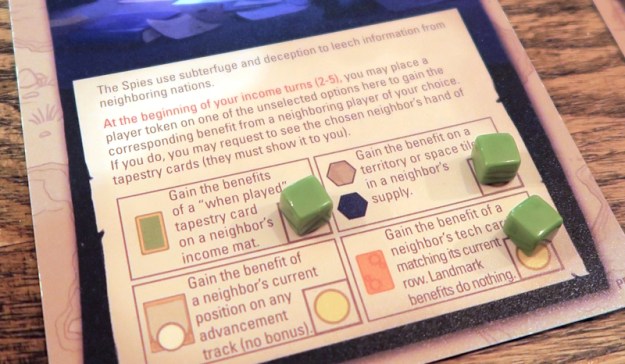
Tapestry is one of those games that sometimes comes in for criticism for being multiplayer solitaire.  Although that’s not true, there is a strong element of players “getting on with their own thing”.  Although they were each very much playing their own game, there was still quite a bit of interaction which definitely gave the game teeth.  Green’s Civilisation (“Spies”), had him perusing over his neighbours positions and cards each income turn.  Luckily for him Ivory’s Civilisation (“Aliens”) gave him four starting space tiles, and one bonus he could choose was the benefit on an unused tile in a neighbours supply which gave a nice healthy early bonus.

Tapestry: Plans and Ploys
– Image by boardGOATS

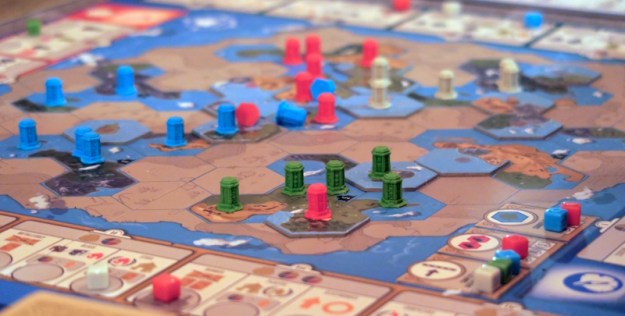
Plum’s “Islanders” Civilisation was focused on collecting area tiles and placing them on her Civilisation mat.  So she started out prioritising collecting landscape tiles, looking for ones with water on more edges as these would give her more points in the final income phase.  She got a bit lucky right from the start getting two out of three.  From there she went for an expansionists strategy as did Byzantium (with his “Riverfolk” Civilisation), and from there, throughout the game they found themselves trying to conquer each others territories on the central island.

Tapestry
– Image by boardGOATS

Plum started the game with two Tapestry cards, so chose to use the standard one for her first era.  The second was from one of the expansions and “charmed”, so much to Byzantium’s annoyance when he tried to topple Plum’s Tower in the middle of the map, his attempt was thwarted by Plum’s Trap card which also gave her an extra benefit.  When Plum later attempted to Conquer Byzantium’s tile, he was delighted to be able to repay the earlier battle with his own Trap card. That satisfaction didn’t last, however, as Plum proceeded to play her charmed Anti-trap card which not only stopped the trap dead, but also gave her yet another bonus.

Tapestry
– Image by boardGOATS

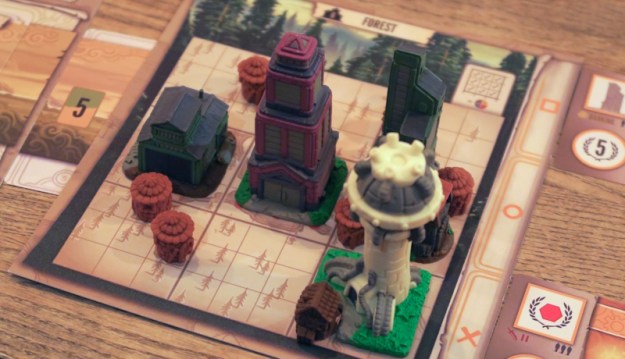
That bonus was a random Tapestry card from Byzantium’s hand—he had two, and the one she picked just happened to be the one he had been working towards maximising the effect of (moving up each track once and getting the bonus action for free).  Plum felt pretty bad about picking it, but it was too late by then.   So, all round, it was quite a frustrating game for Byzantium, who started the game with a large forty-eight point bonus from his landscape board (“Forest”), and his first conquering dice rolls, time after time, gave him the choice between a resource or seven points—quite a dilemma in the early part of the game.  Initially he took the seven points (the highest that dice could give him), but found he wasn’t getting as many turns as the others, so later switched to taking the resource.

Tapestry: Fantasies & Futures
– Image by boardGOATS

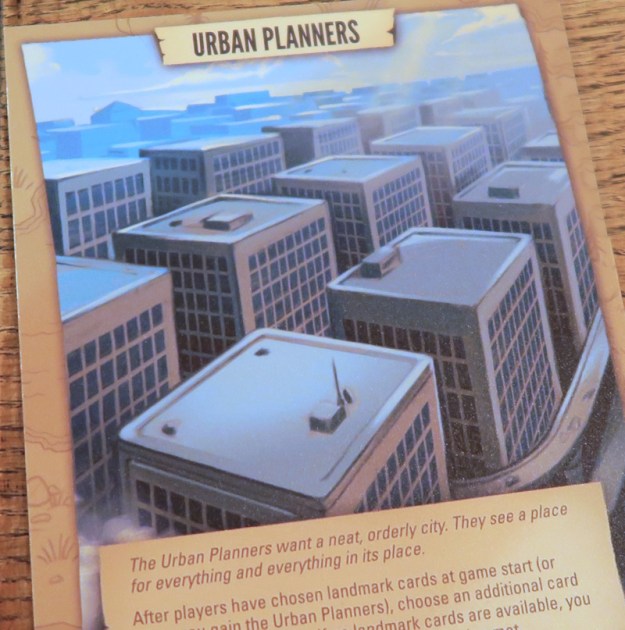
Ivory, meanwhile, managed to make good use of the charmed Tapestry cards, keeping himself well stocked with resources throughout the game.  The rest of the group barely saw any charmed Tapestry cards (aside from Plum’s Trap and Anti-trap cards), but did find the new Civilisations and Landscape boards quite an interesting addition.  As the endgame approached, Green was last man standing, and for his last few turns he was able to grab an extra Civilisation (“Urban Planner”) which was to reward him handsomely.

Tapestry: Arts & Architecture
– Image by boardGOATS

The game which had been a quite sedate affair, started speeding up a little towards the end.  Pretty much everyone did something that if they had thought just a little a bit more would have gained them another point or so—Green put a cube on another player’s map, Plum put a building somewhere where it could have completed a row if she’d considered a little longer.  As the game came to a close, Ivory and Plum counted their remaining income scores to amazingly find themselves both on two-hundred and thirty-five points.

Tapestry: Fantasies & Futures
– Image by boardGOATS

Then Green counted his final points, giving him the lead by a solitary point. That was until he realised that he’d added thirty-six to one hundred and ninety-nine and discovered he was part of a three-way tie with Ivory and Plum!  Nobody was quite sure how they all managed to have an identical score in such a high scoring game.  If the tie-break had been resources remaining, then Green would have won and if it was Tapestry cards remaining, then Plum would have been the victor.  However, a quick check of the rules suggested the tie-break was in favour of the player with the tallest building (which everyone agreed that was a rubbish tie break), and although Ivory narrowly had a taller building that Green, he graciously agreed that everyone should just share victory.

Tapestry: Plans and Ploys
– Image by boardGOATS

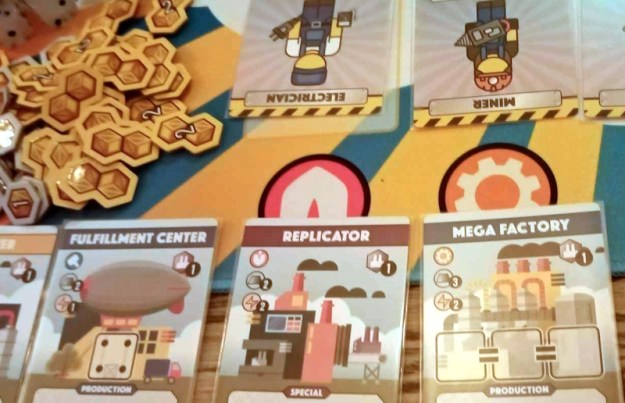
While Tapestry was setting up, on the next table Jade was introducing Black, Purple and Pine (who chose to spectate) to Fantastic Factories.  This is a game where players compete against each other trying to build the most efficient set of factories as quickly as possible.  Players have to carefully manage their blueprints, train their workers, and manufacture as many goods as possible in order to achieve industrial dominance.  Each round consists of two phases:  the market phase and the work phase. In the market phase each player in turn order can either gain a blueprint card from the four available in the market or hire a contractor.

Fantastic Factories
– Image by boardGOATS

To hire a contractor players must pay one card (that matches the tool symbol associated with the contractor’s location on the board) and any additional costs listed.  Contractors have various benefits mostly related to gaining extra resources or extra dice workers for the work phase later in the round.  In the work phase, all players perform actions in their play area simultaneously starting by rolling their four coloured dice (and any additional ones gained from contractors).  Players can use their actions to build cards (which cost various resources matching the building type); while players can build as many cards as they wish in a turn, they may one of each type of building.

Fantastic Factories
– Image by boardGOATS

Dice can be used to take actions on a player’s main Headquarter board or on building cards you have constructed.  A player’s Headquarter board allows them to generate metal and energy.  Players can also activate their buildings once per round. If any player has built ten buildings or produced twelve goods that triggers the end of the game and one final round takes place before end game scoring. Players add up the prestige value of their buildings to their produced goods and the winner is the player with the highest total.  The game was a fairly typical learning game, but was quite close.  Both Purple and Black took thirteen points for their buildings, and while Purple was yet to get her engine going, Black took nine points for his goods.

Fantastic Factories
– Image by boardGOATS

Jade, on the other hand, had fewer points for his buildings (nine), but they were functioning more efficiently.  His total of twenty-three was just one point more than Black who took second.  While they were packing up, the group chatted and Jade showed off Vaalbara, another of his acquisitions from UK Games Expo, which he described this as a nice little set collection, and semi-interactive card game.  Then they chatted while they waited for Tapestry to finish.  And waited some more as the clock ticked and it turned out that Tapestry was no-where as near to finishing as everyone had thought…

Tapestry: Arts & Architecture
– Image by boardGOATS

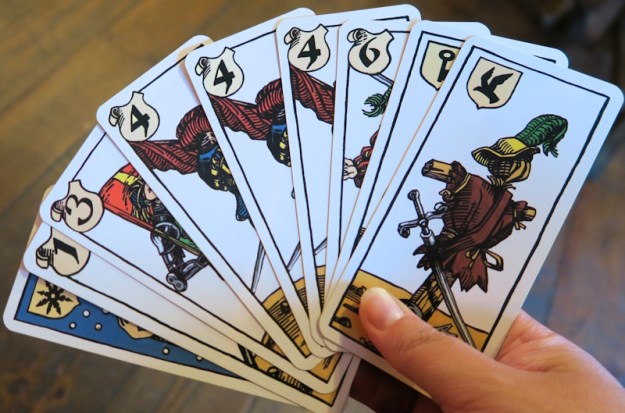
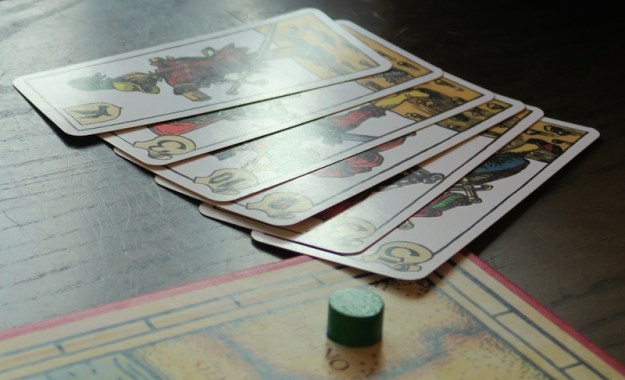
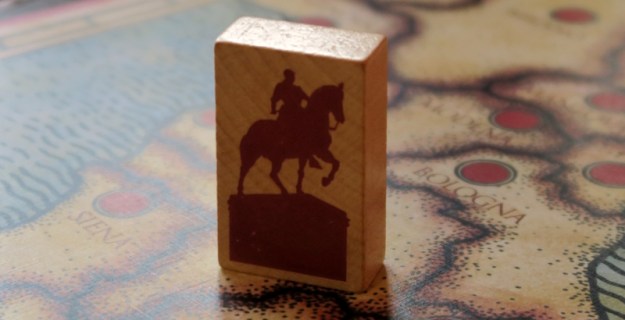
Meanwhile, Teal was introducing Blue, Pink and Lime to a much older game, Condottiere.  This is a sort of trick taking, battle game.  Set in 13th century Italy, where the wealthy city-states had weak armies.  The Condottiere were veteran English soldiers returned from the Crusades who were contracted to fight for individual city-states by an agreement known as a condotta, the most elite fighters were the mercenary leaders known as the Condottiere.  During each round, control of a State is put up for auction, and players bid the number of troops they are willing to lose in order to win the province.  Players bid with cards that represent Mercenaries, Seasons, Scarecrows, and Political Figures, in an effort to try to take control of four adjacent States.

Condottiere
– Image by boardGOATS

Each player starts with a hand of cards, and one player starts the bidding by choosing a State and a starting bid, playing the card or cards from their hand, face up on the table. Other players follow, playing cards each round.  When a player either cannot play another card (or chooses not to), they “stick”, but unlike many other auctions, in which only the highest bidder loses their bid, at the end, everyone loses all the cards they played, whether they finish with the highest value hand or not.  Mercenary cards have values one to six or ten, while the other cards have special powers that take effect when they are played, but it is how the cards work together that is key.

Condottiere
– Image by boardGOATS

For example, the Drums double’s the value of all that player’s Mercenary cards, but this effect can be offset by another player placing a Winter card reduce every Mercenary card played to a value of one, while a Scarecrow can be used to return a card to its owner’s hand, making it available to play later.  There is also the Heroine, which is untouched by either the Drums or Winter, but also cannot be returned by the Scarecrow.  Perhaps the cleverest cards, however, are the Surrender and Bishop cards;  the Surrender ends the battle immediately (with the current leader winning the battle), and the Bishop ends the battle in peace with no-one winning.

Condottiere
– Image by boardGOATS

While there are some clear uses for some cards (the Bishop is only likely to be played by someone who is losing badly, and the Surrender card is usually played when the active player holds the lead), the meta-game is also important.  Although winning is obviously the aim of the game, as battles become head-to-head, players sometimes end up playing with emotion rather than strategy.  Once a battle has been won, the winner chooses the next city-state to be auctioned and starts the bidding.  Unlike other games, however, play continues with the cards they have left until all players but one have run out of cards, and only then do players get more cards (before they start the next battle).

Condottiere
– Image by boardGOATS

Teal explained the game, and that, although he understood the rules, he had no idea how to win.  Indeed, despite having played Condottiere a lot in the weeks since he acquired it at UK Games Expo, he had never won, a situation that was destined not to change this time.  Teal and Lime won a couple of States, giving them extra cards in the refresh.  Blue and Pink realised they were at a disadvantage, so set out to rectify things.  They took a couple of States and redressed the balance.  Then Pink stole a march when he forced Lime to lead out in a battle he could not win.  With this giving him three adjacent states, the writing was on the wall.  Lime, Teal and Blue tried to work together to prevent Pink from taking the last one, but without success.

Condottiere
– Image by boardGOATS

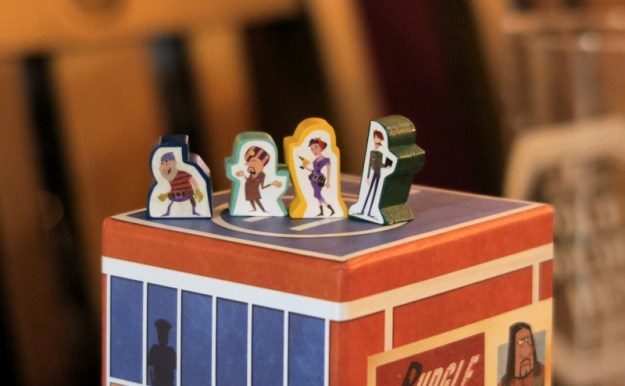
It had been a very enjoyable game, and given its success, the group went on to play another of Teal’s UK Games Expo acquisitions—Burgle Bros..  This is a cooperative game, a style the group traditionally eschew, though recently have played more often (including Scotland Yard last year, The Lost Expedition about six months ago, Zoo Break twice in quick succession, and Forbidden Dessert a couple of weeks ago).  Burgle Bros. works in a similar way to the other games of this type.  Players are a team of robbers, attempting to enter a building from the ground floor, raiding the safes on each floor before escaping by helicopter from the roof.  In addition to finding and cracking the safes, players also have to avoid the Security Guards that patrol the building.

Burgle Bros.
– Image by boardGOATS

In the game, players each have three Stealth tokens. Whenever they are on the same tile with a Guard, they lose one and if any player is caught without a stealth token, the game is over.  On their turn, players have four actions (move, preparing a safe for cracking by putting some dice on its tile, rolling dice to attempt to crack the code etc.).  Once the player has taken their turn, the Guard takes their turn, moving towards their target room (assigned by the route deck and marked with an orange die).  So to win, players first have to find the safe and then crack the code and all without triggering the motion detectors, heat sensors, fingerprint scanners, laser fields, open walkways, deadbolt rooms, and of course avoiding the guards…

Burgle Bros.
– Image by boardGOATS

The group decided to play on the beginner’s level which meant they only had two floors to explore before they could escape the building.  They got lucky right at the start as they popped up from the ground floor right next to the safe. That meant they only had to reveal all the orthogonal tiles and then roll dice to match the code. They were luckier still as the security guard was on the other side of the building and there were very few walls obstructing their way.  As a general rule, cooperative games of this type give each player unique special powers and using these effectively is usually critical to success.

Burgle Bros.
– Image by boardGOATS

So, Pink (who was “The Hacker” and didn’t trigger alarms) was sent off to reveal tiles while Blue (“The Spotter”) started setting up the safe for Lime, who was “The Peterman” and got to roll an additional die when trying to crack the safe.  Before long, things on the first floor looked pretty much under control with just the last few numbers left to crack the safe, so Teal (“The Juicer”) took himself off to the second floor to start hunting for the safe there.  This was a risky strategy as it triggered the Guard moving on the second floor.  However, with fewer people on both floors, the Guards effectively moved slower and gave players more chance to avoid them.

Burgle Bros.
– Image by boardGOATS

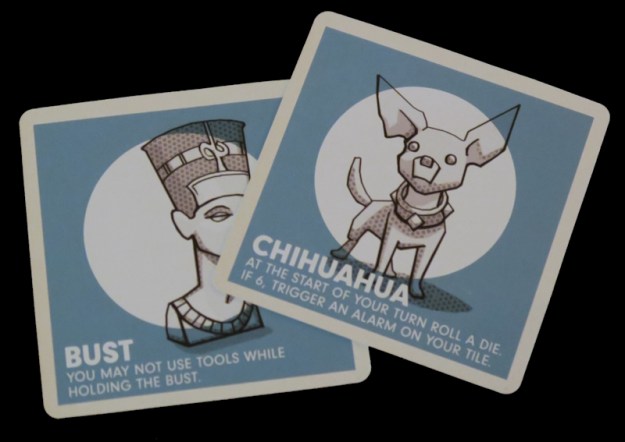
Things were slightly more challenging on the second floor—the Security Guard was a little more proactive, stepping it out more and, of course, the group didn’t find the safe at the top of the stairs this time.  It didn’t take him long to find it though, and with nothing better to do, Pink joined Teal on the second floor, ducking under the risky laser trap at the top of the stairs.  Meanwhile, Lime had finally managed to crack the safe, so Blue headed up the stairs only to find the second floor security guard heading her way, so she escaped to the roof toting their loot (a very annoying large and heavy bust and a particularly yappy dog) .

Burgle Bros.
– Image by boardGOATS

There was a bit of shenanigans as Lime joined Teal and Pink and also dodged the Security Guard (and lost a couple of Stealth tokens), but although there were a couple of near misses, it wasn’t long before all four were on the roof awaiting their lift to safety.  It was another fun game, but with time marching, Lime and Teal headed for home, leaving Blue and Pink to join Jade, Purple and Black who were still waiting for Tapestry to finish.  It was nice to chat though, and eventually Tapestry did finish and everyone who needed one got their lift home (without having to climb on to the roof…).

Burgle Bros.
– Image by boardGOATS

Learning Outcome:  New games are fun, but there are lots of good, slightly older games to be had as well at places like Expo.

13th June 2023

Lime was first to arrive, soon followed by Blue and Pink, and then Pine who were all delighted to see the return of our favourite bar staff.  There was a lot of chat about the recent changes at The Jockey (which is currently managed by the Healy Group who also run the Punch Bowl in Abingdon), and as everyone else arrived, people seemed more interested in gossiping than playing games.  It was a relatively quiet night with quite a few people away.  Black and Purple sent a message to say they were thinking of us, but when Green received a photo from Black and Purple of their current view, it just made everyone else jealous.

Black and Purple in Cornwall
– Image by Black

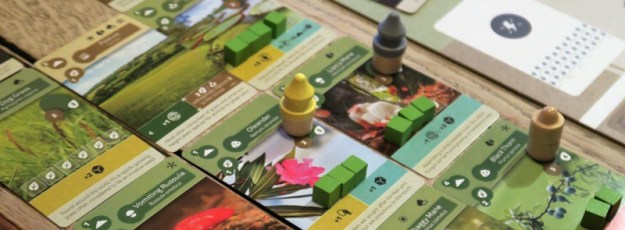
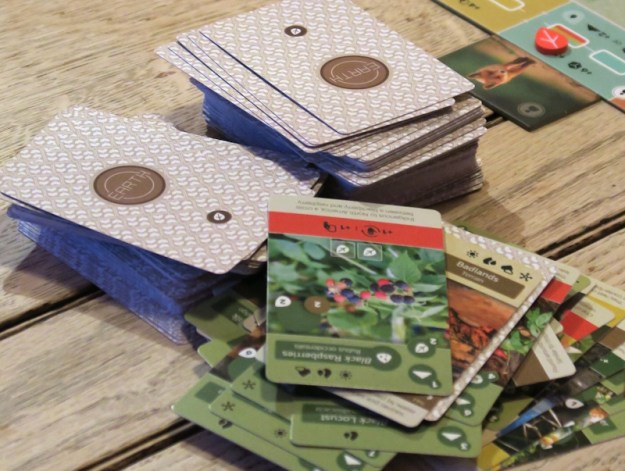
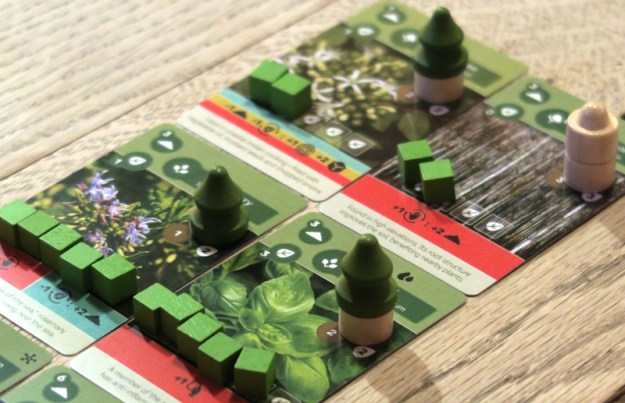
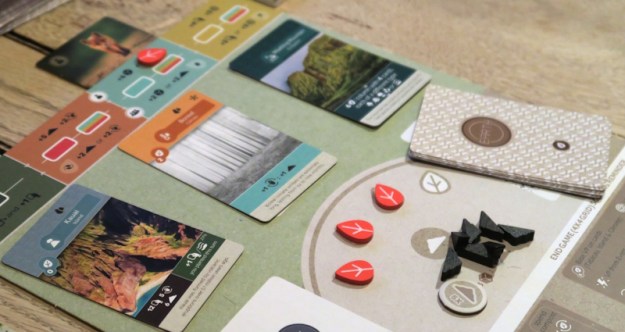
Jade arrived with his shiny new copy of Earth which he’d picked up from UK Games Expo.  It is a game where players are building themselves an ecosystem and was to be the “Feature Game“.  Earth is a sumptuously illustrated, card-driven engine-builder that is often compared to Wingspan.  We played that Last time after a bit of a break, and remembered how much we liked it, so had decided to give Earth a go this time.  The heat was getting to some people, but Ivory was quite keen to give Earth a go, and they were soon followed to the next table by Green (who had played it online) and then Teal.  Everyone was pretty new to the game:  Ivory and Teal had not played it before and Green and Jade had only played a couple of times.

Earth
– Image by boardGOATS

Although there is a lot to explain before starting, Earth itself is not actually all that complicated. Players are building a four by four grid of Flora and Terrain cards which represents their island and during the game they will plant flora, water it and allow it to grow.  On their turn, players do one of four things: Planting (paying the cost in Soil tokens), Composting (gaining Soil and placing cards from the deck in their discard pile), Watering (place Sprouts and gain Soil) & Growing (draw new cards and place growth tokens).  A bit like Puerto Rico, once the active player has chosen which action they are taking, everyone else gets to do a subsidiary, slightly weaker version of the same action.  For example, when Planting, the active player plants two cards, draws four and keeps one, while the other players plant one and draw one.

Earth
– Image by boardGOATS

Once everyone has completed the action for the turn, everyone activates all the cards in their island that match the colour of the action chosen, starting with the card in the top left and working across each row in turn.  This means, not only is it important which cards are played, but also where they are located in the player’s island.  At the end of the game (triggered when one player has completed their island), players score points for each flora card, any Trunks and Canopies they have grown, their Sprouts and their pile of “Composted” or discarded cards.  Players also score points for achieving objectives on the Fauna cards revealed at the start of the game and for completing their island first.

Earth
– Image by boardGOATS

As in Wingspan, Flora cards have actions that take effect when they are planted and when activated, many of the Terrain cards have ongoing effects and/or end-game scoring opportunities.  When Planting, players must place the cards either orthogonally or diagonally adjacent to an existing card, and although they can never exceed a four by four grid, like in Kingdomino, players can extend on either side of their island until the maximum size is reached.  Each Flora card has a maximum growth and when this is achieved the final wooden Growth token placed on it is a Canopy showing it will score extra points at the end of the game.

Earth
– Image by boardGOATS

The challenge in Earth is really in deciding what actions to do and which cards to play into your tableaux.  Teal found that simply building his tableaux was enough to think about without considering the extra goal cards and end game scoring.  Jade and Green both agreed that was the same for their first game too.  Ivory started and played his first few turns, selecting the green Plant action, so his tableaux filled up quickly. The rest of the group needed to choose other actions in order to get the soil and cards to play, so by the time it came back to ivory he was able to plant again.  He had already had his eye on the bonus cards and was quickly planting as many cards as he could, successfully—he was the first to claim a bonus.

Earth
– Image by boardGOATS

Green started with a high scoring climate card which gave him fewer cards at the start, but better in game bonuses, an approach to the game that nearly paid off. He went for the brown scoring cards, but Ivory just pipped him at the post for that particular shared bonus, which helped up his score as well.  Teal spent the first half of the game, learning and began to fall behind.  It wasn’t until Ivory claimed the first shared bonus that he remembered those cards.  Early on he gained lots of Sprouts which are worth points, however, it is possible to gain a whole lot of Sprouts in the latter stage of the game and use those early actions for other more beneficial things.

Earth
– Image by boardGOATS

Jade was quietly working away to build a tableaux engine that worked for him, but was falling behind Ivory and Green on the shared bonuses.  Jade managed to pick up some of the Fauna bonuses later, but mostly after the others so they weren’t as highly scoring.  Green went for brown scoring cards because he kept picking them up from his nearest pile (there were two draw piles), and eventually reverted to the other pile to find green Flora cards.  Unfortunately, he just couldn’t find the double powers he needed for the shared bonus.  On the opposite side of the table, Teal didn’t come across any brown scoring cards, only realising why at the end of the game—it seams the shuffling had left something to be desired. The Event cards also seemed to be clustered towards the bottom of the draw pile.

Earth
– Image by boardGOATS

Ivory came out on top with a very high score of two hundred and thirty-six with Green just eighteen points behind and Jade in third.  There was much discussion about similarities between Earth and other games. Green felt it was similar to Terraforming Mars, the others thought it was more like Wingspan.  After some thought, Green came round to this idea as it is about playing cards which then provide  more actions and bonuses that can be played on those cards (eggs in Wingspan, Sprouts in Earth; tucked cards & cached food in Wingspan, Growth in Earth).  The others could also see Green’s thoughts about Terraforming Mars though as the game has lots of pretty and individual cards that can be played or rejected, with some providing actions, some bonuses and the all important Events.  Everyone really liked it and definitely wanted to play it again, though better shuffling would be a good idea.

Earth
– Image by boardGOATS

Meanwhile, the rest of the group carried on chatting all agreeing they should play something, but nobody terribly keen to commit to anything.  Eventually, Blue suggested Bohnanza, and as Pine agreed, Pink had to go along with it.  This is an old favourite, though Pink had gone off it a bit as he felt he always did badly—unfortunate really given the number of copies of the game that he owns.  The game is very simple:  keeping their cards in the order they are drawn, players must plant the first bean card from their hand and may plant the second if they have space.  They then turn over the top two cards from the deck and can play these or trade them as they prefer.

Bohnanza
– Image by boardGOATS

Finally, once both of these have been planted, the active player may trade cards from their hand before drawing three replacement cards.  Players can harvest their Bean Fields whenever they like, but the amount of money they get depends on how many Bean cards it has in it and what the beans are—scarce ones give a better return, but are harder to get.  Everyone knows the game quite well, though Lime had recently acquired and been playing a new anniversary edition and it seems some of the rules are slightly different for that.

Bohnanza
– Image by boardGOATS

This time, everyone bought a third Bean Field (which makes it easier to hang on to the rarer beans a little longer).  Indeed, Lime was so determined to use his, he ended up not trading, just so that he had something to plant!  As usual it was quite a close game with fine margins.  So little things like Blue harvesting her Red Beans only to immediately draw another and Pine gifting Pink a Wax Bean or Lime trading with Pine instead of Blue made a difference in the final score, though nobody knew it at the time.  Ultimately, Pink was the victor, beating Blue by just two Bean Thalers with Lime a couple behind her in third.  On the plus-side, Pink can’t complain that he never wins any more.

Bohnanza
– Image by boardGOATS

Earth was still underway, and for once in a way, Bohnanza had played relatively quickly, so there was plenty of time for something else.  Nobody was very focused, and eventually the group settled on the cooperative game, Forbidden Desert.  This is a sort of sequel to Forbidden Island, which itself is a simplified version of the popular gateway game, Pandemic.  All three of these games use the same mechanism as Zoo Break, which we played recently.  Essentially, the active player carries out actions and then they reveal cards from a deck which generally make life difficult: releasing wild animals, causing the island to gradually sink, spreading disease, or in the case of Forbidden Desert, burying the play area with sand.

Forbidden Desert
– Image by boardGOATS

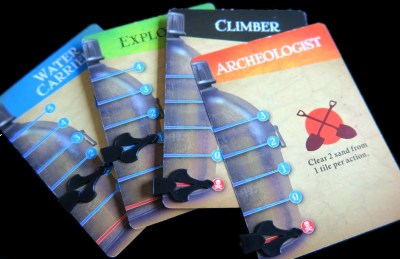
The premise of Forbidden Desert is that the team have crash-landed in the desert and need to find the components of a flying machine and take them to the launch pad to escape.  The game is played on a five by five grid of square Tiles, with a gap in the centre representing the sand storm.  Each player has a character with special powers.  This time, Lime was the Climber, Pink was the Navigator, Pine was the Explorer, and Blue was the Water Carrier.  On their turn, players can take up to four actions:  Move (one action per Desert Tile), Remove Sand from the Desert Tile they are on or an adjacent one, Excavate a Desert Tile (i.e. turn it over), or Pick up one of the four component parts of the flying machine.

Forbidden Desert
– Image by boardGOATS

Lime started.  Once he had cleared some sand and turned over a couple of Desert Tiles, he started turning over Sand Storm Cards.  These indicate which direction Tiles should move to fill the hole, and how many Tiles should be moved, one, two or three.  Each of the Desert Tiles moved then have a Sand Tile placed on them—a single Sand Tile needs to be cleared before the Desert Tile can be Excavated, but two or more additionally obstruct players preventing them from passing (except for Lime who, as the Climber, can cross Sand Dunes of any height).

Forbidden Desert
– Image by boardGOATS

Pine went next and used his special ability—everyone else could clear orthogonally adjacent Tiles, but he could to work diagonally as well.  It wasn’t long before the first “Sun Beats Down” card appeared.  These cause everyone to use water, so as the water carrier (and the only one who could make multiple visits to the Oases and collect water, Blue topped up Lime, who had started with less water than everyone else.  The group gradually started revealing tiles, finding a Duneblaster, a Solar Shield and a Time Throttle, but the Storm picked up and before long the group were turning over more Sand Storm Cards.  Pink located the Propeller for the flying machine and then the engine, the group were making progress, but it was all too slow.

Forbidden Desert
– Image by boardGOATS

Before long it became apparent that the Sand Storm was getting the better of the group and the hiding in the Tunnels wasn’t helping.  Determinedly, the group fought against the rising tide of Sand making good use of their Duneblaster, but it only delayed the inevitable.  Blue, Pine and Lime were discussing a plan to play a Storm Tracker, but when they were briefly side-tracked, Pink played on without it and everyone suffered as a result.  So Pine labelled him as a Saboteur as a consequence.  In such a finely balanced game at such a critical point, it could have made a difference, but in all probability it only hastened the inevitable demise as the group were sadly buried under the ever growing sand dunes and ran out of Sand Tiles (one of the end game conditions).  It was a deflating end to the evening, but given the heat, probably appropriate.

Forbidden Desert
– Image by boardGOATS

Learning outcome:  Shuffling is an important skill.

2nd May 2023

Blue and Pink were the first to arrive and were just finishing their supper when Magenta walked in—sadly not to join in the games as she was there for a Scout meeting.  After a quick chat, she left and as Blue recapped the rules for the “Feature Game“, Zoo Break, Teal arrived and then Purple and Black.  The group had just decided to play Alles im Eimer (aka The Bucket King), when Ivory rocked up to make the full compliment of six.  Purple explained the rules with help from Black.  The idea is very simple:  each player builds a pyramid of ten bucket tokens with two of each of five colours.

Alles im Eimer
– Image by boardGOATS

One player starts, playing a coloured, numbered, animal card and each player has to follow with the same colour and a higher number before picking up a card.  Players can play multiple cards to make the total, but they only ever receive a single replacement card.  If they can’t, or choose not to follow, they lose a bucket of that colour, and any buckets above it.  Worse, if they split their pile of buckets in two, they lose one part as players can only ever have one pile.  On the plus-side, if a player can’t play (or chooses not to), they then lead with a free choice of colour and number.  The last player with buckets still standing is the winner.  With Purple shuffling, Ivory was the first to play.

Alles im Eimer
– Image by boardGOATS

It turns out that there are two things that are really critical in this game.  Firstly, how players stack their buckets—it is not as simple as playing to their hand strengths; the smart player also spreads the colours out a bit so they aren’t forced to take buckets from low down when the unexpected happens.  Secondly, as Ivory pointed out, like 6 Nimmt!, it is all about timing, which is something players may not have control of.  A few rounds in, Black spotted that Pink to his left still had a complete stack where bucket piles had been falling all over the place everywhere else.  So, Black made it his business to make Pink’s life difficult.  From there, it was gloves off and the buckets really started to tumble.  Purple was the first player to kick the last of her buckets over which left Blue to do what she could to damage Ivory’s largely unscathed pile.

Alles im Eimer
– Image by boardGOATS

Black, then Blue, then Teal, all fell, leaving just Pink and Ivory to fight it out.  With Pink’s dwindling pile, it always looked an uphill task, and so it proved, with Ivory taking victory with five buckets still standing.  By this time though, Lime and Green had arrived and with eight, the group split into two tables of four, the first for the “Feature Game“, Zoo Break.  Pink was nearly lured away at the suggestion that the alternate might be Takenoko, but despite being very torn by his love of pandas, he stuck with his original panda driven choice and was joined by Blue, Lime and Black as Keepers at Bedlam Zoo.

Zoo Break
– Image by boardGOATS

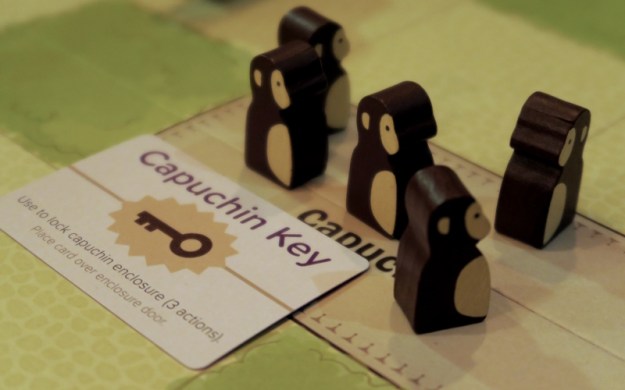
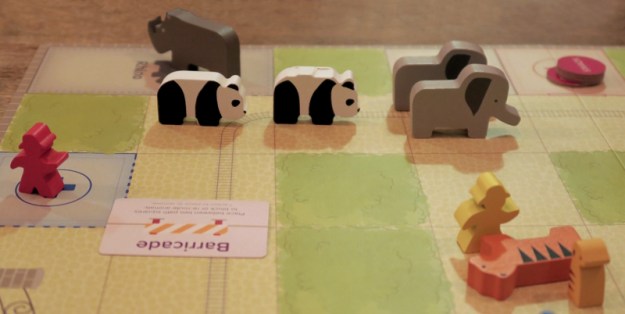
Zoo Break is an apparently light cooperative game where players are a team of zoo-keepers trying to prevent a mass break-out.  The mechanism is quite simple:  the active player rolls a die to decide how many Action Points they get, then they carry out actions, before drawing an Escape card and a Move card (to see what animals escape and move).  The game ends when either a dangerous animal (tiger, elephant, or dangerous snake) escapes, or when the fifth cute animal (panda, Capuchin monkey, meerkat or harmless snake) exits the zoo, or when there are no animals roaming about and all the cages are locked up.

Zoo Break
– Image by boardGOATS

Although the mechanism of Zoo Break is very straight-forward and the art-work implies it is a simple kiddies game, nothing could be further from the truth.  The rule book is twenty pages long, and there are a lot of details regarding escaping and recapturing animals.  For example, when an animal escapes, it doesn’t just move to the space immediately outside its Enclosure, it moves to the nearest “open” space.  Also, different animals are recaptured using different tools which have to be acquired from the supply by the Keepers.  For example, a Net can be used to capture meerkats or monkeys, while a Leash is required for pandas and elephants, and tigers need to be Tranquilised and Stretchered home (very carefully, obviously).

Zoo Break
– Image by boardGOATS

Each Keeper has a different skill.  This time, Blue had the ability to reveal snakes and capture animals from adjacent spaces (especially useful for dealing with snakes); Pink could run faster than anyone else, moving two spaces for each action point (instead of the usual one); Black, the Gardener, could move through and hide in bushes, and Lime could re-roll the die twice to try to get additional actions.  From experience with games like Forbidden Island and Forbidden Desert, the key is almost always to make good use of these special powers.  So Blue suggested she made it her business to concentrate on dealing with the snakes since she could do so without being bitten.

Zoo Break
– Image by boardGOATS

Pink with his Panda obsession, was always going to go after them, and everyone else was happy to let him get on with it.  Before any of that could happen though, the Keepers needed Supplies.  Pink started, and went straight to the Supply shed and started revealing tools.  These are drawn from a face down pile, but Keepers only have space to carry four tools in their backpack, so can choose only to take the ones they want.  This was probably the team’s first mistake:  instead of the few players just searching the whole Supply pile and making a discerning choice while taking as much as they could carry, players grabbed a couple of items and headed off.

Zoo Break
– Image by boardGOATS

This became a problem later in the game when the Keepers realised they didn’t have tools and were now on the other side of the board.  Black who had drawn the meerkat enclosure key headed off to the far corner to lock it quickly.  Lime captured the only roaming meerkat (which had been playing in the fountain) and Black was just about to lock the cage when another one escaped.  As he didn’t have a Net, despite being in the same space as it, he was left chasing about trying to grab it unsuccessfully.  And then more meerkats got out.  So Lime, Keeper without portfolio (but with both a Net and a Leash), waged war on the disobedient meerkats, while occasionally taking time out to catch an elephant or a monkey.

Zoo Break
– Image by boardGOATS

Pink, meanwhile, had his panda enclosure Key and a Leash and was trying to do something about them, but was inconvenienced by a pair of elephants, one of which knocked him flying necessitating a visit to the Medic.  Lime captured the last of the Capuchin monkeys and Blue who was close at hand with the enclosure Key managed to slam the door shut before any more got out—just as well, as the snakes were beginning to get out of hand, and as for the meerkats, well, these little blighters were causing mayhem.  Twice the Keepers had them under control before more escaped, and as they formed a long queue, the queue kept getting longer and longer as they marched inexorably towards the exit.

Zoo Break
– Image by boardGOATS

Pink used the Barricade to delay the escape of a couple of pandas and the pair marauding elephants, but it failed to hold when the Broken Barricade Move card appeared.  The rhino’s occasional charges weren’t much of an issue as they were very predictable, but once animals started to get close to the exit the rhino became more of a problem as players stayed out of its path wasting Action Points.  By this time, the tigers were becoming a problem, but Pink and Black put their Tranquiliser darts to good effect and soon the zoo was littered with sleeping tigers.  Lime had a Stretcher, but never actually used it, briefly loaning it to Blue for the only tiger returned to its enclosure (and left to peacefully sleep off the after-effects, as per one of the new variants).

Zoo Break
– Image by boardGOATS

There was a bit of a debate over whether it was more important to work on the rogue pandas or let them and meerkats escape and focus on the dangerous animals (in particular tigers and elephants).  Slowly but surely, however, the animals were taking over as there was a little procession of Keepers at the Medic’s tent, with only Lime avoiding injury.  Black was the only player to make use of the Train, because it didn’t really go where people wanted it to and players dealt with the issues nearest to them.  That was probably a good strategy; like it says in the advice, it is also important to lock stuff up early—the team didn’t.  They dealt with the monkeys, but the only other enclosure they managed to lock was the pandas, just before two meerkats and a cobra made a run for it in a single turn.

Zoo Break
– Image by boardGOATS

Although the mass escape had caused the zoo to be closed down and Pink hadn’t actually been cuddled by a panda, everyone had really enjoyed themselves.  On reflection, working in pairs might have worked better (as with Flash Point and Escape), because then the team can do things much quicker, get on top of things and lock cages making life easier all round.  Black was curious about the variants available.  The group had played on “Standard” difficulty with two “Phew!” Escape cards (where nothing gets out), but thanks to a rules malfunction, had also included the blank cards in the Move deck which provided quite a bit of respite, so everyone had a good laugh at the idea of making the game harder.

Zoo Break
– Image by boardGOATS

Despite the fact the group rarely plays cooperative games, everyone was keen to give Zoo Break another outing soon.  Zoos were popular elsewhere too—the next table had been playing New York Zoo.  This is a tile-laying game that got its first Tuesday outing only a few of weeks ago, but had been enjoyed by all.  In this game, players add pens to their zoo, populating them with animals, and building attractions.  Like Uwe Rosenberg‘s other similar games (including Cottage Garden, Spring Meadow, Indian Summer and Patchwork), it is Tetris-like but what makes this one unique and interesting is the Market.

New York Zoo
– Image by boardGOATS

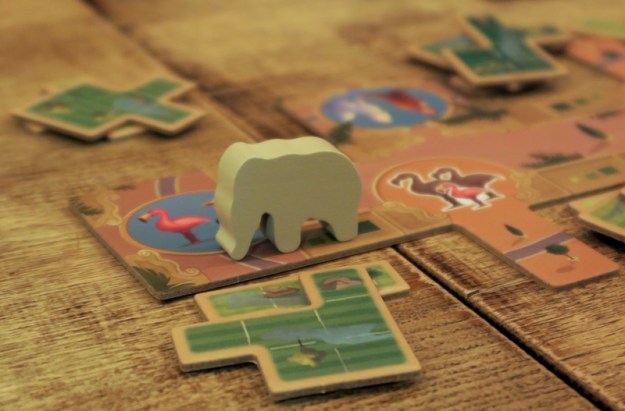
Players move the Marker Elephant one to four spaces round the Market, landing either on an Enclosure tile space (taking the top one and adding it to their zoo) or on an animal space (taking one or both of the animals depicted). Enclosure tiles can be placed anywhere in the player’s Zoo, then one or two identical Animals from elsewhere in their Zoo must be moved to occupy the Enclosure.  Each Enclosure can only hold one type of Animal.  When there are two or more Animals in an Enclosure together they breed when the Elephant passes the Market’s breeding spaces.

New York Zoo
– Image by boardGOATS

When an Enclosure is full, all the animals are removed and the player takes an Attraction tile of their choice and adds it to their Zoo.  Attraction tiles are useful because they fill additional spaces, and at its heart, New York Zoo is a race game—the winner is the first to fill all the spaces in their Zoo.  Purple had played last time, and Green had played elsewhere, however, Ivory and Teal were new to the game and the rules needed explanation.  That didn’t take long though, and the Elephant was soon touring the market and everyone was building their zoo and adding animals.

New York Zoo
– Image by boardGOATS

Purple was quick to get going, as was Green.  New York Zoo is really a tactical game, but there are a couple of broad strategies—fill the zoo with large Enclosures that are harder to fill, but occupy more space, or fill it with smaller Enclosures which are easier to fill with animals giving bonus Attraction tiles.  Purple went for the latter approach, getting some of the large attractions early in the game.  Teal however, opted for the former strategy, which is harder to get to work, but can be extremely effective, as indeed it was this time, making him the first to finish his zoo, and with no Attractions at all.  Purple was the best of the rest with for spaces left to fill, with Green a little way behind.

New York Zoo
– Image by boardGOATS

The Keepers in Bedlam Zoo on the next table were still trying to get the marauding beasts back in their pens (largely unsuccessfully) so the others had to decide what to play.  Green decided to go home, and couldn’t be persuaded to stay by the opportunity to play Nidavellir despite having been very keen to play it previously.  That left Purple, Ivory and Teal, who decided to play it anyhow.  Nidavellir is a card set-collection and bidding game inspired by Norse myths. The game was created by French designer Serge Laget (who sadly passed away in January this year after a lifetime of producing some great games) and the striking black and white artwork by Jean-Marie Minguez which nicely contrasts with the coloured cardboard components.

Nidavellir
– Image by boardGOATS

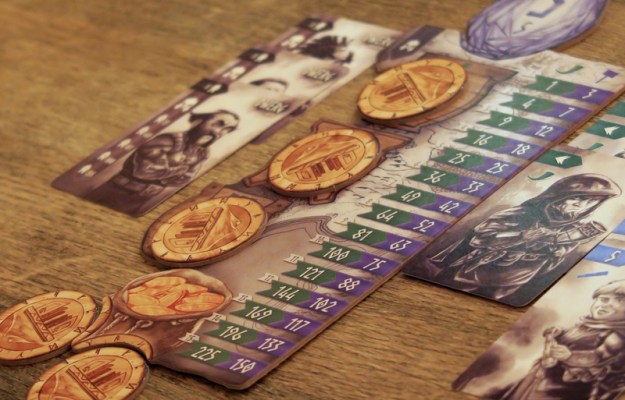
The story behind the game is that the kingdom of Nidavellir is under threat from the stirrings of the Dragon Fafnir and players are tasked by the King to recruit the best army to defeat it. Appropriately for our venue, the action takes places in three Dwarvish pubs where the players must use their coins to bid for the most skillful Dwarves (in a concealed auction), recruit the most prestigious Heroes, and build the best Battalion they can to defeat the Dragon.  Players hire five different professions of Dwarves into their growing army – Warriors, Hunters, Miners, Blacksmiths and Explorers.  Each player starts with five coins with the values: zero, two, three, four and five. Players place one of their coins against each pub space on their player mat.  The coins are revealed and cards are taken from each pub starting with the highest bidder.

Nidavellir
– Image by boardGOATS

Ties are broken in favour of the player with the the highest jewel token (randomised at the start) and then these players swap jewels so the losing player has an advantage next time there is a draw. Once the three pubs have been resolved, players take back their coins, and place their cards in their tableaux.  At the game end, points are awarded in different ways for each group of Dwarves.  For example, Hunters provide points based on the number of cards squared, Blacksmiths score according to the triangular sequence (as used in Coloretto), while the Navigators are simply a total of the number of points printed on the card, and so on.  Each round of the game, random face-up dwarf cards are lined up by each pub (equal to the number of players) and players bid for their order of selection.

Nidavellir
– Image by boardGOATS

If a player plays their “zero” coin, the values of the two unused coins are added together, the highest of the pair is discarded and a new coin of the same total is added to their stash from the Royal Treasure. Thus, players can gradually increase the value of their coins, which is useful for out-bidding others, but also adds value as the total coin hoard is added to their final score.  Hero cards, which supply additional points bonuses in a variety of ways are awarded when a player manages to have five cards of different type and then each time a new set of five is achieved. Heroes are selected from, a separate deck which allows for further point scoring combinations.  The start was a little slow as Purple and Ivory were both new to the game and had to figure out what to do.

Nidavellir
– Image by boardGOATS

Teal and Ivory both started by upgrading their coins.  Ivory was the first to get a set of five cards and claimed one of the Dwerg Brothers as his Hero giving him the target of collecting the other brothers which greatly crank up the points the more that are collected.  Teal, who had played the game before, chose more complex Heroes.  Half way through the game, Purple took the King’s Hand and the King’s Great Armourer Heroes for having the most Warrior and Blacksmith cards, while Teal took the Hunting Master and Crown Jeweler (for the most Hunters and Miners respectively), leaving Ivory just the Pioneer of the Kingdom (for the most Explorers).

Nidavellir
– Image by boardGOATS

The second age (played with a new deck of cards), was similar to the first, with particular tight battles around getting cards to complete sets.  Ivory had a slight advantage in this, having upgraded his coins more aggressively early in the game, and used this to get more of the Dwerg Brothers.  In contrast, Purple and Teal focused on collecting Dwarves of one kind with Teal using his Heroes to add to their “count” in particular colours when completing a set.  In the end, Purple and Teal scored best for Blacksmiths and Hunters, while Teal also took lots of points for his Miners—something he had focused on from the start.

Nidavellir
– Image by boardGOATS

Ivory however, had more Warriors and having the majority of them meant he could add the value of his most valuable coin to his score.  Despite that and over a hundred points for his Dwergs, Ivory finished just shy of Teal’s winning total of two-hundred and seventy-seven.  The downside of his victory—the winner has to face the Dragon Fafnir!  All agreed it was a good game, not overly complex, but with lots of decisions to make; a game that didn’t out stay its welcome finishing within the forty-five minutes advertised (even with two first-time players).

Nidavellir
– Image by boardGOATS

Learning outcome: Always keep a close eye on your meerkats.

9th July 2019

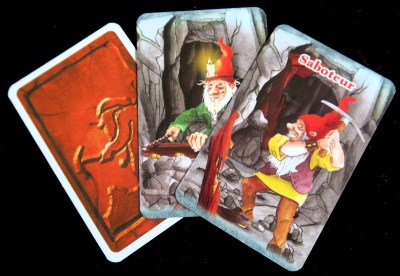
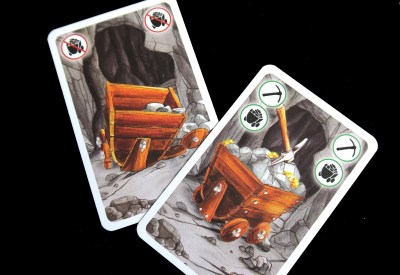
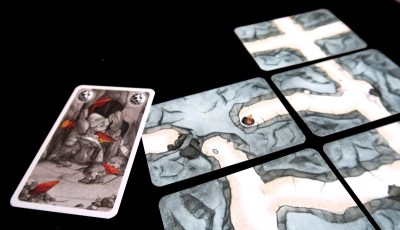
The pub was madly busy thanks to a boisterous party and a couple of large groups in the bar area, so we decided to start with a game while we waited for food.  The “Feature Game” was to be Forbidden Desert, but as most people were waiting for food, we decided to start with something we could play as a group.  6 Nimmt! was the first suggestion, but in keeping with the cooperative game theme of the Feature, we decided to start with Saboteur.  In this game, players are either Dwarves or Saboteurs, where Dwarves are collectively trying to dig a tunnel to find the Gold, while the Saboteurs are trying to stop them.

Saboteur
– Image by boardGOATS

On their turn players can play a tunnel card to extend the network, play an action card or discard a card and pass. Action cards come in several flavours.  There are red and green tool cards, with red broken tool cards stopping others from digging and green “fixed” tool cards that repair broken tools.  There are map cards that allow players to peek at one of the three target cards to see if it holds the gold, and rock-fall cards that enable players to remove a single card  from the tunnel network.  All the action cards can be used by Dwarves and Saboteurs alike to impede the other team.

Saboteur
– Image by boardGOATS

Black was the first to play and began ditching all his rubbish blocking tunnel cards while Pine started off by explaining how Burgundy was always a Saboteur and generally made Burgundy’s life a misery by besetting him with broken tools and reminding everyone how last time we played Burgundy was a Saboteur three times running.  This time, we had more players, but it wasn’t long before it became clear that Burgundy was indeed a Saboteur, along with Lime, who was playing it for the first time and was not at all secretive of his position.  Eventually, Red found the Gold on behalf of the Saboteurs, and Black was outed as the third and final Saboteur and had apparently all the cards he had been discarding had been good tunnel cards not bad ones.

Saboteur
– Image by boardGOATS

The rules as written state that there should be three rounds and players pass gold cards around in an effort to determine who will be the overall winner.  We don’t think the game needs a winner in this way, so we play with a “house-rule” that treats each round as a game in its own right.  This way, we can stop at two games if it is beginning to outstay its welcome, or carry on and play three or even four rounds, giving more people to join Burgundy as Saboteurs.  Everyone had really enjoyed the first round and was keen to go again, so cards were handed out and Pine once again accused Burgundy of a “Saboteury” first move.  Blue had loads of blocking cards, but after Black had spent almost all the previous round dumping cards, didn’t dare pass for fear that she would be accused of being a Saboteur.

Saboteur
– Image by boardGOATS

Blue asked everyone else for advice and Red suggested that the one thing she could do to convince her that she was a Good Little Dwarf was play a blocking card on Burgundy, which she obligingly did.  It didn’t work, however, and it wasn’t long before Red declared Blue a Saboteur.  In frustration Blue showed Red all the blocking cards she had and that seemed to stem the tide of accusations, at least for a few turns.  With Burgundy buried under a pile of broken tool cards, his delight was evident when Blue revealed her true colours and played a disruptive blocking card.  It was just a smidge too late though and Black brought the round to an end by finding the Gold.

Saboteur
– Image by boardGOATS

By this time food had been ordered, but was not looking like it was going to arrive immediately, so we decided to see if Burgundy could make it three in a row again.  Inevitably, we were only a couple of turns in, therefore, when food turned up and the tunnel network was obstructed by Purple’s enormous bowl of mushroom tagliatelle.  Pine confused everyone by indicating his position early, playing a blocking card right in the middle of the map.  Perhaps it was the difficulty of playing round a plate of pasta, or perhaps her mind was just elsewhere, but a very curious card placement quickly led to Purple being labeled as a Saboteur joining Burgundy and Pine.  Flying well under the radar, if only the real Saboteurs had had helpful cards to play then they might have won, however, it was not to be.

Saboteur
– Image by boardGOATS

It turned out that Blue and Black were once again the real Saboteurs (along with the more obvious Pine), but frustratingly there was nothing they could do and Red once again finished the round by finding the Gold for the Dwarf team.  By this time everyone was very hungry, so food mostly disappeared quite rapidly and while Black, Purple and Burgundy dealt with their last few mouthfuls, Blue, Lime, Pine and Mulberry took themselves off to the table by the door (ostensibly to get space to play, but partly to take advantage of the respite the cooling draught offered from the humidity), to play the “Feature Game”, Forbidden Desert.

Forbidden Desert
– Image by boardGOATS

Where Saboteur is a “semi-cooperative” game because it has a traitor mechanic, Forbidden Desert is a fully cooperative game.  This means everyone plays together against the game, with the same goal.  The story is that a helicopter has crash-landed in the desert, and the survivors, in our case, an Archaeologist, a Climber, an Explorer and a very well behaved, cooperative, er, camel (“Water Carrier”), must try to find the buried, missing pieces of a historic air-ship, in order to escape.  This, with minimal water, the sun beating down and the growing sand-storm, means that players have to be quick in their hunt, and smart in keeping the keeping the storm from getting out of hand.

Forbidden Desert
– Image by boardGOATS

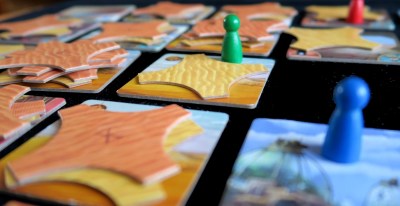
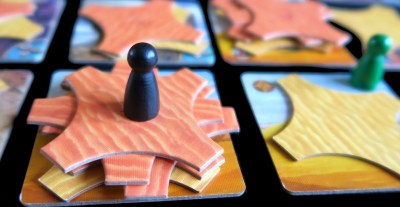
The game is played on a five by five grid made of twenty-four tiles and one gap.  The tiles all start face down and must be excavated to reveal their other side.  Some tiles will yield clues as to where the missing air ship parts are, others hide potentially useful equipment, while excavating others will yield a launch pad or the entrance to a tunnel.  Everything is useful, but all four pieces of the ship must be found together with the launch pad, before the players can escape.  On their turn players have four action points per turn which they can use freely to move, remove sand from the tile they are on (or an adjacent one), excavate a cleared tile, or pick up a piece of airship.

Forbidden Desert
– Image by boardGOATS

Once all four actions have been completed cards from the storm deck are turned over and tiles are moved in the direction indicated into the eye of the storm reflecting the shifting dunes.  As they are moved, sand tiles are placed on each one, building up the dunes and burying the antiquities in sand.  There is a finite number of sand tiles and running out triggers the end of the game with the team losing.  Running out of sand is only one way to lose however.  If any player runs out of water, the whole team loses, and the storm level increasing to its maximum also spells doom.  On the other hand, if the team manage to find all the parts and the launch pad, they will be able to escape from the desert.

Forbidden Desert
– Image by boardGOATS

One of the problems with cooperative games is “quarter-backing” also known as the “alpha gamer problem”, where one player takes control and tells everyone else what to do.  With Blue the only player to have played it before (though Lime had played Forbidden Island some time ago), it would have been easy for her assume the role of Colonel, but that sucks all the fun out of the game.  So there was a little discussion as to how we should approach the game (primarily trying to make the best use of our characters’ special abilities and trying to work quickly to excavate tiles) and then we started, with the storm level on “normal”.

Forbidden Desert
– Image by boardGOATS

The game began badly, when two of the first tiles we excavated were tunnel tiles.  These are very useful because players can use them to shelter from the sun and thus preserve water when a Sun Beats Down card is revealed.  They also enable players to travel from one part of the board to another in a single move.  Unfortunately, the tiles were adjacent which meant they were much less helpful than usual.  Prioritising, digging in order to find parts of the airship, the team found a lot potentially useful equipment, but it seemed ages before the first clue came up, a hint to where the propeller was buried.

Forbidden Desert
– Image by boardGOATS

The team soon found the second clue to the location of the propeller which turned out to be relatively conveniently located so Pine, the Climber, quickly picked it up.  It was then that Lime pointed out that the number of sand tiles available was getting critical, and something had to be done.  A couple of turns and concentrating on the sand problem and use of Mulberry’s Dune Blaster, helped, but a couple of Sun Beats Down cards in the meantime meant there was now a water shortage. so Pine and Blue (the Water Carrier), set out to rectify the situation.  Unfortunately, the first of the possible springs turned out to be a mirage.  While it didn’t lead to anyone running out of water immediately, valuable time and moves had to be used to excavate another tiles.

Forbidden Desert
– Image by boardGOATS

Once a spring had been found, Blue was able to top up her water supply and share water with Pine, before taking some back to the Lime and Magenta (who by this time was hiding in a tunnel to conserve her dwindling water supply).  With everyone settling into their roles and assuming the duties associated with their special abilities, it wasn’t long before the second part of the airship had been located.  Everyone had water and the sand situation was more or less under control, but it was all taking too long.  The storm had picked up and with it, the Sun Beats Down cards were coming round at an increasing speed.

Forbidden Desert
– Image by boardGOATS

Worse, the rate of sand deposition was also increasing. and it wasn’t long before the situation was getting desperate again, and clues to the location of the missing parts of the airship were proving impossible to find.  Forced into making difficult decisions, Pine and Lime started to take risks.  To begin with they seemed to pay off, but it wasn’t long before there was a succession of bad cards, culminating in two Sun Beats Down cards, and Pine and Lime who were left out in the sun ran out of water and sadly perished.  It had been good fun though and everyone had enjoyed playing, even though the team had ultimately failed to escape.

Forbidden Desert
– Image by boardGOATS

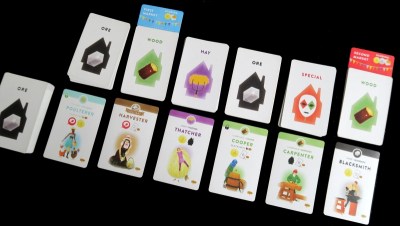
Meanwhile, the other group had been playing Villagers.  This is a new card drafting and tableau building game that first got an outing a few weeks ago and was so successful that Lime immediately bought himself a copy. The idea is that players take it in turns to take villager cards from the “road”, then add them to their village tableau.  Different villager cards have different advantages; some give money at the end of the game, while others enable players to draw more cards from the road per round or place more cards in their village per round.  The clever part of the game is the interplay between the cards caused by the conditions required before they can be played.

Villagers
– Image by boardGOATS

For example, a Blacksmith cannot be added to a village unless there is a Miner already present.  The cards are then played in a tree structure such that the Blacksmith is placed over the Miner card, superseding any icons depicted on it.  Many villager cards, especially the more valuable ones, also require a payment of two gold to another specific villager.  The money then sits on that villager card until a scoring round.  Ideally, the payment would be made to a villagers in the player’s own village, so that the money ultimately remains theirs, but if the active player does not have the necessary villager and someone else does then the money is paid to the opponent.

Villagers
– Image by boardGOATS

Like a lot of card games, there is a lot of luck in the game and there is a knack to surfing it.  Although many of the the group have played it before, Black had missed out, and he struggled waiting for a Grazier to become available.  In general, everyone went for a range of different types of villagers, everyone except Burgundy who went mad for Mining, because it “seemed like a good idea at the time”.  He started with a Seeker and then when he added an Ore Muler his income increased spectacularly and he looked like he was going to romp away with it.  Red and Black eventually managed to play Monks which helped to grease the wheels for them, but it was too late. Burgundy had the edge over Red in almost every department beating her into second place by twenty gold.

Villagers
– Image by boardGOATS

Villagers and Forbidden Desert finished at about the same time, and as time was getting on, Mulberry took Red home, and Pine and Lime didn’t want a late night so went their separate ways too.  That just left Blue, Burgundy, Black and Purple; Purple fancied a game of Bosk, and, as there wasn’t time to debate it, everyone else went along with her suggestion without debate.  This is a really pretty game, and although Black and Purple have played it quite a bit since they picked it up at the UK Games Expo, Blue and Burgundy were new to it.

Bosk
– Image by boardGOATS

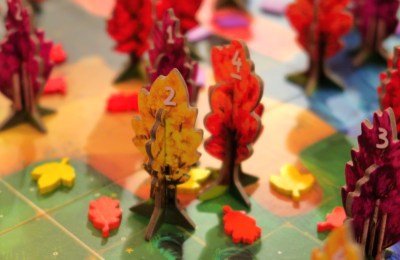
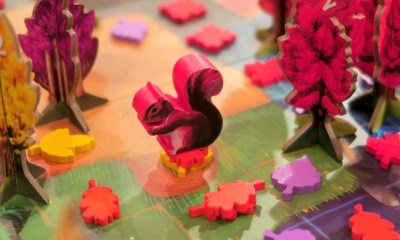
The game is played in two parts:  first players place their trees in the forest on a grid, then each tree sheds its leaves and players try to control where the leaves fall to give them the most leaves in each of the areas of the forest.  The first phase is really just an hors d’oeuvre; the second phase is the guts of the game.  At the end of the first phase, players score for having the majority in each row or column.  Purple was at the back, so went first in the second phase, and more importantly, the direction the wind goes in.  This is important because if the wind is in the wrong direction, any player with trees of the same number wedged up against the same edge  will find their options severely restricted.

Bosk
– Image by boardGOATS

An awful lot of time was spent by all staring at the board, but this is no hardship as it really is a very picturesque game.  Blue and Burgundy were feeling their way, but it was always advantage to Black with his greater experience.  In the end, it was surprisingly close, though that was possibly due to Blue confused by the “S-shaped” score board, screwing up the scoring.  The margin of victory was still significant though as Black finished with thirty-five points while Blue and Burgundy tussled for second place with thirty-one and thirty respectively.  It was then that the group realised the half hour game had taken twice that and everyone quickly left before they out-stayed their welcome and the landlord threw them out.

Bosk
– Image by boardGOATS

Learning Outcome:  Working together is fun, though it helps to know who is on  your side.

Boardgames in the News: Cooperation and the “Alpha Gamer Problem”

Competition is one of the main characteristics people associate with board games, however, in the modern world of Euro games, this is no longer true.  Firstly, one of the primary qualities of Euro games is the lack of “direct interaction”.  This means that although there is competition, it is difficult for players to be “nasty” to each other.  This is an important aspect of modern gaming as it takes away the aggressive element and makes them more inclusive, particularly for families.  These games still have winners and losers though, and while everyone likes winning, nobody likes losing and some people really, really hate it.  This is where “cooperative games” come in:  instead of players competing against each other, everyone works as a team, trying to beat the game.

Pandemic
– Image used with permission of BGG contributor kilroy_locke

There are now hundreds of cooperative games available, but although the first of these date back to the 1960s, the explosion really happened about ten years ago following the release of Pandemic.  Designed by Matt Leacock, Pandemic is a very accessible game where players are disease-fighting specialists whose mission is to treat disease hot-spots while researching cures for the four plagues before they get out of hand.  The game board features the major global population centres and on their turn, each player can travel between cities, treat infection, discover a cure, or build a research facility. The clever part of the game is the two decks of cards that drive it.  The first of these enables players to travel and treat infection, but also contains Epidemic cards that accelerate and intensify the diseases’ activity. The second deck controls the “normal” spread of the infections, with players drawing a set number of these, that increases when Epidemic cards are drawn.

Pandemic
– Image used with permission of BGG contributor kilroy_locke

Since Pandemic, a large number of cooperative games have been published, including Forbidden Island, Forbidden Desert and Forbidden Sky, all of which use cards in a similar way to Pandemic to increase the threat.  All of these have been designed by Matt Leacock and have a very similar feel, though a different theme.  There have also been a number of variations on the Pandemic game which retain the original theme, including the well-regarded Pandemic Legacy titles which change the feel a lot.  Other similar games by different designers include Ghost Stories, Freedom: The Underground Railroad and Flash Point: Fire Rescue, each with a different theme, but with changes to the mechanism (Flash Point for example uses dice instead of cards) and varying degrees of difficulty (Ghost stories played with four is supposed to be one of the most challenging games of its type to win).

Forbidden Island
– Image by BGG contributor DLCrie

Not all cooperative games are family friendly and accessible.  Arkham Horror is set in the H.P. Lovecraft‘s Cthulu mythos.  Each player is a resident of or visitor to the fictional town of Arkham, Massachusets during the 1920s and takes the roll of a character ranging from a gangster to a college professor.  The players discover a nefarious cult attempting to awaken a great evil, and, to prevent an invasion from other realms, they must seal off access to Arkham.  To survive, players must equip themselves with all manner of weapons, and spells, while searching for clues to aid them in their mission.  The game has a substantial rule set and the games are epic experiences which take four to five hours to complete (and are therefore not for the faint-hearted).

Arkham Horror
– Image used with permission of BGG contributor kilroy_locke

While there is plenty of variety available with cooperative games, there are two often cited problems.  Firstly, many players find that cooperative games lack “something”.  In reality, this is largely just a matter of taste, in the same way that some gamers feel that “Euro Games” lack something when compared with highly random dice-heavy games with player elimination.  Perhaps a more fundamental issue is that of the so-called “alpha gamer”. This is where one player effectively becomes the general, and tells everyone else what to do.  This problem arises because most cooperative games are essentially puzzles that can be solved by one player.  Some games designers have tried to fix this issue by adding hidden information, usually in the form of cards, and a rule that players cannot share such knowledge.  Simply instructing players not to share knowledge is much easier said than done, however, as even a slight inflection in the voice or a change of expression can give away a lot of information.

Hanabi
– Image used with permission of BGG contributor aleacarv

In 2013, a very simple, yet clever card game called Hanabi won the Spiel des Jahres.  The idea is that instead of every player looking at the front of their hand of cards and showing the backs to all the other players, hands are held the other way so that each player can’t see their own cards, but can see everyone else’s.  In principle this means players can discuss what a player should do, but a lot of information can be given away accidentally.  For this reason, the best, most intense games of Hanabi are played in near total silence and stony faced.  This is actually extremely hard to do, which is why for many, The Game, a similar cooperative card game nominated for the Spiel des Jares in 2015 has proved to have more longevity.  This is because players can discuss anything they like as long as they never give away specific number information.

Shadows over Camelot
– Image used with permission of BGG contributor kilroy_locke

One of the early cooperative games was Shadows over Camelot, which is a hand-management and deduction-based board game where players are knights of the Round Table collaborating to overcome quests like the search for the Holy Grail.  In order to get round the “alpha gamer” problem Shadows over Camelot introduced a traitor mechanic.  At the start of the game, players are given a Loyalty Card, one of which says “Traitor”.  The player that draws the Traitor card then tries to sabotage the efforts of the Loyal Company.  Initially the Traitor hides within the Company, so players have to be very careful about what information they disclose as the Traitor could use it against them.  Worse, players have to be very careful about what information they believe as it could be given by the Traitor in an effort to mislead.

Shadows over Camelot
– Image used with permission of BGG contributor kilroy_locke

Initially, the Traitor acts as one of the loyal knights, but as suspicions mount, players can accuse others of being a traitor.  If outed, the Traitor’s actions become more limited, but potentially more devastating.  Stacking the deck in different ways can be used to introduce different levels of doubt.  For example, four players drawing from eight Loyalty Cards including one traitor, are unlikely to to have a traitor, but the possibility is just enough to keep people on their toes; at the other extreme, if there are no excess cards a traitor is guaranteed.  One of the problems with the hidden traitor in Shadows over Camelot though, is that it doesn’t scale well with the number of players: seven knights playing against one traitor are still likely to win, whereas three knights are always going to struggle.

Lord of the Rings
– Image by BGG contributor fubar awol

In Shadows over Camelot, the scaling problem was fixed with the Merlin’s Company expansion, which introduced a possible second traitor.  Expansions also arguably improved one of the most intense, cooperative games, Lord of the Rings.  This twenty year old game follows the journey of the Fellowship of the Ring, with players taking on the roles of the hobbits.  It is also a card driven game, which players lose if the ring-bearer is overcome by Sauron, or win if the Ring is destroyed by throwing it into the volcanic fires of Mount Doom. The Friends & Foes and Battlefields expansions add complexity and variety, while the Sauron expansion introduces a semi-cooperative element with someone actively playing the Dark Lord.

Lord of the Rings
– Image by BGG contributor takras

The semi-cooperative, “one versus many” style of game is not new, indeed it was the core mechanism of the winner of the 1983 Spiel des Jahres Award, Scotland Yard.  A staple of many charity shops, this is still a popular family game that still holds up more than thirty years later.  Although modifying the cooperative nature solves the “alpha gamer” problem, it doesn’t fix the other problem:  if one player is significantly weaker than others, everyone suffers.  This is issue inherent in any team game: the team is only as strong as its weakest link, however, it is a particular problem when the weak player is the Traitor.  This is actually a problem in any game where one player has a pivotal role though; Codenames, for example, can be a truly awful experience if the wrong person gets the job of “Spy Master”.

Scotland Yard
– Image used with permission of BGG contributor aleacarv

Despite the issues associated with cooperative and semi-cooperative games, they continue to be very popular.  In the recent years, The Game and Hanabi have featured strongly in the Spiel des Jahres awards and nominees, while the top two games in the BoardGameGeek ranking, Gloomhaven and Pandemic Legacy: Season 1, both feature cooperative play as well.  With epic campaign games like Kingdom: Death Monster and The 7th Continent continuing to build on and develop the mechanism, cooperative games are clearly here to stay, even if they aren’t suitable for every group.

Kingdom Death: Monster
– Image by BGG contributor haslo

31st October 2017

The evening began with Blue handing out Essen orders to Red (Sole Mio!, a relative of Mamma Mia!), Green (Thunderbirds and all the expansions), and Burgundy (lots of Concordia and Orléans bits).   Just to make sure Ivory and Pine didn’t feel left out, she had also brought a whole flock of boardGOATS to pass round – all suitably decorated.  There was a lot of discussion of the games at Essen, but Spiel has grown so much over the last few years that it was impossible to see everything as was evident when Green trotted out the fruits of his research and what was “hot”.  Altiplano, Clans of Caledonia, Photosynthesis, Gaia Project, Charterstone, and Noria were all completely missed for various reasons, but Pink and Blue had managed to look at Agra, Meeple Circus, and Kepler-3042 and had picked up copies of Keyper, Queendomino, Mini Park, Montana, Captain Sonar and Azul (Blue’s tip for Spiel des Jahres next year) among other things, all of which will no doubt appear over the coming weeks.
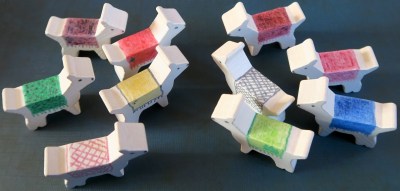
A Flock of boardGOATS
– Image by boardGOATS

With the chit-chat and pizzas over, it was definitely time to play something.  With six of us, it was almost certainly two games which was fortunate as Green wasn’t keen on anything Halloween themed, which ruled out the “Feature Game”, Dead of Winter: A Crossroads Game. That wasn’t a problem though, as Pine was keen to play and everyone else was happy to be a third.  In the end, it was Blue that joined them as she hadn’t played it before.  With two novices, that meant a full explanation of the rules.  Dead of Winter is a semi-cooperative game.  There are a number of things that make it different from other, older cooperative games like Pandemic.  For example, there is a group objective, but each player also has a secret, personal objective:  players must achieve both to win.  There is also the addition of a traitor, who’s objectives are counter to everyone else.  Both Pandemic and Shadows Over Camelot have this mechanism integrated as part of an expansion, and in Dead of Winter, this is also optional, or (like another of our favourites, Saboteur) can be played in such a way that there may, or may not be a traitor present.

Dead of Winter: A Crossroads Game
– Image used with permission of BGG contributor mikehulsebus

Perhaps more significantly than these though, is the nature of the ticking clock.  In Pandemic there is a deck of cards that which dictate what happens and, ultimately, how long the game is going to go on for as the game ends if they run out.  The situation is similar in the other Matt Leacock games like Forbidden Island and its sequel, Forbidden Desert.  In contrast, Dead of Winter, is played over a set number of rounds.  There is still a deck, the “Crisis deck”, but this sets the tone of the round and provides the “team” with a task that must be completed before the end of the round otherwise nasty things happen.  In general, the Crisis sets a tithe of cards that must be forfeit by the “team” during the round.   Of course, as in real life, the “team” consists of people who have different agendas, and one who may be out to sabotage the colony…

Dead of Winter: A Crossroads Game
– Image used with permission of BGG contributor adamfeldner

So, at the start of the round, a card is drawn from the Crisis deck and then everyone rolls their dice and the first player takes their turn.  This begins with another player drawing a card from the Crossroads deck.  This player is supposed to read only the first line, unless the condition is fulfilled in which case they read the rest of the card.  These are quite clever, as they end with two options—the eponymous “Crossroads”. The text on these cards adds a lot of atmosphere as well as adding to the sense of impending doom as sometimes the card might be activated by something the active player does.  Each player starts with two Survivors and the active player has one die per character and an extra one.  The Survivors have special abilities and the dice are “spent” by them carrying out actions.  For example, a player could attack a zombie which costs one die, but the value of the die needed will depend on the character:  James Meyers who is a bit of a wuss, is rubbish at fighting and needs a six, on the other hand Thomas Heart is a violent sort who loves a good brawl and anything at all will do.

Dead of Winter: A Crossroads Game
– Image used with permission of BGG contributor mikehulsebus

As well as attack a zombie, there are a number of other actions that require a die, including search a location, clean the waste, and build a barricade.  Searching is the only way players can get Item cards.  Around the central game board, there are a number of special locations and each one of these has a pile of Item cards.  The distribution of the different types vary and depend on the location, for example, weapons are unlikely to be found a the hospital, but medicine is quite prevalent.  Like attacking zombies, ability to search depends on the different characters and some Survivors have a special ability which means they are good at searching in a particular location.  In contrast, anyone can build a barricade or take out the bins, so these actions can be carried out by anyone with any dice, as long as they are in the right place.  In addition to actions that require a die, players can also play a card, help deal with the crisis, move a Survivor, turn food cards into food tokens, request cards from other players, hand cards to other players or initiate a vote to exile someone.

Dead of Winter: A Crossroads Game
– Image used with permission of BGG contributor mikehulsebus

While there are lots of things players can do, there are also hazards along the way.  For example, moving from one location to another is risky, so the Survivor must roll to see what damage the exposure did.  It may be that they were well wrapped up and nothing happened, but it is also possible that they were wounded in the attempt, or caught frostbite which is nasty because the effect progresses in later rounds.  Worst, of course, is getting bitten because the Survivor dies straight away and the effect spreads to other Survivors at the same location (who also have to roll the exposure dice).  Once every player has taken their turn, the zombies swarm, arriving at each location that where there are Survivors, with extras attracted by noise.  If a location gets overrun by zombies, they start killing Survivors.  Every time a Survivor dies, they Colony’s moral drops.  The game ends moral gets to zero, the requisite number of rounds have been played or if the main objective has been completed.  Our main objective was simply to survive the five rounds we were to play.  Blue began with a serious lack of practical ability in David Garcia (accountant) and James Meyer (psychologist).  Fortunately that was made up for by Ivory and Pine who began with Thomas Heart (soldier), Andrew Evans (farmer), Janet Taylor (Nurse) and Edward White (chemist).

Dead of Winter: A Crossroads Game
– Image by BGG contributor The Innocent

Andrew Evans, Janet Taylor, Edward White and David Garcia all had special abilities when searching and Thomas Heart was excellent fighting off zombies, while James Meyer just had an especially uncool anorak.  We started well and for the first couple of rounds, the zombies were only faintly annoying and the biggest issue was fulfilling the requirements of the Crisis Cards.  Early on, Ivory armed Andrew Evans with a rifle which enabled him to take out any one of the undead, something that proved very handy and made up for the enormous amount of noise Andrew Evans had been making during searching.  During the second round, Blue gained an extra couple of characters (Buddy Davis and Harman Brooks), which gave her extra dice and more special abilities she could use, but the downside was they came with a load of extra helpless survivors (folk that are a bit of a dead-weight and just need a lot of feeding).  It seemed like a gamble, but in the third round, Ivory “found” Sophie Robinson (a pilot) as well.   By the end of the third round, it was clear the message had got out to the zombie hoards and they were coming to get us (possibly due to the racket that Ivory had been making with Andrew).

Dead of Winter: A Crossroads Game
– Image used with permission of BGG contributor kilroy_locke

The fourth round was tight especially as everyone’s attention began to turn to their secondary goals.  The otherwise fairly useless James Meyer suddenly found himself some courage and a baseball bat and set about the un-dead with great gusto.  Pine decided that he really, really wanted that extra character that he’d been persuaded out of earlier in the game and acquired Alexis Grey, a librarian with an ability to search the library efficiently.  Going into the final round, we had to be a little careful in a couple of areas and moral was low, but it was clear that unless one of us turned out to be a traitor, the game was won.  And so it turned out: there was no traitor and it was just a question of who had succeeded in their secondary goal.  At the start of the game, Pine had been highly conflicted, needing medicine for Edward White’s special power, but also having a goal of needing to finish with two at the end of the game.  Since he started his final turn with no medicine, he thought the boat had sailed, but with his very last action, he happened to draw two medicine cards to satisfy his second objective.  Ivory also needed two medicine cards for his goal and had managed to hoard these throughout the game.  Blue’s challenge was more difficult as she needed the colony to have lost three members to the hoards.  Despite her best efforts to kill off some of her own Survivors, Pine and Ivory had generously helped keep them alive, so she failed dismally, the only one not to complete both victory requirements.

Dead of Winter: A Crossroads Game
– Image used with permission of BGG contributor kilroy_locke

Although we had all enjoyed the game, it was unfortunate that there wasn’t a traitor as the lack of an enemy within meant it felt a bit like communal puzzle solving.  It was also unfortunate, that so very few of the Crossroads Cards actually had an effect as they mainly affected characters we weren’t playing with.  This wasn’t helped by our habit of forgetting to draw them and/or reading too much of the card.  We felt the Crossroads Cards would have been more interesting with extra players, but it was already a long game and we felt the down-time would really drag with more.  Certainly, some turns, especially as Blue and Ivory acquired additional Survivors, seemed to take an unbelievably long time already.  Certainly four would probably be the maximum we would want to play with, though we would also increase the likely-hood of a traitor as we felt we’d missed out on half the fun.  In conclusion, Red and Burgundy’s comment at the start now made sense, “It’s a good game, but if there’s something else more interesting about…”

Dead of Winter: A Crossroads Game
– Image used with permission of BGG contributor zombiegod

Meanwhile, on the next table, Green and Burgundy were teaching Red how to play Puerto Rico.  This is a much older game which was the highest rated game for many years and is still well regarded.  Red had never played it and it was a very long time since Burgundy or Green had played it as well, so they were keen to see how it held up against some of the more modern games.  In Puerto Rico, players are plantation owners in seventeenth century Puerto Rico growing up to five different kind of crops: corn, indigo, sugar, tobacco, and coffee. Each plantation owner must try to run their business more efficiently than their competitors. First they must grow their crops then they must store them efficiently. Finally, players must sell their crops at the right time or ship their goods back to Europe for maximum benefit. In order to do this most effectively, the plantation owners must make optimal use of the arriving colonists and develop the capital city, San Juan, building useful amenities.

Puerto Rico
– Image by boardGOATS

The flow of the game is quite straight-forward in that on their turn, the active player chooses a “role” then everyone takes it in turns to carry out the action associated with that role. Each role has a “privilege” which the active player gets which gives them a little bonus (as well as the opportunity to take the action first. Once everyone has chosen a role, the remaining role cards are “improved” by the addition of money, the used role cards are returned to the pool and the start player (The Governor) moves one player to the left before the new Governor starts the next round. The aim of the game is to get victory points which are awarded for buildings and for shipping goods. However, to build, players need money, and before they can ship goods, players need to be able to produce the goods with a plantation (and where necessary process them in the appropriate building).

Puerto Rico
– Image by boardGOATS

Each building/plantation has a special bonus, but for a player to receive this, the building needs to be occupied by a “colonist”. All these activities are carried out through the role cards. For example, the Builder enables players to construct a building, but the player who chooses the role gets the privilege of paying one doubloon less than they would have done otherwise. Similarly, the Craftsman is used to produce, but the privilege allows the player who chose the role to produce one extra item (of those they had already been able to produce). Other roles include the Captain (enables players to ship goods); the Trader (allows players to sell goods for money); the Settler (players can take a plantation tile and add it to their island); the Mayor (the ship of “Colonists” arrives and they are divided among the players), and the Prospector (everyone does nothing except the person with the privilege who takes a doubloon from the bank).  The game ends when either, one player has built their twelfth building or the supply of victory points or colonists has been exhausted.

Puerto Rico
– Image by boardGOATS

The first few rounds were a little tentative. Green started with the Governor (through random selection) and chose the build action first. Burgundy chose Mayor using his extra citizen to occupy both indigo plantation and production building. Red needed a little help to suggest that she place her citizen on her Corn rather than her small market since this would enable her to produce something, whereas in the market she would have nothing to sell. So inevitably Red then chose craftsman. This gave Red a two corn, Burgundy an Indigo and Green nothing as he only had indigo and one citizen.  From there, the game progressed as you might expect, with each player following a different strategy.

Puerto Rico
– Image by boardGOATS

Green relied on his indigo resources and built a Small Market and an Office (so he could sell multiples of the same type of goods), dug a couple of quarries, and clearly went for a money and buildings strategy. When he started losing out in the Captain (shipping) phase he was able to very quickly buy a Wharf and always managed to ship something and thus stay in the running on victory points. He was the first to buy a big building of course and chose the one which gave him extra points for production buildings believing he could fairly easily add to his already reasonable tally. Burgundy went for a diversified portfolio of goods and as able to add a factory building which started to really rake in the money with four different types of goods. He was only missing corn, which he easily added to make an extra five doubloons every time craftsman came up. As a result he was not far behind Green at buying a large building.
Puerto Rico
– Image by boardGOATS

Since he had been shipping regularly and gathering victory points Burgundy took the building that would give him an extra point for every four points he had, however about half way through the game he began to struggle with his shipping. Red had begun to regularly take Captain, which meant that he was last to load and would often miss out being able to load all his goods—without any kind of warehouse was regularly losing all his stock of two or three goods each time.  Eventually, he had enough of this and decided to do something about it.  The choice was between a Wharf and a Harbour:  increasing his victory point income every time he shipped, or gain an extra ship he could always ship to.  It was a tough choice, but in the end he chose Wharf only to then discover he did not have quite as much money as he thought and so had to settle for Harbour after all.  This nearly proved his undoing in the end, as with two or three more captain actions happening he still found himself unable to ship everything, losing several goods in the process—Red and Green made quite sure of that!!

Puerto Rico
– Image by boardGOATS

Red’s game was a little more tentative, as she found her feet, trying to figure out how the game all hung together. She struggled a bit with getting the buildings and plantations all occupied in the right way to produce what she needed. She ended up with a lot of Sugar, but her small warehouse meant that early on she did not have to discard it and was able to make a large shipment later on, locking out Burgundy, the other Sugar producer in the game.  In the end she ended up with more citizens that she had spaces and so for a while had an occupied Indigo Production building but no Indigo Plantation. It seemed it didn’t really matter though, as she had a good thing going on with the Captaincy, shipping large amounts of Sugar regularly giving her a regular supply of points. With everything else that was going on, Red didn’t get round to buying a large building.

Puerto Rico
– Image by boardGOATS

As the game neared conclusion, we thought we would run out of Citizens first, but selection of the Mayor slowed and Captains became a more regular feature so the victory points dwindled fast. Green was worried that he might not get his large building occupied before the victory points ran out, so when he became Governor for the last time, he chose the Mayor in an effort to extend the game, much to Red’s chagrin.  She claimed that it was allowing Burgundy to get his large building occupied and thus gain more points, which is true, but it helped Green too.  In the end it was Red’s Captaincy that ended what proved to be an incredibly close game; Puerto Rico is not a game we usually think of as being so well balanced that the scores are always close. The hidden victory points and various other ways to gain points tend to keep players guessing right til to the end and it is usually possible for one player to quickly build an efficient engine which wipes the floor with everyone else.
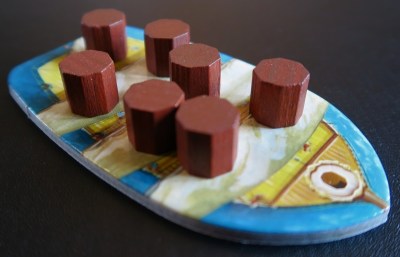
Puerto Rico
– Image by boardGOATS

That wasn’t the case this time.  Although the actual game play is quite simple, Puerto Rico can be a challenging the first time as it is hard to really work out the best way to play, and things only become clear after two or three rounds.  So Red did really well, not only to keep pace with two experienced players, but especially to take second place against two players, scoring fifty points.  Green’s lack of resources to ship, even with his wharf, let him down and it was Burgundy, who scraped a win with fifty-three points.  While packing up, there was a lot of discussion about the game:  did Green really hand Burgundy victory by choosing that Mayor? We concluded probably not, as if Burgundy would have chosen it if Green hadn’t.
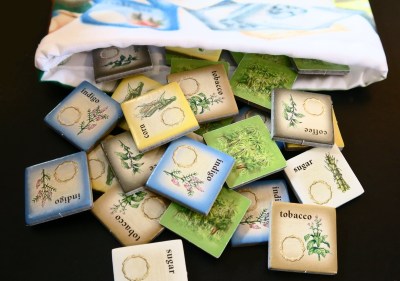
Puerto Rico
– Image by boardGOATS

Puerto Rico used to be the gamers’ game of games for quite a few years, until Agricola elbowed its way to the top. Since then that top spot has been fiercely fought for and, as in Formula 1, (where everyone now talks about Schumacher, Vettel and Hamilton), everyone seems to have forgotten poor old Juan Manuel Fangio, the unsurpassed master for decades. Once in a while it’s good to bring out the old tapes and watch the old master at work though, and so it is with Puerto Rico.  After so many years it was interesting to see how it stacked up against the newest masters of the gaming world.  We concluded that it still competes very well: it has variety and simplicity at its heart, great interaction and just enough complexity to make it a challenge without needing a PhD just to understand the rules.

Puerto Rico
– Image by boardGOATS

Dead of Winter was still going and it sounded like there was another half an hour play, which meant there time for another, shorter game, and the group settled on Coloretto. Everyone knew it quite well it was a quick start.  On their turn the active player either draws a coloured chameleon card and places it on a “truck” or, they take a truck and its chameleons (which means they’re out for the rest of the round). The idea is that players are collecting sets of cards, but only three will yield positive points, with the rest scoring negatively.  There are some “special” cards as well, including multicoloured joker chameleons and “+2” cards which give an extra two points at the end of the game.  So, everyone was shocked when  a “+3” came out of the pile came.  Clearly there were some expansion cards in the deck and nobody had noticed despite having played with it several times before.

Coloretto
– Image used with permission of BGG contributor punkin312

The first round was also remarkable in that first a yellow card was pulled, then a purple (placed on a different pile), then another yellow, which was placed on the purple pile, then a purple, which was placed on the yellow pile, to make two identical piles. So, what were the colours of the next two cards? Yes, yellow and purple! Burgundy and Red bailed at this point but Green decided to see where if he could get a second yellow or purple and ended up with a red instead giving him three singletons.  From there, the game progressed in the usual way. Green collected more new colours each with only one card, but that meant he had a wide choice to specialise in. Eventually he chose green as his primary colour, which the others found difficult to prevent him from getting. Burgundy was trying to keep his number of colours down, concentrating on just brown and yellow, but Red and Green kept ganging up on him to make sure he had to take something else very time.  To get round this, he ended up taking single cards several times, but that meant he didn’t get as many cards as he might otherwise have collected.  Red was the lucky one who took the rainbow joker and otherwise went for blues and purples.  She was forced to collect too many other colours though.  In the end, it was again Burgundy who managed to eek out the best score, despite Red and Green’s combined best efforts.

Coloretto
– Image used with permission of BGG contributor SergioMR

Learning Outcome:  Sometimes winning is impossible, even with teamwork.
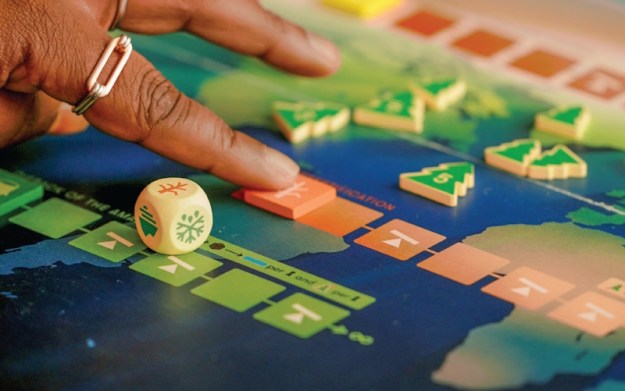
20th August 2013

It being the height of the summer holiday, there was a severe shortage of people about, so we started late with our Feature game, Agricola. This game is about farming in the middle ages and is a one we have played several times now.  However, one of our regulars has somehow missed out and, as it is a game we know she would enjoy we decided that while it was quiet it was a good opportunity to play the “family game” again.

Agricola

So we had a gentle run down of the rules before we started collecting wood and clay, fish and grain.  Before long, Red had renovated her two room hut to brick and started ploughing fields while her farming couple lived on fish.  Meanwhile, Blue was trying (and failing) to expand her wooden hut, plough fields and fence in some pasture so she could keep some sheep, all at the same time.  Blue was the first to engage in a little “family growth” and had no qualms about sending her unfortunate offspring out to work the land at an early age.  Red didn’t have enough clay to build an additional room, so had to wait until she had the option of sharing rooms.  Despite Red picking up vegetables, cattle and pigs, at the end of the day, Blue’s experience (and larger family) meant she had an unassailable lead.

Agricola

There was just time for a quick second game, so we decided to go with something we were familiar with, Forbidden Desert.  This is clever little cooperative game that we’ve played a couple of times before.  The idea is that players are members of a team of adventurers on a mission to excavate an ancient desert city and recover a legendary flying machine that’s rumoured to be powered by the sun.  Moments before arriving at the destination, the helicopter crash lands, stranding the team in the vast desert,exposed to an unrelenting storm and extreme sun.  The only hope for survival is to work together to excavate the city, find the parts of the flying machine and rebuild it to escape.

Forbidden Desert

Players have particular areas of expertise:  this time we had the “Archaeologist” and the “Meteorologist”, which meant we had one player who could clear sand more efficiently (twice as fast as normal) and another who could check what the storm was going to do next.  We started well, making good use of the special abilities and taking advantage of the tunnels to hide from the sun.  Without the “Water Carrier” we were really worried about dying of thirst, but we managed eke out our water supply and stayed on top of the problem by hiding as much as possible.  We also managed to prevent too much sand build-up with occasional judicious use of the Duneblaster, but what we failed to keep an eye on was the sand-storm level and we were at level six with clues still to find.  The storm was on its highest level when we finally managed to pick up the last clue, hop over the dunes with a jet pack, clear the launch pad and escape, but it was a very close-run thing!

Learning Outcome:  There is a reason farming families are usually large.

25th June 2013

This week, we started off playing a slightly neglected old favourite, No Thanks!.  It seemed like ages since we played it last, but it turned out that it was less than two months ago that it last got an outing.  Since it is a quick card game where rounds take just a few minutes, it was ideal to play until everyone had arrived.  Next we, we played the “Feature Game”, Incan Gold, which is another game we’ve played previously.  In this game players are going down a mine and trying to get out with as many gems as possible before it collapses.  One player made a bit of a killing in the opening round, but she failed to hang onto the lead and was pipped by just two gems at the very end.

– Image by BGG contributor joshie

It was a bit of an evening for games we’ve played previously, as next we played Alhambra (which was a “Feature Game” at the end of last year).  This is a tile laying game where players have to collect sets and score points for having the most in any one set.  Scoring takes place twice during the game and once at the end, and each time the number of points increases.  This time, Blue (who won last time), got a terrible run of the cards and Red who had missed it last time, had an amazing game winning by a very large margin.

– Image by BGG contributor EndersGame

Racing fish may not seem like an obvious choice for a game theme, but it turns out that it actually works really well.  We played Salmon Run just two weeks ago and although we enjoyed it, we were all a bit tired, so we decided to give it another go this week.  For variety, however, we changed almost all the boards, using  S2, 3M, 4E, 5E & F2.  This time, Black got going much quicker than everyone else and headed left followed by Red while White went right.  Black decided not to worry about fatigue cards and just run for it, while Red and White were more cautious.  Black’s tactics seemed to pay off, however, as he made it to the spawning pool first and nobody else could quite make it in time.

– Image by BGG contributor kilroy_locke

Our final game game was Forbidden Desert which we also played last week, however it is a new release this year and it was a very close game last time, so we felt it deserved another outing.  This time we didn’t have a Water Carrier, but we managed to make good use of the tunnels and the Navigator’s ability to move other players three spaces for the cost of only one action.  These with the Archeologist’s ability to clear extra sand meant we ran out comfortable winners.  We’ll have to ramp up the difficulty next time!

– Image by BGG contributor henk.rolleman

Learning Outcome:  Doing well the first time you play a game doesn’t mean you’ll do well the second time…

11th June 2013

A couple of us arrived very early and managed to squeeze in a couple of games and dinner before anyone else arrived.  First up was Forbidden Desert.  This is a very new, cooperative game, where players work together to try to escape from the desert before the get swamped by the sand storm or die of thirst.  Although they have a lot in common, it is quite different to its older brother, Forbidden Island, and we felt, quite a bit more advanced.  Since it was only the second time out of the box, we played on the Novice Level.  Essentially, the game consists of a grid of tiles with a storm in the middle.  As the game progresses, the storm moves about, shifting the other tiles creating sand dunes as it goes.  The explorers also have to combat the lack of water in the desert, all the while trying to find clues to the location of parts of an ancient burried flying machine, and eventually, the parts themselves.  In the end we did it with a little breathing space, but there is no way we would have escaped without the Water Carrier’s special ability to get more water from the well.

– Image by BGG contributor duchamp

Next we managed a quick game of Morels.  This is a really pretty set collecting game with a mushroom theme and added “woodsiness” in the form of forage sticks which act as a sort of currency.  The idea is that you can collect the easily accessible mushrooms “at your feet” for free, or you can choose a less accessible fungi for the cost of one or more forage sticks.  Once you have a set of three or more mushrooms you can cook them, with added cider or butter flavouring to add points at the end of the game.

– Image by BGG contributor philsstein

It is the Stanford-in-the-Vale Summer Festival this weekend and we are planning to have a stall to raise our profile (weather permitting).  Since it is quite robust, we are planning to make Army of Frogs available to people to play, so we thought we should try to get to grips with it first. Basically the idea is that you jump one of your hexagonal frog tiles (if you can) and then place a frog from your hand, finally drawing another frog from the bag to make your hand back up to two frogs.  Somehow, we managed to play this apparently simple little game wrongly not once, but twice!  Something to work on before Sunday…

– Image by BGG contributor Moviebuffs

Then, we played this weeks “Feature Game”, Mission: Red Planet, which is about colonizing Mars.  In this game, each player is a colonial power which sends astronauts, in space shuttles, to occupy the most promising zones on the planet.  It is an interesting game with a curious mixture of luck and judgement.  The luck comes from the rockets that are available at the start of each round, the value of each region of Mars (which is hidden in the early part of the game) and the destiny cards drawn.  The judgement comes from the character cards which enable players to place a number of astronauts into rockets and often do something else, like launch a rocket early or move astronauts around on Mars or even sabotage someone elses plans.  The character played also dictates when the player gets their turn which leads to a lot of trying to “out think” everyone else, and with only ten rounds, once a card has been played you may not get the chance to play it again.  This sort of game can either go very well or very badly and this is exactly what happened:  Red came in four points ahead of Blue with fifty-five points, while Green finished with less than half that.

– Image by BGG contributor kilroy_locke

The last game of the night was Salmon Run.  This is a new little race game, where players are fish dodging bears, eagles and rapids, jumping waterfalls and trying to be the first to get to the spawning pool without being too tired.  The game has a modular board and, as it was new to most of us, we used a fairly easy set up:  S1, 4E, 3E, 2M and F1.  Red started quickly up the right side of the course with Black and Grey giving chase.  Unfortunately Red banged her head against the bank which gave Grey and Black the chance to overtake.  Black set the bear on Grey a couple of times and managed to sneak ahead, but Grey made a run for the last water fall and managed to sneak into the spawning pool, and as the last player in the round, ended the game and the evening.

– Image by BGG contributor kilroy_locke

Learning Outcome:  For teaching at the Summer Festival, it is probably a good idea to have some laminated crib-sheets available!