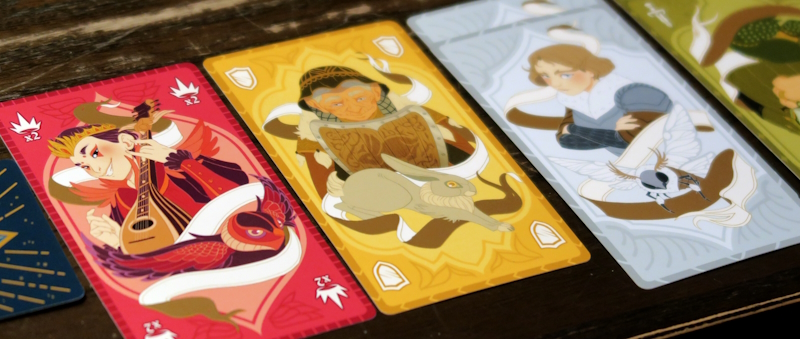
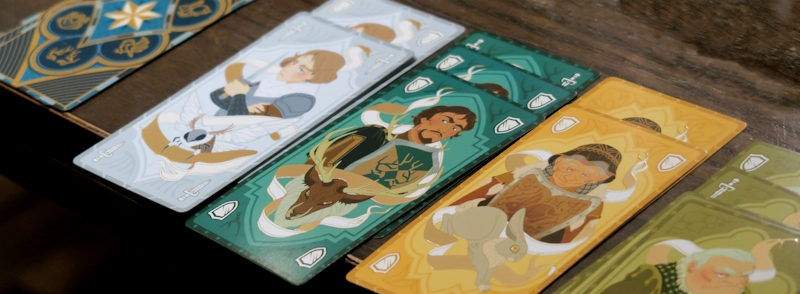
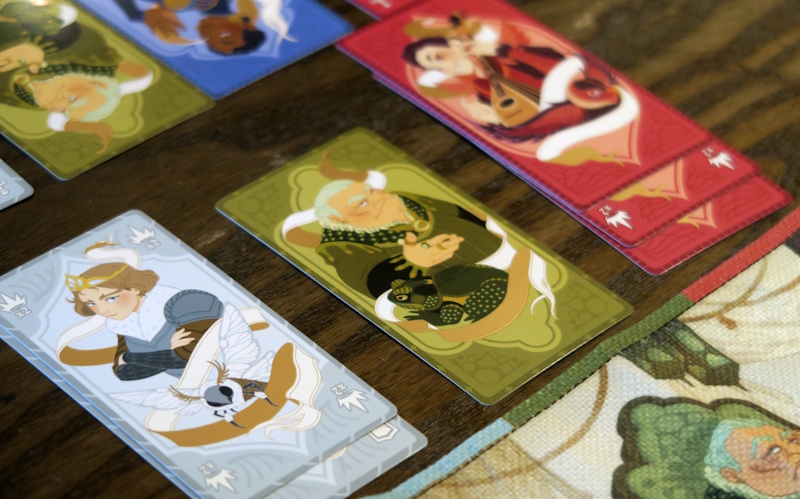
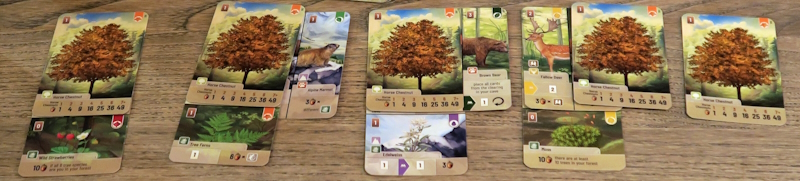
Tag Archives: Kingdomino

8th April 2025

By the time everyone else started to arrive, Cobalt was already most of the way through losing his game of 20 Strong.  This is a solo-player deck-based game where the object is to progress through a shuffled deck of cards, each of which bears a unique challenge. This challenge could be in the form of an enemy, a unique scenario, or some other requirement which are completed by rolling a set of seventeen dice with different odds for a hit.  These dice, along with three adjustable stat dice, make up titular twenty dice.  Cobalt continued rolling his dice while others ordered food, chatted and ate.
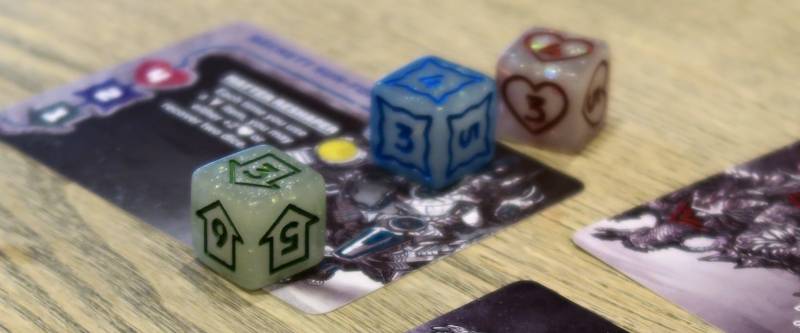
20 Strong
– Image by boardGOATS

Before long players began splitting into groups, deciding what to play.  The first group was Blue, Pine, Mint and Pink playing the “Feature Game” which was to be Fire Tower.  This is a competitive game where players order air drops of water, and plan the building of firebreaks in order to combat a woodland blaze.  The rules are very simple:  players begin their turn by spreading the fire in the current wind direction then play one card from their hand (or discard all their cards) and replenish their hand.  There are four different types of cards, Wind, Fire, Water, and Firebreak cards.  Wind cards can be used to change the Direction of the Wind which affects which direction the fire spreads in.

Fire Tower
– Image by boardGOATS

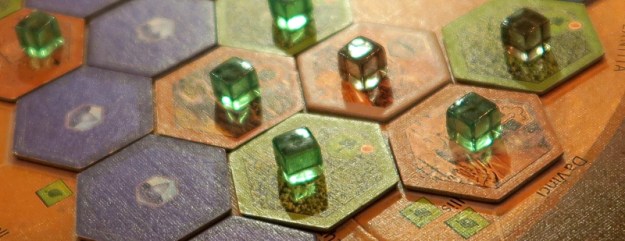
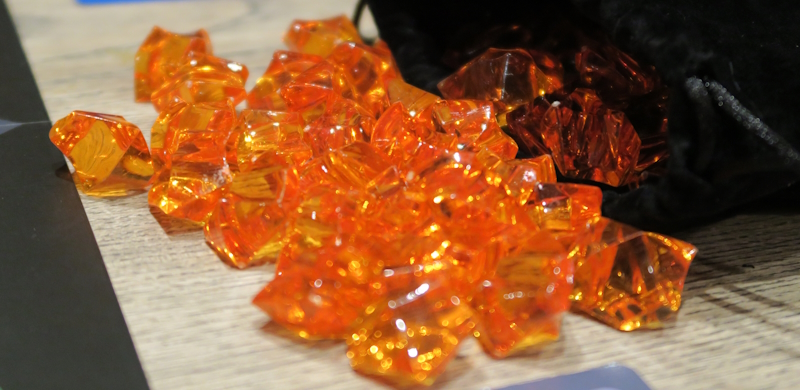
This can either be by playing the card and changing the Wind Direction to that on the card, or by rolling the Wind die and leaving it up to fate.  Alternatively, the player may place a fire gem on one empty space orthogonally adjacent to an existing fire space (or the central Eternal Flame), in the wind direction indicated on the card.  Fire, Water and Firebreak cards give a pattern of spaces that the fire must either spread in, is removed from, or fire break tokens can be placed in.  Firebreaks prevent fire from landing on or jumping over the spaces they occupy and can only be removed using a card that includes the De/Reforest action and cannot be placed in orthogonally adjacent to another Firebreak token.
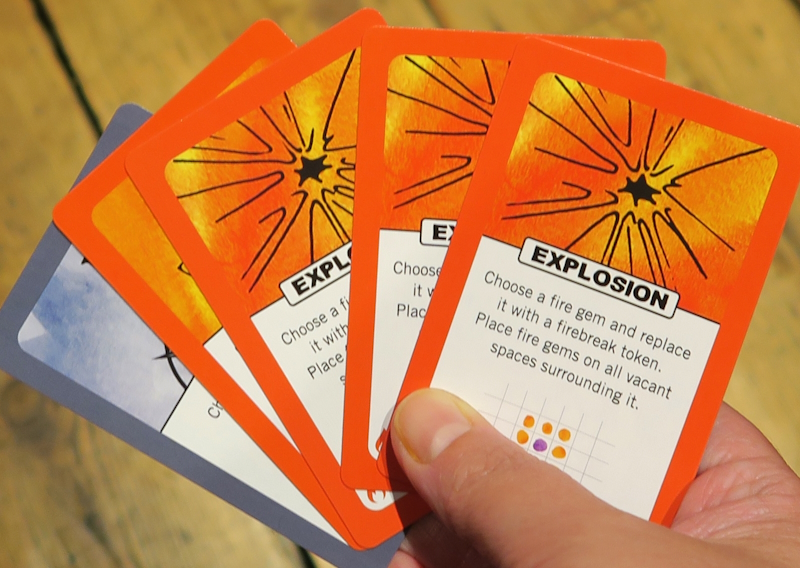
Fire Tower
– Image by boardGOATS

Each player took the Fire Tower on one corner of the board with Pine sitting opposite Blue and Mint opposite Pink.  Blue went first followed by Mint, then Pine and finally Pink.  The base game is an elimination game, with the winner the being the last player who’s Fire Tower has not be burnt down.  The group decided to play without the events and keep the game as simple as possible to see how things worked.  Pink was the first to get knocked out with Firestorms proving to be disastrous for his Tower.  Pine quickly followed with before there was a long, determined rear-guard action by Blue.
Fire Tower
– Image by boardGOATS

Unfortunately, Mint started in a better position and despite her best efforts, eventually Blue’s Tower was also a moldering ruin.  Since Pink and Pine had spent quite a lot of time as spectators, the group decided to give it a second go, but this time working in pairs.  This time, Blue’s Tower was first to be destroyed with Mint’s next.  Eventually, only Pink’s tower was still standing giving a second victory to Mint, which was shared with Pink.  The game had been quite enjoyable, if very different to the usual fare.  There was still plenty of time left for something else though, so the group had a rummage in the bags and came up with Draftosaurus.

Draftosaurus
– Image by boardGOATS

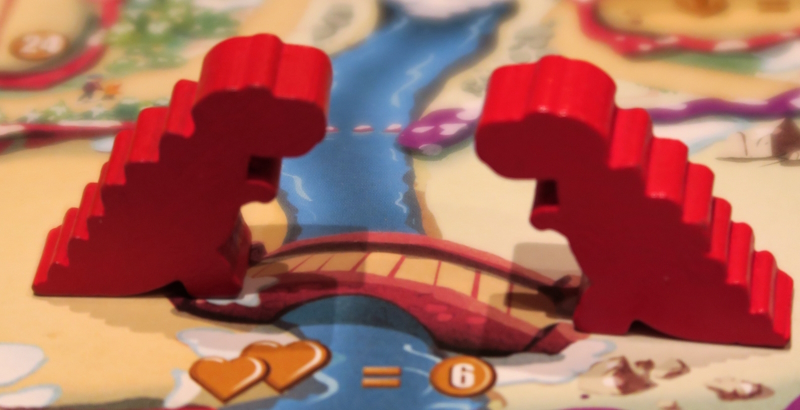
This is a very popular game where players start with a hand of dino-meeples, choose one and pass the rest on before placing them in their dinosaur park.  It frequently gets outings within the group, but on this occasion, for variety, the group decided to play with the winter setting which gives slightly different pens with slightly different placement conditions.  It was very tight, but as is often the case, Pine, who just seems to “get” this game emerged the victor with thirty-six points.  He was only one point ahead of Mint and Pink though, who tied for second place.
Draftosaurus
– Image by boardGOATS

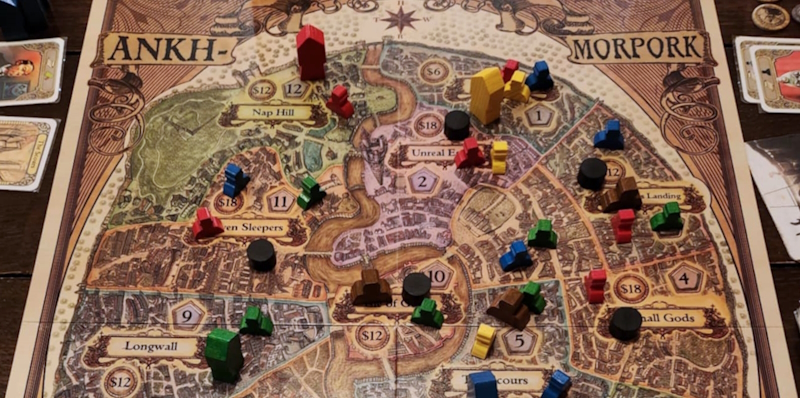
Meanwhile, on the next table, Green putting in a rare, but welcome appearance, was leading Black, Purple and Plum in a game of Discworld: Ankh-Morpork.  In this game, Lord Vetinari has disappeared and players control different factions which are trying to take control of the city.  Game play is quite quick and simple with players playing a card and doing what it says.  Most cards have more than one action on them, and players can choose to do some or all of these actions. Some cards also allow people to play a second card, so they can chain actions together.
Discworld: Ankh-Morpork
– Image by boardGOATS

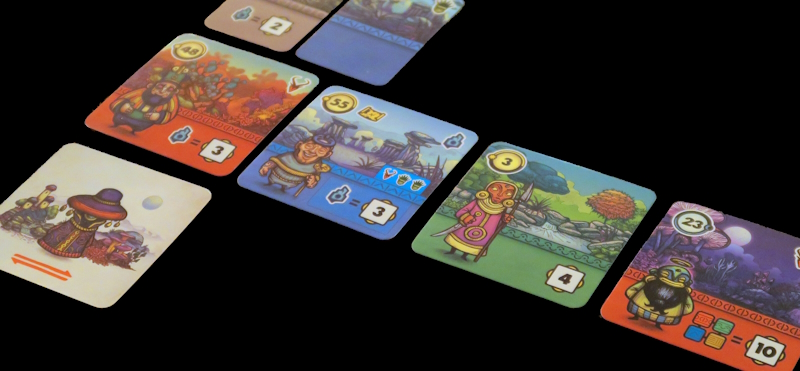
In this game, Black was the Dragon King of Arms, looking for trouble, Green was Chrysoprase, trying to amass lots of money, Plum was Commander Vimes who was trying to play through the deck and Purple was Lord Rust, with an area control remit.  The game was over quite quickly with Black running out the winner in a game that is much under-rated and sadly very out of print due to IP issues.  This copy was a much cherished one, as it had belonged to Burgundy so it was nice for it to get another outing within the group.  There was time for a second game and this ended up being Faraway, a very clever, much more recent, card-driven game that has had a few outings since its release last year.
Faraway
– Image by boardGOATS

The idea is that players simultaneously chose one of the numbered cards from their hand and starting with the the player that played the lowest card (similar to 6 Nimmt! or Kingdomino), everyone takes it in turns to choose one from the market to add to their hand.  Players then simultaneously choose another card, and again, choose one to add to their hand.  The game ends after everyone has played a total of eight cards, and then everyone scores.  The clever part is that the cards are played left to right, but the scoring is from right to left.
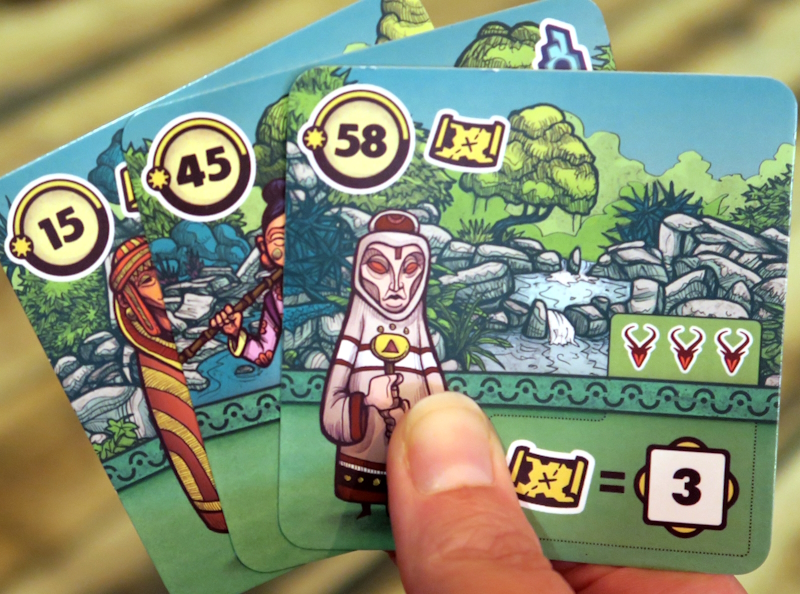
Faraway
– Image by boardGOATS

At first glance, this looks like it makes things easy, because early in the game players find out what they need to get points and can then focus on getting the resources they need as the game progresses, but of course that is not the case.   This time, Purple had a really bad run where she kept getting the highest number cards, which meant she picked last, and then picked up the higher number cards left by others.  Once again, the winner was Black making it two out of two for him, while Plum was second by seven points with Green a little way behind her.
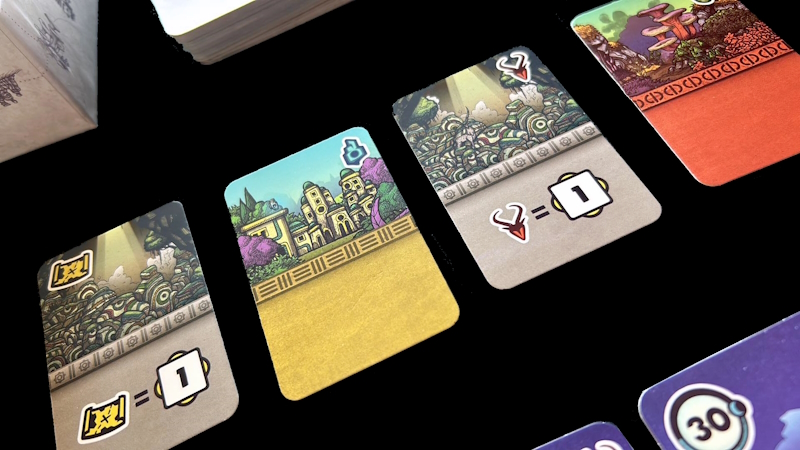
Faraway
– Image by boardGOATS

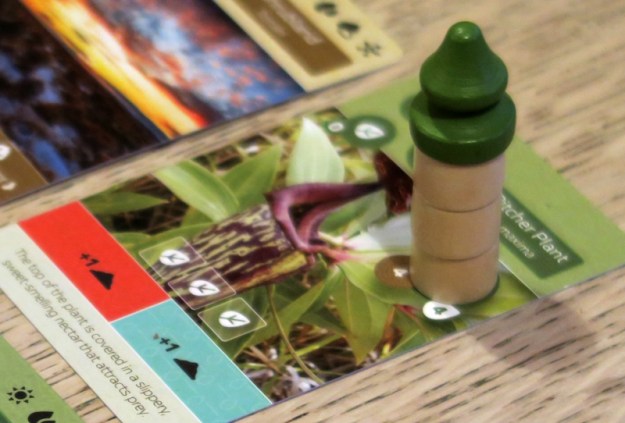
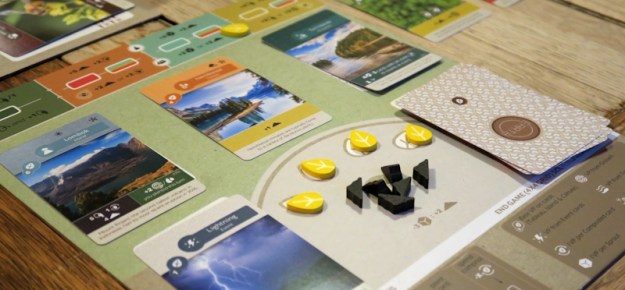
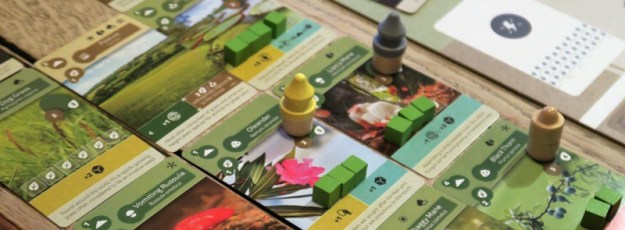
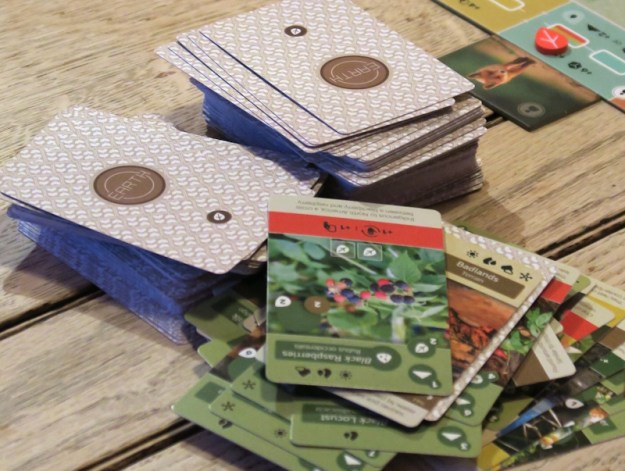
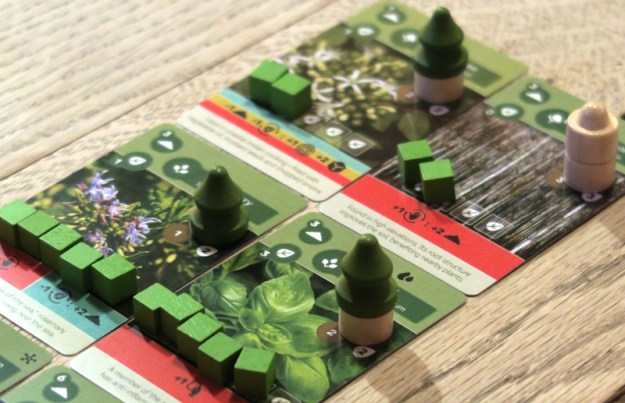
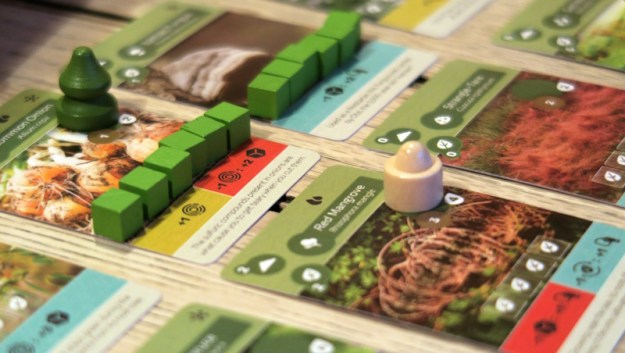
Meanwhile, the third group comprising Jade (fresh from his birthday celebrations), Sapphire, Teal, Byzantium and Cobalt spent the evening playing a five-playergame of Earth.  This is a is a sumptuously illustrated card-driven engine-builder game that is often compared to Wingspan, where players are building themselves an ecosystem.  The game itself is not actually all that complicated. Players are building a four by four grid of Flora and Terrain cards which represents their island and during the game they will plant flora, water it and allow it to grow.  On their turn, players do one of four things: Planting (paying the cost in Soil tokens), Composting (gaining Soil and placing cards from the deck in their discard pile), Watering (place Sprouts and gain Soil) & Growing (draw new cards and place growth tokens).
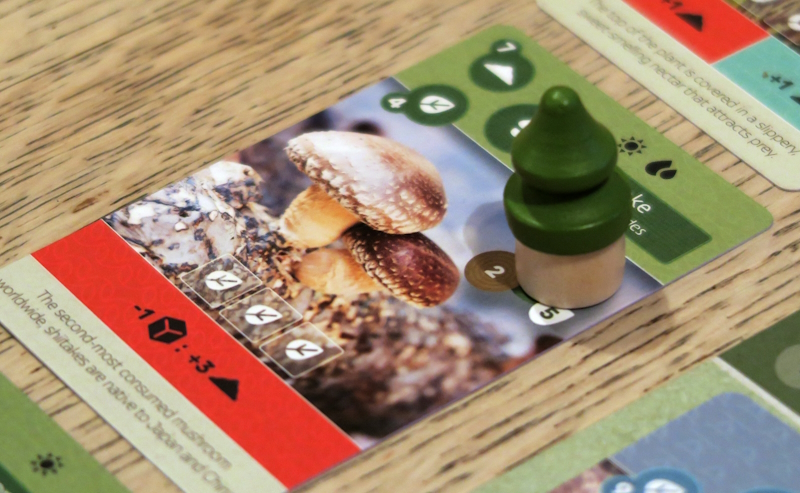
Earth
– Image by boardGOATS

A bit like Puerto Rico, once the active player has chosen which action they are taking, everyone else gets to do a subsidiary, slightly weaker version of the same action.  Once everyone has completed the action for the turn, everyone activates all the cards in their island that match the colour of the action chosen, starting with the card in the top left and working across each row in turn.  At the end of the game (triggered when one player has completed their island), players score points for each flora card, any Trunks and Canopies they have grown, their Sprouts and their pile of “Composted” or discarded cards.  Players also score points for achieving objectives on the Fauna cards revealed at the start of the game and for completing their island first.

Earth
– Image by boardGOATS

During the game, Cobalt built up the most points; his forty-two were some five ahead of Byzantium.  By far the most points come in the end-game scoring however.  A bit of a point salad there are seven scoring sections:  Teal scored best for Compost; Jade scored most highly for completing his Canopies; Byzantium top-scored for Terrain, and Cobalt out-scored everyone else for his Fauna.  As well as getting the most points for his Sprouts and Ecosystem Objectives, Sapphire also scored well in many of the other categories giving him a clear victory with one hundred and sixty-eight points, thirteen more than Byzantium who pipped Cobalt for second by a single point.
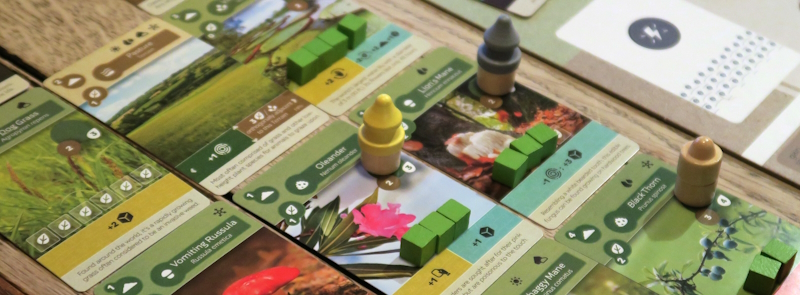
Earth
– Image by boardGOATS

Learning outcome:  Playing with fire may be fun, but you risk getting burnt.

12th Movember 2024

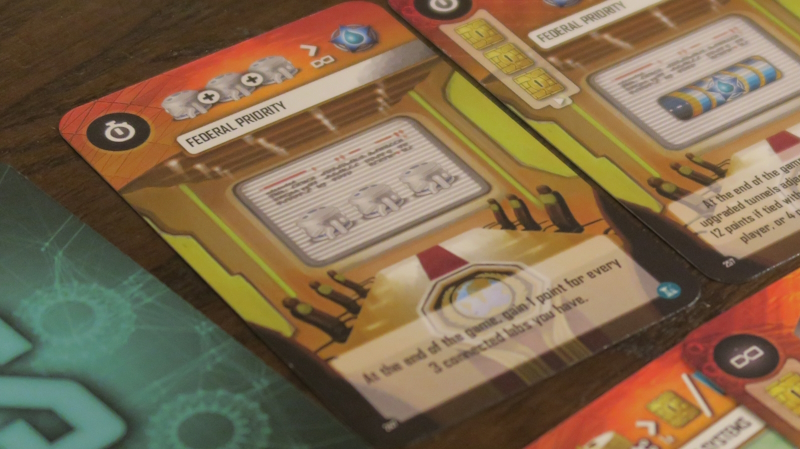
The evening began with Plum explaining the “Feature Game” to Indigo and Navy, despite the fact they had already decided they were unlikely to play it.  Still, there was time to fill as people finished eating and the stragglers, and that was as good a way as any.  The game in question was Underwater Cities, which is a sort of worker-placement and network-building game.  Although the game is quite complex, the underlying mechanism is quite simple:  players start their turn with a hand of three Cards and, on their turn choose an Action space and pay a Card to use it.  The Action spaces and the Cards come in three different colours, green, red and orange.

Underwater Cities
– Image by boardGOATS

If the colour of the Card played matches the colour of the Action space chosen, then the player gets to activate the Card, most of which have an instant effect (though for some, the effect is delayed).  In general, the orange Action spaces are quite powerful and the green Action spaces are weak, whereas the green Cards have powerful effects and the orange cards are weaker, thus the Cards and Actions together are balanced.  Each Action space can only be activated by one person per round and the game takes place over ten rounds (though the group used the Quick Start variant from the New Discoveries expansion which replaces the first round) with each player taking three actions per round and production phases after the fourth, seventh and final rounds.

Underwater Cities
– Image by boardGOATS

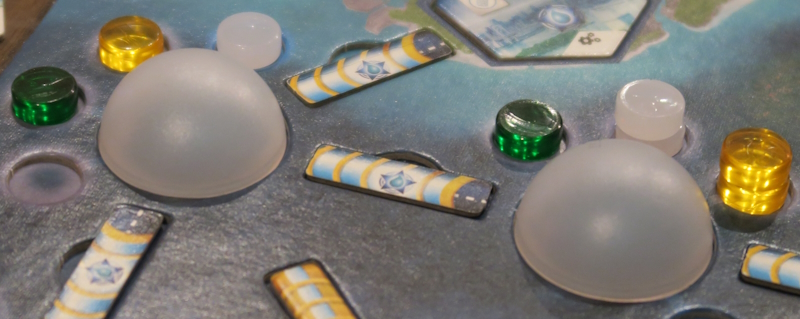
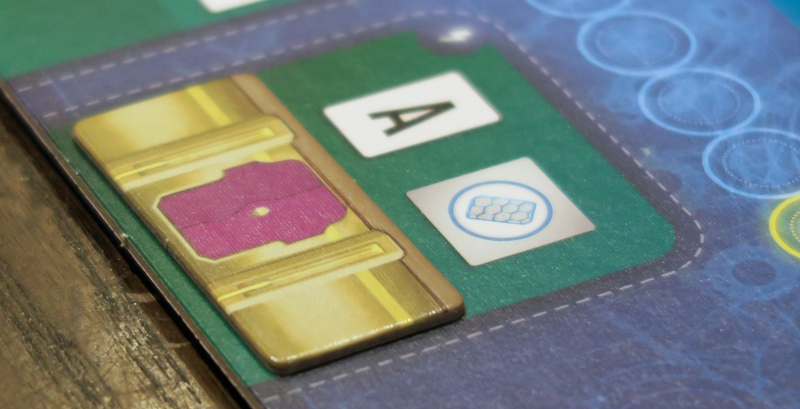
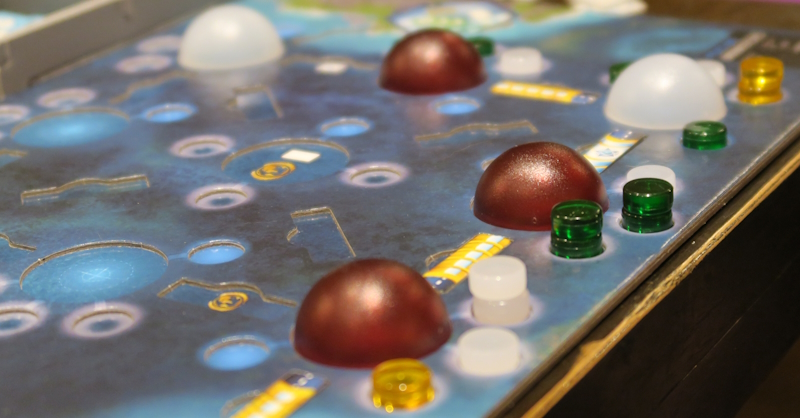
The aim of the game is to build a network on players’ personal player board, connecting Cities together with Tunnels and adding and Upgrading Buildings to provide production capabilities.  There are four Resources, Kelp, Steelplast, Science and Biomatter together with money, or Credits; these are produced by Farms (Kelp), Desalination plants (money) and Laboratories (Steelplast and Science).  Biomatter is essential for building symbiotic cities and can also be a universal building material (can be used instead of Kelp or Steelplast), but is a rare Resource that can only be acquired through Cards, Actions and by connecting some Metropolises to a player’s network.

Underwater Cities
– Image by boardGOATS

Players score points during the game and in the production phases after the fourth and seventh rounds, but most of the points are scored at the end of the game after the final production phase.  At this point, players score for the number of different Buildings next to each connected city in their network, for any end-game scoring cards, for their final scoring Metropolis and for any Resources they have left.  Indigo and Navy showed some appreciation as Plum explained, but ultimately decided it wasn’t for them, and were replaced by Cobalt and Ivory, both of whom had an idea of how the game played from watching run-through videos.

Underwater Cities
– Image by boardGOATS

The Quick Start gave everyone an Enhanced Assistant so Plum started with the ability to get Biomatter on production, so she was able to build purple Symbiotic Cities (which score more points) right from the beginning.  Cobalt’s also helped him when building Cities, giving him one Credit or Steelplast discount, although he didn’t really take advantage of this until the final Era. In contrast, Ivory focused on the end-game scoring from his Metropolis which required him to build seven Cities to get the maximum number of points.  By the first production phase, he had already built three and connected them to his network with Tunnels, but all those people needed a lot of feeding which was costly and slowed him down a lot.

Underwater Cities
– Image by boardGOATS

Plum focused on building a robust food engine with two upgraded green Buildings attached to one City (her end-game Metropolis also gave points for sets of upgraded structures) while Cobalt focused on getting his engine online and started on his objective to connect all his Metropolises and Cities with Tunnels in the second and third Eras.  He was aided by an ongoing ability that triggered whenever he used an Assistant (draw a Card and gain a Point), which he used heavily, getting four Assistants early in the game and activating them all in every Era. The extra Card draw ensured he was always able to play a matching coloured card with every Action which also helped.

Underwater Cities
– Image by boardGOATS

Plum pointed out that a friend who she plays with and often wins says, “Don’t always let me get the Special Cards—they are powerful!”  So after the first production phase, there was a focus on the special cards in middle, all of us grabbing some quite powerful abilities.  Ivory got an additional tile that gave him points every production phase and Plum got a heavily discounted City.  Cobalt’s engine was working very effectively by this time giving him lots of Resources and discounted Actions.  Despite her Special Cards, Plum was struggling as the main upgrade slot which she needed for her end-game Metropolis was denied to me when she had the Resources to use it.  Instead she ended up focusing on Symbiotic Cities and ended up with only the one regular City.

Underwater Cities
– Image by boardGOATS

After the second production phase, there was a big focus on how to maximize points. Ivory took a risk, taking the end game scoring card that gave twelve points for the player with the most upgraded Tunnels.  When he took it, he had the most upgraded Tunnels, but it was clear that Cobalt could challenge this.  Cobalt on the other hand had grabbed a couple of Special Cards giving three points per upgraded Tunnel plus one point per Card in his tableau.  For Ivory to score his Card it was critical that he denied Cobalt the ability to upgrade in the last turn and Ivory was able to make sure he took his first in the final round—this was fairly ironic as the majority of the rounds he had been the last player!

Underwater Cities
– Image by boardGOATS

This scuppered Cobalt’s plans and gave a twenty-four point swing in Ivory’s favour, but since he had increased his hand limit to four and was drawing multiple cards, he was able to pivot and build a City sharing two upgraded Farms and us Cards that provided points when played. This also produced quite a few resources in the final production phase.  Plum was struggling towards the end of the game as she couldn’t get the final Resources she needed to build the last two Tunnels to connect her end-game scoring Metropolis.  Despite it failing to score, it had still been a good focus for her game as the upgraded structures had given her extra production during the game and those Metropolis points would only be critical if the game was close.

Underwater Cities
– Image by boardGOATS

And close it was.  Plum had a slight lead going into the end game scoring and and-game scoring cards gave points fairly evenly too.  Cobalt and Ivory had the same number of Cities with three different Buildings, slightly more than Plum, but she more than made up for it with her Cities with her Cities with two different Buildings.  The Metropolis she failed to connect proved critical in her scoring though and although she just edged Ivory by two points, Cobalt ultimately took victory, also by just two points as he finished with ninety-seven.  It had been a very thinky game, and with three players was reasonably tight with people taking Actions others wanted.  It was very enjoyable when players were so evenly matched which was reflected in the scores despite very different strategies.

Underwater Cities
– Image by boardGOATS

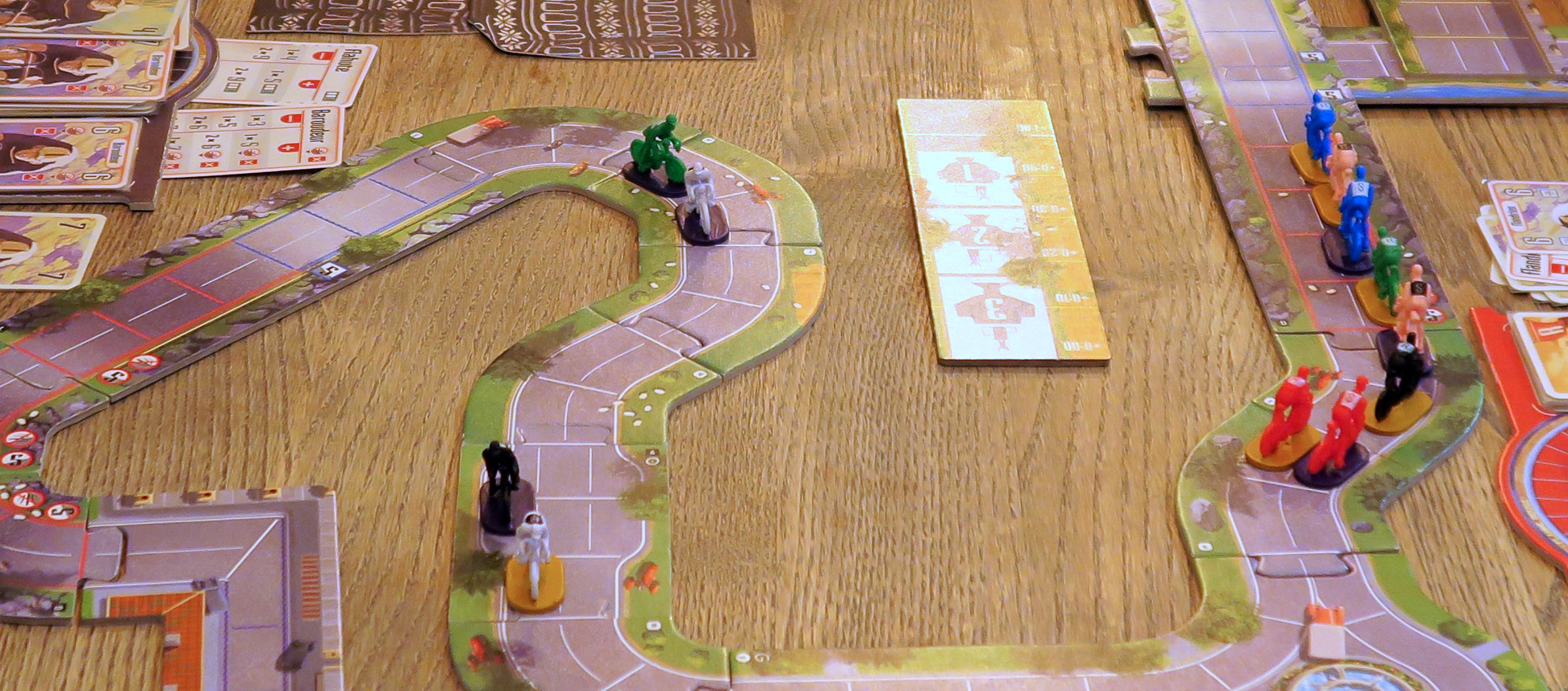
Black and Blue had been interested in joining the game of Underwater Cities, however, as it was, it was the last game to finish by some mile and would have taken a lot longer with a fourth player.  There wasn’t a sixth player interested in making a second game, so in the end, Black joined Pink who was very keen to give Teal’s new acquisition that he’d been toting about since Pink and Blue had brought it back from Essen for him.  This was the Grand Tour expansion to Flamme Rouge. This is a cycle racing game where players move their two riders forward by drawing and playing cards from that riders specific deck, depleting it as they go.

Flamme Rouge: Grand Tour
– Image by boardGOATS

As in real cycle races, players use slipstreaming to avoid exhaustion, in the game, these are cards that block up players’ hands making dealing with obstacles and moving through the peloton more challenging.  A large part of the new expansion is a campaign mode and there was only time for one game, however, there are some additional features, including some new hilly track and a double right-angle hairpin bend.  These added more interesting features to the parcours.  Like all race games, players usually do best if they can start fast and stay at the front of the pack.  In Flamme Rouge, this is mitigated by the fact that once a card is played it is discarded so players have to make their good cards last the duration of the race while avoiding too much exhaustion.

Flamme Rouge: Grand Tour
– Image by boardGOATS

Teal managed to crash both his bikes, while Black and Purple crashed one each.  Indigo and Navy led for most of the game while Pink tried to maintain a position in the front four or five.  Navy faded as the sprinters wound up for a lunge for the line, with Indigo as Marcel Kittel and Pink as Mark Cavendish.  This time, victory went to the German and the Manx Missile with just piped into second with Navy rolling home in third.  The game had been a lot of fun and the general consensus was that the Grand Tour expansion added some nice new features even when multiple games for a campaign weren’t appropriate.  It hadn’t out-stayed its welcome either, and although Teal headed home, there was time for everyone else to play one more quick game.

Flamme Rouge: Grand Tour
– Image by boardGOATS

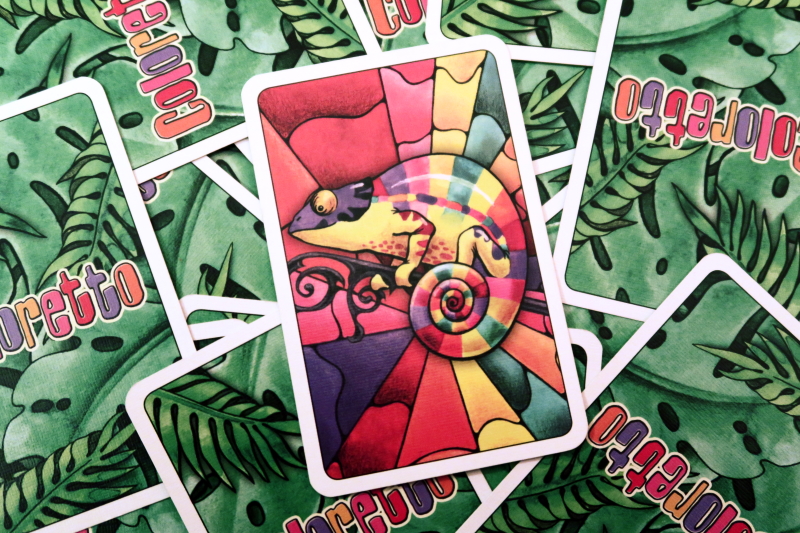
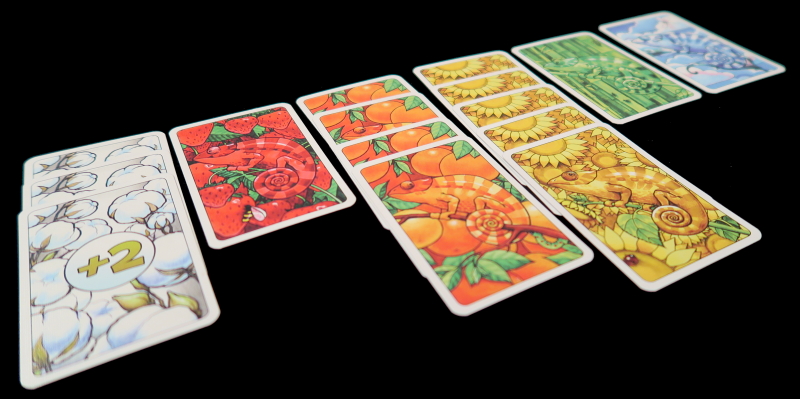
The game of choice was Coloretto—something of an old favourite.  This is a really quick game to teach and start playing, with players taking it in turns to either draw a card and add it to one of the trucks, or taking a truck and adding the Chameleons on it to their collection.  The clever part is that largest three sets score positive points following the Triangular series, while any other sets score negative points.  Purple drew the Golden Joker which was picked up by Pink, while Black took the other Joker.  The game was really tight, well, amongst the top three anyhow.  Navy managed to only score positive points, but his thirty-four points was one less than Indigo who took second and who, in turn, scored one point less than the victor, Black.

Coloretto
– Image by boardGOATS

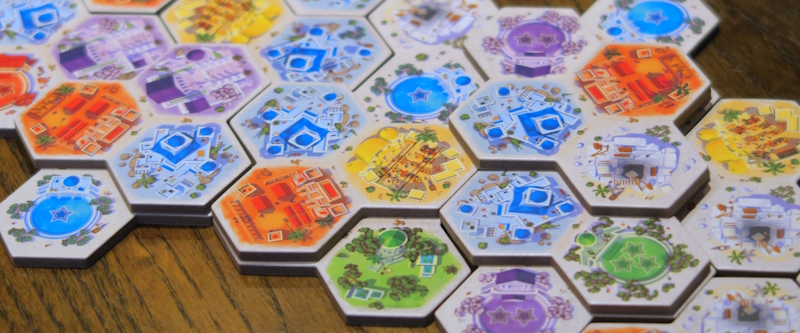
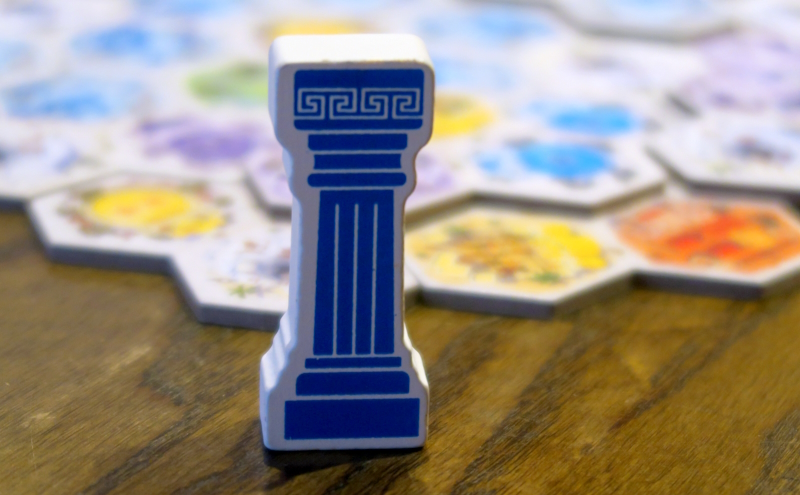
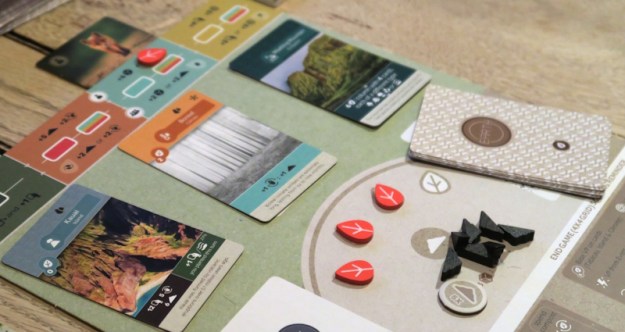
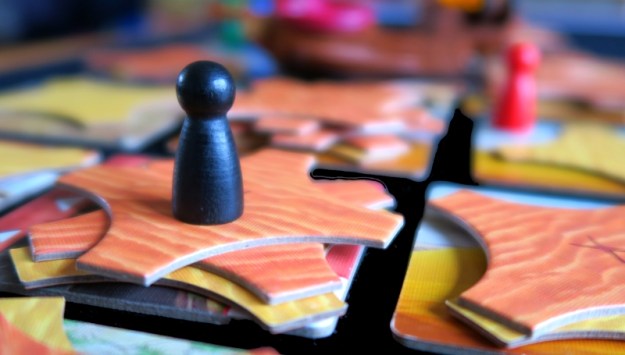
The final table consisted of Pine, Blue, Jade and Sapphire.  After a bit of chit-chat, this group settled on playing Akropolis.  This is a fairly light abstract tile laying game in a similar vein to Taluva or NMBR 9, where tiles placed on higher levels score more points.  In this game, players take a tile from the Market and place it in their City.  The first tile in the market display is always free, the one after costs one stone (the only resource in the game) the next one two stone and so on.  The tiles comprise three conjoined hexes each either a Quarry (which provide Stone when built over), a Plaza, or a District tile.  Tiles can be placed on top of others, but must cover more than one other tile and cannot leave gaps.

Akropolis
– Image by boardGOATS

At the end of the game, tiles that meet the scoring requirements for that colour are multiplied by their height.  As in Kingdomino where the area is multiplied by the number of crowns in it, this District score in Akropolis is multiplied by the number of Plazas in that colour; these totals are added together to give a final total.  This time, Blue scored heavily for her Houses and although Jade almost matched her with his Barracks, he didn’t score much for anything else and Blue had picked up a lot of points for her Markets too.  Together these gave her a bit of a landslide with a total of one hundred and nineteen.  Sapphire and Pine that by the end they had got the hang of things, and fancied giving it another go.

Akropolis
– Image by boardGOATS

The game was punctuated by a discussion about orange juice and lemonade, which is apparently called a “Henry” in these parts though nobody but Jade was aware of it.  Pine commented that where he came from it was more likely to be used to order cocaine.  This time, Blue tried a totally different strategy this time focusing entirely on Houses.  Sapphire’s Markets gave him forty points and Pine’s gave him thirty-four.  These were dwarfed by Jade’s Gardens that gave him sixty points, but they all paled into insignificance compared to Blue’s Houses which gave her one hundred and eight.  Sadly though, with nothing else but a pile of rocks, this left her with exactly the same score as last time—and a tie with Jade, while Sapphire, the most improved player finished in third, just four points behind.

Akropolis
– Image by boardGOATS

Learning Outcome:  The underwater world has a lot of potential.

23rd July 2024

Blue and Pink were still eating when everyone else rolled in and seemed quite content to chat.  It took Blue two attempts to get the first game rolling, with Jade leading Cobalt, Crimson and Plum to the other side of the room.  Pink moved to join Pine who wanted to play his new acquisition with Black and Purple, which left Blue and Lime to lead Byzantium, Sapphire and Cyan in the “Feature Game“, the Alpine expansion for Forest Shuffle.  This is was chosen to mark the announcement of the Spiel des Jahres Awards, as Forest Shuffle, featured on the recommended list and has been popular with the group.

Forest Shuffle
– Image by boardGOATS

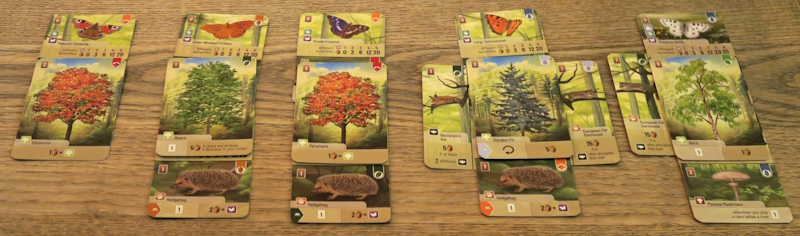
Blue made a bit of a meal of explaining the rules, but really they are very simple.  On their turn, players either take two cards from the market and add them to their hand (with a hand limit of ten), or play a card from their hand into their tableau.  There are three different types of cards.  Tree cards are the central cards around which Critter cards are played.  Then there is the first set of Critter cards which are divided into two, left and right with an animal on each half.  Finally, there are Critter cards which are divided into two, the canopy at the top and the undergrowth at the bottom.  The Critter cards are half-tucked under the Tree cards, so only one animal, flora or fauna is visible.

Forest Shuffle
– Image by boardGOATS

The difficult part of the game is getting the cards to work together efficiently to give extra actions and, ultimately, points.  The Alpine expansion doesn’t change the game significantly, just adding more variety to the cards, adding more opportunities for scoring.  For example, it adds an extra Butterfly which give players more points if they have a complete the set.  This time, Blue started with a hand full or Hares, making her initial strategy obvious.  Sapphire was less fortunate, so Blue and Lime suggested that starting with Trees was always a good way to go as players can’t do anything without them.  He also had some Butterflies, so that was where he went next.

Forest Shuffle: Alpine Expansion
– Image by boardGOATS

Lime built up a collection of Birds, and since he advertised his strategy to the group, everyone else was able to take cards he wanted.  This is a key part of the game:  some cards give points for the number of something you have, so having more of both multiplies the score.  For example, Hares give one point for every Hare a player has.  Thus, one Hare gives one point, but Blue’s seven Hares mean that first Hare scored seven points.  More to the point, every other Hare also scored seven points giving her forty-nine points just for her Hares.  Meanwhile, Byzantium was going Bats, and Cyan was experimenting with Deer.

Forest Shuffle: Alpine Expansion
– Image by boardGOATS

The game ends when the third Winter card is drawn from the deck, so after the second, everyone got very nervy as they tried to complete all their plans and play all the cards they wanted to.  Each time someone drew a card from the deck, it was with bated breath.  The final stage seemed to last forever, and although the third Winter card wasn’t the last card in the deck, it was close, and when it was drawn the game ended immediately. And then it was time for the scores:  everyone assumed that Blue’s husk of Hares would give her victory, but it was actually quite much closer than they thought.  Although Blue finished with a hundred and sixty-five, Byzantium was only twenty points behind.

Forest Shuffle: Alpine Expansion
– Image by boardGOATS

Byzantium was ready to leave, but for everyone else there was just time for something really quick.  So as everyone else was still playing, the remaining four decided on a quick game of Coloretto.  This is an old game, but one that was on the Spiel des Jahres Award “Recommended List” in 2003.  Remarkably, Cyan and Sapphire were new to it, but it is a super easy and quick game to play, but with tactical decisions to make.  It is also one that can essentially be taught as you go:  either turn over the top Chameleon card and add it to one of the Trucks, or take one Truck.  Each Truck can contain a maximum of three Chameleons and once everyone has taken a Truck, the round ends.

Coloretto
– Image by boardGOATS

At the end of the game, players score each group of coloured Chameleons, with the largest three groups giving positive points and any others scoring negatively.  There are a small number of cards that just give straight points and balancing these with Chameleons is part of the challenge.  The end is triggered when the end of game card is drawn and then the round is played to completion.  This time, everyone kept their negative scores down, while Cyan went for the pure point cards, collecting fourteen points, more than half his score, by that route.  The winner was Lime, however, who was imperious and won by some distance with a total of thirty-three.

Coloretto
– Image by boardGOATS

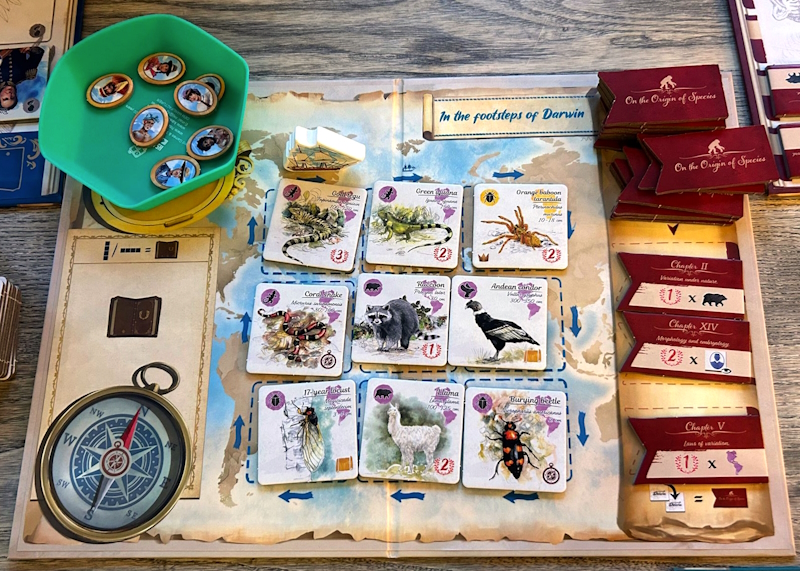
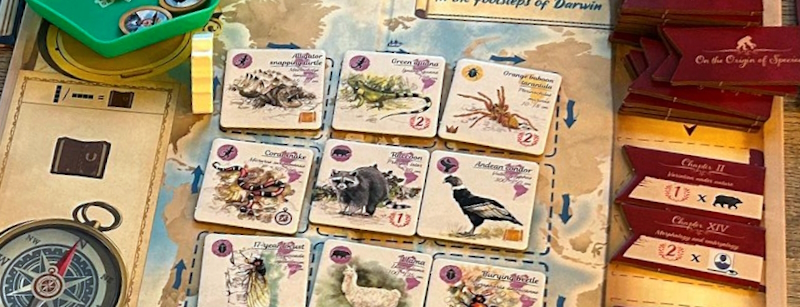
Meanwhile, on the next table Jade was teaching Cobalt, Crimson and Plum the Spiel des Jahres 2024 nominee, In the Footsteps of Darwin.  The premise of this is that players are naturalists aboard the Beagle helping Charles Darwin finish his book On the Origin of Species, studying animals, carrying out cartographic surveys, publishing their findings, and developing theories. On their turn, players study an animal or take inspiration from a character by choosing one of the three tiles in the row or column marked by the Beagle, and placing it onto their naturalist’s Notebook. This may be an animal to study or a character from the Beagle’s previous journey and will give an immediate bonus or a scoring bonuses.

In the Footsteps of Darwin
– Image by boardGOATS

After placing the tile, the Beagle is moved round the market, with the distance dependent on the tile chosen and a new tile is drawn to fill the empty space on the journey board.  At the end of the game, the player who contributed the most to On the Origin of Species wins.  At it’s heart, In the Footsteps of Darwin is a fairly simple set collection and “make the most of what’s available” game. Players obtain an additional scoring objective when they place a tile on top of a previous one, covering up any icons, so a key part of the game is the conflict between points being gained verses points being lost.

In the Footsteps of Darwin
– Image by boardGOATS

There’s also quite a bit of luck invoiced, as a player may need one or two specific tiles that don’t come out, or that get taken by someone else before they have the opportunity to do so.  The group found it was very quick to play, taking just forty minutes including teaching.  Plum’s  starting goal was points for tiles in the upper right quadrant, but in the absence of tiles that fitted that criteria she focused instead on collecting Charts and Compasses as these score points equal to the number of these multiplied together.

In the Footsteps of Darwin
– Image by boardGOATS

One advantage of these is that once a Compass has been collected, the tile can be covered without loosing any points. Cobalt didn’t worry about that at all, covering loads of tiles to get more Theories banners which give points.  Ultimately, everyone’s score was pretty similar at the end of the first game but Jade took victory as he was most effective with the Chart/Compass scoring.  As it was so quick, the group decided to give it a second try—this the scores all improved.  This time the victor was Crimson, who was again the most effective with the Charts/Compasses, but also scored well in other areas, as did Cobalt who came second again.

In the Footsteps of Darwin
– Image by boardGOATS

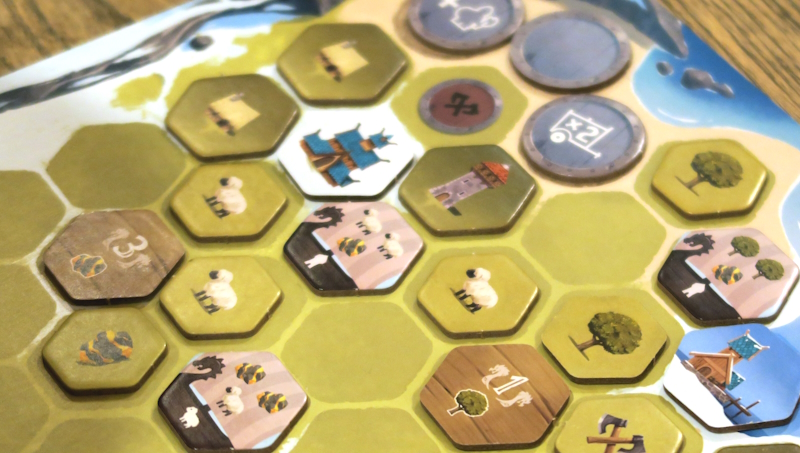
From there, the group moved on to a game of Looot, which is too recent a release to have been acknowledged in the Spiel des Jahres awards.  It has been popular amongst the members of the group that have played it so far, however, and may well get an award next year.  In this game, players gain points by gathering resources and capturing buildings to try to develop their Fjord, fill their long ships and complete buildings. The winner is the player with the most riches and is crowned Jarl of the Vikings. The game is played over several rounds until each player has played all their Vikings, giving a maximum of thirteen turns, each with a simple structure.

Looot
– Image by boardGOATS

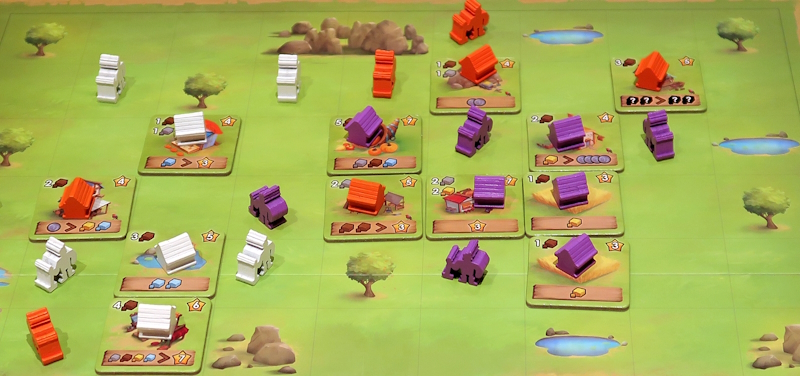
Players start by placing their Viking on a Resource tile on the central board adjacent to another Viking of any colour.  They then take the associated Resource and place it on their personal board.  If possible, they then use their Resources to capture a Building and place that on their board, take a Long Ship and also place it on their board, use a Shield, or complete a Construction Site and finally grab a Trophy.  Looot is quite a light game, but with enough decision space to be interesting.  Last time was a three-player game, but this time, with four, players get another map area, which the group arranged to give a wide play area.

Looot
– Image by boardGOATS

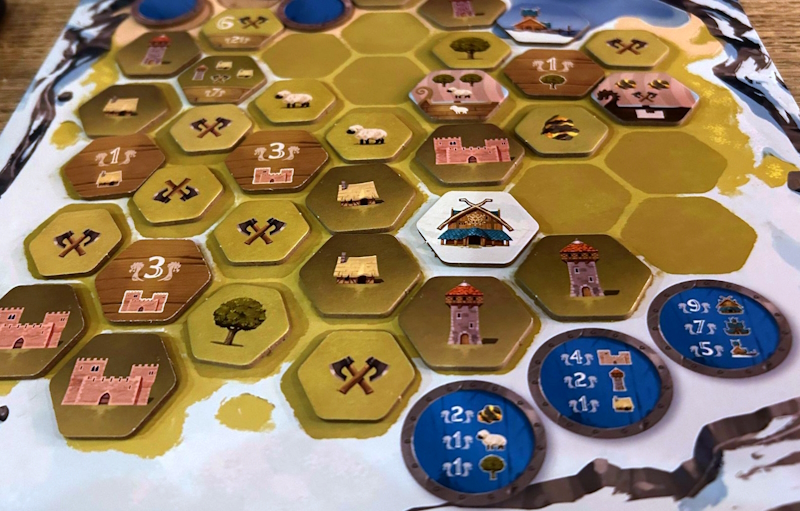
The board layout made it easier to get to more areas of the map relatively early in the game, but there was still plenty of competition for the Towers.  Like last time, Plum decided not to worry about all the home tiles and focused on gold, which was good, but not enough on its own.  Cobalt scored massively for Castles by getting plenty of them plus the equivalent Long Boats.  Cobalt started on that strategy largely by accident, before he had got a real understanding of game-play and a full appreciation of how they increased the Castle scoring and matched the requirements he could fulfill.

Looot
– Image by boardGOATS

Crimson had a nice balance of increased score for Towers and Houses, while Jade built up a huge pile of Wood.  Unlike last time, things didn’t just come together at the end for Plum, and nobody else could compete with Cobalt’s Castles and he took victory with one hundred and twenty-one, fourteen points ahead of Crimson in second.  It had been a good game though, and as players become more experienced, they will be increasingly able to determine the best scoring opportunity from the start and how to optimise the mini game that is building their Fjord. With experienced players, this could be quite ruthless with players trying to block each other and prevent objectives.

Looot
– Image by boardGOATS

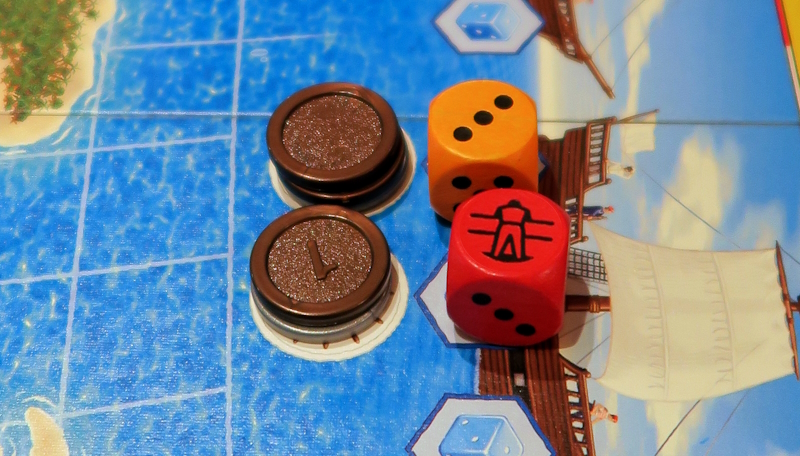
In the third group, meanwhile, Pine was introducing his new acquisition, the old game, Tonga Bonga, to Pink, Black and Purple.  This is a sailing race game a bit like the 2008 Spiel des Jahres recommended Jamaica.  In Tonga Bonga, players pilot their ship around the archipelago with the goal of visiting four of the five remote islands and returning to Tonga Bonga Bay.  Each player has room for three sailors on their ship, each of which represented by dice and indicate how fat the ship will move.  At the start of the round, players decide how much they are prepared to pay for the sailors who will serve as their captain and first mate that round (the Cabin Boy always works for nothing).

Tonga Bonga
– Image by boardGOATS

Players then simultaneously roll their dice, and take it in turns assign their dice to the other players’ ships, in return for the money offered.  In a mechanism vaguely reminiscent of that in the really rather vicious game, Vanuatu, if a player tries to place a higher value die where someone has already assigned a die, the lower value one is displaced and bumped to a lesser and usually less lucrative role.  Thus, all things being equal, the ship offering the most money will get the highest value dice and the most moves, though of course, players can work together to disrupt this behaviour. One side of each die has a Seasick Sailor (effectively zero), so the maximum value dice are five.

Tonga Bonga
– Image by boardGOATS

Once all the dice have been assigned, players move their ships racing to reach the islands, leaving one of their tokens there.  Landing on an island, earns $25 from the bank, but the player has to pay $5 to each player who landed there ahead of them.  Pine explained the rules and before long, everyone was sailing.  Pink got a bit of a lead by using his winnings to buy more moves and visit more islands.  He had been feeling that the game was maybe a bit “broken”, but as is usually the case when a game feels like that, it was all down to the “rules malfunction”, but it wasn’t until the final round that the rules were “clarified”.

Tonga Bonga
– Image by boardGOATS

Instead of the winner being the player to cross the line first with any left over money used as a tie-breaker, once a player has visited four islands they return to Tonga Bonga Bay and trigger the game end—and whoever has the most money wins.  Pink crossed the line and claimed the moral victory, as he was playing by the original rules.  Everyone else was quite happy with the “updated rules” though, which left Pine the victor with Purple in second and Black just behind.  Pink blamed “Evil Pine” for the mishap, but was eventually won round with a bottle of dubiously flavoured cider.

Tonga Bonga
– Image by boardGOATS

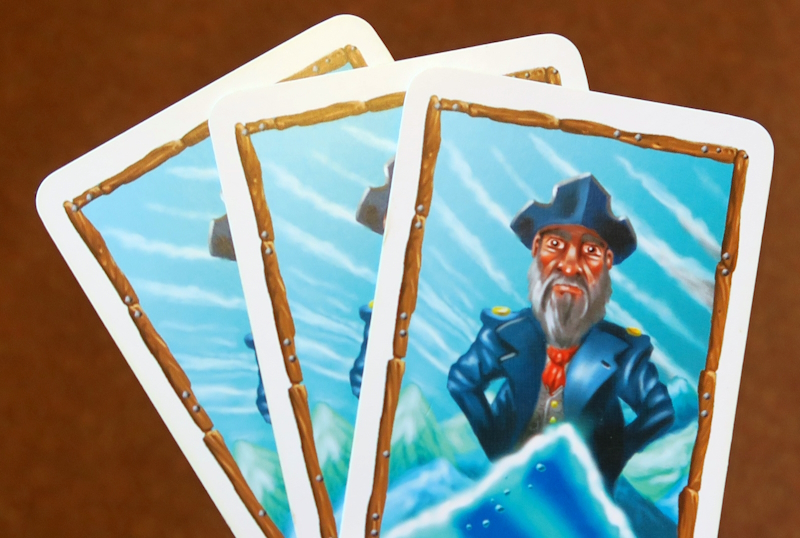
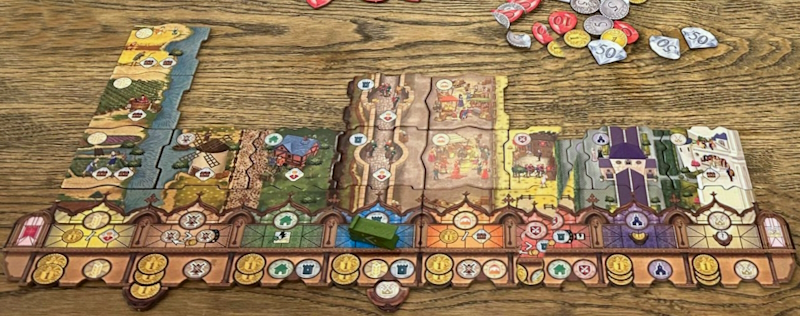
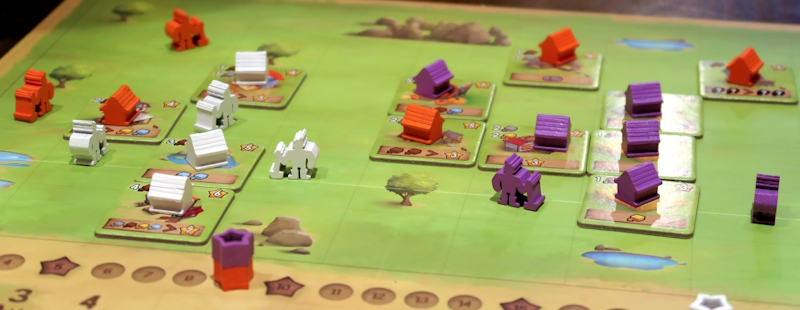
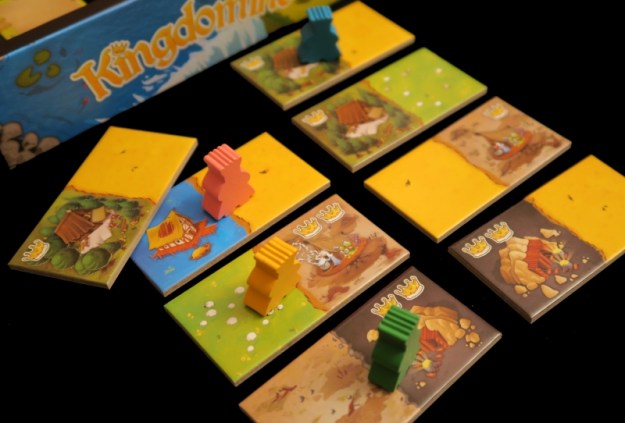
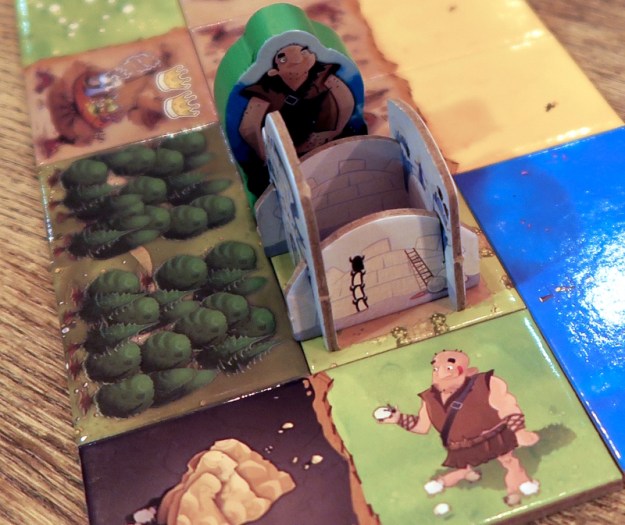
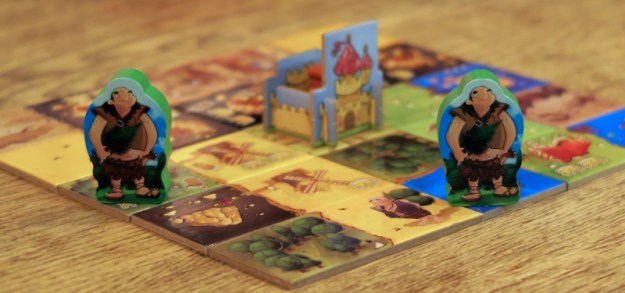
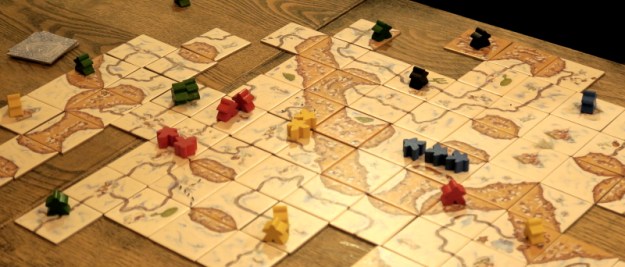
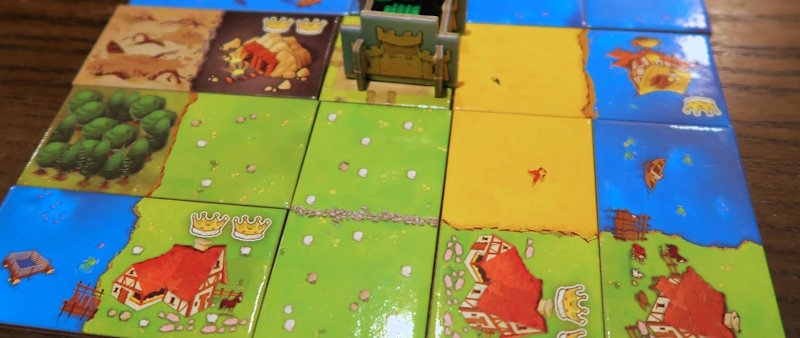
Although the debate had been audible by the players at the neighbouring tables, ultimately it was all taken in good part and the game had been a lot of fun and showed its age less than Lifeboats that was played a few weeks back and was only five years older.  From there though, the group moved on to a game of the 2021 Spiel des Jahres winner, Kingdomino.  This is a clever little game where players are building a kingdom made out of double-headed, domino-like tiles.  As in Dominoes, the ends of the tiles have to match, or at least it has to match with one tile tile already in the player’s kingdom.

Kingdomino
– Image by boardGOATS

The really clever part of the game is the double market, where the tiles are taken in reverse order of value.  The double market means that when a player takes the tile for the current round, they choose which tile they will get in the next round.  Thus, taking the lowest value tile this round means they will have first choice next round.  Players score for each contiguous area of Terrain—the number of points is equal to the number of squares multiplied by the number of Crowns featuring in it.  This time, Pink concentrated on Wheat Fields and Sea, Pine focused on Sea and Meadow while Black concentrated on Woodland with a smattering of points from Marsh, Mountain and Wheat fields.

Kingdomino
– Image by boardGOATS

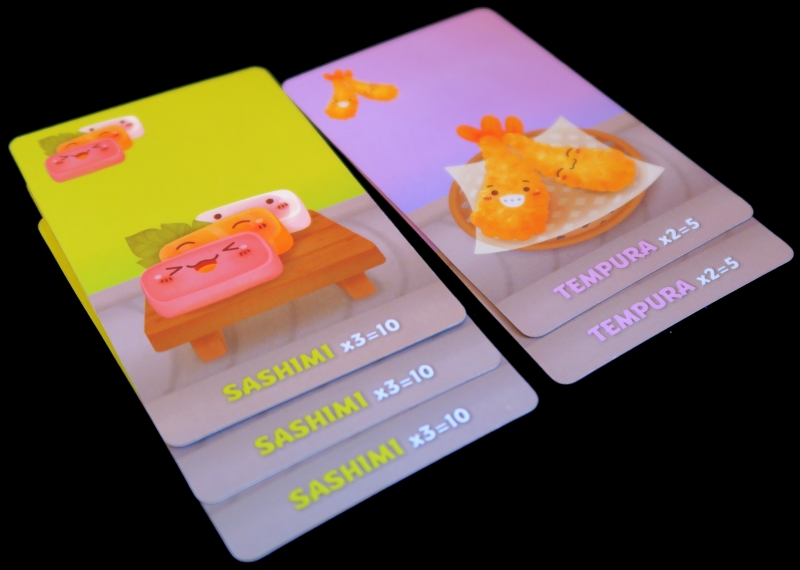
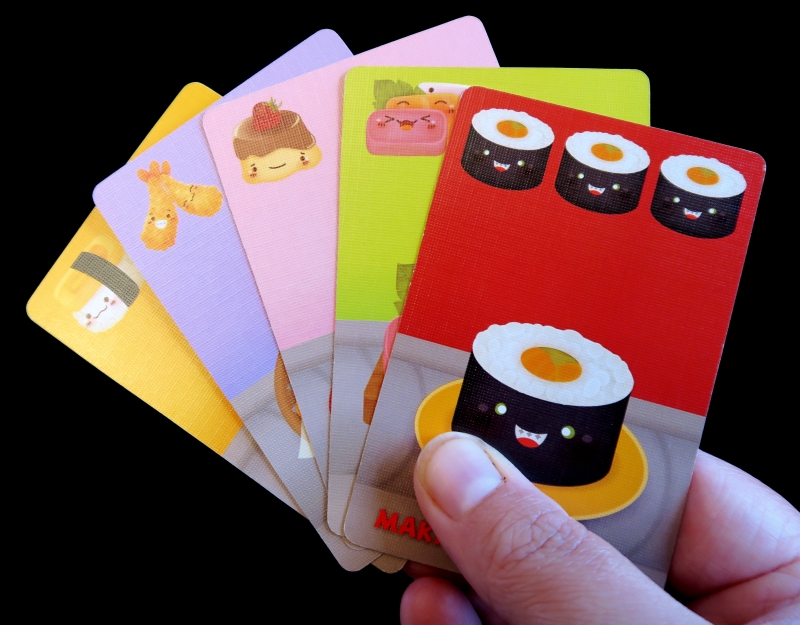
In contrast, Purple prioritised her four contiguous areas forfeiting the “Harmony” and “Middle Kingdom” bonus points for using all the tiles to give a square kingdom with a central castle.  Pine took victory with a massive seventy-three with Pink and Black tying for second with sixty points.  This group wasn’t done by any means and swiftly moved on to a quick game of Sushi Go!.  This is one of those games that takes a mechanism that is a relatively minor part of other games and distills it into its purest form in the game.  Coloretto does the same for the central market mechanism used in the 2007 Spiel des Jahres winner, Zooloretto, and Sushi Go! does it for the card drafting mechanism in the 2011 Kennerspiel des Jahres winning game, 7 Wonders.

Sushi Go!
– Image by boardGOATS

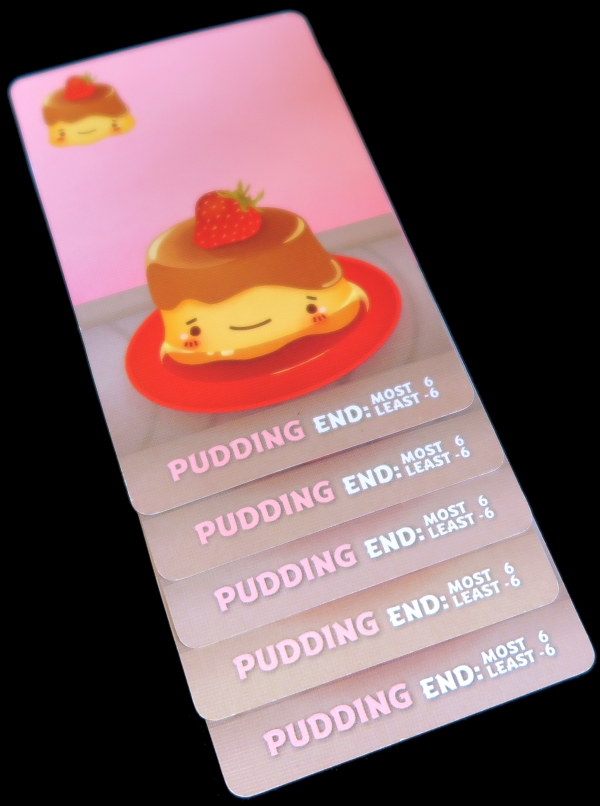
In Sushi Go!, players start with a hand of cards, keep one and pass the rest on, repeating until all the cards have been distributed.  As well as being a core mechanism in 7 Wonders, this “Card Drafting” is also often used to try to reduce the luck of the draw at the start of games like Terraforming Mars and Agricola (both also acknowledged by the Spiel des Jahres committee).  In Sushi Go!, players are using the card drafting to collect sushi and, most importantly Pudding!  The game is played over three rounds, with cards drafted to the left, then right and then left again, scoring points at the end of each round.

Sushi Go!
– Image by boardGOATS

This time, Pink and Black tied for the high-scoring first round, with Pine just behind.  Pine made up for it on the second round by taking it convincingly, however, with everyone else scoring very badly.  The third round was more even again, this time won by Black with Purple taking second.  That resulted in a three-way tie between Black, Pink and Pine, but at the end of the game, the player with the most Pudding cards gains six points, with the one with the fewest losing six points.  Unusually for Pink (as he has quite a sweet tooth), he had eschewed Puddings, while Black had the most giving him what ended up being a quite convincing victory.

Sushi Go!
– Image by boardGOATS

There was just time for a single round of Love Letter (a game from the 2014 Spiel des Jahres recommended list).  This is a sixteen card game where players start with a card, draw a second and then play one.  The idea is to try to be the last play in or the player with the highest value card when the deck runs out.  The theme is all about getting as close as possible to the Princess card, which has the highest value.  This led to a discussion about real princesses and how close people had been to them.  It turns out that Purple has met a real one, Princess Nina who lives in a massive house in Cheltenham.  During the game, Pink was the Princess, but was spotted and knocked out, leaving Black to take another win.

Love Letter
– Image by boardGOATS

Learning Outcome:  The Spiel des Jahres committee may reward lighter games, but they are good games.

25th June 2024

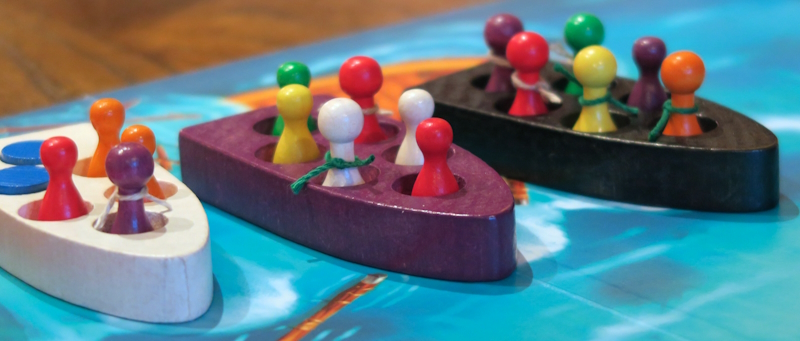
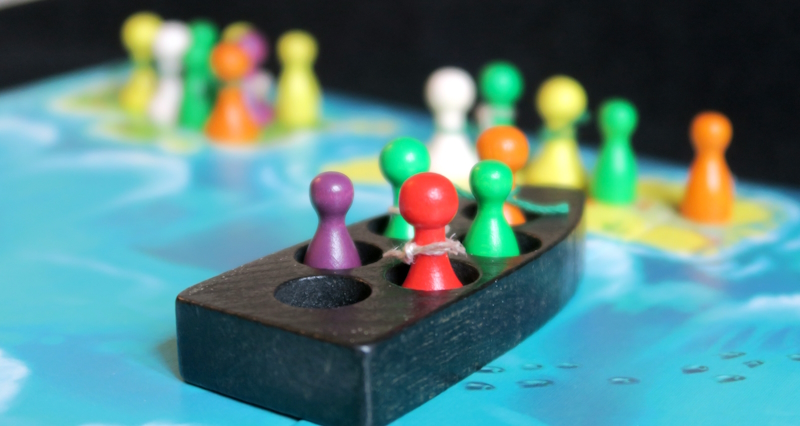
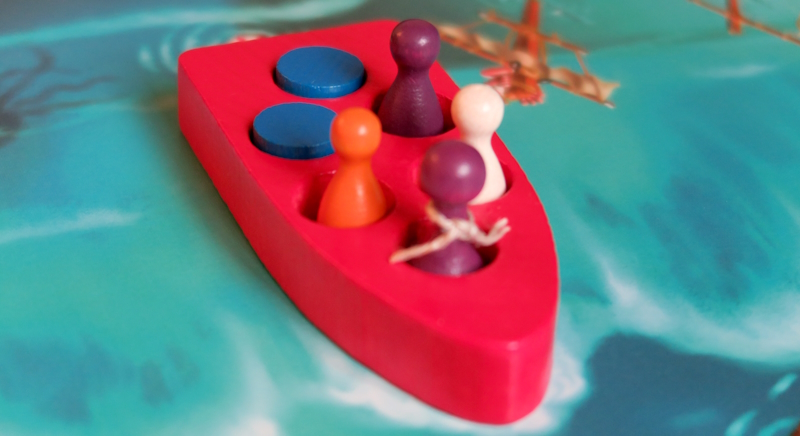
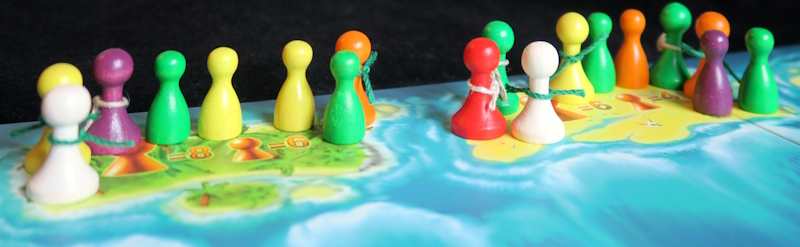
To mark the upcoming General Election, the “Feature Game” was to be Lifeboats, an older game which features lots of voting (as well as boating…).  Blue and Pink were still eating as the others arrived, so those that wanted to join them staked their claim and waited and the others took themselves off to play something else, but it wasn’t long before the voting and boating was underway.  Lifeboats is a fairly simple, if savage game, where players are trying to get their sailors from the sinking wreck of the Santa Timea to shore.  Unfortunately, the lifeboats are old and leaky and as the water comes in and the boats begin to sink, players vote to decide which boats to move and who to throw overboard.

Lifeboats
– Image by boardGOATS

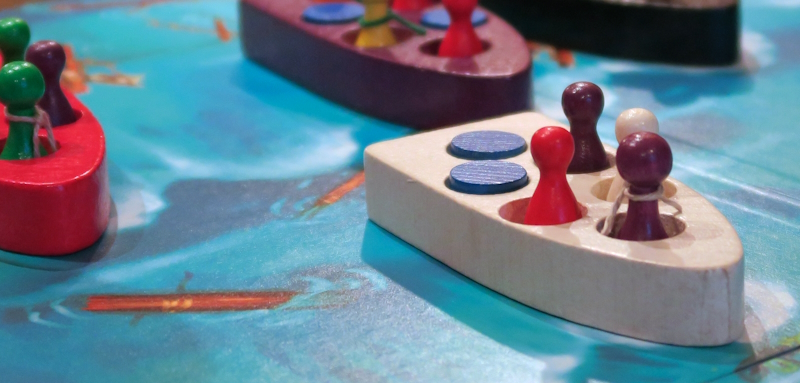
There are three phases to each round in Lifeboats:  firstly one boat develops a leak, then one boat moves forwards, and then finally, one seaman in each boat jumps overboard and then climbs back into a different boat.  In the first phase, players vote to decide which craft develops a leak and a blue wooden disk is placed in an empty spot in that boat—if there isn’t an empty space, the occupants vote to decide who is going over the side.  Once that has been resolved, players vote again, this time to decide which boat is going to move; it’s only three spaces to reach land, but that can seem an awfully long way.

Lifeboats
– Image by boardGOATS

In the final phase of the round, beginning with the start player, players take it in turns to take one of their seamen from a boat into the water and then in reverse order the swimmer climbs into a different boat.  And it must be a different boat—if there isn’t a different boat with space, the unfortunate sailor drowns in the attempt.  All that is quite straight forward, but there are a some little tweaks that add interest to the game.  Firstly, each player has two Officers and a number of Sailors:  deciding who is going to be thrown overboard, players have one vote per Sailor in the boat and two per Officer.  Seamen that make it to land score points, but Officers score more, all this also makes them a target though.

Lifeboats
– Image by boardGOATS

Even though the Santa Timea is headed for Davey Jones’ Locker, the Captain is still in command.  So, during any vote, players may invoke his name to get their way by playing a Captain’s Hat card.  Players only have three of these though, and they are single use so must be used with care.  Worse, if more than one player plays a Captain’s Hat, they cancel out, and a bit like ties in Las Vegas all the tied players lose out, so they also have to be well timed to be effective. The winner is the player to score the most points by getting their seamen back to land before the last boat sinks (and the different islands give different numbers of points for Sailors and Officers).

Lifeboats
– Image by boardGOATS

A key part of the game is the negotiation before votes, so the group played with “The Stick Variant” whereby the Start Player controls how long players have for debate.  The other advantage of being the Start Player is they have the casting vote in the event of a tie.  This time, Ivory went first and began with the Start Token.  As he was playing white, to maintain the election theme, he was representing Independent candidates.  Blue played with orange who were therefore the Liberal Democrats; Lime had purple UKIP pieces; Pine directed the Greens, Black Labour and Pink the SNP.

Lifeboats
– Image by boardGOATS

Nobody was quite sure what to do at the start, but Ivory’s Independent boat was the first to spring a leak.  Although players have no control over boats of their colour, they are a tie-break at the end of the game where players finish with equal points.  In the second round, Black opined that there were too many boats and rather than share the leaks around, the group should concentrate on sinking one boat.  Everyone else obligingly agreed and the vote was carried, so before long the Independent boat was heading to the bottom of the deep-blue sea.  In contrast, the Liberal Democrat boat danced over the waves making it to shore first, carrying two Green Sailors, and one Sailor each for UKIP and the Independents, all led by one SNP and one Independent Officer.

Lifeboats
– Image by boardGOATS

From there, things got more savage as the spaces in the boats became more scarce and everyone realised that the SNP (Pink) was on course for a landslide.  Ivory “spoiled his ballot” when he chose to throw his own Sailor overboard, and Lime was sufficiently confused by proceedings that he wound up voting to move a candidate forward when it had already withdrawn (by sinking).  The last boat to go down was Labour, but by that point, it was already clear that the Greens (in the guise of Pine) had the majority with a vote share of thirty-two, six more than the SNP (Pink) in second and twelve more than the third party, the Liberal Democrats (Blue).

Lifeboats
– Image by boardGOATS

It had been a lot of fun, if quite nasty, and as such, is a game with an older feel to it, as befits a game that is thirty years old.  It wasn’t the only thing that was showing it’s age, as the Blackadder quote got several outings too (“Lord Nelson has a vote…”  “He has a BOAT, Baldrick…”).  There had also been an large element of gerrymandering leading to Pine’s victory which, as he said, would not have happened if Lilac had been there as she would have really enjoyed drowning all his seamen.  As it was, he was the only player to get all his men to safety, so deserved his term in Parliament.
Lifeboats
– Image by boardGOATS

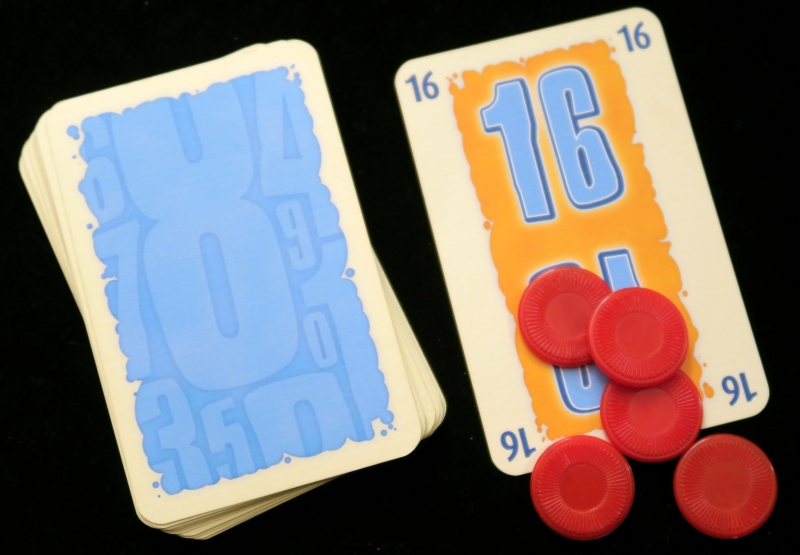
The other games were still underway, so the group played a couple of quick rounds of the old favourite, No Thanks!.  This is a super-quick filler, where players choose to take the face-up card, or pay a chip to pass the problem on to the next player.  At the end of the game, players score for the lowest card in each run, minus the number of chips they have left—the player with the lowest total is the winner.  In the first game, Black top-scored with forty-eight and the winner was Lime with nine, pipping Blue by one.  In the second game, Pine finished with the highest total (though it wasn’t a patch on Black’s).  Blue thought she had this one when her total came to just three, but much to her chagrin, Lime finished with two, again beating her by a solitary point.

No Thanks!
– Image by boardGOATS

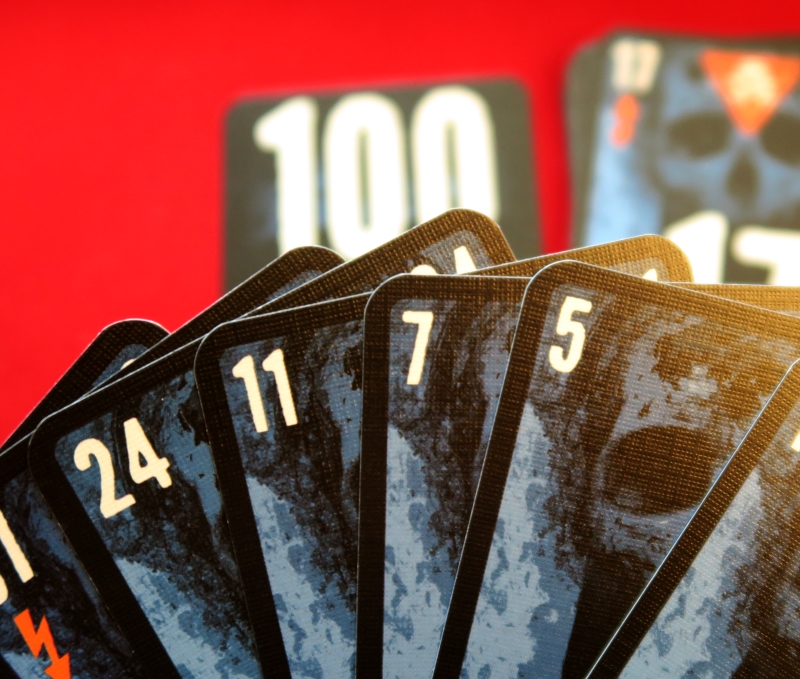
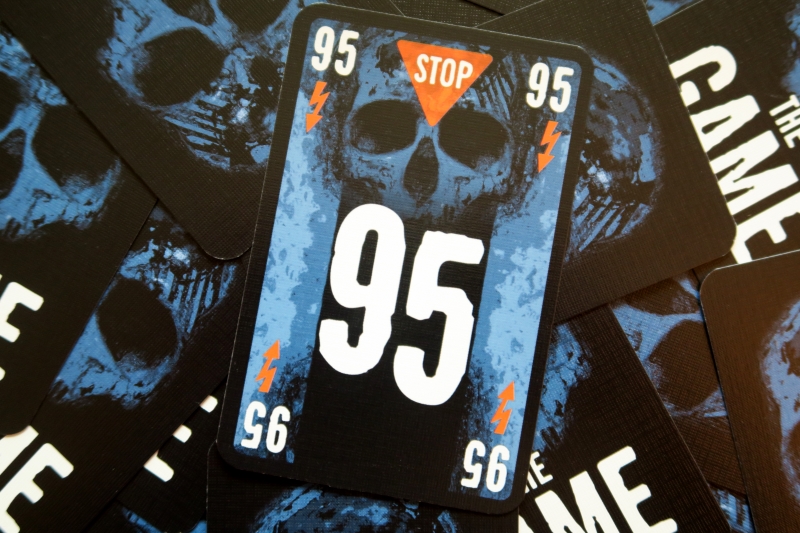
Ivory took his leave, and the remaining five managed one more game, this time of The Game.  This cooperative effort used to be a popular filler in the group, though it is a few years since it last got an outing.  The team have a deck of cards numbered from two to ninety-nine (in our case, from a copy of The Game: Extreme, but ignoring the special symbols), and play each card on one of four piles, two ascending and two descending.  There are just three rules:  the active player can play as many cards as they like, but must play at least two cards before replenishing their hand, and players can say anything they like but must not share “specific number information”.
The Game: Extreme
– Image by boardGOATS

There is the so-called “Backwards Rule” where players can reverse a deck as long as the card they play is exactly ten above or below the previous card played on that pile. The game ends when, either all the cards have been played onto the four piles, or a player cannot play a card. As is often the way, things started to go wrong from the start and pretty much kept going wrong.  The game finally cam to an end when, shortly after depleting the draw deck several people said there wasn’t anything they could play, and after the last possible card had been played the group had seventeen cards left.

The Game: Extreme
– Image by boardGOATS

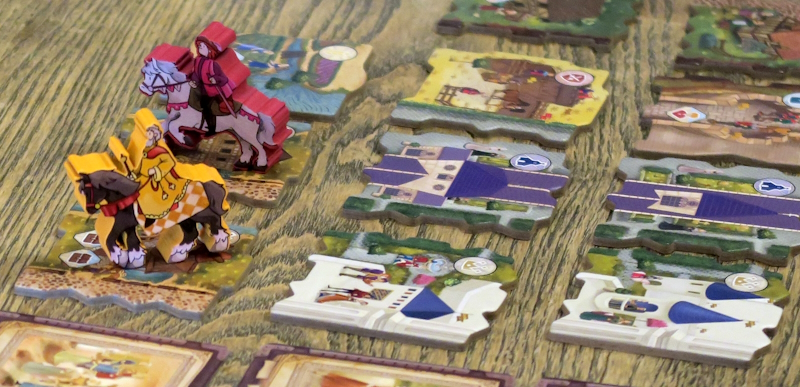
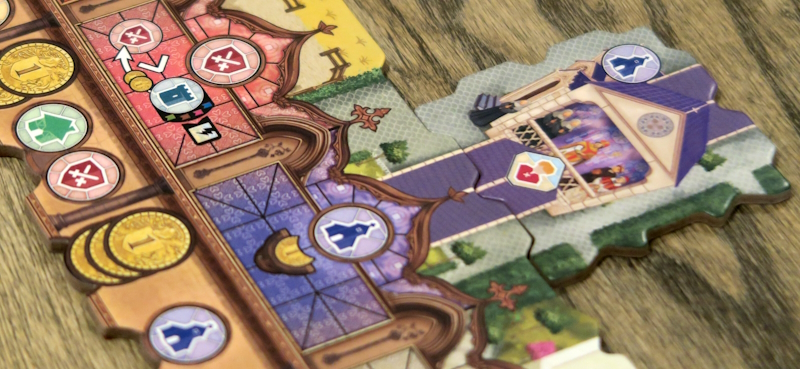
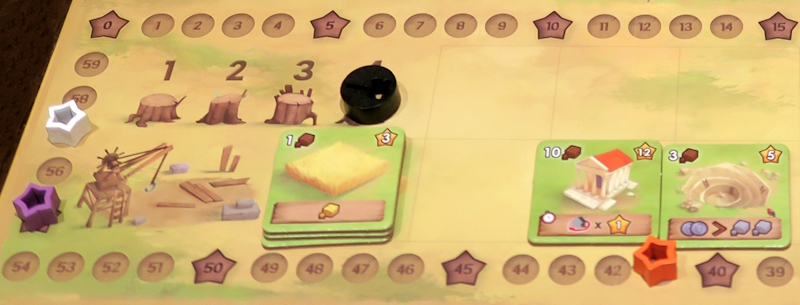
Meanwhile, Jade, Plum and Byzantium had started out playing one of Jade’s acquisitions from the recent UK Games Expo.  Middle Ages (a reimplementation of Majesty: For the Realm) is a quick little game where players are the head of a fiefdom.  The idea is that players use their Lord-eeple (or perhaps that should be lord-muman) to take tiles, placing them on their player board and gain its rewards, which change depending on the type of the piece.  The game is based around a market, similar to that in Kingdomino, where tiles are arranged in ascending order with players taking tiles in that order and placing their Lord-eeple on their chosen tile from the next row.  Thus, the player has to choose between an early choice in the next round and a low value tile, or a high value tile, with less or no choice.

Middle Ages
– Image by boardGOATS

Players then carry out the tile’s special effect and take the associated income.  The payout increases payout the more tiles of the same type a player has.  Every four rounds, there is an event and the game ends after the sixteenth round when players lose ten points for each type of tile they don’t have in their city and the person with the most points is the winner.  This time, Byzantium went all in for Windmills (players with fewer Windmill tiles had to give him two Coins) while Jade built some Barracks.  The Barracks enabled Jade to attack everyone with fewer Rampart tiles than he had Barracks tiles forcing them to give him money.  Plum opted for a more balanced approach that allowed her to improve her income stream significantly due to the Churches and Palace buildings she played.

Middle Ages
– Image by boardGOATS

Plum’s Church gave her a coin bonus which she placed on a Village, which enabled her to repair a broken building. There was some discussion about whether that was voluntary or not, but it didn’t seem to be written like it was a choice. Although not planning for it, Plum did well out of the third Event, “Restoration”, giving her coins for having three broken buildings.  Jade, on the other hand, had interpreted the rule as compulsory and had therefore mended his broken building a turn earlier so wasn’t able to benefit from the Event.  It was close between Jade and Byzantium with Jade just edging it.  Someway ahead, however, was Plum, who finished with one hundred and thirty-one points.
Middle Ages
– Image by boardGOATS

Middle Ages is a quick little game, and the trio then moved on to another UK Games Expo game, the slightly meatier Looot.  This is a game where players gather resources and capture buildings to develop their fjord, fill their longships and complete buildings to rack up victory points. The player with the most riches is crowned Jarl of the Vikings.  Like Middle Ages, this was new to both Plum and Byzantium, so after teaching the group got down to the serious pillaging. The game is played over several rounds until each player has played all their Vikings, giving a maximum of thirteen turns, each with a simple structure.

Looot
– Image by boardGOATS

First, a player places their Viking on a Resource tile on the central board adjacent to another Viking of any colour and take the Resource and place it on their personal board. If possible, they then capture a Building and place that on their board, take a Long Ship and also place it on their board, use a Shield, complete a Construction Site and finally grab a Trophy.  Plum felt she wasn’t going to be able to complete all three of her initial goal hexes, but hedged her bets and left space, just in case.  She used the “occupy the same space as another” option fairly early on to make sure she connected at least two Towers—Towers were the more difficult requirements for the two easier home hexes.

Looot
– Image by boardGOATS

Byzantium’s higher scoring home hex needed two Castles. He failed to complete one of his hexes, but did achieve the most difficult one giving him only slightly fewer points than the other two for this aspect. Jade thought the others were likely to take the spots he was aiming for a few times, but he needn’t have worried as a closer look at the others’ boards would no doubt have told him.  Byzantium got quite a good engine going early game with optimal placements of his first four to five Long Ships, which give bonuses for Resources and Buildings on the player’s map.  In order to complete a Long Ship it needs to be adjacent to three specific resources, however.

Looot
– Image by boardGOATS

Each Long Ship taken and left incomplete leads to a five point penalty, so it is important not to over commit, but equally players don’t want to leave prime location Long Ships for their opponents either.  Byzantium’s Long Ships made great use of the Looot he had pillaged, but for some reason he lost his way a little and ended up with a lot of low scoring Looot at the end of the game.  It felt really close, but Jade thought he would just sneak it as he had increased his Castle scoring to seven points per Castle and had he three of them.  In the end though, Plum ended up winning by quite a significant margin, her hundred and eleven were eight points more than Jades total for second place.

Looot
– Image by boardGOATS

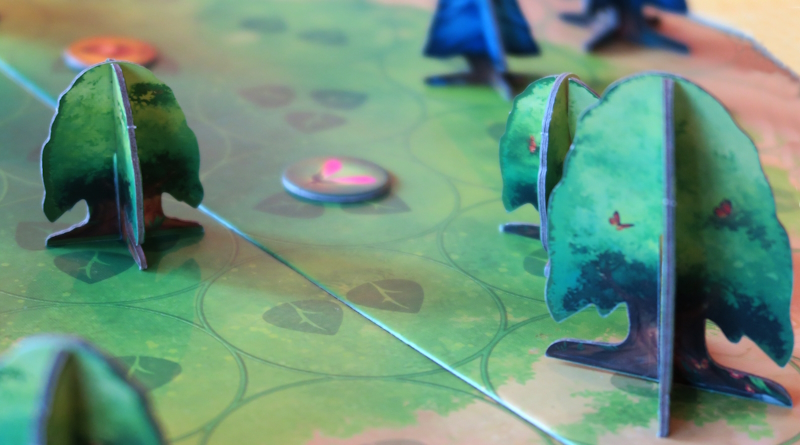
It was an evening for playing games from Expo, as Teal led Purple and Sapphire in a game of Photosynthesis.  This game is a few years old now, but Teal had been really delighted to find a copy for a very good price in the “Bring and Buy”.  In Photosynthesis, players collect light points based on the trees they have on the board and the direction of the sun gaining light points for any of their trees that aren’t in the shadow of another tree.  By collecting light, players can grow and further their species’ dominance over the forest.  Each round, the sun moves creating the direction of light for the round.   Players begin by placing two small trees on the board.

Photosynthesis
– Image by boardGOATS

Small trees collect one light point and cast a shadow over one space. Players can then spend light points to grow a tree, plant a new seed, and eventually harvest a tree once it has reached full size.  As well as a unique spacial puzzle, the game is quite beautiful with mechanics that fit the theme giving simple but meaningful choices.  Like a lot of puzzle-games, Photosynthesis can be quite hard to get one’s head round on the first play.  This time the game was really quite tight between Teal and and Sapphire, but Sapphire just had the edge, beating Teal by one point with final total of fifty-four.

Photosynthesis
– Image by boardGOATS

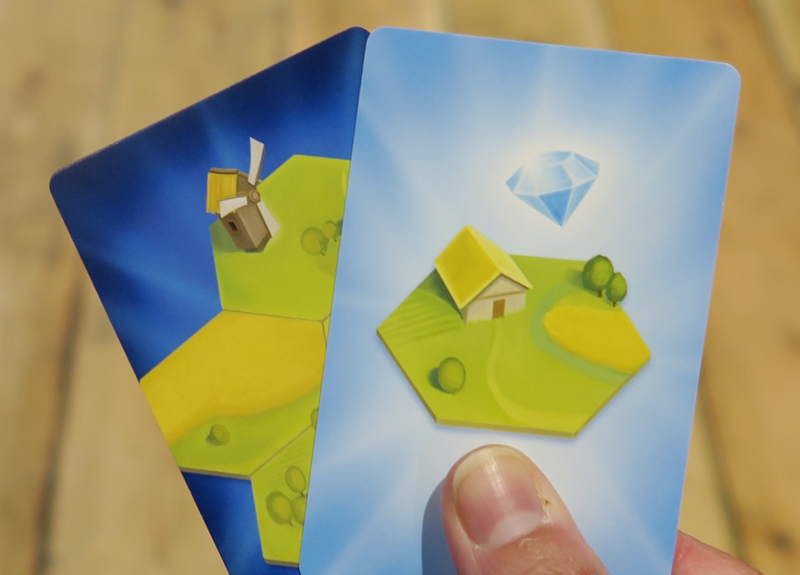
Lifeboats and Looot were still going, so Purple pulled out another Expo special, that first got a run-out last time, a game called Rome in a Day.  This is a cute little “I divide, you choose” game, where players draw five land tiles at random and place two buildings on tiles one and two. They then divide the five tiles into two groups—a bigger and a smaller one (in any ratio) and add a crystal to the smaller land set before offering the choice to their neighbour. During the four rounds the game is played over this neighbour alternates, right, left, right, left.  So, each round, players choose a set from their neighbour and these and the tiles they were left with are added to their domain.

Rome in a Day
– Image by boardGOATS

At the end of the game, any building that stands on or adjacent to land of its own colour will score for each tile in the group and then players score for the diamonds they have collected—the player with the most points is the winner.  It was a really close game, in fact, it was a tie for second place between Purple and Teal who both scored twenty-seven points. Sapphire did rather better, however, finishing with thirty-five points having concentrated on yellow Wheat Fields and green Olive Groves to the complete exclusion of blue-purple Vineyards and red Towns.

Rome in a Day
– Image by boardGOATS

Learning outcome:  Politics can be savage, but it is important everyone votes.

11th June 2024

The pub was not as busy as last time, and in any case, Pink, Blue, Black and Purple were there in good time for food.  Once they had finished, they managed to squeeze in a quick game of Rome in a Day while they were waiting for food and eating.  This is a cute little tile-laying game Black and Purple picked up from UK Games Expo as few days back.  It is a bit like Kingdomino with the “I cut, you choose” mechanism to allocate the tiles.  The “I cut, you choose” mechanism is used in a number of other games like, Castles of Mad King Ludwig, Isle of Skye, and Dice Hospital, but it is a more fundamental part of games like San Marco, and particularly …aber bitte mit Sahne and New York Slice.

Dice Hospital
– Image by boardGOATS

In the case of Rome in a Day, Players start by taking five land tiles drawn at random and place two buildings on tiles one and two.  They then divide the five tiles into two groups—a bigger and a smaller one (in any ratio) and add a crystal to the smaller land set before offering them to their neighbour.  During the four rounds the game is played over this neighbour alternates, right, left, right, left.  So, each round, players choose a set from their neighbour and these and the tiles they were left with are added to their domain.  At the end of the game, any building that stands on or adjacent to land of its own colour will score for each tile in the group and then players score for the diamonds they have collected—the player with the most points is the winner.

Rome in a Day
– Image by boardGOATS

Like in Kingdomino where players score better for a medium number of crowns in a medium sized area than for a combination where one is large and the other small, players benefit more if they can surround one large area of coloured tiles with multiple buildings of the same colour.  The most successful at this was Pink who scored well for three coloured areas, the green Olive Groves, the blue-purple Vineyards and the yellow Wheat Fields, while the others didn’t score at all.  As a result of his ruthless scoring strategy, he finished with fifty four points, eight points clear of second place, which went to black by a single point.

Rome in a Day
– Image by boardGOATS

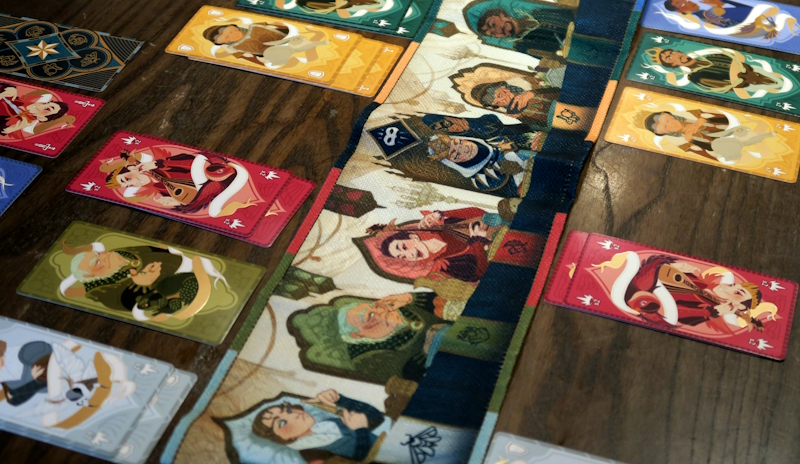
The game was just coming to an end when Jade, Sapphire, Plum and Byzantium arrived, followed by Pine, Ivory and Teal, and then the inevitable debate as to who would play what began.  In the end, Jade led a group of four including Black, Purple and Sapphire in the “Feature Game“, Courtisans (the French for Courtier as it is spelled with an “i” rather than an “e”), which also came from UK Games Expo.  The first game was essentially a learning opportunity where players tried to understand the learning the mechanics of the game.  On their turn, each player receives and plays three coloured Family cards.

Courtisans
– Image by boardGOATS

One card is played at the Queen’s table to sway a family’s influence in a positive or negative way depending on whether it is placed above the table or below—at the end of the game, those with more cards below than above will have “Fallen from Grace”.  The other two cards are then played, one in the player’s own Domain and the other in an opponent’s Domain. At the end of the game, each card a player has from an “Esteemed” Family is worth a point, while each card from an Family that has “Fallen from Grace” loses them a point.  Thus the cards can be worth positive or negative points, depending on the Family’s status at the end of the game.

Courtisans
– Image by boardGOATS

Some of the Courtier cards have a special power, for example, Nobles count as two cards, Spies are played face down and their allegiance is only revealed at the end of the game, Assassins can be used to eliminate other Courtier cards, while Guards are not affected by Assassins.  The game ends when the card deck has been exhausted and nobody has any cards left in hand.  Players then total up their score and add any points earned from successful Secret Missions (each worth three) and the player with the most points is the winner.

Courtisans
– Image by boardGOATS

Black went first chosen by an app and began feeling his way forward.  The group only realised there was a slight issue towards the end as they ran out of cards a bit early.  It was then that it was discovered that at some point Black had acquired a second hand which he had placed on the table beside him.  Despite only a few personal objectives being met mostly players scored scored well; the exception was Purple who was the only one to complete both objectives which added six points to her score at the end.  It wasn’t enough for victory though, that went to Sapphire who had fifteen points, with Jade a point behind in second.

Courtisans
– Image by boardGOATS

Having felt their way through the first game, the group decided to play again.  As the winner, Sapphire went first, and from the off, it was like everyone woke up together and all decided to attack.  This time, everyone completed at least one objective, but this second game was a lot more treacherous and this was evidenced in the scoring.  One of Jade’s objectives was to ensure at least one of the Houses had at least five cards bringing them into disrepute—Jade chose yellow which caused others problems.  It didn’t have as much of an effect as his second objective though,which was to have fewer red cards than the player to his left.  As a result of this, Black was the kind recipient of any red cards he acquired.

Courtisans
– Image by boardGOATS

While he tried to bring the reds into disrepute too, it wasn’t possible to do both.  So, despite his best efforts they still scored positively and probably helped ensure Black’s victory with seven points, four more than Jade himself.  The scores were much more diverse in the second game though with a range of sixteen points with the person at the back finishing with minus nine!  Although savage, it had been a lot of fun; Jade commented that the game felt a bit like a dance with lots of nuance.  Definitely one to play again, especially given the truly beautiful foiled cards which are a delight to play with.

Courtisans
– Image by boardGOATS

Meanwhile, Teal had picked up the Alpine expansion for one of his favourite games of the moment, Forest Shuffle, and was keen to give it its first outing.  He was therefore joined by Plum, Byzantium and Pink who were also keen to see how it changed things.  Forest Shuffle is mechanically a fairly straight-forward game, but playing it well is comparatively difficult as it requires good, robust strategies and an understanding of how to get the best from the cards.  The idea is that players start with a hand of cards and, on their turn draw two more from the market (or “Clearing”) or play one into their tableau.

Forest Shuffle: Alpine Expansion
– Image by boardGOATS

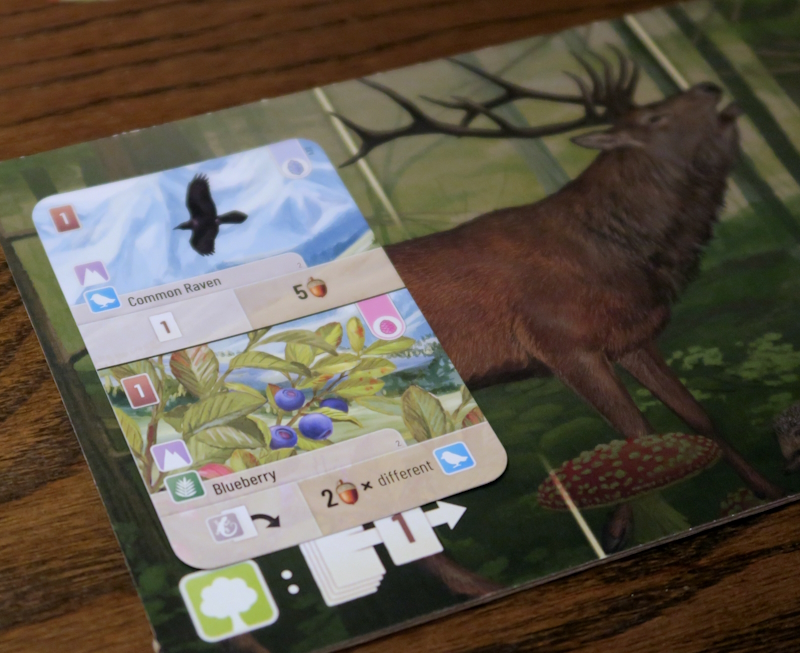
There are two sorts of card, Trees and “Critters”.  Before playing a Critter, players must have played a Tree, which then has spaces on all four sides.  Birds and Butterflies are played to the canopy (i.e. above tree cards), Fungi and Amphibians are played at the bottom of the tree (i.e. below them) and Mammals are played either side.  The clever part is that Critter cards are split so they show two critters (either left and right or top and bottom), so players choose which they would like to play, and where, tucking the other side under the tree, making the unplayed half invisible.

Forest Shuffle
– Image by boardGOATS

The new Alpine expansion for Forest Shuffle only adds some thirty six cards to the game and, since roughly twenty additional cards are removed during setup, in practice it adds just sixteen to the deck.  Of course, the cards are removed at random so many should be from the base game and the expansion adds new cards like the Mountain Hare, who scores as for the European Hare, but wants to stay alone so can’t share a space with another Hare.  There is an extra Butterfly and more Trees too, which make these easier to score and help to balance the game somewhat.  Additionally, there is the new Alpine Newt provides a new way of scoring, for players who have managed to pick up a lot of cards from the Alpine expansion cards.

Forest Shuffle: Alpine Expansion
– Image by boardGOATS

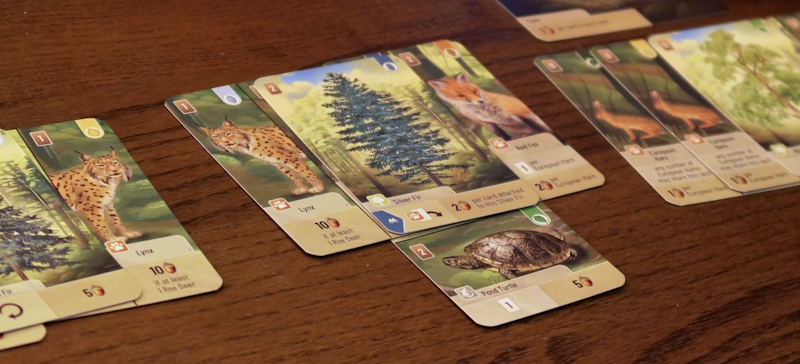
This time, Plum went for Trees in a big way with loads Horse Chestnuts which give more points the more you have on them up to forty-nine for seven or more.  While she didn’t quite make the full seven, she scored a total of forty-eight for her Trees, fifteen more than the nearest player (Byzantium) and more than double what anyone else took.  They, of course, got points elsewhere though.  Pink, for example, went for Butterflies and, with the additional Phoebus Apollo Butterfly, took thirty-five points for them alone.  Byzantium opted for a deer strategy and received a total of sixty-one points for all his Critters.

Forest Shuffle: Alpine Expansion
– Image by boardGOATS

The winner was Teal however, with everyone else totally overcome by “The Lynx-Effect”, where each Lynx he had gave ten points as long as he had a Roe Deer to keep them fed.  Perhaps his victory was to be expected as he has played the game quite a bit with family, but his finishing score of a hundred and fifty was some way ahead of Pink and Plum who tied for second place with a hundred and nineteen.  Overall, the Alpine expansion adds some pretty artwork and made a few of the alternative strategies a lot more viable, reducing the apparent dominance of Wolves and Deer which it has often been claimed are overly powerful.

Forest Shuffle: Alpine Expansion
– Image by boardGOATS

With the Courtisans and Forest Shuffle groups sorted, that left just three players without a game.  Since Ivory and Pine both missed out on playing Little Town last time and neither wanted a particularly late night the decision was made to eschew Key Flow in favour of the lighter, quicker, tile-laying game.  Play is very simple:  players take it in turns to place their Workers in a space on the central board and then activate the eight spaces around them.  These eight spaces could be Buildings, but may also be Trees, Rocks or Lakes pre-printed on the board giving resources (Wood, Rock or fish respectively).  With three players, there are four Workers in each of four rounds and the player with the most points at the end is the winner.

Little Town
– Image by boardGOATS

Little Town has had a few outings, but was the “Feature Gamelast time, with two games played simultaneously, both with the starting tile set up.  This time, a random tile setup was used drawn from the full set that included the Pier, the Marketplace, the Bar, from the variant set as well as the Shop, the Workshop, the Goldmine, the Bakery, the Pawnshop, the Quarry and Wheat Fields from the basic set.  The twelve Buildings were completed by the Temple, the Cornucopia, and the Sushi Bar from the Goodie Buildings mini expansion.  Blue and Pine both complained that their Objectives were considerably more difficult than Ivory’s as he claimed all his quite quickly.

Little Town
– Image by boardGOATS

Eventually though, all three managed to complete all their Objectives.  Pine misunderstood the fact that each Worker needs to be fed at the end of every round, rather than just at the end of the game.  As it was a genuine error, rather than cripple his game at the end of the first round, Blue and Ivory let him pay with other resources leaving his unfortunate workers to gnaw on bits of stone, wood and coins.  Other than that, the game proceeded according to the rules.  Ivory majored on trying to convert Fish into points, while Blue tried to do the same with Wheat and Pine played the merchant, building the Gold mine and the Shop.

Little Town
– Image by boardGOATS

As the game came to a close, Ivory had a substantial lead with forty-two, ahead of Blue in second with thirty and Pine with eighteen.  This was without any of the points from the buildings (which Blue had a lot of) or from leftover money (of which Pine had an enormous pile).  As it turned out, money is not worth much at the end of the game, and although Blue’s buildings were worth considerably more than Ivory’s, she still fell two points short of his final total of fifty-seven.  So although we’ve still not been able to use the “sixty point tokens” we were only a handful of points shy.

Little Town
– Image by boardGOATS

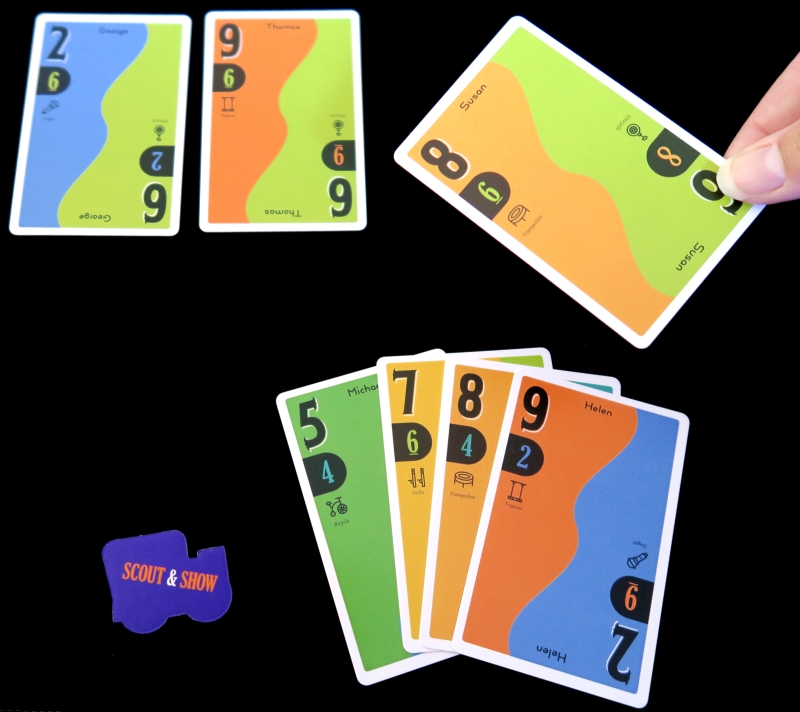
The others were still playing, so after some discussion, Blue, Pine and Ivory decided to give the 2022 Spiel des Jahres nominee, SCOUT, an outing.  This is a clever little card game with two key features: firstly, as in Bohnanza, players can’t rearrange their hands, and secondly, the cards have different values depending which way up they are.  Like Tichu or Haggis, SCOUT is a climbing game, that is to say, on each turn players are aiming to beat the previous score.  In SCOUT, that means players have to play a higher value or larger meld, or a longer run or one of a higher value (and a meld of the same size always beats a run).

SCOUT
– Image by boardGOATS

These cards are played from hand, but have to be consecutive.  In the event that a player can’t or doesn’t want to play cards from their hand (aka “Showing”), they may instead take a card from either end of the current winning set and add it to their hand anywhere, and either way up (aka “Scouting”).  Additionally, once per round, players can “Scout and Show” which is take a card and then also play cards.  The round ends when either nobody in the round has been able to Show or a player plays their last card and has nothing left in hand. At the end of the round, players lose a point for every card they have left, and this is taken from the total from their scoring cards and points earned when others Scout from their display.

SCOUT
– Image by boardGOATS

With three players, there were three rounds, the first of which was finished by Pine, though Ivory nearly managed to check out, leaving Blue with a large handful.  The second round was much closer with Blue playing a nine-card run (though as cards in front of players at the end don’t score, and very quickly nobody could beat it, she didn’t get the advantage she felt she deserved).  The final round was taken by Pine again, but it was also close again.  The total favoured Pine, who finished with a total of twenty-six, a clear victory with Blue just pipping Ivory to second place by a single point.

SCOUT
– Image by boardGOATS

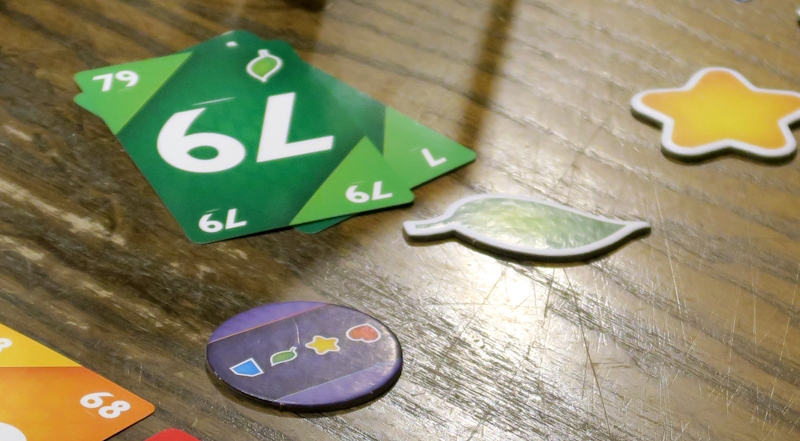
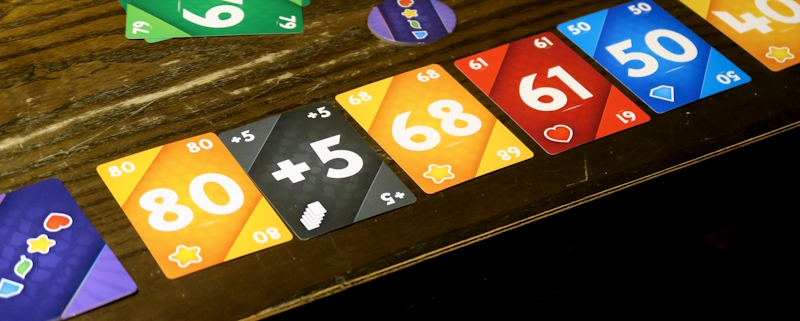
Forest Shuffle and SCOUT were both still going when the Courtisans finished, so they quickly set about playing a light filler that Jade had picked up from the Hachette UK stand that he had worked on at UKGELine-it, is another card game, played with a deck that consists of cards in four colors, numbered one to a hundred and six “Bet” cards (numbered three to five), which are shuffled together and laid out to create a market consisting of slightly more cards than there are players.  Players then take it in turns to take a card and either add it to their hand or add it to the row of cards in front of them (their Line).  There is a hand limit of two and the row must continue either increasing or decreasing.

Line-it
– Image by boardGOATS

If a player can’t add the card to their hand or their Line (because it would break the ascending/descending pattern), they have to score their Line, then play that card to start a new Line.  After drafting a card, players may choose to add one card from their hand to their Line and then score it. When scoring, if there is a Bet card in the Line, if there are more cards added since the Bet card than the value depicted on the Bet card, players get chips equal to the value of the Bet.  If the Bet is lost, the player takes negative points instead. Finally, three cards are discarded from the Line and the others turned over and placed in the player’s scoring pile.

Line-it
– Image by boardGOATS

Once each player has had a turn, all remaining Bet cards are discarded, and the other cards are placed under the Jackpot token that corresponds to their colour—these can be claimed whenever a player adds the third card of the respective color to their Line.  The game ends when the draw deck depleted, and each player plays one last card from their hand, then scores their line and tallies their points, the player with the most points is the winner.  As he had won the second game of Courtisans, Black went first.

Line-it
– Image by boardGOATS

Black and Purple both took (and completed) Bet cards early in the game, whereas Jade didn’t even take because his Lines weren’t right when the Bet cards were available because just didn’t make sense.  Purple won the first jackpot of the game which was a tidy little stack of blue Diamond cards and Sapphire also picked up Jackpot cards later in the game.  The game plays quite quickly and smoothly and this time out, it was close, well, close between Black, Jade and Purple—Sapphire was streets ahead, finishing with twenty-six points, a long way clear of Black in second with fifteen.

Line-it
– Image by boardGOATS

Learning Outcome: UK Games Expo is a good source of new games.

14th May 2024

Pine was already sitting outside marking his birthday, when Blue and and Pink rocked up and ordered their tea.  Jade and Sapphire soon joined the group, ferried by newcomer, Tangerine who not only brought gamers, but also his shiny new copy of the “Feature Game“, Faraway, which he had won at Gweeplefest a few days earlier.  This game is has been a bit of a hidden gem whose popularity is rapidly gaining traction as more people play it.  It is quite a simple game, but one which really messes with the head.  Some of the group played it a few weeks back and it was so popular that it seemed a good idea to Feature it so more of the group could try it.

Faraway
– Image by boardGOATS

The story is that players are exploring the mysterious land of Alula in search of its secrets, meeting its inhabitants and listing its wonders in order to gain more fame than everyone else.  In practice, however, it is a fairly simple little card game with a market with a trick-taking type element.  Players simultaneously chose one of the numbered cards from their hand and starting with the the player that played the lowest card (similar to 6 Nimmt! or Kingdomino), everyone takes it in turns to choose one from the market to add to their hand.  Players then simultaneously choose another card, and again, choose one to add to their hand.  The game ends after everyone has played a total of eight cards, and then everyone scores.

Faraway
– Image by boardGOATS

There are a couple of very clever things about the game.  Firstly, if the card someone plays is numbered higher than their previous card, they take a card from the Sanctuary deck.  These cards a really important because of the second clever element, the scoring.  Each card has a number and a colour, while some also have resources and some have also have scoring conditions.  The scoring is clever because the cards are played left to right, but the scoring is from right to left—at first glance, this looks like it makes things easy, because early in the game players find out what they need to get points and can then focus on getting the resources they need as the game progresses.

Faraway
– Image by boardGOATS

However, the scoring is tensioned against the ability to get Sanctuary bonus cards. This is because the scoring cards are generally those that have a higher number and are therefore the ones players want to play first (following them with resource cards which generally have a lower face value).  To get a Sanctuary card though, players have to play a higher value card than the immediately preceding one, and Sanctuary cards are very useful because they are eligible for scoring regardless of when they are played.  Thus, trying to play cards increasing and decreasing in value to score the most points backwards really messes with players’ heads!

Faraway
– Image by boardGOATS

Tangerine, started one game and explained the rules to half the group, comprising Plum, Byzantium, Blue, Pink and Pine, while he ate his supper.  Meanwhile, Jade and Sapphire took their copy to a neighbouring table where they were joined by Teal, Black and Purple, and started a second game.  Although it is a very simple game, the backwards forwards up and down thing got to several of the group at various points, including Blue (who lost the ability to count), Teal (who did all his scoring forwards instead of backwards), Pine (who struggled with the how maps worked) and Purple (who couldn’t get her head round the reverse scoring).  Jade’s game was the first to finish, with Sapphire beating jade into second place by a single point and Black taking third.

Faraway
– Image by boardGOATS

There was a general appreciation of the art and the mechanism though the theme was a bit invisible.  There had been such confusion, however, that the group decided to “do a Lime” and play again.  This time, the finishing order was exactly the same, but the game wasn’t as close with Sapphire’s eighty-two being the highest score of the evening.  On the other table, Plum was the victor with seventy, followed by Tangerine and Byzantium in third.  This game had taken a little longer, and with six, there is a lot of downtime, so although everyone had enjoyed it, the group decided to split into two groups of three.  Blue tempted Plum and Sapphire to a game of Calico with cries of “Kittens!”, while Pink and Pine lured Tangerine into a game of Ticket to Ride: San Francisco.

Ticket to Ride: San Francisco
– Image by boardGOATS

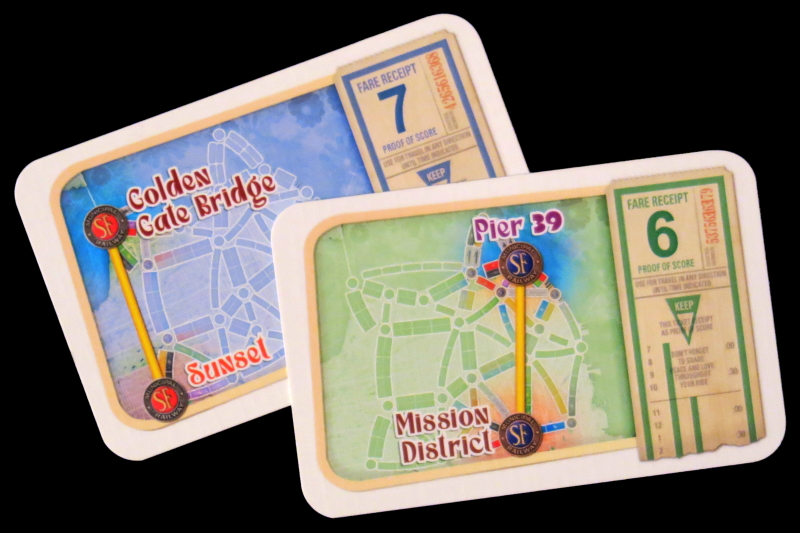
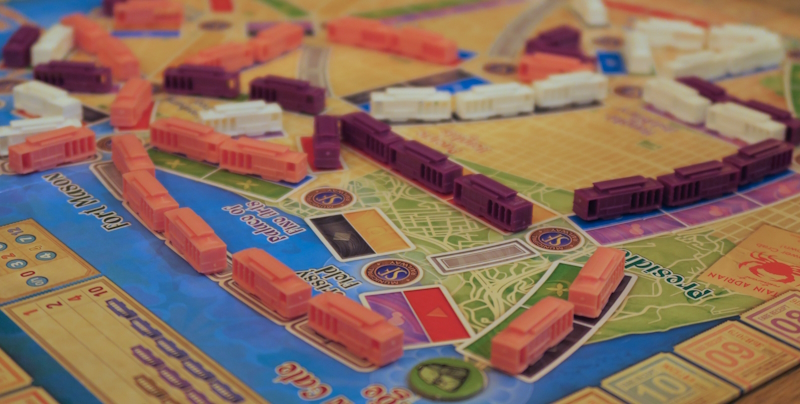
San Francisco is one of the smaller city versions of Ticket to Ride.  The game play is much the same as the original, but the maps are smaller, players have fewer pieces and they only play a maximum of four.  In all the games, players take it in turns to take coloured cards into their hand from the market, or play cards to place pieces on the board connecting locations to satisfy tickets and score points.  Each version of the game has its own specific unique rules, and this one is no exception with players collecting Souvenirs which give points at the end of the game.  Players collect these by building a route (in this case made of trolley cars rather than trains) to the cities where they are available.

Ticket to Ride: San Francisco
– Image by boardGOATS

Each player can only collect one of each Souvenir, but a full set of seven gives twelve points, which is a lot.  Tickets are also always key though.  This time, Pink escaped early from Alcatraz to Twin Peaks which gave him a high scoring eight points.  Unlike Pine (who always seems to draw routes he’s already completed), Tangerine was unlucky and and instead picked up some negative points late in the game.  It was very close between Pink and Pine though, but the Souvenirs made the difference and Pink (with five) just edged it, beating Pine (who only had two Souvenirs) by three points.

Ticket to Ride: San Francisco
– Image by boardGOATS

Meanwhile, the kitty-philes were playing the extremely frustrating game Calico, which is all about trying to entice cats to come and sleep on a patchwork quilt by making it with the patterns they like.  In this game, players take it in turns to place a coloured, patterned tile from their hand into their quilt board before taking a replacement from the market.  Everyone had played it before, but it had been a while, so the rules needed a bit of revision.  Each player starts with three tiles in a fixed location with scoring criteria for the neighbouring tiles—satisfying these for either colour or pattern gives points, with more points for for those that satisfy both (which is not easy).

Calico
– Image by boardGOATS

Players then also receive a coloured button for every group of three adjacent tiles of the same colour (with a bonus if they get all six possible colours).  Finally, there are the cats that give Calico its name.  This time the cats in question were Almond, Tibbit and Shop Cat (from the Kickstarter Promo).  Almond was attracted by a group of five tiles of one of the patters in a close packed predefined shape while Tibbit found a set of four tiles of one of the given patterns in any shape most appealing.  Shop Cat was lured to the player with the longest connected chain of tiles in one of the given patterns with the player with the second longest attracting a smaller cat (worth fewer points).

Calico
– Image by boardGOATS

This last one was the subject of some debate as Byzantium ended up with both the longest and second longest chain and it was unclear from the rules whether he would get both.  In the end he allowed the smaller Shop Cat to wander off, but fortunately it didn’t make any difference to the placings.  Almond looked by far the most challenging kitty to attract and initially it looked impossible without failing on the fixed starting challenges.  Plum thought she had made a mess of things, but Byzantium pointed out how Almond could be enticed  using some of the partial tiles around the border of her player board and she was the only one to ultimately have that particular kitty to cuddle.

Calico
– Image by boardGOATS

Blue started badly, and in this game, when that happens things usually only get worse, which they did.  Byzantium and Plum both picked up twenty-seven points for their buttons, but in both starting tiles and kitties, Byzantium had the edge (even without the second Shop Cat).  In the end his final score of sixty-one points gave him a significant margin of victory, by seven points.  Everyone agreed that Calico is a good game, but a very frustrating one when players can’t get the tiles they need.  So Byzantium echoed everyone’s feelings when he commented, “That was fun, but very frustrating—I’ll be ready to play it again in another eighteen months…”

Calico
– Image by boardGOATS

As Faraway and Ticket to Ride had both finished, Tangerine took Jade and Sapphire home and Teal also headed off.  That left Black, Purple, Pine and Pink to play a quick game of the old favourite, Coloretto.  This is a very simple set collecting game, that makes a great filler.  The idea is that players either take the top coloured chameleon card from the deck and place it on a cart, or take a card and add the cards to their collection.  Players score points for their largest three sets (up to six cards, worth twenty-one points), while everything else scores negatively.  The player with the most points is the winner.  Playing with the Jubiläumsausgabe edition, as usual, there was a discussion about what the Golden Joker does and how it differs from the normal Joker.

Coloretto
– Image by boardGOATS

In the end, Pink was the victor and, for the second game in a row, pushed Pine into second place, this time with Black just behind.  The evening looked to be ending there, when a couple of people from the bar came over and asked what we were doing.  That led to a fairly wide-ranging discussion about Monopoly, Cluedo and Mystery of the Abbey amongst other games.  The evening really did come to an end eventually, after Pink and Blue had dragged one of the interested parties into a quick game of No Thanks!.  Unfortunately, there was a misunderstanding and he top-scored with ninety-three, but hopefully he understood that some of the games we play are not that complicated.

No Thanks!
– Image by boardGOATS

Learning Outcome:  Playing forwards and backwards at the same time makes heads hurt.

13th June 2023

Lime was first to arrive, soon followed by Blue and Pink, and then Pine who were all delighted to see the return of our favourite bar staff.  There was a lot of chat about the recent changes at The Jockey (which is currently managed by the Healy Group who also run the Punch Bowl in Abingdon), and as everyone else arrived, people seemed more interested in gossiping than playing games.  It was a relatively quiet night with quite a few people away.  Black and Purple sent a message to say they were thinking of us, but when Green received a photo from Black and Purple of their current view, it just made everyone else jealous.

Black and Purple in Cornwall
– Image by Black

Jade arrived with his shiny new copy of Earth which he’d picked up from UK Games Expo.  It is a game where players are building themselves an ecosystem and was to be the “Feature Game“.  Earth is a sumptuously illustrated, card-driven engine-builder that is often compared to Wingspan.  We played that Last time after a bit of a break, and remembered how much we liked it, so had decided to give Earth a go this time.  The heat was getting to some people, but Ivory was quite keen to give Earth a go, and they were soon followed to the next table by Green (who had played it online) and then Teal.  Everyone was pretty new to the game:  Ivory and Teal had not played it before and Green and Jade had only played a couple of times.

Earth
– Image by boardGOATS

Although there is a lot to explain before starting, Earth itself is not actually all that complicated. Players are building a four by four grid of Flora and Terrain cards which represents their island and during the game they will plant flora, water it and allow it to grow.  On their turn, players do one of four things: Planting (paying the cost in Soil tokens), Composting (gaining Soil and placing cards from the deck in their discard pile), Watering (place Sprouts and gain Soil) & Growing (draw new cards and place growth tokens).  A bit like Puerto Rico, once the active player has chosen which action they are taking, everyone else gets to do a subsidiary, slightly weaker version of the same action.  For example, when Planting, the active player plants two cards, draws four and keeps one, while the other players plant one and draw one.

Earth
– Image by boardGOATS

Once everyone has completed the action for the turn, everyone activates all the cards in their island that match the colour of the action chosen, starting with the card in the top left and working across each row in turn.  This means, not only is it important which cards are played, but also where they are located in the player’s island.  At the end of the game (triggered when one player has completed their island), players score points for each flora card, any Trunks and Canopies they have grown, their Sprouts and their pile of “Composted” or discarded cards.  Players also score points for achieving objectives on the Fauna cards revealed at the start of the game and for completing their island first.

Earth
– Image by boardGOATS

As in Wingspan, Flora cards have actions that take effect when they are planted and when activated, many of the Terrain cards have ongoing effects and/or end-game scoring opportunities.  When Planting, players must place the cards either orthogonally or diagonally adjacent to an existing card, and although they can never exceed a four by four grid, like in Kingdomino, players can extend on either side of their island until the maximum size is reached.  Each Flora card has a maximum growth and when this is achieved the final wooden Growth token placed on it is a Canopy showing it will score extra points at the end of the game.

Earth
– Image by boardGOATS

The challenge in Earth is really in deciding what actions to do and which cards to play into your tableaux.  Teal found that simply building his tableaux was enough to think about without considering the extra goal cards and end game scoring.  Jade and Green both agreed that was the same for their first game too.  Ivory started and played his first few turns, selecting the green Plant action, so his tableaux filled up quickly. The rest of the group needed to choose other actions in order to get the soil and cards to play, so by the time it came back to ivory he was able to plant again.  He had already had his eye on the bonus cards and was quickly planting as many cards as he could, successfully—he was the first to claim a bonus.

Earth
– Image by boardGOATS

Green started with a high scoring climate card which gave him fewer cards at the start, but better in game bonuses, an approach to the game that nearly paid off. He went for the brown scoring cards, but Ivory just pipped him at the post for that particular shared bonus, which helped up his score as well.  Teal spent the first half of the game, learning and began to fall behind.  It wasn’t until Ivory claimed the first shared bonus that he remembered those cards.  Early on he gained lots of Sprouts which are worth points, however, it is possible to gain a whole lot of Sprouts in the latter stage of the game and use those early actions for other more beneficial things.

Earth
– Image by boardGOATS

Jade was quietly working away to build a tableaux engine that worked for him, but was falling behind Ivory and Green on the shared bonuses.  Jade managed to pick up some of the Fauna bonuses later, but mostly after the others so they weren’t as highly scoring.  Green went for brown scoring cards because he kept picking them up from his nearest pile (there were two draw piles), and eventually reverted to the other pile to find green Flora cards.  Unfortunately, he just couldn’t find the double powers he needed for the shared bonus.  On the opposite side of the table, Teal didn’t come across any brown scoring cards, only realising why at the end of the game—it seams the shuffling had left something to be desired. The Event cards also seemed to be clustered towards the bottom of the draw pile.

Earth
– Image by boardGOATS

Ivory came out on top with a very high score of two hundred and thirty-six with Green just eighteen points behind and Jade in third.  There was much discussion about similarities between Earth and other games. Green felt it was similar to Terraforming Mars, the others thought it was more like Wingspan.  After some thought, Green came round to this idea as it is about playing cards which then provide  more actions and bonuses that can be played on those cards (eggs in Wingspan, Sprouts in Earth; tucked cards & cached food in Wingspan, Growth in Earth).  The others could also see Green’s thoughts about Terraforming Mars though as the game has lots of pretty and individual cards that can be played or rejected, with some providing actions, some bonuses and the all important Events.  Everyone really liked it and definitely wanted to play it again, though better shuffling would be a good idea.

Earth
– Image by boardGOATS

Meanwhile, the rest of the group carried on chatting all agreeing they should play something, but nobody terribly keen to commit to anything.  Eventually, Blue suggested Bohnanza, and as Pine agreed, Pink had to go along with it.  This is an old favourite, though Pink had gone off it a bit as he felt he always did badly—unfortunate really given the number of copies of the game that he owns.  The game is very simple:  keeping their cards in the order they are drawn, players must plant the first bean card from their hand and may plant the second if they have space.  They then turn over the top two cards from the deck and can play these or trade them as they prefer.

Bohnanza
– Image by boardGOATS

Finally, once both of these have been planted, the active player may trade cards from their hand before drawing three replacement cards.  Players can harvest their Bean Fields whenever they like, but the amount of money they get depends on how many Bean cards it has in it and what the beans are—scarce ones give a better return, but are harder to get.  Everyone knows the game quite well, though Lime had recently acquired and been playing a new anniversary edition and it seems some of the rules are slightly different for that.

Bohnanza
– Image by boardGOATS

This time, everyone bought a third Bean Field (which makes it easier to hang on to the rarer beans a little longer).  Indeed, Lime was so determined to use his, he ended up not trading, just so that he had something to plant!  As usual it was quite a close game with fine margins.  So little things like Blue harvesting her Red Beans only to immediately draw another and Pine gifting Pink a Wax Bean or Lime trading with Pine instead of Blue made a difference in the final score, though nobody knew it at the time.  Ultimately, Pink was the victor, beating Blue by just two Bean Thalers with Lime a couple behind her in third.  On the plus-side, Pink can’t complain that he never wins any more.

Bohnanza
– Image by boardGOATS

Earth was still underway, and for once in a way, Bohnanza had played relatively quickly, so there was plenty of time for something else.  Nobody was very focused, and eventually the group settled on the cooperative game, Forbidden Desert.  This is a sort of sequel to Forbidden Island, which itself is a simplified version of the popular gateway game, Pandemic.  All three of these games use the same mechanism as Zoo Break, which we played recently.  Essentially, the active player carries out actions and then they reveal cards from a deck which generally make life difficult: releasing wild animals, causing the island to gradually sink, spreading disease, or in the case of Forbidden Desert, burying the play area with sand.

Forbidden Desert
– Image by boardGOATS

The premise of Forbidden Desert is that the team have crash-landed in the desert and need to find the components of a flying machine and take them to the launch pad to escape.  The game is played on a five by five grid of square Tiles, with a gap in the centre representing the sand storm.  Each player has a character with special powers.  This time, Lime was the Climber, Pink was the Navigator, Pine was the Explorer, and Blue was the Water Carrier.  On their turn, players can take up to four actions:  Move (one action per Desert Tile), Remove Sand from the Desert Tile they are on or an adjacent one, Excavate a Desert Tile (i.e. turn it over), or Pick up one of the four component parts of the flying machine.

Forbidden Desert
– Image by boardGOATS

Lime started.  Once he had cleared some sand and turned over a couple of Desert Tiles, he started turning over Sand Storm Cards.  These indicate which direction Tiles should move to fill the hole, and how many Tiles should be moved, one, two or three.  Each of the Desert Tiles moved then have a Sand Tile placed on them—a single Sand Tile needs to be cleared before the Desert Tile can be Excavated, but two or more additionally obstruct players preventing them from passing (except for Lime who, as the Climber, can cross Sand Dunes of any height).

Forbidden Desert
– Image by boardGOATS

Pine went next and used his special ability—everyone else could clear orthogonally adjacent Tiles, but he could to work diagonally as well.  It wasn’t long before the first “Sun Beats Down” card appeared.  These cause everyone to use water, so as the water carrier (and the only one who could make multiple visits to the Oases and collect water, Blue topped up Lime, who had started with less water than everyone else.  The group gradually started revealing tiles, finding a Duneblaster, a Solar Shield and a Time Throttle, but the Storm picked up and before long the group were turning over more Sand Storm Cards.  Pink located the Propeller for the flying machine and then the engine, the group were making progress, but it was all too slow.

Forbidden Desert
– Image by boardGOATS

Before long it became apparent that the Sand Storm was getting the better of the group and the hiding in the Tunnels wasn’t helping.  Determinedly, the group fought against the rising tide of Sand making good use of their Duneblaster, but it only delayed the inevitable.  Blue, Pine and Lime were discussing a plan to play a Storm Tracker, but when they were briefly side-tracked, Pink played on without it and everyone suffered as a result.  So Pine labelled him as a Saboteur as a consequence.  In such a finely balanced game at such a critical point, it could have made a difference, but in all probability it only hastened the inevitable demise as the group were sadly buried under the ever growing sand dunes and ran out of Sand Tiles (one of the end game conditions).  It was a deflating end to the evening, but given the heat, probably appropriate.

Forbidden Desert
– Image by boardGOATS

Learning outcome:  Shuffling is an important skill.

7th March 2023

Plum and Blue were first to arrive and, by the time they had finished their enormous rack of ribs (or given up and had a doggy bag made up), almost everyone else had arrived.  There were a few people missing, but still enough for two games of four.  The first was the “Feature Game“, but nobody really wanted to commit to that until they knew what the other game was going to be.  As he had done the last couple of times, Green suggested Terraforming Mars.  Unlike previously, this time Ivory, Plum and Teal felt up to it, leaving Blue, Black, Purple and Lime to play their preferred choice of New York Zoo.

New York Zoo
– Image by boardGOATS

New York Zoo is a tile laying game by Uwe Rosenberg, designer of Agricola, Bohnanza, Patchwork and many other well-known games.  The idea is that players are building pens in their zoo, populating them with animals, and building attractions.  This is one of several polyomino, Tetris-like, tile-laying type games (including Cottage Garden, Spring Meadow, Indian Summer and Patchwork), but what makes this one unique and interesting is the Market.  Players move the Marker Elephant one to four spaces round the Market, landing either on an Enclosure tile space (taking the top one and adding it to their zoo) or on an animal space (taking one or both of the animals depicted).  Enclosure tiles can be placed anywhere in the player’s Zoo, then one or two identical Animals from elsewhere in their Zoo must be moved to occupy the Enclosure.

New York Zoo
– Image by boardGOATS

Each Enclosure can only hold one type of Animal, meercats, snow-foxes, kangaroos, penguins or flamingos, but when moving Animals, no pen can be left empty.  There is an advantage to pens having two or more Animals in them too—the Market also features breeding spaces, and when the Marker Elephant passes these, up to two pens containing two or more matching Animals get an extra one.  When a player moves the Elephant onto an Animal space, they take one of either or both the Animals depicted into Enclosures containing matching Animals (moving another from Storage if they can), or into the Storage space.  Moving animals is important, because when an Enclosure is completed the player removes all the animals putting one into Storage if they have space, and then takes an Attraction tile of their choice and adds it to their Zoo.

New York Zoo
– Image by boardGOATS

Attraction tiles are useful because they fill additional spaces, and at its heart, New York Zoo is a race game—the winner is the first to fill all the spaces in their Zoo.  Black and Purple had played this a few times, and once Black had explained the rules to Lime and Blue, Purple started.  Black and Purple prioritised completing Enclosures to get Attractions.  The Market is stacked so there are large tiles, heptominoes, on the top of each tile space, with hexominoes, then pentominoes and finally tetrominoes at the bottom of each pile.  Black and Purple prioritised getting breeding pairs of animals and as the Market dwindled, getting smaller enclosures because small Enclosures are easier to complete than large ones.

New York Zoo
– Image by boardGOATS

Blue, who had not played the game before, started off getting large Enclosures and fitting them tightly together.  As the game progressed, however, she realised her mistake as everyone else’s Animals were breeding and she didn’t have pairs because she was taking one out every time she added another Enclosure.  This had the additional consequence that she was starting to run out of Animals too, so she prioritised getting breeding pairs for a couple of rounds before continuing to take the biggest Enclosures she could get away with.  It was a tight game—Purple seemed to take an early lead, but it looked like Black and Lime over-took her towards the end and were in a tussle to finish the game first.

New York Zoo
– Image by boardGOATS

With everyone else concentrating on filling pens and taking Attractions, nobody was watching Blue.  So they were taken by surprise when her kangaroos bred filling their pen and she took her first Attraction.  That left one space which she promptly filled taking the only Enclosure that fitted, perfectly, and ended the game.  With everyone else so close to finishing, however, the rest of the group played on to see who would place where.  In the event, Black finished just ahead of Lime.  The group were just dissecting the different strategies when Pine arrived, fresh from his meeting teaching “cubbish-sized scouts” about waste.  Terraforming Mars was still going on, so the hunt was on for a five-player game, and the group settled on Kingdomino.

Kingdomino
– Image by boardGOATS

Native, Kingdomino is a four player game, however, with the Age of Giants expansion, it plays five.  The base game is simple enough, but it had been a while since most people last played it, so there was a quick run through of the rules.  On their turn, players add a terrain domino to their Kingdom; each domino comprises two squares of terrain and when placed at least one end must be adjacent to the same terrain type.  Like New York Zoo, the interesting and clever part of the game is the Market.  In Kingdomino, there are two parts, current and future—when a player takes their domino from the current market, they choose their next domino by placing their marker on it.

Kingdomino
– Image by boardGOATS

At the end of the game, players score each terrain region with points equal to the area of each region multiplied by the number of crowns on it.  The clever part is the timing of the Market.  The tiles are drawn at random from a set numbered from one to forty-eight.  The low numbers generally being the less desirable ones, those without crowns or those for terrain types where crowns are more scarce.  Since players take the tiles in numerical order (low to high), taking a low value tile in one round gives a better choice in the next.  Similarly, taking a high value tile means there will be less (or maybe no) choice in the following round.

Kingdomino: Age of Giants
– Image by boardGOATS

The Age of Giants expansion firstly adds twelve extra tiles (enough for a fifth player), six labeled with letters A to F and six numbered forty-nine to fifty-four.  These are ranked below one for the letters and after forty-eight for the high numbers, with the low ranking tiles featuring a Giant, and the high ranking ones featuring Footprints.  Players taking dominoes with a Giant on them, also take a Giant-eeple and place it over a crown in their Kingdom so that it doesn’t score.  Taking a Footprint domino allows the player to move a Giant from their Kingdom to a crown in someone else’s and this increase their score, making these tiles potentially very valuable.

Kingdomino: Age of Giants
– Image by boardGOATS

Unfortunately (especially for Lime and Blue who ended up with all the Giants), the Footprints seemed hard to come by in this game.  The other part of the Age of Giants expansion are the Quests.  The base game comes with two Quests, arrangement targets that give points.  These are “Middle Kingdom” and “Harmony” which respectively give ten points for a castle in the centre of a player’s Kingdom and five points for a complete five-by-five territory with no discarded tiles.  This time, the Quests drawn essentially at random were “Bleak King” and “Four Corners of the Kingdom”.  The first of these gave five points for each five square of terrain with no crowns while the second gave players five points for placing cornfields on all four corners of the five-by-five grid that defines their Kingdom.

Kingdomino: Age of Giants
– Image by boardGOATS

Although the Quests had been included in game play several times before, the Giants have only had an outing once and didn’t go down all that well.  Still, with five players all the extra tiles were needed and their values would have been unbalanced without including Giants, so the group thought they’d give it another try.  This time Blue and Purple had a really hard time getting crowns and things were so bad for Blue that she resorted to picking up twenty points, more than half her total, from the “Bleak King” Quest.  Black built a lot of sea and pasture, while Lime scored heavily for his mountains and Pine picked up lots of points for his large woodland.

Kingdomino: Age of Giants
– Image by boardGOATS

It was very close between the top three and both Lime and Pine scored forty-five points for their highest scoring terrain—Lime for nine crowns spread over five spaces, Pine for five crowns spread over nine spaces.  There were just two points between Lime and Pine in the end, but Pine’s sixty-eight points just edged Lime into second with Black four points behind that.  It had been a good game.  However, the group felt that the Giants took a positive constructive game and added a negative aspect.  Those that had been stuck with them hadn’t found that aspect particularly enjoyable, especially as it was easy to get lumbered largely through no fault of their own, so it is unlikely they’ll get another outing very soon.

Kingdomino: Age of Giants
– Image by boardGOATS

Meanwhile, on the next table, Green, Ivory, Plum and Teal were still playing Terraforming Mars.  To speed up the game they played with the Prelude start cards and also removed the Corporation cards—that turned out to be a good choice as the game only just finished before the pub closed.  In this game, players play corporations sponsored by the World Government working together in the terraforming process, but competing for victory points.  These are awarded not only for their contribution to the terraforming, but also for advancing human infrastructure throughout the solar system, and doing other generally commendable things.

Terraforming Mars
– Image by boardGOATS

The players acquire unique Project cards by buying them into their hand; these can represent anything from introducing plant life or animals, hurling asteroids at the surface, building cities, to mining the moons of Jupiter and establishing greenhouse gas industries to heat up the atmosphere. The Projects can give immediate bonuses, as well as increase production of different resources. Many cards also have requirements and become playable when the temperature, oxygen, or ocean coverage increases enough. Buying cards is costly, so there is a balance between buying cards (three MegaCredits per card) and actually playing them.

Terraforming Mars
– Image by boardGOATS

The game ends after the terraforming is complete when the three global parameters, temperature, oxygen, ocean have all reached their goal.  Players then score for their Terraform Rating with any other points they might have accrued.  This time, Green made his presence felt on the surface of Mars in the early stages with his initial starting forest, which grew a little, and seeded the oceans. He was the only one for a while.  Plum played a blue card which gave her a couple of extra Credits every time someone built a city.  This one really paid for itself in the four-player game as everyone wanted to build more than one city.  Green was first, but had mis-read the card and found himself colonizing Phobos instead.

Terraforming Mars: Prelude
– Image by boardGOATS

So, Teal was the first to actually build a city on the surface of Mars. He opted for the equator but on the other side from Green’s forests.  Later he played a blue city bonus card that gave him a Credit production bonus for each one. Although several cities had already been built by then, several more followed and he was able to enjoy the benefit of extra cash in later rounds.  Ivory meanwhile had made a different start to the game than his normal opening gambit (building a city), and completed the first Milestone: the Ecologist. However his cities did follow later as he extended down towards the south pole. Teal claimed the second milestone: the Specialist, helped on by his city Credit production bonus.

Terraforming Mars
– Image by boardGOATS

Plum was the last to claim a Milestone: the Generalist, as she was able to pay to increase her production one step each round.  She did not claim it straight away, but noticed it after Teal had claimed his, and thought she had better get in there quick.  Green was not able to claim any milestones, but instead was the first to fund an Award. A quick check around the player boards suggested he should fund Celebrity as he had three high value cards to Teal’s two, but neither Plum or Ivory had any cards over the value of twenty Credits. Later on Teal funded the second award and went for Estate Dealer as he clearly had more tiles next to oceans at this point (having planted his forests northwards around the oceans.

Terraforming Mars
– Image by boardGOATS

At the end of the game Green pulled out his wallet once more and funded Benefactor since he was ahead on the Terraform Rating track. Ivory was only one behind, but Green had a couple of options he could play on his last turn for a couple of extra Terraform Rating points. This prevented Ivory from funding the Dessert Settler award for which he had been building.  Green decided to go for outworld domination and also built Deimos city.  During the second half of the game Green realised he had forgotten his company bonus of a two MegaCredits reduction for each brown, Industrial tagged card.  He had built three, so put six Credits aside to be used in the event of a tie, (although had he remembered to claim them at the time, he may have been able to play more and better cards).

Terraforming Mars: Prelude
– Image by boardGOATS

In the final scoring it was very close indeed, although during the game Mars was regularly bombarded with meteors and nuclear bombs, so it was a wonder any one survived at all!  Ivory and Green tied for second with fifty-nine points. Even with his extra six Credits, Green still lost the tie to Ivory, who had more Credits left over from the final production.  At this point, Green realised he again had misread a card thinking he would get one point per ocean tile in the game for his capital city, but that would have given him a guaranteed nine points and would have been way too powerful. In the end, it was Teal who triumphed, but only just, with sixty-one points, in well deserved victory.

Terraforming Mars
– Image by boardGOATS

Learning Outcome:  Mama’s taking us to the zoo tomorrow, zoo tomorrow, zoo tomorrow… We can stay all day!

13th December 2022

With this being the annual GOATS UnChristmas Dinner, almost everyone was present for a festival of food and fun, when Blue and Pink arrived with a small car full of party.  There were lots of volunteers to help bring everything in and before long, pizza boxes were being handed round along with crackers stuffed full of bling and GOAT Award voting forms.  The glittery Wingspan eggs from the crackers were especially popular, partly because so many people have a copy, everyone liked the idea of adding them to their game.  As the last of the pizza boxes were being passed around, people started to think about this year’s GOAT awards.

Wingspan
– Image boardGOATS

There was lots of umming and ahhhing as people tried to remember which game was which, but eventually the votes were in and people chatted while the returning officers (Pink and Green) did their counting thing.  Then Green announced the winners.  The GOAT Poo prize for the worst game of the year went to Villainous – The Worst takes it All and the Golden GOAT went to Everdell.  Three epic games, one of Viticulture, one of Tapestry and one of Turf Horse Racing were nominated for “Moment of the Year”, but that somewhat poignantly went to the 2021 UnChristmas Dinner which was the last meeting attended by Burgundy, and the last game he played with us, Santa’s Workshop.

Golden GOAT - 2022
– Image boardGOATS

Eventually, we all started thinking about playing games.  Ivory and Indigo were keen to play the “Feature Game“, Merry Madness: The Nightmare Before Christmas, while Jade had specially requested a game of Gingerbread House.  Eventually, largely due to logistics and lethargy (perhaps caused by too much pizza), everyone stayed pretty much where they were and played something with the people they were sat next to.  First underway was Green, Lilac, Pine, Teal and Lime, largely because they were playing a game they were all familiar with, Carcassonne, albeit the Winter Edition.

Carcassonne: Winter Edition
– Image boardGOATS

The Winter Edition is essentially the same game as the original “Blue-box” Carcassonne, but with snowy art work.  Thus, players take it in turns to draw and place a tile, add a meeple if desired/possible and then remove any meeples that are ready to score.  As in the original, the features on the tiles include city segments, roads and cloisters. Players score two points for each tile in a city or road they own if it is completed during the game, or one point at the end if incomplete. Similarly, Cloisters score nine points when completely surrounded or one point for the central tile and each surrounding it at the end of the game.

Carcassonne: Winter Edition
– Image boardGOATS

The clever part of the game is that while players cannot add a meeple to a feature that is already owned by another player, features can be joined together and then shared so that both players score.  Green and Lilac had played the same game last year at Christmas, with Der Lebkuchenman (aka Gingerbread Man) mini expansion which consists of additional Gingerbread Man tiles mixed in with the base game; when drawn, the player moves the brown Gingerbread Meeple to an unfinished city of their choice.  Before he is moved, however, the current city containing the Gingerbread Man is scored with each player receiving points for the number of meeples they have in the city multiplied by the number of tiles in the city.

Carcassonne: Winter Edition
– Image boardGOATS

Thus, even players that have only one meeple in the city when their opponents have more score a few points.  This year, in addition to Der Lebkuchenman, the group also added Die Kornkreise (aka Crop Circles) mini expansion. Although they were happy with the Gingerbread Meeple, they were less sure about the crop circles—they looked more like funny shaped snow “angels”.  The expansion consists of six extra tiles which allow each player to place a second follower on a feature that they have already-claimed or return an already-placed follower back to their supply.  Of course, the group did not play the rules quite right, however, initially thinking that each person had a free choice of which action to take and whether to take it or not.

Carcassonne: Winter Edition
– Image boardGOATS

It was only just after the second tile was placed that they realised it was the active player that chose the action (add an extra Meeple to the specific terrain type or pick up a Meeple) and everyone else had to do the same (they decided that if the player had no Meeple in an appropriate area then they just skipped the action).  As a result of the Kornkreise, Lime  ended up with three Farmers on the same tile, which at least it guaranteed him that particular field!  The Crop Circle expansion also led to the biggest coup of the game.  Lilac had started a city with her first tile and Pine positioned himself to muscle in on it a couple of turns later.

Carcassonne: Winter Edition
– Image boardGOATS

Their cities were joined, but they just could not get the city closed before Teal then joined the fray.  This became a very long city and then in the last quarter of the game, Lime also managed to add himself into the action on this game winning city.  Then the final Crop Circle tile came out for Teal. He decided he wanted everyone to add a Meeple to a city, which he, Pine and Lime were able to do. Unfortunately Lilac (who had started the city right at the beginning of the game) had no Meeples left, so couldn’t and found herself locked out of the scoring  at the end of the game as it was never completed.

Carcassonne: Winter Edition
– Image boardGOATS

It was a game where no-one seemed to be able to get the tiles they wanted. Green regularly selected from the pile nearest to him, but only ever got roads. When he tried from different piles, he still got roads and when others selected from the “Green” pile, they got cities!  Pine started to choose tiles from within the middle of the stack, raising cries of “cheat” from Green and Lilac. Pine’s argument was that the tile was still random, which was hard to disagree with and Lime started doing the same later on as well.  In the final scoring, Lime surprisingly edged everyone out for the win, with Teal and Pine not too far behind.

Carcassonne: Winter Edition
– Image boardGOATS

It had been fun though and the Winter edition is certainly the prettiest version of Carcassonne, so Green and Lilac are already looking forward playing it again next Christmas.  Meanwhile, on the next table, Blue, Pink, Ivory and Indigo were playing the “Feature Game“, Merry Madness: The Nightmare Before Christmas, a very quick and light dice chucking game where players are trying to gather together all the spooky-themed gifts in Sandy Claws’ Christmas Bag.  It really is very, very light and quick:  simultaneously players roll their three dice and do what they say (in a similar style to Escape: The Curse of the Temple).  The three dice are different: one shows which of the six gift types is moved, another shows how many, one, two or three, and the final die indicates where: to the player on their left, right or of their choice.

Merry Madness: The Nightmare before Christmas
– Image boardGOATS

The group played with the “Making Christmas Toys” variant.  Players started with the same number of each of the different toys.  The idea is to get rid of all the toys that don’t match the one depicted on their “Wish List” (shown on their player mat).  If they roll the toy on their Wish List, they take that toy from the player indicated, whereas for every other type they roll, they gift one of that type to the recipient indicated.  There really wasn’t a lot to it, and basically the game was all about who was most awake (possibly correlated to the person who had eaten the least pizza).  Blue won the first round, and Pink took the second.  Blue finished the game when she took another two rounds and, although it had been silly fun, it was time for something else and Purple joined the foursome from the next table.

Merry Madness: The Nightmare before Christmas
– Image boardGOATS

Meanwhile, Purple had been explaining Gingerbread House to Plum and Jade and their partners Byzantium and Sapphire, respectively.  In this game players are witches in the Enchanted Forest, building their gingerbread house and attracting hungry fairy tale characters with colorful gingerbread.  Each player has a board with a three-by-three grid of building spaces.  There is a face down stack of rectangular tiles with the top three turned face up (a little like the train cards in Ticket to Ride).  These tiles each feature two squares, similar to Kingdomino tiles.  On their turn, players draw one of the face up tiles and place it on their player board, then carry-out the effect of the symbols they covered up.  The most likely symbol is one of the four different types of gingerbread, which means they collect a token of that type.

Gingerbread House
– Image boardGOATS

Careful placement of pieces is important because if a player is able to cover the same two symbols in one one turn, the player gets the effect three times instead of twice.  Once a tile has been placed, the active player can use some of their gingerbread tokens to capture fairy-tale characters.  If placing tiles completes a level, the active player may also take a bonus card.  The group found the game simple enough once they got going, but it took a while to get there.  The “wilds” caused problems from the first and the group weren’t sure whether covering two at once meant doing three of the same thing.  After re-reading that bit of the rules, it was decided the extra actions didn’t have to be the same, and as a result, Plum was able to make more of her final turn. 

Gingerbread House
– Image boardGOATS

It was close, but despite his super-charged final turn, Byzantium finished two points clear of Plum with Jade coming in third.  Everyone had really enjoyed the game, though, so much so that Jade and Sapphire are now on the lookout for a reasonably priced copy!   Although it took a little while to get going, once Plum, Jade, Byzantium and Sapphire were playing, Purple was at a bit of a lose end.  Nightmare Before Christmas didn’t take long though, so when it was over, Purple joined Blue, Pink, Ivory and Indigo for a game of the husky sled-racing game, Snow Tails.

Snow Tails
– Image boardGOATS

The idea is that each player has a sled led by two dogs.  They start with a hand of five cards drawn from their personal deck.  On their turn, they can play up to three cards as long as they all have the same number.  There are three places a card can be played, two drive the dogs, and one activates the brake.  The idea is that a sled’s speed is the sum of the dogs’ speed minus the current value for the brake.  in addition, the difference between the dog values is the sled’s drift, which causes the sled to move left or right. At the end of their turn, players draw back up to five cards.

Snow Tails
– Image boardGOATS

In general, if players hit something, they pick up a dent card which goes into their hand, blocking space and limiting their options.  The game is quite simple, but as always, how and when to apply the “drift” caused some confusion; Pink certainly benefited from the rules malfunction, but others probably did as well.  The group started out with the “Treemendous” track, but it seemed to take an age to get the game going and everyone was concerned that they might not finish before midnight.  So, about half-way through the game, the track was truncated removing the the final bend and finishing with a straight section just before the finish line.

Snow Tails
– Image boardGOATS

Ivory stole a march in the first couple of turns and looked like he was going to leave everyone miles behind, but when he rammed the first corner it let everyone else catch up.  Ivory was still the first out, but Pink was now not far behind going into the first stand of pines and was taking a different line.  By this time, the damage to Ivory’s sled was starting to take its toll, and Pink was able to take advantage of his balanced sled (his dogs pulling evenly giving him a bonus equivalent to his position in the field) and moved into the lead.

Snow Tails
– Image boardGOATS

It was then that the act of shortening the track played into Pink’s dogs’ paws.  With just the finish line in front, his dogs stretched their legs, he released the brake and shot through the second stand of pines taking out a couple of saplings on his way through.  Everyone could see what was going to happen, but nobody could do anything about it, and Pink crossed the line miles ahead of Ivory who would, no doubt, have taken second had the group played on.  Everyone else was far behind, still working their way through the first plantation.  It had been fun, but it was time for home, so with many “Happy Christmases”, everyone headed off into the cold dark night.

Snow Tails
– Image boardGOATS

Learning Outcome:  Turkey, bacon, sausage, cranberry sauce and stuffing really do make a Pizza taste like Christmas Dinner!

15th November 2022

With lots of absentees including Pink, Lemon, Orange and Plum, it was a relatively quiet night, but there were still nine and that left a difficult decision as to how to split up the group.  The “Feature Game” was Everdell, and although it only really plays four, Ivory had the new, Complete Collection which includes the Bellfaire expansion which adds two more players.  Three players seemed a little on the small side, so a four and a five it was, and the five were keen to give Everdell a go.

Everdell
– Image by boardGOATS

Although Ivory had played Everdell with Pink and Blue in the summer of 2020, nobody had seen the new, Complete Collection which was a recent acquisition for Ivory, and what a box it was—It was humongous!   Everyone wondered how Ivory stored it.  That developed into a conversation about where people store their games, and it seems pretty much everyone uses a “Kallax” (though some people didn’t know that’s what they are called). However, it turned out the Everdell box is so big, it doesn’t fit onto a Kallax and Ivory stored it under his bed!

Everdell
– Image by boardGOATS

Everdell is a very good looking game, a card-driven, tableau building and worker placement game set in a woodland glade.  Players take the role of leader of a group of critters constructing buildings, meeting characters and hosting events by placing workers to get resources and spending them to play cards.  Everyone enjoyed the opportunity to choose their own wooden meeple animals out of a selection of over twenty different types.  Ivory went for the purple Platypuss, Purple went for a light purple Owl, Lilac went for orange Foxes, Teal chose the grey Hedgehogs , and Green wanted the Brown Bats.  By random selection using a mobile app, Teal was to go first.

Everdell
– Image by boardGOATS

It took a few turns to get the hang of the game, although it is not overly complex on the face of things.  It is one of those games where there are apparently lots of choices, but in practice they are clear and relatively simple:  players either place a meeple to get a selection of resources, or play a card into their tableau.  And then, when all possible choices have been exhausted, players move onto the next “season”.  The trick is working out how to extend the possible number of turns taken each season. Ivory was the only one of the group who had played it before, so had got it worked out.  Everyone else had moved into spring while he merrily carried on taking his turns in his winter!

Everdell
– Image by boardGOATS

Teal was the first to move onto spring, and this order continued through the rest of the game. At one point it looked as though everyone else would have finished completely, while Ivory was still in summer!  It didn’t quite work out like that, but Ivory did have several more turns after everyone else had finished.  The other trick to Everdell is to pair up the Critters cards with the Construction cards. By building a Construction, a player could then build the corresponding critter for free afterwards, thus giving them extra turns and extra bonuses.  Ivory did well in this, and his starting and early meadow cards fell his way.

Everdell
– Image by boardGOATS

Green and Purple also did well getting pairs of cards and playing them during the game. Unfortunately Lilac and Teal just couldn’t seem to get the pairings they needed. So it seems there is still a certain amount of luck in this game.  The other thing which surprised everyone was how quickly the group got through a very big stack of cards from the meadow draw pile.  After last time where we nearly failed finish Endeavor before the pub closed, the group set an alarm to give them a thirty minute warning before closing time as we were worried we may have the same problem this time.

Everdell
– Image by boardGOATS

By the time the alarm went off nearly two hours later, the game was all but finished—not bad for a new five player game.  Playing it again, the same group could probably do it in ninety minutes or less.  Would it get another outing though?  It certainly has cuteness factor in spades; it is interesting, and the game-play is not overly complicated; it has challenge in random variations, and many good looking expansions to enhance and change the experience. So, it will almost certainly get another outing and Ivory had better not put the box too far under the bed, as we’ll be wanting him to bring it along again in the new year.

Everdell
– Image by boardGOATS

After too much “cards with text” with Villainous last month, it was clear that Everdell was not a game ideally suited to Lime and Pine.  Instead, Blue said she had just the game for them: Cascadia.  Cascadia won this year’s Spiel des Jahres award, and had not yet had an outing within the group.  The game is very simple though:  players have a starting three hex terrain tile, and on their turn, they take a terrain hex and a wooden wildlife token and add these to their tableau.  Each terrain tile has one, two or three types of wildlife depicted on it, and the wooden tokens have to be placed on a terrain tile with matching wildlife symbol and that is more or less all there is to it.

Cascadia
– Image by boardGOATS

The interesting part is the scoring.  Players score points for the largest area they have of each of the five different types of terrain with bonus points for the player with the largest area of each.  That is simple enough, but they also score points for each of the different types of wildlife, and their scoring is different for each game.  The scoring depends on the location of each type of wildlife, for example, this time players scored for each set of three (and only three) adjacent bears.  They also scored points for each different type of wildlife between pairs of hawks.  Ribbons of salmon and groups of elk also scored as did foxes for each different type of wildlife surrounding them.

Cascadia
– Image by boardGOATS

The game play behind Cascadia isn’t very new or terribly original, with the tile laying elements giving a feel similar to games like Kingdomino, or even Carcassonne.  The variation in the wildlife scoring (with more wildlife cards available to add more variety), however, and the fact that the wildlife tokens are finite in number and are drawn from a bag, adds just a hint of something reminiscent of bag-builder games like Orléans or Altiplano.  As the group played and Lime and Pine got into it, Blue and Black started to appreciate the subtlety a little more.  The addition of special Keystone tiles that give players nature tokens when wildlife tokens are placed on them, also help players to mitigate the luck elements.

Cascadia
– Image by boardGOATS

This time, foxes seemed to hide in the corner of the bag when players wanted them, then when they didn’t, they all came out of hiding.  Pine, inevitably put in a good showing and, despite everyone trying to persuade him, Lime succeeded in ignoring the advice to join his two groups of bears together (which would render them pointless).  The scores for the terrain were quite close with a spread of just a handful of points.  However, while Lime, Blue and Black had similar scores for their wildlife as well, Pine was eight points clear of his nearest rival giving him a final score of ninety-eight, ten points clear of Blue who was the best of the rest.  Pine and Lime had clearly enjoyed the game though and it will almost certainly get another outing soon.

Cascadia
– Image by boardGOATS

Lime excused himself, leaving Blue, Black and Pine to play something quick, taking less than an hour.  Although every time we play it, Pine points out that Bohnanza is not quick, this time he was persuaded because there were only three players and he wasn’t given time to think about it too carefully.  Bohnanza is one of the group’s most popular games, yet it hasn’t had an outing for ages.  The game play is very simple, but very interactive with a strong trading element. The active player first plays one or two bean cards from their hand into their fields taking care to keep them in the same order and only play the cards at the front.  They then turn over the top two cards from the deck and plant or trade them.  Finally when everything else has been dealt with, they can trade any cards in their hand with anybody else.

Bohnanza
– Image by boardGOATS

Cards are played into fields—with more players, each person has two fields in front of them and may buy a third, but with three, everyone starts with three fields.  This is important as each bean field can only hold one type of bean at any given time.  Beans can be harvested at any time to give coins and the game ends after three turns through the deck.  There are a few clever things about the game.  Firstly, players cannot harvest a field with a single bean in it unless all their fields have a single bean in them—this prevents players just cycling through beans they don’t want.  The really clever part of the game is that the fact that bean cards turn into coins when fields are harvested.  As the rarer beans are more valuable, this means they get increasingly rare as the game progresses.

Bohnanza
– Image by boardGOATS

This time, Blue planted two lots of Garden Beans early in the game which meant there were none available later.  Pine and Black shared the Black-eyed Beans, Stink Beans and Red Beans between them.  Blue planted lots of Green Beans and took it in turns with Pine to experiment with Soy Beans.  By the end, there were really only Wax Beans, Blue Beans, Coffee Beans and the occasional Green, Soy and Stink Beans.  With three experienced people playing, it was always going to be a tight game.  Pine finished with thirty “Bohnentaler”, a couple of more than Black, and was quite disgusted to find he was pipped by Blue by a single point.

Bohnanza
– Image by boardGOATS

Learning outcome:  Ikea need to sell a bigger Kallax.