Tag Archives: Pandemic

Boardgames in the News: Twenty Awesome Games according to The Guardian

The Guardian boardgame section has produced a number of interesting articles over the last few months, including one about a French Scrabble champion who doesn’t speak French; an article discussing the impact of political boardgames, and a review of the cooperative war game, 7 Days of Westerplatte, where players take on roles of Polish defenders trying to save their city from attack in September 1939.

7 Days of Westerplatte
– Image used with permission of BGG contributor henk.rolleman

Their latest article is entitled, “20 Awesome Board Games You May Never Have Heard Of” and as well as the inevitable usual suspects, there are indeed a number of even less widely known games.  Popular franchise games are included like spin-offs from A Game of Thrones and Firefly to catch the eye of the general public, but these have a good reputation amongst gamers too.  Twilight Struggle also makes its second newsworthy appearance in a month, as well as the slightly less well known gateway games, Dominion and 7 Wonders.

Twilight Struggle
– Image used with permission of BGG contributor killy9999

More interesting are some of the other inclusions.  For example, Survive: Escape from Atlantis! is an excellent game that is very easy to teach, but has a nasty edge, with players trying to save their meeples while encouraging monsters to attack everyone else’s.  Although it is a great game to play with teenagers and students, for some reason it very rarely makes this sort of list.  Similarly, newer games like the 2014 Pandemic spin-off, Pandemic: Contagion and this years’s Spiel des Jahres winner, Colt Express also get a mention.

Colt Express
– Image used with permission of BGG contributor punkin312

It’s not all light family fare either and games like the well regarded semi-cooperative game, Dead of Winter, make an appearance as well as older “Geek Fayre” like Netrunner and Civilisation.  Perhaps the biggest surprises though are Antiquity and Euphoria: Build a Better Dystopia.  These are both much more obscure games:  Antiquity is produced in very small numbers by Splotter (and is currently out of print), and Euphoria is the product of a very successful KickStarter campaign by Stonemaier Games.  The inclusion of games off the beaten track, shows that the Guardian boardgames coverage is from people who know their subject matter much better than those at the Telegraph!  As such, these Guardian articles are always well worth a look and it will be interesting to see what comes of their quest to find the worst games people have played.

Dead of Winter: A Crossroads Game
– Image used with permission of BGG contributor mikehulsebus

Boardgames in the News: The Best Games Featuring Maps

The “Brilliant Maps” Blog recently listed what it considered “The 28 Best Map Based Strategy Board Games You’ve Probably Never Played“.  Leaving aside the fact that most dedicated gamers will have played many of them, how valid is this list?  On closer inspection it turns out that the list is really just the top twenty-eight games listed on BoardGameGeek.com (BGG) that happen to have a map for the board.  As such, it makes no subjective judgement on the quality of the map and is simply a list of the best games according to BoardGameGeek that feature a map.

Twilight Struggle
– Image used with permission of BGG contributor killy9999

For example, the game with the highest rating on BoardGameGeek.com is Twilight Struggle which is a Euro/war game hybrid and is therefore played on a map.  The map is not particularly picturesque, however, though for those old enough to remember, its spartan nature is strongly evocative of the Cold War setting.  Is it a great map though?  It certainly captures the theme of the game and perhaps, as such, it is indeed a great map.

Terra Mystica
– Image by BGG contributor Verkisto

Unsurprisingly, many of the games mentioned are war games.  There are a fair number of Euro games too though:  high on the list are Terra Mystica at number two, Brass at four and Power Grid at six.  Number ten on the list is Concordia and eleven is El Grande – a game that is celebrating its twentieth anniversary this year.  Further down are Tigris and Euphrates, Steam, Pandemic, Ticket to Ride: Europe, Carcassonne and finally, just sneaking onto the list, The Settlers of Catan (or Catan as we are now supposed to call it).  All these games indeed include maps of some description, but overwhelmingly, they are also all well-established “classic” games.  Are they the best maps though?

Amerigo
– Image used with permission of BGG contributor Oceluna

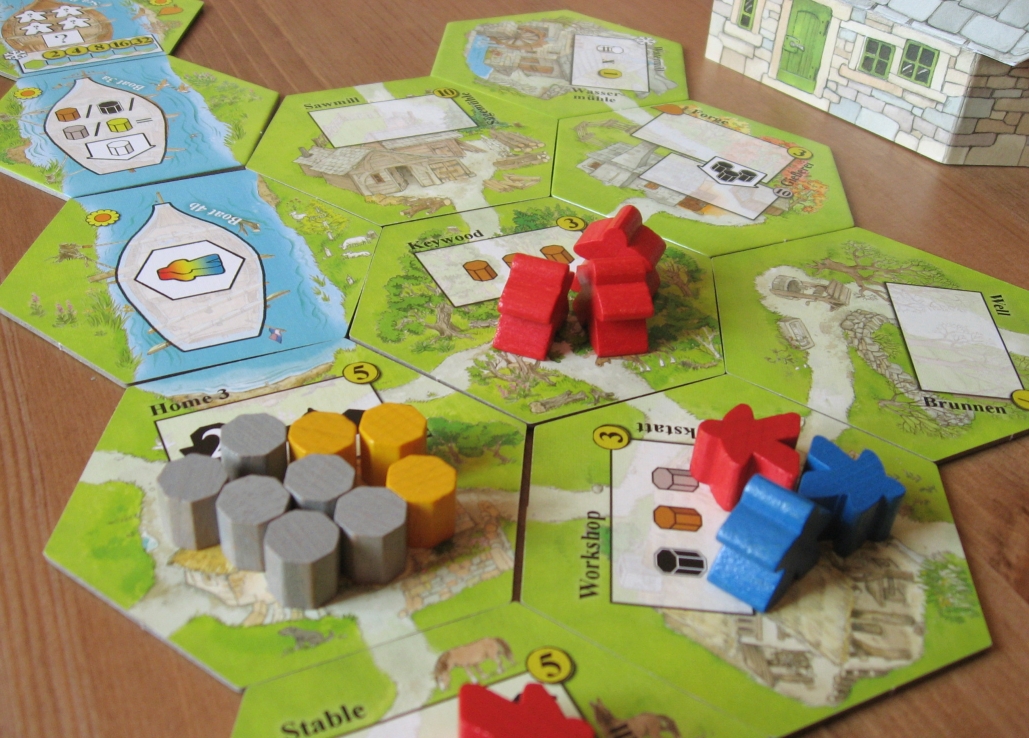
There are some stunningly beautiful games that haven’t made the list, for example, Amerigo is played on a beautiful seascape and Lancaster includes a lovely map of the England.  How do we define “map-based game” however?  Clearly, a map is is a two-dimensional play space so that excludes games where the play-area is predominantly linear i.e. “a track”.  But what about games where the map is produced as the game is played?  If Carcassonne is considered a map game, other games where the board is built during the play should also be included, like Saboteur and Takenoko.  What about one of our favourite games at boardGOATS, Keyflower?  In this game, players buy tiles and then use them to build their own personal little village map.  Should this be included too?

Keyflower
– Image by boardGOATS

Ultimately, none of this really matters of course:  a game is a game and it all comes down to how much people enjoy playing it.  One thing is clear though, while a game can be good in spite of the rendering, playing with beautiful components can only enhance the boardgame experience.

Carcassonne
– Image used with permission of BGG contributor Topdecker

Boardgames in the News: The Past, Present and Future of Z-man Games

The summer is now here which means conferences and take-overs.  Last summer, Asmodée acquired Days of Wonder and then followed it with Fantasy Flight Games, Ystari Games, Asterion Press and Pearl Games. Last week, Canadian company F2Z Entertainment announced the purchase of the U.S. company Plaid Hat Games (who are responsible for Dead of Winter and Summoner Wars).  Most people in the UK will have no idea who F2Z Entertainment are, however, they are the parent company of Pretzel Games, but perhaps more significantly, they also own Filosofia Éditions who in turn bought Z-Man Games four years ago.

Dead of Winter: A Crossroads Game
– Image by BGG contributor mikehulsebus

Z-Man Games was created in 1999 by New Yorker, Zev Shlasinger, for the sole purpose of reviving Shadowfist, the multiplayer Collectable Card Game.  From then on, the company produced a number of other American style games, including Grave Robbers from Outer Space and Ideology: The War of Ideas.  The company had a much more significant impact on Euro-games, however, by introducing many German games to the United States.  Z-man was one of the first companies to do this by actively engaging with the original European manufacturer and providing English translations.  The first game to receive this treatment was Ursuppe (a.k.a. Primordial Soup) designed and produced by Doris & Frank.   At the time, this was a very highly regarded game and the success of this reproduction quickly led to English editions of games like Santiago, Saboteur and No Thanks!.

Ursuppe (a.k.a. Primordial Soup)
– Image used with permission from BGG contributor samoan_jo

In 2007, Agricola was released in Germany to great acclaim, but as the cards are very text-heavy, it was essentially unplayable by non-native speakers.  The problem with this game was the huge number of wooden pieces adding to the expense of producing a new edition.  At the time, heavy Euro-games were perceived as a niche market and nobody was prepared to risk the capital outlay for such an expensive game.  Z-Man were only a small company and were already engaged on their own projects including the production of what was to become another hit, Pandemic, and could not take the risk either.  In the end, amid much controversy, Zev Shlasinger decided to gauge the interest of the community with one of the first boardgame pre-orders and the rest, as they say, is history.  So the impact of Z-Man on the history of modern boardgames highly significant, and arguably, they were the forerunner of the current KickStarter Craze.

Agricola
– Image by BGG contributor Simulacrum

In 2011, Z-Man Games was taken over by the French-Canadian distributor, Filosofia Éditions.  With the take-over of Plaid Hat Games last week, the company now has the “cradle to grave” of the boardgame market:  creation, publishing and distribution.  So in that sense, the deal is clearly a sensible one.  However, Z-Man Games used to be a by-word for exceptional customer service and following the take-over by Filosofia, this reputation was tarnished.  Although it seems to be picking up again, this demonstrates one of the downsides of this streamlining of the market.  More serious however, is the potential loss of innovation that comes from  agglomeration, particularly on a large scale.  That said, so far at least, all the “studios” that are part of the Asmodée group have kept their identity – the boardgamer in the pub would have no idea that Fantasy Flight Games and Days of Wonder are part of the same company.  Only time will tell whether we have seen the pinnacle of the golden age of boardgames or whether there is even better still to come.

Z-man Games Logo
– Image from zmangames.com

Boardgames in the News: Confusion at The Telegraph!

Anyone who plays modern boardgames knows how our hobby has been growing and growing.  Games like Carcassonne and The Settlers of Catan are now available in Waterstones and WHSmith, there has been a series of regular comments in The Guardian, there are repeatedly TV appearances, and boardgame cafés are sprouting up all over the place.  It seems strange then that last week, Harry Wallop from The Telegraph announced that “Card games and board games are dying out and it’s no great loss”.

Snap
– Image by BGG contributor loopoocat

The basis of this report is a survey carried out by Barclaycard which apparently indicated that games like Old Maid, Happy Families and Snap are in danger of dying out.  Strangely, on the same day, Martin Chilton, the Telegraph online Culture Editor reported that 67 per cent of the children surveyed said that they would like to learn how to play traditional games.  The really annoying thing about all this is that they focus solely on “traditional games”:  Martin Chilton’s article is entitled “The five best board games” and lists them as Chess, Scrabble, Monopoly, Cluedo and Backgammon.

Scrabble
– Image used with permission of BGG contributor Susie_Cat

On closer inspection, however, Harry Wallop’s article does include a link to a more interesting list of fifteen party games, including Pandemic, Camel (C)Up and Biblios.  While their definition of “Party Games” clearly leaves a lot to be desired, it is clear that someone at The Telegraph at least has heard of modern games.  Perhaps the most reassuring aspect of this though, is the response to Martin Chilton’s article in the comments section which includes a nearly eighty passionate responses pointing out better, modern, “classic games” and where to find information about them.

Biblios
– Image by BGG contributor creatsia

Let’s hope Mr Chilton and Mr Wallop read the comments and write a better article soon!

Boardgames in the News: 20 Years of Catan and El Grande

It seems to be the year for anniversaries: arguably 2015 celebrates significant anniversaries for two of the greatest games in boardgaming history.  We are not talking about Monopoly here (though there has been a lot written about the 80th anniversary of the brand).  The games in question were both released in Germany in 1995:  The Settlers of Catan and El Grande.   The first of these, Klaus Teuber’s The Settlers of Catan, is widely known amongst gamers and many non-gamers, and is often cited as being responsible for the “gaming revolution”.  The base game of “Settlers” (or “Die Siedler”) and its expansions have appeared in thirty languages and sold more than twenty-two million copies worldwide.  At Spielwarenmesse, The International Toy Fair at, Nürnberg, Kosmos and Mayfair unveiled a new look for the entire line of Catan games.

The Settlers of Catan
– Image used with permission of BGG contributor kilroy_locke

The press release explains, “The new look will strengthen the Catan brand both domestically and internationally.  The new cover art utilized by all partners will provide a visual continuity throughout the world.  This new look is more vibrant and alluring with overall improved presentation and splendidly clean branding. The new packaging cries out… CATAN!”  It goes on to say, “As part of the growing expansion of the Catan® family of products, the base game will simply be called CATAN® in all countries and languages, along with a unification of the game’s graphic design in all territories and languages.”

The Settlers of Catan
– Image by BGG contributor herman_the_german

There are a couple of curious things about this, firstly, when Kosmos released the game twenty years ago, it was just going to be called “The Settlers” (or rather “Die Siedler” since it was released in German first).  That was until Blue Byte published a computer game by the same name, so Kosmos decided they wanted something more unique and identifiable and made up “Catan”.  Secondly, aside from the the editions released in English by Mayfair Games (who went its own way with original art and component design), the brand has already been “unified” in its look!

The Settlers of Catan
– Image by BGG contributor degamer

The second of the games mentioned above is El Grande, which was first published in Germany by Hans im Glück.   Like “Settlers” the year before (or “Catan” as we must now call it), in 1996, Wolfgang Kramer and Richard Ulrich’s El Grande was awarded both the Spiel des Jahres and the Deutscher Spiele Preis.  Although it is less widely known than its predecessor, El Grande is hugely respected by gamers often cited as “still the best area control game”.  It is so highly thought of that it continues to be higher on the BoardGameGeek ranking than The Settlers of Catan and many other well known and hugely popular games including Carcassonne, Ticket to Ride, Pandemic and Dominion.  These games are all continuously reprinted, but sadly, the nature of boardgames means that many good titles go out of print.  Unfortunately, El Grande is one such game; it had fallen out of favour with its publishers and has not been reprinted in English or German since the Decennial Edition, ten years ago.

El Grande
– Image used with permission of BGG contributor garyjames

There are a number of reasons why games like this go out of print.  Firstly, much as we hate to admit it, boardgaming is a niche market:  Hasbro recently proudly announced that Monopoly has sold 275 million copies over the eighty years, but compare this with the estimated 450 million Harry Potter books sold in a fraction of the time.  In turn, these make Catan’s 22 million copies look positively paltry by comparison and for games that fail to make the jump to the wider market, the first print run is often only a few thousand.  Whether or not one of these games gets a second print run depends on demand and sale-speed of the first impression, and ultimately, whether or not the publisher thinks it can secure a good return.  Factors that affect this, obviously include the mark-up and the Recommended Retail Price (or RRP, sometimes known as Manufacturer’s Recommended Sale Price or MRSP).  Games that have language dependent components usually suffer here.

El Grande
– Image used with permission of BGG contributor DrGrayrock

There are two main markets:  Germany and USA.  We in the UK benefit from the fact that the USA nominally speak the same language as us, but otherwise, the UK boardgame market is relatively small-fry.  Anyhow, for this reason, games are commonly released primarily in English and German, however, the margins are clearly much larger if the same game can be released to both markets with minimal reworking, and companies like Z-Man Games have made a name for themselves translating the best European games for the English market.  Other companies (e.g. Zoch, Queen and R&D Games) release games as “international” editions which include language independent components and rule booklets in multiple languages.

El Grande
– Image by BGG contributor Domostie

Obviously, it is much more difficult to release a multi-lingual edition if key components include significant text.  It is also much easier to translate a game if the only change needed is the box and the rules; El Grande clearly fell foul of this.  However, so did The Settlers of Catan, and that didn’t do so badly.  So there are obviously other factors, including game play, accessibility, approachability, appearance and marketing.  There is no question that the trading dynamic and controlled randomness in Catan are key parts of its success as they keep everyone involved between turns, but timeliness is probably the real key:  it was perhaps just the right time for a family game that felt a bit different.  So, by the time El Grande came along, well, everyone was playing Settlers, and as a result, El Grande didn’t make quite the same impact.

El Grande
– Image by BGG contributor Bernaar

That doesn’t mean it is less of a game though, so it is great news that Hans im Glück has recently announced the long-awaited return of El Grande, this time in the form of a Big Box with upgraded components.  The Big Box is a collection that, like the Decennial Edition ten years ago, will contain all the expansions that have been officially released over the years.  Z-Man Games has also confirmed that it will release a parallel Big Box in English; Dutch publisher 999 Games will be doing the same in Dutch and have also mentioned a “Jubileumuitbreiding”, or “anniversary extension”.  Clearly anniversaries are to be celebrated, especially if it means older, well-loved games become available once more.

Essen 2012

Essen is a small city in the industrial heartland on the River Ruhr.  One of the less well known German cities, people are often surprised that it features in so many games.

Pandemic

The reason for this is a sort of in-joke:  Essen is the home of the largest games fair in Europe and, arguably, the world, The Internationale Spieltage.  Known by gamers simply as “Essen”, it runs for four days in October every year (18th-21st October 2012) and everyone who is anyone goes.

As well as all the major (and most of the minor) publishers, game designers and game illustrators, there are also thousands of people from all over the world who simply like playing board games.  In 2012, there are nearly 750 exhibitors who will be selling and demonstrating their latest offerings to the nearly 147,000 visitors.

This year no-one from boardGOATS will be going, however, you can get a flavour of the event and an idea of some of the latest games by watching the live feed from the BoardGameGeek booth.

Here are some more games that feature Essen, can you recognise the games they are from?

Ticket to Ride: Europe

Railways of Europe

Paths of Glory