Tag Archives: Splendor

13th December 2016

Unsure of who was coming, to get everyone in the mood, we started off with the quick set collecting game, Coloretto.  We’ve played this little filler a few times, but somehow, Red felt she’d missed out. The game is very simple: on their turn the active player either draws a chameleon card and places it on a “truck” or takes a truck (which means they’re out for the rest of the round). The idea is that players are collecting sets of cards, but only three will yield positive points, with the rest scoring negatively.  The really clever part of the game is the scoring which uses the triangular number sequence (one point for the first card, three points for two cards, six points for three cards etc.), which rewards one large set more than two or even three small ones. It was very tight between Blue and Ivory who both picked up sets of six, but Blue finished one point ahead thanks two her second set, three green chameleons.

Coloretto
– Image by BGG contributor SergioMR

With everyone arrived, we moved on to the evening’s “Feature Game”, Marrakech, a very simple little area control game played through the medium of the Persian rug. Played on a small grid, each player starts with thirty lire and a pile of pieces of carpet.  On their turn the active play can rotate Assam, the master salesman a maximum of ninety degrees left or right, before they roll the die to find out how far he must be moved.  If Assam lands on a carpet square of an opponents colour, then the active player must pay the owner “rent” equivalent to the total size of the carpet.  Once Assam has been moved and any dues paid, the active player places a strip of carpet. The carpet pieces are all the same size (twice as long as they are wide) and cover two squares on the board.  They can also overlap with pieces laid previously, but cannot be placed wholly on top of one single rug.
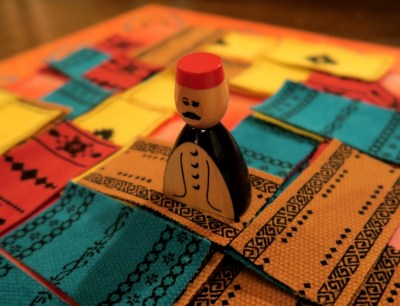
Marrakech
– Image by boardGOATS

This is where the strategy comes in – is it best to try to make a large contiguous area which will be very lucrative every time someone lands on it (but that players will avoid if at all possible) or is it better to make many small areas that players will be more likely to land on?  The game ends when everyone has played all their pieces of carpet and the winner is the one with the most money (each visible piece of carpet earns its owner one lira).  Marrakech is a nice little game, but what really makes it is the quality of the rendition.  Assam is a beautifully made and painted wooden piece; the “coins” are wonderfully tactile wooden discs and the carpet is well, a strip of coloured fabric.  Without these touches, the game would still be as good, but would be very abstract.

Marrakech
– Image by boardGOATS

We had two copies and plenty of people who were interested in it (to quote one of the GOATS, “I want to play the carpet game!”), so we played two parallel games.  Red, Blue, Ivory and Pine were first to get going with the slightly newer, brighter version of the game.  Pine and Red started out quite aggressively building large areas of carpet, trampling on each other and Blue and Ivory in the process and building a mini-carpet-mountain seven or eight layers high.  Throughout, it felt tight, but in practice, there was only ever going to be one winner and Red finished eleven lira ahead of Blue in second place.  On the next table, playing with the more traditionally “sandy-coloured” version, Green, Ivory, Purple and Black were playing a slightly more strategic and less vindictive game.  The result was a closer game with everyone within four points of each other, but was won by Green, just two lira ahead of Black.
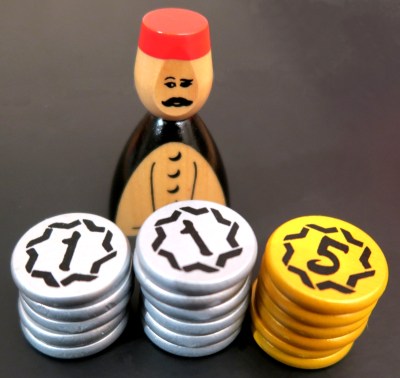
Marrakech
– Image by boardGOATS

With both games finishing almost simultaneously, there was a quick bout of musical chairs, with Green joining Ivory and Blue for a game of Ivor the Engine (its first outing with the “mammy sheep” picked up at Essen).  This is a cute little game with a viciousness that lurks just below the surface and belies the gentle art-work from the Ivor cartoons as drawn by Peter Firmin.  The idea is that players are travelling round Wales collecting sheep and the person with the most sheep at the end of the game is the winner.  A single sheep can be collected whenever you start your turn on a town or village with sheep in it, but more sheep can be collected if you are in a town or village without sheep and perform a task to “help Ivor”.  Helping Ivor comes at a price, however, as in order to do this you have to play one of the dual-purpose cards from your hand, which means you cannot use it to help you in other ways.  At the end of your turn you add one card to your hand from the face up displayed cards, however, when the chosen card is replaced from the draw-pile though mixed in with the errand cards are event cards which can be nice or nasty.

Ivor the Engine
– Image by boardGOATS

Blue got lucky, and started off in Grumbly Town which happened to have only one sheep. Since she also had a card for Grumbly Town, this meant she could pick up the one sheep and then play the card to help Ivor, netting a total of six sheep before Ivory had even had a chance to take a turn.  That was where her luck finished though, and Green soon caught up quickly followed by Ivory.  The cards fell well for Green as he picked up several cards for Tewin as he traveled to the south-east corner of the board picking up lots of sheep as he went.  Ivory had a little poke at him, taking a couple of his sheep when he had the chance, then , out of fairness, he then had a go at Blue, taking both the last sheep and the lost sheep token from her current location. Next turn, Green did the same to Blue and just to compound things, “the game” joined in, giving a total of nine sheep she’d missed out on.

Ivor the Engine
– Image by boardGOATS

Feeling rather “got at”, and in desperate need of time she tried to stop Green from finishing the game by doing the only thing her cards allowed her to do – put sheep in Tewin to slow Green down.  It was all too little too late, and twenty-five sheep is not an awful lot, so it wasn’t long before Green passed the threshold and triggered the last round.  Still with no useful cards and in a position that was not going to trouble the scorers, Blue was forced to do nothing, leaving Ivory to do what he could to catch up.  With some effort he was able to cross the line, but was still some way short of Green who still had his final turn to come.  In the final accounting, Green finished on thirty-five, nine sheep ahead of Ivory, and more than twenty clear of Blue, in what had been a very unforgiving game.

Ivor the Engine
– Image by boardGOATS

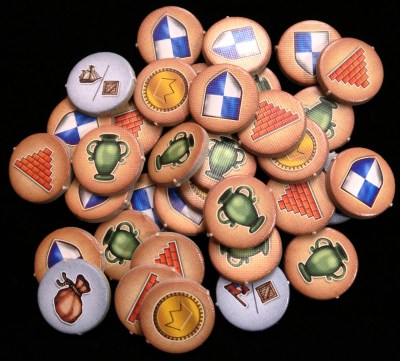
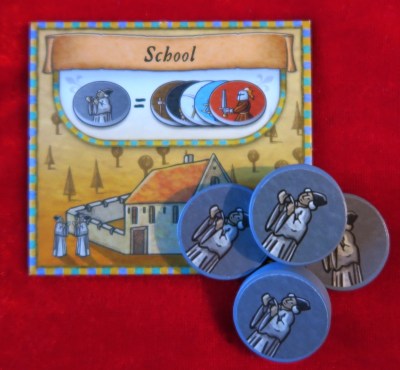
Meanwhile, Red, Black, Purple and Pine were looking for something to play. With Burgundy away worrying about his MOT, Pine fancied his chances at Splendor.  We’ve played this little chip-collecting and card development “engine building” game quite a bit, but we all still seem to quite like it when we are looking for a light filler game. Since Black, Purple and Red had also suffered at Burgundy’s hands recently, they were very happy to join Pine in the certain knowledge that, for once, Burgundy wouldn’t win. The idea of the game is that players collect chips to buy gem cards which can, in turn, be used in lieu of chips. More expensive cards are also worth points and the game end is triggered when one player reaches fifteen points (and the round is completed to give everyone the same number of turns). Points are also awarded for “nobles” which go to the first player to get a specific combination of gem cards and the player with the most points at the end is the winner.

Splendor
– Image used with permission of BGG contributor henk.rolleman

Everyone was up for it, and it started out with players taking it in turns to pick up cards, keeping everyone guessing as to who had the edge. Before long, Black, Pine and Red edged ahead, then suddenly, Black declared he had fifteen points and everyone else panicked.  It wasn’t long before someone smelled a rat and there were demands for a re-count.  With the discovery that Black had miscounted and only had fourteen points, there were the inevitable tongue-in-cheek accusations of cheating and a second “final round” began.  Although this gave everyone a second chance, it wasn’t quite enough, and Black won with eighteen (despite “cheating”).  Pine finished in second, three points behind, so he’ll have to wait a little longer to win Splendor. One thing everyone was pleased about, however, was that at least Burgundy hadn’t won, and that was almost as satisfying as beating him, though not quite, obviously.

Splendor
– Image used with permission of BGG contributor henk.rolleman

With Ivory and Green heading off early, that left five players and a debate as to what to play next.  Somewhere in the discussion “Beans” got a mention, and from then on, despite conversation moving onto Christmas music and everyone’s favourite version of “The Bean Rhyme” (“Beans, beans, good for your heart…” – who knew there were so many different versions?), the final game was inevitably Bohnanza.  This game is very simple:  in front of each player are two “Bean Fields” and on their turn, players must plant the first card in their hand and may plant the second.  Once the active player has planted the card(s) from their hand, then they turn over the top two cards from the draw deck:  these must be planted by the end of the turn, though not necessarily in one of the active player’s fields if they can be traded.  Once all these cards have been planted, the active player can then offer to trade any unwanted cards in their hand before their turn ends with them replenishing their hand from the draw deck.

Bohnanza
– Image used with permission of BGG contributor spearjr

The catch is that players are not allowed to change the order of the cards in their hand which must be “planted” in the order they arrive.  However, it is possible to remove unwanted cards by trading them away (either during their turn or with the active player).  This simple mechanic coupled with the different availabilities and values of cards when they are harvested, are the critical parts of the game.  Thus one of the key points is the ability to value a bean and not overpay for it, or equally important, not give it away for less than it is worth.  The problem is that “value” depends on perspective, and this caused an otherwise friendly little game with a bit of bite to become a little bit nasty.

Bohnanza
– Image used with permission of BGG contributor spearjr

Blue had picked up and planted the first two Cocoa beans, so when Purple drew a third, Blue asked whether she would trade.  Blue didn’t have much to offer, but offered what she could and pointed out that there were only four Cocoa beans in the game and since we were less than a quarter of the way through the deck on the first pass, Purple could be waiting a long time.  Purple had other plans though and commented that it was a very valuable card and determinedly planted it.  On her next turn, Blue dug up her pair of Cocoa beans and put both in her money stack.  So it was more than a bit irritating for her when she promptly drew the fourth Cocoa bean card.  Blue was feeling a bit obstreperous after the rough treatment in Ivor and Purple was unable to offer a good trade.  So, much to Purple’s disgust and despite the difficulties it caused both of them, Blue planted the offending bean before immediately digging it up.
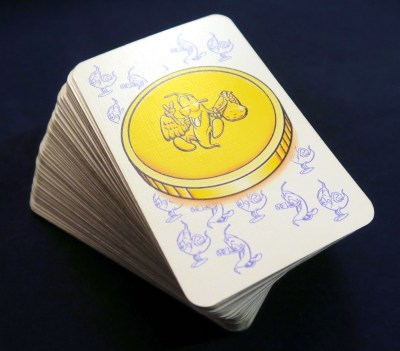
Bohnanza
– Image by boardGOATS

This had a couple of consequences.  Firstly, Blue’s plans were now in tatters, and secondlym Purple had to choose whether to get rid of the Cocoa bean (with singles being hard to get rid of) or whether to wait for the second pass through the deck.  Purple doggedly stuck with it, so it was particularly unfortunate when Blue drew the Cocoa bean card almost as soon as the deck was turned.  With little chance to get rid of it and still in a very kamikaze mood, Blue planted it a second time before digging it back up again.  Purple was not impressed.  Fortunately, on the third pass, the Cocoa bean finally landed in the hands of Red.  She wasn’t in a silly mood like Blue, so Purple finally got her second Cocoa bean and was able to harvest them for two coins.  It was only just in time though and she had played nearly the entire game with only one field, and still finished third – quite an achievement.  Red finished in first place, just one coin ahead of Blue who had spent most of the game trying to dig herself out of her self-inflicted mess.

Learning outcome:  Value is dependent on circumstances and very much in the eye of the beholder.

1st Movember 2016

Blue and Red arrived first, with Red telling the tale of her exciting weekend.  It wasn’t long before Burgundy, Pine and Green had arrived so, at Blue’s behest, Red began telling it all over again.  She had been part of a teem entered into to a twenty-four hour “jigsaw-a-thon” in Belgium.  The Unofficial World Jigsaw Puzzle Championship is held every year in a place called Hannut and includes teams from all over the world.  This year, there were one hundred and twenty four teams, each fielding four active members at any one time (though as many interchanges as required were allowed).  Each team was competitively “jigsawing” in a little pen, Red explained, and when a puzzle was finished the team involved cheered madly and set off a klaxon.  Red’s team came a very creditable fifty-ninth, which was particularly remarkable as they had primarily gone along to have a good time where other teams took it very seriously and were exceptionally well organised.  Everyone was quite taken with the idea though, so much so that Green suggested entering a GOATS team next year.  It remains to be seen whether that actually happens…

Hannut 2016
– Image from 24hpuzzle.be/flickr.com

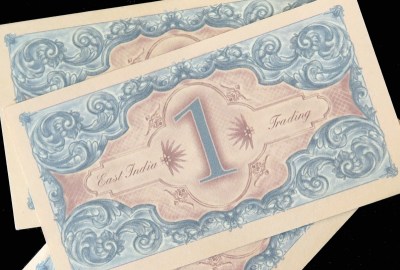
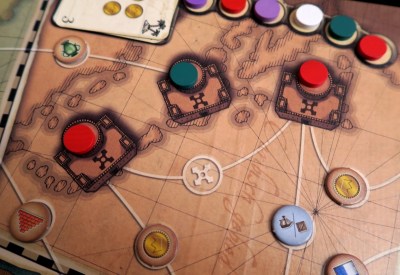
Green had his own exciting tales to tell about his visit to Millbrook Proving Ground and Burgundy had been to Wembley to see the season’s last American Football match of the NFL International Series which had turned out to be “a great game for neutrals”.  Consequently, it was gone 8pm before we realised that Black and Purple still hadn’t arrived and nobody knew whether they were coming or not.  Texts followed just as Black and Purple walked in commenting how great the NFL match had been.  Needless to say, we were late starting as we chatted on about that again.  Eventually, we split into two groups, with Green, Black and Burgundy settling down to play the “Feature Game”, Batavia.  Batavia was the Dutch colonial name given to the Indonesian city of Jakarta from the seventeenth century.  Batavia was also a ship of the Dutch East India Company (Vereenigde Oost-Indische Compagnie, or VOC) that was built in Amsterdam, and shipwrecked on her maiden voyage in 1629 off the Western Australian coast.  The game, Batavia, on the other hand, is concerned with shipping commodities from the spice islands in the seventeenth century and features both the city Batavia and the ship Batavia.

Batavia
– Image used with permission of
BGG reviewer EndersGame

Batavia is played over several rounds on a map of Asia featuring the central islands of the spice trade route.  Players are merchants visiting trading posts of the five East India Companies throughout Asia, gaining “majorities”, which earn the right to different commodities, which in turn translate into money that wins the game.  Each round consists of two phases:  an auction phase and a movement phase.  In the first phase, a die is rolled to determine how many cards will be auctioned.  Then, players bid using their promissory notes increasing the bid until everyone has passed with the highest bidder winning the cards and the right to go first.  The interesting part is that the winning bidder does not pay the bank, instead paying the other players by dealing the promissory notes round the table.  This is a very clever balancing mechanism, because it means the total number of promissory notes in circulation remains unchanged throughout the game.  Players who fail to win an auction also have in increased chance of winning the next time, and promissory notes are worth bonus points at the end of the game, giving them an intrinsic value in their own right.

Batavia
– Image used with permission of BGG reviewer EndersGame

One the auction has been completed the auction winner begins the movement phase.  Each player has a choice, they can take two cards or play ship cards and move their merchant figure to get a new trading post counter.  Ship cards can only be played if the active player has, or can can achieve a majority of cards in one of the five trading companies – cards are played into a tableau and the player with the most cards of a particular shipping company gets the corresponding Company Seal which indicates possession of the majority in that company (and can be taken from another player if necessary).  Thus a player with a Company Seal can play any cards they wish, but if they do not have a Company Seal, they must play enough cards to earn the right to get one, and then can play additional cards as well.  In other words, if a player does not have any of the Company Seals, and can’t play enough cards to get one, then they must draw two cards instead.  Once the active player has played cards and has at least one Company Seal, they may move their Merchant figure along the hex-track to a trading post counter that corresponds to one of the Company Seals they own.  They take this tile which represents gaining the matching commodity from that trading post and is marked by placing a wooden Crate in the appropriate warehouse for that commodity.

Batavia
– Image by boardGOATS

Once a player has played their cards and moved their Merchant, they may, if they wish, turn their hex-tiles into points (or Gold).  The commodities on the tiles are of no significance, but the tiles traded must be from different companies; the more a player trades, the better the return, i.e one tile gives one point, but five tiles (from each of the five different companies) yields a massive fifteen points.  There is a catch though, trading is prohibited if the hex-tile just acquired comes from a company that the player already had a counter for.  Worse, trading post tiles cannot be turned into points at the end of the game, which means decisions can be tense, especially towards the end of the game.  There is another catch though.  Every time a ship card is played, the token that corresponds to that shipping company is moved along the Pirate track, as is the Pirate cannon.  When the cannon reaches a certain point, players forfeit all cards that correspond to the shipping company token that has made it the furthest along the Pirate track.  This fulfills many functions, including ensuring the number of cards in play doesn’t become unwieldy and preventing one player from getting an unassailable majority as well as encouraging players to diversify.  The game end is triggered when one player reaches the end of the trading post track and the round is finished to ensure everyone gets an equal number of turns.

Batavia
– Image by boardGOATS

We had nearly completed the set up when we discovered several pieces missing from the box that had been used elsewhere and not returned.  Rather than abandon the game though, we scavenged bits for the company seals and ‘navigator’ pieces from other games, primarily Vasco da Gama (at least some part of that game is being played).  With that sorted, we were quickly under way.  The early rounds of the game were characterised with high dice rolls, meaning that there were a lot of cards available for each auction that both Burgundy and Green paid handsomely for.  While Burgundy and Black made steady progress, laying claim to a few different commodities, Green raced ahead concentrating on just nuts and vases, the two highest valued commodities available in the game at that point. Black, on the other hand, won so few auctions that he had to miss his turn twice, collecting just two cards instead.

Batavia & Vasco da Gama
– Image by boardGOATS

During the early part of the game we discussed the optimum number of trading post hex-tiles to a swap for points.  The more a player trades, the better the return, i.e one tile gives one point, but five tiles (from each of the five different companies) yields a massive fifteen points, but more is correspondingly more challenging.  Burgundy explained that he felt that three was a good number as four was rife with risks of not being able to get one of the two remaining companies available. He stuck to his guns and exchanged after just three chits, while Green and Black both managed a four relatively easily.  Elsewhere in the  game, Cloth and Coffee were conspicuous by their absence, until about half way when Cloth materialised creating a veritable textile market quarter.  Coffee didn’t become available until the second half of the game and two thirds turned up in the final ten spaces, but by then Green was so far ahead of the other two that neither of them stood much of a chance to even get a foot-hold in that particular racquet.

Batavia
– Image by boardGOATS

In the end, although Burgundy had placed more crates overall, he only had the majority in one commodity, while both Green and Black managed the majority in two each. However with Green snatching the most valuable majorities and the end Target Token he was a clear winner. Black, who had seemed to be on the back foot for most of the game, just snatched the bonus for finishing with the most promissory notes (everyone must have been pretty even handed about their assumptions of card values, to finish with almost exactly the amounts we started with).  When Green snatched that final trading post hex-tile, Burgundy and Black were both a long way behind and plans were scuppered, but it did mean they had a reasonable choice to gather a final useful token.  Ironically, Burgundy placed a final crate in Cotton, which removed Black’s majority there. If he hadn’t done that, Black would have beaten Green by one point. It just goes to show that the player to watch out for isn’t always the most obvious one.

Batavia
– Image by boardGOATS

Meanwhile, on the next table, after a short debate about what to play, Blue, Red, Pine and Purple started on Kerala: der Weg der Elelfanten, “the way of the elephant”.  This was one of the games that came back from Essen and, as a light tile-laying game got its first outing last time.  Pine and Purple had enjoyed it and Red had missed out last time so was keen to give it a go.  The idea is that on their turn, the active player draws the same number of tiles from the bag as there are players and then chooses one to add to their display of tiles.  The everyone else takes it in turns taking a tile and adding them to their own display.  Play is mostly simultaneous as players puzzle over where to add tiles according to the fairly simple rules.  Tiles must be placed next to a tile with an elephant on it and the elephant is then moved onto the new tile.  It can be placed in an empty space, or on top of a previously laid tile.  However, a large part of the game is to finish with exactly one contiguous region of each colour (except the player’s own colour which can have two regions) as any extras must be removed and each tile taken away scores minus two points at the end of the game while any missing colours score minus five.

Kerala
– Image by boardGOATS

Blue drew with Black drew last time, thanks to a large number of “apron” tiles which score five points each when placed so that the apron matched the correct colour.  This time, everyone else was wise to how valuable these were and Blue had to fight harder for points.  In this game, positioning elephants and choosing suitable tiles (or leaving everyone else with poor tiles) is everything.  Both Purple and Pine and pine got themselves in a bit of a tangle with multiple regions of the same colour.  For the most part though, by the end of the game they had managed to connect the relevant areas and minimise the number of points lost.  It was Red, playing for the first time who got the best of the tiles.  She was no doubt helped by the fact that Blue (sat to her right), got herself in a terrible tangle and ended up trying to build her way out of trouble by placing tiles on top of others.  The problem was that no sooner had she fixed one problem than another came along, which meant she was more concerned about choosing the best tiles she could for herself than leaving tiles that were difficult for the next players.  Once again, the game finished in a tie, but this time it was Pine and Red who finished in joint first place, nearly ten points clear of the others.

Kerala
– Image by boardGOATS

Batavia was still underway, so the group moved onto a nominally quick little card game, called Fleet Warfside.  Although the game is about the fishing industry and uses the same artwork as the original Fleet card game, the game play is quite different.  The idea is that Wharfside is the sequel, with players buying and selling fish (caught in the original Fleet).  Players begin the game with a handful of fishy goods cards which they can use as currency or trade for points.  In ascending value, the goods cards each represent shrimp, oyster, tuna, swordfish, lobster or king crab.  Thus, two oyster cards are worth more than two shrimp cards and two king crab are worth more than two of anything else.  However, an extra card will always be worth more so three shrimps for example is worth more than two of anything else, even the valuable king crab.  Over-paying is allowed, in fact, it is over-paying that means the game works as, at its core, Fleet Wharfside is a set collecting game, and players need to be able to cover all the bases as prices are constantly changing.

Fleet Wharfside
– Image by boardGOATS

On their turn, players can either carry out a Market action or use the Wharf.  Market action involves buying contract or building card from the face up Market.  The price of each of the four individual cards is set in advance and is given by an indicator card immediately above the contract cards.  When a card is bought, the price of one of the four cards will change as the indicator card is rotated (usually increasing the price).  The Market affected depends on the replacement card drawn.  Instead of carrying out a Market action, players can instead visit the Wharf.  This allows them to do a variety of actions including: use any special abilities that come with the contract cards; assign a maximum of two goods to contracts and store king crab for scoring at the end of the game.  If a contract is completed during this phase, the assigned goods cards are placed on the discard deck and the completed contracts removed from the player’s tableau and placed in their scoring pile.  Bonus points cards are awarded for the first and second contract of each type to be completed.  A Wharf action is finished with a visit to the Wharf where players can take two cards from one of the two pools of face up cards.  There is a hand-limit, but players can choose which cards to discard after they have picked up.

Fleet Wharfside
– Image used with permission of BGG reviewer EndersGame

The game end is triggered when a player completes a set number of contracts and the round completed so everyone gets the same number of turns.  Points are scored for completed contracts/buildings (at face value); stored king crab (at a rate of one per card plus a bonus for the player with the most); contract completion bonuses; the largest set in-hand at the end of the game (one point per card), and the player’s personal Captain Bonus (each player gets a random Captain card at the start of the game which depicts one type of goods and the player scores one point per speciality on their completed contracts).  Blue and Pink played Fleet Warfside on their way to Essen last month, but otherwise it was new to the group.  Although it is a great little card game, it is not really like anything else we’ve played on a Tuesday, and as a result, everyone struggled a bit.   Things were made worse by the fact that nobody really used the ability to over-pay, nor did they use the any two for one, which when judiciously used can speed things a long quite a bit.  When explaining the game, Blue commented that although the goal was to finish contracts, in actual fact it was generally better to try to keep the maximum of three contracts for as long as possible, as each contract has a spacial power and as soon as a contract was fulfilled, its power was lost.  Although this comment was well-meaning, it only succeeded in confusing Pine and Purple further.

Fleet Wharfside
– Image used with permission of BGG reviewer EndersGame

The effect was an endless stream of questions and queries and repeated questions and queries which gave Red a fit of the giggles. The advertised time for Fleet Warfside is twenty to thirty minutes, but although Blue was expecting it to take longer, even she wasn’t expecting it to drag on as long as it did.  The problem was made worse since its sweet-spot is probably three players and with people agonising over what to do and questioning what the options are, the effect was even worse than it was.  Unsurprisingly given that she was the only one to play it before, Blue finished as the winner five points ahead of Red in second place.  Sadly, although it is a clever little game, with this group it was not a great success this time.  Actually, it may be that the more abstract, less visual nature of card games is the problem, since the same people struggled with Port Royal Unterwegs last time and with Oh My Goods! the time before – perhaps something to keep in mind for the future.

Isis and Osiris
– Image by boardGOATS

Since Batavia had finished, Green, Burgundy and Black looked round for something to play that might fill the time while Fleet Wharfside ground on.  Green’s eye fell on Isis & Osiris, a little game that Blue and Pink had brought back for him as a present from Essen.  The pieces  needed removing from their frames and nobody had played it before so there a flurry of rules reading, though in truth it was a simple enough game.  The game comprises elements of strategy and memory.  At the start, players are dealt a pile of tiles, face down, and get a handful of octagonal wooden blocks in their colour.  Game play is very simple: on their turn, the active player can either place a tile face down, first showing it to everyone else, or they can place a block.  At the end of the game, all the tiles are turned face up and players score points for those tiles orthogonally adjacent to their blocks.  The catch is that the tile values range from minus four to plus four (with no zeros), i.e. are both positive and negative.

Isis and Osiris
– Image by boardGOATS

After the inevitable terrorism comments, we started.  The skill in this game is to not only remember where all the best scoring tiles have gone, but also to work out when and where to place your own piece in order to maximise those tile placements: if someone turns up a high negative tile they certain to try to place it next to your piece and away from their own.  While playing we soon realised that a real quandary was when to place the four wooden pieces. Placing them early ensures they are out and gets a large part of the board covered.  Alternatively, waiting until near the end gives a better idea of where the scores are, but leaves less spaces in which to actually get those points. On reflection it seems that it really needs to be a balance, going early or late will probably end up with being boxed out of controlling your own destiny (not that you feel like you have much control normally anyhow).

Isis and Osiris
– Image by boardGOATS

We were unsure what kind of scores we would get. We had the feeling it was one of those game where negative scores would be all too common, and even a single point might be the winning score In the end the scores were a little higher than that at four, five and eight.  Burgundy admitted to forgetting where the scoring tiles were very early, on but still went on to win. It’s not clear what that says about this game, though we would need to play it a couple more times to find out how “random” it really is. With good players with good memories it could be a very challenging game.  Still it did only take the twenty minutes claimed (including set up, explanation and confusion during scoring) which makes it a good filler, which is more than could be said for Fleet Warfside on the next table which was still going.  It was obvious they would be another half hour or so, so with no messing our old favourite Splendor was out of the box and ready to go.
Isis and Osiris
– Image by boardGOATS

In Splendor, players have just three options on their turn:  collect gem tokens, buy a gem card using gem tokens (and/or cards), or reserve a gem card and receive a gold (wild) token at the same time.  Players can have a maximum of ten tokens, though unlimited cards and the cards act as permanent tokens.  Thus, at its heart Splendor is an engine building game built on a set-collection mechanism.  Players score points when they buy some gem cards and for attracting Nobles which are awarded to the first player collect certain combinations of gem cards; the game end is triggered when one player reaches fifteen points and the player with the most at the end wins.  One of the fun things about this game is that, despite its relative simplicity, each game plays differently.  This time it seemed to be a token-heavy game, in other words everyone did a lot of token hoarding, keeping several key colours out of circulation, making progress in a particular colour tricky for everyone.  As a result a number of gold tokens were taken for very lowly cards, several level twos and even a couple of level one cards. Indeed, Black took gold several times for want of anything better to do, since nothing else looked helpful.  The lack of tokens seemed to weigh particularly heavily on Burgundy in the early parts of the game, giving Black and Green a little optimism that maybe this time they might be able to topple him for the first time in four games.
Splendor
– Image used with permission of boardgamephotos

Overall it was a very tight game. Burgundy, in spite of his protestations of having nothing he could do, managed to take the first Noble card. Black quickly got another with a high scoring card, leap frogging him into a strong lead and Green wasn’t far behind in gathering his first Noble.  Burgundy was able to build on his first Noble (one with three cards in each of three colours) by adding just two more cards to give his second Noble and put him within a whisker of ending the game with fourteen points. At this point, Black recognised that this could be his last turn, but he needed two turns to complete his plan. He did the best he could and also reached fourteen points.  Green went next, but his plan worked out just in time, and he placed a reserved card worth three points giving him his second Noble in the same way that Burgundy had and helping him to fifteen points triggering the game end making it the last round.  Unfortunately,  thanks to the turn order, Burgundy got one final turn and it didn’t take a lot of effort to find a way to gather two more points to maintain his Splendor crown, albeit with a warning shot across his bows: next time we’ll get him, maybe.

Splendor
– Image used with permission of BGG contributor henk.rolleman

With Fleet Warfside finally over, Red there was still time one final short filler, and, after a quick discussion, we resorted to our old favourite, 6 Nimmt!.  While Burgundy shuffled, the rest of us engaged in a discussion as to when we last played – after a look through the book, the verdict was July, which only left us to decide whether that was “ages” or not.  We reminded ourselves of the rules:  players simultaneously choose a card, then simultaneously reveal them before playing them in ascending order placing each on the row finishing with the highest card that is lower than the card being played.  When the sixth card is added to a row, the first five are taken and the number of heads contributes to the player’s score, lowest score wins.  We tend to play a variant over two rounds with half the deck in each round and not resetting the table in between which tends to result in a cascade of points in the second round, and this time was no exception.  Black and Burgundy top scored in the first round with zero and one point respectively and nobody else close, setting up a head to head in the second.  Victims of the second round cascade, unfortunately for them, Black and Burgundy both had disastrous second round.  It was Red who redeemed a poor first round to win by one point from Purple and Green who finished in joint second place.

6 Nimmt!
– Image by boardGOATS

Learning Outcome:  Card games are more abstract and sometimes more difficult to understand.

4th October 2016

It was a quiet night, thanks to illness, work and other commitments.  There were still enough of us to split into two small groups, the first of which settled down to play Endeavor.  This is a game we’ve played a couple of times this year and still proves quite popular.  This time, only Green had played it before and Grey and Ivory were unfamiliar with it, so it was necessary to have a complete run-down of the rules.  The game is played over seven rounds, each of which consists of four phases:  Building, Population, Income and Action.  The idea is that players have four status tracks, one each for Industry, Culture, Finance and Politics, which roughly correspond to the four phases of the game and dictate what players are allowed to do at each stage.

Endeavor
– Image by boardGOATS

Players begin by choosing a building, some of which provide an increase in one (or more) of the four status tracks, some provide actions, while most others do a mixture of both.  Players then move population markers from their general supply to their harbour according to their current culture level.  A strong population is essential as it ultimately limits the number of actions players can take on their turn.  The income phase allows players to move some of their workers from buildings back into their harbour as dictated by their current level on the income track.  These add to the population players have available to do things with, while also making space on the buildings so that these actions are available for re-use.  The first three phases of each round are mostly just preparation and book-keeping; the guts of each round are in the final phase, where players take it in turns to carryout an action of their choice.  There are five basic actions: Taking Payment, Shipping, Occupying, Attacking, and Drawing Cards.

Endeavor
– Image by boardGOATS

In order to carryout an action, players must activate an appropriate building by moving a population marker from their harbour to the building.  In the case of shipping, occupying and attacking, the actions are carried out on the central, communal player board.  To ship, after activating an appropriate building, players can move one of the population markers to one of the six shipping tracks and take the token that was on the space.  These tokens are useful as they add to the status tracks, but some also give a free action.  Shipping is also important as it gives players a presence in a region which is necessary for occupying, attacking and drawing cards.  When a player places the last token on a shipping track, The Governor card from the top of the pile in the region is allocated and the region is considered “open”.  This means that players who already have a presence in the region can also occupy the cities within the region. This gives both tokens and victory points, but where a player occupies a city that is connected to another city they already occupy, they get an extra token, which can be very valuable, as well as providing extra points at the end of the game.  This makes position very important, but if someone occupies a city that another player wants, one option is attacking.

Endeavor
– Image by boardGOATS

This is carried out in the same way as occupying, but is a separate action and costs an additional population marker.  Occupying a region also adds to a players presence in the region: players can also draw the top card from a region’s stack and add it to their player-board, so long as their total presence in the region is higher than the card number.  Cards are important as they also add to the status tracks as well as provide victory points, however there is a card limit which is enforced when a player passes at the end of the round and any status track points gained with the card are lost when cards are discarded.  Once everyone has completed one action phase players continue taking it turns until everyone passes.  Thus, the final possible action is taking payment which is the simplest action and allows players to move one of their population markers back to the harbour so that they can re-use the building in the same round. In addition to the five basic actions, some of the more expensive buildings provide a choice or even a combination of two of the basic actions.  After seven rounds, points are awarded for cities, for connections between cities, for progress up status tracks, cards, some special buildings, and any left-over population markers.

Endeavor
– Image used with permission of BGG contributor henk.rolleman

It was an inauspicious start: Grey was unhappy with the name, it hurt his language sensibilities, and he was very concerned as to where the “u” had gone.  Green was definitely at an advantage as the only person to have played the game before, but he did his best to guide the others for their first few turns. In truth, there is very little choice to be made in the first round or so, however, what choice there is tends to turn out to be critical by the end of the game.  With so little decision to make, the first round is always over in a flash, though the later rounds take progressively longer as the game goes on.  Ivory and Green both started building Workshops for the extra brick, while Grey went for a Shipyard and started to ship. In the second round, Ivory and Green’s Workshop enabled them to build more valuable buildings and Ivory took a Guildhall to get in on the shipping act, while Green declined the extra brick and went for the Shipyard. This gave him a second green population token and popped him over into gaining three population markers.  As the fog of first game confusion began to clear for Grey, he saw the advantage of the Workshop, so took it at the second opportunity.

Endeavor
– Image by boardGOATS

The first few rounds raced past as everyone developed their own board, increased their  populations and took cities and shipping tracks, but some clear strategies were emerging.  Green had a large number of cities in central Europe and a smattering of shipping routes, but was pushing strongly for Africa (to make connections with his European cities and give some great bonus action chits). Ivory was also keeping a strong hold in Europe, but not so much on the shipping tracks, while Grey was concentrating on opening up India and the Far East. Ivory had built up a healthy row of cards, and although he was the only one to resort to slavery so far, it was only the one card.  In the fourth round Grey took the penultimate space on the India shipping track and gifted Green a super-turn, when he used his Dock to ship (thus opening up the region) and then occupied too. The newly occupied town linked to his European city and so he got that extra token too. Grey did get the bonus Governor card in consolation however.  And then, the regions tumbled, next were the Far East and then North America.

Endeavor
– Image by boardGOATS

By the fifth round, the first four cards in the central region had all been taken, and a quick count up showed Green had five cities. He waited until the sixth round and, since no-one had attacked him, he took the final card and abolished slavery. Luckily Ivory was not too badly affected by this and avoided the collapsing house of cards such an event can often trigger.  At the start of the final round, Grey spotted that Ivory had a cluster of four cities plus one in Africa: that gave him four connections.  He also noticed that there was one cornerstone city that connected them all. So he bravely marched in, took the losses involved in attack and swiped several points from Ivory in one go.  The final turns were used for mopping up as many points as possible and once everyone had passed, it was on to final scoring.

Endeavor
– Image by boardGOATS

Not unexpectedly given his extra experience with the game, Green scored the most, with victory points from most areas.  Ivory was close behind in what had been a very enjoyable game.  In fact Grey had not only got over the mis-spelled title, but had enjoyed it so much that he went on to try to find a copy for himself.  Alas Endeavor is very out of print so if it can be found, it’s going to cost a pretty penny, which is a shame, as it is a really good game with good replay-ability, thanks to its random token layout.  On the adjacent table, there was much debate as to what to play, but eventually, the group settled on Istanbul, winner of the Kennerspiel des Jahres two years ago.  We’ve played it a couple of times, but Pine was completely new to it, though both Blue and Red had played it before.  It is also a fairly simple game where players are trying to lead their Merchant and his four Assistants through the Turkish bazaar.  There are sixteen locations each with an associated action, but to carry out an action, the Merchant needs an Assistant to help out.

Istanbul
– Image used with permission of BGG contributor duchamp

The problem is, once an action has been completed, the Merchant must move on, however, an Assistant remains to complete the details of the transaction.  Thus, the Merchant can only carryout a transaction if he has the help of an Assistant.  When he runs out of Assistants, the Merchant cannot carryout a transaction and must either visit the Fountain and summon his Assistants or go back to stalls where the Assistants are to collect them.  The central play-area is made up of tiles representing each stall, so there are four possible layouts:  “Short”, where the distances between places that work well together are small making game-play easier; “Long”, where places that work well together are far apart, which forces players to plan ahead more; “Challenging”, where similar places are grouped together, and “Random”.  For this game, we chose “Long” routes to give us a slightly more interesting game.

Istanbul
– Image used with permission of BGG contributor punkin312

Blue began by collecting money and visiting the Wainwright to build up the size of her cart, while Red began collecting the special tiles from the Mosque’s while they were still cheap.  Although Pine felt he understood the rules and the aim of the game perfectly, it took him a few rounds to work out how to go about making things work together effectively.  So it was that Blue just managed to get to the Jewelers before Pine and use a double card to buy two gems.  As Pine had only had the exact money for his own double gem purchase, he was now two Lira short and had to go and acquire more cash.  To add insult to injury, he had just acquired his extra Lira when Red pulled a similar trick and Pine had to go and find yet more cash.  While Blue and Pine were building piles of currency, Red was quietly collecting tiles from the Mosques and a full set gave her two gems.

Istanbul
– Image used with permission of of boardgamephotos

Blue and Pine completed their carts and, with her gems from the Jeweler, Blue seemed to have got her nose in front.  That was before Pine, largely unintentionally, got his revenge for the problems Blue had caused him earlier in the game.  Everything Blue tried to do, Pine was there first and obstructed her plans.  In such a tight game, it was just enough to give Red the extra time she needed to get her fifth gem and trigger the end of the game.  Despite a massive forty-two Lira, Pine needed two turns to change them into gems leaving Blue just ahead in second place with four gems.  As Endeavor was still in the closing stages, Red, Blue and Pine investigated the “Feature Game”.  To celebrate our fourth birthday this week, this was to be Crappy Birthday a silly little filler/party game.  This game has a lot in common with games like Apples to Apples and in particular, Dixit.  The idea is that each player has a hand of cards featuring strange potential gifts.  On their turn, it is the active player’s birthday and everyone else passes them a card.  The active player then chooses what they think is the best and worst and returns them to the original owner who keeps them as points.

Crappy Birthday
– Image by boardGOATS

After a couple of turns, Endeavor came to an end and the group joined up for a proper game of Crappy Birthday.  The key to playing this sort of game is knowing the other players.  Although we meet regularly, we don’t all know each other all that well, so this was always going to be interesting.  By the end, we’d learned that Red would quite like to bungee-jump; Green thinks turning his car into a caravanette would be fun (well, perhaps not his car); Blue has a pathological hatred of having her photo taken and Pine likes fluffy penguins and had been to the Westmann Islands and played with warm lava…  In the absence of cake (partly due to a mix up) we completed two rounds and Ivory and Green finished in front with three points apiece.  Given how unsuccessful social games often are with our group (most recently Codenames, which was very divisive), this was not expected to be a great success.  However, the cards were such fun and so unusual, that we all really enjoyed it.  Sadly, that means the game has poor replayability as, once the surprise has gone, the game will be much less fun.

Splendor
– Image by boardGOATS

With that done, Red, Ivory and Grey headed off, leaving Pine, Blue and Green to play something quick.  After a little chit-chat Splendor was the chosen game, with both Pine and Blue having unfinished business after getting soundly beaten twice in quick succession.  In this game, players have just three options on their turn:  collect gem tokens, buy a gem card using gem tokens (and/or cards), or reserve a gem card and receive a gold (wild) token at the same time.  Players can have a maximum of ten tokens, though unlimited cards and the cards act as permanent tokens.  Thus, at its heart Splendor is an engine building game built on a set-collection mechanism.  Players score points when they buy some gem cards and for attracting Nobles which are awarded to the first player collect certain combinations of gem cards; the game end is triggered when one player reaches fifteen points and the player with the most at the end wins.

Splendor
– Image used with permission of BGG contributor henk.rolleman

The game started with both Pine and Blue going for it with all guns blazing.  The set up included three special Noble tiles:  one from the 2015 Brettspiel Adventskalender and two from the promotional tiles set, but all four Nobles included opals.  So, it was just as well that there were lots of opals out at the start of the game.  Blue and and Pine collected as many of them as they could.  Green picked up a few too, but found the competition was quite stiff and went for more rubies and sapphires.  It was Pine who picked up the first of the Nobles, but that galvanised Blue into action and she grabbed the remaining three in quick succession.  She was still a few points short of the finish line, and it was then that Green realised he had misread one of the cards.  Having had a similar lead and lost last time she had played, she wasn’t going to let this one get away, and ruthlessly gathered the remaining points she needed to quickly bring the game to a close.  Blue finished the game with sixteen four points ahead of Pine in second place.

Splendor
– Image used with permission of BGG contributor henk.rolleman

Learning outcome: Some of the best games can be very difficult to get hold of.

23rd August 2016

A little unsure as to who was coming, we decided to start with the “Feature Game”, which was the filler, Abluxxen (also known as Linko!).  This is a “get rid of all your cards” type of game, and although it is initially a little confusing to understand, it mostly became clear as we played.  On their turn, players play any number of cards as long as they are all the same. The cards are then sequentially compared with the last cards played by all the other players:  if the number of cards played is the same, and the face value of the cards played is higher, then the other player’s cards are “snatched”.  They can either be “snatched” by the active player (the “snatcher”) who takes them into their hand, or alternatively the “snatchee” has to do something with them.  The “snatchee” can either choose to take them back into their hand or discard them.  If they decide to discard, then they must replace the cards with the same number from the face up display in the centre or drawn blind from the draw deck.

Abluxxen
– Image by boardGOATS

Thus, the idea is that players are trying to get rid of cards and force other players to pick cards up, however, picking up cards an also be a good thing as it can be an opportunity to improve the cards in hand.  Better, having a lot of identical cards in hand means that when they are played they go on top of any cards previously played making it more difficult for anyone to “snatch” them or force them to be picked up.  The game ends when either one player runs out of cards or the draw deck and central pool has been depleted.  Just to add to the the confusion, however, the winner is then the player who has played the most cards, but any cards left in hand give a penalty of minus one.

Abluxxen
– Image used with permission of BGG contributor punkin312

Although it was a simple game and everyone knew what they had to do, at first nobody really understood what they had to do to win.  Gradually people began to work it out though, starting with Burgundy who had watched a video of the game online, then Ivory who was new to the group, but had played plenty of games before.  Pine and Blue eventually joined the “in the know” club, but Red continued to struggle.  Every time it was her turn, Red said, “Sorry, I know I keep asking, but if I play two sevens what will happen?”  Despite this apparent lack of understanding, Red was the first to check-out and with a huge pile of cards too.  This was particularly amusing as Red had just been explaining to Ivory that he shouldn’t believe Burgundy and Blue when they claim to be doing badly or have no idea what they are doing as they usually go on to win.  Inevitably then, although most people were only one or two turns away from finishing, Red was miles ahead much to Burgundy’s chagrin as he needed just one more turn and was left with six cards in hand compared with the seven in his pile.  Blue who had just played seven “fives” and had only a couple of cards in-hand was second, just ahead of Ivory and Pine.

Abluxxen
– Image used with permission of BGG contributor punkin312

Black and Purple had walked in just as Abluxxen started, so amused themselves reading game rules and trying to work out what everyone else was doing.  Abluxxen had taken a little longer than expected so with everyone present and a group of seven, we decided to split into two.  Red was keen to play Niagara, a really unusual game with a moving river.  It won the Spiel des Jahres in 2005 and still holds up as a good family game more than ten years on.  The group has played it before, but in summary, players have two boats that they move up and down the river, trying to collect gems and return them home, to the top of the river.  There are a couple of catches.  The first is that each player has a set of Paddle Cards and must play each one once before they can play any of them again.  These Paddle Cards dictate how far they can move on the river, but can also affect how much the river will move.  Paddle Cards are selected simultaneously at the start of the round, so there is an element of programming involved, though not as much as in games like Colt Express or Walk the Plank!, but it does mean there is an element of anticipation.

Niagara
– Image used with permission of BGG contributor Marsh

The second “catch” is the river.  The river flows after everyone has moved their boats and the rate is dependent on the lowest Paddle Card played in the round and the weather.  Each player has a weather Paddle Card, which they use to speed up or slow the river down, however, as this has to be played instead of moving boats, this can be a trap for the unwary.  In the worst case this can lead to the loss of a boat and its contents with a penalty to get the boat back.  The game ends when one player fulfills one of three criteria:  four gems of the same colour, one gem of each of the five colours or any seven gems.  Gems are limited, and this leads to the third “catch”, which is that once a player has picked up a gem and has it safely in their boat, another player can steal it so long as they are paddling up stream and land on the same river segment.  So a nice little game with a nasty edge.

Niagara
– Image used with permission of BGG contributor erfalucho

Red was joined by Pine, Ivory and Burgundy in what was to be a very close game.  With four players, each boat should only hold one gem at a time, but a minor rules malfunction meant that everyone played with the double boats from the Spirits of Niagara expansion.  Red and Burgundy took full advantage of this collecting the difficult blue and pink gems first and in one trip.  It quickly became clear that five unique gems was going to be difficult so everyone went for the slightly easier seven random gems.  Pine was the only “proper adventurer” exploring the limits of the river.  Misinformed by Burgundy with respect to the effects of the weather, Pine become intimately acquainted with the waterfall, turning one of his boats to matchwood, but he was the only one to experience the long soggy drop.  Otherwise, the weather was fairly muted and everyone was fairly close to getting a full set of gems when Red, kicking on from her successful start got her nose over the line first, finishing with a total of eight gems.

Niagara
– Image used with permission of BGG contributor William Hunt

With Niagara done, the group moved onto Splendor.  In this game, players have just three options on their turn:  collect gem tokens, buy a gem card using gem tokens (and/or cards), or reserve a gem card and receive a gold (wild) token at the same time.  Players can have a maximum of ten tokens, though unlimited cards and the cards act as permanent tokens.  Thus, at its heart Splendor is an engine building game built on a set-collection mechanism.  Players score points when they buy some gem cards and for attracting Nobles which are awarded to the first player collect certain combinations of gem cards; the game end is triggered when one player reaches fifteen points and the player with the most at the end wins.

Splendor
– Image by boardGOATS

Despite being a very simple game, it is one we still enjoy as a relaxing little filler.  Indeed, it got an outing last time when Blue succeeded in snatching defeat from the jaws of victory when Burgundy came steaming through from nowhere to win.  It could have been this, or perhaps it was previous alleged trouncings that inspired Blue and Purple to let out an emphatic war cry from the neighbouring table exhorting everyone to stop Burgundy at all costs.  So, Burgundy did lots of sighing as everyone rallied to the clarion call and went out of their way to bring him down.  Pine had been one of the victims last time and, understanding his likely fate commented that he wished he could record all of Burgundy’s deep sighs and general moaning and then play it back to him when he won.

Splendor
– Image used with permission of BGG contributor henk.rolleman

The tactics appeared to be working, however, as about half way through, Pine had eight points as Burgundy took his first.  It wasn’t long before Burgundy took the first Noble too, but he was still some way behind and nobody was terribly concerned.  Meanwhile, Ivory was quietly building his engine taking lots of freebees, looking like the new threat.  Red was enjoying herself hoarding rubies just to annoy Burgundy even though she was well aware that it wasn’t actually doing her any favours.  Then suddenly, Burgundy took his second Noble and the writing was on the wall:  everyone knew they were doomed.  It wasn’t long before Burgundy took his third Noble and nobody had an answer as he repeated the trick he’d pulled off so successfully last time winning from the back of the pack.

Splendor
– Image used with permission of BGG contributor henk.rolleman

Meanwhile, on the next table Black, Blue and Purple were engaged in a slightly protracted game of Castles of Burgundy.  This is a game we’ve not played before with the group, though Blue had played it a few times as a two player game and Black had played it quite a bit online.  It is one of those games with fairly simple mechanics, but a lot of complexity in the game play.  The idea is that each player has two dice which they roll at the start of the round.  On their turn they then spend the two dice, trading them for two separate actions.  Players can take a building from the pool on the central player board that matches the number on their die, for example, if a player rolled a six, they can take any of the buildings in the “six” poll and place it in their own supply.  Their supply is limited in size and there must be space for them to be able to do this.

Castles of Burgundy
– Image by BGG contributor thatmadgirl

Alternatively, the player could take a building form their supply and place it on their personal player board on a space that matches both the number of the die and the colour of the building.  Both of these actions are quite restrictive, so players can instead choose to collect two worker tiles and add them to their store.  These worker tiles are the oil that greases the wheels a little, since they allow players to alter one of their dice by one for each tile used (e.g. spending two worker tiles will allow a player to change a five to a three or a one).  The last action is selling goods.  Players can acquire goods tiles during the game, but can only store three different types.  each of the six types correspond to a different number and, on their turn, as an action players can sell all their goods that correspond to the die (modified by workers if they choose).  In return they get a silverling and some points.  Silverlings are a form of currency and can be used to buy one extra building per round.  These are taken from a special pool, though there is nothing particularly special about the buildings themselves except that they are harder to obtain and therefore are generally only taken by players that really want them.

Castles of Burgundy
– Image by BGG contributor verminose

Points is what the game is all about, and being a game designed by Stephan Feld, there are lots of different ways to get them.  Although the actions within the game are simple, how points are achieved is where the complexity of the game really lies.  Each building placed on their board gives the active player a bonus.  Sometimes it is a bonus action, sometimes it is bonus points and sometimes it is a strategic advantage; it is the player that makes the most of these bonuses that will win the game.  Players then also score points for placing buildings to complete regions on their own board.  The larger the region, the more points they get, however, there are also bonus points for completing regions early.  Extra points are also available to the first players place the maximum number of each type of building in their province.

Castles of Burgundy
– Image by BGG contributor 3EBC

Black, by far the most experienced, began by investing in the special buildings that give one off strategic bonuses (e.g. an the opportunity to place an extra tile or take another from the central board).  Blue began without a strategy and, as is her wont played very tactically, without a real strategy and see what unfolded.  Purple, on the other hand, went for animals early.  These give points, but in an unusual way:  every time an animal tile is added to an area, all the other animals of the same type score again.  Blue picked up four pigs in the first couple of rounds, then added two, then three then another four more, and before long she was following Purple down the animal route.  Their strategies were very different, however, with Purple taking anything she could get while Blue was much more targeted.  So, as Blue went heavily into pigs, she was able to keep re-triggering their scoring building a tidy number of points.  Purple could have made up for with the yellow knowledge tile that rewards players with four points at the end of the game for each different sort of animal they have, but Blue had her eye on it too and got there first.

Castles of Burgundy
– Image used with permission of BGG contributor kilroy_locke

While Blue and Purple were engaged in a agricultural battle Black was able to continue with his plan pretty much unchallenged.  So he moved into shipping and completed lots of areas picking up the corresponding bonuses.  Purple took the bonus for finishing the farming tiles first and picked up points for finishing several others too including mining – quite an achievement since she was the last to get a mine at all.  It was the compound scoring for the animals that clinched it though coupled with the knowledge tile that enabled Blue to place her green farming tiles more flexibly and she ran out the winner with one hundred and eighty-five points, nearly twenty ahead of Black in second place.

Castles of Burgundy
– Image by BGG contributor Korosu_Itai

Ivory headed off, and Castles of Burgundy was still well under way, which gave Red an opportunity to suggest one of her favourite games, Bohnanza.  The original bean-trading game, this is a staple family game and is still very popular with the group as it keeps everyone involved throughout and is usually very popular as a “gateway” game.  Last time he’d played it, Pine had really struggled, which both surprised the rest of the group and caused us a certain amount of consternation as it should have been a game Pine would have enjoyed.  It seemed he couldn’t remember the disaster last time though and he was happy to try again.

Bohnanza
– Image used with permission of BGG contributor spearjr

The game is very simple, but players have to keep their eye on what is going on around them.  Players start with a hand of cards and are not allowed to change the order – a simple mechanic that is the critical part of the game.  In front of each player are two “Bean Fields” and on their turn, players must plant the first card in their hand and may plant the second.  Thus, the key to the game is managing the order of cards in their hand, as they cannot be rearranged and must be “planted” in the order they arrive.  However, it is possible to remove unwanted cards by trading them away.  Once the active player has planted the card(s) from their hand, then they turn over the top two cards from the draw deck:  these must be planted by the end of the turn, though not necessarily in one of the active player’s fields if they can be traded.  Once all these cards have been planted, the active player can then offer to trade any unwanted cards in their hand before their turn ends with them replenishing their hand from the draw deck.

Bohnanza
– Image by boardGOATS

There are lots of different strategies players use:  the cards have different values which reflect their rarity so some go for high value rare cards and others for more common cards that are easy to get.  The best players are usually the most flexible and those that fit in best with what other players around are trying to do.  Another aspect players need to keep an eye on is harvesting.  Each field can only contain one type of bean and when they are harvested some of the cards are kept as profit.  In this way, the rare cards (which are also the most profitable) are gradually depleted from the deck.  So towards the end of the game, they become increasingly difficult to find.  Worse, sometimes there might only be one card left and woe-betide the player that gets stuck with it in a field as there is a nasty little rule that says players can only harvest a field with one bean card if all their fields have only one bean card.

Bohnanza
– Image used with permission of BGG contributor spearjr

This time, Pine began well offering lots of generous donations which earned him lots of good will as well as getting him off to a flying start.  In contrast, Burgundy was repeatedly forced to plough up fields before promptly picking up the beans he had just disposed of.  The first trip through the deck always seems to take ages, but as usual, the second time through was much quicker.  With three players, everyone got a couple of turns in the final, third pass and everyone was looking nervously at each others’ piles of “coins”; it looked very close.  In fact, there was only one point in it as Red finished just ahead of Pine who finished with a very creditable twenty-seven.

Bohnanza
– Image by boardGOATS

With Castles of Burgundy finally over, Blue was keen to play something quick and light to finish the evening and, knowing how much Purple likes it, suggested Om Nom Nom.  This is a really sweet little game with elements of double-think.  The idea is that there are three food chains each with three tiers, a primary predator, a secondary predator and pray.  Each player has a hand of cards representing the top two predator tiers and dice are rolled to represent the bottom two tiers.  Once the dice have been rolled and assigned to their spaces on the board, everyone simultaneously chooses a card and the food chains are resolved starting from the top.  Any predator with no prey (or where there is insufficient for all the animals played) goes hungry and is discarded.  Otherwise, prey is divided equally amongst its predators leaving any left-overs for later.

Om Nom Nom
– Image by BGG contributor jancis

A bit like 6 Nimmt!, it is all about synchronising with everyone else, or rather in this case, getting out of synch with everyone else.  This is because everyone has the same set of cards, so if every player except one plays the same cards, all the players who played the same cards will likely cancel each other out and get no reward.  On the other hand, irrespective of whether they get any reward for playing something different, the very fact they did not play the same card means they have it to play later when there is no competition.  This worked particularly well for Blue in the first round, when she managed to pick up lots of carrots and cheese uncontested.  Since prey at the bottom of the food chain are worth two point, this netted her a massive seventeen points.  In contrast, the second round was very low scoring with lots of animals going hungry.  Blue was less effective this time, but still won the round so going into the final round the game was hers to lose, and she tried her best.

Om Nom Nom
– Image by boardGOATS

Pine struggled throughout and Red couldn’t get to grips with the double think aspect so was curious as to whether random draw would work better  Since she won the final round it is possible that it did.  Meanwhile Blue was doing her best to throw the game, demonstrating that while it was important to be out of synch with everyone else, it was important to be out of synch in the right way.  First her rabbit got eaten, then her cat went hungry, but somehow she managed to scrape together enough points to ensure she ran out the winner.

Om Nom Nom
– Image by boardGOATS

Learning Outcome:  You don’t have to know what you are doing to win.

9th August 2016

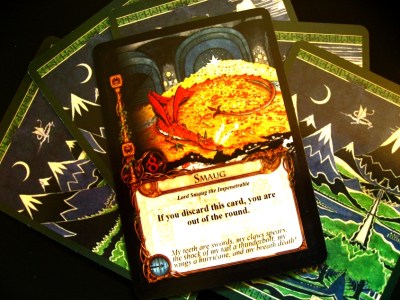
While they were waiting for people to finish their supper, Green, Grey, Red and Violet warmed up with a quick game of Love Letter.  One of the first of the “micro-games” this is a tiny gem, played with just sixteen cards.  Each card has a value (one to eight) and an action; players start with one card and add a second to their hand before playing one of them and enacting the action.  The round goes to the player with the highest value at the end and the player who wins the most rounds wins the game.  This time we were playing with a print-and-play Hobbit version, with players trying to finish with the Smaug card and winning a tiny gold ring if they do.  This time, although he was dealt cards, Grey didn’t really get the chance to play as he was out before his turn each time.  Red, on the other hand, took the game winning two rounds, one more than Violet.

Love Letter
– Image by boardGOATS

With everyone fed we moved onto our “Feature Game”, Orléans.  This is a “bag building” game set in medieval France.  The idea is that each player has a bag and, at the start of the round draws workers from it.  Players then place their workers on it their market which has a maximum of eight spaces, before moving as many as they want onto their personal player board which dictate the actions they can carry out.  Once everyone has placed their pieces, players take it in turns to carry out their actions.  There are a variety actions, but most of them involve taking another worker that is added to the bag along with any workers that have been used.  Thus, the game is mechanically very simple: draw workers from a bag, plan which actions to do and then do them with points awarded at the end of the game.  This simplicity belies the depth of the game and the complexity that comes as a result of combining the different actions though.

Orléans
– Image used with permission of BGG contributor bkunes

In addition to taking a worker, the most actions come with a bonus; some of these help players manage their game, while others give players scoring opportunities.  For example, going to the Castle will give a player an extra “Knight”, but will also enable them to take an extra worker out of the bag on subsequent turns.  Similarly, a trip to the Village to get a “Craftsman” will also yield a technology tile which can be placed in a location and stays there for the rest of the game, acting as a permanent worker.  On the other hand, players who go to the Farm House will get an extra “Farmer” but also an extra resource and an extra “Boatman” comes with money.  Both money and resources score points at the end of the game.  Each of the Character actions has an associated track on the communal player board and the players move one step along these tracks each time they carry out an action; the bonus received on each step is marked just above the track, and in general they increase the further along the track players are.

Orléans
– Image used with permission of BGG contributor jsper

The biggest source of points, however, comes from a combination of travelling around France building Trading Stations, collecting “Citizens” and travelling along the development track.  Travelling can either be carried out along rivers or roads and, if there is no-one else has already built there, they are able to place one of their ten little wooden houses in the town (all using the appropriate actions of course).  Citizens can be acquired by being the first player to fulfil certain requirements (e.g. get the maximum number of Knights or Boatmen).  Along the bottom of the main player board, there is also a Development Track and at intervals Coins and Citizens are available (only the first player get the Citizens though every player gets money).  There are also Status Markers at intervals along the track – these are critical:  at the end of the game, players score points equal to the sum of the number of Trading Stations built and Citizens acquired multiplied by the total number of Status Markers.

Orléans
– Image by boardGOATS

There are a range of ways to move along the Development Track, for example, choosing the University action comes with a Development Point bonus, and the Scriptorium and Town Hall can both also give Development Points, though perhaps less efficiently.  One thing is clear though, this aspect of the game is a bit like collecting Nobles in Lancaster in that players neglect the Development track at their peril.  This is particularly important as as the number of each type of worker is strictly limited, so when they are all gone, that action is no-longer available to any player.  Thus, players who neglect the University action in the early part of the game may find it is no longer available when they want to use it later.  One of the most important aspects of the game for players is controlling the contents of their bag as this dictates what actions they will be able to take.  Since the Development Track is so important, it might be thought that a good way to start is to make repeated visits to the University.  This will fill the player’s bag with Scholars, though, which might not be such a good thing unless players can find another way to use them effectively.

Orléans
– Image by boardGOATS

Scholars are not very useful for travelling or building Trading stations and can really only be used in the Scriptorium or Cloister (to get highly versatile “Monks”) in partnership with another worker, so are of limited use.  This means that players need to vary the actions they take so that their bag remains balanced.  Even so, probability can play tricks and players can end up with a very unrepresentative handful of workers.  It takes a very courageous player to then forfeit actions in the current turn in the knowledge that the workers they need will likely come out next time enabling the player to carry out twice as many actions later.  This approach will cause the player to delay their turn which can be a disadvantage though it can also give them a better chance to plan a larger more complex sequence of actions.

Orléans
– Image by BGG contributor styren

Another way a player can control what they draw from their bag is for a player to ensure their bag stays small.  Players cannot just throw workers away, so once a player has a worker in their bag a player they have only two practical ways of getting rid of them.  The first is to park them on an action they don’t intend to use.  This works well if there is a suitable action available, but is not always possible and each action can only be occupied by one worker at a time, though it does allow players to recover them if necessary.  The other option is the Town Hall action.  Each player has two of these on their player board and, workers placed here are moved to the Beneficial Deeds board where they earn a one-off reward (either money or Development Points) and then remain there for the rest of the game.  There are two  problems with this:  firstly, there are a finite number of spaces on the Beneficial Deeds board, so if they are filled up that is that and secondly, they can never be recovered.

Orléans
– Image used with permission of boardgamephotos

This last point is significant as players can change their strategy during the game and find that they need more of a particular type of worker.  For example, the Village action allows players to collect a black Trader and the bonus is a free choice of a Place Tile.  These are essentially extensions to player’s individual board providing them with extra possible actions, however, they also require workers of a given type.  Thus, adding one of these may provide a use, for example, for all the Scholars that they had previously disposed of.  As the number of workers available is strictly limited, the desired Scholars may also no longer be available rendering the additional Place Tile much less useful than initially thought.  There is a get-out as the Cloister action gives “Monks” which are effectively “wild and can generally be used as a substitute for any other worker.  However, these are also limited in number of course and tend to disappear early so the wise player will try to grab a few of these early to help keep their options open.

Orléans
– Image used with permission of boardgamephotos

This is all very well, but it is almost certain that a well balanced bag will suffer the full consequences of the Plague.  At the start of each of the eighteen rounds, an event tile is drawn at random which takes effect at the end of the round.  There are six different events each of which occurs three times and they variously have good or bad consequences, including additional income, a visit from the tax man and harvest.  Probably the worst of these, however, is the Plague, though the most serious effects of this can be mitigated to some degree with a bit of care and a little sacrifice.  When the Plague comes, it kills one worker drawn at random from each player’s bag, but if they draw one of their key starting workers it survives.  Thus the smart player will try to ensure their most precious pieces don’t go back into their bag during a Plague round, while stuffing it full of their starting workers and hoping probability does the right thing.

Orléans
– Image by boardGOATS

With seven players, we had to play two games, and they could both be the same since we had two copies of Orléans available (one the original Anglo-German version enhanced with fancy pieces and the other the Deluxe US version with different fancy pieces).  Green was the least keen to play Orléans as he had played it several times recently, but as everyone else seemed keen he graciously joined in with Grey, Red and Blue to make up the first group.  Blue had only played the game as a two player game and Grey and Red were completely new, so the game started fairly slowly, but Green showed the way by getting himself an early Knight and using it to go travelling, building Trading Stations as he went.  In contrast, Blue and Red began by taking Craftsmen and using the associated Technologies.  These are effectively permanent workers once placed on the board, which can make them very powerful if gained early enough.  Grey began by taking the University action and progressing along the Development Track and being the first he managed to pick up a few early Citizens.

Orléans
– Image by boardGOATS

Red then moved onto collecting Farmers – not only do these give resources (worth points at the end of the game), but the person who gets ahead in this gets an extra coin at the start of the round (and if someone gets left behind, they lose a coin).  It was about this point that we suddenly ran out of Scholars leaving everyone a long way from where they wanted to be on the Development Track and starting a rules debate as to whether players could continue to take the action for the bonus without getting a worker.  This was a situation that hadn’t arisen in Blue’s two-player games and wasn’t helped by the fact that Burgundy (on the next table) had the first edition of the rules and Blue had the second.  It turned out that Blue had got confused by a rules clarification by the author which explains that although players can’t perform actions that give a worker if they have reached the end of the track or there are no workers left; resources and Technologies on the other hand are a bonus and the actions are still possible if they run out.  This left everyone a little bit stuck, but since Green was the only one who could have really seen it coming and was the most affected having neglected the Development Track for travelling and building Trading Stations, everyone carried on.

Orléans
– Image by boardGOATS

Blue tried to mitigate the problem by taking the Library extension tile which she could use to get two Development Points each time she used it.  Similarly, Grey took the Apothecary extension which enabled him to buy Development Points up to a maximum of three per turn.  By this time we had also run out of Craftsmen, so Blue picked up the Library extension which gave her extra access to the Technologies, though unfortunately for her this was a bit of a waste as it was too late in the game to really make use of it and she ended up only getting the one Technology from it.  As the game progressed into the final stages, everyone suddenly seemed to discover the advantage of the extensions, so Red took the School (so that she could use Scholars as other workers); Grey took the Sacristy (to protect him from the negative effects of events), and Green took the Gunpowder Tower (which expands the market by two and can also be used to place extra workers on the Beneficial Deeds board).  Green was probably the most effective as he was able to use it to pick up extra Development Points and make up for a lot of his shortfall.  In the last turn Blue managed to get her final Sailor and with it an extra Citizen; this proved very effective as it gave her lots of extra points as well as a lot of money and made the game much closer than it would otherwise have been.  It wasn’t quite enough however, and Green won by just four points.

Orléans
– Image by boardGOATS

On the next table, Burgundy, Pine and Violet were engaged in a three player game of Orléans.  Only Burgundy had played it before and he took great pains to explain it very carefully and try to help everyone avoid some of the most gruesome pit-falls early on.  Pine started off like Green, by travelling and building Trading Stations until Burgundy pointed out that he had been neglecting the Development Track.  Meanwhile, Violet shot up the farming track, picking up lots of resources and the extra coin at the start of each round as an added bonus.  Once she had got the maximum number of Farmers, Violet moved onto travelling and collected even more resources, and building the occasional Trading Station when she could.  While all this was going on, Burgundy concentrated on collecting Citizens and building a quality bag. Pine tried stuffing his bag with monks, but they seemed very shy and didn’t seem to want to come out to play when he needed them.  Everyone took an expansion tile:  Burgundy took the Wool Manufacturer early in the game and, as a result and ended up with piles of the stuff, while Violet (like Red on the next table) took the School which enabled her to use Scholars in place of other workers, something she used a lot.

Orléans
– Image by boardGOATS

Pine took the controversial Bathhouse expansion tile which has been the subject of two rules re-writes.  In the first edition of the rules, the player had to place one Farmer on the tile to activate it and then, when it was chosen as an action, the player draws three workers from the bag and chooses two of them to place on appropriate actions which can be used straight away if appropriate.  When the game was first released some players seemed to find this overly powerful, so the designer suggested a modification to the rules such that only two tiles are drawn and only one is kept.  When TMG brought out their edition, they altered the rules again.  In this third version, it is not necessary to place a Farmer to activate the tile, but the additional two workers are drawn from the bag after the others and one is returned, but for this to be useful, there must be sufficient space in the player’s market to hold the extra worker. Each of these has advantages and disadvantages with the requirement for a Farmer to activate it being used to give an extra worker during the round allowing players to leave planning till later in the game and potentially enabling them to use an action twice.  In this game, however, we played by the rules as originally written.

Orléans
– Image by boardGOATS

As the game progressed, everyone struggled a bit on the Development Track and everyone was pretty much dead level.  Burgundy (like Blue on the next table) decided to make a move on the oft-neglected Sailors.  Since the bonus isn’t immediately useful, players tend not to bother about them, however, they provide a lot of money (a total of fourteen for a player who gets everything available) and money equals points at the end of the game.  There is also a Citizen for the player who gets the maximum first, so getting ahead can be quite lucrative, especially as there is often no real competition for it.  Meanwhile, Burgundy was struggling with the Beneficial Deeds board.  He was after the citizens, but as the only one using it, he was struggling and ended up with fewer of some workers than he really wanted.  Eventually Pine and Red gave him a hand, but it was all a bit late in the game for Burgundy.  That said, he had a huge pile of money and finished nearly thirty points ahead of Pine who just sneaked into second place.

Orléans
– Image used with permission of BGG contributor punkin312

Despite the fact that the two games had different numbers of player, they finished at much the same time, with the four-player game actually beginning scoring first.  Even though the number of resources and workers are adjusted the game plays very differently with different numbers:  with fewer players there is more space to move around France and there is a lot less to take on-board.  Red in particular found it very difficult to absorb all the information and options available in the four-player game so perhaps it is easier to grasp what is going on as a two or three player game the first time.  We all struggled to get the workers we wanted at key times.  Monks (especially Pines) appeared to hide in a closet reading their scriptures for most of the game.  Until there was a plague that is, at which time they all came out to find out what all the screaming was for, at which point they were immediately struck down.  That said, Orléans is a great game with a good balance of frustration and a remarkable amount of depth for what are otherwise very simple rules.  Perhaps the biggest issue is the number of tiny rules exceptions (e.g. the first Technology must replace a Farmer), which complicate teaching a bit, but that’s a small criticism in what is otherwise an unusual worker placement game.

Splendor
– Image used with permission of BGG contributor henk.rolleman

Red, Green, Grey and Violet all headed off, leaving Burgundy, Blue and Pine with some three-quarters of an hour to play something.  After a short chat about the future of the “Feature Game”, and how we choose what to play, the group settled down to a quick game of Splendor.  We’ve played this little chip-collecting and card development “engine building” game quite a bit, but we all still seem to quite like it when we are looking for a light filler game.  The idea is that players collect chips to buy gem cards which can, in turn, be used in lieu of chips.  More expensive cards are also worth points and the game end is triggered when one player reaches fifteen points (and the round is completed to give everyone the same number of turns).  Points are also awarded for “nobles” which go to the first player to get a specific combination of gem cards and the player with the most points at the end is the winner.

Splendor
– Image used with permission of BGG contributor henk.rolleman

This time, Blue started really well, and before long was eight points clear of everyone else.  Burgundy couldn’t get what he wanted at the start, so just picked up lots of ruby cards while Pine found that everyone else nicked the cards he was after just before he could get to them.  Maybe it was because Blue relaxed, or maybe it was because she and Pine took their eye off the ball, but suddenly, the cards seemed to fall right for Burgundy and Blue and Pine let him take what he wanted.  Before long, Burgundy had picked up two nobles in very quick succession and needed only one point to end the game (as the last player in the round).  Blue managed to pick up two points but it wasn’t enough and Burgundy pipped her to the final win of the evening by just one point.

Splendor
– Image used with permission of BGG contributor henk.rolleman

Learning Outcome:  Tight games are some of the most interesting.

3rd May 2016

Pine, Magenta, Red and Burgundy were all keen to give the “Feature Game”,  Cheesonomics a go, especially when they saw the eye-catching truckle shaped box.  Pine was especially enthusiastic when he realised that it featured both cheese and goats!  The game itself is a fairly simple, set-collecting and hand management card game based on controlling and manipulating supply and demand of various types of cheese, all seasoned with a sprinkling of dreadful puns.  Players have a hand of five “wedge-shaped” cheese cards each with a colour suit (corresponding to country) and an animal suit (milk type).  On their turn, the active player can carry-out one of three possible actions:  churn, produce or sell.  Churning is a way a player can improve their hand.  First they declare a suit (colour or animal) and everyone else has to pass a matching card to the active player.  Once all the cards are in, the active player chooses five to keep and hands one card back to each player.

Cheesonomics
– Image by boardGOATS

Players can then place a matching set of cards in front of them to produce cheese; the cards must either have the same colour or the same animal.  The last possible action is to sell cheese:  a maximum of three cheese wedges can be sold at any one time and they must all be the same country (colour).  The cheese is valued at the market rate which is calculated from the number of wedges of that colour displayed in the market.  These wedges are different on both sides, so once a sale has been made, one market “share” is turned over (the market is “mooved”), which reduces the value for the next sale.  The clever part of the game is the scoring:  in addition to money made from selling cheese, players also get bonus points at the end of the game.  The players who sold the most of each cheese type (i.e. animal) get extra points equivalent to the number of wedges sold.  So, cheese is sold by colour, but bonus points are awarded for animals.

Cheesonomics
– Image by boardGOATS

Only Blue had played Cheesonomics before and that was a two-player game, so nobody really had a feel for how it would play.  Red went first and churned, followed by Pine who asked for goats.  Burgundy got a good starting hand and was able to produce a large batch of German cheese on his first turn, but otherwise we all got carried away churning cheese.  The problem was that since everyone was churning cards furiously, we were all disrupting each other’s hands which meant we ended up having to churn again on the next turn too.  Eventually, this seemed to dawn on us collectively and we all started producing what we had rather than trying to get the perfect hand first.  With a couple of good hands early on Burgundy was also the first to sell and everyone else struggled to catch up.

Cheesonomics
– Image by boardGOATS

Pine eventually managed to sell some of his goats and Blue, the last to convert cheese to cash, shifted a large batch of Scandinavian (yellow) cheese and take a massive fifteen curds.  It was all way too little and much too late though:  the game suddenly ended and Burgundy’s excellent start coupled with the fact that he’d managed to focus almost solely on both reindeer and yak yielded huge bonuses at the end.  Pine and Red had eventually spotted this and made a concerted effort to catch him, but Burgundy had just got too far ahead and won by two points with Pine in second.

Mijnlieff
– Image used with permission of BGG contributor thepackrat

Black and Purple had eschewed the opportunity to play Cheesonomics and settled down instead to play Mijnlieff (pronounced Mine-Leaf).  This “fancy noughts and crosses” game is played with beautiful little wooden tiles on a four by four wooden board.  the aim of the game is to form lines of three, but since there are different types of pieces and your opponent controlling where you can play it is much more strategic.  Each Player has eight pieces with two each of four different symbols where the different pieces dictate where the other player can put their next piece.  For example, when a Greek cross (or “+” symbol) is played, the next player must place his piece on an empty square in an orthogonal line from the piece just played.  Similarly, playing a saltire (or “×” symbol) forces the next player to place his piece in a diagonal line from the piece just played.

Mijnlieff
– Image used with permission of BGG contributor thepackrat

Black managed to get a line of three, but Purple took the game with two lines of three and one of four giving her a total of four points to Black’s one.  Since the supposedly quick little “Feature Game” was still going, Black and Purple moved onto another game we know quite well, Splendor.  This is a game of chip-collecting and card development where players collect chips to buy gem cards which can then be used in lieu of chips.  More expensive cards are also worth points and the game end is triggered when one player reaches fifteen points and the round is completed to give everyone the same number of turns.  Points are also awarded for “nobles” which go to the first player to get a specific combination of gem cards and the player with the most points at the end is the winner.

Splendor
– Image used with permission of BGG contributor henk.rolleman

The game was incredibly tight, but when Black was declared the winner, Purple looked slightly crest-fallen.  On closer inspection, they realised that they’d missed scoring one of her nobles.  Purple had managed to take two of the three available picking up both Isabel of Castille (awarded for four each of opals and diamonds) and Anne of Brittany (awarded for three each of emeralds, sapphires and diamonds).  This left them on sixteen all and a draw, though on closer inspection there is a tie-breaker, so arguably Black took it as he had the fewest cards in his display.

Splendor
– Image used with permission of BGG contributor henk.rolleman

Since Cheesonomics had finally come to an end as well, we had a lot of options on what to play next.  Half the group weren’t staying late, so we decided to play something short as a group before splitting up again into two groups (one of “light-weights” and one of “dirty late-night stop-outs”).  Looking for something to play seven, our choices were limited, and as is often the case in our group, we settled on our old favourite, 6 Nimmt!.  In the first round Black and Magenta were vying for the wooden spoon taking a total of twenty-four nimmts each.  Unusually, Burgundy, though high scoring, was some way behind the race for the bottom, only taking fifteen points.  Both Red and Blue kept a clean sheet so the question was which of them were going to be able to keep their score down in the second round too.  In the end though, both quickly started picking up cards and it was Purple who took the glory, finishing with just three nimmts over the two rounds, her second win of the evening (and only robbed of a third by a tie-breaker nobody knew existed).

6 Nimmt
– Image by boardGOATS

With the fun filler over, the “light-weights” looked for a similarly light game to finish, but in the end, settled on Splendor, as it was still out and Magenta and Red were very familiar with it.  This game was a very difficult one as all the cards in the second row needed lots of sapphires which were scarce throughout.  Magenta tried to work round the problem by collecting nobles, but everyone struggled.  For several rounds, Red was very close to the fifteen points needed to end the game and Magenta had four points available on a reserved card, but could not get the last ruby to buy it.  In the end, but it was Pine, who was new to the game, who finally put everyone out of their misery, ending the game with seventeen points, three points clear of Red.

Splendor
– Image used with permission of BGG contributor henk.rolleman

On the neighbouring table, after a short debate, the “late-night stop-outs” settled on Isle of Skye: From Chieftain to King as their longer game.  We’ve played it a couple of times before and it is hugely popular with the group.  Borrowing heavily from tile-laying games like Carcassonne, Isle of Skye is a much deeper game without adding an awful lot to the rules.  The idea is that players draw three tiles from a bag and and then secretly choose one to discard and set prices for the other two.  This is done by placing the tiles in front of a screen and a discard token and money for the player’s stash behind.  The money remains in place for the duration of the round, unless the corresponding tile is purchased by another player.  This mechanism is very clever as if nobody else wants the tile, then the player uses the money to purchase it themselves.  Thus, it is critically important to correctly evaluate the worth of the tile, depending on whether it is most desirable to sell it or keep it.

Isle of Skye: From Chieftain to King
– Image used with permission of BGG contributor henk.rolleman

The other clever part of the game is the scoring:  This is mostly carried out at the end of each of the six rounds.  At the start of the game, four scoring tiles are drawn at random and these are used in different combinations at the end of the rounds in such a way that each appears a total of three times, but only one is used in the first round while three are used in the last.  We included the the extra tiles from the 2015 Brettspiel Advent Calendar in the draw mix and one of them  came up. The four tiles were:  points for animals next to farms (A), extra scroll scoring from the Advent Calendar (B), points for each tile with a road that is connected to a castle (C) and points for each enclosed region (D).  Inevitably, everyone started out desperate for animals and farms, but since these scored in rounds one, three and five, all of a sudden they fell out of favour.

Isle Of Skye: From Chieftain to King
– Image by boardGOATS

Despite having loads of cash, Burgundy really struggled to get the tiles he wanted particularly as everyone else kept buying them off him.  In contrast, Blue didn’t do too badly for tiles, but always seemed to be running out of money.  This was exacerbated by the fact that she didn’t get any of the “catch-up cash” given out from the start of round three.  It is only the number of players in front of them that dictates how much money players get (not how far behind they lag), but the amount can really add up: a player who is consistently at the back in a four player game will net an extra thirty sovereigns over the course of the game compared with a player who leads throughout.  Theoretically, the difference in position between the first and last player could remain just one point throughout, so there is an art to being “just behind”, in the same way as there is an art to being at the back in Colosseum (which was our “Feature Gamelast time).  Clearly this time Burgundy had the knack, and Blue didn’t.

Isle of Skye: From Chieftain to King
– Image used with permission of BGG contributor henk.rolleman

While Burgundy and Blue were struggling with their respective finance issues, Purple quietly plugged away collecting barrels and brochs, while Black ended up with ships and when the corresponding scrolls turned up, they looked to be well placed, until Black ran out of money and a critical tile was taken from him in the final round.  Despite her lack of money, however, Blue didn’t over-reach herself and managed to enclose her scrolls early giving her extra points at the end, but also for the Brettspiel Advent Calendar scoring tile during the game.  Nearly bankrupting herself in the early rounds for those animals now proved worth it as she raked in the points for the scrolls she had enclosed.  Enclosing scrolls was the key in this game as the other player to succeed in this area was Purple who finished a highly creditable second after a barn-storming evening.

Isle of Skye: From Chieftain to King
– Image used with permission of BGG contributor henk.rolleman

We had a little over half an hour left, so we decided we could fit in one last game.  We couldn’t afford to spend too long thinking about it.  Since Black expressed an interest in Karuba as he’d heard good things about it and Blue assured everyone that it wouldn’t take the forty minutes claimed on the box, we decided to give it a go.  This is a game that Blue and Pink bought at Essen last year and is very similar to Das Labyrinth des Pharao which they picked up at the same time on behalf of Black and Purple.  In the event, Karuba did take just about forty minutes, but that included setting up and teaching.  The game is a bit of a cross between bingo and a tile-laying solitaire.  The idea is that every player has the same number of numbered tiles which the players simultaneously place when the number is called.  Unlike Das Labyrinth des Pharao, the tiles the orientation is fixed, which narrows down the number of possibilities and helps to reduce “analysis paralysis”.  Both games are loosely themed with explorers, but in Karuba they are crossing the jungle to find treasure rather than exploring a pyramid.

Karuba
– Image used with permission of BGG contributor punkin312

Each player has set of four coloured explorer meeples and matching coloured pyramids, with the aim being to get the explorers to the corresponding pyramids by laying tiles to make a path.  Everyone begins with the same layout (chosen collectively) and players score points for getting their meeples to their matching temples first.  Everyone draws the tiles in the same order, since the “caller” (Blue, in this case), draws their tiles at random and calls out the number for everyone else to play too.  Once the number has been called, each player can either place the tile on the board or discard it and move an explorer along a path where the distance corresponds to the number of exits on the tile discarded (i.e. two, three or four squares).  Some tiles have crystals or gold nuggets next to the path and an explorer who stops on the tile gets to pick up the treasure which are worth points at the end of the game.

Karuba
– Image used with permission of BGG contributor henk.rolleman

Our explorers all ended up a long way from their pyramids, so sharing a common route was essential and it was just the logistics of how to do it that everyone had to work out.  With time at a bit of a premium, Blue didn’t hang about and kept the tile drawing moving quickly.  Burgundy got a bit carried away picking up crystals before getting his explorers in a tangle (the paths are too narrow for meeples to pass each other).  Purple, for whom spacial awareness does not come naturally, unfortunately managed to completely cut off one of her explorers and Black got into a bit of a tangle too before he managed to extricate himself from the mess and bring them home safely.  Blue, the only one to have experience with the game neglected picking up crystals and got three of her explorers home first netting an unassailable fifteen points, in a game that definitely benefits from experience of how to balance crystals and getting to temples.  While packing up, we discussed the game and the fact that it is likely to be one of the nominees for the Spiel des Jahres award this year given the lack of other good competition.

Karuba
– Image used with permission of
BGG contributor henk.rolleman

Learning Outcome:  GOATS like cheese, but they like whisky more…

8th March 2016

While Burgundy finished his ham, egg ‘n’ chips, the rest of us continued our political discussions from two weeks ago.  This time we discussed the length and timing of the school day, the inevitability of double-parent working households, the cost of childcare and whether or not parents should be paid to stay at home and look after their little ones.  We were expecting Black and Purple, but eventually, someone suggested playing a quick game, to which Blue commented that you could guarantee that they would arrive just as we finished setting up.  A brief debate about what to play followed before we settled on one of our old favourites, Walk the Plank!, a simple pirate themed “programming” game where players try to push each other along a plank and off the ship.

Walk thePlank!
– Image by boardGOATS

Since everyone had played Colt Express fairly recently, the rules were quick to reprise:  everyone simultaneously chooses three cards and the order in which they are going to play them, placing them face-down; starting with the first player, players then take it in turns to play one card until everyone has played all three.  With lots of aggressive options the game is always quick and fun, and the last pirate standing is the winner.  We had just finished the summary when Black and Purple arrived, but since it is only a short game we carried on.  Blue started the game by immediately shortening the plank and before long there was no plank left (a situation we allow through a “house rule”).  When Green Green played a “Drag to Sea) with only one pirate left which was perched precariously on the edge of the boat, it was inevitable that he would take Blue’s only pirate with him for company, leaving everyone else with two pirates each.

Walk the Plank!
– Image by boardGOATS

It didn’t last, however, and before long Magenta’s last pirate received the Big E from Burgundy and joined the others watching the goings on from Davy Jones’ Locker.  With all the carnage in the first round (eleven pirates down in just fifteen cards), there were just two players left with two pirates each all on the ship.  Although the rules say the last two players share the victory this seems strangely friendly end for an otherwise savage little game, so we always play to the death. The second round began a little cagily with both players extending the plank, but then Burgundy was paid out for his treachery to Magenta when, in a moment of stupidity, one of his two remaining pirates dragged his pal off the end of the plank, leaving Pine the clear victor with two pirates still standing.  It was an exceptionally short game thanks to the early vindictiveness, but in truth, it is a much more fun game when it is played that way.

Mijnlieff
– Image used with permission of BGG contributor thepackrat

Despite the compressed nature of Walk the Plank!, Black and Purple still managed to squeeze in a little two-player abstract game called Mijnlieff (pronounced “Mine-Leaf”).  This is a beautiful little game made out of wood and designed by the designer of Dodekka, Andy Hopwood (Hopwood Games).  Black described the game as “fancy Noughts and Crosses” since the aim of the game is to form lines of three, but since there are different types of pieces and your opponent controlling where you can play it is much more strategic.  The game is played by placing wooden tiles on a four by four board.  Each Player has eight pieces with two each of four different symbols where the different pieces dictate where the other player can put their next piece.  For example, when a Greek cross (or “+” symbol) is played, the next player must place his piece on an empty square in an orthogonal line from the piece just played.  Similarly, playing a saltire (or “×” symbol) forces the next player to place his piece in a diagonal line from the piece just played.

Mijnlieff
– Image used with permission of BGG contributor thepackrat

Game play is really quick, so much so that despite Walk the Plank! finishing in record time, with Purple taking it by three points to Black’s two.  With everyone finished, we had a quick show of hands as to who would like to play the “Feature Game”, Kingdom Builder.  When seven hands went up, Green asked who was very keen to play it and nobody looked interested.  The most enthusiastic was Burgundy who had played it before, so Magenta swapped seats with Green to make a foursome with Blue and Pine.  On the face of it, Kingdom Builder is also a simple game, played by placing small wooden huts (Settlements) on a board made up of different terrains laid out using a fine hexagonal grid.

Kingdom Builder
– Image used with permission of BGG contributor msaari

At the start of the game, each player is dealt a terrain card and on their turn, they have to place three settlements on that terrain type.  As far as possible, the Settlements must be adjacent.  At the end of their turn, the player discards their card and draws a replacement.  Play proceeds in clockwise order until one player has run out of Settlements, then the round is completed and scores are tallied up.  While these are the basic rules, there are also specific rules that change for each game, and since the board is made up of four modules chosen at random from a set of eight, the number of possible layouts is vast. Each module board also has three special hexes on it: two with a gold scroll-work border (Locations) and one with a silver scroll-work border (Castles).  The Castles give points for players with an adjacent building at the end of the game while the Locations give an in-game benefit.

Kingdom Builder
– Image used with permission of BGG contributor SpaceTrucker

At the start of the game, each Location has two hexagonal chits on it which are taken by the first two players to build next to it.  These chits give players extra actions that they can take on their turn, but the nature of the Location and corresponding action is dependent on the boards chosen.  In this game we had the Tower, the Tavern, the Barn and the Paddock.  These allowed players to add an extra Settlement along the edge of the board; add an extra Settlement to where a player had a row of three or more Settlements; move an existing Settlement to a space matching the active player’s current terrain tile, and move one Settlement two spaces in a line from its current position (i.e. jump).

Kingdom Builder
– Image used with permission of BGG contributor kilroy_locke

Points are awarded at the end based on the rules cards and a subset of three are drawn from a total of ten at the start of the game.  For this game, we draw the Knights, Discoverers and Citizens cards which gave two points for each settlement a player built in the horizontal row where they had the most Settlements; one point for each horizontal row in which they had at least one settlement, and one point for every two Settlements in each player’s largest settlement area.  Thus, to score one well, you needed a horizontal line, a vertical line and a clump, all with a limited number of huts.  To make the problem even more challenging the board layout had a large mountain range across the middle with a couple of awkwardly positioned rivers.  We all blamed Burgundy for his awful “choice” of boards and layout…

Kingdom Builder
– Image by BGG contributor pphh

Although the rules are prima facie quite simple we got into a bit of a tangle with the modifications caused by the Locations.  Blue kept forgetting that the Tower and the Barn were subject to adjacency restrictions and Pine struggled to see the point of the Barn at all.  Blue made an appalling start, while Burgundy’s best laid plans were stymied first by Blue and then by Magenta.  Meanwhile, Pine had got two groups of Settlements and was trying to build a vertical ribbon development to connect the two.  As Burgundy’s supply of Settlements dwindled faster than anyone else’s, Pine desperately needed to draw a desert terrain card, but kept drawing woodland cards which were nearly useless for him.  In the final round everyone tried to make the best of their limited number of remaining Settlements before totalling up the scores.  It was very, very close, but Blue finished with a round fifty, just two points ahead of Magenta, with Pine and Burgundy both within two points of her.

Kingdom Builder
– Image by boardGOATS

Kingdom Builder isn’t a long game, so Black, Green and Purple decided to opt for something short and light so settled on another old favourite, Splendor.  This is a fairly simple card game with a very loose gem merchant theme.  On their turn, a player can either collect chips (gems), or use chips to buy gem cards.  Most of the gem cards are effectively just a permanent source of chips, i.e. can be used to buy other cards, but the higher value ones also provide victory points.  Nobles can also give players points and these are claimed by the first player to collect certain combinations of gem cards (e.g. three each of onyx, sapphire and diamond).  The game finishes at the end of the round when one player gets to fifteen points, and the winner is the person with the most points.

Splendor
– Image used with permission of BGG contributor henk.rolleman

Three of the four randomly selected Noble cards required a set of three green emerald cards as part of their requirements, with differing selections of the other colours; white diamonds, red rubies, blue sapphires and black onyx. The fourth Noble required four cards of each white diamonds and black obsidian.  With the first card selections it was clear that both Black and Green had studied the distribution of cards required to win Nobles tiles and were fighting hard to get the green emeralds that were available. Unfortunately, the number available was quite small, but nothing compared to the scarcity of rubies. The first of these was nabbed by Purple and Green, who failed to get the second was left unable to get the remaining one which was an expensive, high scoring, level three card.  Early on Black marked his intentions by reserving a level three (taking the bonus “wild” gold chip).  Meanwhile Purple was busy building a large supply of diamonds while Green concentrated on the low level emeralds and sapphires. With half a dozen cards each, scores were low and close, but quick glance across to Kingdom Builder showed they were still going through the rules…

Splendor
– Image used with permission of BGG contributor henk.rolleman

Black reserved another high value card, Purple had managed a large haul of diamonds, both cards and chips and green had got his three green emeralds, now joined with three sapphires. Rubies still refused to come up with any kind of regularity which meant that players priorities usually changed quickly when one did come up.  Green was the first to obtain a noble when he got his third diamond card.  He did this with mostly non-scoring cards and so this only put his score on a par with the others.  The game entered a new tenser phase when Green quickly picked up his second noble after taking a third ruby card, though even he couldn’t quite believe he had managed to get three of them.  Black finally paid up for one of his put away cards and now the points were close to the end.

Splendor
– Image used with permission of BGG contributor henk.rolleman

Black was just two points from getting the fifteen needed to trigger the end-game, and a study of the available cards showed Green that Black could get it with a diamond card on his next turn. Green persuaded Purple that she needed to take the diamond card using her gold chip (she couldn’t afford it otherwise) as she would not get another go if she didn’t and could not afford the high value one she was saving for anyhow.  Luckily the replacement card was not one which Black could afford so he had to take chips instead pushing the game into another round.  Green grabbed a high value level three card taking the bonus gold chip (giving him all he needed to buy it on his next turn) and Purple bought her high value card. Black bought his last reserved card, which put him on sixteen points giving Green one last turn. With a flourish he paid for his reserved card card which gave him three points and claimed the final noble for another three, giving him a winning total of seventeen points.  It was a few moments, before Green noticed and the others didn’t spot it at all, but Green’s last card was not a black onyx, but a fourth ruby – he had not got the noble after all.  Perhaps it was a touch of colour blindness from the excitement of the end-game, but Black was the winner after all with Green and Purple finishing in joint second.

Splendor
– Image used with permission of BGG contributor henk.rolleman

Kingdom Builder should only take thirty to forty minutes, but for some reason it took nearly twice that, so Green, Black and Purple moved on to play Tobago, a really pretty game in which the players possess different parts of treasure maps and try to use narrow down the possible locations faster than everyone else in order get to the treasure first.  The idea is that on their turn, players can either can either play a card on one of the four Treasure Maps or move their little 4×4 truck up to three “legs” (a leg being anywhere within the current terrain, or a move from one terrain to another).  Playing a card narrows down the number of possible places that the Treasure could be, for example, “in the jungle”, “not next to a hut” or “in sight of a statue” etc..  Each clue card placed must narrow down the possible locations by at least one hex, cannot contradict a previous Clue, and cannot eliminate all possible locations for the Treasure.  Eventually there will only be one possible location, after which, the first player to get there retrieves the Treasure.

Tobago
– Image used with permission of BGG contributor Lord Warlock

When a Treasure is retrieved, everyone who helped narrow down the treasure location by playing a card gets a share proportional to the amount of effort they put in.  Initially, each player gets a Treasure card for each clue card they contributed.  They look at the card(s) secretly before they are shuffled together with one drawn blindly from the deck. A card is then drawn at random and, starting with the player who found the Treasure, it is offered to each player in turn until someone takes it.  The order corresponds to the order they made their contribution, so some players may have made multiple contributions and therefore may get multiple chances to take a Treasure card.  Once a player has taken a treasure, that contribution is considered fulfilled.  The Treasure varies in value, but there are also two “Cursed Treasure” cards (also known as “Baad Treasure”).  If one of these is turned over, the remaining Treasure cards are not distributed and anyone left in loses an amulet (if they have no Amulet, they lose their most valuable Treasure card instead).  The appearance of Amulets is triggered every time a Treasure has been found and they can be collected by players moving their 4×4.  The player with the most Treasure at the end of the game wins.

Tobago
– Image used with permission of BGG contributor Toynan

Green’s strategy was to contribute as many Clues as possible, Black went for a drive to dig up treasure and Purple complained of having a terrible set of clue cards (to be fair she had a lot of “not in …” cards, which did prove difficult to place on the “in play” Treasure maps, but for some reason she was reluctant to start a new one). It was a slow start, but after the first treasure had been found and the Amulets started to appear we got into our stride a little more.  About half way through the game, Green checked the rules on what to do with the discarded Clue cards and instead found a small rule which stated that the one who takes the last Treasure card immediately places the first Clue on the now empty treasure “map”. We felt that this might have speeded the game up a little and implemented the rule.

Tobago
– Image used with permission of BGG contributor Lord Warlock

Green and Purple were the first casualties of the “Baad Treasure”. They both had Amulets, but annoyingly a six point and a five point treasure were both lost.  The second time round we were all affected and everyone lost an Amulet, but the lost cards were not high value so it felt less of a loss somehow.  With only three treasure cards left in the deck (game ends when they are exhausted) placing Clues was quite tricky. Only one of the treasures would be found, and placing your clues on the others would result in nothing, but which one would be “found” first?  In the end it was a treasure only Green and Purple benefited from.  In the final scoring, Purple came out the richest finishing with thirty-eight, and Black came in second just four behind. So for all her complaining about her hand, she had made it work to her advantage. It also looked like Green’s strategy to spread clues thinly across all Treasure maps and let others do the actual finding, had failed as it made him almost certain to lose out when the “Baad Treasures” came up.

Tobago
– Image used with permission of BGG contributor jayboy

By the time Kingdom Builder finally finished, Tobago was well under way, with no sign of finishing soon.  Magenta took an early night, so while Pine was at the bar, Burgundy and Blue discussed the options.  Given the time available, it was a toss-up between two games that Burgundy said he couldn’t get the hang of: Isle of Skye and Blueprints. Blue gave him the choice and in the end, he chose the latter as we’d not played it for a while.  This is a clever little building game where players are architects who must use different coloured dice (representing different materials) to build different structures from their blueprints.  The idea is that on their turn, each player chooses a die from the central pool and adds it to their building.  Each die must have the same value or higher than any it is placed on top of.  At the end of their turn, they roll a replacement from a bag, thus replenishing the dice supply.  Once each player has placed six dice, their building is evaluate depending on the colour of the dice they used, how many they are and their position etc.  For example, black dice score more if they are placed high up, whereas orange dice score more if they are surrounded by lots of other dice.

Blueprints
– Image used with permission of BGG contributor kilroy_locke

The person with the best building wins the round winning the Gold Award which is worth three points at the end of the game.  Points are also available for Silver and (depending on the number of players) Bronze.  There are also Special Awards (which are worth two points at the end) which go to players who fulfil other specific criteria, such using five dice out of the six in the same colour or having a building with a height of five or more.  In the first round, Burgundy demonstrated exactly how he couldn’t get the hang of the game, but failing to make the Special Award he was trying for and also not scoring highly enough to take either the Gold or Silver awards.  The second round was notable for the number of black fours that were rolled, and how, despite that, Pine somehow managed to take the Special Award for using four dice with the same number, but with fives while Blue failed to do the same with fours.  Going into the last round, both Burgundy and Pine tried to collect green dice, leaving Blue the pick of the rest, her third Gold Award, second Special Award and a clear win with thirteen points.

Blueprints
– Image used with permission of BGG contributor dotKeller

With the evening coming to a close, there was just time for a quick filler.  Black commented that there was always “the old favourite” and since Pine claimed he’d not actually played it (though the logbook proved he had), there was no opposition to a quick closing game of 6 Nimmt!.  We reminded Pine of the rules:  players simultaneously choose a card, then simultaneously reveal them before playing them in ascending order placing each on on the highest card that is lower than the card being played.  When the sixth card is added to a row, the first five are taken and the number of heads contributes to the player’s score, lowest score wins.  The thing that makes the game so compelling is that any grip is incredibly tenuous and once it begins to go wrong it tends to escalate horribly.  In the first round, Green seemed to pick up everything and in the second it was Burgundy’s turn.  Black and Pine had two mediocre rounds and Purple made the only clean sweep.  It was Blue who got lucky this time though with two very good rounds totaling just two and four, so she took the game with a combined total of six, slightly ahead of Purple with twelve.

6 Nimmt
– Image by boardGOATS

We tend to play a variant over two rounds with half the deck in each round and not resetting the table in between.  This led to a bit of discussion as to why things tend to cascade.  The problem is that there are always some rows that get blocked off as they pick up a couple of high scoring cards as well as a finishing with a high face value card.  This means the chance of a player being forced to add something to (and take the row) is small, and nobody will take it voluntarily as the hit is too great.  In our game, three rows got blocked off early on in the first round which meant we spent nearly the whole game playing cards on one row.  The problem is that once a player has used, say, a low card that card is no-longer available, so the player is likely to be in the same position next time  too.  In the case of a six player game, things are exacerbated because it is the sixth card that triggers the pick up.  Thus, in our game, the first first player would take the singleton, leaving the next four players to add to the row and the player with the highest card to take the row and no better off for next time.  That doesn’t really detract from the fun though and it is still wonderfully stressful in a good way, so justifiably one of our favourite fillers.

6 Nimmt
– Image by boardGOATS

Learning Outcomes:  Sometimes some games just take much longer than expected.

21st Movember 2015 @ “The Mix”

Our second drop in gaming session at The Mix in Wantage was once again, a great success.   As last time, it started very quietly, this time with Green fighting to blow up balloons and Pink and Blue struggling to get the ends to meet when building a nice PitchCar track.  Before long, “Grandma” had arrived with her young grandson in tow and they began with a game of the very intimidating Boom Boom Balloon.  They then moved onto Toc Toc Woodman (aka Click Clack Lumberjack), while another couple began a rather intense game of Carcassone: Winter Edition.

Toc Toc Woodman
– Image used with permission of BGG contributor adamfeldner
and bgpov.com

Meanwhile, PitchCar was attracting the eye of visitors as usual, and other people got engaged in games of Dobble, Roar-a-Saurus, Billy Biber (aka Log Jam) and Maxi Bamboleo.  Before long, lunch beckoned and people began to drift off.  The couple playing Carcassonne asked about other, similar games and so out came Ticket to Ride: Europe and Nordic Countries which they liked the look of.  By this time, Grandma and Grandson had moved onto Escape: The Curse of the Temple, with Green (who had never played it before) and Pink making up the foursome.  After losing the first few games, Pink took a break and was replaced by Blue who had played it a lot and suggested they worked in two pairs.  Despite her experience, it was Blue who was last to the exit and seemed completely incapable of rolling the two keys necessary.  As the stress levels rose, she eventually succeeded with a few seconds to spare.

Escape: The Curse of the Temple
– Image used with permission of BGG contributor rassilonsghost

The session finished with Grandma and Grandson playing a final quick game of PitchCar before going swimming.  As it had quietened down, Blue, Green and Pink persuaded the last of the helpers to participate in a quick game of Splendor, which Green won, but with a very creditable second place for the shyly reluctant new player.  Then it was time to tidy up and go home.  As Green headed off in the car, he happened to catch JACKtivities on the radio, advertising a “Beyond Monopoly session at The Mix in Wantage, with boardGOATS“. “Sounds good,” he thought, “Maybe I should go along…”

Splendor
– Image used with permission of BGG contributor TrashcanCity

25th August 2015

It was a very quiet night, so we decided to leave the feature game for another occasion and started with the gorgeously produced Helios instead. This was a new one for all of us, so we had the inevitable long set-up and rules reading – it sounded both complicated and simple.  Players take the role of spiritual Guardians, tasked with forging and evolving the cultures assigned to them by Ahau, the Sun God. During the game, Players will collect resources, explore lands and build temples and other buildings.

Helios
– Image used with permission of BGG contributor punkin312

The power of the sun drives everything in the game as players try to build temples, expand cities, and generally make their civilization flourish.  Players can also harness other realms and use their power and invention to further develop their culture.  Development can only succeed, however, with sufficient raw materials which are limited and become increasingly expensive as players build their temple.  The game’s currency are Glass mana-stones, which can be used to recruit people.  Victory Points are awarded for buildings, the number of recruits, the collected energy (or mana).  Additionally, as the game progresses, the sun moves round the player’s board and bonuses are awarded depending on the way the civilisation has evolved.  The winner is the Guardian that has the most advanced culture after a given number of rounds (i.e. the player with the most Victory Points) and receives full blessing from Ahau.

Helios
– Image used with permission of BGG contributor punkin312

Every part of the game was simple, but how much we had to do and the best order to do them in seemed complicated.  We eventually found it flowed quite well, however, and we found the game easier to follow than we expected.  This did not stop the confusion over what strategies to employ and which actions were best though.  Throughout the game no-one had any inkling as to who had worked it out best and was in the lead.  Purple built many tiles and buildings, while Black eventually went for a small island with temples and thus a fast moving sun to gain the regular rotation points.

Helios
– Image used with permission of BGG contributor duchamp

Burgundy went for a mana strategy from the beginning, giving him the choice of characters.  Inevitably, he took the Treasurer which gave him extra points for remaining mana and resources at the end of the game. meanwhile, Green went for a building strategy as he gained the Architect which gave him extra points for every building and temple. This character alone, netted him twenty-seven points.  This gave a total of one hundred and seven points, just three ahead of Burgundy and six clear of Black.  Everyone was amazed at how close the final results were, and as we put the game away, we decided that we liked it, but had yet to really work out how best to approach it.  We’re all looking forward to an interesting second game.

Helios
– Image used with permission of BGG contributor punkin312

Despite the box claiming it should take less than an hour, we had taken the best part of two hours excluding set-up and rules reading!  So, we decided to play a shorter game next that everyone knew, and chose Splendor.  This is an engine building game that we’ve played quite a bit since last year when it received a Spiel des Jahres nomination.  The idea is very simple – on their turn players can either take chips, or use chips to buy cards from the display drawn from three different decks.  The cards in the display can then be used to help buy other cards and sometimes also yield victory points.  The winner is the player with the most points at the end of the round when one player reaches fourteen.

Splendor
– Image by BGG contributor duchamp

This was an intense game with close scores all the way to the end and amazingly the deck feeding the first row completely exhausted.  In the end, it was a close contest between Black and Burgundy as to who could close out the last few points.  Black just didn’t have enough in his last turn to buy anything, mostly because Green had nabbed the card he wanted.  So Burgundy took the spoils to finish the night.  Just the two games played, but both were close-fought and interesting.

Splendor
– Image used with permission of BGG contributor punkin312

Learning outcome:  Always allow at least two hours for a new game, whatever the box might say!