Tag Archives: Ticket to Ride: San Francisco

14th May 2024

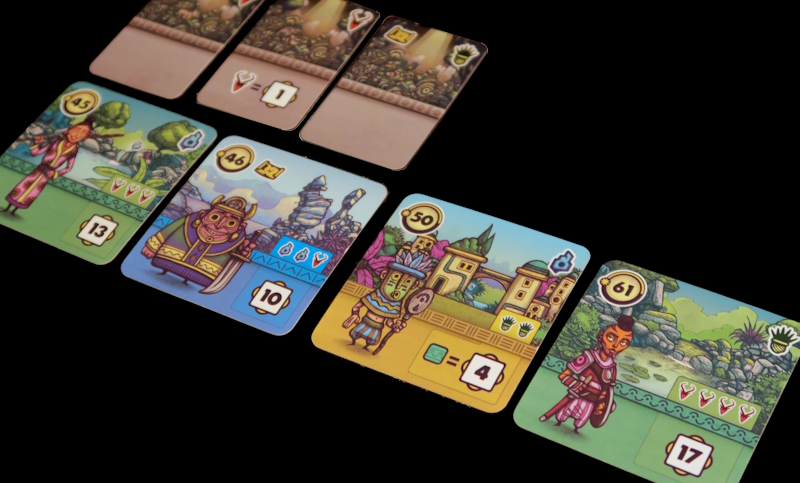
Pine was already sitting outside marking his birthday, when Blue and and Pink rocked up and ordered their tea.  Jade and Sapphire soon joined the group, ferried by newcomer, Tangerine who not only brought gamers, but also his shiny new copy of the “Feature Game“, Faraway, which he had won at Gweeplefest a few days earlier.  This game is has been a bit of a hidden gem whose popularity is rapidly gaining traction as more people play it.  It is quite a simple game, but one which really messes with the head.  Some of the group played it a few weeks back and it was so popular that it seemed a good idea to Feature it so more of the group could try it.
Faraway
– Image by boardGOATS

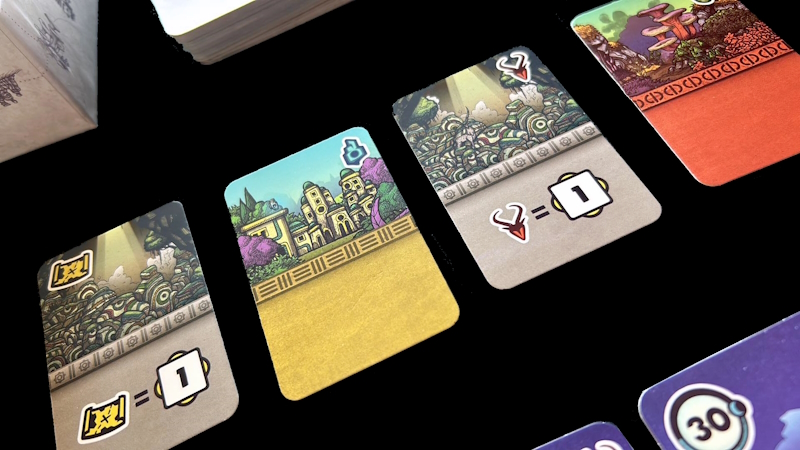
The story is that players are exploring the mysterious land of Alula in search of its secrets, meeting its inhabitants and listing its wonders in order to gain more fame than everyone else.  In practice, however, it is a fairly simple little card game with a market with a trick-taking type element.  Players simultaneously chose one of the numbered cards from their hand and starting with the the player that played the lowest card (similar to 6 Nimmt! or Kingdomino), everyone takes it in turns to choose one from the market to add to their hand.  Players then simultaneously choose another card, and again, choose one to add to their hand.  The game ends after everyone has played a total of eight cards, and then everyone scores.
Faraway
– Image by boardGOATS

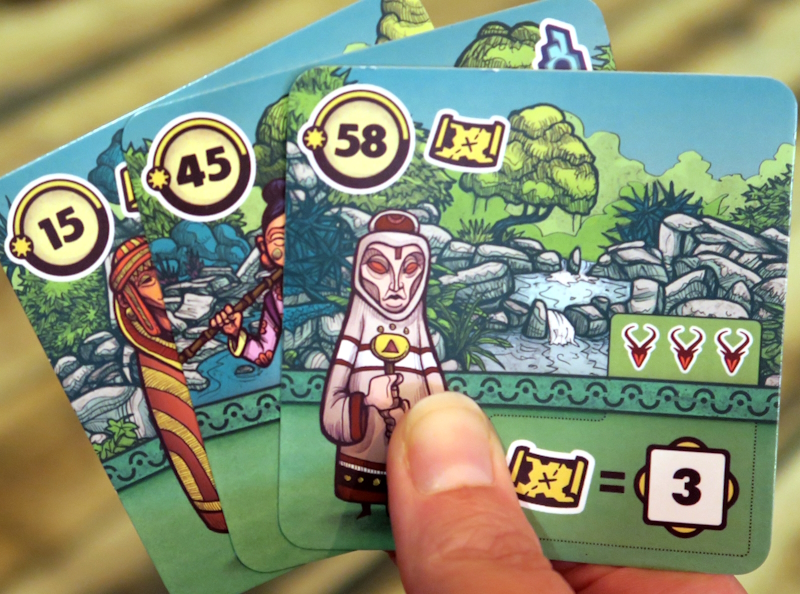
There are a couple of very clever things about the game.  Firstly, if the card someone plays is numbered higher than their previous card, they take a card from the Sanctuary deck.  These cards a really important because of the second clever element, the scoring.  Each card has a number and a colour, while some also have resources and some have also have scoring conditions.  The scoring is clever because the cards are played left to right, but the scoring is from right to left—at first glance, this looks like it makes things easy, because early in the game players find out what they need to get points and can then focus on getting the resources they need as the game progresses.

Faraway
– Image by boardGOATS

However, the scoring is tensioned against the ability to get Sanctuary bonus cards. This is because the scoring cards are generally those that have a higher number and are therefore the ones players want to play first (following them with resource cards which generally have a lower face value).  To get a Sanctuary card though, players have to play a higher value card than the immediately preceding one, and Sanctuary cards are very useful because they are eligible for scoring regardless of when they are played.  Thus, trying to play cards increasing and decreasing in value to score the most points backwards really messes with players’ heads!

Faraway
– Image by boardGOATS

Tangerine, started one game and explained the rules to half the group, comprising Plum, Byzantium, Blue, Pink and Pine, while he ate his supper.  Meanwhile, Jade and Sapphire took their copy to a neighbouring table where they were joined by Teal, Black and Purple, and started a second game.  Although it is a very simple game, the backwards forwards up and down thing got to several of the group at various points, including Blue (who lost the ability to count), Teal (who did all his scoring forwards instead of backwards), Pine (who struggled with the how maps worked) and Purple (who couldn’t get her head round the reverse scoring).  Jade’s game was the first to finish, with Sapphire beating jade into second place by a single point and Black taking third.
Faraway
– Image by boardGOATS

There was a general appreciation of the art and the mechanism though the theme was a bit invisible.  There had been such confusion, however, that the group decided to “do a Lime” and play again.  This time, the finishing order was exactly the same, but the game wasn’t as close with Sapphire’s eighty-two being the highest score of the evening.  On the other table, Plum was the victor with seventy, followed by Tangerine and Byzantium in third.  This game had taken a little longer, and with six, there is a lot of downtime, so although everyone had enjoyed it, the group decided to split into two groups of three.  Blue tempted Plum and Sapphire to a game of Calico with cries of “Kittens!”, while Pink and Pine lured Tangerine into a game of Ticket to Ride: San Francisco.

Ticket to Ride: San Francisco
– Image by boardGOATS

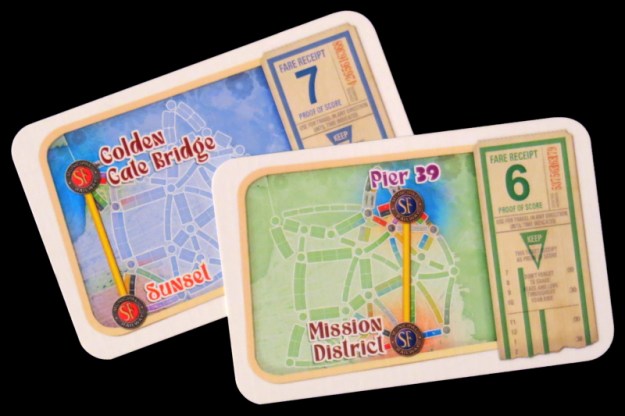
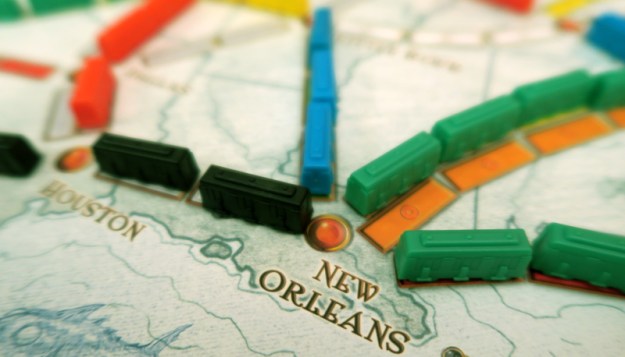
San Francisco is one of the smaller city versions of Ticket to Ride.  The game play is much the same as the original, but the maps are smaller, players have fewer pieces and they only play a maximum of four.  In all the games, players take it in turns to take coloured cards into their hand from the market, or play cards to place pieces on the board connecting locations to satisfy tickets and score points.  Each version of the game has its own specific unique rules, and this one is no exception with players collecting Souvenirs which give points at the end of the game.  Players collect these by building a route (in this case made of trolley cars rather than trains) to the cities where they are available.
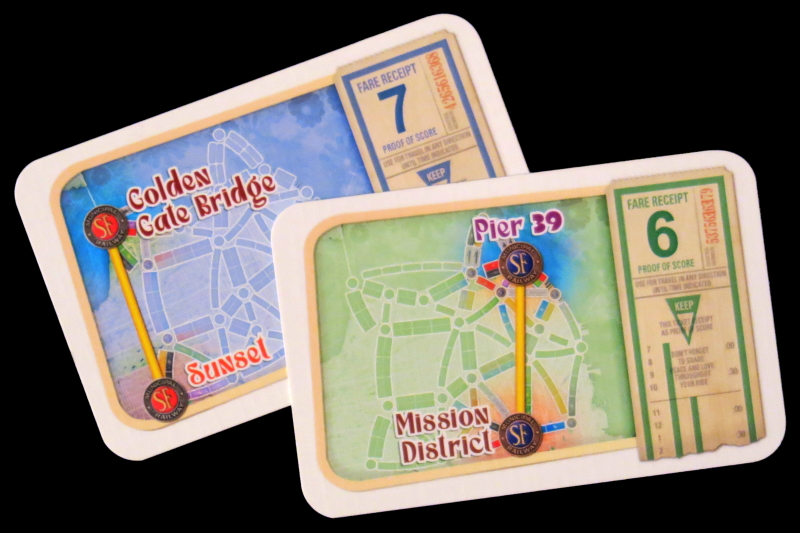
Ticket to Ride: San Francisco
– Image by boardGOATS

Each player can only collect one of each Souvenir, but a full set of seven gives twelve points, which is a lot.  Tickets are also always key though.  This time, Pink escaped early from Alcatraz to Twin Peaks which gave him a high scoring eight points.  Unlike Pine (who always seems to draw routes he’s already completed), Tangerine was unlucky and and instead picked up some negative points late in the game.  It was very close between Pink and Pine though, but the Souvenirs made the difference and Pink (with five) just edged it, beating Pine (who only had two Souvenirs) by three points.
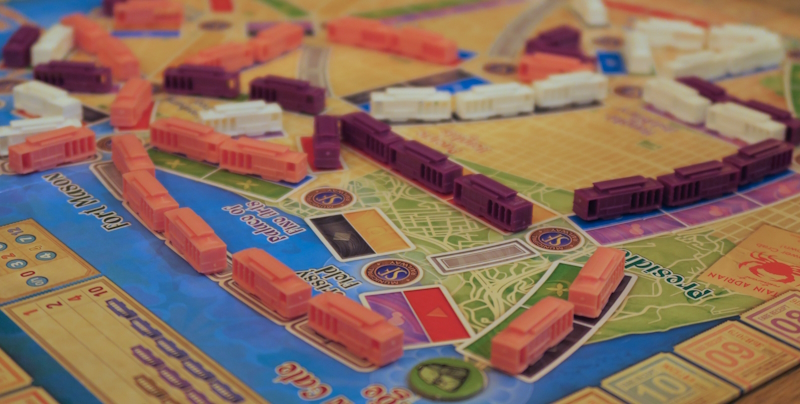
Ticket to Ride: San Francisco
– Image by boardGOATS

Meanwhile, the kitty-philes were playing the extremely frustrating game Calico, which is all about trying to entice cats to come and sleep on a patchwork quilt by making it with the patterns they like.  In this game, players take it in turns to place a coloured, patterned tile from their hand into their quilt board before taking a replacement from the market.  Everyone had played it before, but it had been a while, so the rules needed a bit of revision.  Each player starts with three tiles in a fixed location with scoring criteria for the neighbouring tiles—satisfying these for either colour or pattern gives points, with more points for for those that satisfy both (which is not easy).
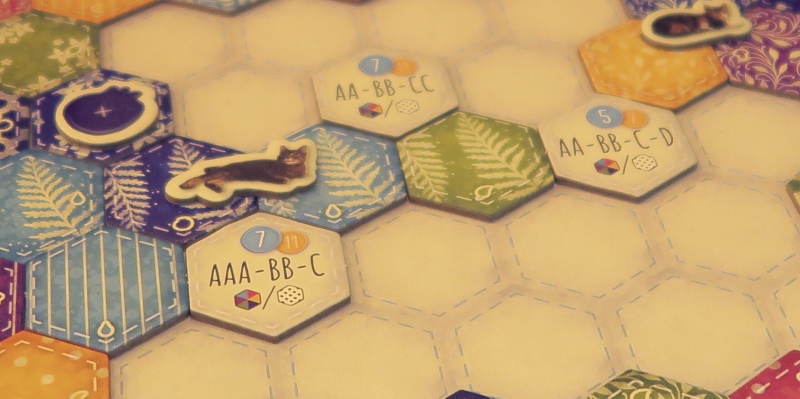
Calico
– Image by boardGOATS

Players then also receive a coloured button for every group of three adjacent tiles of the same colour (with a bonus if they get all six possible colours).  Finally, there are the cats that give Calico its name.  This time the cats in question were Almond, Tibbit and Shop Cat (from the Kickstarter Promo).  Almond was attracted by a group of five tiles of one of the patters in a close packed predefined shape while Tibbit found a set of four tiles of one of the given patterns in any shape most appealing.  Shop Cat was lured to the player with the longest connected chain of tiles in one of the given patterns with the player with the second longest attracting a smaller cat (worth fewer points).

Calico
– Image by boardGOATS

This last one was the subject of some debate as Byzantium ended up with both the longest and second longest chain and it was unclear from the rules whether he would get both.  In the end he allowed the smaller Shop Cat to wander off, but fortunately it didn’t make any difference to the placings.  Almond looked by far the most challenging kitty to attract and initially it looked impossible without failing on the fixed starting challenges.  Plum thought she had made a mess of things, but Byzantium pointed out how Almond could be enticed  using some of the partial tiles around the border of her player board and she was the only one to ultimately have that particular kitty to cuddle.
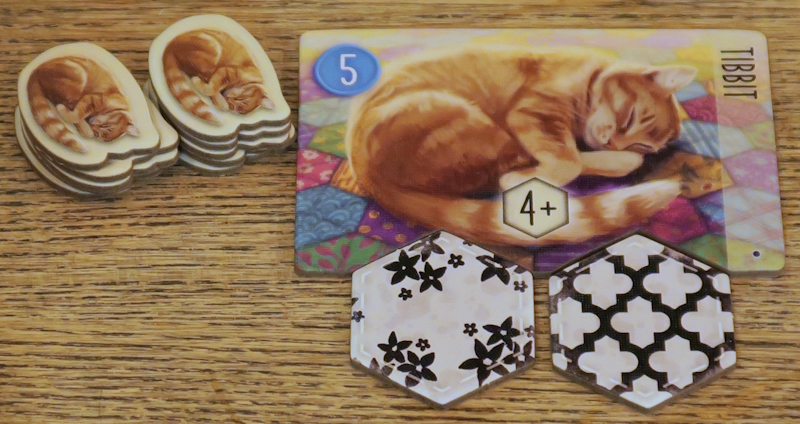
Calico
– Image by boardGOATS

Blue started badly, and in this game, when that happens things usually only get worse, which they did.  Byzantium and Plum both picked up twenty-seven points for their buttons, but in both starting tiles and kitties, Byzantium had the edge (even without the second Shop Cat).  In the end his final score of sixty-one points gave him a significant margin of victory, by seven points.  Everyone agreed that Calico is a good game, but a very frustrating one when players can’t get the tiles they need.  So Byzantium echoed everyone’s feelings when he commented, “That was fun, but very frustrating—I’ll be ready to play it again in another eighteen months…”
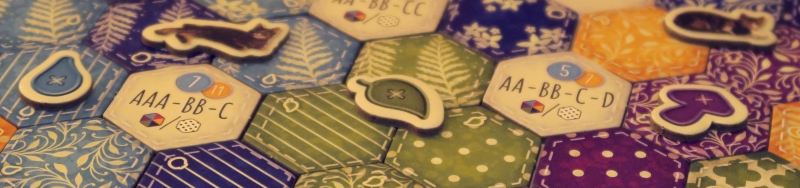
Calico
– Image by boardGOATS

As Faraway and Ticket to Ride had both finished, Tangerine took Jade and Sapphire home and Teal also headed off.  That left Black, Purple, Pine and Pink to play a quick game of the old favourite, Coloretto.  This is a very simple set collecting game, that makes a great filler.  The idea is that players either take the top coloured chameleon card from the deck and place it on a cart, or take a card and add the cards to their collection.  Players score points for their largest three sets (up to six cards, worth twenty-one points), while everything else scores negatively.  The player with the most points is the winner.  Playing with the Jubiläumsausgabe edition, as usual, there was a discussion about what the Golden Joker does and how it differs from the normal Joker.

Coloretto
– Image by boardGOATS

In the end, Pink was the victor and, for the second game in a row, pushed Pine into second place, this time with Black just behind.  The evening looked to be ending there, when a couple of people from the bar came over and asked what we were doing.  That led to a fairly wide-ranging discussion about Monopoly, Cluedo and Mystery of the Abbey amongst other games.  The evening really did come to an end eventually, after Pink and Blue had dragged one of the interested parties into a quick game of No Thanks!.  Unfortunately, there was a misunderstanding and he top-scored with ninety-three, but hopefully he understood that some of the games we play are not that complicated.
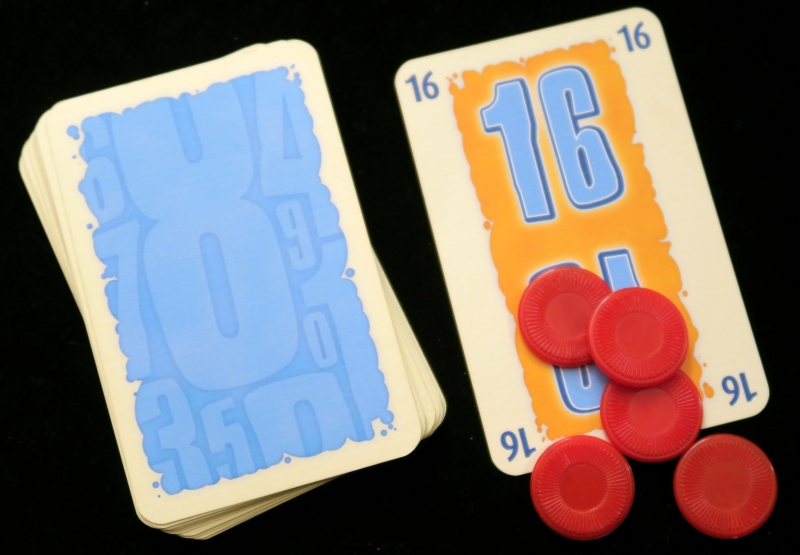
No Thanks!
– Image by boardGOATS

Learning Outcome:  Playing forwards and backwards at the same time makes heads hurt.
31st October 2023

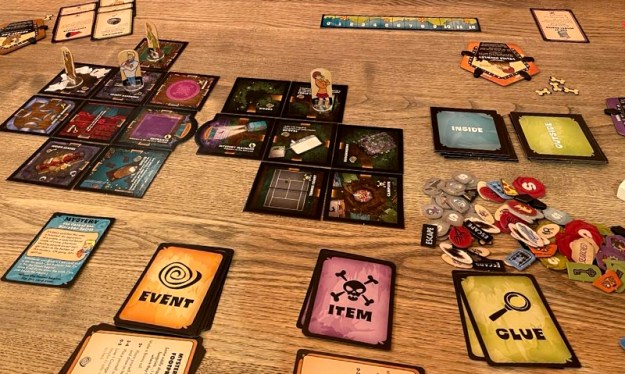
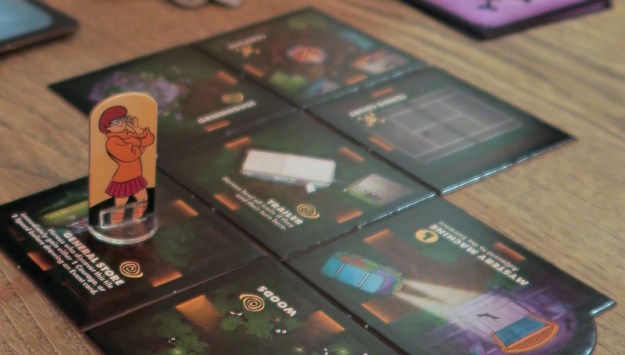
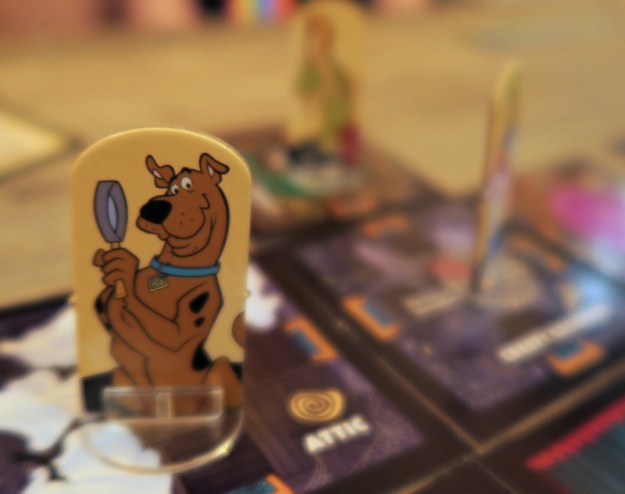
With it being Halloween, there were lots of treats and some very fine spooky-themed attire to go along with the “Feature Game“, Betrayal at Mystery Mansion.  This is a Scooby-Doo themed re-implementation of Betrayal at House on the Hill, a semi-cooperative game, where players work together until there is a haunting and one player takes on the role of the bad guy.  So, the first task for the evening was to decide who was going to take on the roles of Mystery Inc., which precipitated lots of discussion about which was the best character.  Scrappy got short-shift from Pink, though others were less dismissive.  In any case, Scrappy was not an option, and before long, Sapphire, Pink and Pine joined Jade to solve the mystery.

Betrayal at Mystery Mansion
– Image by boardGOATS

Jade, as the group leader, took the role of Fred, while Pink and Pine enthusiastically engaged in the game as Scooby Doo and Shaggy.  That left Sapphire to choose from Velma or Daphne and he went for brains over bimbette.  The group spent quite a bit of time exploring the mansion collecting clues and the like, before the haunt finally started.  As Sapphire was the one to trigger the haunt, Velma was “temporarily lost in the woods” as he took on the roles of the bad guys, a Spectre and a female character called Sharon who was being possessed and controlled by the Spectre.  As the game progressed, it became apparent that the Spectre was her great uncle who was trying to control her to gain access to documents that would enable him to take control of the family fortune.

Betrayal at Mystery Mansion
– Image by boardGOATS

The Scooby Gang (minus Scrappy Doo, Daphne and the now lost Velma) had to track down and battle the Spectre and try break the spell controlling Sharon.  As the villain, Sapphire rolled very well and it was very hard for the Gang to pin him down.  Fred ended up stunned at one point, but thankfully revived after missing a turn.  Shaggy scoffed piles of Scooby Snacks in order to re-roll, but the dice weren’t with him.  Scooby himself, however, did very well and survived his battle with the Spectre then was able to recharge in one of the special rooms of the mansion.  In the end the Mystery Inc. won the day and the great uncle was unmasked and announced that he “would’ve gotten away with it if it weren’t for you pesky kids”!

Betrayal at Mystery Mansion
– Image by boardGOATS

Meanwhile, there were two other games underway on the neighbouring tables.  Blue, Plum and Byzantium eschewed Witch’s Brew (which plays better with more people) and opted for the slightly bigger, beefier, boardgame version of the same game, Broom Service.  Both games rely on the players having a personal deck of Character cards and a lead and follow mechanism.  Each player starts by choosing a set number of Characters from their deck, each with different actions.  The first player then chooses one to lead with and announces that they are either “Brave” or “Cowardly”.  If they choose Cowardly, they can take the action straight away, whereas, if they choose Brave, they must wait until everyone has played to see if they can take the more powerful action.

Broom Service
– Image by boardGOATS

The next player must follow if they have the card in hand, and has the same decision to make—be a Coward and take the weaker action, or be Brave, and risk being gazumped by a later player, as there can only be one Brave player taking the powerful action.  The Brave player (or the most recent Brave player) then leads with another card.  In the card game, Witch’s Brew, players are collecting tokens to give them points, however, in Broom Service, there is an additional “Travelling Salesman” pick-up and deliver type of mechanism.  Players have two Witch-meeples which travel the land collecting potions and delivering them locations to get points.  This time, it was a really, really close game, despite everyone doing different things.

Broom Service
– Image by boardGOATS

Byzantium prioritised collecting Lightening Bolts and Blue concentrated on collecting potions and delivering them.  While they both headed south and contrived to get in each-other’s way, Plum headed north and fell foul of one of the events which left her stuck with no good move in the final round.  Blue kept forgetting about the “Bewitched Roles” which can be used but with a hefty three point penalty and lost six points as a result.  Byzantium assumed he would be the only one to consciously choose to take the hit and thus guarantee he could be Brave, but happened to do that exactly when Blue picked them as well and lost the advantage when he led with those roles.

Broom Service
– Image by boardGOATS

As the game came to a close, it was clear it was going to be close with Blue ahead by a single point with sixty points scored during the game.  She lots of resources left while Byzantium had none but lots of Lightening Bolts, and Plum had some of both.  Initially, Blue and Byzantium tied with seventy-three, just two points ahead of Plum.  That gave Blue victory with the tie break (the most left over resources), but that was only until the miss-count was spotted and Blue lost one point and with it her Winning Witch Medal, instead taking second place by a single point.

Broom Service
– Image by boardGOATS

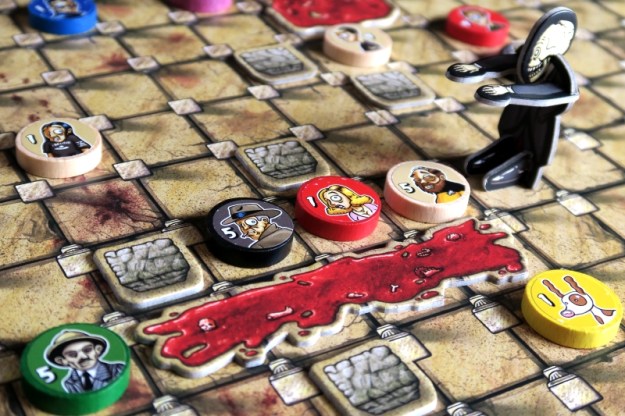
While the first two tables were playing spooky-themed games, Black and Purple led Teal and Cobalt in the monster-mad Finstere Flure (aka Fearsome Floors).  This is a game where players are trying to escape from Fürst Fieso before the castle collapses and without getting eaten.  The idea is very simple: first players move all their pieces the number of spaces shown on their visible side, then the Monster moves.  The Monster moves according to a stack of tiles, either moving a set number or moving until he eats.  The Monster moves one step forwards then looks straight ahead, left and then right. If he sees a player, he turns and moves towards them.

Finstere Flure
– Image by boardGOATS

Thus, the Monster looks, moves, looks, moves until he either runs out of spaces to move, or eats someone.  The game ends after fifteen rounds.  It is simple enough, but there are a few little elements that add to the fun.  Firstly, each player piece moves a total of seven spaces over two turns, but while some alternate three and four space moves, others are more variable, with the most extreme moving six spaces and then one space on the next turn; these different pieces require different tactics.  Players can’t land on another player, if they walk into a rock they push it and if you step in a pool of blood, they slide across it.

Finstere Flure
– Image by boardGOATS

Finally, if the Monster walks into a wall he appears elsewhere on the board adding a further layer of unpredictability.  The game opened with a bang when the first Monster tile revealed was a “Two Kill”, that is to say, the monster keeps moving until he’s eaten twice.  From there, it was carnage.  Everyone had someone eaten, with some multiple times.  There were people who managed to escape from Fürst Fieso, though it wasn’t easy of course.  Everyone managed to get at least one piece out of the castle, with Purple and Cobalt managing to get two pieces out.  The winner, however, was Black who liberated three of his people.

Finstere Flure
– Image by boardGOATS

They were the first to finish, so moved on to play the recent release, Ticket to Ride: Ghost Train.  This is really just a variant of First Journey, a simpler version of the group favourite, Ticket to Ride, aimed at children and non-gamers with super-sized pieces.  Like the original game, players take it in turns to either take “two parade float” cards (in this case blind), or pay cards to place trains on the map.  However, instead of scoring points for placing trains, the game is essentially a race game.  Players start with three Tickets and every time they complete one, they draw a replacement.  The winner is the player who completes the most Tickets.

Ticket to Ride: Ghost Train
– Image by boardGOATS

This time, Teal took an early night, but Black, Purple and Cobalt went at it with spooky enthusiasm.  As a different take on the original, they found this a very enjoyable alternative.  As well as Tickets, players can also win “Trick or Treat” bonuses for connecting the Dark Forest region to the Seashore region.  Black and Purple both took a “Trick or Treat” bonus, but the winner was Cobalt who finished with six Tickets, one more than Purple who would have taken another if she’d had just a little more time.  That wasn’t the only Ticket to Ride game of the night however, as the Scooby Gang played a quick game of Ticket to Ride: Berlin once they had solved their mystery.

Ticket to Ride: Ghost Train
– Image by boardGOATS

Ticket to Ride: Berlin is one of the mini versions, and there was a little chat about these and which ones people had played.  The first mini version was a “demo” game the publisher used to introduce people to the game at conventions.  Since then, there have been a series of City versions, with New York, London, Amsterdam and San Francisco all featuring and Berlin being the most recent (with Paris to come next year).  These all feature the same basic mechanism as the original game (including the scoring of points for placing trains unlike the First Journey type games), but they have fewer train pieces and a smaller map.  The Berlin map, is long and thin, but the big difference is that players have mixture of Trams and U-Bahn pieces.

Ticket to Ride: Berlin
– Image by boardGOATS

Tram and U-Bahn routes are paid for in similar ways, though only one U-Bahn piece is needed to mark them and they score slightly more points.  Once the differences had been highlighted by Pine and Pink (who played this together a few weeks back), everyone got down to business.  Jade and Sapphire dominated the West while Pink and Pine concentrated on the East, though the geography of the map meant everyone had to include East-West connections in their network.  It was a hard-faught close game with both Jade and Sapphire taking negative points due to incomplete Tickets.  Pine completed five Tickets and Pink finished six.

Ticket to Ride: Berlin
– Image by boardGOATS

Pine’s Tickets were more lucrative, however, and he took victory with sixty-one points, while Jade with forty-nine just pipped Pink by two points in the struggle for second place.  Everyone had enjoyed the game, and Jade commented that it was one of his favourite renditions of Ticket to Ride so far—indeed, the addition of a second set of transport seems to have been much more successful in this mini version than it was in the full-sized Rail & Sails where it made it longer and more fiddly without making it significantly better.  While everyone else was playing and then discussing the merits of different versions of Ticket to Ride, the Crafty Trio, Plum, Blue and Byzantium had finished Broom Service and squeezed in a quick game of Dinosaur Drafting with Draftosaurus.

Draftosaurus
– Image by boardGOATS

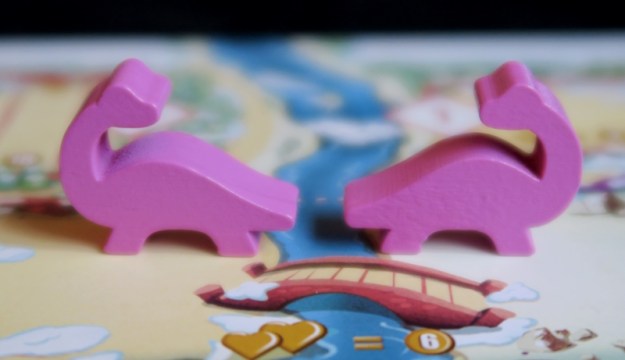
This is a fun little game that we play quite a bit, where players choose one Dinosaur from a handful, add it to their Park and then pass the rest on.  Dino-placement is slightly restricted by the roll of a die, with everyone getting points for how they occupy their pens.  Usually, the group plays with the Summer board, but with the cold weather, the group decided to play with the alternate, Winter board which introduces new and different pens.  These include the Well-Ordered Wood (Dinosaur types must alternate); Lovers’ Bridge (giving six points for each pair of Dinosaurs separated by the bridge); the Lookout (contains one Dinosaur and scores two points for each one of that type in their right neighbour’s pen).

Draftosaurus
– Image by boardGOATS

The most challenging, however is the Pyramid, which holds up to six Dinosaurs in a layered structure, but dinosaurs of the same species may not be placed adjacent to each other (horizontally or vertically).  Blue got into a mess with this, and was stuck with a Dinosaur she could not place at the end as a result.  Plum and Byzantium did slightly better and were able to capitalise more on the Quarantine Zone, which allows players to move the single occupant at the end of the game.  In the end, it was a tight game (though not as tight as Broom Service), in which Plum ran out the victor, three points ahead of Byzantium.

Draftosaurus
– Image by boardGOATS

Learning outcome: They’d have got away with it if it weren’t for those pesky kids!

4th October 2022

To mark the tenth anniversary of our first meeting, this week was a bit of a party. We started with a fish and chip supper (courtesy of Darren at The Happy Plaice) and followed it with cake, complete with “marzimeeples”. There was also a special “solo game” of Carcassone, where everyone chose a tile, wrote their name on it and stuck it on a board to be framed as a keepsake to mark the occasion. Unfortunately, Lilac was unwell and not able to come, and the chaos on the A34 (due to a burst water main on the Oxford ring road and an accident) conspired to delay Black, Purple, Orange and Lemon. Everyone else made it though, and after a quick round of Happy Birthday and some cake, the group moved on to play the now traditional “Feature Game“, Crappy Birthday.

2022 Birthday Cupcakes
– Image by boardGOATS

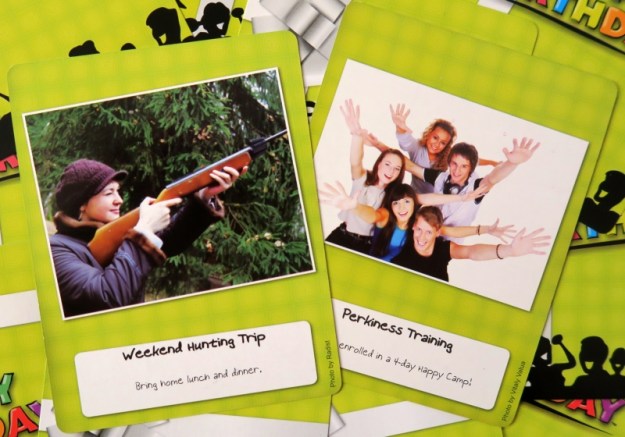
Crappy Birthday is a party game where players give each other comedy birthday presents and the recipient has to decide who gave the best and worst gifts. We house-rule the game to play a year so that everyone has one birthday, so on their turn, they receive a gift from everyone else. They then look through the gifts and choose the best and worst, and the givers of those gifts get a point each. The winner is the player with the most points at the end of the year. Written like this, the game sounds very dry, but there are three things that make the game a lot of fun.

Crappy Birthday
– Image by boardGOATS

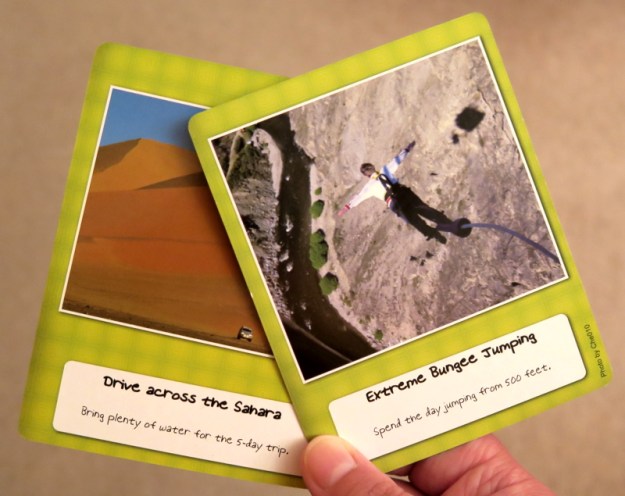
Firstly, the gift cards are fantastic; the pictures are great and the texts that accompany them are just enough to give a flavour while also allowing interpretation. Secondly, the way we play, the Birthday Boy or Girl goes through the gifts reading them out. It is not so much this, as the disgust, excitement or other response as people “open their gifts” that makes everyone smile. Playing board games can be very impersonal—for many people this is a good thing as it allows people who are shy or private to control what they reveal about themselves because everyone focuses on the game. As a result, gamers often don’t really know an awful lot about each other. In playing Crappy Birthday, however, players reveal just a little bit more of their likes and dislikes, helping everyone to get to know each other that little bit better.

Crappy Birthday
– Image by boardGOATS

Finally, we only play Crappy Birthday once a year. This is really key, as without this constraint, the cards would get repetitive and the element of surprise would be lost. In terms of game play, it isn’t a very strategic or challenging game, so playing more frequently would likely mean it would quickly outstay its welcome. As it was, Pink started (his birthday was soonest), and he set the tone for the year. As usual, we discovered lots of interesting things about people in the group. Pink surprised everyone with his delight at receiving some Monopoly money toilet paper, though it was a close-run thing between that and a road trip across the Sahara as he’d always fancied participating in the Paris-Dakar Rally. He was much less impressed with the bungee-jump however.

Crappy Birthday
– Image by boardGOATS

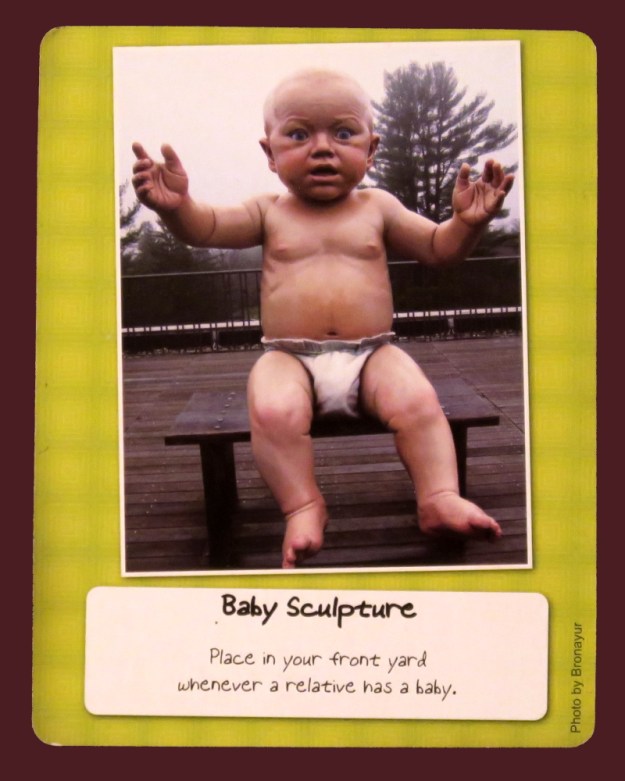
Pine was next and this time didn’t get his usual pile of equine and meat flavoured gifts. His choice of a giant lobster sculpture for his front yard was also unexpected, and he explained that it would be interesting to see where it ended up when the kids and drunks in the village decided to move it. On Plum’s turn we discovered that she liked the idea of a one-armed bandit and Chess lessons (no cheating, obviously), but preferred Flying lessons. Pink proved he knew Blue best when she picked a non-electric iron as her favourite gift, while Ivory was disappointed that when Teal eschewed his generous gift of a trip on the first trip to Mars. We discovered that Teal used to play the bagpipes, and that Lime was quite disgusted by the thought of a giant baby sculpture for the front of his house (to be fair, it looked quite hideous and not a little creepy).

Crappy Birthday
– Image by boardGOATS

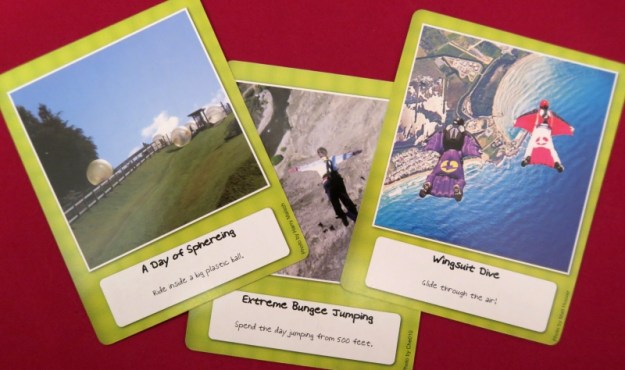
Leaping off or out of things seemed to be generally quite unpopular, with a parachute jump being Black’s least favourite gift, though he was delighted by tickets to a live metal music gig. Ivory complained that he kept drawing perfect gifts for people just after their birthday. On his birthday, Pink thought he had a winner when he gave Ivory a snow machine, and everyone else felt the same knowing how much he loves Christmas, but surprised everyone by choosing a space walk as his best gift and a permanent barbed wire fence as his worst. Pine showed his approval when Lemon picked bird watching as her choice gift, and most people could see her point when she ranked her deer-foot lamp as her least favourite.

Crappy Birthday
– Image by boardGOATS

There was more surprise on Purple’s turn when she chose a custom chopper as her best gift, but her dislike of a trip on a submarine was less of a shock. The final birthday of the year was Orange who picked throat rings as his best gift. There was a lot of taxidermy-based gifts so it was perhaps fitting that his less surprising choice of worst gift was a good luck bat (not particularly good luck for the bat if the picture is anything to go by). Not that it really mattered, but everyone knew who the winner was long before the end of the year, as Lemon had managed to get a point in half of the rounds and finished with five points. The race for second place was much closer though with three people taking two and Black and Purple tying with three points apiece.

Crappy Birthday
– Image by boardGOATS

There was a lot of chatter, some tidying up and more chatter, before Lime and Teal wished everyone else a good night and enjoyable rest of the party, and those remaining tried to decide what to play. Everyone was very indecisive, so eventually Blue made the executive decision that one group would play New York Slice while the others played Ticket to Ride, and Pink went out to the car to collect the rest of the games that had been left in the car when everything else was brought in.  After some four-player, five-player, no definitely four-player shenanigans as Lemon shuffled from one game to the other, Ivory, Orange, Plum and Pink eventually got going with New York Slice.

New York Slice
– Image by boardGOATS

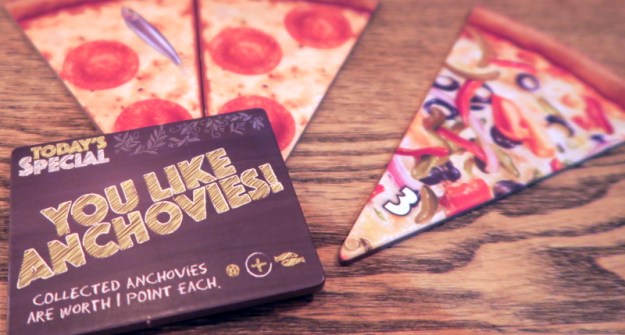
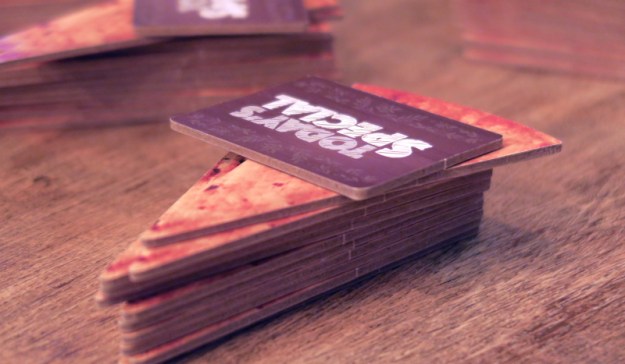
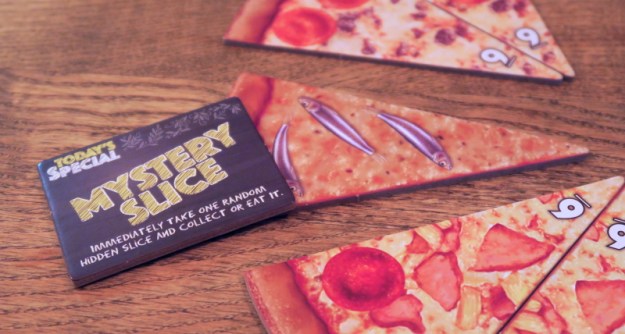
New York Slice is a re-implementation of …aber bitte mit Sahne, a game we’ve played a couple of times over the summer.  Having enjoyed the pizza version last month, it definitely deserved another outing.  The idea is that one player makes the pizza and cuts it into segments equal to the number of players, then players take it in turns to choose one of the segments.  When a player takes a segment, they can either eat the individual slices or store them for later. Those they will eat are worth points at the end of the game with the score dependent on the number of pepperoni slices on top. The pieces players keep are scored depending on who has the most of each type at the end of the game.

New York Slice
– Image by boardGOATS

Each piece of pizza has a number on it which tells players the number of that type in the game and also what the player with the most will score at the end of the game.  Some of the pizza slices have anchovies on them and any that are visible at the end of the game are worth minus one.  Each pizza is also served with a Special—a side order bonus tile with rule-breaking powers which accompanies one of the portions.  These can be good or bad, and add something to the decision making all round.  This time, the game was very close with just four points between first and last.

New York Slice
– Image by boardGOATS

As often happens, most people didn’t compete for the majority in the lucrative Meat Feast pizza, instead gobbling up the pepperoni straight away giving Orange the eleven points relatively cheaply.  The most valuable pizzas were collected by Orange and Ivory, whereas Plum made most of her points from her Specials:  “The Everyone-Else Diet” and “Seconds”.  The Everyone-Else Diet” was handy because it gave negative points to everyone else for every two slices eaten.  It was perhaps “Seconds” that just gave her the edge though, as it allowed her to eat one set of slices just before scoring, enabling her to see what she wasn’t winning and eat that.  As a result, she finished a single point ahead of Ivory with Orange taking third.

New York Slice
– Image by boardGOATS

Meanwhile, on the next table, Blue, Black, Purple and Lemon settled down to a game of the new Ticket to Ride: San Francisco.  This is the latest in the Ticket to Ride series and is making its debut at Essen this year.  The games all follow the same basic pattern:  on their turn players draw coloured cards, or spend them to place trains on the central map.  They score points for trains placed, but also for completing any tickets they kept at the start of the game or picked up and kept during it.  One of the smaller games, Ticket to Ride: San Francisco only plays four and has fewer pieces so games are shorter.

Ticket to Ride: San Francisco
– Image by boardGOATS

Like all the other versions of the game, however, San Francisco also has a small rules tweak:  when players make a connection to a tourist destination, they can collect a token.  They can only collect one per turn and one from each location.  Each tourist destination has different tokens, and players score bonus points at the end of the game for each different token they have collected.  These points are significant, varying from nothing to twelve, with the number of points increasing exponentially as players add more to their collection.  Otherwise, the map is different and instead of trains, players have cable tram-cars to place, but otherwise it is similar to the other versions of Ticket to Ride.

Ticket to Ride: San Francisco
– Image by boardGOATS

Black’s starting tickets both went north-south, but one was on the east side and the other the west side.  So he picked one and immediately went fishing for a more.  Everyone else was slightly better off, and although Blue’s were better aligned they were fairly low scoring so once she had made a little progress she also took more tickets.  Black and Purple went for the potentially lucrative Tourist tokens, while Lemon kept forgetting to pick them up and ended up collecting a handful at the end.  Although the more a player has, the more they are worth, it turns out that getting the last couple is really difficult, and they are the ones that are worth the most points.

Ticket to Ride: San Francisco
– Image by boardGOATS

Blue tried to claim the long route from Fort Mason to the Golden Gate Bridge, but couldn’t get the multi-coloured-wild or the last yellow card she needed despite the draw deck apparently being stuffed with them.  In the end, she ran out of time as Black brought the game to a swift end.  In the end, it was a really close.  Black had the most points from placing trains on the board, closely followed by Purple, who was also very close to running out.  Blue had the most completed tickets though so it all came down to the Tourist tokens which meant Black edged it by a single point from Blue with Purple just a couple of points behind that.

Ticket to Ride: San Francisco
– Image by boardGOATS

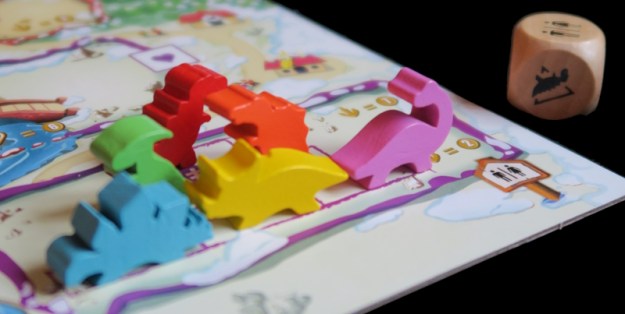
Ticket to Ride was still going on when people had finished their pizzas, so although Ivory headed home, Plum was tempted to stay for one last game of Draftosaurus.  This was new to Orange, so while Pink set up, Plum explained the rules.  Draftosaurus is similar to games like Sushi Go! or Go Nuts for Donuts except that instead of drafting cards, players draft wooden dino-meeples, which players then place in their Dino Park.  Unfortunately, Orange wasn’t familiar with either of those games, so Plum explained that drafting is where players start with a handful of dino-meeples, take one and pass the rest on.

Draftosaurus
– Image by boardGOATS

So, in Draftosaurus, each player begins the round with a handful of wooden dino-meeples and a player board for their dinosaur amusement park.  Everyone chooses one meeple from their handful to place in their park and passes the rest to the next player.  Each turn, one of the players roll a die which adds a constraint on which pens players can place their dinosaur in.  The different pens have different scoring criteria and some also have restrictions.  The game is played over two rounds, with players passing meeples clockwise in the first round and anti-clockwise in the second, ending with twelve meeples in their park.

Draftosaurus
– Image by boardGOATS

The parks boards are double-sided, but this time the group played just one round on the summer side.  The game rocked along quite nicely, though Plum struggled to find mates for the dinosaurs in her Prairie of Love, while Pink and Orange had fun with the Forest of Sameness and Meadow of Differences (which have to have either all the same or all the different dinosaurs in them).  A few scaly beasties ended up being thrown into the river because of the dice restrictions, but everyone did a good job of picking the right King for their Dino Park.  Orange was king of the King of the Dinosaurs with the most Tyranosaurus rex, but he wasn’t the king of Draftosaurus—that was Pink who finished with thirty-nine points and a lot of Hadrosaurs.

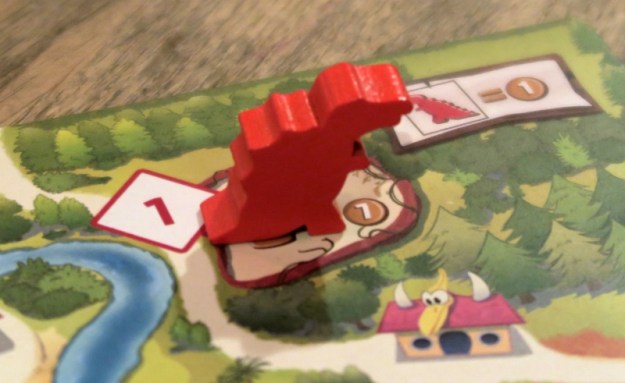
2022 Birthday Cupcakes
– Image by boardGOATS

Learning outcome: It’s great to be ten, but bring on eleven!

Essen 2022

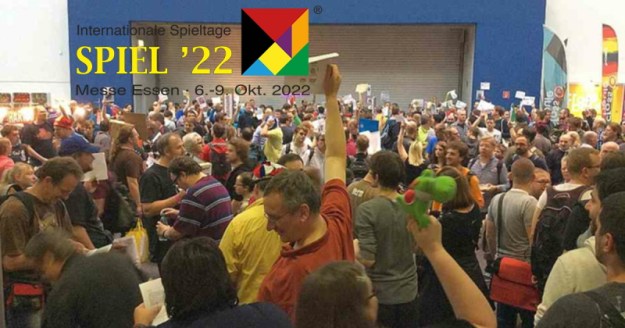
Known to gamers worldwide simply as “SPIEL” or “Essen”, the Internationale Spieltage, the annual German games fair is the largest in Europe and arguably the world.  The fair is of particular significance as many new releases are scheduled to coincide with the event just in time for Christmas sales.  In 2020, like many other events, SPIEL was cancelled.  The online event that replaced it was not as successful, and in 2021 there was a return to the in person fair albeit with restrictions and much smaller than that in 2019.  Today is the first day of this year’s SPIEL which runs from Thursday to Sunday every October.

Essen 2022
– Image from spiel-messe.com

Although many of the Covid restrictions have been lifted, medical grade surgical masks covering mouth and nose are still mandatory for all visitors and exhibitors.  So while SPIEL will likely be larger this year than last, it probably won’t reach pre-pandemic proportions.  The maths trade is back though, a crazy event where hundreds of people agree multiple trades and sales online in advance and then all meet up at 3pm and try to find the people they have made contracts with and make the exchanges.  Remarkably, it works, and very well too, with some people selling hundreds of euros worth of games through this means.

Essen Maths Trade
– Image by Friedhelm Merz Verlag

Despite the number of people involved, the exchanges only take a few minutes and it is usually almost all over in half an hour making it a surprisingly efficient way of making space for the new arrivals.  In addition to the Maths Trade, there will be the usual exhibitors showcasing their wares.  The Spiel des Jahres and Deutscher Spiele Preis winners will also all be available and there will also be lots of games making their SPIEL debut.  These include Uwe Rossenburg’s latest game, Atiwa, and the top of “The Essen Hotness” games:  Tiletum, Revive, Woodcraft, Lacrimosa and Hamlet: The Village Building Game.  Games like Flamecraft, Turing Machine and War of the Ring: The Card Game will be for sale too.

Atiwa
– Image by BGG contributor W Eric Martin

There will be re-implementations, like Richard Breese’s reworking of his 1998 game, Keydom’s Dragons (formerly Keydom), Clever 4Ever (extending Ganz Schön Clever), Skymines (a redevelopment of Mombasa), Amsterdam (formerly Macao) and of course, Ticket to Ride (San Francisco).  Expansions will also be on show for games like The Red Cathedral (Contractors), Galaxy Trucker (Keep on Trucking), Meadow (Downstream), Sagrada (The Great Facades – Glory) and two of our favourites, Viticulture (World) and Wingspan (Asia).  Sadly, no-one from boardGOATS will be there to see them though; maybe next year…

Wingspan: Asia
– Image from stonemaiergames.com

28th June 2022

When Blue, Pink, Orange and Lemon rolled in (late thanks to the delights of the Oxford traffic and garden watering), Plum was already there.  A gamer with Gweeples in Didcot, Plum was a friend of Burgundy’s that members of the group first met at his funeral about six months ago.  While she finished her tagliatelle, Blue and Pink waited for their supper to arrive, and everyone admired Pink’s Pornstar Martini, the group revisited Tsuro, which Orange and Lemon had enjoyed so much on their first visit, last time.

Tsuro
– Image by boardGOATS

While setting up, Pine arrived and needed a quick reminder of the rules, but that only took a moment:  players have a hand of three tiles and, on their turn place one of them in front of their stone and extend it’s path, moving their stone (and any others) to the end of its path.  Players are eliminated when their stone goes off the board or collides with another stone—the last player on the board is the winner.  First blood went to Blue, who took out Lemon and Pine, but that was collateral damage as she had no choice and went off the board herself at the same time.

Tsuro
– Image by boardGOATS

Pink was next, being trapped and left with no option, and then just Plum and Orange remained to duel it out.  There was very little space left on the board and the writing was already on the wall when Plum went off.  That left Orange a worthy winner, especially as he had a tile to spare too.  Teal arrived and while Blue and Pink fed, he led everyone else in a game of No Thanks!.  This is a game we’ve played a lot in the group and is a very clever design but like all the cleverest games, has very simple rules.  Played with a numbered deck of thirty-two cards, the idea is that on their turn, the active player can take the card in the middle or pay a chip to pass the problem on to the next person.

No Thanks!
– Image by boardGOATS

The next person has the same decision:  they can take the card and the chip, or pay a chip, and so on.  At the end of the game, a player’s total score is the sum of the face value of the cards they took and the player with the lowest number wins.  There are two key points that make the game, however.  Firstly, if a player has consecutively numbered cards, only the lowest card in the run contributes to their total, which means cards have different values to different players.  Secondly, nine cards are removed from the deck, which adds jeopardy on top.  The game can play out in several different ways.

No Thanks!
– Image by boardGOATS

The player or players with the most chips are always in control, until one player is left with so few chips or runs out completely, that they are forced to take cards even when they don’t want them.  This can prevent players, even those with lots of chips, from getting the cards they need to close runs causing the strategy to back-fire, and leaving those with the most chips with the most points as well.  This time, Orange and Teal amassed a huge pile of chips each, but both managed to avoid ending up with multiple high scoring runs.  Then someone dropped a chip on the floor giving Pine the opportunity to recount the tale of how he dropped a chip between the floor boards and how it is still there despite everyone’s best efforts.

No Thanks!
– Image by boardGOATS

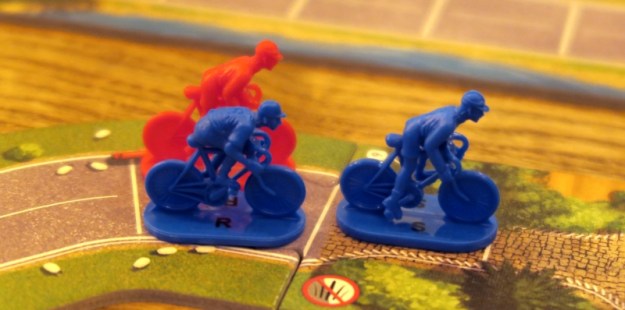
This time, the dropped chip was recovered successfully and the game ended without further mishap.  Orange and Teal took first and second respectively, giving Orange two in two games to match Lemon’s achievement at the start of last time.  By this time, the feeders had finished feeding and everyone else had arrived, so it was time for the “Feature Game“.  To mark the start of the Tour de France later in the week, this was to be the Peloton expansion for the cycling game, Flamme Rouge.  Flamme Rouge is a fast-paced, tactical bike-racing game where each player controls a team of two riders: a Rouleur and a Sprinteur.  The aim is to manage the first rider to cross the finish line.

Flamme Rouge
– Image by boardGOATS

Each rider has a deck of cards, and Players move their riders one at a time, by drawing four cards from the rider’s deck, choosing one to play, and recycling the rest.  Once every player has picked cards for both their riders, players simultaneously reveal their cards and, starting with the cyclist at the front, each rider is moved in turn.  After all the riders have moved, slip-streaming takes effect, with groups that have exactly one space between them and the group in front moving forward to remove the gap.  Finally, every rider that still has an empty space in front of them is deemed to be riding into the wind and takes an exhaustion card which goes into their deck—these are bad because they are slow cards and block up plays’ hands.

Flamme Rouge
– Image by boardGOATS

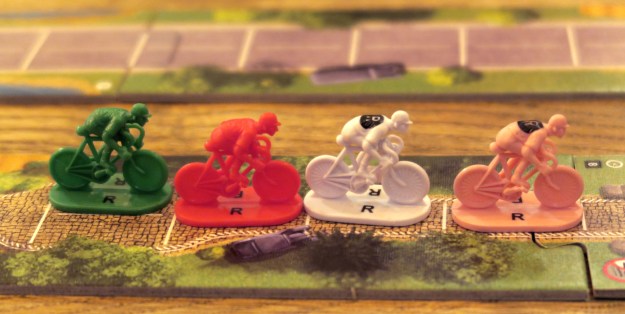
At the start of the race, everyone’s Rouleurs have the same cards, and everyone’s Sprinteurs have the same cards.  The Rouleurs have lots of cards with a similar face value, where the Sprinteurs have some cards that are faster and have a higher value, which are offset by others that are slower and have a lower value.  Players have to balance how they manage their riders and make the most of the slip-streaming opportunities.  The game is modular with the option to add hills to the base game.  The Peloton expansion adds extra riders (so that the game plays up to six players), cobbled sections (aka “Pavé”), Feed Zones, and rules to set up a break-away.

Flamme Rouge
– Image by boardGOATS

Unusually with so many people, rather than splitting in to three groups playing three different games, we split into just two with both playing the same game.  Since the Grand Départ was due to take place in the essentially flat Denmark this year, both groups largely played without hills, but included cobbled sections (à la Stage 5, from Lille to Arenberg, a week later).  Cobbled sections change width frequently and are generally narrower than normal road, but perhaps more importantly, riders can no-longer benefit from slipstreaming but still get exhaustion cards.  The slightly larger group, led by Ivory and Teal also decided to start with a break-away.

Flamme Rouge
– Image by boardGOATS

Their chosen route was Stage 11 of the stage race and took in three sections of Pavé.  The first of these was shortly after the start, the second after the first hairpin and a short slight up-hill ramp, and the third was after a second hairpin and a little chicane.  Teal and Lime made it into the breakaway and they stayed away for most of the game.  Being at the front “pushing air out of the way” all the time is tiring though, and inevitably, they picked up a lot of exhaustion cards.  That meant that as the Peloton was bearing down on them, just as the finish line was in sight, they didn’t have the energy fend them off.

Flamme Rouge
– Image by boardGOATS

As a result, Black and Pink, who had been sheltering in the middle of the group slid across the line just ahead of the gallant breakaway, who were definitely candidates for the day’s combativity award.  Black took first place, having spent most of the race doing as little as possible and saving it all for the final sprint.  While saving energy is a good tactic, Purple took it to a different level picking up no exhaustion cards at all, though she wasn’t able to turn on the burners in time to take advantage of it.

Flamme Rouge
– Image by boardGOATS

The smaller group, led by Blue and Plum rode a simpler route based on the Avenue Corso Paseo ride, with a cobbled section in the middle between the two hairpin bends.  With most people in this group new to the game, they decided to keep things simple and eschewed the complexities of hills completely, sticking to a pan-flat course, and kept to the standard roll-out used in the base game.  First Orange and then Lemon rode off the front while Pine and especially Blue were repeatedly under threat of being spat out of the back of the peloton.  Most rounds seemed to end with Blue breathing a sigh of relief as she managed to hang on and Lemon laughing as she picked up yet another exhaustion card.

Flamme Rouge
– Image by boardGOATS

Once the riders had passed the Pavé the speed picked up and Blue and Pine started to try to move forward in the field.  Lemon who had led most of the way “bonked” and “hit the wall”, and as a result, was unceremoniously dropped.  It was tight, but Pine’s Rouleur was first over the line just holding off Plum’s first rider who took second followed by Pine’s Sprinteur who took third.  It had been a close and quite attritional race, but despite the fact there were fewer riders with a shorter parkour, the race finished at much the same time as the other one.  So races were compared and there was a bit of chatter about other options as people packed away.

Flamme Rouge
– Image by boardGOATS

Ivory took himself off for an early night, as did Teal, but those that were left were keen to play on, albeit not for long in some cases.  Inevitably there was a lot of discussion about what to play, but when Ticket to Ride got a mention, Pine and Lime were keen to give the London version a run out, and were quickly joined by Pink and Purple.  Ticket to Ride is one of our favourite games and we play a lot of different versions, short and long.  They all have the same basic structure, but different layouts on different maps, and often with a little rules change.  In summary, in the original game, players are connecting cities across the USA.

Ticket to Ride (USA)
– Image by boardGOATS

They do this by collecting coloured cards and then spending those cards to place trains.  Players score points for placing trains and also for completing “Tickets” by connecting two cities together by any chosen route—the further apart the cities, the more points they are worth.  The game end is triggered when one player has only two train pieces left and at the end of the game, the player with the most points is the winner.  The original game takes around an hour to play with the full compliment, but more recently, there have been a number of smaller, lighter versions available.  They have the same rules, but players have fewer pieces and the maps are more congested, based on cities like New York, Amsterdam and later this year, San Francisco.

Ticket to Ride: London
– Image by boardGOATS

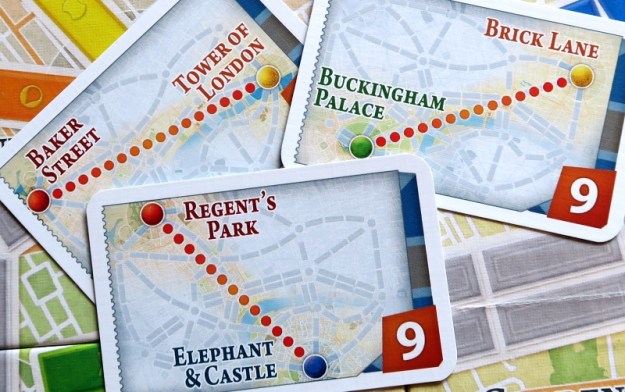
This time, however, the version chosen was London.  In this edition, players are placing buses to mark routes, and in addition to scoring points for claiming routes and Tickets, players also score points for connecting all the places in the same district. Pine won the “name the people on the front of the box” competition and went first.  Lime crossed the city travelling from Baker Street to The Tower of London while both Purple and Pink did the same but from Buckingham Palace to Brick Lane, and via different routes. Pine had a northern route and a south route that looked like they would join up in the middle, but didn’t quite make it.  He did manage to claim a district though, the only player to do so for a district of any significant size.

Ticket to Ride: London
– Image by boardGOATS

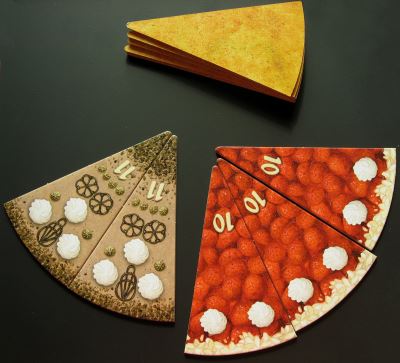
It was very close between first and second, though there was a bit more distance to Pink in third.  In the end, Lime just pipped Pine to victory by two points.  Meanwhile, there had been some debate between the other five as to what they would play.  Blue suggested introducing Orange and Lemon to one of our old stalwarts, 6 Nimmt!, but it wasn’t one of Plum’s favourite games.  So instead, Blue and Black introduced everyone else to …Aber Bitte mit Sahne, a clever but simple little “I divide, you choose” game.  The idea is that one player is The Baker who divides the cake into pieces and then everyone else takes it in turns to take a one of them.

…Aber Bitte Mit Sahne
– Image by boardGOATS

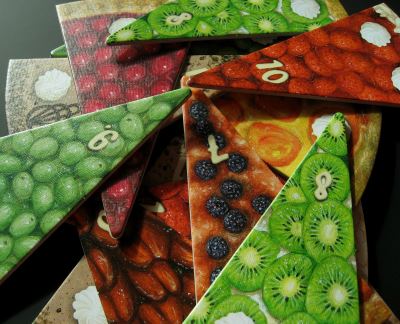
Each slice of cake has a type, a number on it and a some cream.  When a player takes cake, they can choose to eat it or store it.  For all eaten cake, players a point for each blob of cream.  For stored cake, however, the player with the most of each type will score the number of points associated with that type.  The clever part is that the number of points is equivalent to the number of slices of that type in the game, so the more common types which are harder to get a majority in are worth more, but they also have the most cream, tempting players to eat them straight away.

…Aber Bitte Mit Sahne
– Image by boardGOATS

It is always difficult for the first couple of players to take the role of Baker, but this is exacerbated with five players.  Blue went first, then Black.  It was only a couple of rounds in, that the twinkle appeared in Plum’s eye as she realised how clever the game was and expressed her approval.  It was quite tight in the early stages with players staking their claims to different sorts of cake.  There was competition for kiwi and redcurrent, but others went largely un-stored (and therefore eaten).  After everyone had been the Baker it was time to see who had the most of each and add up the scores.  Black got lucky with the chocolate as everyone else was greedy and ate theirs.

…Aber Bitte Mit Sahne
– Image by boardGOATS

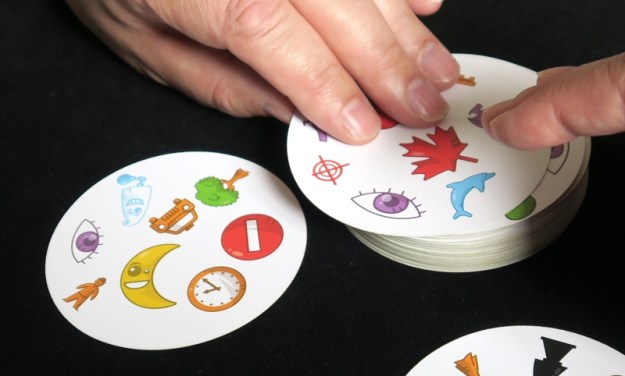
Unfortunately, there was a rules misunderstanding and Orange thought he would get points for every slice he kept if he had the most of that type, so we’ll have to play it again soon so he can try again.  This time though, Black who had been very abstemious and eaten none of his cake, ran out the clear winner with thirty-five points to Blue’s twenty-nine and Plum’s twenty-seven for second and third place respectively.  Ticket to Ride: London was still underway on the next table, so as Orange and Lemon had not played it before, Blue got out Dobble.  We’ve not played this in the group for years, but it is a fantastic little Snap-based filler.

Dobble
– Image by boardGOATS

The idea is that every card has several pictures and each card shares exactly one match with every other card in the deck and using this principle, there are five possible Snap-based games.  Black decided discretion was the better part of valor and opted to spectate while Plum had a significant drive so headed off, leaving just Blue, Orange and Lemon.  They started with a pile of cards each and the winner the first to shed their pile onto the central one.  The game was all very well, but there was a vocabulary check as, although Blue said they could play in Ukrainian, Orange and Lemon were game to give English a go.  Once the items had been identified, the mania started.

Dobble
– Image by boardGOATS

As it was a trial game, the piles weren’t carefully measured, but Orange quickly got the hang of it and in spite of the language differences, managed to shed his pile first for yet another victory.  From there, the group did the reverse and started with one card and grabbed progressively matching cards from the middle.  This can be quite savage, which is why Blue opted for the gentler game first.  Still, everyone was well-behaved and nobody got scratched.  The tension and concentration was palpable though and Ticket to Ride finished and Lime and Pine left with only a a cursory grunt from those playing Dobble, before Blue just edged it to win the final game of the night.

Dobble
– Image by boardGOATS

Learning Outcome:  Tour de France coverage is available on ITV4.

UK Games Expo 2022

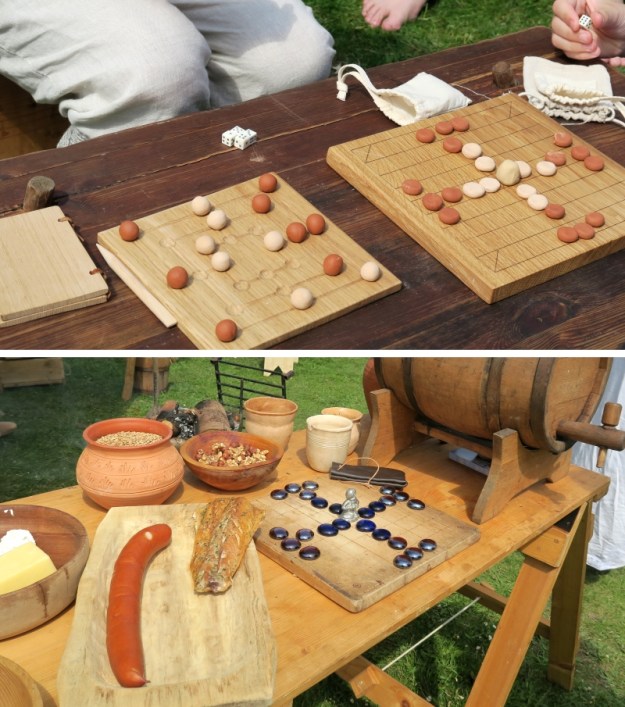
Today was the first day of the fifteenth UK Games Expo.  After the cancellation two years ago and the subdued event last year, it was almost back to normal this year.  On arrival, outside the NEC, there were vikings in their camp, playing Hnefatafl with their visitors.

Hnefatafl
– Image by boardGOATS

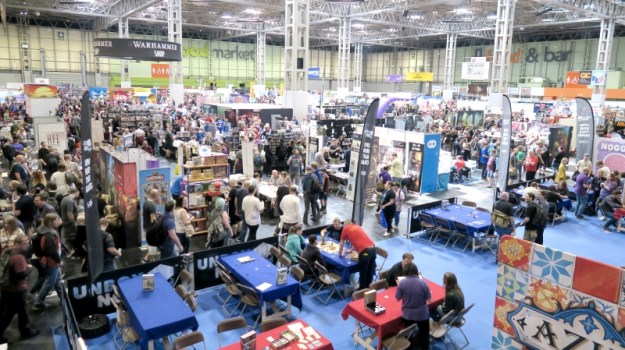
It seems blinging games has been a thing for over a millennia, as the vikings were proudly showing off their pimped out copy.  Inside, the halls were busy, but not overcrowded, though of course this was Friday, traditionally the “quiet day”.

UKGE 2022
– Image by boardGOATS

Just inside the door was the Burley Games stand with a shelf of variants of Take it Easy!—an unwanted reminder of playing games remotely through Teams for eighteen months, albeit as one of the games that worked quite well in that format.

UKGE 2022
– Image by boardGOATS

Nearby was the Oink Games stand, showing off the newly Spiel des Jahres nominated, SCOUT and just round the corner, the staff from the Oxford-based Osprey Games were obviously delighted that their game Cryptid had received a Kennerspiel nomination and were keeping their fingers crossed that it would go one further.

SCOUT
– Image by boardGOATS

Hall One was also the home to Fire Tower, a clever puzzle game with the tag line, “fight fire with fire”.

Fire Tower
– Image by boardGOATS

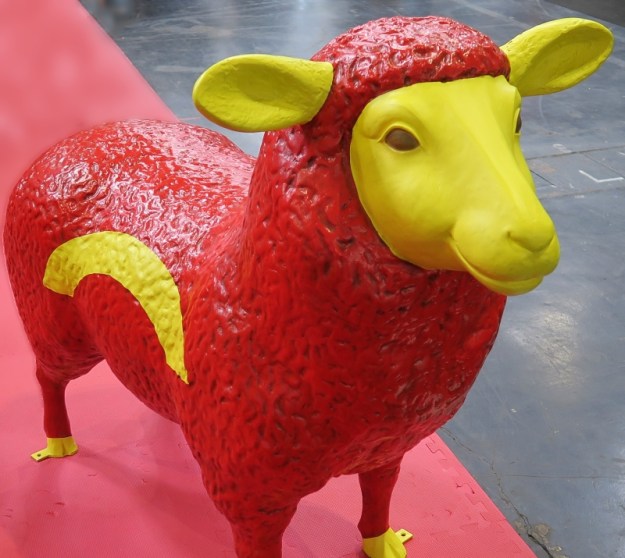
As well as a very smiley sheep from Catan, there were also a lot of designers about, including Tony Boydell, Alan Paul, Andy Hopwood, Bez Shahriari, Rob Harper and Matt Dunstan, all sharing their games and chatting with gamers.

UKGE 2022
– Image by boardGOATS

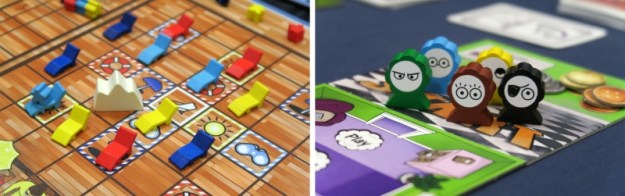
There were a number of interesting little British games, including Daring Dustbunnies and Deckchairs On The Titanic, which were on neighbouring stands, while Surprised Stare were selling a special tribute to the festive weekend called Corgi Dash (based on the 1986 Spiel des Jahres winner, Heimlich & Co.).

UKGE 2022
– Image by boardGOATS

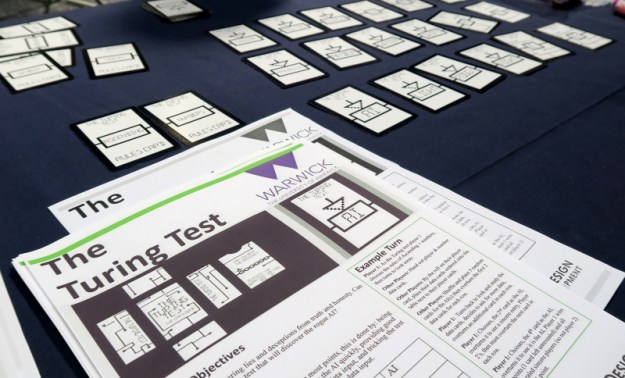
Universities of Warwick, Chester and Canterbury were all present, variously advertising their courses in game design and demonstrating how gaming can be used as a learning device.  One Warwick (IATL) computer science student showed a game he designed to demonstrate the Turing Test and how people are poor at understanding randomness.

UKGE 2022
– Image by boardGOATS

There were also previews of upcoming games.   These included Namiji, a game which has the same theme and uses the same basic mechanic as Tokaido, but increases the complexity with more challenging steps along the way.  Namiji was demonstrated at Essen in 2019, but like so many things, fell foul of the global pandemic in the interim.

Ticket to Ride: San Francisco
– Image by boardGOATS

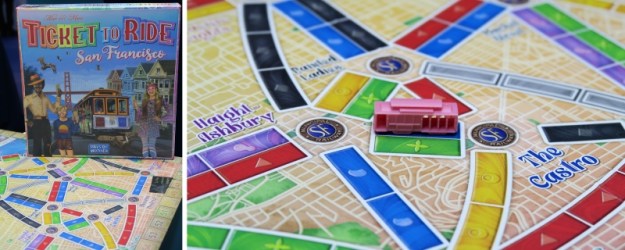
The new Ticket to Ride game which will be released later this year was also available to see and play.  It is based round the city of San Francisco and features street cars and follows the successful format of a new map and a slight rules tweak.

UKGE 2022
– Image by boardGOATS

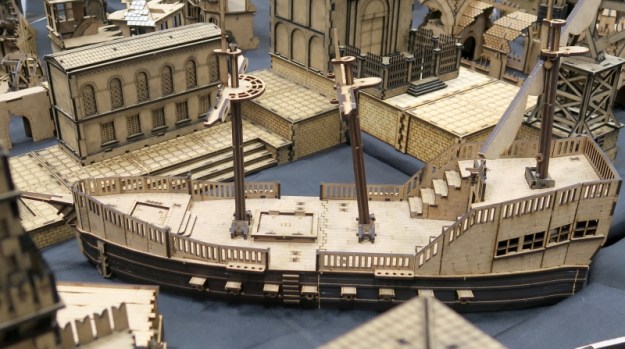
Aside from games, there were also a lot of stands selling books, costumes, props, and scenery—these days, the distinctive aroma of singed wood pervades the aisles of games conventions as an homage to the laser cutter, which is used to make everything from wooden boxes, to houses, coasters and puzzles.

UKGE 2022
– Image by boardGOATS

All in all, the return to face-to-face conventions was a date to remember.  UK Games Expo continues until 4pm Sunday 6th June.