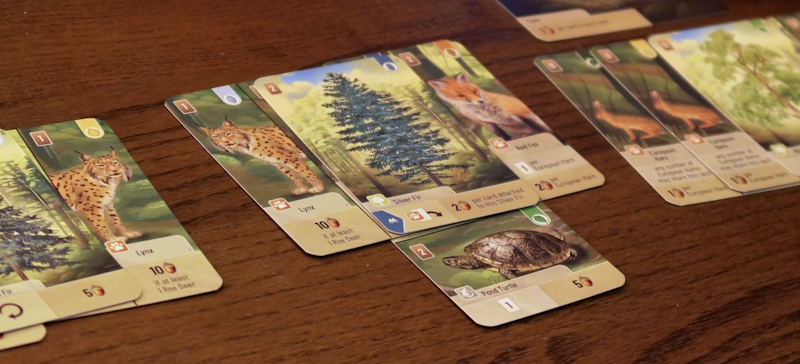
Blue and Pink were still eating when everyone else rolled in and seemed quite content to chat. It took Blue two attempts to get the first game rolling, with Jade leading Cobalt, Crimson and Plum to the other side of the room. Pink moved to join Pine who wanted to play his new acquisition with Black and Purple, which left Blue and Lime to lead Byzantium, Sapphire and Cyan in the “Feature Game“, the Alpine expansion for Forest Shuffle. This is was chosen to mark the announcement of the Spiel des Jahres Awards, as Forest Shuffle, featured on the recommended list and has been popular with the group.
 |
| – Image by boardGOATS |
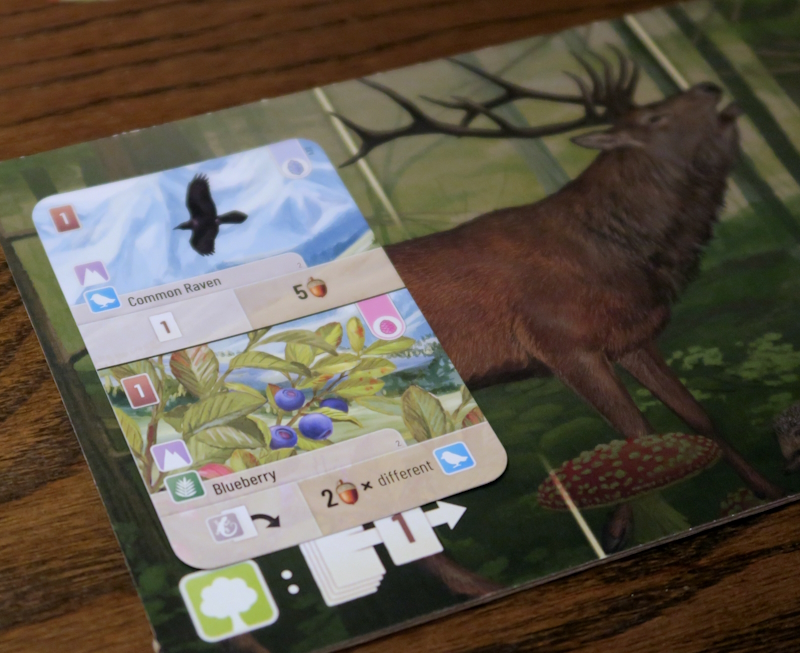
Blue made a bit of a meal of explaining the rules, but really they are very simple. On their turn, players either take two cards from the market and add them to their hand (with a hand limit of ten), or play a card from their hand into their tableau. There are three different types of cards. Tree cards are the central cards around which Critter cards are played. Then there is the first set of Critter cards which are divided into two, left and right with an animal on each half. Finally, there are Critter cards which are divided into two, the canopy at the top and the undergrowth at the bottom. The Critter cards are half-tucked under the Tree cards, so only one animal, flora or fauna is visible.
 |
| – Image by boardGOATS |
The difficult part of the game is getting the cards to work together efficiently to give extra actions and, ultimately, points. The Alpine expansion doesn’t change the game significantly, just adding more variety to the cards, adding more opportunities for scoring. For example, it adds an extra Butterfly which give players more points if they have a complete the set. This time, Blue started with a hand full or Hares, making her initial strategy obvious. Sapphire was less fortunate, so Blue and Lime suggested that starting with Trees was always a good way to go as players can’t do anything without them. He also had some Butterflies, so that was where he went next.
 |
| – Image by boardGOATS |
Lime built up a collection of Birds, and since he advertised his strategy to the group, everyone else was able to take cards he wanted. This is a key part of the game: some cards give points for the number of something you have, so having more of both multiplies the score. For example, Hares give one point for every Hare a player has. Thus, one Hare gives one point, but Blue’s seven Hares mean that first Hare scored seven points. More to the point, every other Hare also scored seven points giving her forty-nine points just for her Hares. Meanwhile, Byzantium was going Bats, and Cyan was experimenting with Deer.
 |
| – Image by boardGOATS |
The game ends when the third Winter card is drawn from the deck, so after the second, everyone got very nervy as they tried to complete all their plans and play all the cards they wanted to. Each time someone drew a card from the deck, it was with bated breath. The final stage seemed to last forever, and although the third Winter card wasn’t the last card in the deck, it was close, and when it was drawn the game ended immediately. And then it was time for the scores: everyone assumed that Blue’s husk of Hares would give her victory, but it was actually quite much closer than they thought. Although Blue finished with a hundred and sixty-five, Byzantium was only twenty points behind.
 |
| – Image by boardGOATS |
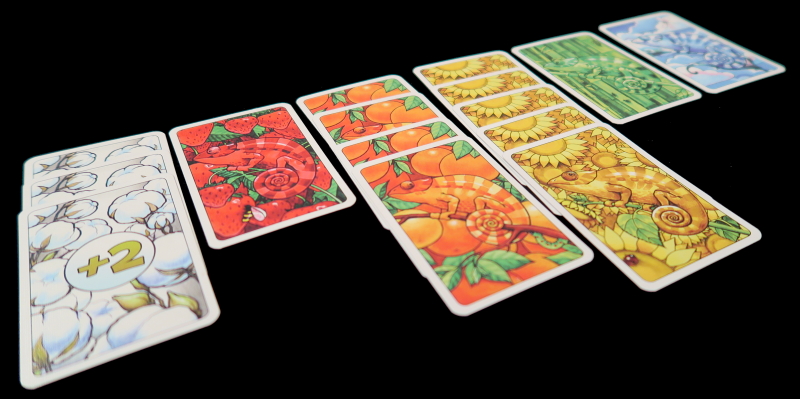
Byzantium was ready to leave, but for everyone else there was just time for something really quick. So as everyone else was still playing, the remaining four decided on a quick game of Coloretto. This is an old game, but one that was on the Spiel des Jahres Award “Recommended List” in 2003. Remarkably, Cyan and Sapphire were new to it, but it is a super easy and quick game to play, but with tactical decisions to make. It is also one that can essentially be taught as you go: either turn over the top Chameleon card and add it to one of the Trucks, or take one Truck. Each Truck can contain a maximum of three Chameleons and once everyone has taken a Truck, the round ends.
 |
| – Image by boardGOATS |
At the end of the game, players score each group of coloured Chameleons, with the largest three groups giving positive points and any others scoring negatively. There are a small number of cards that just give straight points and balancing these with Chameleons is part of the challenge. The end is triggered when the end of game card is drawn and then the round is played to completion. This time, everyone kept their negative scores down, while Cyan went for the pure point cards, collecting fourteen points, more than half his score, by that route. The winner was Lime, however, who was imperious and won by some distance with a total of thirty-three.
 |
| – Image by boardGOATS |
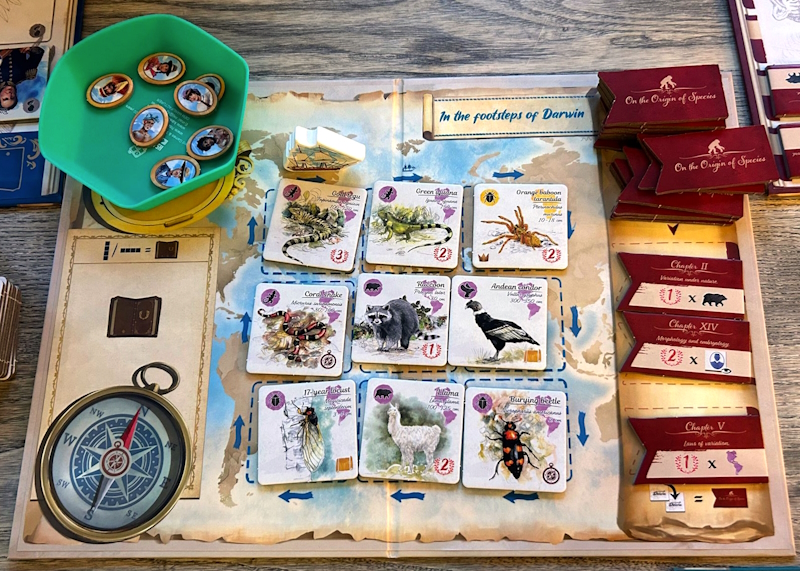
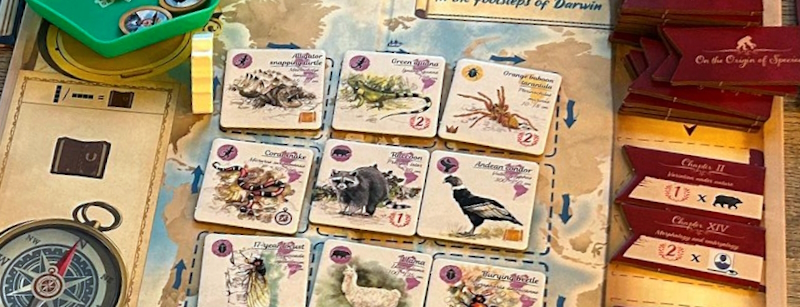
Meanwhile, on the next table Jade was teaching Cobalt, Crimson and Plum the Spiel des Jahres 2024 nominee, In the Footsteps of Darwin. The premise of this is that players are naturalists aboard the Beagle helping Charles Darwin finish his book On the Origin of Species, studying animals, carrying out cartographic surveys, publishing their findings, and developing theories. On their turn, players study an animal or take inspiration from a character by choosing one of the three tiles in the row or column marked by the Beagle, and placing it onto their naturalist’s Notebook. This may be an animal to study or a character from the Beagle’s previous journey and will give an immediate bonus or a scoring bonuses.
 |
| – Image by boardGOATS |
After placing the tile, the Beagle is moved round the market, with the distance dependent on the tile chosen and a new tile is drawn to fill the empty space on the journey board. At the end of the game, the player who contributed the most to On the Origin of Species wins. At it’s heart, In the Footsteps of Darwin is a fairly simple set collection and “make the most of what’s available” game. Players obtain an additional scoring objective when they place a tile on top of a previous one, covering up any icons, so a key part of the game is the conflict between points being gained verses points being lost.
 |
| – Image by boardGOATS |
There’s also quite a bit of luck invoiced, as a player may need one or two specific tiles that don’t come out, or that get taken by someone else before they have the opportunity to do so. The group found it was very quick to play, taking just forty minutes including teaching. Plum’s starting goal was points for tiles in the upper right quadrant, but in the absence of tiles that fitted that criteria she focused instead on collecting Charts and Compasses as these score points equal to the number of these multiplied together.
 |
| – Image by boardGOATS |
One advantage of these is that once a Compass has been collected, the tile can be covered without loosing any points. Cobalt didn’t worry about that at all, covering loads of tiles to get more Theories banners which give points. Ultimately, everyone’s score was pretty similar at the end of the first game but Jade took victory as he was most effective with the Chart/Compass scoring. As it was so quick, the group decided to give it a second try—this the scores all improved. This time the victor was Crimson, who was again the most effective with the Charts/Compasses, but also scored well in other areas, as did Cobalt who came second again.
 |
| – Image by boardGOATS |
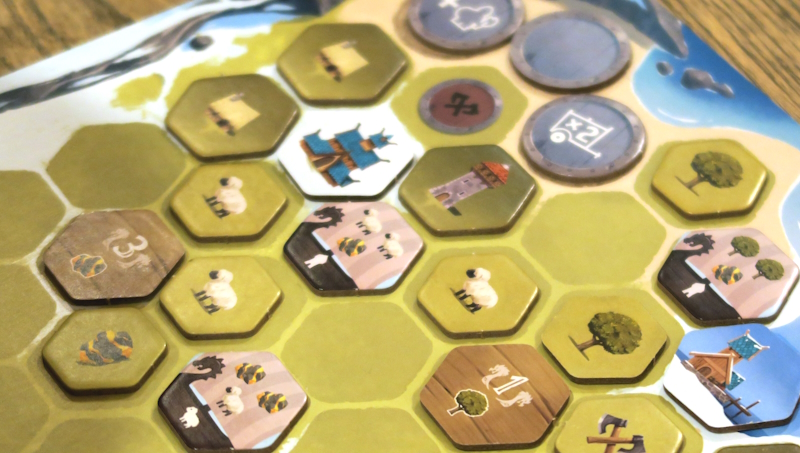
From there, the group moved on to a game of Looot, which is too recent a release to have been acknowledged in the Spiel des Jahres awards. It has been popular amongst the members of the group that have played it so far, however, and may well get an award next year. In this game, players gain points by gathering resources and capturing buildings to try to develop their Fjord, fill their long ships and complete buildings. The winner is the player with the most riches and is crowned Jarl of the Vikings. The game is played over several rounds until each player has played all their Vikings, giving a maximum of thirteen turns, each with a simple structure.
 |
| – Image by boardGOATS |
Players start by placing their Viking on a Resource tile on the central board adjacent to another Viking of any colour. They then take the associated Resource and place it on their personal board. If possible, they then use their Resources to capture a Building and place that on their board, take a Long Ship and also place it on their board, use a Shield, or complete a Construction Site and finally grab a Trophy. Looot is quite a light game, but with enough decision space to be interesting. Last time was a three-player game, but this time, with four, players get another map area, which the group arranged to give a wide play area.
 |
| – Image by boardGOATS |
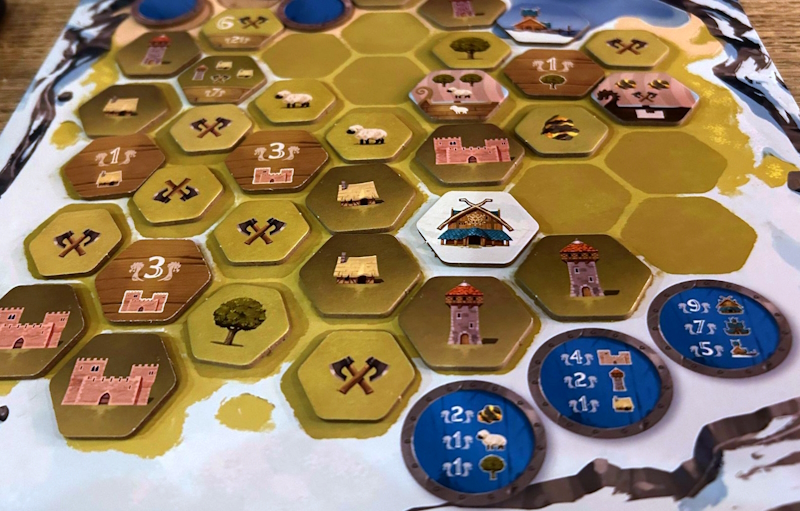
The board layout made it easier to get to more areas of the map relatively early in the game, but there was still plenty of competition for the Towers. Like last time, Plum decided not to worry about all the home tiles and focused on gold, which was good, but not enough on its own. Cobalt scored massively for Castles by getting plenty of them plus the equivalent Long Boats. Cobalt started on that strategy largely by accident, before he had got a real understanding of game-play and a full appreciation of how they increased the Castle scoring and matched the requirements he could fulfill.
 |
| – Image by boardGOATS |
Crimson had a nice balance of increased score for Towers and Houses, while Jade built up a huge pile of Wood. Unlike last time, things didn’t just come together at the end for Plum, and nobody else could compete with Cobalt’s Castles and he took victory with one hundred and twenty-one, fourteen points ahead of Crimson in second. It had been a good game though, and as players become more experienced, they will be increasingly able to determine the best scoring opportunity from the start and how to optimise the mini game that is building their Fjord. With experienced players, this could be quite ruthless with players trying to block each other and prevent objectives.
 |
| – Image by boardGOATS |
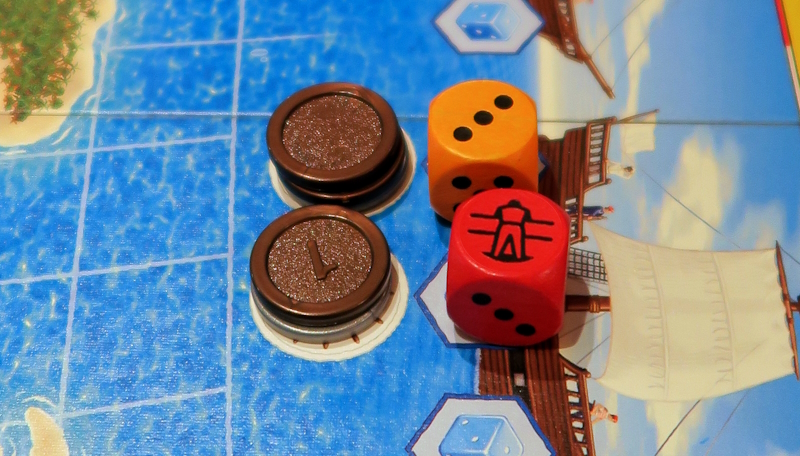
In the third group, meanwhile, Pine was introducing his new acquisition, the old game, Tonga Bonga, to Pink, Black and Purple. This is a sailing race game a bit like the 2008 Spiel des Jahres recommended Jamaica. In Tonga Bonga, players pilot their ship around the archipelago with the goal of visiting four of the five remote islands and returning to Tonga Bonga Bay. Each player has room for three sailors on their ship, each of which represented by dice and indicate how fat the ship will move. At the start of the round, players decide how much they are prepared to pay for the sailors who will serve as their captain and first mate that round (the Cabin Boy always works for nothing).
 |
| – Image by boardGOATS |
Players then simultaneously roll their dice, and take it in turns assign their dice to the other players’ ships, in return for the money offered. In a mechanism vaguely reminiscent of that in the really rather vicious game, Vanuatu, if a player tries to place a higher value die where someone has already assigned a die, the lower value one is displaced and bumped to a lesser and usually less lucrative role. Thus, all things being equal, the ship offering the most money will get the highest value dice and the most moves, though of course, players can work together to disrupt this behaviour. One side of each die has a Seasick Sailor (effectively zero), so the maximum value dice are five.
 |
| – Image by boardGOATS |
Once all the dice have been assigned, players move their ships racing to reach the islands, leaving one of their tokens there. Landing on an island, earns $25 from the bank, but the player has to pay $5 to each player who landed there ahead of them. Pine explained the rules and before long, everyone was sailing. Pink got a bit of a lead by using his winnings to buy more moves and visit more islands. He had been feeling that the game was maybe a bit “broken”, but as is usually the case when a game feels like that, it was all down to the “rules malfunction”, but it wasn’t until the final round that the rules were “clarified”.
 |
| – Image by boardGOATS |
Instead of the winner being the player to cross the line first with any left over money used as a tie-breaker, once a player has visited four islands they return to Tonga Bonga Bay and trigger the game end—and whoever has the most money wins. Pink crossed the line and claimed the moral victory, as he was playing by the original rules. Everyone else was quite happy with the “updated rules” though, which left Pine the victor with Purple in second and Black just behind. Pink blamed “Evil Pine” for the mishap, but was eventually won round with a bottle of dubiously flavoured cider.
 |
| – Image by boardGOATS |
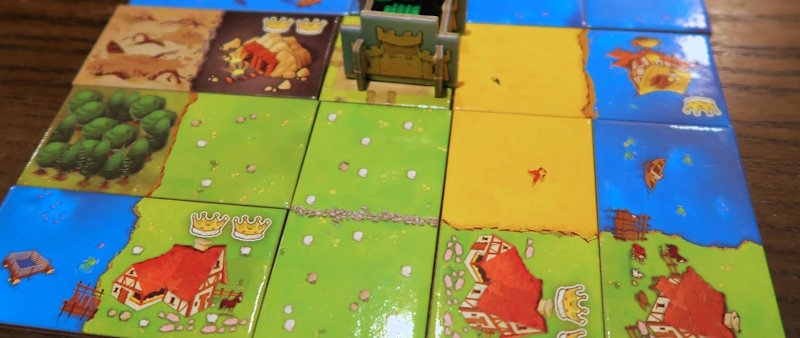
Although the debate had been audible by the players at the neighbouring tables, ultimately it was all taken in good part and the game had been a lot of fun and showed its age less than Lifeboats that was played a few weeks back and was only five years older. From there though, the group moved on to a game of the 2021 Spiel des Jahres winner, Kingdomino. This is a clever little game where players are building a kingdom made out of double-headed, domino-like tiles. As in Dominoes, the ends of the tiles have to match, or at least it has to match with one tile tile already in the player’s kingdom.
 |
| – Image by boardGOATS |
The really clever part of the game is the double market, where the tiles are taken in reverse order of value. The double market means that when a player takes the tile for the current round, they choose which tile they will get in the next round. Thus, taking the lowest value tile this round means they will have first choice next round. Players score for each contiguous area of Terrain—the number of points is equal to the number of squares multiplied by the number of Crowns featuring in it. This time, Pink concentrated on Wheat Fields and Sea, Pine focused on Sea and Meadow while Black concentrated on Woodland with a smattering of points from Marsh, Mountain and Wheat fields.
 |
| – Image by boardGOATS |
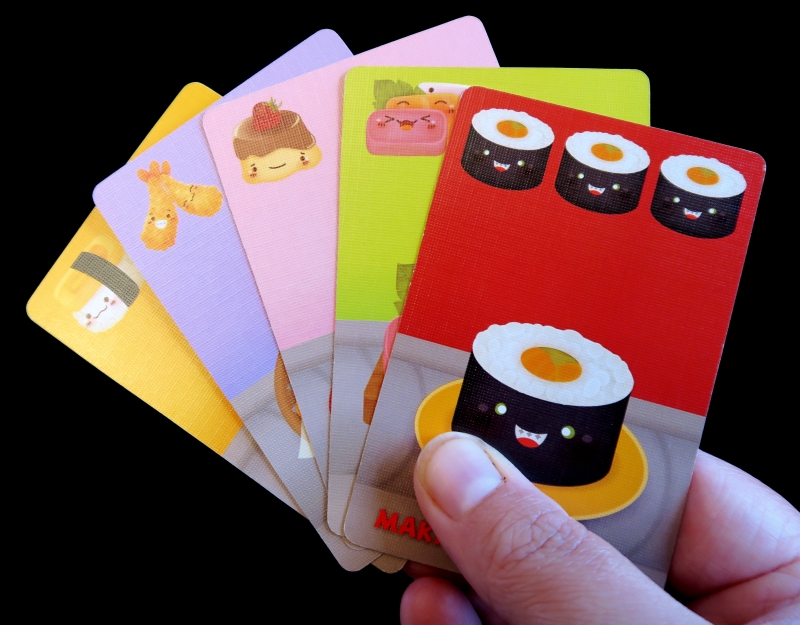
In contrast, Purple prioritised her four contiguous areas forfeiting the “Harmony” and “Middle Kingdom” bonus points for using all the tiles to give a square kingdom with a central castle. Pine took victory with a massive seventy-three with Pink and Black tying for second with sixty points. This group wasn’t done by any means and swiftly moved on to a quick game of Sushi Go!. This is one of those games that takes a mechanism that is a relatively minor part of other games and distills it into its purest form in the game. Coloretto does the same for the central market mechanism used in the 2007 Spiel des Jahres winner, Zooloretto, and Sushi Go! does it for the card drafting mechanism in the 2011 Kennerspiel des Jahres winning game, 7 Wonders.
 |
| – Image by boardGOATS |
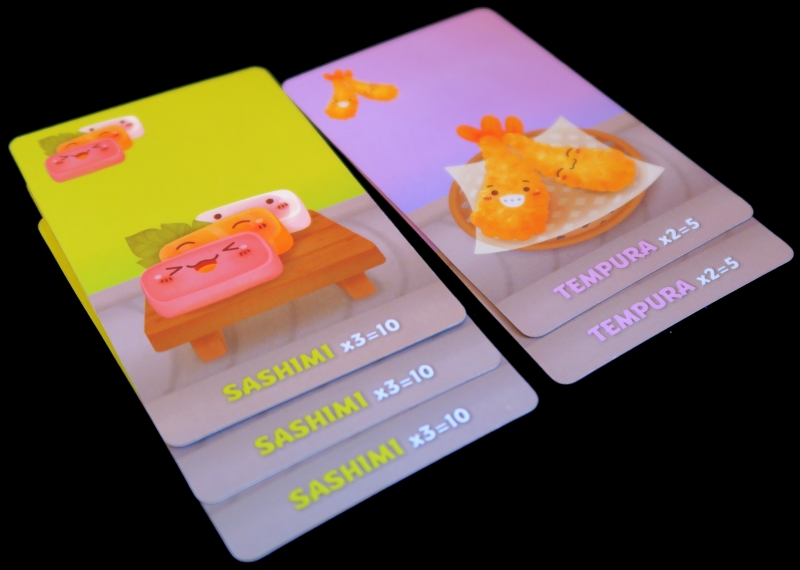
In Sushi Go!, players start with a hand of cards, keep one and pass the rest on, repeating until all the cards have been distributed. As well as being a core mechanism in 7 Wonders, this “Card Drafting” is also often used to try to reduce the luck of the draw at the start of games like Terraforming Mars and Agricola (both also acknowledged by the Spiel des Jahres committee). In Sushi Go!, players are using the card drafting to collect sushi and, most importantly Pudding! The game is played over three rounds, with cards drafted to the left, then right and then left again, scoring points at the end of each round.
 |
| – Image by boardGOATS |
This time, Pink and Black tied for the high-scoring first round, with Pine just behind. Pine made up for it on the second round by taking it convincingly, however, with everyone else scoring very badly. The third round was more even again, this time won by Black with Purple taking second. That resulted in a three-way tie between Black, Pink and Pine, but at the end of the game, the player with the most Pudding cards gains six points, with the one with the fewest losing six points. Unusually for Pink (as he has quite a sweet tooth), he had eschewed Puddings, while Black had the most giving him what ended up being a quite convincing victory.
 |
| – Image by boardGOATS |
There was just time for a single round of Love Letter (a game from the 2014 Spiel des Jahres recommended list). This is a sixteen card game where players start with a card, draw a second and then play one. The idea is to try to be the last play in or the player with the highest value card when the deck runs out. The theme is all about getting as close as possible to the Princess card, which has the highest value. This led to a discussion about real princesses and how close people had been to them. It turns out that Purple has met a real one, Princess Nina who lives in a massive house in Cheltenham. During the game, Pink was the Princess, but was spotted and knocked out, leaving Black to take another win.
 |
| – Image by boardGOATS |
Learning Outcome: The Spiel des Jahres committee may reward lighter games, but they are good games.
/pic1181226.jpg)
/pic1186614.jpg)
/pic1128018.jpg)
/pic1186616.jpg)
/pic1140249.jpg)


/pic1666337.jpg)
/pic1561153.jpg)
/pic1559247.jpg)
/pic1746001.jpg)
 boardGOATS