Author Archives: nannyGOAT

Next Meeting – 2nd April 2013

The next meeting is on Tuesday 2nd April playing shorter games from 7.30pm as people arrive, until 8pm when we will start something a little longer.

The “Feature Game” will be Coloretto, which is a simple card game where players have to collect sets of coloured chameleons.  We played it once before and have chosen it this time because we hope to have some new gamers and it is a very accessible game that is easy for new players to get to grips with.

Coloretto

And talking about chameleons…

One day, a pet chameleon called Jeff fell off a table.  Being only a small chameleon who was easily stressed and the drop being quite large, he got very anxious and needed a lot of calming down.

The next day, Jeff was quietly sunning himself on a window sill, when a dog jumped up and barked giving him a real fright so his owner had to calm him down again.

The day after that was Guy Fawkes’ Night and Jeff heard some fireworks go off outside, so he hid under the table and it was midnight before his owner could calm him down and coax him back out.

The following evening Jeff got all worried when his owner was a bit late feeding him and he needed to be calmed down before he could be fed.

About a week later Jeff got stuck in the back of a cupboard and was all alone for a few hours and it was dark and scary, so, once he’d found him, his owner need to calm him down again.

Yesterday Jeff fell off a table again, but these days he’s a calmer, calmer, calmer, calmer, calmer chameleon…

19th March 2013

It was another quiet night as work intervened for many of us.  So first up was the “Feature Game”, Carcassonne.  This is one of the classic “modern” games where players lay tiles and play “Meeples” to score points.  Since the new gamers were unable to come, we played “nasty” rather “friendly”, with one player who kept getting road junctions and another who got all the got city ends!  It was a very close game that went twice round the scoring track and ended with only five points between first and last place.

Carcassone

The second game we decided to go with was Hamburgum which is a game set in Hamburg during the seventeenth century where players produce beer, sugar and cloth and sell them overseas. They compete for the best sites for their buildings and the best berths for their ships in the harbour, but ultimately they vie to make the most prestigious church donations, because only prestige decides the game. The game is almost completely luck free as it has no cards or dice and the actions are selected by your position on a carousel or roundel.

The game started quite slowly, until we realised we could build more than one building at a time, so, it took a while for the first church to be completed with all five donations.  The second was slightly quicker, but once we completed the third, the rest followed very quickly and the race round the roundel was on to get goods turned into money and then into resources to make the final donations to the prestigious last church. The margin of victory was much larger for this game than Carcassonne, but with about twenty-four points on that last church, the result could have been much closer.

Hamburgum

Learning Outcome:  When it comes to resources, “few but often” sometimes goes further than “lots but rarely”.

Next Meeting – 19th March 2013

The next meeting is on Tuesday 19th March playing shorter games from 7.30pm as people arrive, until 8pm when we will start something a little longer.

The “Feature Game” will be Carcassonne, which is one of the classic “modern” games where players lay tiles and play “Meeples” to score points.  We chose this game as it is we hope to have some new gamers and this is a very accessible game that is easy for new players to get to grips with.  Equally, if the new players are unable to come, it can be a fairly quick game and played “nasty”…

Carcassone

And talking about tiles…

A builder was talking to his assistant Jeff, “I have a question for you Jeff.”

“OK,” replied Jeff, “What is it?”

“We’ll,” says his boss, “What’s the difference between a tile and a crocodile?”

Jeff, who hates riddles, sighed and rolled his eyes.  “I don’t know,” he answered, “What IS the difference between a tile and a crocodile?”

“That answers that question then,” says the builder, “I guess I’d better not send you to the hardware store!”

We Play “Second Generation Games”

The BBC really seems to have picked up on boardgaming recently:  in January, BBC Breakfast reported a rise in game sales over the Christmas period and now You and Yours on BBC Radio 4 are getting in on the act.  The report interviewed Joe Jaques (from Jaques of London) and Steve Buckmaster (from Esdevium Games).  It is a nice article that explains the rise of “Second Generation Games” including Carcassonne, Settlers of Catan and Ticket to Ride and discusses their origin and how many of these games have iOS versions that have led to increased interest in the real thing.  The 5 minute article starts 22 minutes and 45 seconds into the program and is available from the BBC website.  There is also an online write up in the business section of the BBC Website.

BBC Radio 4

5th March 2013

Since people were there nice and early, we started off the evening with a quick game of Turf Horse Racing.  This is a clever little game where players bet on horses, but the return depends not only on the place and the “stake”, but also the number of people who bet on the horse.  Thus, if several people backed the same horse, the return would be a lot lower than one which only one player bet on.  Nobody backed Raven Beauty, but even it did better than Roamin’ Emperor who might as well have had three legs.  Up front however, the race was quite tight with Mosstown Boy making a mad dash for the line only to run out of steam and lose to Lagoon Lady, Red Baron and Silver Blaze.

Turf Horse Racing

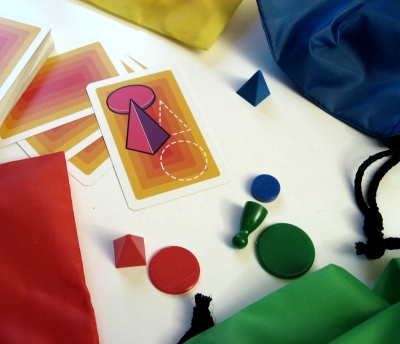
Next we played the “Feature Game” which was Nollkoll (aka Speedybag), which is another quick, fun game, but was universally agreed to be the most stressful game any of us had ever played.  Basically, players turn over a card which has a shape on it and players have to feel in their bag and pull out a matching small plastic shape.  The first wins the card, the person with the most cards at the end wins.  It was a tight game, but oh soooo stressful!

Noll Koll

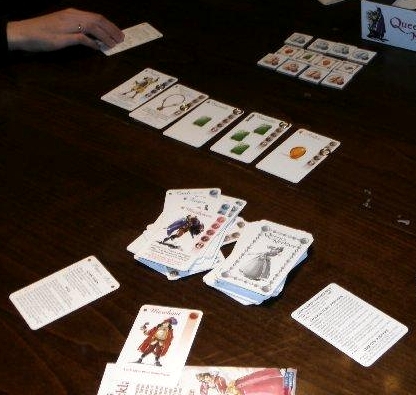
Then it was Queen’s Necklace.  We had one player who was new to it, but the rest of us played it a few weeks ago, so revisiting it was nice as it meant we could use what we had learnt the first time.  It was a much closer game this time with one round really making the difference between first and second place.

Queen's Necklace

Our fourth game of the evening was Coloretto, which strangely was new to most of us, though it is a well known game.  Play is very simple:  you can either draw a card to add to a “truck”, or take one of the “trucks” and add the cards in it to your collection to make sets of different colours. Each “truck” has a maximum of three cards and only the largest three sets score points with any others scoring negatively.  It is a fun little game closely related to Zooloretto, and in many ways much better as you don’t get side-tracked by cute fluffy animals, barns and vending stalls.

Coloretto

Finally we finished off with our old favourite, Bohnanza (known within the group as “The Bean Game”).  Since we all knew this one very well, we just checked the specific details for player numbers and launched straight into a game.  Unfortunately, the deck hadn’t been shuffled very well before it was put away, so the first time through the pack was a little strange, but we sorted that out for the second time through.  It was another tight game, but the “Queen of Cards” won by one card giving her a hat-trick for the evening.

Bohnanza

Learning Outcome:  Shuffling is a skill we all need to improve.

Next Meeting – 5th March 2013

The next meeting is on Tuesday 5th March playing shorter games from 7.30pm as people arrive, until 8pm when we will start something a little longer.

The “Feature Game” will be Nollkoll (aka Speedybag), which is a quick, fun game where players have to feel in their bag and match small plastic shapes with the pictures on a card.  We chose this game as it is similar to one of our most frequently played fillers, Dobble and we would like to play something a little more substantial that would depend heavily on who comes along (possible games include, AgricolaVillage, Niagara, Mystery of the Abbey, Vasco da Gama, Keyflower and Snowdonia).

Noll Koll

And talking about bags…

A little paper bag was feeling unwell, so he took himself off to the doctors.

‘Doctor, I don’t feel too good,’ said the little paper bag.

‘Hmm, you look OK to me,’ said the Doctor, ‘But I’ll do a blood test and see what that shows.  Come back and see me in a couple of days.’

The little paper bag felt no better when he got back for the results.

‘What’s wrong with me?’ asked the little paper bag.

‘I’m afraid you are HIV positive!’ said the doctor.

‘No, I can’t be – I’m just a little paper bag!’ said the little paper bag.

‘Have you been having unprotected intercourse?’ asked the doctor.

‘NO, I can’t do things like that – I’m just a little paper bag!’ he replied, quite distressed.

“Well, have you been sharing needles with other intravenous drug users?’ asked the doctor.

‘NO, I can’t do things like that – I’m just a little paper bag!’

‘Perhaps you’ve been abroad recently and required a jab or a blood transfusion?’ queried the doctor.

‘NO, NO, I don’t have a passport – I’m just a little paper bag!’

‘Well,,’ said the doctor, ‘are you in a homosexual relationship?’

‘NO! I keep telling you I can’t do things like that, I”M JUST A LITTLE PAPER BAG!’

‘Then there can be only one explanation,’ said the doctor. “Your mother must have been a carrier.’

19th February 2013

Most people had arrived by about 8pm, so we started off with the “Feature Game”, For Sale. This is a quick, fun game consisting of two rounds: in the first players buy properties by auction; in the second they sell them again for the greatest profit possible.  There were the usual mix of bad calls and lucky gambles, but the win was well deserved.

For Sale
– Image by BGG contributor 4100xpb

Since one of the players had to leave early, we decided to have a quick game of Incan Gold before she left. This is one of the first games we played back in October last year and is a light, “push your luck” game.  The idea is that players are exploring a mine collecting treasures as they go, but if the mine collapses before they get out, they loose everything.  Another run-away victory and, since she had won both games, the winner decided it was definitely time to leave and give the rest of us a chance…

Incan Gold
– Image used with permission of BGG contributor mikehulsebus

So we all moved on to another bidding game, called The Speicherstadt.  This is an interesting game set in post-Hanseatic League Hamburg.  At its heart, it has a curious auction mechanic where players take it in turns placing markers to indicate which contract, ship or firefighter cards they would like.  The first person to declare an interest in a card then has first refusal, but the cost is proportional to the total number of people interested in the card.  If the first player decides it is too expensive, then the card offered at a discount to the other players in the order they declare their interest; the later the player, the larger the discount.  Although it wasn’t obvious a the time, this was won by a massive margin based on collecting the Counting Offices, fulfilling a couple of lucrative contracts and an unhealthy interest in fire-fighters…

The Speicherstadt
– Image used with permission of BGG contributor henk.rolleman

The final game of the evening was Fleet.  This is another game that we hadn’t played before and also had financial management at its heart albeit with a fishy flavour.  Each round starts with players bidding for fishing licenses.  As well as allowing players to launch boats corresponding to the license type, they also provide their owners with a handy bonus.  Cards are multipurpose, as they can be played as boats, captains or used as currency. This game was also won by a large margin, appropriately by the fisherman with by far the largest fleet of boats.

Fleet
– Image by BGG contributor mattmill

Learning Outcome:  Sometimes an interest in men in uniforms helps, although girls always love a sailor.

Cat in Monopoly Box

Monopoly is always being updated and new versions released.  For example, last year Winning Moves/Bletchley Park announced that a special edition to commemorate the life of Alan Turing was to be released. In this edition, the board’s London landmarks, and its Community and Chance cards, have been swapped for places and events important in Turing’s life and players can move their pieces from his birthplace in Maida Vale to Hut 8 at Bletchley Park.  Alan Turing is undoubtedly one of technology’s heroes — a mathematician and codebreaker who laid the foundation for today’s computing age, and 2012 was the 100th anniversary of his birth, but what is the connection with Monopoly? 

Turing Monopoly
– Image of unknown origin

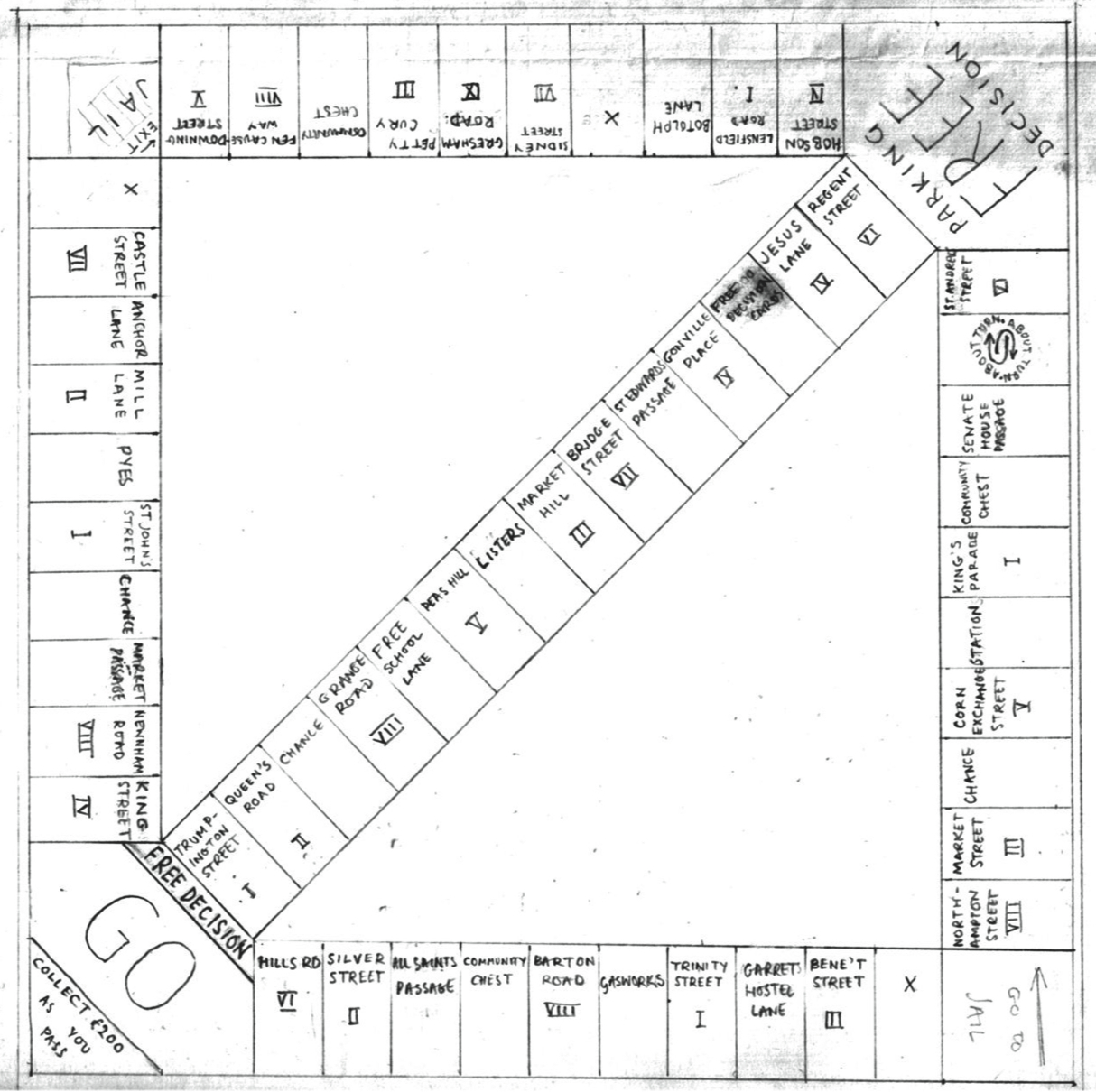
Well, it turns out that he once played a hand made copy made by William Newman (the son of his mentor Max Newman).  According to the booklet that comes with the set, “One afternoon the Newman household phone rang, with Turing on the other end, asking to speak with William. ‘Did he have a Monopoly board?’ Alan asked, and on hearing that he did, raced round. Turing’s mind was fascinated with codes, and there have long been suggestions he thought there were code-based tactics to playing Monopoly to ensure success. Alas, the hand drawn nature of William’s board (not to mention the unique diagonal straight and ‘turn around’ square) proved otherwise, and the great mathematician was beaten.

CAT-an!
– Image by boardGOATS

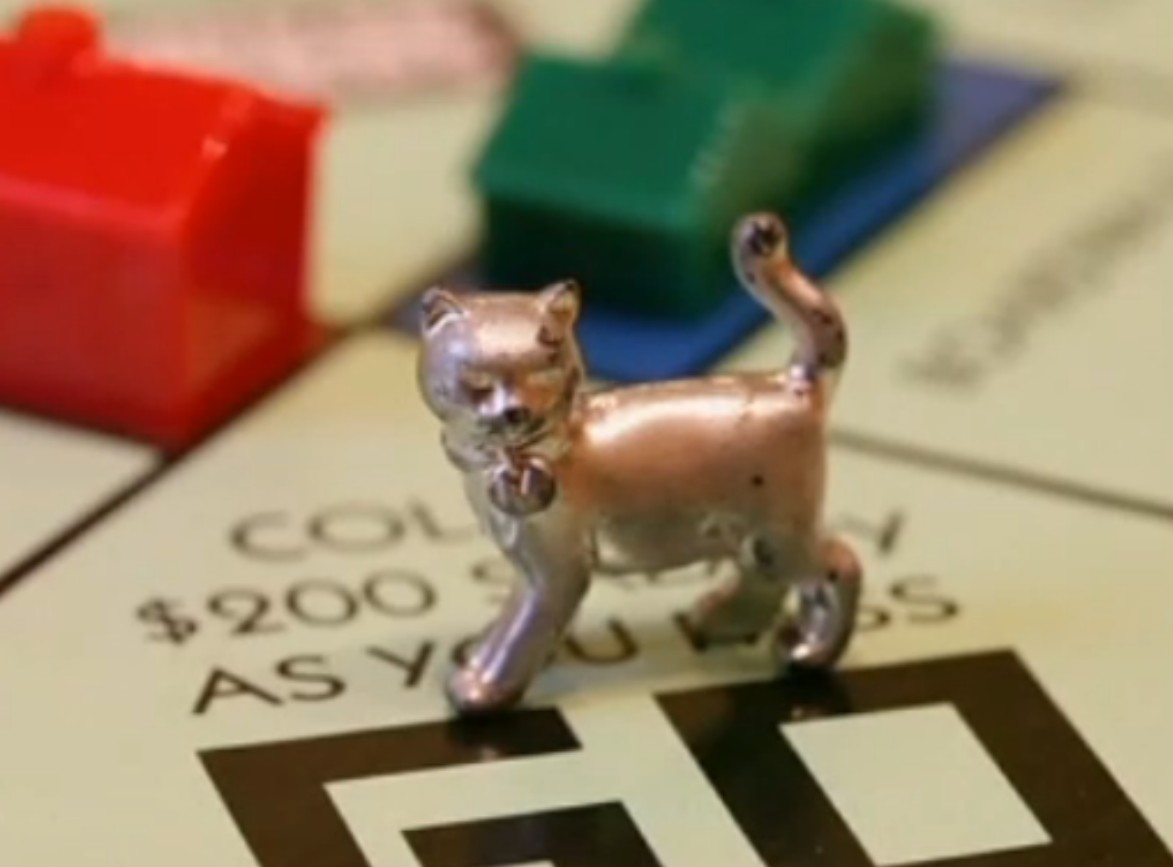
The connection between Alan Turing and Monopoly may seem tenuous, but in contrast, the way cats have a penchant for sitting in game boxes is well known to all gamer-cat-owners – there is even a game called “The Settlers of CATan”!  Thus, it should come as no surprise that, following a month long poll by Hasbro, the cat has beaten off competition from a robot, a helicopter, a diamond ring and a guitar.  The new cat design received 31% of the total vote and will replace the iron in the next edition which will be released later this year.

So now every Monopoly box will come with its own cat!

Monopoly Cat Token
– Image of unknown origin

Next Meeting – 19th February 2013

The next meeting is on Tuesday 19th February playing shorter games from 7.30pm as people arrive, until 8pm when we will start something a little longer.

Since we didn’t play it last time, the “Feature Game” will be For Sale, which is a quick, fun game about buying and selling real estate, where players first bid for several buildings then, after all buildings have been bought, sell the buildings for the greatest profit possible.  We chose this game as we would like to play something a little more substantial that would depend heavily on who comes along (possible games include, Village, Niagara, Mystery of the Abbey, Vasco da Gama, Keyflower and Snowdonia).

For Sale

And talking about selling things…

A door-to-door vacuum cleaner salesman manages to bully his way into a woman’s home in a rural area.

“This machine is the best ever,” he exclaims, whilst pouring a bag of dirt over the lounge floor.

The woman says she’s really worried it may not all come off, so the salesman responds, “If this machine doesn’t remove all the dust completely, I’ll lick it off myself.”

“Do you want ketchup on it?” she says, “We’re not connected for electricity yet…”

5th February 2013

It was another quiet night this week, but the landlady of the pub commented that February is the worst month for them, so maybe it’s catching.

The first game up was Race for the Galaxy.  This is a card game where players build galactic civilizations by playing cards that represent worlds or technical and social developments. Some worlds allow players to produce goods, which can be consumed later to gain either cards or victory points and other worlds or developments have bonuses that help players manage their hand or build more efficiently.  At the beginning of each round, players secretly and simultaneously choose roles, then each player has the opportunity to the action associated with the roles.  The iconography on the cards takes a little getting used to, and some of the players were unfamiliar with the game so we used pre-set hands.  The game was tight with only five points between first and last place and the Produce/Consume strategy giving the win.

Race for the Galaxy

We decided to save the “Feature Game” for next time, so instead, we played Queen’s Necklace.  This is another card game  (maybe we should be renamed “CardboardGOATS”?!?!)  where players buy gem-stones and then try to win the right to sell them.  There are two key things about this game:  firstly, if a card is not bought by the first player, it’s value decreases for the next player, so the longer they hang about the cheaper they are to purchase.  Secondly, when it comes to selling, each gem has an intrinsic value, but the amount the seller gets will also depend on availability, so if everyone tries to sell a valuable gem, the seller may not get as much as the person who won the right to sell a less valuable gem.  In addition to gems, players can also buy character cards which allow players to inspect another’s hand, steal a card, sell an extra gem etc.  This game was not as close as Race for the Galaxy though the eventual winner was the same.

Queen's Necklace

Learning Outcome: It’s always just when you have managed to build a really efficient victory point engine that someone ends the game.