Author Archives: nannyGOAT

15th October 2019

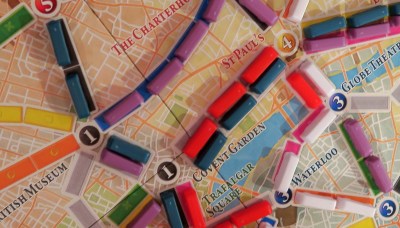
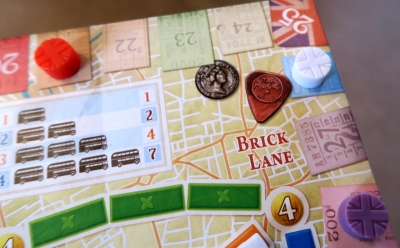
With food and Ivory both a little delayed, the “Feature Game”, Tapestry was starting to look a bit doubtful. Ivory and the food both arrived eventually though, and Burgundy made haste with his ham, egg and chips while everyone else decided what they were going to play.  To fill in time while the eaters ate, everyone else decided to squeeze in a quick game of Ticket to Ride: London.  This version of Ticket to Ride is reduced in size and is designed be quicker to play, which certainly proved to be the case.  The game play is very similar, however, with players taking it turns to draw coloured cards or use them to place pieces, but in this version the Train pieces are replaced by Routemaster Buses.

Ticket to Ride: London
– Image by boardGOATS

Although it is still high quality, the board is also smaller than in the full-sized versions, the players have fewer pieces and a maximum of four can participate.  As usual, players also start with a selection of ticket cards and successfully fulfilling these give more points, but woe betide any player who fails to complete a ticket as the points become negative, which can be very costly indeed.  In addition to these features, this new light version of the game also gives bonus points to players who manage to connect all the locations in an area. Not large numbers of points, but in a tight game it can make all the difference. And these games are often quite tight…
Ticket to Ride: London
– Image by boardGOATS

Players started placing Buses very early in the game, and it wasn’t long before it became clear that everyone was trying to claim routes in the same “south of the river” area.  Although Ivory eventually extended to the east, Lime broke ranks first and claimed a north west route.  Pine completed his routes early and went for more tickets a couple of times. Then before we knew it, the game was over as Ivory placed his last bus.  Placed Bus scores had Ivory way out in front as he had several of the long, four-bus routes, while Lime brought up the rear as he had been claiming mostly two-bus lengths routes.

Ticket to Ride: London
– Image by boardGOATS

So it was looking like a bit of a “slam dunk” for Ivory.  Everyone had managed to complete an area or two and pick up the associated bonuses, but Ivory had actually managed to get the four point area with all his long routes in the east.  When the completed route scores were added in, Pine just pipped Green, but unfortunately for Lime he had failed complete his longest route causing him to lose eleven points.  The clear winner was Ivory though, and managing to complete three high scoring routes just increased his already substantial lead giving him a dominant win.
Ticket to Ride: London
– Image by boardGOATS

With food just about done and the first game coming to an end, there was some debate who would play the “Feature Game”, Tapestry.   This is the hot new game from Jamie Stegmaier, designer of Scythe and producer of Wingspan, so everyone knew what they were getting – amazing production values in a very solid game. In this case, the game is quite simple in terms of the number of rules, however, they combine together to make a much more complex game.  The idea is that on their turn, the active player simply either pay resources to progress their civilisation in one of the four directions (Science, Exploration, Military and Technology) and carries out the associate action, or they start a New Era for their people and collect Income.  It is how these apparently simple options interact that leads to a complex and deep game however.

Tapestry
– Image by boardGOATS

The game is played over four Eras, with each player book-ending their game with an Income phase.  Players choose when to take their own Income phases which has the unusual consequence that Civilisations can be in different Eras and even finish at very different times.  Advancing their Civilisation can have a wide range of consequences because each step along the four tracks is different and, in general, the further along the tracks the more powerful the action is.  For example, in the early stages of the game, a player taking the explore action might be able to place a tile on the central player board, which later may enable them to expand the are they control.  Later in the game, however, a player who reaches the end of the Explore track can move away from terra firma and explore Space, which can be very lucrative.

Tapestry
– Image by boardGOATS

After the usual debate over who was going to play, Black joined the inevitable trio of Burgundy, Blue and Ivory.  The game is asymmetric, so each player’s civilisation has a different special power. For example, Ivory’s civilisation, “Leaders”, were to allow him to progress along one of the tracks at the start of each Era.  Black’s “Merrymakers” also granted a bonus at the start of each Era, but this time it’s according to three private progression tracks; the further up a track that the Merrymakers move, the more potent the benefit they receive.  The bonus received by Burgundy’s “Chosen” would depend on his position on each of the four technology tracks at the start of each Era: where there were no players in front of him, he would pick up victory points equal to the number of other players in the game (three in this case).

Tapestry
– Image by boardGOATS

Not all civilisations give advantages during the income phase, however.  For instance, Blue’s “Isolationists” gave her an advantage when colonising.  The game features a central board which represents the colonies’ territories.  At the start of the game, the colonies are well separated by unexplored land.  The Explore action generally enables players to take tiles from the supply (though some are provided as part of the Income phase), and place hexes on the map next to territory they control.  When carrying out a Military action, players can take control of a neighbouring, explored hex, by placing one of their coloured markers on it.  If the tile is already occupied, it can be “attacked” with the second player simply placing one of their markers and tipping over the defeated player’s marker.
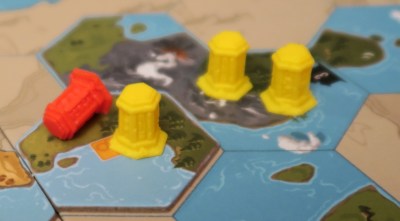
Tapestry
– Image by boardGOATS

Each hex can hold a maximum of two pieces, so there is no come-back.  In general, players are also not able to place a second marker as a defense.  This means that players are naturally reticent when it comes to expanding and controlling the border regions as expanding can leave their border regions vulnerable by providing a path for the opposition to attack.  The Isolationists colony helps to prevent this by enabling the player to place a second marker on a small number of occasions.  Occupying territory is one way of scoring points.  Another is by improving a civilisation technologically.  This is done by taking orange Technology cards.

Tapestry
– Image by boardGOATS

Technology cards give no immediate advantage, but they give a bonus when they are upgraded, either as part of the Income phase at the start of an Era or as an action.  They also give points during the Income phase, but the number of points depends how developed their Capital is.  Each player has a personal play area that includes a Capital City board as well as an area to place their Technology cards, a space at the top to store buildings and the Tapestry Cards that give the game its name.  There are four types of buildings which start the game placed on four tracks that roughly correspond to the four types of advancement and yield resources: Markets (yellow), Houses (grey), Farms (brown) and Armourers (red).
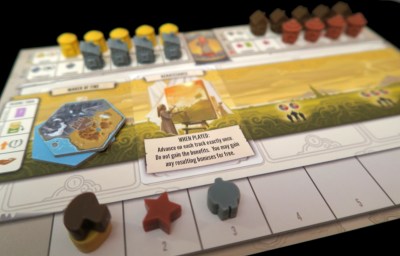
Tapestry
– Image by boardGOATS

During the game, the buildings are moved to the players’ Capital Cities, revealing bonuses that the player will get during the forthcoming income phases.  These bonuses include resources (money, people, mushrooms and power), but also victory points, additional terrain hexes, Tapestry cards and scoring multipliers.  These multipliers are critical:  players score points for the number of Technology cards, the size of the territory they control on the central map, and the number of completed rows and columns in their Capital.  The more buildings a player moves to their Capital, the more of these multipliers are revealed and the more points a player gets.

Tapestry
– Image by boardGOATS

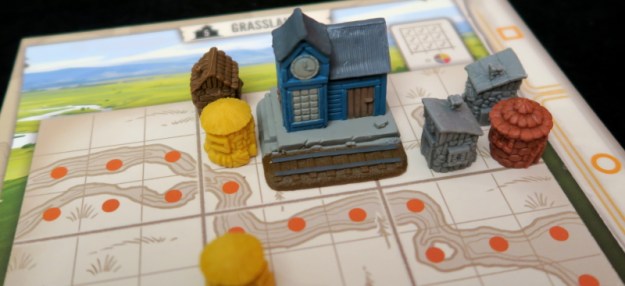
In addition to their personal buildings, players can also enhance their cities with large buildings which are awarded to to the first player to progress onto certain spaces on the development tracks.  These special buildings are wonderfully over-produced and come pre-painted, really adding to the appearance and feel of the game.  As they are only space fillers, there is no question – they could certainly be replaced with simple card tiles and would have been had the game been produced a few years ago.  This is not a deluxe edition however; the added “bling” comes as standard and elevates the feel of the game above the ordinary (and unfortunately,  elevates the price too).  Unfortunately, these sculpts have very rounded corners which makes it a little hard to see what space they cover during play.  They are really gorgeous though!
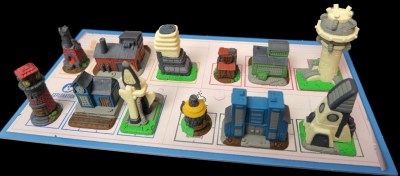
Tapestry
– Image by boardGOATS

The key to the game is probably the resources though as progressing along the four development tracks, Science, Exploration, Military and Technology need to be paid for.  The price increases the further up the track the player gets as well, so running out of resources largely dictates when players will choose to start a New Era.  That said, if a player moves into a New Era before their neighbours, they get additional resources which can be just enough to encourage players to move on early.  Although it is clear that resources are important, the winner is likely to be the player that best leverages the advantages from their Civilisation.  Like all good engine builders, however, there are always more things to do than resources available.

Tapestry
– Image by boardGOATS

The game started slowly, with Blue taking an early lead largely thanks to her Civilisation giving her points as she explored and expanded her territory.  She was up against Ivory though, who was also progressing along the expansion track, though his progress was accelerated by his use of the Science development.  In the early stages of this development track the action is to move one space along another track dictated by by a roll of the Science die, but without taking the action.  This has the advantage of accelerating development (moving two spaces instead of one per turn), which increases the likelihood of obtaining the beautiful, big, special buildings and consequently makes filling rows and columns in the Capital easier.

Tapestry
– Image by boardGOATS

This is at the expense of increasing the cost of actions earlier in the game, on the other hand, the actions become more powerful and are therefore worth the price provided that the player can make the most of them.  One additional consequence of Ivory making an early dart up the development tracks was the damage it did to Burgundy.  Burgundy’s “Chosen” Civilisation gave him three victory points equal for every track he was ahead on.  Ivory’s rapid progress, increased by the power of his “Leaders” Civilisation, essentially annulled Burgundy’s “advantage”.  Burgundy’s game was further stymied by his struggle to get resources to move things along, a problem that only got worse as the game progressed.
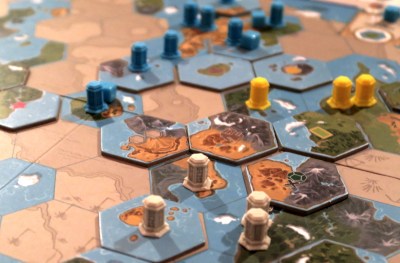
Tapestry
– Image by boardGOATS

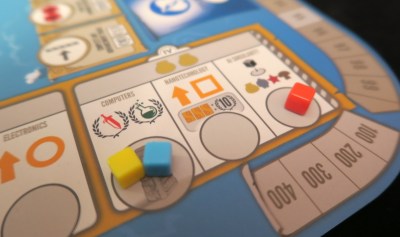
As a result, Burgundy turned to Technology cards, but it took a while to get this alternative approach going.  Black meanwhile, kept things simple, concentrating on making the most of his Merrymakers and trying to expand to the centre of the map first.  In this, his life was made difficult by being sandwiched between Blue and Ivory who squeezed his options.  Blue made it to the middle first, and used her special power to prevent anyone else taking it from her and picking up the points for getting there second.  Black made good use of his Trap cards which he initially kept in case he was attacked, but then used instead of Tapestry cards to give him points.
Tapestry
– Image by boardGOATS

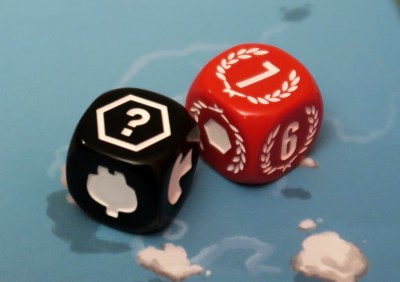
He started slowly as he built his engine, but it wasn’t long before Ivory started to edge in front.  By the third era, he really started to push forward, Blue gave chase, but she was always chasing and when Ivory launched his Civilisation into space, the writing was on the wall.  He didn’t quite manage to lap the players at the back and so spared their blushes, but he wasn’t far off, finishing with a very creditable one hundred and eighty-five points.  It is clearly a game that needs multiple plays to understand and get the best out of, and everyone could see its potential, although Burgundy felt some of the Civilisations were more powerful than others.
Tapestry
– Image by boardGOATS

Meanwhile, on the neighbouring table, the others decided to play an old favourite,  Jamaica.  This was new to Lime and although Pine had played it once before, he couldn’t remember it.  The game is a pirate-themed tactical race with beautiful artwork and quality pieces, where the winner is the player who best balances their position in the race with success at generally being a pirate doing piratical things. Each player always has a hand of three cards, and a personal board depicting the five “holds” of their ship, into which goods can be loaded during the game. Each round, one player is designated as “Captain” and rolls two dice, examines their cards, then announces which die will correspond to the “day” and which to the “night”.

Jamaica
– Image by BGG contributor verminose

Each player then simultaneously selects and places it face down in front of them.  Each card has two symbols on it (corresponding to “day” and “night”). The symbols indicate either ship movement (forward or backward) or the loading of a type of goods.  The cards are then revealed simultaneously and resolved clockwise one by one, starting with the Captain. When it is a player’s turn to resolve their card, first the “day” part, then the “night” part, multiplying the number of pips on the appropriate die by the  icons on the card to either move forwards (or backwards) by a given amount, or to load goods.

Jamaica
– Image by BGG contributor verminos

When they take goods (gold, food or gunpowder), Players must have space to store them.  If they do not, they must throw the contents of one hold (containing something different) overboard.  When moving, players pay depending one the space they finish on:  on a deep sea space the cost is food; in a port they must pay doubloons.  At a pirate’s lair, the player can take a treasure token and draw a treasure card, (which can be good, or “stinky”, “cursed” treasure), and if they are sharing the space with another pirate ship, they must fight.

Jamaica
– Image by BGG contributor verminose

Battles are resolved with the attack die, but the attacker rolls first and adds to their total by discarding gunpowder. The defender then dies the same, though if either player rolls the special “star” it counts as a direct hit and that player wins outright and can take one holds worth of goods, a treasure card, or give away some “cursed” treasure.  The game end is triggered when a player’s ship reaches the finish line, after completing one circuit of Jamaica when players receive different amounts of gold depending how far they were from the finish line when the race concluded. This is added to any gold gathered along the way  and the player with the most total gold is declared the winner.

Jamaica
– Image used with permission of boardgamephotos

The race started very slowly (as is often the case) as players stayed in Port Royal and stocked up, but then everyone started moving forwards (and backwards) and fights very quickly broke out. With Gold and food changing ships and ships moving forwards and backwards, or in Green’s case, backwards and forwards: he crossed the finish line from the wrong direction – but no, he couldn’t win that way!   Pine was the first one to claim a treasure and then a second;  the map card enabling him to have an extra card in his hand to choose from, not that seemed to help him:  he still complained that he had poor choice of options. Lime was next, and then followed a period when everyone ended up attacking each other, so much that at least one player ended up in two battles during the same morning move.

Jamaica
– Image used with permission of boardgamephotos

Once players had got around the first corner of the island things began to speed up (again, as is usual for this game). Lime led the way and round this part of the island, Chris started to hoover up the treasures and found himself with an extra hold.  It wasn’t all good though, as became clear when he defeated a sneaky attack from Purple and took the opportunity of foisting a “stinky”, cursed treasure onto her (and the associated negative points.  As the flotilla rounded the final corner, Lime was still out in front with everyone else not far behind. While everyone had full holds, Purple’s ship looked more like a take-away van on a Saturday night, and no gold!

Jamaica
– Image used with permission of BGG contributor Toynan

Lime rolled a five and then a six when he was only three spaces away from Port Royal, but he played a double move anyway and finished the game. The rest of the salty sea-dogs were able to make use of that following wind and bring themselves across the red line into at least point scoring positions, but still some way off Port Royal.  The final scoring was looking quite good for Lime, but he insisted that he didn’t think he would win, as he knew he had a minus five point “stinky” treasure.

Jamaica
– Image used with permission of BGG contributor Ceryon

Pine and Green had finished just one space apart, had a lot of gold on ships and treasure cards.  Pine had the plus seven, and Green had three scoring treasures, but one was a minus three, so the scores were very close indeed.  Purple, unfortunately was almost lost at sea, only creeping across the line with no gold in her hold and only a negative treasure.  Otherwise, it was really close, but Green just beat Pine into second place with Lime just a couple of points behind.  Once again this proved how good a game Jamaica is, well balanced and extremely fun.

Jamaica
– Image used with permission of boardgamephotos

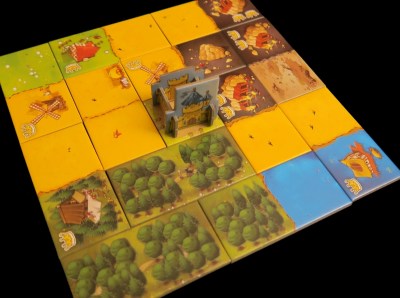
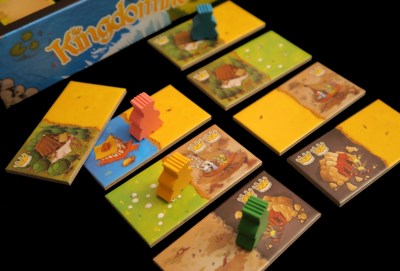
With Tapestry still under way, the group moved onto another, this time more recent, favourite, Kingdomino, albeit one that we’ve not played for nearly a year.  In this short game, players take a domino and add to the kingdom and then place a meeple on one of the dominoes on display for the next round.  When placing the dominoes, one of the two ends must connect to terrain of the same type already in the kingdom, or connect directly to the start tile.  Points are awarded at the end of the game by multiplying the number of tiles in an area of terrain by the number of crowns in the area.  Although we have the Age of Giants expansion, this time the group used the base game so all dominoes must fit in a five-by-five space (or be discarded) and bonus points are awarded for successfully placing all tiles and finishing with the start tile in the centre.
Kingdomino
– Image by boardGOATS

Sadly, Pine made an unfortunate placement decision partway through and thus created himself a single space gap which meant he was not complete a five-by-five kingdom with his castle in the middle.  This was because hadn’t caught the rule that the whole kingdom needed to be square so he’d ended up choosing a tile which was not as good as he’d thought and thus created even more problems for himself.  Everyone else completed their kingdoms so everyone got the full fifteen point bonus.
Kingdomino
– Image by boardGOATS

Green went for a mixture of several smaller sections (including stone and sand), but none scored highly. Purple ended up with fewer, but slightly larger regions (wheat, water and forest) and a similar score to Green.  Lime on the other hand, concentrated on a couple of larger regions, water and forest, each six or seven spaces and with three crowns each they gave a healthy score. On top of that Lime had a few low scoring space regions to top off a very good score and take the victory by twenty points.  An excellent score, especially since it was the first time he’d played the game.
Kingdomino
– Image by boardGOATS

Learning Outcome:  Game-play is very important, but component quality is important too.

Essen 2019

This week, the Internationale Spieltage, the largest games fair in Europe (and arguably the world), is being held in Germany. Known to Gamers worldwide simply as “Essen”, the fair runs Thursday to Sunday in late-October every year with many new releases timed to coincide with the event.  It is one of the biggest and most significant of all the boardgame conventions; according to convention organizer Friedhelm Merz Verlag, this year there will be more than one thousand two hundred exhibitors offering more than one thousand five-hundred new games, from fifty-three countries.

Essen 2019
– Image from spiel-messe.com

A couple of people from the group are going this year and will no doubt come back with a selection of the latest new and exciting games, as well as some older games that are new to the group and expansions for other well-loved games.  This year, the new releases include Cooper Island, Maracaibo, ECOS: First Continent, Alubari: A Nice Cup of Tea, Tapestry, Deep Blue, Paladins of the West Kingdom, Glen More II: Chronicles, the Japan and Italy map pack for Ticket to Ride, and the new European birds expansion for one of the Kennerspiel Des Jahres winner, Wingspan.

Wingspan
– Image by boardGOATS

Next Meeting – 15th October 2019

Our next meeting will be on Tuesday 15th October, at the Horse and Jockey pub in Stanford-in-the-Vale.  As usual, we will be playing shorter games from 7.30pm as people arrive, until 8pm when we will start something a little longer.

This week, the “Feature Game” will be the hot new game, Tapestry.  This is a beautiful civilisation game, with just four pages of rules that combine to form a surprisingly deep game.  Although it is not a quick game, there should still be plenty of time for the inevitable pre-Essen discussions.

Tapestry
– Image by boardGOATS

And speaking of tapestries and other needlework…

Jeff’s mum was cooking Sunday Lunch of roast lamb.  Jeff had contributed the joint, but his mother was not impressed with his purchase.

“That leg of lamb shrank by six inches when I cooked it,” Jeff’s mum scolded her son.

“That’s funny,” said Jeff, “You know that jumper you knitted me for Christmas?  It shrank by six inches, when you washed it.  It must have been from the same sheep…!”

Pink’s sPecial Party

It being a very special day for Pink, he decided he wanted to spend it playing games with friends and family at the Jockey.  The early arrivals set up PitchCar, including the new “Loop” expansion and others played Loopin’ Louis, Patchwork Express, Dobble and the surprise hit, Boom Boom Balloon.  Little-Lime won PitchCar (perhaps flicking talent runs in the family as Lime himself managed to complete the  loop at least three times), and almost everyone managed to lose Boom Boom Balloon at least once.  Late in the afternoon, a game of Scotland Yard was started with Pink as the fugitive, and finished almost before it was begun when he was quickly captured.  It was then restarted with Mrs. Lime as the fugitive and turned into an epic game that went on for a couple of hours with a brief break as people tucked into the buffet supper and amazing sticky-toffee pudding cake-desert provided by the Jockey Kitchen.

Boom Boom Balloon
– Image by boardGOATS

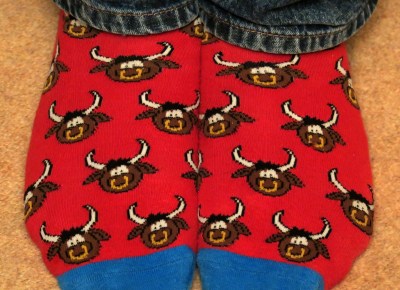
The evening continued with more games including No Thanks!, Finstere Flure (a.k.a. Fearsome Floors), Saboteur, …Aber Bitte mit Sahne (a.k.a. Piece o’ Cake) and Ice Cool.  The team of five eventually managed to corner Mrs. Lime, freeing up Pink to play his special request, Captain Sonar, which his team fittingly won, twice.  This was followed by a game of Ca$h ‘n Guns (it is always fun entertaining the bar staff by waving foam pistols about and threatening to shoot each other), before finishing with 6 Nimmt!, a game to match Pink’s socks.  It was a great day, and we all went home tired, but very happy, with Pink and Blue keen to thank everyone for sharing Pink’s sPecial day.

6 Nimmt!
– Image by boardGOATS

1st October 2019

It was a bitty start with lots of chit-chat and eating, including Blue’s fantastic pizza with mushrooms growing out of it. A little bit of singing to celebrate the fact it was the eve of our seventh birthday was immediately followed by special meeple cakes. Eventually, when everyone had finally finished sucking the icing off their wooden meeples, we finally settled down to the now traditional birthday “Feature Game”, Crappy Birthday.

Pizza
– Image by boardGOATS

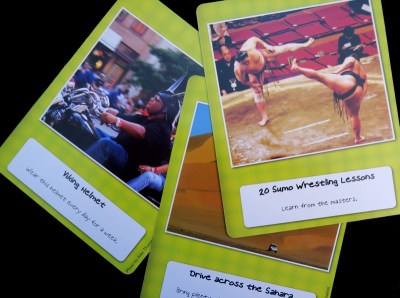
Crappy Birthday is a very silly party game that most of the group would normally turn their noses up at, but love to play once a year. The idea is that each person has a hand of cards featuring silly things and chooses one to give to the active player as a birthday present. The Birthday Boy/Girl then chooses the best and worst gifts which score the giver a point. Players take it in turns to receive gifts and after everyone has had one go, the player with the most points is the winner. It is very simple, but the best part is really when the recipient has to sit and sort through all their gifts and justify their choices. It seems a really silly game, and indeed it is, but it encourages people to get to know each other a little better and in a different way too.

Crappy Birthday
– Image by boardGOATS

This year, we discovered that Black would like a trip to the North Pole, Pine fancied two weeks in a swamp and Purple fancied a course on Mime Art.  In contrast, Burgundy was not keen on getting his earlobes stretched, Blue wasn’t keen on a GPS (with or without an annoying voice) and Lime eschewed some “garden manikins”.  Perhaps the most surprising thing we discovered was just how great Ivory would be as a day-time quiz host.  Amongst the fun, the scores were largely incidental, but everyone picked up just one or two points except for Purple who scored three points and Black who just pipped her to the post, with four points.

Crappy Birthday
– Image by boardGOATS

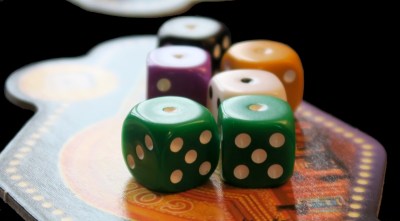
Since Blue and Ivory had both brought Roll for the Galaxy, it was clear that they were keen to give it a go and when Green said he’d play it, the only real question was which copy would get played. Since it can be quite a long game, Blue and Ivory got going quickly and left the others to sort themselves out. Although Ivory was keen to give the new Rivalry expansion a go, as it has been a while since we last played (and Green wasn’t totally familiar with it either), the trio decided to leave that for another day.  Although a lot of the group seem to get in a bit of a mess with Roll for the Galaxy, it is not actually a complicated game. It is a “pool building” game, similar to deck builders like Dominion or bag builders like Orléans or Altiplano, except with dice.

Roll for the Galaxy
– Image by boardGOATS

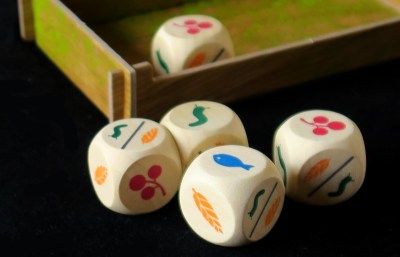
The idea is that at the start of the round, everyone simultaneously rolls all their dice in their cup and, depending on what faces are shown, secretly allocate the dice to the five possible phases of the game: Explore, Develop, Settle, Produce & Ship. One of the dice can be used to select which phase that player wants to “nominate”, i.e. guarantee will happen. Any die can be used for this, it does not have to match the chosen phase. Once everyone has assigned all their dice and chosen their phase to nominate, all dice are revealed and the active phases are revealed. The clever part is the element of double think that players have to use: a player can only nominate a single phase, so if they want to Produce and Ship they have to rely on someone else to nominate the other one. Guess right and both phases will happen, guess wrong and they will only get one of them, and if that relies on something else happening, they may find they end up doing neither.

Roll for the Galaxy
– Image by boardGOATS

Thus, while there are a lot of other moving parts, fundamentally, a successful player must piggy-back on other players because it will give them more actions.  Dice that are used then go into the players’ Citizenries, and unused dice go back into the players’ cups. Dice are extracted from the Citizenries and returned to the cups on payment of $1 per die, once all the actions have been carried out. Thus, the player with the most appropriate dice can turn the handle on their engine most efficiently. The aim of the game is to finish with the most points, which are obtained from settling and developing worlds and shipping goods to give points.

Roll for the Galaxy
– Image by boardGOATS

So, the first action is Explore, which is taking world tiles from a bag. These are double-sided with a development on one side and a production or settlement world on the other. They go into either the Development or Settlement piles so that dice are placed on top of these during the Develop and Settle phases: when the cost has been matched by the number of dice, the world is added to the player’s tableau and they can use whatever special power it provides. Some of the worlds are production worlds which typically provide more, exciting dice to add to the system.  In addition to extra, coloured dice, Production worlds also house dice played during the Produce phase. These can then be consumed for victory points or traded for cash, enabling more dice to be transferred from the player’s citizenry to their cup.

Roll for the Galaxy
– Image by boardGOATS

The game ends at the end of the round when either, a player Settles/Develops their twelfth world or when the stock of victory point chips run out. The winner is the player with the highest score from their combined victory points and worlds. There are a couple of other minor rules (for example players can pay one die to effectively change the face of one other die), but essentially, that is all there is to it.  Players start with a double tile comprising a complimentary pair of settlement and development worlds and a start world, together with a couple of tiles to add to their Development/Settlement piles.  For the first game it is recommended that players choose the Development and World with the lowest cost to add to their piles, because that is easier to play.  For later games, however, players can choose, which gave Blue a really tough decision.

Roll for the Galaxy
– Image by boardGOATS

In the end she decided to go for it, and chose to start with the “Galactic Federation”, “6+” development world in her building pile.  This would give her an extra one third of her development points at the end of the game, but more importantly two of the dice used for every development would bypass her citizenry, going straight into her cup.  Green started with no fewer than three of the red, “Military” dice, which coupled with his “Space Piracy” starting development, gave him really a good source of finance. He looked very unimpressed with this combination, but Ivory and Blue felt it was a really nice combination of starting tiles. Ivory’s start tiles were also nice, but didn’t have quite the same degree of complimentarity, but he did get a nice  purple, “Consumption” die.  The starting tiles are only the beginning though; the game is all about building an engine made up of dice, Production Worlds, and Developments and then using it efficiently.

Roll for the Galaxy
– Image by boardGOATS

In the case of Blue, her starting tiles led her towards a Development strategy, so she spent a lot of the early part of the game Exploring to try to find nice Development tiles to enhance that approach.  Green and Ivory had a more conventional, “build the finances and the dice pool then Produce and Consume” strategy.  The problem with this was they both frequently wanted the same phases, but ended up with either both of them choosing to, say, Produce, or both choosing Ship, when what they both really wanted was to maximise their dice by Producing and then Shipping.  Blue, on the other hand, could mostly be fairly sure that neither Ivory or Green were going to what she wanted, so was able to focus on her own plan, and just piggy-back the actions of the others.  Although the game has a reputation of being slow (with our group at least), this time, the game got going quite quickly and it wasn’t long before Ivory started his Production engine, Shipping his produce for victory points.

Roll for the Galaxy
– Image by boardGOATS

Green soon followed, while Blue kept building her Developments and occasionally taking advantage of the “Produce/Consume” strategies of the others to provide enough finance to move her dice out of her Citizenry.  Blue felt her game was really boring since all she did was Develop, but in the end, it was probably the fact that Blue was doing something different that was key.  Blue triggered the end of the game placing her twelfth Development/World tile, which gave her the most points from building, slightly more than Green.  Ivory Consumed the most victory points, with Green not far behind, and Blue not really troubling the scorer in that department.  It therefore all came down to bonuses from the “6+” Developments, which is where Blue made up for other deficiencies taking fifteen points giving her a total of fifty-seven points, five more than Green who was just a couple ahead of Ivory.

Roll for the Galaxy
– Image by boardGOATS

It had been a lot of fun, and next time we’ll have to give one of the modules form the Rivalry expansion a try.  On the next table, their game was coming to an end too.  Having been abandoned to sort themselves out, someone mentioned Ticket to Ride, and with everyone having a good idea how to play, that turned out to be most popular. The game is very simple and everyone has played it, in most cases, quite a lot, so we often play with expansion maps.  This time, the Team Asia/Legendary Asia expansion was an option, but as we usually play with the Europe version of the game, the group decided to play with original USA map with the addition of the USA 1910 additional route cards.

Ticket to Ride: Europe
– Image by boardGOATS

The basics of the game is that players start with a handful of train pieces and place them on the board to connect cities, paying with cards.  Thus, on their turn a player can take two coloured train cards from the market (either the face up cards or blind from the deck) or play sets of cards of a single colour that matches both the number and colour of one of the tracks on the board.  Players score points for the number of trains they place, but also for tickets.  Players choose from a handful of these at the start of the game and can take more tickets on their turn instead of placing trains or taking train cards.  These are risky though, because although they are a source of points, any tickets that are not completed at the end of the game give negative points.

Ticket to Ride (USA)
– Image by boardGOATS

The original version of Ticket to Ride (with the USA map) is much less forgiving than the Europe edition that we more usually play.  This is partly thanks to the layout of the tracks, but also due to the absence of Stations which can help alleviate some of the stress associated with failure to complete tickets.  With five, it was always going to be a really hard game and likely to end up with a bit of a train-wreck for someone, and so it turned out.  The eastern states were rough, really, really rough with Burgundy, Lime, Pine and Purple all fighting for routes in the same space.  As a result, Black benefited from mostly staying out of the scrap.

Ticket to Ride (USA)
– Image by boardGOATS

Pine, Lime and Purple managed to complete the most tickets, five each, but remarkable, all three were a long way behind Burgundy and Black who only completed three and four tickets respectively.  This was partly due to negative points, but was mostly caused by the fact that the longer tracks give disproportionately more points and Black for example was able to pick up two of the long tracks around Salt Lake City relatively unopposed as he was mostly alone working in the west.  Similarly, Burgundy did well in the north.  As a result, it all came down to the longest route bonus, ten points, but with Black and Burgundy both in the running it gave a twenty point swing to Burgundy giving him a total of one hundred and thirty-five points, nearly twenty more than Black in second place.

Ticket to Ride
– Image by boardGOATS

Ticket to Ride and Roll for the Galaxy finished simultaneously and only Green decided he needed an early night, leaving everyone else to play one of the group’s favourite game, Las Vegas.  This is a simple game of dice rolling and gambling, where players use their dice to bet in one of the six numbered casinos.  Each casino has one or more money cards and at the end of the round, the player with the most dice in that casino takes the highest value money card.  The player who comes second takes the next highest value card and so on.  When betting, players must place dice in one of the numbered casinos.  The first catch is that they must place all the dice they roll that depict that number in the matching casino.  The second catch is that any dice involved in a tie at the end of the round are removed, and it is this that makes it a great game.

Las Vegas
– Image by boardGOATS

We have the original version of the game rather than the new edition, Las Vegas Royale, though we added elements from the Las Vegas Boulevard expansion, including the double weight “Big” dice and the Slot Machine.  We also house-rule to only play three rounds instead of the four in the rules as written.  This time, Ivory stole a march in the first round, when he was forced to place his last die as a losing singleton in “Casino Five”, only for Purple to roll a five with her final roll and take out both herself and the hitherto winner, Pine.  As a result Ivory took the jackpot of $90,000 to go with his other winnings.

Las Vegas
– Image by boardGOATS

It is not a game to give up on though, as anything can happen.  The second round was relatively uneventful, but the deal for the final round left the last three casinos each with a single card of $100,000.  This is highly unusual, but we decided to play on and see what happened.  In the end, it had a bit of an “all or nothing” feel about it, with players going in early and in big.  It was probably no coincidence that the three big jackpots were taken by the three highest scoring players.  Pine thought he had come off worst, Black, who had done so well in the other two games took the wooden spoon.  It was Ivory’s flying start that was key though, and together with his strong finish, his total takings were a massive $430,000, $40,000 more than Blue in second.

Las Vegas
– Image by boardGOATS

Learning Outcome:  Party games can be great when everyone is in a party mood.

Seven is Heaven – Happy Birthday to Us!

Seven Today

BoardGOATS is Seven Years Old Today!

Remarkably, after seven years boardGOATS is still meeting at the Horse and Jockey in Stanford-in-the-Vale. Five of those who were at the first meeting are still coming along and, we now have a nice solid eight to ten, lovely people every time.  While we have two or three people from the village, we still have a lot of people who travel some miles to join us.  Without you, boardGOATS wouldn’t be the success it is, so we really appreciate it.  We’d also like to thank the folks at the Jockey who have always been so supportive and let us do pretty much what we want in their back room.  Here’s to the next year!

Next Meeting – 1st October 2019

Our next meeting will be on Tuesday 1st October, at the Horse and Jockey pub in Stanford-in-the-Vale.  As usual, we will be playing shorter games from 7.30pm as people arrive, until 8pm when we will start something a little longer.

It will be the eve of our seventh birthday, so as is now traditional, the “Feature Game” will be Crappy Birthday.  This is a silly little filler/party game that we can mess about with while people are eating cake allowing us to play something longer once everyone has arrived and finished food and the inevitable Essen discussions.

Crappy Birthday
– Image by boardGOATS

And speaking of birthdays…

It was Joe’s birthday, and his mum wanted to do something special.  She called him on the phone, but his housemate, Jeff, answered.  When Joe’s mum said she wanted to bring round a cake, Jeff was very excited.

“Oh, Mrs. Schaeffer,” Jeff said, “What a lovely idea – that would be great!”

That afternoon, Joe’s mum drove to the house and rang the doorbell. Jeff answered the door, but when he saw the cake, his face fell.

“Oh,” he said, clearly very disappointed. “I thought you said ‘keg’.”

17th September 2019

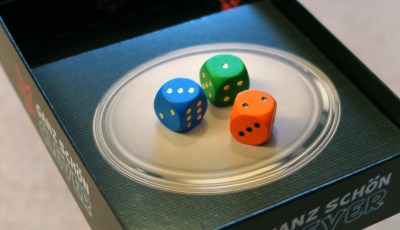
Blue and Pink arrived nice and early and so after ordering food, started a quick game of Ganz Schön Clever (a.k.a. That’s Pretty Clever).  This is one of the first of the “Roll and Write” games from the last couple of years and, as it received a Kennerspiel des Jahres nomination last year, arguably one of the best.  This type of game has been around for many years, with Yahtzee being one of the first, but the current trend was started by games like Qwixx.  Qwixx came out seven years ago, but has since been followed last year by games like Roll to the Top!, Railroad Inc., Welcome to… and the Roll Through the Ages and Penny Papers Adventures series of games.

Ganz Schön Clever
– Image by boardGOATS

These games all have different themes and different mechanisms, but the basic principle is the the same with players rolling dice (sometimes bespoke dice) and marking the results on a piece of paper, usually from a bespoke pad, or more recently a laminated card.  Ganz Schön Clever is an abstract game using six coloured dice which are used to fill in boxes in five coloured areas of the individual player “boards” (the white die is wild).  The active player, rolls all six and chooses one to keep and use, discarding all dice with lower pip values.  They then roll any remaining dice, again keeping and using one and discarding the rest before rolling the rest one last time keeping and using one final die.  The other players can then use one of the discards, before play passes to the left.

Ganz Schön Clever
– Image by boardGOATS

The clever part is the way the dice are used, and the fact that filling in some of the boxes gives a bonus action, enabling players to fill in other boxes or gain the opportunity to re-roll their dice or even use an extra die.  With just two, the game is played over six rounds, giving them just eighteen dice on their own turn with another six from their opponent’s turn and as many bonuses as they can get.  The player who wins is therefore the player who makes the best use of the dice they roll and usually, the player who manages to build the most combinations to take advantage of the bonuses available.  This time round, Blue was failed to get a good start and Pink took her to the cleaners, finishing with a hundred and ninety-two, a winning margin of twenty-six.

Ganz Schön Clever
– Image by boardGOATS

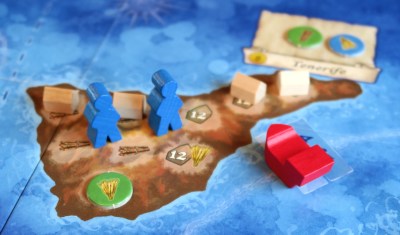
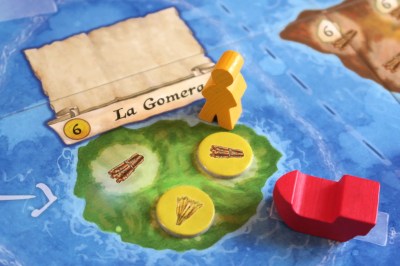
Blue and Pink had only just started, when the others started rolling in, but unusually, there was no sign of Burgundy.  By the time food had arrived, we were into double figures, but still no  sign of Burgundy.  People were starting to get worried until Blue borrowed a phone and checked her email to discover he wasn’t feeling well.  There were still enough players for three games, and eventually, everyone else took themselves off leaving Blue, Pink and Green to play the “Feature Game”, West of Africa.  This is a game set in the Canary Islands (which really are west of Africa, unlike Krakatoa which is famously not East of Java), and has a slightly nasty edge to it, making it almost like a “Vanuatu Light”.

West of Africa
– Image by boardGOATS

The game is quite simple with some very nice little elements. The basic flow of the game involves planting crops, selling crops, becoming Alcalde (or mayor) of islands and then building settlements.  Each player has their own deck of cards which they use to carry-out their actions, with each card having a value.  Players simultaneously choose up to five of their cards (the first four are free, the fifth comes at a cost), then each hand is evaluated and the lowest value hand is played first.  This means there is a nice tension between choosing a low value hand and going first, or choosing higher value cards, giving other players the chance to carry out actions first, potentially meaning that those actions are no-longer available.

West of Africa
– Image by boardGOATS

There are two types of cards: islands and actions.  Moving workers or boats are simple actions where players just move workers a given number of steps along the shipping lanes, however, some of the action cards need a location to be played.  For example, planting crops needs to be played with an island card which indicates where the crop tokens are to be played.  Similarly, selling crops and settling both need to be played with island cards, but the clever part is that island cards can be used for multiple actions and actions can be carried out at multiple islands an unlimited number of times.  The round ends once all players have completed their actions, then any planted crops are automatically moved into the warehouses where they can be moved and/or sold in later rounds.

West of Africa
– Image by boardGOATS

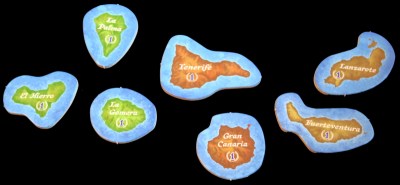
The islands are split into east, west and central with islands in the different regions having different characteristics.  So the western Canaries only have spaces for production, while the eastern islands only have spaces for settlements.  Selling goods is more lucrative in the east than in the west, however, each lot selling for twelve gold, instead of six.  So shipping goods eastwards can be lucrative, but that requires playing a card and only four (or five) can be played each round.  Selling only provides gold, however, and players need points to win.  The two players with the most gold at the end of the round get a point each, but this is not the main source of points.

West of Africa
– Image by boardGOATS

At the end of the round, the occupation of each island is evaluated and the Alcalde or mayor of each is assigned, with players getting a point for each island they control.  This is not the main source of points either though, that is settling with each settlement giving three points.  Settling is expensive though and gets more so as the cheaper plots get built on.  Another of the clever little features of the game is that the number of settlements available in each round is limited which adds more pressure to the turn order.  As this is so critical, ties have to be resolved, and are always in favour of the player with the most gold which increasing the importance of money, adding balance to the game.

West of Africa
– Image by boardGOATS

Pink had the lowest scoring starting hand so went first.  This can be a substantial advantage as he knew he would be able to do what he wanted.  Green went next and managed to interfere with Blue’s plans, though she had been aware of the risk and had managed to build in some extra options to help mitigate the effects a little.  Pink took control of La Hierro and La Palma, and Green took La Gomera leaving Gran Canaria to Blue who also picked up Fuerteventura, with an eye to later in the game.  Green got the best of the early rounds though setting up a small, but important lead, though more significantly, arguably better positioning.  The game is not a long one, and there isn’t really time to build an engine, so it wasn’t long before Green, in particular, was threatening to trigger the end of the game by getting twenty-five points.

West of Africa
– Image by boardGOATS

It was then that Blue made her monumental mistake: when choosing which of two island cards to play she ended up playing both and not the sale action card to go with them.  This, coupled with Green’s action which he took first, meant she was unable to do anything at all in the penultimate round.  Green followed this by messing up his final round, also failing to play a sale action card which meant he didn’t have enough gold to build the number of houses he wanted to.  He was still able to build one final settlement though, giving him a clear win with forty points.  It was much closer for second with Pink’s thirty-two points just pipping Blue by a single point.  It had been an enjoyable game, but despite the excellent balance and some really nice touches, none of the three players could put their collective finger on what was lacking and what the game needed to take it from “OK, but eminently forgettable” to “great”.

West of Africa
– Image by boardGOATS

Meanwhile, on the neighboring table, despite their reluctance to play it with two chemists, Pine and Lime had joined Red and Mulberry to play Periodic: A Game of the Elements.  This is a recent KickStarter delivery, and seemed entirely appropriate for the International Year of the Periodic Table.  On their turn, the active player either pays energy to activate trends (such as “Decrease Atomic Mass” or “Increase Atomic Radii”) to move their flask around the periodic table board in the direction allowed by the trend.  If they finish a trend movement on an element that appears on the top, visible card of one of the four goal card decks, they can “discover” that element.  Flasks can be moved up to five spaces, but activating the trend multiple times means the player’s flask can be moved further enabling them to “discover” multiple elements.

Periodic: A Game of the Elements
– Image by boardGOATS

The first activation costs one energy point and all additional trends costing two energy points with tokens spent in this way placed on a space associated with the trend used.  Instead of paying to move, the active player can take all the energy accrued on that trend and move their flask according to a trend, but just once.  Thus, the conservation of energy forces players to spend carefully and play efficiently.  When someone discovers all the elements for one goal they take the associated card with a bonus action tile, and all the other players who discovered some of the elements on the card, get consolation points.  Players can also discovering particular types of elements, as shown in by cards laid out around the edge of the board.

Periodic: A Game of the Elements
– Image by boardGOATS

Moving along a step along this “track” gives players academic achievement which is worth an ever increasing amount of points.  The third and final source of points are from the agenda cards which give players personal objectives and are dealt out at the start of the game.  The game ends when someone completes the research track or when a stack of goal cards is depleted and the player with the most points at the end wins.  Unfortunately, due to a “rules malfunction”, the group were halfway through the third stack of goal cards when they realised the game should have ended so decided to carry on till all four piles were depleted in what they referred to as “Periodic: The Director’s Cut”.

Periodic: A Game of the Elements
– Image by boardGOATS

All in all, Pine and Lime needn’t have worried that Mulberry’s and Red’s chemistry backgrounds would give them a significant advantage.  Although there were a lot of nice chemistry references that the scientists appreciated it was not necessary to understand these to play the game effectively.  The strategies employed varied:   Red and Mulberry concentrated on progressing on along the academic track, while Lime on his agenda cards and Pine focused on goal cards.  In the end, it didn’t make a lot of difference and there was a three-way tie for second place with Red, “The Evil Chemist” finishing seven points ahead of the others, with a final total of seventy-one.  Everyone had enjoyed the game though and would be happy to give it another go though they all agreed they would do things differently next time.

Periodic: A Game of the Elements
– Image by boardGOATS

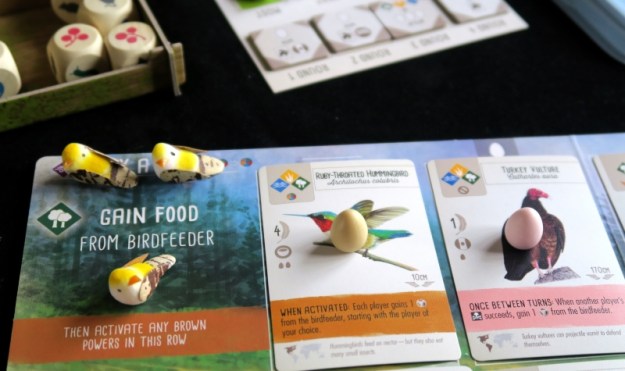
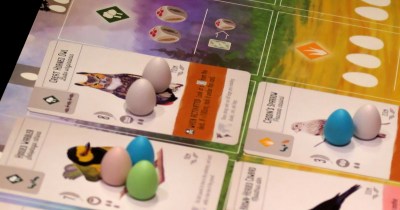
On the other side of the room, Ivory was introducing Black and Purple to this year’s Kennerspiel des Jahres winner, Wingspan.  Wingspan was our “Feature Game”, a few weeks ago and was always going to have another outing – in fact, this time we had a choice of two copies!  Wingspan is a robust, card-based engine builder, with beautiful production and gorgeous artwork.  The idea is that players are collecting birds for their reserves.  On their turn, the active player chooses one of four actions/habitats, and then starting with the card furthest to the right in that habitat, activate each card in turn.

Wingspan
– Image by boardGOATS

The primary action associated with the habitats are spending food to play cards; getting food; laying eggs, and more drawing bird cards.  Players start with eight possible actions per turn, which gradually reduces to five over the course of the four rounds of the game.  All the bird cards in the game give bonuses that fit with their real-life behaviour.  For example, the food needed to play cards closely resemble their diet.  The designer and producer have paid attention to other details too.  For example, the number of eggs each bird has in their nest is not accurate, but are proportionately correct and bonus actions are associated with birds that flock and birds of prey.
Wingspan
– Image by boardGOATS

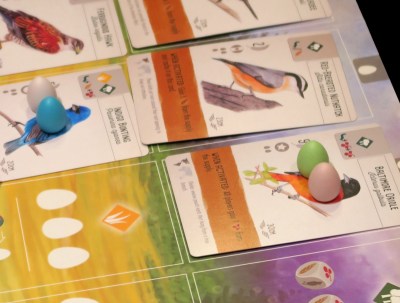
This time the game was very tight, though different strategies were employed.  Purple tried to maximise her food income, starting with an Eastern Phoebe which provided invertebrates , and later adding a Baltimore Oriole, a Red-Breasted Nuthatch, a Mountain Chickadee and an Indigo Bunting ensuring a lucrative food source giving her a wide variety too.  Then she added a White-Faced Ibis and a Ferruginous Hawk both birds of prey that are triggered by other players actions and give points at the end of the game for each food they bring in.

Wingspan
– Image by boardGOATS

It’s arguable that the cards could have been shuffled better, and as a result birds that ate small mammals or fish and aquatics didn’t come out till later so she wasn’t able to take as much advantage of some of her food supplies as she might.  In contrast, Black and Ivory went for a more egg-based strategy, with Ivory playing a Cassin’s Sparrow and a Brown-Headed Cowbird both of which laid eggs, the sparrow when activated and the Cowbird on other players’ turns.

Wingspan
– Image by boardGOATS

Black played a Yellow-Billed Cuckoo, which also activated on on other players’ turns and coupled it with a House Finch which enabled him to store a lot of eggs.  The end result was really close, with only four points between first and third.  Everyone had a similar number of “tucked” birds, bonus points and end of round points.  Purple took more from her birds and finished with ten food on her cards from her predators.  Although Black and Ivory had no stored food they had twice as many eggs as Purple and, on aggregate, Ivory pipped Purple, by just two points.

Wingspan
– Image by boardGOATS

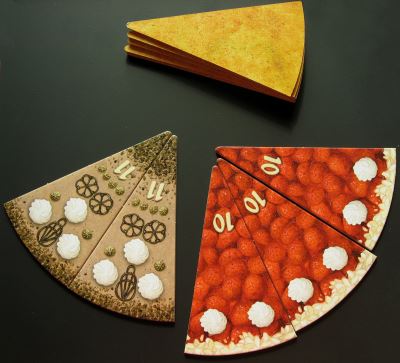
With time marching on, some of the group decided to head off for an early night leaving Blue, Black, Purple, Pink and Pine to play “something short”.  Pink determinedly eschewed the option of Bohnanza, and suggested “Sahne” instead, which was quickly accepted by the other four.  This cute little game, correctly known as …aber bitte mit Sahne (a.k.a. Piece o’ Cake), is the archetypal “I divide, you choose” game.  Played over five rounds, players take it in turns to be the “Master Baker”.  They divide the eleven slices of the pie into pieces and each player takes it in turns to take a piece (leaving the Master Baker with whatever’s left).

…Aber Bitte Mit Sahne
– Image by boardGOATS

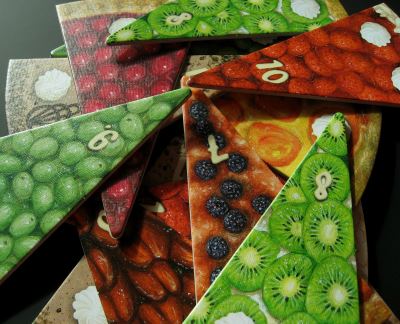
As players take their share, they can choose to keep slices or eat slices:  eating a slice guarantees points (equal to the number of blobs of cream on top), while saving it gives the opportunity for more points if the player has the most of that type stored at the end of the game.  Each slice has a number on it which is the number of points the player with the most uneaten slices of that type gets, but also how many are available (though a couple are always removed to add a little non-determinism).  Thus, the most valuable cakes are also those with the most slices available but also those with the most cream.

…Aber Bitte Mit Sahne
– Image by boardGOATS

Purple started out collecting slices of strawberry tart, while Pine opted for what he insisted was gooseberry flan, but looked like it was made out of peas.  He also went for the pizza (or possibly apricot?) and got into a tussle with Blue for that and cockroach (which Pine insisted on calling pecan, though in truth it could have been date too).  Things kicked off when Pine offered Pink (sat to his left) a particularly favourable selection and when Blue pointed this out, was persuaded by Pink to be “nice”.  However on Pink’s turn, when he had the option to be nice to Blue, he wasn’t.

…Aber Bitte Mit Sahne
– Image by boardGOATS

Learning Outcome: Clever mechanisms, a great game do not necessarily make.

Deutscher Spiele Preis – 2019

With “Essen” approaching, last week the Deutscher Spiele Preis list was announced. This is the result of an open vote by games clubs, gamers and people in the industry.  It typically rewards a slightly heavier game than the the Spiel des Jahres awards, but as the top ten are published, a range of tastes and complexities usually feature.  Last year number one on the list was Azul, the first game to win both the Deutscher Spiele Preis and the Spiel des Jahres since Dominion in 2009.  This year, the winner of the Deutscher Spiele Preis is the same as the winner of the Kennerspiel des Jahres i.e. Wingspan (Flügelschlag in Germany).  This is a great card game with fantastic production values which is well deserving of the prize.

Wingspan
– Image by boardGOATS

Other games in the top ten list include third placed Teotihuacan: City of Gods which is emotionally the sequel to the well received Tzolk’in: They Mayan Calendar and the hugely popular fifth placed Architects of the West Kingdom, both very solid “Euro Games”.  The Taverns of Tiefenthal, Underwater Cities and Newton also medium-heavy weight Euro games made the top ten too, as did the Spiel des Jahres winner, the light family game, Just One. Some slightly more unusual games were also recognised, including Spirit Island, a complex cooperative game, and in particular, Detective, which is a real-time puzzle game with an internet component. The Deutscher Spiele Preis for Best Children’s game went to Concept Kids: Tiere (Animals).  The prizes will be awarded at the Internationale Spieltage, Essen.

Wingspan
– Image by boardGOATS


Playing with Money at The British Museum: Currency and Games

Following on from their visit to see the “Game Plan: Board Games Rediscovered” exhibition at the V & A Museum of Childhood, under beautiful blue skies, Blue and Pink set out to Oxford Parkway once more, to visit The British Museum to see their “Playing with Money: Currency and Games” exhibition.  Entry to The British Museum is free, which is excellent value given the number of truly remarkable, internationally significant exhibits that are there, including the Rosetta Stone and the Elgin Marbles.

The British Museum
– Image by boardGOATS

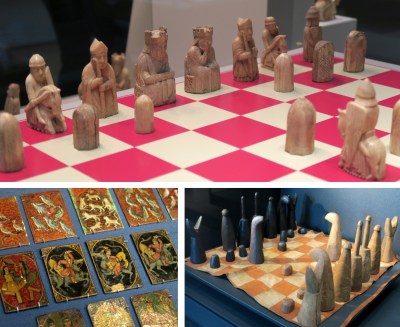
Of more interest to gamers are a large number of pieces from the Lewis Chess Set, one of which was recently discovered in a drawer in a family home in Edinburgh.  These are actually a number of pieces from at least four sets and maybe more, but are iconic and were used as the basis of the design for the Chess set in the film, Harry Potter and the Chamber of Secrets.  In addition to the Lewis Chessmen, The British Museum also has a permanent display entitled, “Games: People and Pastimes”, which includes a Nigerian Chess Set, a Syrian Mancala board, and a selection of Iranian playing cards.

The British Museum Exhibits
– Image by boardGOATS

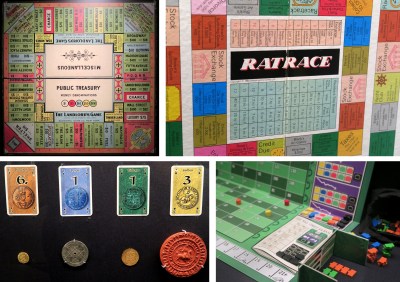
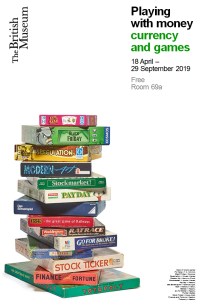
There is also currently a specific exhibition entitled “Playing with Money: Currency and Games”, which is available until the end of the month.  This is in a small, side-gallery and and really focussed on the development of money in board games, from it’s use in The Landlord’s Game and Monopoly, to more recent games like Speculation, Dominion and Black FridayThe Noble Game of Swan, Ratrace, and Magic: The Gathering also featured, though the gallery was quite small so there were not as many exhibits as there were at the Museum of Childhood, nor were they as varied.  One of the most interesting displays was perhaps some of the money cards from Alhambra with the actual coins that inspired the artwork on the cards.

The British Museum, "Playing with Money: Currency and Games"
– Image by boardGOATS

Given the other exhibits, The British Museum is well worth a visit although the “Playing with Money: Currency and Games” exhibition is only open till 29th September 2019.

The British Museum, "Playing with Money: Currency and Games"
– Image by boardGOATS