Author Archives: nannyGOAT

Next Meeting – 30th October 2018

Our next meeting will be on Tuesday, 30th October, at the Horse and Jockey pub in Stanford-in-the-Vale.  As usual, we will be playing shorter games from 7.30pm as people arrive, until 8pm when we will start something a little longer.

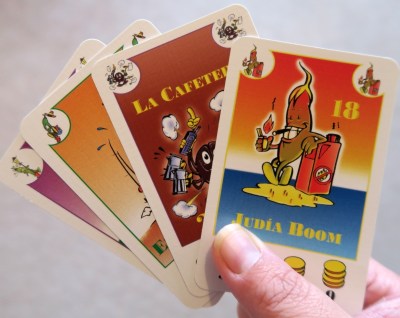
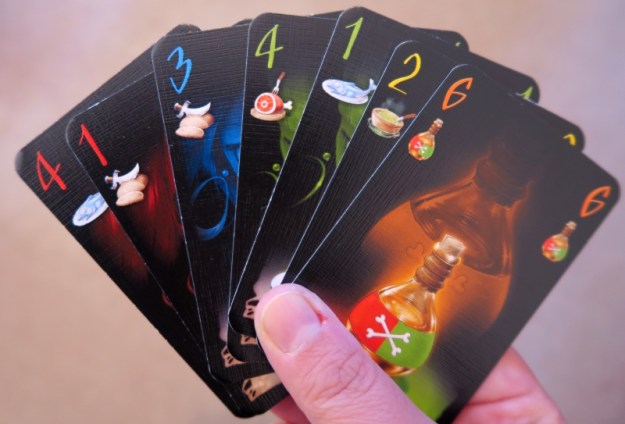
This week the “Feature Game” will be Peppers of the Caribbean, a cute little set collecting card game with a loose pirate theme, that was released at Essen last week.  The game is very quick to play, giving us lots of time to play other games depending on who comes and what mood they are in.  Originally we had planned to play Key Flow, however, it’s still packed and there wasn’t time to learn the rules…!

Peppers of the Caribbean
– Image by boardGOATS

And speaking of pirates…

Jeff was going to a fancy-dress party, but he was feeling a bit shy about his outfit so on his way he called into his local pub for some Dutch courage.  He walked up to the bar complete with eye patch, wooden leg, parrot on his shoulder and ships wheel sticking out of his fly.  The landlord asked why he was dressed as a pirate, so Jeff explained about the party.

The barman answered, “OK, I get that by why do you have the ships wheel down your trousers?”

Jeff thought for a moment then replied, “To be honest, I do don’t really know, but it’s been driving me nuts…”

Essen 2018

Last week was The Internationale Spieltage, the largest games fair in Europe and, arguably, the world, known to Gamers worldwide simply as “Essen”.  The fair runs Thursday to Sunday in mid/late-October every year and is the one of the biggest and most significant of all the boardgame conventions with many new releases and timed to coincide with the end of October.

Essen 2018
– Image from spiel-messe.com

This year several of the group went, and despite a lot of games selling out really early, they came back with expansions for well-loved games like Kingdomino (Age of Giants), Isle of Skye (Druids) and Altiplano (The Traveler), some new games like Azul: Stained Glass of Sintra, Solenia and Key Flow, and some old classics like Mississippi Queen.  It will be exciting to see how these new toys go down with the group over the coming months.

Azul: Stained Glass of Sintra
– Image used with permission of boargamephotos

16th October 2018

Blue was late after an unscheduled nap, so Burgundy consumed the first half of his supper alone.  Blue was quickly followed by Ivory and Pine and then a new visitor, Navy.  With Cobalt last week (who was busy moving house this week so couldn’t come) that makes two new people in two weeks.  Navy is a more experienced gamer and is into slightly more confrontational games than those we normally play, but that’s good as it might encourage us to leave our comfort-zone of cuddly Euros set in medieval Germany.  As we were all introducing ourselves, Green, and then Black and Purple turned up and the discussion moved on to how we choose the “Feature Game” (Blue suggests something to Green who mostly replies that he’s never heard of it, but it sounds quite interesting…).  Recent discussions have centred round the new Key Flow (aka “Keyflower the card Game”) for the next meeting and maybe Imaginarium (or, “The One With The Elephant on the Front” as Navy referred to it).  With that, Green started getting out this week’s “Feature Game“, which was Greed, a card drafting game where players are crime lords trying to earn more money than anyone else through clever use of their cards.

Imaginarium
– Image by BGG contributor W Eric Martin

At it’s heart, Greed is a quite simple, card-drafting game with a healthy dose of “take that” and a gangster theme.  Players start with a hand of twelve cards and “draft” three cards  (i.e. choose a cards and pass the rest on, three times).  Players then simultaneously choose one card then together reveal this card and action it before the it is replaced with another drafted card.  A total of ten cards are played in this way per person before the players tally their holdings and the player with the highest value is the winner.  Obviously, the game is all about the cards and there are three types, Thugs, Holdings and Actions, but it is the combination of these that is critical.  Actions have a unique effect associated with them while Thugs and Holdings typically also have a cost or a condition associated with them (e.g. cash paid to the bank or a collection of symbols on cards held).  Holdings are the key however.  When a Holding is played a token is placed on that card for each symbol on it and an additional token for each symbol of that type already possessed. These tokens are worth $10,000 each at the end of the game which is added to the value of cash collected through card plays.

Greed
– Image from kickstarter.com

Although it was Green’s game he had only played it once and that was over a year ago, while Burgundy had read up on it.  Pine and Navy had joined them to make the foursome.  The game takes a few rounds to understand how it really works.  After that, it’s quite easy to play, but working out which card to take and which to play is much harder, as they all seem to be really good. Unfortunately Navy struggled a bit at the beginning and made mistakes in his first couple of plays as he either found he couldn’t actually play his chosen card and had to just ditch it, or wasn’t able to get the indicated bonus. However, as he had not accumulated any wealth early on, it also meant he didn’t lose any when Green played a couple of cards which meant everyone else lost dollars, which leveled the scores a little.  Burgundy’s preparation really helped when he played a Holding card and proceeded to place six tokens on it, so by the half way mark it was looking like a two horse race between Burgundy and Green with both Navy and Pine looking short on cards.

Greed
– Image used with permission of BGG contributor punkin312

Through the second half of the game, Pine really got the hang of it and started raking in the dollars and had quite a pile of cash. Green then played a Holding card which enabled him to add chits equaling the same number as the maximum on another players cards, which meant he was able to gain from Burgundy’s excellent earlier play.  In the final rounds, Green played another card which removed one of his holdings only to be able to play it again the following round with even more tokens than it had previously. There was a brief discussion as to whether he should get the usual amount for it as well as the removed ones and two extras, a decision that went in Green’s favour, but the real question was whether it would be enough to beat Burgundy.  In the end, it was close, but the answer was no and Green finished with $30,000 behind Burgundy’s winning total of $235,000.

Roll for the Galaxy
– Image used with permission of BGG contributor punkin312

Meanwhile, on the next table everyone was being indecisive, but in the end the decision was made in favour of Roll for the Galaxy.  This is a game that really fascinated the group for a while because somehow it behaves differently to everything else we play and we really struggled to get to grips with it.  At the time, we concluded that our struggles were probably because we weren’t playing it enough so effectively had to learn it afresh every time we played.  For this reason we went through a phase of playing it quite a bit, but that was some months ago now and it was definitely time for another outing.  In principle, it is not a difficult game and the core mechanism is similar to the so-called “deck builders” (like Dominion) or “bag builders” (like Orléans or Altiplano), except instead of building a deck of cards or a bag of action tokens, players are building their supply of dice.  In Roll for the Galaxy, each different die colour reflects the different distributions of the dice, so for example, white “Home” dice feature each of the symbols for Develop, Settle, Produce and Ship once and Explore twice.  On the other hand, the yellow “Alien Technology” dice have three faces that depict the asterisk (“Wild”) and one each of Develop, Settle and Produce.  Thus, where probability affects which cards or tokens are drawn in the other games, in Roll for the Galaxy, players have more control over which dice they are using, but chance affects how those dice roll.

Roll for the Galaxy
– Image used with permission of BGG contributor punkin312

In principle, Roll for the Galaxy is not a difficult game and the basic mechanism is similar to that in Dominion or Orléans/Altiplano, except instead of building a deck or a bag of action tokens, players are building their supply of dice.  Each different die colour reflects the different distributions of the dice, so for example, white “Home” dice feature each of the symbols for Develop, Settle, Produce and Ship once and Explore twice.  On the other hand, the yellow “Alien Technology” dice have three faces that depict the asterisk (“Wild”) and one each of Develop, Settle and Produce.  Thus, where probability affects which cards or tokens are drawn in the other games, in Roll for the Galaxy, players have more control over which dice they are using, but chance affects how those dice roll.  Although the dice are important, like Greed, the game is really all about the special powers the players’ tableau, in this case made up of World tiles rather than cards.  Ultimately the game is really a race to trigger the end of the game is when the victory point chip pool runs out or a player builds their twelfth World.

Roll for the Galaxy
– Image used with permission of BGG contributor punkin312

Game play is mostly simultaneous:  players roll their dice and  allocate them to their phase strip.  Each player can choose one phase that they guarantee will happen, so in a four player game there is a maximum of four phases per round and where players choose the same phase there will be fewer, sometimes even only one.  The phases are:  Explore, Develop, Settle, Produce & Ship which correspond to draw Worlds from a bag; “spend” dice to build development Worlds;  “spend” dice to build production Worlds; place dice on production Worlds, and move dice from production Worlds in exchange for either victory points or money (which in turn can be used to speed up recycling of dice).  While we were setting up Ivory regaled us with the first few pages of Julia Donaldson’s “The Gruffalo”.  We will miss him and his stories when he takes his paternity leave in the new year.

Roll for the Galaxy
– Image by BGG contributor The Innocent

Blue began with the poor starting combination of a level six development World and a level one settlement, or a a level one development World and a level six settlement so began by rectifying the problem by exploring.  The game rocked along at a merry lick, with Black and Purple building and Ivory thrilled that he finally managed to build his first ever “Alien Technology World”, a feat he quickly followed with his second. Blue was slower building, but had a few high value developments and made good use of these before she began collecting some victory points.  This started a sudden cascade of Black and Ivory collecting points as well.  As a result, everyone focused on the number of victory point chips as the end game trigger, so much so that nobody, spotted that Purple had built her twelfth World.  As the group was just about to start the next round and everyone likes seeing their plans fulfilled, they played on anyhow.

Roll for the Galaxy
– Image by BGG contributor dodecalouise

Although it was a very tight game and everyone added to their scores, the extra round probably didn’t make any difference to the final placings.  Black and Ivory took over twenty victory points in chips alone, but they were offset by Blue’s high value Worlds and bonus points which gave her fifty-six points, just three more than Black in second place.  Everyone enjoyed the game, but there was one non-game highlight: Green’s sad little face when he looked across and broke off from setting up Greed with the sad comment, “Oh, They’re playing Roll for the Galaxy…”  Well, as everyone had a good time and with players getting quicker at it, it’s less of a labour than it used to be, so it surely won’t be long before he gets a chance to play it again.

Roll for the Galaxy
– Image by BGG contributor haslo

Greed finished first and as it was still early there time for another game, but nobody wanted to have a late night so the group picked something shorter and settled on this year’s Spiel des Jahres winner, Azul.  This was another game that was new to Navy, but it is very popular in the group and we’ve played it a lot.  Players are tiling a wall, taking tiles of one colour either from one of the factories (putting the rest in the central pool) or from the central pool.  Tiles are added to rows on the players’ boards and at the end of the round one tile from each full row is transferred to the players’ mosaics.  The aim is obviously to fill all the rows to transfer the maximum number of tiles, however, any excess tiles score negative points.

Azul
– Image used with permission of boardgamephotos

Navy quickly got the hang of this one and all the scores were close for a lot of the game, though it was noted how neat Green’s mosaic was looking as he managed to fill the first left hand vertical row and nearly completed the second as well before placing anywhere else.  Burgundy and Pine were both less tidy, but was still picking up extra points for connecting tiles when placing them. Although Navy’s board was a little more scattered, but that would help him to catch up later.  Everyone thought they were entering what would be the final final round with  three players with at least one row just one tile from completion, amazingly nobody completed them and everyone get one extra round.  This meant the group actually ran out of tiles to place on the central discs, triggering the end game in different way.  After this final round and final scoring, Pine finished on top of the podium, ahead of Burgundy in  second place with Navy in a very respectable third in a close game.

Azul
– Image by BGG Contributor styren

While Roll for the Galaxy was finished, there was a bit of chit-chat about strategy and it was clear that to do well at the game, you also need to keep a close eye on what everyone else is doing too. This can be tricky when you are struggling to work out what to do on your own board however.  Winning or losing though, Azul is a nice game that always delivers a challenge; it will be interesting to see how the new stand-alone version of the game, Stained Glass of Sintra compares and if it is as good or better than the original, or whether it “does a Queendomino or Tsuro of the Seas“.  No doubt we will find out in due course.  With that, those that wanted an early night headed for home, leaving Black, Purple, Burgundy and Blue with time for one last, shortish game.  Black suggested San Juan which had been played at the last Didcot Games Club meeting, and everyone else concurred.

San Juan
– Image used with permission of BGG contributor EndersGame

Essentially, San Juan is sometimes referred to as “Puerto Rico the Card Game”, but in truth they are very different games although the artwork and roll selection is similar.  In practice, it is actually a simpler version of the card version of Roll for the Galaxy, Race for the Galaxy.  The game uses the same multi-purpose card mechanism seen in games like Bohnanza, though in this case, cards can be buildings, goods, or money.  The idea is that players take it in turns to choose a “role” and then everyone carries out the action associated with that role, though person who chose it carries out with the “privilege”, a slight advantage.  The roles are Councillor; Prospector; Builder, Producer and Trader.  Players have a hand of cards and can use the Builder to build these cards to paying for them with other cards from their hand.  Hands are replenished directly using the Councillor or Prospector.  However, it is much more efficient to build an engine using production buildings.  These take cards from the deck and turns them into goods when a player chooses the Producer role; when the Trader role is chosen, these goods can be traded for cards according to the current value depicted on the tally stick.  The game end is triggered when someone builds their twelfth building.

San Juan
– Image by BGG contributor Aldaron

Black and Burgundy were quick out of the traps building their efficient production engine, with high value coffee and silver producers.  Purple started with “purple buildings” before also moving into sugar production and then Monuments.  Blue on the other hand started with a hand full of nice looking purple civic buildings that she didn’t want to part with and after three rounds hadn’t seen a production building, so decided to try something different and built a Tower (to increase her hand limit from seven to twelve) and started building.  Elsewhere on the table Burgundy was stealing a march on everyone else, adding a Well, Smithy, Aqueduct and Market Hall to his high value buildings.  When he added a Library which enabled him to use his privilege twice, he began turning over cards at a phenomenal rate and it looked like the writing was on the wall.  Everyone was keeping a careful eye on everyone else, trying to make sure they didn’t fall behind in the number of buildings they had, and before long, the game end was triggered and it was the final round then the scores were added up.

San Juan
– Image used with permission of BGG contributor EndersGame

After the scores had been added up, Black bemoaned the lack of the endgame scoring bonus cards that rewarded the production buildings and monuments that he had been collecting (Guild Hall and Triumphal Arch).  It was then that Blue explained that she had been stashing them under her Chapel as she had no use for them and didn’t want the others to have them.  It was possible that this tactic made the difference, as despite having only two production buildings, her City Hall and Chapel delivered a massive thirteen bonus points, just enough to offset the cheaper buildings she had been forced to build.  Remarkably, Blue finished with thirty-one points, four ahead of the “Production King” Burgundy.

San Juan
– Image used with permission of BGG contributor thatmadgirl

Learning Outcome:  Though difficult, it is important to keep a close eye on what everyone else is doing.
Next Meeting – 16th October 2018

Our next meeting will be on Tuesday, 16th October, at the Horse and Jockey pub in Stanford-in-the-Vale.  As usual, we will be playing shorter games from 7.30pm as people arrive, until 8pm when we will start something a little longer.

This week the “Feature Game” will be Greed, a card drafting game where players are crime lords trying to earn more money than anyone else through clever use of their cards.  The game is very quick to play, giving us lots of time to play other games depending on who comes and what mood they are in.

Greed
– Image used with permission of BGG contributor punkin312

And speaking of greed…

When Jeff met friend in the street, Joe was horrified to find him looking very morose and almost on the verge of tears. Joe asked,, “Hey Jeff, what on earth’s the matter mate, d’ya want to tell me about it over a pint?”

Joe began, “Three weeks ago, my uncle died…”

“I’m sorry to hear that,” interrupted Joe, “I guess you were close then?”

Jeff looked a little confused, “Not really he replied, but he left me £50,000 in his will.”

“That’s amazing,” said Joe.

“Hold on, I’m just getting started.” continued Jeff. “Two weeks ago, a cousin I never knew kicked-the-bucket and left me £95,000, tax-free to boot.”

“Wow,” said Joe, “Well, that’s great! I could really do with a windfall like that.”

Jeff went on, “And last week, my grandfather passed away and I inherited close on £1,000,000.”

There was a pause; Joe knew Jeff was always short of money, and eventually said, “So why are you so glum?”

Jeff answered, “Well all that and then this week…I got nothing…”

2nd October 2018

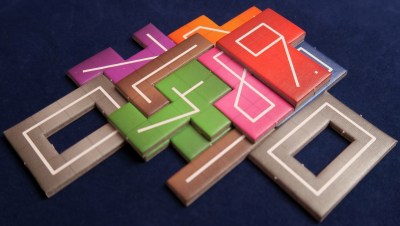
Blue was the first to arrive with Pink, who had come specially to celebrate our sixth birthday.  While they were waiting for food they managed a quick game of NMBR 9.  This is a very simple game, almost like Tetris where players try to tessellate tiles, building layers on top of layers, with the higher layers scoring more points.  It is almost a year since Blue and Pink picked it up at Essen, and since then it has been played repeatedly, an average almost once a month (or every other games night).  Mostly we aren’t so keen on multiplayer solitaire games like this, but NMBR 9 is the exception largely because it is so very fast to set up and games are quick to play too making it a great filler.  It is a shame it only plays four, because there is no real reason that it couldn’t play a few more.  Food arrived really quickly, and we were still placing the final tiles.  It was quite close with similar values for the “first floor”, but Blue edged it with a four and a nine on the next layer compared with Pink, who only managed a six.

NMBR 9
– Image by boardGOATS

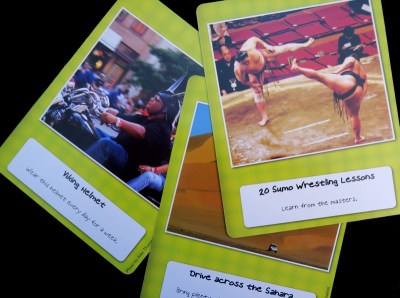
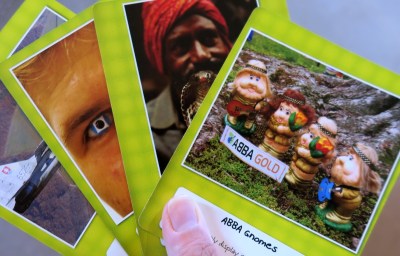
Burgundy arrived soon after, and attacked his ham, eggs ‘n’ chips, eventually followed by Pine, Ivory, Green, and Cobalt (a friend of Green’s who will be moving into the village in a few weeks time).  As it was exactly six years since the first games night, we couldn’t let the night pass without some sort of small celebration.  So this year we had chocolate brownie cupcakes adorned with meeples to go with the now traditional, the “Birthday Feature Game”, Crappy Birthday.  This is a very silly game that we now play exactly once a year at the beginning of October, with some house rules to make it slightly more palatable as it really isn’t our sort of game at all.  Strangely though, everyone seems to really enjoy playing it once a year on our birthday.  The idea is very simple:  everyone has a hand of gift cards, and everyone takes it in turns to “celebrate their birthday”.  On a player’s “birthday” they receive a gift from everyone else.  These are shuffled, and the “birthday boy” picks the best and worst – the players who gave these get a point and after one year (i.e. after everyone has had a “birthday”), the player or players with the most points win.

Crappy Birthday
– Image by boardGOATS

It is the cards that “make” the game for us:  they are brilliant with fantastic comments.  For example, Pink was tickled, well, pink, by the “pet vulture” that he gave to Pine, which was “very friendly, but stares at you while you are sleeping”.  Pine was quite taken with it too and picked it to be his favourite gift, to go with the “fresh turkey” which was always going to be unpopular with a vegetarian (though might have given him something to feed to the vulture).  Burgundy showed an unexpected desire for a set of fluffy dice (thought that might have been more due to the nature of the other gifts than their actual desirability), and Ivory returned the “thoughtful gift” of a set of “camera scales”, which he felt would have been off-putting.  Despite his love of Star Wars, Green decided he’d rather have “a suit of armour” than a complete collection of memorabilia .  Star wars wasn’t in favour with Cobalt either as he unceremoniously returned the gift of “a Star Wars themed wedding” (though it wasn’t completely clear whether it was the Star Wars theme or the wedding that he was rejecting).

Crappy Birthday
– Image by boardGOATS

There was a brief hiatus while Ivory entertained everyone with a complete rendition of Rod Campbell’s “Dear Zoo” story.  Despite being written over thirty-five year ago, nobody else seemed very familiar with the story and everyone was spell-bound as Ivory explained, “I wrote to the zoo to send me a pet.  They sent me an elephant, but he was too big, so I sent it back.”  A very long list of animals later, we established that the puppy was just perfect and Crappy Birthday continued.  The game finished with Pink who fittingly received a real birthday card (it really IS his birthday soon).  Blue then tried to persuade him that Chernobyl was now a safe place to visit and full of lots of interesting wildlife, but he wasn’t convinced and much to everyone’s surprise, rejected a visit (and possible nuclear suntan) in favour of “twenty tanning sessions”.  With Crappy Birthday done and people just licking the last of the icing off the meeples from the cupcakes, it was time to decide what to play next.

Cupcakes!
– Image by boardGOATS

Pink was very keen to play either Altiplano or Clans of Caledonia and Ivory and Burgundy were very keen to join them.  Time was short and the games are similar lengths, however, Blue, Pink and Burgundy had all played Altiplano, and with it’s similarity to Orléans, it was felt that it would be easier for Ivory to pick up quickly.  On the next table, everyone else was trying to decide what to play.  With Cobalt new to the group and not able to stay late, they needed a short game that was quick and easy to explain that might be a good introduction to gaming, so in the end, the group settled on Coloretto.  The game is very simple, with players drawing a card and adding to one of the available “trucks”;  each truck can take a maximum of three cards.  Instead of drawing a card players can take a truck and the round is over when everyone has taken a truck.  The aim of the game is to collect sets of cards, but while the three largest sets score positive points, everything else gives negative points.  The really clever part is the score which is based on the triangular number series, so sets score increasingly well as they get larger (or badly if they score negative points of course) .

Coloretto
– Image used with permission of BGG contributor punkin312

Cobalt  quickly got to grips with the game, but played it safe by taking the bonus score cards. Pine went for a specific set of colours and Green ended up with several that he could build on.  As the game progressed, Cobalt continued to play cautiously and kept the number of colours he had small. Green had several colours, but a few sets were building to a significant number.  Meanwhile Pine’s attempt to keep to specific colours was failing and although had lots of one colour, just couldn’t get the others he wanted.  The final round featured a golden joker which took a little while to work out the rules for.  Despite being very pretty, it turned out that it wasn’t such such a good thing after all, especially at the end of the game. Pine ended up with it and took another random card, which didn’t help him, but didn’t hurt him either.  It was very close, but in the final scoring, Cobalt’s cautious approach kept his negative points down to just one, but his positive score had also suffered. It was Green that topped the podium though, with five points more than Pine.

Coloretto
– Image used with permission of BGG contributor punkin312

Cobalt and Green were chatting while Pine was side-tracked by the eye-catching alpaca on the neighbouring table.  Eventually Cobalt called it a night, and Green and Pine contemplated playing something and had just decided to play a quick game, when Black and Purple arrived. They were delighted to find that cakes had been saved for them (with suitably coloured meeples), and the foursome settled down to a game of Splendor.  This is another light, set collecting game that we’ve played a lot.  With simple choices, we find it a relatively relaxing game to play and perfect in the circumstances.  The idea is that players use gem tokens to buy cards, which in turn provide permanent gems that can be used to buy other cards.  Some of the high value cards also give points and players who collect enough of the right gems may earn a visit from a Noble giving them more points – first player to fifteen points is the winner.

Splendor
– Image by BGG contributor zapata131

Everyone followed their own strategy, but it looked like opal (black) and diamond (white) gem cards were the ones that everyone would need due to the Nobles and very few blue sapphires and green emeralds. Purple managed to corner the market for diamonds causing everyone difficulties.  Green was building up red rubies and opals and also going for high scoring cards and Black was managing to gain lots of opals and was quietly beavering away. Pine seemed to find himself in all sorts of trouble as he just couldn’t get the cards he needed with everyone else nabbing them just before him.  It was beginning to look like Black was going to win, but suddenly Purple’s hoarding of diamond gems paid dividends as she was able to grab nobles one after the other and reached the magic fifteen points before anyone else, and exactly one turn ahead of Black as it turned out.

Splendor
– Image used with permission of boardgamephotos

Meanwhile, on the neighbouring table, Altiplano had been going for some time.  It had been the “Feature Gamea few weeks back and everyone had really enjoyed it as it gave a new spin on the “bag building” mechanism used in another game we are very familiar with, Orléans. The games are similar in that each player has their own player board, draws “workers” out of their bag and then plays them onto their board before everyone takes in it in turns to carry out the associated actions (one at a time).  The biggest fundamental difference between the two games is that in Altiplano, when tokens are used, they don’t go straight back in the bag as in Orléans, instead, they go into a separate box.  The tokens then only go back into the bag once everything has been used and the bag is empty.  This reduces the lottery element and as a result the game is a lot less forgiving to a poorly controlled bag, but players have much more control if they can find a way of using it.

Altiplano
– Image used with permission of BGG contributor JackyTheRipper

The games are visually very different too, with everything set out on a central player board in Orléans, which also features a map which players are trying to navigate and build on.  There is no map, in Altiplano, but there is still a spacial element to the game:  the central play area is made of locations arranged in a circle and only certain actions can be carried out in each one.  For example, if players want to sell goods, they must be at the Market, and must have the relevant goods placed in the Market spaces on their player board.  Before or after their action, players can move, but movement is very restricted.  Players begin with one card that can move up to three spaces in either direction, but they can also “buy” additional moves. And this is where we got the rules wrong.  The correct rules are that players can place a food token onto one of the movement spaces allowing the player to travel just one space (recycling the food into their box).  When these spaces are upgraded with carts, there is still a cost of one food, but now players can move up to three spaces. The rules error was that players couldn’t use the extra movement spaces until they had got a cart, and then they could only travel one space.

Altiplano
– Image used with permission of boardgamephotos

Blue was sure something wasn’t right, but was too busy checking other things and answering questions that she didn’t get to find what the problem was until the game was nearly finished.  At this point, Pink informed everyone that he hadn’t been listening to the rules outline and had just been “playing correctly”.  The problem with this is that in a game as tight as Altiplano, even the smallest of changes can have unpredictable consequences.  Last time, Green had been taking a token when he bought Cottage Cards (in effect using them as Canoe Cards); although he had only benefited from a couple of extra tokens, he would have been able to use them several times, and as one of them was Stone it would have helped him to get extra tokens out of his bag, and taking the last Glass token ended the game prematurely etc.  Thus, in this game in particular it is impossible to unravel mistakes and try to work out what effect it might have had, though both Blue and Burgundy felt they would have benefited hugely had they been able to take those extra moves.

Altiplano
– Image used with permission of boardgamephotos

Aside from that, the game was mostly played according to the rules.  Pink went for a warehouse strategy concentrating on trying to obtain high value goods, in particular Silver and Wool. Burgundy really struggled at the start and in the end just tried to get hold of any resources he could, and then send them off to his warehouse.  Blue started off really well, but her game stalled in the second half when she ended up with a lot of stuff in her bag that ended up blocking spaces she wanted to use and slowed down the rate she was drawing the tokens she wanted.  While trying to sort out the mess she commented, “I’m going to stuff my whorehouse,” which gained a lot of sniggers from the neighbouring table.  The game was a bit of a mystery to Ivory and he kept saying that he could see how the game worked, but not where he was going to get any points from.  That said, he managed to get nearly a hundred of them giving him a very creditable score for a first try especially given the rules error and the haste they had been explained in.  He probably raised the biggest laugh of the night as well when he sighed deeply and announced, “I think I’m just going to have to get my wood out!”

Altiplano
– Image used with permission of BGG contributor JackyTheRipper

Blue had fulfilled more contracts than anyone else and had the vast majority of the glass, but it wasn’t enough.  It was very tight between Pink and Burgundy in first and second place though—Burgundy had more goods in his warehouse, but Pink’s were generally of a higher value.  In fact it was so close that it called for a recount, just in case.  It turned out that the scores had been correct though and Burgundy’s hundred and fifty-two, just edged out Pink who finished three points behind.  Comparing the totals to those achieved last time showed how much everyone has improved since the winning score for that game was a hundred and three.  The reason for that is probably largely the fact that everyone is getting better at controlling the contents of their bag.  As Pink pointed out, it really is critical to get rid of things that aren’t wanted, otherwise you end up in the mess Blue got herself into.

Altiplano
– Image used with permission of boardgamephotos

Learning Outcome:  Don’t put wooden meeples on cakes, they are too chewy…

Next Meeting – 2nd October 2018

Our next meeting will be on Tuesday 2nd October, at the Horse and Jockey pub in Stanford-in-the-Vale.  As usual, we will be playing shorter games from 7.30pm as people arrive, until 8pm when we will start something a little longer.

It will be our sixth birthday, so as is now traditional, the “Feature Game” will be Crappy Birthday.  This is a silly little filler/party game that we can mess about with while people are eating cake allowing us to play something longer once everyone has arrived and finished food and the inevitable Essen discussions.

Crappy Birthday
– Image by boardGOATS

And speaking of birthdays…

It was Jeff’s birthday and, as it was a special birthday, his brother had bought him a special present.  Before opening the gift, Jeff shook it slightly, and noticed that it was wet in the corner.  Touching his finger to the wet spot and tasting it, he asked, “Is it a bottle of wine?”

His brother shook his head, “No…” So, again, Jeff touched his finger to the box and tasted the liquid.

“A bottle of Scotch then?” he asked, beginning to get all excited – this was way better than he’d expected.  Again his brother shook his head though, “No, not a bottle of Scotch…”

Eventually, Jeff said, “OK, I give in, what is it?”

His brother paused for effect, before answering, “A puppy!”


Now We Are Six – Happy Birthday to Us!

BoardGOATS is Six Years Old Today!

Yes, unbelievably boardGOATS is still here after six years, still meeting fortnightly in the Horse and Jockey in Stanford-in-the-Vale.  Of the six people who were present at the first meeting so long ago, five are still coming; the group has grown, but still has the lovely, friendly, social feeling we cherish.  We would like to thank to everyone who has come along in the past and in particular, all those travel regularly from further afield.  Without you, boardGOATS wouldn’t be the success it is, so we really appreciate it.  We’d also like to thank the folks at the Jockey who have always been so supportive, and let us have so much fun in their back room.

18th September 2018

While Blue and Burgundy finished their tea, Pine, Black and Purple squeezed in a quick game of Coloretto.  This is a simple little game and inspiration for the more popular (though arguably not better), Zooloretto.  A set collecting game, the idea is that on their turn, the active player either takes a truck, or turns over the top card of the deck and places it on one of the trucks.  Each truck has three spaces and players are trying to stack the trucks so that when it is their they can get what they want.  In practice, the game doesn’t work like this at all, and players spend most of the time trying to avoid giving everyone else a combination they want.  At the end of the game, players choose three sets to score positively, while all the others score negatively.

Coloretto
– Image used with permission of BGG contributor of punkin312

The clever part is that the score (positive or negative) depends on the number of cards, according to the Triangular series.  This means that one card only scores one point (positive or negative), but a set of six will score twenty-one points.  This players generally don’t mind lots of cards that aren’t part of their three top sets, so long as they are all different colours; the problem comes when they have sets of a significant size…  Purple started off best as Black ended up with too many negatively scoring cards.  Pine put up quite a fight, but in the end Purple was too strong and won the game with forty-seven points, ten more than Pine in second place.

Coloretto
– Image used with permission of BGG contributor SergioMR

Once food had been dealt with, the usual debate as to who wanted to play what began.  Aside from Pine and Purple, everyone was keen to play the “Feature Game”,  Endeavor: Age of Sail, the new, deluxe edition of Endeavor, a game we’ve enjoyed a few times. The new edition is particularly shiny with lots of KickStarter exclusives, including a new game element, “Exploits”.  Pine and Purple were a bit reluctant as they thought it would be very “thinky”, but everyone who had played it before tried to reassure them that it although it was a little challenging, it wasn’t a long game and was usually over in an hour or so.  Things were complicated by the fact that it was a quiet night and with only six people, we didn’t want to leave the “two Ps” in a pod by themselves as that’s a bit unfriendly.  We had two copies of the game, so Blue, who was a little under the weather volunteered to teach them the basic game (i.e. without the “Exploits”).

Endeavor: Age of Sail
– Image used with permission of boardgamephotos

There are seven rounds, each with four phases which roughly correspond to the four progress tracks on each individual player’s board.  In the first phase, Building, each player chooses a building from one of five levels, depending on their position on their industry (Building) attributes track.  Everyone starts at zero, so everyone has to pick level one buildings in the first round.  The buildings give players abilities and/or actions as well as helping them along the other attribute tracks, In the first game, Blue went first and started by picking a Workshop, which gives two extra industry points (and she hoped might let he build more exciting buildings earlier); Purple followed and also took a Workshop.  Pine decided to go for something different and picked a Shipyard which gave him one step on the Culture (Population) track and additionally gave him a shipping action.

Endeavor: Age of Sail
– Image used with permission of boardgamephotos

The second phase can be carried out simultaneously and each player moves population tokens form their supply into their Harbour space where they need to be so they can use them later.  At the start of the game, everyone could take two population disks, even Pine with his Shipyard as it only added one step along the Culture track and it needed two before he could take an extra.  That was to change quickly though, as Pine concentrated on building up his Culture and the number of population tokens he could take as he felt this would give him extra actions.  In order to make best use of it though, he would also need the buildings and the ability to vacate them so he could use them again.  Buildings are vacated in the third phase, where the player’s Wealth is used to pay the population and move markers off the buildings back to the Harbour.  Again all players can do this simultaneously and obviously nobody could do anything on the first round though this aspect becomes  increasingly important as the game progresses.

Endeavor: Age of Sail
– Image used with permission of boardgamephotos

The final phase is the Actions.  This is the guts of the  game, and is also the most complicated part.  The idea is players take it in turns to carry out actions by either placing Population discs onto their buildings or playing action tokens they have picked up during a previous round.  There are five basic actions:  Ship, Occupy, Attack, Pay workers and Draw a card from one of the colonies.  At the start of the game the only action available was really Occupy, through the Colonial House that everyone started with.  This enabled Purple, Blue and Pine to place a second population disk in one of the cities and take the Asset disk that was placed there at the start of the game.  In the first round, there really doesn’t seem to be much in the way of decision making in this game, but those few decisions are really critical as everything builds on them.  For example, each city has an Asset disk placed at random during set up.  These enable players to progress along the Asset tracks and the associated abilities enable them to build and carryout more actions.

Endeavor: Age of Sail
– Image used with permission of boardgamephotos

Shipping for example, involves placing more population disks, this time on shipping routes to the colonies.  These also give Asset disks, but the real benefit comes when they are completed and the region is “open”.  At this point, players can Occupy cities in the region, and also Draw cards from the associated deck, giving more Asset points as well as Glory (Victory) points.  At the end of the game each city is worth one (or in some cases two) points, but if a player controls two connected cities, they also control the link between them, each of which is worth another point.  For this reason, players might want to Attack a city occupied by another player.  This is expensive (war always causes collateral damage) and both players lose a population disk as a result, but fighting can be worth while.  Both Blue and Pine had the wherewithal for attacking, but thanks to  mutually assured destruction, they just sat and watched each other for a round or so until Blue decided she really wanted one of Pine’s cities and used her Fortress to pounce.

Endeavor: Age of Sail
– Image used with permission of boardgamephotos

Pine got his revenge shortly after, with his Barracks, but the battles had been costly (even to Pine with his large population), and the protagonists retreated and licked their wounds.  While the others were playing “Tit for Tat”, Purple had been making progress on the shipping track in the Far East and had started in South America.  The fighting wasn’t over yet though, and Purple had a go at Pine who promptly got his own back.  Before the game Blue, Green and Burgundy had all agreed that Endeavor was a surprisingly short game, but it was clear that Purple and Pine weren’t really convinced.  Before they knew it though, it was time to add up the final scores.  Points were available for progress on the Asset tracks, for occupying cities, for occupying linked cities, and on some of the cards.  The catch though is that at the end of every round, players have to check they are far enough along the Influence track to be able to keep all their cards.  The problem is, that for every card that is returned, all the assets it provides are lost as well.  As Blue and Pine had cards to return, there was a bit of Maths to be done to work out which was the best card to lose.  Given that Pine and Purple had never played before (and Blue had been a bit under the weather so her explanation wasn’t the greatest), it was a remarkably close game.  Experience told, however, and Blue finished in first place a little ahead of Pine who was just very pleased that nobody had taken advantage of the slavery option.

Endeavor: Age of Sail
– Image used with permission of
boardgamephotos

Meanwhile on the next table they were still playing, though the final round was just coming to an end.  Everyone in this game had played it before (though Black needed a reminder of the rules), so they chose to play with the new Exploits.  By random selection  the “Imperialism” (some routes “blocked” and give bonuses points if they are opened); “The Haitian Rebellion” (enables cards to be removed from the deck either to stop others getting them, or to clear the way for a better card; points are awarded if enough cards are removed), and “The Jesuit Missionary” (in exchange for attributes players can build churches in cities for extra points, or even in empty cities and then immediately occupy them, with extra points for each church built).  Burgundy chose to start the game with the new Merchant Dock building on the other reverse of the Colonial House starting tile.  This gave him an extra coin and a shipping action, while Black and Green opted to stick with the traditional building which gives an occupy action.  Burgundy used his alternate strategy to steal a march on shipping into Africa, while the others began building a presence in Europe.  Both Black and Burgundy quickly went for the extra bricks from the buildings to move up the Building track while Green tried to expand his Shipping options.

Endeavor: Age of Sail
– Image used with permission of boardgamephotos

With his Merchant Dock, Burgundy was able to quickly build some of the bigger buildings and take a controlling stake in Africa, although both Black and Green managed to sneak in and maintain a presence.  Green concentrated on linking European cities gaining a lot of population bonuses and so always had enough people to do all his actions, especially when he built a Bank giving him an “coin” so could always pay his workers.   Burgundy was the first to be nasty by attacking Black in taking the linking token. By the middle of the game Black and Burgundy were able to build level three and level four buildings, while Green was still stuck level two buildings only.  His population was soaring though and and the on/off war between Black and Burgundy was keeping their holding back their populations somewhat.   Burgundy and Green went on to open two new regions (Caribbean and South America), followed shortly by Black trying for North America.

Endeavor: Age of Sail
– Image used with permission of boardgamephotos

During the latter part of the game, Green was the only player in South America, while everyone had a presence in all the other regions.  Burgundy dominated in the Caribbean though and Black had a strangle-hold on North America and India, and soon followed them with Asia.  As a result of these regions being opened, the Exploits became “open” as well.  Burgundy and Green were first up with the “Hiatian Revolution”, but initially only Burgundy took the opportunity to utilise it.  Later Green opened “The Jesuit Missionary” and then used that to great effect and suddenly he had cities and connections all over the board.  Although he could not get a particular link he wanted as someone else was occupying the city, he suddenly realised that he did have a spare cannon token and could actually make use of his (by now) vast population and claim the city for himself.  Black was the only one who was able to use the ‘Imperialism’ exploit and managed to clear a couple of blockages in the last couple of rounds.

Endeavor: Age of Sail
– Image used with permission of boardgamephotos

And then suddenly the game was over.  It looked like a Green was home and dry as his board presence was very high, but Black had a large number of points from his cards and Burgundy had progressed well along his Asset tracks.  In the end, however, it was Green that scored the most by a reasonable margin (even after removing the four extra Wealth points he had forgotten to discard in the last round, due to card losses).  But what about the exploits?  They had not come into play until the last couple of rounds and seemed to be of varying impact.  The “Jesuit Missionary” had clearly been used to great effect by Green, not so much for the points for the churches (a maximum five), but for the ability to claim cities and their respective tokens and the link tokens, which of course enabled even more scoring.  Maybe if someone else had been able to get a presence in South America and also use it, it might not have felt quite so powerful.

Endeavor: Age of Sail
– Image used with permission of boardgamephotos

The “Haitian Rebellion” was sometimes helpful to remove unwanted lower point cards, but it was worth nothing when it came to end game scoring. Only Black was able to make use of the “Imperialism”, but it was so late in the game it only gave him a couple of extra points and not really enough extra tokens, though it may have had a more positive effect had it been earlier in the game.  Overall though, the Exploits were a nice addition that did not detract from the feel and essence of the base game, but changed it enough (in the end) to notice their presence and draw them into the game.  With fifteen in total and only three used per game, there are a lot to try (and there is also the extra mini expansion with some extra useful buildings as well).  In conclusion, with nice pieces and something new, this KickStarter edition has really breathed new life into a old great game, and we are likely to be playing it for a little while longer yet.

Bohnanza
– Image by boardGOATS

With Endeavor over, Green wanted an early night, but there was still time for one more game.  As Blue had picked up Pink’s new Spanish copy of Bohnanza from last time, there was really only one  game to play.  The first challenge was getting the setup right for five – it turns out that the Spanish edition is a little different and the question was whether Blue’s Spanish was up to the job.  She muddled through and everyone was only slightly confused by the different bean names.  Nobody needed reminding of the rules once we’d got going (plant one bean, and another if you like before turning over two cards from the deck and planting or trading them, make any extra trades you can from your hand and draw cards from the deck, but DON’T rearrange your hand!).  Unusually, it wasn’t as tight as this game often is; Burgundy and Pine did well and made the podium, but in the absence of Red, Blue finished in front with twenty two.

Bohnanza
– Image by boardGOATS

Learning Outcome:  boardGOATS don’t approve of Slavery.

Boardgames in the News: Stop that Goat!

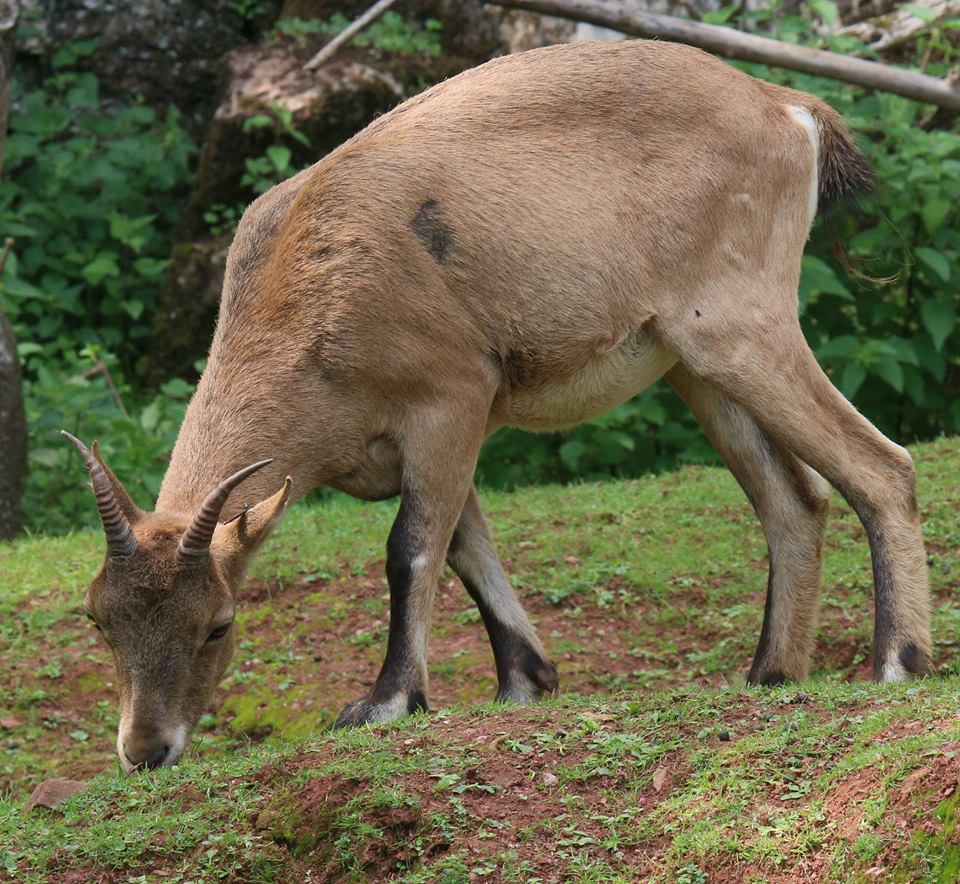
Yesterday, a young female West Caucasian tur, a kind of mountain goat, made her Great Escape from Paignton Zoo in Devon.  Just like Steve McQueen (but without the aid of a motorcycle), she jumped a fence and disappeared into a nearby dense wooded area.  Staff and police have so far failed to catch her, but despite her horns she is a naturally timid goat and is not thought to be dangerous.  Apparently she is not making her way to Oxfordshire to join us for out 6th birthday party on Tuesday as she has been seen and “herd” in the local area and zoo staff are trying to entice her back with a few tasty morsels.  Maybe they should just try smiling at her…?

A West Caucasian Tur
– Image from twitter.com


Deutscher Spiele Preis – 2018

This week the The Deutscher Spiele Preis, or German Game Prize list was announced with first prize going to Azul.  Typically the Deutsche Spiele Preis rewards a slightly heavier game than the the Spiel des Jahres awards, but for the first time since Dominion in 2009, one game took both awards.  This year we haven’t played many of the games on either list, but our first game of Azul was shortly after it’s release at Essen last year and our local groups have played the spots off it since.  So, it is no surprise to us that it has been recognised by both the Spiel des Jahres Jury and the voters from the industry’s stores, magazines, professionals and game clubs, as well as taking the French award at Cannes, the As d’Or and the Origins “Best Family Game of the Year”.

Azul
– Image used with permission of boardgamephotos

Other games that featured on the top ten list included the winner of the Kennerspiel des Jahres award, Die Quacksalber von Quedlinburg (currently only available in German) and one of the runners-up, Heaven & AleThe Mind, which received a nomination for the Spiel des Jahres Award, also featured in the top ten, as did the inevitable Pandemic Legacy: Season 2.  Other than Azul, the only game we’ve played is Altiplano, and that squeaked in at number ten, but Rajas of the Ganges and Clans of Caledonia may feature in the not too far distant future.  The Deutscher Spiele Preis for Best Children’s game went to Memoarrr!.  The prizes will be awarded at the Internationale Spieltage, Essen.

Azul
– Image used with permission of
BGG contributor Vacabck