Author Archives: nannyGOAT

Goats in the News: What if Goats Voted for the US president?

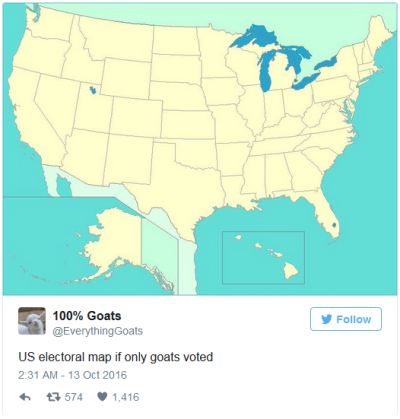
With the US election the subject of every other media article, the silly season is definitely here.  A recent email to Republican supporters sent by Eric Trump included the state division map which apparently showed an overwhelming majority for his father, Donald Trump.  The map was calculated from numbers published on FiveThirtyEight.com, a statistics-driven news website.  Unfortunately, the map he used showed who would win the US election if only men could vote (the report also included a similar map depicting the situation if only women voted). Inevitably, these were followed swiftly by other maps prepared by the Twitterati, including one calculating showing what would happen if goats voted…

US Election Map
– Image from twitter.com

Next Meeting – 18th October 2016

Our next meeting will be on Tuesday 18th October, at the Horse and Jockey pub in Stanford-in-the-Vale.  As usual, we will be playing shorter games from 7.30pm as people arrive, until 8pm when we will start something a little longer.

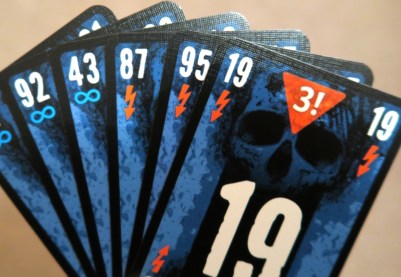
This week the “Feature Game” will be The Game: Extreme, which is a game picked up from the Game Fair last week in Essen.  We’ve played The Game quite a lot, but this new version adds extra instructions on some of the cards that make the game quite a bit more challenging.

The Game: Extreme
– Image by boardGOATS

And speaking of “the game”…

Jeff was working as assistant manager in a hotel.  They used to get all sorts of people staying, one day a group of chess enthusiasts checked in.  That evening, the gamers were all standing in the lobby discussing their recent tournament victories. After about an hour, Jeff came out of the office and asked them to disperse.

“But why?” one of them asked, as they started to move on.

“Because,” answered Jeff, “I can’t stand chess nuts boasting in an open foyer.”

4th October 2016

It was a quiet night, thanks to illness, work and other commitments.  There were still enough of us to split into two small groups, the first of which settled down to play Endeavor.  This is a game we’ve played a couple of times this year and still proves quite popular.  This time, only Green had played it before and Grey and Ivory were unfamiliar with it, so it was necessary to have a complete run-down of the rules.  The game is played over seven rounds, each of which consists of four phases:  Building, Population, Income and Action.  The idea is that players have four status tracks, one each for Industry, Culture, Finance and Politics, which roughly correspond to the four phases of the game and dictate what players are allowed to do at each stage.

Endeavor
– Image by boardGOATS

Players begin by choosing a building, some of which provide an increase in one (or more) of the four status tracks, some provide actions, while most others do a mixture of both.  Players then move population markers from their general supply to their harbour according to their current culture level.  A strong population is essential as it ultimately limits the number of actions players can take on their turn.  The income phase allows players to move some of their workers from buildings back into their harbour as dictated by their current level on the income track.  These add to the population players have available to do things with, while also making space on the buildings so that these actions are available for re-use.  The first three phases of each round are mostly just preparation and book-keeping; the guts of each round are in the final phase, where players take it in turns to carryout an action of their choice.  There are five basic actions: Taking Payment, Shipping, Occupying, Attacking, and Drawing Cards.

Endeavor
– Image by boardGOATS

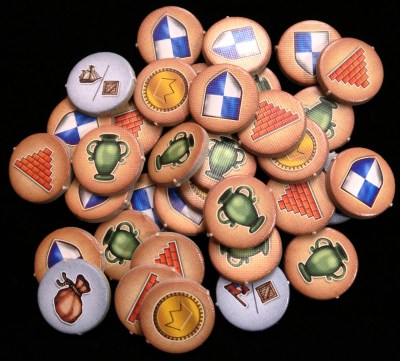
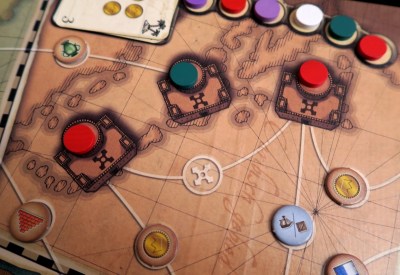
In order to carryout an action, players must activate an appropriate building by moving a population marker from their harbour to the building.  In the case of shipping, occupying and attacking, the actions are carried out on the central, communal player board.  To ship, after activating an appropriate building, players can move one of the population markers to one of the six shipping tracks and take the token that was on the space.  These tokens are useful as they add to the status tracks, but some also give a free action.  Shipping is also important as it gives players a presence in a region which is necessary for occupying, attacking and drawing cards.  When a player places the last token on a shipping track, The Governor card from the top of the pile in the region is allocated and the region is considered “open”.  This means that players who already have a presence in the region can also occupy the cities within the region. This gives both tokens and victory points, but where a player occupies a city that is connected to another city they already occupy, they get an extra token, which can be very valuable, as well as providing extra points at the end of the game.  This makes position very important, but if someone occupies a city that another player wants, one option is attacking.

Endeavor
– Image by boardGOATS

This is carried out in the same way as occupying, but is a separate action and costs an additional population marker.  Occupying a region also adds to a players presence in the region: players can also draw the top card from a region’s stack and add it to their player-board, so long as their total presence in the region is higher than the card number.  Cards are important as they also add to the status tracks as well as provide victory points, however there is a card limit which is enforced when a player passes at the end of the round and any status track points gained with the card are lost when cards are discarded.  Once everyone has completed one action phase players continue taking it turns until everyone passes.  Thus, the final possible action is taking payment which is the simplest action and allows players to move one of their population markers back to the harbour so that they can re-use the building in the same round. In addition to the five basic actions, some of the more expensive buildings provide a choice or even a combination of two of the basic actions.  After seven rounds, points are awarded for cities, for connections between cities, for progress up status tracks, cards, some special buildings, and any left-over population markers.

Endeavor
– Image used with permission of BGG contributor henk.rolleman

It was an inauspicious start: Grey was unhappy with the name, it hurt his language sensibilities, and he was very concerned as to where the “u” had gone.  Green was definitely at an advantage as the only person to have played the game before, but he did his best to guide the others for their first few turns. In truth, there is very little choice to be made in the first round or so, however, what choice there is tends to turn out to be critical by the end of the game.  With so little decision to make, the first round is always over in a flash, though the later rounds take progressively longer as the game goes on.  Ivory and Green both started building Workshops for the extra brick, while Grey went for a Shipyard and started to ship. In the second round, Ivory and Green’s Workshop enabled them to build more valuable buildings and Ivory took a Guildhall to get in on the shipping act, while Green declined the extra brick and went for the Shipyard. This gave him a second green population token and popped him over into gaining three population markers.  As the fog of first game confusion began to clear for Grey, he saw the advantage of the Workshop, so took it at the second opportunity.

Endeavor
– Image by boardGOATS

The first few rounds raced past as everyone developed their own board, increased their  populations and took cities and shipping tracks, but some clear strategies were emerging.  Green had a large number of cities in central Europe and a smattering of shipping routes, but was pushing strongly for Africa (to make connections with his European cities and give some great bonus action chits). Ivory was also keeping a strong hold in Europe, but not so much on the shipping tracks, while Grey was concentrating on opening up India and the Far East. Ivory had built up a healthy row of cards, and although he was the only one to resort to slavery so far, it was only the one card.  In the fourth round Grey took the penultimate space on the India shipping track and gifted Green a super-turn, when he used his Dock to ship (thus opening up the region) and then occupied too. The newly occupied town linked to his European city and so he got that extra token too. Grey did get the bonus Governor card in consolation however.  And then, the regions tumbled, next were the Far East and then North America.

Endeavor
– Image by boardGOATS

By the fifth round, the first four cards in the central region had all been taken, and a quick count up showed Green had five cities. He waited until the sixth round and, since no-one had attacked him, he took the final card and abolished slavery. Luckily Ivory was not too badly affected by this and avoided the collapsing house of cards such an event can often trigger.  At the start of the final round, Grey spotted that Ivory had a cluster of four cities plus one in Africa: that gave him four connections.  He also noticed that there was one cornerstone city that connected them all. So he bravely marched in, took the losses involved in attack and swiped several points from Ivory in one go.  The final turns were used for mopping up as many points as possible and once everyone had passed, it was on to final scoring.

Endeavor
– Image by boardGOATS

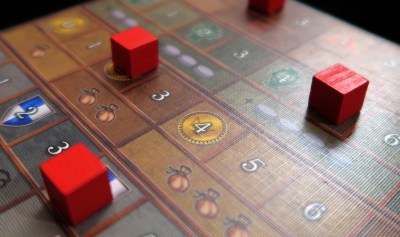
Not unexpectedly given his extra experience with the game, Green scored the most, with victory points from most areas.  Ivory was close behind in what had been a very enjoyable game.  In fact Grey had not only got over the mis-spelled title, but had enjoyed it so much that he went on to try to find a copy for himself.  Alas Endeavor is very out of print so if it can be found, it’s going to cost a pretty penny, which is a shame, as it is a really good game with good replay-ability, thanks to its random token layout.  On the adjacent table, there was much debate as to what to play, but eventually, the group settled on Istanbul, winner of the Kennerspiel des Jahres two years ago.  We’ve played it a couple of times, but Pine was completely new to it, though both Blue and Red had played it before.  It is also a fairly simple game where players are trying to lead their Merchant and his four Assistants through the Turkish bazaar.  There are sixteen locations each with an associated action, but to carry out an action, the Merchant needs an Assistant to help out.

Istanbul
– Image used with permission of BGG contributor duchamp

The problem is, once an action has been completed, the Merchant must move on, however, an Assistant remains to complete the details of the transaction.  Thus, the Merchant can only carryout a transaction if he has the help of an Assistant.  When he runs out of Assistants, the Merchant cannot carryout a transaction and must either visit the Fountain and summon his Assistants or go back to stalls where the Assistants are to collect them.  The central play-area is made up of tiles representing each stall, so there are four possible layouts:  “Short”, where the distances between places that work well together are small making game-play easier; “Long”, where places that work well together are far apart, which forces players to plan ahead more; “Challenging”, where similar places are grouped together, and “Random”.  For this game, we chose “Long” routes to give us a slightly more interesting game.

Istanbul
– Image used with permission of BGG contributor punkin312

Blue began by collecting money and visiting the Wainwright to build up the size of her cart, while Red began collecting the special tiles from the Mosque’s while they were still cheap.  Although Pine felt he understood the rules and the aim of the game perfectly, it took him a few rounds to work out how to go about making things work together effectively.  So it was that Blue just managed to get to the Jewelers before Pine and use a double card to buy two gems.  As Pine had only had the exact money for his own double gem purchase, he was now two Lira short and had to go and acquire more cash.  To add insult to injury, he had just acquired his extra Lira when Red pulled a similar trick and Pine had to go and find yet more cash.  While Blue and Pine were building piles of currency, Red was quietly collecting tiles from the Mosques and a full set gave her two gems.

Istanbul
– Image used with permission of of boardgamephotos

Blue and Pine completed their carts and, with her gems from the Jeweler, Blue seemed to have got her nose in front.  That was before Pine, largely unintentionally, got his revenge for the problems Blue had caused him earlier in the game.  Everything Blue tried to do, Pine was there first and obstructed her plans.  In such a tight game, it was just enough to give Red the extra time she needed to get her fifth gem and trigger the end of the game.  Despite a massive forty-two Lira, Pine needed two turns to change them into gems leaving Blue just ahead in second place with four gems.  As Endeavor was still in the closing stages, Red, Blue and Pine investigated the “Feature Game”.  To celebrate our fourth birthday this week, this was to be Crappy Birthday a silly little filler/party game.  This game has a lot in common with games like Apples to Apples and in particular, Dixit.  The idea is that each player has a hand of cards featuring strange potential gifts.  On their turn, it is the active player’s birthday and everyone else passes them a card.  The active player then chooses what they think is the best and worst and returns them to the original owner who keeps them as points.

Crappy Birthday
– Image by boardGOATS

After a couple of turns, Endeavor came to an end and the group joined up for a proper game of Crappy Birthday.  The key to playing this sort of game is knowing the other players.  Although we meet regularly, we don’t all know each other all that well, so this was always going to be interesting.  By the end, we’d learned that Red would quite like to bungee-jump; Green thinks turning his car into a caravanette would be fun (well, perhaps not his car); Blue has a pathological hatred of having her photo taken and Pine likes fluffy penguins and had been to the Westmann Islands and played with warm lava…  In the absence of cake (partly due to a mix up) we completed two rounds and Ivory and Green finished in front with three points apiece.  Given how unsuccessful social games often are with our group (most recently Codenames, which was very divisive), this was not expected to be a great success.  However, the cards were such fun and so unusual, that we all really enjoyed it.  Sadly, that means the game has poor replayability as, once the surprise has gone, the game will be much less fun.

Splendor
– Image by boardGOATS

With that done, Red, Ivory and Grey headed off, leaving Pine, Blue and Green to play something quick.  After a little chit-chat Splendor was the chosen game, with both Pine and Blue having unfinished business after getting soundly beaten twice in quick succession.  In this game, players have just three options on their turn:  collect gem tokens, buy a gem card using gem tokens (and/or cards), or reserve a gem card and receive a gold (wild) token at the same time.  Players can have a maximum of ten tokens, though unlimited cards and the cards act as permanent tokens.  Thus, at its heart Splendor is an engine building game built on a set-collection mechanism.  Players score points when they buy some gem cards and for attracting Nobles which are awarded to the first player collect certain combinations of gem cards; the game end is triggered when one player reaches fifteen points and the player with the most at the end wins.

Splendor
– Image used with permission of BGG contributor henk.rolleman

The game started with both Pine and Blue going for it with all guns blazing.  The set up included three special Noble tiles:  one from the 2015 Brettspiel Adventskalender and two from the promotional tiles set, but all four Nobles included opals.  So, it was just as well that there were lots of opals out at the start of the game.  Blue and and Pine collected as many of them as they could.  Green picked up a few too, but found the competition was quite stiff and went for more rubies and sapphires.  It was Pine who picked up the first of the Nobles, but that galvanised Blue into action and she grabbed the remaining three in quick succession.  She was still a few points short of the finish line, and it was then that Green realised he had misread one of the cards.  Having had a similar lead and lost last time she had played, she wasn’t going to let this one get away, and ruthlessly gathered the remaining points she needed to quickly bring the game to a close.  Blue finished the game with sixteen four points ahead of Pine in second place.

Splendor
– Image used with permission of BGG contributor henk.rolleman

Learning outcome: Some of the best games can be very difficult to get hold of.

Essen 2016

It is that time of year when, the leaves fall from the trees and gamers visit Germany.  No, Oktoberfest isn’t the draw (that happens in September anyhow), this is an altogether different annual German “festival” – The Internationale Spieltage, which is held in Essen.  To Gamers worldwide, Essen is synonymous with the largest games fair in Europe and, arguably, the world.  The fair runs Thursday to Sunday in mid-October every year and is the one of the largest and most significant of all the boardgame conventions.   As such, many of the manufacturers plan their biggest releases for October with their debut at the Fair.

Essen
– Image from merz-verlag.com

Last year there was a bit of a paucity of new games and it seemed to be all about expansions.  This year, while there are still plenty of expansions for well-loved games like Istanbul, Colt Express, Orléans and Ca$h ‘n Guns etc., there are also a lot of new games based on old favourites.  For example, there is Key to the City – London (which has a lot of elements of one of our favourite games, Keyflower), Jórvík (an update and re-theme of Die Speicherstadt), X Nimmt! (a variant on the popular but chaotic 6 Nimmt!), and the latest incarnation of the Ticket to Ride series, Ticket to Ride: Rails & Sails.  There will be plenty of other interesting original games too though, including The Oracle of DelphiA Feast for Odin, Cottage Garden and The Colonists.  Several members of the group are going this year, and they’ll no doubt bring back lots of exciting new toys to share with everyone.

Essen
– Image used with permission of BGG contributor Gonzaga

Boardgames in the News: The V&A on TODAY

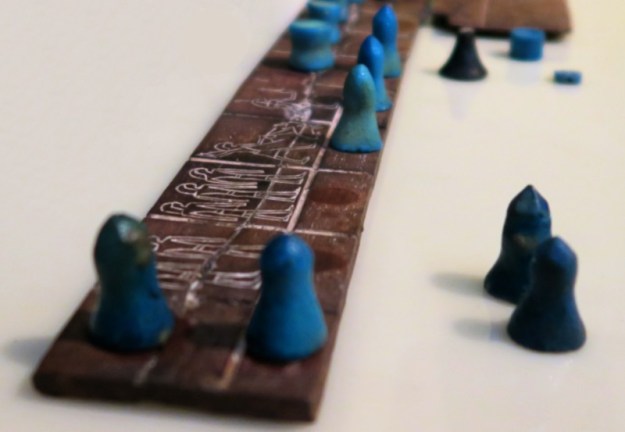
With the increasing interest in modern boardgames and boardgame cafés, it is inevitable that the established media will take more of an interest.  So far we’ve had the articles in the scientific journal Nature, BBC Radio Oxford, The Guardian, BBC Radio 2, and Channel 4’s “What Britain Buys”.  Today the BBC’s flagship radio news program, “TODAY” joined the fray together with a report on the new games exhibition at the Victoria and Albert Museum. The interview with Catherine Howell (of the V&A) and Leslie Scott (designer of Jenga) is available to listen to on iPlayer and starts at starts 2hrs 46 mins in.  It is an interesting article that covers changes in games from Senet to modern games as well as explaining the four different types of games as presented at the exhibition (race, chase, displace and space).  The “Game Plan” exhibition opens this weekend at the V&A Museum of Childhood in Bethnal Green and will include over a hundred objects as well as an “interactive game”.  The event is at least in part inspired by the boardgame café Draughts who are holding a “Gaming in the Galleries” event at the museum later this month.

Senet
– Image by boardGOATS

Aren’t all games interactive?

Boardgames in the News: The Monthly Game Guardian

In recent years it has become increasingly acceptable to play boardgames, so much so that there are now regular articles in the national press – in particular The Guardian who have had a dedicated boardgames area in their “Lifestyle” section for some time.  They now also have a regular monthly guide designed to help people “find the best games” and “steer clear of disappointing duds”.  This is written by Owen Duffy who writes for the Guardian on a range of subjects and until recently ran the tabletop gaming blog Cardboard SandwichThe first article showcases four games that even some dedicated gamers might not be aware of:  Ice Cool, Ticket to Ride: Rails & Sails, Mystic Vale and Sneaky Cards.  Owen has a real love of playing boardgames and is genuinely knowledgable about them, so the “Boarders Hoard” is definitely worth keeping an eye out for.

Ice Cool
– Image used with permission of BGG contributor punkin312

Next Meeting – 4th October 2016

Our next meeting will be on Tuesday 4th October, at the Horse and Jockey pub in Stanford-in-the-Vale.  As usual, we will be playing shorter games from 7.30pm as people arrive, until 8pm when we will start something a little longer.

To celebrate our fourth birthday this week, the “Feature Game” will be Crappy Birthday.  This is a silly little filler/party game that we can mess about with while people are eating allowing us to play something longer once everyone has arrived and finished the inevitable Essen discussions.

Crappy Birthday
– Image by boardGOATS

And speaking of birthdays…

It was Jeff’s birthday and, as it was a special birthday, his brother had bought him a special present.  Before opening the gift, Jeff shook it slightly, and noticed that it was wet in the corner.  Touching his finger to the wet spot and tasting it, he asked, “Is it a bottle of wine?”

His brother shook his head, “No…” So, again, Jeff touched his finger to the box and tasted the liquid.

“A bottle of scotch then?” he asked, beginning to get all excited – this was way better than he’d expected.  Again his brother shook his head though, “No, not a bottle of scotch…”

Eventually, Jeff said, “OK, I give in, what is it?”

His brother paused for effect, before answering, “A puppy!”


20th September 2016

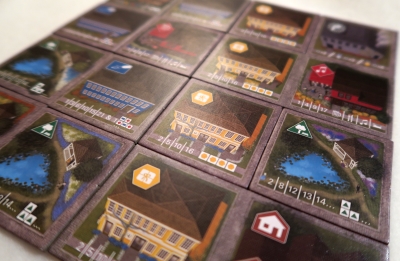
Since the planned “Feature Game” (Cuba) was a long one and we didn’t want anyone to get stuck playing two-player games all evening, we decided to play a quick filler until everyone had arrived.  After a brief discussion, we decided to go for Between Two Cities.  This game is quite popular with our group as it is both competitive, and cooperative and, as such, is totally different to anything else we play.  The idea is that, instead of each player having a personal player board that they work on in isolation, each player sits between two boards which they share with their neighbours.  The game play is based on card drafting games like Sushi Go! and 7 Wonders with scoring taking elements from tile-laying games like Carcassonne and Alhambra.

Between Two Cities
– Image by boardGOATS

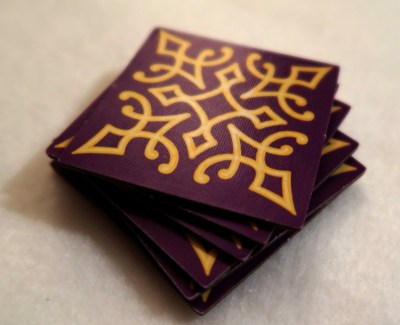
The game is played over three rounds with players placing building tiles to construct cities consisting of sixteen tiles in a four by four array.  Each player starts the first round with six tiles, of which they secretly choose two and pass the rest to the left.  Once everyone has chosen their two, everyone reveals their choices and then negotiates with their neighbours to try to to ensure they get the tiles they want in the two cities they have a share in.  Play continues with each player picking up the hand they were passed and choosing another pair of tiles etc. until there are no tiles left.  In the second round players get three double tiles of which they choose two and discard the third.  These double tiles contain two buildings in a vertical or horizontal arrangement.
Between Two Cities
– Image by boardGOATS

This is where things can get difficult, as the final city must form a four by four square and the location of buildings can be critical to their scoring.  For example, a housing estate built in a city with lots of other different types of buildings is worth up to five points at the end of the game, unless it is next to a factory in which case it is only worth one point.  Similarly, an isolated shop is worth two points, but a row of four is worth sixteen points.  The third and final round is played the same way as the first, except that tiles are passed in the opposite direction.  The winner is the player with the highest scoring second city.  We had just begun getting the game out and revising the game play when Black and Purple arrived, the last two expected.  So, in a quick switch, four jumped ship to play the “Feature Game” leaving Black and Purple to join Red, Magenta and Pine in Between Two Cities.
Between Two Cities
– Image by boardGOATS

The five cities all had very different characteristics, for example, Pine shared two contrasting cities with Magenta and Red.  The city he shared with Magenta had a pleasing arrangement of houses around a large central park with a couple of shops, bars, offices and a factory.  On his other side he shared the top scoring industrial town with Red which comprised a small housing estate buffered from factories by a row of office blocks.  Red shared her second city with Purple. This was built round a large park with lots of offices some bars, but only the one housing estate which cost it points.  Purple also shared a city with Black comprised two small parks surrounded by houses and bars with a couple of shops thrown in for good measure.  The fifth and final city was another industrial conurbation shared by Magenta and Black with lots of factories, and offices interspersed with bars and restaurants giving it a high score.
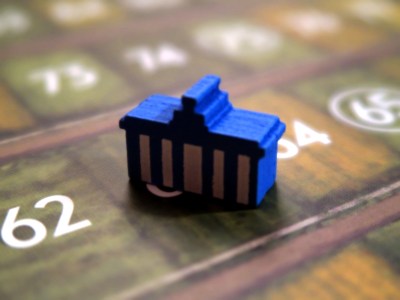
Between Two Cities
– Image by boardGOATS

The key to the game is to build two cities with similar scoring, but ideally using different components.  The other important factor, however, is the layout of the buildings and keeping them flexible for as long as possible.  The most successful in this regard was Pine, who was sat between the first and third highest scoring cities shared with Magenta and Red, who took second and third place respectively.  Filling in the log book was quite a pantomime, accompanied by photos and complicated diagrams before the group moved on to their next game, Pi mal Pfloumen, also known in our group as “Oh my Plums!”.  We’ve played this a couple of times, most recently last time, but on both occasions we struggled with the clarity of the rules.  This time, we finally managed to play it right (we think) and unsurprisingly, the game worked much better played correctly.

Pi Mal Pflaumen
– Image by boardGOATS

The game is one of set collecting built on a framework of trick taking.  Each card has a value, a “fruit suit” and, in many cases, a special action as well.  Players take it in turns to play a card, then, starting with the player who played the card with the highest face value, players then take it in turns to choose a card.  These are added to their tableau in front of them.  In general, any special actions are carried out when the card is taken, which can include taking “π cards” (which can be added to cards when they are played to increase their face value), taking cards from other players or claiming the Watchdog card (which protects from card theft).

Pi mal Pflaumen
– Image by boardGOATS

Some cards depict a “fruit mix” which lead to scoring opportunities, and can be claimed at any point when a player is taking cards at the end of the trick.  It all made a lot more sense this time though Red still didn’t have a clue what was going on.  It was quite a close game, but was finally decided when Red took a critical plum spoiling Black and Pine’s plans and with it taking the game, just ahead of Purple in second place. With Red and Magenta heading home for an early night and the game on the next table still going, Black, Purple and Pine were looking for something interesting to play.  Blue suggested Oh My Goods!, which is a little card game, but as none of the others had played it (and Blue was engaged elsewhere), they settled down to decipher the rules.  Meanwhile, the neighbouring table were just over halfway through their game of Cuba.
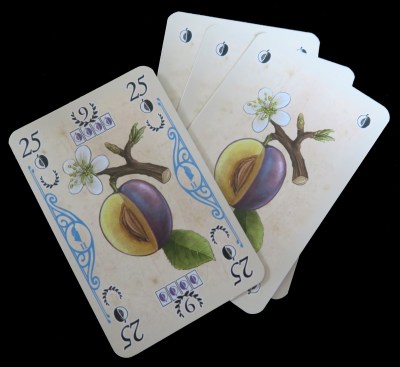
Pi mal Pflaumen
– Image by boardGOATS

Cuba is a fairly simple game mechanistically, but is deceptively complex thanks to the way actions interact and build on each other.  Each player has a player board featuring a four by four array of plantations and/or buildings and a lot for storage.  They also have a pack of five character cards each with an associated action.  In the first part of each round, players take it in turns to play a character card until they have each played four of them.  In the second part of the round, the remaining character provides the basis of each player’s votes in Parliament, with different characters providing different numbers of votes.  This part of the game is vaguely reminiscent of voting for Laws in Lancaster.  In Cuba, players can improve their position by buying more votes in a blind bidding phase with the winner choosing two which two bills Parliament will enact.  There are a number of little features that give the game teeth, for example, any money spent on buying votes goes to the bank, regardless of whether the player wins or loses.  Similarly, the start player (which decided based on the final character card played) can be critical as it is the tie breaker in the voting phase as well as giving priority in the next round.

Cuba
– Image by boardGOATS

Getting these wrong can mess up plans spectacularly, but far more critical are the character cards played, the order they are played in and how they are played.  For example, the Worker card allows a player to move their Worker to any plantation on their player board and then activate the plantation at its new location and all plantations orthogonal to it.  Plantations can generate resources (rock, wood or water) or produce (sugar, citrus fruit or tobacco), but as the game progresses may be replaced by buildings.  Buildings are placed over plantation spaces using the Architect card and exchanging them for resources.  Like plantations, they are activated by playing the Foreman card who activates all buildings orthogonal to the Worker, but does not move the worker as part of the action.  Thus, the relationship between playing the Worker card and playing Foreman card is very important.

 Cuba
– Image by boardGOATS

Furthermore, there is a significant distinction between resources (cubes), produce (octahedral blocks) and goods (rum and cigars created from sugar and tabacco):  while resources and goods can be stored in the lot, produce will rot if left out overnight and must be moved to the Warehouse before the end of the round if they are to be saved.  In order to move produce to the Warehouse, the Warehouse must be activated by the Foreman.  This could be because it is one of the buildings orthogonal to the Worker or because the player sacrifices his positional advantage and activates the warehouse as a single building anywhere on the board.  Thus, the position of the buildings is very important, not only because careful placement allows players to activate multiple buildings, but also because they are placed on top of plantations which are then no-longer usable.  Produce can also be saved from rotting by either using buildings to turn it into goods or by playing the Mayor to place items on a ship.  This last option can be difficult to rely on however as all merchandise must be placed on the same ship and spaces on each ship are limited.
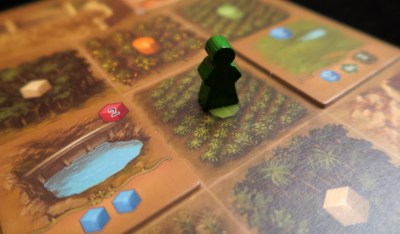
Cuba
– Image by boardGOATS

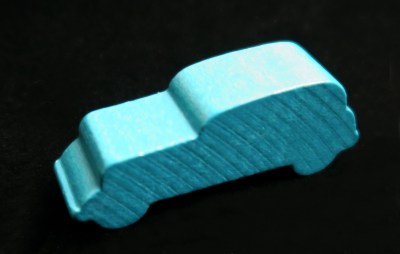
Thus, while Cuba relies on a good strategy, meticulous planning is also vital for success.  Although we could all see this up front, only Green had played it before (albeit some years ago), so he was the only with an idea of the possible strategies.  So, to give everyone else a few extra moments to familiarise themselves with their player board, Green was declared the start player and took the wooden blue sedan (pinched from the El Presidente expansion as a start player marker).  Green began by building the Dam to increase his board’s water supply, while everyone else started with what appeared to be a more flexible opening by using their Worker to collect resources and produce.  By the end of the first part of the first round, Burgundy had shipped a few goods, Green had collected a lot of water, and Ivory and Blue weren’t sure what they were doing, but had decided that collecting and storing produce seemed like a good base to start from.  Then came second part of the round:  bribing officials to decide which bills should be enacted.

Cuba
– Image by boardGOATS

Since Burgundy had been the only one to ship goods he was the only one with fewer than five votes.  Everyone secretly chose an additional amount, but as Green really, really, really wanted this one, he bid four of his ten pesos, while everyone else wasn’t certain how to value the bills and therefore didn’t bid.  So Green chose his expensive laws for the round and in particular the water subsidy which would give him three points straight away.  The second round mirrored the first with everyone choosing their “Worker” until Green played his “Architect”, building the Golf Course (which converts water into victory points).  While everyone else could see what Green was doing, nobody else had worked out what was a good combination of buildings and therefore what strategy to play for. Blue made a mistake thinking the Bank she was would give victory points, but when she activated it she realised it gave her money.  Still, it did give her an advantage during the bribing and in the second round was able to choose the laws.  This time she changed the goods tax from citrus to sugar, and brought in the Harbour Act (this makes any fully loaded ships leave the harbour immediately with all remaining ships moving along accordingly).
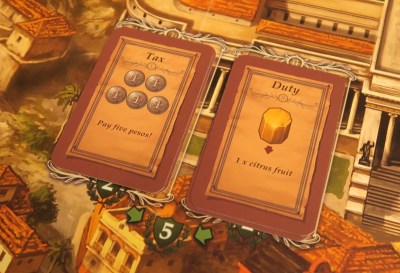
Cuba
– Image by boardGOATS

After taxes had been paid and subsidies received (Green had already converted his water and so did not receive the subsidy this time) the scores were evenly spaced with Green at the front, building a solid lead.   Over the next few rounds everyone stumbled on, still not really sure what to do as Green developed quite a strong lead.  Burgundy was the only one who was really doing any shipping while Ivory had managed to build a Rum Factory and was converting lots of sugar into Rum, which he was hoping to ship.  Unfortunately, he really struggled since only the first ships seemed to required rum and the later ones all seemed to need cigars.  By the time Ivory had given up and sold his rum, ships that did want it finally started appearing, but it was largely too late.  It was at the end of round four when the game took a sudden turn though.  Burgundy had worked hard on shipping, which the rest of us had mostly ignored.  With the Harbour Law still in force, the ships moved on when full and nobody had noticed that Ivory had every piece of merchandise required for the top scoring ship.  So when it was his turn he loaded it completely taking fifteen points, and with it, the lead.  Suddenly everyone knew how important shipping could be.

Cuba
– Image by boardGOATS

With only two rounds to go, it was a bit late to change strategies and only Blue made any inroads using her stash of pesos to win the laws and ensuring she could gather the full five points for fulfilling the taxes while everyone else struggled to get two points. This together with the Rum Café she had built gave her a sudden flurry of points, but it was too, little too late.  In the final final scoring, Green was unable to catch Ivory who finished four points behind Ivory – not how anyone would have predicted from the early rounds where Green had been so dominant and everyone else had been learning.  We had all enjoyed it though, especially once we’d got to grips with the difference between resources, produce and goods.  The sudden change of fortunes as strategies clicked kept it interesting too, though in any future there may be more competition for shipping than there was in this one.  It’s highly likely we’ll play it again soon though.
Cuba
– Image by boardGOATS

As Cuba was coming to an end, Black, Purple and Pine were still making a bit of a meal of Oh My Goods!, getting bogged down in the complexity of the theory of “chaining”.  Although this is the clever part of the game it is a complicated place to start in what is otherwise a simple game.  Players start with a hand of dual purpose cards which can act as resources or buildings.  They also start the  game with a single card face up in front of them, a charcoal burner stacked with face down cards:  charcoal.  The idea is that this charcoal can be used as money to spend on building, or as charcoal to use as an input to other processes.  At the start of each round players get an extra couple of cards before cards are turned over to make the morning market.  This can consist of as few as two cards or as many as eight or more.  The market provides input for buildings – there will be a second, evening market before the end of the round – but players have to use the morning market to provide a steer to decide which building they are going to activate and what they are going to build.
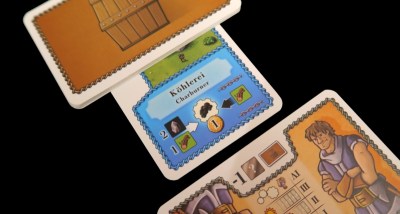
Oh My Goods!
– Image by boardGOATS

Each player has one worker and must be assigned to the building he is going to activate.  The worker can can work efficiently or lazily.  If he works efficiently, he will need the necessary resources in full and will provide two items of produce.  On the other hand, if he works lazily, he can manage with one less than the total necessary resources, but will only produce one item.  The resources can come from the market, but can also be topped up from the player’s hand.  Once each player has placed their worker, decided whether he will be efficient or lazy and chosen a card to build, the second market is revealed.  Once this evening market has been completed, players take it in turns to carryout their production and, if appropriate, build.

Oh My Goods!
– Image by boardGOATS

A building only produces if the necessary resources (on the bottom left corner of the card) can be provided either through the market or from a players hand.  If the worker is efficient, then he produces twice and two cards are taken from the draw deck and placed face down on the top of the card as produce.  If the worker is lazy, only he only produces once.  This is where the game gets slightly nasty:  if the player cannot supply the required input, then the turn is wasted, though if they have sufficient money, they can still use it to build.  If a building is activated, it can additionally be used to “chain” i.e. produce goods using input from other buildings (rather than the market) and it was this that was confusing people.  The problem is that this is only possible once a player has several building and although it is a key part of the game, the ability to build good working chains is highly dependent on the cards drawn.  As such, it is not something to worry about too much when learning to play.

Oh My Goods!
– Image by boardGOATS

Ivory and Green left, leaving Blue to try to explain to Pine, Black and Purple, and Burgundy to spectate.  Perhaps it was because it was late and people were tired, or perhaps it was because the players had confused themselves, but the game itself was still rather tortuous.  Pine’s concluding comment was that if Room 101 existed, he knew which game he would be sending there…  In this light the scores seemed rather irrelevant, though it was obvious that the player who understood best was going to win and that was Black who finished with twenty-two points.  He agreed that it was a clever game and he might be interested in giving it another go, though sadly it is probably beyond Blue’s powers of persuasion to encourage Purple or Pine to try again soon.
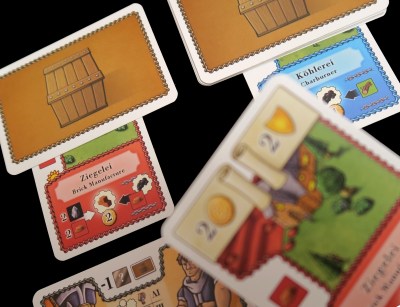
Oh My Goods!
– Image by boardGOATS

Learning outcome:  Sometimes, you don’t have to understand what’s going on, but it usually helps…!
Four Today – Happy Birthday to Us!

Let's Party!

BoardGOATS is Four Years Old Today!

At times it has been tough, but we are still here –  the group is now bigger than it has every been, yet still has a lovely, friendly, social feeling.  Thanks to everyone who has come along in the past and in particular, all those travel from further afield to make it the success it is – we really appreciate it.

Games Night at the Beacon, Wantage

Toy Planet Collectors of Wantage buy and sell toys, comics, and collectables from 1950 to the present.  They are currently holding a monthly games night at The Beacon in Wantage.  To date, the games have mostly been traditional fare.  However, last time one of the gamers from the Didcot Games Club went with some local friends and some good, quick-to-learn-and-play games and began the battle for hearts and minds.  There is a general acceptance of people bringing their own games, and one of the organisers joined in with others and expressed an interest in our sort of games.  This time some of the GOATS are planning to go along and continue the “Good Fight” with a range of light-and-fun games.

Games Night at the Beacon, Wantage
– Image from beaconwantage.co.uk

The next Games Night will be Friday 23rd September from 7.30pm until 11pm (note that the Beacon Website has the times wrong).  There is plenty of parking and the postcode is OX12 9BX; entry is free and the bar will be open.  The coffee shop will also be open serving tea, coffee, soft-drinks, cake and snacks, though they ask that only food purchased on the premises should be consumed there.