Author Archives: nannyGOAT

Next Meeting – 19th April 2016

The next meeting is on Tuesday 19th April at the Horse and Jockey pub in Stanford-in-the-Vale.  As usual, we will be playing shorter games from 7.30pm as people arrive, until 8pm when we will start something a little longer.

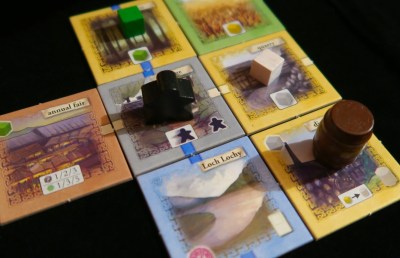
This week the “Feature Game” will be Colosseum, which is an older game where each player is a Roman impresario – producing great spectacles in his or her arena in the hopes of attracting the most spectators.  It has beautiful pieces and is currently out of print though a crowdfunding project has just finished that will hopefully mean it will become available again soon.

Colosseum
– Image by BGG contributor takras

And talking of Romans…

Julius Caesar was addressing the crowd in the Colosseum, “Friends, Romans and countrymen. I have returned from my campaign in France where I killed 50,000 Gauls!”

The crowd rose to its feet cheering, “Hail mighty Caesar!”

At this point Brutus jumped up and yelled, “Caesar lies – I’ve discovered he only killed 25,000!”

Caesar replied, “Yes, but remember that away Gauls count double in Europe.”

5th April 2016

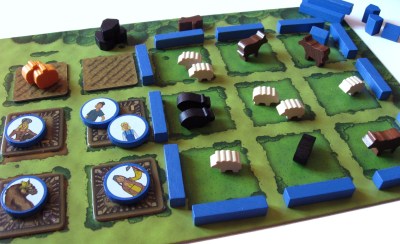
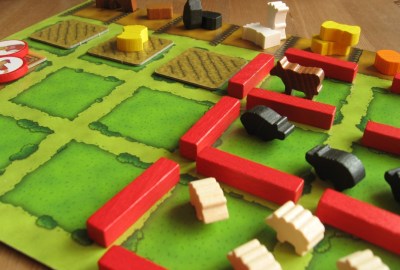
Despite a few regulars being away, there were still enough people for two games and the first group opted for the “Feature Game”, Agricola, a highly regarded game about medieval farming.  Agricola is a worker placement game where players take it in turns to deploy the members of their farming family in activities.  At the start of the game there are very few actions and each  player only has two members of their family, but as the game progresses the number of possible actions increases, but players also have the opportunity to expand their families. Each player has a farm which consists of a three by five grid of spaces and at the start of the game two of them are occupied by a two-room wooden hut.  During the game, players can expand their hut, upgrade their wooden shack to a brick or stone house, they can plough fields, enclose land to keep animals and grow vegetables and wheat.

Agricola
– Image by BGG contributor BeyondMonopoly

The game is played over fourteen rounds with harvests at intervals after which the family must be fed.  Failing to feed the family results in them going hungry and having to beg for vittles which costs points at the end of the game.  Points are awarded for almost everything, but the most successful players are usually those with a thriving farm that makes full use of all the available land and sustains a large family living in a big farmhouse.  The game can be played as a family game, or, for more experienced players, occupation and minor improvement cards can be added.  It had been quite some time since some of us had last played Agricola, and others had never played it, but those of us who were familiar with the game were keen to play with the cards.  When playing with cards it is common to “draft”, i.e. use the primary mechanism found in games like 7 Wonders, Sushi Go! and Between Two Cities where each player chooses a card from their hand before passing it on and choosing the next card from the hand they receive (passing that on until there are no cards left).  The advantage of this approach is that no single player gets all good (or bad) cards by chance, but the disadvantage is that it is very hard to choose cards when players are new to the game and unfamiliar with which cards might work well.  For this reason, drafting wasn’t really an option.  The copy of the game had been “pimped” with shaped wooden resources to replace the original cubes and discs from the base game.  This, combined with three different decks of minor improvements and tight space enhanced our initial confusion, but we did eventually get ourselves sorted and chose the basic “E” Deck.

Agricola
– Image used with permission of BGG contributor henk.rolleman

Green started off by learning a new occupation: Reed Collector; reeds are important for house building.  Having looked at his cards in hand, he had a plan:  he also had the Renovator which would reduce the cost to upgrade his farmhouse, so he thought he could expand his wooden house and then upgrade it on the cheap. He also had the Chiefs Daughter who would give him an additional three points if he successfully upgraded his house to stone. Meanwhile, the others set about collecting resources as a base from which to build their farms.  Indigo quickly learnt the second occupation of the game: the Hedge Keeper which would enable her to build three additional fences each time she built at least one – impressively powerful we thought at the time, especially at end game for filling unused spaces.

Agricola
– Image by BGG contributor lolcese

The first rounds were a lesson in frustration as resources and actions were limited and we all found ourselves unable to get what we needed and do what we wanted, a problem compounded by only having two farmers each.  Progress on the farms seemed slow; Green, Pine and burgundy seemed more interested in home improvements than actual farming and at one point it looked like we should have renamed the game, “Yuppy-ville”.  Green then invested in a canoe and went fishing a lot:  was the price of farming so high he was going into retirement before he got into a financial mess?  Despite her highly prized hedge making ability, it wasn’t Indigo who fenced in their first field but Pine, which he promptly filled with the four sheep that no-one had been able to find a home for previously.  This was especially funny since, as the vegetarian of the group, he had planned to make his and arable farm rather than a pastoral farm.  Still sheep are good for wool, so his moral stance was intact, for the moment, at least. Released from Market, Pine’s sheep quickly produced a nice spring lamb for our intrepid veggie farmer, to keep as a pet in his farmhouse.

Agricola
– Image by boardGOATS

Burgundy meanwhile had made use of his special ploughing skills to turn over two fields in one go, but that was about as far as they went for many rounds.  Although he was forced into a fallow strategy (not one that scores any points or subsidies in this game), he wasn’t complaining. That was reserved for anyone else who took the available wood before he could reach it.  This forced Burgundy into becoming a bit of a clay specialist which meant he was able to build an oven before anyone else, something he desperately needed to feed his family since there was so little actual production going on on his farm.  In keeping with his non-farming, farming strategy, Burgundy was also the first to renovate his home, twice in quick succession to a give him a grand two room stone cottage.  Pine and Green followed and extended their wooden shacks. This gave Green room to grow and he became the first player to gain an extra farmer.  Pine quickly followed suit, but his attempts to grow vegetables was being scuppered by everyone else taking the one available “Plough & Sow” space before him. So, with a tear in his eye, he was forced to build an oven and take some of his precious sheep to the abattoir.

Agricola
– Image by BGG contributor HRune

Our farms were slowly growing.  Green still only had one ploughed field and no pastures, but he had learnt several trades, built a number of improvements to his farm and extended his modest cottage to four rooms.  In one move, he upgraded his house to brick and built a clay oven (the one that Indigo had just returned after trading it in for a better model), which enabled him to bake bread and get enough food to feed his burgeoning family.  By this time, Pine had turned into a hardened livestock farmer, his earlier heartache a mere distant memory.  He enclosed his massive second pasture, moved his sheep around and expanded into cattle.  The Master Hedge Maker, Indigo, still had only one pasture and no animals, but the arable part of her mixed farm was very healthy, overflowing with wheat.  The failure of her livestock attempts did not last long either, and she emulated Pine enclosing a large second pasture and captured a couple of wild boar to place in it.

Agricola
– Image by BGG contributor sufertashu

Back on Green’s farm, he had decided that maybe he should do a little farming and finally having got some wood, he built some fences and acquired some pigs. His skill in ceramics had enabled him to get a free pottery and started turning the now unwanted clay into some strange tasting food.  Green then turned his clay house into a stone mansion and quickly fenced in another pasture and got some cattle.  With the game rapidly drawing to a conclusion he had four farmers to work with, but he was still hampered by the availability of resources and actions, often taken by others.  For example, his plans for a third pasture and some sheep were stymied by Pine who nabbed them to add to his ever growing flock.  Meanwhile, Indigo’s farm was flourishing and when she finally got some sheep, it seemed all she needed to to to be able to say she had a finger in every pie was get some some cattle – one was available and she was so keen on it that she let it live with her in her own house.

RedAgricola
– Image by boardGOATS

In contrast, Burgundy’s whole game seamed to have constantly been scuppered at every turn.  Even taking the start token usually only lasted one round and invariably he then seemed to find himself choosing at the end of the round once more. We don’t quite know how he did it, but somehow by the end of the game he had filled every space on his board – clearly he got that wood and fencing in the end.  With only two rounds left, Pine finally moved into wheat and vegetables.  Discussing the game afterwards he commented that he’d been dealt a poor set of cards at the start and on reflection they did look like a very difficult set to work with.  On the other hand, Black on the next table piped up that the cards were not really all that important.  While that may be the case, in this game Green was the winner primarily thanks to having played a great set of cards. In fact, of his forty-three points, he scored twelve from his cards, which was seven more than anyone else.  In contrast, Indigo’s balanced farm netted her a solid second place, just six points behind.  Were the cards that important?  We’ll play it again sometime soon and maybe find out.

Agricola
– Image by BGG contributor nolemonplease

On the other table, meanwhile, The Voyages of Marco Polo was getting a second outing after its introduction at our last meeting.  The game is played over five rounds with players recreating Marco Polo’s journey to China via Jerusalem and Mesopotamia and over the “Silk Road”.  Each player has a different character and special power in the game.  Each round, the players roll their five personal dice and can perform use them to perform one action each per turn.  The actions include:  gathering resources, gathering camels, earning money, buying purchase orders and travelling.  The game ends with players receiving victory points for arriving in Beijing, fulfilling the most purchase orders, and having visited the cities on secret city cards that each player gets at the start of the game.

The Voyages of Marco Polo
– Image used with permission of
BGG contributor bovbossi

Purple (who also played last time) decided to try the teleporting trader, Johannes Caprini again and work more on getting contracts.  Last time, we realised that taking an action first was a huge benefit because it avoided the problem of having to pay to take actions.  So, after that, Black chose Berke Kahn which would allow him to choose actions already taken without having to pay.   Scarlet, who was new to the game, opted for Wilhelm von Rubruk (played by Black last time) for the extra trading stations.  Also new to the game, Pink, felt that having an extra die and contract each round would give her the edge, and chose with Matteo Polo.

The Voyages of Marco Polo
– Image used with permission of BGG contributor punkin312

Despite her teleporting ability, Purple was unable to get to Beijing, but she was the only one who hadn’t made it across the board for the extra points by the end of the game.  It seemed her extra experience could not help her make full use of her special power as she failed to complete her second destination card as well.  Reading opinion of this character on BoardGameGeek, it seems Purple’s fondness of this character is rather misplaced, as it seems to be universally felt to be a poor one to get to work.  Scarlet had done rather better with his choice it seems, although he just failed to get his extra houses out, which is a tough ask in this game.  Others who play this character seem to get varied results, though perhaps for people that can make it work, it can do really well, but otherwise it can trip players up.  The general opinion on Matteo Polo also appears to be good; sometimes it can work really well, but it is never a hindrance.  Pink, however, just struggled to get the game to work for her and it just didn’t seem to fire her enthusiasm. She failed to complete either of her destinations and only managed to place three “houses” and generally found the game difficult all the way through.

The Voyages of Marco Polo
– Image used with permission of BGG contributor henk.rolleman

Looking back at the last time we played, as well as Johannes Caprini and Wilhelm von Rubrukand, we used Mercator ex Tabriz and Kublai Kahn.  Mercator ex Tabriz (who gives the player a free resource when others use the market) seems to be widely regarded as the best character, however, Pine really struggled with him. In contrast, Kublai Kahn appears to be seen as a middling character, who is very reliant on how the city bonuses fall – last time they fell well for Green who made good use of them, but the character could be a lot less effective if the bonuses were less favourable.  There are two characters we have not yet played, Raschid-ad-Din Sinan and the pairing of Niccolo and Marco Polo.  Even though Raschid-ad-Din Sinan looks good (he allows the player to choose their own dice values), it seems most players only rate him average.  Maybe it’s because poor dice rolls can be compensated for and turn into good ones, so the actual values rolled are of less consequence to the game than might be thought initially.  The pairing of Niccolo and Marco Polo can be difficult to make work as two characters does not mean twice the resources, quite the opposite and they can get stuck in a city, although with less players it is felt they might do better (as there are less opponents to steal the city bonuses first).

The Voyages of Marco Polo
– Image used with permission of BGG contributor henk.rolleman

So clearly, although some characters might have a tendency to be more useful than others, ultimately success depends on circumstances and how well the player uses that character.  This was also the case for this, our second game where Black finished first with a massive fifty-eight points, a combination of a good character played effectively. On the geek there seems to be a general consensus that Berke Khan is one of the top characters in this game, demonstrating others appreciate the power of not having to pay for actions. With Agricola still a few rounds from finishing, there was time for a quick game of Click & Crack, a game of simultaneous action selection game in which the players control two penguins each, walking around on a big ice floe – a cold arctic game to contrast with the heat of the eastern deserts.

Click & Crack
– Image used with permission of BGG contributor aleacarv

Learning Outcome:  Sometimes it is best to put even the most deep-seated moral objections to one side for the duration of a game…

Boardgames in the News: Risking Imprisonment to Play

We are very lucky:  when our little game group meet, the worst anyone risks is a telling off for staying out too late.  In some parts of the world, however, gamers could be risking their liberty or worse.  Just imagine a world in where playing Puerto Rico or Agricola risked imprisonment or torture.  It seems absurd, but for for some people this sort of response is a reality.  In February, police in the Thai resort of Pattaya arrested thirty-two elderly Bridge players when they raided their local Bridge Club.

Bridge
– Image from innontheprom.co.uk

In Thailand, there are strict anti-gambling laws, so despite the fact the Bridge players declared that they were not playing for money, they were arrested for “possessing more than one hundred and twenty unregistered playing cards” in violation of section eight of the Playing Cards Act of 1943.  In this case, the members of the club were released after twelve hours, but Bridge is not the only “risky game”.  According to the Saudi Grand Mufti, Chess is forbidden in Islam, a view which could mean that players in some parts of the world genuinely risks a fate worse than death at the hands of fundamentalists.

We are very fortunate in the UK.

Chess
– Image by BGG contributor unicoherent

Next Meeting – 5th April 2016

The next meeting is on Tuesday 5th April at the Horse and Jockey pub in Stanford-in-the-Vale.  As usual, we will be playing shorter games from 7.30pm as people arrive, until 8pm when we will start something a little longer.

This week the “Feature Game” will be Agricola, which is a highly regarded game about medieval farming   This is slightly heavier game than some of our previous Feature Games, but supports different levels of complexity from the “family” version to more advanced versions, so we can play a level that is appropriate to the people that turn up.

Agricola
– Image by boardGOATS

And talking of farming…

A farm boy accidentally overturned his wagon-load of wheat.

The farmer who lived nearby heard the noise and yelled over to the boy, “Hey Jeff, forget your troubles. Come in and have tea, I’ll help you sort out that wagon later.”

“That’s very nice of you,” Jeff answered, “But I don’t think Dad would like me to.”

“Aw come on Jeff, a bite to eat will give us the strength we need,” the farmer insisted.

“Well OK,” Jeff finally agreed, and added, “But Dad won’t like it.”

After a hearty dinner, Jeff thanked his host. “I feel a lot better now, but I know Dad is going to be very upset.”

“Don’t be silly!” the neighbour said with a smile. “By the way, where is he?”

“Under the wagon.”

22nd March 2016

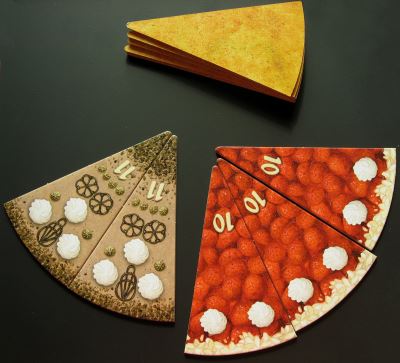
Red, Magenta, Blue, Burgundy and Green were first to arrive and decided to get the evening going with a quick light filler.  After a quick debate, we decided that the best fit to the number of players and the time we wanted to fill was …Aber Bitte Mit Sahne (which means “…But Please, With Cream”, though the game is known as “Piece o’ Cake” in English).  This is a cute little set collection game coupled with the “I divide, you choose” mechanic.  The game starts with “The Baker” taking a pile of cake slices showing a selection of different types, and then arranging them in random order to form a wheel of eleven pieces which they then divide into five slices.  Then the idea is that the other players take it in turns to choose which slice to take and how much of it to “eat”.  Points are scored at the end of the game for the player with the most kept pieces of each type of cake and for the number of “blobs” of cream on cake that has been eaten.

…Aber Bitte Mit Sahne
– Image by boardGOATS

In case of a draw, all parties win the pints, but any set that has been not been eaten and is not the largest scores nothing.  Thus, the player dividing needs to try to make sure that they are left with something useful after everyone else has chosen, but at the same time, they don’t want to give away anything that helps the opposition too much.  After dealing out the piles for each round we realised that we’d inadvertently included the wild card slice from the mini expansion, but Blue couldn’t remember the rules, so we decided to take it out and do it again. In the event, the game itself was quite close with Red and Magenta fighting it out for first place and for the most strawberry gateau.  In the end, Red took first place with thirty-two, three points ahead of Magenta with everyone else some way behind.
…Aber Bitte Mit Sahne
– Image by boardGOATS

We were just deciding what filler to play next when Black and Purple wondered in, so we decided to get on with playing something with a bit more bite.  First on the table was the  “Feature Game”, Glen More, which is a tile laying game set in the seventeenth century highlands. Black wasn’t keen as he’d played it before and had felt it was very random.  Blue said she hadn’t got that sensation from reading the rules, but she did think that it had some very different elements to it and had no feel for how to go about playing it.  Magenta and Red commented that they weren’t really selling it and wondered what the alternative might be.  Black suggested The Voyages of Marco Polo and Green was torn as he really wanted to play both.  Although Blue was very interested in playing Marco Polo too it has a reputation for being monstrously long and she has a very strong dislike for leaving games incomplete.  Burgundy had read up on Glen More, so was keen to give it a try as was Blue, so despite its poor billing, Red and Magenta joined them to make a four and they quickly got going.

Glen More
– Image by boardGOATS

Glen More is a strange mixture of mechanisms and it is initially hard to see how they fit together.  The game has an unusual turn order mechanism (similar to that in Tokaido), where the player at the back goes first moving their token along the circular track, choosing a tile the fancy and replacing it with their marker.  They then add the tile to their village and draw a new tile which is placed at the front of the row of tiles (keeping the number available the same throughout the game).  When a player adds a tile to their village they must obey two basic rules:  any road or river on the tile must connect with their existing road or river and the tile must be next to a clansman.  Tiles cannot be rotated and each player starts with a village tile comprising a clansman, a road running vertically and a river running horizontally.
Glen More
– Image by boardGOATS

Once the tile has been placed, all orthogonally and diagonally neighbouring tiles can be activated.  Each tile gives the village some kind of benefit:  yellow and green tiles provide resources, fairs and the like allow players to trade resources for victory points, village tiles allow the clansman to be moved, while distilleries allow the conversion of grain into whisky.  Resources are essential because, as well as the potential to trade them for points, about half of the tiles also have purchasing costs that has to be payed before a tile can be added to a village. Resources can be bought and sold at any time during a players turn, but any that are bought must be used straight away and the cost will depend on the Market which reflects demand.  When a player buys a resource, they place a coin on the market space and the next player must pay one more than the last up to a maximum of three after which, that resource is no longer available.  A player selling resources takes the last available aliquot until there is no money available, after which they can no-longer sell, making currency circulation a contained system.

Glen More
– Image by boardGOATS

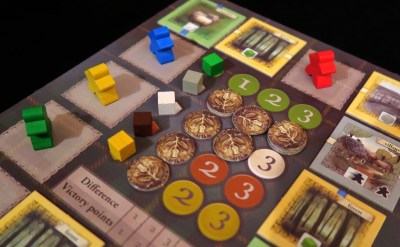
Tiles can be activated in any order and then the new “last player” gets a turn.  Since players can move as far forward as they like, jumping lots of tiles if they choose, it is quite possible that a player may have several consecutive turns, alternatively, they may decide to sacrifice turns in order to get a particular tile that is nearer the front of the track.  There are three piles of tiles and interim scoring occurs every time one of the stacks is emptied.  Scoring is also unusual as players score based on the difference between their position and that of the person in last place in that category.  There are three scoring categories:  locations, chieftains  and whisky.  The locations are special tiles which give some special powers that have an impact during the game, but are also a a source of points.  At scoring time, players evaluate how many special tiles they have and then subtract the number of locations held by the weakest player in that category.  This difference is then compared with a scoring table and points are awarded accordingly.  Larger differences return a proportionately larger number of points.  Chieftains and whiskey are scored in a similar way, with chieftains being clansmen that players moved off the board.

GlenMore007
– Image by boardGOATS

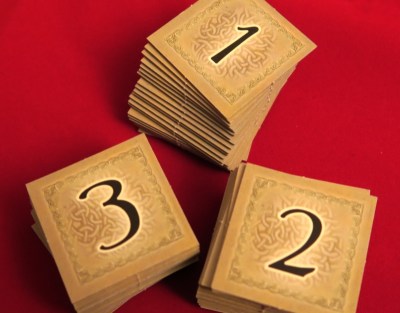
For example, in a four player game, if the players have six, five, three and one barrel the “differences” will be five, four, two and zero which translate into eight, five, two and one victory points.  Thus, as the player in last place, picking up a distillery, may actually have a bigger impact on the scores than adding to the scoring category that they are strongest in.  This is because it reduces the number of points held by all the other players, where the difference is large, it can hurt players more efficiently too.  At the end of the game, players also get points for any remaining money, but also lose three points for every tile they have more than than the player with the smallest village.  So, when choosing which tile to take, each one has to earn its keep, in other words, the winning village has to be efficient as well as effective.
Glen More
– Image by boardGOATS

Having explained the rules, everyone was still not much the wiser.  We could all see what the mechanics did, but connecting them together was more tricky and we all felt we could only find out more by playing.  Red went first, but as she had no clue what she was trying to do, she picked a nice looking grain tile that was some way down the track and went for it.  Burgundy and Blue queried it as it meant she was likely to miss a couple of turns, but she said she was happiest that way as she didn’t feel she could make a better, more meaningful decision.  By the next turn she wasn’t  much wiser, but added a distillery to her village, no doubt making her clansmen very happy indeed as she started her whisky production.  Meanwhile, Magenta’s village was already very resource rich and Burgundy had a couple of valuable Fair tiles that he could use to convert resources into points.  Blue had no idea what she was doing, but was certain she wasn’t doing it very well whatever it was.
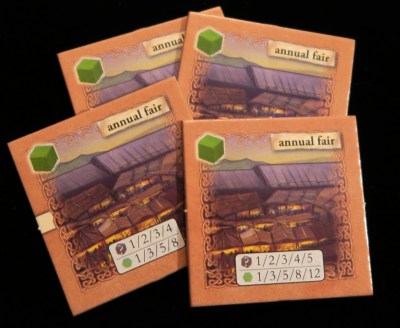
Glen More
– Image by boardGOATS

By the first scoring round, Red was way out in front with a handful of whisky barrels and a very small village full of very merry Scotsmen.  The lean nature of her village meant that everyone else was feeling the pressure to make every tile count as they knew it would cost them three points at the end.  Despite her huge number of resources, Magenta was  struggling to score points and Burgundy and Blue weren’t doing much better, slightly mesmerised by Red who appeared to be winning by miles despite spending most of it watching everyone else make bad decisions.  Things hadn’t changed much by the end of the second round though it was clear that Burgundy was starting to make his Fairs count by activating them frequently and buying the resources he needed if he didn’t have them.  Blue had picked up a couple of Special Location tiles and had distilled a couple of barrels of whisky, but with nothing like the efficiency of Red.  In the third and final round, Magenta now had the maximum number of resources on most of her tiles and had finally started picking up a brown tiles so that she could make use of them.  Blue managed to get herself in a mess, wanting to pick up a Special Location, but not being able to place it because her clansmen weren’t in the right place.  In trying to fix the problem she tried to be clever and discard a tile, but quickly realised she should have played it instead.  People were starting to run short of money as Magenta starved everyone else of cash by selling only the resources that were in highest demand.  In the corner, Burgundy had finally got his engine working, but it still looked like it was too late to challenge the efficiency of Red.

Glen More
– Image by boardGOATS

With just enough tiles left for one turn each, Blue promoted most of her clansmen to chieftains, Magenta managed to use her Fair to trade five resources for a massive twelve points, Burgundy picked up yet another Special Location and Red asked whether she should have been scoring three points every time she placed something next to her Tavern (which she should, and so should Blue…).  Before the final end of game scoring, Burgundy was some way out in front, but as he also had the largest village he was going to lose an awful lot of points.  Surprisingly, Blue wasn’t far behind, so it all came down to how many points people were going to lose.  In the end there was just one point between Burgundy and Blue, but Burgundy took it with forty-four points.  In the end, Red was some way behind, but as we discussed the game, we felt she had left a lot of points on the table in the final few turns, and it was certainly possible to make a lean village strategy work.  Similarly, if Magenta had been able to activate her Fair just once or twice more, she could have been way out in front.  Nobody disliked the game, but we all felt a little bit non-plused about the experience, as we’d really struggled finding a path through the maze on the first visit (though we didn’t feel it was the luck-fest that Black had described).  In the end, we decided that it definitely needed to be played again now we had a better idea of what was going on and it certainly was different to most other games we play.

Glen More
– Image by boardGOATS

Meanwhile, the other group had settled down to play The Voyages of Marco Polo, which won the Deutscher Spiele Preis last year and was designed by the same pairing that put together Tzolk’in: The Mayan Calendar.  It took a while to set up and explain the rules, especially as Black was the only one that had played it before, and even that was on-line. The game is played over five rounds with players recreating Marco Polo’s journey to China via Jerusalem and Mesopotamia and over the “Silk Road”.  Each player has a different character and special power in the game.  Each round, the players roll their five personal dice and can perform use them to perform one action each per turn.  The actions include:  gathering resources, gathering camels, earning money, buying purchase orders and travelling.  The game ends with players receiving victory points for arriving in Beijing, fulfilling the most purchase orders, and having visited the cities on secret city cards that each player gets at the start of the game.

The Voyages of Marco Polo
– Image used with permission of BGG contributor henk.rolleman

Eventually we were all kitted out with merchants, camels, currency, houses, a contract and a couple of city (mission) cards; all that was left was to choose a character. There are eight different characters to choose from providing a range of different benefits, all relating to different strategies. Black gave a quick run-down of the character abilities, quickly dismissing two of them:  Kubilal Kahn who starts in Beijing as opposed to Venezia where everyone else starts and Raschid ad-Din Sinan who can set the dice to whatever numbers he chooses at the start of the round instead of rolling them.  He dismissed Kubilal Kahn, because he does nothing else for the player, although he does guarantee ten points for placing the first house in Beijing. Raschid ad-Din Sinan was dismissed as Black explained it “broke the game”.  By that he meant that half the fun of the game is based on dealing with the dice players roll, not only must choosing the dice numbers take an age to decide, it also removes an element of luck and challenge.

The Voyages of Marco Polo
– Image used with permission of
BGG contributor bovbossi

Pine, the start player, got to choose first and went for Mercator ex Tabriz, who we had all made positive, “Oooh! That’s nice!” noises about when it was explained.  This would give Pine one resource every time someone else collected something in the market, quite handy. He thought that this would push him to a contract completing strategy.  Green was next and went for Kubilal Kahn, despite Black’s dismissal. He felt that being on the other side of the board to the others would mean he was not in competition for the bonuses, and the neighbouring city would give him a free choice bonus at the beginning of the round, a handy one to have at the start of the game. He wasn’t too sure about his plans, but placing would help gain the city-mission bonuses, so a bit of travelling looked likely.  Purple decided that the ability to teleport across the board from oasis to oasis would really help her complete her city missions and took Johannes Carprini. Since the board layout is very much east/west with very little north/south crossovers, all the pairs of cities on the mission cards were on different east/west tracks so being able to jump around the board almost at will looked to be very very useful for this strategy.  In addition, the extra three coins at the beginning of each turn was a nice little sweetener.  The experienced Black felt he was up for a challenge and chose Wilhelm von Rubruk which would allow him to place houses in every city he crossed (normally players have to finish in a city to place a house there).  As an additional goal this gave him two extra houses to place after he had exhausted his personal supply for an extra ten points, if he could manage it.  Clearly Black was also going to be doing quite a bit of travelling.

The Voyages of Marco Polo
– Image used with permission of BGG contributor henk.rolleman

Finally the game got underway with the satisfying sound of twenty dice being rolled, then studious silence as we each tried to work out what actions we could do with the different combinations we had rolled.  A reasonable first goal seemed to be to gain the resources necessary to complete our starting contracts.  The first dice placements were benign affairs. Pine was happy as collecting resources from the market proved popular and he quickly completed his first contract. Green also made use of his “free choice” bonus for reaching the small city to enable him to complete a contract.  It was about half way through the first round that the true heart of this game revealed itself:  how to place all your die actions on spaces already occupied by others.  There is cost involved in placing second, and suddenly it seemed that money (or rather the lack of it!) could be a key factor.  In most games, rolling a set of five’s and sixes would be met with squeals of pleasure – not this one.  High dice rolls might unlock some tasty options, but at a price. Finding that you had only a four and a five to place down on the travelling track when you only wanted to move once, was very annoying.  Such a move increases the cost from four (or three if you’re lucky enough to go first) for placing a single pip die to seven, and if you did decide to make use of the extra moves, that will be sixteen in total, and we’ll not consider the cost of three movements!

The Voyages of Marco Polo
– Image used with permission of BGG contributor punkin312

In the early rounds Black and Purple kept rolling fewer than fifteen in total, which gave them extra camels and/or coins to make up the difference, but it did also mean that their outlay was much less than Pine and Green who kept rolling, fours, fives and sixes.  This meant that when there was something they wanted to do, they could at least afford it. While Pine and Green were left scratching their heads as to how on earth they were to use their remaining six. Pine often just placed it “in the purse” for a measly three coins. Although Green was having similar issues, he did at least have the advantage of gaining some decent first visit bonuses, to keep his game alive. Black and purple were making rapid progress across the board, although perhaps not quite as rapid as their respective characters might suggest was possible. Pine and Green, meanwhile, kept a steady pace on wrapping up the contracts to roar into the lead on the points track.

The Voyages of Marco Polo
– Image used with permission of BGG contributor henk.rolleman

Black commented how we did not seem to be using the black dice very much. In the online games they disappear very quickly (there are only five per turn). It was only during the last part of the last round that we realised that we had not fully understood the implications of the black dice rules. We had thought players could only have one black die per round (i.e. a maximum of five all game distributed over the five rounds), but they could actually have one per turn making them a good way of increase the number of action choices. The camel cost associated with them would reduce the ability to travel, but there are plenty of other ways to trade your way to victory in the game.

The Voyages of Marco Polo
– Image used with permission of BGG contributor jsper

In the last round or two, Black and Purple really wound up their travelling elastic bands and went flying round the board, ultimately completing both of their city-mission bonus cards, which neither Pine nor Green could manage. Green did eventually complete one, but Pine had barely moved at all, preferring to concentrate on completing contracts.  When the final tally came, Green had romped away, proving Black wrong about the Kahn character. Black’s final speed-demon dash across the board netted him enough bonuses (although not his extra two house bonus) to bring him home in second place. Purple was just behind, proving that the teleportation device of the ancient east was a good way to get your presence felt, but she had neglected the contracts and did not manage to net quite enough extra points to sneak past Black. Pine’s contract strategy hadn’t been as successful as he’d hoped and we realised that his special bonus of receiving a resource every time someone else bought in the market, dwindled in later rounds as we all found other ways to get resources.

The Voyages of Marco Polo
– Image used with permission of BGG contributor henk.rolleman

In the end, despite our initial opinions we concluded that the characters are more balanced than we first thought.  Our first game also called into question the widely held BGG opinion that contracts are a better way to gain points than travelling, though we will have to see if this opinion holds over time.  Overall it was a really interesting game, with much variety in it from play to play and the dice action mechanism was also really clever and satisfying.  It did take a long time to play, but next time should be quicker, and there will certainly be a next time as we all enjoyed its first outing and others are also keen to give it a go.  Meanwhile, Glen More had long since finished, so rather than condemning Blue and Burgundy to a two player game, Red and Magenta suggested playing something quick.  Near the top of Blue’s bag was 11 Nimmt!, a game so far only released in German that Blue had picked up last year at Essen.  Designed by Wolfgang Kramer, the same person who brought us one of our favourite, 6 Nimmt!, we were keen to see if this really was five nimmts better…
11 Nimmt!
– Image by boardGOATS

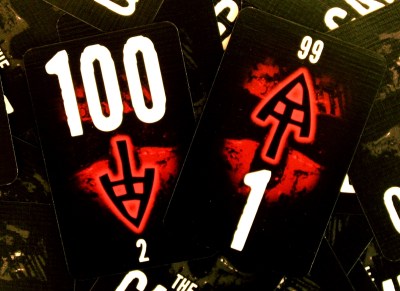
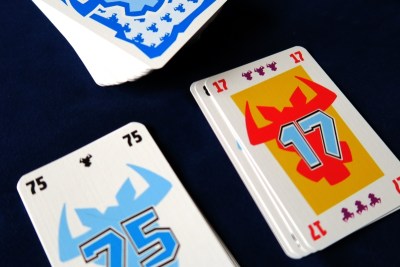
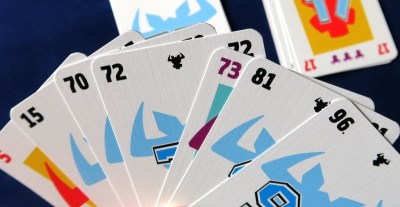
The game is played with a deck of cards numbering one to a hundred, each also with some number of bulls heads, or Nimmts on it (much like 6 Nimmt!, though the distribution is different).  Each player starts with a hand of ten cards and the aim of the game is to be the first person to get rid of them all, or (since the game is played over several rounds) at least finish with a low scoring hand, i.e. as few Nimmts as possible.  In contrast to 6 Nimmt!, the game is played in turns rather than simultaneously and the game starts with one card pile.  On their turn, the active player must discard a card that is above the top card on the pile, but within ten of its face value.  If they do not have a suitable card (or choose not to play it) then they must take the stack into their hand and replace it with two new face up cards drawn from the draw deck making two new piles.  If a player takes a stack comprising three or more cards, then the player also takes a Bull Card which allows that player to play more than one card at a time on one stack so long as they are all within ten of the top card.  Should they end up with a second Bull Card, then they can play on more than one pile, and this is where it becomes an advantage to pick up lots of cards, because with several Bull Cards, players can discard a lot of cards very quickly and have more control over the game.

11 Nimmt!
– Image by boardGOATS

From the start it was apparent that 11 Nimmt! is very different to our much loved 6 Nimmt!.  There is a lot less gratuitous glee at other people’s misfortune when they are forced to take fists full of cards, but this is replaced by strategy and planning.  The lack of simultaneous play also makes it feel a lot more solitaire than 6 Nimmt! and, though there was plenty of opportunity to scupper someone else’s plans, without knowing the contents of their hand it was hard to do it in a constructive way.  It took us a few rounds to get the hang of it, but before long we were starting to see the strategic advantage of picking up cards as well as getting rid of them.  The rules suggested playing the same number of rounds as there are players, but we ended up playing six rounds just to fill time.  Despite Red and Blue both winning rounds, Magenta was the clear winner after four rounds thanks to her consistency and she added just one to her total in the extra rounds compared to everyone else’s ten and, as a result, she finished the clear winner.  Although we all enjoyed it and could see that it was probably a better game with lower player counts, we all felt that it hadn’t usurped 6 Nimmt!, which would retain its special place thanks to its fast play and generally chaotic fun.
11 Nimmt!
– Image by boardGOATS

Learning Outcome:  Sometimes subtle changes to a game make a huge difference.

Boardgames in the News: International TableTop Day 2016 – Save the Date

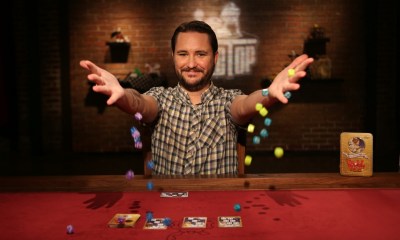
On 2nd April 2012, actress Felicia Day launched Geek & Sundry multimedia production company.  It was part of Google’s Original Channel initiative, a one hundred million dollar project to bring new and original content to YouTube as a means to kick-start GoogleTV.  One of the original three programs on the Geek & Sundry Channel was TableTop, a largely unscripted web series about boardgames, co-created and presented by Wil Wheaton (who is perhaps better known as Wesley Crusher in a former life).  The series has been highly successful, especially in the US where it has been credited with increasing sales of the games featured (the so-called “Wheaton Effect”).

Wil Wheaton
– Image from theguardian.com

To celebrate the launch of the program and of tabletop gaming in general, Geek & Sundry founded International TableTop Day. Inevitably originally US centred, over time, the initiative has spread so that now, every spring, gamers host thousands of events all over the world, and every year, the event grows.  Although boardGOATS are not currently planning anything specifically for International TableTop Day this year, there is lots going on nearby in Reading.  The Reading Boardgames Social group is holding two full days of gaming at the Reading Ukrainian Community Centre on Saturday 30th April and Sunday 1st May and Eclectic Games are also holding holding events during opening hours on the day itself (Saturday 30th April).  There will almost certainly be more events in Oxford as well, so put the date in your diary!

International TableTop Day
– Image from tabletopday.com

Next Meeting – 22nd March 2016

Our next meeting will be on Tuesday 22nd March, at the Horse and Jockey pub in Stanford-in-the-Vale.  As usual, we will be playing shorter games from 7.30pm as people arrive, until 8pm when we will start something a little longer.

This week the “Feature Game” will be Glen More, which is a tile laying game set in the seventeenth century highlands.  The game has an unusual turn order mechanic (similar to that in Tokaido) as well as a novel scoring system and was chosen following the success of Isle of Sky: From Chieftain to King.

Glen More
– Image by boardGOATS

And speaking of Scottish Glens…

When Sandy MacGregor came back from his first trip to London, everyone in the Glen was keen to find out how he had got on.

“So bonny lad, did ee like it?” one elder asked over a wee dram.

“Oh, it was no’ bad, really,” commented Sandy, who was busy thinking about other things.

“As good as that, was it?” came the dry response.

” Well,” Sandy expanded, more thoughtfully, “There was just the one thing wrong. The other guests in ma hotel just would nee go to their beds. They were in the corridor ootside ma room shouting and banging on ma door until three o’clock in the morning.”

“So what did you dae, Sandy?” the elder asked.

Sandy shrugged, “Och, I just kept on playing ma bagpipes.”

8th March 2016

While Burgundy finished his ham, egg ‘n’ chips, the rest of us continued our political discussions from two weeks ago.  This time we discussed the length and timing of the school day, the inevitability of double-parent working households, the cost of childcare and whether or not parents should be paid to stay at home and look after their little ones.  We were expecting Black and Purple, but eventually, someone suggested playing a quick game, to which Blue commented that you could guarantee that they would arrive just as we finished setting up.  A brief debate about what to play followed before we settled on one of our old favourites, Walk the Plank!, a simple pirate themed “programming” game where players try to push each other along a plank and off the ship.

Walk thePlank!
– Image by boardGOATS

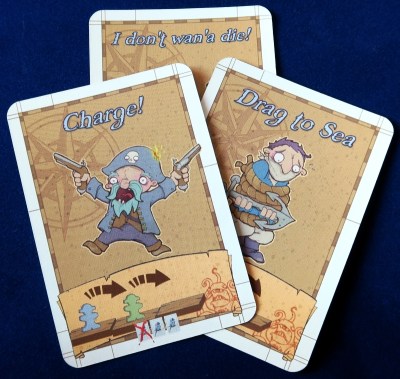
Since everyone had played Colt Express fairly recently, the rules were quick to reprise:  everyone simultaneously chooses three cards and the order in which they are going to play them, placing them face-down; starting with the first player, players then take it in turns to play one card until everyone has played all three.  With lots of aggressive options the game is always quick and fun, and the last pirate standing is the winner.  We had just finished the summary when Black and Purple arrived, but since it is only a short game we carried on.  Blue started the game by immediately shortening the plank and before long there was no plank left (a situation we allow through a “house rule”).  When Green Green played a “Drag to Sea) with only one pirate left which was perched precariously on the edge of the boat, it was inevitable that he would take Blue’s only pirate with him for company, leaving everyone else with two pirates each.

Walk the Plank!
– Image by boardGOATS

It didn’t last, however, and before long Magenta’s last pirate received the Big E from Burgundy and joined the others watching the goings on from Davy Jones’ Locker.  With all the carnage in the first round (eleven pirates down in just fifteen cards), there were just two players left with two pirates each all on the ship.  Although the rules say the last two players share the victory this seems strangely friendly end for an otherwise savage little game, so we always play to the death. The second round began a little cagily with both players extending the plank, but then Burgundy was paid out for his treachery to Magenta when, in a moment of stupidity, one of his two remaining pirates dragged his pal off the end of the plank, leaving Pine the clear victor with two pirates still standing.  It was an exceptionally short game thanks to the early vindictiveness, but in truth, it is a much more fun game when it is played that way.

Mijnlieff
– Image used with permission of BGG contributor thepackrat

Despite the compressed nature of Walk the Plank!, Black and Purple still managed to squeeze in a little two-player abstract game called Mijnlieff (pronounced “Mine-Leaf”).  This is a beautiful little game made out of wood and designed by the designer of Dodekka, Andy Hopwood (Hopwood Games).  Black described the game as “fancy Noughts and Crosses” since the aim of the game is to form lines of three, but since there are different types of pieces and your opponent controlling where you can play it is much more strategic.  The game is played by placing wooden tiles on a four by four board.  Each Player has eight pieces with two each of four different symbols where the different pieces dictate where the other player can put their next piece.  For example, when a Greek cross (or “+” symbol) is played, the next player must place his piece on an empty square in an orthogonal line from the piece just played.  Similarly, playing a saltire (or “×” symbol) forces the next player to place his piece in a diagonal line from the piece just played.

Mijnlieff
– Image used with permission of BGG contributor thepackrat

Game play is really quick, so much so that despite Walk the Plank! finishing in record time, with Purple taking it by three points to Black’s two.  With everyone finished, we had a quick show of hands as to who would like to play the “Feature Game”, Kingdom Builder.  When seven hands went up, Green asked who was very keen to play it and nobody looked interested.  The most enthusiastic was Burgundy who had played it before, so Magenta swapped seats with Green to make a foursome with Blue and Pine.  On the face of it, Kingdom Builder is also a simple game, played by placing small wooden huts (Settlements) on a board made up of different terrains laid out using a fine hexagonal grid.

Kingdom Builder
– Image used with permission of BGG contributor msaari

At the start of the game, each player is dealt a terrain card and on their turn, they have to place three settlements on that terrain type.  As far as possible, the Settlements must be adjacent.  At the end of their turn, the player discards their card and draws a replacement.  Play proceeds in clockwise order until one player has run out of Settlements, then the round is completed and scores are tallied up.  While these are the basic rules, there are also specific rules that change for each game, and since the board is made up of four modules chosen at random from a set of eight, the number of possible layouts is vast. Each module board also has three special hexes on it: two with a gold scroll-work border (Locations) and one with a silver scroll-work border (Castles).  The Castles give points for players with an adjacent building at the end of the game while the Locations give an in-game benefit.

Kingdom Builder
– Image used with permission of BGG contributor SpaceTrucker

At the start of the game, each Location has two hexagonal chits on it which are taken by the first two players to build next to it.  These chits give players extra actions that they can take on their turn, but the nature of the Location and corresponding action is dependent on the boards chosen.  In this game we had the Tower, the Tavern, the Barn and the Paddock.  These allowed players to add an extra Settlement along the edge of the board; add an extra Settlement to where a player had a row of three or more Settlements; move an existing Settlement to a space matching the active player’s current terrain tile, and move one Settlement two spaces in a line from its current position (i.e. jump).

Kingdom Builder
– Image used with permission of BGG contributor kilroy_locke

Points are awarded at the end based on the rules cards and a subset of three are drawn from a total of ten at the start of the game.  For this game, we draw the Knights, Discoverers and Citizens cards which gave two points for each settlement a player built in the horizontal row where they had the most Settlements; one point for each horizontal row in which they had at least one settlement, and one point for every two Settlements in each player’s largest settlement area.  Thus, to score one well, you needed a horizontal line, a vertical line and a clump, all with a limited number of huts.  To make the problem even more challenging the board layout had a large mountain range across the middle with a couple of awkwardly positioned rivers.  We all blamed Burgundy for his awful “choice” of boards and layout…

Kingdom Builder
– Image by BGG contributor pphh

Although the rules are prima facie quite simple we got into a bit of a tangle with the modifications caused by the Locations.  Blue kept forgetting that the Tower and the Barn were subject to adjacency restrictions and Pine struggled to see the point of the Barn at all.  Blue made an appalling start, while Burgundy’s best laid plans were stymied first by Blue and then by Magenta.  Meanwhile, Pine had got two groups of Settlements and was trying to build a vertical ribbon development to connect the two.  As Burgundy’s supply of Settlements dwindled faster than anyone else’s, Pine desperately needed to draw a desert terrain card, but kept drawing woodland cards which were nearly useless for him.  In the final round everyone tried to make the best of their limited number of remaining Settlements before totalling up the scores.  It was very, very close, but Blue finished with a round fifty, just two points ahead of Magenta, with Pine and Burgundy both within two points of her.

Kingdom Builder
– Image by boardGOATS

Kingdom Builder isn’t a long game, so Black, Green and Purple decided to opt for something short and light so settled on another old favourite, Splendor.  This is a fairly simple card game with a very loose gem merchant theme.  On their turn, a player can either collect chips (gems), or use chips to buy gem cards.  Most of the gem cards are effectively just a permanent source of chips, i.e. can be used to buy other cards, but the higher value ones also provide victory points.  Nobles can also give players points and these are claimed by the first player to collect certain combinations of gem cards (e.g. three each of onyx, sapphire and diamond).  The game finishes at the end of the round when one player gets to fifteen points, and the winner is the person with the most points.

Splendor
– Image used with permission of BGG contributor henk.rolleman

Three of the four randomly selected Noble cards required a set of three green emerald cards as part of their requirements, with differing selections of the other colours; white diamonds, red rubies, blue sapphires and black onyx. The fourth Noble required four cards of each white diamonds and black obsidian.  With the first card selections it was clear that both Black and Green had studied the distribution of cards required to win Nobles tiles and were fighting hard to get the green emeralds that were available. Unfortunately, the number available was quite small, but nothing compared to the scarcity of rubies. The first of these was nabbed by Purple and Green, who failed to get the second was left unable to get the remaining one which was an expensive, high scoring, level three card.  Early on Black marked his intentions by reserving a level three (taking the bonus “wild” gold chip).  Meanwhile Purple was busy building a large supply of diamonds while Green concentrated on the low level emeralds and sapphires. With half a dozen cards each, scores were low and close, but quick glance across to Kingdom Builder showed they were still going through the rules…

Splendor
– Image used with permission of BGG contributor henk.rolleman

Black reserved another high value card, Purple had managed a large haul of diamonds, both cards and chips and green had got his three green emeralds, now joined with three sapphires. Rubies still refused to come up with any kind of regularity which meant that players priorities usually changed quickly when one did come up.  Green was the first to obtain a noble when he got his third diamond card.  He did this with mostly non-scoring cards and so this only put his score on a par with the others.  The game entered a new tenser phase when Green quickly picked up his second noble after taking a third ruby card, though even he couldn’t quite believe he had managed to get three of them.  Black finally paid up for one of his put away cards and now the points were close to the end.

Splendor
– Image used with permission of BGG contributor henk.rolleman

Black was just two points from getting the fifteen needed to trigger the end-game, and a study of the available cards showed Green that Black could get it with a diamond card on his next turn. Green persuaded Purple that she needed to take the diamond card using her gold chip (she couldn’t afford it otherwise) as she would not get another go if she didn’t and could not afford the high value one she was saving for anyhow.  Luckily the replacement card was not one which Black could afford so he had to take chips instead pushing the game into another round.  Green grabbed a high value level three card taking the bonus gold chip (giving him all he needed to buy it on his next turn) and Purple bought her high value card. Black bought his last reserved card, which put him on sixteen points giving Green one last turn. With a flourish he paid for his reserved card card which gave him three points and claimed the final noble for another three, giving him a winning total of seventeen points.  It was a few moments, before Green noticed and the others didn’t spot it at all, but Green’s last card was not a black onyx, but a fourth ruby – he had not got the noble after all.  Perhaps it was a touch of colour blindness from the excitement of the end-game, but Black was the winner after all with Green and Purple finishing in joint second.

Splendor
– Image used with permission of BGG contributor henk.rolleman

Kingdom Builder should only take thirty to forty minutes, but for some reason it took nearly twice that, so Green, Black and Purple moved on to play Tobago, a really pretty game in which the players possess different parts of treasure maps and try to use narrow down the possible locations faster than everyone else in order get to the treasure first.  The idea is that on their turn, players can either can either play a card on one of the four Treasure Maps or move their little 4×4 truck up to three “legs” (a leg being anywhere within the current terrain, or a move from one terrain to another).  Playing a card narrows down the number of possible places that the Treasure could be, for example, “in the jungle”, “not next to a hut” or “in sight of a statue” etc..  Each clue card placed must narrow down the possible locations by at least one hex, cannot contradict a previous Clue, and cannot eliminate all possible locations for the Treasure.  Eventually there will only be one possible location, after which, the first player to get there retrieves the Treasure.

Tobago
– Image used with permission of BGG contributor Lord Warlock

When a Treasure is retrieved, everyone who helped narrow down the treasure location by playing a card gets a share proportional to the amount of effort they put in.  Initially, each player gets a Treasure card for each clue card they contributed.  They look at the card(s) secretly before they are shuffled together with one drawn blindly from the deck. A card is then drawn at random and, starting with the player who found the Treasure, it is offered to each player in turn until someone takes it.  The order corresponds to the order they made their contribution, so some players may have made multiple contributions and therefore may get multiple chances to take a Treasure card.  Once a player has taken a treasure, that contribution is considered fulfilled.  The Treasure varies in value, but there are also two “Cursed Treasure” cards (also known as “Baad Treasure”).  If one of these is turned over, the remaining Treasure cards are not distributed and anyone left in loses an amulet (if they have no Amulet, they lose their most valuable Treasure card instead).  The appearance of Amulets is triggered every time a Treasure has been found and they can be collected by players moving their 4×4.  The player with the most Treasure at the end of the game wins.

Tobago
– Image used with permission of BGG contributor Toynan

Green’s strategy was to contribute as many Clues as possible, Black went for a drive to dig up treasure and Purple complained of having a terrible set of clue cards (to be fair she had a lot of “not in …” cards, which did prove difficult to place on the “in play” Treasure maps, but for some reason she was reluctant to start a new one). It was a slow start, but after the first treasure had been found and the Amulets started to appear we got into our stride a little more.  About half way through the game, Green checked the rules on what to do with the discarded Clue cards and instead found a small rule which stated that the one who takes the last Treasure card immediately places the first Clue on the now empty treasure “map”. We felt that this might have speeded the game up a little and implemented the rule.

Tobago
– Image used with permission of BGG contributor Lord Warlock

Green and Purple were the first casualties of the “Baad Treasure”. They both had Amulets, but annoyingly a six point and a five point treasure were both lost.  The second time round we were all affected and everyone lost an Amulet, but the lost cards were not high value so it felt less of a loss somehow.  With only three treasure cards left in the deck (game ends when they are exhausted) placing Clues was quite tricky. Only one of the treasures would be found, and placing your clues on the others would result in nothing, but which one would be “found” first?  In the end it was a treasure only Green and Purple benefited from.  In the final scoring, Purple came out the richest finishing with thirty-eight, and Black came in second just four behind. So for all her complaining about her hand, she had made it work to her advantage. It also looked like Green’s strategy to spread clues thinly across all Treasure maps and let others do the actual finding, had failed as it made him almost certain to lose out when the “Baad Treasures” came up.

Tobago
– Image used with permission of BGG contributor jayboy

By the time Kingdom Builder finally finished, Tobago was well under way, with no sign of finishing soon.  Magenta took an early night, so while Pine was at the bar, Burgundy and Blue discussed the options.  Given the time available, it was a toss-up between two games that Burgundy said he couldn’t get the hang of: Isle of Skye and Blueprints. Blue gave him the choice and in the end, he chose the latter as we’d not played it for a while.  This is a clever little building game where players are architects who must use different coloured dice (representing different materials) to build different structures from their blueprints.  The idea is that on their turn, each player chooses a die from the central pool and adds it to their building.  Each die must have the same value or higher than any it is placed on top of.  At the end of their turn, they roll a replacement from a bag, thus replenishing the dice supply.  Once each player has placed six dice, their building is evaluate depending on the colour of the dice they used, how many they are and their position etc.  For example, black dice score more if they are placed high up, whereas orange dice score more if they are surrounded by lots of other dice.

Blueprints
– Image used with permission of BGG contributor kilroy_locke

The person with the best building wins the round winning the Gold Award which is worth three points at the end of the game.  Points are also available for Silver and (depending on the number of players) Bronze.  There are also Special Awards (which are worth two points at the end) which go to players who fulfil other specific criteria, such using five dice out of the six in the same colour or having a building with a height of five or more.  In the first round, Burgundy demonstrated exactly how he couldn’t get the hang of the game, but failing to make the Special Award he was trying for and also not scoring highly enough to take either the Gold or Silver awards.  The second round was notable for the number of black fours that were rolled, and how, despite that, Pine somehow managed to take the Special Award for using four dice with the same number, but with fives while Blue failed to do the same with fours.  Going into the last round, both Burgundy and Pine tried to collect green dice, leaving Blue the pick of the rest, her third Gold Award, second Special Award and a clear win with thirteen points.

Blueprints
– Image used with permission of BGG contributor dotKeller

With the evening coming to a close, there was just time for a quick filler.  Black commented that there was always “the old favourite” and since Pine claimed he’d not actually played it (though the logbook proved he had), there was no opposition to a quick closing game of 6 Nimmt!.  We reminded Pine of the rules:  players simultaneously choose a card, then simultaneously reveal them before playing them in ascending order placing each on on the highest card that is lower than the card being played.  When the sixth card is added to a row, the first five are taken and the number of heads contributes to the player’s score, lowest score wins.  The thing that makes the game so compelling is that any grip is incredibly tenuous and once it begins to go wrong it tends to escalate horribly.  In the first round, Green seemed to pick up everything and in the second it was Burgundy’s turn.  Black and Pine had two mediocre rounds and Purple made the only clean sweep.  It was Blue who got lucky this time though with two very good rounds totaling just two and four, so she took the game with a combined total of six, slightly ahead of Purple with twelve.

6 Nimmt
– Image by boardGOATS

We tend to play a variant over two rounds with half the deck in each round and not resetting the table in between.  This led to a bit of discussion as to why things tend to cascade.  The problem is that there are always some rows that get blocked off as they pick up a couple of high scoring cards as well as a finishing with a high face value card.  This means the chance of a player being forced to add something to (and take the row) is small, and nobody will take it voluntarily as the hit is too great.  In our game, three rows got blocked off early on in the first round which meant we spent nearly the whole game playing cards on one row.  The problem is that once a player has used, say, a low card that card is no-longer available, so the player is likely to be in the same position next time  too.  In the case of a six player game, things are exacerbated because it is the sixth card that triggers the pick up.  Thus, in our game, the first first player would take the singleton, leaving the next four players to add to the row and the player with the highest card to take the row and no better off for next time.  That doesn’t really detract from the fun though and it is still wonderfully stressful in a good way, so justifiably one of our favourite fillers.

6 Nimmt
– Image by boardGOATS

Learning Outcomes:  Sometimes some games just take much longer than expected.

Next Meeting – 8th March 2016

Our next meeting will be on Tuesday 8th March, at the Horse and Jockey pub in Stanford-in-the-Vale.  As usual, we will be playing shorter games from 7.30pm as people arrive, until 8pm when we will start something a little longer.

This week the “Feature Game” will be Kingdom Builder, which is an area control and network building game where players create their own kingdoms by skilfully building their settlements, aiming to earn the most gold at the end of the game.  The game is fairly light and won the Spiel des Jahres in 2012.

Kingdom Builder
– Image used with permission of BGG contributor msaari

And speaking of gold…

Jeff came home drunk at four in the morning.  It had been a really good night, but his wife didn’t see it that way was very upset, yelling and crying because she thought he was with another woman.

In despair, Jeff pleaded, “No, honey, I swear, I was at this bar, and it was so fancy that even the urinals were made of gold!”  Obviously his wife didn’t believe him, so she called the bar.

“Hello,” she said, “My husband claims to have spent the night at your bar and I have one question; are your urinals plated with gold?”  To which she heard the bartender say, “Hey, Clarence, I think we found the guy who widdled in your saxophone…!”

23rd February 2016

After another quick game of Love Letter (a resounding win for Magenta), we moved on to our “Feature Game”, Kobayakawa.   This is a simple little Japanese micro-filler game with elements of betting and push-your-luck.  The rules sounded unpromising, but it was much more fun on the table.  The idea is very simple:  from a deck numbered one to fifteen, each player is dealt a single card with one extra one face up in the middle.  Like Love Letter, players draw a card and chose which to keep, but the aim is different as players are trying to set themselves up for the second phase of the game.  In the second phase, players take it in turns in player order choosing whether to pay a token to join the bidding or not. The player with the highest card in hand wins the pot and the winner over all is the player with the most tokens after seven rounds.  There is a catch, however, as the player with the lowest card gets to add the face up card to their total.

Kobayakawa
– Image by boardGOATS

It is at this point that the little bit of strategy comes in:  in the first phase, players can choose to replace the face up card instead of drawing a card into their hand.  It is only a very little bit of strategy though, since play is strictly in player order and at the start of the round you have almost no information.  Thus, a player who has chosen to keep a low card can find their round is trashed when the last player in the round changes the face-up card from a high value to a low one.  That said, the game is not meant to be an intensely deep strategy game, and it was much more fun than it sounded on reading through the rules.  Pine took an early lead with Green crashing out as he ran out of tokens.  Although we enjoyed it, we felt the end-game could do with a little work as the rules say that everyone who has enough tokens must pay two to join in the last round of bidding (instead of one as previously).  This increases the value of winning the final round and means the preceding rounds can be essentially meaningless unless a player has managed to accrue more than half the number of tokens available (and in that case the final round is pointless instead).  We felt that maybe the game would be better with an early target, with the winner being the player to collect, say, three times the number of tokens as players, and if that hadn’t happened by round seven, then play the final round.

Kobayakawa
– Image by boardGOATS

This was followed by a short break during which we discussed what to play next and got side-tracked by an (unusually serious) conversation regarding the upcoming EU referendum.  As the debate disintegrated into general moaning along the lines of European stereotypes Green felt a game of Lancaster was in order, as it is a game where players are directing noble families from the time of Henry V, vying for power and favour amongst themselves, with a side order of fighting the French.  This is a game that has had a couple of outings recently since we first played it just after Christmas, but this time we decided to add the Reward Tiles mini-expansion.  Pine was the only one not to have played it before, so we had a quick run-through of the rules.  Players take it in turns to place their knights in one of three places:  in the shires; in their castle, or in the wars in France.  Once the knights have been placed, players then vote on and evaluate “the Laws” which give players a benefit just before they get their their rewards for knight placement.  After five rounds, the player with the most points wins.

Lancaster: Reward Tiles
– Image used with permission of BGG contributor Baartoszz

The mini-expansion added reward tiles which are drawn at the start of each round and placed next to a county on the game board.  During the rewards phase, the player who takes control of the county may collect the reward tile instead of the imprinted basic reward (collecting both the nobleman tile and the reward tile if they pay the extras).  Clearly these weren’t going to have a huge impact on the game, though they would make some of the benefits slightly more available during the game, something that had the potential to help out Purple who insisted that she never did very well as Green and Black always knocked her out of the castle improvement counties (something that was not denied).  The first round of knight placement was a benign affair as no-one seemed up for a fight. Black concentrated on beating the French, Purple inevitably went for castle improvements, Green wanted the starting token and Pine thought building up his knights would be a good start.

Lancaster
– Image used with permission of
BGG contributor kopernikus

Then came the first phase of voting for the Laws. Confusion abounded concerning quite how it worked, and having been fairly unanimous in our votes we prepared to discard two laws and replace them with two more. A quick check of the rules about how we do this indicated that we’d done it all wrong:  we should have voted for the new laws we wanted not the old laws we wanted to keep.  There was a little more discord at the ballot box when we tried again, but we still got two new Laws.  With that, the most complicated part of the game, out of the way for the first time, we went into the rewards round with players counties collecting knights, castle improvements, voting cubes and squires, and awarding points for the victory in France.  It was when we came to the rewards from the Laws that Green realised that all his calculations as to what he would get were wrong since number of squires and money had suddenly changed.  It was only when placing the knights in the second round that Green realised that the rewards from the Laws should be awarded immediately after the vote and before the rewards from the rest of the board.  We changed to follow the rules for the rest of the game, but did think that it could make an interesting variant as it provides an extra level of uncertainty into the game.

Lancaster
– Image used with permission of BGG contributor kilroy_locke

Over the next couple of rounds, Black continued his grudge against France, Purple tried to build her castle (largely unsuccessfully), Green gathered voting nobleman around his table and Pine built up his fighting strength.  By round three Purple and Black had both accumulated a lot of squires and Pine and Green found themselves being kicked out of a few counties and having to replace somewhere else and by the fourth round, the knives were really out and the counties were changing hands like “pass the parcel” at a birthday party.  Pine and Green had superior knight strength, but Black and Purple had the upper hand with squires; battles raged across the land and the rivers ran red with the blood of so many faithful soldiers.

Lancaster
– Image used with permission of BGG contributor henk.rolleman

The battles continued into the final round, however, Black had often swiped the nobleman from under the noses of the other players by judicious use the free nobleman king’s favour and the free nobleman alternative reward from the expansion (the only person to actually take advantage of it in the whole game). Eventually, everyone settled with several sending their knights home to treat their wounds, and the game ended except final scoring.  Black began the scoring several points ahead of the others and it looked like his fighting in France may have paid off, especially as he had managed to gain quite a table of nobleman as well. The superior knights of Green and Pine and the better castles of Pine and Purple brought them a little closer to Black prior to the nobleman scoring.  Black and Purple finished with the same number of nobles giving them fifteen points, but Green finished with two more which he had snuck in right at the end and took him to a near full compliment giving him an extra thirteen points and with it the win, leapfrogging Black in second place with Pine finishing just one point behind in third.

Lancaster
– Image used with permission of BGG contributor punkin312

In discussing the game after, Pine said he quite enjoyed it and we ruminated on how weak the castle improvements seemed to be, more because they were so hard to get early on, when they would provide the most benefit whereas later on they were of less use.  This brought in the idea of using the expansion extra reward tokens all at the beginning of the game rather than only one new one out each round.  We also wondered if placing them randomly rather than on specific counties could work, though that might need some thought.

Lancaster
– Image used with permission of BGG contributor punkin312

Meanwhile, Blue, mindful that Green and Burgundy had been keen to play Endeavour again, had produced that as a her offering for a game about international treaties.  With Green engaged elsewhere, Blue and Burgundy recruited Magenta to the cause and gave her a rules run-down as she had not played it before.  The game felt much less confusing than last time as it was fresh in Blue’s and Burgundy’s minds having played it within a month.  So, despite all the little bits that need to be set out, the perceived complexity of the game and the relative inexperience of the players, Endeavour was actually under way first.  The game is played over seven rounds, each of which consists of four phases:  Building, Population, Income and Action.  The idea is that players have four status tracks which correspond to Industry, Culture, Finance and Politics, which roughly correspond to the four phases and dictate what players are allowed to do at each stage.  The game is actually much less confusing than we made it last time, though there are a number of apparently little rules that have the potential to make a large difference.  For example, last time at least one player had multiple copies of one building which can significantly change the balance of the game as well as potentially making that building unavailable to other players.

Endeavor
– Image by boardGOATS

Players start by choosing a building:  although the choice is very limited at the beginning so everyone begins with only a slight variation in direction, we have a feeling that the choices made very early on in the game are critical.  Similarly, getting the first round of settling and shipping right is vital as this gives both position and a crucial fast start on the status tracks allowing players an early toe-hold in the game.  As such, Magenta was at something of a disadvantage not having seen the game play out before, though with just three players (compared to four last time) there was just a little more wriggle room.  Burgundy and Magenta began by building Shipyards, so Blue decided to do something different (largely just for the sake of it) and built a Market instead.  Although she didn’t plan it that way, it meant that she was first to start picking up cards from the Asset Deck in Europe, giving her an alternative method of building her status tracks.

Endeavor
– Image by boardGOATS

Meanwhile, Magenta and Burgundy were both engaging in shipping though Magenta was having the better of it managed use to build up her Population and Income tracks and quickly took the Governorship of South America.  Somehow, Burgundy had got things very slightly out of kilter and was unable to put them right.  Before long his Income status track had fallen behind which restricted his available population as well as blocking up his action spaces.  Magenta was on roll judiciously shipping, settling and picking up Asset cards, and generally playing a very canny game.  In the previous game, with four players, almost all the board had been opened up in what had been a very tight game.  This time, with only three players, large sections of the board didn’t get explored much at all.  This was exacerbated by Blue only starting her shipping slowly, so Burgundy had to make almost all the running in India, which was hard work, but necessary for him to build a network of settlements.  Matters were made worse for him with Blue pouncing on one of his key targets.

Endeavor
– Image by boardGOATS

Although everyone finished in much the same place, as before, with nearly complete status tracks and a near full set of cards, it was clear that Burgundy had struggled and Magenta had really done very well.  Blue’s position was less clear as she hadn’t done quite as well as Magenta on the status tracks (especially as she had to discard one of her cards at the end of the final round), but had picked up points elsewhere, in particular on her Asset cards.  In the final count, Burgundy was nowhere near as far back as we had thought and it was clear that if he had been able to increase his income just slightly, earlier in the game, he would have been way out in front.  As it was, Blue finished some twelve points clear thanks to her Asset card victory points and more cities than anyone else.

Endeavor
– Image by boardGOATS

Lancaster was still under way, so Burgundy, Magenta and Blue decided to play something small and quick that they all knew.  The minimal set-up time and its more relaxed feel commended The Game, and since the decision had to be made quickly, no-one really looked any further.  We’ve played this simple little card-laying co-operative game a lot, so the only thing we needed to check was the number of cards in the starting hand.  Unfortunately, an appalling deal quickly put paid to our “R&R” and the stress levels quickly rose as it looked highly likely that we weren’t going to even get through the deck.  In the event, we just about managed to get to a point where the draw deck was depleted, but that was it and we finished with seventeen unplayed cards.  Lancaster was drawing to a close, but scores still had to be tallied and there were a lot of bits to put away, so we decided to give it another go, with speed.  Not thinking seemed to help (or maybe it was the practice from the previous try), because we made a much better fist of it, finishing with just four unplayed cards.

The Game
– Image by boardGOATS

With Magenta heading home for an early night, there was just enough time (and people) for a quick game of one of our most popular fillers, Om Nom Nom.  The game is quite simple with players simultaneously choosing animal cards to try to eat as much possible:  for example, a cat will eat mice.  Similarly a mouse can eat cheese, but only if it is not eaten by a cat first.  The board is seeded with dice, after which there is a large dose of double-think as players try to guess whether everyone/anyone else is going to go for the largest tastiest helpings or not.  As usual, Green moaned about how badly he does in the game, and tried his usual array of randomly choosing cards and going for his second choice rather than his first, but for all that, he didn’t do so badly in the end, though he was some way behind Blue who just pipped Pine thanks to a large helping of carrots (which, it turns out score double) in the final round.
Om Nom Nom
– Image used with permission of BGG contributor msaari

Learning Outcome: Games can be very different when you change even the smallest of rules…