Author Archives: nannyGOAT

Next Meeting – 23rd February 2016

Our next meeting will be on Tuesday 23rd February, at the Horse and Jockey pub in Stanford-in-the-Vale.  As usual, we will be playing shorter games from 7.30pm as people arrive, until 8pm when we will start something a little longer.

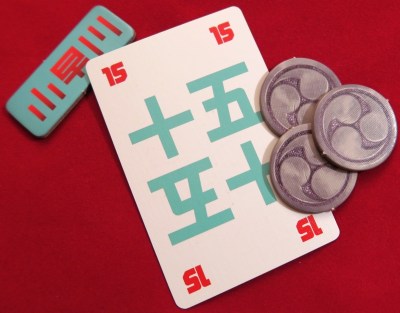
This week the “Feature Game” will be Kobayakawa, which is a Japanese micro-filler game in the mould of Love Letter.  We have chosen this game as it will leave plenty of time for something a little longer and we can choose what to play based on the people who are there.

Kobayakawa
– Image by boardGOATS

And speaking of Japan…

Recent reports indicate the Japanese banking crisis shows no signs of improving, if anything, it’s getting worse.  Following last week’s news that Origami Bank had folded, it was announced today that Sumo Bank has gone belly up, Bonsai Bank plans to cut back some of its branches and Karaoke Bank is up for sale and is going for a song. Meanwhile, shares in Kamikaze Bank have nose-dived and five hundred jobs at Karate Bank will be chopped. Analysts report that there is also something fishy going on at Sushi Bank and staff there fear they may get a raw deal…

9th February 2016

Blue was delayed by washing machine shenanigans and Green by pancakes, so while Burgundy, Black and Purple were entertained by food, Red and Magenta distracted them with a few quick rounds of Love Letter.  Magenta took the first two rounds winning the second by drawing the princess as the penultimate card; the third round went to Black when he played a Prince and asked Purple to discard her card which turned out to be the Princess.  With the arrival of Green and Blue had finishing her pancakes, we decided to play our “Feature Game” which was Ticket to Ride and its variants.

Love Letter
– Image used with permission of BGG contributor henk.rolleman

Which variant was the subject of some debate as we had all played different versions and everyone wanted to try a different one.  For example, Blue had never played the original USA version, but all those that had didn’t want to play again; similarly while Green was interested in playing Märklin, Black and Purple weren’t keen; they were interested in Switzerland or Nordic Countries, but Magenta, Blue and Green were unenthusiastic about that.  And so it went on, in fact, the only thing everyone agreed on was that we should split into a three and a four and nobody wanted to play Europe edition (as everyone had played that a lot). In the end, the group of three was based round Black and Purple who wanted to play with the Switzerland map and setup, and were joined by Burgundy who was fairly flexible.  That left the group of four who decided to go for Nederland as none of them had played it before.

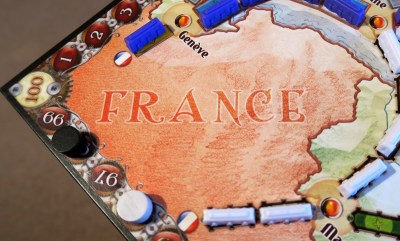
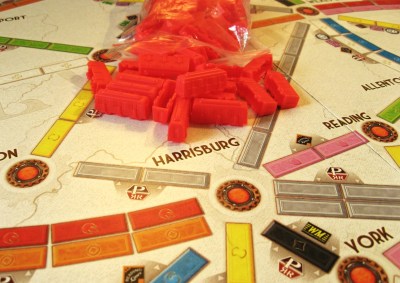
Ticket to Ride: Europe
– Image by boardGOATS

The basic Ticket to Ride game can be summarised as follows:  players take it in turns to carry out one of three possible actions and when one player has two pieces left or fewer, everyone gets one more turn before the game ends and points are tallied.  The first action is to lay trains on the map, but in order to do this, they must spend train cards in the colour featured on the map.  Thus, if a player wants to claim a four car route, they must play four cards of the corresponding colour and finally place four of their plastic carriages on the board in the correct location scoring points as they do so.  If they do not have cards to claim the route they want then they can, instead, choose two cards, either from the five face up cards next to the board, or from the face down draw pile.  “Laying trains” scores points, but a large number of a player’s points are scored at the end through tickets which give points to players that have connected several short routes together to connect two more distant cities.  Each player starts the game with some tickets (chosen from a larger number), but on their turn may, instead of drawing cards or claiming routes, draw more tickets.  At the end of the game, tickets which have been successfully completed score points, while unfulfilled tickets score negatively.

Ticket to Ride: Europe
– Image by BGG contributor stormrover

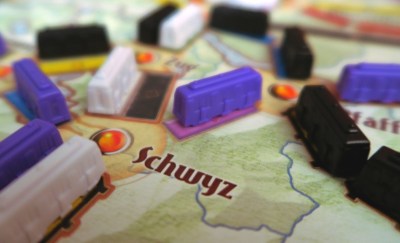
Although this is a fairly complete summary of the rules for the original base game, each different version has slight modifications and variations that change the game slightly.  The “Swiss trio” got under way first as Burgundy was quite familiar with the rule modifications:  tunnels, ferry routes and country-to-country tickets; locomotive cards can only be used for ferries and tunnels, but can be drawn from the face-up cards without penalty.  The game was very close with Purple trying to make a long route from east to west, Black travelling north to south and Burgundy doing a bit of both. The tunnels were a bit of a hindrance with everyone struggling to get through the Alps without paying extra.

Ticket to Ride: Switzerland
– Image by boardGOATS

As the ticket scoring came to a close, Burgundy had his nose in front and looked to have the win in the bag, but carefully counting up the trains gave Black the bonus for the longest route and with it, the win by just two points.  Burgundy was particularly cheesed off as he had attempted to claim a tunnel on his final turn that would have given him the longest route, but the fates conspired against him.  It was only later that we realised that there hadn’t been a recount for the points awarded as trains were placed on the map and as, invariably points tend to get missed out, a recount is generally sensible.

Ticket to Ride: Switzerland
– Image by boardGOATS

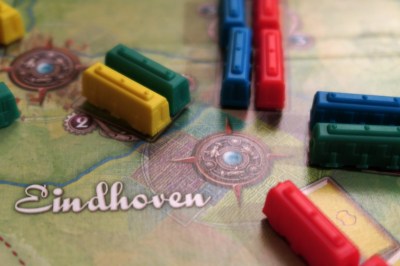
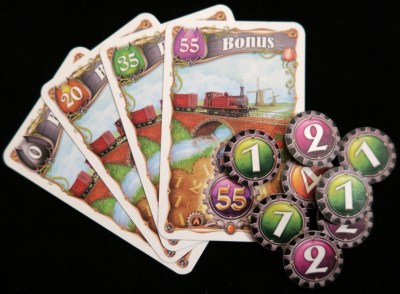
Meanwhile, Blue, Green, Red and Magenta had worked out the rules changes applicable to Nederland.  There are no ferry routes or country-to-country tickets and obviously, no tunnels, however, in this low-country with countless canals and rivers, there are bridges instead. and these have a toll.  Each player starts with “toll tokens” to a total value of thirty.  Most of the routes are double routes, so can be claimed by two different players, this feature is common with all other versions of Ticket to Ride when playing with the maximum number of players, but in this game they are used for all games.  The first player to claim a double route pays the marked toll to the bank, but the second player to claim that route pays the toll to the player who got there first.  These tolls become quite critical in the end game as there are bonus points available for players who manage to conserve toll tokens, and these bonuses are sizable with fifty-five points going to the player with the most tokens at the end of the game and thirty-five and twenty for second and third.  Players who can’t afford to build, can borrow from the bank, but that removes them from the race for bonus points as well as costing points at the end of the game.

Ticket to Ride: Nederland
– Image by boardGOATS

As is traditional, everyone began by moaning about where their starting tickets were.  Beyond that, nobody really knew quite what to expect, but it was clear that this wasn’t a game where players could ill-afford to hoard train cards and wait as they were likely to find themselves paying tolls to other players and giving them bonus points.  As such, everyone got going quickly and Red led the way placing several long routes giving her an early lead.  Everyone else caught up, and as players started to run low on trains, they realised they had to watch the number of toll tokens they had left else they would have to begin to borrow and that would put them out of the running for the bonuses.  Blue picked up extra tickets first, but they left her with a really tough decision as most of her track was in the north-west and the tickets she had were pretty much everywhere else.  After a very long time thinking, she decided to keep them all and go for broke.  The others soon followed, picking up more tickets, and Green had several goes with some corresponding to routes he had already claimed.  It was only a couple of turns after she had drawn her extra tickets that Magenta counted her trains and started to make some uncomfortable sounding noises suggestive of possible problems ahead.

Ticket to Ride: Nederland
– Image by boardGOATS

Blue triggered the end of the game and it was all too close to call with less than ten points between first and last before the tickets and bonus points were added on. Green was the first to count up and there was a stunned silence when we found he had a massive one hundred and thirty-seven points from the tickets to add to his train total of fifty-two.  Red had a couple of tickets that she had failed to complete so her ticket total took a bit of a bruising, but her problems were nothing to Magenta’s.  She only realised she didn’t have enough pieces to complete all her tickets when it was too late, so all her hard work to fulfil her initial tickets was almost completely negated as she finished with a ticket total of just one!  Blue had managed to complete all her routes and was pretty much neck-a-neck with Green which, like the other game, left it all down to the bonus points for toll tokens.  Red took the fifty-five points for the most remaining toll tokens, giving her a very respectable one-hundred and fifty-four and third place.  Blue picked up an extra thirty-five points and finished forty points ahead of Green who finished with the fewest toll tokens and therefore didn’t add to his score.

Ticket to Ride: Nederland
– Image by boardGOATS

Pine had appeared towards the end of the game and, after a brief explanation of the rules, had commented on the name of the game in German:  Zug um Zug, which translates to “step by step”, although Zug also means train.  This kind of double-entendre is not uncommon in Euro game titles and prompted a discussion of other games with similar “jokes”.  Blue mentioned Tier auf Tier which literally translates to the English title “Animal upon Animal”, a children’s game where players stack wooden animals, creating “tiers”.  Magenta brought up her favourite game, Bohnanaza, where “Bohn” is the German for bean.  Green chipped in with his offering of Citadels, which is called “Ohne Furcht und Adel” in German which literally means “without fear and noble” (colloquially translated as “without fear and nobility”).  This is actually a pun on “Ohne Furcht und Tadel”, which means “without fear or blemish”.  It is an old-fashioned expression seldom used now except perhaps when describing a perfect performance by Michael Schumacher for example, that refers to somebody being very valiant and chivalrous (ala King Arthur and the Knights of the Round Table).  Interestingly, when trying to find the correct literal translation, Green submitted “Ohne Furcht und Adel” to Google and got “Citadels” in return, perhaps a measure of how embedded games are in German life.

Animal Upon Animal
– Image by BGG contributor dr.mrow

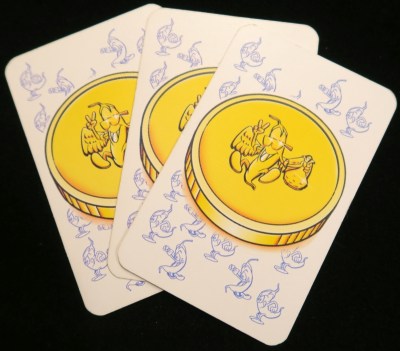
With eight of us, and nobody terribly keen to play anything too cerebral, we decided to go for something light, 6 Nimmt got a mention, but we settled on Las Vegas, using the extra dice for more players players and the wild cards from the Boulevard expansion, and the Slot Machine from the 2015 Brettspiel Advent Calendar.  This was a Christmas gift and had its first outing in January when it was the “Feature Game”, but as a light dice game that plays a wide range of player numbers it is quite versatile.  On their turn, each player begins by rolling their dice, then assigning some of them to one of the six casinos.  Each casino is numbered one to six and has a jackpot drawn at random from a deck of money.

Las Vegas
– Image used with permission of BGG contributor ckirkman

On their turn, players must use all the dice of one number to bet on the casino of that number.  Once everyone has placed all their dice the player who placed the most dice on a casino takes the highest value currency card. The really clever bit is that before any money is handed out, any “draws” are removed, which leads to a lot of barracking.  The Slot Machine is like a seventh casino, except that it can hold dice of any number, but each number can only be added once (though a player must add all the dice they have of that number).  The game was a lot of chaotic fun with with lots of chit-chat and before long we had worked our way through the card deck and spent an hour doing it.  Although there is a lot of down-time with so many players, it didn’t seem to matter very much and it was quite relaxing to chat about things.

Las Vegas
– Image by boardGOATS

We found Slot Machine definitely added a useful extra option to the game, however, the “wild cards” were less interesting.  This inspired a discussion about the value or otherwise of expansions.  In an evening essentially devoted to expansions, it was interesting consider whether the addition of expansions took a simple game that everyone liked and made it unnecessarily more complex, or whether it breathed new life into a game people had become tired of.  In the case of Ticket to Ride at least, it was clear that with a game that players had become almost too familiar with, the extra maps provided a nice alternative.  Meanwhile, the game was providing an interesting background to the discussion and the end results were almost incidental.  Magenta redeemed herself after the disastrous ticket fiasco, finishing with $390,000 and third.  Second place went to Red with $420,000, but with her second victory of the night, Blue took home the bacon with $460,000, more than twice that of last place.

Las Vegas
– Image used with permission of BGG contributor joeincolorado

Learning outcome:  Germans *do* have a sense of humour!

Boardgames in the News: What’s all this about a Hasbro-Mattel Merger?

In what is the latest of a long line of merger and acquisitions stories, it seems that the really big boys are now getting in on the act:  according to a report by Bloomberg, late last year, Hasbro initiated talks with Mattel for what would become the worlds largest toy company. This is not the first time a merger has been proposed; twenty years ago, Mattel attempted to buy Hasbro for $5.2 billion, but Hasbro resisted the deal with what Mattel described as a “scorched earth” campaign.  In the end, Mattel withdrew the offer citing an “intolerable climate” created by its competitor’s use of the media and politicians to fight the proposed takeover. Since then, there has been a lot of water under the bridge and representatives for Hasbro and Mattel have declined to comment, so we are left to speculate as to why the subject of a possible merger has arisen once more.

Hasbro & Mattel
– Image by boardGOATS with components from wikipedia.org

Both Hasbro and Mattel are currently valued at approximately $10 billion with an annual revenue in the region of $5 billion.  Hasbro owns brands as divers as Furby, My Little Pony, Playdoh and Nerf, but is perhaps best known amongst gamers for titles like Monopoly, Cluedo, Connect 4, Cranium, Battleship and Jenga.  Mattel brands perhaps tend to be aimed slightly more at the toy market with Barbie, Hot Wheels, Matchbox and Fisher-Price some of their biggest sellers.  There are also a number of games under the Mattel umbrella though, including UNO, Othello, Scene It?, Apples to Apples and Scrabble.  Clearly, both companies have a very similar portfolio, and are essentially direct competitors.  This has been very clearly demonstrated with Hasbro recently taking the licensing rights to Disney’s lucrative Frozen and Princess brands from Mattel, a change that will undoubtedly make a dent in their bottom line.  While changes are often a sign of a robust market, such seismic shifts are seldom good for the companies involved at least in the short term, often leading to restructuring and job losses – we have seen something similar with Mayfair Games and the recent loss of the distribution rights to the Catan Brand.

Scrabble
– Image used with permission of BGG contributor Susie_Cat

It seems there are two other key driving forces however.  Firstly, it would make them much stronger competition for the Danish company, Lego, which has been growing much faster than its U.S. rivals.  Secondly, both Hasbro and Mattel are looking to expand their presence in the digital market, with movie and computer game tie-ins similar to those seen with Hasbro’s Transformers franchise, and, according to Bloomberg, a merger would facilitate this.  The real question though is, regardless of whether or not Hasbro and Mattel can agree a deal, would the regulators let it happen?  In the last year alone, the U.S. Department of Justice has prevented Electrolux’s purchase of GE’s appliance business as well as stopping mergers between Office Depot and Staples, and Sysco and U.S. Foods, all due to concerns about industry concentration and the potential for higher prices resulting from the deals.  So it seems quite likely that a deal between Hasbro and Mattel would go the same way.  If they do merge, however, the giant Hasbro-Mattel would make Asmodee look like very small minnows indeed, right up until they get gobbled up too.

Lego
– Image from 3dprint.com

Next Meeting – 9th February 2016

Our next meeting will be on Tuesday 9th February, at the Horse and Jockey pub in Stanford-in-the-Vale.  As usual, we will be playing shorter games from 7.30pm as people arrive, until 8pm when we will start something a little longer.

This week the “Feature Game” will be Ticket to Ride, which, despite being from the USA is a poster child for modern, family-friendly, Euro-style games.  The game is based on a simple set collecting mechanic which players then use to build routes across a map in order to complete tickets.  Winner of the Spiel des Jahres in 2004, there are a lot of variants and expansion maps available.  So, since it is pancake night and there are likely to be some late arrivals, we thought we would go for a game that most people know, but where people can also try something new if they want to.

TtRPa-002
– Image by boardGOATS

And speaking of trains…

Jeff was travelling by train across Europe.  In Rome, an attractive young woman joined him in his compartment, so he engaged her in conversation.  He tried all his favourite chat-up lines and after a short while, the young Italian woman offered to show Jeff her legs if he gave her a two Euros. Utterly charmed by the flirty young lady, Jeff fished in their pockets for a two Euro coin and the girl pulled up her dress a bit to show her legs.

She could almost see Jeff’s tongue hanging out, so she went on, “If you give me ten Euros, I’ll show you my thighs.”  She hadn’t finished speaking before Jeff’s hand was in his wallet fishing for a note and his eyes were popping out on stalks as the girl pulled her dress up a little further reveal her legs in full.  Conversation continued, and Jeff couldn’t believe his luck when the young woman said, “If you will give me a hundred Euros, I will show you where I was operated on for appendicitis.”

Of course, Jeff couldn’t resist and almost without thinking he handed over the money.  The girl then turned to the window and pointed outside at a building they were passing, saying, “See, there in the distance? That’s the hospital where I had it done!”

26th January 2016

Supper had just arrived for Burgundy and Blue, so Green and Red set up our first game of the evening which was Ca$h ‘n Guns.  We last played it at our New Year games night, though only Blue and Burgundy who had been at that game had made it this time as Cerise and Grey are “still waiting” and Purple has work issues.  Green, Magenta and Red knew how to play though and gave Pine a quick run-down.  It’s not a particularly challenging filler, so set up and teaching didn’t take long, in fact the longest part was probably the debate about who was the eldest and therefore would start.  Pine lost the debate (and won the right to start).

Ca$h 'n Guns
– Image used with permission of BGG contributor punkin312

The idea is that each player has eight bullet cards, five of which are blank.  Simultaneously, everyone chooses one bullet card and, on the count of three, chooses a target by pointing their foam gun at them.  Then, The Godfather may enact his privilege by redirecting one of the guns pointing at him before he gives a count of three on which any cowards (or astute tacticians) may withdraw.  All remaining players reveal their bullet cards and the target of any live cards are out for the rest of the round and pick up a wound token.  All players still standing then take it  in turns to choose one of the face up loot cards (or the Godfather token) from the centre of the table, continuing until there is nothing remaining.  The winner is the wealthiest player who is still alive at the end of the  game.

Ca$h 'n Guns
– Image used with permission of BGG contributor punkin312

Meanwhile, Blue finished her pizza in record time, just in time to join in.  She got off to a good start going for pictures, but that made her an early target.  Magenta also picked up some potentially valuable artwork, while Green and Red traded The Godfather role a few times.  Going into the last round, it was all quite tight, especially as it is a game where players can have a hugely successful round or completely bomb out.  Pine had the hugely successful final round, as did Green, while Blue, with two wounds and a gun pointed at her head chickened out.  This meant she had a null round and finished in second with $130,000 (after a recount).  Green took the $60,000 Diamond bonus giving him $161,000 total, some way clear of the rest, and leaving Blue ruing the fact that she had made the snap decision to withdraw from the last round when she had a live bullet pointed at him.  That said, had she stayed in and taken out Green, one of the others would have taken the huge Diamond bonus and as they had more than Green without it, they could have won by an even larger margin.

Ca$h 'n Guns
– Image used with permission of BGG contributor punkin312

With Magenta wanting to leave early, we didn’t want to leave anyone stranded without a game, so decided to play something shorter as a large group first and leave our slightly longer, “Feature Game” for after.  With six, the options were limited, but there were still plenty of possibilities.  Red’s eyes lit up at the thought of Bohnanza, and although it can run on a little, we felt we could finish it and leave plenty of time for Endeavor.  After a little debate, Red got her way, and then pointed out that 2016 is “International Year of Pulses“, a fact that pleased Pine as a vegetarian who makes a mean dal.

Bohnanza
– Image used with permission of BGG contributor spearjr

Pine was the only one unfamiliar with “The Bean Game”, so Green gave him a brief run-down of the rules while Red and Magenta handed out cards.  A simple, old favourite, albeit one we’ve not played for a while, the game is largely based on the fact that players have a hand of cards that they must play in strict order.  On their turn, the active player must play (plant) the first bean card in their hand (the one that has been there the longest) and may plant the second if they wish.  Then they draw two cards and place them face up in the middle of the table so everyone can see, at which point the bidding starts with players offering trades for cards they like.  Once both cards have been planted (either in the active player’s fields or somewhere else), then the active player can trade cards from their hand too.  All traded cards must be planted before the active player finished their turn by drawing three cards and putting them into their hand in strict order.  And it is the strict order that is the key to the game, however difficult it is for players to refrain from rearranging their cards.

Bohnanza
– Image used with permission of BGG contributor spearjr

The game started with some accusations of dodgy shuffling which the guilty parties strongly refuted, but led to a strange start, with chilli beans getting sort of stuck.  Red spent nearly the whole game with no cards, yet everyone wanted to trade with her, an ominous sign, it is the player who trades most and best who wins.  Meanwhile, Green sat on a black-eyed bean field for a while, then they all came all at once, the product of more dodgy shuffling perhaps?  It was a close game with Burgundy ending with thirteen and Blue just ahead with fourteen, but the signs were true and Red won with a grand total of fifteen “beangeld”.

Bohnanza
– Image by boardGOATS

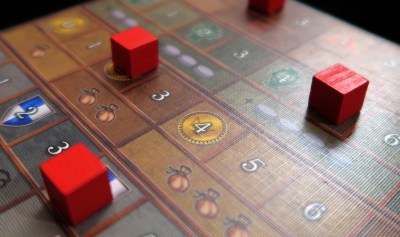
Red and Magenta left for an early night so Magenta could nurse her cold and the rest of us moved onto the, “Feature Game” which was Endeavor, a game that Green has been desperate to play for a very long time.  It is nominally about exploring, however, the slightly dry artwork, though clear, does give it a bit of an abstract feel, though ours was seasoned with a little bit of international atmosphere as we were playing with Dutch Buildings.  The game is played over seven rounds, each of which consists of four phases:  Building, Population, Income and Action.  The idea is that players have four status tracks which correspond to Industry, Culture, Finance and Politics, which roughly correspond to the four phases and dictate what players are allowed to do at each stage.

Endeavor
– Image by boardGOATS

Players begin by choosing a building from the range allowed by the player’s current industry level.  Some buildings provide an increase in one (or more) of the four status tracks, some provide actions, while some of the most others do both.  Once everyone has taken it in turns to to choose a building, they then move population markers from their general supply to their harbour according to their current culture level.  A strong population is important because that ultimately limits the number of actions players can take on their turn.  The income phase allows players to move some of their workers from buildings back into their harbour as dictated by their current level on the income track.  These add to the population players have available to do things with, while also making space on the buildings so that the action is available for re-use.

Endeavor
– Image by boardGOATS

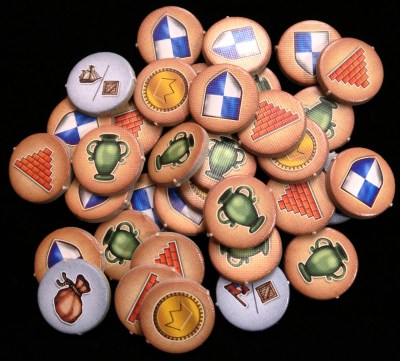
The first three phases of each round are mostly just preparation and book-keeping; the guts of each round are in the final phase, where players take it in turns to carryout an action of their choice.  There are five basic actions: Taking Payment, Shipping, Occupying, Attacking, and Drawing Cards.  In order to carryout an action, players must activate an appropriate building by moving a population marker from their harbour to the building.  In the case of shipping, occupying and attacking, the actions are carried out on the central, communal player board.  To ship, after activating an appropriate building, players can move one of the population markers to one of the six shipping tracks and take the token that was on the space.  These tokens are useful as they add to the status tracks, but some also give a free action.  Shipping is also important as it gives players a presence in a region which is necessary for occupying, attacking and drawing cards.

Endeavor
– Image by boardGOATS

When a player places the last token on a shipping track, he takes The Governor card off the top of the pile in the region and the region is considered “open”.  This means that players who already have a presence in the region can also occupy the cities within the region. This gives both tokens and victory points, but where a player occupies a city that is connected to another city they already occupy, they get an extra token, which can be very valuable, as well as providing extra points at the end of the game.  This makes position very important, but if someone occupies a city that another player wants, one option is attacking.  This is carried out in the same way as occupying, but is a separate action and costs an additional population marker.  Occupying a region also adds to a players presence in the region: players can also draw the top card from a region’s stack and add it to their player-board, so long as their total presence in the region is higher than the card number.  Cards are important as they also add to the status tracks as well as provide victory points, however there is a card limit which is enforced when a player passes at the end of the round and any status track points gained with the card are lost when cards are discarded.

Endeavor
– Image used with permission of BGG contributor henk.rolleman

Once everyone has completed one action phase players continue taking it turns until everyone passes.  Thus, the final possible action is taking payment which is the simplest action and allows players to move one of their population markers back to the harbour so that they can re-use the building in the same round. In addition to the five basic actions, some of the more expensive buildings provide a choice or even a combination of two of the basic actions.  After seven rounds, points are awarded for cities, for connections between cities, for progress up status tracks, cards, some special buildings, and any left-over population markers.

Endeavor
– Image by boardGOATS

Although the game was more complex than many that we play, and only Green had played it before, so it took a while to explain.  In the event, it was not actually as complex as we all thought at the start, but it took most of us a while to work out what we were trying to do.  The first few rounds are quite quick as there aren’t a lot of options, however, they are very important as they set the foundations for the later rounds.  With people new to it though, we mostly had no idea what we were doing at the start, but quickly picked up the rhythm of the game.

Endeavor
– Image by boardGOATS

Pine struggled at the start having had a bad day, but he made reasonable ground going down the slavery route and finished just behind Blue and Green.  It was Burgundy, however, who had managed to build his culture early in the game and capitalised on it later finishing twelve points clear with sixty seven.  While packing up, Blue, Green and Burgundy reviewed the game a little and tried to see where Burgundy had really picked up his additional points.  First we noticed that Blue couldn’t count and had missed ten points putting her second.  This meant that although we had finished with similar points for the status tracks, it was really the cities that Burgundy had occupied and connections he’d made that made the difference.  We had enjoyed the game though and thought we needed to play it again.  Although the game has essentially the same ingredients (the region cards and buildings are the same every time), we felt the starting token layout would actually have a much larger impact on game play than we had originally thought and would give it a surprising amount of replay value.

Endeavor
– Image by boardGOATS

Learning Outcome:  Some people need to take their shoes and socks off to count to more than ten!

Boardgames in the News: Google plays Go

Go is an ancient Chinese two player game played with black and white stones on a nineteen by nineteen grid.  The game is one of territory where the aim is to surround the most intersections.  Although the game itself is very simple with players taking turn to place stones on the points of the grid, There is significant strategy involved in the game, and the number of possible games is vast (10761 compared, for example, to the estimated 10120 possible in Chess).

Go
– Image used with permission of BGG contributor ManCorte

In addition to the huge number of possible moves, Go has also always been considered to be particularly challenging for an Artificial Intelligence to play well as strategy involves patterns rather than specific moves with a finite solution tree – something that humans generally do better than computers.  Thus, for twenty years, devotees Go, have smugly pointed out that while Deep Blue first beat the then World Chess Champion Garry Kasparov in February 1996,1 a computer has never beaten a Go Champion.  Yesterday, however, Google announced that it’s AlphaGo software (part of their DeepMind project) had beaten the reigning three-time European Go champion Fan Hui winning five consecutive games.  The work has been published in the scientific journal Nature,2 which seems to have been making a bit of a habit of publishing boardgaming articles recently…

Go
– Image used with permission of BGG contributor ManCorte

1 Campbell, et al., Artif. Intell. (2002), 134, 57; doi:10.1016/S0004-3702(01)00129-1.
2 Silver et al., Nat. (2016), 529, 489; doi:10.1038/nature16961.

OxCon 2016

This weekend is OxCon, a weekend of gaming held every January in The Mitre pub in the middle of Oxford.  It has almost mythical status since publicity hitherto has almost entirely been by word of mouth and often quite last minute.  This year, in a break from tradition, it was advertised early.   As usual, for those who are about on Friday evening there will be a meal at Pizza Express and some gaming afterwards.  As well as general gaming, there will also be tournaments with Puerto Rico on Saturday, and Settlers of Catan on Sunday.  Not sure how many of the GOATS will make it, that will depend on weather and family commitments, but it should be a good event.

The Mitre
– Image from pubsofoxford.co.uk

Next Meeting – 26th January 2016

Our next meeting will be on Tuesday 26th January, at the Horse and Jockey pub in Stanford-in-the-Vale.  As usual, we will be playing shorter games from 7.30pm as people arrive, until 8pm when we will start something a little longer.

This week the “Feature Game” will be Endeavor, which is a more complex game where each player represents a growing empire engaged in a glorious endeavor to expand their
influence and status at home and across the great oceans of the world.  Players earn glory by increasing their scores in Industry, Culture, Finance, and Politics, as well as by occupying cities, controlling connections between cities, and by holding certain Asset Cards and Building Tiles.

Endeavor
– Image used with permission of BGG contributor matthew.marquand

And speaking of Captain Cook…

Jeff was at chic gathering and struggling to make polite conversation.  The person he was talking to was a psychiatrist, so, after a minute or two, Jeff asked him, “Would you mind telling me, how you detect a mental deficiency in somebody who appears completely normal?”

“Nothing is easier,” the doctor replied. “I ask him a simple question, which everyone should answer with no trouble at all. If he hesitates, that tells me just what I need to know.”

“What sort of question?” Jeff asked.

“Well,” replied the psychiatrist, “I might ask him, ‘Captain Cook made three trips around the world and died during one of them. Which one?'”

Jeff paused a minute and thought for a moment before he replied, “You wouldn’t happen to have another example, would you? I must confess I don’t know much about history.”

12th January 2016

With Red, Magenta and Blue moaning about work and only Burgundy waiting for real food, when Pine rolled up we began straight away with our “Feature Game”, the light filler, Las Vegas. This is a very simple dice game, but actually quite a lot of fun.  On their turn, each player begins by rolling their dice, then assigning some of them to one of the six casinos.  Each casino is numbered one to six and has a jackpot of over $50,000, drawn at random from a deck of money.  Thus, each jackpot could be anything from $50,000 to $180,000 and comprise one to five notes.  On their turn, players must use all the dice of one number to bet on the casino of that number.

Las Vegas
– Image used with permission of BGG contributor punkin312

Once everyone has placed all their dice the player who placed the most dice on a casino takes the highest value currency card. The player with the most money after four rounds is the winner.  The snag is that before any money is handed out, any dice leading to a draw are removed. It is this rule that makes the game interesting, raising the decisions above the trivial and, in our view, making it a better and much more fun game than Qwixx which we played two weeks ago.  Although the game only plays five (without the Boulevard expansion), Blue had added an extra set of purple dice just in case, so when Green walked in just before the game started, he was able to join in.

Las Vegas
– Image used with permission of BGG contributor punkin312

In the early part of the round, each player has to decide whether to conserve dice or whether to make a statement and go in big.  As the round progresses, players must choose where to place their bets then try to finesse their position before being forced to place their last die or dice based solely on chance.  The factors that go into the decision include the value of the rewards available, the current position and the number of notes as well as the probabilities of other players interfering.  The probabilities are non-trivial too, because rolling multiples can change the number of dice available for the next roll.

Las Vegas
– Image used with permission of BGG contributor ckirkman

In the first round, everyone made the same mistake and committed too many dice too early, but after that, we all got the hang of it and the game was quite close.  Players keep their winnings hidden, but since everyone had had rounds with lean pickings as well as generous ones, we all felt we were in with a chance.  The last round began with it all to play for and everyone taking it in turns to roll lots of sixes.  At the end of the game, we announced our totals in turn:  Green finished with $260,000, Pine with $250,000, Burgundy and Blue tied with £270,000, but Magenta just pipped them with $280,000.  Red, however, took longer to count up her cash for good reason and finished well clear with $360,000.

Las Vegas
– Image used with permission of BGG contributor joeincolorado

With the arrival of Black and Purple, we decided to split into two groups.  The only game that everyone really wanted to play was Isle of Sky: From Chieftain to King, so since we only had the one copy, five went for that leaving the three others to find something else to play.  Isle of Skye is a tile laying game where players play a sort of solitaire Carcassonne, bidding for tiles and scoring a the end of each of the six rounds.  We’ve only played the game once on a Tuesday in November, but it has proven to be very popular at other local meetings too, so everyone playing had played before and the game was quick to get going.

Isle of Skye: From Chieftain to King
– Image used with permission of BGG contributor henk.rolleman

Burgundy had played it a few times and, unusually, generally seems to struggle with this game.  This time he started well, and took the lead from the start, unfortunately however, he struggled to pick up scrolls, so suffered in the end game scoring.  One of the peculiarities of this game is the fact that from round three, at the start of the round players get one extra gold coin per player in front of them on the score track, increasing to four extra coins by the final round.  This really adds up, and a player who takes advantage of this bonus can have a large impact on the score track.  Black made hay on the bonus sitting at the back for most of the game, however, he failed to use the gold and finished with fifty-one unspent coins.

Isle of Skye: From Chieftain to King
– Image used with permission of BGG contributor Punkin312

Between Burgundy at the front and Black at the rear, Purple, Pine and Magenta were jostling for position.  Without sheep and cattle featuring strongly in the scoring tiles this time, Pine felt he would struggle, but he made a surge for the front in the final scoring.  Magenta who had spent a lot of the game at the back of the pack with Black gradually moved through the field in the later rounds and finished four ahead of Burgundy in joint first with Pine on sixty-six, with Pine taking it on the tie-breaker.
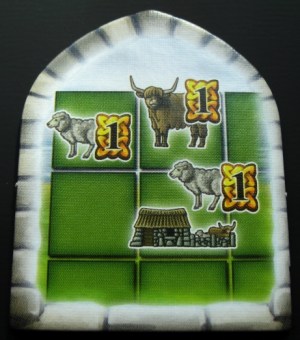
Isle of Skye: From Chieftain to King
– Image by boardGOATS

Meanwhile, Blue, Green and Red were playing an aggressive game of Citadels.  This is a slightly older, role selection game.  Everyone starts with a hand of district cards and the start player, “The King”, also has a hand of eight Character cards.   The Character cards are shuffled and one is placed face down blind.  The King can then choose one Character card and pass the rest on to the next player.  The cards are drafted in this way until (in the three player game) everyone has two and the remaining card joins the first card, face down to one side.  Thus, each player has two Character cards and each Character card has a number and a special ability.  “The King” then calls the characters in turn, by number and name, and the player who has that card then immediately carries out their turn.

Citadels
– Image used with permission of BGG contributor themilkcrate

A turn consists of either taking money or drawing two cards from the deck, then paying the monetary cost to build one of the district cards from their hand.  The game ends at the end of the round in which a player builds his eighth district card.  The scores are then added up with players receiving points for their buildings equalling the total cost to build them, plus bonuses for being the first player to build eight district cards, bonuses for having at least one district in each of the five colours and for achieving a total of eight buildings before the game ends.  We played with some of the Characters from the Dark City expansion so “The Witch” replaced “The Assassin”, “The Tax Collector” replaced “The Thief” and “The Navigator” replaced “The Architect”.  We also chose a random selection of the valuable “purple buildings”, a factor that turned out to be quite critical to the game play in the end.

Citadels
– Image used with permission of BGG contributor Nodens77

Blue took an early lead, building a couple of “purple buildings”, in particular, the very annoying Ball Room.  The “purple buildings are expensive to build, but generally come with some sort of special power, in the case of the Ball Room, if the owner is also The King, every player must say “Thanks, Your Excellency” before taking their turn otherwise it is forfeit.  Without “The Thief” in play, Blue was able to let her money build up and was hoping to build the Library, when Red played “The Magician” and swapped hands with her.  Unimpressed, in the next round Blue played the same trick, giving Red the apparently rather useless Armory in exchange.  To make sure Red didn’t nick it back, Blue built the Library quickly, her third purple building giving her a healthy lead though she, like Green was struggling to get the blue cards she wanted to pick up the bonus for having a building of each colour.  Green meanwhile was having other problems of his own, compounded by the fact that he forgot to be obsequious and therefore lost a turn.

Citadels
– Image used with permission of BGG contributor kilroy_locke

Red made persistent assaults on Blue, but it was when Blue had six district cards built and was trying to find a way to close out the game that Red decided to use that “rather useless Armory” to destroy Blue’s valuable Library.   Discussion ensued as Blue had originally decided to ditch the Armory as it was too restrictive, but Red wasn’t so sure.  Green resorted to looking it up on-line and found a wealth of discussion none of which really answered our questions.  After a brief hiatus, we decided to let Red go ahead as Blue was so far in front, although it wasn’t that far as it turned out.  Both Green and Blue hadn’t seen a blue district card all game so missed out on the three point bonus and, as Red completed her eighth building first, she also took an extra two points for that, finishing on thirty-seven.  Green and Blue tied for second place though arguably Green should not have been able to take his last turn since he forgot to “Thank, Her Excellency” again…

Citadels
– Image by boardGOATS taken from boardgamegeek.com

Citadels is one of those rare games that plays a wide player count, nominally from two to eight players.  However, while there is a consensus that it does not play all numbers equally well, the on-line jury is still out as to where its “sweet spot” is.  In fact, some people appear to think it is best with small numbers, while others prefer it with more players.  We’ve played Citadels a few times on a Tuesday, a couple of times with just two players, but also with five.  Blue and Green had been involved on each occasion and Blue in particular had quite enjoyed the game with just two players, but had hated it with five.  With two she felt it was a game where players could really try to get inside the head of their opponent whereas with five she felt it was horribly chaotic and difficult to follow what was going on.  Knowing this, Green had thought three might have some of the features of the head-to-head game while adding more dimension to the game play and, despite losing, Blue agreed, that three was an excellent number of players for this game.

Citadels
– Image by BGG contributor lolcese

While Citadels was finishing, the other players filled the time with a couple of rounds of an old favourite, Dobble.  The first round was a warm up which Magenta ducked out of as she has a bit of a reputation as the “Dobble Queen”.  This was played with the conventional “Towering Inferno” variant, where players call out matches and grab cards from the central pile.  In the second round, Magenta joined in so “The Poisoned Gift” variant was chosen, otherwise known as “Gang up on Magenta”.  In this version, instead of grabbing cards from the middle for yourself, you match them and stick them on someone else’s pile (usually Magenta’s), with the aim to finish with as few cards as possible.  Everyone accordingly rained cards down on Magenta who duly lost with Black winning by one from Pine and Burgundy.

Dobble
– Image used with permission of BGG contributor msaari

Time was ticking on, so we decided to play a quick game of Saboteur.  This is a team game where you don’t know who your team mates are.  With eight players, there is a team of five or six Dwarves trying to find the treasure, and two or three Saboteurs, trying to stop them.  On their turn, the active player can play a tunnel card to progress towards the three possible treasure locations, play an action card or discard a card face down (a very Saboteur-like action).  The action cards come in a variety of flavours:  broken tool cards that are played in front of other players and prevent them from laying tunnel cards; tool cards than cancel out broken tool cards; map cards that allow players to look at one of the possible treasure locations to see whether it contains the gold or not, as well as rockfall cards that allow players to remove tunnel cards that have already been placed.

Saboteur
– Image used with permission of BGG contributor mikehulsebus

The game is supposed to consist of three rounds with the winning team taking prize cards, however, last time we played, we decided that the addition of prizes meant the game inevitably outstayed its welcome.  We felt it would be better to play one round, and if we wanted, play a second, but treat them as separate games, which is exactly what happened this time.  In the first “game”, Magenta and Purple claimed the gold was at one side, while Black and Blue claimed it was in the middle – clearly we had two of our Saboteurs, but which pair looked guilty?

Saboteur
– Image used with permission of BGG contributor mikehulsebus

After a couple of rounds, Magenta showed her true colours and played a broken tool card in a Saboteur-like manner and she and Purple were promptly stomped on.  Suitably, after everyone had doubted him for so long, Black was the one to finally find the gold.  Green had had enough and headed off, but Pine, Red and Magenta agreed to stay for one more go.  This time Red decided to have a go at Pine from the very start – maybe it was the pointiness of his ears or the way he carried his pick axe, but she claimed he was definitely a Saboteur.  Everyone else was less quick to condemn, and before long it became clear that it was Red and Purple (again!) who were guilty and, although it was closer, the Dwarves still got to the gold first.

Saboteur
– Image used with permission of BGG contributor mothertruckin

With people leaving, there was just time for Black, Purple, Burgundy and Blue to squeeze in a quick game of The Game.  We started dreadfully, and two piles were very quickly closed off.  Somehow we managed to keep going though and, despite an appalling run of luck and a couple of us making dodgy decisions, Black was eventually able to draw the last card from the deck.  Playing just one card at a time made things a little easier, but we still had over twenty cards to get rid of.  Sadly, it was not to be; the poor start had done its damage and we finished with a total of eleven cards in hand.
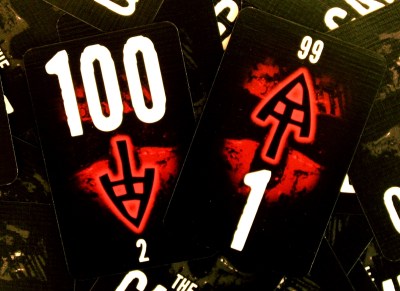
The Game
– Image by boardGOATS

Learning Outcome:  When a game is *that* popular, bring it again!
Boardgames in the News: Playing with History on Radio Oxford

On Friday afternoons, Radio 2 broadcaster Alex Lester presents a magazine show on BBC Radio Oxford.  This afternoon’s episode included a nice article about the new boardgame display in the Bodleian Library called “Playing with History”.  As well as a bit of general chit-chat, there was a very interesting interview with Chris Fletcher, the Keeper of Special Collections at the Bodleian, and Richard Ballam the game collector who donated 1,500 games dating from 1800 to the John Johnson Collection which are the subject of the display. The program is available on iPlayer for a month and the article starts about forty-four minutes in.

Alex Lester
– Image by boardGOATS from bbc.co,uk