Author Archives: nannyGOAT

Boardgames in the News: Will the Latest Consolidation Lead to Price Rises?

In February, following their acquisition of Esdevium GamesLibellud, Days of Wonder, Fantasy Flight games, Ystari Games, Asterion Press and Pearl Games we asked the question, “Are Asmodee Taking Over the World?”  As if to answer in the affirmative, in April, Asmodee announced the start of a new contract with Queen Games for exclusive distribution rights in the USA.  Since Asmodee has been the distributor for Queen Games in Germany, this made logistical sense.  However, other consequences of these consolidations are now becoming apparent.

Asmodee Logo
– Image from escapistmagazine.com

This week, Asmodee issued a press release stating that from the 1st January 2016, games made available by its three main US operations, Days of Wonder, Fantasy Flight games and Asmodee Editions will be sourced from a single entity, Asmodee North America.  Furthermore, in the New Year, Asmodee North America will be adjusting its sales terms and reducing the number of its primary customers in the USA to just five authorised distributors.  From 1st April 2016, these authorised distributors will be restricted to selling Asmodee North America’s products to “speciality retailers” that have agreed to Asmodee North America’s “Speciality Retail Policy”.

Asmodee North America
– Image from Asmodee North America Press Release

This Speciality Retail Policy states that a “retailer must not sell or transfer … other than through face-to-face commercial resale exchange with end-users in retailer’s physical retail location(s) or at a physical extension of the retailer’s location at a consumer show/convention”.  Thus, all future sales will be restricted to bricks and mortar stores, effectively preventing the selling of Asmodee North America‘s products online.  This is not an end to online sales, however, as the press release goes on to say that “Asmodee North America will allow select merchants to service the online sales channel under a separate sales policy. Such select online merchants will either be supplied directly by Asmodee North America, or by appointed distributors acting under Asmodee North America’s related policy.”

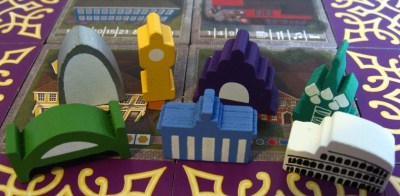
Ticket to Ride Map Collection: Volume 5 – United Kingdom & Pennsylvania
– Image by boardGOATS

Online speculation is rife that these measures have been put in place to prevent the deep discounting seen in the USA, and that the contracts the retailers will have to sign will include a commitment to sell at the list price, thus effectively price fixing by other means.  This has been carried out in the past by both Mayfair Games (the Catan brand) and Games Workshop (Warhammer etc.) who both have strict Speciality Retail Policies that restrict distribution, maintaining high prices.  This is all highly significant with the growth of modern boardgaming as Asmodee North America produce some of the most popular gateway games, in particular Ticket to Ride, 7 Wonders, Dixit, and Dobble as well as the newly reawakened Star Wars license.  It is not yet clear whether this will also have any effect on the distribution of Queen Games products in the USA.

Star Wars: X-Wing Miniatures Game
– Image used with permission of BGG contributor adamfeldner

Asmodee North America has claimed these changes are because they are “committed to brick-and-mortar hobby market speciality retailers”.  On the other hand, in the FAQ that accompanied the statement, Asmodee North America state that even physical stores with an online presence are “limited to the channel of sale involving physical retail stores only”, which appears to belie this, since online sales are often what keeps “Bricks and Mortar” stores afloat.  The FAQ also states that “These policies currently affect our business in the US. Our Canadian operations will continue unaffected until notified otherwise.”  There is no mention of the EU, but it is likely that Esdevium, who already have something of a strangle-hold on the distribution of games in the UK, will continue to assert pressure on the market as they did at the start of this year.

Esdevium Logo
– Image from asmodee.co.uk

Boardgames in the News: What is a Meeple?

Reading our game reports, a fairly commonly used term is “Meeple”.  The word is used so widely amongst Euro gamers, that it was adopted for the name of the Oxford boardgame café, Thirsty Meeples, however, non-gamers are completely unfamiliar with it.  So, what does it mean and where does it come from?

Carcassonne
– Image used with permission of BGG contributor wizardless

The term was allegedly coined in 2000 by Alison Hansel while paying the tile laying game, Carcassonne. In Carcassonne, players draw a tile and then add it to a growing map before placing a wooden figure on the tile. Thus, meeple was a conjunction of “my” and “people” and was used specifically to refer to the characteristic wooden people-shaped pieces used in Carcassonne and more recently, games like Keyflower. Since then, the range of game pieces available has increased hugely and the term has been adapted and broadened.

Keyflower
– Image used with permission of BGG contributor punkin312

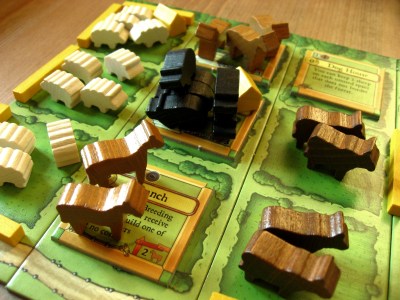
For example, Agricola has a wide range of resource tokens, including sheep, pigs and cows, which are often collectively referred to as “animeeples”. Similarly, the wheat and vegetable resource tokens are often referred to as “vegimeeples” or even “vegeeples”. So, the suffix “-eeple” has now come to mean game token, interestingly, usually one that is shaped. Thus, people playing games like Ice Flow or Salmon Run might talk about “fish-eeples”, devotees of Caverna may discuss “dog-eeples” and “donkeeples”, and players of the Arctic Bounty expansion for Fleet might comment on “crab-eeples”, though they may also be collectively referred to, simply as meeples.

Agricola: All Creatures Big and Small
– Image by boardGOATS

So, generically, a meeple is a game piece, usually made of wood, and often, but not necessarily with two arms, two legs and a head…

Meeples
– Image by boardGOATS


Christmas GOATS – 2015

For the last few years, on New Year’s Eve, we have had a bit of a party in a private house with a bite to eat followed by games.  These things rapidly become “tradition”, so this year we are once again holding the now “traditional”, New Year’s Eve Games Night.  In the past, because of the way the holidays have fallen, this has replaced a normal Tuesday games night, but this year, we will holding both!  So the next two meetings will be, Tuesday 29th December, at the Horse and Jockey pub and Thursday 31st December, at “Barney’s House”.  More details will follow nearer the time, but we look forward to seeing everyone then.

Merry Christmas
– Image from christmasquotescards.com

Next Meeting – 15th December 2015

Our next meeting will be on Tuesday 15th December, at the Horse and Jockey pub in Stanford-in-the-Vale.  As usual, we will be playing shorter games from 7.30pm as people arrive, until 8pm when we will start something a little longer.

This week the “Feature Game” will be Between Two Cities.  Set in the early 1800s, a time of immense construction and urbanization, this is an unusual game as players are paired with a partner with whom they discuss and execute their grandiose development plans.  We chose this quick, interesting, partnership-driven tile-drafting game as it should leave us with plenty of time to play other games.

Between Two Cities
– Image by boardGOATS

And speaking of city planners…

A judge, a bishop, and a city planner were having a discussion. All three were rather vain , and their talk soon turned to the question of which of them was the greatest.

“Well,” said the judge, “my position is one of dignity and power. When I walk into the courtroom, the bailiff says, ‘All rise!’ and all the people stand to pay me honour.”

“That’s very nice,” responded the bishop. “People stand in your honour, but when people have an audience with me they kneel, kiss my ring, and they address me as ‘Your Eminence.'”

The city planner snorted and said, “I think I’ve got you both.  When I walk into any room as a consultant, the people look down, put their hands over their eyes, and say ‘Oh, my God!'”

1st December 2015

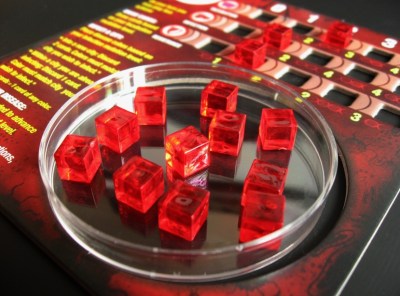
Red and Blue were late thanks to a ridiculous queue at Frilford Crossroads, so food had only just been ordered when Green and Pine turned up.  We hadn’t seen Grey and Cerise for a while, so when they arrived the evening descended into gossip.  Pine manfully resisted the chips, but when he eventually succumbed, he ended up with more than he bargained for as they’d all stuck together…  Amid chips and chat, eventually, someone suggested a game and everyone else agreed, so we started with the “Feature Game”, Pandemic: Contagion.  The original game, Pandemic, is a very well known cooperative game where everyone plays together to defeat the tide of disease that is overcoming the world.  Pandemic: Contagion is a lighter game and almost the complete opposite:  players are the diseases and compete against each other to be the most effective and take over the world.
Pandemic: Contagion
– Image by boardGOATS

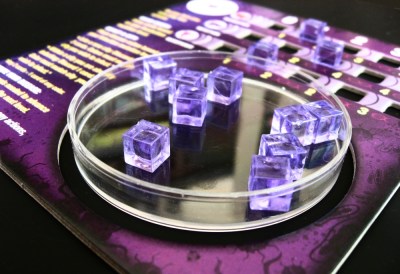
The game itself is fairly straightforward.  Cards are drawn to represent cities – these are coloured and are under attack from disease.  On their turn players can do any two of three possible actions: place cubes or “infect” a city, draw cards or mutate their disease.  Placing cubes cost cards and the cards must match the colour of the city they are infecting.  The number of cubes they can place or cards they can draw depend on the characteristics of their disease, and both can be increased by mutation.  Like infection, mutation must be paid for with cards, though the number of cards used depends on the level, thus going from an infection level three to level four is much more expensive than going from level one to two.

Pandemic: Contagion
– Image by boardGOATS

A city becomes overrun with disease when the total number of cubes placed on the card equals or exceeds the population.  At this point, the city is scored and the players with the most cubes get points (in the event of a tie, the disease to infect it first wins).  The person who placed the last disease cube additionally gets a bonus action that depends on the city.  At the start of each round an event card is drawn which either alters the rules of the game for the duration of that round, or otherwise disrupts everyone’s plans, by for example, causing them to lose cards or reduce their infection rate etc. etc..  Some of these cards also have a symbol on them either a city indicating that a new city should be added, or a skull and crossed bones after every second of which points are awarded to the player with the most disease cubes in each city.  The game ends when either, there are only two cities left, or the game has proceeded through all twelve event cards.

Pandemic Contagion
– Image by boardGOATS

The game went very slowly with everyone falling for “group think” and going for the cities with the largest populations which therefore score the most points when completed.  Unfortunately, this left the game somewhat mired in treacle as everyone did pretty much the same thing for the first three rounds collecting cards and infecting cities.  Blue picked up a few points at the first interim scoring, but otherwise it was pretty dull and we were all wondering what we were doing wrong.  Then it dawned on us that our disease cubes weren’t doing very much:  for all the large cities, one player had a significant majority, so there was no incentive to compete for it; worse, the winner was reluctant to commit more resources to the cause, but that meant their cubes were just sitting there, waiting.

Pandemic: Contagion
– Image by boardGOATS

Burgundy tried to get things going by increasing the number of cards he could draw, but that back fired when an event card forced him to dispose of half his cards (much to his horror, rounded up!).  It was then that everyone began to look for other things to do and attention turned to finishing off some of the smaller, weaker cities.  We’d sort of forgotten about the bonuses that come when cities are scored and it turns out that some of them are very powerful indeed.  This was amply demonstrated when Blue finished Milan that gave her a card for every city she had infected, which turned out to be quite a few.
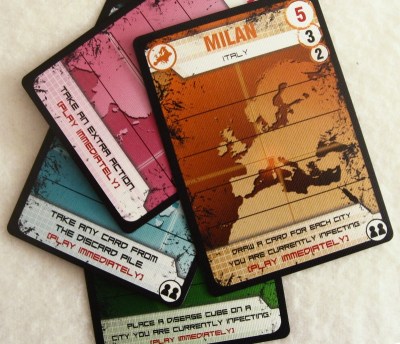
Pandemic Contagion
– Image by boardGOATS

With a little grease to oil the wheels, she was now able to use her newly liberated disease cubes to infect other cities in an effort to finish them.  Everyone else joined in and finally the game began to look a little better, however, before we’d had time to really start to appreciate it, the game was over and it was time to score the remaining cities.  Blue took the win with sixty-one points with Cerise some fifteen points behind behind just fending off Burgundy and taking second place, but everyone was frustrated at what had looked like a promising game, but had fallen so spectacularly flat.

Pandemic: Contagion
– Image by boardGOATS

On reflection, as Blue commented (much to Green’s amusement as he listened in from the next table), “If we’d played it differently it would have been a very different game.”  Although that sounds like a stupidly obvious thing to say, the problem was that everyone tried to play the same way and everyone fell into the same trap which dragged the game down badly.  If we’d realised the value of the bonuses and gone for some of the smaller cities first, the game wouldn’t have dragged so much and would have been much more enjoyable and interesting.  Unfortunately, as Pine succinctly put it, he’d enjoyed everything he’d played with us and would be happy to play any of them again, “except that.”  Which means it’s unlikely to get a second chance very soon.

Pandemic: Contagion
– Image by boardGOATS

Meanwhile, Green and Grey had decided they fancied playing something a bit more “piratey” together.  With Pandemic: Contagion supposedly taking “just half an hour”,  they decided to give Port Royal a go.  Although Green had played it a couple of times, Grey was completely new to the game.  We’ve played it quite a bit recently, but in summary, the game combines “push your luck” with strategy, the idea being that players turn over cards until there is something they want, or they go bust.  Once they’ve taken a card, the other players have their pick of what’s left (for the cost of one coin).  This means that in a two player game, the strategy changes quite a bit as players have to watch what they leave as well as be careful about taking a card and paying their opponent for the privilege.

Port Royal
– Image used with permission of BGG contributor joeincolorado

Green decided to aim to complete “expeditions”, while Grey took a more tactical approach, just doing what seemed best at the time; neither player decided to protect themselves by picking up pirate cards.  Both players really enjoyed it and the fickle hand of fate was much in evidence:  there was much hilarity when three of the four tax cards came out in the same round.  Fate wasn’t done yet either and when Green pushed for four ship cards (in order to be able to buy two cards in the round), almost two dozen cards had been drawn before he finally went bust by revealing a second of the same colour.  With no pirates in his arsenal to repel the attack, the whole lot was wiped out, much to Grey’s annoyance as he had his eye on a particular card.  In the end Green won convincingly with his expedition strategy, but he had the advantage of having played it twice before.

Port Royal
– Image used with permission of BGG contributor punkin312

Since the larger group were still playing Pandemic: Contagion and only about half way through, Grey and Green decided to give Port Royal another go. This time both players decided to mitigate some of the luck by picking up pirate cards and it was generally a very close game.  Pirate ships were repelled left, right and centre and more than once two cards were purchased in one round.  In the end Grey brought the game to an end by exchanging cards for an expedition causing him to exceed the magic twelve points, finishing on fourteen.  Since Grey had started, Green got one more round.  With eleven points, Green needed four to win.  As only two card purchases would do, he went for a four pirate line. With a fighting total of six he could easily repel anything except the skull ships.  With the odds in his favour managed to get to the necessary four ships so that he could buy two cards, but his meagre finances stopped him getting the four points and had to settle for three, leaving him with fourteen points, level with Grey.  Unfortunately for Grey, he had no money left to buy anything, and it all went down to the tie-breaker.  The rules state this is by money, and since Green had just one coin left, he took his second victory of the night.

Port Royal
– Image used with permission of BGG contributor punkin312

With Pandemic: Contagion STILL going (yes, it really DID drag on, though it was near the end by this time…) Green and Grey decided to play a very quick game of Pick Picknic. This is another game that was new to Grey, but he proved to be a natural at.  A sort of early version of one of our current favourites, Om Nom nom, the game combines simultaneous card selection with bluffing and a good slice of luck.  The idea is that there are six farm  yards of different colours, if someone plays the only chicken card of a given colour, they get all the grain at that coloured farm.  If multiple players go for the same coloured yard, then players can either agree to share the corn in any way that is mutually acceptable or roll the die for all of it.  Foxes don’t eat corn, however, they only eat chickens, so if someone plays a fox card, they will eat any chicken cards of that colour, and before long Grey was happily gobbling his way through Green’s chickens adding to his pile of captured corn.  In the end Green managed to get more corn, but the birds captured by Grey’s hungry foxes more than made up for the missing corn and Grey ran out a clear winner. Both players agreed that they preferred Pick Picknic to Om Nom Nom.  Although it doesn’t have the great dice of the newer game, they game doesn’t have the feeling that it’s all over after one poor move.

– Image used with permission of BGG reviewer EndersGame

With Pandemic: Contagion finally finished, Cerise and Grey headed off, leaving Burgundy, Green, Pine and Blue with a little over an hour to play.  After a little bit of thought, we decided to continue Pine’s “boardgame education” and introduce him to The Settlers of Catan (or simply “Catan” as it is now known).  Playing with Green’s fourth Mayfair edition, there were the inevitable comments on the new colour scheme.  Blue outlined the rules to Pine while Burgundy and Green set up the board.  At its basic level, the game is one of resource management and civilisation building.

The Settlers of Catan
– Image used with permission of BGG contributor kilroy_locke

Players start with two roads and two settlements.  These are placed along the edges and on the corners of the hexagons of the modular board.  Each hexagon has a number on it, and on each player’s turn, first they roll both dice and resources are awarded to players with settlements on the corners of the hexagon that  corresponds to the total rolled.  Once the resources have been handed out, the active player can trade resources with other players and use them to build more roads and settlements, develop their settlements into cities or buy development cards.  Victory points are awarded for settlements, cities and the longest continuous road as well as via development cards (both as straight victory points and for the player with the most soldier cards, i.e. the Largest Army).  The random set up had the desert off centre and almost all the specific ports a very long way from good supplies of the necessary resources.  After much debate, we decided to let Pine go first and try to make sure he ended up with decent starting positions.  Green, who went third, decided to try something different and explore the coast hoping there would be less competition there, leaving Blue two reasonable positions in the centre of the board.

The Settlers of Catan
– Image by boardGOATS

As usual with “Settlers”, resources were poorly distributed amongst players and after a brief flurry of wood, it disappeared for the rest of the game.  On the other hand, Green was awash with ore, and Blue, who had quickly upgraded one of her settlements to a city after an early glut of wheat, suddenly found she had more brick than she could possibly work out what to do with.  Pine, once more attracted animals and had an enthusiastically breeding flock of sheep while Burgundy persistently rolled sixes – just about the only number he didn’t have a settlement on. We had a big debate as to whether a four-for-one trade with the bank had to be four identical cards.  After checking the rules, we found they should be identical, though neither Burgundy nor Blue remembered playing that way in the past.  Since we were a little tight on time, we decided to house-rule it to “any four resources” this time, though on reflection, it probably wasn’t really necessary.

The Settlers of Catan
– Image used with permission of BGG contributor
thephantomhennes

Burgundy picked up the Longest Road tile and joined Pine in the sheep farming business.  Having ensured Pine’s starting placements were reasonable, he was making an excellent job of building on it and had found a nice little bit of space to work in, building a couple of new settlements and threatening to take the Longest Road card.  Meanwhile, Green discovered that he was a bit stuffed, with few good options despite having tried to place his starting settlements to avoid being cut off.  With good access only to ore and occasional wheat, he started buying development cards and used the robber effectively to cut off the wood supply.  Blue, with a sudden influx of cards, managed to get her nose in front with a couple of settlements which she was able to upgrade quickly when she got another sudden influx of grain and brick.

The Settlers of Catan
– Image by boardGOATS

Just passing the hour mark, Blue hit eight points and was looking to extend her road and take the Longest Road from Burgundy, or build a couple more settlements.  In the event, the dice rolled in her favour and she picked up a stack of cards with no sign of the robber, which meant she was able to do both giving her eleven points.  This brought the game to a swift and sudden end and the score belied how close the game actually was.  Since we’d finished a little quicker than expected we decided to play something quick.  The suggestion of Red7 scared off Burgundy, but after some consideration, Blue and Green decided to continue Pine’s boardgame education with a quick game of Love Letter.
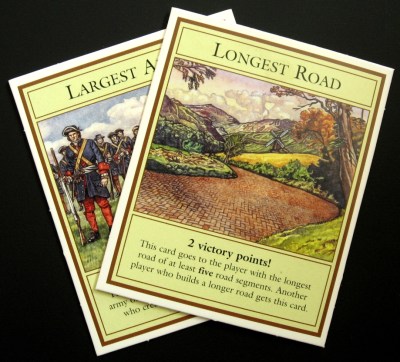
The Settlers of Catan
– Image by boardGOATS

Love Letter is a game we played a lot a year or so ago, but not so much recently.  The first of the so-called “micro games” it is played with just sixteen cards.  Each player starts with one card and on their turn, draws a second card and then plays one of them.  Each card has a value (one to eight) and an action (discard a card, swap cards with another player, compare cards, etc. etc.).  The object of the game is to have the highest card when the deck has been exhausted or, be the last person remaining, which ever is soonest.  The rules say the winner is the first player to take a set number of hands, however, we tend to play far a few rounds and then decide how far to take it.  In this case, Green, Blue and Pine had one point each, so we went for one final round, which Pine took with much aplomb.

Love Letter
– Image used with permission of BGG contributor thatmadgirl

Learning Outcome:  Sometimes it is the way that you play that makes a game enjoyable.

Boardgames in the News: Ten Great Games to Play with the Family at Christmas

With the nights drawing in and the weather becoming increasingly wet and wintery, what could be nicer than an afternoon playing board games in front of the fire?  If you are new to the hobby, here are ten great modern boardgames to play over the Christmas holidays.  These are all readily available online and/or in dedicated boardgame shops.

  1. PitchCar – This superb car racing game is guaranteed to get kids of all ages playing together; the winner is the person who manages to flick their car round the track first. The game plays six people, but you can get more cars from the Ferti website and play a pursuit type game which is also good fun.  You can also get expansion packs to make your track longer and more interesting if you really like it.
    Target Audience: Families & parties; ages 2 to 102…
    Game Time: From half an hour tailor-able to the group, plus time to build the track.
    Price:  Approximately £45 from amazon.co.uk for the base game (also available in a slightly cheaper mini-version for those without a large table).

    PitchCar
    – Image used with permission of BGG contributor garyjames
  2. Tsuro – Players take it in turns to build a path for their “dragon”, creating a maze for everyone else at the same time. The game lasts just fifteen to twenty minutes and plays up to eight people.  It combines just enough strategy and luck that if you get knocked out early, there is always time to try again.  Don’t be tempted to get Tsuro of the Seas though, it takes all the really good things about Tsuro and makes them slightly less good.
    Target Audience: Friends & Families with ages 8+
    Game Time: 15-20 mins with almost no set up time.
    Price:  £20-25 from amazon.co.uk.

    Tsuro
    – Image used with permission of BGG contributor aleacarv
  3. Bohnanza – This one sounds really uninspiring on reading the rules:  players have to trade beans to make the most money from the biggest and best bean fields.  Despite the unpromising sound, you only need to play it once with a couple of other people and before you’ve gone far you will agree it is one of the best games ever made – never has bean farming been so much fun!
    Target Audience: Older children and adults; ages 10+
    Game Time: 45-60 mins
    Price:  Readily available for around £15-20.

    Bohnanza
    – Image used with permission of BGG contributor spearjr
  4. Dobble – With five games in the tin, this Snap-inspired game is excellent value.  Since it relies on reactions, it is also one of those games where children are often genuinely better than adults.  And it is so quick to play that it is an ideal game to squeeze in while the kettle is boiling or tea is brewing.
    Target Audience: 3 and up
    Game Time: 2 mins per round
    Price:  Readily available for around £10 or less.

    Dobble
    – Image used with permission of BGG contributor msaari
  5. Escape:  The Curse of the Temple – While most Euro Games don’t use dice, in this game players have five each.  This is a team game that is played against the clock, so has the advantage that everyone wins or loses together.  The team of five players simultaneously roll dice to explore the temple and activate gemstones and then try to escape together before the temple collapses around their ears.  This is also ideal for children to play with adults as they can work in pairs or groups learning communication and team working skills.  If the game seems too difficult for the group, it can also be made a little easier by reducing the number of gems the group have to activate.
    Target Audience: age 5+ as long as there are understanding adults playing
    Game Time: 10 mins per game plus a few minutes setting up
    Price:  approximately £25-30 from amazon.co.uk.

    Escape: The Curse of the Temple
    – Image used with permission of BGG contributor mikehulsebus
  6. Survive: Escape from Atlantis! – This is good fun and really, really nasty.  Not quite so easy to learn, but really not that difficult either and great fun with four people who have a competitive streak.  Each player has a number of pieces that they are trying to get from the central island to the mainland.  Players take it in turns to move a person or boat, then they take a piece from the island, finally they roll a die to move a whale, shark or sea-monster, with potentially devastating consequences…
    Target Audience: Teenagers; not recommended for children under 12 or people who can’t take getting picked on
    Game Time: 40-60 mins
    Price:  Approximately £25-30 from amazon.co.uk; a 5-6 player expansion is also available which makes things even nastier…

    Survive: Escape from Atlantis!
    – Image used with permission of BGG contributor ckirkman
  7. Dixit – This is a great game to play with the mums and grannies in the family.  Players take it in turns to be the “story teller” who chooses a card from their hand and gives a clue that everyone else tries to match.  Everyone then has to guess which card belonged to the story teller, with points awarded for good guesses as well as cards that mislead other players.  The original base game plays six well, but Dixit: Odyssey plays up to twelve with a slight tweak to the rules.  Extra decks of cards are also available.
    Target Audience: Friendly groups and parties.
    Game Time: 30-45 mins
    Price:  Approximately £15-30 from amazon.co.uk, depending on the version.

    Dixit
    – Image used with permission of BGG contributor lacxox
  8. Colt Express – For older children and younger adults, this game is a glorious mixture of controlled chaos.  Players are bandits attacking and looting a fantastic 3D train.  Rounds are broken into two parts, first players take it in turns to choose the cards they will play placing them in a communal pile the centre of the table.  Then, once everyone has chosen, players carry out the action on each card in turn.  The problem is by the time they get to the end, the plans they had at the start have gone terribly awry…  A similar feel can be got from the pirate themed Walk the Plank! which is a cheaper, smaller, easier game that packs a lot of fun into a shorter playing time.
    Target Audience: Young, and not-so-young adults.
    Game Time: 30-60 mins
    Price:  Approximately £25 from amazon.co.uk; Walk the Plank! is available for £15-20.

    Colt Express
    – Image used with permission of BGG contributor henk.rolleman
  9. Ticket to Ride: Europe – Players are collecting coloured cards and spending them to place plastic trains on map/board with the aim of trying to build routes across Europe.  This game has been around a little while now and is available in several different flavours:  for the typical UK family, the Europe edition is probably best (plays up to five players), but for a couple, the Nordic edition with its gorgeous festive artwork might be more appropriate (only two to three players though).  If it is popular, there are also a number of expansion maps available.
    Target Audience: Age 10+.
    Game Time: 30-60 mins
    Price:  Readily available for available for £25-40 depending on the version and vendor.

    Ticket to Ride: Europe
    – Image used with permission of BGG contributor kilroy_locke
  10. No Thanks! – A quick and simple little betting game anyone can play.  The game consists of a deck of cards and some red plastic chips.  The first can take the top card, or pay a chip and pass the problem onto the next player.  The aim of the game is to finish with the lowest total face value of the cards, but if woe-betide anyone who runs out of chips as they will be left at the mercy of everyone else.
    Target Audience:  Friends and families; children aged 8+.
    Game Time: 10-15 mins
    Price:  Readily available for approximately £10.

    No Thanks!
    – Image used with permission of BGG contributor ckirkman

Boardgames in the News: Where to Buy Modern Boardgames

Occasionally, Euro-games can be found in the high street including charity shops or stores like Waterstones, WHSmiths or even Tesco.  However, for a good selection, it is best to go to a dedicated seller.  There are many online stores, but we also have a few “bricks and mortar” stores in the local area.  In general, shops without a physical shop-front to maintain are often able to maintain lower prices, but the staff at a “bricks and mortar” store can offer advice if you visit in person.  Here are a few suggestions of places to go to and websites to have a look at.

          1. Thirsty Meeples – If you are unfamiliar with modern boardgames and live in the Oxford area, Thirsty Meeples is an excellent place to start.  For a cover charge you can play anything you fancy from their extensive library of games.  Members of their troupe of dedicated “games sommeliers” are there to help you choose what to play and can teach you the rules too, as well as keep you supplied with refreshment during your visit.  They also sell games, so if you really enjoyed it, you can take a copy home afterwards.  Although the shop is small, they have more stock off-site and also take orders online for delivery or collection.  Since Thirsty Meeples has an alternative revenue stream, they are able to sell games at internet prices, though parking in Oxford will add to the cost considerably.
            Thirsty Meeples
            – Image by flickr.com contributor Mac Amazing
          2. The Gameskeeper – A little store on the Cowley Road, The Gameskeeper is Oxford’s oldest games shop.  John and Carol Benney who run it are extremely friendly and love to talk about games of all sorts with beginners and veterans alike.  Although their stock of Euro games is a little more limited, they are always happy to order anything in and specialise in beautiful editions of traditional games.
            The Gameskeeper
            – Image by flickr.com contributor Kake
          3. Eclectic Games – This Friendly Local Games Store won co-owners Darrell and Becky Ottery Reading “Retailer of the Year” in 2014.  Recently moved to larger premises on Union Street, Eclectic Games host gaming nights during the week and also have have plenty of playing space available for demonstrating games.
            Eclectic Games
            – Image from meetup.com
          4. GamesLore – This is another excellent online store, based in Telford and run by Paul Bryant.  Since there is no physical shop-front to maintain, the games are very well priced and the shop is also well stocked with a reliable online inventory.
            GamesLore
            – Image from gameslore.com
          5. BoardGameGuru – Formerly run by Paul Lister organiser of London On Board, this online games store is now run by Angus Abranson and is based in Southampton.
            BoardGameGuru
            – Image from boardgameguru.co.uk
          6. Amazon – Probably the largest online seller is Amazon, however, as well as the UK outlet, it is often worthwhile considering the US and German sites.  Since Amazon can ship items internationally using their own transport network, it is often considerably cheaper to import games, particularly from Germany.  Eurogames in particular are very popular in Germany and many games are a lot cheaper on amazon.de than on amazon.co.uk.  Shipping from Germany can be very reasonable, especially for multiple purchases.  With the new automatic translation, buying from Germany couldn’t be easier, however, care should be taken to ensure the game is genuinely a multi-lingual version, or at that the game parts are at least “language independent” as a lot of manufacturers won’t readily replace foreign pieces if it is your mistake.
            Amazon.de
            – Image from wikipedia.com

boardGOATS: Round & About in Oxfordshire (Again!)

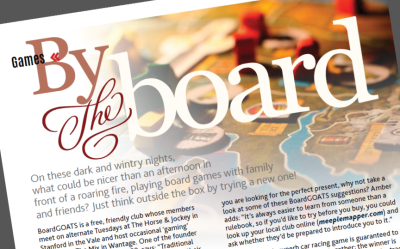
Once again, boardGOATS have featured in the magazine, Round & AboutIn January, the main feature article was a double page spread on hobbies and at the bottom of the second page of the Oxfordshire edition, our little game group got a mention.  Now, almost a year later, we have a whole page dedicated to modern boardgames and boardGOATS features strongly thanks to the involvement of one of our members.  The article covers the difference between traditional games and modern Euro-style games as well as some of the venues in the Oxfordshire area and some suggestions of games to play over the holidays.

RoundAndAbout002
– Image by boardGOATS

Next Meeting – 1st December 2015

Our next meeting will be on Tuesday 1st December, at the Horse and Jockey pub in Stanford-in-the-Vale.  As usual, we will be playing shorter games from 7.30pm as people arrive, until 8pm when we will start something a little longer.

This week the “Feature Game” will be Pandemic: ContagionPandemic is a very well known cooperative game where everyone plays together to defeat the tide of disease that is overcoming the world.  Pandemic: Contagion is a lighter game and almost the complete opposite:  players are the diseases and compete against each other to be the most effective and take over the world – there is no cure.

Pandemic: Contagion
– Image by boardGOATS

And speaking of diseases…

Jeff went to the doctor for the results of his blood test.  When he arrived, the doctor asked him to take a seat, before he took sat down himself and took a deep breath.

Jeff said, “Well, come on then Doc, give it to me straight.”

After a moment, the doctor replied, “OK Mr. Pie, but would do you want the good news or the bad news first?”

Jeff thought a moment before he responded, “Um, give me the bad news first please.”

The Doctor paused again, took another deep breath and said, “Okay well, I’m very sorry, it’s the worst possible news.  There’s nothing we can do for you.  There’s no easy way to say this, but you’ve only got days left to live.”

Jeff was obviously very shocked.  Lip trembling, after a bit he said, “Well, so, what’s the good news?”

The Doctor brightened up a little suddenly and replied, “Well, it’s actually very interesting and we’re naming the disease after you.”

21st Movember 2015 @ “The Mix”

Our second drop in gaming session at The Mix in Wantage was once again, a great success.   As last time, it started very quietly, this time with Green fighting to blow up balloons and Pink and Blue struggling to get the ends to meet when building a nice PitchCar track.  Before long, “Grandma” had arrived with her young grandson in tow and they began with a game of the very intimidating Boom Boom Balloon.  They then moved onto Toc Toc Woodman (aka Click Clack Lumberjack), while another couple began a rather intense game of Carcassone: Winter Edition.

Toc Toc Woodman
– Image used with permission of BGG contributor adamfeldner
and bgpov.com

Meanwhile, PitchCar was attracting the eye of visitors as usual, and other people got engaged in games of Dobble, Roar-a-Saurus, Billy Biber (aka Log Jam) and Maxi Bamboleo.  Before long, lunch beckoned and people began to drift off.  The couple playing Carcassonne asked about other, similar games and so out came Ticket to Ride: Europe and Nordic Countries which they liked the look of.  By this time, Grandma and Grandson had moved onto Escape: The Curse of the Temple, with Green (who had never played it before) and Pink making up the foursome.  After losing the first few games, Pink took a break and was replaced by Blue who had played it a lot and suggested they worked in two pairs.  Despite her experience, it was Blue who was last to the exit and seemed completely incapable of rolling the two keys necessary.  As the stress levels rose, she eventually succeeded with a few seconds to spare.

Escape: The Curse of the Temple
– Image used with permission of BGG contributor rassilonsghost

The session finished with Grandma and Grandson playing a final quick game of PitchCar before going swimming.  As it had quietened down, Blue, Green and Pink persuaded the last of the helpers to participate in a quick game of Splendor, which Green won, but with a very creditable second place for the shyly reluctant new player.  Then it was time to tidy up and go home.  As Green headed off in the car, he happened to catch JACKtivities on the radio, advertising a “Beyond Monopoly session at The Mix in Wantage, with boardGOATS“. “Sounds good,” he thought, “Maybe I should go along…”

Splendor
– Image used with permission of BGG contributor TrashcanCity