Category Archives: Games Night

19th September 2017

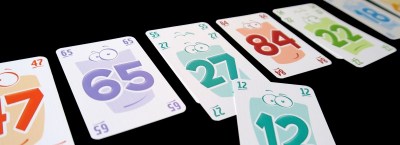
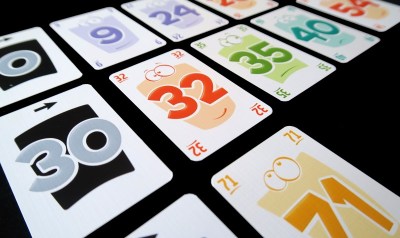
After more discussion that it really warranted, we started the evening with a quick game of Bokken Schieten (aka Ziegen Kriegen).  Given the choice of this, No Thanks! or 6 Nimmt!, Red chose “the Goat Game”, but was disappointed to find it wasn’t what she was expecting.  Bokken Schieten is a very simple trick-taking game based on Blackjack.  Players choose a card from their hand and play it face up in front of them – the person who plays the highest card takes the trick and with it all the cards played in the round.  The player who plays the lowest card draws a Goat Island card and places the goat-meeple on one end, choosing which end will start Goat Island and the value of the number to contribute to the limit.  The game continues with players playing cards and winning tricks, and the player who plays the lowest numbered card adding to Goat Island, choosing whether to add a large or small amount to the total.  At the end of the game players count the number of goat heads on their cards and the winner is the player with the highest total that does not exceed the limit given by the sum of the numbers on Goat Island.
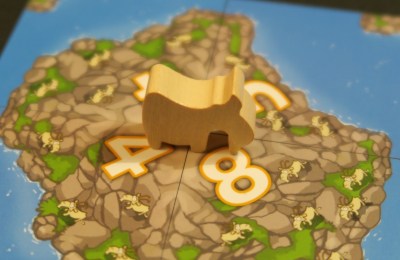
Bokken Schieten
– Image by boardGOATS

Pine was the player who had most recently seen a goat, so he went first.  It quickly became apparent that several players were struggling:  Burgundy had all the low cards, while Magenta had only one card below twenty-four and consequently went bust quite quickly.  Blue also had few low cards, but was so paranoid about going bust she ended up winning no tricks at all.  Goat Island finished with a value of fifteen which immediately put two players out of the running and with Blue taking no tricks it was between Burgundy and Pine.  It turned out that having so many low value cards gave Burgundy the edge as he finished with eleven goat heads, four more than Pine.  It was about this point that Red pointed out that Green, Black and Purple were pariahs because they were the only ones who weren’t wearing blue.  Everyone looked a bit mystified until Red explained that she was celebrating Dublin beating Mayo in the final of the All Ireland Gaelic Football Chamionship, and Dublin played in blue.  Green and Purple quickly demonstrated they did have something blue on (socks and scarf respectively), which just left Black.  He looked shifty and commented that he was also wearing blue, but didn’t think anyone really wanted him to prove it…
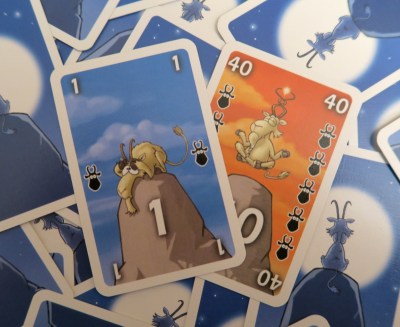
Bokken Schieten
– Image by boardGOATS

The silliness continued as Pine commented that he’d received an email with the subject line, “Show us your knickers”.  Apparently this was something to do with recycling and they wanted new undies or “slightly used bras”.  Pine’s well-endowed colleague had commented that none of her bras were “slightly used” and Pine looked to the girls round the gaming table for opinions precipitating a discussion as to what constituted a “slightly used bra”.  With the nonsense continuing into the discussion of games, there were only two games people were keen to play.  Some of the group had played Roll for the Galaxy a few weeks earlier and felt it needed to be played more so everyone could get to grips with it better.  Green was particularly keen to give it another go, and Black and Purple were happy to join him, leaving place for one more.  Burgundy actively rejected it and Red was keen to play the “Feature Game”, Battle Kittens which left three people to sort themselves out.  In the end, we went with seating positions and Pine, although he was a little skeptical and hadn’t played it before, joined the Roll for the Galaxy group leaving Blue and Magenta play Battle Kittens with Red and Burgundy.

Battle Kittens
– Image by boardGOATS

Battle Kittens is a quick-playing card drafting game with a ninja-cat theme.  The idea is that each player is one of the Cat King’s Royal Cat Herders, who starts with seven cat cards, taking one passing the rest on.  As each player receives a new hand, they take another card and keep passing the ever-diminishing hands on until there are no cards left to circulate.  Once this drafting phase has been completed, players divide up their packs of kittens into three groups which will contest the three different battle arenas.  Each arena will be contested on the basis of one of the four traits:  cuteness, strength, wisdom, and agility.  The squads with the three highest point totals in a battlefield are awarded a number of fish tokens in accordance with that particular battlefield’s allotment for first, second and third place.  The key thing is that some kittens have special powers allowing players to pick up “King” cards or add points to other cat cards.  King cards are mostly good, but the King can be fickle sometimes takes out his ill-temper on an unsuspecting squad of kittens.  The game is played over three rounds and the winner is the player with the most fish at the end of the game.
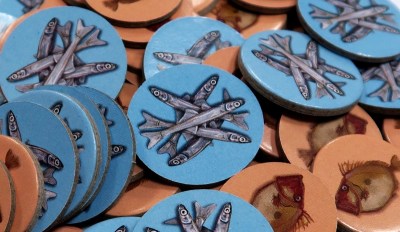
Battle Kittens
– Image by boardGOATS

It took everyone a round to really appreciate what they were trying to do, but by the second round, the gloves were off and the ninja kittens were attacking with everything they had.  It was a hard fought close series of battles as the piles of fish gradually grew and grew.  With the game quickly all done bar the counting, which was very close, but Blue’s Brave Moggies took first place, two fish ahead of Burgundy in second place.  The other table were still underway, so with time for something else, there was another decision to be made.  With time now a factor, there were fewer options and it wasn’t long before a decision was made and players were getting out Sheep & Thief.

Bokken Schieten
– Image by boardGOATS

Sheep & Thief is a strange little “point salad” of a game.  Each player has a board divided into a four by four grid, and starts with their home card and two sheep in the top left hand corner.  Each round is played in two halves: first players draft cards then they play them, taking it turns to place one card per turn.  There are lots of different elements to the game: players are trying to connect their home card to the other three corners while trying to keep their sheep safe and trying to catch other players sheep with their fox, meanwhile, they are also attempting to navigate their black sheep to the bottom right corner of their board.  With points for sheep captured, sheep retained, long rivers, connecting the home card to the other corners of the board as well as for moving their black sheep as far from home as possible, it is hard to see who has the most points and get an idea of who is in the lead.  Blue and Burgundy had both played the game before and both said it was very hard to do everything.

Sheep & Thief
– Image by boardGOATS

Blue didn’t have many sheep and most of them got stolen by Burgundy and particularly Red who really engaged with the thief aspect of the game.  Meanwhile, Magenta didn’t quite follow the rules surrounding the rivers so we had to re-write things a bit to work round it.  Although Blue had almost no sheep and her black sheep got itself sent back to the start right at the end so scored nothing, Blue did manage to pick up lots of points for a long river and and connecting her home to the other corners, giving her a quite respectable score of twenty-eight.  In contrast, Burgundy hadn’t managed to build a route to any of the corners and only had a short river.  With all the sheep he had stolen and his travelling black sheep (who nearly made it all the way to the far corner), he also scored twenty-eight.  It was quite a surprise when Magenta, who had lots of sheep, but was a little low in the other areas, also scored exactly twenty-eight points.  With a three-way tie, it was with bated breath that everyone waited while Blue added up the scores, but sadly, Red had only managed twenty-three.  This seemed a little low to Red, however, and on the recount, it turned out she had, not twenty-eight, but thirty-three, making her the winner and the best sheep thief!
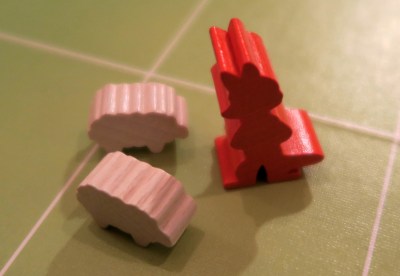
Sheep & Thief
– Image by boardGOATS

With Red and Magenta heading off and the other game still going on, there was just time for Blue and Burgundy to play something short.  It was hard to decide what, as Splendor was the obvious choice, but last time Blue and Burgundy had played, Blue had finally won after two years of trying and was reluctant to start another losing streak.  The game is a simple one of chip collecting and engine-building with a very loose gemstone theme. Basically, on their turn, players can take gemstone poker chips, or use chips to buy a card. Some cards have points on them and all can be used like the poker chips to buy cards (but without having to return them). The cards also give players access to “Noble tiles” which also give points. The winner is the player with the most points after someone reaches fifteen points.  This time, although Blue started well, Burgundy soon wore her down eventually finishing with seventeen points to Blue’s eleven by take two points and a Noble to end the game.

Splendor
– Image used with permission of boardgamephotos

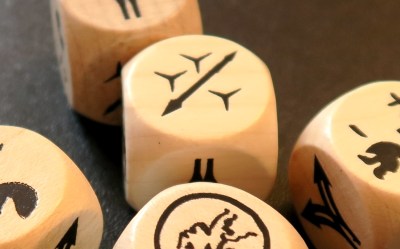
Meanwhile, on the next table a tight fought battle was underway in Roll for the Galaxy.  Black, Purple and Green had all played it before several times and relatively recently too, so it was only Pine who needed a detailed rules explanation.  In summary, players roll the dice in their cup in secret, behind their player screen. They then distribute the dice according to their symbols, matching them up to each of the five phases, Explore, Develop, Settle, Produce and Ship. Players then, still in secret, re-position one of their dice to use it to choose one action they would like to activate. Players can also put a die to one side for a turn to “Dictate” the symbol on another die, i.e. reassign it to a different phase. Once everyone has positioned all their dice, the player screens are removed and players simultaneously carry out the phases that have been chosen in order.  In general, if a phase is chosen by anyone, it will happen for everyone.  Thus, players can look at what others are doing and try to decide whether someone else will activate a particular phase and then they can activate another.

Roll for the Galaxy
– Image used with permission of BGG contributor punkin312

Each die is used to carry out an action once, so if a player has multiple dice assigned to the same phase, the action may be carried out several times. Any dice that were not used because the phase did not happen or because the player chose not to use them are returned to the players’ cups.  Dice that have been “spent” to carry out an action must be placed in the player’s “Citizenry” and must be transferred back into the player’s dice cup at a cost of $1, before they can be used again.  The aim of the game is to get points which come through Trading goods and Settling and Developing Worlds.  These actions have corresponding phases which players must choose during the game.  Worlds broadly come in two different types:  Production and Development.  Production Worlds come with extra dice in different colours and as the different colours have different distributions of symbols, they have different advantages and disadvantages.  The dice can be “spent” in exchange for victory points or money; all dice have the same value when used to get victory points, but different values when acquiring money.  Development Worlds do not provide dice, but instead give special powers and/or extra points at the end of the game.

Roll for the Galaxy
– Image used with permission of BGG contributor punkin312

Players draw World tiles from a bag during the Explore phase and one of the key parts of the game is controlling these piles and manipulating the worlds built in order to steer a particular strategy.  Another important part of the game is controlling which dice that go into the player’s cup.  In this sense, the game could be compared with deck building games like Dominion or bag-building games like Orléans, where players build the contents of their deck/bag in an effort to control luck.  Perhaps the most important part of the game is choosing which Worlds to build and trying to get a synergy between them.  This is quite hard to get to grips with on the first try as it’s not always easy to identify which Worlds are god ones to keep.  That said, players essentially draw one tile from the bag at a time, so the only decision to be made is which side to use.  On the other hand, one of the options is throwing tiles out, in which case, several tiles may be drawn from the bag simultaneously which is more powerful, but makes the decision much harder.  The game end is triggered when one player has built twelve worlds or the pile of victory point chips is consumed.  It is a game that takes a bit of getting used to and everyone usually struggles a bit at the start, which is what Black and Green were so keen to try it again quickly after they last played.  This time everyone seemed to build their strategies round slightly different approaches.

Roll for the Galaxy
– Image by BGG contributor haslo

Green started with a green “Genes” World which is valuable when Trading, however, he was able to he was able to pair it with a Development world that gave him a Production bonus making it very lucrative.  With this and a couple of other Production Worlds he was able to engage in a lot of Shipping.  Black began with a red, Military die which has a distribution that encourages Settling and Developing.  It wasn’t until right at the end of the game though that he was able to Develop some of his most valuable Worlds.  Pine began quite tentatively as it was his first time, but quickly got the hang of Producing and Settling and managed to Develop Worlds that gave him bonuses which eased things along.  Purple, on the other hand,  struggled to get to grips with the game, largely thanks to the worlds she picked up at the start.  In the end, she just built as much as she could and triggered the end of the game when she built her twelfth world.  The others weren’t far behind her though and their better combination of Worlds gave them more points.  It was the victory points from Shipping that really made the difference however, but it was very close at the top with just two points in it.  Had Green ended the game a round earlier (as he’d had the chance to do) he might just have kept his nose in front.  As it was, allowing Black to Develop in the final round was a crucial error and gave him the victory by just two points.

Roll for the Galaxy
– Image used with permission of BGG contributor punkin312

The evening was nearly over, but after a quick update on Richard Branson and Hurricane Irma, there was just time for a little bit more “Trash Talk” – quite literally as it happens, as the conversation moved onto the subject of “drive-through litter-bins” on motorways.  This is now apparently a thing, which led to a discussion with everyone expressing their disgust at the laziness of people who seem incapable of taking their littler home with them and recycling it.  It was in response to one such comment on this subject from Blue that Pine, much to everyone’s astonishment pronounced, “That is because you’re intelligent…”  And on that note, it was definitely time for home!

Roll for the Galaxy
– Image used with permission of BGG contributor punkin312

Learning Outcome:  Black wears blue underwear and Pine thinks Blue is “intelligent” (well, sometimes).
5th September 2017

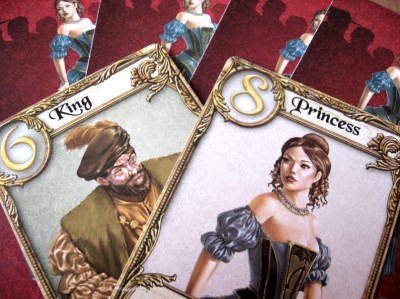
As people arrived slowly, the evening started out with a few rounds of Love Letter.  The archetypal “micro game”, Love Letter is a simple filler game that we’ve played a lot in the past, but less so recently.  The idea is that players have a single card in hand and, on their turn, draw a second and choose which one to play.  There are only sixteen cards in the deck and each has a value and an action.  The action is carried out when the card is played and the player with the highest value card at the end of the game is the winner.  The game is not high on strategy, but is ideally suited to playing while doing other things (like eating pizza), so it is very light hearted and can often generate lots of silly moments with this time being no exception.  When Blue drew the second highest card, the Countess, she got carried away and chose to play the Prince she already held.

Love Letter
– Image by boardGOATS

Unfortunately, the special action for the Countess is that if a player has a Prince or the King as well as the Countess she must discard the Countess (thus revealing information).  Without thinking properly, she played used Prince’s action on Green who was forced to discard the Princess, putting him out of the game.  Too late Blue realised her error and she apologised profusely as Green grabbed his card back and she played her Countess instead.  When the next player, Burgundy, then draw a Guard card giving him the chance to assassinate any card he could name, everyone knew that Green’s days were numbered, though they were reckoning without Burgundy’s bad memory!  Completely unable unable to recall the card Green had been forced in error to reveal, he incorrectly named the King and Green lived on.  In the long run, nobody really benefited from the confusion though, with almost everyone taking one round, we played sudden death and it was Pine who ultimately emerged victorious.

Love Letter
– Image used with permission of BGG contributor thatmadgirl

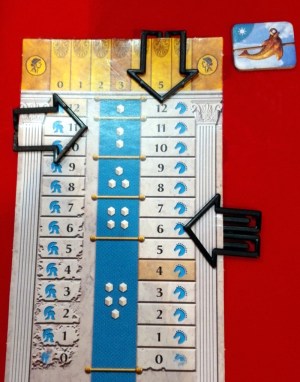
With everyone present it was time for the “Feature Game”, Chariot Race, which is a fairly quick-playing Yahtzee style dice game with a horse racing theme, but actually has more of a feel of King of Tokyo (that we played last time) than anything else.  Players take on the role of charioteers participating in a great race in ancient Rome with the aim being to use dice to complete two laps of the dusty arena and be the first to steer their chariot over the finish line.  On their turn, the active player rolls a number of dice dependent on their speed on the previous turn, with faster chariots rolling fewer dice.  Each face of the six-sided dice allows a different action: Gain new Favors; increase or decrease speed; change lanes, or attack opponents (either directly by hurling javelins or indirectly by dropping caltrops in their path).  If the first roll is not satisfactory, the player can re-roll any or all of the dice.  They can re-roll a second time or turn one die to their chosen face, but to do that they must cash in some of the favour of the goddess Fortuna.  Favours of Fortuna are useful for repairing chariots too, and as there is a large kamikaze element to the game, Favours prove very useful indeed.  Once the dice roll is set, the active player moves their chariot forward according to the final speed they achieved, swerving to avoid rivals, caltrops and potentially devastating piles of rocks and the first player to drag their wreck of a chariot across the line for the second time is the winner.

Chariot Race
– Image modified from original by BGG contributor JackyTheRipper

The game is supposed to be a quick little fun racing game, but it turned out to be everything but quick. This was probably the fault of the players as much as anything else as everyone seemed to get bogged down in analysing all the options.  With seven people present and Chariot Race, playing a maximum of six, Ivory kindly offered to team up with Green who was feeling a little out of sorts, but they were in complete agreement that they should start at the front of the grid.  In contrast, Black decided to start at the back, hoping that others would see him as less of a threat and maybe take each other out leaving him an easy run in.  In practice, it turned out that the back was a particularly bad place to be as Black struggled to avoid everyone in front of him and consequently picked up a lot of damage, soon wrecking his chariot and joining the rows of spectators cheering on their heroes.  Burgundy was quick to follow when the wonky donkey pulling his chariot sped up suddenly and accidentally invented a new Roman form of skittles when he crashed into everyone else in turn.  The problem with that was that although everyone took damage, each collision caused damage to Burgundy’s chariot eventually turning it in to match-wood.

Chariot Race
– Image modified from original by BGG
contributor JackyTheRipper

Starting at the front, the Green/Ivory chariot made a very quick start and took an early lead.  Blue gave chase starting with a recklessly high speed and a “go down in a blaze of glory” attitude.  Pine was a little more circumspect, but made good ground early on.  Purple on the other hand, started towards the back of the grid, made a slow start and was obstructed by the wreckage of Black’s and Burgundy’s chariots at the start of her second lap.  Blue and Green/Ivory tried to impede each other with Blue chucking spears and Green/Ivory dropping caltrops.  As Green/Ivory approached the end of their second lap, Blue was just behind.  So as Green/Ivory crossed the line running on empty they were speared by Blue on the next turn and their wheels fell off their chariot.  Blue crossed the line with a bit to spare and was quickly followed by Pine who couldn’t quite pass Blue so chucked a spear at her to make up for it.

Chariot Race
– Image by boardGOATS

That just left Purple.  With a lot of ground to make up, the odds were always against her and everyone joined helping her to try to cross the line or take out Pine or Blue.  Sadly it was not to be and she decided that if she couldn’t influence the race, she would go out with a bang and smashed her chariot to smithereens on a rock.  So, a game that was listed as taking less than an hour had taken over two and only a third of the chariots playing had made it to the finish line.  It didn’t matter who won though, it had been a lot of fun.

Chariot Race
– Image modified from original by BGG contributor JackyTheRipper

With Chariot Race taking so much time though, we were limited by what else we could play.  Before long there was a debate about the options, including all out old favourites like Saboteur and 6 Nimmt!.  In the end Bohnanza won as a game we could all play without thinking, and Burgundy was reaching for the familiar yellow box from his bag.  The game is one of our old staples, is quick to learn and keeps everyone involved throughout.  Often the simplest of mechanisms are the most effective an that is the case of Bohnanza:  players cannot rearrange the cards in their hand and must play them in the order they arrive.  Thus, on their turn, the active player first plays the first card in their hand with the option of playing the second if they desire.  Once they’ve been planted, two cards are drawn which can be traded, but must be planted by someone.  This can lead to free gifts, but also players being nasty and refusing to take even the apparently most lucrative trades

Bohnanza
– Image used with permission of BGG contributor spearjr

This time, Burgundy started strongly, as did Pine and Ivory.  Black struggled consistently to get the cards he wanted, and with so many people playing, everyone had to be quick or they would miss out.  It was a very tight game with players mostly being nice to each other though everyone was typically reluctant to give Burgundy any easy trades, he got plenty anyhow.  As everyone totaled up the scores, it was clear there wasn’t much in it.  Five of the seven players ended the game with either nine or ten coins, but it was Purple who just sneaked in front finishing with eleven to win by a nose.  And with that, it was time to go home.

– Image by boardGOATS

Learning Outcome: Games sometimes take a lot longer than it says on the box.

22nd August 2017

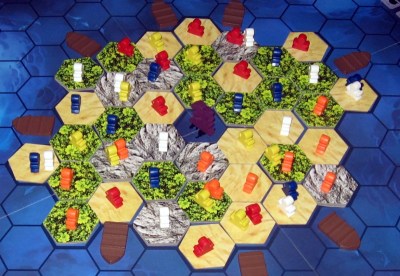
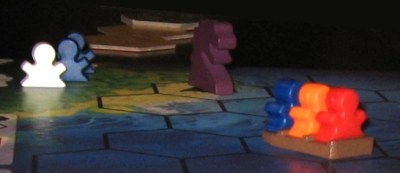
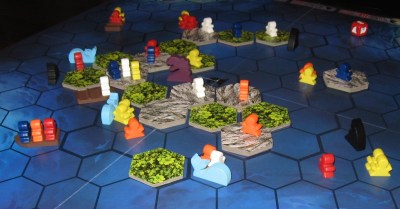
It was a quiet night thanks to work and holidays, and for a long time looked like it might just be a clash of colours between just Magenta and Pink, but gradually others rolled in, just in time for the “Feature Game”, Survive: Escape from Atlantis!.  This is a fairly light game, with a vicious edge that only really works if players engage fully in the “take that” elements.  Basically, each player has set of meeples, each with a number on the base which equates to their value.  With Blue away for work, everyone was keen to take the opportunity to play blue for a change, but Burgundy got in first.  The aim of the game is for players to get their meeples safely to the mainland on the four corners of the board before the volcano erupts and kills them.  To this end, the game begins with players taking it in turns to place their meeples on the hexagonal tiles that make up the central island.   There are actually quite a few things to consider here.  Firstly, the tiles flood in order with the coastal low-lying beach tiles sinking beneath the waves first, then the forest tiles, and finally the grey mountainous tiles.  So, starting on a mountain means there is more time to make arrangements before a vindictive player can sink that hex dumping the unfortunate meeple into the drink.  However, the meeple in question may have to travel some distance across the island to get to the coast, which will take time and actions, both of which are limited.

Survive: Escape from Atlantis!
– Image by boardGOATS

The other major consideration when placing meeples are their value – each player has ten meeples and their values range from one to six.  The winner is the player who gets the highest total value home, so getting a six home is far more important than getting a one to safety.  For this reason, positioning the high value meeples well is critical, on the other hand, placing them first might telegraph that they are the most important meeples, putting them at risk later.  Critically, once they have been placed nobody, not even their owner, can look at the number on the bottom.  So remembering where the high value meeples are also vital to success, as is deciding whether to put the high value meeples together and potentially in the same boat, risking other players attacking it, but ensuring that all efforts can be focussed in one direction.  In general, each hexagon can only hold one meeple, so the available choice steadily decreases during set up.  The base game only plays four, but more can be accommodated with a mini expansion that adds extra pieces in two new colours.  The rules state that everyone should place only eight meeples (returning a one and a three to the box), but we didn’t realise this until people had begun placing so we used the “overpopulated” variant where players place their extra pieces on hexes that are already occupied once the island is at capacity.

Survive: Escape from Atlantis!
– Image by boardGOATS

Once all the meeples had been placed and were jostling for position, the game began in earnest.  On their turn, each player does four things:  play a tile from their hand; move their meeples; remove a tile (carrying out the action if appropriate or adding it face down to their hand), and finally roll the red Creature Die.  Players have three movement points and can use them to move any combination of their meeples and/or boats up to a total of three land or sea spaces.  There are a few rules associated with these, for example,”swimmers” can only move one space per turn because they tire easily, and once they have left the island, they cannot return.  Similarly, it only costs one point to move a “dry meeple” from land to a boat in a neighbouring space, whereas a swimmer must be in the same space as the boat and then it takes a movement point for them to climb over the side.  While anyone can move empty boats, only the player with the largest number of meeples can move an occupied boat.

Survive: Escape from Atlantis!
– Image by boardGOATS

Once the active player has moved his meeples, he then removes one tile from the island, tipping any residents into the sea and then secretly looks at the underside of the tile.  Each tile has different effect with some spontaneously creating whales, sharks or boats out of thin air, while others allow players to hitch a ride on a passing dolphin or cause sharks to magically vanish into the ether.  There are three different types of tile, green bordered to be played immediately; red bordered to be kept for later and played at the start of a later turn; and tiles with a red cross which are also kept but are played on another player’s turn (typically in response to them moving a shark into an attacking position or similar).  Finally, after the tiles have been dealt with, the active player rolls the Creature Die, and then move the creature of that type of their choice.  There are three types of creature.  Whales move fast (up to three spaces) and attack occupied boats, turning them into matchwood, but they leave swimmers alone.  Sharks, on the other hand, move a maximum of two spaces and will happily scoff any swimmers they come across, but can only circle boats looking longingly at their occupants.  Sea monsters are the slowest movers travelling only one hex at a time, but are also the most hazardous, smashing boats and then eating the contents.

Survive: Escape from Atlantis!
– Image used with permission of BGG contributor jsper

For the most part, everyone had distributed their meeples evenly over the island, but Green went for the mountain spaces first so his were a little land-locked in the early part of the game.  Perhaps it was just as well for him though, as everyone started out aggressively and got more so.  There were a lot of whale tiles early on, so boats didn’t last long and no mercy was shown to swimmers at all. Even being nice and trying to make allies didn’t work, so when Pink tried to be nice by moving his boat towards one of Magenta’s swimmers she didn’t repay him in kind.  It’s true that Pink might have had an ulterior motive thinking it was less likely she would attack his boat it if it had one of her own meeples in it, but setting a shark on two of his swimmers was arguably uncalled for.  He got his revenge though when he used a whale to sink one of her boats and parked a shark in the neighbouring hex.  Meanwhile, there was a brief uneasy truce between Green, Burgundy and Ivory as they shared a boat and, with so many people with a vested interest and Pink and Magenta still at war, all three made a rapid crossing.

Survive: Escape from Atlantis!
– Image by boardGOATS

It wasn’t long before all the beach tiles had gone and then all the forest tiles too.  Then everyone was on tenter-hooks waiting for someone to turn over the volcano tile triggering the immediate end of the game.  There are eight mountain hexes, so the probability started out as one in eight, then one in seven, then one in six…  And then Green turned over the fourth mountain tile signalling the end for Pink’s swimmer who had nearly made it to land and Ivory’s boat which disappeared beneath the waves as it filled up with lava.  That just left the scoring.  Burgundy had got three of his meeples home closely followed by Ivory and Magenta who had saved two each.  The number of meeples is largely irrelevant however, as it is the sum of the value of the meeples that is key, and although it looked like a close game, in the end it was much less close than everyone thought.  Almost all of the high value meeples had been eaten or drowned and only Ivory had managed to save any, rescuing both his five and his six point meeples.  That left him with eleven, a clear margin of victory over Burgundy who finished with a creditable seven, taking second place.  It had been fun though, and Pink, who had played it most recently concluded that it was very different with lots of players as it’s a lot easier to end up getting eaten or sunk since it’s a long time between turns delaying the chance to deal with “the impending sea serpent of doom…”.

Survive: Escape from Atlantis!
– Image by boardGOATS

Everyone hadn’t got the aggression out of their systems, so it was out with King of Tokyo for a bit more “take that” style gaming.  This is another “light, but vicious” game where players are mutant monsters, gigantic robots, and strange aliens—all of whom are destroying Tokyo and whacking each other in order to become the one and only, undisputed master of the city.  At the start their turn, the active player rolls six dice, each of which show six symbols each of which has a different effect.  The active player gets three successive throws over which they can choose whether to keep or discard each die.  The dice are used to get points, restore lives, acquire energy and attack other monsters.  Lives and points are tracked using a dial and the aim of the game is to be the first to reach twenty points.

King of Tokyo
– Image used with permission of BGG contributor mikehulsebus

At its core the game uses a three roll, keep or re-roll system similar to that used in Yahtzee, but there is a little more going than that.  In addition to cute standee-monsters and the scoring dials, there is also a small board representing Tokyo.  At the start of the game, Tokyo is empty, but the first player to roll at least one paw (attack) on the dice and choose to use it can move into Tokyo.  Once Tokyo is occupied, it will not be empty again during the game.  Monsters in Tokyo can only damage monsters outside the city and monsters outside Tokyo can only attach monsters inside the city.  This means that a player in Tokyo is a target for all the other monsters.  On the other hand, rolling an attack die while in Tokyo deals damage to everyone else increasing its value.

King of Tokyo
– Image used with permission of BGG contributor msaari

Tokyo is also important because when a Monster enters Tokyo the player earns a point for doing so, furthermore, if a Monster is still in Tokyo at the start of their next turn then the player earns another two points, and will continue to earn points for every round they stay there.  This is perilous, however, as they will be the subject of every attack someone makes from outside Tokyo and monsters in the city are not able to heal themselves.  With five players, there is room for two monsters in Tokyo, which means there is one less outside, but that is only the case until a monster inevitably succumbs to their injuries.  Once a player is in Tokyo, the only way to get them out again is to keep attacking them, until their nerve fails and they decide to leave making way for the attacking monster.  By this time, of course, it may be too late and too much damage has been done for them to be able to heal sufficiently.

King of Tokyo
– Image used with permission of BGG contributor Toynan

In addition to attacking and healing, the dice can also yield energy.  For each lightening bolt rolled and kept, the active player gets a green energy cube, which can be used to buy power cards.  These come in two main types,  “Keepers”, that can be used repeatedly, or “one off” cards that are discarded when used for their benefit.  They are potentially very valuable, especially if bought early in the game and can be used repeatedly.  Finally, it is also possible to score points from the dice by rolling three of the same numbers.  For example, rolling three “twos” will give two points, however, rolling two will score nothing which makes going for these quite a gamble.  The game ends when either one player gets two twenty points or there is only one monster left standing.

King of Tokyo
– Image used with permission of BGG contributor msaari

The game continued the aggressive theme of the evening.  Magenta and Burgundy were first in Tokyo and survived the whole round picking up the bonus points.  Pink then attacked and both Magenta and Burgundy fled with their tails firmly between their monstrous legs.  On his next turn, Burgundy was able to hide and heal, but Magenta was not so lucky being forced to attack and go back into Tokyo.  Sadly, this proved fatal and she was quickly out after accruing just seven points.  At this point Green was looking very strong with a powerful hand, in particular the “Evacuation Orders” which caused everyone else to lose five points.  This meant that when Pink quickly followed Magenta out of the game (finished off by Ivory) he went with no points at all.  Meanwhile, Burgundy was slowly rebuilding his health and was able to keep the other remaining players at a minimum.  Ivory was next, making it a battle to the death between Burgundy and Green, a battle that Burgundy eventually won after much blood was spilt.  Although it was still early, all the savagery had been tiring and everyone opted for an early night.

King of Tokyo
– Image by BGG contributor Schaulustiger

Learning outcome:  Being nasty can be very hard work.

8th August 2017

With Burgundy and Blue still finishing their supper, Black, Red Purple and Pine decided to play a quick game of Coloretto.  Pine and Red needed reminding of the rules, and by the time that was done Blue was ready to join them, but Burgundy was still wading through his pizza.  When he commented that he was struggling because it was “really very cheesy”, Pine responded that, “You can’t order a four cheese pizza and then complain that its too cheesy!”  Most people agreed it was a fair point, but it didn’t speed him up.  In the end Blue and Burgundy joined forces and played together, not because it is a complicated game, quite the opposite – the game is very simple.  On their turn the active player either draws a chameleon card and places it on a “truck” or takes a truck (which means they’re out for the rest of the round). The idea is that players are collecting sets of cards, but only three will yield positive points, with the rest scoring negatively. The really clever part of the game is the scoring which uses the triangular number sequence (one point for the first card, three points for two cards, six points for three cards etc.), which rewards one large set more than two or even three small ones.

Coloretto
– Image by BGG contributor SergioMR

Blue & Burgundy started out collecting blue, and Black orange.  Purple on the other hand ended up with nearly every possible colour, which really isn’t the point!  In contrast, Red managed to restrict herself to just three colours, but didn’t really manage to get enough cards in each to compete with the big hitters, Black and Pine.  Black collected a full set of orange cards, but Pine had four purple cards and a joker to score highly.  In the end, Black took the game, just three points ahead of Pine.  With the first game over and Burgundy finally having finished his very cheesy pizza, it was time for the “Feature Game”.  This necessitated splitting into two groups, and that couldn’t be done until a second game had been chosen.  There was much debate, but Pine and Burgundy were keen to play Kerala.  Purple was reluctant, she said because everyone had been nasty to her last time.  Eventually, she was persuaded to play when Pine promised to be nice, and for the most part, everyone was very nice.

Kerala
– Image by boardGOATS

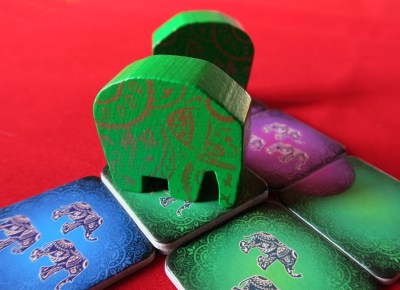
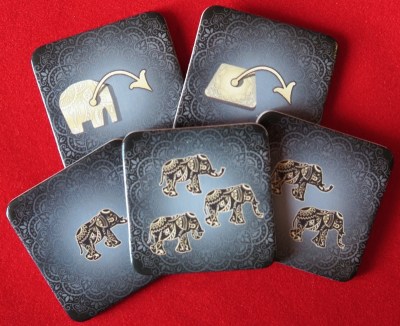
Kerala is one of the games Blue and Pink picked up at Essen last year. It is a fairly simple tile-laying game where each player starts with a single tile in their own colour with two wooden elephants perched precariously on it.  On their turn, the active player draws the same number of tiles from the bag as there are players and then chooses one before everyone else takes it in turns pick one.  Players then simultaneously place their tiles next to a tile with an elephant on it and move the elephant onto the new tile.  The tile can be placed in an empty space, or on top of a tile previously laid.  Thus, over the course of the game the elephants ponderously move over their play-area while players messing with the opponent to their left by leaving them with tiles they don’t want.  There are three types of tiles, Elephant tiles, Edge tiles and Action tiles.  Elephant tiles score points at the end of the game with players receiving one point for each elephant visible.”Edge” tiles have one side with a different colour; if these are adjacent to the correct colour the player scores an additional five points otherwise they can be ignored.  There are also two sorts of action tiles, which score no points but allows the player to move either a tile or an Elephant.

Kerala
– Image by boardGOATS

Everyone was very nice and offered everyone else advice on where to place tiles.  It wasn’t always helpful advice, but no-one was obviously hostile.  It was only as the game came to a close that everyone realised that they had forgotten some of the most important aspects of the scoring.  At the end of the game players require precisely one contiguous region of each colour (with two allowed for their own colour).  Somehow in the rules recap the bit about losing five points for each missing a colour had been missed.  It didn’t matter though, because everyone had all the colours so nobody was in danger of losing points even though some players picked up their last colour in the final round.  In the end it was a close game, but it was burgundy’s very stripey layout that had the edge and he finished four points ahead of Purple who took second.

Kerala
– Image by boardGOATS

Meanwhile, Black, Purple and Blue played the “Feature Game”, Honshū.  This is a light trick-taking, map-building card game loosely set in feudal Japan – almost like an oriental mixture of Pi mal Pflaumen and something like Carcassonne or Kingdomino.  The idea is very simple:  from a hand of six numbered map cards, players take it in turns to choose one and play it.  The player who plays the highest numbered card then chooses one, then the next player and so on until every card has been taken.  The players then add the cards to their city.  Each card is divided into six districts, each of which scores in a different way at the end of the game.  For example, the for every district in their largest city, players score a point.  Similarly, any forest districts also score one point.  More interestingly, the water district is worth nothing, but water district connected to it after that is worth three points.  Perhaps the most interesting are the factories which only score if they are supplied with the appropriate resources, wooden cubes that are placed on resource producing districts.

Honshū
– Image used with permission of BGG contributor msaari

Resources can also be used increase the value of cards when they are played allowing players to manipulate their position in the turn order.  Like Pi mal Pflaumen, this is a key part of the game as it enables players to ensure they get the card they want.  One of the biggest challenges is choosing the cards though.  When the cards are placed, players must take care to make sure that they either partially cover (or are covered by) at least one other card.  This, together with the fact that players are trying to expand their largest city and any lakes makes choosing and placing a card really difficult as there are many options to explore.  Nobody really had much of a clue as to what strategy they were trying to employ, and for the first three rounds, everyone ended up picking up the cards they’d played as these were the ones they’d thought about.  After the first three rounds, players pass their remaining three cards left and add another three; his is repeated after nine rounds when the cards are passed right.  So when at the start, when Black commented that he had lots of good cards and Red and Blue answered that they had lots of poor ones, in actual fact nobody really had much idea what good and bad cards were.  That quickly changed when Blue passed her left over cards on and Black discovered what a bad hand really looked like.

Honshū
– Image used with permission of BGG contributor William Hunt

Everyone found the game very strange, and a real brain-burner, dressed up in such an innocent sounding game.  There were more spells of players choosing the cards they had just played, so Red was really mifffed when Blue broke the tradition and took the one she had played and wanted for herself.  Towards the end, Black pointed out that while he had built a very compact island Red and Blue both had long thin islands.  This was the first time either of them had looked at anyone else’s island – a demonstration of how absorbed they had been in choosing cards.  After lots of turning cards round trying to decide where best to place them, it was time to add up the scores.  It didn’t really matter who won as everyone felt they were fighting to get to grips with the game, though it was Blue who’s island scored the most points, and Black and Red tied for second place.  Both games finished simultaneously and the Honshū crowd were in need of some light relief so we resorted to 6 Nimmt!.  This is a game that we have played a lot on Tuesday evenings, but seems to have been neglected of late.

Honshū
– Image used with permission of BGG contributor msaari

We reminded ourselves of the rules:  players simultaneously choose a card, then simultaneously reveal them before playing them in ascending order placing each on on the highest card that is lower than the card being played.  When the sixth card is added to a row, the first five are taken and the number of heads contributes to the player’s score, lowest score wins.  We tend to play a variant over two rounds with half the deck in each round and not resetting the table in between which tends to result in a cascade of points in the second round, and this time was no exception.  Purple and Blue started out well, but quickly made up for that in the second round.  Red and Mike started badly in the first half and Mike got worse in the second – they tied for highest scorers. Black started out low and although Pine did better than him in the second round, Black’s aggregate score of nine was seven points lower.  Black was the only one to stay in single figures and was therefore a worthy winner.  6 Nimmt! finished quite quickly and we were all feeling quite sociable, so despite having played it last time, we gave in to Red, the “Bean Queen”, who fluttered her eye-lashes and we agreed to play Bohnanza.  While people sorted out refreshments, we compared Bean rhymes, Pine came out with the best, borrowed from Bart Simpson,  “Beans, beans, the unusual fruit, the more you eat, the more you toot!”

Bohnanza
– Image used with permission of BGG contributor spearjr

Bohnanza is a card game where the key element is the fact that players have a hand of cards that they must play in strict order.  On their turn, the active player must play (plant) the first bean card in their hand (the one that has been there the longest) and may plant the second if they wish.  Then they draw two cards and place them face up in the middle of the table so everyone can see, at which point the bidding starts with players offering trades for cards they like.  Once both cards have been planted (either in the active player’s fields or somewhere else), then the active player can trade cards from their hand too.  All traded cards must be planted before the active player finished their turn by drawing three cards and putting them into their hand in strict order.  And it is the strict order that is the key to the game, however difficult it is for players to refrain from rearranging their cards.

Bohnanza
– Image used with permission of BGG contributor spearjr

This time, the game proceeded with lots of trading and everyone warning everyone else who dangerous it was give Red any favourable trades.  Nevertheless, everyone seemed to be forced to give her free-bees as she was the only person who could take them. In the dying stages of the game Pine was desperate to get his paws on some of Blue’s Wax Beans and was offering all sorts of lucrative trades, but they all evolved round Blue’s now complete field of Green Beans.  When she pointed this out he grumped that it was her own fault for building up the field to capacity, ” adding “That’s hardly sustainable farming now, is it?!?!”  With the last trade done, everyone began counting their takings. During the game everyone had given Red loads and loads of cards, mostly because they were forced to.  When the Bean Queen was inevitably victorious, Black commented that it was fine as we had all contributed so much that everyone could rejoice and share in the joy of her win.

Bohnanza
– Image by boardGOATS

Learning Outcome:  Beanz meanz fun.

25th July 2017

The evening began with Burgundy and Blue playing a non-Extreme version of The Game: ExtremeThe Game was one of our more popular games, but seems to have been somewhat neglected of late.  It is one of those simple games that we really enjoy as a group, and is unusual because it is a cooperative game, which we generally avoid.  The game consists of a deck of cards numbered two to ninety-nine, which are shuffled and everyone is dealt a hand (seven in the two player game).  On their turn, the active player must play at least two cards onto the four piles following a handful of simple rules.  Two of the piles start at one and every card there after have a higher number than the card on top; the other two start at 100 and the cards that follow must have a lower number.  The aim of the game is for all the cards to end up on the four piles, so timing is everything – play a card that is too low and someone could get shut out and be unable to play one of their cards.  This makes communication important: players can say anything they like, but must not give specific number information about the cards they hold.  There is one “get out of gaol” rule, sometimes known as “The Backwards Rule”, where players can play a card on the wrong deck, but only if the card is exactly ten different to the top card.

The Game: Extreme
– Image by boardGOATS

The Game: Extreme is just like the The Game, except that some of the cards have extra icons on them which limit the number of options available and consequently make being successful even more difficult.  Although we have played the full version, we have found that the basic game is usually quite challenging enough for us, so we chose to stick to the original game this time and ignored the extra symbols. Blue and Burgundy had just started when Pine turned up so he grabbed six cards (the number of cards in hand for three players) and joined in.  It was just as well that it was only the base game, because after Blue had an excellent start, everyone else thereafter had very middling cards, that is to say, they were all in the thirty to seventy region.  Then things got worse, because having been forced to move to the middle, everyone drew single digit cards and cards numbered in the nineties.  Everyone blamed Burgundy because he shuffled, but he had some of the worst timed cards of all.  Remarkably, the draw deck was eventually exhausted and there was a moment’s respite as layers only had to play the one card.  It wasn’t long before it was all over though, with Blue stuck with a large number of unplayable cards.  In the end there were eleven cards left unplayed – a lot worse than our best (we have beaten it in the past), but not so bad considering our truly dismal start.

The Game: Extreme
– Image by boardGOATS

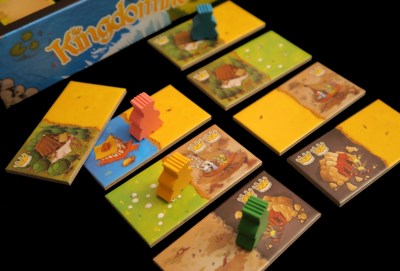
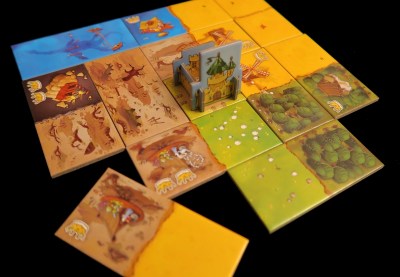
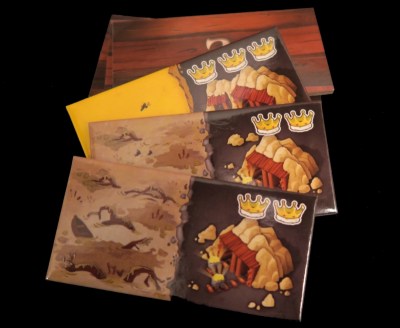
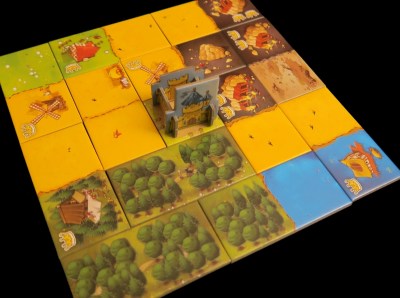
With everyone who had been expected arrived, we moved on to the “Feature Game”, which, following it’s entirely predictable Spiel des Jahres win last week, was Kingdomino.  The game consists of dominoes featuring two terrain “tiles” with some tiles also depicting one or more crowns.  When the dominoes are placed, one end must either connect to another domino matching at least one of its terrain types or connect to their starting tile (which can be considered to be “wild”).  All dominoes must fit in a five-by-five space and if one or more dominoes cannot be placed according to these rules, then they are discarded. At the end of the game, each player multiplies the number of tiles in each contiguous region of terrain with the number of crowns on the tiles in that region and adds them up together with any bonuses to give their score.  We’ve played this a lot since Expo, and found it very enjoyable, so everyone was happy to give it another go.  With a total of seven people we split into two groups, the first was a group of three consisting of Black, Purple and Green.

Kingdomino
– Image by boardGOATS

With only three playing a dozen dominoes were removed and it was not until the end of the game that it became apparent that over half were pasture tiles.  As a result, it was unsurprising that Green managed to corner the market in pastures with four squares and two crowns leaving Black and Purple with only one tile and no crowns. In contrast, Purple ended up with all the swampland (with two squares and three crowns), while Black and Green only managed only a couple of tiles and no crowns.   Black’s wheat, woodland and water provided good solid scoring, while Green added two woodland areas and a small strip of water to his.  In a very close game with just four points between first and third, it was Purple’s extensive wheat field that made up the bulk of her winning score of forty-nine.  On the next table, with four players, none of the dominoes were removed, but that didn’t stop fate getting involved.  In this game, all the high numbered (and therefore valuable) dominoes came out at the start, making it very obvious who wanted what later in the game.  In the first game everyone had managed a perfect five-by-five grid with the castle in the middle so they all picked up the bonus points.  In the second game, Burgundy failed on both counts so started fifteen points adrift.  Despite this, he still finished with a very creditable fifty points and was only beaten by two points by Blue in what was also a very close game.

Kingdomino
– Image by boardGOATS

Both games finished more or less together and there was just time for a little chit-chat before we moved onto the next game.  Inevitably, people were interested in how Keyper had gone, when the group had been fortunate enough to participate in a play-testing session with the designer.  As a group, we love Keyflower and were keen to see how this one plays out.  Although the game is quite deep, it isn’t actually as complex as it seemed at first and the novel game boards that change throughout the seasons were described as “Genius” by Black while they simply fascinated Blue, reminding her of a Moomin toy she had picked up in Helsinki airport ten years before.  Pink on the other hand was captivated by the individual art on the MeepleSource Character Meeples in the deluxe edition.  The general consensus seemed to be that everyone was looking forward to playing it again on its release, which will probably be in a couple of months time.

Keyper
– Image from kickstarter.com

With drinks refilled there was the inevitable debate as to who was going to play what and eventually, Pine joined Black, Purple and Green for a game of Jamaica.  This was the group’s first ever “Feature Game” and as such is an old favourite; quick to learn and fun to play, but oh so difficult to do well in. Pine was new to it, so a run-down of the rules was in order.  Essentially a race game, the board depicts the island of Jamaica surrounded by a water race track where each space is a Port, a Pirates’ Lair, or “Deep Sea”.  For the most part, there is just one route, but there are a couple places where players can choose to cut a corner to get ahead, but there are always consequences.  Each player has a ship, a player board representing their ship’s hold a starting amount of food and gold together with a deck of action cards from which they draw three.  At the start of each round, the Captain rolls the two dice and places them in the middle of the board – one on a “morning” spot and the other on the “evening” spot. Each player then chooses one of their three action cards and places it face down in front of them.  Staring with the Captain, players then take it in turns to carry-out the two actions on their card, applying the number on the morning die to one of them and the number on the evening die to the other.

Jamaica
– Image used with permission of
BGG contributor Punkin312

The actions vary from sailing (forwards or backwards) to taking food, gunpowder or doubloons, and in each case the number of spaces or the amount of resource depends on the morning and evening dice.  When sailing the player must move their ship the exactly amount and then carry-out the action according to the space they land on: in Deep Sea, they must discard food; at a Port, they must discard gold; at a Pirate’s Lair they get to take any treasure that may be there (and they aren’t all good).  More seriously, if there is another ship on the space, there is a battle which is resolved with dice and gunpowder.  The game ends when one player makes it all the way round the island and back to Port Royal and players score points for how far they got, the number of treasures they stole and the amount gold they collected.  Random role meant he was the starting captain, but he was happy to go first.  The flotilla started slowly, but Pine and Purple soon found a little wind to get started, while Green and Black remained in port for a while longer.  Inevitably, Pine and Purple were soon fighting it out with Purple winning the first melee.

Jamaica
– Image by BGG contributor verminose

Purple also managed to steal the first treasure, which everyone quickly realised was a stinky one when she beat Black in battle and passed it along.  Black kept his ship smelling sweet by fighting and beating Pine soon after and passing it on again… From then on, even though Pine had managed to gain more bonus cards, no-one dared take one as booty, just in case!  By this time, Purple was full-sail ahead and also gained the “roll again in battle” card, Black found the luxury of an extra card in hand, and Green remained lingering far behind the others.  This soon changed within a couple of rounds, when a quick reverse for Green resulted in the plus-two cannon card and double high scoring forward brought him back into the fray.  With his eye on the treasure in the Pirate’s Lair as he sailed past, he knew he didn’t have enough to pay the harbour tax at the Port and would therefore be “forced” to go back a space to the Pirates’ Lair.  First he had to deal with Purple who was ominously lurking at the entrance to the harbour.  He bravely took her on and won, taking some gold as his prize, but then realised his mistake – now he could pay the tax and would not have to reverse to the unclaimed treasure!

Jamaica
– Image by BGG contributor verminose

Purple and Pine continued their tit-for-tat squabbling and Purple’s boat got heavier while Pine’s got lighter.  Black tactfully mostly avoided too many fights, leaving his hold almost empty for much of the middle of the game.  Green, on the other hand, took on Purple once again, and lost and with it went his plus-two cannon. Purple was beginning to look invincible with both fighting bonuses and a hold full of cannons to boot, but she did not do much fighting after that, since everyone else tried their hardest to avoid her!  Pine then came within a whisker of landing in Port Royal, which was just six spaces away, so everyone knew the end was nigh and every round was about maximising points. A six was rolled and everyone thought that would be it, but Pine decided to stay put and claim some more gold, then promptly lost some to Purple who joined him in Port.  With a three and a six rolled the end was triggered when Green just struggled across the line, gaining seven points, but losing five gold in duty at the Port.  Black stayed put and just piled in more gold while Purple and Pine both raced across the line.  It was close at the front, but Pine romped home with just enough bonuses to pip Purple by two points.

Jamaica
– Image used with permission of
BGG contributor The_Blue_Meeple

Meanwhile, on the neighbouring table, Burgundy and Blue were introducing Ivory to Orléans.  This is one of Burgundy’s favourite games and he was almost purring as he was setting up while Blue explained the rules.  The idea is that each player has a bag and, at the start of the round they draw workers from it.  Players then place their workers on it their market which has a maximum of eight spaces, before moving as many as they want onto their personal player board which dictate the actions they can carry out.  Once everyone has placed their pieces, players take it in turns to carry out their actions.  There are a variety actions, but a lot of them involve taking another worker that is added to the bag along with any workers that have been used.  Thus, the game is mechanically very simple: draw workers from a bag, plan which actions to do and then do them with points awarded at the end of the game.  This simplicity belies the depth of the game and the complexity that comes as a result of combining the different actions though.

Orléans
– Image by BGG contributor styren

In addition to taking a worker, the most actions come with a bonus; some of these help players manage their game, while others give players scoring opportunities.  For example, going to the Castle will give a player an extra “Knight”, but will also enable them to take an extra worker out of the bag on subsequent turns and so on.  Each of the Character actions has an associated track on the communal player board and the players move one step along these tracks each time they carry out an action receiving a bonus as they go; in general, the bonuses increase the further along the track players are.  Probably the biggest source of points, however, comes from a combination of traveling around France building Trading Stations, collecting “Citizens” and traveling along the development track.  This scores heavily because the total awarded is equal to the product of the number of Status Markers achieved along the development track, and the sum of the Trading Stations and Citizens.  This is not the only way to score points though, something that was very evident in this game when it came to scoring.

Orléans
– Image used with permission of BGG contributor jsper

The game started slowly, with everyone trying to fill their bag with useful characters.  Blue began by going to University which gave her a good start along the development track, though of course this meant nothing without Citizens and/or Trading Stations to act as a multiplier.  It also gave her a lot of grey Scholars, which she mostly put to good use in the Cloister to get yellow Monks, and before long her bag was a veritable monastery!  This meant she was forced to neglect other areas though.  Meanwhile, Burgundy had started by looking at the map of France and the lay out of resources and had noticed that there was a lot of wool and cloth on the eastern border, so he began moving and collecting resources with a vague plan to add a Tailor’s Shop or Wool Merchant to add more, though things didn’t work out quite like that when Ivory got in on the act and his blue Sailors decided to hide in his bag.

Orléans
– Image by boardGOATS

Ivory had begun by building the basics, starting with his Castle which gave him lots of red Knights and allowed him to draw more people out of his bag, then moving on to brown Craftsmen adding automation and then blue Sailors that provided lots of money.  This meant his development track was sorely neglected and he looked like he was going to be in trouble as places at the University ran out.  He had a plan for that though, and added the Observatory to his board which allowed him to move large distances along the Development track, something he used to great effect.   As the game drew to a close, event tiles continued to be drawn in pairs with the same event occurring in consecutive rounds – something Burgundy got the blame for again.  The fates got their revenge however, and Burgundy’s shy Sailors continued to hamper his plans while Blue headed down the west coast of France to build her final score.  In the final rounds there was a flurry of building and sending people to the Town Hall to pick up those few extra citizens.  The final score was close, very close, with everyone scoring in different areas:  Burgundy and Ivory had large piles of cash, while Blue was cash poor and made the majority of her points through the development track and Trading Stations.  Similarly, Ivory scored highly for his cloth, while Burgundy scored for his wool and Blue had the most cheese.  There were only eleven points between first and third, but Blue finished just ahead of Ivory in second place.

Orléans
– Image by boardGOATS

On the next table, Jamaica had come to an end, so with Burgundy tied up in the battle for France, Pine, Black and Purple fancied their chances at Splendor.  The game is very simple: players collect chips to buy gem cards which can, in turn, be used in lieu of chips.  More expensive cards are also worth points and the game end is triggered when one player reaches fifteen points (and the round is completed to give everyone the same number of turns).  Points are also awarded for “nobles” which go to the first player to get a specific combination of gem cards and the player with the most points at the end is the winner.  This time, although it started as a tight game, Black quickly got his nose in front and there he stayed.  Pine picked up a noble, but that was matched by Black and the writing was on the wall long before Black triggered the end of the game, finishing with a total of sixteen points, five more than Pine in second.

Splendor
– Image used with permission of BGG contributor henk.rolleman

With Orléans over, Ivory headed home leaving just enough time and people for one last quick game, another old favourite, Bohnanza.  The original bean trading game, the clever part of the game is that players cannot rearrange the cards in their hand and must play them in the order they arrive.  Thus, on their turn, the active player first plays the first card in their hand with the option of playing the second if they desire.  Once they’ve been planted, two cards are drawn which can be traded, but must be planted by someone.  The game is very free flowing with lots of table talk, which perhaps explains why it took a lot longer than planned.  Burgundy once again got the blame when cards grouped together, that didn’t stop Blue from getting in a tangle with Garden and Cocoa Beans, harvesting them only to draw one straight away.  Despite this, was a close game and finished in a three-way tie for first place, with Pine just one point behind in second.  Unusually, Burgundy trailed a long way behind, capping a hard fought evening that went unrewarded.  As he commented on the way out of the door though, while it had been an unsuccessful evening, it had still been enjoyable.

– Image by boardGOATS

Learning Outcome:  Losing can be fun, but don’t let Burgundy shuffle.

11th July 2017

It was another quiet night, with Ivory attending a course, Red recovering from partying too hard, Green and Violet learning about rocks ‘n’ stuff, and Pine delayed by work (swearing blind that his absence had nothing at all to do with how much he had hated 20th Century last time).  We had enough people though, with Turquoise putting in an appearance for the last time before travelling over-seas to visit family for the summer.  While Blue, Burgundy, Turquoise and Magenta waited for pizza, they decided to get in a quick game of one our current favourites, the Spiel des Jahres nominated Kingdomino.

Kingdomino
– Image by boardGOATS

Kingdomino first really hit the group radar after UK Games Expo when both Black and Purple, and Blue and Pink came back with copies.  Both couples enjoyed playing it when they got home and immediately introduced it to the rest of the group who have also taken quite a shine to it.  Despite this, neither Turquoise nor Magenta had managed to play Kingdomino, so Blue quickly explained the rules.  The game consists of dominoes featuring two terrain “tiles” with some tiles also depicting one or more crowns.  When the dominoes are placed, one end must either connect to another domino matching at least one of its terrain types or connect to their starting tile (which can be considered to be “wild”).  All dominoes must fit in a five-by-five space and if one or more dominoes cannot be placed according to these rules, then they are discarded. At the end of the game, each player multiplies the number of tiles in each contiguous region of terrain with the number of crowns on the tiles in that region and adds them up together with any bonuses to give their score.

Kingdomino
– Image by boardGOATS

It’s not a difficult game, but it is one where players can get themselves in trouble if they don’t play the early stages well.  So everyone helped out Turquoise, especially Burgundy.  In truth though, she didn’t really need it, instead, it was Blue who struggled with a complete inability to get any tiles with crowns on them.  Burgundy had mixed results with a mixed kingdom and Magenta made good use of what she got building a massive lake which with a few smaller features gave her a total of seventy-four, enough for second place.  With Burgundy taking Turquoise under his wing, the rest of us should have seen the writing on the wall, especially given how large the writing was!  Her massive, high scoring woodland gave Turquoise eighty-five points and clear victory.  Black, who had arrived with Purple in the closing stages commented that he could see how forests were potentially a game-breaking strategy, but that just meant we all now know what he will be trying to do next time we play.

Kingdomino
– Image by boardGOATS

With what was likely to be our full quota of players we then moved onto our “Feature Game”, Santo Domingo.  This is a light card game of tactics and bluffing with a pirate theme set in the world of one of our more popular games, Port Royal.  The game is a re-implementation of the slightly older game, Visby, which was only given a limited release.  The idea is that in each round player one character card from their hand which are activated in character order and then are placed on a personal discard pile.  The characters are designed to maximise player interaction, with their result dependent on cards that other players have chosen, similar to games like Citadels and Witch’s Brew.

Santo Domingo
– Image by boardGOATS

Thus, the first card is the Captain who can take a victory point (from a track on a central game board) up to a maximum of twice.  If more than one player has chosen to play the Captain, then players take it in turns.  The second character is the Admiral:  he can also take one victory point, but this time up to five times, giving him a maximum of five points, but this is only possible if there are enough points available.  Since points added to the track at the start of each round, players want to try to play their Admiral card in a different round to everyone else so that they can ensure they get the maximum number of points.  Alternatively, it could be looked at from the other perspective with players wanting to play their Captain at the same time as everyone else plays their Admiral so that they minimise the income other players can get.

Santo Domingo
– Image by boardGOATS

The third card is the Governor.  This card is different to the first two as it gives players goods (rather than points) for every other player who played either a Captain or an Admiral card.  So, for the Governor, players are trying to maximise their return by reading everyone else’s minds and saving their Governor for the round when everyone else is playing the Captain and the Admiral.  The fourth, fifth and sixth characters (Frigate, Galleon and Customs) are roughly analogous to the first three characters, except the Frigate and Galleon yield goods (instead of points) and the Customs card gives points (instead of goods).  Goods are very useful as they can be turned into victory points using the Trader (the seventh character card).  Timing is key here too though as the potential return increases for every round that nobody uses the Trader; the return also depends on the number of people to play the card though, so even if everyone waits and then plays the Trader at the same time, players may get less than if they had played a round earlier.

Santo Domingo
– Image by boardGOATS

The final card is the Beggar which allows players to pick up their discard pile so that they can re-use them in the following rounds.  Even this character has a timing element as player playing the Beggar are rewarded with extra goods for every Trader played in the same round and for minimising the number of cards they have left when they play it.  At the end of each round, players check to see if anyone has passed thirty points and if so, that triggers the end of the game where any residual goods are converted to points at the minimum rate and the player left with the most points is the winner.  Santo Domingo is one of those games that takes a little while to get the hang of, so the game started slowly with everyone feeling their way.  Blue and Magenta had played before and led the way, but Black and Burgundy were quick to follow.  It was a tight game with players taking it in turns to take the lead.  It is a quick little game and it wasn’t a long game though before Black triggered the end of the game by reaching thirty points.  Magenta just had the edge though and pipped him to the post finishing with thirty-three points, one more than Black.

Santo Domingo
– Image by boardGOATS

There was still plenty of time before Magenta and Turquoise had to leave, so we decided to give Las Vegas a go.  This was another one that was new to Turquoise, but we’ve played it a lot as a group and all enjoy it as there is plenty of time to relax and offer unhelpful advice to everyone else between brief bouts of activity.  The game itself is a very simple betting game.  Players begin their turn by rolling all their dice and then assign some of them to one of six casinos (one for each dice face) each of which has a jackpot drawn at random from a deck of money.  Players must place all the dice displaying one number to bet on the casino of that number, and when done, play passes to the next player.  Once everyone has placed all their dice the player who placed the most dice on a casino takes the highest value currency card, with the person in second place taking the next and so on.

Las Vegas
– Image used with permission of BGG contributor punkin312

The really clever part of this game is that before any money is handed out, any “draws” are removed.  This leads to a lot of barracking when dice are played as opponents try to encourage the active player to choose their favoured option.  As usual, we included the Big Dice from the Boulevard expansion which are double weight and count as two dice in the final reckoning.  We also included the Slot Machine mini-expansion from the 2015 Brettspiel Advent Calendar which acts a bit like a seventh casino, except that it can hold dice of any number, but dice of each number can only be added once (though a player must add all the dice they have of that number).  Since we tend to play the game unusually slowly which can make it out-stay it’s welcome, we also house-rule the game to just three rounds rather than the four given in the rules.

Las Vegas
– Image by boardGOATS

The first round had all the large value cards with every casino having jackpot of $90,000 or $100,000.  This really put the pressure on early as with six casinos (and the the Slot Machine) and six players, everyone was under pressure to win at least one to stay in the game.  Inevitably, someone didn’t and that someone was Magenta.  Someone else was obviously the beneficiary, and that was Turquoise.  There were plenty of slightly smaller amounts available as well, so things wouldn’t have been so bad if Magenta had picked up some of these.  Sadly she didn’t though and got her revenge by knocking over a glass of water and drowning the lot. Reactions were quick and the game is hardy, so a quick mop and dry followed by a firm press and everything was fine.

Las Vegas
– Image used with permission of BGG contributor punkin312

The second and third rounds were much more evenly spread out, but the jackpots were also smaller, which made playing catch up more difficult.  Much hilarity ensued when Magenta kept rolling “lucky” sixes, but couldn’t do much with them.  Despite such “good luck” without the fourth round, Magenta felt she was pretty much out of the game, but everyone else was in with a good chance.  There is a reason why winnings are kept secret though and as everyone counted out their totals, it was clear it was really close, with everyone within a few thousand dollars of each other.

Las Vegas
– Image used with permission of BGG contributor ckirkman

It was only when Turquoise gave her winnings though that everyone else realised they were actually competing for second place, some four hundred thousand dollars behind her.  It was just before Magenta and Turquoise headed off that Blue touted for interest in a weekend gaming session.  Together with Pink, she had been asked to play-test a new game, Keyper, and was looking for one or two more to make up the numbers.  Magenta and Turquoise were unavailable, but Black and Purple were keen to give it a go.  So, with that matter of business out of the way, Magenta and Turquoise left and everyone else settled down to one last game, Lanterns: The Harvest Festival.

Lanterns: The Harvest Festival
– Image used with permission of boardgamephotos

Lanterns is a straight-forward, light tile laying game, where players are decorating the palace lake with floating lanterns and competing to become the most honored artisan when the festival begins.  Each tile is divided into four quarters, each of which has a colour, red, orange, blue, green, purple, black and white.  On their turn, players choose a tile from their hand of three and add it to the central palace lake.  Every player then receives a lantern card corresponding to the color on the side of the tile facing them, with the active player receiving bonus cards for any edges where the colours of the new tile match those of the lake.  At the start of their next turn, players can gain honour tiles by dedicating sets of lantern cards, three pairs, four of a kind or seven different colours.  Each tile is worth honour points and the player with the most points at the end of the game wins.

Lanterns: The Harvest Festival
– Image used with permission of BGG contributor punkin312

This was another close game, made difficult by the lack of orange cards in the early part of the game.  Ordinarily, players can use favour tokens to make up a deficit like this.  Favours are rewards for placing special tiles that feature a “platform”, and pairs can be spent to enable players to exchange one coloured card for another.  It takes a while to collect favour tokens, however, so it is difficult to obtain and use pairs early in the game.  Spotting how the lack of orange cards was making life difficult for people, Blue began hoarding blue lantern cards, quickly followed by Purple who hoarded purple lantern cards.  It was another close game, though, with everyone finishing within five points of the winner.  In fact, Black and Blue finished level with around fifty honour points, but Blue took first place with the tie-breaker thanks to her two left-over favours.

Lanterns: The Harvest Festival
– Image used with permission of boardgamephotos

Learning Outcome:  Light games are best when they are as close as possible.

27th June 2017

After our recent large numbers, this was a really quiet night.  It all started off slightly controversially with a new “Tuesday Night is Pizza Night” at the pub and a new menu to go with it.  Despite being very set in our ways, we just about coped and the staff were very understanding and worked round our little foibles.  Inevitably, discussion about pizza re-ignited the pizza topping discussion from last time, with Pine adamant that pineapple is not a suitable topping for a pizza, while Blue commented that she quite liked it and in any case it is much better than sweetcorn, which is added to all sorts of things just for the sake of it.  It was about this point that Ivory pointed out that today was “International Pineapple Day”, much to everyone else’s disbelief.  From there the conversation moved onto the food value of celery and how much you had to chew it before it gave fewer calories than it needed to eat it and GIGO (“Garbage In, Garbage Out”).

Mamma Mia!
– Image by boardGOATS

We then segued neatly onto the subject of Thomas Midgley.  He was the the chap who discovered that adding tetraethyl lead to petrol stopped combustion engines “knocking” and developed the first of the CFCs, “Freon”, thus single-handedly causing more damage to the environment than anyone else, ever.  The world has a strange way of righting itself, though, and Dr. Midgley stopped torturing the planet when he caught polio and was paralysed.  Undeterred, the innovative scientist devised an elaborate pulley system get him out of bed, which ultimately (and perhaps fortunately for the future of planet earth) caused his premature death when he became entangled in the ropes.  Eventually, the conversation came full circle as we moved back to pizza toppings and the unusual “red jalapeños” (or should they be “hala-peenoes”?) on the Jockey’s new “J.B Pizza”.

Scoville
– Image by boardGOATS

By this time it was clear we were only five and we were all going to play the “Feature Game”, 20th Century.  Blue had carefully read the rules over the weekend and fully understood them at the time, however, in the interim, something seemed to have happened to those brain cells making it almost inevitable that we were going to struggle a little.  That said, the game is not that complex, taking place through a series of auctions, however, there are lots of steps to each round.  Part of the problem is that there are only five full rounds and, as the game is quite a long one, it takes at least two or three rounds to get a grip on how they flow, by which time it is too late to do anything about it.

20th Century
– Image by boardGOATS

The idea of the game is that players are building their own country (“Pine-istan”, “United States of Burgundy”, “Côte d’Ivory”, “Great Blue-tain”, and “Green-land”) with the winner being the player with the cleanest country.  Each round begins with a land auction.  The “Start Player” begins the auction by choosing a tile and placing the first bid. On their turn, players must increase the bid or they can pass.  The winner then starts the next auction in the same manner.  With five players, there are a total of eight tiles to be auctioned  and players can win as many as they can afford, however, there is a penalty, as each successive tile comes contaminated with additional waste.

20th Century
– Image by boardGOATS

When a player passes, they can either choose to “pass” and bid on the later auctions, or as Pine commented, they can “completely pass out”.  In this case, the player can move onto the next phase and choose whether or not to buy a technology tile.  Choosing when to pass onto the next phase is quite critical as the first player to “pass out” gets the choice of all the available technology tiles, whereas leaving it too late means the good tiles may have already gone.  However, leaving it later can also make them cost less, especially as there are two different “currencies”, “money” and “science points”.  This means that in this game, timing is everything.  Going first allows players to choose to auction the tile(s) of their choice and then move onto choosing from all the technology tiles, but that can be very expensive and money is needed to prevent catastrophes in the next phase.  And some of the catastrophes are very much to be avoided if at all possible.

20th Century
– Image by boardGOATS

As the game progresses, the catastrophes get progressively worse leading to pollution and contamination and can be utterly crippling.  This is effectively another auction, started by the first player to move on to the technology purchasing phase.  These are very different though as there are the same number of catastrophes as players and the are effectively auctioned simultaneously.  The first bidder chooses one of the catastrophes and bids.  The next player can increase the bid on that catastrophe or choose a different one and bid any amount they can afford for it.  When it is a player’s turn, unless they are currently winning, they must increase their bid or place a winning bid on a different catastrophe. Bidding continues in this fashion until everyone has bid for different catastrophes.

20th Century
– Image by boardGOATS

With all the bidding over, players then add any tiles they’ve won to their country along with any rubbish that may have come their way during the round.  Each land tile features one or more cities built on a piece of railway that can be connected to the player’s rail network.  Each city has special production abilities with some producing money, others producing science points or victory points.  Cities are activated with a citizen token, so players have to pick which cities they are going to activate when they place the tiles.   How the tiles are connected is also critical, because some cities have a recycling plant which can be used to remove waste cubes, but only from the same tiles or adjacent tiles connected by rail.  Some technologies also allow players to move rubbish or citizens, which make the rail networks all the more critical.

20th Century
– Image by boardGOATS

In addition to their “country”, everyone has a player board depicting three production tracks (finance, science and victory points), as well as the pollution level in their country.  The production tracks simply help players keep track the production in all their activated cities.  The pollution track is more interesting, however, as the position on the track gives end-game scoring.  After the fifth round, players can use their technology tiles, productions and recycling plants one last time.  Then, in the final scoring each tile with one rubbish token on it scores nothing and those with more than one score negative points.  Each clean tile scores two, three or four points depending on the state of the player’s pollution track.  Players also score points for the environmental quality or take penalties for any pollution, as well as the players with the most cash-in-hand and science points picking up bonuses.

20th Century
– Image by boardGOATS

We all struggled at the start, but Pine (still in “plaster” after the little incident at the egg-throwing in the village fete) came off worst.  In truth, this sort of game is not really his sort of thing, made worse by the fact that he always wants to understand how games work rather than just doing “stuff” and seeing what happens.  For this reason, in the end he decided he’d “Just pass out” during the first auction.  This wasn’t necessarily a bad tactic as it meant he had a lot of money going into the second round.  Burgundy, meanwhile, began picking up victory points left right and centre and quickly built up a healthy lead, while Ivory and Green were busy trying to build more environmentally friendly countries.  Blue eventually began to catch Burgundy a little until her rail network finally ran out of steam, but the end-game scoring showed how close the game really was.

20th Century
– Image by boardGOATS

Everyone picked up a huge number of points at the end and finished within five points of each other.  Green and Blue both finished on eighty-seven.  It was Ivory though, who had managed to push his pollution track much further into environmental quality than anyone else and took the glory finishing with eighty-eight points.  Almost everyone had enjoyed the game, all the more so since it was a £10 special from The Works clearance sale a few years ago.  There were several aspects that we enjoyed, in particular, the catastrophe bidding is very stressful, as it can ruin plans as well as have significant impact on the amount of money player have for the next round.  Pine was the exception, as he clearly hated it from start to finish, not helped by the fact that Blue wasn’t on the ball when teaching it and he clearly felt that £10 was a ripoff!

20th Century
– Image by boardGOATS

Learning Outcome:  The way the rules are presented can be critical.

13th June 2017

Purple and Black were first to arrive and were finishing off their supper when Burgundy joined them.  While Burgundy waited for for his dinner to arrive, he joined Purple and Black in a quick game of Kingdomino.  This is a fairly light little game that has recently been nominated for this year’s Spiel des Jahres Award.  Kingdomino is a simple little tile laying game with elements borrowed from other games, in particular, Carcassonne and Dominoes.  These are combined to make a well presented family game that is in with a great chance of winning the award.  During the game, players taking it in turns to add to their kingdom by placing dominoes that depict different terrains types.

Kingdomino
– Image by boardGOATS

The dominoes comprise two squares each featuring one of six different terrain types: pasture, cornfield, woodland, sea, swamp and mountain.  Some tiles also depict one or more crowns.  When the dominoes are placed, one end must either connect to another domino matching at least one of its terrain types or connect to their starting tile (which can be considered to be “wild”).  All dominoes must fit in a five-by-five space and if one or more of dominoes cannot be placed according to these rules, then they are discarded.  At the end of the game, each player multiplies the number of tiles in each continuous region of terrain with the number of crowns on the tiles in that region and adds them up to give their score – the player with the highest score wins.

Kingdomino
– Image by boardGOATS

There are a couple of interesting little quirks.  Firstly, the dominoes are chosen by players in a very elegant way.  Each domino has a number on the reverse with the higher numbers roughly correlating to the more valuable ones.  At the start of the game four dominoes drawn at random are placed face up in ascending order and each player puts a coloured meeple on one of them.  These dominoes are played in ascending order, so the more valuable ones are played later.  At the beginning of round, another four dominoes are placed face up in number order creating a second row.  When a player carries out their turn, they take the domino under their meeple and add it to their kingdom and moving their meeple to the next row, choosing which domino to place it on.  In this way, players can choose a more valuable tile for the coming round but that is offset by having a later choice of tiles for the following round.

Kingdomino
– Image by boardGOATS

There is also matter of the distribution of the tiles.  Some terrains types, like cornfield, are quite common with few crowns available, however others (like mountain) are very scarce, but have most have more than one crown on them.  This is quite critical because a player could build up a very large area, which fails to score because it has no crowns.  Alternatively, a couple of squares of mountain (or marsh) can score relatively highly.  This effect was critical in this game as both Burgundy and Purple built up large areas of cornfield, but Burgundy managed to add four of the five crowns available to his which gave him substantial score. He had very little else though, and Black had built up areas of sea and woodland and Purple had added several small terrains to her large cornfield.  Largely thanks to his massive cornfield, Burgundy finished with a massive forty-two, almost twice that of Black in second place.  With Kingdomino over and Burgundy and Blue’s pizzas having arrived, the group split into three, with one group playing a new game, “London Meerkats”, one group playing the pizza making card game, Mamma Mia! and the last group eating pizzas (far too serious to be a game).

Kingdomino
– Image by boardGOATS

We first played Mamma Mia! about a month ago, and it went down so well, that Red fancied giving it another go this week prior to perhaps making a little purchase herself.  The idea is that players are trying to fulfill pizza orders by first putting topping cards in the “oven” and then sneaking their order cards in on top before another player does the same and claims the toppings for their order. So, each player has a deck of personal order cards and a random hand of toppings. On their turn, each player must place at least one topping card in the oven pile (all the same type) and may follow it with an order card if they choose.  The winner is the player who manages to complete the most orders.

Mamma Mia!
– Image by boardGOATS

Red and Pine had played Mamma Mia! last time (with the Double Ingredients mini expansion) and introduced Magenta and Turquoise to it.  Unfortunately, it is a slightly strange game and some of the rules didn’t quite make it somewhere along the line, not that it mattered though and Burgundy and Blue were thoroughly entertained by some of the snippets that drifted across the room. It seemed Pine in particular had strong opinions on what should go on a pizza, “How can you have four pineapples and one mushroom on a pizza?  That’s disgusting!”  On the other hand he was clearly less revolted by chili and  pineapple commenting, “That’s a nice combination!”  In the final round with Blue and Burgundy now spectating, Pine was clearly getting frustrated at being asked for the third time whether he had a card to add to his order, as he grunted, “No, I still don’t have one; why on earth would I want pepperoni – I’m a vegetarian!”

– Image by boardGOATS

With all the fun and a close game, the winner was almost a incidental, but once again, it was the Red, the “Pizzza Queen” who managed to complete all eight orders, one more than Magenta who finished with a highly creditable seven.  With pizzas cooked and eaten it was time for the “Feature Game”, Between Two Cities with the new Capitals expansion.  We’ve played Between Two Cities quite a bit, and when the expansion was available as a pre-release at the UK Games Expo at the start of the month, it was inevitable that we’d be keen to give it a go.  That said, Pine (clearly still suffering from a surfeit of pineapple and pepperoni), commented, “Here’s where an expansion takes a good game and makes it a worse.”  So it had a lot to live up to.

– Image by boardGOATS

Unfortunately, Turquoise had not played the base game before, however, of all games Between Two Cities is one game where a novice can get a lot of help due to its inherent nature.  The game is very simple as players draft buildings tiles, keeping two tiles each round and passing the rest on.  The novel part of the game is that instead of adding these tiles to one’s own city, the tiles are added to two cites, one on each side, each shared with a neighbour.  The winner is the player with the “best” second city (i.e. the player with whose lowest scoring city is the strongest). This peculiarity of the scoring means players are trying to balance their two cities and ensure the buildings they require a complementary.  The semi-cooperative nature meant that Red and Burgundy could help out Turquoise, and in fact, everyone could help eachother dealing with the complications of the expansion.

Between Two Cities
– Image by boardGOATS

There are three components to the Capitals expansion.  Firstly, each city now starts with a three-by-three starting tile with some pre-filled spaces and others that can  be filled by players.  This adds a tweak to the start of the round that we all agreed we liked, as well as making the game slightly longer as the cities occupied a slightly larger space.  The other two modules were slightly more controversial.  The new tile type, Civic buildings, might have been more popular if the icons hadn’t been so small that they were almost impossible to see in the slightly subdued lighting in the pub (which was worse than normal due to a blown bulb in exactly the wrong place).  Even those who could see them well though, were playing them in a very negative way.  These tiles give three points if placed near one specific type and six if next to two specific types, but one if not adjacent to either or if adjacent to a third specific type.  Unfortunately, the icons were too small to distinguish for anyone over about twenty.  Finally, there were district awards given to the largest districts i.e. contiguous areas of a pair of tile types.  Most people ignored these, largely due to the fact they were concentrating on trying to work out what to do with the Civic buildings.

Between Two Cities: Capitals
– Image by boardGOATS

One of the nicest parts of the Capitals expansion is that it includes a list of all the wooden monument meeples with their names, allowing players to identify better with their two structures.  Burgundy and Turquoise filled their shared city, the “Red Pagoda”, with lots of houses, parks and shops.  Since Burgundy was struggling to see the Civic buildings they completely eschewed them in favour of factories which they mostly managed to avoid placing next to any houses.  On Turquoise’s other side was the “World War Monument”, shared with Magenta.  This city scored less well, partly because it was competing with the “Red Pagoda” for park and factory tiles.  Magenta’s second city didn’t do much better, though at least it wasn’t in competition with her first city.  Sharing with Pine, the “Rialto Bridge” city combined offices with leisure and housing.

– Image by boardGOATS

Pine’s second city, the “Sydney Harbour Bridge” was shared with Red, and the profile almost exactly mirrored his first city.  It scored much better though partly thanks to the addition of a few Civic buildings and a couple of extra leisure facilities.  Red’s second city, “St. Basil’s Basilica” was shared with Blue and also featured several Civic buildings (as did Blue’s other city, well, someone was going to end up with them).  Despite completely missing out on shops which dented its housing score, “St. Basil’s” still scored quite well due to a lot of houses and parks.  The final city, the “Geekway to the West”, was shared by Blue and Burgundy and featured lots of shops, leisure buildings and houses as well as the Civic buildings, scoring well.

Between Two Cities: Capitals
– Image by boardGOATS

All the scores were a little moot, however, as the District Bonus scores were still to be allocated.  Only Blue had really paid attention to these at the start, and she had infected Burgundy and Red who she had been sharing cities with.  It was perhaps no surprise then that the “Red Pagoda”, the “Sydney Harbour Bridge”, the “Geekway to the West” and “St. Basil’s Basilica” all picked up bonus points which put them in first, second third and fourth place respectively.  That still left the winner to determine.  Blue, Burgundy and Red all had an interest in two of the top four cities.  Burgundy participated in the first and third placed cities giving him first place, and Red and Blue shared “St. Basil’s Basilica” in fourth so Red took second place on the tie-break.

Between Two Cities: Capitals
– Image by boardGOATS

Meanwhile, the next table had been playing London Markets (or “London Meerkats” as we  have taken to calling it).  This game was released at Essen last year following a KickStarter fund-raiser and is a re-themed revision of Dschunke, which was originally nominated for the Spiel des Jahres in 2002.  Green, Black and Purple had tried to play it at Didcot once before, but the set up and rules explanation had taken so long that they had only managed a few opening rounds before running out of time.  This meant they were all keen to try it properly, especially as it seemed to have an interesting and unusual mechanic.  In this, they were joined by Ivory who is always keen to try something new, especially the slightly more complex games.  Although “London Meerkats” is not actually that complicated, being a little different it takes a bit of time to understand how the components fit together.  At its heart, “London Meerkats” is an auction game, where players use goods to make a concealed bid for one of four options with the ultimate aim of having the most money at the end of the game.

London Markets
– Image by boardGOATS

In general, there are four items available in each auction, usually three giving a monetary reward and the fourth providing a special power card.  In a four player game, it is possible that each player bids for a different option and everyone moves onto the next round happy.  More often than not though, more than one person bids for one of the options, in which case at least one person is going to be disappointed and not just because they didn’t win, but also because all bids, even losing bids, go to the bank.  Worse, in the case of a tie, the winnings are split and rounded down, so when this is not possible, again, everyone involved comes out with nothing.  If there are items than nobody bid for, these are auctioned again, but it is even more risky this time as there are the same number of participants, but fewer targets.  They are also the items nobody bid for at the first attempt, so may be less desirable, leaving players with another difficult decision.  The interesting part of the game is how players acquire the goods to use in the bidding in the second part of the round.

London Markets
– Image by boardGOATS

The first part of each round is played on the board featuring London and five of her markets, Brixton, Borough, Portabello, Covent Garden and Petticoat Lane.  Each market exclusively provides textiles, soaps, coffee, porcelain apart from the last one which provides access to one of the others.  There are also three merchants who each start at one of the markets and two assistants who occupy locations on the banks of the river.  Players start by taking it in turns to select a merchant or one of the assistants and activating them, turning the token over so that only one person can carry out each action per round.  The merchants allow players to stack goods crates of their own colour in the market, collect goods cards (which are used for bidding) or collect money from the bank.  The latter number of cards or the amount of money depends on the number of crates visible when the action is used.  Since crates come in bars and are stacked, the number of crates visible changes throughout the game.

London Markets
– Image by boardGOATS

The merchants carry out the activity in the market they are in, whereas players who activate the the assistants can choose which of the two markets to carryout the action in with the action dictated by the assistant’s position on its riverside path.  Once everyone has carried out an action in the London Markets, players get two extra cards of their choice (or more if they have the right power cards) before the auction phase.  With almost everyone having recently played it (or at least a bit of it), the group relied largely on memory, which turned out to be a bit of a mistake, as part way through the game it became apparent that people had mis-remembered the rules in a number of small ways, which did distort the game in very unhelpful manner.

London Markets
– Image by boardGOATS

Black began by targeting the auctions for bonus cards, with Ivory going for the high value coffee, Green for low value cloth while Purple cornered the market in cheap lavender soap.  As the first few rounds went on, Ivory continued to pursue coffee and added a bonus card strategy too, claiming several extra pounds for having crates in a multiple markets. Green continued to do well in the auctions, Purple too, but with the lower value goods. Black seemed to miss out several times.  In round three, the first mistake reared its ugly head.  At several intervals during the game, there is an extra mini-action, the first of which is during round three.  We assumed the person who chose the first assistant would also get a bonus card on top of his action which Ivory used to great advantage. It was only after the half way mark that we realised the symbol on the board actually meant that everyone gets a bonus card that round.  Unable to fix this retrospectively with only one bonus card marker left we chose to continue as before. This would mean that Purple got the chance first and only Green didn’t get the bonus.

London Markets
– Image by boardGOATS

After round four, that we realised our second mistake. The two assistant actions are only supposed to be used in the two unoccupied markets, but we had played them as being available in all.  Since the first player marker had made one full rotation, we felt it had been fair and playing that rule properly hereafter would not penalise anyone unduly.  The game continued, Black managed to get the tie-breaker bonus card, meaning he would win any tied auctions and Ivory began to use his bonus cards to good effect.  Green was switching his auction goods quite well, winning several at high and low values, while Purple often found herself taking the short straw, losing a few.  By the half way money check mark, it was all very close with Green narrowly in the lead with £21 just £1 ahead of Ivory had £20 and Black and Purple just behind.

London Markets
– Image by boardGOATS

In the second half of the game, Black was finally able to start making good on his tie breaker, often to the demise of Green and Purple. Ivory was also able to really start building his position as he could now take four cards before each auction and exchange two more, meaning he could acquire a set of six of any type under almost any circumstances. It was about this that the third big mistake became apparent – some of the bonus cards could be held and cashed in later rather than having to be used as an immediate cash injection.  This meant players could work to get crates positioned in the appropriate market before cashing in a card, which would have helped those floundering quite a bit.

London Markets
– Image by boardGOATS

By about three quarters of the way through, it was obvious who the winner would be because he was raking in the cash and everyone else barely got a look-in.  Black had had a better second half, nearly doubling his score, while Green and Purple struggled, although Green fared worse of all as he barely managed a third of what he had taken in the first part of the game.  It was Ivory though that finished with £56, nearly £20 clear of Black in second, a huge margin of victory in what had seemed like a close game at half-time.  It was clear that the incorrect rules had a big impact on the outcome though, and as a result, and as we played it, it really meant that gaining an advantage would result in a increasing circle of benefit so maybe another try is in order, with all the correct rules.

London Markets
– Image by boardGOATS

Since “London Meerkats” finished before Between Two Cities, Purple and Black fancied another go at Kingdomino, this time with four players and Ivory and Green instead of Burgundy as the opposition.  There are also a couple of variants, in particular the option of adding a ten point bonus for finishing with the castle in the centre of the five-by-five grid as well as a five point bonus for players who successfully add all twelve dominos to their kingdom, so for a little variety, these were added to the final scoring.  This time Black’s Kingdom started out with a lot of woodland as he struggled to get anything very much, but kept his options open and managed to work in some other regions and get them scoring. He also managed to get his Castle in the middle and complete the whole set for a full fifteen point bonus.

Kingdomino
– Image by boardGOATS

Green started out with cornfields and meadows, soon adding woodland, swamp and water.  Although he kept it tidy with the castle in the middle, he was left with a terrible final double swamp tile that he just couldn’t place.  Purple was trying to play for the high value swamp and mountain tiles, but failed to maintain her five-by-five grid. She had misunderstood the rules and thought that she would score the bonus as long as the castle was surrounded by tiles. In the end her regions were generally small, but with lots of crowns.  Ivory, the “London Meerkats” Meister, went for a wet kingdom and produced a massive scoring lake and a couple of other regions, got his castle in the middle and completed the grid for a full set of bonuses and his second win of the evening.

Kingdomino
– Image by boardGOATS

With time getting on and people beginning to leave, there was just still time for another game and with Burgundy, Blue and Pine left, Splendor was always a likely target.  Burgundy had had an unbeaten Tuesday night run since January 2015 – well over two years and at least eight games, during which time both Pine and Blue had made several attempts to beat him.  The game is a simple one of chip  collecting and engine-building with a very loose gemstone theme.  Basically, on their turn, players can take gemstone poker chips, or use chips to buy a card.  Some cards have points on them and all can be used like the poker chips to buy cards (but without having to return them).  The cards also give players access to “Noble tiles” which also give points.  The winner is the player with the most points after someone reaches fifteen points.

Splendor
– Image used with permission of boardgamephotos

This time the nobles required three each of sapphire, opal and diamond; three each of sapphire, emerald and diamond; three each of sapphire, emerald and ruby; and four each of diamond and opal.  Pine started, but Burgundy was quick out of the traps, collecting diamond cards as there were a lot about at the start and they featured on three of the four Noble cards.  Blue followed quickly and went for sapphire cards as they were also strongly represented on the Noble tiles.  Pine was a little slower, but not far behind picking up opal cards.  Burgundy was first to take a Noble taking the sapphire, emerald and diamond Noble, just beating Blue to it.  He was working on the sapphire, emerald and ruby Noble, but Blue had her eye on that and it with both layers having three sapphire and three emerald cards, it was all down to who would be first to get three ruby cards.

Splendor
– Image used with permission of boardgamephotos

It was neck-a-neck, and it was Blue’s turn.  She only needed the one ruby card and there was one in the display,but unfortunately, although Burgundy could afford it, she couldn’t.  Grudgingly, she reserved the card for herself, hoping that she wouldn’t turn over another ruby card.  Sadly, she did reveal a ruby card, and since Burgundy loads of cards and lots of chips, he could afford it.  It was Pine’s turn first though and he could also afford the ruby card so he decided to add it to his tableau.  It was with bated breath that Pine reveled the replacement card.  Unfortunately for Burgundy it was not a ruby card which left the road open for Blue to take the Noble on her next turn.  It wasn’t all over though, there were two Nobles still available, and Burgundy went for the next one, however, Pine had other ideas and took both in quick succession.

Splendor
– Image used with permission of boardgamephotos

During the game, both Blue and Burgundy had been picking up a few point bearing cards, however, Blue also had two high scoring cards reserved and was looking to play one of these, a four point card requiring seven sapphires.  Knowing Blue’s habit of spotting what other players want and reserving it to obstruct them, Burgundy reserved a four point level three card that he could play next turn.  Unfortunately for him, this revealed a five point card that Blue could afford.  As the last player in the round, taking the card gave her fifteen points which immediately ended the game, and with it, Burgundy’s unbeaten run, finally.

Splendor
– Image used with permission of boardgamephotos

There was still time for a quick game of that “nasty card game”, 3 Sind Eine Zu Viel!.  This game is very simple:  there are three rows of cards (zero to thirty, thirty to sixty and sixty to ninety) and on their turn, the active player chooses a numbered card and adds it to the appropriate row.  If there are five cards in the row the active player must pick up cards: if the card added is the highest card in the row, the active player takes the card with the lowest number, otherwise they take all cards higher than the card added by the active player.  The cards all have a colour as well as a number, and the aim of the game is to get as close as possible to two of each colour, while three is one too many…

3 Sind Eine Zu Viel!
– Image by boardGOATS

About half way through the game, Pine asked whether the card marker was included in the five cards.  This prompted a quick rules check with the inevitable discovery that we had been playing it wrong.  We finished the game with our rules and although nobody managed a full set of seven cards, Blue and Pine both managed very creditable scores, with Blue five points clear.  Since the game is reasonably quick and we all wanted to know what difference the rules change made, we gave the game a second go.  We all felt it was different this time and maybe a little less prone to catastrophic card collections, not that that helped Burgundy.  For the second game on the trot he scored just seven, while Blue and Pine scored more but were even closer this time with Blue taking the second win, by just one point.

3 Sind Eine Zu Viel!
– Image by boardGOATS

Learning Outcome:  Games are generally better when everyone plays by the same rules, ideally the right ones…!

30th May 2017

While we were waiting for  food to arrive, we decided to play a quick game of the “nasty card game we finished with last time“, 3 Sind Eine Zu Viel!.  This is a nasty little variant on one of our old favourites, 6 Nimmt!.  It doesn’t have the simultaneous play and there is a little more strategy or at least, there is more of the same “illusion of control”.  The idea is that there are three rows of cards, zero to thirty, thirty to sixty and sixty to ninety.  On their turn, the active player chooses a card and adds it to the appropriate row.  If there are five cards in the row the active player must pick up cards: if the card added is the highest card in the row, the active player takes the card with the lowest number, otherwise they take all cards higher than the card added by the active player.  The cards all have a colour as well as a number, and the aim of the game is to get as close as possible to two of each colour, while three is one too many…

3 Sind Eine Zu Viel!
– Image by boardGOATS

The rules state that each player starts with eight cards and a face down deck of twelve cards.  After six turns, each player has two cards remaining and restores their hand to eight by taking six from the deck, which happens a total of three times.  The game plays a maximum of four, so there are a number of cards left unused.  We started with three players, Pink, Blue, Burgundy, but then Green & Violet turned up, so we fiddled the rules to make the game play five, by reducing the number of cards each player had in their deck, such that each player would draw six, five and four cards, rather than six each time.  This worked quite well, though Pink felt that it made the game much more difficult to play. The game was quite tight in the early stages, with different players trying different strategies, but in the final accounting it turned out that Pink had more pairs than anyone else as well as both ten point bonuses giving him a sizeable winning margin of twelve, pushing Green into second place.

3 Sind Eine Zu Viel!
– Image by boardGOATS

With the food and the “gaming starter” over, it was time for the main course, our “Feature Game”, Terraforming Mars.  Almost everyone was really keen to play, so, since we had two copies available, we decided to split into two groups and play two parallel games.  This began a big debate about who would play in each group. It made sense for Green and Violet to play in the same group, but Blue wanted to play with Pink as she doesn’t see much of him.  There were also gaming considerations as we wanted to make sure there were people who knew what they were doing on both tables but nobody wanted to move about too much. In the end Black swapped seats with Violet and we were ready to start, though since we were nearly all new to it, we had to go through the rules first.

Terraforming Mars
– Image used with permission of BGG contributor henk.rolleman

The idea is that players take the role of giant corporations, sponsored by the World Government on Earth, to initiate huge projects to raise the temperature, the oxygen level, and the ocean coverage until the environment on Mars is habitable. Players then buy project cards into their hand and later, when they have the resources needed, they can play the cards and ultimately place tiles on Mars itself.  There are three different types of cards:  Red cards provide actions that have an instant effect and are then discarded until the end of the game; Green cards have a one-off effect but their “tags” are retained, and Blue cards have an ongoing effect and/or an action that can be activated once per round.  It is building these card combinations that is the interesting part of the game, but also the part that some players struggle most with.

Terraforming Mars
– Image used with permission of BGG contributor punkin312

Each round (or Generation as they are called in the rules) begins with drawing four cards.  In order to keep these cards, players must pay three M€, the currency used in the game.  Next, players take it in turns to carry out one or two actions and continue to do so until every player has passed.  At the end of the round everyone gets resources according to their Terraform Rating and production ability.  Everyone starts with the same Terraform Rating which increase when players raise one of the three global parameters (temperature, oxygen level, and ocean coverage) – this forms the basis of players’ end game scores as well as their income at the end of each Generation.  Each player also has their own production track for the six key resources, M€, Steel, Titanium, Plants, Energy, and Heat.

Terraforming Mars
– Image used with permission of BGG contributor henk.rolleman

Each resource has a primary use in addition to any uses that project cards may make of them.  For example, M€ are generally used to buy cards into players’ hands and then to pay to activate them.  On the other hand, Steel and Titanium can be used to activate specific types of cards in place of M€; although they can be much more efficient than the currency, their use is much more restricted.  Plants can be used to provide greenery on the surface of Mars which in turn gives oxygen.  Energy can be used by in conjunction with projects and all residual energy is turned into heat at the end of the round which in turn can be used to warm the planet.  The guts of the game are the actions. Players take it in turns to carry out one or two actions and continue carrying out actions until every one has passed. In this way, players can ultimately have take as many actions as they like, though they will be limited by the resources they have.

Terraforming Mars
– Image used with permission of BGG contributor punkin312

The actions are:  play a card, paying any costs and carrying out any associated actions if appropriate;  use the action on a Blue card played previously, or carry out a standard action.  The standard actions mostly involve paying for things at a very high rate.  Typically it is much more efficient to do these actions by playing cards, however, sometimes it is worth paying the inflated price because of the way the actions combine.  In the introductory game, every player starts with the same amount of money and project cards, however, despite the lack of experience, both groups decided to play with the Corporation cards. These have delightfully imaginative names like, “Interplanetary Cinematics” (Green), “Inventrix” (Violet) and “Republika Tharsis” (Burgundy). These potentially give players a bit of a steer as to what project cards to buy and later, hopefully, play. With almost everyone new to the game (though several had struggled to read through the rules), it was a steep learning curve that started straight away when we had to choose which cards to pay to keep from our starting hand of ten. This is one of the big challenges of the game as keeping cards costs money and money is scarce.

Terraforming Mars
– Image used with permission of BGG contributor henk.rolleman

Ivory (who had played before, albeit solo) got his table going first, but fairly quickly, they discovered it was generally better to do one action at a time, unless a second relied on a first and there was a chance it might not be possible to play it if someone else got there first.  This was slightly counter to the other table where players started out trying to take both actions, though they also quickly decided that since the last player can keep going at the end, sometimes it is better not to force that second action.  One standard action is to claim a Milestone.  Claiming these costs M€, but can be a good way to add points.  Players can also pay to activate Awards which will give points to the most effective players in certain fields. On Ivory’s table, the Milestone and Award points were fairly evenly spread and it was the Terraform Rating that had the largest influence on the placings, with Ivory finishing three points ahead of Green.  On the other table, the opposite was true with players’ Terraform Ratings very even and Milestones as the key battle-ground.  Burgundy just pipped Blue to almost all of them so she countered funding a couple of awards and winning them.  It was the cards that made the difference though, and Blue picked up a massive fourteen points leaving her seven points clear.  The battle for second was more interesting though, with Burgundy and Pink finishing level.  On reflection both players felt they had missed scoring points on the table with Pink certain he had forgotten to add to his Puppy Farm on at least one occasion.  We let the points stand though and Money-Bags-Burgundy took second on the tie-break.

Terraforming Mars
– Image used with permission of BGG contributor bkunes

We all felt that the game has high potential for “Analysis Paralysis”, particularly at the beginning, in deciding which cards to keep (a problem made worse for on the first play which is why the Beginner Corporations give players ten cards drawn at random). The game could be won or lost on decisions about which cards to keep.  Miscalculations like paying for that extra card that then didn’t leave enough money to play that one really important card that had been saved for can also prove critical.  There were some nasty actions, too.  For example, Green got caught out in his penultimate turn when two of his plant cubes were snatched which left him short of plants to terraform a tile.  Thus he was unable to gain the additional Steel he needed to pay for the next card he was planning which would have given him more plants for another end of game terraforming tile, as well as extra points.  Since this happened to Green just before his turn, he then spent far too long trying to work out whether he could still do it a different way and if not, then what should he do instead!

Terraforming Mars
– Image used with permission of BGG contributor henk.rolleman

The game is full of such enjoyable but difficult decisions, which perhaps explains why it has been the subject of a lot of chatter online, culminating in its recent nomination for this year’s Kennerspiel des Jahres.  It also explains why everyone was concentrating so hard that nobody could really remember what they had been trying to do, what had worked and why.  All that said, the game is a long way from being perfect and bears a lot of the hallmarks of a crowdfunded game, with very difficult rules and variable production values (some over-produced pieces while others could be improved).  In actual fact, the game was originally produced by the Swedish company, FryxGames, a small family run company primarily consisting of four brothers with the rest of their substantial family helping in designing and testing, illustrating and translating.

Terraforming Mars
– Image used with permission of BGG contributor henk.rolleman

Although the rules are very difficult to get to grips with and arguably could be better written, the folks at FryxGames have made some exceptional online teaching material available.  One of the other not insignificant issues is the number of small cubes on the individual player boards.  These mean that it is pretty much guaranteed that at some point the table will take a bump and everyone will have to try to remember where everything was.  Unfortunately, these issues and the difficulty producing the game in sufficient quantities to supply the demand it would lead to, probably mean Terraforming Mars won’t actually win the Kennerspiel des Jahres.  We mostly really enjoyed it though, and almost everyone was keen to give it another go.  In fact only Purple wasn’t keen on playing it at the start with and playing it probably didn’t really change her mind, as it’s just not really her sort of thing.

Terraforming Mars
– Image used with permission of BGG contributor punkin312

Learning Outcome:  Difficult decisions almost inevitably lead to Analysis Paralysis, but sometimes it is worth it.

16th May 2017

Since Red had been hankering after playing the “Feature Game” for a year or so, the first thing we had to do was work out who was going to play it.  With Burgundy starting his pizza, and Red and Blue’s still to come, we decided to play something to keep Pine occupied while we waited to see who else was coming.  We were just setting out Bokken Schieten (aka Ziegen Kriegen) when Purple and Black arrived closely followed by Green.  Pine was sure Ivory wasn’t coming, so with two copies of the “Feature Game” to hand, we then began a debate about how to divide the group into two.  At this point, the matter was sort of settled by Ivory’s arrival, so the four player comfortably ensconced at “the wrong table” continued setting up their “goaty game” while the others migrated back to our usual, now vacated table.

Bokken Schieten
– Image by boardGOATS

Bokken Schieten (aka Ziegen Kriegen) is a simple little “push your luck” game, based on Blackjack (aka Pontoon or Vingt-et-Un), but with a moving target.  Thus the idea is to collect cards up to a limit, but exceeding that limit yields a score of zero and the player is “bust”.   So, players choose a card from their hand and play it face up in front of them – the person who plays the highest card takes the trick and with it all the cards played in the round a score equal to the total number of goats heads on the sides of the cards.  Unfortunately, they get to lead again and worse, the player in last place gets to add a card to “Goat Island” and choose whether to contribute the larger or smaller number to the limit.  Burgundy went bust first taking the first two hands, followed by Red.  When Blue dumped a nice large card onto a trick Pine was winning he went out too, leaving Blue to take all the final trick.  The only question was whether she had managed to stay within the limit, but finishing with twelve, and given a limit of twelve she just squeaked in to win.

Bokken Schieten
– Image by boardGOATS

With that done, and the pizzas also taken care of, it was time for Keyflower, the “Feature Game”.  This is one of the group’s favourite games, but has been someone neglected of late.  On checking back, we found it was two years since we last played it, though we had played Keyflower’s little brother, Key to the City – London (released at Essen last year), more recently.  Both games have the same general flow, using the same tile laying and auction mechanism, but with different tiles and resources used in different ways.  The basic mechanism is quite simple, though the resultant game is much deeper.  The game is played over four rounds or Seasons,  with players taking it in turns to bid on a tile, carry out an action or pass.  Once everyone has passed in succession, the round is over, and the tiles are are added to the winning players’ villages.  After four rounds, the player with the most points wins.

Key to the City - London
– Image by boardGOATS

The clever part of the game is that the bidding and actions are both carried out with Keyples (which is what meeples are called in these games).  So, on their turn, the active player can bid for one of the tiles.  If that tile already has a bid against it, then the active player must follow suit by bidding with the same colour and with at least one additional Keyple, thus increasing the bid.  Only winning bids are paid for at the end of the round, with loosing bids are returned to their owner, which is just as well because Keyples are scarce, very scarce.  In fact, losing bids belong to their owner during the round too as players can move losing bids and use them elsewhere adding more Keyples if necessary.  On their turn, players can also activate tiles by placing Keyples on the tile which gives a resource or an action.  These resources are then placed on the tile or, in the case of skill tiles, placed behind their player screen.  There are several different actions available, but one of the key things players will want to do during the game is upgrade tiles.
Keyflower
– Image by boardGOATS

Tiles are double-sided:  when a tile is first added to a village, it has a corresponding action, but upgrading and turning it over will make it more useful.  For example, the Workshop tile gives either one coal, one wood or one stone, but when upgraded gives one of each. Tiles can typically be activated three times each Season, but players must follow colour suit and the cost increases by one each time; tiles can hold a maximum of six Keyples.  One of the more unusual things about Keyflower is that players can activate the tiles in other peoples’ Villages.  This is interesting because the first player to activate a tile dictates the colour for the rest of the round, so if an opponent activates a tile with “the wrong colour” it can make life very difficult for the Village owner.  On the other hand, since all Keyples working in the Villages return home and go behind the owners’ screens at the end of the Season, activating a tile in someone else’s Village is effectively giving them valuable Keyples.  Perhaps one of the most interesting thing about the game is that strategies almost never turn out quite the way people plan.  Other players can innocently make a tile too expensive or even completely unattainable by starting bidding with “the wrong colour”.

– Image by boardGOATS

Also, although the tiles are well balanced, depending on player count, some tiles are not introduced into the game which can make it difficult to get that resource that was essential to a that particular strategy.  This means that players tend to do best by keeping their options open for as long as possible and then trying to bring it all together at the end.  At the start of the game, each player is given some tiles for the final round, Winter and each player can choose which of these they want to make available to the highest bidder.  They can choose as many as they like to introduce, though they must include at least one.  This decision doesn’t have to be made until the start of the final round, so although they don’t direct players’ strategy exactly, they can give people a bit of a general steer.  The first group of players were Green, Black, Purple and Ivory.  Green, Black, and Purple have played Keyflower quite a bit over the years, and although Ivory was new to the game, he had played Key to the City – London, which has a lot of similarities.  This made the group quite experienced, but that is certainly no guarantee of success in Keyflower.  And how many points make success, was something Ivory asked before they started and received the reply from the other side of the room, “Over a hundred!”, to which, everybody laughed.

Keyflower
– Image by boardGOATS

Spring is the Season for resources, and Purple led the way by picking up the Key Mine, Key Wood and Keystone Quarry tiles providing coal, wood and stone.  Although a strong start, sometimes it is easy to get carried away with bidding which can result in a shortage of Keyples for later rounds.  On the other hand, if the tiles are particularly useful, they can prove a valuable source of Keyples when other players are tempted to activate them.  Unfortunately for Purple, Ivory picked up the Workshop and quickly upgraded it making it a much more enticing tile.  Purple’s cause was not helped by Green who was being particularly parsimonious with his Keyples as he had the Craftsmans’ Guild as one of his Winter tiles and was hoping to make it pay at the end of the game.  Useful actions can be a double-edged sword however, as Black found out to his cost when everyone kept activating his tiles before he got the chance, and generally with colours that he did not have.

Keyflower
– Image by boardGOATS

Going into the final round, everyone’s plans were on a knife edge.  Black’s plans fell apart when, after picking up the Stone Yard (which rewards players for getting stone), in a fit of enthusiasm he upgraded his mason tile.  This meant that instead of turning skills tiles into stone, he could now turn them into gold, which is very nice, but was worth about half the number of points to him as well as being a lot more interesting to everyone else.  As Winter progressed, the bidding got more determined and everybody had to fight their corner, but especially Green and Ivory.  Ivory took the boat tile Green was after, but failed to stop Green winning the Craftsmans’ Guild.  Ivory had been quietly collecting skills tiles and squirrelling them away behind his screen, and it was clear why when the Scribes tile appeared at the start of Winter.  Green made his move early, putting in a large bid to try to stop him from getting it, but when Ivory countered, Green couldn’t afford to increase the bid further.  In fact, it wouldn’t have helped if he’d been able to continue, because Ivory had a number of Keyples in reserve, just in case.  And it was those reserve Keyples that clinched it, with Ivory winning with seventy-six points, twenty-one points ahead of Green in second.

– Image by boardGOATS

On the other table, things went a little differently.  While Blue and Burgundy had played Keyflower a lot and it was one of their favourite games, Pine had only played Key to the City – London, and Red was completely new to the game, though she had been hankering after giving it a go for a ages.  In this game, Pine started off very strongly and then proceeded to build a very nicely balanced little village coveted by both Blue and Burgundy.  With both the Miner and the Gold Mine tiles as well as as the Smelter, Pine had access to coal and lots valuable gold and the others felt he only needed a couple of nice Winter tiles to top it off for a really high score.  Burgundy picked up the Keystone Quarry giving him plenty of stone once he had upgraded it.  As it was, Burgundy’s Workshop was in high demand for those who needed timber for upgrading their home tiles, but the almost complete lack of wood in any Village, became apparent when the Timberyard and Sawmill tiles both appeared in autumn and nobody had any wood to do anything with them.  Burgundy’s problems were exacerbated by the shortage of tiles that would give points for stone.

Keyflower
– Image by boardGOATS

Having bid for a lot of tiles in the opening round, and won none Blue was left trying to make a silk purse out of a sow’s ear and cobble together a score from the Apprentice Hall and the flotilla of boats she ended up with at the end of Spring.  As she was completely new to the game, Red found herself a little overwhelmed by the amount the game gives players to think about.  While the mechanics are fairly straightforward, there are a lot of considerations to take into account when bidding and, unlike the arguably slightly simpler Key to the City – London, getting resources to the right location can be challenging.  Red started off with the Peddler tile in spring, which enabled her to swap yellow Keyples for special green Keyples.  This gave her an early start going for the Key Market Winter tile that she had in her hand (which rewards players for the number of green Keyples they have at the end of the game) with the added bonus that she would be in a strong position to bid with green Keyples if she needed to.

Keyflower
– Image by boardGOATS

Despite having a fair idea what people had, somehow the Winter tiles were still a bit of a surprise and the scrap began as players tried to make they didn’t lose out.  With the other game finishing first, the others came over to spectate and see how their game had compared. Burgundy got his Craftmans’ Guild tile and, tried to stop Blue picking up both the Key Guild and the Scholar, but with both in the game, it was odds on that Blue would get one.  In the end she managed to take both and having a huge pile of skill tiles to go with them gave her a healthy number of points.  Pine took the Keythedral and decided to fight for his choice of end game boat tile, taking the Keyflower tile giving him points for his transport abilities.  As everyone was a little short on Keyples except Blue (largely thanks to having not spent any on bidding during the game) was also able to pick up the Village Hall (and score points for the large number of Red Keyples she had amassed) as well as picking up sixteen points for her sizeable river.  These gave her a total just shy of that magic hundred, and thirty-seven points ahead of Pine who’s lovely little village gave him an excellent second place.

Keyflower
– Image by boardGOATS

With the other group not staying to watch the packing away, Pine, Burgundy, Blue and Red felt they needed something quite quick and fun to lighten the mood before bed, indeed a bit 6 Nimmt!-a-like.  With that in mind, we went for 3 Sind Eine Zu Viel!, which has a similar run building and picking up cards element as 6 Nimmt!, but a little more strategy, or at least, an illusion of more strategy.  The idea is that on their turn they play one card from their hand and add it to one of three rows, in its correct numerical order.  If it is the fifth card added to the row (in any position) they have to pick up cards and add them to their collection.  The cards they pick up depend on where the card was added however:  if the new card is the last in the row, the player picks up the first card in that sequence, otherwise they take all cards higher in number.  The cards come in seven different colours; at the end of the game one card of a colour will score one point while two cards will score five, but three will score minus three.  Thus, players are ideally trying to collect two of each colour, but three is one too many…

3 Sind Eine Zu Viel!
– Image by boardGOATS

The first player to have at least one of each colour face up collects an intermediate bonus, which diminishes for players who achieve this feat later in the game.  Players with six or seven different colours at the end of the game receive five or ten bonus points respectively.  Each player starts with a hand of eight cards and a face down deck of twelve cards.  When they have played their hand down to the last two cards, they can draw back up to eight.  This introduces just a little bit of stress during the game, and prepares players for the inevitable stress at the end.  And stress there was a plenty.  Blue had played the game a few times with Pink and found it interesting, however, with four it has added spice, especially towards the end.  Blue picked up the first intermediate swiftly followed by Pine and then Red.

3 Sind Eine Zu Viel!
– Image by boardGOATS

Burgundy is well known for his muttering, but this time he had Pine for company.  In fact, Pine soon surpassed Burgundy, muttering about how nasty the game was.  When it came to the end-game scoring it was clear that he had something to mutter about finishing with almost as many negative points as positive ones and he was only saved from the ignominy of a negative score by the intermediate bonus he had collected.  Perhaps she was too tired to moan or maybe she didn’t feel the need, but Red quietly just got on with the game and, with perfect timing, took the full ten point bonus at the end of the round.  With Burgundy doing the same, it was close at the tome, but Burgundy just sneaked in ahead of Red, finishing five points clear with forty-seven points.

3 Sind Eine Zu Viel!
– Image by boardGOATS

Learning Outcome:  It may be Nasty, but “The Nasty Game” is Good Fun!