Category Archives: Games Night

5th March 2013

Since people were there nice and early, we started off the evening with a quick game of Turf Horse Racing.  This is a clever little game where players bet on horses, but the return depends not only on the place and the “stake”, but also the number of people who bet on the horse.  Thus, if several people backed the same horse, the return would be a lot lower than one which only one player bet on.  Nobody backed Raven Beauty, but even it did better than Roamin’ Emperor who might as well have had three legs.  Up front however, the race was quite tight with Mosstown Boy making a mad dash for the line only to run out of steam and lose to Lagoon Lady, Red Baron and Silver Blaze.

Turf Horse Racing

Next we played the “Feature Game” which was Nollkoll (aka Speedybag), which is another quick, fun game, but was universally agreed to be the most stressful game any of us had ever played.  Basically, players turn over a card which has a shape on it and players have to feel in their bag and pull out a matching small plastic shape.  The first wins the card, the person with the most cards at the end wins.  It was a tight game, but oh soooo stressful!
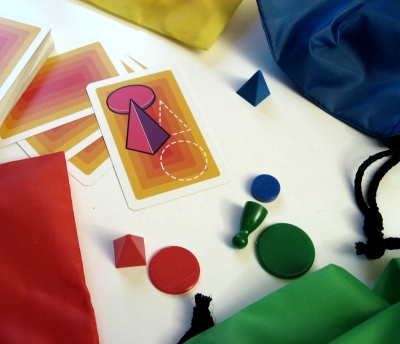
Noll Koll

Then it was Queen’s Necklace.  We had one player who was new to it, but the rest of us played it a few weeks ago, so revisiting it was nice as it meant we could use what we had learnt the first time.  It was a much closer game this time with one round really making the difference between first and second place.
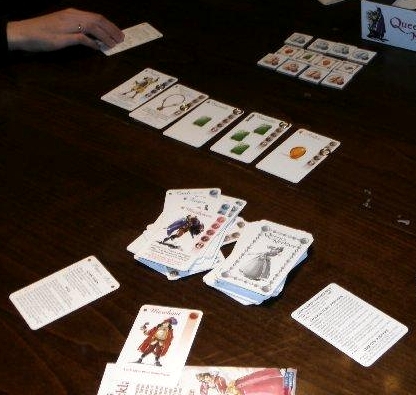
Queen's Necklace

Our fourth game of the evening was Coloretto, which strangely was new to most of us, though it is a well known game.  Play is very simple:  you can either draw a card to add to a “truck”, or take one of the “trucks” and add the cards in it to your collection to make sets of different colours. Each “truck” has a maximum of three cards and only the largest three sets score points with any others scoring negatively.  It is a fun little game closely related to Zooloretto, and in many ways much better as you don’t get side-tracked by cute fluffy animals, barns and vending stalls.

Coloretto

Finally we finished off with our old favourite, Bohnanza (known within the group as “The Bean Game”).  Since we all knew this one very well, we just checked the specific details for player numbers and launched straight into a game.  Unfortunately, the deck hadn’t been shuffled very well before it was put away, so the first time through the pack was a little strange, but we sorted that out for the second time through.  It was another tight game, but the “Queen of Cards” won by one card giving her a hat-trick for the evening.

Bohnanza

Learning Outcome:  Shuffling is a skill we all need to improve.

19th February 2013

Most people had arrived by about 8pm, so we started off with the “Feature Game”, For Sale. This is a quick, fun game consisting of two rounds: in the first players buy properties by auction; in the second they sell them again for the greatest profit possible.  There were the usual mix of bad calls and lucky gambles, but the win was well deserved.

For Sale
– Image by BGG contributor 4100xpb

Since one of the players had to leave early, we decided to have a quick game of Incan Gold before she left. This is one of the first games we played back in October last year and is a light, “push your luck” game.  The idea is that players are exploring a mine collecting treasures as they go, but if the mine collapses before they get out, they loose everything.  Another run-away victory and, since she had won both games, the winner decided it was definitely time to leave and give the rest of us a chance…

Incan Gold
– Image used with permission of BGG contributor mikehulsebus

So we all moved on to another bidding game, called The Speicherstadt.  This is an interesting game set in post-Hanseatic League Hamburg.  At its heart, it has a curious auction mechanic where players take it in turns placing markers to indicate which contract, ship or firefighter cards they would like.  The first person to declare an interest in a card then has first refusal, but the cost is proportional to the total number of people interested in the card.  If the first player decides it is too expensive, then the card offered at a discount to the other players in the order they declare their interest; the later the player, the larger the discount.  Although it wasn’t obvious a the time, this was won by a massive margin based on collecting the Counting Offices, fulfilling a couple of lucrative contracts and an unhealthy interest in fire-fighters…

The Speicherstadt
– Image used with permission of BGG contributor henk.rolleman

The final game of the evening was Fleet.  This is another game that we hadn’t played before and also had financial management at its heart albeit with a fishy flavour.  Each round starts with players bidding for fishing licenses.  As well as allowing players to launch boats corresponding to the license type, they also provide their owners with a handy bonus.  Cards are multipurpose, as they can be played as boats, captains or used as currency. This game was also won by a large margin, appropriately by the fisherman with by far the largest fleet of boats.

Fleet
– Image by BGG contributor mattmill

Learning Outcome:  Sometimes an interest in men in uniforms helps, although girls always love a sailor.

5th February 2013

It was another quiet night this week, but the landlady of the pub commented that February is the worst month for them, so maybe it’s catching.

The first game up was Race for the Galaxy.  This is a card game where players build galactic civilizations by playing cards that represent worlds or technical and social developments. Some worlds allow players to produce goods, which can be consumed later to gain either cards or victory points and other worlds or developments have bonuses that help players manage their hand or build more efficiently.  At the beginning of each round, players secretly and simultaneously choose roles, then each player has the opportunity to the action associated with the roles.  The iconography on the cards takes a little getting used to, and some of the players were unfamiliar with the game so we used pre-set hands.  The game was tight with only five points between first and last place and the Produce/Consume strategy giving the win.

Race for the Galaxy

We decided to save the “Feature Game” for next time, so instead, we played Queen’s Necklace.  This is another card game  (maybe we should be renamed “CardboardGOATS”?!?!)  where players buy gem-stones and then try to win the right to sell them.  There are two key things about this game:  firstly, if a card is not bought by the first player, it’s value decreases for the next player, so the longer they hang about the cheaper they are to purchase.  Secondly, when it comes to selling, each gem has an intrinsic value, but the amount the seller gets will also depend on availability, so if everyone tries to sell a valuable gem, the seller may not get as much as the person who won the right to sell a less valuable gem.  In addition to gems, players can also buy character cards which allow players to inspect another’s hand, steal a card, sell an extra gem etc.  This game was not as close as Race for the Galaxy though the eventual winner was the same.

Queen's Necklace

Learning Outcome: It’s always just when you have managed to build a really efficient victory point engine that someone ends the game.

22nd January 2013

This week was an all time low in terms of numbers with illness, snow and work all conspiring to reduce attendance.  We knew we were going to be low on numbers, so we started out with a game of Tutto, to give anyone who might have been delayed by the weather time to arrive.  Tutto is a very short game with people drawing cards and rolling dice to score points.  If all six dice score, that’s “tutto” and you get a bonus as detailed on the card; if only some dice score, you can re-roll non-scoring dice, or stick and forfeit the bonus; if none of the dice rolled score, you lose everything from that round.  The game was amazingly tight, with the all players within a few hundred points of the 6000 target at the end.

Tutto

With so few of us, we took the opportunity to play something very new and quite complex:  Vasco da Gama. This is a resource management game with an element of risk where players have to buy projects, recruit sailors, build, captain and launch ships and finally use them to open new commercial routes.  Points were slow coming in the early rounds and players’ scores remained close.  However, as time went on, it became clear that the position of ships in the navigation area was key and the player with the best positioned ships romped away to a clear victory.

Vasco da Gama

Learning Outcome: Sailing is all about positioning your ship to make the best of the prevailing conditions.

8th January 2013

Normally, we are very reliant on support from people coming from outside Stanford – Stanford is a village and we are very grateful to the people who travel from the surrounding villages and towns.  However, this week we had a visitor who set a new record coming over 8,000 miles – although it is possible she might not have come just to play games…!

Since the early arrivals were eating, we didn’t start playing until 8pm by which time we had six people, so the first game was Pick Picknic. This is a fun little game where players play chicken cards to claim corn in one of six coloured fields.  If two or more chickens claim the same field, then they can choose to share or they can roll to see who gets it.  But watch out for the foxes:  They are not interested the large tempting pile of corn, and eat chickens instead.  Initially, it seemed that a handful of fox cards was an advantage (well, wouldn’t you prefer to be a fox?), but the winner was the person with the most corn…

Pick Picknic

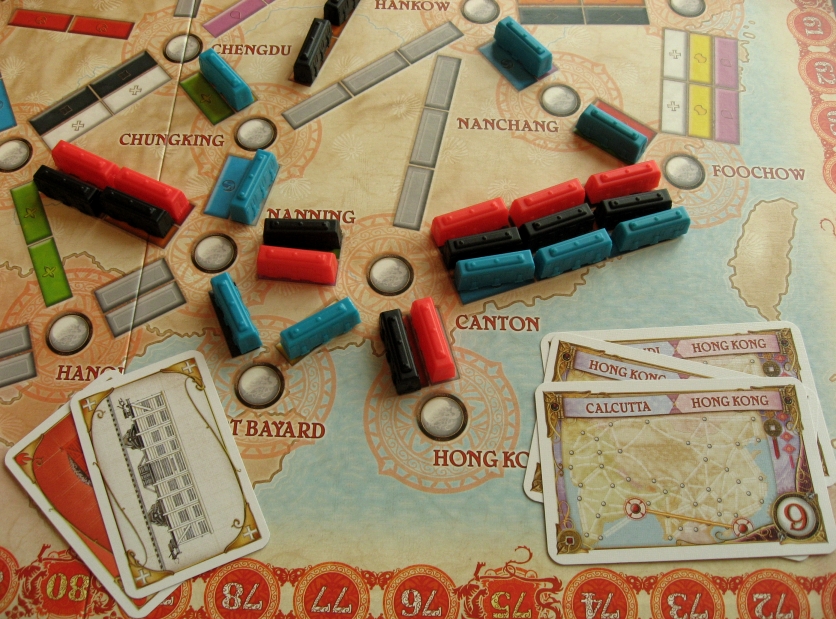
The next game was the “Feature Game” which was Ticket to Ride, a train game where players compete to make routes connecting cities.  Since there were six of us we decided to play the “Team Asia” map which adds the twist that players play in teams of two and have shared information and hidden information.  The first thing we discovered was that it plays a lot better if you include the white, blue and yellow cards, but once we had got that sussed, the game progressed in the usual way with players picking up cards and mispronouncing place names as they laid trains to fulfil their routes.  After a short tussle for Hong Kong, Blue took an early lead with Red and Black squabbling over second place.  However, in the final scoring Black had many more tickets (and higher scoring ones too), and shot ahead running out easy winners.

Ticket to Ride - Team Asia

There had been a lot of discussion and the game took much longer than expected, so we finished up with three rounds of an old favourite, No Thanks!, with the added luxury of real poker chips.  All the winning scores were less than ten, but the final was -1.  We thought that was a good place to end the evening.

Poker Chips

Learning Outcome: Sometimes it is better to be a chicken than a fox!

27th December 2012

With Christmas day and New Years day both falling on a Tuesday (and players valuing playing games with their family more than with other GOATS – can’t imagine why!) we decided to have an extraordinary meeting on the Thursday.

This week there were six of us, including two new people.  However, although we didn’t start until 8pm (as burgers and chips had to be dealt with), we still managed to squeeze in four games.

With Christmas so recent, everyone had new games to play, and the first one up was a Santa Special – Mundus Novus. This is a card game where players are seventeenth century Spanish ship owners, travelling to the New World and making their fortune.  It took us a while to get started, but once we got the hang of it, everyone started to rack up dubloons at a steady rate. We were pretty much neck-a-neck when the game came to a bit of a shuddering halt because one of us played the equivalent of a Royal Flush, which wins the game outright.

Mundus Novus

Next we played the “Feature Game” which was PitchCar, a gorgeous, dexterity car-racing game.  This game was also a Christmas Special and included the first expansion which has shicanes and jumps/bridges.  For this game we used one of the standard layouts making full use of the special features.

PitchCar Track - 27/12/12

Once everyone had completed their qualifying lap, we were off.  Yellow, who won the qualifying, stalled on the grid, so Pink led into the first corner and got in everyone else’s way.  Meanwhile, Black went for a pitstop and came out Orange. After about half a lap, Green had got his nose in front and despite the best efforts of Blue and White (who came from the back of the grid to finish second), this proved an unassailable lead.

PitchCar

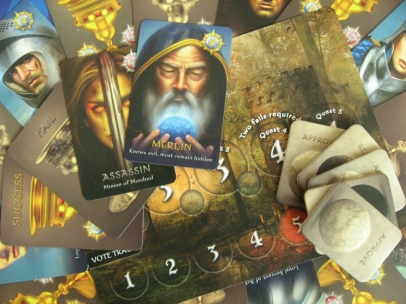
Next up was The Resistance: Avalon.  This game is a little different with players dividing into two teams, the Loyal Servants of Arthur and the Minions of Mordred, to go on a series of quests.  Arthur’s team want the quests to be successful, whereas Mordred’s team want them to fail.  The catch is, the Loyal Servants of Arthur don’t know who Mordred’s men are and players vote for teams to go on each quest.  The first two quests were successful, before the Minions managed to sneak in a failure.  After winning the fourth quest, the Loyal servants snatched defeat from the jaws of victory when Merlin was named correctly and assassinated.

Avalon

The last game of the evening was an old favourite, Dobble and we played several chaotic rounds in different styles before we went home.

Dobble

Learning Outcome: A little research before preparing your Christmas list goes a long way!

11th December 2012

This week, freezing fog, work and family commitments conspired to reduce our numbers to four, none of whom were there much before 8pm.  So we kicked off straight away with the “Feature Game”, Alhambra, which is a tile laying game where players are architects, competing to build the greatest palace.

With two new players, the realisation came slowly that leading in the early stages is not necessarily significant and a lot can change in the final scoring.  In the end, the game was really tight between three players with a surprising, small lead for the winner (who had no idea how it happened).

Alhambra

For some reason, Alhambra which should take less than an hour took nearly two, so we only managed the one other game, which was Thurn and Taxis.

This is a game that is often describes as “being a bit like Ticket to Ride“, however, in reality it’s nothing like it and probably has more in common with games like Elfenroads or Elfenland.  This game was probably best characterised by frustration with people waiting patiently for cards they wanted only to see them shuffled away just as they turned up.  This game was also quite close, but it was clear that acquiring high value tokens was the key which meant that having played the game before was a significant advantage.

Thurn and Taxis

Learning Outcome: Patience is a virtue, but having multiple strategies is more often rewarded…

27th Movember 2012

This week, some of the group turned up early to sample the food the pub offers (which was really rather good), and two people managed to squeeze in a very quick “learning game” of Mr. Jack Pocket before it arrived.  Mr. Jack is an asymmetric two player game, that is to say, the protagonists have different goals.  One plays “Mr. Jack” who is trying to escape, the other plays “The Investigator” who is trying to deduce who Mr. Jack is masquerading as.  This version was the travel version, but is still just as much a brain burner as its big brother despite the diminutive size of the box.

Mr. Jack Pocket

Just as the diners finished, the others arrived giving us a total of five people who had braved the flood water.  After a quick game sale, we started the “Feature Game”,  Eketorp.  This is a game where players attempt to gather resources to build their Viking stronghold on the Swedish island of Öland.  In this game players try to second guess which resources the others don’t choose, with a battle and a potential extended stay in the hospital as the reward for failure.

Eketorp

Next, after some discussion we decided to play Citadels.  Citadels is a role selection and city building game.  Each round, players choose a role to aid them building their city, and each is called in turn to perform their turn.  The first of these is the Assassin, then the Thief, then Magician, then the King etc.  You have to be particularly careful of the first three, as (for example) the thief seemed to think royalty was a good target.

Citadels

The last game was a very quick game called Dobble (aka “Spot It”), so we had several goes.  There are lots of different ways to play this, but basically it is Snap, except that each card has more than one symbol.  The idea is to call a correct match more often and faster than everyone else.  Apparently every card has exactly one matching symbol, though a number of disbelievers amongst us felt the need to check…

Dobble

Learning Outcome: Beware the magician who steals all your cards (though perhaps you deserve it if you set the example).

13th Movember 2012

This week there were only four of us so we took the oportunity to play something a little heavier.  So, we started out as soon as everyone had arrived at 8pm.  The game was very new, only released in the last couple of months, and called Snowdonia.

In this game, players are struggling to build a railway up Mount Snowdon fighting the mist, rain and navvies that keep running back to the pub.  It was clearly quite a big advantage to have played the game before as the two players who were familiar with it ended up in a very tight race for first and second.  However, the game is so finely balanced that one or two errors early on by the others probably had quite a large impact on the two front runners.  Definitely a game to give another go sometime after it has had time to sink in.

Snowdonia

We only had time for one other game, and that was the “Feature Game”, Bohnanza.  This is a card trading and set collecting game where players are bean farmers.  Most of us had played this before, but it is such a nice light game that keeps everyone involved throughout that it was a great way to end the evening.  The final score had everyone within five points and the winner decided on a tie-break.

Bohnanza

Learning Outcome: Sometimes, Snowdonia can be very sunny (but only in board games!).

30th October 2012

This week we had two new people, who arrived early, so we started the evening off with a quick four-player game of No Thanks!  This is a very, very simple push-your-luck game with just a hint of strategy and probably one of the best games going for its size.  The idea is that you turn over the first card in the stack and either take it or pay a chip.  If you take it, you turn over the next card, if you pay, the decision passes to the next player; the person with the lowest number of points when the cards run out wins.  The strategy comes because for runs of two or more cards, only the lowest counts, but unfortunately, someone removed nine cards from the deck at random…  Just as we were finishing the first round, another player arrived, so as it is such a quick game we gave it another go.

No Thanks!

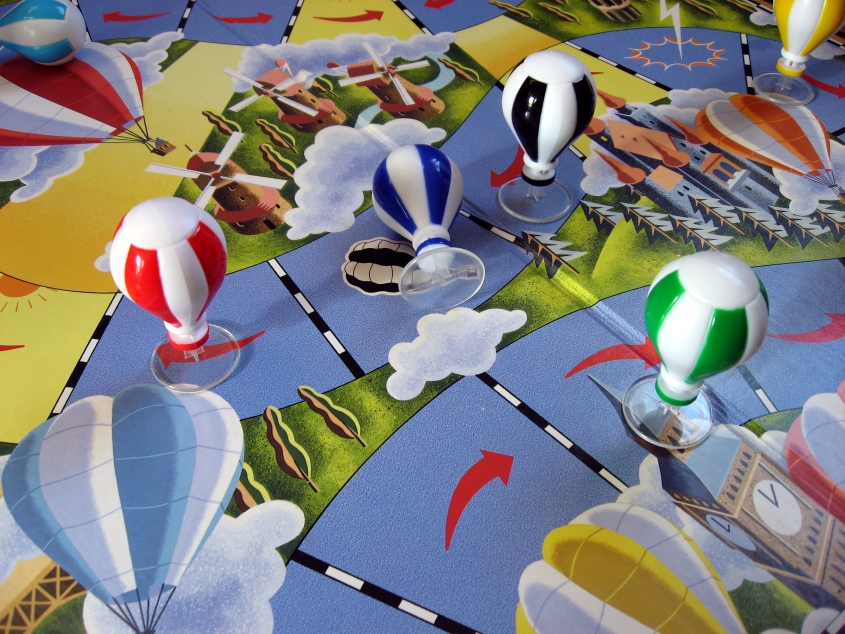
Since it was gone 8pm, we decided to play the  “Feature Game” which was The Great Balloon Race. This is a light hearted, relatively quick race game with quite a lot of luck, and (as it turns out) a lot of vendettas against certain colours with orange and blue being the most victimised.  One of the really nice things about this game was the way that people at the back who felt they had no chance, were able to catch up and indeed win.

The Great Balloon Race

Next, there was some debate about what to play next and in the end we decided to play a fairly light card game, Boomtown.  In this game, players are mining moguls who bid to win the first choice of the cards on offer.  Winning the bidding has two consequences:  you get first pick from the cards available, but you have to pay the other players what you bid.  The game was won by an landslide and it turns out that winning the bid is not always best as it can be expensive as well as favouring the player to your left.  Or was it right?  Actually, it was probably both…

Boomtown

With five games something of a record, we managed to squeeze in a game of Snow Tails.  This is a very pretty game of dog-sled racing, but the choice of game was possibly a mistake given the time, compounded by the fact that we used a more complex track than was wise, and we were playing with the full five players (three of whom were new to it).  Basic numeracy proved to be something of a challenge and the “Big Paws” token changed hands several times as the dents in the sleds increased and the saplings took a beating.  However, most people were in the lead at some point and in the final run for the line, everyone was within one turn or so of finishing the race.

Snow Tails

Learning Outcome: Basic skills such as being able to add up and tell your left from your right can be really useful when mining, flying balloons, and especially driving dog-sleds!