Category Archives: News

Boardgames in the News: Convention Season

Broadly speaking, June to November is boardgame convention season.  These vary wildly in size, style and location.  Some conventions, like Gen Con, are primarily meetings for people who like playing games, while others are limited access trade fairs, like the SpielwarenMesse.  Similarly, some conventions, like BGG.Con, are focused on boardgames whereas the PAX series, include miniatures, comics and other Geek fayre.  A bit like the film world where the Oscars are later in the year and earlier events tend to give a preview, the biggest boardgame conventions are in the second half of the year.

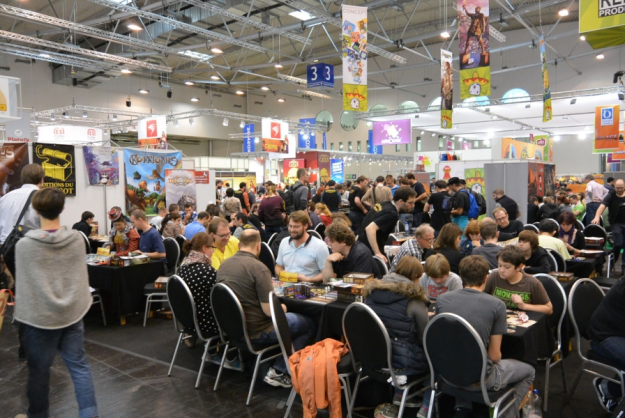
Essen 2014
– Image used with permission of BGG contributor Sjeng

In fact, the Euro-boardgame calendar is largely constructed around the German market, with the main even held in October, the Internationale Spieltage in Essen.  This is a massive games fair and held in the industrial heartland of Germany and showcases everything from children’s games to the latest Euro-game.  Many (or even most) manufacturers release their games at one of the big conventions like Essen, which is nicely in time for the Christmas market.  Of course this only really catches the most hard-core of gamers as these freshest releases don’t make it in to the wider conciousness.  However, they are perfectly timed for the next major landmark, the Spiel des Jahres.  Games that make it into the nomination and recommendation lists or better still, win an award, are then perfectly placed for a new print run with the “Red Pöppel” on the cover, with plenty of time for Christmas advertising and a second outing at Essen.

Gen Con
– Image from graphicpolicy.com

One of the largest conventions, Gen Con has just concluded.  The name Gen Con is derived from “Geneva Conventions” reflecting both its original location on the bank of Lake Geneva and it’s war gaming heritage, though it is now held in Indianapolis and includes games of all types.  It will be quickly followed by PAX in Seattle in a few days time. PAX, the Penny Arcade Expo, is actually series of gaming festivals held in Seattle, Boston, Melbourne and San Antonio, run by the authors of the Penny Arcade webcomic.  These are shows exclusively developed for gamers and include everything from speeches from industry insiders, to tabletop game tournaments.  One of the defining features of every PAX is the Omegathon which is a festival long tournament consisting of a group of randomly selected attendees competing for a grand prize.

UK Games Expo Logo
– Image from ukgamesexpo.co.uk

Although some of these big events may be half a world away and therefore totally inaccessible without a small fortune, there are a lots of more local events that are easier to get to and often offer excellent value for money.  These vary from smaller local game days (like the Oxford Meeples “Big DoG” events) to large country-wide conventions (like the UK Games Expo held annually in Birmingham).

– Image of unknown origin
Selected Local, National and International Conventions
Convention  Location Month
OxCon Oxford, UK January
LeiriaCon Leiria, Portugal January
SpielwarenMesse Nürnburg, Germany February
UK Games Expo Birmingham, UK June
Origins Columbus, Ohio, USA
June
Gen Con Indianapolis, Indiana, USA August
Penny Arcade Expo – PAX  Seattle, Washington, USA  August
Internationale Spieltage  Essen, Germany  October
BGG.Con  Dallas, Texas, USA  November

Boardgames in the News: The Past, Present and Future of Z-man Games

The summer is now here which means conferences and take-overs.  Last summer, Asmodée acquired Days of Wonder and then followed it with Fantasy Flight Games, Ystari Games, Asterion Press and Pearl Games. Last week, Canadian company F2Z Entertainment announced the purchase of the U.S. company Plaid Hat Games (who are responsible for Dead of Winter and Summoner Wars).  Most people in the UK will have no idea who F2Z Entertainment are, however, they are the parent company of Pretzel Games, but perhaps more significantly, they also own Filosofia Éditions who in turn bought Z-Man Games four years ago.

Dead of Winter: A Crossroads Game
– Image by BGG contributor mikehulsebus

Z-Man Games was created in 1999 by New Yorker, Zev Shlasinger, for the sole purpose of reviving Shadowfist, the multiplayer Collectable Card Game.  From then on, the company produced a number of other American style games, including Grave Robbers from Outer Space and Ideology: The War of Ideas.  The company had a much more significant impact on Euro-games, however, by introducing many German games to the United States.  Z-man was one of the first companies to do this by actively engaging with the original European manufacturer and providing English translations.  The first game to receive this treatment was Ursuppe (a.k.a. Primordial Soup) designed and produced by Doris & Frank.   At the time, this was a very highly regarded game and the success of this reproduction quickly led to English editions of games like Santiago, Saboteur and No Thanks!.

Ursuppe (a.k.a. Primordial Soup)
– Image used with permission from BGG contributor samoan_jo

In 2007, Agricola was released in Germany to great acclaim, but as the cards are very text-heavy, it was essentially unplayable by non-native speakers.  The problem with this game was the huge number of wooden pieces adding to the expense of producing a new edition.  At the time, heavy Euro-games were perceived as a niche market and nobody was prepared to risk the capital outlay for such an expensive game.  Z-Man were only a small company and were already engaged on their own projects including the production of what was to become another hit, Pandemic, and could not take the risk either.  In the end, amid much controversy, Zev Shlasinger decided to gauge the interest of the community with one of the first boardgame pre-orders and the rest, as they say, is history.  So the impact of Z-Man on the history of modern boardgames highly significant, and arguably, they were the forerunner of the current KickStarter Craze.

Agricola
– Image by BGG contributor Simulacrum

In 2011, Z-Man Games was taken over by the French-Canadian distributor, Filosofia Éditions.  With the take-over of Plaid Hat Games last week, the company now has the “cradle to grave” of the boardgame market:  creation, publishing and distribution.  So in that sense, the deal is clearly a sensible one.  However, Z-Man Games used to be a by-word for exceptional customer service and following the take-over by Filosofia, this reputation was tarnished.  Although it seems to be picking up again, this demonstrates one of the downsides of this streamlining of the market.  More serious however, is the potential loss of innovation that comes from  agglomeration, particularly on a large scale.  That said, so far at least, all the “studios” that are part of the Asmodée group have kept their identity – the boardgamer in the pub would have no idea that Fantasy Flight Games and Days of Wonder are part of the same company.  Only time will tell whether we have seen the pinnacle of the golden age of boardgames or whether there is even better still to come.

Z-man Games Logo
– Image from zmangames.com

Boardgames in the News: Are Games a Good Investment?

It might seem strange for a courier company to comment on the value of boardgames, however, David Jinks, the Head of Publications at ParcelHero (a UK courier comparison site), has been has been reported to have strong opinions on the subject.  He explains how traditional games can be worth many thousands if the edition is right; they even have a page on their website discussing collectible games.  So why are ParcelHero so interested?  Well, it turns out that buying and selling vintage copies of Monopoly is big business, most of which is done on the internet using sites like eBay (who have several buyers’ guide pages on the subject).  Thus, ParcelHero’s involvement is in shipping these items (though in truth it is probably mostly about publicity as there are a lot of other things that they can deliver too).

Container
– Image used with permission of BGG contributor Zoroastro

Now, there will always be a market for vintage copies of traditional family games, but what about the more modern classics?  Sadly, that early copy of The Settlers of Catan is not worth a lot yet, though of course it might be when the game has been around as long as Monopoly of course.  There are modern games that sell for a small fortune however.  These tend to be games where there is some combination of high demand, small print-run, popular designer and unlikely reprint.  There are a number of games that fall into this category and some are not all that old.  Container was released in 2007 by Valley Games Inc., and is an unusual production and shipping game – those who have played it claim there is nothing similar.  The recent law suit that ensnared the reprint of Up Front means a reprint is unlikely, so copies cannot be easily be obtained for less than £100.

Key Market
– Image used with permission of BGG contributor duartec

Another example, is Key Market, which was designed by David Brain and released at Essen in 2010, however, only nine hundred copies were made and it sold out very quickly.  R&D Games are a small company and have moved on to other things (including one of our favourite games, Keyflower), so it looks unlikely that Key Market will be reprinted in the near future.  This is not the only high value game from the Key Series: a set of the earlier titles Keywood, Keydom and Keytown recently went for £1,800!

Keywood, Keydom & Keytown on eBay
– Image by boardGOATS

It’s not just games from small companies that become rare and demand high prices.  Colosseum was a Days of Wonder game with a wide release, but following an alleged dispute between the designer and publisher, it seems unlikely it will be reprinted.  Witch’s Brew is in a similar boat, though it is the implementation of its central mechanism in the Spiel des Jahres winning Broom Service which is likely to prevent a reprint.  The irony is that Witch’s Brew and Broom Service are quite different even though though the publisher and designer have been saying otherwise, so demand is not likely to drop, quite the opposite.

Witch's Brew
– Image used with permission of BGG reviewer EndersGame

So clearly there is money to be made from boardgames, or at least, from some boardgames.  However, for every game that increases in value there are many that end up nearly worthless.  Worse, timing is everything; there is nothing like the announcement of a reprint to have a sudden impact on the market of a desired game.  So, before a reprint is announced the price climbs steadily as the desired item becomes increasingly rare and people continue to pay the inflated prices as “they are only going to go up”.

Mission: Red Planet
– Image used with permission of BGG contributor kilroy_locke

When a new release is announced, everyone has to take a gamble.  Many potential buyers will wait for the new edition hoping that the price will be lower and the quality will have improved in line with modern expectations.  So, demand suddenly drops and sellers are left with a tricky choice:  reduce the price and hope someone who hasn’t heard the news will bite, or sit tight and wait.  Notably, the recent Fantasy Flight Games announcement of a third edition of Fury of Dracula has led to a sudden flood of copies on the secondary market caused by people hoping to get a sale before the price drops.  Similarly, the secondary market price for Mission: Red Planet plummeted when a second edition was announced. On the other hand, waiting can turn out to be a better option in the event that the new edition is deemed inferior to the original.  This is not as uncommon as one might imagine, as artwork often changes and there are frequently also “improvements” to the rules as well and changes to some components.

Fury of Dracula - Secondary Market
– Image used with permission of BGG contributor tumorous

Sometimes changes are for the better, but it is not uncommon for buyers to prefer the original.  For example, for the second edition of one of our favourite games, Snowdonia, the wooden workers were upgraded to plastic figurines, however, our group find the first edition tokens more tactile.  Sometimes, the publicity surrounding a release of a second edition has the additional effect of reviving a market that had become stagnant due to the lack of availability.  In such cases, the reprint can actually increase the price of an already expensive edition when the new version is thought of as inferior.  Mostly, however, a reprint will cause the price to fall as the difference between editions is something only a connoisseur will really appreciate.

Snowdonia
– Image by boardGOATS

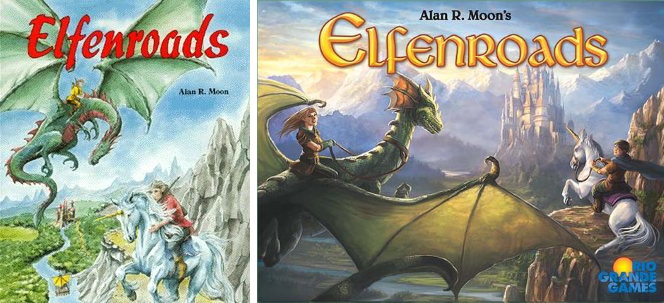
So, where does this leave us?  There are a number of facts that are undoubtedly true.  Firstly, with the exception of the most popular games, almost all modern boardgames are perpetually “between print runs”, with sufficient stock available to supply demand.  For this reason, games can suddenly become unavailable and to some degree the buyer should take the opportunity when they see it, as it may not be there for long.  That said, the best games generally remain in demand and are almost always re-released in some form or another.  The recent announcement by Rio Grande demonstrates that even long out of print classics like the 1992 game Elfenroads, do sometimes eventually get a re-print, albeit in a very different form.

Elfenroads
– Images from the manufacturers

The fact that boardgames are currently a niche market means that mature games are inevitably more likely to go out of print with a corresponding increase in demand.  So, good games ideally with high production values will rarely depreciate by more than 50% if bought for a good price and sold in the right place.  Thus, a gamer with a mature high quality collection who looks their games well, will rarely lose a lot of money if they keep them for long enough, especially if they can chose their time to sell.  Of course, spotting good games at the right price is the challenge, but very occasionally, if they have the correct edition, a gamer might make a killing.

Catan - 3D Collector's Edition
– Image by BGG contributor theotherside

Boardgames in the News: The Rise of the Boardgame Café?

It is just over two years since Thirsty Meeples opened in Oxford as one of the first boardgame cafés in the UK.  From the outset it has been very popular, building on the example set in North America where Snakes and Lattes in Toronto is often given as an example of a successful enterprise.  In fact, It has been so popular that there have been rumours of expansion or developing a second premises.  The way Thirsty Meeples works is very simple:  customers pay a cover charge which gives them access to the shop’s very extensive library of games for a period of time.  Meanwhile, the “games sommelier’s” serve drinks, snacks and help people choose something to play and teach them to play it if necessary.

Thirsty Meeples
– Image from Oxford University Scientific Society

Over the last couple of years, there have been a number of other boardgame cafés opening using a similar model, including the Games Hub in Edinburgh and Draughts in Hackney, London.  There are also moves afoot to open a café in Cardiff called Counters, and The Dice Cup in Nottingham which is scheduled to open in October, was the subject of a recent successful KickStarter which raised over £12,000.  There are rumours of people trying to open venues in Brighton and Bristol and more recently, another three crowd-funding campaigns have been launched for cafés in Exeter, Portsmouth and Preston.  How successful all these ventures will be, ultimately depends on the local clientele and the offerings as well as the overheads of course.  It has to be a positive trend, however, and is one that is going beyond the dedicated venues, with many more pubs and cafés offering games for customers.

Draughts
– Image from draughtslondon.com

Stolen Goats

Comet, Cosmos and Chico, three pygmy kid goats, were stolen from Willow Farm, Chilton, OX11 0QU.  They were last seen on 22nd July at 9pm – the barn was broken into during the night.  Lots of damage was caused, but only the goats were taken.  If you know their whereabouts please contact the Animal Finders on 07886 793681 (quoting AF13-4766) or the Police.

Chico
– Image from animalfinders.co.uk

boardGOATS: 200 Posts

This is the 200th post on our website!

Fireworks
– Image from giphy.com

We are only a little club with a small web presence, but here are a few of our statistics:

  • Since our first post on 6th September 2012, we’ve had 6,746 views;
  • Our best month was January 2015 when we had 646 visits and 382 visitors;
  • Our best day was 5th February 2015, the day after we shared an amusing flow-chart which has since become our most popular page;
  • We have 148 followers through Facebook, Twitter, tumblr, email and WordPress;
  • Google is our most frequent referrer with 687 transfers so far this year alone;
  • Most search terms that have led to our site are hidden by the searcher’s browser, though it is reassuring to find that variations on “boardGOATS” are the most common;
  • Some of the curious search strings that have led people to our site include,
    horse racing dice lagoon group” and “jeff takenoko“;
  • We get 17% of our views on a Tuesday which presumably reflects that we meet on a Tuesday evening, however, the intersection of that group and the 11% who view the site at around 10pm must be sorry to find out they’ve missed most of it!

Boardgames in the News: So, What Are Euro-Games?

A couple of months ago at our game night, one of the gamers commented that there were a lot of good games from Europe.  This prompted a discussion about “traditional games”, “Euro-games”, “American games” and their relative merits.  Most people know all about traditional games even if they don’t know what gamers mean when they use the term:  traditional games are the games we all used to play as a child including Scrabble, Cluedo and love it or loath it, the dreaded Monopoly.  Some people also include in this list games like Chess, Go and Backgammon as well as traditional card games like Whist, Hearts and Rummy.

Go
– Image used with permission of BGG contributor ManCorte

But the front page of the boardGOATS website says, “We generally prefer to play “Euro” style games,” so, what do gamers mean by “Euro-games” or “Euro style games”?  Well, most of the traditional games we used to play as children were produced by publishers in the United States of America, companies like Milton Bradley (who made Scrabble) and Parker Brothers (who made Cluedo and Monopoly).  Incidentally, both these companies are now part of Hasbro, but the aggregation of smaller companies to form a larger one is a topic that’s been covered elsewhere.  While the “English” market was dominated by big players that concentrated on producing a few top sellers, in Germany there was no such dominance.  The effect this had was that the market consisted of a large number of small manufacturers producing more varied products.

Scrabble
– Image used with permission of BGG contributor Susie_Cat

This coupled with the traditionally strong German toy industry encouraged the growth of a culture of families playing games together on a Sunday afternoon. It was in this environment that the annual German Game of the Year, or Spiel des Jahres Award, highlighted a range of games from Rummikub in 1980, Torres in 2000 and Camel Up last year.  Over the years, the red pawn of the Spiel des Jahres logo, has become a mark of boardgaming quality, and for many German families, buying the game of the year is something they do every Christmas.  Therefore, the qualities espoused by these awards heavily influence the concept of the “Euro-game”.

Rummykub
– Image by BGG contributor OldestManOnMySpace

But what are these qualities that make a game “European”?  Well, that fount of all knowledge, Wikipedia, describes them as characterised by “simple rules, short to medium playing times, indirect player interaction and abstract physical components”.   It goes on to say, “Such games emphasize strategy, downplay luck and conflict, lean towards economic rather than military themes, and usually keep all the players in the game until it ends.”  On the whole this is not a bad summary, except that it is not very specific:  how simple are “simple rules” and how long are “short to medium playing times”?  Clearly these features are more about contrast, and although there are lots of different types of games including party games and war games, this comparison is usually between European style ames and American-style Games, aka “Ameri-Trash”.

Last Night on Earth
– Image used with permission of BGG contributor Bilben04

Although common, use of the term Ameri-Trash (or Ameritrash) is controversial as some see it as unnecessarily negative, however, although other terms have been suggested none have proved as popular or as persistent.  The term itself is over fifteen years old and was probably originally used disparagingly and applied to genuinely bad American games as a comparison with the much higher professional standards of games in Germany at the time.  Since then, the scope has been expanded and many fans of those American games have adopted the term as a badge of honour.

Merchant of Venus
– Image used with permission of BGG contributor kilroy_locke

American-style games tend to be long, usually over two hours, and classically involve a lot of luck and often feature dice rolling.  They are often considered to be a lot less “cerebral” or “puzzle-like” and, as a result, are sometimes described as “more fun”.  The reference to “trash” may in part reflect the style of the pieces which tend to include a lot of plastic pieces to go with the dice.  There is also often a lot of direct conflict in American-style games, where European games tend to be much more family friendly with indirect player interaction.  Classic Ameri-Trash games include:  Arkham Horror, Merchant of Venus, Cosmic Encounter and Last Night on Earth: The Zombie Game.  Sometimes there is also a book or film tie-in leading to games like Battlestar Galactica and Dune.  Even just comparing the titles with those of classic Euro-games like Puerto Rico, El Grande, Tikal and Agricola, the difference can clearly be felt.

Arkham Horror
– Image by BGG contributor igorigorevich

The most essential part of American-style games is the theme, however, which is often integral to the game mechanisms.  This encourages people fantasize they are part of the action when playing the game.  The miniatures, the long playing times, the complex interwoven rule-set and the interaction (often culminating in players being eliminated) all combine to draw players into the drama of the game.  In contrast, for Euro-games, the mechanisms are the focus, and the games can often be re-themed without much effort.  The theme is therefore used more as an introduction to the more abstract European strategy games, making them more accessible, rather than being an essential part of the emotional investment.

Relic Runners
– Image by BGG contributor cnidius

But things are not as simple as that.  The nature of modern boardgaming encourages cross-fertilisation.  There are more highly-themed, strategy-games available now and more long, strategic games with miniatures – these are sometimes referred to as “hybrid games”.  For example, games produced by the Days of Wonder (based in the USA), like Ticket to Ride and Relic Runners have a lot of plastic pieces, though the games themselves are quite strategic and generally run for no more than an hour.  Similarly, games like Escape: The Curse of the Temple and Space Alert use real-time and a sound-track to draw the players in, yet they are both short (Escape takes just ten minutes to play) and have no player elimination.  Vlaada Chvátil’s Dungeon Lords series of games, also have a lot of theme, but are also playable in a manageable time-frame, have a lot of strategy and a reasonably streamlined set of rules.

Dungeon Lords
– Image used with permission of BGG
contributor PaulGrogan

Confusingly however, “hybrid” has more recently also come to mean games that include some sort of mobile device application (and thus require a smart phone, tablet or similar).  Now, lots of games have Apps that help them a long a little (e.g. One Night Ultimate Werewolf), but games like Alchemists and XCOM: The Board Game don’t really function properly without them.  The question is, are these still boardgames?  In truth, they are a sort of hybrid computer-boardgame, but the point is, however appropriate the name, it is all about the game and the other people playing:  the bottom line is, if you enjoy playing it, it doesn’t matter what it is called.

Alchemists
– Image used with permission of
BGG contributor Mouseketeer

Boardgames in the News: Spiel des Jahres Awards

This week, Colt Express won the Spiel des Jahres Award.  Although it may seem strange, this German award is highly sought after and is the most coveted award in the world-wide world of boardgames.  The reason for this goes back nearly forty years when the “English” market was dominated by companies like Milton Bradley (who made Scrabble) and Parker Brothers (who made Cluedo and Monopoly).  These concentrated on producing a few top sellers, however, in Germany there was no such dominance.  So, the German market consisted of a large number of small manufacturers producing more varied products.  This, coupled with the traditionally strong German toy industry, encouraged the growth of a culture of families playing games together on a Sunday afternoon.

Spiel des Jahres
– Image from spieldesjahres.de

It was in this environment that the annual German Game of the Year, or Spiel des Jahres Award, began in 1978, with the stated purpose of rewarding excellence in game design, and promoting top-quality games in the German market.  The red pawn of the Spiel des Jahres logo, has since become a mark of quality, and for many German families, buying the game of the year is something they do every Christmas.  Thus, the award has been such a success that it is said a nomination can increase sales from a few hundred to tens of thousands and the winning game can be expected to sell up to half a million copies or more.

El Grande
– Image by BGG contributor Domostie

Over the last fifteen years, years, the Spiel des Jahres has generally gone from highlighting games like El Grande, Tikal and Torres (1996, 1999 & 2000), to rewarding lighter games like Dixit, Qwirkle and Camel Up (2010, 2011 & 2014).  The problem was particularly brought to light in 2002 when Puerto Rico, arguably one of the best games ever made was not rewarded because it was perceived as too complex.  The problem reared its ugly head again in 2008, but this time the jury awarded Agricola a special “Complex Game” award.  These two games are widely considered to be the pinnacle of “Euro-Games”: between them they’ve held the top position on the BoardGameGeek website for the best part of ten years, yet neither were awarded the top prize. The problem was that these games were not mainstream enough for the German family game market:  they were too complex for those families making their annual purchase. On the other hand, for frequent and dedicated boardgamers, these Spiel des Jahres games are too light.  So, for this reason, the Kennerspiel des Jahres or “Connoisseurs’ Game of the Year” was introduced in 2011 and for more serious gamers, this has largely superseded the Spiel des Jahres.  This year it was awarded to Broom Service, a reimplementation of Witch’s Brew which was itself nominated for the Spiel des Jahres in 2008.

Adel Verpflichtet
– Image by BGG contributor Henco

The Kennerspiel des Jahres is not the only prestigious award available to strategy games however.  In 1990, the German magazine “Die Pöppel-Revue”, introduced the Deutscher Spiele Preis or “German Game Prize”.  This is announced in October every year at the Internationale Spieltage in Essen.  In contrast to the Spiel des Jahres, the Deutscher Spiele Preis has gone from rewarding lighter games like Adel Verpflichtet (aka Hoity Toity, in 1990) and our group’s current favourite filler, 6 Nimmt! (winner in 1994) , to highlighting games like Russian Railroads and Terra Mystica (in the last two years).

Deutsche Spiele Preis
– Image from wikimedia.org

Spiel des Jahres Winners – 2015

The 2015 winner of the coveted German Game of the Year or Spiel des Jahres award is Colt Express which is a game about bandits robbing an amazing 3D train.  The game plays in two phases:  first everyone plays action cards cards onto a common pile and then the action cards are resolved in the order they were played. There were three games nominated for the Spiel des Jahres this year and we’ve played the other two, Machi Koro and The Game, so we’ll play Colt Express next week to see what all the fuss is about!

Colt Express
– Image used with permission of BGG contributor henk.rolleman

At the same time the Kennerspiel des Jahres was awarded, which honours more challenging games.  It was introduced in 2011 to replace the jury’s habit of intermittent special awards for games too complex for the Spiel des Jahres (notably Agricola which was awarded a special “Complex Game” prize in 2008).  The 2015 award went to Broom Service, which is a reimplementation of the 2008 Spiel des Jahres nominated game, Witch’s Brew.  It is a role selection game where players collect potions, then deliver them across the land to towers that advertise their desires with color-coded roofs.  This year we haven’t played this or either of the other nominees (Orléans and Elysium), but it probably won’t be long before we do.

Broom Service
– Image from asaboardgamer.com

Boardgames in the News: Confusion at The Telegraph!

Anyone who plays modern boardgames knows how our hobby has been growing and growing.  Games like Carcassonne and The Settlers of Catan are now available in Waterstones and WHSmith, there has been a series of regular comments in The Guardian, there are repeatedly TV appearances, and boardgame cafés are sprouting up all over the place.  It seems strange then that last week, Harry Wallop from The Telegraph announced that “Card games and board games are dying out and it’s no great loss”.

Snap
– Image by BGG contributor loopoocat

The basis of this report is a survey carried out by Barclaycard which apparently indicated that games like Old Maid, Happy Families and Snap are in danger of dying out.  Strangely, on the same day, Martin Chilton, the Telegraph online Culture Editor reported that 67 per cent of the children surveyed said that they would like to learn how to play traditional games.  The really annoying thing about all this is that they focus solely on “traditional games”:  Martin Chilton’s article is entitled “The five best board games” and lists them as Chess, Scrabble, Monopoly, Cluedo and Backgammon.

Scrabble
– Image used with permission of BGG contributor Susie_Cat

On closer inspection, however, Harry Wallop’s article does include a link to a more interesting list of fifteen party games, including Pandemic, Camel (C)Up and Biblios.  While their definition of “Party Games” clearly leaves a lot to be desired, it is clear that someone at The Telegraph at least has heard of modern games.  Perhaps the most reassuring aspect of this though, is the response to Martin Chilton’s article in the comments section which includes a nearly eighty passionate responses pointing out better, modern, “classic games” and where to find information about them.

Biblios
– Image by BGG contributor creatsia

Let’s hope Mr Chilton and Mr Wallop read the comments and write a better article soon!