Tag Archives: 6 Nimmt!

8th August 2017

With Burgundy and Blue still finishing their supper, Black, Red Purple and Pine decided to play a quick game of Coloretto.  Pine and Red needed reminding of the rules, and by the time that was done Blue was ready to join them, but Burgundy was still wading through his pizza.  When he commented that he was struggling because it was “really very cheesy”, Pine responded that, “You can’t order a four cheese pizza and then complain that its too cheesy!”  Most people agreed it was a fair point, but it didn’t speed him up.  In the end Blue and Burgundy joined forces and played together, not because it is a complicated game, quite the opposite – the game is very simple.  On their turn the active player either draws a chameleon card and places it on a “truck” or takes a truck (which means they’re out for the rest of the round). The idea is that players are collecting sets of cards, but only three will yield positive points, with the rest scoring negatively. The really clever part of the game is the scoring which uses the triangular number sequence (one point for the first card, three points for two cards, six points for three cards etc.), which rewards one large set more than two or even three small ones.

Coloretto
– Image by BGG contributor SergioMR

Blue & Burgundy started out collecting blue, and Black orange.  Purple on the other hand ended up with nearly every possible colour, which really isn’t the point!  In contrast, Red managed to restrict herself to just three colours, but didn’t really manage to get enough cards in each to compete with the big hitters, Black and Pine.  Black collected a full set of orange cards, but Pine had four purple cards and a joker to score highly.  In the end, Black took the game, just three points ahead of Pine.  With the first game over and Burgundy finally having finished his very cheesy pizza, it was time for the “Feature Game”.  This necessitated splitting into two groups, and that couldn’t be done until a second game had been chosen.  There was much debate, but Pine and Burgundy were keen to play Kerala.  Purple was reluctant, she said because everyone had been nasty to her last time.  Eventually, she was persuaded to play when Pine promised to be nice, and for the most part, everyone was very nice.

Kerala
– Image by boardGOATS

Kerala is one of the games Blue and Pink picked up at Essen last year. It is a fairly simple tile-laying game where each player starts with a single tile in their own colour with two wooden elephants perched precariously on it.  On their turn, the active player draws the same number of tiles from the bag as there are players and then chooses one before everyone else takes it in turns pick one.  Players then simultaneously place their tiles next to a tile with an elephant on it and move the elephant onto the new tile.  The tile can be placed in an empty space, or on top of a tile previously laid.  Thus, over the course of the game the elephants ponderously move over their play-area while players messing with the opponent to their left by leaving them with tiles they don’t want.  There are three types of tiles, Elephant tiles, Edge tiles and Action tiles.  Elephant tiles score points at the end of the game with players receiving one point for each elephant visible.”Edge” tiles have one side with a different colour; if these are adjacent to the correct colour the player scores an additional five points otherwise they can be ignored.  There are also two sorts of action tiles, which score no points but allows the player to move either a tile or an Elephant.

Kerala
– Image by boardGOATS

Everyone was very nice and offered everyone else advice on where to place tiles.  It wasn’t always helpful advice, but no-one was obviously hostile.  It was only as the game came to a close that everyone realised that they had forgotten some of the most important aspects of the scoring.  At the end of the game players require precisely one contiguous region of each colour (with two allowed for their own colour).  Somehow in the rules recap the bit about losing five points for each missing a colour had been missed.  It didn’t matter though, because everyone had all the colours so nobody was in danger of losing points even though some players picked up their last colour in the final round.  In the end it was a close game, but it was burgundy’s very stripey layout that had the edge and he finished four points ahead of Purple who took second.

Kerala
– Image by boardGOATS

Meanwhile, Black, Purple and Blue played the “Feature Game”, Honshū.  This is a light trick-taking, map-building card game loosely set in feudal Japan – almost like an oriental mixture of Pi mal Pflaumen and something like Carcassonne or Kingdomino.  The idea is very simple:  from a hand of six numbered map cards, players take it in turns to choose one and play it.  The player who plays the highest numbered card then chooses one, then the next player and so on until every card has been taken.  The players then add the cards to their city.  Each card is divided into six districts, each of which scores in a different way at the end of the game.  For example, the for every district in their largest city, players score a point.  Similarly, any forest districts also score one point.  More interestingly, the water district is worth nothing, but water district connected to it after that is worth three points.  Perhaps the most interesting are the factories which only score if they are supplied with the appropriate resources, wooden cubes that are placed on resource producing districts.

Honshū
– Image used with permission of BGG contributor msaari

Resources can also be used increase the value of cards when they are played allowing players to manipulate their position in the turn order.  Like Pi mal Pflaumen, this is a key part of the game as it enables players to ensure they get the card they want.  One of the biggest challenges is choosing the cards though.  When the cards are placed, players must take care to make sure that they either partially cover (or are covered by) at least one other card.  This, together with the fact that players are trying to expand their largest city and any lakes makes choosing and placing a card really difficult as there are many options to explore.  Nobody really had much of a clue as to what strategy they were trying to employ, and for the first three rounds, everyone ended up picking up the cards they’d played as these were the ones they’d thought about.  After the first three rounds, players pass their remaining three cards left and add another three; his is repeated after nine rounds when the cards are passed right.  So when at the start, when Black commented that he had lots of good cards and Red and Blue answered that they had lots of poor ones, in actual fact nobody really had much idea what good and bad cards were.  That quickly changed when Blue passed her left over cards on and Black discovered what a bad hand really looked like.

Honshū
– Image used with permission of BGG contributor William Hunt

Everyone found the game very strange, and a real brain-burner, dressed up in such an innocent sounding game.  There were more spells of players choosing the cards they had just played, so Red was really mifffed when Blue broke the tradition and took the one she had played and wanted for herself.  Towards the end, Black pointed out that while he had built a very compact island Red and Blue both had long thin islands.  This was the first time either of them had looked at anyone else’s island – a demonstration of how absorbed they had been in choosing cards.  After lots of turning cards round trying to decide where best to place them, it was time to add up the scores.  It didn’t really matter who won as everyone felt they were fighting to get to grips with the game, though it was Blue who’s island scored the most points, and Black and Red tied for second place.  Both games finished simultaneously and the Honshū crowd were in need of some light relief so we resorted to 6 Nimmt!.  This is a game that we have played a lot on Tuesday evenings, but seems to have been neglected of late.

Honshū
– Image used with permission of BGG contributor msaari

We reminded ourselves of the rules:  players simultaneously choose a card, then simultaneously reveal them before playing them in ascending order placing each on on the highest card that is lower than the card being played.  When the sixth card is added to a row, the first five are taken and the number of heads contributes to the player’s score, lowest score wins.  We tend to play a variant over two rounds with half the deck in each round and not resetting the table in between which tends to result in a cascade of points in the second round, and this time was no exception.  Purple and Blue started out well, but quickly made up for that in the second round.  Red and Mike started badly in the first half and Mike got worse in the second – they tied for highest scorers. Black started out low and although Pine did better than him in the second round, Black’s aggregate score of nine was seven points lower.  Black was the only one to stay in single figures and was therefore a worthy winner.  6 Nimmt! finished quite quickly and we were all feeling quite sociable, so despite having played it last time, we gave in to Red, the “Bean Queen”, who fluttered her eye-lashes and we agreed to play Bohnanza.  While people sorted out refreshments, we compared Bean rhymes, Pine came out with the best, borrowed from Bart Simpson,  “Beans, beans, the unusual fruit, the more you eat, the more you toot!”

Bohnanza
– Image used with permission of BGG contributor spearjr

Bohnanza is a card game where the key element is the fact that players have a hand of cards that they must play in strict order.  On their turn, the active player must play (plant) the first bean card in their hand (the one that has been there the longest) and may plant the second if they wish.  Then they draw two cards and place them face up in the middle of the table so everyone can see, at which point the bidding starts with players offering trades for cards they like.  Once both cards have been planted (either in the active player’s fields or somewhere else), then the active player can trade cards from their hand too.  All traded cards must be planted before the active player finished their turn by drawing three cards and putting them into their hand in strict order.  And it is the strict order that is the key to the game, however difficult it is for players to refrain from rearranging their cards.

Bohnanza
– Image used with permission of BGG contributor spearjr

This time, the game proceeded with lots of trading and everyone warning everyone else who dangerous it was give Red any favourable trades.  Nevertheless, everyone seemed to be forced to give her free-bees as she was the only person who could take them. In the dying stages of the game Pine was desperate to get his paws on some of Blue’s Wax Beans and was offering all sorts of lucrative trades, but they all evolved round Blue’s now complete field of Green Beans.  When she pointed this out he grumped that it was her own fault for building up the field to capacity, ” adding “That’s hardly sustainable farming now, is it?!?!”  With the last trade done, everyone began counting their takings. During the game everyone had given Red loads and loads of cards, mostly because they were forced to.  When the Bean Queen was inevitably victorious, Black commented that it was fine as we had all contributed so much that everyone could rejoice and share in the joy of her win.

Bohnanza
– Image by boardGOATS

Learning Outcome:  Beanz meanz fun.

30th May 2017

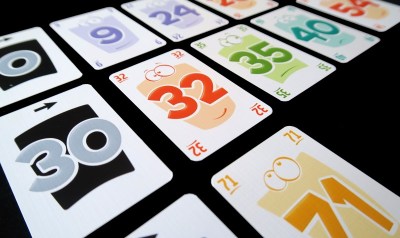
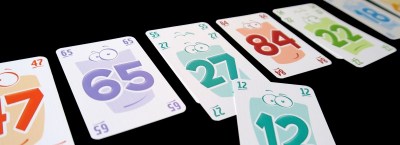
While we were waiting for  food to arrive, we decided to play a quick game of the “nasty card game we finished with last time“, 3 Sind Eine Zu Viel!.  This is a nasty little variant on one of our old favourites, 6 Nimmt!.  It doesn’t have the simultaneous play and there is a little more strategy or at least, there is more of the same “illusion of control”.  The idea is that there are three rows of cards, zero to thirty, thirty to sixty and sixty to ninety.  On their turn, the active player chooses a card and adds it to the appropriate row.  If there are five cards in the row the active player must pick up cards: if the card added is the highest card in the row, the active player takes the card with the lowest number, otherwise they take all cards higher than the card added by the active player.  The cards all have a colour as well as a number, and the aim of the game is to get as close as possible to two of each colour, while three is one too many…

3 Sind Eine Zu Viel!
– Image by boardGOATS

The rules state that each player starts with eight cards and a face down deck of twelve cards.  After six turns, each player has two cards remaining and restores their hand to eight by taking six from the deck, which happens a total of three times.  The game plays a maximum of four, so there are a number of cards left unused.  We started with three players, Pink, Blue, Burgundy, but then Green & Violet turned up, so we fiddled the rules to make the game play five, by reducing the number of cards each player had in their deck, such that each player would draw six, five and four cards, rather than six each time.  This worked quite well, though Pink felt that it made the game much more difficult to play. The game was quite tight in the early stages, with different players trying different strategies, but in the final accounting it turned out that Pink had more pairs than anyone else as well as both ten point bonuses giving him a sizeable winning margin of twelve, pushing Green into second place.

3 Sind Eine Zu Viel!
– Image by boardGOATS

With the food and the “gaming starter” over, it was time for the main course, our “Feature Game”, Terraforming Mars.  Almost everyone was really keen to play, so, since we had two copies available, we decided to split into two groups and play two parallel games.  This began a big debate about who would play in each group. It made sense for Green and Violet to play in the same group, but Blue wanted to play with Pink as she doesn’t see much of him.  There were also gaming considerations as we wanted to make sure there were people who knew what they were doing on both tables but nobody wanted to move about too much. In the end Black swapped seats with Violet and we were ready to start, though since we were nearly all new to it, we had to go through the rules first.

Terraforming Mars
– Image used with permission of BGG contributor henk.rolleman

The idea is that players take the role of giant corporations, sponsored by the World Government on Earth, to initiate huge projects to raise the temperature, the oxygen level, and the ocean coverage until the environment on Mars is habitable. Players then buy project cards into their hand and later, when they have the resources needed, they can play the cards and ultimately place tiles on Mars itself.  There are three different types of cards:  Red cards provide actions that have an instant effect and are then discarded until the end of the game; Green cards have a one-off effect but their “tags” are retained, and Blue cards have an ongoing effect and/or an action that can be activated once per round.  It is building these card combinations that is the interesting part of the game, but also the part that some players struggle most with.

Terraforming Mars
– Image used with permission of BGG contributor punkin312

Each round (or Generation as they are called in the rules) begins with drawing four cards.  In order to keep these cards, players must pay three M€, the currency used in the game.  Next, players take it in turns to carry out one or two actions and continue to do so until every player has passed.  At the end of the round everyone gets resources according to their Terraform Rating and production ability.  Everyone starts with the same Terraform Rating which increase when players raise one of the three global parameters (temperature, oxygen level, and ocean coverage) – this forms the basis of players’ end game scores as well as their income at the end of each Generation.  Each player also has their own production track for the six key resources, M€, Steel, Titanium, Plants, Energy, and Heat.

Terraforming Mars
– Image used with permission of BGG contributor henk.rolleman

Each resource has a primary use in addition to any uses that project cards may make of them.  For example, M€ are generally used to buy cards into players’ hands and then to pay to activate them.  On the other hand, Steel and Titanium can be used to activate specific types of cards in place of M€; although they can be much more efficient than the currency, their use is much more restricted.  Plants can be used to provide greenery on the surface of Mars which in turn gives oxygen.  Energy can be used by in conjunction with projects and all residual energy is turned into heat at the end of the round which in turn can be used to warm the planet.  The guts of the game are the actions. Players take it in turns to carry out one or two actions and continue carrying out actions until every one has passed. In this way, players can ultimately have take as many actions as they like, though they will be limited by the resources they have.

Terraforming Mars
– Image used with permission of BGG contributor punkin312

The actions are:  play a card, paying any costs and carrying out any associated actions if appropriate;  use the action on a Blue card played previously, or carry out a standard action.  The standard actions mostly involve paying for things at a very high rate.  Typically it is much more efficient to do these actions by playing cards, however, sometimes it is worth paying the inflated price because of the way the actions combine.  In the introductory game, every player starts with the same amount of money and project cards, however, despite the lack of experience, both groups decided to play with the Corporation cards. These have delightfully imaginative names like, “Interplanetary Cinematics” (Green), “Inventrix” (Violet) and “Republika Tharsis” (Burgundy). These potentially give players a bit of a steer as to what project cards to buy and later, hopefully, play. With almost everyone new to the game (though several had struggled to read through the rules), it was a steep learning curve that started straight away when we had to choose which cards to pay to keep from our starting hand of ten. This is one of the big challenges of the game as keeping cards costs money and money is scarce.

Terraforming Mars
– Image used with permission of BGG contributor henk.rolleman

Ivory (who had played before, albeit solo) got his table going first, but fairly quickly, they discovered it was generally better to do one action at a time, unless a second relied on a first and there was a chance it might not be possible to play it if someone else got there first.  This was slightly counter to the other table where players started out trying to take both actions, though they also quickly decided that since the last player can keep going at the end, sometimes it is better not to force that second action.  One standard action is to claim a Milestone.  Claiming these costs M€, but can be a good way to add points.  Players can also pay to activate Awards which will give points to the most effective players in certain fields. On Ivory’s table, the Milestone and Award points were fairly evenly spread and it was the Terraform Rating that had the largest influence on the placings, with Ivory finishing three points ahead of Green.  On the other table, the opposite was true with players’ Terraform Ratings very even and Milestones as the key battle-ground.  Burgundy just pipped Blue to almost all of them so she countered funding a couple of awards and winning them.  It was the cards that made the difference though, and Blue picked up a massive fourteen points leaving her seven points clear.  The battle for second was more interesting though, with Burgundy and Pink finishing level.  On reflection both players felt they had missed scoring points on the table with Pink certain he had forgotten to add to his Puppy Farm on at least one occasion.  We let the points stand though and Money-Bags-Burgundy took second on the tie-break.

Terraforming Mars
– Image used with permission of BGG contributor bkunes

We all felt that the game has high potential for “Analysis Paralysis”, particularly at the beginning, in deciding which cards to keep (a problem made worse for on the first play which is why the Beginner Corporations give players ten cards drawn at random). The game could be won or lost on decisions about which cards to keep.  Miscalculations like paying for that extra card that then didn’t leave enough money to play that one really important card that had been saved for can also prove critical.  There were some nasty actions, too.  For example, Green got caught out in his penultimate turn when two of his plant cubes were snatched which left him short of plants to terraform a tile.  Thus he was unable to gain the additional Steel he needed to pay for the next card he was planning which would have given him more plants for another end of game terraforming tile, as well as extra points.  Since this happened to Green just before his turn, he then spent far too long trying to work out whether he could still do it a different way and if not, then what should he do instead!

Terraforming Mars
– Image used with permission of BGG contributor henk.rolleman

The game is full of such enjoyable but difficult decisions, which perhaps explains why it has been the subject of a lot of chatter online, culminating in its recent nomination for this year’s Kennerspiel des Jahres.  It also explains why everyone was concentrating so hard that nobody could really remember what they had been trying to do, what had worked and why.  All that said, the game is a long way from being perfect and bears a lot of the hallmarks of a crowdfunded game, with very difficult rules and variable production values (some over-produced pieces while others could be improved).  In actual fact, the game was originally produced by the Swedish company, FryxGames, a small family run company primarily consisting of four brothers with the rest of their substantial family helping in designing and testing, illustrating and translating.

Terraforming Mars
– Image used with permission of BGG contributor henk.rolleman

Although the rules are very difficult to get to grips with and arguably could be better written, the folks at FryxGames have made some exceptional online teaching material available.  One of the other not insignificant issues is the number of small cubes on the individual player boards.  These mean that it is pretty much guaranteed that at some point the table will take a bump and everyone will have to try to remember where everything was.  Unfortunately, these issues and the difficulty producing the game in sufficient quantities to supply the demand it would lead to, probably mean Terraforming Mars won’t actually win the Kennerspiel des Jahres.  We mostly really enjoyed it though, and almost everyone was keen to give it another go.  In fact only Purple wasn’t keen on playing it at the start with and playing it probably didn’t really change her mind, as it’s just not really her sort of thing.

Terraforming Mars
– Image used with permission of BGG contributor punkin312

Learning Outcome:  Difficult decisions almost inevitably lead to Analysis Paralysis, but sometimes it is worth it.

16th May 2017

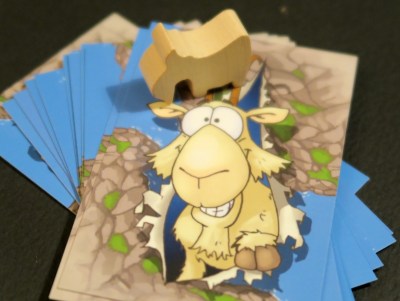
Since Red had been hankering after playing the “Feature Game” for a year or so, the first thing we had to do was work out who was going to play it.  With Burgundy starting his pizza, and Red and Blue’s still to come, we decided to play something to keep Pine occupied while we waited to see who else was coming.  We were just setting out Bokken Schieten (aka Ziegen Kriegen) when Purple and Black arrived closely followed by Green.  Pine was sure Ivory wasn’t coming, so with two copies of the “Feature Game” to hand, we then began a debate about how to divide the group into two.  At this point, the matter was sort of settled by Ivory’s arrival, so the four player comfortably ensconced at “the wrong table” continued setting up their “goaty game” while the others migrated back to our usual, now vacated table.

Bokken Schieten
– Image by boardGOATS

Bokken Schieten (aka Ziegen Kriegen) is a simple little “push your luck” game, based on Blackjack (aka Pontoon or Vingt-et-Un), but with a moving target.  Thus the idea is to collect cards up to a limit, but exceeding that limit yields a score of zero and the player is “bust”.   So, players choose a card from their hand and play it face up in front of them – the person who plays the highest card takes the trick and with it all the cards played in the round a score equal to the total number of goats heads on the sides of the cards.  Unfortunately, they get to lead again and worse, the player in last place gets to add a card to “Goat Island” and choose whether to contribute the larger or smaller number to the limit.  Burgundy went bust first taking the first two hands, followed by Red.  When Blue dumped a nice large card onto a trick Pine was winning he went out too, leaving Blue to take all the final trick.  The only question was whether she had managed to stay within the limit, but finishing with twelve, and given a limit of twelve she just squeaked in to win.

Bokken Schieten
– Image by boardGOATS

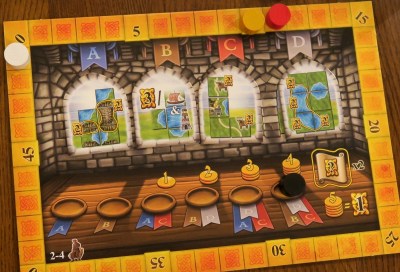
With that done, and the pizzas also taken care of, it was time for Keyflower, the “Feature Game”.  This is one of the group’s favourite games, but has been someone neglected of late.  On checking back, we found it was two years since we last played it, though we had played Keyflower’s little brother, Key to the City – London (released at Essen last year), more recently.  Both games have the same general flow, using the same tile laying and auction mechanism, but with different tiles and resources used in different ways.  The basic mechanism is quite simple, though the resultant game is much deeper.  The game is played over four rounds or Seasons,  with players taking it in turns to bid on a tile, carry out an action or pass.  Once everyone has passed in succession, the round is over, and the tiles are are added to the winning players’ villages.  After four rounds, the player with the most points wins.

Key to the City - London
– Image by boardGOATS

The clever part of the game is that the bidding and actions are both carried out with Keyples (which is what meeples are called in these games).  So, on their turn, the active player can bid for one of the tiles.  If that tile already has a bid against it, then the active player must follow suit by bidding with the same colour and with at least one additional Keyple, thus increasing the bid.  Only winning bids are paid for at the end of the round, with loosing bids are returned to their owner, which is just as well because Keyples are scarce, very scarce.  In fact, losing bids belong to their owner during the round too as players can move losing bids and use them elsewhere adding more Keyples if necessary.  On their turn, players can also activate tiles by placing Keyples on the tile which gives a resource or an action.  These resources are then placed on the tile or, in the case of skill tiles, placed behind their player screen.  There are several different actions available, but one of the key things players will want to do during the game is upgrade tiles.

Keyflower
– Image by boardGOATS

Tiles are double-sided:  when a tile is first added to a village, it has a corresponding action, but upgrading and turning it over will make it more useful.  For example, the Workshop tile gives either one coal, one wood or one stone, but when upgraded gives one of each. Tiles can typically be activated three times each Season, but players must follow colour suit and the cost increases by one each time; tiles can hold a maximum of six Keyples.  One of the more unusual things about Keyflower is that players can activate the tiles in other peoples’ Villages.  This is interesting because the first player to activate a tile dictates the colour for the rest of the round, so if an opponent activates a tile with “the wrong colour” it can make life very difficult for the Village owner.  On the other hand, since all Keyples working in the Villages return home and go behind the owners’ screens at the end of the Season, activating a tile in someone else’s Village is effectively giving them valuable Keyples.  Perhaps one of the most interesting thing about the game is that strategies almost never turn out quite the way people plan.  Other players can innocently make a tile too expensive or even completely unattainable by starting bidding with “the wrong colour”.

– Image by boardGOATS

Also, although the tiles are well balanced, depending on player count, some tiles are not introduced into the game which can make it difficult to get that resource that was essential to a that particular strategy.  This means that players tend to do best by keeping their options open for as long as possible and then trying to bring it all together at the end.  At the start of the game, each player is given some tiles for the final round, Winter and each player can choose which of these they want to make available to the highest bidder.  They can choose as many as they like to introduce, though they must include at least one.  This decision doesn’t have to be made until the start of the final round, so although they don’t direct players’ strategy exactly, they can give people a bit of a general steer.  The first group of players were Green, Black, Purple and Ivory.  Green, Black, and Purple have played Keyflower quite a bit over the years, and although Ivory was new to the game, he had played Key to the City – London, which has a lot of similarities.  This made the group quite experienced, but that is certainly no guarantee of success in Keyflower.  And how many points make success, was something Ivory asked before they started and received the reply from the other side of the room, “Over a hundred!”, to which, everybody laughed.

Keyflower
– Image by boardGOATS

Spring is the Season for resources, and Purple led the way by picking up the Key Mine, Key Wood and Keystone Quarry tiles providing coal, wood and stone.  Although a strong start, sometimes it is easy to get carried away with bidding which can result in a shortage of Keyples for later rounds.  On the other hand, if the tiles are particularly useful, they can prove a valuable source of Keyples when other players are tempted to activate them.  Unfortunately for Purple, Ivory picked up the Workshop and quickly upgraded it making it a much more enticing tile.  Purple’s cause was not helped by Green who was being particularly parsimonious with his Keyples as he had the Craftsmans’ Guild as one of his Winter tiles and was hoping to make it pay at the end of the game.  Useful actions can be a double-edged sword however, as Black found out to his cost when everyone kept activating his tiles before he got the chance, and generally with colours that he did not have.

Keyflower
– Image by boardGOATS

Going into the final round, everyone’s plans were on a knife edge.  Black’s plans fell apart when, after picking up the Stone Yard (which rewards players for getting stone), in a fit of enthusiasm he upgraded his mason tile.  This meant that instead of turning skills tiles into stone, he could now turn them into gold, which is very nice, but was worth about half the number of points to him as well as being a lot more interesting to everyone else.  As Winter progressed, the bidding got more determined and everybody had to fight their corner, but especially Green and Ivory.  Ivory took the boat tile Green was after, but failed to stop Green winning the Craftsmans’ Guild.  Ivory had been quietly collecting skills tiles and squirrelling them away behind his screen, and it was clear why when the Scribes tile appeared at the start of Winter.  Green made his move early, putting in a large bid to try to stop him from getting it, but when Ivory countered, Green couldn’t afford to increase the bid further.  In fact, it wouldn’t have helped if he’d been able to continue, because Ivory had a number of Keyples in reserve, just in case.  And it was those reserve Keyples that clinched it, with Ivory winning with seventy-six points, twenty-one points ahead of Green in second.

– Image by boardGOATS

On the other table, things went a little differently.  While Blue and Burgundy had played Keyflower a lot and it was one of their favourite games, Pine had only played Key to the City – London, and Red was completely new to the game, though she had been hankering after giving it a go for a ages.  In this game, Pine started off very strongly and then proceeded to build a very nicely balanced little village coveted by both Blue and Burgundy.  With both the Miner and the Gold Mine tiles as well as as the Smelter, Pine had access to coal and lots valuable gold and the others felt he only needed a couple of nice Winter tiles to top it off for a really high score.  Burgundy picked up the Keystone Quarry giving him plenty of stone once he had upgraded it.  As it was, Burgundy’s Workshop was in high demand for those who needed timber for upgrading their home tiles, but the almost complete lack of wood in any Village, became apparent when the Timberyard and Sawmill tiles both appeared in autumn and nobody had any wood to do anything with them.  Burgundy’s problems were exacerbated by the shortage of tiles that would give points for stone.

Keyflower
– Image by boardGOATS

Having bid for a lot of tiles in the opening round, and won none Blue was left trying to make a silk purse out of a sow’s ear and cobble together a score from the Apprentice Hall and the flotilla of boats she ended up with at the end of Spring.  As she was completely new to the game, Red found herself a little overwhelmed by the amount the game gives players to think about.  While the mechanics are fairly straightforward, there are a lot of considerations to take into account when bidding and, unlike the arguably slightly simpler Key to the City – London, getting resources to the right location can be challenging.  Red started off with the Peddler tile in spring, which enabled her to swap yellow Keyples for special green Keyples.  This gave her an early start going for the Key Market Winter tile that she had in her hand (which rewards players for the number of green Keyples they have at the end of the game) with the added bonus that she would be in a strong position to bid with green Keyples if she needed to.

Keyflower
– Image by boardGOATS

Despite having a fair idea what people had, somehow the Winter tiles were still a bit of a surprise and the scrap began as players tried to make they didn’t lose out.  With the other game finishing first, the others came over to spectate and see how their game had compared. Burgundy got his Craftmans’ Guild tile and, tried to stop Blue picking up both the Key Guild and the Scholar, but with both in the game, it was odds on that Blue would get one.  In the end she managed to take both and having a huge pile of skill tiles to go with them gave her a healthy number of points.  Pine took the Keythedral and decided to fight for his choice of end game boat tile, taking the Keyflower tile giving him points for his transport abilities.  As everyone was a little short on Keyples except Blue (largely thanks to having not spent any on bidding during the game) was also able to pick up the Village Hall (and score points for the large number of Red Keyples she had amassed) as well as picking up sixteen points for her sizeable river.  These gave her a total just shy of that magic hundred, and thirty-seven points ahead of Pine who’s lovely little village gave him an excellent second place.

Keyflower
– Image by boardGOATS

With the other group not staying to watch the packing away, Pine, Burgundy, Blue and Red felt they needed something quite quick and fun to lighten the mood before bed, indeed a bit 6 Nimmt!-a-like.  With that in mind, we went for 3 Sind Eine Zu Viel!, which has a similar run building and picking up cards element as 6 Nimmt!, but a little more strategy, or at least, an illusion of more strategy.  The idea is that on their turn they play one card from their hand and add it to one of three rows, in its correct numerical order.  If it is the fifth card added to the row (in any position) they have to pick up cards and add them to their collection.  The cards they pick up depend on where the card was added however:  if the new card is the last in the row, the player picks up the first card in that sequence, otherwise they take all cards higher in number.  The cards come in seven different colours; at the end of the game one card of a colour will score one point while two cards will score five, but three will score minus three.  Thus, players are ideally trying to collect two of each colour, but three is one too many…

3 Sind Eine Zu Viel!
– Image by boardGOATS

The first player to have at least one of each colour face up collects an intermediate bonus, which diminishes for players who achieve this feat later in the game.  Players with six or seven different colours at the end of the game receive five or ten bonus points respectively.  Each player starts with a hand of eight cards and a face down deck of twelve cards.  When they have played their hand down to the last two cards, they can draw back up to eight.  This introduces just a little bit of stress during the game, and prepares players for the inevitable stress at the end.  And stress there was a plenty.  Blue had played the game a few times with Pink and found it interesting, however, with four it has added spice, especially towards the end.  Blue picked up the first intermediate swiftly followed by Pine and then Red.

3 Sind Eine Zu Viel!
– Image by boardGOATS

Burgundy is well known for his muttering, but this time he had Pine for company.  In fact, Pine soon surpassed Burgundy, muttering about how nasty the game was.  When it came to the end-game scoring it was clear that he had something to mutter about finishing with almost as many negative points as positive ones and he was only saved from the ignominy of a negative score by the intermediate bonus he had collected.  Perhaps she was too tired to moan or maybe she didn’t feel the need, but Red quietly just got on with the game and, with perfect timing, took the full ten point bonus at the end of the round.  With Burgundy doing the same, it was close at the tome, but Burgundy just sneaked in ahead of Red, finishing five points clear with forty-seven points.

3 Sind Eine Zu Viel!
– Image by boardGOATS

Learning Outcome:  It may be Nasty, but “The Nasty Game” is Good Fun!

7th March 2017

This week we had a very late start, largely thanks to Blue falling asleep, Green debating whether he was coming alone or not, and a wine tasting evening at The Jockey which resulted in an unexpectedly long queue for food.  Then there was the inevitably long discussion about what to play.  Eventually, we split into two with the first group playing the “Feature Game”, Citrus.  This is a fairly simple tile laying game with a surprising amount of depth.  The game is played on a  fifteen by ten board, sprinkled with a small number of rocks spaces, a similar number of special landscape tiles, four Fincas and ten Finca sites with three of them prepared for building.  On their turn, the active player has two options, build or harvest.  If they decide to build, they take tiles from the market, paying for them with Pesetas and adding them to the board either expanding an existing area occupied by one of the active player’s workers or beginning a new area. If a new area is established, the active player claims it for their own by placing a worker on it.  Instead of building, the active player may harvest one or more of their areas, which awards them with points and income.

Citrus
– Image used with permission of boardgamephotos

There are a number of clever features which make the game interesting.  Firstly, each player has a maximum of five workers who live in their hacienda until they have been placed.  Income received from harvesting depends how many workers are in their hacienda after they complete their harvest.  For example, if a player has no workers in their hacienda, and on their turn harvests one plantation, they receive two Pesetas. If they chose to harvest another plantation on their next turn, this would then give them a second worker in their hacienda giving them an extra four Pesetas – a total of six Pesetas over the two turn.  Alternatively, they could have harvested both plantations in the first turn, but this would only yield a total of four Pesetas.  Each player has a limited maximum amount of twelve Pesetas, followed using a money track on the bottom of their hacienda player board.

Citrus
– Image used with permission of BGG contributor Toynan

One of the most novel parts of the game is the market.  At the start of the game, twelve tiles are placed on an asymmetric grid consisting of rows of two, three and four tiles.  On their turn the active player chooses a row and and takes the tiles paying one Peseta for each one.  If, after take plantations from the market, there are three or fewer plantations remaining there, the active player must immediately build a new Finca before restocking the market.  They draw the top Finca tile from the stack, choose one of the three building site tiles on the game board, replacing the tile with the new Finca.  This building site tile is removed from the game and a new one drawn from the stack, and placed on the matching space on the game board ensuring that there are always three building sites.  Since the Finca tile is placed on a building site of the active payer’s choice before they place their plantation tiles, timing a purchase to take this opportunity is a key part of the strategy of the game.

Citrus
– Image used with permission of BGG contributor punkin312

There are also a small number of tile placement rules:  new plantations can be created by placing the tile orthogonal to a Finca, on a road, or tiles can be added to the active player’s preexisting plantations.  Each plantation started next to a Finca must be of a different colour.  Tiles cannot be placed over rock spaces, nor can they be placed so they force a merger with another players plantation of the same colour.  Merging with a vacant plantation is not allowed if it is larger than the one belonging to the active player.  When a Finca is completely surrounded (all 8 spaces around it are  occupied), it is scored and the Finca tile is flipped over.  Each Finca depicts two scores: the number of tiles from all plantations adjacent to the Finca are counted and the player who owns most gets the higher score with the second placed player getting the lower number.  Players can also place tiles on spaces occupied by landscape tiles taking the tile which can give special actions or extra points.

Citrus
– Image used with permission of BGG contributor William Hunt

Importantly, all players involved retain their plantations and their workers remain on the board.  This means that large plantations that spread to several Finca’s can be highly effective scoring multiple times and when their reach has been exhausted, the they can be harvested yielding large amounts of points.  Thus, one of the cleverest parts of the game is the aspect of timing: understanding when a plantation has exceeded its usefulness and is ready for harvest, making sure that all large plantations are harvested before the end of the game is key., and our game was no  exception.  It was very cagey at the start with everyone playing for position, but nobody keen to start finishing off Fincas as it was guaranteed to give someone else points.  Eventually, players were forced to complete Fincas as they needed to be able to get cash and to do that, they had to harvest.  Pine took a substantial lead and soon Blue and then Purple left Burgundy far behind with nothing.

Citrus
– Image used with permission of BGG contributor punkin312

Eventually Burgundy got off the mark, but it became something of a running joke how Burgundy was at the back and we were all waiting for some incredible move.  In the end it didn’t really happen like that, but he did gradually bring himself back into contention.  Blue was convinced Pine had it as he had a very large lime plantation that gave him a lot of points as covered a lot of ground connecting several Fincas together, and would give even more when he harvested it.  Everyone made lots of mistakes, taking workers off when they shouldn’t have etc., but some were more costly than others. The game ends when the last plantation tile is bought and placed, so the end of the game, like the beginning was quite cagey with everyone trying to maximise the number of points they could get, and make sure they could harvest as many of their remaining plantations as possible.  In the end it was a very close game, but Pine had not picked up any “Wild Horse” tokens, which proved costly with Blue pushing him into second place in the final scoring.  It was the tussle for third that was tightest though, with Purple just managing to fend off Burgundy.

Citrus
– Image used with permission of BGG contributor punkin312

Meanwhile, on the next table, Black had joined Green and Ivory in a game of Fresco.  This is a game where players are master painters working to restore a fresco in a Renaissance church.  Each round begins with players deciding what time they would like to wake up for the day. The earlier they wake up, the earlier they are in turn order, and the better options they get.  However, if they waking up early too often, the apprentices become unhappy and stop working as efficiently. Players then decide their actions for the turn, deploying their apprentice work force to the various tasks:  buying paint, mixing paint, working on the fresco, raising money to buy paint by painting portraits, and even going to to the opera to increase the apprentices’ happiness and inspire them. Points are scored mostly by painting the fresco, which requires specific combinations of paints.  For this reason, players must purchase and mix their paints carefully and beat the other players to the store to buy the pigments and fresco segments they would like to paint.

Fresco
– Image used with permission of BGG contributor jsper

Green was keen to play with the third and final expansion module (that comes with the base game), and Ivory and Black were happy to give it a go.  This expansion uses the additional paint splodges on the back of the completed paint tiles of the fresco.  If a player gets thee identical splodges (or any three random colours, or indeed even no colours), he can “exchange” them for a Bishops Favour bonus tile.  This reduced his income, but does give an additional paint cube as well as bonus points.  Although Green went first (after a random selection from the bag), he chose to get up later, with both Black and Ivory getting up earlier. Therefore Ivory got first pick in the first round. He hadn’t played it before, but quickly realised that a key aspect of the game is getting the good paint from the market before anyone else can take them.  He combined this strategy with regular trips to the theatre (to make up for his early rising) and portrait painting (to fund his market purchases).

Fresco
– Image used with permission of BGG contributor ckirkman

Unfortunately this strategy left Ivory with fewer apprentices to mix paints and paint the fresco, so he spent most of the game behind Black and Green on the score track. This meant he regularly had first dibs on the alarm clock and could have changed strategy whenever he chose.  He eschewed the Bishops favours for most of the game, favouring the income over the bonus points and “free” paint.  Green used his late rising to grab whatever he could from the market cheaply and paint whatever he could of the fresco, using his spare cash to move the bishop to more favourable locations.  The tiles he accumulated he was able to gain income from , meaning he was never short of cash to buy what he could. The regular painting in the church meant he gained tiles early on and was able to be the first to exchange them for the Bishops Favour, and he maintained a modest lead through most of the game.  Towards the end of the game, Green was able to grab that early morning slot, buy the expensive quality paints he really needed and paint three high value tiles in one turn. This brought about the last round, but he had few resources left to do much in it.

Fresco
– Image used with permission of BGG contributor Toynan

Black played a canny game of “piggy in the middle” most of the time, and was able to get a good turn over in paint, mixing and fresco painting.  He kept pace with Green on the Bishops Favours, gaining the valuable three purple one for ten points and free purple every round (purple being the hardest colour to get as normally it can only be mixed from red and blue).  In the final round, Ivory went first, choosing to mix for some final alter painting.  This left two tiles in the church (either side of the bishop), which left them available to Black along with a three big colour alter job which pushed him ahead of Green.  Green, going last, had little paint and only managed a big alter painting, but it wasn’t enough and he was still four points behind Black.  Converting the remaining money into points, Ivory added a massive ten points to his tally, but with twelve and thirteen coins respectively, Black and Green were equal, picking up an additional six points each giving Black a well deserved victory.  In the final game analysis we decided we enjoyed the Bishops Favour and Black felt it was better than the extra colours expansion.  Green still felt the portrait cards were best, but combining both could make for a very interesting game, one for next time perhaps.

Fresco
– Image used with permission of BGG contributor jsper

With both Fresco and Citrus finishing at much the same time, Ivory and Green went home leaving everyone else to shuffle chairs and decide what to play next.  There wasn’t a huge amount of time and nobody was terribly keen to play anything too “thinky”, so it wasn’t long before Las Vegas came out.  This is a strange game which has masses of downtime, yet seems to get played every time it is brought.  Part of this is probably because it falls into that category of being a game nobody minds playing although, few would say it was a game they actively want to play.  In truth, it is almost more of an activity than a game really, but we find it quite relaxing towards the end of the evening.  The game itself is a very simple betting game.  Players begin their turn by rolling their dice and then assign some of them to one of six casinos (one for each dice face) each of which has a jackpot drawn at random from a deck of money.  Players must place all the dice displaying one number to bet on the casino of that number, and when done, play passes to the next player.

Las Vegas
– Image used with permission of BGG contributor ckirkman

Once everyone has placed all their dice the player who placed the most dice on a casino takes the highest value currency card, with the person in second place taking the next and so on. The really clever bit is that before any money is handed out, any “draws” are removed.  This leads to a lot of barracking when dice are played as opponents try to encourage the active player to choose their favoured option.  As usual, we included the Big Dice from the Boulevard expansion and the Slot Machine mini-expansion from the 2015 Brettspiel Advent Calendar.  The large dice are double weight and count as two in the final  reckoning.  The Slot Machine acts like a seventh casino, except that it can hold dice of any number, but dice of each number can only be added once (though a player must add all the dice they have of that number).  Since we play the game unusually slowly, we generally stop after just three rounds rather than the four recommended in the rules.  This time, the game was tight between first and second, but Purple just pipped Pine to the post, winning by $10,000.

Las Vegas
– Image by boardGOATS

We were almost out of time, but there was perhaps time for something quick.  Since Pine had expressed dismay at missing the “Feature Gamelast time, we decided to give Bokken Schieten (aka Ziegen Kriegen or Cliff Hanger) a quick go, as “it really does only take ten minutes to play”.  It turned out that Black and Purple had also missed out last time, but that didn’t slow things down too much as it is not a complex game.  The idea is that players choose a card from their hand and play it face up in front of them – the person who plays the highest card takes the trick and with it all the cards played in the round.  The player who plays the lowest card plays draws a Goat Island card and places the goat-meeple on one end, choosing which end will become start Goat Island.  The game continues with players playing cards and winning tricks, and the player who plays the lowest numbered card adding to Goat Island, choosing whether to add a large or small amount to the total.  At the end of the game players count the number of goat heads on their cards and the winner is the player with the highest total that does not exceed the sum of the numbers on Goat Island.

Bokken Schieten
– Image by boardGOATS

There were lots of appreciative remarks about the fabulous “goaty” artwork, which features “zen-goat”; “artist-goat”, and even a “bored-goat” (or should it be a “boardGOAT”?).  We started out a little tentatively, but the game as taken by Black who managed to successfully exactly hit the Goat Island target.  Since it really had taken less than fifteen minutes (ten to play and five to explain), since everyone now understood how to play, we decided to give it another go.  As in the first round, Burgundy continued to apply his “winning” 6 Nimmt! strategy, picking up a massive forty-two goat heads.   With a limit of just eleven, however, it was Blue who took the game, with just one head more than Pine.  Much hilarity ensued when Pine, trying to work out how to pronounce Bokken Schieten idly mused wither “kk” in Dutch was actually pronounced like “tt” in English…  On a bit of a roll, with the cards out, we ended up playing a third round.  This one went to Purple, giving her a second victory which made her evening, especially given how thrilled she had been at beating Burgundy in Citrus.

Bokken Schieten
– Image by boardGOATS

Learning Outcome:  A game may take ten minutes, but only if it is played just once…

21st February 2017

We started the evening setting up the card games, The Golden Sails and 3 Sind Eine Zu Viel!, but as more players arrived and time was getting on, we abandoned them in favour of the “Feature Game”, Bokken Schieten (aka Ziegen Kriegen or Cliff Hanger).  This is a game that that arguably should be come the group’s signature game as it is very simple little trick taking card game all about goats.  As the rules were explained, Grey (on one of his rare, but much valued appearances), commented that it was like Blackjack (aka Pontoon or Vingt-et-Un) – i.e. play to a limit, but exceed that limit and you are bust.  The idea is that players choose a card from their hand and play it face up in front of them – the person who plays the highest card takes the trick and with it all the cards played in the round.  The player who plays the lowest card plays draws a Goat Island card.  These have two ends with different numbers on them, so the first “loser” takes a card and places the goat-meeple on one end, choosing which end will become part of Goat Island.

Bokken Schieten
– Image by boardGOATS

The game continues with players playing cards and winning tricks, and the player who plays the lowest numbered card adding to Goat Island, choosing whether to add a large or small amount to the total.  At the end of the game, the total of the four cards that make up the island define the limit and players who exceed that value are out.  The catch is that players are not summing the face value of the cards (which go from one to fifty), instead, a little like 6 Nimmt!, they are counting goats head symbols which have little relation to the face value of the cards.  We played the game twice through, since we made a bit of a mess of it the first time.  After a long discussion about whether completed tricks should be placed face down or not, Red who led first misunderstood and thought the cards were played face down, so that screwed up her first turn and lumbered her with a pile of cards she didn’t want.

Bokken Schieten
– Image by boardGOATS

This led to Grey’s comment that the game was poorly designed as once a player is bust their game is over.  In fact though, the game is so short that effective player elimination doesn’t matter that much and in any case, players who are out can still try to take as many others with them as possible.  After the first hand (taken by Grey), we gave it another try.  By this time, Blue had managed to find out who leads after the first trick so instead of passing the honour round the table, we played correctly and the winner led.  The second game went to Red, and was definitely more fun as we began to see what the aim of the game was and how to screw up other people.  We were just beginning to get the hang of it, but felt we should move on to something else now everyone had arrived.  It was genuinely very quick though, so we’ll probably play it again and it might be worth trying some of the variants too.

Bokken Schieten
– Image by boardGOATS

With such a short “Feature Game” and everyone being far too polite, we spent a lot of time deciding what to play next.  Orleans, Terraforming Mars, Viticulture and Agricola were all on the table, but nobody wanted to commit in case something better came along, or perhaps because they genuinely didn’t really mind and were happy to fill in once those who did mind had made a choice. Eventually, Magenta said she would like to play Isle of Skye and several said they’d be happy to play that if others wanted to play something else.  Ivory on the other hand said he was quite happy to play Agricola (which had been brought with him in mind, then Green walked in, making things slightly more complicated as with nine players one game would have to be a five-player which might make it long.  In the end Red got fed up with people being indecisive and started to direct people:  first she made a three player game of Agricola, then she found two to join Magenta playing Isle of Skye which left Blue, Burgundy and Red to find something else to play, which ended up being Imhotep.

Imhotep
– Image by boardGOATS

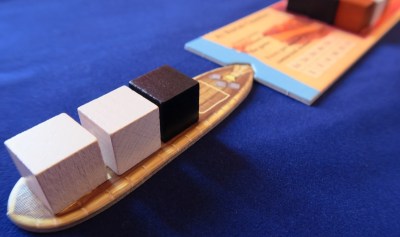
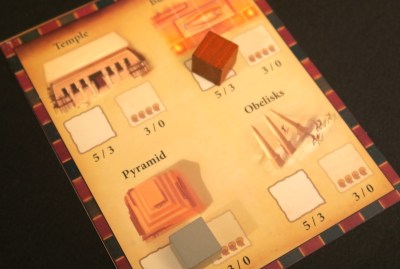
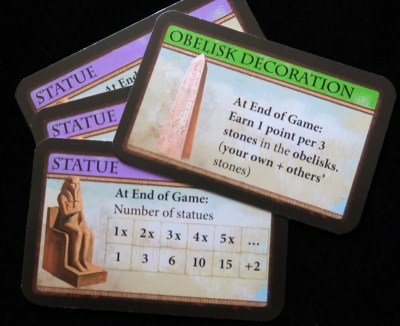
Imhotep is a very simple game that we’ve played a few times since is was nominated for the Spiel des Jahres last year.  On their turn, the active player chooses one of four actions:  procure new stones; load stones on a boat; sail a boat to a monument; or play an action card.  Players can only store a maximum of five stones and when they procure stones they can collect a maximum of three.  Stones are loaded onto ships one at a time, but which of the five possible destinations the boats end up at and the order they are unloaded in is vital, so timing and planning is everything.  What makes it particularly tricky is that the best plans in the world can be crushed by opponents with one small action: when they take a boat to the “wrong place” or “at the wrong time”.  There are four ships and five building locations, so one doesn’t get visited and the round ends when all four boats have sailed.

Imhotep
– Image by boardGOATS

The building locations are double sided so the game can be played with the less complex Side A, the slightly more confusing Side B, or a mixture of the two.  Red had struggled last time she had tried Imhotep since she ended up playing with two people who had tried it before and wanted to play with Side B without fully appreciating how much more complexity it adds.  This time, therefore, we stuck to the simpler Side A, but instead added the Stonemason’s Wager Mini Expansion to give it just a little extra interest.  This little promotional item allows players a one-off, extra option:  the chance to bet on which monument will have the most stones in it at the end of the game.  Otherwise the game is unchanged and there are six rounds in total, as usual, with points scored in different ways for the different buildings; the player with the most points at the end is declared the best builder in Egypt.

Imhotep: The Stonemason's Wager Mini Expansion
– Image by boardGOATS

This time, Blue and Burgundy started out visiting the Market picking up statues, but with both in the same market it was always going to be a struggle.  Meanwhile, Red stole an essentially insurmountable lead in the Obelisks.  Blue took a green card that would yield a point for every three stones in the Burial Chamber at the end of the game, so she tried to encourage boats to go there.  Unfortunately, because she also nearly picked up a significant score on the Burial Chamber, but Burgundy was first forced to obstruct her plans and then Red and Burgundy started sending boats to the Temple instead.  In general, it was quite a cagey game with everyone concentrating on not letting anyone take too many points rather than trying to make a killing themselves.  Going into the final scoring, it was all quite close.  Red took the points for the Stonemason’s Wager, and Burgundy took points for statues, but Blue had a lot of bonus points from a range of sources, giving her first place, ten points ahead of Burgundy in second.

– Image by boardGOATS

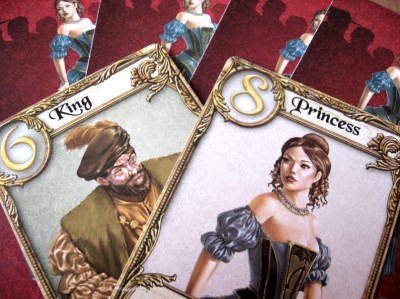
Imhotep finished, but next game was not far behind, so Blue, Red and Burgundy played a couple of quick hands of Love Letter while they waited.  With its quick play, this micro-game is one of our go to fillers.  The idea is that each player has a single card in hand, and on their turn they draw a second and choose one of the two to play.  Each card has an action and a number, one to eight.  Players use the actions to try to deduce information about which cards others are holding and, in turn use that to eliminate them.  The winner is either the last player standing or the player with the highest ranking card at the end of the game.  In the first round, Blue was caught holding the Princess leaving Burgundy to take the round.  The second played out to the final card.  With just two possible cards left and the Princess still hiding, Red took a chance and played the Prince, forcing Blue to discard her hand.  This meant she had to pick up the set-aside card, which was, of course, the Princess, making it a two-way tie.

LoveLetter
– Image by boardGOATS

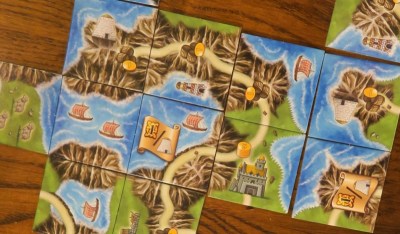
On the next table, Magenta, Purple and Grey had been playing a game of Isle of Skye: From Chieftain to King.  This won the Kennerspiel des Jahres last year, and has proven to be quite popular with our group.  The game is a sort of upgraded tile laying game with a lot in common with Carcassonne, but with the added feature of an auction at the start of each round and scoring at the end of each round.  The scoring is one of the interesting parts of this game as the four scoring criteria change from game to game and, and each one scores three times during the course of the game.  Choosing how to prioritise these to drive a strategy is one of the keys to playing well.  This time, with points available throughout for completed areas (lakes and mountains), this was a clear target, however, identifying a strategy and making it work are two different things.

Isle of Skye: From Chieftain to King
– Image by boardGOATS

For example, Purple was unlucky that she was unable to get any tiles with cows on roads until the final round, which meant she struggled to build a score early in the game.  Although this meant she picked up the bonus money for being at the back, she still struggled to get the tiles she wanted.  Similarly, Grey was unlucky in that he placed a tile that later became an real obstacle making it difficult for him to place tiles later and get points.  It was Magenta though who had been able to build an early lead, and kept it throughout picking up points every round.  A couple of lucky tile draws gave her good tiles that both Grey and Purple wanted making it a sellers market, and leaving Magenta with lots of cash to spend towards the end of the game.  Going into the final scoring, Magenta had a sizeable lead, but Grey had a large pile of cash which yielded a tidy eight points and very nearly gave him the game.  Magenta managed to fend him off though with the one point she took for her remaining seven coins, making the difference between first place and second.

Isle of Skye: From Chieftain to King
– Image by boardGOATS

With the games on the first two tables complete, Red, Magenta and Grey went home leaving Purple, Blue and Burgundy to play yet another in the long running campaign to beat Burgundy at Splendor.  This simple set collecting, engine builder has proved to be quite intractable.  Blue and Pine in particular have had several attempts to get the better of Burgundy, but so far he has just had the edge.  Sadly this this game was no exception, though the game was very, very tight. There was a shortage of Opals cards available, despite the presence of lots of cards needing them.  Emeralds were also quite scarce at the start, but Burgundy managed to build a substantial collection of Diamonds to keep the threat alive.  Blue thought she had finally got Burgundy trapped but in the final round Purple took a card and the replacement was a sapphire that Burgundy could take and gave him eighteen points, one more than Blue (who was last in the turn order).  Yet another very, very close game – we’ll get him in the end…

Splendor
– Image used with permission of boardgamephotos

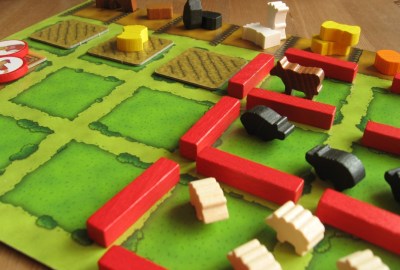
Meanwhile, all evening, Ivory, Black and Green had been engaged in an game of Agricola.  This had started out with an extensive effort to disentangle the cards for the base game from the myriad of expansions Blue had somehow crammed into the box.  Once this was sorted though, and the game was set up, a rules explanation was necessary as Ivory hadn’t played it before.  The archetypal worker placement game, players star out with a farming couple and a shack and during the game try to build up their farmstead, livestock and family, the winner being the player with the most successful farm. Actions available include things like upgrading the farmhouse, ploughing and sowing fields, enclosing areas, taking livestock, and, of course, procreating.  One of the clever parts of the game is that each round, an additional action become available, but the order of these is not known in advance.  The stress is provided by harvests that occur at intervals during the game and require players to have enough food to feed their family, or resort to begging (which yields negative points at the end of the game).

Agricola
– Image by boardGOATS

This time, instead of playing the family game, we played the full version which includes occupation and improvement cards.  The challenge with this game is to use the cards effectively, but not to get carried away and try to force the strategy to use cards to its detriment.  Green started with occupations and used them to quickly fenced a large padock for sheep (building one gave him three extras).  He then ploughed and got three fields up and running before going back to enclosing pasture for cattle. Despite only having two family members, he struggled to have enough food until he eventually managed to nab a cartload of clay and used it to build a an oven, which proved invaluable at keeping hunger at bay.  Towards the end, he finally managed to develop his family and added a pig for a total of twenty-nine.

Agricola
– Image by boardGOATS

Black played a quiet game, also didn’t grow his family and farm developed only slowly too.  As he often does, Black instead concentrated on home-making and upgraded his house to clay and then stone in quick succession.  Somehow he didn’t struggle at harvest time as much as Green, probably because he went into building ovens which provided his food.  This was at the expense of his farm, which remained stubbornly small, right until the end.  The unused spaces cost him though, as did his lack of pigs, and he finished with a fine house, but only one child and a score of twenty-three points.

Agricola
– Image by boardGOATS

Ivory went for a different strategy, starting by going for lots of food, and support for getting food later.  In particular he made good use of his Mushroom Picker.  Building his food engine so early enabled him to grow his family early in the game giving him extra actions.  These he used to quietly collect lots of resources, which enabled him to build a large field for sheep.  He then enclosed second pasture and just swiped a field full for boar before Green got them. He only ploughed late (perhaps it was the snowy landscape that delayed him), but his early food strategy really paid off.  All his extra cards were valuable too and added ten points to his score, giving him a total of forty-one points and victory by a sizeable margin, despite Green’s inadvertent cheating!

Agricola
– Image by boardGOATS

Just as Agricola came to an end, Splendor finished too.  So, after helping to shoe-horn the miriad of little pieces back into the boxes, Ivory and Green headed off leaving Black to join the others.  The ever dwindling numbers were boosted with the arrival of Pine, who had been two-timing us with the WI – he said they had the lowest average age of any WI he’d ever come across, so maybe that was the appeal.  The remaining five gamers felt there was time for one more game, as long as we could keep it to about forty-five minutes.  We are not the quickest at playing, or choosing and time was beginning to get tight, so we opted for Bohnanza as it played quicker than other suggestions and it wouldn’t need any rules reminders (like 11 Nimmt! and Port Royal).  The game is one of our old staples, is quick to learn and keeps everyone involved throughout.  The key to the game is that players cannot rearrange the cards in their hand and must play them in the order they arrive.  Thus, on their turn, the active player first plays the first card in their hand with the option of playing the second if they desire.  Once they’ve been planted, two cards are drawn which can be traded, but must be planted by someone.  This can lead to free gifts, but also players being nasty and refusing to take even the apparently most lucrative trades.

– Image by boardGOATS

This time, Pine was making up for lost time, and the well-known good nature of the WI hadn’t rubbed off.  He accused Burgundy of just about everything he could think of, in an effort to persuade everyone else not to trade with him. Black had one of his worst games for a long time with all the wrong cards coming up at the wrong time giving him nothing to work with.  Otherwise it was a very tight game. In the dying turns, despite Black’s protestations, Purple and Pine both gave Blue exceptionally favourable trades (possibly in an effort to square things from earlier, but more likely to ensure that Burgundy didn’t win – again).  Much to Pine’s surprise, that left him in joint first place with Blue, one coin ahead of Burgundy (possibly the most important factor to him).  Feeling she had been gifted a joint win by Pine’s generosity at the end, Blue offered to concede to Pine, but on checking the rules he won anyhow on the tie-breaker, as the player with the most cards in hand at the end.

Bohnanza
– Image used with permission of BGG contributor spearjr

Learning Outcome:  Cheating doesn’t pay.

10th January 2017

A new year, a new log book, and a shortage of people thanks to sickness, work and problematic cars.  Pine, Magenta and Blue were the first to arrive, so while they were waiting for food they decided to get in a quick game of No Thanks!.  This used to be one of those games that got played a lot, but for some reason it fell out of favour and was replaced by games like Love Letter, 6 Nimmt! and Om Nom Nom.  No Thanks! is a very simple little game where players have to make the binary decision to take a card or pay a chip and pass the problem on to the next player.  At the end of the round, players add the face values of the cards together and offset this with any remaining chips to give their total – the smallest value is the winner.  The really clever part is that if a player has a run of consecutive cards, then only the lowest counts.  Spice is added by the removal of nine cards from the original thirty-two consecutive cards in the deck.

No Thanks!
– Image used with permission of BGG contributor ckirkman

We first introduced Pine to No Thanks! over Christmas, when he had done rather well at it, this time was a bit different, however, with Blue coming in first with twenty-five in a generally high scoring game.  As food arrived, so did the other gamers, with Ivory first and, just as we were explaining the rules to him, Green rolled up as well.  The second hand began with Ivory picking up cards.  As it went on, he picked up more cards, and more and more.  This was excellent for everyone else until it started to look like he might be able to make them into one very long run.  In the end, Ivory’s massive gamble didn’t pay off and he finished with ninety points, a massive  eighty more than anyone else.  It was Magenta who took the round though, her enormous pile of chips offsetting all her cards leaving her with minus one.

No Thanks!
– Image used with permission of BGG contributor punkin312

With food over and everyone who was expected present, we decided to move onto our “Feature Game” will be Jórvík.  This is a Viking retheme of a game we have played a few times and enjoyed called The Speicherstadt.  The game is card based and driven by a novel auction mechanism that somehow doesn’t really feel like an auction.  The idea is there is a row of cards and players use their meeples to bid with.  They take it in turns to choose which cards they would like to have the option of buying, by placing their meeples in rows below the cards they want.  The cards are then “auctioned” in turn with person who who placed their meeple below a card first getting first refusal.  The clever bit is that the cost of the card is the same number of coins as there are meeples below the card.  When it is their turn, the active player can choose not to to buy the card, but then they must remove their meeple which makes it cheaper for the next player in line.   Thus, placing first can be a good thing if you have enough money to back it up, but money is scarce, very scarce.

Jórvík
– Image by boardGOATS

The cards could be contracts (that give points at the end if fulfilled), ships containing goods (that enable players to fulfill contracts), defenders (which help score points if there is an attack of the Picts), craftsmen (which enable players to sell goods for a better price), feasts (which give points the more you have), journey cards (which just give points) or, towards the end of the game, skald cards (which yield points for some other condition).  The deck of cards is broken into several batches which ensures that while cards don’t come out in a  fixed order, early cards are less powerful than cards that appear later in the game.  The basic Jórvík game is quite light, but the new rendition includes the original Kaispeicher expansion.  This provides extra cards, though more importantly, it also adds a whole new mechanism that still has the same flavour, but turned on its head.

Jórvík

The new expansion adds a second method for players to get cards:  at the start of each round a second row of cards are displayed and, instead of using their turn to place a meeple in the auction, they can use it to reserve a card.  This card (and its meeple marker) are then moved to a new row.  At the end of the round, after the cards in the usual “auction” have been dealt with, the reserved cards are paid for in the order that they were reserved.  The snag is that the cost depends on how many cards were reserved after it.  Thus, players who reserve early have the best selection of cards to choose from, but will end up paying if they choose to buy it.  This means that players often end up reserving a card, as much as anything else, to stop the other players from getting it.  This led to Pine commenting that the game was a bit like window shopping with players standing hopefully next to items they had no hope being able to afford!

Jórvík
– Image by boardGOATS

Only two of us had played the game before (mostly in its original form as The Speicherstadt), and nobody had played with the expansion at all.  Everyone tried different strategies, with Magenta trying to collect feasting cards (largely unsuccessfully) and Green beginning by trying to collect defender cards in the hope of being able to scoop up all the points for repelling the Picts.  Ivory, Blue and Pine were slower to settle on a strategy, though Ivory was ominously collecting what looked like some very powerful cards.  Then, Pine began collecting pink resource cubes, the valuable cloth and successfully used them to fulfill a couple of lucrative contracts.  For a long time this looked like it was going to be a winning strategy, until Blue changed tack.  She had started by trying to pick up contracts and fighting with everyone else for resources, but it was gradually becoming clear to her that this wasn’t working.  Although Blue had fallen foul of the Picts in the first round, since then she had been trying to avoid losing points.  This strategy had kept her in the running, and she decided to to actively pursue the points.  In the end she finished with thirty-six points, just three ahead of Pine in second place.

Jórvík
– Image by boardGOATS

Despite winning, Blue wasn’t sure about the expansion.  She felt it added a largely random element that players had no control over.  She felt the that the fact players were reserving cards that only they could buy meant that once someone had selected a card nobody else had a chance to contest it.  The only thing they could do was force the price up.  Green, on the other hand, said he really liked it and thought it was really clever, though he agreed that with five players it probably wasn’t at its best.  In the end, we concluded that it would likely add a lot to two and three player games, which encouraged Blue to get out her copy of The Speicherstadt with Pink to try it with KaispeicherJórvík had taken longer than expected and for Ivory and Magenta it was home time.

Jórvík
– Image by boardGOATS

Living more locally, Green, Pine and Blue had time for a quick game and chose Lanterns: The Harvest Festival.  This pretty little tile-laying game was a Christmas present chosen with the group in mind, so this seemed like a good opportunity to give it a go.  The game is very simple:  players have a hand of tiles and take it in turns to add one to the central “lake”.  Each tile has up to four coloured sections and if the tile is placed in such a way that some of these match the tiles they are next to, the active player gets a lantern card of that colour.  In addition, every turn, each player gets a card that corresponds to the colour on their side of the tile placed.  At the start of their turn, players can make a devotion and trade sets of lantern cards for points tiles.  There are three stacks of points tiles, with values decreasing from top to bottom.  Each stack corresponds to different sets, with one each for three pairs, a set of seven different and four of a kind.  There are also special platform tiles that give players favour tokens.  These grease the wheels a little as pairs can be spent to allow players to swap a card for one of a different colour.

Lanterns: The Harvest Festival
– Image used with permission of BGG contributor punkin312

The winner is the player with the most points once all the tiles have been played.  This means that there are two competing factors, players want to make as many dedications as they can, but higher value dedications are better.  Tile placement was cagey at the start, but before long Green and Blue began making dedications, quickly followed by Pine.  It was Green who managed to maintain the highest frequency of dedications though Blue’s early tiles were generally slightly higher in value.  Frequency was important and his later tiles were also higher value which meant Green finished ten points clear with fifty one.  With bed calling, there was just time to discuss a new idea:  “Monster Games” sessions.  The idea is that as a group we have quite a lot of games that are too long to play on games nights, so the plan is to arrange ad hoc games afternoons in private residences, with the first one planned for 14th January.

Lanterns: The Harvest Festival
– Image used with permission of BGG contributor punkin312

Learning Outcome:  Sometimes it is better to stop others than make a purchase yourself.

1st Movember 2016

Blue and Red arrived first, with Red telling the tale of her exciting weekend.  It wasn’t long before Burgundy, Pine and Green had arrived so, at Blue’s behest, Red began telling it all over again.  She had been part of a teem entered into to a twenty-four hour “jigsaw-a-thon” in Belgium.  The Unofficial World Jigsaw Puzzle Championship is held every year in a place called Hannut and includes teams from all over the world.  This year, there were one hundred and twenty four teams, each fielding four active members at any one time (though as many interchanges as required were allowed).  Each team was competitively “jigsawing” in a little pen, Red explained, and when a puzzle was finished the team involved cheered madly and set off a klaxon.  Red’s team came a very creditable fifty-ninth, which was particularly remarkable as they had primarily gone along to have a good time where other teams took it very seriously and were exceptionally well organised.  Everyone was quite taken with the idea though, so much so that Green suggested entering a GOATS team next year.  It remains to be seen whether that actually happens…

Hannut 2016
– Image from 24hpuzzle.be/flickr.com

Green had his own exciting tales to tell about his visit to Millbrook Proving Ground and Burgundy had been to Wembley to see the season’s last American Football match of the NFL International Series which had turned out to be “a great game for neutrals”.  Consequently, it was gone 8pm before we realised that Black and Purple still hadn’t arrived and nobody knew whether they were coming or not.  Texts followed just as Black and Purple walked in commenting how great the NFL match had been.  Needless to say, we were late starting as we chatted on about that again.  Eventually, we split into two groups, with Green, Black and Burgundy settling down to play the “Feature Game”, Batavia.  Batavia was the Dutch colonial name given to the Indonesian city of Jakarta from the seventeenth century.  Batavia was also a ship of the Dutch East India Company (Vereenigde Oost-Indische Compagnie, or VOC) that was built in Amsterdam, and shipwrecked on her maiden voyage in 1629 off the Western Australian coast.  The game, Batavia, on the other hand, is concerned with shipping commodities from the spice islands in the seventeenth century and features both the city Batavia and the ship Batavia.

Batavia
– Image used with permission of
BGG reviewer EndersGame

Batavia is played over several rounds on a map of Asia featuring the central islands of the spice trade route.  Players are merchants visiting trading posts of the five East India Companies throughout Asia, gaining “majorities”, which earn the right to different commodities, which in turn translate into money that wins the game.  Each round consists of two phases:  an auction phase and a movement phase.  In the first phase, a die is rolled to determine how many cards will be auctioned.  Then, players bid using their promissory notes increasing the bid until everyone has passed with the highest bidder winning the cards and the right to go first.  The interesting part is that the winning bidder does not pay the bank, instead paying the other players by dealing the promissory notes round the table.  This is a very clever balancing mechanism, because it means the total number of promissory notes in circulation remains unchanged throughout the game.  Players who fail to win an auction also have in increased chance of winning the next time, and promissory notes are worth bonus points at the end of the game, giving them an intrinsic value in their own right.

Batavia
– Image used with permission of BGG reviewer EndersGame

One the auction has been completed the auction winner begins the movement phase.  Each player has a choice, they can take two cards or play ship cards and move their merchant figure to get a new trading post counter.  Ship cards can only be played if the active player has, or can can achieve a majority of cards in one of the five trading companies – cards are played into a tableau and the player with the most cards of a particular shipping company gets the corresponding Company Seal which indicates possession of the majority in that company (and can be taken from another player if necessary).  Thus a player with a Company Seal can play any cards they wish, but if they do not have a Company Seal, they must play enough cards to earn the right to get one, and then can play additional cards as well.  In other words, if a player does not have any of the Company Seals, and can’t play enough cards to get one, then they must draw two cards instead.  Once the active player has played cards and has at least one Company Seal, they may move their Merchant figure along the hex-track to a trading post counter that corresponds to one of the Company Seals they own.  They take this tile which represents gaining the matching commodity from that trading post and is marked by placing a wooden Crate in the appropriate warehouse for that commodity.

Batavia
– Image by boardGOATS

Once a player has played their cards and moved their Merchant, they may, if they wish, turn their hex-tiles into points (or Gold).  The commodities on the tiles are of no significance, but the tiles traded must be from different companies; the more a player trades, the better the return, i.e one tile gives one point, but five tiles (from each of the five different companies) yields a massive fifteen points.  There is a catch though, trading is prohibited if the hex-tile just acquired comes from a company that the player already had a counter for.  Worse, trading post tiles cannot be turned into points at the end of the game, which means decisions can be tense, especially towards the end of the game.  There is another catch though.  Every time a ship card is played, the token that corresponds to that shipping company is moved along the Pirate track, as is the Pirate cannon.  When the cannon reaches a certain point, players forfeit all cards that correspond to the shipping company token that has made it the furthest along the Pirate track.  This fulfills many functions, including ensuring the number of cards in play doesn’t become unwieldy and preventing one player from getting an unassailable majority as well as encouraging players to diversify.  The game end is triggered when one player reaches the end of the trading post track and the round is finished to ensure everyone gets an equal number of turns.

Batavia
– Image by boardGOATS

We had nearly completed the set up when we discovered several pieces missing from the box that had been used elsewhere and not returned.  Rather than abandon the game though, we scavenged bits for the company seals and ‘navigator’ pieces from other games, primarily Vasco da Gama (at least some part of that game is being played).  With that sorted, we were quickly under way.  The early rounds of the game were characterised with high dice rolls, meaning that there were a lot of cards available for each auction that both Burgundy and Green paid handsomely for.  While Burgundy and Black made steady progress, laying claim to a few different commodities, Green raced ahead concentrating on just nuts and vases, the two highest valued commodities available in the game at that point. Black, on the other hand, won so few auctions that he had to miss his turn twice, collecting just two cards instead.

Batavia & Vasco da Gama
– Image by boardGOATS

During the early part of the game we discussed the optimum number of trading post hex-tiles to a swap for points.  The more a player trades, the better the return, i.e one tile gives one point, but five tiles (from each of the five different companies) yields a massive fifteen points, but more is correspondingly more challenging.  Burgundy explained that he felt that three was a good number as four was rife with risks of not being able to get one of the two remaining companies available. He stuck to his guns and exchanged after just three chits, while Green and Black both managed a four relatively easily.  Elsewhere in the  game, Cloth and Coffee were conspicuous by their absence, until about half way when Cloth materialised creating a veritable textile market quarter.  Coffee didn’t become available until the second half of the game and two thirds turned up in the final ten spaces, but by then Green was so far ahead of the other two that neither of them stood much of a chance to even get a foot-hold in that particular racquet.

Batavia
– Image by boardGOATS

In the end, although Burgundy had placed more crates overall, he only had the majority in one commodity, while both Green and Black managed the majority in two each. However with Green snatching the most valuable majorities and the end Target Token he was a clear winner. Black, who had seemed to be on the back foot for most of the game, just snatched the bonus for finishing with the most promissory notes (everyone must have been pretty even handed about their assumptions of card values, to finish with almost exactly the amounts we started with).  When Green snatched that final trading post hex-tile, Burgundy and Black were both a long way behind and plans were scuppered, but it did mean they had a reasonable choice to gather a final useful token.  Ironically, Burgundy placed a final crate in Cotton, which removed Black’s majority there. If he hadn’t done that, Black would have beaten Green by one point. It just goes to show that the player to watch out for isn’t always the most obvious one.
Batavia
– Image by boardGOATS

Meanwhile, on the next table, after a short debate about what to play, Blue, Red, Pine and Purple started on Kerala: der Weg der Elelfanten, “the way of the elephant”.  This was one of the games that came back from Essen and, as a light tile-laying game got its first outing last time.  Pine and Purple had enjoyed it and Red had missed out last time so was keen to give it a go.  The idea is that on their turn, the active player draws the same number of tiles from the bag as there are players and then chooses one to add to their display of tiles.  The everyone else takes it in turns taking a tile and adding them to their own display.  Play is mostly simultaneous as players puzzle over where to add tiles according to the fairly simple rules.  Tiles must be placed next to a tile with an elephant on it and the elephant is then moved onto the new tile.  It can be placed in an empty space, or on top of a previously laid tile.  However, a large part of the game is to finish with exactly one contiguous region of each colour (except the player’s own colour which can have two regions) as any extras must be removed and each tile taken away scores minus two points at the end of the game while any missing colours score minus five.
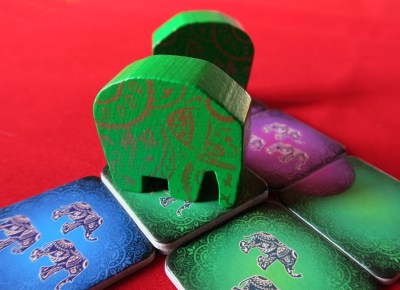
Kerala
– Image by boardGOATS

Blue drew with Black drew last time, thanks to a large number of “apron” tiles which score five points each when placed so that the apron matched the correct colour.  This time, everyone else was wise to how valuable these were and Blue had to fight harder for points.  In this game, positioning elephants and choosing suitable tiles (or leaving everyone else with poor tiles) is everything.  Both Purple and Pine and pine got themselves in a bit of a tangle with multiple regions of the same colour.  For the most part though, by the end of the game they had managed to connect the relevant areas and minimise the number of points lost.  It was Red, playing for the first time who got the best of the tiles.  She was no doubt helped by the fact that Blue (sat to her right), got herself in a terrible tangle and ended up trying to build her way out of trouble by placing tiles on top of others.  The problem was that no sooner had she fixed one problem than another came along, which meant she was more concerned about choosing the best tiles she could for herself than leaving tiles that were difficult for the next players.  Once again, the game finished in a tie, but this time it was Pine and Red who finished in joint first place, nearly ten points clear of the others.

Kerala
– Image by boardGOATS

Batavia was still underway, so the group moved onto a nominally quick little card game, called Fleet Warfside.  Although the game is about the fishing industry and uses the same artwork as the original Fleet card game, the game play is quite different.  The idea is that Wharfside is the sequel, with players buying and selling fish (caught in the original Fleet).  Players begin the game with a handful of fishy goods cards which they can use as currency or trade for points.  In ascending value, the goods cards each represent shrimp, oyster, tuna, swordfish, lobster or king crab.  Thus, two oyster cards are worth more than two shrimp cards and two king crab are worth more than two of anything else.  However, an extra card will always be worth more so three shrimps for example is worth more than two of anything else, even the valuable king crab.  Over-paying is allowed, in fact, it is over-paying that means the game works as, at its core, Fleet Wharfside is a set collecting game, and players need to be able to cover all the bases as prices are constantly changing.

Fleet Wharfside
– Image by boardGOATS

On their turn, players can either carry out a Market action or use the Wharf.  Market action involves buying contract or building card from the face up Market.  The price of each of the four individual cards is set in advance and is given by an indicator card immediately above the contract cards.  When a card is bought, the price of one of the four cards will change as the indicator card is rotated (usually increasing the price).  The Market affected depends on the replacement card drawn.  Instead of carrying out a Market action, players can instead visit the Wharf.  This allows them to do a variety of actions including: use any special abilities that come with the contract cards; assign a maximum of two goods to contracts and store king crab for scoring at the end of the game.  If a contract is completed during this phase, the assigned goods cards are placed on the discard deck and the completed contracts removed from the player’s tableau and placed in their scoring pile.  Bonus points cards are awarded for the first and second contract of each type to be completed.  A Wharf action is finished with a visit to the Wharf where players can take two cards from one of the two pools of face up cards.  There is a hand-limit, but players can choose which cards to discard after they have picked up.

Fleet Wharfside
– Image used with permission of BGG reviewer EndersGame

The game end is triggered when a player completes a set number of contracts and the round completed so everyone gets the same number of turns.  Points are scored for completed contracts/buildings (at face value); stored king crab (at a rate of one per card plus a bonus for the player with the most); contract completion bonuses; the largest set in-hand at the end of the game (one point per card), and the player’s personal Captain Bonus (each player gets a random Captain card at the start of the game which depicts one type of goods and the player scores one point per speciality on their completed contracts).  Blue and Pink played Fleet Warfside on their way to Essen last month, but otherwise it was new to the group.  Although it is a great little card game, it is not really like anything else we’ve played on a Tuesday, and as a result, everyone struggled a bit.   Things were made worse by the fact that nobody really used the ability to over-pay, nor did they use the any two for one, which when judiciously used can speed things a long quite a bit.  When explaining the game, Blue commented that although the goal was to finish contracts, in actual fact it was generally better to try to keep the maximum of three contracts for as long as possible, as each contract has a spacial power and as soon as a contract was fulfilled, its power was lost.  Although this comment was well-meaning, it only succeeded in confusing Pine and Purple further.

Fleet Wharfside
– Image used with permission of BGG reviewer EndersGame

The effect was an endless stream of questions and queries and repeated questions and queries which gave Red a fit of the giggles. The advertised time for Fleet Warfside is twenty to thirty minutes, but although Blue was expecting it to take longer, even she wasn’t expecting it to drag on as long as it did.  The problem was made worse since its sweet-spot is probably three players and with people agonising over what to do and questioning what the options are, the effect was even worse than it was.  Unsurprisingly given that she was the only one to play it before, Blue finished as the winner five points ahead of Red in second place.  Sadly, although it is a clever little game, with this group it was not a great success this time.  Actually, it may be that the more abstract, less visual nature of card games is the problem, since the same people struggled with Port Royal Unterwegs last time and with Oh My Goods! the time before – perhaps something to keep in mind for the future.

Isis and Osiris
– Image by boardGOATS

Since Batavia had finished, Green, Burgundy and Black looked round for something to play that might fill the time while Fleet Wharfside ground on.  Green’s eye fell on Isis & Osiris, a little game that Blue and Pink had brought back for him as a present from Essen.  The pieces  needed removing from their frames and nobody had played it before so there a flurry of rules reading, though in truth it was a simple enough game.  The game comprises elements of strategy and memory.  At the start, players are dealt a pile of tiles, face down, and get a handful of octagonal wooden blocks in their colour.  Game play is very simple: on their turn, the active player can either place a tile face down, first showing it to everyone else, or they can place a block.  At the end of the game, all the tiles are turned face up and players score points for those tiles orthogonally adjacent to their blocks.  The catch is that the tile values range from minus four to plus four (with no zeros), i.e. are both positive and negative.

Isis and Osiris
– Image by boardGOATS

After the inevitable terrorism comments, we started.  The skill in this game is to not only remember where all the best scoring tiles have gone, but also to work out when and where to place your own piece in order to maximise those tile placements: if someone turns up a high negative tile they certain to try to place it next to your piece and away from their own.  While playing we soon realised that a real quandary was when to place the four wooden pieces. Placing them early ensures they are out and gets a large part of the board covered.  Alternatively, waiting until near the end gives a better idea of where the scores are, but leaves less spaces in which to actually get those points. On reflection it seems that it really needs to be a balance, going early or late will probably end up with being boxed out of controlling your own destiny (not that you feel like you have much control normally anyhow).

Isis and Osiris
– Image by boardGOATS

We were unsure what kind of scores we would get. We had the feeling it was one of those game where negative scores would be all too common, and even a single point might be the winning score In the end the scores were a little higher than that at four, five and eight.  Burgundy admitted to forgetting where the scoring tiles were very early, on but still went on to win. It’s not clear what that says about this game, though we would need to play it a couple more times to find out how “random” it really is. With good players with good memories it could be a very challenging game.  Still it did only take the twenty minutes claimed (including set up, explanation and confusion during scoring) which makes it a good filler, which is more than could be said for Fleet Warfside on the next table which was still going.  It was obvious they would be another half hour or so, so with no messing our old favourite Splendor was out of the box and ready to go.

Isis and Osiris
– Image by boardGOATS

In Splendor, players have just three options on their turn:  collect gem tokens, buy a gem card using gem tokens (and/or cards), or reserve a gem card and receive a gold (wild) token at the same time.  Players can have a maximum of ten tokens, though unlimited cards and the cards act as permanent tokens.  Thus, at its heart Splendor is an engine building game built on a set-collection mechanism.  Players score points when they buy some gem cards and for attracting Nobles which are awarded to the first player collect certain combinations of gem cards; the game end is triggered when one player reaches fifteen points and the player with the most at the end wins.  One of the fun things about this game is that, despite its relative simplicity, each game plays differently.  This time it seemed to be a token-heavy game, in other words everyone did a lot of token hoarding, keeping several key colours out of circulation, making progress in a particular colour tricky for everyone.  As a result a number of gold tokens were taken for very lowly cards, several level twos and even a couple of level one cards. Indeed, Black took gold several times for want of anything better to do, since nothing else looked helpful.  The lack of tokens seemed to weigh particularly heavily on Burgundy in the early parts of the game, giving Black and Green a little optimism that maybe this time they might be able to topple him for the first time in four games.

Splendor
– Image used with permission of boardgamephotos

Overall it was a very tight game. Burgundy, in spite of his protestations of having nothing he could do, managed to take the first Noble card. Black quickly got another with a high scoring card, leap frogging him into a strong lead and Green wasn’t far behind in gathering his first Noble.  Burgundy was able to build on his first Noble (one with three cards in each of three colours) by adding just two more cards to give his second Noble and put him within a whisker of ending the game with fourteen points. At this point, Black recognised that this could be his last turn, but he needed two turns to complete his plan. He did the best he could and also reached fourteen points.  Green went next, but his plan worked out just in time, and he placed a reserved card worth three points giving him his second Noble in the same way that Burgundy had and helping him to fifteen points triggering the game end making it the last round.  Unfortunately,  thanks to the turn order, Burgundy got one final turn and it didn’t take a lot of effort to find a way to gather two more points to maintain his Splendor crown, albeit with a warning shot across his bows: next time we’ll get him, maybe.

Splendor
– Image used with permission of BGG contributor henk.rolleman

With Fleet Warfside finally over, Red there was still time one final short filler, and, after a quick discussion, we resorted to our old favourite, 6 Nimmt!.  While Burgundy shuffled, the rest of us engaged in a discussion as to when we last played – after a look through the book, the verdict was July, which only left us to decide whether that was “ages” or not.  We reminded ourselves of the rules:  players simultaneously choose a card, then simultaneously reveal them before playing them in ascending order placing each on the row finishing with the highest card that is lower than the card being played.  When the sixth card is added to a row, the first five are taken and the number of heads contributes to the player’s score, lowest score wins.  We tend to play a variant over two rounds with half the deck in each round and not resetting the table in between which tends to result in a cascade of points in the second round, and this time was no exception.  Black and Burgundy top scored in the first round with zero and one point respectively and nobody else close, setting up a head to head in the second.  Victims of the second round cascade, unfortunately for them, Black and Burgundy both had disastrous second round.  It was Red who redeemed a poor first round to win by one point from Purple and Green who finished in joint second place.

6 Nimmt!
– Image by boardGOATS

Learning Outcome:  Card games are more abstract and sometimes more difficult to understand.

Essen 2016

It is that time of year when, the leaves fall from the trees and gamers visit Germany.  No, Oktoberfest isn’t the draw (that happens in September anyhow), this is an altogether different annual German “festival” – The Internationale Spieltage, which is held in Essen.  To Gamers worldwide, Essen is synonymous with the largest games fair in Europe and, arguably, the world.  The fair runs Thursday to Sunday in mid-October every year and is the one of the largest and most significant of all the boardgame conventions.   As such, many of the manufacturers plan their biggest releases for October with their debut at the Fair.

Essen
– Image from merz-verlag.com

Last year there was a bit of a paucity of new games and it seemed to be all about expansions.  This year, while there are still plenty of expansions for well-loved games like Istanbul, Colt Express, Orléans and Ca$h ‘n Guns etc., there are also a lot of new games based on old favourites.  For example, there is Key to the City – London (which has a lot of elements of one of our favourite games, Keyflower), Jórvík (an update and re-theme of Die Speicherstadt), X Nimmt! (a variant on the popular but chaotic 6 Nimmt!), and the latest incarnation of the Ticket to Ride series, Ticket to Ride: Rails & Sails.  There will be plenty of other interesting original games too though, including The Oracle of DelphiA Feast for Odin, Cottage Garden and The Colonists.  Several members of the group are going this year, and they’ll no doubt bring back lots of exciting new toys to share with everyone.

Essen
– Image used with permission of BGG contributor Gonzaga

23rd August 2016

A little unsure as to who was coming, we decided to start with the “Feature Game”, which was the filler, Abluxxen (also known as Linko!).  This is a “get rid of all your cards” type of game, and although it is initially a little confusing to understand, it mostly became clear as we played.  On their turn, players play any number of cards as long as they are all the same. The cards are then sequentially compared with the last cards played by all the other players:  if the number of cards played is the same, and the face value of the cards played is higher, then the other player’s cards are “snatched”.  They can either be “snatched” by the active player (the “snatcher”) who takes them into their hand, or alternatively the “snatchee” has to do something with them.  The “snatchee” can either choose to take them back into their hand or discard them.  If they decide to discard, then they must replace the cards with the same number from the face up display in the centre or drawn blind from the draw deck.

Abluxxen
– Image by boardGOATS

Thus, the idea is that players are trying to get rid of cards and force other players to pick cards up, however, picking up cards an also be a good thing as it can be an opportunity to improve the cards in hand.  Better, having a lot of identical cards in hand means that when they are played they go on top of any cards previously played making it more difficult for anyone to “snatch” them or force them to be picked up.  The game ends when either one player runs out of cards or the draw deck and central pool has been depleted.  Just to add to the the confusion, however, the winner is then the player who has played the most cards, but any cards left in hand give a penalty of minus one.

Abluxxen
– Image used with permission of BGG contributor punkin312

Although it was a simple game and everyone knew what they had to do, at first nobody really understood what they had to do to win.  Gradually people began to work it out though, starting with Burgundy who had watched a video of the game online, then Ivory who was new to the group, but had played plenty of games before.  Pine and Blue eventually joined the “in the know” club, but Red continued to struggle.  Every time it was her turn, Red said, “Sorry, I know I keep asking, but if I play two sevens what will happen?”  Despite this apparent lack of understanding, Red was the first to check-out and with a huge pile of cards too.  This was particularly amusing as Red had just been explaining to Ivory that he shouldn’t believe Burgundy and Blue when they claim to be doing badly or have no idea what they are doing as they usually go on to win.  Inevitably then, although most people were only one or two turns away from finishing, Red was miles ahead much to Burgundy’s chagrin as he needed just one more turn and was left with six cards in hand compared with the seven in his pile.  Blue who had just played seven “fives” and had only a couple of cards in-hand was second, just ahead of Ivory and Pine.

Abluxxen
– Image used with permission of BGG contributor punkin312

Black and Purple had walked in just as Abluxxen started, so amused themselves reading game rules and trying to work out what everyone else was doing.  Abluxxen had taken a little longer than expected so with everyone present and a group of seven, we decided to split into two.  Red was keen to play Niagara, a really unusual game with a moving river.  It won the Spiel des Jahres in 2005 and still holds up as a good family game more than ten years on.  The group has played it before, but in summary, players have two boats that they move up and down the river, trying to collect gems and return them home, to the top of the river.  There are a couple of catches.  The first is that each player has a set of Paddle Cards and must play each one once before they can play any of them again.  These Paddle Cards dictate how far they can move on the river, but can also affect how much the river will move.  Paddle Cards are selected simultaneously at the start of the round, so there is an element of programming involved, though not as much as in games like Colt Express or Walk the Plank!, but it does mean there is an element of anticipation.

Niagara
– Image used with permission of BGG contributor Marsh

The second “catch” is the river.  The river flows after everyone has moved their boats and the rate is dependent on the lowest Paddle Card played in the round and the weather.  Each player has a weather Paddle Card, which they use to speed up or slow the river down, however, as this has to be played instead of moving boats, this can be a trap for the unwary.  In the worst case this can lead to the loss of a boat and its contents with a penalty to get the boat back.  The game ends when one player fulfills one of three criteria:  four gems of the same colour, one gem of each of the five colours or any seven gems.  Gems are limited, and this leads to the third “catch”, which is that once a player has picked up a gem and has it safely in their boat, another player can steal it so long as they are paddling up stream and land on the same river segment.  So a nice little game with a nasty edge.

Niagara
– Image used with permission of BGG contributor erfalucho

Red was joined by Pine, Ivory and Burgundy in what was to be a very close game.  With four players, each boat should only hold one gem at a time, but a minor rules malfunction meant that everyone played with the double boats from the Spirits of Niagara expansion.  Red and Burgundy took full advantage of this collecting the difficult blue and pink gems first and in one trip.  It quickly became clear that five unique gems was going to be difficult so everyone went for the slightly easier seven random gems.  Pine was the only “proper adventurer” exploring the limits of the river.  Misinformed by Burgundy with respect to the effects of the weather, Pine become intimately acquainted with the waterfall, turning one of his boats to matchwood, but he was the only one to experience the long soggy drop.  Otherwise, the weather was fairly muted and everyone was fairly close to getting a full set of gems when Red, kicking on from her successful start got her nose over the line first, finishing with a total of eight gems.

Niagara
– Image used with permission of BGG contributor William Hunt

With Niagara done, the group moved onto Splendor.  In this game, players have just three options on their turn:  collect gem tokens, buy a gem card using gem tokens (and/or cards), or reserve a gem card and receive a gold (wild) token at the same time.  Players can have a maximum of ten tokens, though unlimited cards and the cards act as permanent tokens.  Thus, at its heart Splendor is an engine building game built on a set-collection mechanism.  Players score points when they buy some gem cards and for attracting Nobles which are awarded to the first player collect certain combinations of gem cards; the game end is triggered when one player reaches fifteen points and the player with the most at the end wins.

Splendor
– Image by boardGOATS

Despite being a very simple game, it is one we still enjoy as a relaxing little filler.  Indeed, it got an outing last time when Blue succeeded in snatching defeat from the jaws of victory when Burgundy came steaming through from nowhere to win.  It could have been this, or perhaps it was previous alleged trouncings that inspired Blue and Purple to let out an emphatic war cry from the neighbouring table exhorting everyone to stop Burgundy at all costs.  So, Burgundy did lots of sighing as everyone rallied to the clarion call and went out of their way to bring him down.  Pine had been one of the victims last time and, understanding his likely fate commented that he wished he could record all of Burgundy’s deep sighs and general moaning and then play it back to him when he won.

Splendor
– Image used with permission of BGG contributor henk.rolleman

The tactics appeared to be working, however, as about half way through, Pine had eight points as Burgundy took his first.  It wasn’t long before Burgundy took the first Noble too, but he was still some way behind and nobody was terribly concerned.  Meanwhile, Ivory was quietly building his engine taking lots of freebees, looking like the new threat.  Red was enjoying herself hoarding rubies just to annoy Burgundy even though she was well aware that it wasn’t actually doing her any favours.  Then suddenly, Burgundy took his second Noble and the writing was on the wall:  everyone knew they were doomed.  It wasn’t long before Burgundy took his third Noble and nobody had an answer as he repeated the trick he’d pulled off so successfully last time winning from the back of the pack.

Splendor
– Image used with permission of BGG contributor henk.rolleman

Meanwhile, on the next table Black, Blue and Purple were engaged in a slightly protracted game of Castles of Burgundy.  This is a game we’ve not played before with the group, though Blue had played it a few times as a two player game and Black had played it quite a bit online.  It is one of those games with fairly simple mechanics, but a lot of complexity in the game play.  The idea is that each player has two dice which they roll at the start of the round.  On their turn they then spend the two dice, trading them for two separate actions.  Players can take a building from the pool on the central player board that matches the number on their die, for example, if a player rolled a six, they can take any of the buildings in the “six” poll and place it in their own supply.  Their supply is limited in size and there must be space for them to be able to do this.

Castles of Burgundy
– Image by BGG contributor thatmadgirl

Alternatively, the player could take a building form their supply and place it on their personal player board on a space that matches both the number of the die and the colour of the building.  Both of these actions are quite restrictive, so players can instead choose to collect two worker tiles and add them to their store.  These worker tiles are the oil that greases the wheels a little, since they allow players to alter one of their dice by one for each tile used (e.g. spending two worker tiles will allow a player to change a five to a three or a one).  The last action is selling goods.  Players can acquire goods tiles during the game, but can only store three different types.  each of the six types correspond to a different number and, on their turn, as an action players can sell all their goods that correspond to the die (modified by workers if they choose).  In return they get a silverling and some points.  Silverlings are a form of currency and can be used to buy one extra building per round.  These are taken from a special pool, though there is nothing particularly special about the buildings themselves except that they are harder to obtain and therefore are generally only taken by players that really want them.

Castles of Burgundy
– Image by BGG contributor verminose

Points is what the game is all about, and being a game designed by Stephan Feld, there are lots of different ways to get them.  Although the actions within the game are simple, how points are achieved is where the complexity of the game really lies.  Each building placed on their board gives the active player a bonus.  Sometimes it is a bonus action, sometimes it is bonus points and sometimes it is a strategic advantage; it is the player that makes the most of these bonuses that will win the game.  Players then also score points for placing buildings to complete regions on their own board.  The larger the region, the more points they get, however, there are also bonus points for completing regions early.  Extra points are also available to the first players place the maximum number of each type of building in their province.

Castles of Burgundy
– Image by BGG contributor 3EBC

Black, by far the most experienced, began by investing in the special buildings that give one off strategic bonuses (e.g. an the opportunity to place an extra tile or take another from the central board).  Blue began without a strategy and, as is her wont played very tactically, without a real strategy and see what unfolded.  Purple, on the other hand, went for animals early.  These give points, but in an unusual way:  every time an animal tile is added to an area, all the other animals of the same type score again.  Blue picked up four pigs in the first couple of rounds, then added two, then three then another four more, and before long she was following Purple down the animal route.  Their strategies were very different, however, with Purple taking anything she could get while Blue was much more targeted.  So, as Blue went heavily into pigs, she was able to keep re-triggering their scoring building a tidy number of points.  Purple could have made up for with the yellow knowledge tile that rewards players with four points at the end of the game for each different sort of animal they have, but Blue had her eye on it too and got there first.

Castles of Burgundy
– Image used with permission of BGG contributor kilroy_locke

While Blue and Purple were engaged in a agricultural battle Black was able to continue with his plan pretty much unchallenged.  So he moved into shipping and completed lots of areas picking up the corresponding bonuses.  Purple took the bonus for finishing the farming tiles first and picked up points for finishing several others too including mining – quite an achievement since she was the last to get a mine at all.  It was the compound scoring for the animals that clinched it though coupled with the knowledge tile that enabled Blue to place her green farming tiles more flexibly and she ran out the winner with one hundred and eighty-five points, nearly twenty ahead of Black in second place.

Castles of Burgundy
– Image by BGG contributor Korosu_Itai

Ivory headed off, and Castles of Burgundy was still well under way, which gave Red an opportunity to suggest one of her favourite games, Bohnanza.  The original bean-trading game, this is a staple family game and is still very popular with the group as it keeps everyone involved throughout and is usually very popular as a “gateway” game.  Last time he’d played it, Pine had really struggled, which both surprised the rest of the group and caused us a certain amount of consternation as it should have been a game Pine would have enjoyed.  It seemed he couldn’t remember the disaster last time though and he was happy to try again.

Bohnanza
– Image used with permission of BGG contributor spearjr

The game is very simple, but players have to keep their eye on what is going on around them.  Players start with a hand of cards and are not allowed to change the order – a simple mechanic that is the critical part of the game.  In front of each player are two “Bean Fields” and on their turn, players must plant the first card in their hand and may plant the second.  Thus, the key to the game is managing the order of cards in their hand, as they cannot be rearranged and must be “planted” in the order they arrive.  However, it is possible to remove unwanted cards by trading them away.  Once the active player has planted the card(s) from their hand, then they turn over the top two cards from the draw deck:  these must be planted by the end of the turn, though not necessarily in one of the active player’s fields if they can be traded.  Once all these cards have been planted, the active player can then offer to trade any unwanted cards in their hand before their turn ends with them replenishing their hand from the draw deck.
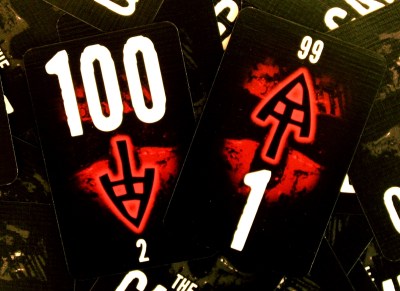
Bohnanza
– Image by boardGOATS

There are lots of different strategies players use:  the cards have different values which reflect their rarity so some go for high value rare cards and others for more common cards that are easy to get.  The best players are usually the most flexible and those that fit in best with what other players around are trying to do.  Another aspect players need to keep an eye on is harvesting.  Each field can only contain one type of bean and when they are harvested some of the cards are kept as profit.  In this way, the rare cards (which are also the most profitable) are gradually depleted from the deck.  So towards the end of the game, they become increasingly difficult to find.  Worse, sometimes there might only be one card left and woe-betide the player that gets stuck with it in a field as there is a nasty little rule that says players can only harvest a field with one bean card if all their fields have only one bean card.

Bohnanza
– Image used with permission of BGG contributor spearjr

This time, Pine began well offering lots of generous donations which earned him lots of good will as well as getting him off to a flying start.  In contrast, Burgundy was repeatedly forced to plough up fields before promptly picking up the beans he had just disposed of.  The first trip through the deck always seems to take ages, but as usual, the second time through was much quicker.  With three players, everyone got a couple of turns in the final, third pass and everyone was looking nervously at each others’ piles of “coins”; it looked very close.  In fact, there was only one point in it as Red finished just ahead of Pine who finished with a very creditable twenty-seven.

Bohnanza
– Image by boardGOATS

With Castles of Burgundy finally over, Blue was keen to play something quick and light to finish the evening and, knowing how much Purple likes it, suggested Om Nom Nom.  This is a really sweet little game with elements of double-think.  The idea is that there are three food chains each with three tiers, a primary predator, a secondary predator and pray.  Each player has a hand of cards representing the top two predator tiers and dice are rolled to represent the bottom two tiers.  Once the dice have been rolled and assigned to their spaces on the board, everyone simultaneously chooses a card and the food chains are resolved starting from the top.  Any predator with no prey (or where there is insufficient for all the animals played) goes hungry and is discarded.  Otherwise, prey is divided equally amongst its predators leaving any left-overs for later.

Om Nom Nom
– Image by BGG contributor jancis

A bit like 6 Nimmt!, it is all about synchronising with everyone else, or rather in this case, getting out of synch with everyone else.  This is because everyone has the same set of cards, so if every player except one plays the same cards, all the players who played the same cards will likely cancel each other out and get no reward.  On the other hand, irrespective of whether they get any reward for playing something different, the very fact they did not play the same card means they have it to play later when there is no competition.  This worked particularly well for Blue in the first round, when she managed to pick up lots of carrots and cheese uncontested.  Since prey at the bottom of the food chain are worth two point, this netted her a massive seventeen points.  In contrast, the second round was very low scoring with lots of animals going hungry.  Blue was less effective this time, but still won the round so going into the final round the game was hers to lose, and she tried her best.

Om Nom Nom
– Image by boardGOATS

Pine struggled throughout and Red couldn’t get to grips with the double think aspect so was curious as to whether random draw would work better  Since she won the final round it is possible that it did.  Meanwhile Blue was doing her best to throw the game, demonstrating that while it was important to be out of synch with everyone else, it was important to be out of synch in the right way.  First her rabbit got eaten, then her cat went hungry, but somehow she managed to scrape together enough points to ensure she ran out the winner.

Om Nom Nom
– Image by boardGOATS

Learning Outcome:  You don’t have to know what you are doing to win.

26th July 2016

To celebrate Codenames winning the Spiel des Jahres Award, this week it was our “Feature Game”.   Although the game seems to be very, very popular, it definitely has the “Marmite Factor” amongst our group.  It also really needs a group of a reasonable size.  Since it is relatively quick, even the most reluctant agreed to give it a go, especially as Cerise had made it for the first time in ages and it was a game she had really enjoyed last time we played it.  It was also Turquoise’s first visit, so a team game seemed a good way of starting.  The idea of the game is that there are two rival teams of Spies, each with a leader or Spymaster.  The Spies are trying to locate their Agents, but these are only known by their Codenames, and only the Spymasters have the key to who is on which team.  The Codenames are laid out on the table in a five by five array where everyone can see them together with some innocent bystanders and an Assassin.  The Spymasters then take it in turns to give clues to their team so that the Spies can identify their own team’s Agents by pointing at them.

Codenames
– Image by boardGOATS

Clues are of the form “word; number”, where “word” is a clue that connects several cards and “Number” is the number of connected cards.  For example, the clue “bird; three” might connect “sparrow”, “beak” and “Naomi Campbell”.  The team then discuss the clue and point to code cards, one at a time.  If they get it wrong, their turn ends straight away, so ideally they should start with the answers they think are most obvious.  If the Codename corresponds to one of their agents, then the team can guess again, and keep trying until they have exhausted their theoretical maximum number cards that match the clue (three in the example).  Importantly, the only measure of “correct” is whether the Codename is one of the Agents, the agent chosen does not actually have to match the current clue.  So, a team who can’t make sense of a clue or identify all the Codenames may decide point to a Codename that matches a clue given earlier in the game.  For this reason, when a team get all their theoretical maximum number of Codenames for that turn right, they also get one extra chance.

Codenames
– Image by boardGOATS

So, the trick is for the leader to come up with clues that cover multiple correct answers so that the rest of the team can identify the complete set before the opposition identify all theirs. Unfortunately, we had a particularly unconnected set of words and two Spymasters, Blue and Burgundy, who were particularly useless at this sort of thing.  Consequently there were lots of clues like “continent; one”, and when Blue got adventurous and went for “music; two” she totally confused her team and was perilously close to a hint that could lead to the Assassin (Codename “Snowman”) and bring the game to an abrupt end.  “Zooloretto; two” also fell on stony ground since nobody on Blue’s team had actually played it (where everyone in Burgundy’s team had).  The game remained finely balanced as Blue continued to try to give slightly more adventurous clues which her team didn’t always get, while Burgundy played safe with smaller clues that his team understood.

Codenames
– Image by boardGOATS

It all came to a head when, with only two Agents left to find, Burgundy decided to be adventurous and gave the clue “film; two”.  His team quickly got one of them, “Alien”, but the second was more tricky.  Green thought it was probably “forest” (as in “The Forest Moon of Endor”), but could also be several other things.  Cerise, on the opposite team leant a hand and suggested that it could be “wind” as in “Gone with the…”  or maybe “snowman”.  Meanwhile, Burgundy remained stony-faced, in what were very trying circumstances.  Eventually the team ignored Cerise (who had managed to suggest both the correct answer and the Assassin), which gave Blue and her team one last chance.  With only one Agent left to guess, there was only a short pause before they finished the game.  There was a big sigh of relief all round as everyone was put out of their misery, particularly Blue and Burgundy who had found the whole clue-giving experience very stressful indeed.  Unquestionably, with the right crowd Codenames could be great fun, but sadly, we just aren’t it, so it is unlikely to get another outing in the near future – definitely not our group’s Spiel des Jahres this year.

Codenames
– Image by boardGOATS

With that over, we decided to split into two groups.  Black and Purple were keen to give Imhotep a try (one of the other Spiel des Jahres Award nominees), as they had wanted to play it at the UK Games Expo, but it had been constantly booked out of the games library.  Burgundy had played it (also at Expo, with Blue and Pink), had enjoyed it and was happy to give it another go, so Green made up a group of four.  As well as being the key protagonist in the film, “The Mummy”, Imhotep was also a priest and a great architect.  So in this game, players take the role of builders in Egypt who are trying to emulate Imhotep.  The premise of the game is very simple.  On their turn, the active player chooses one of four actions:  procure new stones; load stones on a boat; sail a boat to a monument; or play an action card.  Players can only store a maximum of five stones and when they procure stones they can collect a maximum of three.  Stones are loaded onto ships one at a time, but which of the five possible destinations the boats end up at and the order they are unloaded in is vital, so timing and planning is everything.

Imhotep
– Image by boardGOATS

Admittedly the lovely big wooden blocks make this game feel like a “junior” board game, but Imhotep is anything but.  It is one of those games that is easy to learn but difficult to master. Although players have a range of options, trying to decide which one is best depends on what has already transpired, what opponents do and how the game will develop.  What makes it particularly tricky is that the best plans in the world can be crushed by opponents with one small action: when they take a boat to the “wrong place”.  It turns out the cubes are large for a good reason:  stacking cubes is a key part of the game and anything smaller would make a very wobbly obelisk.  There are four ships and five building locations, so one doesn’t get visited and the round ends when all four boats have sailed.  There are six rounds in total with points scored in different ways for the different buildings; the player with the most points at the end is declared the best builder in Egypt.

Imhotep
– Image by boardGOATS

Once everything was set up, the game got under way, but then almost stalled. Nobody had any idea what should be a good opening gambit.  Placing a cube on a ship was the easy choice, but which ship and in which position?  After some head scratching, everyone began placing cubes on boats, making plans where wanted the ships should go, waiting for them to be full, when suddenly, Purple jumped the gun and sent the first boat on its way.  She chose a boat with one cube of each of her competitors and sent it build an Obelisk, catching everyone by surprise.  It wasn’t a particularly bad place to go, but the obelisk doesn’t score until the end and since the highest scores are for the tallest towers, it might not actually be the most efficient use of a cube, especially so early in the game.

Imhotep
– Image by boardGOATS

The rest of the first round continued to be a lesson in frustration as each of the other boats ended up somewhere other than where players had planned. The next boat went to the Burial Chambers (another scoring at the end of the game), the third to the Wall (scored at the end of the round, but only one point per cube) and the last went to the Market to get cards. As Green was first on the boat he had the first choice of the cards available and based on that first boat he chose the card that gave him an extra point for every 3 cubes in the Obelisk (any three cubes, not just his own).  Now no-one other than Green wanted a boat to go to the Obelisk.

Imhotep
– Image by boardGOATS

The second round began a little more cautiously.  Everyone had a better idea of how the round would go and began placing their cubes in particular positions on the ships.  The game continued to frustrate everyone as the ships just wouldn’t go where players wanted them to go.  This is frustration is similar to that in Zooloretto where players place animals on trucks, but have to wait until the next turn to collect them, if someone else hasn’t got there first, of course.  In Imhotep, it was usually pretty obvious where players wanted the boat to go, so someone else almost always got there first to send it somewhere else!

Imhotep
– Image by boardGOATS

The unusual scoring of the Pyramid (not steadily increasing or decreasing points) meant that everyone tried to position themselves carefully for that optimum high scoring space, but no-one ever managed to get the boat set up quite how they wanted.  As a result, again no boat went to the pyramid.  The obelisks grew, and the pattern of the Burial Chamber was going in Black and Burgundy’s favour and the Wall scored a few more points, mostly for Purple. The Wall was beginning to show its strength as a cube placed there can score round after round until it is covered – potentially scoring well.  The market cards were dolled out, with Burgundy and Black both taking a blue extra action cards for later use. Green wasn’t sure what to take and ended up with a purple end game scoring card which would only come into it’s own if he could collect a few more.  In the third round the pyramid finally got started, in Black’s favour. The game continued in much the same way, individual plans were more and more obvious and as a result became harder and harder to fulfil.  The trouble was, in taking an action to scupper someone else it often helped a different player or upset their own plans.

Imhotep
– Image by boardGOATS

By the end of the game nobody was sure who the winner was going to be.   Before adding all the end-game scores, Burgundy was ahead of Black and Purple, with Green trailing behind.  Everyone had managed a couple of areas in the Burial Chamber, but despite best efforts to scupper him, Burgundy still had the largest area.  The Obelisks had become a fraught battle field at the end.  Black had thrown down the gauntlet to take a boat there which only had two of his cubes and pushed him into the lead, but in the penultimate round Green had sailed a sneaky little single cube boat which made his tower equal.  By making sure that he placed a cube in any boat that Black had used, Green then ensuring that he would at least share the Obelisk spoils. The presence of a single cube boat in that last round, was interesting, but no-one wanted to use it as it was guaranteed that the cube would get taken to the least useful dock, so in the end the Obelisk scores for first and second place were shared between Black and Green with Purple and Burgundy sharing the scores for third and fourth place.

Imhotep
– Image by boardGOATS

With Black now several points ahead, Burgundy and Green were vying for second with only the the green and purple end-game scoring cards left, though only Black and Green had any.  Black scored points for every three cubes in the burial chamber, which extended his lead and now looked unassailable.  Green got his Obelisk cubes score, which proved to be the same as Black took for the burial chamber, but with three purple cards giving him another six points he leap-frogged over Black to win by one point.  It was an incredibly close game which suggests that where cubes go may not matter as much as it feels like it should.  On one hand, this seems like a good thing as it relieves the pressure of all those boats going to the “wrong place”, but on the other hand it may suggest the game is a little too balanced making strategy play is less important, which would be a great shame.  Everyone really enjoyed it, however, and would definitely play it again especially as it plays quickly and the alternative tile options look as though they would add variety and new challenges to the game keeping it fresh.  For our group, from the nominations list, this would definitely have been our choice of Spiel des Jahres.

Colt Express
– Image used with permission of boardgamephotos

Meanwhile, everyone else was engaged in a brutal game of Colt Express, the worthy winner of last year’s Spiel des Jahres.  This is a programming game, where players take it in turns to choose the cards to they will play, but only action them after everyone has chosen.  Since everyone then takes it in turns to carry out their actions, the game is full of unforeseen consequences.  The game has a Western theme and is played on a fabulous three-dimensional train.  The idea is that each player is a bandit attacking the train trying to move about to pick up cash and jewels while avoiding the Marshall and shooting each other.  Although we’ve played this a few times, we had a couple of people who hadn’t played it before so we had a quick run-down of the rules first.  Each player starts with the same deck of action cards and six bullet cards.  A round card dictates how many cards will be played and how (face up or down; in pairs or singly) and players each shuffle their action deck and draw six cards.

Colt Express
– Image used with permission of boardgamephotos

Players then take it in turns to play the action cards.  At the beginning of a round everyone can see where everyone else is and it is easy to choose which card to play and predict its outcome.  Before long, however, things begin to become unpredictable and by the time players have to choose a second card it is highly likely that plans will have gone awry, though of course, nobody know this yet.  Once the cards have all been played, the pile of cards is turned over and the cards are actioned in the order that they were played.  It is only at this point that people realise the mistakes they’ve unwittingly made, shooting nobody or the wrong person, trying to pick up jewels that aren’t there or finding they’ve got nowhere to go because the Marshal is in the way and has screwed up their plans.  As the game progresses, things get worse too since shooting someone involves passing them a bullet card.  This is added to their action deck, but is a dead card and gives no possible actions.  Multiple bullet cards means the chance of drawing them increases making the action cards drawn all the more precious and adding pressure to make the maximum use of them.

Colt Express
– Image used with permission of BGG contributor punkin312

Colt Express is a light, fun game and inevitably, someone gets picked on.  This time Blue was the victim (playing the character Django).  Magenta (playing the innocent looking Belle) started using Blue for target practice, but Cerise (Doc) was very quick to join in the fun.  Blue did her best to escape and briefly managed to grab the $1,000 strongbox (gold bar in our version of the game) before Magenta biffed her soundly on the nose and nabbed it.  Meanwhile, Cerise and Turquoise were doing an excellent job of gathering up the loot and robbing the passengers blind, before they decided to try to empty their revolvers.  Obviously, this was mostly at Blue’s expense and with so many bullet cards she struggled to do anything, but that didn’t put people off of course.  Before long even the Marshall was getting in on the act and, much to her disgust, Blue finished the game with more bullets than action cards and no money or gems at all.

Colt Express
– Image used with permission of BGG contributor punkin312

For everyone else, however, the game was quite close.  Magenta had managed to hang onto the gold bar (aka strongbox) and one gem, but it wasn’t enough to compete with Turquoise and Cerise.  Turquoise had picked up a massive five money purses while Cerise added the Sharp Shooter bonus to her one gem and single purse.  Much to our surprise, both totalled $1,850 which meant we had to check the rules for a tie-breaker.  It turned out this was the number of bullets received, which meant that even though she was a long way from competing, Blue had an influence on the result.  As well as being a bullet-magnet, Blue had just about managed to fire a couple of shots in return.  Cerise had been one of the main attackers, so she had caught a few of Blue’s bullets as well as a couple of Magenta’s.  Since Turquoise had rarely fired at anyone, she had picked up just two bullets and with it, her second win of the evening, with Cerise getting her comeuppance.

Colt Express
– Image used with permission of BGG contributor lacxox

With it nearing “pumpkin time” for Magenta and Turquoise, there was just time for one last quick game and, almost inevitably, that was 6 Nimmt!.  How this game is still interesting for our group, is a bit of a mystery.  It is short, everyone is always happy to play it and, since it has such a small footprint, it gets brought every week which means it is there when the occasion is right, the mystery though is why people haven’t got bored when other games have long since fallen off the radar.  This time Purple started badly picking up twenty Nimmts in the first round while Turquoise began with a clean sheet.  Burgundy started well with just two Nimmts, but since he always has one good round and one bad, everyone was just waiting for him to start collecting cards in the second round.  Magenta and Blue both had consistently low scores, but they weren’t low enough, and while Purple also made a virtue of consistency, that’s not so good when the scores are both high.  Sadly, Turquoise was forced to pick up a couple of high-scoring of cards while Burgundy, very unusually managed to string two good rounds together.  With a clear round for his second, Burgundy took the game with a total of just two Nimmts, beating Turquoise into second place.

6 Nimmt!
– Image by boardGOATS

With Cerise, Magenta and Turquoise heading off, that left a short hour for something else.  Black was keen to play Isle of Skye, the winner of this year’s Kennerspiel des Jahres, but Green somehow hadn’t played it and we debated whether it would overrun.  Before long we’d prevaricated enough to definitely rule it out due to lack of time and we started hunting round for something else.  In the end we settled on The Game, a nice little cooperative card game that was nominated for last year’s Spiel des Jahres.  We played this quite a bit for a while, but somehow it has fallen out of favour a little of late, but for no very good reason.  The rules are simple: on their turn, the active player lays a minimum of two cards on any of the four piles following the appropriate trend – two piles must always increase, two decrease; the exception to this is if you can play a card where the interval is exactly ten in the wrong direction (known as “The Backwards Rule”).  Players can talk about anything so long as there is no specific number information given and the aim is to cooperatively get rid of all ninety-eight cards by playing them on to the four piles.

The Game
– Image used with permission of boardgamephotos

The Game started badly and then it got worse.  Before long we were wondering whether we were even going to get through the deck.  Our excuse was that the game is harder with five, but that may or may not actually be the case.  Eventually, we finally managed to exhaust the draw deck, leaving just the cards in hand, but it was inevitable that we weren’t going to be able to place every card as several players had lots of very low cards in a run.  In the end we finished with eight unplayable cards.  We felt we might have been able to place a couple more with a bit more planning, discussion and thought at the end, but everyone was tired and it was home time, so our collective competitive streak had deserted us.  Maybe it will come back for next time…

The Game
– Image by boardGOATS

Learning Outcome:  Prize-winning games can be a little bit hit and miss and depend strongly on the group too.