Tag Archives: Bohnanza

5th November 2013

We were relocated once again, so we had six people for the second week running.  Since we are still meeting in private houses, splitting into two games of three was not really an option due to restricted table space, and this limited what we could play somewhat.  For this reason, we started out with one of our old favourites that we’ve played before, Bohnanza.  This is a fairly simple trading game, where players exchange and plant beans to maximise their harvest.  The game was very tight, ending with joint winners on twelve and third and fourth places on eleven and ten respectively.

Bohnanza

Our youngest player left, leaving us with five players for our Feature Game, Hanabi.  “Hanabi” is the Japanese word for “fireworks” (consisting of the ideograms “Flower” and “Fire”) and given the date we felt it was entirely appropriate.  Last time we played, we used the original card version of the game, however, this time we used the new tile version that was released at Essen a couple of weeks ago.   The idea of the game is very simple:  as a group, players must try to lay a total of twenty-five tiles, in number order within their colour suits, thus the red “one”, must be played before the red “two”, and so on.  The snag is that everyone turns their hand back to front so they can see everyone elses tiles, but not their own.  So, on their turn, players can do one of three things:  play a card, give a clue to another player or discard a tile.  If the wrong tile is played, the team lose one of their three lives and there are only eight clues available; although each discarded tile is also worth an extra clue some tiles don’t have any duplicates…

Hanabi

We enjoyed the first game so much that we ended up playing it twice.  The first time a lot of “ones” came out on the first deal, so we had to decide how to guide people to play the correct tiles.  We finished up with three completed fireworks and a total of twenty points.  Any hope that we could improve on our score quickly evaporated when the second game started with no “ones” at all and it took us ages to get started by which time we had run out of clues.  One player was left with the choice of playing or discarding and chose the wrong option and that really set the tone for the rest of the game.  All things considered, it was a bit of a miracle that we finished two fireworks successfully and the game ended with a total of eighteen – not quite as bad as it had looked earlier.

Hanabi

Learning Outcome:  Sometimes “feelings” can be very misleading and you can be doing much better (or worse) than you thought.

23rd July 2013

This week we started with our “Feature Game”, Vasco da Gama.  Some of us played this few months ago so we decided to give it another go.  As discussed previously, it is a worker placement game, with an element of risk management.  Players recruit workers, start projects, build ships and sail new commercial routes to eastern Africa and India, to earn money and glory.

Vasco da Gama

The game comes in three phases:  worker placement, then worker actions, and finally ships sailing.  Players take it in turns to choose one of four areas for their workers:  buying ships; captaining and manning ships with sailors; “schmoozing” some influential characters to win valued favours; and finally, launching boats.  The clever part of the game is that when players place their workers, they also choose a counter to go with it.  The counters are numbered from one to twenty and the actions are carried out starting with the lowest working up to the highest – a bit like the deli counter at the supermarket.  However, here, the low numbers cost cost money while the higher ones are free.  The snag is, you don’t know exactly where the free ones start, only the range of possible values, and the further you are below the cut off, the more it is going to cost you to carry out the action.

So, people take it in turns to choose a counter and place one of their four workers in the four areas.  Then, once all the workers have been placed, in number order, players choose whether or to carry out the action (paying if appropraiate) or whether to pass and take money in lieu of an action (just to make things more interesting, the lower numbers get less money).  Once a ship has been bought and has a full crew, the ship can be launched, and this is where it gets tricky.  You get an immediate reward for launching a ship, but you also get rewards for each ship still sailing at the end of the round, and these rewards are increased if the row the ship is in is also full.  The snag is that before the next round starts, each complete row of ships moves on to the next row, however, if there is no space in the next row the ship is lost and with it any future possibility of rewards. Thus, the position of ships is really critical and can make or break your chances of doing well.

Vasco da Gama

Black chose to fight for the attentions of one of the characters, Bartolomeu Dias.  This character is particularly generous as he gives players two victory points when they offer to host him as well as two more victory points at the end of the round AND means you go first at the start of the next round.  Meanwhile, Yellow and Red decided to buy ships and Blue tried to sail the line between bankruptcy and profit.  It is very clear that it is an advantage to have seen the way the ships move as it is a complex process and appears quite chaotic at times with the best laid plans falling apart because someone places a ship unexpectedly or they simply can’t count!  Before long, ships were sinking all over the place and Black had a massive lead, however, before long, Yellow and Blue started making in-roads too.  Yellow ran out the eventual victor, but only a couple of points ahead of Black.

We only had time for one other game and as time was tight, we chose an old favourite that we’d all played lots of times before, Bohnanza.  This is a fun, trading card game, where players are collecting beans to become the most successful bean farmer.  Players have to play cards in the order they are in their hand and are not allowed to rearrange them, so the game is all about controlling the order of the cards trading.  Everyone was feeling very generous and deals were rarely hard bargains.  In contrast to the first game, it was very close and the game was tied with the winners on thirty-three and everyone within four points of each other.

Bohnanza

Learning Outcome:  Bartolomeu Dias is a very powerful guy.

5th March 2013

Since people were there nice and early, we started off the evening with a quick game of Turf Horse Racing.  This is a clever little game where players bet on horses, but the return depends not only on the place and the “stake”, but also the number of people who bet on the horse.  Thus, if several people backed the same horse, the return would be a lot lower than one which only one player bet on.  Nobody backed Raven Beauty, but even it did better than Roamin’ Emperor who might as well have had three legs.  Up front however, the race was quite tight with Mosstown Boy making a mad dash for the line only to run out of steam and lose to Lagoon Lady, Red Baron and Silver Blaze.

Turf Horse Racing

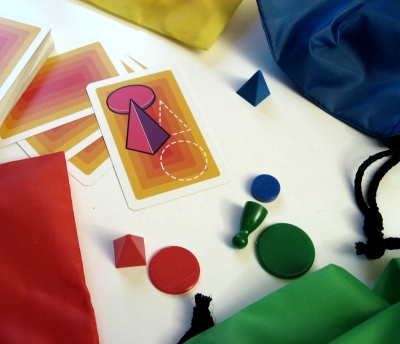
Next we played the “Feature Game” which was Nollkoll (aka Speedybag), which is another quick, fun game, but was universally agreed to be the most stressful game any of us had ever played.  Basically, players turn over a card which has a shape on it and players have to feel in their bag and pull out a matching small plastic shape.  The first wins the card, the person with the most cards at the end wins.  It was a tight game, but oh soooo stressful!

Noll Koll

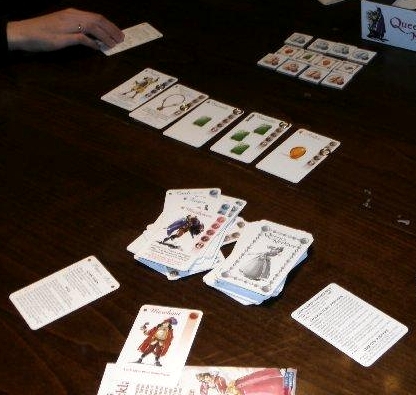
Then it was Queen’s Necklace.  We had one player who was new to it, but the rest of us played it a few weeks ago, so revisiting it was nice as it meant we could use what we had learnt the first time.  It was a much closer game this time with one round really making the difference between first and second place.

Queen's Necklace

Our fourth game of the evening was Coloretto, which strangely was new to most of us, though it is a well known game.  Play is very simple:  you can either draw a card to add to a “truck”, or take one of the “trucks” and add the cards in it to your collection to make sets of different colours. Each “truck” has a maximum of three cards and only the largest three sets score points with any others scoring negatively.  It is a fun little game closely related to Zooloretto, and in many ways much better as you don’t get side-tracked by cute fluffy animals, barns and vending stalls.

Coloretto

Finally we finished off with our old favourite, Bohnanza (known within the group as “The Bean Game”).  Since we all knew this one very well, we just checked the specific details for player numbers and launched straight into a game.  Unfortunately, the deck hadn’t been shuffled very well before it was put away, so the first time through the pack was a little strange, but we sorted that out for the second time through.  It was another tight game, but the “Queen of Cards” won by one card giving her a hat-trick for the evening.

Bohnanza

Learning Outcome:  Shuffling is a skill we all need to improve.

billyGOAT’s Birthday Boardgame Bash

It was billyGOAT’s birthday and he decided that what he really fancied was a day playing games with his mates.  So, on a slightly damp afternoon in December, friends from far & wide converged on Challow Village Hall.

The first game up was a six player game of Pillars of the Earth.  This turned out to be a rather long game and took most of the afternoon.  However, since it was one of billyGOAT’s choice games, it was fitting that he ran out the worthy winner.  Meanwhile, games of Discworld: Ankh-Morpork, Riff Raff, Apples to Apples Kids, Dixit, Hamsterrolle, The Great Balloon Race, Ramses Pyramid, Bohnanza, Incan Gold and Shopping List all went on as the masons slowly built their cathedral and the children played with the Scalextric and decorated biscuits.

Pillars of the Earth

Shortly after 6pm, everyone sat down together for a meal of Chinese takeaway (including dumplings) which was followed by a marvellous Jamaica Cake for those who had any space left.  Then, the games recommenced with parallel games of Lord of the Rings and Formula D while games of Billy Biber (aka Log Jam), Dobble (aka Spot It!) and Loupin’ Louie kept the children occupied until it was time for them to go home to bed.  Unfortunately, Lord of the Rings had to be terminated prematurely and the Fellowship failed to make it to Mordor.

Lord of the Rings

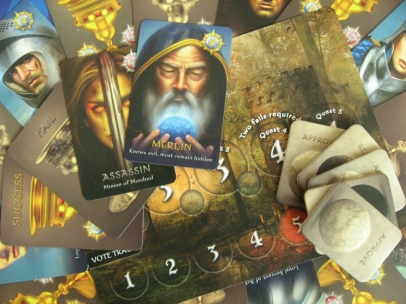
Despite its apparently poor reputation to the contrary, the six player game of Formula D on the other hand finished in timely fashion and players moved on to a quick nine player game of The Resistance: Avalon.  With a lot of new players everyone was a little quiet and Mordred’s Minions won easily.

Avalon

By this time, the numbers were beginning to dwindle a little, but there was still time for a quick six player game of Roman chariot racing with Ave Caesar where everyone competed to show due respect to the Emperor.  billyGOAT’s horse, “Dobbin”, made a very slow start, however, it managed a late charge for the line eventually coming second behind “Glue-pot Boy”, who had led from the off.

Ave Caesar

The last game of the night was another game of Avalon, this time with only seven players and victory went to Merlin and the Loyal Servants of Arthur. Then we had to tidy up the kitchen, sweep the hall and hand the keys back.  A good time was had by all and everyone went home tired, but happy.

Finally, many thanks to everyone who helped out in the kitchen during the event, and kept food and drink flowing, while others played; it would not have been possible without them.

13th Movember 2012

This week there were only four of us so we took the oportunity to play something a little heavier.  So, we started out as soon as everyone had arrived at 8pm.  The game was very new, only released in the last couple of months, and called Snowdonia.

In this game, players are struggling to build a railway up Mount Snowdon fighting the mist, rain and navvies that keep running back to the pub.  It was clearly quite a big advantage to have played the game before as the two players who were familiar with it ended up in a very tight race for first and second.  However, the game is so finely balanced that one or two errors early on by the others probably had quite a large impact on the two front runners.  Definitely a game to give another go sometime after it has had time to sink in.

Snowdonia

We only had time for one other game, and that was the “Feature Game”, Bohnanza.  This is a card trading and set collecting game where players are bean farmers.  Most of us had played this before, but it is such a nice light game that keeps everyone involved throughout that it was a great way to end the evening.  The final score had everyone within five points and the winner decided on a tie-break.

Bohnanza

Learning Outcome: Sometimes, Snowdonia can be very sunny (but only in board games!).

Planning Stages

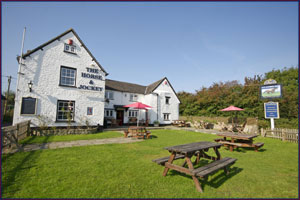
So, after a lot of deliberation and many trips to the Jockey for a quick card game and a drink (which no doubt started a lot of gossip), we have a “day”, we have a venue, and we have a name, so then we got a website – and this is it.  As the name suggests, we are going to meet on alternate Tuesdays in Stanford at the Horse and Jockey pub.  The intention is that this website will be a record of the games played as well as a way of publicising meetings, so it is only fair to mention here some of the games we played during the planning stages…!

  • Citadels
  • The Bean Game (Bohnanza)
  • Mr. Jack Pocket
  • Saturn
  • Court of the Medici
  • Jamaica
  • Dixit
  • Die Erbtante
  • Jaipur
  • Hamburgum (or perhaps Londonum?)

Yes, we spent quite a lot of time thinking about it and playing games in the pub!

Oh yes, and we have settled on Tuesday 2nd October for the big day.

The Horse and Jockey Pub