There was a bit of a delay for food, so after Blue had handed over an exciting box of echidnas to Pine and given Burgundy and Green a selection of Splendor, Orléans, and Zooloretto promo cards from Essen, we decided to play something quick. As there were a lot of hungry people, we decided to start with a quick game of Om Nom Nom. This is a fabulous little double think game based on critters eating other critters further down the food chain. The game is set up with a large handful of dice which are rolled to give either items from the bottom of the food chains (flies, carrots and cheese) or animals from the middle of the food chains (frogs, rabbits and mice). Players start with six cards representing animals from the middle of the food chain and the predators from the top of their food chains (hedgehogs, wolves and cats). Players simultaneously choose a card to play and then everyone reveals them and they are placed on the appropriate space on the three central player boards. before and the animals begin to feed starting at the top of the food chain. For example, wolves eat frogs and any surviving frogs then eat flies.
 |
| – Image by boardGOATS |
If only one card of any type is played, the predator feeds and the player takes their card back with any cards/dice their animal has eaten placing everything in their scoring pile. Where more than one card of the same type is played and there is enough food to go round it is shared equally and everyone eats (taking their cards back with their share of the prey). If there is not enough food for everyone to get a share, they all starve and lose their cards going home with nothing. This is repeated until there are no cards left. Food at the bottom of a chain is worth two points at the end of the game and food from the middle of a chain and any cards are worth one point. The game is played over three rounds and the winner is the player with the most points.
 |
| – Image by boardGOATS |
Blue won the first round with eleven, more than twice the points anyone else managed to gather. Om Nom Nom is one of those games where a high score in one round is usually balanced by a dreadful score in the next, so everyone expected Blue to fail to score at all in the second round. Burgundy’s twelve points in the second round looked really good, but contrary to the usual run of things, Blue somehow managed to improve her score picking up eighteen points—one less than the record for a single round in our group. The third round was a little bit of a dead rubber, but Burgundy was keen to see Blue get her bad round and if she did, fancied his chances. It was a much more even final round and with lots of points available, things looked good for Burgundy, but unfortunately for him, everyone else chose this round to get it together. In the end it was all about second place, which Burgundy just managed to take ahead of Black and Mulberry as food arrived.
 |
| – Image by boardGOATS |
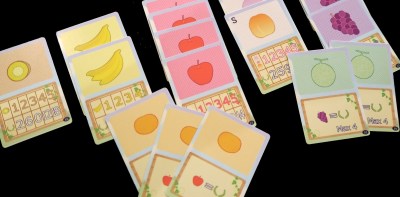
While Burgundy, Blue and Mulberry ate their belated supper, everyone else carried on the food theme, playing a little Japanese game picked up by Black and Purple at Essen called くだものフレンズ or Fruit Friends. This is a little card drafting and set collecting game where players are collecting different types of fruit using the “I divide, you choose” mechanism. There are a surprisingly few games that use this idea, but two of the best are …Aber Bitte Mit Sahne (aka Piece o’ Cake) and San Marco. …Aber Bitte Mit Sahne is relatively unusual as it works well with players dividing the pie into more than three. In contrast, San Marco is a three to four player game, but plays much better with three than four because the “I divide, you choose” mechanism generally works best when the pile is divided into three.
 |
| – Image by boardGOATS |
In Fruit Friends, each player starts with a random start or “seed” card, dealt face up. Players are then dealt seven cards which they divide into three piles of two (discarding the final card). Beginning with the player who was dealt the apple start card, players offer the three piles to the player on their left who takes one pair; the next player then chooses from the remaining two piles leaving one pair for the active player. Play continues in this way until everyone’s cards have been taken. The second round is played the same way except cards are offered anti-clockwise and the player with the grapes start card goes first. The final round is clockwise again, and the player with the kiwi start card begins. At the end of the game, each player has eighteen fruit cards, with each type scoring differently.
|
1 card |
2 card |
3 card |
4 card |
5+ cards |
| Apples |
0 points |
2 points |
5 points |
9 points |
14 points (max) |
| Grapes |
2 points |
5 points |
8 points |
11 points |
11 points (max) |
| Kiwis |
2 points |
6 points |
0 points |
12 points |
18 points (max) |
| Bananas |
3 points |
7 points |
12 points |
0 points |
0 points |
| Peaches |
2 points |
5 points |
9 points |
14 points |
20 points (max) |
There are some catches, for example, peaches come in two colours, yellow and white, but only one of them scores. Oranges score one point per apple card and similarly melons score one point per grape card (both up to a maximum of four points). The scoring intervals also offer some quirks, so while almost everyone scored twelve points for their bananas at the end of the game, Ivory went “Banana Bust” by over-shooting. Otherwise it was close at the top and you could fit the first four players in a fruit-basket with only five points between them. It was Purple, the “Kiwi Queen”, who just had the edge, “pipping” Green by a single point with Pine and Black finishing in joint third.
 |
| – Image by boardGOATS |
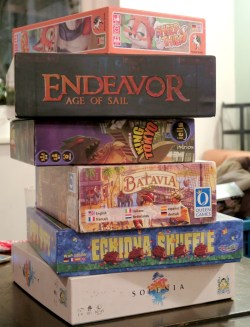
By the time the game came to an end, the eaters had mostly finished, so Black started getting out the “Feature Game”, Imaginarium (also described previously as “the one with the elephant on the box”). Burgundy and Ivory were quick to stake a claim to play it and Purple was equally quick to opt out. Mulberry and Blue made up the five, so Green started to collect together the games he thought the rest might play, which Pine pointed out just made it look like he was playing Jenga with boardgames. It took a while to come to a conclusion, but eventually the trio went for Echidna Shuffle.
 |
| – Image by boardGOATS |
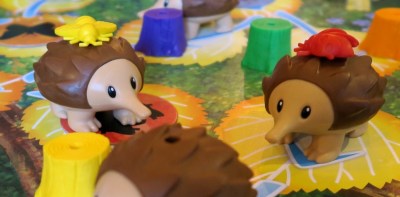
Echidna Shuffle is a game that we first discovered at the UK Games Expo back in June and since then, has been very popular with everyone who has played it. This is partly because of the fabulous, over-produced pieces, especially the lovely echidnas with cute smiley faces. The game is very simple: Players have to get their bugs to their tree-stumps by moving echidnas around the board. On their turn the active player rolls the die, and moves echidnas a total of that number of spaces. The clever part is that players only roll the die on alternate turns with intermediate turns evaluated from the dice board giving a total over two turns of nine moves. Thus, if someone rolls the maximum, a seven, the next turn they get just two. Similarly, if they roll a small number, say a three, then they get a six on the next turn. This means nobody gets screwed over by the dice, but there is still a nice, randomisation effect to the movement.
 |
| – Image by boardGOATS |
There are two sides to the game board: green “Summer” and snowy “Winter”. There was some discussion as to which to play. Pine thought the Summer side of the board rather than the Winter side was more of a challenge. He explained that it was more confusing on the snowy side and that it is not so easy to block people. On the other hand, the first time it was played with the Summer side, the game had become something of an epic marathon as everyone worked together to stop everyone else winning. So this time the group started with the “advanced” Winter board and ended up with a very short game indeed. After only about three rounds, Purple had got one of her bugs home and Green had managed two. Then Pine surprised everyone and with a roll of seven managed to complete all three of his bugs and the game was over, almost before it had begun.
 |
| – Image by boardGOATS |
Echidna Shuffle is really meant to be a children’s game, so perhaps it should not have been a huge surprise that it ended quite so quickly. Maybe Pine had had a point though, so unusually the game got a second chance, this time with the Summer board. This second game, did indeed last longer, but was still relatively quick and before too long everyone had just one bug remaining each. Green was first to get to this point, but Purple and Pine managed to successfully block his route while they also got their second bug home. In the end Pine became the “Kingmaker” as everyone knew how many moves each player would get and he found himself in the position where he could either move the echidna out of purples way and into Green’s or do something else entirely. Either action (or inaction) would result in win for either Green or Purple and in the end he inevitably chose to open the door for Purple.
 |
| – Image by boardGOATS |
It maybe that as a bunch of adult gamers, we have found the limit of this very pretty and lovable game. On the other hand, the number of players also has quite an impact—the full compliment of six seems to have the effect of dragging out the Summer board, but the combination of a small number of players and the complexity of the Winter board appears to make the game too open. Hopefully the company will bring out some new expansions or different board layouts that will give us more to explore, in the meantime, the game may get fewer outings in the weeks to come.
 |
| – Image by boardGOATS |
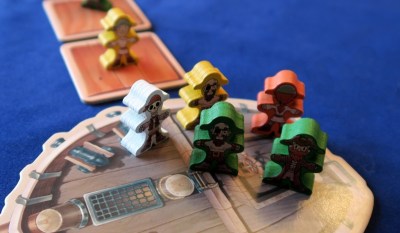
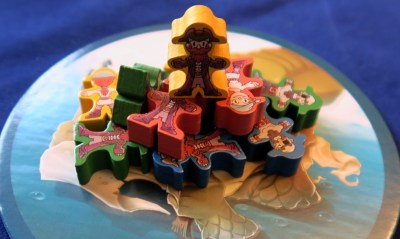
Because of the late start and the fact that Green wanted an early night, there wasn’t enough time for another medium-weight game, but it was still early enough for a short game. After some discussion, the trio agreed upon Walk the Plank!, a cute little programming game with a hefty dose of “take that”. In programming games players choose the cards they are going to play before the round starts and then action them during the round, usually taking it in turns to reveal one card and then carry out the associated action. One of the classic games of this type is Colt Express which won the Spiel des Jahres a few years ago, but Walk the Plank! is a quicker and simpler game. The idea is each player has three pirate meeples on a ship and the last one remaining is the winner. Players start each round by simultaneously choosing three cards and laying them face down in front of them. On their turn, players turn over the top card and action it.
 |
| – Image by boardGOATS |
The cards allow players to do things like “shove” one of the meeples belonging to the player on their left, or to the player on their right. When this is played a meeple that shares a space with one belonging to the active player is moved one step along the plank and thus closer to falling into the depths. There are lots of other actions including “drag to ship”, “drag to sea” and “Charge!”, but the most exciting cards are probably the “retract the plank” cards. At the start of the game the plank comprises three pieces, but usually at least one player removes one of these at the start of the game, heightening the stress levels. We usually play with a couple of house-rules too, firstly we play to the last meeple standing (the rules say the last two share victory) and we allow the plank to be completely removed (the rules say there is always one piece left).
 |
| – Image by boardGOATS |
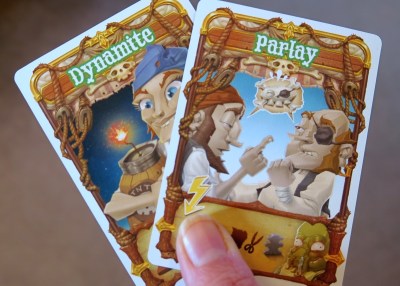
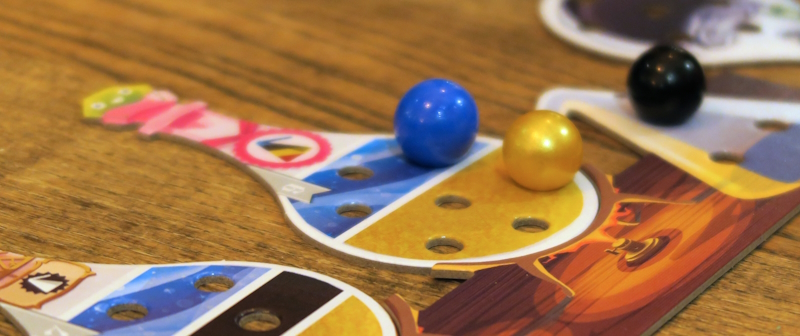
We’ve loved the game for years and have several different editions within the group—this time we played with the “limited edition” which includes some optional extra cards. This time two of the extra single use cards were added to each player’s deck: “Parlay”, which gives a player a chance to turn the tables via a game of Rock-Paper-Scissors, and “Dynamite”, which pushes everyone on one tile one space closer to the sea. After a little shuffling about, Green played his “Dynamite”, but succeeded in sending two of his own men closer to the water as well as the others. Then Purple played a “Charge!” card to try to push Green into the sea. Green used his “Parlay” to see if he could to prevent it, but this ended up in hysterics thanks to a total inability to play the game correctly. It started with Green playing on the count of three as agreed and Purple after the count of three (i.e. on four). After multiple attempts including one where Purple ended up just pointing vaguely at Green everyone was in fits of giggles, but it didn’t look like the tie was anywhere nearer being resolved.
 |
| – Image from theguardian.com |
Pine suggested that perhaps they should try after the count instead. Green duly obliged, but Purple had finally worked out how to play on the count of three and still the problem persisted. Then Green chose stone and Purple also chose stone changing to paper at the last second, but this was spotted by Pine who ruled a “Let” and so they had to try yet again. By this time everyone was laughing so hard that in a fit of confused giggles Purple then chose “none of the above” by using a single finger. Pine suggested Green and Purple put their hands behind their backs, but this time it was Green’s turn to make a mess of things and he just couldn’t get the hang of it. In the end, in an effort to stop Purple from soiling the furniture, Pine suggested they remove the counting element and play with closed eyes which was finally successful. It was largely immaterial by this time, but Green won, so one of Purple’s pirates went charging off the plank into the sea.
 |
| – Image by boardGOATS |
Getting back to the game seemed tame by comparison. Everyone ended up back on the boat and then started moving forward again. With the plank retracted, Green found himself with all three of his pirates on the end when Pine played his dynamite and Green was out in one go taking one of Purple’s and one of Pines own with him. So Green became the Ghost and with two pirates versus one, it looked to be Pines game. Two rounds later, though the Ghost shoved one of Pine’s pirates off the ship to level things up until Purple played her “Dynamite” and managed to get both dumped into the water, bringing the game to a shuddering halt, and on that note, Green headed home.
 |
| – Image by boardGOATS |
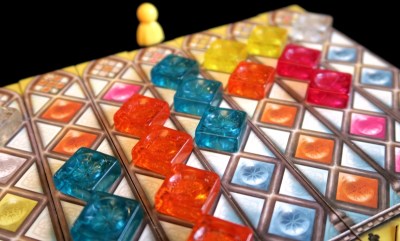
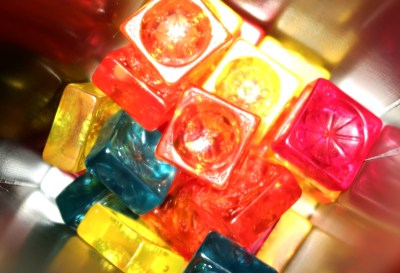
Imaginarium was still underway with no sign of finishing soon, so Pine and Purple decided to give Azul: Stained Glass of Sintra a go as Pine had missed out last time. As in the original game, Azul, players take all the tiles of one colour from a “factory” and put the rest in the middle, or they take all the tiles of one colour from the middle. Tile placement and scoring is rather different however. All the tiles taken in a turn are placed in a single column of the player’s personal player board. This board is modular with the double-sided strips laid out at random so everyone has a different starting setup. Tiles must be placed in the strip immediately below the Glazier meeple, or in a strip to its right. The Glazier is then placed above the strip the tiles were placed in. Instead of taking tiles, players can choose to reset the Glazier’s position, moving him back to the left most strip.
 |
| – Image by boardGOATS |
Players get points when strips are completed scoring the sum of the score depicted below the strip and any strips to the right that have already been completed. There is also a colour bonus—each round has a colour drawn at random at the start of the game, and any tiles that match the colour for the round score extra. Once a strip has been completed, it is flipped over; after it has been filled a second time it is removed. Any left over tiles that cannot be placed yield a penalty with players moving along a negative score track which has small steps at the start that get larger. There are also end-game bonus points with two variants available, one colour dependent and the other rewarding completing adjacent strips.
 |
| – Image by boardGOATS |
This is definitely a game that takes a at least one play to understand how it works and what the best way to score points is. For example, the way the score builds, it is imperative to complete the furthest right strips early as then they score again and again. However, they are relatively low scoring, so this is not the only important strategy. So while Pine started off well, Purple scored more later, especially when she picked up colour bonus point as well. Early in the game, the penalty for picking up the first player token or for having left-over tiles is small, but it quickly increases, and with Pine taking the first player token more than Purple, he finished with more negative points too. All the little extras combined to make it a bit of a landslide in Purple’s favour, but then Purple had the advantage of having played the game several times, so next time will surely be different.
 |
| – Image by boardGOATS |
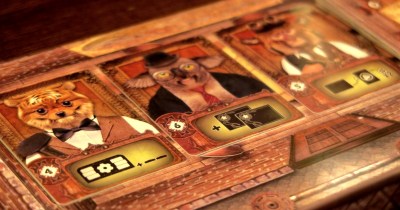
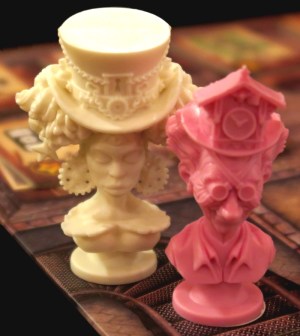
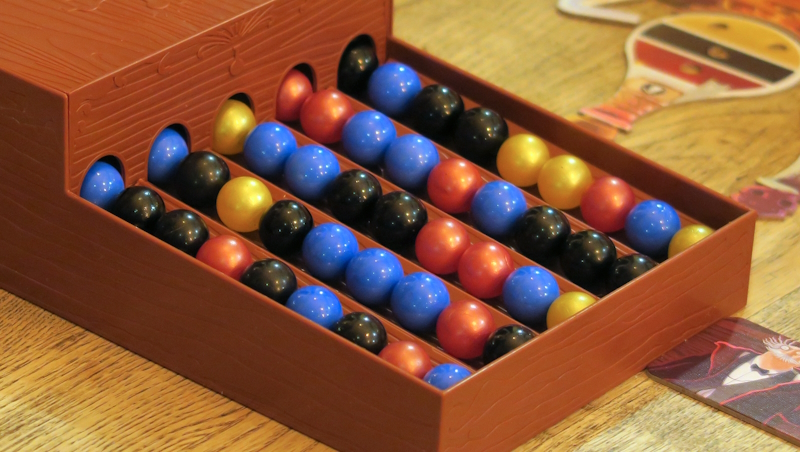
While these games had been going on, the “Feature Game”, Imaginarium was getting an outing. Subtitled “The Dream Factory”, this game is a worker-placement, engine builder with a Steam Punk theme where players are building machines in a factory. Beautifully produced with remarkable artwork, players first take it in turns to choose a position on the factory conveyor-belt. They select either the broken machine card that they are going to buy or a position to collect charcoalium. These are then carried out in “action” order which then also becomes the selection order for the next round. At the end of the round any unused cards move long the conveyor-belt and the early positions are populated with new, exciting cards. As the game progresses, the broken machine cards generally become more expensive, but the machines become more useful, producing more and/or higher value resources.
 |
| – Image by boardGOATS |
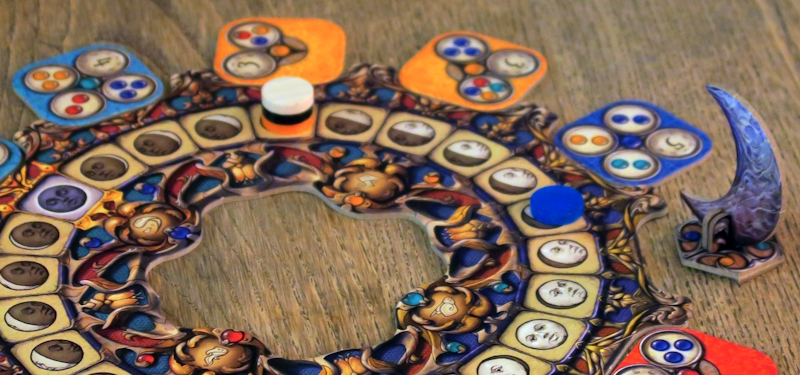
On a player’s turn, their existing “machines” first produce resources, then the player must buy the broken machine card they had chosen. The active player finally carries out two actions dictated by an unusual clock mechanism: each player has a board with the six possible actions arranged in a circle and the hands of the clock are fixed such that players are unable to take actions that are adjacent. As the clock hands must be moved every round, players are only able to take repeat one action in consecutive rounds. Possible actions include hiring a character, trading resources, extracting charcoalium, repairing broken machines and reorganising or dismantling existing machines. When a machine card is taken from the conveyor-belt, it is broken, they must be repaired before they will work and produce resources. Once repaired, machines can be combined to make them more efficient, or dismantled to give points, the game ends when one player gets to twenty points.
 |
| – Image by boardGOATS |
One of Ivory’s questions before playing a new game is always, “Where are the points going to come from?” In addition to dismantling machines, points are also available for completing “projects” i.e. satisfying goals drawn at random at the start of the game, or by trading charcoalium. There are also two points available for players who have the most of one of the four resources at the end of the game. As the game was late starting, the group decided to end the game at fifteen points instead of twenty, though to begin with it didn’t look much like anyone was going to get to fifteen points before midnight. Black assured everyone that people would pick up speed as the game progressed and eventually, Ivory got going completing the first of the projects and then Black and Blue followed.
 |
| – Image by boardGOATS |
The game is mostly multi-player solitaire, except when it’s not. There are some machine cards that take resources from the other players. In a game where resources are very tight and players are very reliant on resources for their plans this can be crucial. The game also has a distinctly mean streak, as a player that is unable to pay for the card they have chosen, doesn’t get the card, but also loses all their resources, completely upsetting their plans and forcing them to start again from scratch, potentially losing them the game. This is exactly what happened to Blue—Ivory went earlier in the turn order and bought and then repaired a machine that took all her charcoalium which meant she lost the card she was going to buy and all her resources. She vowed to get her revenge, but the opportunities for that are few and far between. As she waited for her chance, she gathered charcoalium to ensure she would be able to buy the right card when it came up.
 |
| – Image by boardGOATS |
Sadly for her, interaction in the game is minimal so there she never really got her chance. Amassing large amounts of charcoalium wasn’t totally without use though as it enabled her to fulfill one of the projects and as they were playing to a smaller total, she started trading them in for points in an effort to avoid coming last. Meanwhile, Ivory kept amassing points and Mullberry kept doing “the weird goat-head thing” which ensured she always had plenty of charcoalium and was starting to build a productive engine. Black and Burgundy had also just got their engines going and were planning to score heavily when Ivory announced that he’d passed the fifteen point mark. With Blue still to take her turn, she maximised her points and everyone added up their scores. Sadly, for Black, Burgundy and Mullberry this wasn’t a long process as shortening the game had had the unforeseen consequence that the game ended just before their plans had come to fruition. Much to her surprise, Blue had done rather better as she had stuck to short-term targets that lent themselves to the short game.
 |
| – Image by boardGOATS |
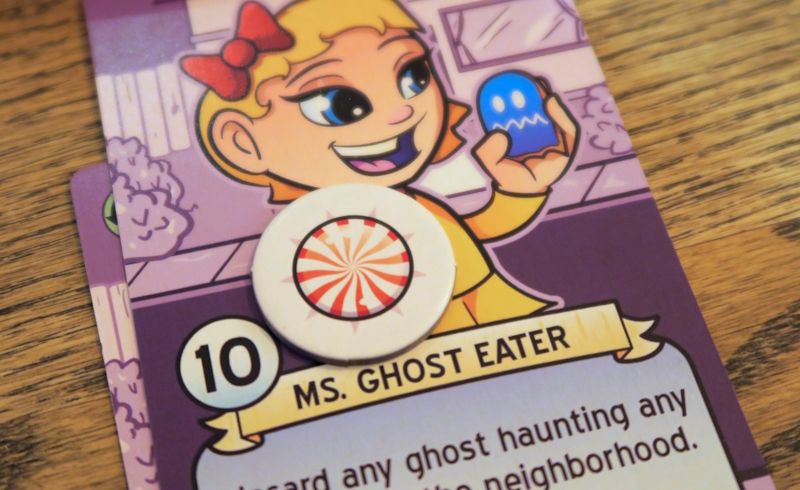
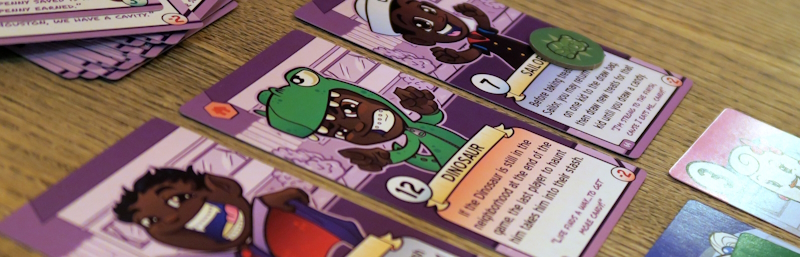
There was only one winner though and Blue’s fourteen points flattered her position as the scores did not tell the true story of the game. It’s definitely a game to try again sometime, though perhaps with fewer people which would give players a bit more control over their own destiny. The artwork is somehow both amazing and very disturbing at the same, and it certainly had an unforeseen effect on Blue. She is not normally one to remember dreams or one to design games, but when she awoke the next morning she had a fleeting recollection of dreaming about playing a card only version of Om Nom Nom that she had designed called “Yum Yum Tum”. We will have to see if that ever comes to fruition.
 |
| – Image by boardGOATS |
Learning Outcome: When gamers are hungry they play games about eating.










 boardGOATS