Tag Archives: Las Vegas

6th August 2024

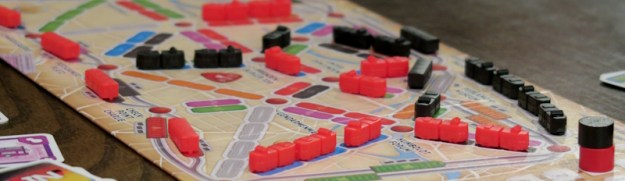
Blue and Pink were just finishing their supper when Pine arrived, soon followed by the rest of the posse.  Despite missing Ivory, Teal and Cobalt, we still made it into double figures and everyone was particularly pleased to welcome back Green who has been missing in action for most of the year.  Jade had declared an interest in giving the France map for Ticket to Ride a go.  Ticket to Ride is always popular, so he quickly gathered Sapphire, Pine, Lime and Pink to make an enthusiastic group of five.  He explained the rules differences, to comments of, “Lizen very carefully, I shall say zis only once!”
Ticket to Ride Map Collection: Volume 6 – France & Old West
– Image by boardGOATS

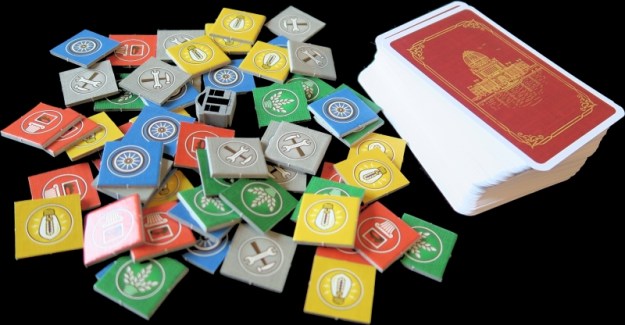
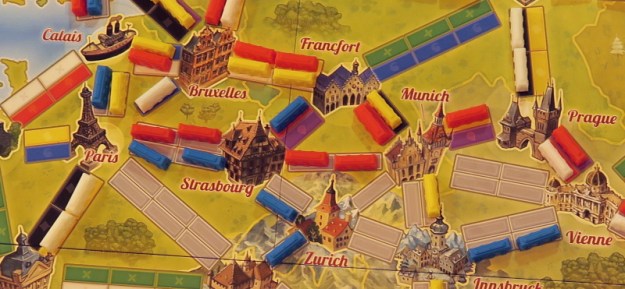
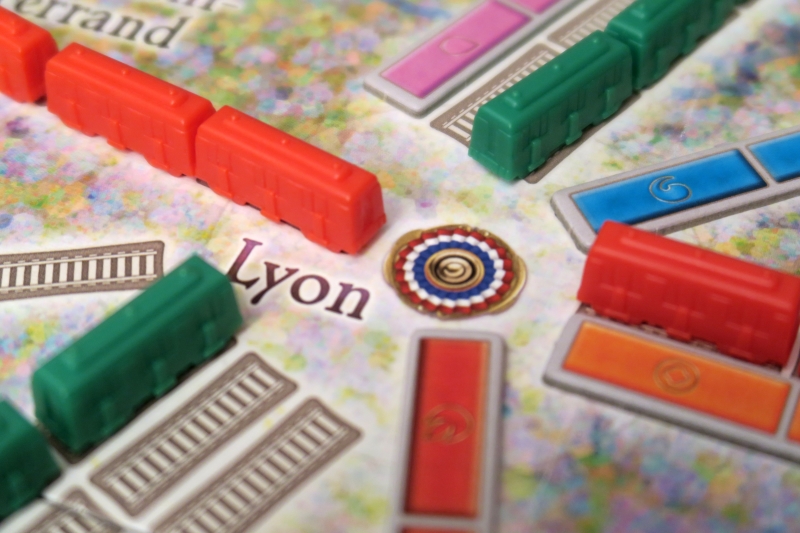
Ticket to Ride is well known in the group and the basic rules needed no explanation (take cards from the market, or use them to claim routes while trying to complete Tickets).  All the maps have their own little unique tweak to the rules.  In the case of the France map, most of the tracks on the board start “uncoloured”.   Whenever anyone draws cards, they take a colored tile that’s two to five train cars long, and place it onto an uncoloured track bed.  After that, any player can claim that route in the usual way (by paying the appropriately coloured cards from their hand).

Ticket to Ride Map Collection: Volume 6 – France & Old West
– Image by boardGOATS

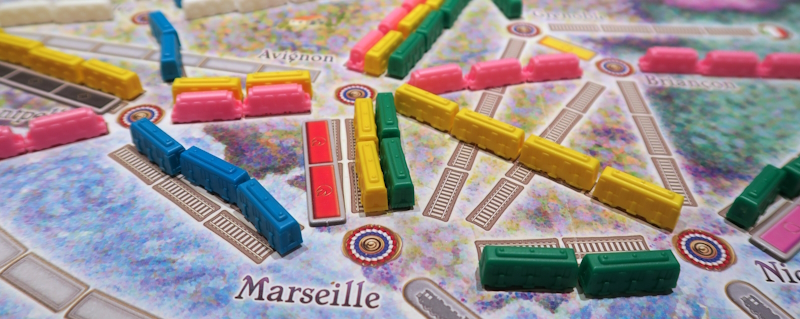
Although anyone can claim a route “coloured” by another player, this time, in practice, most people didn’t build on tracks placed by others.  This was partly because messing with someone else’s plans is usually at the expense of your own, but also because of the “mutually assured destruction” effect—that is to say, interfering with someone else is likely to encourage them to do the same in return.  So on the one occasion when Pine DID “steal” a route that Sapphire had set up, everyone (especially Sapphire) was really shocked! Pine and Sapphire both picked up tickets in the very closing stages of the game and both got very lucky with the tickets matching the routes they had already built.
Ticket to Ride Map Collection: Volume 6 – France & Old West
– Image by boardGOATS

The game was quite close and relatively high scoring, with all five finishing in a twenty point range, but that was before bonuses.  With the France map, there are two bonuses:  ten points for the longest continuous route and fifteen points for the player with the most completed tickets.  With seven, Pine had the most tickets and leap-frogged Jade and Pink (who was playing with his pink “Cancer Awareness” train set), into third place.  That left Lime and Sapphire, but with Sapphire taking the longest route bonus, he finished with a hundred and twenty-nine points, extending his lead over Lime to fifteen points to give him a comfortable victory.  It had been a really enjoyable game, however, so much so that Jade and Sapphire added it the France map to their wish list.
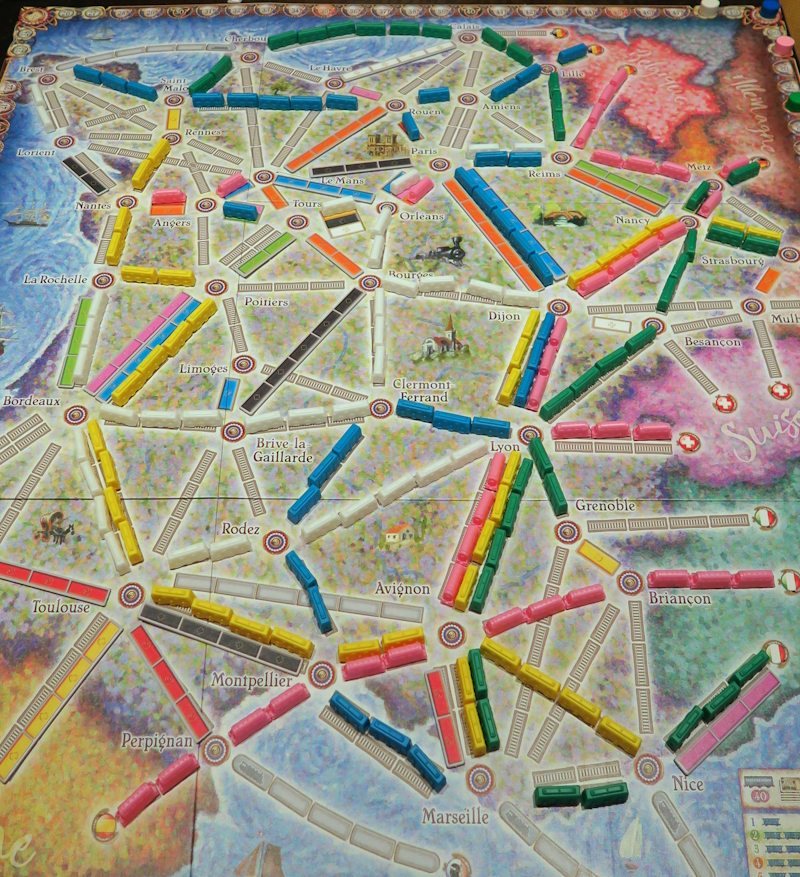
Ticket to Ride Map Collection: Volume 6 – France & Old West
– Image by boardGOATS

At the other end of the table, that left Blue, Plum, Green, Byzantium, Purple and Black.  Nobody seemed keen to play the “Feature Game” (which was to be Montmartre), partly because that would have required splitting into two groups.  Instead, inspired by the Olympics, the group opted for the Heptathlon variant of Reiner Knizia’s Decathlon.  Decathlon is a print-and-play game consisting of a series of ten different, mostly push-your-luck, dice games loosely themed around the ten sports featuring in the Olympic event.  The Heptathlon Variant is slightly shorter and is based on the women’s equivalent.
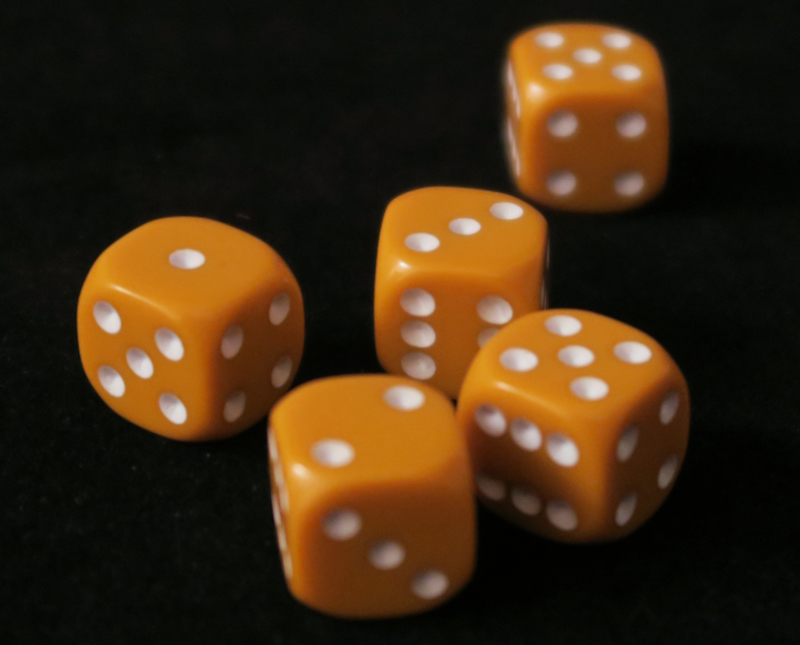
Reiner Knizia's Decathlon (Heptathlon Variant)
– Image by boardGOATS

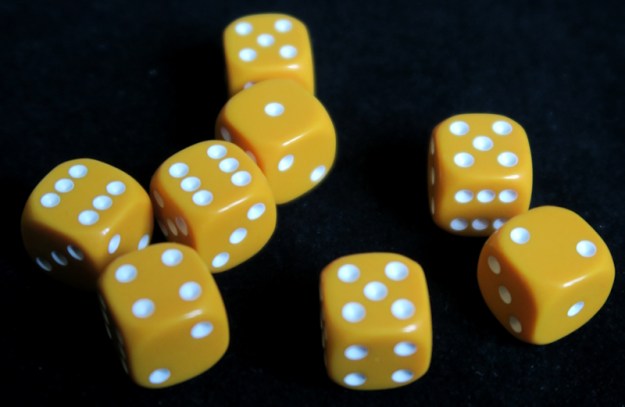
Normally both variations are played with a maximum of four, but this time, the group played the “Championship Variant” where players play together and the winner of an event scores three points, the runner up gets two points and the person placing third gets one point.  The rules say that tied players get the better rank, but the group used count-back to break ties in the first instance.  Blue had brought an enormous pile of printouts and Las Vegas, from which the group got the dice, and started, slightly tentatively with the 100 m Hurdles.  In this game, players have two sets of three dice and throw one until they are happy then throw the other with a total of seven tries.  The catch is that each “one” that is re-rolled scores minus one.
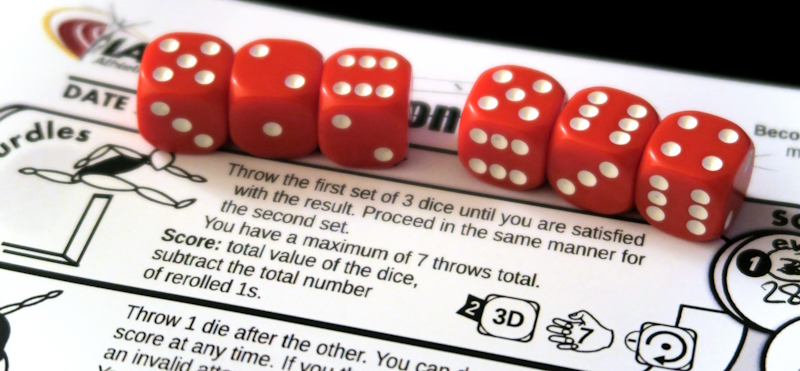
Reiner Knizia's Decathlon (Heptathlon Variant)
– Image by boardGOATS

Green went first and achieved a total of twenty-three.  By the time he had finished though, everyone had got bored watching someone else roll dice and had got on with their own.  It was then that the group realised that, as the 100 m Hurdles was a race, rolling simultaneously was more in keeping with the theme.  Blue crossed the line first (with twenty eight) followed by Byzantium and then Green.  And it was on to the High Jump, a much simpler game where players rolled five dice together to achieve an ever increasing total (with three attempts at each height).  Purple was the first out, failing to achieve eighteen, followed by Blue at the next height.

Reiner Knizia's Decathlon (Heptathlon Variant)
– Image by boardGOATS

The “springiest” was Plum, who sailed over twenty-two, but failed at twenty-four.  She actually tied with Green, but beat him on count-back, with Byzantium taking third.  Next was the Shot Put, where players roll eight dice, one at a time, with a one being a fault.  Players can stick whenever the like, but because of a rules malfunction, the group only played with a maximum of six dice.  The best score after three attempts was again Plum with Black in second and Blue in third.  From here the games got a bit more complex, starting with the 200 m Sprint, which was played with eight dice rolled in a group of four dice, followed by two rolls of two.  Players have a total of eight throws and sixes count negatively.
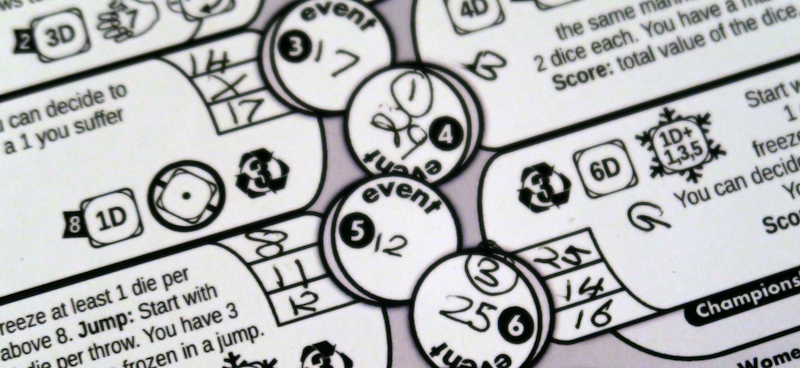
Reiner Knizia's Decathlon (Heptathlon Variant)
– Image by boardGOATS

Plum tripped over her own feet (or maybe Byzantium tied her laces together), but Green demonstrated a remarkable turn of speed to cross the line first, followed by Blue and then Purple.  More than half-way through, it was a three-way tie between Blue, Green and Plum and others not far behind.  So, the second day started with the Long Jump, a five dice game played in two parts.  First there was the run-up, which dictates how many dice the player gets to use for the actual jump.  For the run-up, players roll all five, freeze at least one and roll the rest, but if the total exceeds eight, it is a foot-fault.  Then, for the jump itself, players use the frozen dice and roll all of them, again freezing at least one per throw.

Reiner Knizia's Decathlon (Heptathlon Variant)
– Image by boardGOATS

The best total after three attempted jumps was Byzantium’s twenty-seven.  Green’s turn of speed obviously helped him as he came second while Blue and Plum tied for third, but Plum took the honours thanks to her second longest jump.  Staying in the field, the next and penultimate event was the Javelin.  This six dice game involved players freezing at least one die per turn, but this time only odd dice could be kept.  Green’s first throw threatened to skewer one of the stewards, and things didn’t get much better from there.  Black faulted on his first throw, but was consistent with his second and third taking third with twenty-two.

Reiner Knizia's Decathlon (Heptathlon Variant)
– Image by boardGOATS

First and second went to Purple and Byzantium (respectively), with both failing to improve on an excellent first attempt.  So, going into the final event, the 800 m Race, most people were going for Gold, while everyone was in with a chance of a medal.  This race was an eight dice game with players rolling two dice, then two dice and then the four remaining dice one at a time.  Players have a total of eleven rolls (i.e. just five re-rolls) and the player with the highest total wins, but with the catch that sixes count negatively.  It was a tight race, but Blue crossed the line first which put her in gold medal position, just until Green crossed the line in second and overtook her.  Purple took third, but for her it was too little, too late.
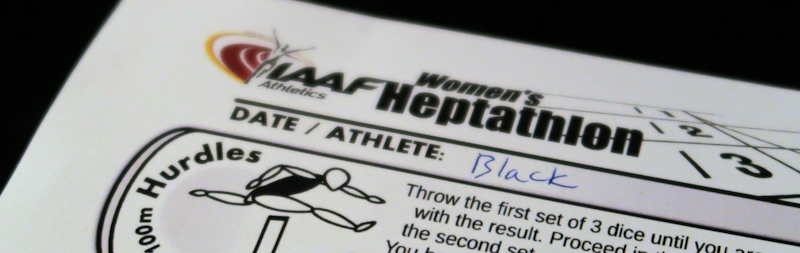
Reiner Knizia's Decathlon (Heptathlon Variant)
– Image by boardGOATS

So, stood on top of the final podium with his gold medal round his neck, Blue with silver and Byzantium who took bronze just ahead of Plum and then Purple, stood either side.  It had been a lot of fun though, and as people often say, it is the journey that counts.  The games have a bit of a feel of Ganz Schön Clever/Doppelt So Clever/Clever Hoch Drei, but sort of stripped back to their raw essence.  The individual events were quite simple and with a sheet each, players could keep their own score and recheck the rules as required.  The questions, “Do I stick or keep going, what have other people done, and do I need to gamble to win?” in a large group add interest, and everyone enjoyed it so much that there was no difficulty getting people to take home the left-over sheets.

Reiner Knizia's Decathlon (Heptathlon Variant)
– Image by boardGOATS

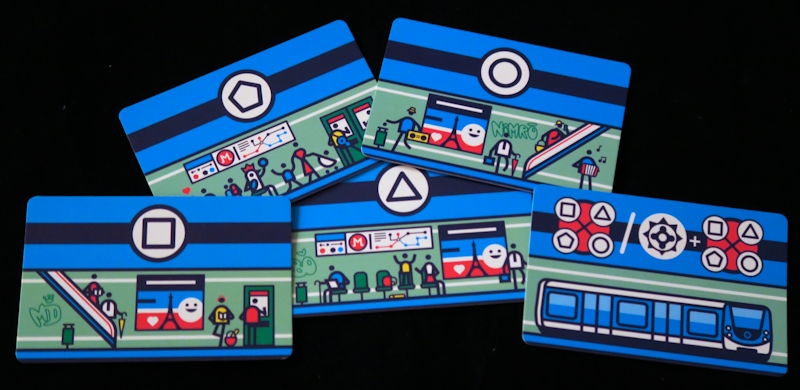
From there, the group of six split into two groups of three and everyone moved from athletics themed games to Paris themed games.  With the best will in the world, there wasn’t time to play Paris, so Blue promised to bring it again another time, and they opted instead to stick with “Roll and Write” type games in the form of Next Station: Paris.  This is the latest variant on Next Station: London, a simple little route planning game with a really clever twist.  The idea is that each station has one of five symbols; a card is turned over depicting one of these symbols and players must extend their route by connecting one end to a station with this symbol without crossing an existing track and following the grid shown on the map.

Next Station: Paris
– Image by boardGOATS

At the end of each round, players score for the number of Districts visited multiplied by the number of Stations in the most visited District.  At the end of the round players get bonus points for Interchange Stations (where two or more lines meet).  However, like the Ticket to Ride maps, each each city comes with a slight variation to the rules as well as a different arrangement of stations.  In London, players score points for crossing the Thames and for the total number of Visitor Attractions visited during the game.  In Paris, these are replaced with scores for visiting Parisian Monuments at the end of each round and using the level crossings marked on the map.

Next Station: Paris
– Image by boardGOATS

The clever part of the game is the fact it is played over four rounds, but each round is played with a different coloured pencil with players swapping pencils between rounds.  This means that while everyone gets the same cards in the same order, they start in different places so are forced to do different things (unlike for example, NMBR 9, where players often play the first few rounds the same).  The Paris version is supposed to be easier than the London variant, but as nobody had played it before, everyone struggled at the start.  The trick though, is, for each line, players need to try to get the same number of Districts as Stations in the most visited District.

Next Station: Paris
– Image by boardGOATS

This is similar to the mechanism in Orléans, where players receive victory points equal to their position on the Development Track multiplied by the number of Trading Stations they have on the map plus the number of Citizen Tiles they have collected.  In both cases, players want these numbers to be as large as possible to give the biggest total.  It is more important that both are significant, however, rather than having one large and one small.  For example, a two times three gives more than one times four, thus it is important to concentrate on both parts equally and not neglect either one of them.

Next Station: Paris
– Image by boardGOATS

Although nobody had played a “Next Station” game before, Blue explained the rules and had got her head round this element of the scoring, where it took the others a little time to get to grips with it. The game suited Plum’s puzzle brain and she liked trying to see where she might get to the level crossings and so on. By the third line, both she and Byzantium were beginning to get the hang of thing (or perhaps the cards just came out better) and then for the final round everyone found their space was more restricted.  It was very close, but Blue’s consistency throughout just gave her the edge and victory by a mere five points.
Next Station: Paris
– Image by boardGOATS

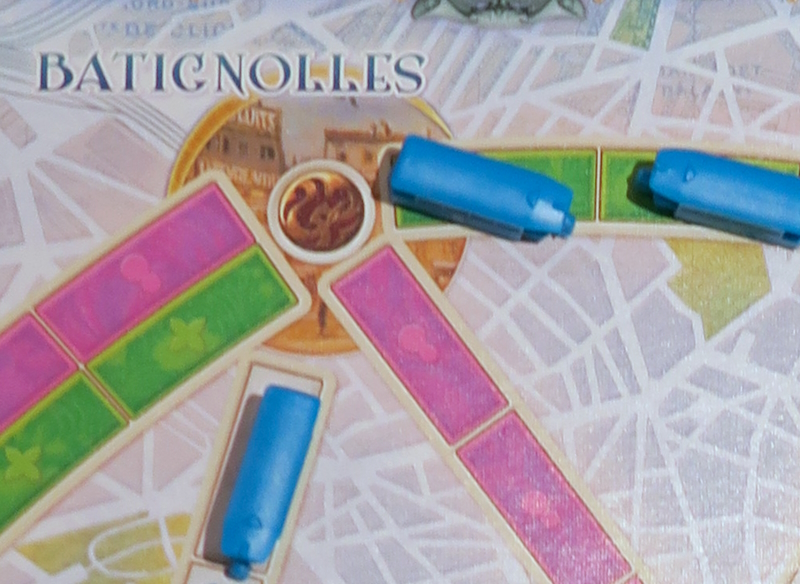
Meanwhile, Green, Black and Purple opted for a quick game of the Paris version of Ticket to Ride.  This is the newest of the smaller, city versions of the game, and one that had not been played within the group hitherto.  In general, these play exactly the same way as the bigger ones, but have fewer pieces and shorter tracks (so play a lot quicker) and have a little rules tweak to keep people interested.  There had been a little bit of chat about it as people arrived and Blue, who had only read the rules was quite scathing about the new rule which felt very bolted on, and as there are now several of these little games, there were comments about the sound of barrels being scraped.
Ticket To Ride: Paris
– Image by boardGOATS

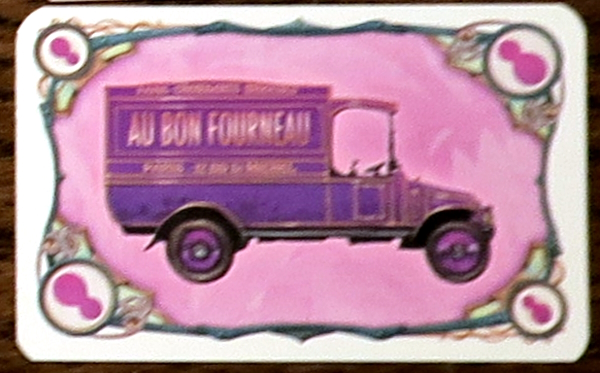
The new rule is that when players claim a red, white, or blue track, they get a card, when they get all three colours they get four “Tricolore” bonus points—this didn’t feel terribly imaginative.  After the game, however, Green commented that it was much better than it sounded.  After he had completed his starting Tickets, he realised they only gave low points, so rather than taking more, he opted to go for Tricolore bonus points instead as the red, white and blue Routes are all short making them easy to get (one, two and one carriage long respectively).  Simpler to achieve than extra Tickets they give an extra four points, though Green only got a total of two Tricolores.
Ticket To Ride: Paris
– Image by boardGOATS

Black and Purple only took one Tricolore each as they were using it as a bonus rather than a target, so missed out on a few opportunities by laying trains on a colour they already had a card for.  In the dying moments of the game, Purple took Tickets—of course she had no way of knowing that Green was about to trigger the final round, but even Black commented that it was a brave move.  And Green ended the game on his very next turn, leaving poor Purple with a couple of uncompleted Tickets.  That extra four point Tricolore bonus Green had taken made all the difference in the final scoring as that was the margin of his victory over Black.

Ticket To Ride: Paris
– Image by boardGOATS

As Green went home (along with Jade, Sapphire, Byzantium and Plum), they passed the copy of Ticket to Ride: Paris along the table to Lime, Pine and Pink who also fancied giving it a go.  They concurred that the Tricolore Bonus was much better in practice than it sounded.  This game was also quite tight with six points between the first and last.  Lime was particularly peeved however, as Pink edged him out by a single point.  With that, and some residual chatter, it was time for home and everyone slowly drifted off.
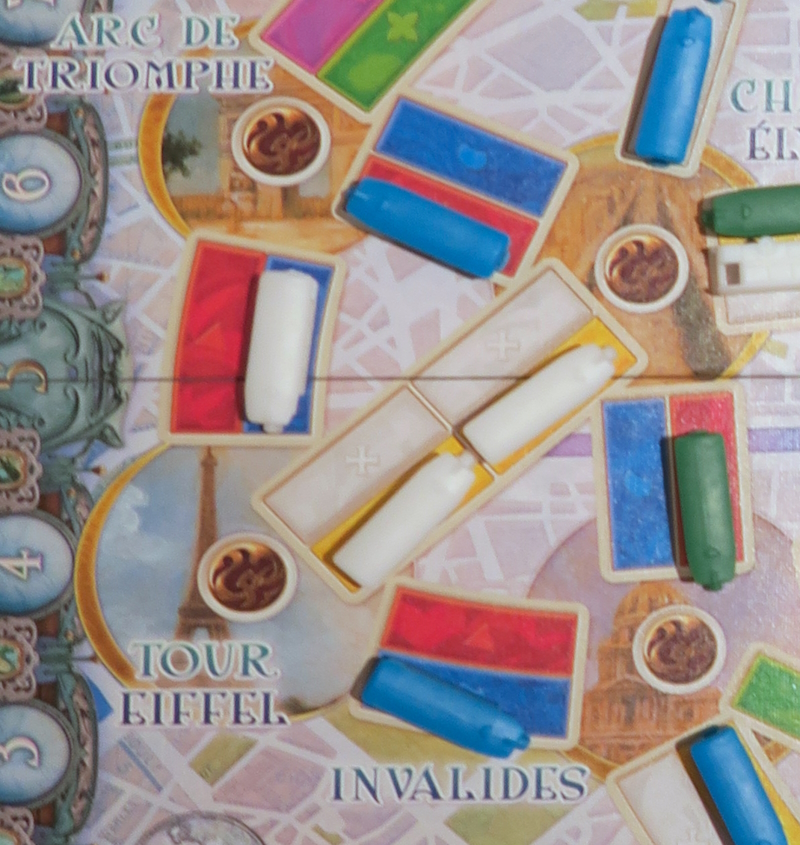
Ticket To Ride: Paris
– Image by boardGOATS

Learning Outcome:  When you take away the sport, you still have France.
25th June 2024

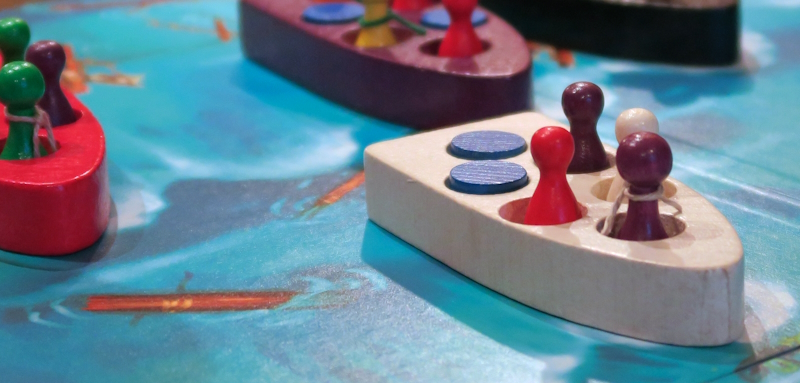
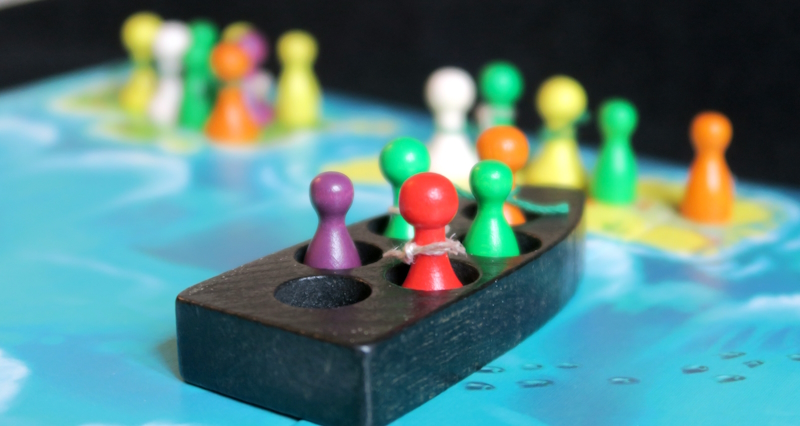
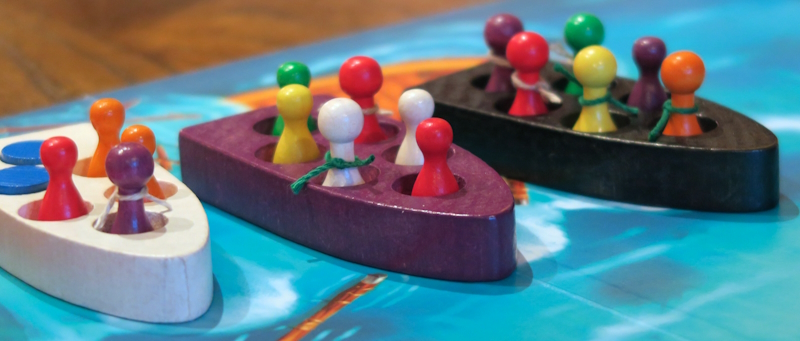
To mark the upcoming General Election, the “Feature Game” was to be Lifeboats, an older game which features lots of voting (as well as boating…).  Blue and Pink were still eating as the others arrived, so those that wanted to join them staked their claim and waited and the others took themselves off to play something else, but it wasn’t long before the voting and boating was underway.  Lifeboats is a fairly simple, if savage game, where players are trying to get their sailors from the sinking wreck of the Santa Timea to shore.  Unfortunately, the lifeboats are old and leaky and as the water comes in and the boats begin to sink, players vote to decide which boats to move and who to throw overboard.

Lifeboats
– Image by boardGOATS

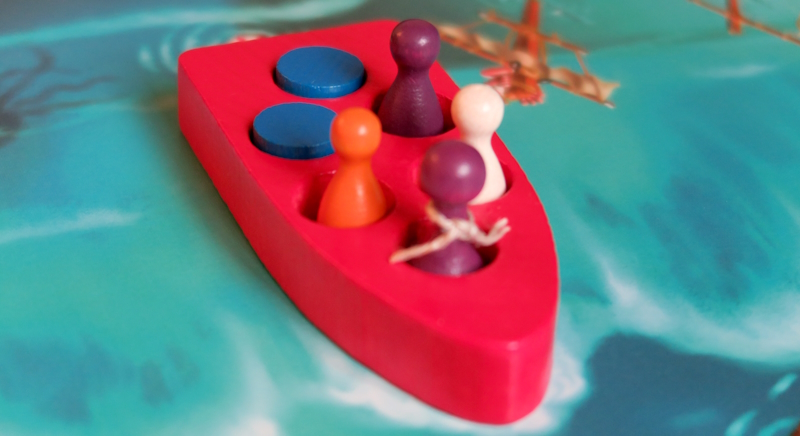
There are three phases to each round in Lifeboats:  firstly one boat develops a leak, then one boat moves forwards, and then finally, one seaman in each boat jumps overboard and then climbs back into a different boat.  In the first phase, players vote to decide which craft develops a leak and a blue wooden disk is placed in an empty spot in that boat—if there isn’t an empty space, the occupants vote to decide who is going over the side.  Once that has been resolved, players vote again, this time to decide which boat is going to move; it’s only three spaces to reach land, but that can seem an awfully long way.

Lifeboats
– Image by boardGOATS

In the final phase of the round, beginning with the start player, players take it in turns to take one of their seamen from a boat into the water and then in reverse order the swimmer climbs into a different boat.  And it must be a different boat—if there isn’t a different boat with space, the unfortunate sailor drowns in the attempt.  All that is quite straight forward, but there are a some little tweaks that add interest to the game.  Firstly, each player has two Officers and a number of Sailors:  deciding who is going to be thrown overboard, players have one vote per Sailor in the boat and two per Officer.  Seamen that make it to land score points, but Officers score more, all this also makes them a target though.

Lifeboats
– Image by boardGOATS

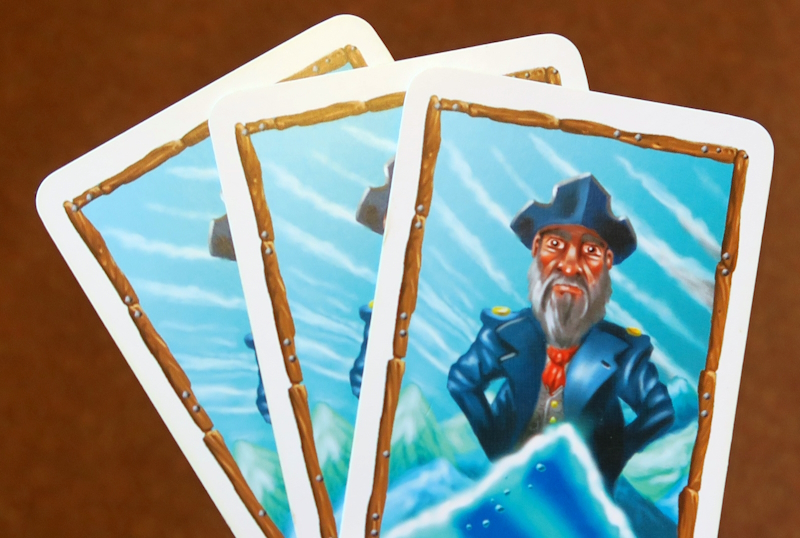
Even though the Santa Timea is headed for Davey Jones’ Locker, the Captain is still in command.  So, during any vote, players may invoke his name to get their way by playing a Captain’s Hat card.  Players only have three of these though, and they are single use so must be used with care.  Worse, if more than one player plays a Captain’s Hat, they cancel out, and a bit like ties in Las Vegas all the tied players lose out, so they also have to be well timed to be effective. The winner is the player to score the most points by getting their seamen back to land before the last boat sinks (and the different islands give different numbers of points for Sailors and Officers).

Lifeboats
– Image by boardGOATS

A key part of the game is the negotiation before votes, so the group played with “The Stick Variant” whereby the Start Player controls how long players have for debate.  The other advantage of being the Start Player is they have the casting vote in the event of a tie.  This time, Ivory went first and began with the Start Token.  As he was playing white, to maintain the election theme, he was representing Independent candidates.  Blue played with orange who were therefore the Liberal Democrats; Lime had purple UKIP pieces; Pine directed the Greens, Black Labour and Pink the SNP.

Lifeboats
– Image by boardGOATS

Nobody was quite sure what to do at the start, but Ivory’s Independent boat was the first to spring a leak.  Although players have no control over boats of their colour, they are a tie-break at the end of the game where players finish with equal points.  In the second round, Black opined that there were too many boats and rather than share the leaks around, the group should concentrate on sinking one boat.  Everyone else obligingly agreed and the vote was carried, so before long the Independent boat was heading to the bottom of the deep-blue sea.  In contrast, the Liberal Democrat boat danced over the waves making it to shore first, carrying two Green Sailors, and one Sailor each for UKIP and the Independents, all led by one SNP and one Independent Officer.

Lifeboats
– Image by boardGOATS

From there, things got more savage as the spaces in the boats became more scarce and everyone realised that the SNP (Pink) was on course for a landslide.  Ivory “spoiled his ballot” when he chose to throw his own Sailor overboard, and Lime was sufficiently confused by proceedings that he wound up voting to move a candidate forward when it had already withdrawn (by sinking).  The last boat to go down was Labour, but by that point, it was already clear that the Greens (in the guise of Pine) had the majority with a vote share of thirty-two, six more than the SNP (Pink) in second and twelve more than the third party, the Liberal Democrats (Blue).

Lifeboats
– Image by boardGOATS

It had been a lot of fun, if quite nasty, and as such, is a game with an older feel to it, as befits a game that is thirty years old.  It wasn’t the only thing that was showing it’s age, as the Blackadder quote got several outings too (“Lord Nelson has a vote…”  “He has a BOAT, Baldrick…”).  There had also been an large element of gerrymandering leading to Pine’s victory which, as he said, would not have happened if Lilac had been there as she would have really enjoyed drowning all his seamen.  As it was, he was the only player to get all his men to safety, so deserved his term in Parliament.

Lifeboats
– Image by boardGOATS

The other games were still underway, so the group played a couple of quick rounds of the old favourite, No Thanks!.  This is a super-quick filler, where players choose to take the face-up card, or pay a chip to pass the problem on to the next player.  At the end of the game, players score for the lowest card in each run, minus the number of chips they have left—the player with the lowest total is the winner.  In the first game, Black top-scored with forty-eight and the winner was Lime with nine, pipping Blue by one.  In the second game, Pine finished with the highest total (though it wasn’t a patch on Black’s).  Blue thought she had this one when her total came to just three, but much to her chagrin, Lime finished with two, again beating her by a solitary point.

No Thanks!
– Image by boardGOATS

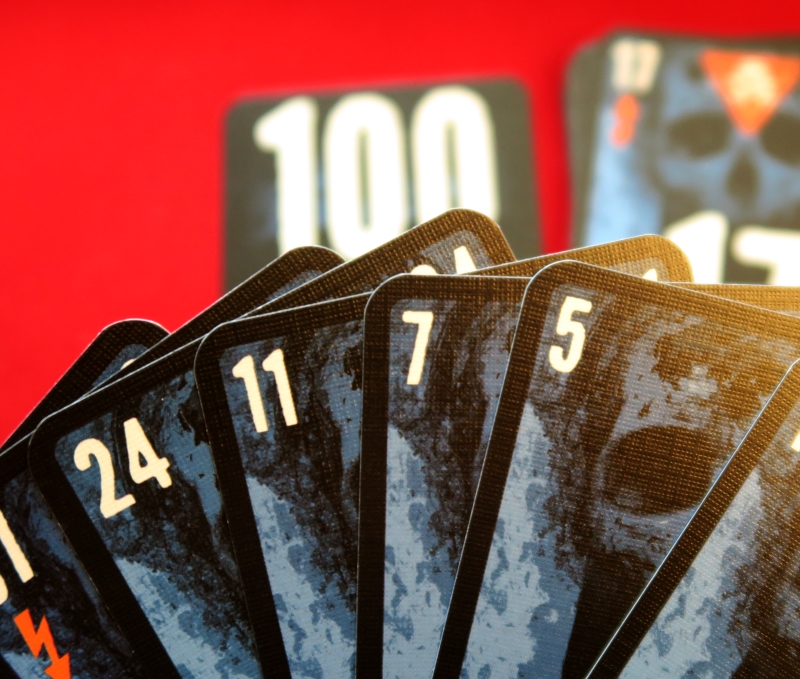
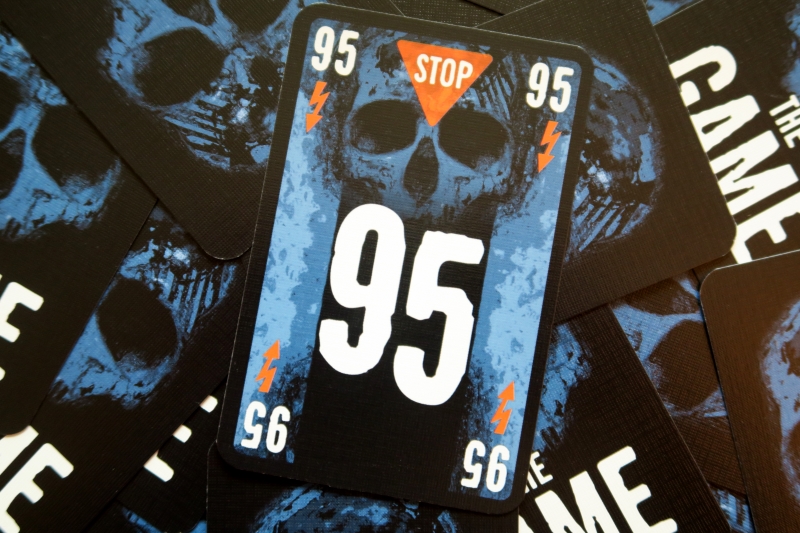
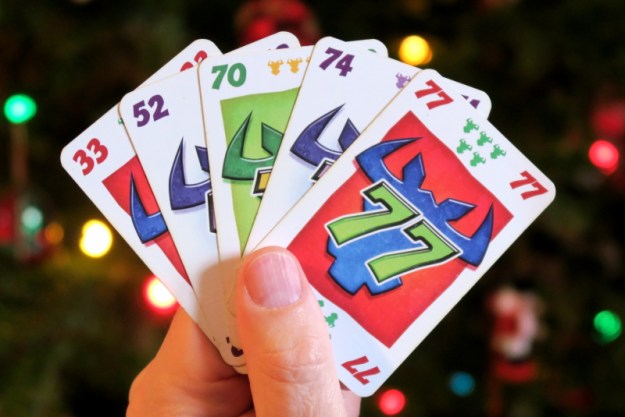
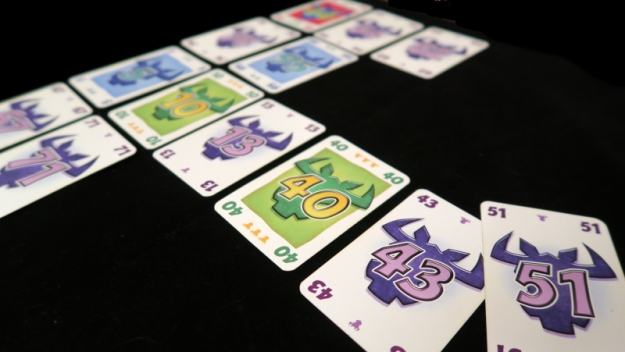
Ivory took his leave, and the remaining five managed one more game, this time of The Game.  This cooperative effort used to be a popular filler in the group, though it is a few years since it last got an outing.  The team have a deck of cards numbered from two to ninety-nine (in our case, from a copy of The Game: Extreme, but ignoring the special symbols), and play each card on one of four piles, two ascending and two descending.  There are just three rules:  the active player can play as many cards as they like, but must play at least two cards before replenishing their hand, and players can say anything they like but must not share “specific number information”.

The Game: Extreme
– Image by boardGOATS

There is the so-called “Backwards Rule” where players can reverse a deck as long as the card they play is exactly ten above or below the previous card played on that pile. The game ends when, either all the cards have been played onto the four piles, or a player cannot play a card. As is often the way, things started to go wrong from the start and pretty much kept going wrong.  The game finally cam to an end when, shortly after depleting the draw deck several people said there wasn’t anything they could play, and after the last possible card had been played the group had seventeen cards left.

The Game: Extreme
– Image by boardGOATS

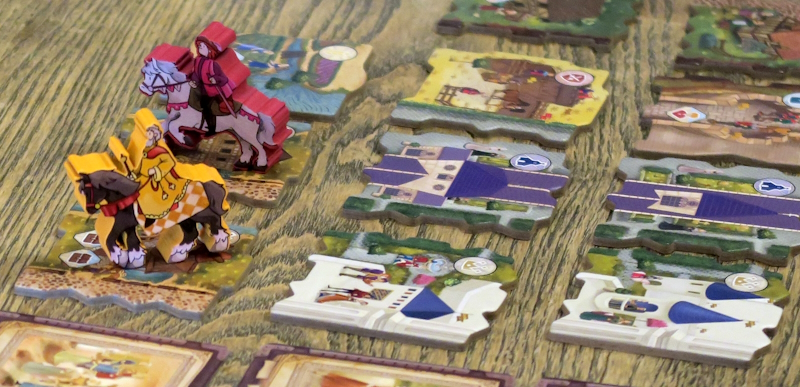
Meanwhile, Jade, Plum and Byzantium had started out playing one of Jade’s acquisitions from the recent UK Games Expo.  Middle Ages (a reimplementation of Majesty: For the Realm) is a quick little game where players are the head of a fiefdom.  The idea is that players use their Lord-eeple (or perhaps that should be lord-muman) to take tiles, placing them on their player board and gain its rewards, which change depending on the type of the piece.  The game is based around a market, similar to that in Kingdomino, where tiles are arranged in ascending order with players taking tiles in that order and placing their Lord-eeple on their chosen tile from the next row.  Thus, the player has to choose between an early choice in the next round and a low value tile, or a high value tile, with less or no choice.

Middle Ages
– Image by boardGOATS

Players then carry out the tile’s special effect and take the associated income.  The payout increases payout the more tiles of the same type a player has.  Every four rounds, there is an event and the game ends after the sixteenth round when players lose ten points for each type of tile they don’t have in their city and the person with the most points is the winner.  This time, Byzantium went all in for Windmills (players with fewer Windmill tiles had to give him two Coins) while Jade built some Barracks.  The Barracks enabled Jade to attack everyone with fewer Rampart tiles than he had Barracks tiles forcing them to give him money.  Plum opted for a more balanced approach that allowed her to improve her income stream significantly due to the Churches and Palace buildings she played.

Middle Ages
– Image by boardGOATS

Plum’s Church gave her a coin bonus which she placed on a Village, which enabled her to repair a broken building. There was some discussion about whether that was voluntary or not, but it didn’t seem to be written like it was a choice. Although not planning for it, Plum did well out of the third Event, “Restoration”, giving her coins for having three broken buildings.  Jade, on the other hand, had interpreted the rule as compulsory and had therefore mended his broken building a turn earlier so wasn’t able to benefit from the Event.  It was close between Jade and Byzantium with Jade just edging it.  Someway ahead, however, was Plum, who finished with one hundred and thirty-one points.

Middle Ages
– Image by boardGOATS

Middle Ages is a quick little game, and the trio then moved on to another UK Games Expo game, the slightly meatier Looot.  This is a game where players gather resources and capture buildings to develop their fjord, fill their longships and complete buildings to rack up victory points. The player with the most riches is crowned Jarl of the Vikings.  Like Middle Ages, this was new to both Plum and Byzantium, so after teaching the group got down to the serious pillaging. The game is played over several rounds until each player has played all their Vikings, giving a maximum of thirteen turns, each with a simple structure.

Looot
– Image by boardGOATS

First, a player places their Viking on a Resource tile on the central board adjacent to another Viking of any colour and take the Resource and place it on their personal board. If possible, they then capture a Building and place that on their board, take a Long Ship and also place it on their board, use a Shield, complete a Construction Site and finally grab a Trophy.  Plum felt she wasn’t going to be able to complete all three of her initial goal hexes, but hedged her bets and left space, just in case.  She used the “occupy the same space as another” option fairly early on to make sure she connected at least two Towers—Towers were the more difficult requirements for the two easier home hexes.

Looot
– Image by boardGOATS

Byzantium’s higher scoring home hex needed two Castles. He failed to complete one of his hexes, but did achieve the most difficult one giving him only slightly fewer points than the other two for this aspect. Jade thought the others were likely to take the spots he was aiming for a few times, but he needn’t have worried as a closer look at the others’ boards would no doubt have told him.  Byzantium got quite a good engine going early game with optimal placements of his first four to five Long Ships, which give bonuses for Resources and Buildings on the player’s map.  In order to complete a Long Ship it needs to be adjacent to three specific resources, however.

Looot
– Image by boardGOATS

Each Long Ship taken and left incomplete leads to a five point penalty, so it is important not to over commit, but equally players don’t want to leave prime location Long Ships for their opponents either.  Byzantium’s Long Ships made great use of the Looot he had pillaged, but for some reason he lost his way a little and ended up with a lot of low scoring Looot at the end of the game.  It felt really close, but Jade thought he would just sneak it as he had increased his Castle scoring to seven points per Castle and had he three of them.  In the end though, Plum ended up winning by quite a significant margin, her hundred and eleven were eight points more than Jades total for second place.

Looot
– Image by boardGOATS

It was an evening for playing games from Expo, as Teal led Purple and Sapphire in a game of Photosynthesis.  This game is a few years old now, but Teal had been really delighted to find a copy for a very good price in the “Bring and Buy”.  In Photosynthesis, players collect light points based on the trees they have on the board and the direction of the sun gaining light points for any of their trees that aren’t in the shadow of another tree.  By collecting light, players can grow and further their species’ dominance over the forest.  Each round, the sun moves creating the direction of light for the round.   Players begin by placing two small trees on the board.

Photosynthesis
– Image by boardGOATS

Small trees collect one light point and cast a shadow over one space. Players can then spend light points to grow a tree, plant a new seed, and eventually harvest a tree once it has reached full size.  As well as a unique spacial puzzle, the game is quite beautiful with mechanics that fit the theme giving simple but meaningful choices.  Like a lot of puzzle-games, Photosynthesis can be quite hard to get one’s head round on the first play.  This time the game was really quite tight between Teal and and Sapphire, but Sapphire just had the edge, beating Teal by one point with final total of fifty-four.

Photosynthesis
– Image by boardGOATS

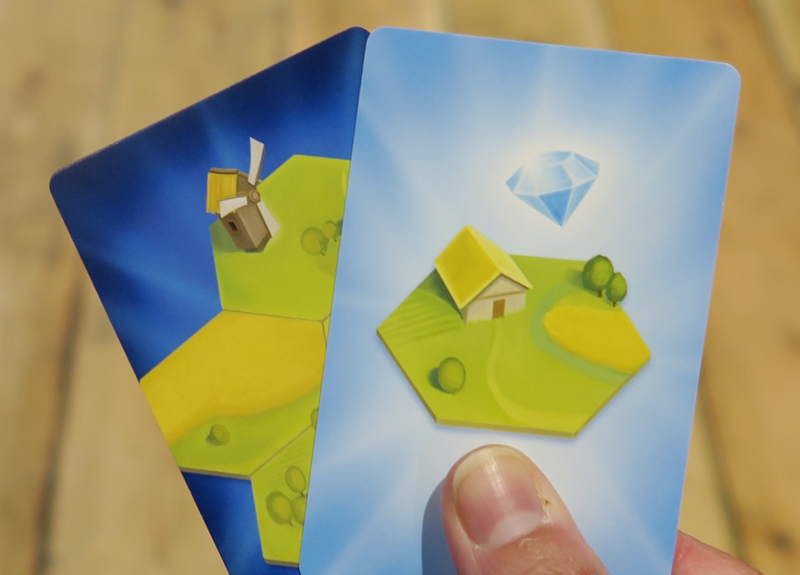
Lifeboats and Looot were still going, so Purple pulled out another Expo special, that first got a run-out last time, a game called Rome in a Day.  This is a cute little “I divide, you choose” game, where players draw five land tiles at random and place two buildings on tiles one and two. They then divide the five tiles into two groups—a bigger and a smaller one (in any ratio) and add a crystal to the smaller land set before offering the choice to their neighbour. During the four rounds the game is played over this neighbour alternates, right, left, right, left.  So, each round, players choose a set from their neighbour and these and the tiles they were left with are added to their domain.

Rome in a Day
– Image by boardGOATS

At the end of the game, any building that stands on or adjacent to land of its own colour will score for each tile in the group and then players score for the diamonds they have collected—the player with the most points is the winner.  It was a really close game, in fact, it was a tie for second place between Purple and Teal who both scored twenty-seven points. Sapphire did rather better, however, finishing with thirty-five points having concentrated on yellow Wheat Fields and green Olive Groves to the complete exclusion of blue-purple Vineyards and red Towns.

Rome in a Day
– Image by boardGOATS

Learning outcome:  Politics can be savage, but it is important everyone votes.

3rd October 2023

Black, Purple, Byzantium, Plum, Blue and Pink all arrived early for food, and were soon joined by Pine, Lime and finally Ivory.  The “Feature Game“, was to be Crappy Birthday, a party game where players give each other comedy birthday presents and the recipient has to decide who gave them the best and worst gifts.  A bit like the better known game, Dixit, the idea is to be the master of non-mediocrity, with the best and worst gifts netting points for the person who gave them.  It was our birthday party, so as is now traditional, everyone shared cake (this year, meeple topped carrot cup cakes), before Plum started off the year of GOATS crappy birthdays, receiving her first gift from Byzantium.

2023 Birthday Cupcakes
– Image by boardGOATS

This year we discovered that Plum fancied a custom chopper, Byzantium liked the idea of visiting a radioactive swamp (so long as it wasn’t too active) and Lime would gratefully accept a gift Monster Truck weekend.  Unusually, Pine didn’t get horses and a pile of meat, and picked skiing in Alaska (finding the Alaska bit more appealing than the skiing), and Black chose a Safari as his favourite gift.  Plum picked a chick-flick marathon over a litter of puppies and Ivory opted for a catapult over several space-based options.  Finally, much to everyone’s surprise, Blue picked a garden chess set and Pink chose a set of cuddly penguins over a pet vulture (who is very friendly, but stares at you while you are sleeping).

Crappy Birthday
– Image by boardGOATS

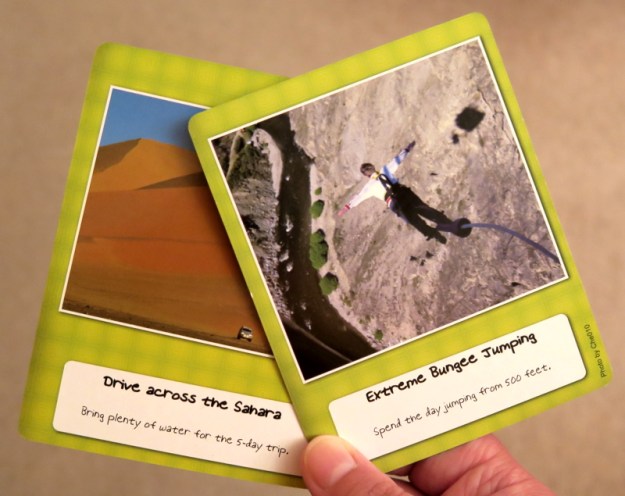
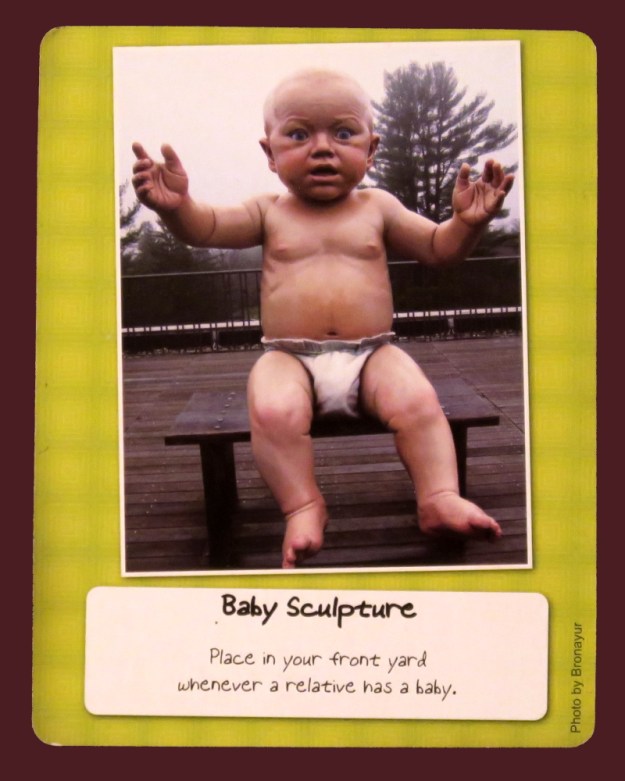
Less popular were singing the national anthem a the baseball, extreme bungee jumping, face piercing, a flexible trainer, and perkiness training.  The horrific baby sculpture was pretty much guaranteed to be rejected (and Lime had the opportunity for a second time), but others were more specific.  For example, Purple eschewed the drive across the Sahara because she dislikes the heat while others felt they would quite like a visit to the desert.  Similarly, Pink couldn’t imagine anything worse than mime camp, although most of the others couldn’t really see his problem.  Most people managed at least one or two loved or loathed gifts, nobody came close to matching Plum, who took a massive six points—a remarkable seventy-five percent of her potential maximum, quite a record for a worthy winner.

Crappy Birthday
– Image by boardGOATS

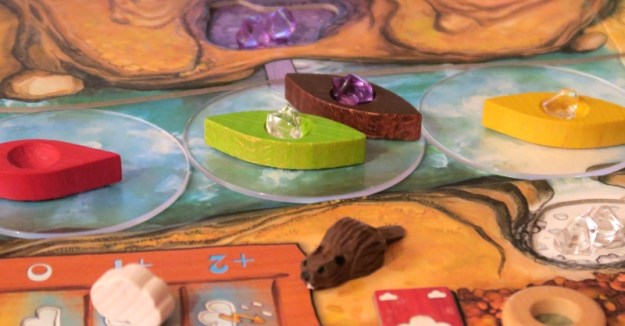
With our birthday suitably marked, the question was whether to continue to play light, large-group games or to break the group up and play something slightly more serious.  Pink suggested Niagara, and although Blue, Black and Purple warned against it, Plum showed an interest and that suckered in Byzantium, Lime and Pine.  The idea of Niagara is that players are rowing their canoes along the river to collect gems and then safely row them back to shore.  Players do this by simultaneously choosing a Paddle tile to play, then taking it in turns to activate their chosen Paddle to move their canoe (or canoes), trying to avoid losing them over the cataract and turning them into match-wood.  The winner is the player who manages to get seven different coloured gems or five gems of the same colour safely to shore.

Niagara
– Image by boardGOATS

The reason for the warnings and large amount of reticence form some of the group was after an online game some two years ago when Pink had the temerity to steal gems from everyone else and collective punishment failed to correct his appalling behaviour, winning the game in spite of it all.  This time, fore-warned and fore-armed the game started mean and got meaner, with the gem stealing starting in the very first round.  As a result, three out of the five finished the game with nothing.  Although Pink ended the game with two red gems, at least he didn’t win—that honour went to Byzantium, who by hook or by crook (mostly crook to be honest), managed to get five purple gems and ended the game.

Niagara
– Image by boardGOATS

Meanwhile, on the next table, Black and Purple were introducing Blue and Ivory to Little Town.  Despite the similarity in names (and inevitable resulting confusion), this is nothing to do with Tiny Towns. In this game, players acquire resources like wood, stone, fish, and wheat from the surrounding squares by placing workers on the board. When a worker is placed, the owner acquires the resources available from all eight surrounding spaces. They can then build buildings by using these resources, and the owner (or indeed any other player), can gain the effect of the building when they place a worker next to it, although when claiming a resource from a building owned by another player, they must pay a them a coin.

Little Town
– Image by boardGOATS

The game is deliciously tight—each player gets one action per turn, three turns per round and the game lasts just four rounds. Players collect victory points by using the powers of buildings, by constructing buildings taken from the market (which is not refilled), and by achieving goals dealt to them at the beginning of the game. After the fourth and final round, whoever has the most victory points wins.  Ivory started building an engine based on turning money into points, but then he realised the flaw in his plan:  there was no additional source of money in the game, so once he’d spent his cash, he was reliant on others paying to use his facilities, a source that rapidly diminished.  So he moved on to collecting wheat instead.

Little Town
– Image by boardGOATS

Blue built an engine to turn fish and wheat into points.  Black also built a wheat into points engine and pinched the last wheat field that both Blue and Ivory had their eye on.  Purple on the other hand did something completely different, converting resources into other resources to satisfy her goal card.  Ultimately though, none of it really mattered as the game was really, really tight and all four players finished within three points of each other.  Black’s experience with the game told and his thirty-two points just edged him one point clear of Blue who took second and she in turn finished one point ahead of Ivory.  It had been an enjoyable game though, definitely deserving of another outing, especially as the variety in the buildings would make it play very differently every time.

Little Town
– Image by boardGOATS

While the Little Town was being explored, Niagara had already finished and Lime, Plum and Byzantium rowed their respective ways home, leaving Pine and Pink to play a quick game of the new mini-version of Ticket to Ride, Berlin.  This is the latest in the “City Series”, smaller versions of the game that play more quickly, but still keep the essence of the original game.  Each game (full-sized or smaller), has some unique “hook” as well as a new map and features designed to bring a flavour of the new location.  Like all the other game, players have a choice on their turn to either take coloured cards from the market, or pay cards to place pieces on the map.

Ticket to Ride: Berlin
– Image by boardGOATS

In the Berlin version, players have both subway trains and trams to place. Tram routes are claimed in the usual way, but only one underground carriage is placed to claim a Subway or U-bahn route. When a player has one or none of their pieces left in their supply (either Tram or U-bahn carriages), each player, including that player, gets one last turn, then tickets are scored as usual.  One of the differences between this game and the other variants is the shape of the map, with it being very elongated in the east/west direction.  Pine built his routes along the north side and into the centre while Pink stretched his network along the south bank and into the centre.

Ticket to Ride: Berlin
– Image by boardGOATS

It was a very enjoyable game, and both Pink and Pine said they would definitely play this one again.  Perhaps part of the reason was that it was very close, but neither player realised how close until the final scoring.  In fact, it was so close that they double checked the score and confirmed that it was a tie with both players finishing with fifty-four points.  After a bit of chat, they had a rummage through the rules to find out what the tie breaker was, only to discover that it was the number of completed tickets, and both had finished with five.  So remarkably, it was a real tie, but while they shared victory this time, there will almost certainly be a rematch in the not too distant future.

Ticket to Ride: Berlin
– Image by boardGOATS

Learning Outcome: Everyone loves a nice birthday gift.

19th September 2023

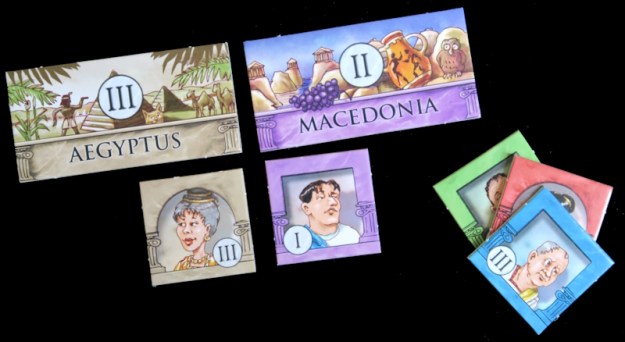
Blue and Pink were the first to arrive, making up for their recent absence on the other side of the world.  They had finished their supper and were just discussing the upcoming Essen, when Purple and Black arrived, quickly followed by Pine, to be regaled of tales of koalas, pandas and roos.  Green, Teal, Cobalt and Lime weren’t that far behind and then the group split into two to play.  The “Feature Game” was Alea Iacta Est, a fairly simple dice chucking game with a Roman theme.  Although it has a lot of similarity to one of our old favourites, Las Vegas, it is more of a “gamers’ game” as it has a bit more planning and slightly more complex scoring.

Alea Iacta Est
– Image by boardGOATS

Like Las Vegas, players have a handful of dice, which they roll on their turn and then place a some or all in one of the locations.  In Las Vegas, the locations are different gambling joints and the dice placed are all the same number.  However, in Alea Iacta Est, the dice placed depend on the location, there are five, and the all behave differently.  For example, in the Templum, the first player adds one die and takes a face down Fortunum token.  The next player to place dice in the Templum adds one more die than the first player making sure the total number of pips is larger, and also takes a token.  If a player is returning to the Templum, they can reuse the dice they placed previously, making sure their number of dice is one more than the previous person to play there.

Alea Iacta Est
– Image by boardGOATS

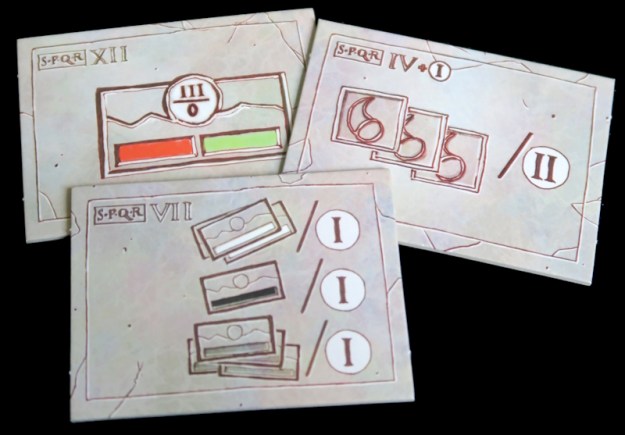
The Fortunum tokens are points, ranging at random from one to three.  At the end of the round (triggered by one player running out of dice), the player with the most Fortunum tokens keeps two of their tokens, while everyone else keeps one of their choice.  In the Senatus, players have to place “runs”, that is sequences of dice with consecutive values.  Players who place dice later must add one more die than the previous player and the run must be different to any that already exist.  Players can only have one run in the Senatus, but as for the Templum, players can ad dice to their previous entry.

Alea Iacta Est
– Image by boardGOATS

At the end of the round, the player with the longest sequence of dice takes three Senate cards, keeps one and passes the rest on to the player with the second longest sequence of dice.  The Senate cards provide players with end game scoring opportunities.  The Castrum is similar to the Slot Machine from the Las Vegas Boulevard expansion, in that players add sets of dice of the same value.  Like the Slot Machine, players can have more than one group, but unlike Las Vegas, there may be any number of groups in the Castrum, but never two groups with the same pips and same number of dice.

Alea Iacta Est
– Image by boardGOATS

The player with the largest group in the Castrum at the end of the round takes their choice from the face up selection of Province tiles.  These score points at the end of the game, as long as they have at least one assigned Patrician.  Players get Patricians from the Forum Romanum.  The Forum Romanum is perhaps the most complex to control. Player can place either a single die with any number of pips or exactly two dice, which show together the total five pips (i.e. a one and a four, or a two and a three).  The dice are placed at the base of pillars in value order with the lowest value added to the left displacing everything to the right by one space.

Alea Iacta Est
– Image by boardGOATS

The clever part is the order the dice are placed when there is the inevitable tie:  the most newly added, also goes in the space to the left the group with the same number (again shifting everything to the right by one space).  At the base of each pillar there is also Patrician tile and these go to the owner of the die next to the pillar at the end of the round.  The fifth and final space is the Latrina, which is where players place dice if they can’t place them anywhere else, getting a re-roll token in return.  These can be cashed in during the game, or are worth a point for each pair at the end of the game.  The Patrician tiles and the Provinces are coloured.  Patricians are worth their face value, but only if allocated to a Province with a matching colour.

Alea Iacta Est
– Image by boardGOATS

Each Province can support two Patricians, one male and one female.  Each Province also scores its face value, though there is a point deduction if it has no Patricians.  These are the main source of points, though Senate tiles can provide a lot as well, with additional points from the re-roll chips and Fortuna tiles (taken from the Templum).  The game is played over five rounds with players taking it in turns to allocate dice until one player runs out (play continues until everyone has had the same number of turns).  As expected, it took a couple of rounds for everyone to get the hang of the locations, and in particular how the Forum Romanum worked and the implications for the scoring.

Alea Iacta Est
– Image by boardGOATS

Initially, everyone, but Pine in particular collected some Senate cards, to try to give them a steer on what to aim for.  They were a bit more complicated than people realised, so while they helped to an extent, in some cases, things became more opaque rather than less.  Pink, Pine and Blue made a real effort to get what they wanted from the Forum Romanum, which became increasingly difficult as the game progress—in the final round, the only dice left there had the value of one.  Teal focused on the getting lots of Provinces, realising that they still scored most of the points even when they were unoccupied.

Alea Iacta Est
– Image by boardGOATS

Given how people struggled to get to grips with the scoring, it was a really close game.  Pink just pipped Blue by a single point and Teal was only a couple of points behind in third.  Ultimately, despite the similarities with Las Vegas, it was very definitely a “learning game”.  Indeed, the similarities are quite superficial as the guts of the game are in the way the different locations interact.  This takes the game from being a light betting game to a much more complex game, though one that is still a lot of fun, with special moments when someone shifts someone else’s carefully positioned dice right out of the Forum.

Alea Iacta Est
– Image by boardGOATS

Meanwhile, on the next table, Green led Black, Purple and Cobalt in a game of Endeavor: Age of Sail.  This is a game that is very popular with the group, and although it seems quite complex, really comprises of point-by-point decisions, so although strategy is very important, tactics are critical too. The game is played over eight rounds, each consisting of four basic phases: Build, Populate, Payment and Action.  There are four technology tracks roughly corresponding to each phase, which dictate what a player can do during that phase.  For example, how far along the building track a player is dictates what they can build: the further along they are, the more buildings they have to choose from.

Endeavor: Age of Sail
– Image by boardGOATS

Thus it is one of those games where small decisions made early can have a big impact later in the game.  The first phase consists of passing round the tray of buildings rather like a box of chocolates, but after that, the second and third phases are more or less carried out simultaneously.  The guts of the game, however, is the Action phase.  In this round, players can place population markers on their buildings to activate them and carry out one of the five actions:  Colonise, Ship, Attack, Plunder Assets, and Pay Workers, actions that are generally focused on the central map.

Endeavor: Age of Sail
– Image by boardGOATS

Cobalt had not played Endeavor before so the group opted for the standard buildings and played using the standard, four/five player side of the board.  They did add three exploits from the Age of Expansion, however, the last three that had not yet been played with this copy of the game. They would not come into play until later and by then everyone should have a good idea of how to play.  While Cobalt and Black went with the Occupy action for their first building followed by the Workshop for extra bricks for their second building, Green and Purple both chose Shipping as their first building.  Green then took a Shipyard for a second shipping action and Purple went for a Market (gaining cards), “just to to be different”.

Endeavor: Age of Sail
– Image by boardGOATS

In that first round, Black and Cobalt only took a single occupy action with a plan to get better actions for their third building. Purple could only manage a single shipping, while Green also only managed one ship, but combined it with gaining a Culture to push him into the next category to get more citizens in the second round.  In that next round, Purple and Cobalt continued their similar strategy, gaining slaves for their bricks, while Green was forced into a workshop to stop himself getting hamstrung on buildings later and Purple was struggling to get enough citizens to use all the actions she had available to her.

Endeavor: Age of Sail
– Image by boardGOATS

That was pretty much how the game continued. Black and Cobalt placing people into Europe and building up their cards; Green was shipping around the world (although mostly in the Caribbean and South America) and Purple was taking the shipping routes in Europe, but always without enough citizens.  As the game progressed, regions started to open. Green inevitably gained the first Governor card. Cobalt and Puple fought for who had the most cards in total.

Endeavor: Age of Sail
– Image by boardGOATS

Once three and then four regions became open, only Green and Cobalt had people in both regions of the two opened exploits, so only they were able to make use of them.  They did use the South Sea Company exploit and Green took the extra brick as a ongoing benefit. This was not a normal brick, but a whole extra brick level, which allowed him to gain a level five building in the final round (the only one to do so). Cobald had tried to get a level five building, but then realised he had failed to reduce his brick level after he’d lost a couple of cards, and so was restricted to another level four building.  Although the Letters of Marque was the other opened exploit, no one actually made use of it.

Endeavor: Age of Sail
– Image by boardGOATS

About three rounds in, Green suddenly realised he had forgotten to explain the “Abolition of Slavery” rule to Cobalt. It didn’t look likely to happen as no-one had yet taken any European cards, however, Cobalt made his mind up then that this was what he was going to aim for—even though he had his own slaves, it felt morally right to him to make it happen!  Which he duly did, however, the only players to lose out as a result were himself and Black.  Both of them needed to reduce their card count anyhow, and the slaves were the ones likely to  be for the chop, so it didn’t cause too much damage.  The minus points they both received were only a small price to pay for their freedom.

Endeavor: Age of Sail
– Image by boardGOATS

Balancing everything is critical in this game and unfortunately Purple had always been on the back foot without enough citizens to do the actions she had available.  In the end Green ran out the winner as he had managed to get most of his attribute tracks up and gained a fair presence on the board.  The Letters of Marque, although unused, did provide for extra scoring on the shipping tracks, where Green had rather a lot of due to his early double shipping strategy. He and Cobalt also gained some points for using the South Sea Company Exploit.  This pushed Cobalt into second, marginally ahead of Black (who had managed a fair few points on cards and buildings).

Endeavor: Age of Sail
– Image by boardGOATS

It was still early and Endeavor was on-going, so when Teal left, the group looked for something little and light to play, and quickly settled on No Thanks!.  This is a favourite with the group because it is super-quick to set up and play:  players start with eleven red chips, and on their turn either take the card shown or pay a chip to pass the problem on to the next player.  At the end of the game, when the deck has been depleted, players score for the lowest value card in each continuous “run”, offset by any remaining chips and the winner is the player with the lowest total.  This is made more difficult by the fact that around thirty percent of the cards have been removed.

No Thanks!
– Image by boardGOATS

This time, the group played a total of three games.  In the first one, Pink took all the chips leaving everyone else with nowhere to go but pick up cards, which Blue did in spectacular fashion, finishing with one hundred and forty points.  The other three were very close together, with Pink just edging it by a single point from Lime.  The second game was much better balanced.  Although Pine won, there were clues as to Lime’s strategy for the next game as he picked up lots of cards and would have won by a large margin if two of the cards he wanted hadn’t been removed from the deck, but that’s the point of the game of course.

No Thanks!
– Image by boardGOATS

The third and final game was very unusual.  Lime rode his luck like a bucking bronco and kept taking cards.  Blue picked up a couple, but that was all he let her have, and Pine and Pink who just kept passing, eventually ran out of chips.  As they were playing open handed, Lime saw this and just collected the rest of the cards leaving him with forty chips and fifty-two points from his cards—a very good final score of twelve. Unfortunately for him, as both Pine and Pink had no cards or chips, they both finished with a round, fat zero, and therefore shared victory in one of the strangest No Thanks! games anyone had ever played.

No Thanks!
– Image by boardGOATS

With Endeavor coming to a close, there was just time to squeeze in something quick.  The fancied a change though and, as it had been a while since it’s last outing, Love letter was picked.  Everyone knew the game well , so the rules didn’t really need to be explained: start with a hand of one card, draw a second and choose one to play, effectively dueling to have the highest value card once the deck was exhausted.  Blue and Pine won the first two rounds, and as the others were finishing packing up, rather than play more, the group decided Blue and Pink should have a play-off.  Blue quickly acquired the Princess, which can be risky, but it was soon over when Pine played the Baron and compared hands, do his detriment.  With that, it was time to go home.

Love Letter
– Image by boardGOATS

Learning Outcome:  Although two games may seem similar, they may not suit people equally well.

24th January 2023

Blue and Pink were first to put in an appearance and availed themselves of the burger offerings at the Jockey before everyone else began to arrive.  Ivory turned up cradling his enormous copy of the Collectors’ Edition of Everdell, complete with its Bellfaire expansion (as well as pretty much everything else available).  And from then on, it was a matter of deciding who was going to play what.  As Ivory began building the Evertree, Green commented that he’d really enjoyed playing it last time and would like to play it again, but wanted to give everyone else the opportunity.  Everyone else similarly followed this gentlemanly gesture, but in the end Ivory took first Teal, then Green and finally Purple to the end of the table and started the mammoth task of unpacking.

Everdell
– Image by boardGOATS

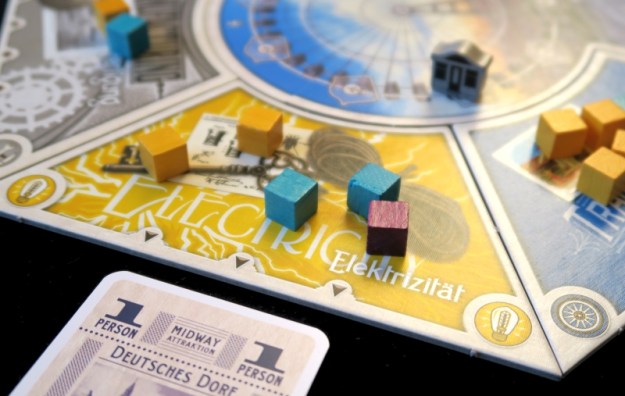
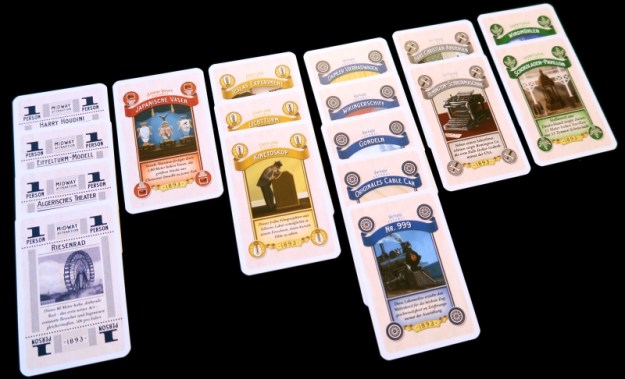
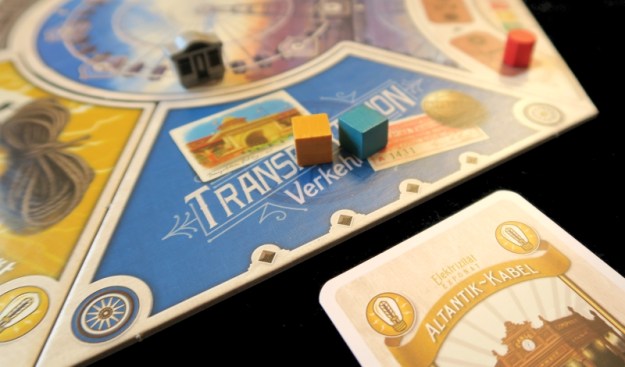
As they began setting up, the other four began deciding what to play.  After suggestions that largely fell on deaf ears, Blue eventually began unpacking World’s Fair 1893.  This is a clever little game that integrates area majority and set collecting mechanics.  The idea is that players choose a segment of the board and place a population marker in it before taking all the cards in that section.  Three cards are then added to the board, with the first added to the section cards have just been taken from and one each added to the next two segments.  Cards come in three types:  Character Cards, Midway Tickets and Exhibit Cards.

World's Fair 1893
– Image by boardGOATS

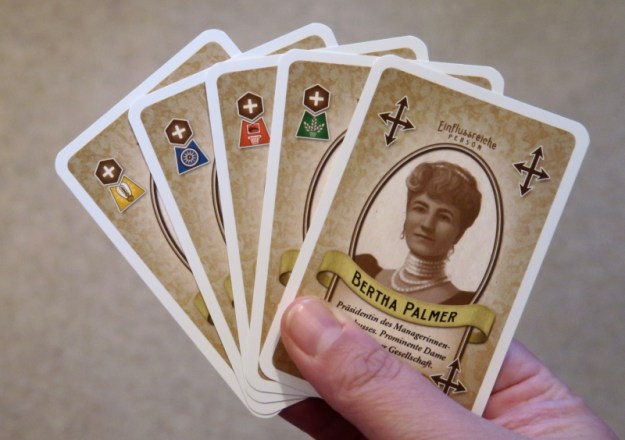
Character cards can be used to move cubes about or add extra cubes and are played by the active player between placing their token and taking the cards from that section.  When the Ferris wheel car has travelled all the way round there is an interim scoring stage.  Midway tickets are exchanged for one point, with the player who has the most earning bonus points.  Exhibit Cards are exchanged for tokens:  each of the five segments of the board are evaluated and the player with the most population tokens gains a couple of bonus points and the opportunity to trade up to three exhibit cards for matching coloured tokens. The player who comes second also gets points and can exchange fewer Exhibit Cards for tokens.

World's Fair 1893
– Image by boardGOATS

The tokens are combined into sets at the end of the game with the larger sets worth more points; sets containing all five different coloured tokens are worth fifteen points, with sets of four worth ten, and three, two and one worth six, three and one point respectively.  Played over the three rounds, the winner is the player with the most points at the end of the game.  Blue didn’t do a great job of explaining the point of tokens, so in the first round, Lime focused on collecting Midway Tickets, lots and lots of Midway Tickets taking lots of points and the bonus too.

World's Fair 1893
– Image by boardGOATS

Pink, on the other hand, had played it before and better understood the relationship between Exhibit Cards, Tokens and points at the end of the game.  That said, he seemed to have a bit of a mental block on how to use the his character cards (after placing a population token, but before taking cards).  Bertha Palmer seemed to cause a particular problem and her function had to be explained at least three times before the message got through.  Through the second and third round, Lime continued to collect Midway Tickets while Blue, Pink and Pine tried to manipulate the majorities in the areas for which they wanted tokens for.

World's Fair 1893
– Image by boardGOATS

Lime kept doing well in the green Agricultural region, but was unable to get the cards to match.  This is the catch with the game:  in order to obtain tokens in a specific colour, players need the majority of population markers in that region, but also need to gain Exhibit cards to match, which quite likely are only available from other segments.  Pine commented that he thought this game should be played with ties cancelling each other out like in Las Vegas—funny, that that would have left him in pole position in several key areas that he needed…

World's Fair 1893
– Image by boardGOATS

As the game came to an end, the question was whether anyone would have enough sets of tokens to catch Lime with his huge pile of coins from his Midway Tickets.  It looked like Pink might make it with his two sets of five giving him thirty points, but he fell two points short.  Blue however did slightly better with sets of five, four, three and two and finished with sixty-two points, five more than Lime.  When Pine asked how Pink collected so many tokens, Pink’s response was, “Never underestimate the value of coming second…”

World's Fair 1893
– Image by boardGOATS

Everdell was very much still underway and although time was marching on, there was still time to play something else.  So a decision was made very quickly as Blue got out Les Aventuriers du Rail Express.  “Les Aventuriers du Rail” is the french name for Ticket to Ride, and this “Express” version originally released only in French and Italian, was a “light” version of the game, positioned somewhere between the “City” editions (like New York, London, Amsterdam etc.) and the full sized games.  Thus it plays quicker than the full sized game, but is longer than the City editions, and has a maximum of four players like the smaller games

Ticket to Ride: Switzerland
– Image by boardGOATS

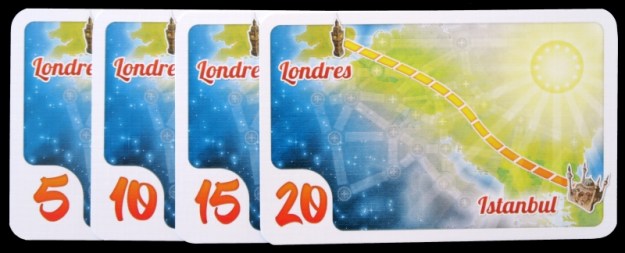
The basic principle of all the games is the same however:  on their turn players either take two coloured carriage cards from the market, pay sets of cards to claim a route and place plastic pieces on the map, or draw tickets giving cities that players need to connect to score points.  Each edition has its own special rules and this one has a shared ticket:  London to Istanbul.  The first player to connect these cities gains twenty points with the second getting fifteen and so on.

Les Aventuriers du Rail Express
– Image by boardGOATS

Additionally, instead of Locomotive (Wild) Cards being included in the Carriage Card market, they are always available from a separate face up deck with players taking one card on their turn instead of two).  It didn’t take long before the group had checked they had the right number of trains and had identified the special rules for this version of the game.  Blue went first, but Pine was the first to place trains on the map, at which point everyone else realised they were going to have to go hard and fast to compete.

Ticket to Ride: Europe
– Image by boardGOATS

Blue also placed an early train, but Pink opted for the “expert strategy” espoused by Black, to pick up tickets early.  The idea is that knowing the destinations you need to connect early is an advantage, but this is offset of course, by the fact that it gives everyone else an extra turn to claim some of the routes you might need.  This time, unbeknownst to the others, Pink got lucky with long overlapping routes and, as a result picked up another batch of tickets.  Pine tried to follow the ticket strategy, but got less lucky.

Les Aventuriers du Rail Express
– Image by boardGOATS

Blue thought the London to Istanbul ticket was quite a good option as it was almost zero risk since it wouldn’t cost her if she failed to complete it, it was also relatively complementary to her starting tickets.  This strategy meant she had to go through the middle of Europe and, as a result, got caught up in the three-way punch-up with Lime and Pine centred on Strasbourg.  Pine came off worst, but unquestionably, Pink came off best as he eschewed central Europe, instead focusing on taking the route to Warsaw via Berlin which also included two slightly more lucrative five car connections.

Les Aventuriers du Rail Express
– Image by boardGOATS

Blue claimed the London to Istanbul route first and with it twenty points, followed by Lime who had completely forgotten about it in his tussle to make his other tickets.  Blue was then left with a choice:  pick up tickets or try to end the game quickly.  Knowing Pink and Pine in particular had a lot of tickets to complete and with plastic trains beginning to run low, she opted for the latter.  Unfortunately for her, Pink had already nearly finished his tickets and was able to complete his last one on his final turn.  That just left the scoring, and it wasn’t really close with Pink finishing with eighty-two and Blue the best of the rest some fifteen points behind.

Les Aventuriers du Rail Express
– Image by boardGOATS

On the next table, Ivory, Green, Teal and Purple played the “Feature Game“, the Bellfaire expansion to Everdell, the winner of the Golden GOAT just before Christmas.  Everdell is a fairly simple game in principle, with players either placing a worker to collect resources or then using the resources to pay to play cards from their hand into their tableau.  The game is very smooth to play, well balanced and has beautiful artwork.  One of the things that makes it different to many other games is that when a player runs out of actions (or earlier if they choose), they can end their season and reclaim all workers and start again.  This is important because some of the action spaces can only be occupied by one critter at any one time.

Everdell
– Image by boardGOATS

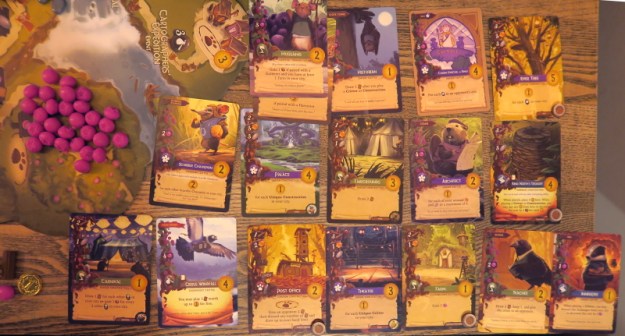
The cards come in different types, but one of the key aspects is that critter cards can be played by paying their cost or as a bonus for playing the associated construction card.  For example, if a player builds a Courthouse, they can play the Judge at the same time if they have it in their hand.  Cards give players special powers, extra resources, actions and points at the end of the game.  Each player’s tableau can only hold a maximum of fifteen cards; when a player cannot perform any more actions (or does not wish to) they pass and their tableau is completed.  Everyone else carries on playing and the game continues until everyone has passed with the winner being the player with the most points.

Everdell
– Image by boardGOATS

The Bellfaire expansion adds a little bit of variety to the game, in particular the Market, a Bonus for one of each card category, and a randomly selected Beauty Bonus for the most purple flower cards.  The group also included the Extra! Extra! and Legends cards with the Corrin Evertail cards (from the Mistwood expansion).  One of the joys of Everdell is selecting playing pieces. With sixteen different creature meeples to choose from there is something for everyone.  Ivory  was quick to nab the purple coloured Platypus, Teal selected grey Hedgehogs, Purple chose red Squirrels and Green wanted the green Lizards.

Everdell
– Image by boardGOATS

On pulling out all the Lizards from the Box, Green declared that one of his meeples was disabled. It was missing the bottom half, its legs and its tail, poor thing!  To give this one an easy ride green selected it for later use as part of the Autumn cache.  As expected Ivory got off to a flying start.  While Purple was the first to leave winter and head into spring, Green and Teal were not far behind. Ivory, however, seemed to be able to keep going in Winter for many turns after everyone else had left.  He had been quite lucky with the card draw and was able to pair critters with his buildings to a much greater extent than everyone else.

Everdell
– Image by boardGOATS

Teal noticed that Ivory had completed all the card categories and could claim the bonus tile, but he kept quiet and instead was the first to claim a bonus tile: for having three forest tags.  A short while later Green also noticed that Ivory could claim the bonus, but he, perhaps due to silliness or perhaps innate honesty, did not keep quiet.  Ivory had not noticed, so promptly claimed it on his next turn.  No-one else was able to fulfill that requirement for quite some turns.

Everdell: Bellfaire
– Image by boardGOATS

The Bellfaire Market allows players to choose to either gain resources, or to trade them.  When gaining resources, players choose one token, gain the resources and cards, then move that token to the “trade” side of the market.  When trading, players pay resources and discard cards to gain three points and any two resources, before moving the token back to the “gain” side.  This time, players used the market to collect initial resources, but once they had all been used, no-one seemed to show much interest in trading to bring them back into play.  Trading did happen a couple of times later in the game, but no-one could really see the benefit of the trading versus collecting resources outright, especially since two of the randomly drawn extra forest spaces included the ability to trade cards or wood for “any” resource.

Everdell
– Image by boardGOATS

The pattern of Purple going into the next season first and Ivory going last remained all the way through Spring and Summer.  Ivory did slow down somewhat though, and did not enter Autumn much later than Teal and Green.  By this time, most the group had managed to play at least one of their Legends cards and were beginning to use them to good effect.  Green’s Ranger Strey Softpaw which enabled him to use two already used forest action spaces for one worker was generally remarked as a very useful legend card.  Maybe that was how he was able to catch up a little, but one of the key challenges he struggled with was being able to get the Critter and Construction pairs.

Everdell
– Image by boardGOATS

Once Autumn came round, it was time for the poor disabled lizard to play a part on Green’s behalf.  That part was, to cries of being cruel, to go straight to the Cemetery so he could select a card to play for free—unfortunate critter!  Although Ivory kept going longer than anyone, he already had all fifteen cards played, and found himself unable to do much else, even though he still had workers left.  Purple finished early with a similar problem, although she was unable to afford any more cards even with gathering from her last worker.

Everdell
– Image by boardGOATS

Eventually, everyone finished their final season and in the final scoring, Ivory scored big on the card totals.  Green did quite well and finished a few points ahead of Teal, though Purple suffered as she had not been able to play as many cards.  Ivory also scored well on other bonuses and Teal and Green were similarly matched with several bonuses, except that Teal managed to accrue more coins and score Journey points.  As a result, Teal took second, though Ivory was way ahead of everyone else.

Everdell
– Image by boardGOATS

Learning outcome:  We’ll have to brush up the Everdell skills if we ever want a chance of beating Ivory in future.

31st December 2022

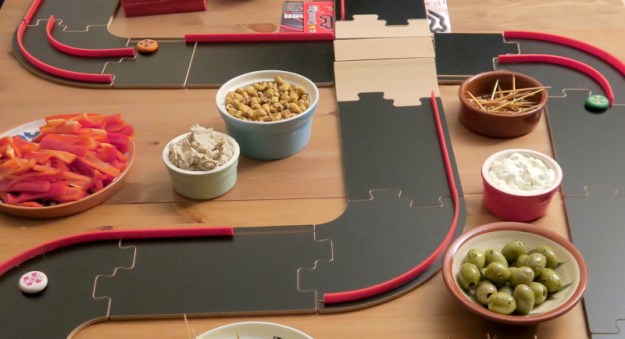
Pine was the first to arrive and, as a result, was landed with the task of setting up the “Feature Game”, the gorgeous, dexterity car-racing game, PitchCar.  Black, Purple and Lemon arrived soon after to give him a hand, while Pink got drinks and Blue carried on messing about in the kitchen.  Once an annual event, there has been a bit of a hiatus in the New Year PitchCar game over the last couple of years, and it turned out the lack of practice meant everyone had forgotten how to set up the bridge from the first extension.  Blue was summoned from the kitchen to explain, and then the track-builders continued their construction work.

PitchCar Track 31/12/22 (1)
– Image by boardGOATS

Aside from the bridge and a few chicanes, the track was kept to a simple figure-of-eight, eschewing the multi-level tracks, jumps, potholes, crossroads and loop of the more recent extensions.  Before long, the track was complete, and then Lime arrived.  Starting order was decided by arrival time, so the first to flick-off was Pine. The game is very simple:  starting with the car at the front of the pack, players take it in turns to flick (not push) their puck along the track.  Cars can jump as long as they don’t cut corners, land on the track “rubber-side down”, and don’t knock anyone else off the track in the process.

PitchCar
– Image by boardGOATS

There were the usual ooos, ahhhhs, howls of delight, and cheers, as there were near misses, total misses, bumps and amazing somersaults. First to cross the line was Lime after some amazingly spectacular long distance flicks, followed by Pink and then Lemon taking a podium spot on her debut.  Before we started, Pine had commented that he wondered how his skills would have deteriorated over the three years since we’d last played, so he was initially surprised to find that he’d improved.  That feeling didn’t last however, as he eventually followed everyone else over the line.

PitchCar
– Image by boardGOATS

Supper wasn’t quite ready, so Pink suggested a shortened course running the length of the table, replacing one of the straights with a second finishing line and ignoring the return under the bridge.  This time, pole was decided as the reverse order that players crossed the line in the first race, so Pine went first.  Unfortunately, he repeatedly rolled his car going over the bridge and it took some dozen or more attempts to cross it.  With the shortened course, he didn’t have time to make his way back up the field (indeed the race was over before he crossed the bridge), though he did improve his final position slightly compared to the first race.

PitchCar Track 31/12/22 (2)
– Image by boardGOATS

With the short course, it was always likely to come down to who got a good start and made it over the bridge first.  Black got a storming start and led the field down the track before running out of gas as he approached the chequered flag.  That was OK though, as Lemon rear-ended him at speed and shot him across the line.  Lemon followed him onto the podium with Pink taking bronze.  With that, supper was pretty much ready, so it was all hands to the deck to dismantle the track in time for the arrival of home-made pie with veg.

– Image by boardGOATS

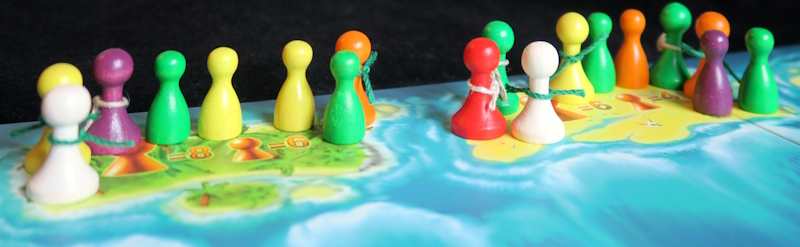
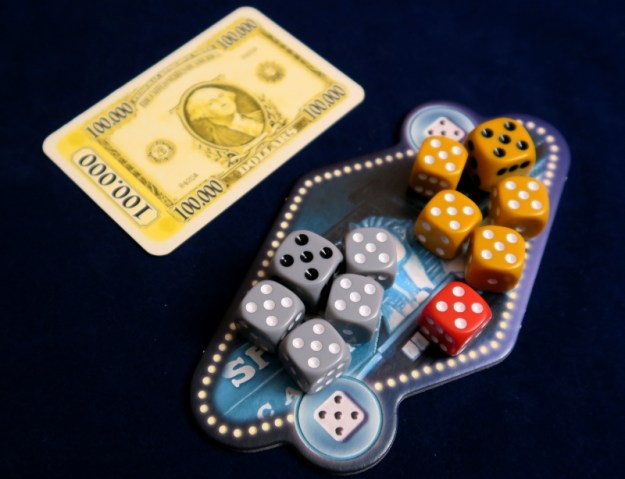
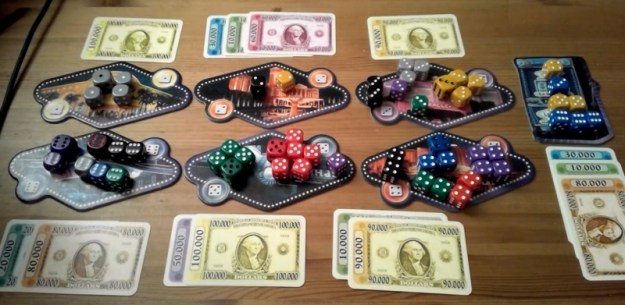
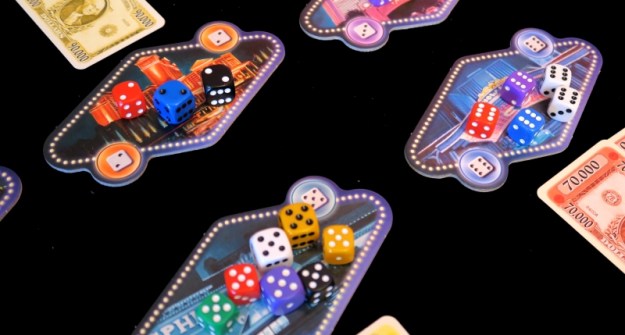
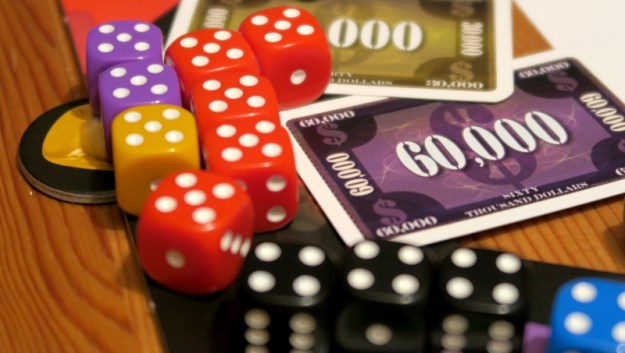
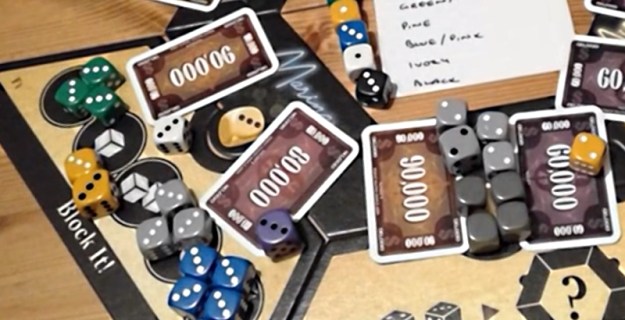
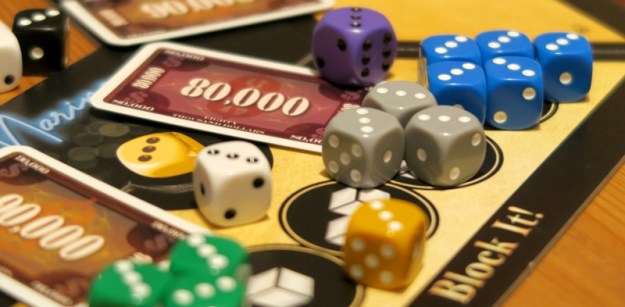
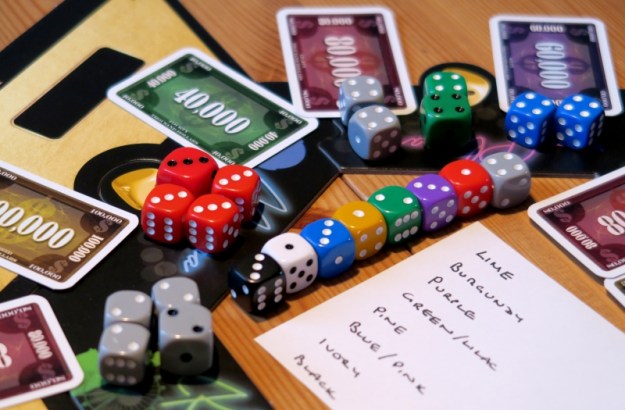
There was much chatter over supper, then, while everyone else pondered what game to play, Lime gave Pink a hand with the washing-up.  Eventually, Pine went upstairs and returned with Las Vegas and a panda, and with only snacks remaining on the table, he began setting up while Blue and Black explained the game to Lemon.  This is an old favourite that we’ve not played for a long time.  It truth, it is a simple enough game, albeit one that is quite clever.  The idea is that each player bets in the six numbered casinos using their dice.

Las Vegas
– Image by boardGOATS

On their turn, each player rolls all their dice and must choose a number and place all the dice with that face value in the casino of that number.  The player with the most dice in that casino at the end of the round wins the money.  There are a couple of catches, however.  Firstly, all the dice of the chosen number must be placed, even if this is not to the player’s advantage.  Secondly, and this is why the first catch is so critical, if two players tie, neither gets any money and the winner is the next inline (who is not involved in a tie).

Las Vegas
– Image by boardGOATS

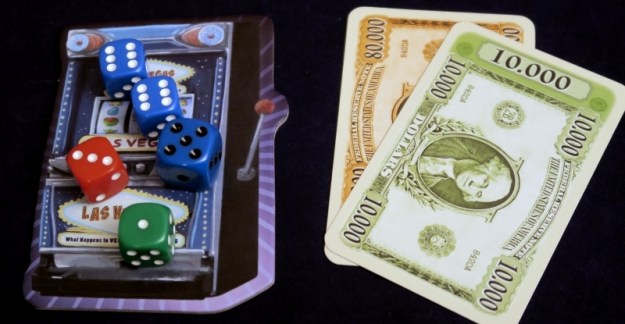
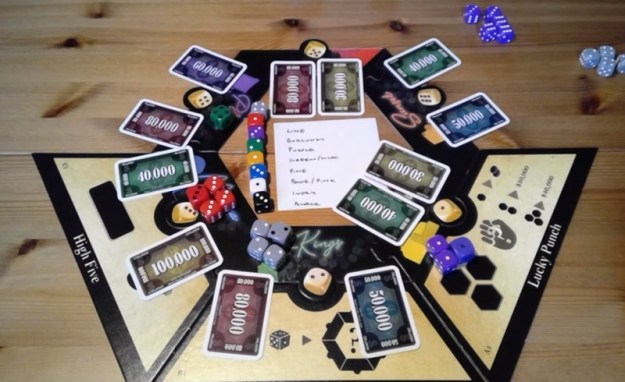
Finally, at the start of each round, money cards are dealt at random to each casino giving them a set value; the winner only takes one of these with the others going to the players in the lower placings.  This means that some casinos might have several small denomination cards up for grabs, while others might have only one high value card to fight over.  The combination of these features make this a great little game.  We also tend to add some components from the Boulevard expansion.  There are lots of modules, but we usually only use “The Bigun”, the extra high value money cards, The Slot Machine, and extra dice for additional players.

Las Vegas: The Slot Machine
– Image by boardGOATS

“The Biggun” replaces one die for each player with a bigger one that is worth two smaller dice.  The Slot Machine is a bit different though.  Like the casinos, players can add dice on several turns, however, unlike the casinos, each number can only be added to the Slot Machine once.  Then, although the winner is still the player with the most dice, ties are broken by the number of pips on all the dice placed.  The game is played over three rounds and the wealthiest player at the end of the game is the winner.

Las Vegas
– Image by boardGOATS

Black went first and started the dice rolling fest.  Everyone took some money in the first round, but the beginnings of the rivalries began, between Purple and Pine, between Pine and Lime and between Lime and Purple.  The second round was filled with high-value cards which entrenched the rivalries and ensured a few new ones were started with Pink, Black and Blue encouraging everyone else’s misbehaviour leaving Lime coming out of the second round without any winnings.

Las Vegas
– Image by boardGOATS

After a brief sojourn to view the midnight fireworks in the village and to toast absent friends and the New Year, we started the final round.  This was very cut-throat:  Blue and Pine got into a very silly battle for the Four casino which Blue was winning with seven dice until the final roll by Pine which gave a tie knocking them both out leaving $100,000 to Lime with his lone die.  If Pine had won, that would have given him victory, but as it was, it was close between Black and Pink, with Pink taking victory by $10,000 with his total of $340,000.

Las Vegas
– Image by boardGOATS

By this time it was 1am, and although everyone was tired, people lingered, first to talk about the robustness of Ikea furniture and then the status of the Jockey.  With Monday being the last day for the current Managers/Chefs it is unclear what the situation will be in ten days time when we are next due to meet.  We talked over other options, but all that really did was highlight how lucky we have been with The Jockey.  And with that, everyone drifted home leaving Blue and Pink to find their beds.

Las Vegas
– Image by boardGOATS

Learning Outcome:  Parties are great fun.

26th July 2022

Blue and Pink were first to arrive and were just finishing their supper when Ivory joined them soon followed by Pine.  Ivory and Pink were keen to play Ark Nova which is longer than our usual fare and therefore needed a quick and early start.  So, when Black and Purple arrived, they grabbed Black and headed over to the other side of the room.  Everyone else conformed to more typical hesitant behaviour and were a lot slower to get going.  This wasn’t helped by Blue who was explaining how Pink had managed to find the “Only Panda Themed Village in Cornwall” and when Lemon and Orange queried it, she felt the need to find the photos to prove it.

The Lanivet Inn
– Image by boardGOATS

Eventually, the group split into two with Purple, Blue, Pine and Teal playing the “Feature Game“, the Spiel des Jahres nominee, SCOUT.  Although this has a nominal and very tenuous “circus theme”, it really is well hidden and “pasted on” to what is otherwise a relatively traditional, though clever little Rummy-esque card game with a Bohnanza-type twist—players cannot change the order of the cards in their hand.  The idea is that players have a hand of cards and on their turn takes an action:  they play a run or a meld (set of cards of the same value à la Rummy), or take a card from the active set (the previously played set).  The first of these actions is called “Show” and players can only Show the set they want to play beats the previously played set (called the Active Set).  A set wins if it has more cards or the same number, but a higher value, and a meld always beats a run.

SCOUT
– Image by boardGOATS

When Showing, the cards played must be consecutive in the player’s hand, so a player can, for example, take a four, five and six from the beginning, middle or end of their hand.  It must beat the current Active Set, and it then becomes the new Active Set with the old one turned face down and added to its owner’s scoring pile.  In this way, the quality of the the Active Set is ever increasing—this mechanism makes SCOUT a ladder-climbing game, of which Tichu and Haggis are probably the best known.  The problem is that of course it will become progressively difficult to play cards (especially with the consecutive constraint), so players can also use the Scout action and take a card from the Active Set, for which it’s owner gets a Scout token as a reward.

SCOUT
– Image by boardGOATS

When Scouting, players can only take a card from the end of the Active Set, ensuring that runs retain their integrity and just become shorter and maybe of lower value.  A card that has been Scouted goes into the player’s hand, anywhere they like, so they can use this to connect two cards in a run, or enhance an already existing meld for example.  The really clever part of the game is that the cards have two values, and which value they take depends on which way up the cards are.  This is clever because it adds just enough flexibility to make the game work, while not making things trivial.

SCOUT
– Image by boardGOATS

At the start of the game, players are dealt a hand of cards and choose which way up the hand goes—not the individual cards, the whole hand.  From this point on, the hand stays the same way up, but when cards are added to a player’s hand (and only then), the added card can be rotated.  The game ends when either, one player runs out of cards, or when it gets to a player’s turn and they were the last person to Show.  In addition to Scout and Show, once during the game, players can also “Scout & Show” which is often used to bring about or prevent the game coming to an end.  Players then add up the number of scoring cards and tokens and subtract the number of cards in the their hand and the player with the most is the winner.

SCOUT
– Image by boardGOATS

The game is one of those games that is a bit odd to understand at first, so Purple (who started), began tentatively, but it wasn’t long before people were Scouting and Showing happily.  There was a bit of confusion when it came to Teal’s turn and he Scouted one of his own cards—a rules check didn’t answer the question of whether he should get a token (we called them Cadbury’s Chocolate Bars because of their colour) or not, so we decided not.  It was only later that we realised that of course players could not Scout from their own set, as a round of Scouting triggers the end of the game.  Pine was the clear winner with fourteen points, more than twice Blue in second, and in spite of forgetting he could Scout & Show which would have given him victory earlier.

SCOUT
– Image by boardGOATS

The game can be played in campaign mode where players get scoring tokens and add up the total after several rounds, however, we tend to prefer to play games like this as single, short, one-off games.  And this time, everyone wanted to “do a Lime” and give it a second go now they understood what they were doing.  It was about this time that Pine checked his phone for the first time and reported that the England versus Sweden semi-final in the Women’s European football championships was goalless, but that “Sweden were playing well”.  There was a general slightly pessimistic noise around the table and Teal began the second round.

SCOUT
– Image by boardGOATS

A cheer from the bar prompted Pine to check his phone again and everyone relaxed a little when he reported that England had scored their first goal.  This second game of SCOUT was much closer than the first with scores of eleven, twelve, thirteen and fourteen, with Blue the victor, just ahead of Teal.  It had been a lot of fun and everyone really appreciated the cleverness of such a simple little game and found it had really grown on them from the two rounds they’d played.  There were other games people fancied playing, however, so the group moved on to Trek 12: Himalaya, a Roll and Write game we first enjoyed playing a few months ago and was given a “Recommendation” by the Spiel des Jahres Award committee.

Trek 12: Himalaya
– Image by boardGOATS

Trek 12 is similar to On Tour which we played several times online, but is a little more complex.  In On Tour, two d10 dice are rolled and players combine them to make a two digit number, so a five and a four can be combined to make a forty-five and a fifty-four, one of which is then written in a location on the map.  Locations are connected by “roads” and players are aiming to make the longest continuous route of numbers that only increase.  Trek 12 does something similar in that two dice are rolled and the numbers combined to give one, but as the sum, difference, or product, alternatively players may choose one single die (either the larger or the smaller).

On Tour
– Image by boardGOATS

The catch is that each of these operations can only be used just four times each during the game.  The resultant number is then written on the map, but the theme is trekking so chains of ascending or descending numbers represent ropes while groups of the same number represent camps.  Another difference is that in On Tour player can write their numbers anywhere on their map, whereas in Trek 12 numbers have to be added next each other.  This means that it is advisable to start in the centre and work out, advice that Pink eschewed at his cost last time we played.  Scoring is more complex as well, since players score for the highest value in each rope/camp plus one for each other number in the rope/camp with bonuses for the longest rope/largest camp and negative points for any isolated numbers.

Trek 12: Himalaya
– Image by boardGOATS

This time the group  used the Kagkot map, rather than the Dunai map used last time.  Teal, Purple and Pine all started at much the same place putting a five in the middle, but from there things quickly diverged despite the plague of fives that were rolled.  Blue decided to do something different and started with a zero in the middle.  Everyone got themselves into a bit of a tangle, but Purple struggled the most.  Part of the reason might have been distraction caused by the updates on the football as, during the second half of the match, there was a second goal, then a third.  Everyone was still digesting the third which was described as “Outrageous” when a fourth went in just eight minutes later to leave the final score four-nil to England.

Trek 12: Himalaya
– Image by boardGOATS

Teal gambled on getting the high dice rolls he wanted, and jammily got them.  However, the game was won by Blue who put together lots and lots of very short ropes and small camps to give her high base scores, with one long rope to give a decent bonus and a final total just above the target set for the map in campaign mode.  While all this was going on, Lilac and Green were introducing Orange and Lemon to Carcassonne, an older, now classic Euro game that won the Spiel des Jahres award over twenty years ago.  The game is perhaps one of the best known tile-laying games and was the inspiration for the term “Meeple“.

Carcassonne
– Image by boardGOATS

On their turn, players draw a tile and add it to the central map.  The tiles feature some combination of Roads, Cloisters, City and Fields.  Once the tile has been placed, the player can then add a single Meeple from their supply to the tile placing it on one of the features so it becomes a Thief, Monk, Knight or Farmer (respectively).  Finally, any features that are completed are scored and the players gets their Meeples back.  In this context, completed means Roads that end with a junction at both ends, Cloisters that are completely surrounded by other tiles, and Cities without gaps where the wall is closed).  Fields or Farms are only scored at the end of the game.

Carcassonne
– Image by boardGOATS

In this way, players score one point for each tile in a completed Road, nine points for a completed Cloister and two points for each tile in a completed city (plus two for any Pennants).  Although players can’t add a Meeple to a feature that is already occupied, it is possible to end up with shared features.  This happens when two separately owned Roads (say) are joined together.  In this situation, the player with the most Meeples scores the points, or, if there is a tie, both players get the points.  And this is really the crux of the game—players can play nicely or nastily, working together to build big Cities, or muscling in and stealing them from other players just before they score, or even playing tiles to make Features difficult to complete.

Carcassonne
– Image by boardGOATS

At the end of the game, Farms and any still incomplete Features are scored (though they only give only one point for each tile and Pennant in a city and one point for each tile in a Cloister array).  A Farm is a continuous Field, i.e. a green space that a Meeple could “walk” around that might be bordered by Roads, City walls, River or the edge of the map.  Each Farm then scores three points for each City that it “feeds”, i.e. that borders the Farm.  Since Farms can be very high scoring, early Farmers in the right place can be very valuable as they mean other players have to work hard to join fields together if they want to share the points.  On the other hand, an early farmer can be cut off and left scoring very few points.

Carcassonne
– Image by boardGOATS

Additionally, since they are not recovered during the game, Farmers placed early are not scoring points during the game, so part of the skill of the game is timing when to place Farmers to maximise their value.  Scores are kept on a track, and the player with the most points at the end is the winner.  This time, although there were a number of expansions available, with Lemon and Orange were new to the game, the group only added the River expansion, which consists of a small number of tiles played at the start and helps to prevent the formation of one massive Field.  Lilac explained the rules: although it is mostly a simple game, the Farmers always cause a little confusion, in particular where the edges of the Fields were and how you might end up with more than one Farmer in a field.

Carcassonne
– Image by boardGOATS

Lilac placed the second river tile and with little other option available to her placed the first Farmer.  For the next few turns of placing River tiles, the question of when another player could place a farmer was often repeated, until Orange was able to get one with a road and bridge tile.  The River started running along the length of the table, expecting the board to develop more in the that direction than to the edges of the table. Unfortunately, fairly early on the river shifted sideways and the whole board developed across the table rather than along, so they had to shift the tiles a couple of times to make room (this was not meant to be the Discworld!).

Carcassonne
– Image by boardGOATS

Lilac took an early commanding lead on the score board, with Orange next to start scoring. It seemed to take ages before Lemon got her first points and even longer for Green to get going.  However, Lilac’s lead soon disappeared as Green, Lemon and Orange shared the points for one enormous city—they thought they would never complete it, but with three people after one particular tile, it was almost inevitable really.  Lilac meanwhile was after the single bend road tile to complete a roundabout with her Meeple on it.  Everyone else got that tile, everyone except Lilac of course.  It looked like it would never happen, but in the dying moments of the game, she finally got the tile she needed. It was only worth four points, but it gave her a spare Meeple.

Carcassonne
– Image by boardGOATS

With the Farmers now understood, with his last tile, Orange was able to complete a City and then place a Meeple on the field part of that tile to be sole farmer for one complete city. It was only three points, but more than the couple he could have scored by using the tile to complete a Road. Having spotted this useful use of a final Meeple, Lemon and then Lilac both did the same.  In the mêlée of farmers, Orange came out on top, managing to knock out Lilac’s and Green’s farmers, and Lemon scored a few too.  The end result was a victory for Orange, a close second for Lemon, with the veterans of Green and Lilac well behind.  Perhaps they did not play quite as aggressively as they could have done, but mostly they just didn’t get the right tiles and were simply out-played.

Carcassonne
– Image by boardGOATS

Meanwhile, on the other side of the room, Black, Pink and Ivory were playing Ark Nova, but as it was showing no sign of finishing soon, with both Carcassonne and Trek 12 finished, the two groups had a decision to make:  play two games (maybe with a quick game of Musical Chairs first) or play one large game.  Las Vegas was suggested as a possible large game (it plays eight with the Boulevard Expansion), and Living Forest (winner of the Kennerspiel des Jahres this year) was an option if breaking into two groups.  Time marched on, and nobody in the group is very good at decision making and before long it was too late to play Living Forest and Las Vegas can take a while to play.  So in the end, the group decided to introduce Orange and Lemon to an old favourite, 6 Nimmt!.

6 Nimmt!
– Image by boardGOATS

Although 6 Nimmt! didn’t win the Spiel des Jahres Award, we certainly think it should have done; it did get a recommendation from the Jury though and of course it won the Golden GOAT in 2020 (a very difficult year for everyone).  Teal had to play taxi for his family, so headed off leaving seven to play.  The game is very simple:  players simultaneously choose a card from their hand and play it face down in front of them.  Once everyone has chosen a card, the cards are revealed and played in order from lowest to highest.  The cards are added to one of the four rows on the table—they are added to the row that ends with the highest number that is lower than the card itself.

6 Nimmt!
– Image by boardGOATS

If the card added would have been the sixth card, instead the player takes the cards in the row and their card becomes the start of the new row.  If the card is lower than all the cards at the end of the rows, instead the player chooses a row and their card replaces that row.  At the end of the game, players sum the total of Bull’s heads or “Nimmts” shown on the cards in their scoring pile and the player with the least is the winner.  There are a hundred and four cards in the deck, and we play a variant where the game is played over two rounds, each with half the cards.

6 Nimmt!
– Image by boardGOATS

The delicious thing about 6 Nimmt! is that everyone feels that they are in control, until the moment when they aren’t.  Some people argue that it is a random game, but as the same players (like Burgundy) often seem to do well, it can’t be.  That said, and it is especially true for those that often do well (like Burgundy), when it goes wrong it can go catastrophically and spectacularly wrong.  As a result the suspense is murder and the game is loads of fun yet never seems to outstay its welcome.  Orange quickly got to grips with it and clearly quickly appreciated the jeopardy.

6 Nimmt!
– Image by boardGOATS

This time we played without the “Professional Variant” that had become so popular online, partly because it would not be fair on the people new to it, but mostly because everyone was tired and nobody was up to the mathematical gymnastics it required.  This time the first round was unusual, because everyone had similar scores.  Usually, at least one player manages to keep a clean or cleanish sheet and at least one player picks up lots of pretty coloured cards, but the range of scores at half way were between seven and thirteen.  That meant it was all to play for in the second half.

6 Nimmt!
– Image by boardGOATS

The second half was a little more varied with Green only collecting four Nimmts and Blue and Lilac collecting sixteen, but the net effect largely offset the differences in the first round.  Blue top-scored with twenty-seven, Pine was just behind with twenty-six and Lilac after him with twenty-three (she really is going to have to try harder if she is going to compete with the really high scorers).  The winner though was Purple with fifteen, one Nimmt less than the runner up, Green, in what had been a tight game, but a lot of fun, as always.

6 Nimmt!
– Image by boardGOATS

Ark Nova was still on-going, so Orange, Lemon and Lilac killed a few minutes with a quick round of Dobble.  This Snap-a-Like game is simple, but a lot of fun.  This time, players started with a single card and called a match with the central pile and grabbed a card.  Despite playing in English which is not his first language, Orange is remarkably good at this game, taking twenty-two cards, beating Lemon into second place.  From there, that side of the room just deteriorated into random chatter about random pub-type things (including the Voice of Jack and the demise of Frosts at Millets) as people ran out of steam and waited for Ark Nova to finish.

Dobble
– Image by boardGOATS

By this time, Black, Pink and Ivory were rapidly running out of time as last orders had been called some time ago.  Ark Nova is a much longer game than we usually play with an advertised playing time of upwards of two hours and reputedly considerably more with inexperienced players and setup time included.  It is all about planning and designing a modern, scientifically managed zoo—when this was first mentioned at the start of the evening, Pine looked all interested in the theme, but was quickly put off when Ivory added it was “a bit like Terraforming Mars with animals”.  That said, although it is quite complex, functionally it is not difficult to play on a turn by turn basis, though there is quite a lot to manage and keep a track of.

Ark Nova
– Image by boardGOATS

On their turn, players take one of six possible actions:  activating one of the five action cards (Cards, Build, Animals, Association and Sponsor) with a strength equal to the number above the card, or move a card back to the first space and take a cross token instead.  When activating a card players perform the action based on its power level.  The power level is dictated by its position in the row, with the level one power to the left and the level five to the right.  Once a card has been played, it is moved the first space in the player’s five card row (i.e.to the lowest power position on the left) moving the other cards to the right to replace the card removed, effectively incrementing their power by one.  During the game, players can upgrade and turn over the action cards to a more powerful second side using various bonuses.

Ark Nova
– Image by boardGOATS

The Cards action is the simplest action, which lets players draw cards from the deck (the number depending on strength) then advance the marker two spaces along the break track which defines when the round ends.  The Build action allows players to pay to construct one building on their zoo map.  Players can build basic enclosures with a size of one to five, but they can also build a petting zoo for animal storage or pavilions and kiosks (which give players appeal and money respectively based on adjacent filled enclosures).  With the upgraded build action, players can build multiple different buildings and have access to the large bird aviary and reptile house which allow the storage of multiple animals.

Ark Nova
– Image by boardGOATS

There’s no point of having enclosures without animals, and that’s where the animals action comes in:  it allows players to add animals into enclosures in their zoo. Some animals have a special requirement and need a symbol in their tableau and/or the upgraded animal card. Adding an animal to an enclosure has a cost, and then the player turns over the empty enclosure of at least the size needed or places the listed cubes into a special enclosure (an aviary or a reptile house).  The player then adds the animal card to their tableau and resolves the abilities on it and receives ticket sales along with possibly conservation points and reputation.

Ark Nova
– Image by boardGOATS

The association action allows players to take one task on the association board with different tasks available based on their power level.  This allows people to gain reputation points, acquire a partner zoo they don’t already own, gain a partner university, or support a conservation.  Finally the sponsor action allows players to play exactly one sponsor from their hand which offer ongoing abilities.  They can allow players to place unique tiles in their zoo and offer end game conservation point opportunities. Some Sponsor cards have conditions on their play similar to the animal cards.

Ark Nova
– Image by boardGOATS

Players take it in turns to take actions, resetting every time a break occurs, until the end game has been triggered.  There are two tracks, Appeal (Tickets) and Conservation that follow the same course, but in opposite directions.  The game end is triggered when one player’s pair of scoring markers cross, after which, everyone gets one more turn and then the end-game cards are scored.  The player with the largest overlap between their Conservation and Appeal values is the winner.  A player’s tokens can meet and pass at any point, but Conservation points are much harder to get than Appeal, so to compensate, each step on the early part of the Conservation track is equivalent to two Tickets on the Appeal track, while each Conservation step is worth three Tickets.

Ark Nova
– Image by boardGOATS

Pink started hard and fast with a simple animal strategy concentrating on upgrading his action cards to get the more powerful actions and getting extra workers.  In contrast, Ivory and Black started a little slower and focused on getting larger (Size five) pens, like the reptile house and the aviary.  These are more difficult to get, but are also more valuable.  Ivory then added a Stork and a Condor, while Black collected a Horse and engaged the services of a European Hobbit-like Expert.  The game was about half-way through when the other table heard a howl of delight from all three of them:  The Panda card had come out.  From this point forward, Pink’s primary aim was to get the Panda and find it a nice, cosy, bamboo-filled space in his zoo where he could love it and hug it at leisure.

Ark Nova
– Image by boardGOATS

Although Pink got a lot of Tickets early, his Conservation was very low which made him look like he wasn’t a threat.  Maybe Ivory and Black took their eye off him because of this, as they seemed surprised when Pink suddenly got ten Conservation points very quickly using the Association action which triggered the end of the game quite abruptly.  In a similar way to the recent game of Viticulture where Teal did the same thing, this meant everyone else had to make the best of things.  It was probably for the best, however, as by this time it was a real race against the clock.

Ark Nova
– Image by boardGOATS

In the end game scoring, Ivory also managed to get his Appeal and Conservation pieces to cross over, but Black was less fortunate finishing with a negative score.  It was close between Pink and Ivory, but Ivory scored more in the end-game scoring and took victory by a single point.  Even though it finished in a bit of a rush, they had all really enjoyed the game; Black commented that rather than being like Terraforming Mars, to him it felt more like Wingspan, which was probably just as well as he’s not very fond of Terraforming Mars.   As they rushed to pack the game away, Pink gave his Panda one last hug before putting him back in the box and going home.

Ark Nova
– Image by boardGOATS

Learning Outcome:  Pink Likes Pandas.

30th March 2021 (Online)

The pandemic is hardly something to celebrate, but it has had such a huge impact on the group and life in general over the last year, that we couldn’t let the first anniversary of moving games night online pass without marking the occasion.  That and the close proximity of Easter meant the Easter Bunny had made some early deliveries.  Before we were able to open them though, there was another attack of The Gremlins…

Easter 2021 Biscuits
– Image by boardGOATS

This time, the unfortunate victims were Lime and Little Lime.  When they first arrived things seemed to be working, but then there were briefly two Limes and although we got rid of one, it seemed to take their sound with it.  There was much hilarity when Lime asked questions and obviously got no answer despite lots of us shouting at him…  In the end, we resorted to communicating with scribbled notes, but even turning it off and on again failed to work and he ended up joining us using his work computer.  Then the boxes of eggs, cake, and festive iced meeple biscuits were opened and we started the “Feature Game“, Las Vegas.

IT Gremlins
– Image by boardGOATS

Las Vegas is a dice chucking, betting, and push your luck game that we love and used to play a lot before we were forced to move game nights online.  It was the first game we played online a year ago and although other games work better with the current restrictions, we thought it was appropriate to play it again to mark a year of remote gaming.  Like a lot of the best games, the game itself is very simple: players start with a handful of dice and take it in turns to roll them and place some of them on one of the six casinos.  The player with the most dice in a casino wins the money at the end of the round.  The player with the most money after three rounds (“House Ruled” from four) is the winner.

Las Vegas
– Image by boardGOATS

So, each casino has a number, one to six, and on their turn, players can only place dice with that number on the corresponding casino.  They must place all the dice they have of that number and can only place dice in one casino on each turn.  Players thus take it in turns to roll their ever diminishing number of dice and place them on the casinos until they have nothing left to roll.  As usual, we played with the Big Dice from the Boulevard Expansion—these have double weight and count the same as two smaller dice giving people an additional decision to make.

Las Vegas: The Slot Machine
– Image by boardGOATS

We also used the Slot Machine, which is like a seventh casino, but works a little differently.  Instead of having a number, each die number can be placed just once in the round (though with more than one dice if appropriate).  The winner of the pot is the one with the most dice, with the total number of pips and then the highest numbered dice as tie-breakers.  Like the casinos, the pot is dealt out from a pile of money cards until it holds more than the minimum threshold—the winner then takes the highest value card, the runner up taking the second and so on.

Las Vegas
– Image by boardGOATS

The clever part of the game, the really, really clever part, the bit that makes it fun, is that  at the end of the round, all ties are removed (except for those on the Slots of course).  This gives players a reason to stay involved, even after they have run out of their own dice.  It leads to players egging each-other on and trying to persuade other players what to do with their dice, even when the most sensible move is obvious to everyone.

Las Vegas
– Image by boardGOATS

In order to reduce down-time between turns, the couples played in Teams, this led to inevitable debates and more barracking.  Blue and Pink ended up in conflict over Blue’s tendency to put her money on the Slots and while there was some debate between Green and Lilac, while Black also disagreed with Purple occasionally from his position under the patio.  It was good fun though, slower and more difficult to play than some of the “Roll and Write” games we’ve played more of recently, but it made a nice change.

Las Vegas
– Image by boardGOATS

There was lots of chatter and lots of hilarity, especially when Team Pinky-Blue rolled four fours and used them to take out Team Greeny-Lilac.  Then, with Ivory threatening to get involved in the same casino, instead he rolled three threes with his last dice and could do nothing useful with them.  It was a game for mulitples—in the next round Pine rolled five fives and Team Greeny-Lilac rolled six twos.

Las Vegas
– Image by boardGOATS

There was lots of smutty responses to Green’s comment, “I have a big one…” along the lines of, “So you keep saying…”.  And from there, every time someone rolled a one with their large dice, the comment got another airing, though fortunately it didn’t happen too often.  It almost didn’t matter who won; Team Greeny-Lilac made a march in the final round picking up $160,000, but it was only enough to push Team Purpley-Black into fourth place, just $10,000 ahead of Ivory.

Las Vegas
– Image by boardGOATS

Burgundy took second place with $340,000, but it was Team Pinky-Blue who, despite their bickering managed to steal first place with $370,000.  It had been fun, but everyone was in agreement in the hope that next time we play Las Vegas, it will be face to face.  With that, Ivory and Lime took their leave and everyone else moved onto Board Game Arena for a game of another old favourite, No Thanks!.

No Thanks!
– Image by boardGOATS

No Thanks! is a really simple game too and one we played quite a lot prior to last year, and has recently had a bit of a resurgence thanks to the new implementation on Board Game Arena.  This is the new version which plays seven (rather than the original five), but works in exactly the same way:  the active player has a simple choice, they can take the revealed card or pay a chip to pass the problem on to the next person who then has to make the same decision.

No Thanks!
– Image by boardGOATS

Taking the card doesn’t solve the problem though as the next card is revealed and the active player has to make the decision all over again.  At the end of the game, the player with the lowest total wins, however, there are two catches.  Firstly, if a player has consecutive cards, they only count the lowest number, and secondly, some of the cards are removed from the deck before the start of the game.  And it is the interplay of these two rules that make the game work as they change the dynamic, so that some players want high value cards that everyone else rejects.

No Thanks! on Board Game Arena
– Image by boardGOATS from boardgamearena.com

This time Black, Blue and Green all managed to pick up over forty points thanks to all of them taking cards each other wanted.  Purple came off worse though, getting landed with all the cards between thirty-one and thirty-five, except thirty-three…  Pine and Burgundy both finished with five chips and two scoring cards, but Burgundy just edged it, finishing with seventeen points to Pine’s twenty-one.

No Thanks!
– Image by boardGOATS

There really was only one way to finish the evening, and that was with the 2020 winner of the Golden Goat Award, 6 Nimmt!.  This is so simple and we have played the spots off it this year.  The idea is that everyone simultaneously chooses a card from their hand and these are added in turn to the four rows.  Adding the sixth card to a row causes the owner to pick up the other five, giving them points or “nimmts”.  In the Board Game Arena implementation, everyone starts with sixty-six points and the game ends when one player reaches zero and the winner is the player with the most points remaining.

6 Nimmt! on Board Game Arena
– Image by boardGOATS from boardgamearena.com

This time the game was unusually close amongst almost everyone except Black who brought the game to a sudden and slightly unexpected end when he reached exactly zero.  More than half of the group were still battling away in the forties when the game came to an end, with Green at the top of the tree with forty-nine.  Much to his chagrin, however, Blue was some way ahead of him and finished with fifty-eight.  And with that, we decided we’d had enough of the first anniversary of playing games online, and it was time for bed.

6 Nimmt!
– Image by boardGOATS

Learning Outcome:  A year is a long time when you can only play games online.

Remote Gaming: Some Learning Outcomes

With the advent of Covid-19, boardGOATS, like many other groups were left with the choice of meeting online or not meeting at all.  So, like many other groups, boardGOATS chose to try to continue with meetings.  While some groups have struggled, dwindled, and eventually given up, so far, boardGOATS has managed to keep going with almost everyone still attending regularly.  We decided that we would put together this summary of some of the reasons we think we are still meeting, and a resource companion in case anyone else is in the same boat.

Setting up for online gaming
– Image by boardGOATS

The first, and by far the most important factor is that everyone has been extremely patient and very tolerant of the limitations.  Everyone is fundamentally appreciative of the interaction meeting online offers and have been amazingly understanding of the current issues.  This is essential.  Secondly, we meet once a fortnight:  boardGOATS meetings have always been alternate weeks, but this is actually quite key when meeting online.  If meetings are too frequent everyone can get very frustrated quite quickly, but too infrequent and people lose the routine.  As it is, fortnightly means everyone makes a date to make it happen as otherwise the next one would be a month away.

Noch Mal!
– Image by boardGOATS

Finally, there’s planning and organisation.  Having a plan is vital if things are to run smoothly, and smooth is essential to avoid people becoming frustrated.  The group has always had a “Feature Game“, because we’ve always been a group that takes ages to decide what to play; having a starting option helps us to get going a bit quicker.  With remote meetings, however, the “Feature Game” has become essential.  It is also important that someone takes the lead to teach if necessary, and keep things moving to stop games dragging, but also allows the all important banter to flow when possible as well.

Tsuro on Tabletop Simulator
– Image by boardGOATS

The group have broadly used three different approaches to remote gaming, all underpinned by Microsoft Teams.  This choice of platform is largely immaterial, but our decision was made early on because of possible security issues with alternatives and the hardware that some of the group were using.  Either way, this provides sound and, where required, visuals.  We always start the meeting early and then leave a place holder in front of the game camera so everyone knows which screen to pin in advance.  In our case we usually use a stuffed panda doing something humourous, but a game box would suffice too.
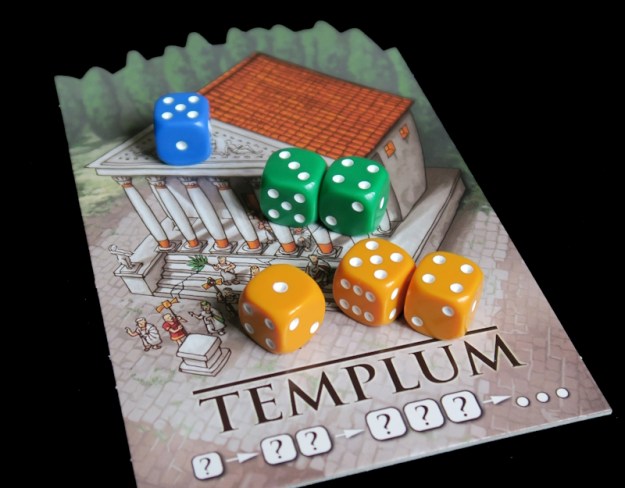
The three different approaches to remote gaming we have used have been:

  • A real-life game hosted at one location, shared through Teams.
    This works well, but really only for relatively simple games like Second Chance, HexRoller or Noch Mal!, though we’ve played Cartographers and Troyes Dice as well.  It turns out that “Roll and Write” type games work exceptionally well, but other games are possible too.  The most complicated game we’ve played using this method is Las Vegas/Las Vegas Royale, which is one of the group’s favourites, but this is right on the limit of what is possible.  The key is that players need to be able to see the whole game layout with all the information.  For this, the resolution of the camera is important, but also that of the screen used for displaying it at the other end.  Video compression by the platform feeding the data can also be an issue.  Lighting is absolutely critical too—good lighting makes all the difference.
    Main Advantage:  We’ve found this feels most like playing a “real” game.
    Main Disadvantages:  One person/location does most of the manipulation, and there is a  complexity limitation.
    Cartographers: A Roll Player Tale
  • A virtual game on Tabletop Simulator manipulated by a small number of people , shared with everyone else through Teams.
    Some people can’t install software on their computers and for others sand-box type environments like Tabletop Simulator are too complex.  Piping a virtual game through Teams is a sort of half-way house.  To make this work, the person “hosting” has to set the game up with the camera view set to “overhead” with everything in view, and leave it there.  Then they share this screen through their meeting platform (in our case, Microsoft Teams).  Again, this means there is a limit on the complexity of the game:  the most complex games we’ve played using this method are Camel Up and Finstere Flure (aka Fearsome Floors)These have worked quite well, but it’s a bit more impersonal and relies on a small number of people operating the Simulator to make the game work.  Downtime is a bit of an issue too for turn based games.  For these reasons, this has been the least popular method for our group.
    Main Advantage:  We can modify and play slightly more complex games to our own house-rules.
    Main Disadvantages:  People need to be comfortable with the software and there are limitations caused by the stability of the platform as well as there being a steep learning curve for those who are not used to playing computer games.
    Tsuro on Tabletop Simulator
  • An online game played on a website (e.g. Board Game Arena) with audio provided by Teams.
    These are great because they allow players to do things like draw cards from a shared deck and keep them hidden until they play them.  This is a fairly fundamental aspect of many games and enables games like Saboteur which would not otherwise be possible.  There is a limited range of games available though, and there is no scope for modifying the game either (adding extra players or altering the end-game conditions, for example).  On the other hand, the software does a lot of the up-keep and can make even quite advanced things possible.  For example, without Board Game Arena to do the maths, we would never have discovered the delightful madness that is the “Professional Variant” of 6 Nimmt! (which recently won the 2020 Golden GOAT at our annual GOAT Awards).   It does feel very much like playing a computer game though.
    Main Advantages:  Very low maintenance and higher complexity games are possible including those with “hidden information”.
    Main Disadvantages:  Everyone needs to have an account on the platform and a device, and the games are restricted to those that are available and the rules as implemented, in particular, player counts.
    Saboteur on Board Game Arena


Each of the different modes has their limitations, but we’ve found that by mixing them up we avoid getting fed up with any specific issue.

One of the biggest challenges boardGOATS has is that we have been playing as a group of up to ten.  This is because we are all friends, even though many of us only know each other through the fortnightly meetings.  If the group were to break into two or more parts it would likely be along the lines of game “weight”, which would mean some people would never play together and it could be divisive.  This only works because those who prefer more complex games are extremely patient and understanding.  Ultimately, as a group, we feel the social aspect is the most important thing at the moment, much more important than the quality of the gaming.  We’ll definitely make sure we play lots of more complex games when we finally return to our beloved Horse and Jockey though.

The Horse and Jockey
– Image by boardGOATS

23rd June 2020 (Online)

Maybe it was the really hot weather, or perhaps it was the prospect of playing something we all know and love, but people seemed in a slightly brighter mood this week.  Pine commented that every time Purple moved her head he could see the swastika on the box for Escape from Colditz behind her and he was finding it disconcerting.  After she had shuffled her seat, Purple commented that it was hers and Black’s fifteenth wedding anniversary, leading to a chorus of “Happy Anniversary” from everyone.

The Horse and Jockey
– Image by boardGOATS

From there the conversation inevitably moved on to the news that pubs will reopen on 4th July, and specifically the fantastic news that the Horse and Jockey will be one of them.  Clearly there is a long way to go before we can return to playing games there, but it has to be good news for our friends whose livelihoods depend on the place.  There was a lot of concern at the suggestion that people will have to leave their personal details in pubs and what other purposes these may be put to; this was followed by the suggestion that there might be an awful lot of visits to the pub by “Dominic Cummings”…  With that, it was 8pm and everyone had arrived, so we started with an explanation of the differences between Las Vegas Royale and our old favourite, Las Vegas.

Las Vegas
– Image by boardGOATS

The underlying game is much the same, in that people roll dice and choose which of six, numbered casinos to place them on.  As usual, the active player must place all the dice of one number on the casino of that number and when all dice have been placed, any ties are removed and the winnings are awarded to the owners of the remaining dice, with the largest money card going to the player with the most dice.  In the new Royale version, the casinos are arranged in a circle which is quite nice, but more importantly for us, there is no Slot Machine.  This is a shame, but in the event, we didn’t really miss it.  The new game is played with the “Biggun” from the Boulevard expansion, as standard, which suits us as we always include it when we play.
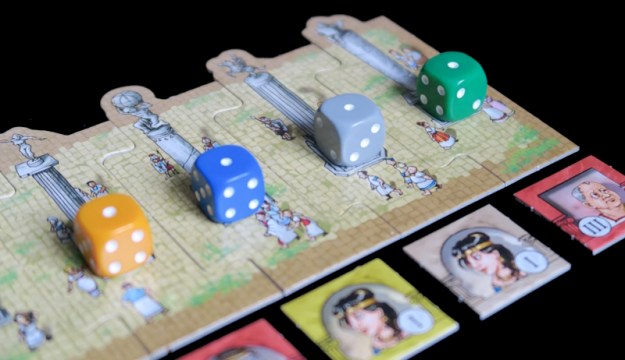
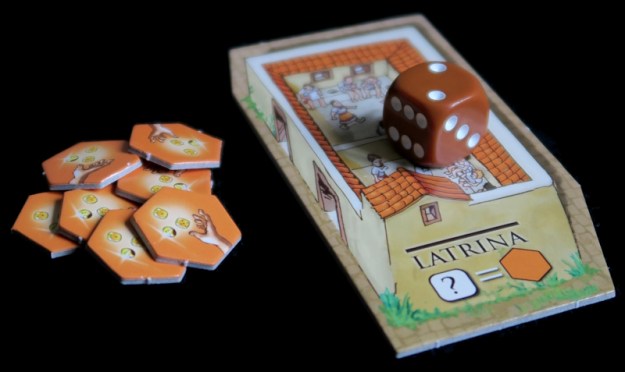
Las Vegas: The Slot Machine
– Image by boardGOATS

Aside from the new artwork and layout, there is a subtle change to the setup for Las Vegas Royal.  In the original, the money cards, each with a value of $10,000 to $100,000 are distributed so that each casino has a minimum fund (dependant on the number of players).  This means some will have many winners and others only a single jackpot.  In the new version, each casino has just two cards, each with a value between $30,000 and $100,000.  We thought this might have a large impact on game play, and although it changed things, it wasn’t worse, just different.

– Image by BGG contributor kalchio

The biggest differences though, were the inclusion of “jetons” and the additional effects associated with some of the casinos.  The jetons are tokens that players can use to pass during the game, when their dice roll is unhelpful.  The additional actions are added to three of the casinos and usually take effect when a player places dice in that casino.  We chose to start with “Lucky Punch” on Miracle Casino (Casino 1), “Prime Time” on Kings Casino (Casino 2) and “High Five” on Marina Casino (Casino 3).

Las Vegas Royale
– Image by BGG contributor kalchio

It is possible to add extra actions to all six casinos, but for our first play, we decided to stick to the rules and add them to three only.  One area which were we weren’t able to follow the rules in, however, was the player count:  the new version, specifies two to five players and there were ten of us.  This change is likely because the new features lengthen the game, so additionally, the number of rounds is reduced from four to three.  We usually play just three rounds, so we played with two teams of two and decided to make a decision as to how many rounds we would play at the end of the first round.  Blue and Pink had set the game up in advance and, like our first remote game back in March, Las Vegas, everyone else followed using Microsoft Teams.

Las Vegas Royale
– Image by boardGOATS

Lime started, followed by Burgundy, who rolled five threes and placed them on the Marina Casino activating the “High Five”.  This has a token worth “$100,000” on it to be claimed when someone places their fifth die on that casino, and Burgundy duly claimed it.  Purple went for the Miracle Casino (1) and the “Lucky Punch” action at the first opportunity.  With this action, the active player takes one, two or three tokens into their hand and the next player (in this case Team Greeny-Lilac) have to guess how many tokens they have in their hand.  An incorrect guess would give Purple two jetons, $30,000 or $40,000 depending on how many tokens she was holding.

Las Vegas Royale
– Image by boardGOATS

So, Purple turned on her camera and held out her paw in such a way that nobody could see it until Black pointed out that the camera was over the other screen.  Maybe that was just enough information for Team Greeny-Lilac or maybe they were just lucky, but they successfully guessed Purple had two dice in her hand and, as a result, she won nothing.  Burgundy was the next to have a go at the “Lucky Punch”, and it was Purple’s turn to guess.

Las Vegas Royale
– Image by boardGOATS

Purple guessed three and Burgundy’s simple reply of “Bugger” told the whole story—this was especially funny since he didn’t have a camera and we were all trusting him to be honest!  The “Lucky Punch” proved really popular: Pine was next to have a go and Pink (playing as a team with Blue) had to guess.  Although Pine was holding out his hand, Pink couldn’t see the screen from where he was sitting so just guessed three and Pine’s response was just as clear as Burgundy’s.  With three out of three failures, people began to wonder whether if we were all psychic.

Las Vegas Royale
– Image by boardGOATS

Burgundy was the first to be successful at the “Lucky Punch”, adding $30,000 to his $100,000 from the “High Five”.  That wasn’t the opening of the flood-gates though and Ivory’s attempt was blocked by Black and then Black’s was blocked by Lime.  Purple was eventually successful, taking $30,000 and Ivory also managed to sneak a couple of jetons,  though Pine’s attempt at palming a tree-eeple and a duck-eeple (from Christmas crackers at previous unChristmas Dinners) were spotted by Team Bluey-Pink.

Las Vegas Royale
– Image by boardGOATS

Meanwhile, Team Bluey-Pink were the first to use a jeton, followed soon after by Lime.  Egged on by everyone else and much to Ivory’s disgust, Black engaged in a battle for Cleopatra Casino (5), eventually leaving Pine to take the $80,000 with just one die.  Lime won the Kings Casino, but his “Prime Time” bonus meant he could roll two dice and place them if he wished, though unfortunately they had no impact.  The clear winner of the round was Burgundy, however, largely thanks to his $130,000 of bonuses.  Time was marching on, so the group decided that there would only be one more round.

– Image by BGG contributor kalchio

Normally, all the additional actions are swapped, however, there were a lot to choose from and swapping them all would have been a significant task.  The group decided to swap out “High Five” though, and after rejecting “Bad Luck” as “very evil”, the group opted for “Block It!”.  This action enables players to mess with others by placing cubes on casinos where they would be scored in the usual way, but act as an inanimate player.  Pine went first in the second round but was immediately obstructed by Team Bluey-Pink who were the first to try the “Block It!” action.  First, they moved three neutral dice into the Kings Casino (2) pushing Pine into second place.  On their next turn they start moved more neutral dice onto the Sunset Casino, and with Team Greeny-Lilac’s help, made Ivory’s life more difficult and effectively scuppered Burgundy’s plans.

Las Vegas Royale
– Image by boardGOATS

Pine eventually won $40,000 on the “Lucky Punch”, but Black was not so lucky when Lime correctly called him holding two tokens.  Team Greeny-Lilac took $30,000, Black took $40,000, and then Purple did too.  It looked like people had worked out how to escape the jinx until Team Greeny-Lilac tried again and Pine guessed correctly.  The odds were certainly moving towards the expected two out of three though, especially as Purple and Pine picked up $30,000 each towards the end of the game and Team Bluey-Pink picked up a couple of extra jetons.

Las Vegas Royale
– Image by BGG contributor kalchio

Those extra jetons that Blue and Pink had acquired nearly proved very useful when Green and Lilac placed their fifth dice on the Marina Casino (3) leading to a tie for first place.  Unfortunately for both, despite several re-rolls, the tie remained and both pairs missed out on both first and second place ($80,000 and $90,000).  Green got his just desserts when he ended up in another tie for Miracle Casino (1), this time with the unfortunate Pine who got caught in the cross-fire.
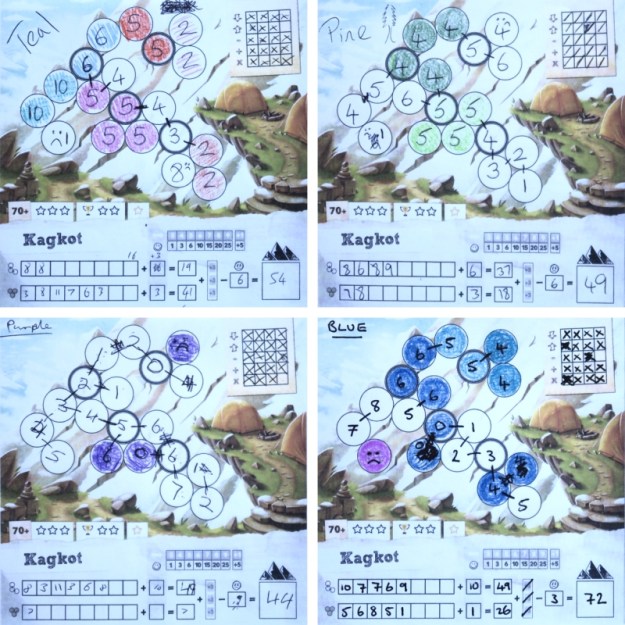
Las Vegas Royale
– Image by boardGOATS

In the final tally, the winner was Burgundy, largely thanks to that $100,000 bonus for the “High Five” at the start.  Team Greeny-Lilac weren’t far behind though and neither were Pine and Purple who tied for third place.  Though it could all have been so different, had Burgundy not picked up that obvious windfall so early, everyone else might not have worked so hard to spoil things in the second round and he may well have picked up more money by other means.

– Image by BGG contributor kalchio

As usual, we had a great time with this fantastic game.  The changes to the payout distribution were neither good nor bad, just different.  The group had mixed feelings about the new additional actions, though on balance, they were positive.  We had a load of fun with the “Lucky Punch” and online it was even more fun somehow.  In our game “Prime Time” had little effect and didn’t really influence players, but was very quick to implement and may have more impact at lower player counts.  “Block It!” affected the game more, and certainly influenced the game in the second round.  “High Five” was the huge game-changer though, certainly in this game.

Las Vegas Royale
– Image by boardGOATS

The rules are not completely clear on how this should be used, saying, “When you place your fifth die … in this casino, take the token”.  It is not entirely clear whether the $100,000 is available to everyone who places five dice in the casino, or if the first person is the only one who can claim it.  Before the game, we had decided to go with the latter and Burgundy’s freaky first roll of five threes effectively ended the competition for the Marina Casino (3) in the first turn.  Had the values for the payouts been different and if Burgundy hadn’t rolled all five in one go, this might have played very differently.

Las Vegas Royale
– Image by boardGOATS

On reflection, however, there is another way to play this which might have worked better increasing competition, and may have be the designer’s intention too.  If each subsequent player to reach five dice were to take the token from the current holder it would increase competition and add a nasty edge to the game.  This could also make it a target for using the jetons which otherwise got a bit of mixed reception.

– Image by BGG contributor kalchio

At the end of the game everyone seemed to have too many jetons left and decided to spend them adding a lot of time to the game, mostly for little reward.  Several suggestions about how to improve it were made, including forcing players to exchange them for cash at the end of the round, and/or topping people up to a maximum of two at the start of a new rounds, or maybe giving players one or even none at the start of each round thus making any gained from the “Lucky Fist” that bit more precious.

Las Vegas Royale
– Image by boardGOATS

The combination of the extra actions, the large number of players and the effect of playing online meant the game had taken a long time, so Lime, Ivory, Green and Lilac took their leave.  Although it was late in the UK, it wasn’t in California where Mulberry joined us from her balcony at 38 °C in the mid-afternoon for a game of our old favourite, 6 Nimmt!.

6 Nimmt!
– Image by boardGOATS

6 Nimmt! is such a simple game which keeps everyone involved throughout and the Board Game Arena implementation is so good, that it is often a fall-back for when nobody can be bothered to think.  Players simply choose one card simultaneously, then, starting with the lowest value card, they add them to one of the four rows.  If the card is the sixth card to be added, the player takes the five cards and the new card becomes the new first card in the row.

6 Nimmt!
– Image by boardGOATS

As always, people complained about the cards they had, though Blue felt she was particularly hard done by this time with one, two and three in consecutive hands and almost nothing above fifty for most of the game.  Given that, she didn’t do too badly in the end.  There was no beating Pine though.  After the game, Pine left and everyone else made it their business to investigate how many games Pine had played on Board Game Arena. There were over a thousand, of which nearly a hundred had been 6 Nimmt!, winning around 30% of games against all comers!  And with that, it was time for bed.

6 Nimmt! on Board Game Arena
– Image by boardGOATS from boardgamearena.com

Learning Outcome:  If voting Donald for US President, many people would prefer the Duck!