Tag Archives: Love Letter

15th October 2024

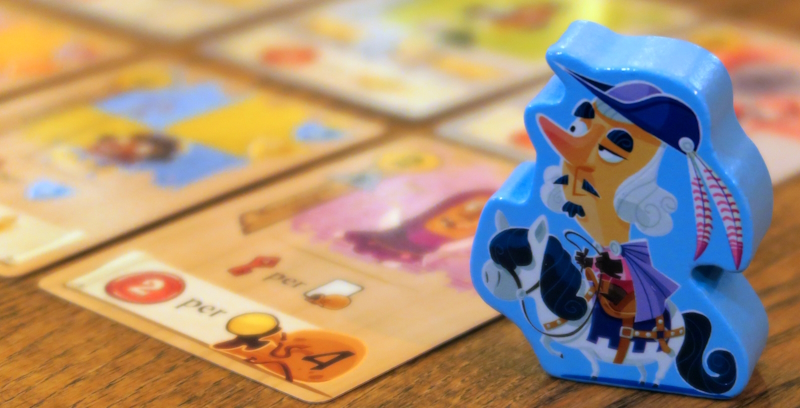
There were quite a few people eating this week, but the earliest arrivals were finished when Green turned up for the first time in months toting his copy of Lost Ruins of Arnak.  Jade was already preparing to lead the “Feature Game” which was to be Castle Combo, and he was joined by Sapphire, Pine and Lime.  This is a game that was released to coincide with Essen, but like many of the most popular games was sold out within a couple of hours.  The essence of the game is tableau-building where players draft cards from two markets creating a three-by-three square of people interacting with each other triggering instant effects and end-of-game bonuses.
Castle Combo
– Image by boardGOATS

The two markets consist of Castle Cards and Village Cards.  At the start of their turn, players can pay a Key to to carry out a special action, before they buy a Card from whichever market the Messenger token is currently located in and place it in their Tableau. Some card abilities grant a permanent discount when purchasing cards of a specific location (Castle, Village, or both).  If a player can’t afford any of the cards (or choose not to pay for them), they can always take a card without paying its cost, and place it face down in their tableau. In doing so, they ignore its ability, its end game points and any other information printed on it, but immediately gain six Gold and two Keys in compensation.

Castle Combo
– Image by boardGOATS

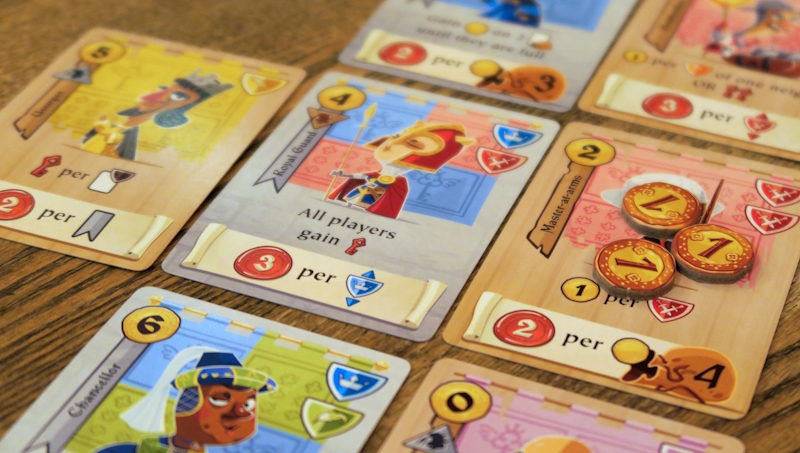
Each card after the first must be placed orthogonally adjacent to at least one other card in a player’s Tableau and at the end of the game, their Tableau must be a three-by-three grid of Cards. In this way, the final position of the cards in the array is fixed as the game progresses. Once it has been placed, the ability of the Card is applied. Some abilities affect opponents (all other players), while others affect a player’s neighbour (they choose which one). Finally, if the Messenger icon is depicted on the card played, the active player moves the Messenger Token, either to the Castle or to the Village, as appropriate, before refilling the market and ending their turn.
Castle Combo
– Image by boardGOATS

The game ends when everyone has nine Cards in their Tableau and everyone adds up their scores.  This time, Sapphire went first as he’d played before.  The game plays very quickly and smoothly as everyone began building up their displays.  It turned out that playing before wasn’t a great deal of help, however,, as Pine gave everyone else a bit of a trouncing as his final Tableau was worth ninety-six points, seventeen more than Jade who took second place a handful of points ahead of Sapphire in third.  Meanwhile, on the next table, Blue and Byzantium were leading a game of Stamp Swap at the request of Pink who had missed out last time.

Stamp Swap
– Image by boardGOATS

This is another fairly straight forward game, albeit one that takes a bit longer than Castle Combo, though it plays just as smoothly.   There is a lot of simultaneous play, which is nice because it minimises down time.  First, players take it in turns to choose items from the central Pool, then simultaneously divide them into two piles of offerings.  The player with the first player token, chooses and takes one of the piles offered by their opponents.  The opponent keeps their other pile and then chooses a pile from one of their opponents and so on.  Once everyone has two piles, players arrange the Stamps in their Album and then choose which of the four available end of round cards to score this time.
Stamp Swap
– Image by boardGOATS

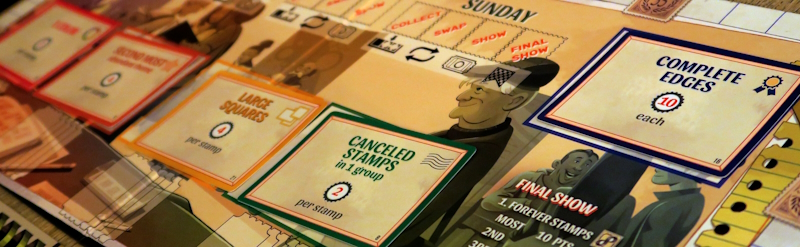
After three rounds, players score the end of game objective card and the player with the most points is the winner.  One of the clever parts about this game is how much difference the objective cards make to the way players arrange their Stamps.  This was very obvious last time when there were two parallel games and one scored Finale Contest gave for points for Stamps completely surrounded by other Stamps, while the other gave points for each empty region.  The former gave lots of Albums where the Stamps were clumped together, while the latter gave spread out Stamps in a lattice-type pattern.  This time, the Finale Contest gave ten points for each completed edge, so players began the game working along the borders of their Album page leaving a hole in the middle that they only filed in later in the game.
Stamp Swap
– Image by boardGOATS

The end of round scores allowed players to score points for the number of stamps they had in one colour, the number of large square Stamps they had, the number of cancelled Stamps and the number of Stamps in their second most abundant theme.  This artificially increased the value of large square Stamps, which was something that Pink failed to take into account early on.  It led to Blue taking what Pink felt was his obviously less valuable pile and giving her a surprise Special Stamp with a sad face from him.  Still, that was replaced with a big grin when he stole one of Blue’s hidden Stamps later in the game and it turned out to be the one with the Giant Panda on it.

Stamp Swap
– Image by boardGOATS

The first event card was Generous Gifts where players choose one of their Stamps to score and then pass on—always a difficult decision, but more-so at the start of the game.  Slim Pickings was the second event giving players fewer items from the Pool at the start of the round, while Hands to Shake was the final event which made more Attendee Cards available, although by this time, it was too late to really take advantage of them.  That said, Byzantium had made collected quite a few Attendee Cards, using them to great effect to gain extra points and Stamps and took one in the final round as well.

Stamp Swap
– Image by boardGOATS

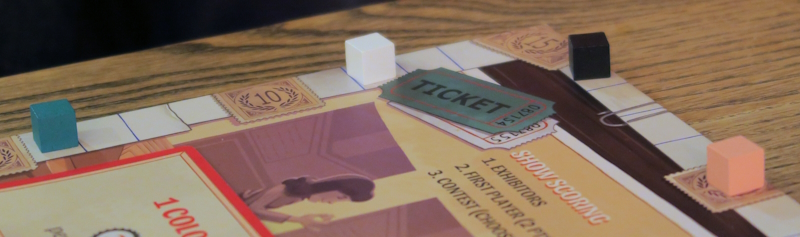
Aside from the Panda, Purple seemed to collect nearly all the Animal Stamps, while Pink did a good job of collecting Flowers.  The game is a bit of a “Point Salad” though, with points coming in little aliquots from lots of different places, and it perhaps pays not concentrate too much on one aspect.  Byzantium got a fast start and took an early lead, which he just managed to maintain to the end, beating Blue into second place by ten points, for the second time, which Pink taking third.  While packing up, everyone agreed that they really enjoyed the game for its smoothness, and the only part that “jarred” was setting out the starting Pool which was a little laborious.  Discussion online later, however, suggested a away to improve this, so that’s something to try next time.
Stamp Swap
– Image by boardGOATS

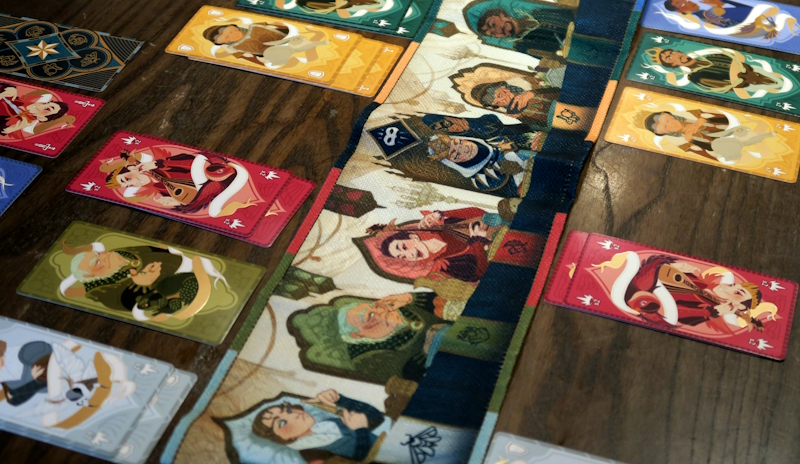
By the time Stamp Swap finished, Castle Combo had already come to an end and Jade, Sapphire, Pine and Lime had moved on to play Courtisans.  We first played this a few weeks ago, shortly after UK Games Expo.  This is a clever little card game from the same stable as Castle Combo and Faraway, where players are manipulating card values by where they play them.  On their turn, each player receives and plays three coloured Family cards.  One card is played at the Queen’s table to sway a Family’s influence in a positive or negative way depending on whether it is placed above the table or below.  At the end of the game, those Families with more cards below than above will have “Fallen from Grace”.
Courtisans
– Image by boardGOATS

One of the other two cards is played in the player’s own Domain and the other in an opponent’s Domain. At the end of the game, each card a player has from an “Esteemed” Family is worth a point, while each card from an Family that has “Fallen from Grace” loses them a point.  Thus, players are trying to increase the value of the cards they have, while decreasing the value of the cards their opponents have. The first game was a game of two parts, Jade and Pine tied for victory with nine points, while Sapphire and Lime also tied with four points.

Courtisans
– Image by boardGOATS

As is often the case with this sort of game, after the first play, once he’d seen how the game works, Lime requested a second game.  This second game was higher scoring with players getting more “Esteem” and fewer Families that had Fallen from Grace.  Both Jade and Lime completed both their objectives as well.  Lime’s massive Esteem scoring of twelve, gave him clear victory with a total of sixteen points, while Jade, who finished with eleven points, just pipped Pine to second by a single point.  There was a bit of chatter with everyone discussing the games, but nobody really had the inclination to play anything else before going home.

Courtisans
– Image by boardGOATS

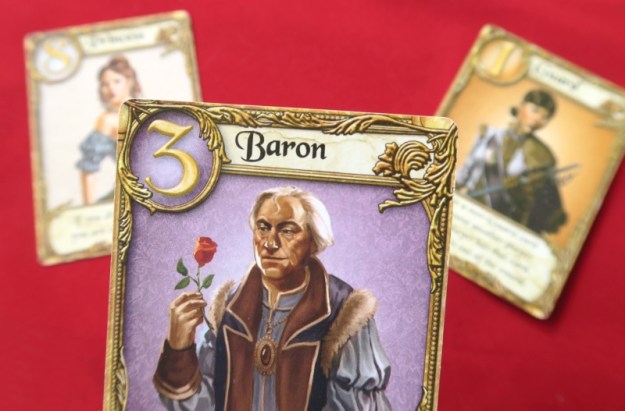
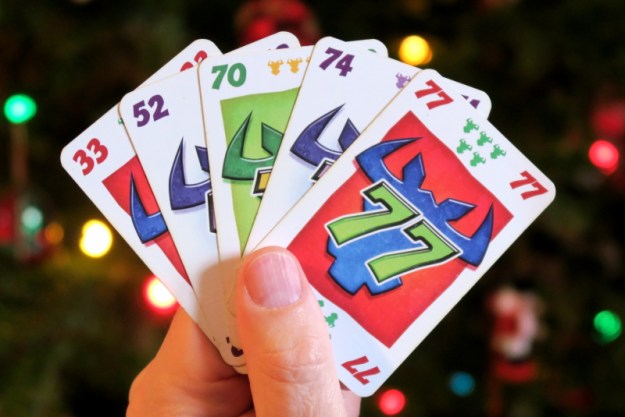
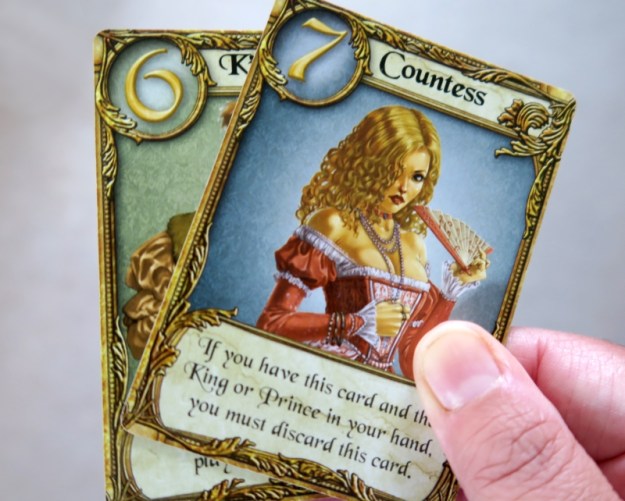
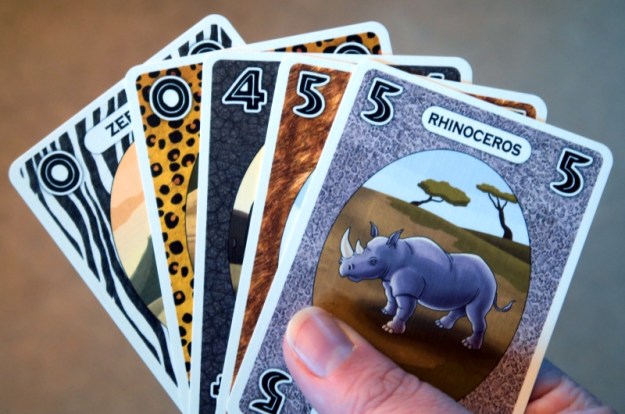
On the next table, while Blue took a little time out, Pink, Purple and Byzantium played a quick game of the sixteen card filler, Love Letter. This is a sort of multiplayer dueling game where players have a hand of one card, draw a second from the face down deck and then choose one to play, with the aim of being the last player standing, or the player with the highest value card if in the event that the deck runs out first. The trio only played two rounds, but Byzantium managed to get knocked out first turn both times. It was a tie between the other two though, with Purple taking the first round and Pink the second when he knocked out Princess Purple.

Love Letter
– Image by boardGOATS

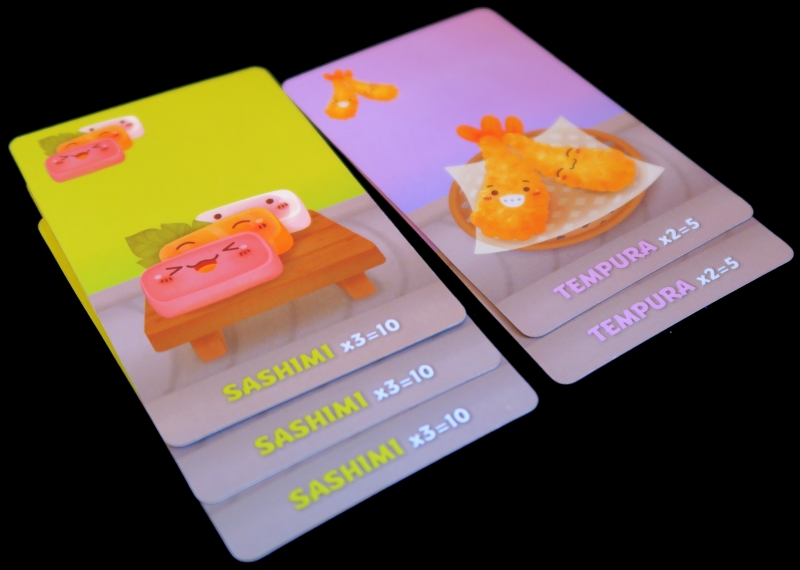
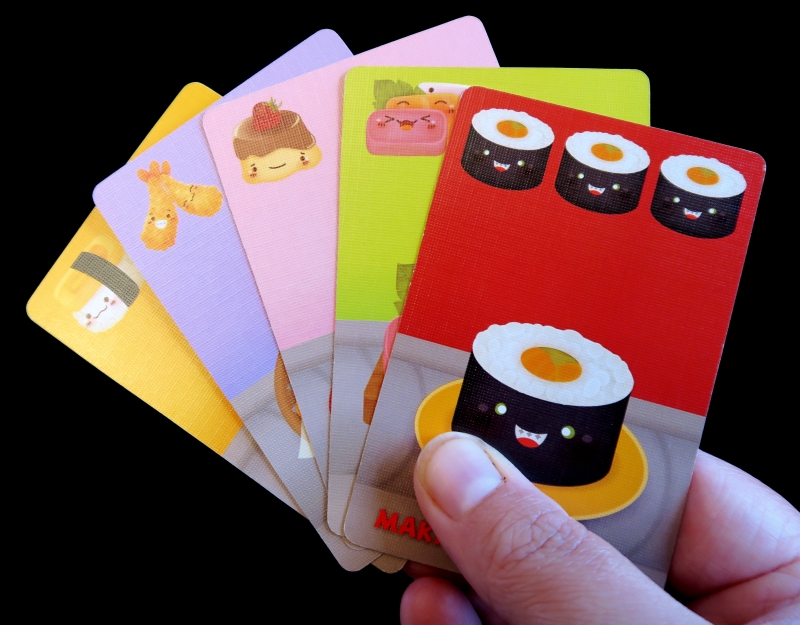
After two rounds, the trio got bored and moved on to playing Sushi Go!Sushi Go Party! had had a mention earlier in the evening, but as none of them were familiar with the rules changes, they stuck with the smaller, original version.  This is a simple, and one of the purest card drafting games where players start with a hand of cards, keep one and pass the rest on.  The cards are Sushi and players are trying to get sets, or pairs, or as many as possible depending on the Sushi on the card.  The group played the full three rounds, with very mixed outcomes.  At the end of the game, the player with the most Pudding cards gets extra points, but as all three tied so nobody got any.  The winner was Byzantium, with a massive fifty-eight points, seven more than Pink in second in what was a high scoring game.
Sushi Go!
– Image by boardGOATS

Byzantium was waiting for Plum to finish on the other side of the room, so Blue rejoined the group for a quick game of something silly—an old game that Blue and Pink acquired at Essen, called Why First?.  The premise of this game is, what’s so important about being first, maybe the winner should be the person who is second.  So in this game, players start with a hand of five number cards and simultaneously, chooses a card to play before, on the count of three giving it to someone.  This player’s piece is then moved that number along the race track.  The round ends after five cards, the last of which must be used to move the payers’ own piece.

Why First?
– Image by boardGOATS

At the end of the round, only the player who is second scores, and that depends on their location on the track.  In the first round, Blue came second (and therefore won the points) and Pink won the second.  Byzantium won the third, but as he finished on the start line, he scored no points, much to his chagrin.  Blue and Purple tied for second in the fourth round so both took a single point, before Purple took the final round.  The winner of the game is, obviously, the player who comes second overall.  Despite a lot of effort by Blue who ultimately finished first and therefore lost, this was Pink who was therefore the winner.

Why First?
– Image by boardGOATS

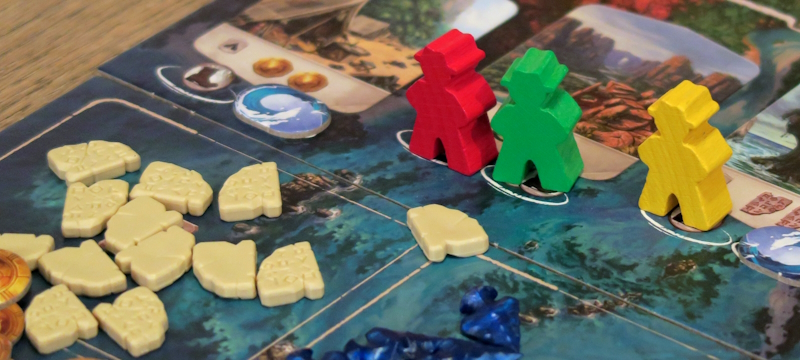
By this time, the table on the other side of the room had finally finished and were packing up.  Green had clearly arrived wanting to Lost Ruins of Arnak, and Ivory and Plum had kindly joined him.  This had an outing about six months ago, when Green and Plum were also involved.  By this time, however, Green had acquired The Missing Expedition expansion and, having played the game quite a lot solo, wanted to include it to add interest.  The basic game combines deck-building and worker placement with resource management. Players start with six cards in their deck, two Money, two Compasses and two Fear cards (which just clog up players’ hands), and draw five of these to play.
Lost Ruins of Arnak
– Image by boardGOATS

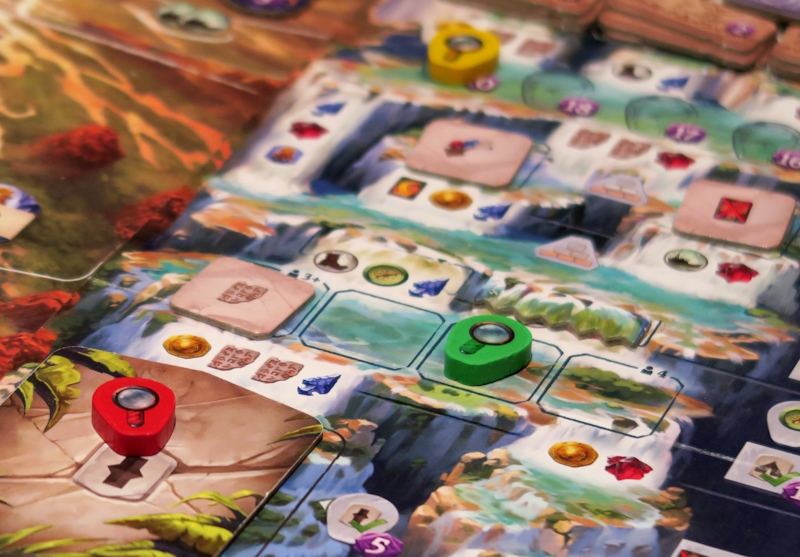
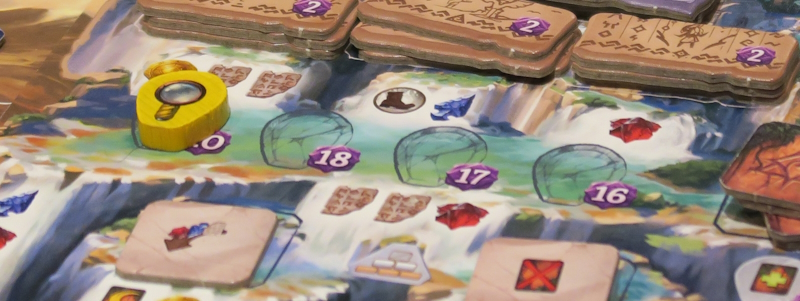
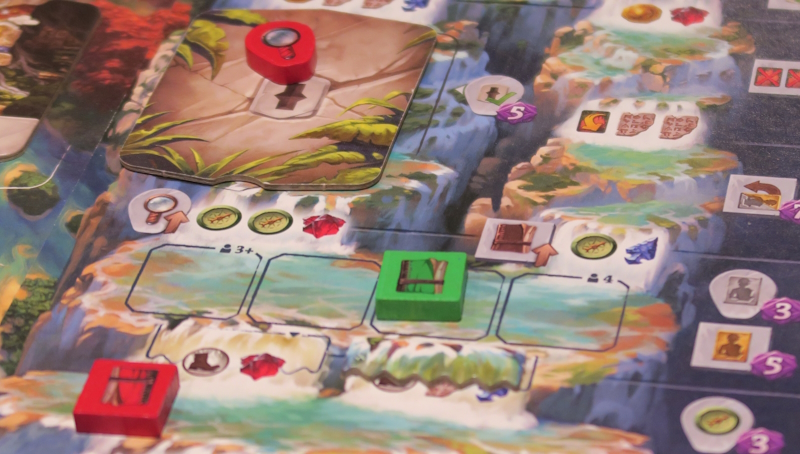
Players then have two meeples each that can be sent to locations on the map, to either discover or use an action Location which generally give Resources plus some extras. Each new site has a Creature guarding it, which, if beaten, will give points and a small one-time bonus.  Players can use resources to move up the Research Track giving different rewards.  Players get one action each per turn, until everyone has passed signalling the end of the round, and the game finishes after five rounds.  The Missing Expedition expansion is modular, but this time the group added the Waterfall Temple and the extra encounter cards. The Waterfall Temple has a couple of steps whose cost changes each time someone Researches past them which can make it a bit unpredictable, though there is a sneaky shortcut to the top of the temple for players prepared to pay the steep cost.
Lost Ruins of Arnak: The Missing Expedition
– Image by boardGOATS

The first round went very quickly with everyone having limited options. Green and Plum began moving up the Research track, looking to gain an Assistant as soon as possible, where Ivory focused on gaining coins and an additional card. Ivory grabbed the Recovered Plane card (from the expansion) that allowed him to recall his explorers and using them again, which felt quite powerful. In the second round, Plum and Green both got their Assistants. They also started getting additional cards with Plum getting the Unreliable Compass card that gave her the benefits from the bottom tile of the exploration track and Green got the Army Knife which gave him flexibility when gaining Resources. Ivory began Exploring, uncovering the first new worked spot, slowly followed by Plum. Ivory managed to use his Plane card to avoid the Guardian, whereas Plum didn’t have that option and gained a Fear card at the end of the round.

Lost Ruins of Arnak: The Missing Expedition
– Image by boardGOATS

In the following rounds, Ivory begin focusing on the research track, catching up with Green and Plum and eventually overtaking them. He reached the part of the track where he could gain the Resources on a set aside exploration tile and got one that gave me an Explore card from the expansion which gave him the choice of something now or something latter. As the third and fourth rounds progressed, the Research track became a core focus Ivory managed to reach the top the first. Everyone continued exploring, and Ivory was also the first to explore a level two tile, gaining additional idols and resources and then subsequently able to recall his explorer to avoid the Guardian and Fear card.
Lost Ruins of Arnak: The Missing Expedition
– Image by boardGOATS

Plum was also Exploring, though at the lower level, but unfortunately the Guardians that she was drawing meant they were very difficult to defeat and she picked up more Fear cards. Green was Exploring less, but was using the engine that he assembled with his Assistants and cards to explore and defeat quite a few Guardians, adding to his engine whilst also gaining points. Towards the end of the game, the question for everyone was how to be most efficient and make the most moves up the Research track. Green joined Ivory at the top, and additionally gained enough Resources to grab an eleven point temple tile. Ivory was looking for an additional Resource to move my notebook up one more step and then remembered he hadn’t gained the bonus tile for reach the top of the Research track, gaining him that valuable Resource.

Lost Ruins of Arnak: The Missing Expedition
– Image by boardGOATS

Plum was also pushing up the Research track, looking to squeeze as much value as possible. Ivory also had accumulated quite a few coins, which allowed him to buy lots of cards during the final round just for their points. With everyone passing in the final round there was just the small matter of the scores. Points for Exploring, Research and Idols were pretty much level. Green’s engine which allowed him to gain the eleven point temple tile and defeat four Guardians (as opposed to Ivory’s and Plum’s one) ultimately gave him victory with seventy-seven points. Ivory’s Artifacts and Item cards gave him second ahead of Plum who had struggled with her Fear (bordering on Terror!) throughout the game.
Lost Ruins of Arnak: The Missing Expedition
– Image by boardGOATS

Learning Outcome: Princesses don’t want to live in Ruined Castles.
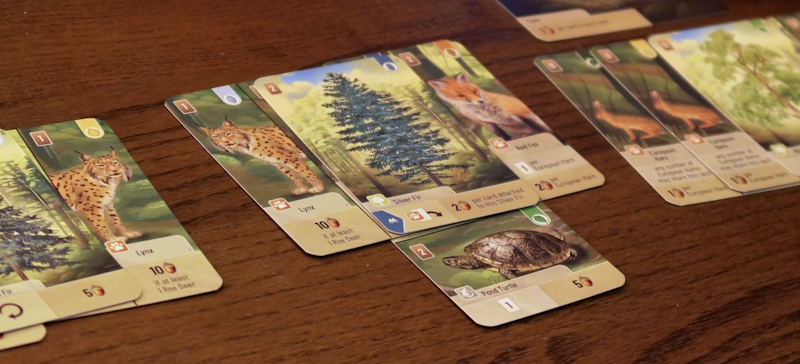
23rd July 2024

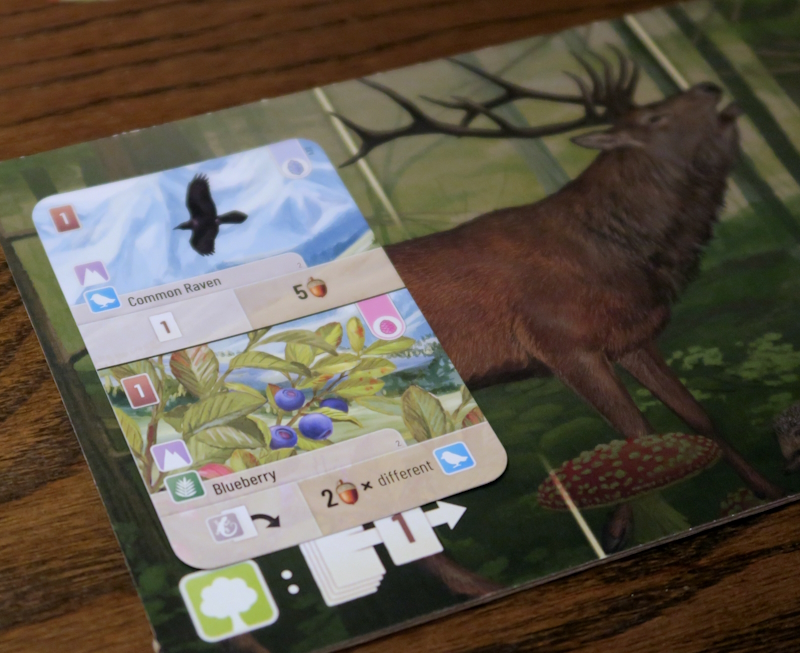
Blue and Pink were still eating when everyone else rolled in and seemed quite content to chat.  It took Blue two attempts to get the first game rolling, with Jade leading Cobalt, Crimson and Plum to the other side of the room.  Pink moved to join Pine who wanted to play his new acquisition with Black and Purple, which left Blue and Lime to lead Byzantium, Sapphire and Cyan in the “Feature Game“, the Alpine expansion for Forest Shuffle.  This is was chosen to mark the announcement of the Spiel des Jahres Awards, as Forest Shuffle, featured on the recommended list and has been popular with the group.

Forest Shuffle
– Image by boardGOATS

Blue made a bit of a meal of explaining the rules, but really they are very simple.  On their turn, players either take two cards from the market and add them to their hand (with a hand limit of ten), or play a card from their hand into their tableau.  There are three different types of cards.  Tree cards are the central cards around which Critter cards are played.  Then there is the first set of Critter cards which are divided into two, left and right with an animal on each half.  Finally, there are Critter cards which are divided into two, the canopy at the top and the undergrowth at the bottom.  The Critter cards are half-tucked under the Tree cards, so only one animal, flora or fauna is visible.

Forest Shuffle
– Image by boardGOATS

The difficult part of the game is getting the cards to work together efficiently to give extra actions and, ultimately, points.  The Alpine expansion doesn’t change the game significantly, just adding more variety to the cards, adding more opportunities for scoring.  For example, it adds an extra Butterfly which give players more points if they have a complete the set.  This time, Blue started with a hand full or Hares, making her initial strategy obvious.  Sapphire was less fortunate, so Blue and Lime suggested that starting with Trees was always a good way to go as players can’t do anything without them.  He also had some Butterflies, so that was where he went next.

Forest Shuffle: Alpine Expansion
– Image by boardGOATS

Lime built up a collection of Birds, and since he advertised his strategy to the group, everyone else was able to take cards he wanted.  This is a key part of the game:  some cards give points for the number of something you have, so having more of both multiplies the score.  For example, Hares give one point for every Hare a player has.  Thus, one Hare gives one point, but Blue’s seven Hares mean that first Hare scored seven points.  More to the point, every other Hare also scored seven points giving her forty-nine points just for her Hares.  Meanwhile, Byzantium was going Bats, and Cyan was experimenting with Deer.

Forest Shuffle: Alpine Expansion
– Image by boardGOATS

The game ends when the third Winter card is drawn from the deck, so after the second, everyone got very nervy as they tried to complete all their plans and play all the cards they wanted to.  Each time someone drew a card from the deck, it was with bated breath.  The final stage seemed to last forever, and although the third Winter card wasn’t the last card in the deck, it was close, and when it was drawn the game ended immediately. And then it was time for the scores:  everyone assumed that Blue’s husk of Hares would give her victory, but it was actually quite much closer than they thought.  Although Blue finished with a hundred and sixty-five, Byzantium was only twenty points behind.

Forest Shuffle: Alpine Expansion
– Image by boardGOATS

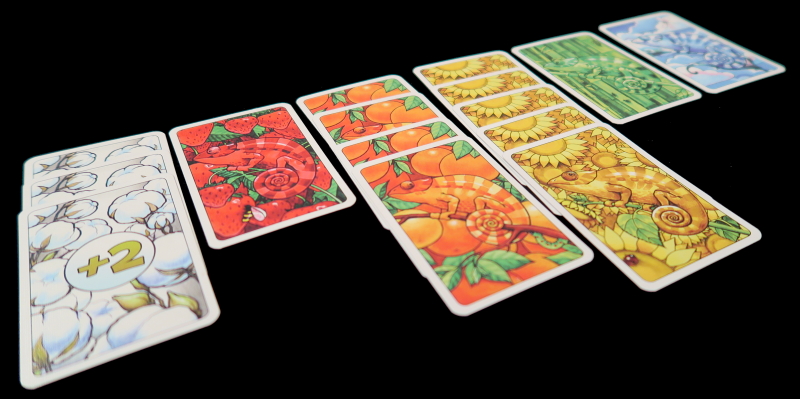
Byzantium was ready to leave, but for everyone else there was just time for something really quick.  So as everyone else was still playing, the remaining four decided on a quick game of Coloretto.  This is an old game, but one that was on the Spiel des Jahres Award “Recommended List” in 2003.  Remarkably, Cyan and Sapphire were new to it, but it is a super easy and quick game to play, but with tactical decisions to make.  It is also one that can essentially be taught as you go:  either turn over the top Chameleon card and add it to one of the Trucks, or take one Truck.  Each Truck can contain a maximum of three Chameleons and once everyone has taken a Truck, the round ends.

Coloretto
– Image by boardGOATS

At the end of the game, players score each group of coloured Chameleons, with the largest three groups giving positive points and any others scoring negatively.  There are a small number of cards that just give straight points and balancing these with Chameleons is part of the challenge.  The end is triggered when the end of game card is drawn and then the round is played to completion.  This time, everyone kept their negative scores down, while Cyan went for the pure point cards, collecting fourteen points, more than half his score, by that route.  The winner was Lime, however, who was imperious and won by some distance with a total of thirty-three.

Coloretto
– Image by boardGOATS

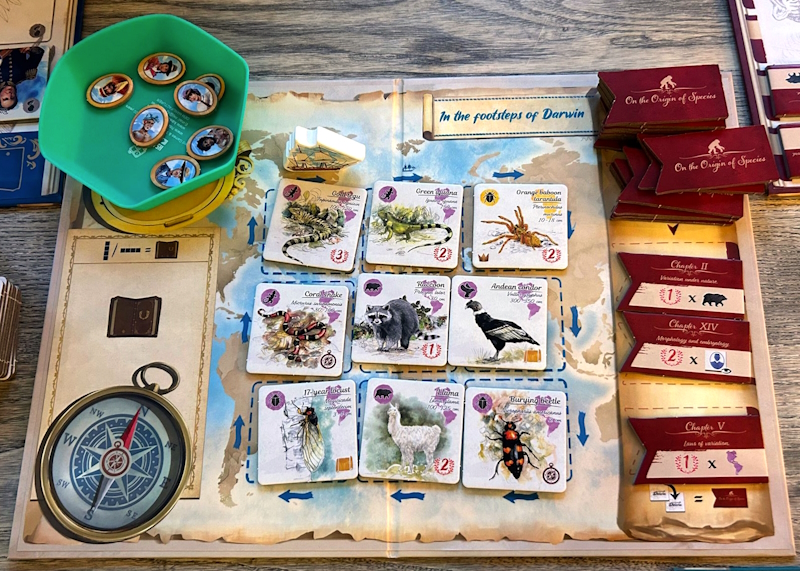
Meanwhile, on the next table Jade was teaching Cobalt, Crimson and Plum the Spiel des Jahres 2024 nominee, In the Footsteps of Darwin.  The premise of this is that players are naturalists aboard the Beagle helping Charles Darwin finish his book On the Origin of Species, studying animals, carrying out cartographic surveys, publishing their findings, and developing theories. On their turn, players study an animal or take inspiration from a character by choosing one of the three tiles in the row or column marked by the Beagle, and placing it onto their naturalist’s Notebook. This may be an animal to study or a character from the Beagle’s previous journey and will give an immediate bonus or a scoring bonuses.

In the Footsteps of Darwin
– Image by boardGOATS

After placing the tile, the Beagle is moved round the market, with the distance dependent on the tile chosen and a new tile is drawn to fill the empty space on the journey board.  At the end of the game, the player who contributed the most to On the Origin of Species wins.  At it’s heart, In the Footsteps of Darwin is a fairly simple set collection and “make the most of what’s available” game. Players obtain an additional scoring objective when they place a tile on top of a previous one, covering up any icons, so a key part of the game is the conflict between points being gained verses points being lost.

In the Footsteps of Darwin
– Image by boardGOATS

There’s also quite a bit of luck invoiced, as a player may need one or two specific tiles that don’t come out, or that get taken by someone else before they have the opportunity to do so.  The group found it was very quick to play, taking just forty minutes including teaching.  Plum’s  starting goal was points for tiles in the upper right quadrant, but in the absence of tiles that fitted that criteria she focused instead on collecting Charts and Compasses as these score points equal to the number of these multiplied together.

In the Footsteps of Darwin
– Image by boardGOATS

One advantage of these is that once a Compass has been collected, the tile can be covered without loosing any points. Cobalt didn’t worry about that at all, covering loads of tiles to get more Theories banners which give points.  Ultimately, everyone’s score was pretty similar at the end of the first game but Jade took victory as he was most effective with the Chart/Compass scoring.  As it was so quick, the group decided to give it a second try—this the scores all improved.  This time the victor was Crimson, who was again the most effective with the Charts/Compasses, but also scored well in other areas, as did Cobalt who came second again.

In the Footsteps of Darwin
– Image by boardGOATS

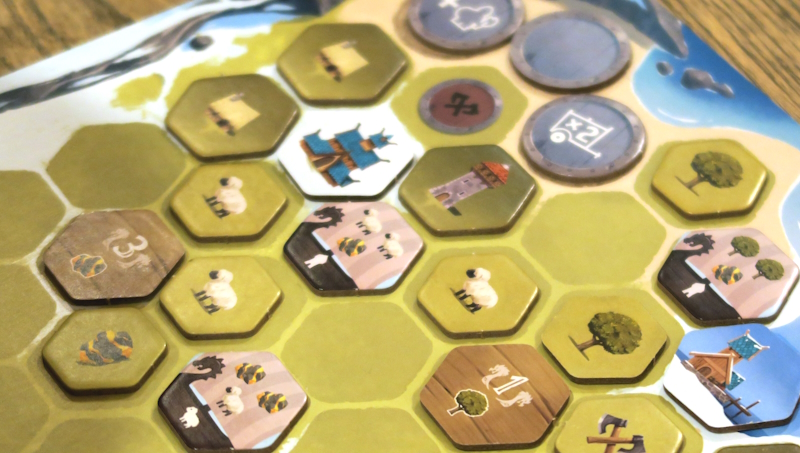
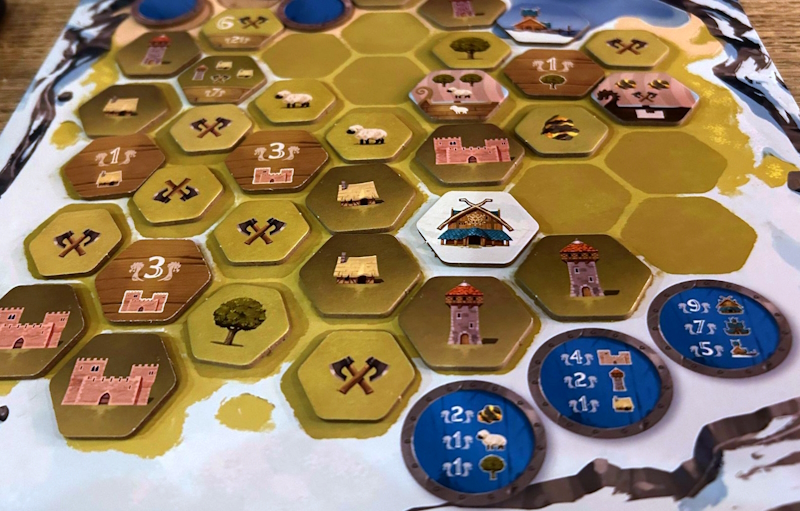
From there, the group moved on to a game of Looot, which is too recent a release to have been acknowledged in the Spiel des Jahres awards.  It has been popular amongst the members of the group that have played it so far, however, and may well get an award next year.  In this game, players gain points by gathering resources and capturing buildings to try to develop their Fjord, fill their long ships and complete buildings. The winner is the player with the most riches and is crowned Jarl of the Vikings. The game is played over several rounds until each player has played all their Vikings, giving a maximum of thirteen turns, each with a simple structure.

Looot
– Image by boardGOATS

Players start by placing their Viking on a Resource tile on the central board adjacent to another Viking of any colour.  They then take the associated Resource and place it on their personal board.  If possible, they then use their Resources to capture a Building and place that on their board, take a Long Ship and also place it on their board, use a Shield, or complete a Construction Site and finally grab a Trophy.  Looot is quite a light game, but with enough decision space to be interesting.  Last time was a three-player game, but this time, with four, players get another map area, which the group arranged to give a wide play area.

Looot
– Image by boardGOATS

The board layout made it easier to get to more areas of the map relatively early in the game, but there was still plenty of competition for the Towers.  Like last time, Plum decided not to worry about all the home tiles and focused on gold, which was good, but not enough on its own.  Cobalt scored massively for Castles by getting plenty of them plus the equivalent Long Boats.  Cobalt started on that strategy largely by accident, before he had got a real understanding of game-play and a full appreciation of how they increased the Castle scoring and matched the requirements he could fulfill.

Looot
– Image by boardGOATS

Crimson had a nice balance of increased score for Towers and Houses, while Jade built up a huge pile of Wood.  Unlike last time, things didn’t just come together at the end for Plum, and nobody else could compete with Cobalt’s Castles and he took victory with one hundred and twenty-one, fourteen points ahead of Crimson in second.  It had been a good game though, and as players become more experienced, they will be increasingly able to determine the best scoring opportunity from the start and how to optimise the mini game that is building their Fjord. With experienced players, this could be quite ruthless with players trying to block each other and prevent objectives.

Looot
– Image by boardGOATS

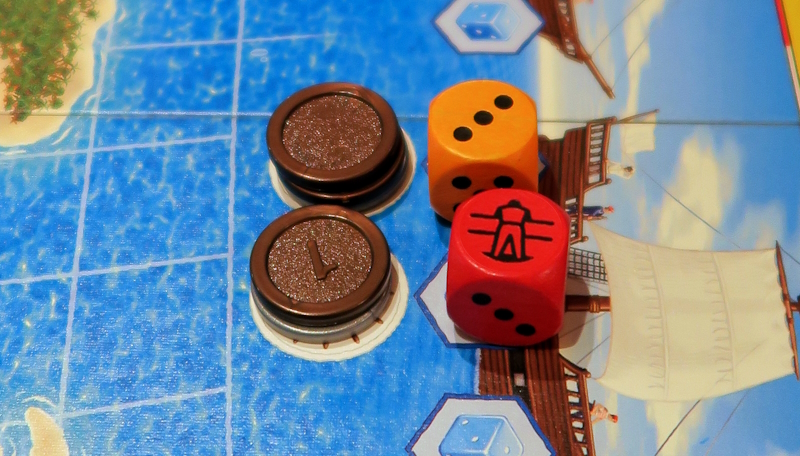
In the third group, meanwhile, Pine was introducing his new acquisition, the old game, Tonga Bonga, to Pink, Black and Purple.  This is a sailing race game a bit like the 2008 Spiel des Jahres recommended Jamaica.  In Tonga Bonga, players pilot their ship around the archipelago with the goal of visiting four of the five remote islands and returning to Tonga Bonga Bay.  Each player has room for three sailors on their ship, each of which represented by dice and indicate how fat the ship will move.  At the start of the round, players decide how much they are prepared to pay for the sailors who will serve as their captain and first mate that round (the Cabin Boy always works for nothing).

Tonga Bonga
– Image by boardGOATS

Players then simultaneously roll their dice, and take it in turns assign their dice to the other players’ ships, in return for the money offered.  In a mechanism vaguely reminiscent of that in the really rather vicious game, Vanuatu, if a player tries to place a higher value die where someone has already assigned a die, the lower value one is displaced and bumped to a lesser and usually less lucrative role.  Thus, all things being equal, the ship offering the most money will get the highest value dice and the most moves, though of course, players can work together to disrupt this behaviour. One side of each die has a Seasick Sailor (effectively zero), so the maximum value dice are five.

Tonga Bonga
– Image by boardGOATS

Once all the dice have been assigned, players move their ships racing to reach the islands, leaving one of their tokens there.  Landing on an island, earns $25 from the bank, but the player has to pay $5 to each player who landed there ahead of them.  Pine explained the rules and before long, everyone was sailing.  Pink got a bit of a lead by using his winnings to buy more moves and visit more islands.  He had been feeling that the game was maybe a bit “broken”, but as is usually the case when a game feels like that, it was all down to the “rules malfunction”, but it wasn’t until the final round that the rules were “clarified”.

Tonga Bonga
– Image by boardGOATS

Instead of the winner being the player to cross the line first with any left over money used as a tie-breaker, once a player has visited four islands they return to Tonga Bonga Bay and trigger the game end—and whoever has the most money wins.  Pink crossed the line and claimed the moral victory, as he was playing by the original rules.  Everyone else was quite happy with the “updated rules” though, which left Pine the victor with Purple in second and Black just behind.  Pink blamed “Evil Pine” for the mishap, but was eventually won round with a bottle of dubiously flavoured cider.

Tonga Bonga
– Image by boardGOATS

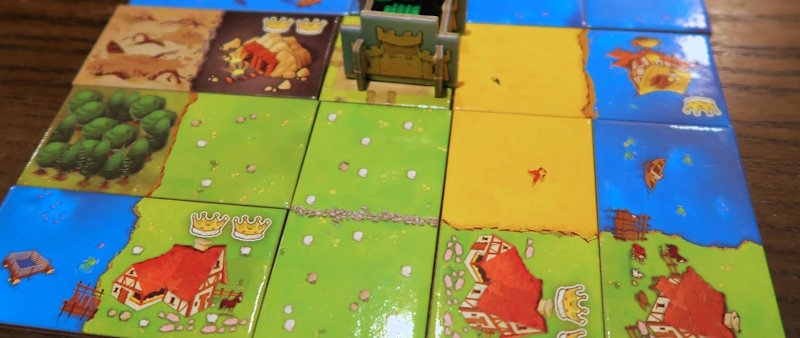
Although the debate had been audible by the players at the neighbouring tables, ultimately it was all taken in good part and the game had been a lot of fun and showed its age less than Lifeboats that was played a few weeks back and was only five years older.  From there though, the group moved on to a game of the 2021 Spiel des Jahres winner, Kingdomino.  This is a clever little game where players are building a kingdom made out of double-headed, domino-like tiles.  As in Dominoes, the ends of the tiles have to match, or at least it has to match with one tile tile already in the player’s kingdom.
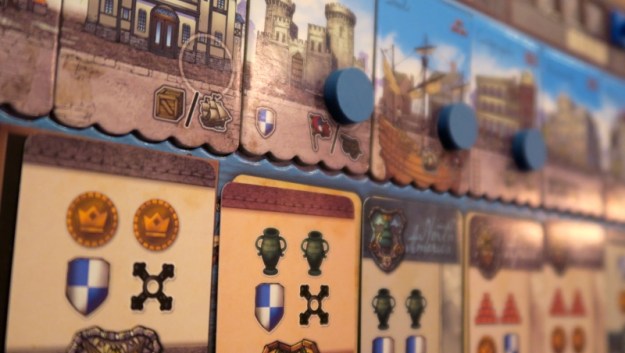
Kingdomino
– Image by boardGOATS

The really clever part of the game is the double market, where the tiles are taken in reverse order of value.  The double market means that when a player takes the tile for the current round, they choose which tile they will get in the next round.  Thus, taking the lowest value tile this round means they will have first choice next round.  Players score for each contiguous area of Terrain—the number of points is equal to the number of squares multiplied by the number of Crowns featuring in it.  This time, Pink concentrated on Wheat Fields and Sea, Pine focused on Sea and Meadow while Black concentrated on Woodland with a smattering of points from Marsh, Mountain and Wheat fields.

Kingdomino
– Image by boardGOATS

In contrast, Purple prioritised her four contiguous areas forfeiting the “Harmony” and “Middle Kingdom” bonus points for using all the tiles to give a square kingdom with a central castle.  Pine took victory with a massive seventy-three with Pink and Black tying for second with sixty points.  This group wasn’t done by any means and swiftly moved on to a quick game of Sushi Go!.  This is one of those games that takes a mechanism that is a relatively minor part of other games and distills it into its purest form in the game.  Coloretto does the same for the central market mechanism used in the 2007 Spiel des Jahres winner, Zooloretto, and Sushi Go! does it for the card drafting mechanism in the 2011 Kennerspiel des Jahres winning game, 7 Wonders.
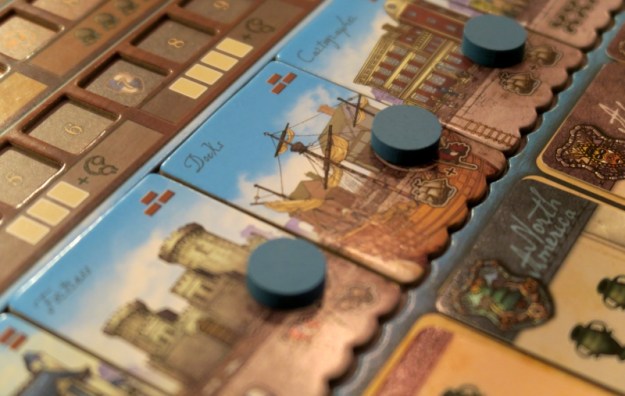
Sushi Go!
– Image by boardGOATS

In Sushi Go!, players start with a hand of cards, keep one and pass the rest on, repeating until all the cards have been distributed.  As well as being a core mechanism in 7 Wonders, this “Card Drafting” is also often used to try to reduce the luck of the draw at the start of games like Terraforming Mars and Agricola (both also acknowledged by the Spiel des Jahres committee).  In Sushi Go!, players are using the card drafting to collect sushi and, most importantly Pudding!  The game is played over three rounds, with cards drafted to the left, then right and then left again, scoring points at the end of each round.

Sushi Go!
– Image by boardGOATS

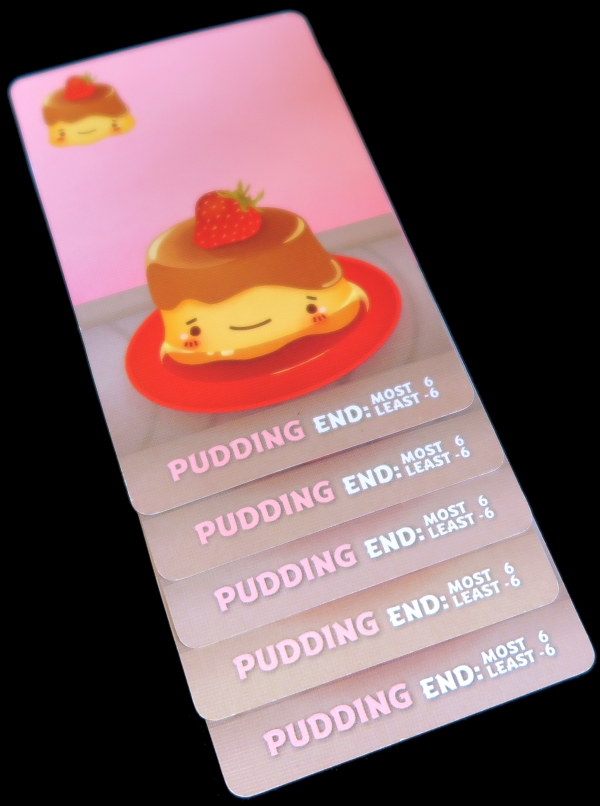
This time, Pink and Black tied for the high-scoring first round, with Pine just behind.  Pine made up for it on the second round by taking it convincingly, however, with everyone else scoring very badly.  The third round was more even again, this time won by Black with Purple taking second.  That resulted in a three-way tie between Black, Pink and Pine, but at the end of the game, the player with the most Pudding cards gains six points, with the one with the fewest losing six points.  Unusually for Pink (as he has quite a sweet tooth), he had eschewed Puddings, while Black had the most giving him what ended up being a quite convincing victory.

Sushi Go!
– Image by boardGOATS

There was just time for a single round of Love Letter (a game from the 2014 Spiel des Jahres recommended list).  This is a sixteen card game where players start with a card, draw a second and then play one.  The idea is to try to be the last play in or the player with the highest value card when the deck runs out.  The theme is all about getting as close as possible to the Princess card, which has the highest value.  This led to a discussion about real princesses and how close people had been to them.  It turns out that Purple has met a real one, Princess Nina who lives in a massive house in Cheltenham.  During the game, Pink was the Princess, but was spotted and knocked out, leaving Black to take another win.

Love Letter
– Image by boardGOATS

Learning Outcome:  The Spiel des Jahres committee may reward lighter games, but they are good games.

19th September 2023

Blue and Pink were the first to arrive, making up for their recent absence on the other side of the world.  They had finished their supper and were just discussing the upcoming Essen, when Purple and Black arrived, quickly followed by Pine, to be regaled of tales of koalas, pandas and roos.  Green, Teal, Cobalt and Lime weren’t that far behind and then the group split into two to play.  The “Feature Game” was Alea Iacta Est, a fairly simple dice chucking game with a Roman theme.  Although it has a lot of similarity to one of our old favourites, Las Vegas, it is more of a “gamers’ game” as it has a bit more planning and slightly more complex scoring.

Alea Iacta Est
– Image by boardGOATS

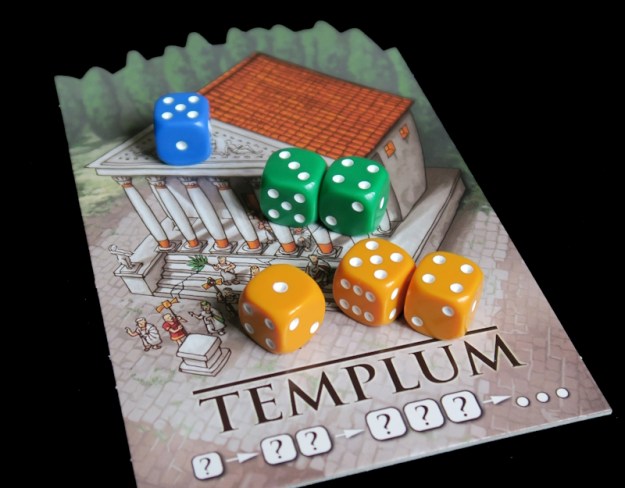
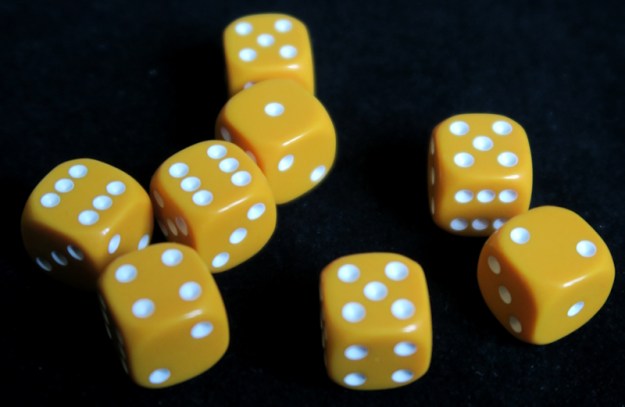
Like Las Vegas, players have a handful of dice, which they roll on their turn and then place a some or all in one of the locations.  In Las Vegas, the locations are different gambling joints and the dice placed are all the same number.  However, in Alea Iacta Est, the dice placed depend on the location, there are five, and the all behave differently.  For example, in the Templum, the first player adds one die and takes a face down Fortunum token.  The next player to place dice in the Templum adds one more die than the first player making sure the total number of pips is larger, and also takes a token.  If a player is returning to the Templum, they can reuse the dice they placed previously, making sure their number of dice is one more than the previous person to play there.

Alea Iacta Est
– Image by boardGOATS

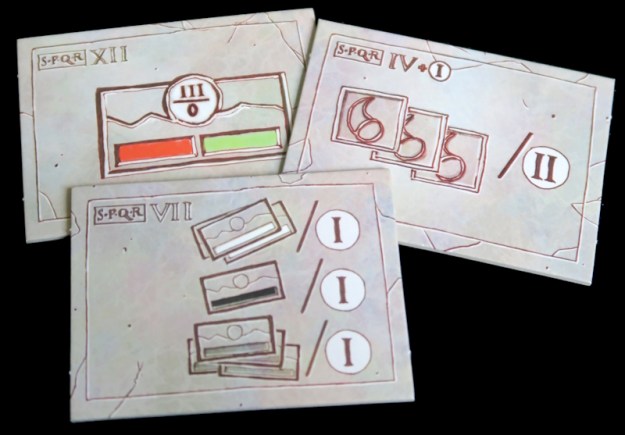
The Fortunum tokens are points, ranging at random from one to three.  At the end of the round (triggered by one player running out of dice), the player with the most Fortunum tokens keeps two of their tokens, while everyone else keeps one of their choice.  In the Senatus, players have to place “runs”, that is sequences of dice with consecutive values.  Players who place dice later must add one more die than the previous player and the run must be different to any that already exist.  Players can only have one run in the Senatus, but as for the Templum, players can ad dice to their previous entry.

Alea Iacta Est
– Image by boardGOATS

At the end of the round, the player with the longest sequence of dice takes three Senate cards, keeps one and passes the rest on to the player with the second longest sequence of dice.  The Senate cards provide players with end game scoring opportunities.  The Castrum is similar to the Slot Machine from the Las Vegas Boulevard expansion, in that players add sets of dice of the same value.  Like the Slot Machine, players can have more than one group, but unlike Las Vegas, there may be any number of groups in the Castrum, but never two groups with the same pips and same number of dice.

Alea Iacta Est
– Image by boardGOATS

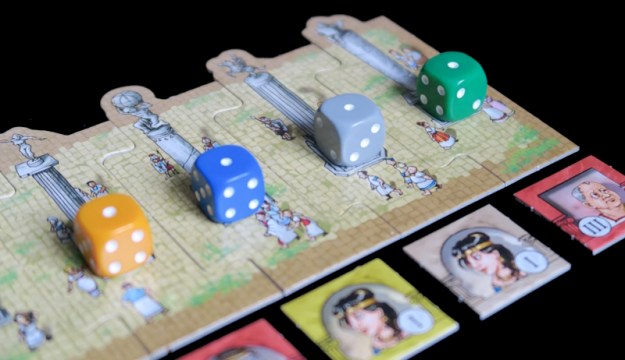
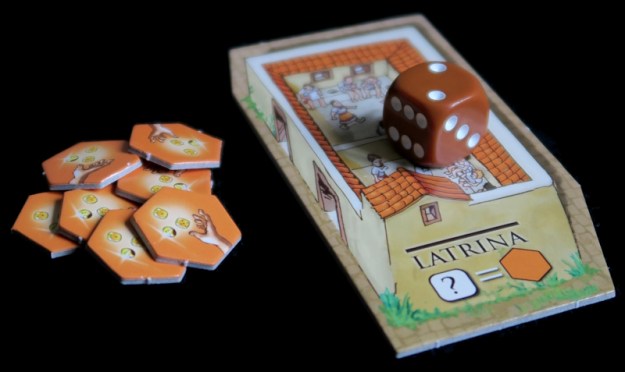
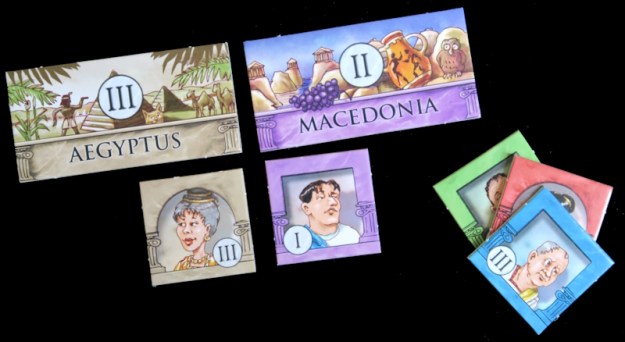
The player with the largest group in the Castrum at the end of the round takes their choice from the face up selection of Province tiles.  These score points at the end of the game, as long as they have at least one assigned Patrician.  Players get Patricians from the Forum Romanum.  The Forum Romanum is perhaps the most complex to control. Player can place either a single die with any number of pips or exactly two dice, which show together the total five pips (i.e. a one and a four, or a two and a three).  The dice are placed at the base of pillars in value order with the lowest value added to the left displacing everything to the right by one space.
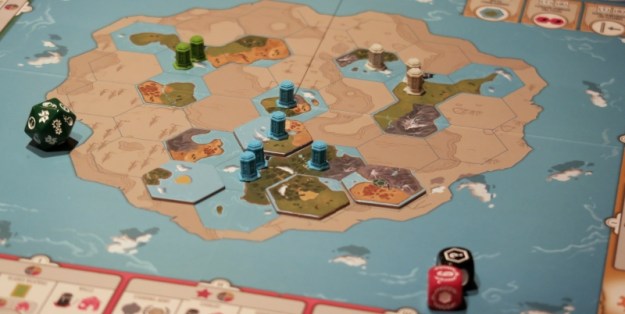
Alea Iacta Est
– Image by boardGOATS

The clever part is the order the dice are placed when there is the inevitable tie:  the most newly added, also goes in the space to the left the group with the same number (again shifting everything to the right by one space).  At the base of each pillar there is also Patrician tile and these go to the owner of the die next to the pillar at the end of the round.  The fifth and final space is the Latrina, which is where players place dice if they can’t place them anywhere else, getting a re-roll token in return.  These can be cashed in during the game, or are worth a point for each pair at the end of the game.  The Patrician tiles and the Provinces are coloured.  Patricians are worth their face value, but only if allocated to a Province with a matching colour.

Alea Iacta Est
– Image by boardGOATS

Each Province can support two Patricians, one male and one female.  Each Province also scores its face value, though there is a point deduction if it has no Patricians.  These are the main source of points, though Senate tiles can provide a lot as well, with additional points from the re-roll chips and Fortuna tiles (taken from the Templum).  The game is played over five rounds with players taking it in turns to allocate dice until one player runs out (play continues until everyone has had the same number of turns).  As expected, it took a couple of rounds for everyone to get the hang of the locations, and in particular how the Forum Romanum worked and the implications for the scoring.

Alea Iacta Est
– Image by boardGOATS

Initially, everyone, but Pine in particular collected some Senate cards, to try to give them a steer on what to aim for.  They were a bit more complicated than people realised, so while they helped to an extent, in some cases, things became more opaque rather than less.  Pink, Pine and Blue made a real effort to get what they wanted from the Forum Romanum, which became increasingly difficult as the game progress—in the final round, the only dice left there had the value of one.  Teal focused on the getting lots of Provinces, realising that they still scored most of the points even when they were unoccupied.

Alea Iacta Est
– Image by boardGOATS

Given how people struggled to get to grips with the scoring, it was a really close game.  Pink just pipped Blue by a single point and Teal was only a couple of points behind in third.  Ultimately, despite the similarities with Las Vegas, it was very definitely a “learning game”.  Indeed, the similarities are quite superficial as the guts of the game are in the way the different locations interact.  This takes the game from being a light betting game to a much more complex game, though one that is still a lot of fun, with special moments when someone shifts someone else’s carefully positioned dice right out of the Forum.

Alea Iacta Est
– Image by boardGOATS

Meanwhile, on the next table, Green led Black, Purple and Cobalt in a game of Endeavor: Age of Sail.  This is a game that is very popular with the group, and although it seems quite complex, really comprises of point-by-point decisions, so although strategy is very important, tactics are critical too. The game is played over eight rounds, each consisting of four basic phases: Build, Populate, Payment and Action.  There are four technology tracks roughly corresponding to each phase, which dictate what a player can do during that phase.  For example, how far along the building track a player is dictates what they can build: the further along they are, the more buildings they have to choose from.

Endeavor: Age of Sail
– Image by boardGOATS

Thus it is one of those games where small decisions made early can have a big impact later in the game.  The first phase consists of passing round the tray of buildings rather like a box of chocolates, but after that, the second and third phases are more or less carried out simultaneously.  The guts of the game, however, is the Action phase.  In this round, players can place population markers on their buildings to activate them and carry out one of the five actions:  Colonise, Ship, Attack, Plunder Assets, and Pay Workers, actions that are generally focused on the central map.

Endeavor: Age of Sail
– Image by boardGOATS

Cobalt had not played Endeavor before so the group opted for the standard buildings and played using the standard, four/five player side of the board.  They did add three exploits from the Age of Expansion, however, the last three that had not yet been played with this copy of the game. They would not come into play until later and by then everyone should have a good idea of how to play.  While Cobalt and Black went with the Occupy action for their first building followed by the Workshop for extra bricks for their second building, Green and Purple both chose Shipping as their first building.  Green then took a Shipyard for a second shipping action and Purple went for a Market (gaining cards), “just to to be different”.

Endeavor: Age of Sail
– Image by boardGOATS

In that first round, Black and Cobalt only took a single occupy action with a plan to get better actions for their third building. Purple could only manage a single shipping, while Green also only managed one ship, but combined it with gaining a Culture to push him into the next category to get more citizens in the second round.  In that next round, Purple and Cobalt continued their similar strategy, gaining slaves for their bricks, while Green was forced into a workshop to stop himself getting hamstrung on buildings later and Purple was struggling to get enough citizens to use all the actions she had available to her.

Endeavor: Age of Sail
– Image by boardGOATS

That was pretty much how the game continued. Black and Cobalt placing people into Europe and building up their cards; Green was shipping around the world (although mostly in the Caribbean and South America) and Purple was taking the shipping routes in Europe, but always without enough citizens.  As the game progressed, regions started to open. Green inevitably gained the first Governor card. Cobalt and Puple fought for who had the most cards in total.

Endeavor: Age of Sail
– Image by boardGOATS

Once three and then four regions became open, only Green and Cobalt had people in both regions of the two opened exploits, so only they were able to make use of them.  They did use the South Sea Company exploit and Green took the extra brick as a ongoing benefit. This was not a normal brick, but a whole extra brick level, which allowed him to gain a level five building in the final round (the only one to do so). Cobald had tried to get a level five building, but then realised he had failed to reduce his brick level after he’d lost a couple of cards, and so was restricted to another level four building.  Although the Letters of Marque was the other opened exploit, no one actually made use of it.

Endeavor: Age of Sail
– Image by boardGOATS

About three rounds in, Green suddenly realised he had forgotten to explain the “Abolition of Slavery” rule to Cobalt. It didn’t look likely to happen as no-one had yet taken any European cards, however, Cobalt made his mind up then that this was what he was going to aim for—even though he had his own slaves, it felt morally right to him to make it happen!  Which he duly did, however, the only players to lose out as a result were himself and Black.  Both of them needed to reduce their card count anyhow, and the slaves were the ones likely to  be for the chop, so it didn’t cause too much damage.  The minus points they both received were only a small price to pay for their freedom.

Endeavor: Age of Sail
– Image by boardGOATS

Balancing everything is critical in this game and unfortunately Purple had always been on the back foot without enough citizens to do the actions she had available.  In the end Green ran out the winner as he had managed to get most of his attribute tracks up and gained a fair presence on the board.  The Letters of Marque, although unused, did provide for extra scoring on the shipping tracks, where Green had rather a lot of due to his early double shipping strategy. He and Cobalt also gained some points for using the South Sea Company Exploit.  This pushed Cobalt into second, marginally ahead of Black (who had managed a fair few points on cards and buildings).

Endeavor: Age of Sail
– Image by boardGOATS

It was still early and Endeavor was on-going, so when Teal left, the group looked for something little and light to play, and quickly settled on No Thanks!.  This is a favourite with the group because it is super-quick to set up and play:  players start with eleven red chips, and on their turn either take the card shown or pay a chip to pass the problem on to the next player.  At the end of the game, when the deck has been depleted, players score for the lowest value card in each continuous “run”, offset by any remaining chips and the winner is the player with the lowest total.  This is made more difficult by the fact that around thirty percent of the cards have been removed.

No Thanks!
– Image by boardGOATS

This time, the group played a total of three games.  In the first one, Pink took all the chips leaving everyone else with nowhere to go but pick up cards, which Blue did in spectacular fashion, finishing with one hundred and forty points.  The other three were very close together, with Pink just edging it by a single point from Lime.  The second game was much better balanced.  Although Pine won, there were clues as to Lime’s strategy for the next game as he picked up lots of cards and would have won by a large margin if two of the cards he wanted hadn’t been removed from the deck, but that’s the point of the game of course.
No Thanks!
– Image by boardGOATS

The third and final game was very unusual.  Lime rode his luck like a bucking bronco and kept taking cards.  Blue picked up a couple, but that was all he let her have, and Pine and Pink who just kept passing, eventually ran out of chips.  As they were playing open handed, Lime saw this and just collected the rest of the cards leaving him with forty chips and fifty-two points from his cards—a very good final score of twelve. Unfortunately for him, as both Pine and Pink had no cards or chips, they both finished with a round, fat zero, and therefore shared victory in one of the strangest No Thanks! games anyone had ever played.

No Thanks!
– Image by boardGOATS

With Endeavor coming to a close, there was just time to squeeze in something quick.  The fancied a change though and, as it had been a while since it’s last outing, Love letter was picked.  Everyone knew the game well , so the rules didn’t really need to be explained: start with a hand of one card, draw a second and choose one to play, effectively dueling to have the highest value card once the deck was exhausted.  Blue and Pine won the first two rounds, and as the others were finishing packing up, rather than play more, the group decided Blue and Pink should have a play-off.  Blue quickly acquired the Princess, which can be risky, but it was soon over when Pine played the Baron and compared hands, do his detriment.  With that, it was time to go home.

Love Letter
– Image by boardGOATS

Learning Outcome:  Although two games may seem similar, they may not suit people equally well.

10th January 2023

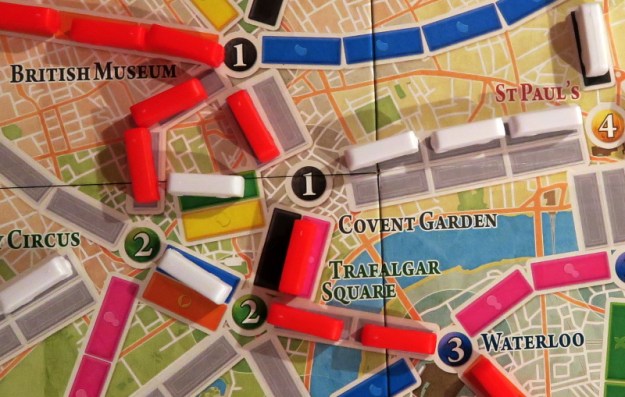
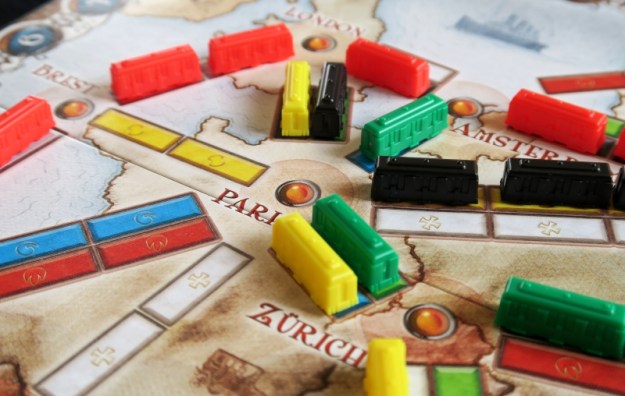
One of the first to arrive was Yellow, and it was delightful to see him after such a long time.  He was especially welcome as he was bringing a copy of Paris that he’d been looking after since UK Games Expo in August 2021.  Before long though, there were eight all ready and lined up to play the “Feature Game“, Long Shot: The Dice Game, when two more arrived and a debate began to work out who would play what and where.  As Long Shot was supposed to be quite short, eventually, Plum, Pine, Purple and Lime took themselves off to play Ticket to Ride: London, with Blue, Green, Yellow, Black, Ivory and Teal sticking around to play Long Shot:  The Dice Game.

Long Shot: The Dice Game
– Image by boardGOATS

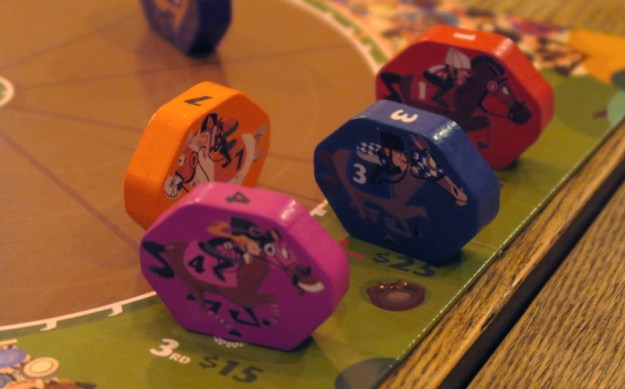
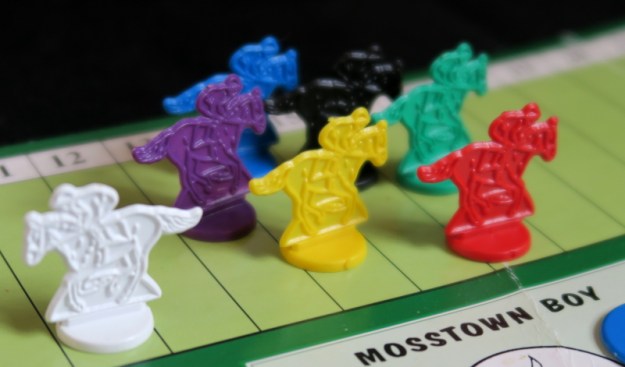
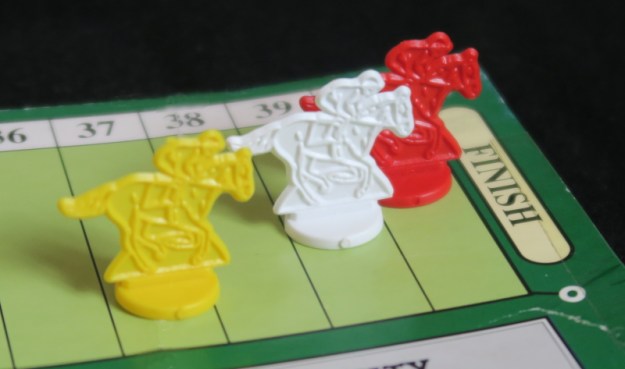
Based on the party game Long Shot, Long Shot: The Dice Game is a light horse racing and betting game in a similar mould to that of Turf Horse Racing, that featured on several people’s lists of top games from 2022.  As it is relatively quick to play, the idea was that it would leave plenty of time to play some of our other old favourites and Ticket to Ride: London was thought to be a good match in terms of length.  Inevitably, that was not quite how things turned out, however.  Long Shot (Dice) is quite simple, and Blue, assisted by Green, was explaining the necessary to the runners and riders.  Ticket to Ride is well known within the group though and was therefore quicker to get started.

Long Shot: The Dice Game
– Image by boardGOATS

The idea of Long Shot (Dice) is that the active player rolls two dice which dictate which horse moves and how far (one to three spaces).  Everyone (including the active player) then chooses an action from their card, carries it out and crosses it off.  The actions include:  placing bets, buying a horse, buying a riding cap, buying a riding jersey, crossing a horse off the concession chart to get a bonus action once a row or column has been completed.  In general, the action depends on the horse that has been rolled, i.e. if horse number two is rolled, players can bet on that horse, buy that horse, get a cap or jersey for that horse’s rider or cross that horse off the concession grid.  However, each player has three “wilds” which are opportunities to choose any horse.

Long Shot: The Dice Game
– Image by boardGOATS

At the end of the game, players score if they own or bet on a horse that is placed and for any cap/jersey combo for the same horse.  This time, Green started and rolled the blue horse number three which moved three spaces.  As did Teal.  By the time it had moved on three out of four opportunities (and a total of nine spaces), it was starting to look like the dice were loaded and this did not appeal to everyone’s sense of fair play.  The group more or less divided into those that wanted the blue horse wearing number three to win (because they had invested in it) and those who didn’t and preferred the red number one horse.

Long Shot: The Dice Game
– Image by boardGOATS

As Ticket to Ride progressed, the route planners asked how the race was going, and the gamblers, felt it would not be long, given the progress the blue number three horse had made and the lead it had built up.  After its early spurt, a few other horses managed to start to make a bit of ground and, with players starting fill out their bonus grid, players began to take bonus actions which leveled the course somewhat.  The bonuses included taking a free $7 (quite a lot of money in this game); a free $3 bet; free riding cap/jersey, but by far the most interesting were the options to move horses.

Long Shot: The Dice Game
– Image by boardGOATS

Each player has the following four bonuses:  they can move one horse three spaces (once forwards and once back) and they can move two horses two spaces (also both forwards once and both backwards once).  It was as the blue number three horse approached the three-quarters mark (after which players could no longer bet on it) that players showed their allegiance, moving it forwards, or backwards.  And with six players, everyone had potentially several bites of the cherry.  Just as it seemed that one horse had an unassailable lead, one or two players would upset the apple cart and push the leader back and something else forward.  Even the the three-legged purple number eight horse looked like it might be in with a chance of placing at one point (albeit not for long).

Long Shot: The Dice Game
– Image by boardGOATS

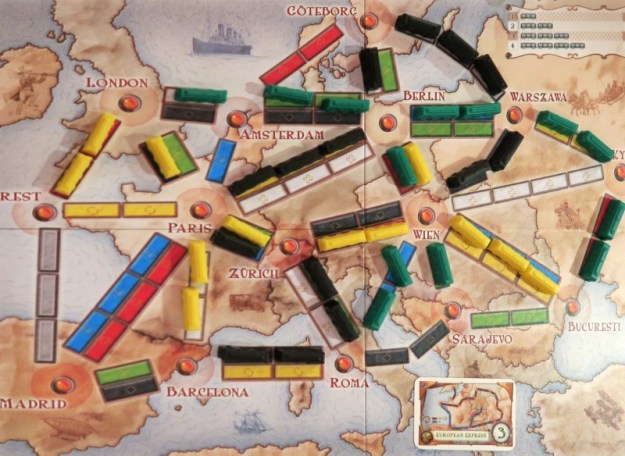
Ticket to Ride made more rapid progress.  Although Purple succeeded in completing one of her tickets (for three points), she failed to finish her other two.  That cost her ten points (effectively twenty, which is what she’d have got if she’d completed them), and she blamed Lime.  Lime had troubles of his own though as he was in a very tight battle with Pine.  Perhaps it was his comeuppance for the trouble he’d caused Purple (real or only perceived), but Pine pipped him to victory by a single point, gained when he completed one of the single carriage routes in the centre of the board in the dying moments of the game.

Ticket to Ride: London
– Image by boardGOATS

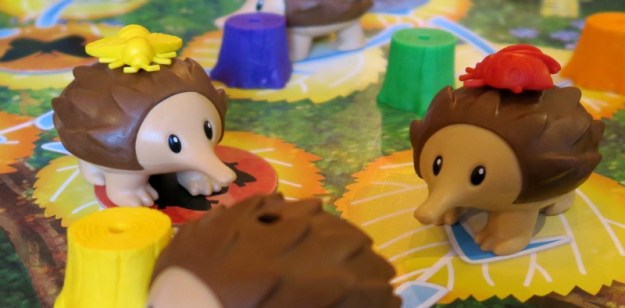
It became a bit of a running joke that the Purple/Plum/Pine/Lime group playing with their train-set asked how things were doing when they finished, and again as they packed away, and again after they’d been to the bar, and again after they’d consumed their drinks and been to the bar again, and each time were told that it was nearly done.  Eventually, Purple, Lime and Pine resorted to playing Love Letter to kill time, winning one round each.  Although Long Shot (Dice) was great fun and everyone was quite amused by the shuffling of horses backwards and forwards, Pine had a point when he commented that when gamers play a light silly game they can play it to destruction—a bit like Echidna Shuffle, which we all adored though it outstayed its welcome when one game lasted two hours!

Echidna Shuffle
– Image by boardGOATS

As players ran out of bonuses, the Long Shot horses ran out of track, and eventually, the red horse number one crossed the line, followed by the blue horse number three and finally, the pink horse number four.  Unlike in Downforce for example, however, although winning the race is useful, the betting has much, much more of an influence on the final result.  For example, the two horses Ivory had bet on, numbers five and six, didn’t come in making a severe dent in his score.  In spite of this, it was quite close—Green and Yellow tied for third  with $109 while Teal took second place with $114.  Blue claimed victory though, finishing with $122.

Long Shot: The Dice Game
– Image by boardGOATS

It was only when Green and Pine pointed out that Teal hadn’t scored his horse which gave him $2 per horse he had a bet on, and in his case, an extra $12.  Recalculating his final score, much to her chagrin, Teal just pipped Blue to victory.  From there it was simply a case of tidying up and working out what people wanted to play next.  Ivory had suggested Roll for the Galaxy at the start of the evening and there were lots of takers now, so he went off to set up with Teal, Green and Plum.  Although Teal had played Race for the Galaxy online, Roll for the Galaxy was new to him so the group started with a quick rundown of the rules.

Roll for the Galaxy
– Image by boardGOATS

The idea is that everyone starts with a couple of “Worlds” and some dice representing their population.  Players roll their dice with the faces dictating different actions.  In secret, players allocate their dice to the five different phases: Explore, Develop, Settle, Produce and Ship.  Players choose one phase that they want to happen then everyone simultaneously reveals their choices.  All the phases selected will happen, with dice that players have allocated to other phases returned to their cup and recycled.  The game is a combination of “engine builder” and “population builder” (similar to games like Orléans), with players needing the right combination of Worlds to provide their engine, and then building the right combination of dice to make them work effectively.

Roll for the Galaxy
– Image by boardGOATS

With the lighting being less than perfect, some of the dice colours were a little difficult to distinguish, particularly purple and brown.  Plum came to the rescue though, with her new Christmas present:  a portable folding lamp.  The magic of the LED gave a good strong light, enough for everyone without taking up too much room on the table.  Everyone was very impressed and many rapidly came round to the idea that it was a must have gamers’ accessory!  After a faltering start for a couple of turns, Teal soon got the hang of how to select actions and where the dice should go.

Roll for the Galaxy
– Image by boardGOATS

The first clarification needed was that players can only choose one action (though everyone’s choice will be activated), and the second was that the die used to select that action does not need to show a face that matches it. The rest of Teal’s game was one of learning:  with his mining industry, he was able to ship goods for victory points while still gaining some credits, and gained a couple of useful purple die. Unfortunately being new to the game meant he was unable to mount a serious challenge for victory points.  Plum, on the other hand, started out with a couple of red military dice and managed to obtain one more during the game along with the New Galactic Order tile which gave her a couple of extra points for those red dice.

Roll for the Galaxy
– Image by boardGOATS

Plum also made good use of her Terraforming Robots which gave her an extra credit for each World she built and two extra if it was a brown world. She managed to get three brown Worlds.  Ivory also managed to obtain the useful purple die, but his real bonus was from the Alien research ship which gave him a white and a yellow explore action whenever it was chosen.  This meant he was able to keep his credits topped up and have plenty of new tiles on the go without the expenditure of a die. As a result he was able to concentrate on building worlds and shipping/trading.

Roll for the Galaxy
– Image by boardGOATS

Green, meanwhile, quietly built his tableaux concentrating on blue worlds due to his Consumer Market which gave him an extra credit if at the end of the produce round he had  goods on a blue world. He also obtained a green and a yellow world. His Galactic Recycler meant he gained a credit every time he managed to complete a tile. He was the first and only player to build all twelve tiles which gave him the largest score for Worlds. Combined with his Free Trade Association he scored extra points for his three blue worlds and with the victory points he’d collected along the way he finished with forty-four points and a healthy lead, ahead of Ivory’s thirty-eight, just ahead of Plum thanks to his two yellow and two green worlds.

Roll for the Galaxy
– Image by boardGOATS

Meanwhile, at Purple’s request, everyone else was playing Saboteur.  This is a hidden traitor game where players take it in turns to either place tunnel cards or to play action cards.  The Good Dwarves are trying to find gold, while the Evil Saboteurs are trying to obstruct them.  In the rules as written, the game is played over several rounds with gold handed out at the end of each round.  The way the gold is distributed doesn’t really necessarily reflect the player who made the biggest contribution, so we play with the “House Rule” that each round is treated as an individual game, then we can play as many “games” as we like and/or time allows.

Saboteur
– Image by boardGOATS

This time, the group played three games.  The first one began with lots of people suspiciously checking and double-checking where the treasure was buried by playing map cards.  Purple was accused of being an Evil Saboteur, quickly followed by Black, Lime and Blue, all of which made no sense as there could only be a maximum of two.  In the end apologies were required when Pine found the gold and Blue and Purple were revealed as the Actual Saboteurs.  The second round followed a similar pattern, only this time pretty much everyone was accused of “Saboteury behaviour”.

Saboteur
– Image by boardGOATS

This time there was a Solitary Saboteur, which meant poor black had a really uphill battle and had really lost before he’d begun.  Once again, Pine was the Dwarf that found the gold, with Lime setting him up.  In the final round, things went a little differently though, particularly when Pine’s dubious behaviour signaled that he might not be trying to find the gold this time.  When Blue distracted the Dwarves by causing a massive rock-fall, it was up to Lime to try and patch the tunnel.  Things had just settled when Blue played another rock-fall and Lime patched that too.  When Blue brought down a third and fourth tunnel collapse, Lime was able to patch them too.

Saboteur
– Image by boardGOATS

It took so much effort though, that when Pine pushed the tunnel past the gold card, although it only needed a couple of extra tunnel segments, the Dwarves couldn’t make it giving a rare victory for the Saboteurs.  As Roll for the Galaxy was still going and there was a little time left till last orders, there was just time for a quick game of 6 Nimmt!, an old favourite. Blue commented that the name was one of the infamous German joke game titles, and Yellow added that “Nimmt” was the imperative of the German verb, nehmen, to take, thus when the sixth card is played on a row, that player takes the other cards.  The player with the fewest bulls heads wins.  We’ve played it quite a bit recently with the professional variant where cards can be added to the low or high end of the rows.

6 Nimmt!
– Image by boardGOATS

This time, however, as time was pressing the group decided to stick with the simple maths.  We play over two rounds with half the deck in each.  Lime had a complete nightmare in the first round, with twenty-seven “nimmts” in the first round; Pine in contrast managed a clean sheet and Black only picked up two points, so it was all to play for, for some at least.  Lime did much better in his second round giving him a total of thirty-three, only slightly more than Yellow, while Blue managed nearly that in the second round alone, top-scoring with a nice round fifty.  Black picked up just five, but there wasn’t much anyone could do to compete with Pine, who picked up just one solitary point in the second round, his only one in the whole game.

6 Nimmt!
– Image by boardGOATS

Learning Outcome:  Betting can be a mugs game.

20th September 2022

Blue and Pink were the first to arrive to the news that The Jockey was under new management.  Pine soon followed and after a bit of chatter, the three of them settled down to the first “Royal Themed” game, Love Letter.  This is a very quick little game played with a deck of just sixteen cards.  The idea is that players have a hand of one card and, on their turn draw a second and choose which one to play.  The cards each have a special action and a number—the actions allow players to eliminate each other and the player with the highest number at the end is the winner.

Love Letter
– Image by boardGOATS

Powerful cards can lead to early gains, but are risky as they make players targets, however, relying on weaker cards for too long will give a guaranteed loss.  This time, Pink was taken out twice in consecutive rounds by Guard cards with Pine and Blue sharing the spoils.  In the third round, it was down to Blue and Pine again and Pine ran out the winner.  Although with three players the winner is usually the first to win five rounds, as Green and Lilac arrived with Orange and Lemon, the trio called it a halt there.

Love Letter
– Image by boardGOATS

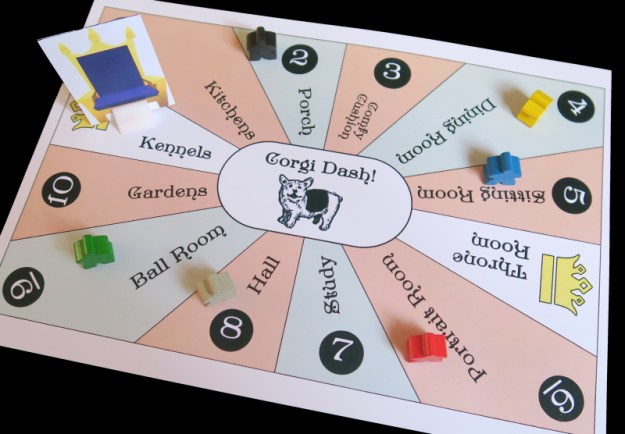
Ivory, Black and Purple turned up as well and as they arrived, everyone remarked on the new smart table decor.  We were only waiting for Lime, but when Pine suggested he might not be coming, his text enquiry was met with the response, “OMG, it’s Tuesday not Monday, will be there in twenty minutes!”  So, while the group were waiting, they decided to start with the “Feature Game“.  To mark the passing of Her Majesty Queen Elizabeth II, this was Corgi Dash, a re-theme of the 1986 Spiel des Jahres winner Heimlich & Co..  Corgi Dash was published as a “Jubilee Souvenir” earlier this year, by Tony Boydell; although we had a copy picked up at the UK Games Expo, as it was a special occasion we had enlarged the board to make it easier to play in a large group.

Corgi Dash
– Image by boardGOATS

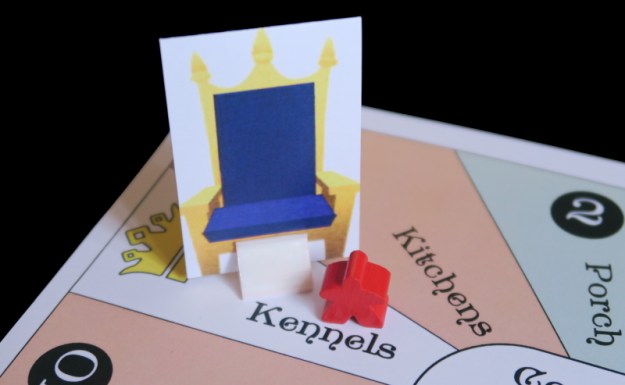
The game is very simple:  on their turn, players roll a die and distribute the pips amongst the “corgis” to move them round the board.  When one of the corgis reaches the throne (either in the Throne Room or the Kennels), each dog scores with the one that triggered the scoring getting nothing.  The Throne then moves to the next location, and the corgis continue to dash towards the Throne.  Each player secretly “owns” one of the dogs and after one dog reaches a score of thirty, everyone secretly guesses which dog belongs to which player.  The game ends when one dog reaches forty points.  Players then score for their dog and receive five additional points for each identity they guessed correctly.

Corgi Dash
– Image by boardGOATS

Blue, Pink, Ivory, Purple and Pine got going first.  In their game, the blue dog (well, meeple actually) got picked on early which marked it out as the dog with no owner.  Unfortunately, the blue dog turned out to belong to Pine and it was the grey dog who had no owner, which became more apparent towards the end when everyone concentrated on their own hounds.  The black dog was the first to get to thirty and then the only one to get to forty too.  Ivory was the only one to guess more than one owner correctly, but it didn’t make any difference as the black dog’s score was twenty more than any other, making it’s owner, Pink, the clear winner.

Corgi Dash
– Image by boardGOATS

On the neighbouring table, Green (who had played Heimlich & Co. a very long time ago, explained the rules to Lilac, Orange, Lemon and Purple. They finished their game early, guessing after two scoring rounds and scoring after the third.  Green’s dog did by far the best picking up thirty-two points, twelve more than any other hound.  Orange did exceptionally well at guessing who had each dog, getting three right, but it wasn’t quite enough to take the lead and he finished two points behind Green, both some way clear of the field with Lemon a distant third.

Corgi Dash
– Image by boardGOATS

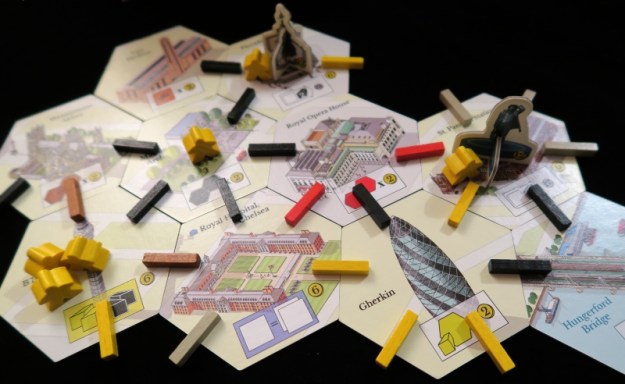
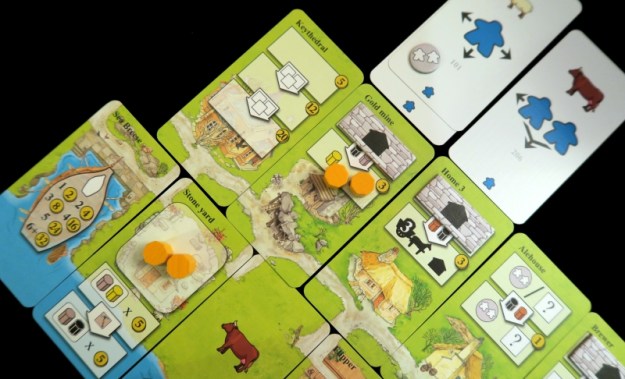
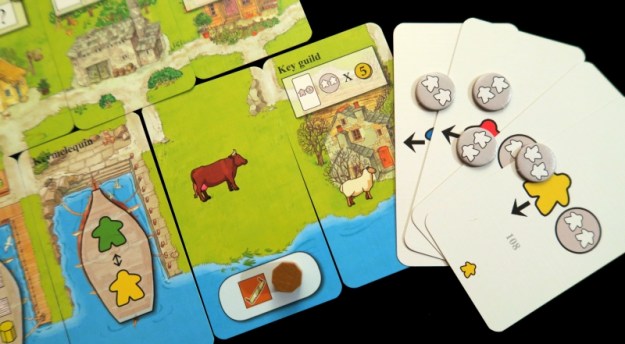
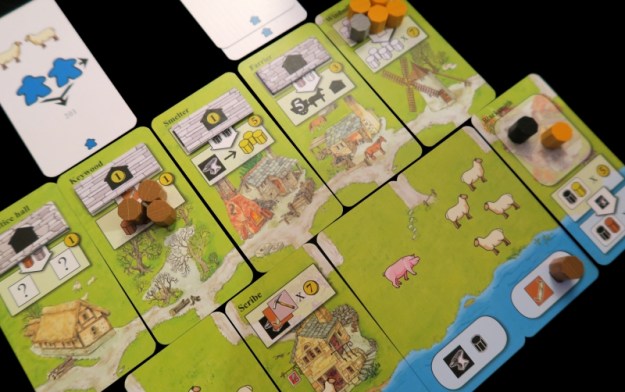
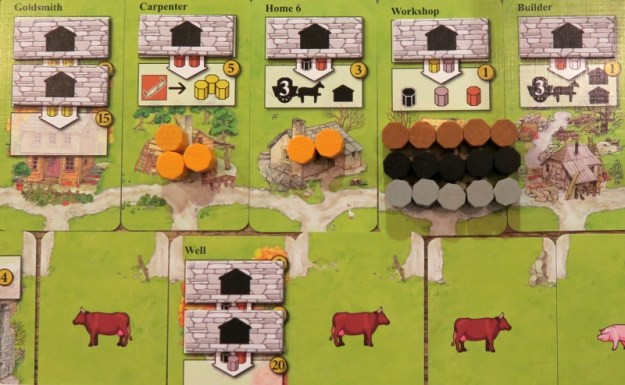
Corgi Dash was very quick to play leaving plenty of time for other games.  With all the happenings around Buckingham Palace and Westminster over the last week, “London themed” games seemed appropriate, so while everyone else played Ticket to Ride: London, Ivory, Blue and Lime took themselves off to the other side of the room to squeeze in a game of Key to the City: London.  This is a reimplementation of one of Blue’s favourite games, Keyflower.  Lime, however, had not played either game, so Blue and Ivory had to explain the rules first.

Key to the City - London
– Image by boardGOATS

Like Keyflower, Key to the City: London is based on an a series of tile auctions where players bid with meeples.  The rules for bidding are simple:  players can bid on any tile, but if there is already a bid, they must follow with the same colour and increase the value.  In addition to bidding for tiles, players can also activate a tile in their Borough, a tile in someone else’s Borough or even a tile that is currently up for auction.  Again though, players must follow colour if the tile has already been activated or has an active bid, further, every time it is activated it costs one additional meeple.

Key to the City - London
– Image by boardGOATS

At the end of each round, all meeples in winning bids return to the bank and players take any tiles they’ve won and add them to their Borough.  All meeples on tiles in a player’s Borough go back to that player, and any meeples used to activate tiles up for auction go to the winner of the tile.  Tiles are worth points at the end of the game.  Some are just worth points out-right while others are dependent on tiles they are connected to and all are worth more if they are upgraded.  Connections are acquired by activating specific tiles; tiles are also upgraded by activating them and paying any associated cost.

Key to the City - London
– Image by boardGOATS

The winner is the player with the most points at the end of the game.  While the mechanics of the game are fairly straight forward, like Keyflower the art of the game is combining them to score well.  The Connections are the main difference between Key to the City and Keyflower, but there are several other smaller differences like the round endings, for example.  In Keyflower, players bid for boat tiles which dictate how many meeples they get at the end of each round, but in Key to the City, when players choose to end their round place their boat in a position on the river.  The earlier a player “checks out”, the earlier they can place their boat and the more meeples they can get—and meeples are scarce, very scarce, in both games.

Key to the City - London
– Image by boardGOATS

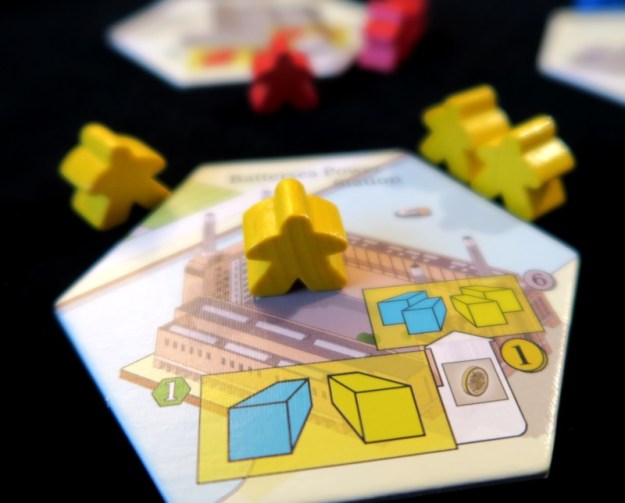
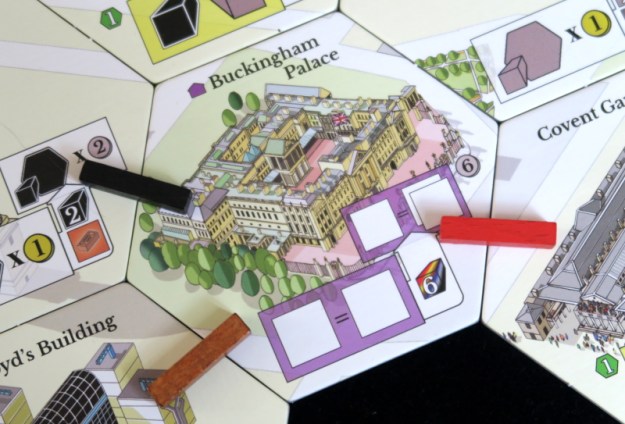
This time, Ivory with the Buckingham Palace player screen and start tile, went first.  He began by winning Paddington Station which gave him telecoms (black) and electricity (grey) cable connections.  He went on to couple this with St. Pancras, Kings Cross and the Royal Academy which gave points when connected with electricity cables and Marble Arch and Monument which gave points for telecoms cable connections.  Lime understood the fundamentals, but was struggling with how to fit them into the game, so when he picked up Battersea Power Station which provided water (blue) and gas (yellow) pipe connections, he was encouraged to pick up the London Eye and Canary Wharf to go with it which ultimately proved good choices.

Key to the City - London
– Image by boardGOATS

Blue lost out in a couple of early bidding wars, so ended up with the Barbican instead, giving her underground tunnels (red) and waste pipe (brown) connectors and later Charing Cross (more underground tunnels and grey electricity cables).  Maybe she’s spent too long with Pink, but she mostly chose to eschew sewage pipes and electricity pylons, instead focusing on trains, using them to make connections with the Royal Opera and the Globe Theatre.  Unfortunately, there was a little “rules malfunction” in the early part of the game with a misunderstanding of one of the scoring icons.  Instead of players scoring for connectors of the colour indicated connected directly or indirectly to a tile, players should only score for each tile connected to the scoring tile.

Key to the City - London
– Image by boardGOATS

The “rules malfunction” was spotted quite early, so although it added a little to Lime’s confusion, everyone had enough time to correct things before scoring took effect.  In the final round, Ivory bid for the Natural History Museum which gave him points for monuments, and London Zoo giving him two points for each blue meeple he was left with at the end of the game.  He then activated a few last tiles and set sail.  Lime engaged in making lots of utilities connections, and bid for the British Museum and the Royal Festival Hall (giving two points for each tile won in the final round and three points for each tile connected by all six utilities respectively).

Key to the City - London
– Image by boardGOATS

Blue took the V & A Museum (giving points for sets of skills tiles) and the Science Museum (giving points for tiles with six connections).  Then she made a mistake:  with Ivory out and Lime running low on meeples, she had the opportunity to either out bid Ivory for London Zoo, or compete with Lime for the British Museum and in a fit of stupidity went for the latter.  Blue’s error might have proved critical though as winning the zoo would not only have given her twelve points, but also taken twelve from Ivory.  As it was, in the final count, Ivory took victory with a hundred and seventeen to Blue’s ninety-six and Lime’s seventy-eight.

Key to the City - London
– Image by boardGOATS

Meanwhile, on the other side of the room two games of Ticket to Ride: London were underway.  Ticket to Ride is one of our current favourite games and the London variant, being one of our “local” editions is particularly popular.  The game plays in the usual way with players taking cards from the market, using them to pay to place trains on the map and claim routes, or taking Tickets which give points at the end of the game if the two destinations are connected.  Each map has an extra rules “tweak” and in case of the London edition players get bonus points if they visit all the places in a borough.

Ticket to Ride: London
– Image by boardGOATS

When Pink asked Pine who the people were on the box there was a general aura of shock when he claimed not to recognise Emma Peel (though he did correctly identify Her Majesty Queen Elizabeth II).  Their game with Purple and Black started off very confrontationally in the centre of the board and carried on in much the same vein as the game developed from there.  Pink took Pine’s dubious advice to take more tickets, but failed to score them.  Pine got his comeuppance though when Black just pipped him to the line beating him into second place by a single point, while Purple took third.

Ticket to Ride: London
– Image by boardGOATS

The other group managed to rattle through the game really quickly too as everyone knew what they were doing.  Orange completed all his Tickets and triggered the end of the game.  For everyone else it was a more frustrating game. Lilac was convinced she was going to lose as she had failed to complete one of her tickets finding herself blocked, but in the end finished second, significantly ahead of Green and Lemon.  Green had tried the “gamers tactic” (espoused by Black on previous occasions) said all the best Ticket to Ride players do, namely  collecting more tickets at the start of the game.

Ticket to Ride: London
– Image by boardGOATS

This went OK until about half way through when he got blocked on his best route, then while trying to re-route got blocked again, forcing him to try a third option. This was blocked too and he was locked out of his key station, finishing with three incomplete Tickets.  Lemon had tried the same strategy (collecting tickets first), but also ended up with a couple not completed.  As a result, Orange wiped the floor with everyone else finishing with a score nearly three times that of his nearest competitor: a convincing victory.

Ticket to Ride: London
– Image by boardGOATS

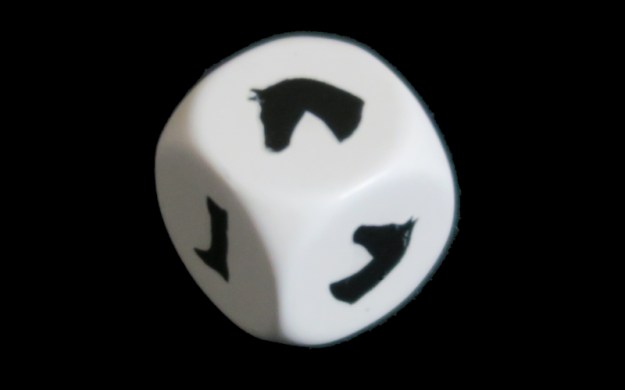
Key to the City: London was still underway, so, given Her late Majesty’s well known love of the gee-gees, the two groups got together to play Turf Horse Racing.  It was a while since anyone in the group played it, so Green reminded everyone of the rules.  The idea is very simple, players have three counters to use for betting, two small and one large, double weight one.  In the first stage, players take it in turns to use these counters to bet on horses.  In the second stage, players take it in turns to roll the die and move a horse to determine the outcome of the race.

Turf Horse Racing
– Image by boardGOATS

The game works because the die has three horses heads with one of each of the other icons, and each horse moves a different amount depending on what is rolled.  Since each horse has to move before a horse can be moved again, players can choose to make a positive move for one of their own horses, or nobble someone else’s.  Although the rules as written give the maximum number of players for Turf Horse Racing as six, the group thought it would stretch to more due to the way it is played.  And given the hilarity that ensued, that seemed a really good decision.

Turf Horse Racing
– Image by boardGOATS

It was decided that due to there being so many players, perhaps three bets per player would create too many horses with multiple bets, so it was house-ruled to two bets only each: one big and one small.  The extra bet tokens needed were taken from Ticket to Ride: a scoring disc and a bus.  Pine was the sole “investor” in Roamin’ Emperor’s fortunes.  Pink, trying to get his revenge for being misled in Ticket to Ride, cajoled everyone to choose this purple horse to move only one space, much to Pine’s annoyance.  Pink got his way, but then got his comeuppance when someone made his chosen horse, Lagoon Lady, also move only one.

Turf Horse Racing
– Image by boardGOATS

After the first round it was Silver Blaze blazing a trail up front, closely followed by Mostown Boy and Raven Beauty.  This theme kept repeating with Lagoon Lady and Roamin’ Emperor moving only one space a turn, until finally Pine struck gold and was able to shoot his horse forward by a massive fifteen spaces and get it into the leading group.  It was a close race, and eventually Silver Blaze was overhauled and brought back into the pack.  As the race entered it’s final furlongs Lagoon Lady was still languishing behind.  Although it had made up some ground, Roamin’ Emperor was making better progress but also starting to fall back.  One more “mega surge” would have been enough to put it within spitting distance of a win, however, that was not to be.

Turf Horse Racing
– Image by boardGOATS

In the end it was The Red Baron who crossed the line first, with Silver Blaze second and Desert Prince third. Adding up the betting totals, Lemon took home the biggest winnings with eight, with Lilac just one behind in second and Black a comparatively distant third.  The conclusion was that Turf Horse Racing can definitely be played with eight, but maybe a little more tinkering is needed. Perhaps keeping the three bets, but with seven horses, the start player moved around the table very slowly—something to think on and investigate further perhaps.

Turf Horse Racing
– Image by boardGOATS

Learning Outcome:  Her Majesty had a point—dogs and horses can be a lot of fun.

Boardgames in the News: What are “Filler” Games?

To most people, games come in two types, board games and card games.  Modern board gamer, however, have many other classifications.  For example, board gamers make the distinction between Strategy Games and Family Games.  Strategy Games typically are more complex than Family Games, which is not to say that Family Games don’t involve strategy, simply that the strategies are more involved.  Typically, a “Light Family Game” will be relatively simple in concept and take around forty-five minutes to an hour to play, where “Heavy Strategy Games” tend to take at least a couple of hours and sometimes several or more.

Niagara
– Image by boardGOATS

Examples of Family Games include Niagara, Downforce and Escape: The Curse of the Temple, while Altiplano, Keyflower and Concordia might be described as Strategy Games.  There is a third category which, can be harder to describe, Filler Games.  These are typically shorter games that often also fit the Family Game criteria, but have sufficient challenge that players of heavier Strategy Games enjoy playing them between other games.  “Shorter” is obviously in the eye of the beholder—to people who often play games that last several hours, any game that lasts less than an hour and a half might be a “Filler game”.

– Image by boardGOATS

However, if a games night lasts around three hours, a Filler Game might be one that lasts no more than around thirty minutes or so.  More importantly, and in order to save time, they have minimal setup time and are usually well known amongst gamers or at least are very quick to teach.  Popular Filler Games include card games like No Thanks! and Love Letter, but also tile laying games like NMBR9 and board games like Tsuro and Draftosaurus.  All these fit the basic criteria, but additionally are good fun and are great for warming up or down at the start or end of an evening, as well as for playing between games and while waiting for other games to finish.

No Thanks!
– Image by boardGOATS

17th May 2022

Black and Purple were first to arrive this week, but Pink and Blue were not far behind, and once food had been ordered, there was just time for a quick game of Love Letter to commemorate its recent tenth anniversary.  We used to play this quick little filler game quite a bit, but that fell victim to the global pandemic and, as a result, it’d been a while since anyone round the table had played it.  Played with just sixteen cards, the game is really simple, but is a great way to kill a few minutes.  The idea is that each player starts with one card, and on their turn draw a second from the deck and play one of the two.

Love Letter
– Image by boardGOATS

Each card has a number and an action or effect.  The actions range from number one, the Guard, which allows the player to guess what character card a player is holding and “assassinate” them if correct, to number eight, the Princess, who will win the game for the player holding it at the end, but lose it for them if they are forced to discard it before then. There was just time for three rounds before food arrived.  Black took the first round and Pink the second.  Pink then recused himself as he went to chat to some of the locals about Jubilee plans leaving Black, Purple and Blue to fight it out with Blue taking the final point.

Love Letter
– Image by boardGOATS

With the arrival of Pine and Lime, the group went on to play Moneybags, which had been the “Feature Game” a couple of weeks ago.  The idea of this is that, on their turn, players have to decide whether to rob another player’s hessian sack of gold or not.  Critically, however, they must not be too greedy.  This is because the victim can challenge the thief, and if the thief is found to have more than the victim, the victim takes the lot, but that makes them more of a target as now everyone else knows how much they have…

Moneybags
– Image by boardGOATS

This time, the game did not go according to plan.  Black played the Godfather and divvied up the loot.  Purple robbed Pine, who promptly challenged and won a huge pile of gold.  As it was his turn next, after lots of advice from everyone else, he closed his bag and stepped out.  Then Blue challenged Black and won, knocking him out too.  Although it was close between Pine and Blue, much closer than most people thought it would be, Pine’s huge stash won out.  The moral of this story is to rob someone before you in the turn order otherwise, if they challenge and win, they can kill the game by closing their bag.

Moneybags
– Image by boardGOATS

This week, the “Feature Game” was the Arts and Architecture expansion to Tapestry, which is something that Ivory in particular, had been waiting ages to play.  We wanted to give others an opportunity to play the base game first and then the (slightly less complex) Plans and Ploys expansion, which got an outing a few weeks ago.  That was enjoyed by everyone involved, so it was now time to add the second expansion.  The base game is simple in terms of what you do, but playing well is much more difficult.  The idea is that there are four advancement tracks:  Science, Technology, Exploration and Military, and on their turn, the active player progresses along one of these taking the actions for the space they land on.

Tapestry
– Image by boardGOATS

In general, players must pay resources to carry out actions and, in some cases, may pay more to carry out a bonus action.  The first player to progress along each of the tracks receives a building as they pass landmark spaces, which those players then add to their city.  Filling rows and columns of their city gives additional resources and as these are scarce, the extras can be invaluable.  Players can focus on a specific track or take a more balanced approach, but this decision is often driven by starting Civilisations which give players a special and unique ability.  Coupling the Civilisation with the right strategy is often the difference between success and failure.

Tapestry
– Image by boardGOATS

When players run out of resources, they can instead take income which means players move on to the next round at different times.  The Arts and Architecture expansion provides more civilizations, tapestry cards, technology cards and capital city plans.  The biggest change, however, is the addition of a new advancement track featuring new Art or Masterpiece cards and tiles and, of course, associated Landmark miniatures.  Each Income phase, players can activate their masterpiece power and get the benefit shown, typically resources or points allowing players to prolong their turns further, but like the Technologies, they are really a long term investment.

Tapestry: Arts & Architecture
– Image by boardGOATS

Green and Teal joined Ivory in what was a Tapestry rematch of the last game and, in addition to the Arts and Architecture expansion also included the Plans & Ploys expansion. Each player received a standard capital city and an expansion capital city, but everyone decided to try the new ones to add variety to the game.  For the Civilisations, in an effort to ensure things were balanced, the up-to-date starting adjustments were used, and players chose:

  • Craftsmen (Ivory), which gave him a new board to place his income buildings on for extra bonuses;
  • Historians (Teal), which enabled him to choose a player each round, and when that player placed a special building, Teal would gain extra resources;
  • Architects (Green), which gave his income rows double points scoring under certain conditions.
Tapestry
– Image by boardGOATS

Green’s Civilisation did not last beyond his first income phase, however, as he played the Plague Tapestry card which allowed him to draw a new one. This new one, Entertainers, gave him an extra bonus track to follow each income phase.  Ivory made his intentions clear by moving up the new purple Arts track and gained a couple of special Arts cards.  Green followed him, but also spread a bit more onto the Technology track for a Technology card.   It was Ivory who was first to take an income phase, but as he had not explored the Technology track he did not have a Technology to upgrade on his first income.  Ivory did have a couple of Arts cards to provide him with a nice little bonus though.

Tapestry: Plans and Ploys
– Image by boardGOATS

Teal went a different route and travelled up the Explore track and expanded his island.  The resources he gained on the way enabled him to take his first income much later than the others.  This pattern of Teal taking income last remained in play to the end of the game. Green took the second income first, and Ivory switched back to first for the third income. It was Ivory who took his final income first, closely followed by Green leaving Teal to play on his own at the end.  By this time, Ivory had collected all the Arts buildings, completed both the Arts and Science tracks and expanded his empire by three more hexes.

Tapestry: Arts & Architecture
– Image by boardGOATS

Ivory had also collected three Arts cards and replaced two of his income scoring tracks. He had only placed two income buildings on his Civilisation card, but had mostly completed his capital city (including a massive seven special buildings), but had only one, solitary technology card.  Teal had completed the Explore track, although two of his space hexes were very poor scoring for him, and had not progressed at all on the Arts track. His empire was seven hexes in size, including the one in the centre of the territory. He had also collected six special buildings on his way, but no Technology at all.

Tapestry: Arts & Architecture
– Image by boardGOATS

Green managed to complete the Arts and Technology track, choosing to travel up the Arts again for his technology completion bonus. He did not expand his empire at all, although he had grown the islands a little. He finished with four Arts cards and three Technology cards, but only five special buildings.  In the final scoring  Green finished with a personal best of two hundred and ninety-three points, beating the hitherto invincible Ivory who “only” managed two hundred and fifty-one, some way ahead of Teal.  Part of the reason for this was that Teal did not place his last player cube choice from his civilisation on his penultimate income.

Tapestry: Arts & Architecture
– Image by boardGOATS

This was because the game ended in a bit of a rush because time was getting on and Teal unfortunately didn’t thought the others wouldn’t get any more buildings.  As a result he missed out on a few free resources in the final round and even a few resources can make a huge difference. As ever it is difficult to find the right balance in Tapestry as players need to both specialise and be a Jack of all trades, which is very hard to do.  Although the game took longer as a result of the expansions, all three liked the added enhancements and would be keen to play again with all the extras.

Tapestry: Arts & Architecture
– Image by boardGOATS

Meanwhile, on the the other side of the room, Lime was introducing Black, Lilac and Pine to Die Wandelnden Türme, a recently released, curious little family game.  The idea is that players start with a handful of Wizards placed on top of the little Towers around the board, and a hand of three cards.  On their turn, the active player plays a card which allows them to move one of their Wizards a set number of spaces forward, or move a tower a set number of spaces.  When Towers move, they take any resident Wizards with them but can also land on top of another Tower and trap any pieces that were on the roof.  A player that catches other pieces in this way gets to fill a Potion Flask.  They can then spend the Potions to cast spells.

Die Wandelnden Türme
– Image by boardGOATS

In the base game the spells available are “move a Wizard one space forward” or “move a Tower two spaces forward”, but others are available and change the feel of the game a little.  Players are trying to land all their Wizards in the black, Raven Castle and fill all their Potion Flasks—when someone succeeds, that triggers the end of the game.  It is a fun and entertaining game where players Wizards get variously trapped and if they have a bad memory, can find they lose them in the circus of dancing towers.  And that is exactly what happened to poor Pine.  His Wizards disappeared and every time he uncovered where he thought they were, he discovered they weren’t.

Die Wandelnden Türme
– Image by boardGOATS

In the end it was a tie between Lime and Black, but it had been a lot of fun, and Pink in particular was watching with envious eyes from the next table as he’d read about the game in the Spielbox magazine and fancied giving it a go.  While eying up the Wizards, Pink was playing Calico with Purple and Blue.  This is another game that is new to the group, although it was released a couple of years ago.  It has a similar feel to Patchwork, the popular two-player tile-laying game about designing quilts, though the games are by different designers.  The most obvious difference is that Patchwork is a Tetris-like game with polyomino tiles, where all the tiles in Calico are regular hexagons.

Calico
– Image by boardGOATS

On their turn, the active player chooses a patch tile from their hand of two, and sews it into their quilt, before replenishing their hand.  If they complete a colour group with that tile, they can add a button to their quilt; if they create a pattern group that is attractive to a cat, it will come over and sit on their quilt.  At the end of the game, when the quilt is finished, players score for buttons, cats, and their own personal target.  In reality, the theme is a bit “pasted on”, but the pieces are nice, and make what is otherwise a bit of a brain-burny abstract a little more accessible.  Purple and Pink struggled with the puzzly nature of the game at the beginning, where Blue got a better start.

Calico
– Image by boardGOATS

Achieving the personal targets is difficult—these specify the number of different tiles that should surround a particular tile.  For example, the goal tile AA-BB-CC scores when surrounded by three different colours, or three different patterns, with two matching tiles in each colour/pattern.  Successfully fulfilling a target with both the colour and the pattern scores more points, but is significantly more difficult.  Despite explaining this to Purple in her rules outline and saying she had decided to give up on the extras, Blue somehow got lucky and was able to fulfill two of private goals with both the colour and the pattern.  With lots of buttons and cats, it was a bit of a runaway victory for Blue, but it was very close for second, with Pink just edging it.

Calico
– Image by boardGOATS

Die Wandelnden Türme finished first, so the foursome scratched about for something else to play and settled on The Game.  This is a simple cooperative game that was one of Burgundy‘s favourites.  The team have a deck of cards numbered from two to ninety-nine (in our case, from a copy of The Game: Extreme, but ignoring the special symbols), and they must play each card on one of four piles.  For two piles where the card played must be higher than the top card, and for two it must be lower.  There are just three rules:  on their turn, the active player can play as many cards as they like (obeying the rules of the four piles), but must play at least two cards before replenishing their hand, and players can say anything they like but must not share “specific number information”.

The Game
– Image by boardGOATS

Finally, there is the so-called “Backwards Rule” where players can reverse a deck as long as the card they play is exactly ten above or below the previous card played on that pile.  The game ends when, either all the cards have been played onto the four piles, or a player cannot play a card.  This time, things went wrong from the start and unusually, kept going wrong, so much so that there were still two cards left in the deck when the group could no-longer play.  Lilac ducked out and Pine, Lime and Black gave it a second try, but the end result was not much better.  Clearly the group keenly felt the loss of Burgundy’s special skills.

– Image by boardGOATS

While they played their second game of The Game, Calico came to an end, and Lilac joined Purple, Pink and Blue for a game of Sushi Go!, the archetypal “card drafting” game.  Players start with a hand of seven cards, and choose one to keep, passing the rest on to the player on their left. Players repeat this with the aim of the game being to end up with the set of cards that score the most points. The game is played over three rounds with the player with the highest total winning.  This time, the game was interrupted by an arrival, one some people had been waiting all evening for.  The “special guest” was the new resident at the pub, a gorgeous black Labrador puppy by the name of Winston.

Sushi Go!
– Image by boardGOATS

The game decidedly played second fiddle when cuddles were on offer.  Despite the distraction of Winston, or perhaps because of his help, Blue, who is usually appalling at this game, somehow managed to make two solid rounds.  Pink did the same in the first and third rounds, while Purple and Lilac were more consistent over the three rounds.  Purple finished with the most puddings, and Pink and Lilac shared the penalty for having the least.  Those penalty points made all the difference as Blue pipped Pink to the post.  And as Tapestry had also finished and Pink had finished admiring Teal’s copy of Root, it was time for all little puppies to go to bed.

Winston
– Image by boardGOATS

Learning Outcome: It’s hard to specialise and be a “Jack of all trades” simultaneously.

Boardgames in the News: Ten Years of Love Letter

This week, Love Letter celebrated its tenth anniversary.   Originally self-published by Seniji Kenai (of the Kanai Factory) and released at the Tokyo Game Market in 2012, the sixteen card micro-game has been a roaring success from the very start.  The game reached a much wider audience, however, after the designer Seniji Kanai literally gave the AEG owner John Zinser an “elevator pitch” when he demonstrated Love Letter to him during a ride in a lift. As a result, the game received a US release in later the same year and has since sold an more than three million copies copies worldwide.

Love Letter
– Image by boardGOATS

The secret of Love Letter is in its speed and simplicity:  on their turn, players draw a card and add it to their hand, then choose one of their two cards to play.  Each card is numbered, and the winner is the player left holding the highest value card at the end of the game, or the last person standing, if everyone has been eliminated.  The clever part are the actions, which work fit together well, creating a really tight game.  The actions are simple enough that they can be played as an introductory game with players just reading the cards and choosing one of the two options, but also works as a very quick filler for more experienced gamers.

Love Letter
– Image by boardGOATS

Since its release, Love Letter has been continuously in print with some thirty or more variants and special editions including Santa, Munchkin, Batman, Hobbit, Star Wars and Lovecraft themed versions.  Some of these have small rule changes, while others simply have alternative artwork.  There have also been games that develop the core mechanism like Infinity Gauntlet, Star Wars: Jabba’s Palace, Archer: Once You Go Blackmail… and the Lost Legacy series of games.

Love Letter
– Image by boardGOATS

To celebrate the tenth anniversary, Arclight, the Japanese publisher of Love Letter, is planning three new editions of the game:  a collection of all the variants; a version with alternate action cards that can be swapped in and out, and a campaign based story-driven edition of the game.

6th October 2021

For the first time, the group were meeting on a Wednesday to avoid clashing with the Quiz on Thursday.  As Blue and Pink waited for food they decided to squeeze in a quick game of NMBR9 to celebrate our ninth birthday.  This is a quick little tile-laying game that has almost zero setup time, so is very appealing as a filler in this sort of situation.  The tiles are poly-ominos roughly shaped like the numbers zero to nine and there is a deck of cards featuring each number, zero to nine, twice.  Players take the appropriate number from the box following a flip of a card, and add it to their personal play-space.

NMBR 9
– Image by boardGOATS

Tiles have to be placed in layers with tiles on higher layers being more valuable as the number on the tile is multiplied by the “storey” it is on.  Tiles must be placed adjacent to another tile on the same layer and, when placing tiles on higher layers they must not be wholly over one other tile and must be completely supported (no bridging gaps or overhangs).  This time, Pink managed to make it to four layers putting a seven on the top layer, his third “storey” to give twenty-one points.  As a result he was sure he was going to win.

NMBR 9
– Image by boardGOATS

Pink had fewer tiles on the second and, particularly third levels, though, where Blue had concentrated her efforts.  The effect was very similar, so much so that there was only one point in it, but much to his disappointment, even several recounts couldn’t put the deficit in Pink’s favour.  He was cheered up by the imminent arrival of his pizza though and they were still eating when Green, Lilac, and then Teal turned up.  Since Green and Lilac had missed last time, they introduced themselves to Teal and there was some general chit-chat as everyone else turned up.

NMBR 9
– Image by boardGOATS

Appropriately, as we were celebrating our ninth birthday, there were nine of us to play the traditional birthday “Feature Game“, Crappy Birthday, as we ate meeple decorated chocolate cupcakes.  Crappy Birthday is a silly little party game but is a surprising amount of fun.  As we explained the rules to Teal, we reminisced about last year, when we played it over two sessions (one wrapping our parcels and one giving them) in order to be able to play it online.  Lime expressed his astonishment that it was a year ago, and everyone concurred that it didn’t feel like a year.

2021 Birthday Cupcakes
– Image by boardGOATS

Crappy Birthday doesn’t sound like much: the game is played over one “year” and each player takes it in turns to have their birthday, with everyone else choosing a card from their hand as a “gift”.  The birthday boy or girl then chooses their favourite and least favourite gifts and the givers of these each get a point.  As such, those gifting are trying to avoid the mediocre , in a similar way to Dixit, but “not as good” as Purple opined.  While most people around the table would agree that Dixit is the better game, this group tend to get more fun out of Crappy Birthday because of the really silly gifts on the cards.

Crappy Birthday
– Image by boardGOATS

The silliness of the gifts would get stale if we played the game more frequently, but we only play Crappy Birthday once a year and we usually only use around half the cards, so most cards only come out once every two years.  It is a great way to find out about people though, so being new to the group, everyone thought Teal would be at quite a disadvantage.  This year we found out that Pink was unimpressed by 100lb of raw fish, Lilac quite fancied a trying out a wingsuit and Blue would overcome the creepiness of 3am in the Paris catacombs as apparently they were hard to get to visit.  Ivory, was torn between the opportunity to sing the National Anthem before a Major League Baseball game and getting his earlobes stretched, but went for the latter as his least favourite as it was more permanent.

Crappy Birthday
– Image by boardGOATS

We discovered that Teal likes to keep his feet on the ground, so he eschewed a flight in a fighter jet, but really liked the idea of a Viking helmet.  It was about this point that we were joined by one of the former bar staff who stuck about to help Pink with his gift selection.  It seemed she didn’t really help a lot though as he completely failed to get any of his gifts picked as best or worst.

Crappy Birthday
– Image by boardGOATS

From there, Purple nearly ended up instigating divorce proceedings when she received a set of camera scales from Black (a gift nobody else would have been prepared to give to anyone).  Instead of fully justified revenge, however, Purple gave Black’s his favourite gift a campervan.  Lime having just moved house eschewed recycled newspaper wallpaper, instead opting to decorate his new home with some modern art after some classes.  DIY seemed to be in the air, as Green chose a house that needed renovation, though he volunteered Lilac to fix the roof.

Crappy Birthday
– Image by boardGOATS

As usual, Lime’s amazing gift-giving skills meant he did well, but this time he was beaten into third place by Purple and, remarkably, Teal who tied for first place, with four—it seems Teal knows us all surprisingly well after just a couple of weeks!  As people counted their scores and decided what to play next, the group put together a special selection of gifts for Pine who was running late thanks to a group of over-enthusiastic cubs whom he had been showing round his work.  This special selection was tailor-made for a vegan who doesn’t like horses.

Crappy Birthday
– Image by boardGOATS

From there, the group split into three, one led by Lilac who wanted to play Thurn und Taxis, one led by Ivory who wanted to play Key Flow and one led by Green to play with something short that Pine could join in with when he arrived.  Thurn und Taxis is a slightly older, Spiel des Jahres winning game where players build postal routes connecting cities across Bavaria and surrounding regions.  Routes are built city to city to city, so that each city is adjacent to the next city on the route and there is a road connecting these two cities.

Thurn und Taxis
– Image by boardGOATS

Players are building routes by collecting cards and playing them in front of them.  Every turn, the active player takes a city card from the face-up display (or blind from the top of the deck) and then plays a card for a city connected to either end of their existing route.  The card played, must connect to their route, otherwise they have to discard their route and start again.  Then they can score their route if they choose, but each route must consist of at least three cities and players may build only one route at a time.

Thurn und Taxis
– Image by boardGOATS

If after adding to the route, the length of the route is at least three cities, the player may declare it finished and score it.  Players start with a supply of twenty post offices in their colour, each of which is worth minus one at the end of the game. When they score a route, players place post offices in cities on the board, but they have a choice.  Each city is in a region and each region has a colour, when a route is scored, the active player can either place one post office in one city in each of the region their route visits, or in all the cities on one of the regions their route goes to.

Thurn und Taxis
– Image by boardGOATS

When a route is scored, the active player can take a cart card.  These give points, however, in the general case, the cart card must be one more than the previous one and the route must be longer than the cart number.  Thus, if someone is scoring a six leg route, they can only take a level six card if their previous cart was a level five card.  If they enlist the help of the Wainwright, however, if they have a level five card, they would be able to take a level six card with a route of only four legs.  Once a route is scored, the city cards of that route are discarded, and the player begins a new route on their next turn.

Thurn und Taxis
– Image by boardGOATS

The Wainwright is not the only special character in the game: the Postman, Bailiff and Coachman are all there to offer help, allowing players to take a second card, refresh the card market and play a second card respectively.  Players can only enlist aid once per turn though, so they must choose who they call on carefully. When a player exhausts their supply of post offices or acquires a value seven carriage, the end of the game is triggered with players continuing the round—the player with the most points wins.

Thurn und Taxis
– Image by boardGOATS

In addition to points for cart cards, there are also bonus points available for players to connect all the cities in a region or to have a post office in every outer region, as well as for players completing longer routes and for the player who triggers the end of the game.  In general, bonuses score most for the first player to make the achievement with diminishing returns thereafter.  This is therefore a consideration players must take into account, but the fact that players must add at least one city to their route each turn or lose the whole route is probably the most important aspect of planning in the game.

Thurn und Taxis
– Image by boardGOATS

Although Thurn und Taxis is an older game, Purple had not played it before, and it took her a while to get her head round it.  She got to grips with it eventually, however, it was later in the game and Black and Lilac had already got a head start.  It was very close between them though with the scores neck-a-neck until the last.  Lilac triggered the end of the game by taking a level seven cart card and with it took what turned out to be the decisive bonus point, pipping Black with twenty-seven points to his twenty-six.

Thurn und Taxis
– Image by Lilac

On the next table, Teal had looked in the game bags and decided Azul was one he’d like to play.  Green, Lime and Teal had just started without Pine when he inevitably arrived a couple of turns in.  He politely eschewed their kind offers to start again, instead concentrating on his healthy supper of crisps and cake and choosing his gift.  In Pine-like fashion, he chose to redefine the rules and decided his favourite gift was a hunting expedition as long as the subjects of the hunt were the people delivering the perkiness training in his other “choice” gift.

Crappy Birthday
– Image by boardGOATS

We have played a lot of Azul and its derivatives (Stained Glass of Sintra and Summer Pavilion) over the last three years, but the original is probably still the favourite across the group.  It is really very simple, and despite being an abstract game, the pieces are really nice.  On their turn, the active player either takes all the tiles of one colour from one of the “markets” putting the rest in the centre, or they take all the tiles of one colour from the central pool.  They then add the tiles to one of the rows on their player board.  The catch is that all the tiles placed in any row must be the same colour and if they over-flow, they score negatively.  Additionally, each colour can only score in each row once.

Azul
– Image by boardGOATS

Only complete rows are removed and scored, and then only at the end of the round (when all the tiles in the market and central pool have been taken).  Thus if a player has a nearly complete row at the end of a round, they carry that through to the next round leaving them with less free space to work with.  When a row is scored, one tile is moved to the player’s mosaic and scores for the number of tiles it forms a continuous row/column with.  The game ends when one or more players complete two rows.  This time it was a game of two halves, or rather two games.  It had been a while since we played the original version (or any version for that matter), but it wasn’t long before Teal, Lime and Green were happily playing, filling their boards.

Azul
– Image by boardGOATS

Lime and Teal took an early lead and were soon well ahead of Green as he had concentrated on filling his grid from the bottom up, whereas they had been working from the top down. As the game progressed Green began to catch up.  It was then that he realised that he’d forgotten what the game end trigger was.  He’d thought it was when the markets could no-longer be refilled, but checked the rules to be sure.  Only to find that two full completed rows had happened two turns earlier!  The group decided to finish the round and make it the last.  It was very close between Lime and Teal, with Lime just taking victory by three points.  The other games were still going and it was not yet late, so the group decided to give it another go, and this time finish the game correctly.

Azul
– Image by boardGOATS

In the second game, Green built his grid from the top down and the scores remained fairly similar, until around half way through when Teal began to pull away.  It was at about this point that Green noticed that one row had tiles of a colour he’d already scored for that row.  No-one was quite sure how it had happened, but the mutual decision was that he’d move these tiles down to the next row.  That turn didn’t go quite as expected, but at least it wasn’t a complete disaster.  The following round, he discovered he’d done the same thing again.  This time he worked out what he’d done:  he’d had failed to clear the remaining tiles when he moved one across to the pattern board.  So, on the previous turn, instead of moving tiles, he should have removed them.  It didn’t really matter though as Teal won by a landslide.

Azul
– Image by boardGOATS

Meanwhile, Ivory, Blue and Pink had revised the rules, completed card set up for Key Flow, and had started playing.  Key Flow is the card game of one of the group’s favourite games, Keyflower.  In both games, players are building villages and activating the buildings in their villages by playing meeples (or rather Keyples) to generate resources and score points.  The games have a lot in common including the artwork, the iconography and the fact both take place over four rounds or seasons.  Fundamentally, the underlying game mechanism is different, however, with players acquiring tiles by auction in Keyflower and by card drafting in Key Flow.

Keyflower
– Image by boardGOATS

Once the card decks have been sorted out, Key Flow is quite straightforward to play, though doing well is a different matter.  Players who start with a hand of cards, choose one and pass the rest on.  They then add their chosen card to their village.  There are three types of card:  Village cards, Riverside cards and “Keyple” cards.  Village cards are buildings that can be activated by playing Keyples above them, while Riverside cards provide instant resources and skill tiles.

Key Flow
– Image by boardGOATS

The cards have to be “connected” together and location can be important.  Buildings for example are more productive if they have been upgraded, but upgrading needs resources and the resources need to be located on the building being upgraded.  Similarly, in autumn there are some buildings which score points for resources they are holding.  Therefore, it is helpful if the building producing the resources is near to the one being upgraded or used for scoring as moving resources can be expensive and sometimes difficult.

Key Flow
– Image by boardGOATS

At the start of both Keyflower and Key Flow players get some winter tiles/cards which can act as objectives to guide players’ strategies.  Whereas in Keyflower these are just added to the tile draw, in Key Flow, players get to keep one of their winter cards with the rest going into the draft.  At the end of the game, at the end of winter, players score for any autumn cards, any buildings with upgrades as appropriate, any winter cards and finally one point for any otherwise unused gold.

Key Flow
– Image by boardGOATS

One of the biggest differences between Key Flow and Keyflower is the way Keyples work.  In Key Flow, they are cards and come in singletons and pairs.  Each card has a small Keyple at the bottom of the card, and the number of Keyples needed to activate a building is one more than the number of small Keyples already there.  So if there is one small Keeple already there, a pair would be needed to activate that building.  Further, only one card is can be played each round, so if two small Keyples are already present, the Keyple card must be augmented with a Keyple token (obtained as a bonus with some cards or from some buildings).

Key Flow
– Image by boardGOATS

Further, the Keyple cards also feature arrows which indicate where they can be played.  Some can be played either in a neighbour’s village or the player’s own village.  Other cards can only be played on one side or cannot be played in their own village.  This is why three players is arguably the sweet-spot for Key Flow—with more players there is at least one village players cannot use, adding a level of randomness that it is difficult to deal with.  With three however, everything in play is accessible, though perhaps at a cost.

Key Flow
– Image by boardGOATS

It had been a while since Key Flow had been given an outing, so although game play is functionally straightforward, it took Blue, Ivory and Pink a while to remember the little features and how to make the game work for themselves.  Pink started off early with an obvious strategy of generating stone, stone and even more stone from his Keystone Quarry.  It was very clear, even to Pine who joined in to spectate about halfway through, that Pink had a winter card that would score for stone.  And so it proved when he produced the Trader in the final round.

Key Flow
– Image by boardGOATS

Things were less clear-cut for Blue and Ivory, however.  Blue started by just playing the cards in her hand, which meant she ended up with a lot of cows (just because).  In summer, Ivory picked up a boat that allowed him to convert sheep into pigs and pigs into sheep, which went nicely with his animal scoring winter cards.  Blue, on the other hand, very out of practice with this sort of game, just played tactically, and played for points.  Her Workshop went well with the Mercer’s Guild she had in her winter cards, but the Well and Goldsmith, both fully upgraded gave her thirty-five points alone.

Key Flow
– Image by boardGOATS

Ivory had a bit of a nightmare and was unable to make the game work for him this time.  This was made worse by a rule we only spotted towards the end which meant each Keyple card could only be used towards one goal and the fact he made a mess of things when he put a Riverside card in the middle of his village and had to make it work retrospectively.  As he said sadly, although he had remembered how to play, he’d forgotten how to win.  Pink, with his massive pile of stone thought he was in with a good chance, but they were actually only worth one and a half points each, so although he had a huge pile, it only gave him thirty-nine points and had taken a lot of work to get them.

Key Flow
– Image by boardGOATS

Pink was a little bit stymied by the fact he was banking on also getting a a sheep scoring card in winter, but Ivory took it before it got round to him.  Blue on the other hand had lucked out when she picked up a lot of Keyple scoring cards that nobody else seemed interested in giving her over a hundred points and a comfortable victory.  With that, Ivory left, as did Lime and Teal, leaving Green, Pink, Blue and Pine waiting for the conclusion of Thurn und Taxis, and time to play a couple of rounds of Love Letter.  In the end, it really was just a couple of rounds and ended with a round a piece for Green and Pink, as the pub was closing and it was time to leave.

Love Letter
– Image by boardGOATS

Learning Outcome:  While camera scales may seem like a good gift idea, in reality the giver will probably end up sleeping on the couch.

23rd September 2021

Burgundy and Blue were just finishing their supper when Teal introduced himself.  The three were chatting when Lime, who hadn’t been able to come for over a month, also joined the group.  It was expected to be a quiet night with Green and Lilac away on holiday, Pine working late, and Pink stuck somewhere on the Warwick bypass.  So, there was a lot of chat, but eventually, the group decided to play something and settled on Love Letter.

Love Letter
– Image by boardGOATS

This is a very simple little game that we’ve played a lot, but somehow Lime had missed out.  So, there was a very quick rules explanation:  players start with a hand of one card, draw a second and choose one to play and do the action on the card.  The cards are numbered and the aim of the game is to finish the round with the highest card, or more commonly, avoid being knocked out.  There are only sixteen cards in the deck (and one of those is removed at the start of the round), so it doesn’t take long.

Love Letter
– Image by boardGOATS

The group were only three rounds in when everyone else turned up (including Pink who had escaped the roadworks), so Lime was declared the winner with two tokens and everyone else was introduced to Teal and started to discuss what to play.  In the end, Burgundy took matters into his own hands and started a game of Wingspan, so while Pink waited for his pizza to arrive, Blue explained the “Feature Game“, Mini Rails.

Mini Rails
– Image by boardGOATS

Mini Rails is a very simple little stock-buying and track-laying train game that compresses a lot of the game play of long and complicated games like the 18xx series into under an hour.  Players have two turns in each round, on one they buy shares in one of the companies and on the other they extend the “track” of one of the networks.  If it is built on a white space, players with holdings in that colour increase their value by the marked amount.  If the network is built on a red space, the stocks in that company are decreased in value.

Mini Rails
– Image by boardGOATS

The game is very simple, but there are a couple of clever little tweaks.  Firstly, there are two “tracks”, one is the turn-order track, while the other holds train disks drawn at random from a bag.  On their turn, players choose one of tokens and decide which action to use it for, “build track”or “buy shares”.  The position of the token that is taken dictates where they will be in the turn order in the next round.  Manipulating this turn order is one key aspect of the game, as is deciding whether to buy and then build, or build and then buy.

Mini Rails
– Image by boardGOATS

Perhaps the most complicated aspect of the game is the end-game scoring.  At the start of each round train discs are drawn from a bag; one more than there are turns.  This means everyone always has a choice, but the token the last player does not use is put to one side indicating they have paid “taxes”.  For the companies that have “paid taxes” any negative dividends are erased and positive dividends are counted.  For those companies that have avoided paying their taxes the reverse is true and negative points will be scored while positive points are lost.

Mini Rails
– Image by boardGOATS

This means it is in the interest of players with both large positive or significant negative scores to forgo building track or buying shares and leave a potentially valuable token as taxes.  Similarly, if a player is left with a choice of two tokens, it may be in their interest to buy/build a relatively unfavourable track to deprive other players of points.  With three players, the game doesn’t take too long to play, and with more it would likely become quite random.

Mini Rails
– Image by boardGOATS

Lime took an early lead, though of course lots of early points are… pointless, if the company doesn’t pay taxes.  In the end it was extremely tight, but in the end, Blue just pipped Lime by a single point.  With just three there isn’t much downtime and the game rocks along nicely with plenty of interaction, though as Pink said, “That’s one hell of an abstraction for a train game.”  Blue pointed out that this was what a lot of gamers thought of when someone said “Train Game”.  Pink felt disappointed at the lack of actual trains and tracks so to make it up to him, the group moved on to play Ticket to Ride Demo.

Ticket to Ride Demo
– Image by boardGOATS

Ticket to Ride Demo is one of the small games based on the Spiel des Jahres winner, Ticket to Ride Europe.  The Demo game has an interesting history—it was designed as a sales tool and had only a small print run.  It was so popular though, that it ultimately spawned a new range of small “City” games, New York, London and Amsterdam.  These games are essentially played the same way as the full-sized versions, but with fewer pieces on a smaller map which means they typically take less than half the time.

Ticket to Ride Demo
– Image by boardGOATS

On their turn players can do one of three things:  take cards from the market, spend cards to place trains or take tickets.  Players score points for placing trains, but also for connecting the places on their tickets.  The catch is that any tickets that are not completed score negative points.  The small versions of the game are much tighter with less room for error.  Unlike the others, Ticket to Ride Demo has a double sided map, one USA and one Europe.  This time the group played the Europe map.

Ticket to Ride Demo
– Image by boardGOATS

Compared to the full-sized equivalents, all the little games are like a knife-fight in a phone-box, and this game was no exception.  Lime only completed three of his four tickets as Blue brought the game to a quick and sudden end.  Pink completed all four of his tickets and they were high-scoring too.  Blue’s tickets were less lucrative, but she managed to place all her trains and took the European Express bonus points for the longest continuous route, and with it victory, by just two points.

Ticket to Ride Demo
– Image by boardGOATS

Meanwhile, on the next table an epic, five-player game of Wingspan was underway.  We’ve played Wingspan quite a bit since it came out and always found it very enjoyable.  We’ve played it enough that we’ve also explored the European expansion, but thanks to the restrictions over the last year or so, this was the first opportunity to play the new Oceania expansion.  The base game is a reasonably light, card-driven, combination building game.  On their turn, players can place a bird card from their hand in one of the three habitats, or activate all their cards in one of the habitats and carry out the associated action.

Wingspan: Oceania Expansion
– Image by boardGOATS

The habitats are Woodland, Grassland and Wetland and the actions associated with them are collecting food, laying eggs or collecting cards (respectively).  Once the action has been carried out, the active player activates each card in the habitat in turn.  The game is played over four rounds, with a decreasing number of actions per round as the game progresses.  At the end of each round there are goals and each player also starts with a personal bonus card which is evaluated at the end of the game.

Wingspan
– Image by boardGOATS

The European expansion really only adds extra cards, though this includes a number of birds with abilities that are activated at the end of rounds, and others that increase player interaction.  The new Oceania expansion also adds more cards, but additionally mixes things up a little more with the addition of a new food type, nectar.  Nectar can be used as wild food type, although some of the new bird cards have nectar specified in the cost.  Whenever players spend nectar though, they don’t put it back in the supply, instead they store it in the habitat they spent it on.

Wingspan
– Image by boardGOATS

At the end of the game, the player with the most nectar stored in each habitat scores five points at the end of the game with the player coming second scoring two points.  Nectar is therefore a very important resource giving a potential fifteen points at the end of the game, although it requires some skill to use it effectively as it can’t be carried over between rounds.  Burgundy and Black really invested in nectar and managed to make good use of it during the game as well as take the lion’s share of the nectar points at the end of the game.

Wingspan: European Expansion
– Image by boardGOATS

Burgundy and Black also prioritised valuable birds and tried to ensure they stayed in the running for the end of round bonuses.  Three out of the four of these involved eggs, which fitted with Ivory and Teal’s strategies which focused on an end-of-game egg rush.  Ivory also picked up a lot of points from his Common Starling which enabled him to discard up to five bits of food and tuck a card for each one.  With a maximum of twenty points, Ivory did well to take eighteen during the game, but it was only enough for third place this time though.

Wingspan
– Image by boardGOATS

It was very close at the top between Black and Burgundy.  Burgundy had four bonus cards one of which proved quite lucrative.  The big difference was in the value of the bird cards, however, while Black edged it in many departments Burgundy had a ten point head start.  This wasn’t simply because he had high value birds, more that he had lots of them.  In the end, Burgundy finished five points ahead of Black with ninety-five, in a good game that had been enjoyed by everyone round the table.

– Image by boardGOATS

Wingspan was still only on its third round when Ticket to Ride Demo came to an end.  At around the same time, Pine pitched up, so the, now foursome settled down for something else which ended up being a game of Reiner Knitzia’s Botswana (aka Wildlife Safari).  This is an unusual auction-like game made all the better by the inclusion of plastic animals.  Played over several rounds, players are dealt a hand of cards and on their turn play a card and take an animal of their choice.  The cards are numbered zero to five and come in five different animal suits.

Botswana
– Image by boardGOATS

The cards are played in the centre of the table in suits and the game ends when all six cards of one suit have been played.  The top card in any suit is the current value of that animal.  Thus, if the top zebra card is a five, a player that has three zebras will earn fifteen points for them if the game ends.  However, if the zero just before the game ends, the zebras will become worthless.  It is a deceptively simple, yet fun little game.  Blue thought she’d won until a recount docked her ten points and she finished just two points behind a delighted Pink.

Botswana
– Image by boardGOATS

As Botswana came to an end, so did Wingspan, and although time was marching on, and Lime and Ivory took an early night, there was still time for everyone else to play one last game.  After a little discussion, we settled on 6 Nimmt!, a game we all know and love.  Players simultaneously choose a card and these are sequentially added to the end of four rows of cards, specifically the row with the highest number that is lower than the card itself.  If the card is the sixth card in the row, instead, the player takes other five and adds them to their scoring pile.  The player with the lowest score at the end of the game is the winner.

6 Nimmt!
– Image by boardGOATS

We’ve all played this a lot online over the last year, but doing the maths ourselves was a little daunting, so we decided to go back to playing the non-professional version.  We play over two rounds using half the deck in first and the other half in the second.  This time Teal top-scored in the first round with nineteen, while Burgundy kept a clean sheet with Pink just behind.  Blue’s killer thirty-three in the second round gave her a total of forty-eight, but the winner for the second time in the evening was Pink with just four points.  And with that, it was bedtime.

6 Nimmt!
– Image by boardGOATS

Learning Outcome:  Today’s railway industry is no longer about trains and tracks. ☹