Tag Archives: Saboteur

28th July 2015

We started the evening splitting into three groups, the first of which played Machi Koro.  This was the “Feature Gamea couple of months back when it received a nomination for the coveted German Game of the Year, or Spiel des Jahres Award.  In essence, it is an engine building game with elements taken from The Settlers of Catan and Dominion.  Like Settlers, on their turn players first roll one or two dice, which yield resources, in this case money.  Players then use their money to buy cards like Dominion.  Each card is numbered and provides money, sometimes when the owner rolls, sometimes when someone else does, with the amount sometimes depending on the other cards a player has.

Machi Koro
– Image used with permission of BGG reviewer EndersGame

Players have five special buildings costing varying amounts and the winner is the first player to build all of them.  Red, Yellow, Orange and Cyan started setting up while people finished eating, but Red emigrated to play the hidden traitor game, Saboteur, with Teal and Violet when they arrived.  This is one of those little games that everyone always enjoys playing and plays lots of people well.  With only three players, it’s possible to have one bad dwarf, or none at all which makes everyone very twitchy, and as usual, accusations abounded.  After three rounds, Teal ran out the winner with five gold.

Saboteur
– Image used with permission of BGG contributor mothertruckin

Machi Koro and Saboteur finished together to the two groups coalesced to play Colt Express.  This had been the “Feature Game”, last time, however, none of this group had been available to play.  Red was particularly keen to give it a go as it has a lot in common with one of her favourite games, Walk the Plank!.  This style of game is sometimes refereed to as a “programming game” because players play all the cards and only after everyone has played cards, do they get to action the cards.  The effect of this is semi-organised chaos as players try to make plans to take care of all eventualities, and then find that by the time they get round to carrying out the actions the situation has completely changed and is nothing like they would have predicted.  This time, Orange took the $1,000 for the sharpest shooter and Cyan took the strongbox.  Despite this, the best thief turned out to be Yellow who finished with $2,700 some way ahead of Cyan in second place.

Colt Express
– Image used with permission of BGG contributor henk.rolleman

Meanwhile, everyone else had been playing the “Feature Game”, which was Last Will.  This is basically the boardgame equivalent of the 1985 film “Brewster’s Millions”.  The story goes that in his last will, a rich gentleman stated that all of his millions would go to the nephew who could enjoy money the most.  In order to find out who that would be, each player starts with a large amount of money, in this case £70, and whoever spends it first and declares bankruptcy is the rightful heir, and therefore the winner.

Last Will
– Image used with permission of BGG contributor PaulGrogan

The game is played over a maximum of seven rounds each comprising three phases.  First, starting with the start player, everyone chooses the characteristics of their turn for the coming round from a fixed list.  These include the number of cards they will get at the start of the round, the number of “Errand Boys” they will be able to place, the number of Actions they will get and where they will go in the turn order.  For example, a player may choose to go first when placing Errand Boys, but will then only get one card at the start of the round and crucially, only one Action.  On the other hand, a player may choose to sacrifice position in the turn order, draw no cards, only place one Errand Boy, but receive four Actions.  Since all but two cards are discarded at the end of the round and Actions must be used or lost, this decision is critical.

Last Will
– Image used with permission of BGG contributor Toynan

Next, in the revised turn order, players take it in turns to place one Errand Boy before placing their second if applicable.  Errand Boys are important as they allow players to control the cards they are drawing as well as manipulate the housing market and increase the space on their player board.  The heart of the game is the cards, however, which are played in three different ways:  as a one off (white bordered cards); on a player’s board (black bordered cards) or as a modifier (slate bordered cards) which enable players to spend more when black or white bordered cards.  Thus, White bordered cards are event cards which cost a combination of money and Actions to play, but once played, are discarded.  Black bordered cards cost at least one Action to play, but are kept and can be activated once in each round.

Last Will
– Image used with permission of BGG reviewer EndersGame

Black bordered cards come in three different types: “Expenses” which allow players to spend money; “Helpers” which additionally allow give players some sort of permanent bonus, and “Properties” which are by far the most complex cards in the game.  Properties are an excellent way of spending money as they are bought for a given amount and will either depreciate every round, or will require maintenance which can be expensive. Unfortunately, players cannot declare bankruptcy if they have property and must sell them.  This is where the property market comes in:  one of the possible errands is to adjust the property market, so if a property is bought when the market is high and sold when it is low, this is another possible avenue for losing money.

Last Will
– Image used with permission of BGG contributor bswihart

At the end of the round, everyone reduces their hand to just two cards and loses any left-over actions, which puts players under a lot of pressure as it makes it very hard to plan.  So the game is an unusual mixture of timing, building card combinations, strategy and tactics.  Only Blue had played it before and that was a long time ago, so it took a long time to explain the rules and make sure that everyone understood how the cards worked.  Even then, there were a lot of misunderstandings.  Burgundy had also read the rules quite carefully as well though and mostly managed to keep everyone on track.

Last Will
– Image used with permission of BGG contributor Toynan

Green (as the last person to the bar and therefore the last person to buy something) went first and started out with an “Old Friend” which gave him an extra action.  Burgundy went for a “lots and lots of cards which don’t cost an Action to activate” strategy while Black and Purple went into the properties market.  Meanwhile, Blue’s starting cards favoured buying farms, but by the end of the first round it was becoming clear that the cards she needed weren’t there and an Events strategy would probably be better.

Last Will
– Image used with permission of BGG reviewer EndersGame

Towards the end of the fourth round it was becoming obvious that Burgundy’s preparation (reading the rules) was paying dividends as he was systematically spending more than £12 per round – the amount needed to force an early finish to the game.  Blue on the other hand was trying to work out why her pile of poker chips didn’t seem to be decreasing.  By the end of the fifth round it was clear that Green was pressing Burgundy hard and there would only be one more round.  A quick bit of maths also suggested that there had been a “banking error”.  Although it would normally be in Blue’s favour, unfortunately, as this is game where players are trying to lose money, it didn’t help her.  Since she had been in charge of the poker chips though, it could only have been her own fault.

Poker Chips
– Image by boardGOATS

The game came to an end in round six when Green ran out of chips.  This left him with a final total of zero and everyone else trying to make the best of the final round.  Black and Purple tried selling off their properties and Blue held another couple of expensive parties, but it was Burgundy who spent £20 to finish the winner with £13 of debt.  As we put the game away, we agreed that it was quite an unusual game, though quite complicated, especially on the first play.  We also all felt that it was the sort of game that would benefit from the familiarity with the cards that comes from repeated plays, so it is quite likely that we’ll play it again soon.

Last Will
– Image used with permission of BGG contributor CellarDoor

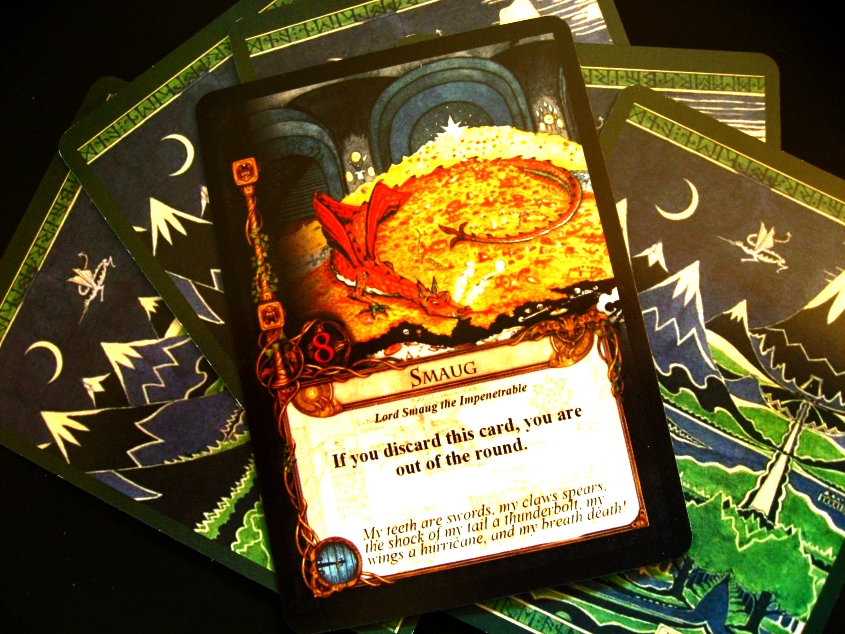
With everyone else gone, there was just time for a few quick rounds of Love Letter.  This is a game we played a lot a year or so ago, but not so much recently.  The first of the so-called “micro games” it is played with just sixteen cards.  Each player starts with one card and on their turn, draws a second card and then plays one of them.  Each card has a value (one to eight) and an action (discard a card, swap cards with another player, compare cards, etc. etc.).  The object of the game is to have the highest card when the deck has been exhausted or, be the last person remaining, which ever is soonest.  For variety, we played with Green’s much loved, very battered, previously lost but recently re-found, home-made, “Hobbit” themed deck, complete with tiny gold rings.  So, the first problem was remembering what all the cards did and then trying to match them to the new characters…  With five, we played until the first player had two rings – everyone got one except Burgundy before Black won a second round and finished as the winner.

Love Letter
– Image by boardGOATS

Learning Outcome:  Spending money is not quite as easy as you think.

Boardgames in the News: The Past, Present and Future of Z-man Games

The summer is now here which means conferences and take-overs.  Last summer, Asmodée acquired Days of Wonder and then followed it with Fantasy Flight Games, Ystari Games, Asterion Press and Pearl Games. Last week, Canadian company F2Z Entertainment announced the purchase of the U.S. company Plaid Hat Games (who are responsible for Dead of Winter and Summoner Wars).  Most people in the UK will have no idea who F2Z Entertainment are, however, they are the parent company of Pretzel Games, but perhaps more significantly, they also own Filosofia Éditions who in turn bought Z-Man Games four years ago.

Dead of Winter: A Crossroads Game
– Image by BGG contributor mikehulsebus

Z-Man Games was created in 1999 by New Yorker, Zev Shlasinger, for the sole purpose of reviving Shadowfist, the multiplayer Collectable Card Game.  From then on, the company produced a number of other American style games, including Grave Robbers from Outer Space and Ideology: The War of Ideas.  The company had a much more significant impact on Euro-games, however, by introducing many German games to the United States.  Z-man was one of the first companies to do this by actively engaging with the original European manufacturer and providing English translations.  The first game to receive this treatment was Ursuppe (a.k.a. Primordial Soup) designed and produced by Doris & Frank.   At the time, this was a very highly regarded game and the success of this reproduction quickly led to English editions of games like Santiago, Saboteur and No Thanks!.

Ursuppe (a.k.a. Primordial Soup)
– Image used with permission from BGG contributor samoan_jo

In 2007, Agricola was released in Germany to great acclaim, but as the cards are very text-heavy, it was essentially unplayable by non-native speakers.  The problem with this game was the huge number of wooden pieces adding to the expense of producing a new edition.  At the time, heavy Euro-games were perceived as a niche market and nobody was prepared to risk the capital outlay for such an expensive game.  Z-Man were only a small company and were already engaged on their own projects including the production of what was to become another hit, Pandemic, and could not take the risk either.  In the end, amid much controversy, Zev Shlasinger decided to gauge the interest of the community with one of the first boardgame pre-orders and the rest, as they say, is history.  So the impact of Z-Man on the history of modern boardgames highly significant, and arguably, they were the forerunner of the current KickStarter Craze.

Agricola
– Image by BGG contributor Simulacrum

In 2011, Z-Man Games was taken over by the French-Canadian distributor, Filosofia Éditions.  With the take-over of Plaid Hat Games last week, the company now has the “cradle to grave” of the boardgame market:  creation, publishing and distribution.  So in that sense, the deal is clearly a sensible one.  However, Z-Man Games used to be a by-word for exceptional customer service and following the take-over by Filosofia, this reputation was tarnished.  Although it seems to be picking up again, this demonstrates one of the downsides of this streamlining of the market.  More serious however, is the potential loss of innovation that comes from  agglomeration, particularly on a large scale.  That said, so far at least, all the “studios” that are part of the Asmodée group have kept their identity – the boardgamer in the pub would have no idea that Fantasy Flight Games and Days of Wonder are part of the same company.  Only time will tell whether we have seen the pinnacle of the golden age of boardgames or whether there is even better still to come.

Z-man Games Logo
– Image from zmangames.com

27th January 2015

We started off with our “Feature Game”, which was the card game, SaboteurWe’ve played it a few times before, but basically the idea is that the group is split into two teams:  Dwarves and Saboteurs.  The aim of the game for the Dwarves is to lay cards forming a tunnel that leads to the gold, whereas the Saboteurs job is to stop them.  So players take it in turns to play cards.  These cards could be tunnel cards, which are added to the play area and, although they generally extend the tunnel, there are also dead-ends which can be used by Saboteurs to upset the Good Little Dwarves’ plans.  Alternatively, there are action cards, which come in several types.  There are broken tool cards, which allow players to prevent other players from laying path cards (useful if you suspect there is a Saboteur about); mended tools which are used to repair broken tools (useful when a Saboteur has been trying to slow everyone down by smashing up their tools); map cards (useful when a nasty Saboteur has been misleading everyone telling them the gold is in the wrong place), and rock-fall cards which can be used to remove tunnel cards (useful when an evil Saboteur has been causing havoc).  The round ends when the draw deck is depleted and gold cards are allocated to the winning side.

Saboteur
– Image used with permission of BGG contributor mikehulsebus

As people arrived, Blue explained the game to the people unfamiliar with it and pointed out that, despite his protestations, Green was always a Saboteur.  At which point, in walked Green, commenting, “Whatever Blue may have said, I’m NOT always the Saboteur…!”  Needless to say, it quickly became apparent that Green was very definitely a Saboteur, but despite his best efforts (assisted by Yellow and Cerise), the dwarves found the gold, though it was pretty close at the end, coming down to the last few cards.  The second round was under-way with Burgundy indicating that the central target card was gold (a fact disputed by Grey) when Black and Purple arrived.  Since they’d missed the start they began a game of Patchwork.  This is a recently released two-player game where players compete to build the most aesthetic (and high-scoring) patchwork quilt, buying Tetris-like patches with buttons.  The patches are laid out in a circle round the central time board, with a cotton reel marking the start.  On their turn players can purchase one of the three patches immediately following the cotton reel; they then pay the cost in buttons shown on the patch, and then add it to their personal “quilt board”.  In addition to the cost in buttons, the player must also advance their time token on the central time track: if the active player’s time token is behind or on top of the other player’s time token, then they take another turn, otherwise play passes to the opponent.

Patchwork
– Image used with permission of BGG contributor Percatron

Instead of purchasing a patch, players can also pass, in which case, they move their time token to the space immediately in front of their opponent’s time token and take one button from the bank for each space moved.  Players can place their patches anywhere on their quilt so long as it doesn’t overlap any other patches.  This is not the only way to get buttons; in addition to a button cost and a time cost, each patch also features 0-3 buttons.  When a player moves their time token past a button marker on the time track, they sum the number of buttons on their quilt and get this number of buttons from the bank.  The game ends when both players are in the centre of the time track.  Each player then loses two buttons for each blank square on his game board and whoever has the most buttons wins.

Patchwork
– Image used with permission of BGG contributor
greetingsfrombergen

Meanwhile, on the first table, the second and final (third) round of Saboteur had both finished with the Saboteurs making almost no impact on Dwarves’ ability to find the gold.  When the teams are drawn, there is always one card more than there are players, so one card is always left out.  The idea is that this introduces an element of ambiguity, however, we felt that this also unbalanced the teams.  For example, with eight players, the teams go from five Dwarves and three Saboteurs to six Dwarves and two Saboteurs, making it almost impossible for even a vaguely competent team of Dwarves to lose.  We discussed the options including whether it would be better to have a set-up phase where the everyone closes their eyes and the Saboteurs open them and look at each other (similar to Werewolf or The Resistance), but we felt this would give a large team of Saboteurs too much power.  In the end, we decided it would be better to remove the spare card and ensure there was the maximum number of Saboteurs.  Since Black and Purple were still going, we decided to play one extra round.  This worked much better, and thanks to a horrid distribution of cards for the Dwarves and some brilliant play by the team of Saboteurs led by Burgundy, there was nothing the Dwarves could do.  It was fitting therefore, that Burgundy finished one gold ahead of his closest competition.  On reflection, we decided there were definitely a couple of House Rules we would implement next time we play.  Firstly, we would remove the extra card when allocating players to teams, this definitely seemed to create a much more balanced game.  Secondly, we would probably also play several separate rounds and not worry about allocating gold at the end of the game.  This way, we could play one or two rounds and stop when the game had outstayed its welcome, rather than feeling that we should play to the end.

Saboteur
– Image by BGG contributor ckhiew

Patchwork was also coming to a close; scores there were quite close until the final scoring, when it turned out that Purple had more “gaps” in her quilt which lost her more points, leaving Black to take the victory.  With both games finishing we had a slight shuffling of seats, with the first group playing Mascarade.  This is a “micro” game, albeit with big cards.  The idea is that each player begins the game with a character card, but after a brief spell with them face up, everyone turns them face down and that’s the way they remain for the rest of the game.  So, the game is all about deducing which player everyone is, while trying to collect enough money to win the game.

Mascarade
– Image used with permission of BGG contributor henk.rolleman

After some initial trading, on their turn, each player can do one of three things.  Firstly, the active player can declare that they are a particular character, say, The King.  If nobody objects they can then carry out the action associated with The King, unmolested (in this case, take three coins).  On the other hand, another player may protest and claim that they are actually The King, in which case all players claiming to be The King must show their cards and whoever is correct, gets to take three coins from the bank, and all the others pay a fine of one gold coin.  A player’s second option is to “swap” their card with that of another player; since the actual exchange is done under the table, it is possible that there is no swap at all, and only the active player will know either way (or not, since everyone always seems to immediately forget which card is which).  The final option a player has, if all is complete confusion, is to look at their own card.

Mascarade
– Image used with permission of BGG contributor henk.rolleman

It always takes a little while to get the hang of the characters in play, and with people unfamiliar with the game, it was slow to get going. Orange was happy to be The Queen and collect her two gold each round, as did The King.  After a couple of turns, however, Red realised the power of The Witch and swapped her somewhat diminished fortune with that of Blue, who, as The King had managed to build a reasonably sized pile.  Meanwhile, the fines had built up and then the Judge became of interest and suddenly, the game clicked with everyone around the table, and people tried to manipulate the card they got and call others on their declarations.  Gradually, some of the piles started to get perilously close to the magic thirteen coins, especially since The Cheat was in play (if declared correctly, that player needs only to have ten coins to win).  The game finished somewhat abruptly, when Red declared that she was The Bishop and, as everyone knew she was right, there was nothing we could do.  And then it was home time for some.

Mascarade
– Image used with permission of BGG contributor pan_satyros
and pelnapara.znadplanszy.pl

Meanwhile, the second game was still going.  They were playing Colors of Kasane, one of our “Essen Specials”, but one we’ve not got round to playing until now.  It is a Japon Brand game, and they have a bit of a reputation for creating little, yet interesting games:  as Black commented, “They have a different way of thinking.”  They also have a bit of a reputation for rules that are difficult to understand; even when they seem clear, it often turns out that they aren’t, and we’ve fallen foul of this one before, most noticeably with Secret Moon (the sequel to Love Letter).  Colours of Kasane was no exception in this regard which may go some way to explaining why its taken so long to play it!

Colors of Kasane
– Image used with permission of BGG contributor punkin312

Nevertheless, the game itself is reasonably simple and beautifully rendered with pretty little Japanese fabric buttons used as player markers, reflecting the theme of a festival held at the Emperor’s court for which the players must make their own beautiful robe.  The game play is a mix of hand management and set collection.  The idea is that players take one card from the four available, and then, from their hand the active player may lay cards.  However, the cards can never be rearranged (similar to Bohnanza) and sets can only be laid from the most recent end (i.e. a “last in, first out” system) and may also include the last card laid.  Any cards laid must meet the requirements shown on one of the target cards, which also indicate the amount scored:  the more challenging the target, the more it is worth.  These target or scoring cards allow players to place of groups of even numbered cards, groups of odd numbered cards, melds with the same number, ascending or descending sets of cards, cards summing to ten etc. etc..  The key thing is that once a specific combination has been played, a glass bead is placed on it and no other player can score it.  This means it becomes increasingly difficult to play cards and score points, worse, someone else might claim something you have been building towards and render all the hard-work useless.  This is one way that players can mess with each-other’s plans, another is when picking up cards:  cards are laid out in columns so that players can see all the cards, but only the card at the bottom of each column is available to take.  Since the cards laid must necessarily include the card just picked up, a player’s plans can easily be blown out of the water by an opponent who watches carefully.  The winner is the player with the most points, with bonuses awarded for players who succeed in playing more than eight cards and either used a lot of different colours or who colour coordinated their “robe” and also for any players who managed to play all twelve of their cards.

Colors of Kasane
– Image used with permission of BGG contributor punkin312

The game began with everyone groping their way through the the first round trying to get an idea of how the game played and how players and cards interacted and what strategies should be employed.  By the time Blue joined to sneeze and spectate, it was clear that all the best plans had gone horribly awry.  Black, who had brought the game and taught everyone the rules, was struggling, but he was not alone in that.  Green and Purple were also finding other players obstructing their plans, and even Burgundy (the eventual winner) was having difficulty placing the cards he wanted.  The challenges posed by the game were reflected in the fact that nobody got the bonus for playing all twelve cards:  definitely a game that requires a second try.

Colors of Kasane
– Image by BGG contributor matador

We finished with Istanbul, a game we’ve played a couple of times recently, so didn’t require too much in the way of rule revision.  Since Burgundy was the only person who  had not played it before and everyone else had previously played it with the “short track layout”, this time we used the “large number layout”.  This puts all the Warehouses together and a long way from the Mosques, and puts the money making a long way from the Wainwright.  Black started and went straight to the Post Office before expanding his cart with a trip to the Wainwright.  Purple also made several visits to the Post Office, coupled with a few trips to the Warehouses while Burgundy and Blue attempted to improve their success rates with visits to the Mosques.  Green on the other hand, paid several trips to the Caravansary to collect bonus cards in the hope that a few of these would help him out later on.  It is unquestionably a more interesting game with five players and useful things further apart, but that didn’t stop Black delivering the rest of us a sound thrashing.  All of a sudden, he ended the game as he collected his fifth gem when nobody else had more than two.  On inspection, other players were closer than it seemed:  Green collected his third gem on his final turn, Burgundy had loads of Lira and everyone else was well on the way to getting everything they needed, however, they needed several more turns to do it.

Istanbul
– Image used with permission of BGG contributor duchamp

Learning Outcome:  It’s true, Green always IS a Saboteur!

28th January 2014

This week was memorable for a number of reasons.  Firstly, the non-playing member of the group, had been to the vet for the first time in about fifteen years and she didn’t like what they did to her (in fairness, she started it by taking a chunk out of the vet, but it is certain both she and the vet won’t forget the day quickly).  Secondly, nearly every current member turned up, the first time this had happened since the fire at the Jockey, and with the added bonus of a new member, we were just a bit pushed for space.  It is a very nice problem to have though, especially since this time last year we were really struggling.

Zooloretto: The Dice Game

People arrived gradually, so we started with our “Feature Game”, the filler Zooloretto:  The Dice Game.  This is closely related to the tile laying game, Zooloretto, which we’ve played before.  Both use the “Coloretto mechanism” which is a variant of the “I divide, you choose” mechanism that children sometimes use when sharing a cake.  Basically, the idea is that players take it in turns to roll dice (or draw tiles or cards depending on the game) and choose which “truck” to place them in.  When they see a truck they like, they can choose to take the contents instead of rolling (then they sit out of the rest of the round).  In the case of the dice version, players are collecting custom animal dice;  the idea is to have as many as possible up to a given limit and exceeding the maximum incurs a penalty.  The first two people to arrive were about half way through when two more turned up and joined in for a second game.

Zooloretto:  The Dice Game

After the second game we had a quick game of “extend the table, rearrange the furniture and hunt for extra chairs” and were just finishing as the last group arrived.  After some discussion, we decided to split the group into two and the first group played Montego Bay.  This is a game that we played last year and all felt that it was quite enjoyable, so we decided to give it another outing.  In summary, players control two figures, a large docker and a small docker who are travelling round the warehouses collecting barrels of rum to place on ships before they sail.  There are two aspects to the game, the first is the priority given to filling boats because, when a boat sails, the player with the largest number of barrels on board scores the most points.  Secondly, everyone chooses how far to move their dockers simultaneously at the start of the round, however, players take their turns in a prearranged order which leads to an interesting juxtaposition of chaos and “double-think”.  In this game, Orange came back from the dead with optimal use of “Lazy Jack” to win by four points.

Montego Bay

Meanwhile, the second group played 7 Wonders, which we played at New Year.  Played in three rounds, this is a card drafting game where players take one card from their hand and then pass the rest on, then repeatedly do the same with the cards they receive until there are none left.  The idea of the game is to build an civilisation and complete their “wonder”.  For the last game there were seven of us and it was over-long and completely disorganised chaos.  This time there was a much more manageable number and it worked much, much better.  One player had played it many times before and it showed in the score with him winning with fifty-two points, five ahead of second place.  The other group were only about halfway through their game though, so that gave an opportunity for a rematch.  Revenge was duly served as the game finished with the winner of the second game fifteen points clear of a tight pack which included the winner of the first game.

7 Wonders

For the last game we got back together as a large group and finished with a game of SaboteurWe played this nearly a year ago, but again didn’t have an optimal number of players.  This time, with more than twice as many, the game played much, much better.  The idea is that players are digging for gold by laying cards to form tunnels.  Everyone is either a “Dwarf” or a “Saboteur” and at the end of the game, points are given to the Dwarves if they extend the tunnel to find the gold, and Saboteurs if they succeed in stalling the Dwarves so much that they fail.  In addition to extending tunnel network, players can also play cards that inhibit the digging ability of others, or alternatively remove an impediment someone else has played.  The first game everyone was watching our “Habitual Saboteur” and waiting for him to do something suspicious, meanwhile, another player moaned about the nature of his hand, and kept discarding cards and everyone else seemed to get on with digging.  The Dwarves were about halfway there when one player declared she was a Saboteur and played a very obstructive card and immediately received a hail-storm of broken tool cards.  It was only after the Dwarves had run out of cards that the “discarder” showed his true colours as a Saboteur and the Habitual Saboteur wasn’t (this time).

Saboteur

In the second round, our Habitual Saboteur made up for his good behaviour in the first round and teamed up with the Saboteur Queen.  It looked like the dwarves might just make it when another Saboteur jumped out of the shadows throwing broken tools at all the Dwarves and putting the gold definitively beyond their reach.  Going into the final round, the Saboteur Queen (who ended up obstructing in all three rounds) had what was thought to be an unassailable lead with six points to a maximum of three elsewhere and a third failure for the Dwarves would have given her a landslide victory.  However, this time she only had the one team-mate which made it much more difficult for her to obstruct the tunnellers and, in due course, it was the Habitual Saboteur (who once again, surprisingly, wasn’t) who laid the final card and found the gold.  He managed to take a total of four points from the last round and just pipped the Saboteur Queen to the win.

Saboteur

Learning Outcome:  Don’t believe anyone when you know there is a Saboteur in your midst!

14th May 2013

The first game we played this week was our “Feature Game”, the card game, Saboteur which is a little like a cross between two games we’ve played before:  Avalon and Incan Gold. In this game players are dwarves working together mining for gold, with the catch that there could be a saboteur in their midst…  Since nobody had ever played it before, the first round was a bit of an experiment for all of us and we all started out “honest” playing path cards and maps.  However, suspicion arose a when one player claimed to have run out of useful paths and had to play a broken pick-axe, with inevitable reprisals.  Unfortunately, he HAD been honest and there were no saboteurs, but as we just managed to get to the gold, it didn’t really matter.

Since we felt we were starting to get the hang of it, we went went for a second round and this time correctly identified the saboteur and pinned him down with a pile of broken picks, lanterns and wagons while we dug up the gold.  When we picked on the same player for the third time, however, he was understandably distressed and protested his innocence.  Nevertheless, since he had very obviously shut off one of optional tunnels we had been carefully building, the pleading fell on deaf ears and failed to prevent the hail-storm of broken tools, only for it to become apparent that, once again, he was innocent.  When we asked why he had behaved in such a treacherous way, he forlornly explained that he was trying to stop us going the wrong way as he knew where the gold was.  Next time I suppose we might listen to him…

Saboteur

Next, we played the Scandinavian Ticket to Ride, a game we were all reasonably familiar with.  This is a really beautiful edition of “the train game”, but with slight twists to the usual rules.  White and Purple took the first few points, but Black joined in quickly and play continued pretty much evenly.  Black ran out of trains first which stymied Purple’s attempt to get the long track into Murmansk, however, we were all within ten points or so when we went into the final scoring.  Unfortunately, it turned out that Black and Purple had accidentally conspired to block White making her take a sizeable detour.  This had consequences for the number tickets she could complete.  Black and Purple jointly took the Globetrotter bonus with five completed tickets each, but it was the magnitude of the completed tickets that made the difference and Black ran out the winner by some fifty points.

Ticket to Ride:  Nordic Countries

Next we returned to semi-cooperativity with a quick game of The Great Balloon Race.  This is a great little race game (albeit with a ridiculously large box), where players have three different coloured balloons and the first to get them all home wins.  The snag is that nobody knows who owns which colour and it is highly likely that players will share at least one balloon with other players.  We last played this back in October and Blue and Orange got a bit victimised.  This time it was Blue and Pink…

The Great Balloon Race

Finally, we squeezed in a game of Ice Flow.  This is a really pretty strategy game where players direct teams of three explorers that are trying to get from Alaska to Siberia, climbing pack-ice, dodging polar bears, catching fish and occasionally jumping in for a quick swim.  Although this is a new game to boardGOATS, we were all familiar with it, so with a quick reminder of the rules we were off, jumping from ice floe to ice floe.  The game has a bit of a tendency for players to get stuck unable to get fish or rope, but we were wise to this and managed to control the resources quite successfully.  Black got an explorer home first, followed by a couple of Red meeples, however, while Black’s last piece dodged a hungry polar bear, Red managed to get his final one home for the win.

Ice Flow

Learning Outcome:  A clever move can sometimes be mistaken for a guilty one, however much you protest.