Tag Archives: Snow Tails

Next Meeting, 23rd December 2025

Our next meeting will be on Tuesday 23rd December 2025.  As usual, we will start playing shorter games from 7.30pm as people arrive, until 8pm when we will start something a little longer.  Please note, the pub is NOT DOING FOOD.

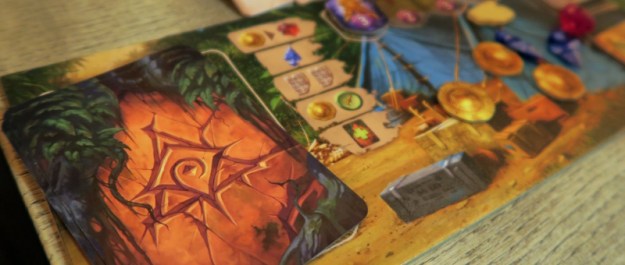
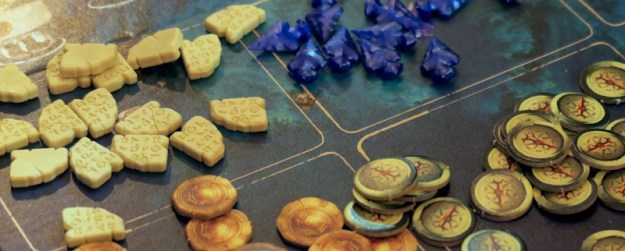
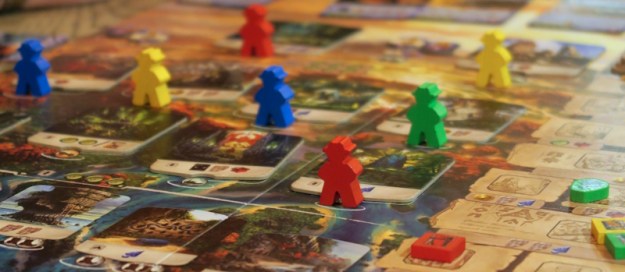
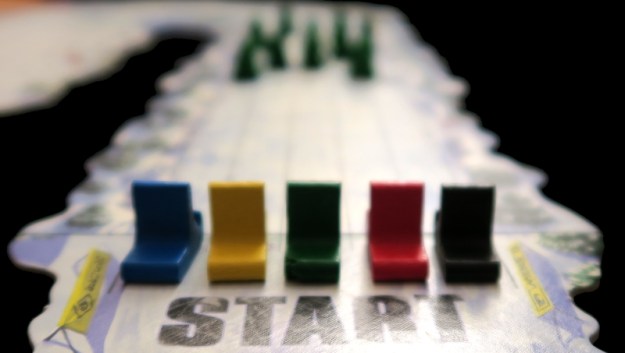
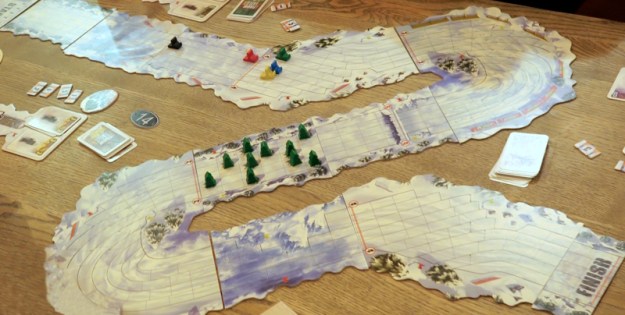
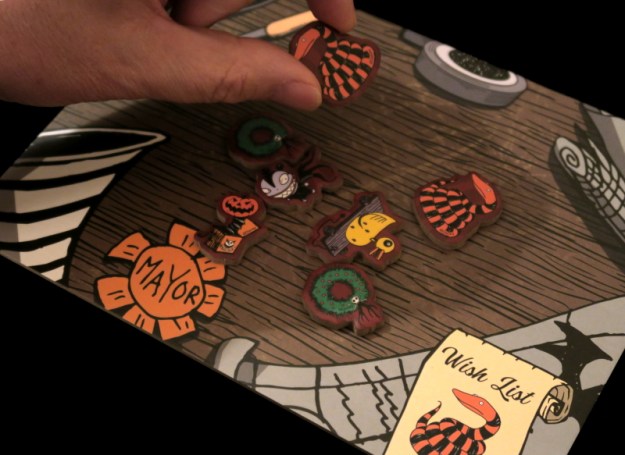
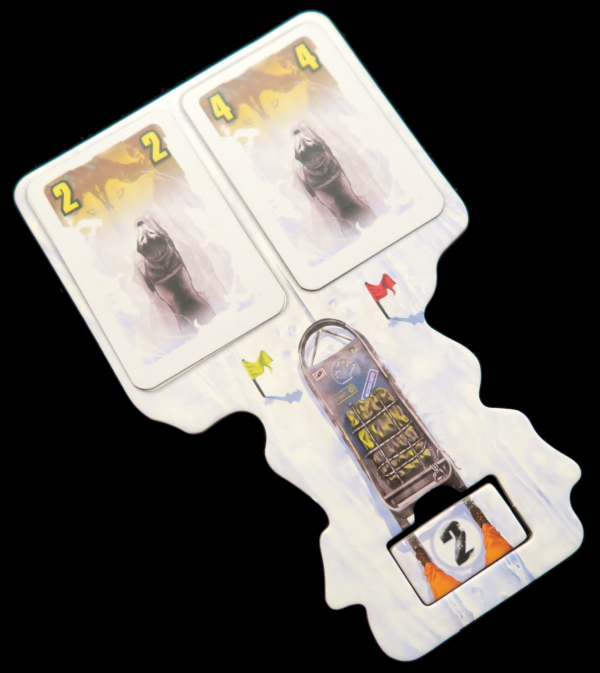
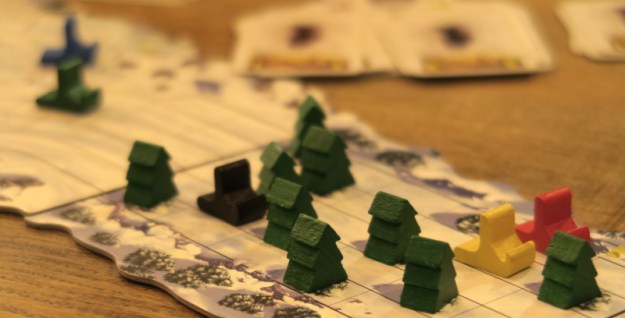
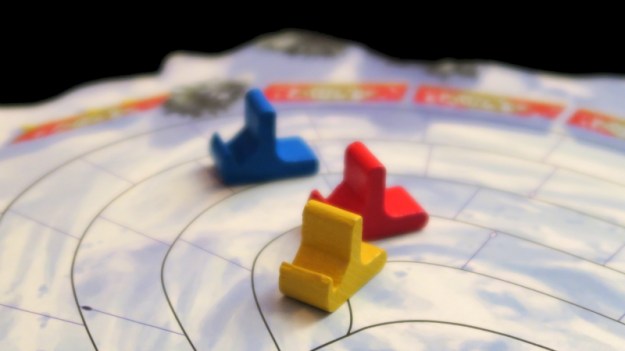
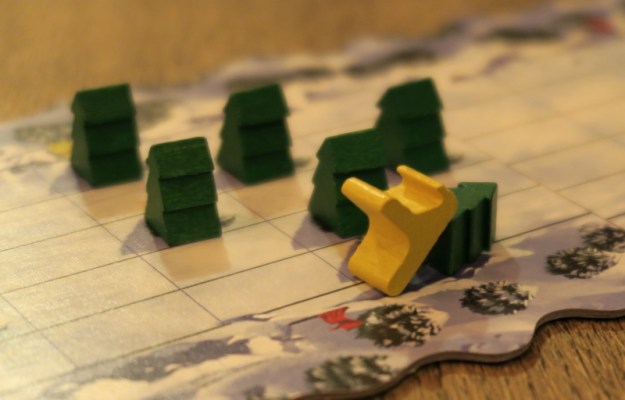
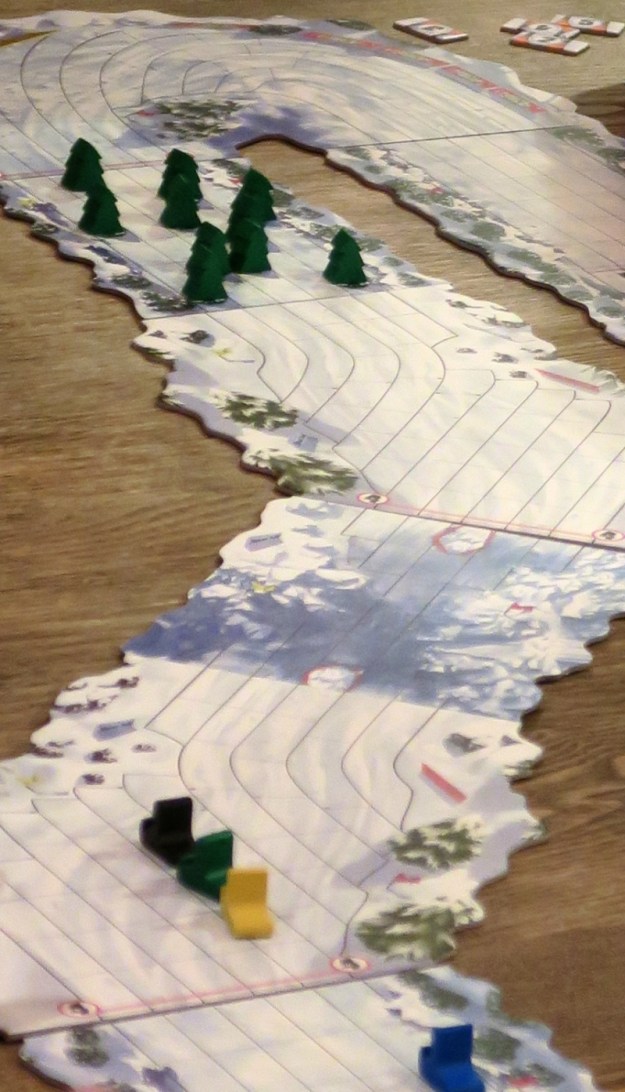
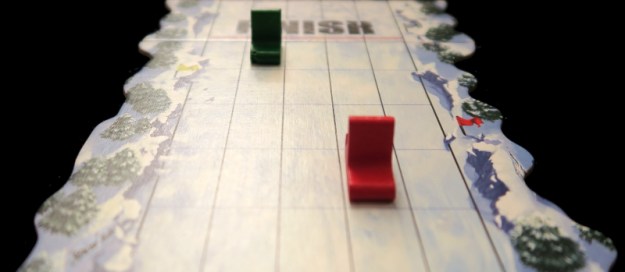
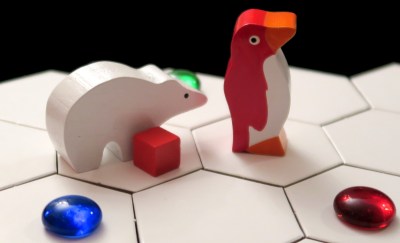
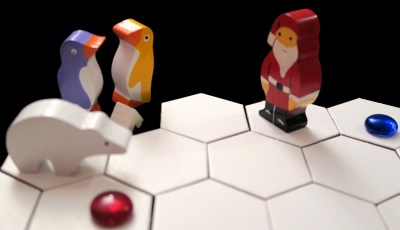
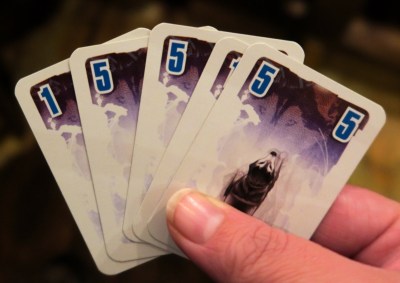
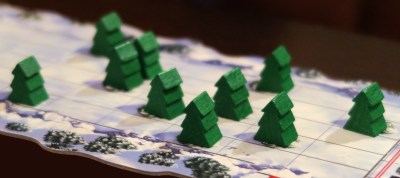
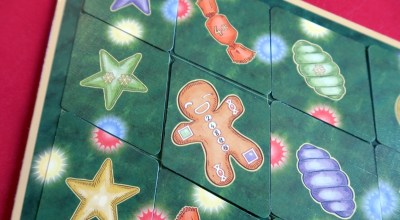
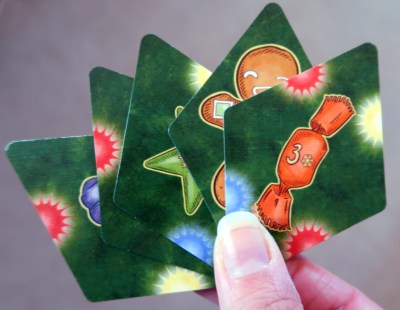
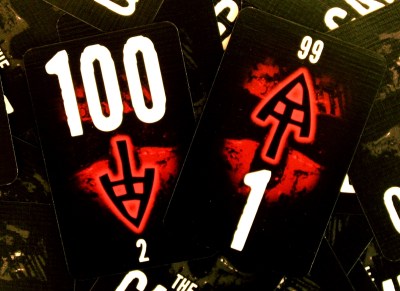
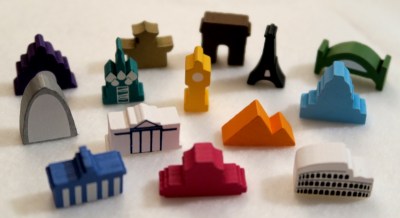
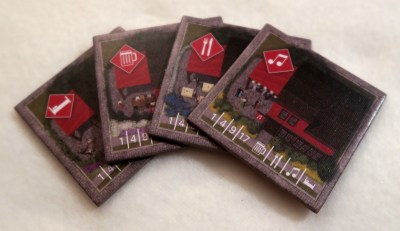
As this is likely to be a very quiet evening (aside from the live music party in the next room), we will be playing some of our favourite games from the year or maybe some of the Christmas and winter themed games like Waddle, Jokkmokk, Santa’s Workshop, Christmas TreeSnow Tails and  Gingerbread House.

Ticket to Ride: Nordic Countries
– Image by boardGOATS

And speaking of Christmas…

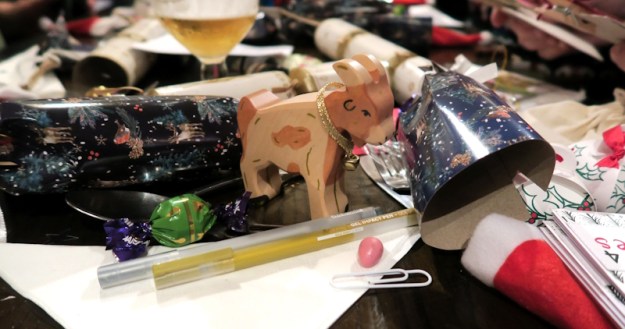
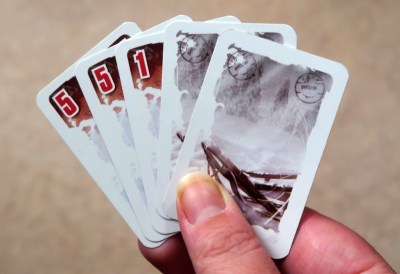
Jeff had run out of time to buy Christmas presents and the only gift he’d bought for Joe was a pack of very sticky playing cards.  He knew he’d find that very hard to deal with…

21st January 2025

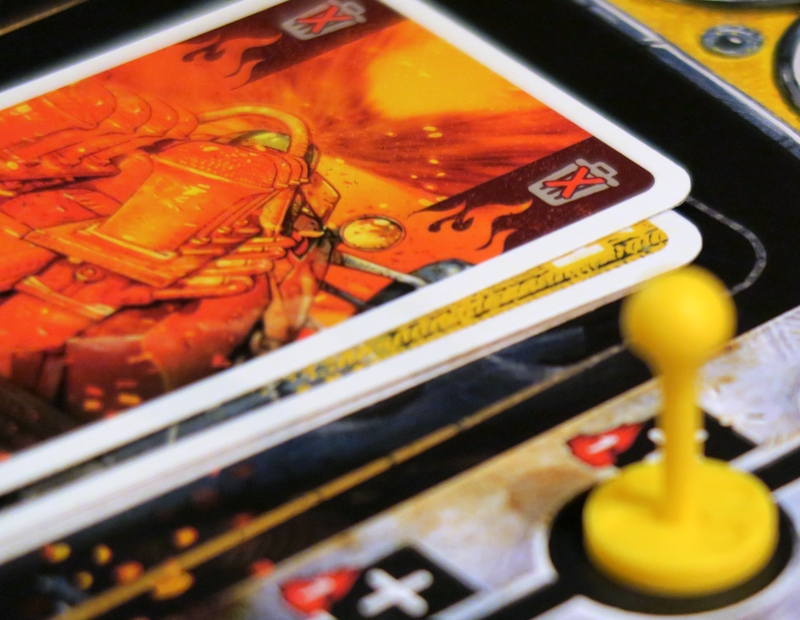
Blue and Pink were still eating as everyone else rolled up.  But as they did, like last time, there was an unusual amount of interest in the “Feature Game“, which, in a change to previous plans, was to be Heat: Pedal to the Metal.  This is a car racing game, in a similar vein to other games popular within the group like Flamme Rouge, Snow Tails, and Downforce.  Like Flamme Rouge and Snow Tails, as well as a racing game, Heat is also a hand management game.  The idea is that players simultaneously choose cards to play and then these are activated from the front of the pack (much like PitchCar).

Heat: Pedal to the Metal
– Image by boardGOATS

Players have a hand of seven cards drawn from their personal deck.  During the game, certain actions that are bad for their engine cause it to heat up meaning they pick up cards that block their hand.  Initially, Heat cards go into players discard pile, simulating the delayed effect engine damage can have, blocking their hand later in the game as the deck is recycled.  There are ways to cool the engine down, but these Heat cards cannot be discarded or played in the normal way.  What makes Heat slightly different to some of the other hand-management-racing games is that there is formally simultaneous play to choose cards and then players take it in turns to activate their cards and take a series of optional mini-actions.
Heat: Pedal to the Metal
– Image by boardGOATS

Players start by simultaneously adjusting their gear, staying put or shifting up or down one without penalty, or shifting two and picking up a Heat card.  The gear dictates how many cards a player must play – second gear means they have to play two cards for example.  Players then take it in turns to reveal their cards and move their car.  There are then five “situational” options: Adrenaline, React, Slipstream, Corner Check, and Discard, before the player replenishes their hand back to seven cards.  Adrenaline is a catch-up mechanism, where the player at the back can move one extra Space while adding one to their Speed value and/or gain one extra “Cool down”.

Heat: Pedal to the Metal
– Image by boardGOATS

“Cool down” is an important aspect of the game because it allows players to remove a Heat card from their hand and return it to their engine deck.  In React, players activate any additional symbols on the cards they have played or from the gear they are currently in or from the Adrenaline.  These include picking up cards because of Stress—players start the game with three Stress cards in the deck which represent lapses of concentration.  When a player plays these, they then have to draw cards from their deck to add an essentially random amount to their speed.  Of course it is not random, and a player who has an idea of what cards are still in their deck will be able to mitigate this.

Heat: Pedal to the Metal
– Image by boardGOATS

Further, Stress cards can also be used to postpone the effects of Heat, as any non-movement cards go straight into the discard pile.  Players can also control their engine heat by spending a period of time in a low gear by “Cooling down” their and removing Heat cards from their hand (three for first gear, two for second).  In contrast, players that have Heat cards available, may add an extra one to their discard pile to boost their speed by drawing an extra card as for Stress cards.  Once all these have been activated, players who end their movement along-side or immediately behind another car can Slipstream, that is move two spaces forward (this does not add to speed, it simply means the car moves further because it is moving more efficiently).

– Image by boardGOATS

If the player has crossed a Speed restriction line typically at a corner, they have to evaluate their Speed by summing the value of their cards and adding one for any Adrenaline bonus if they used it.  If this is more than the limit, players add the difference to their discard pile in Heat Cards.  Players that do not have enough Heat to pay for their excess Speed, pay all the Heat they have and then immediately spin out—move their car back to the last available space before the Speed limit line, take one or two extra Stress cards and change down to first gear.  Once all this is done, players can discard any cards they want that are not Stress or Heat cards before replenishing their hand, shuffling their discard pile if necessary.  The first player to cross the finish line triggers the end of the game and the player that travels the furthest is the winner.
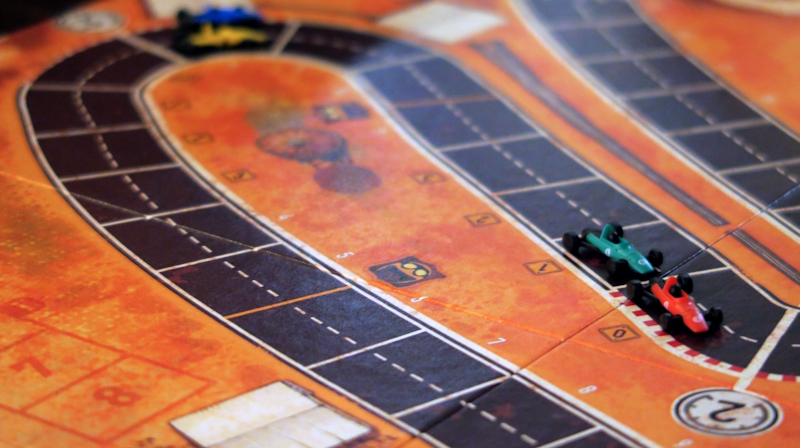
Heat: Pedal to the Metal
– Image by boardGOATS

Although Blue and Ivory were keen to play, numbers meant they missed out and instead, Jade, led Teal, Pink and Lime.  A slight rules malfunction where the group were trying to play all the steps simultaneously meant the safety car did a lap before a restart, then they were off in earnest.  The group were playing on the USA track, which is generally recommended for a first play and is raced over two laps.  One thing that seems to be true for all race games is that once someone has got in front, it is very hard to haul them back, making it critical to get a good fast start.  This time, the good fast start was had by Jade and before long he had built that up and had gone one corner ahead, everyone else felt they were playing for placings and trying to work out how best to approach the corners.

Heat: Pedal to the Metal
– Image by boardGOATS

Instead of playing the end-game as written, the group decided to play it until everyone had crossed the line, so the game continued for some time after Jade had claimed victory.  Lime crossed the line second with Pink in hot pursuit, so much so that although Pink crossed the line in third, he finished his turn ahead of Lime and therefore was awarded runner-up (or first loser) status.  Teal just crossed the line, claiming a sympathy vote ensuring that everyone finished the race.  It had been a bit of a trial and Blue was still keen to give it a go, so Jade, who had been looking to pass it on, sold it to Blue on the spot, which means it will likely get a few more tries over the coming year.
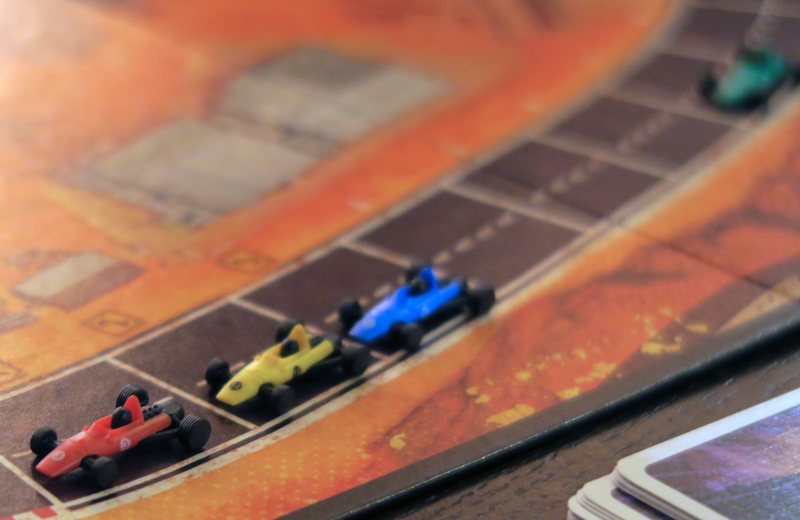
Heat: Pedal to the Metal
– Image by boardGOATS

Blue and Ivory meanwhile, although keen to play Heat, had also been tempted by Roll for the Galaxy.  So, when Byzantium had commented that he hadn’t understood his first and only play, but had enjoyed it, the decision was made.  Roll for the galaxy is a dice game based on the card game Race for the Galaxy, which is itself a sort of space themed, card game version of Puerto Rico.  The thing all these games have in common is “Role (or Action) Selection”—the games have five or six phases or Roles and each player chooses one which will happen in the round.  Thus some things happen, and others do not.  A large part of these games is correctly gambling on others picking certain Roles or Actions and making them happen, so they can be piggy-backed.

Roll for the Galaxy
– Image by boardGOATS

The smaller the number of players, the more critical this can be.  So with just three players in Roll for the Galaxy, at least two will not be happening, possibly more.  The Actions are Explore (acquire world tiles); Develop (progress on building Development worlds); Settle (progress on building Production worlds); Produce (use Production Worlds to produce Goods), and Ship (sell Goods for money, or consume them for victory points).  In this game, the actions are all carried out using dice which are rolled in secret and placed behind the players screen to choose where those dice will get used.  This placement depends on the face shown, though any one die can be used to choose which Action will happen.

Roll for the Galaxy
– Image by boardGOATS

The dice are then moved to the Development or Settlement piles of tiles in their respective phases to progress building those worlds, or placed on Production worlds as goods.  Alternatively, they can be spent to pay for Exploring or Shipping in which case, they (along with any dice from any completed building projects or shipped goods) are placed back in their Citizenry.  Dice can be purchased into the player’s cup at a rate of one dollar each, so it is important for players to ensure their finances are healthy or their game will rapidly stagnate.  The game ends when, either someone has built their twelfth World, or the the pool of victory point chips has been exhausted.
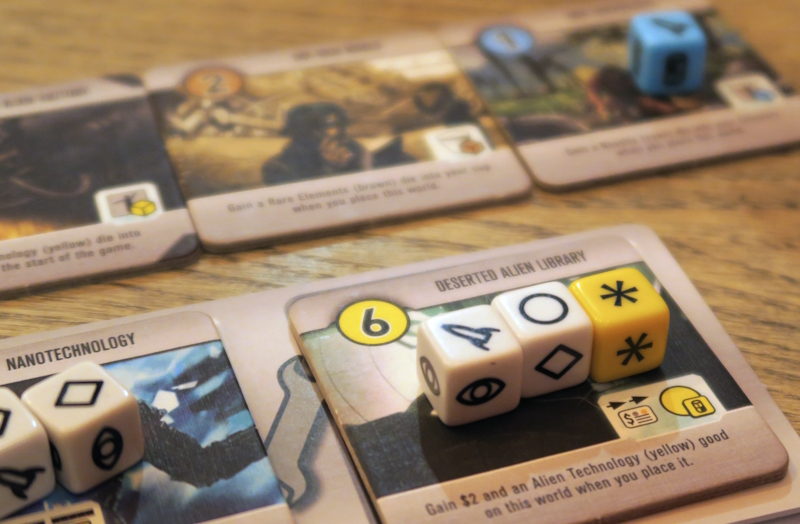
Roll for the Galaxy
– Image by boardGOATS

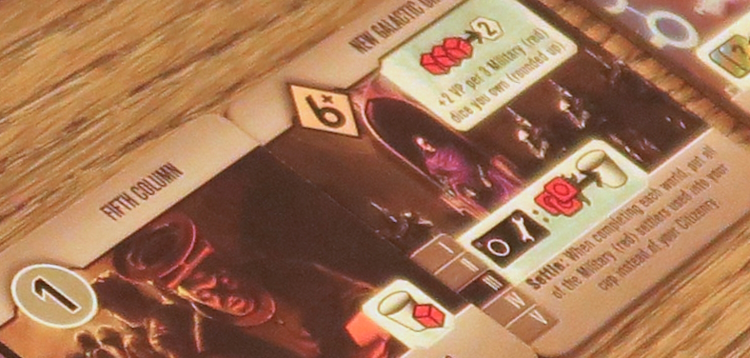
The game was slow to get going at the start, but then Ivory raced to an early lead getting a nice array of Worlds in his tableau leaving Blue and Byzantium trailing in his wake.  But then, instead of finishing the game by building his final World, he appeared to pull up.  This gave Blue and Byzantium the illusion of a chance, but was of course because he had a plan.  Ivory had the Galactic Reserves Development World which gave an extra victory point for every Goods item on a World at the end of the game while also allowing each Production World to hold an extra Goods item.
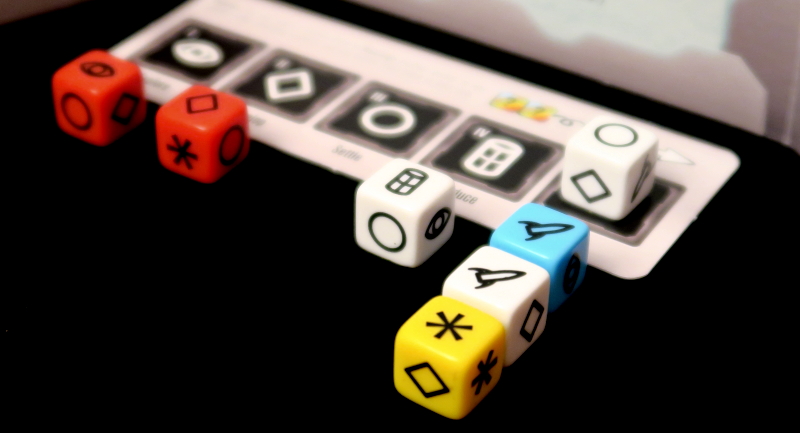
Roll for the Galaxy
– Image by boardGOATS

So, the couple of extra rounds was to enable him to fill his Production Worlds and in the end, the game was brought to a close by Byzantium building his twelfth planet, although the victory point chips were also depleted by the end of that round.  Blue had taken a sizeable twenty-four of those victory points through trading goods, but hadn’t been able to build enough.  As a result, her planets were worth only eighteen points, barely twice those of Ivory’s and Byzantium’s thirty.  Byzantium had five victory point chips and a couple of points from his New Galactic Order, but Ivory was some distance in front, thanks to his thirteen points for his Galactic Reserves and Galactic Bankers Developments together with his eight victory point chips.

Roll for the Galaxy
– Image by boardGOATS

There was time to play something else, but rather than go through rules, as Roll for the Galaxy was already out, the trio decided to give it another go.  This time, with an element of time pressure, it was arguable that some of the decisions made weren’t as sharp and the scores were all lower the second time, though that might have been partly because there were notably fewer rounds.  Blue kept dipping into the bag to try to get Rare Element (brown) Worlds to go with her Mining League, but failed repeatedly and eventually gave up.  Ivory triggered the end game with his twelfth World and this time it was Byzantium who struggled to build enough.
Roll for the Galaxy
– Image by boardGOATS

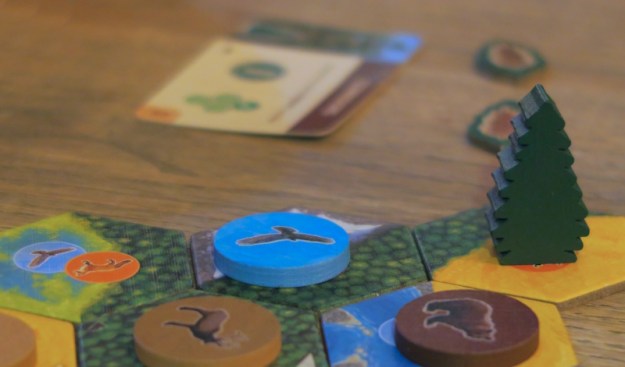
The scores were a bit closer on the second attempt, though the end result was still much the same, with Ivory again taking victory, though with half the winning margin.  By this time, the other games had also finished.  The first of these was Forests of Pangaia, in which Mint was joined by Pine and Plum.  This is a truly beautiful, tactile game, where players are trying to meet objectives to score Life Points; the player with the most Life Points at the end of the game is the winner.  The game has elements of set collection and area control and is played on a central map made of terrain hexagons.  Players take turns to perform three phases: Grow Seeds, take a Spirit Action, and finally add Treetops.  Once Seeds have grown and been turned into Trees, players carry out one of three possible Spirit actions.

Forests of Pangaia
– Image by boardGOATS

These are: Plant (moving their Spirit Pawn to a Lake space and planting seeds in adjacent spaces); Gather (moving their Spirit Pawn back to their player board and receiving a resource), and Prey (moving their Spirit Pawn back to their player board and playing their Ritual Card).  There are fourteen Rituals the Spirits can perform to collect Gaia’s Life Energy.  Once the Ritual card has been scored all the player’s Trees that were involved in the Ritual then partially or fully Decay (depending on the Ritual), either losing a level or rotting back to nothing and leaving a Seed.  The player then discards their Ritual card and draws a new one.  The game ends when the last Ritual card is taken by any player.

Forests of Pangaia
– Image by boardGOATS

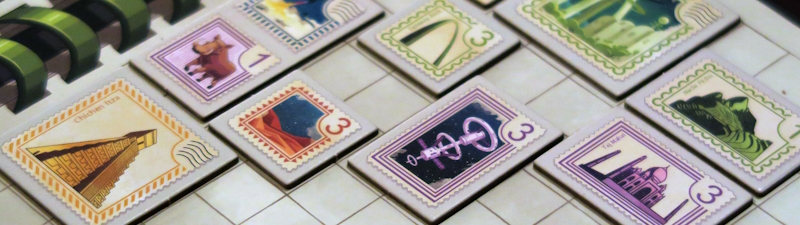
Plum went first and spent most of the game collecting Sun tokens.  In contrast, Pine collected lots of Wind tokens inspiring lots of jokes about using wind to spread his seed.  The winner, however, was Mint with a nine point Trail Ritual due to excessive seed spreading giving her a total of twenty-eight points.  Pine just pipped Plum for second place by a single point.  It had been a really enjoyable game, however, made all the better by the gorgeous pieces. Meanwhile, on the other end of the same, albeit long table, Black, Purple and Sapphire played a game of last year’s winner of the Golden GOAT Award, Stamp Swap.
Stamp Swap
– Image by boardGOATS

This is a really smooth tile placement centred around stamp collecting.  There is a lot of simultaneous play, which is nice because it minimises down time.  First, players take it in turns to choose items from the central Pool, then simultaneously divide them into two piles of offerings.  The player with the first player token, chooses and takes one of the piles offered by their opponents.  The opponent keeps their other pile and then chooses a pile from one of their opponents and so on.  Once everyone has two piles, players arrange the Stamps in their Album and then choose which of the four available end of round cards to score this time.

Stamp Swap
– Image by boardGOATS

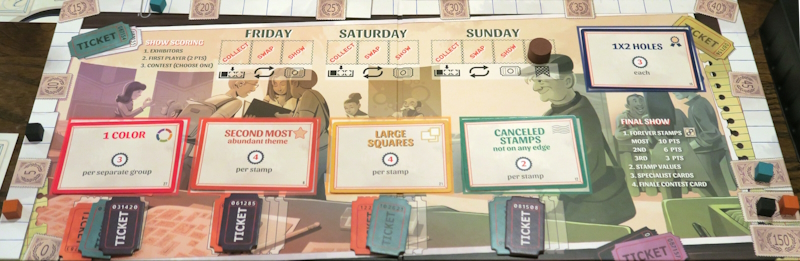
After three rounds, players score the end of game objective card and the player with the most points is the winner.  One of the clever parts about this game is how much difference the objective cards make to the way players arrange their Stamps.  The end-game scoring gave three points for each enclosed gap two spaces in size (i.e. a one-by-two hole).  More points were available during the game for cancelled stamps not on the edge of the page; for large square stamps; for each stamp in a player’s second most abundant theme, and for groups of a chosen colour.
Stamp Swap
– Image by boardGOATS

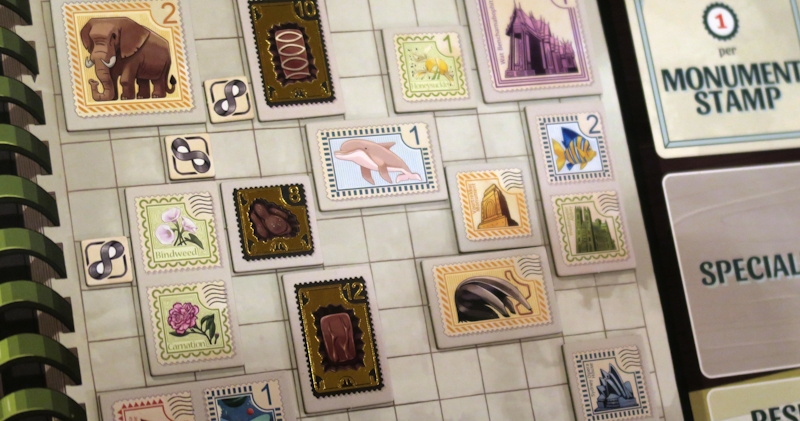
This time the game was very close.  Purple (specialising in Flowers) struggled to get the stamps she needed and Sapphire (specialising Space stamps) kept getting confused which way the turn went.  It didn’t seem to inconvenience him too much however as he and Black (Monuments) fought it out for first and second place.  Black picked up a lot of his points for Special Stamps—just three accounted for a quarter of his points, which contributed to his total of one hundred and seven points, just four more than Sapphire.
Stamp Swap
– Image by boardGOATS

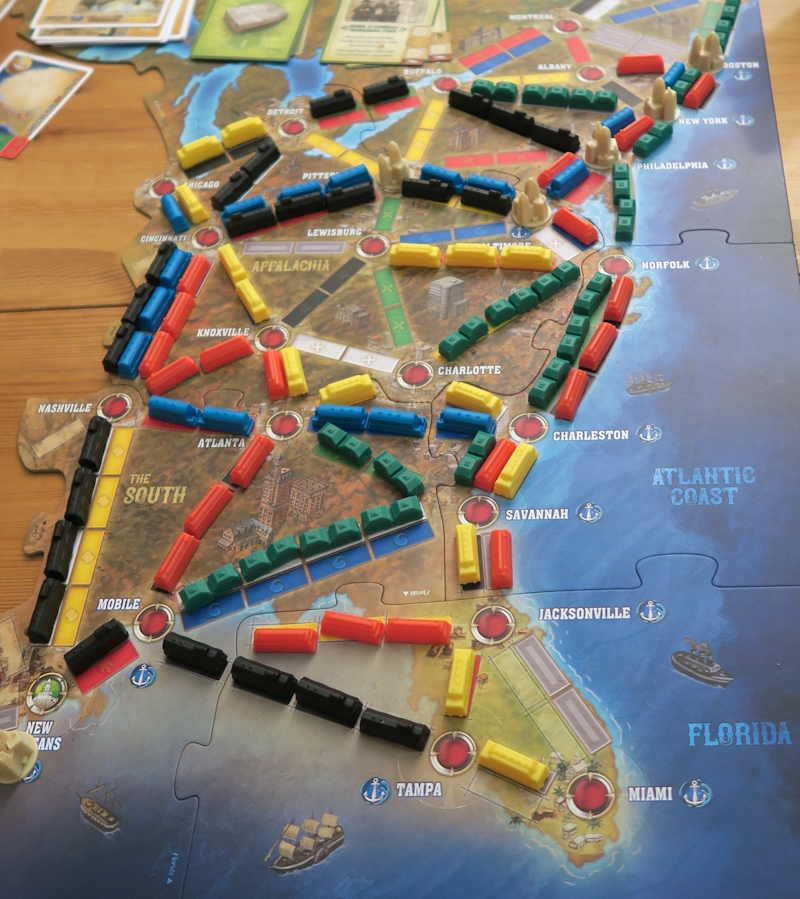
While everyone else was finishing up, there was some discussion about the continuation of the Ticket to Ride Legacy campaign that Blue, Pink, Black, Purple and Pine embarked on at New Year.  The campaign is played over twelve rounds and the group had managed the first two games on the first outing with the next two more recently on Saturday evening.  Spoiler alert—hover HERE to see details. The winner of the third round was Black, very closely chased by Pink with Blue taking third.  After a break for tea (lamb and vegetable tagines with millet), the group began their fourth game. Spoiler alert—hover HERE to see details.

Ticket to Ride Legacy: Legends of the West
– Image by boardGOATS

This was much less close than the third game. The winner was Pine, with Black six dollars behind and Pink a further fourteen points behind him, in third. Spoiler alert—hover HERE to see details. While chatting with the others, out of curiosity, Pine went through The Book and totaled up the scores for the first four rounds, which gave Black a lead of some twenty dollars. Something the rest of the group need to give some thought to next time, before he gets an unassailable advantage although there is a suspicion that as the campaign progresses, the games get longer and more points will be available in each round giving players a chance to catch up.  We shall see.
Ticket to Ride Legacy: Legends of the West
– Image by boardGOATS

Learning Outcome:  However you roll, when you race you need a fast start.
16th April 2024

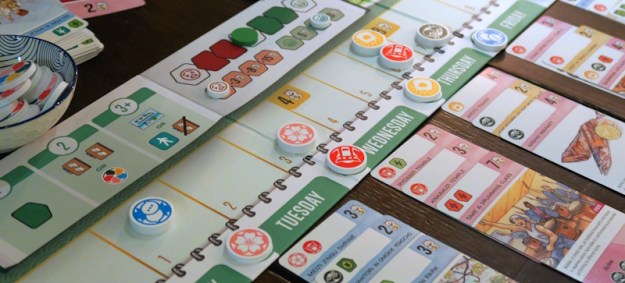
Everyone seemed more keen on standing around and chatting that playing, but eventually, once everyone had arrived, people started dividing up into groups.  Ivory began by leading Jade, Sapphire and Cobalt to the other side of the room to play the “Feature Game“, which was the new “hotness” Let’s Go! To Japan.  In this game, players are travelers planning, then experiencing their own dream holiday in Japan.  Played over thirteen rounds, players draw activity cards place them in different days in their week-long itinerary. These can’t-miss tourist attractions have players traveling between Tokyo and Kyoto as they try to maximize their experience by optimising their activities while balancing resources.

Let's Go! To Japan
– Image by boardGOATS

In each of the thirteen rounds, players draw cards according to the pre-organised sequence.  For example, there are two decks of cards (Tokyo and Kyoto), and for the first four rounds, players take one card from each deck, keep one and add it to their tableau assigning it to one of the days of their dream, then pass the second card to their neighbour.  In the fifth round, players take the four cards they’ve been given and then they place two in their tableau and pass two on, and so on.  Once eighteen cards have been played (three on each of the six days), the game is over and players take their planned trip, activating each of their cards in order, starting on Monday and work their way through to Saturday.

Let's Go! To Japan
– Image by boardGOATS

There is a catch:  where there is a swap between the two decks, players have to move between the cities of Tokyo and Kyoto by playing a Luxury Train Ticket which they can acquire during the game.  Each of these is worth two points.  If players do not have enough tokens to cover each change, they play a Regular Train Ticket from the supply which costs them two points.  Activating cards involves moving the players’ five Experience tokens along a track, increasing or decreasing their Mood, Stress and Happiness, gaining points and then evaluating the requirements for the Highlight of the Day depicted on the final card of the day.  If these requirements have been fulfilled, the player gets bonus points and the player with the most points at the end of the game is the winner.

Let's Go! To Japan
– Image by boardGOATS

The game rattled along very quickly with swift turns and the added bonus that setup was quite rapid too.  As a result, it was easily under forty-five minutes before everyone was explaining their plan and scoring it.  That said it was hard to keep track of what everyone was doing.  Ivory was the first to fill a day and managed to get everything aligned to get the top bonus of a Luxury Train ticket. Although this was very nice, it in no way indicated Ivory was going to get a big score.  Jade and Cobalt quickly followed suit, Cobalt also gaining Luxury Train Tickets (which he got quite a few of throughout the game), and Jade got quite a lot of the second best reward, choosing Wild Tokens that would be really useful at the end of game to ensure meeting Highlight of the Day/End of Game objectives.

Let's Go! To Japan
– Image by boardGOATS

Sapphire was spreading his activities out a little bit more, but as the game went on he also managed to build a large store of wild tokens.  At the start of the game, Jade and Sapphire (who were not sitting next to each other) focused more on Kyoto, whereas Ivory and Cobalt were playing a lot more Tokyo cards.  Inevitably, however,  everyone ended up going to both cities and need Train Tickets as a result. Cobalt and Jade were the only people who choose to grab research tokens; Cobalt used one of these mid-game and managed to manipulate his hand so he ensured he passed nothing of use to Jade, much to his annoyance.  Otherwise, everyone worked on their mental health and managed to keep their stress down scoring positive points for the trip.

Let's Go! To Japan
– Image by boardGOATS

At the end of the game, Sapphire, Jade and Ivory had minimized their travel between the two cities though, whereas Cobalt required a lot of trains:  as he had lots of Luxury Train Tickets he actually increased his score significantly with these.  Jade had not picked up enough Luxury Train Tickets, so was stuck on commuter trains causing him to lose a lot of points. Sapphire ended up with a quick return trip between Kyoto and Tokyo on his last day, but that was acceptable because you should always go out your way for Sake!

Let's Go! To Japan
– Image by boardGOATS

Scoring took longer than usual as everyone gave a detailed description of their trip. Both Cobalt and Sapphire scored well on every day of their trip, with Cobalt slightly ahead thanks to his Luxury Train Tickets.  Sapphire managed to complete all his Highlight of the Day objectives though without using his wild tokens, so he cashed these in at the end of the game to push all his tokens into the next scoring zone and subsequently won the game by two points from Cobalt.  It had been a highly enjoyable experience though, enhanced by the beautiful components, especially the extremely pretty, but totally over the top ceramic component bowls!

Let's Go! To Japan
– Image by boardGOATS

From there, the group then played a game of Faraway, a light game set on the mysterious continent of Alula with its ever-changing geography, shaped after the rhythm of the seasons.  On each turn, players play a card from a hand of three.  As play is simultaneous, players must take into account the priority system in all their choices—being last to pick a card leaves fewer options and often less profitable choices for later turns.  During the game, players will play a row of eight cards in front of them, from left to right. These cards represent the regions they will come across while exploring the lands. Characters on these cards will give victory points if the player later fulfills the conditions they demand.  At the end of the game, players walk back along the same route, scoring cards in the opposite order to that they were played in—and therein lies the heart of the game-play.

Faraway
– Image by boardGOATS

Throughout the game, the cards played serve both to set new objectives, and to meet ones played previously.  This time, Ivory started quickly out of the traps playing the highest card and subsequently getting the last pick in the following round, which was a minor hindrance. As the game went on, the order of picking the cards changed each time and everyone managed to pick first at some point, although it did seem like Sapphire and Ivory had the greatest varieties, mostly either being first or last!  Jade was very quick off the mark getting lots of maps which gave him a significant card advantage throughout the game as he could look at four or five cards and pick the best one. Ivory also didn’t do too badly with maps.

Faraway
– Image by boardGOATS

It eventually became clear that Jade had managed to play his cards in such a way he was always playing a higher card than his last card giving him an additional secondary card, but he was also able to fulfill the requirements to score the objective on that card even though it would need fulfilling earlier in the journey.  Come the end of game scoring and going on their journey, both Cobalt and Ivory had slightly take their eye of the ball and missed fulfilling the requirements of some of their cards and thus missed out on points they though we were going to get. In the end, it was very close for second place Sapphire just taking it, while everyone was thrashed by Jade.

Faraway
– Image by boardGOATS

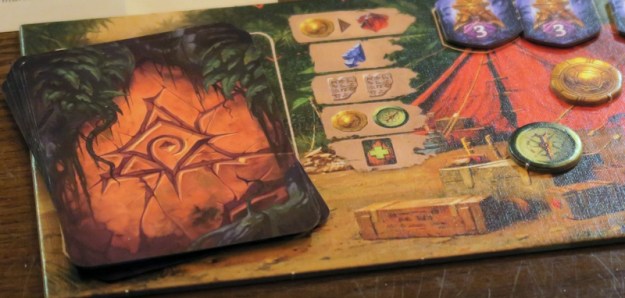
On the next table, Green was keen to play Lost Ruins of Arnak, and was eventually joined by Black and Plum.  This game combines deck-building and worker placement with resource management.  Players start with six cards in their deck, two Money, two Compasses and two Fear cards, and draw five of these to play.  As in the original deck-builder, Dominion, or in the racing games, Flamme Rouge and Snow Tails, Fear cards clog up players’ decks and more are acquired as the game progresses.  But also as in Dominion, there are ways to “exile” cards during the game.  So, players can try to keep a tight deck with minimal cards, or try to buy lots of cards that work well together.

Lost Ruins of Arnak
– Image by boardGOATS

Players then have two meeples each that can be sent to locations on the map, to either discover or use an action Location.  These generally give Resources plus some additions like draw a card, or gain a Fear card etc.. Each new site also has a Creature guarding it, which, if beaten, will give points and a small one-time bonus.  The Research Track is where players spend three of the resources, Tablets, Arrows and Jewels. Each player has two tokens which move up the same track giving different rewards as it ascends. Thematically, you can’t write stuff in the notebook until you find it with your magnifying glass, so the former can never overtake the latter on the track. And of course, the notebook gives cooler rewards.

Lost Ruins of Arnak
– Image by boardGOATS

Players get one action each per turn, until everyone has passed signalling the end of the round, and the game finishes after five rounds.  At the end of the game, Points are awarded for Cards, for progress on the Research Track, for discovering Locations and for beating Creatures; the player with the most points at the end is the winner.  This time, early in the game, Green pointed out to Plum that she could use an Idol gained by defeating a Guardian to give her the resources she needed to go up the Research Track.  That gave Plum an Assistant and she picked one that turned a Boot into an Arrowhead.

Lost Ruins of Arnak
– Image by boardGOATS

Green bought the card Plum had been eying up, which let players rid themselves of Fear cards (worth minus one point), and therefore seemed like a good use for a Boot/Fear.  It was pointed out later, however, that any card could be used in place of the Boot as all other transport types work for Boot icons.  Plum then got an Assistant that could upgrade a resource, which in practice she used turn Arrowheads into a Rubies as that was all she had by the end of the rounds.  She also managed to get ahead with her Explore magnifying glass token and was the first to a new level on a couple of occasions, which gave her valuable bonuses.

Lost Ruins of Arnak
– Image by boardGOATS

Green picked up a couple of Fear cards from leaving Guardians undefeated; Black got at least one as well, but Plum managed to dodge them.  Both Black and Green got useful Artifact Cards where they could get lots of resources.  It was a little way in that the group noticed the slight Rules Malfunction:  although players were putting their new cards at the bottom of their Draw pile, players were then shuffling the Draw and Discard piles together before drawing new cards.  This gave an extra bit of randomness that this time, worked in Plum’s favour.  For example, she had an item card that gave a Compass per worker when it was played, and it seemed to put in a lot of appearances.  In contrast, all the cards Green had bought didn’t come out until the final round—he got the balance of the bad luck.

Lost Ruins of Arnak
– Image by boardGOATS

Black picked up an Assistant which helped him cycle through his cards which helped mitigate the randomness a little, though there were a couple of occasions when someone took the location he had been working towards. Right at the end of the game, when Plum had managed to reach the top of the Explore/Research Track with her magnifying glass, she was able to use the Icons on her board to get the resources needed to pick up one of the most valuable Temple Tiles—worth eleven points. Green, however, scored almost twice that of the others for his Idols and Black top-scored for his item and artifact cards.

Lost Ruins of Arnak
– Image by boardGOATS

It was the Temple points, together with the extra points Plum got for getting to the top of the Explore/Research Track that ultimately made the difference, giving her a total of sixty-nine points, thirteen more than Green who took second place.  Both Plum and Green had played before, though most of their previous games had been online where the administration of the card shuffling was done for them, hence the Rules Malfunction.  It was Black’s first game, and despite the rules issue and not scoring as well as the other two, he still really enjoyed the game, so there is a good chance it will get another outing in the not too distant future.

Lost Ruins of Arnak
– Image by boardGOATS

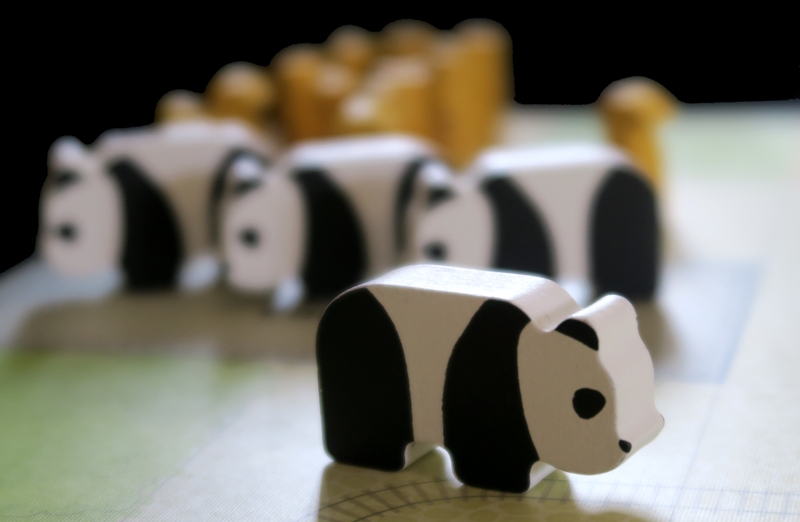
Meanwhile, that left six players; Pink was keen to give his favourite panda game another outing, so Pine and Lime joined him in a game of Zoo Break.  This is a cooperative game, where players work together to try to prevent animals escaping from Bedlam Zoo.  On their turn, players roll the die to decide how many Action Points they get, then, after carrying out their turn, flip a Escape Card and a then a Move Card to determine what gets out of its cage and what moves.  Players have to avoid getting trampled on or bitten by the animals, while catching them and then locking them in their cages.

Zoo Break
– Image by boardGOATS

The group started well, or at least it started well from Pink’s perspective when he was cuddled by a Panda (one of his real-life wishes).  However, the game did not go so well.  There are a number of optional variants, and the group had chosen to use the “Faulty Lock” Variant which means that if an escape card is drawn for animals who have already been locked up, the die is rolled to determine whether there are escapees.  This turned out to make things just a bit too difficult and a Coral snake quickly made a bid for freedom, and as it’s a dangerous animal, that was that.  One snake might not seem like much, but there were another five lining up in front of the gate and three tigers too, so it really did not go well.

Zoo Break
– Image by boardGOATS

Reluctant to leave it like that, the trio decided to give it another try, this time without the “Faulty Lock” Variant.  This second try went better, though at one point two elephants got very close to the exit.  The situation was rescued by peanuts which enticed them to the Snack Stall where they were eventually captured.  There was some extensive rules reading to decide whether Pandas were considered “Dangerous” so only one escaping would trigger failure.  The group concluded that Pandas were not Dangerous animals after all though, and four Pandas roaming the streets would not lead to closure of the Zoo (though perhaps the Chinese government would not be appreciative).

Zoo Break
– Image by boardGOATS

In the end, the distinction wasn’t necessary, none of the Pandas got out, though one Capuchin did manage to escape.  That was all, however, and once the group finally rounded up the last of the mad Meercat escapees, the writing was on the wall and the Zoo was saved.  The other games were still underway, so once the charming wooden animals had been tucked away, the trio opted for a couple of rounds of Coloretto.  This is a charming little card game which is the core of the, arguably better known board game, Zooloretto.

Coloretto
– Image by boardGOATS

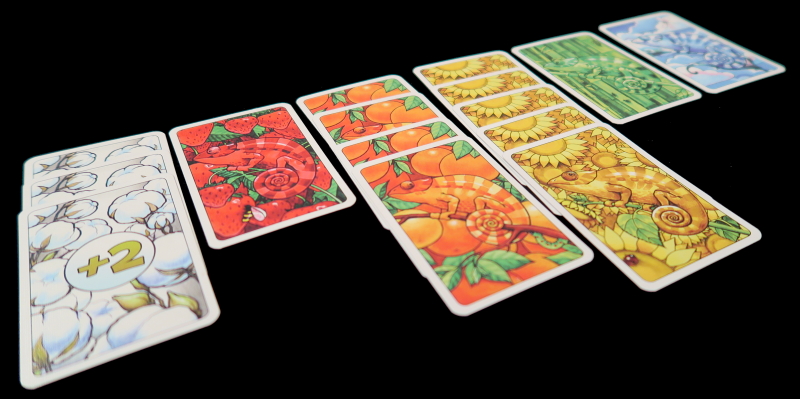
The game is very simple:  Players either draw a Chameleon card from the deck and add it to one of the Carts, or take the cards on one of the Carts and add them to their tableau, stepping out until everyone else has taken a Cart.  Each Cart has three spaces and players core points for their three largest sets of cards and negative points for any others.  The player with the most points at the end of the round after the trigger card is revealed is the winner.  The clever part is the scoring for sets, which uses the Triangular Number sequence and means that later cards are worth a lot more than the early ones.

Coloretto
– Image by boardGOATS

When the Golden Chameleon card came out, there was some discussion about the difference between it and the multi-coloured Chameleon.  Blue, on the next table was consulted, and explained that it meant the person who takes it gets an extra card drawn from the top of the deck.  With that sorted, the game continued.  The group played two games and both were close, especially between Pine and Pink with Pink just edging it for the first game by two points and Pine just beating Pink by a single point in the second.  Both games were won by Lime, however, and by a larger margin, taking the first by four points and the second by six.

Coloretto
– Image by boardGOATS

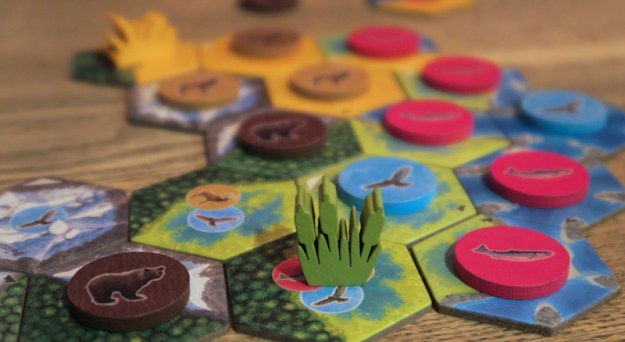
The last table included three players, Blue, Purple and Byzantium.  They were the last to start, and were somewhat torn between two of the current hot games in the group, Wyrmspan and Meadow.  After some discussion, the group went for what was probably the easier of the two, and gave Meadow its their outing in three consecutive meetings.  A light to medium card collection game, it was new to both Purple and Byzantium, so Blue explained the rules.  Most of the game is built round a Card Market with players placing an Action Token and taking a card into their hand, before playing a card from their hand.

Meadow
– Image by boardGOATS

This aspect of the game has led to some reviewers comparing the game to Splendor, though there is a lot more to the game than that.  In addition to the Market, there is a second Campfire board, which allows players to carry out special actions, and also claim Bonus points. for cards in their tableau.  The first time the game was played, there was a token included erroneously from the Envelope U mini-expansion, and last time the game got an outing, there was a minor rules malfunction where the four players ended up playing on the three-player board.  So although the game has been played three times in fairly quick succession, this time was the first time the game was played by the rules as written, probably.
Meadow
– Image by boardGOATS

Players start with a hand of cards, including one from the North deck (which is only introduced halfway through the game)—this last card is typically more worth more but is difficult to play, so is a good way to get a steer in the early stages of the game.  As well as the other cards in their starting hand, another key strategy lead is the Bonus points obtained from the Campfire board.  These are obtained by placing a Bonus point token between two Icons, but in order to do so, the player must have those icons in their tableau.  Since each bonus place can only be claimed once, this element of the game is something of a race between those who want to compete for these points.

Meadow
– Image by boardGOATS

This time, the Icons drawn at random and placed round the Campfire included the relatively scarce Cottage, Fence and Garden Bird as well as the Wolf and Hawk which only come out in the second half of the game, when the North deck is introduced.  This made the Bonus points hard to claim. Although neither Blue nor Byzantium appreciated it at the time, although most Wolf cards are in the North deck, this copy of the game included the Seal promo card, which is a Wolf card that hides in the South Deck.  As it was key to getting bonus points, when it came out, both Blue and Byzantium spotted it, but Blue got to it first, and that turned out to be critical to her Bonus point objectives as Byzantium pinched the other spots early.

Meadow
– Image by boardGOATS

Meanwhile, Purple was busy collecting frogs and very effectively daisy-chaining cards to give her points.  As the game moved into its final rounds, Byzantium struggled to get a Landscape card that he could play without needing too many difficult prerequisites.  In spite of the frustrations when players can’t get cards, the game has a nice gentle roll to it and with three players doesn’t outstay its welcome in the way it does with four (when there are two extra rounds).  It was quite a tight game—Purple and Byzanium finished with thirty-seven and thirty-six points respectively from their observations, but Byzantium had more points from his Landscape cards.

Meadow
– Image by boardGOATS

Blue didn’t do as well as them with her observations, but had the most points from her Landscape cards.  Although Purple hadn’t managed to get any Bonus points, both Blue and Byzantium had picked up the full nine giving them a bit of a lead.  In the end, it was the Observations that were key, and they gave Byzantium victory by four points with a total of sixty.  As the Meadows were tidied up, the last of the other games came to a close too and everyone chatted until it was time to go home.

Meadow
– Image by boardGOATS

Learning Outcome:  Every game should come with ceramic component bowls.

9th January 2024

Blue and Pink were just finishing their supper when Pine arrived, soon followed by Cobalt.  There was a lot of discussion about the road closure to the A420 (due to an accident) and whether this would delay those coming from the west, but Jade, Plum, Sapphire and Byzantium soon arrived with their tales of countryside detours in the dark.  Inevitably, that led to more stories of road closures due to accidents and flooding, and the horror-show that driving anywhere has been over the last week or so.  With almost everyone present, with more proactivity than usual, the group split into three, with two tables playing the “Feature Game“, the Landmarks expansion to the 2022 Spiel de Jahres winner, Cascadia.

Cascadia: Landmarks
– Image by boardGOATS

Cascadia is one of the group’s most popular tile laying games.  The mechanisms of the base game are simple enough:  on their turn, players take a Habitat Tile/Animal pair from the market and add them to their territory.  The Habitat Tile can be placed anywhere, but the Animal Token must be placed on a Habitat Tile which depicts that Animal.  The market is then replenished back to four pairs until the Tile pile is depleted and the game ends.  The Tiles and Animals are drawn and paired at random, and players have to take the prearranged pair, they cannot freely mix and match unless they have a Nature Token, which they can spend to either change all the Animals, or to take an Animal from a different pair.

Cascadia
– Image by boardGOATS

Nature tokens are rewards for adding animals to Keystone Habitat Tiles, which, in general, are more difficult to fill because they can only hold one animal type (other tiles can take two or three).  While the mechanism is quite simple, the guts of the game is in the scoring.  Players score for each of the five Animals, Bears, Elk, Foxes, Salmon and Eagles, but the clever part is that the way each of these scores depends on which card is drawn at random from each of the five Animal decks.  Thus, the game plays very differently depending on the combination of Animal scoring cards drawn.

Cascadia
– Image by boardGOATS

In addition to animal scoring, players also score one point for each tile in their largest corridor of each of the five Terrain types, as well as earning bonuses if their largest area is the largest overall.  The Landmarks expansion consists of three new modules, one which increases the the potential player count, one which adds more variety to the scoring (more Animal scoring cards) and finally, the titular Landmarks.  The first of these adds a Personal Market of five Habitat Tile/Animal pairs for each player to give them something to think about (and potentially play) between turns.  This can be played at lower player counts, but is essential in larger numbers as it reduces perceived downtime.

Cascadia: Landmarks
– Image by boardGOATS

The second module is simply some more scoring cards, which adds more variety, but also a little more complexity as some of these are slightly more challenging to work with.  The final module, the Landmarks, changes things a little more.  These can be added to a Habitat Tile when the once the area of Terrain is large enough (spreads over five tiles or more).  These Landmarks also come with a choice of the available cards (drawn at random) which give bonus points at the end of the game, for example, for every Bear in the player’s Forests.  Each player can only build one Landmark on each Terrain type, and because the Landmarks occupy space, players start the game with one additional Keystone Tile.

Cascadia: Landmarks
– Image by boardGOATS

Blue, Pink, Plum, Black and Lime played with all three modules, making a point of choosing scoring cards from the expansion.  In contrast, although the Personal Market can be used for any player count, the four on the other table, Jade, Byzantium, Sapphire and Pine, only added the Landmarks module, choosing scoring cards solely from the base game.  Jade et al. got going first and were four or five rounds in before Blue’s Crew had even started, as the latter had more rules to cover and were a little later to start as they were too busy gossiping.  On the other hand, despite the fact that there were a lot of rules queries, at least they mostly got them right, in contrast, to the little rules malfunction on the other table.

Cascadia: Landmarks
– Image by boardGOATS

The rules for the Landmarks state that players may take a Landmark when they add their fifth or tile to a Terrain, or any subsequent addition, whereas Jade, Byzantium, Sapphire and Pine played that the Landmark had to be taken when the fifth Terrain Tile is added.  It was just a very little thing, but actually had quite a large knock-on effect. The problem was, if a Landmark is added to a Keystone Tile, then players don’t get the Nature token.  Worse, in some cases, players were taking Landmarks when the cards weren’t in-line with their strategy, just because they had to.

Cascadia
– Image by boardGOATS

As the games progressed, both groups realised that taking Landmarks can really restrict a player’s options, especially towards the end of the game when things can get very tight.  And forcing players to take unhelpful Landmarks just exacerbated this effect and meant some Terrains were stuck at four just to avoid some of the issues.  The games both progressed quite merrily, however.  Blue concentrated on a mixture of Animals and Terrain, going for Landmarks early in the proceedings. Plum, misunderstood and didn’t realise that players scored a point for each tile in their largest Terrain, so she concentrated on Animals, but did very well with her Terrain anyhow, by virtue of trying to get bonus points for having the largest areas.

Cascadia: Landmarks
– Image by boardGOATS

Pink asked a lot of questions and got a bit confused between when he could add Landmarks and when he could take tiles from his Personal Market.  So, he ended up concentrating on Foxes instead, “as he was a foxy sort of fellow” (and there aren’t any Pandas in the game).  Black meanwhile collected Elk, but all-round concentrated on animals rather than Terrain.  Lime commented, “Birds are difficult to understand, so I’m not going to bother with them; if I score at the end of the evening, so be it…” though he probably didn’t mean it to come out quite like that!  On the other table, Sapphire was collecting Elk, and Byzantium was focussing on Eagles while Pine concentrated on building his Terrain and Jade capitalised on the Landmarks.

Cascadia: Landmarks
– Image by boardGOATS

With or without the Landmarks expansion, Cascadia is a little bit of a “multi-player solitaire” game, that is to say, players can mostly quietly get on with their own thing without upsetting each others’ plans.  However, with Blue, Black and Plum all having a full set of five salmon, Pink and Lime struggled to get the last few they needed.  In the four-player base game, all the tiles and therefore all the animals are used and Lime hadn’t realised the expansion added more tiles, some of which had been removed and therefore, there was no guarantee that any of the lovely juicy salmon left in the bag were going to come out.  And much to Lime’s chagrin, so it proved, as he was left one short of the full set at the end of the game.

Cascadia: Landmarks
– Image by boardGOATS

The five-player game, despite starting later and having the extra player, finished at much the same time as the four-player game, demonstrating how the new mechanism in the Landmarks expansion really does speed the game up.  Despite the perceived, increased challenge associated with the new Landmark scoring cards, the five-player game was generally more highly scoring, with the Blue and Plum sharing victory, tied on a hundred and seven points (some fifteen more than Black in third) and tied on the tie-breaker too.  The other game was much closer, with a spread of just eleven points and with Pine finishing in first place with ninety-nine, only two points ahead of Byzantium who was the runner up.

Cascadia
– Image by boardGOATS

All in all, both groups liked the base game and enjoyed the game with the Landmarks expansion.  The group playing with all three Landmarks modules felt it was much more of a struggle, though both groups felt the Landmarks didn’t give all that many points unless you knew what you were going for and were able to really make them count.  Certainly, adding lots of Landmarks made things very difficult at the end of the game causing players to reject Animal Tokens, so although the rules say add an extra Terrain Tile, there was some discussion regarding the merits of “house ruling” the addition of a second in future, to encourage people to build Landmarks.

Cascadia: Landmarks
– Image by boardGOATS

Meanwhile, on the next table, Ivory had enticed Cobalt, Purple and Teal to play his new Christmas acquisition, Lost Ruins of Arnak.  It turns out that he wasn’t the only person in the group to receive this game over the holidays—Green had also been given a copy and would no doubt have been keen to play had he been able to come.  The game is set on an uninhabited island  where explorers have found traces of a great civilization. Players lead an expedition to explore the island, find lost artifacts, and face fearsome guardians in a quest to learn the island’s secrets.

Lost Ruins of Arnak
– Image by boardGOATS

The game combines deck-building and worker placement with resource management.  Players start with six cards in their deck, two Money, two Compasses and two Fear cards, and draw five to play.  As in the original deck-builder, Dominion, or in the racing games, Flamme Rouge and Snow Tails, Fear cards clog up players’ decks and more are acquired as the game progresses.  But also as in Dominion, there are ways to “exile” cards during the game.  So, players can try to keep a tight deck with minimal cards, or try to buy lots of cards that work well together.  Players then have two meeples each that can be sent to locations on the map, to either discover or use an action Location.  These generally give Resources plus some additions like draw a card, or gain a Fear card etc.. Each new site also has a Creature guarding it, which, if beaten, will give points and a small one-time bonus.

Lost Ruins of Arnak
– Image by boardGOATS

The Research Track is where players spend three of the resources, Tablets, Arrows and Jewels. Each player has two tokens which move up the same track giving different rewards as it ascends. Thematically, you can’t write stuff in the notebook until you find it with your magnifying glass, so the former can never overtake the latter on the track. And of course, the notebook gives cooler rewards. Players get one action each per turn, until everyone has passed and the game finishes after five rounds.  At the end of the game, Points are awarded for Cards, for progress on the Research Track, for discovering Locations and for beating Creatures; the player with the most points at the end is the winner.

Lost Ruins of Arnak
– Image by boardGOATS

The first round was very slow as there was only limited spaces to go and everyone had weak cards in hand. Purple, Cobalt and Teal all focused on building up resources and buying tool cards for future rounds where Ivory did something a little different and started progressing along the Research Track as well as opening up new Dig sites. The issue with this was that he picked up a Fear card, though fortunately he had already got rid of one of his initial Fear cards through the site he opened so there was no net negative effect.  In the second round, things picked up and strategies started to become apparent.

Lost Ruins of Arnak
– Image by boardGOATS

Cobalt continued to focus on getting Tools, especially ones that allowed him to draw extra cards (and hence allowed additional actions) and he started making headway on the Research Track and was first to unlock an Assistant. He also did a little exploring, but did not overcome the Guardian. Ivory wasn’t far behind on the Research Track and also continued to explore new areas (and this time overcome the Guardian) and make up for lost ground in getting tool cards. Teal went for a very different strategy and started to focus purely on exploring and overcoming Guardians, netting him three points for exploring and gaining the idol and five points for overcoming the Guardian. Purple, on the other hand, continued to focus mainly on building her supply of resources.

Lost Ruins of Arnak
– Image by boardGOATS

The third round continued in much the same vein with everyone continuing to pick up Tools and starting to gain Artifacts. Ivory focused almost exclusively on the Research Track and was able to catch Cobalt and had picked up all the bonuses, while both unlocked their second assistant. Teal was continuing his exploring strategy to great effect, whilst Purple continued to bide her time building up resources, including a significant amount of Rubies (the most valuable resource).  And so it continued into the next round too, except Cobalt began spending his Compasses on Artifacts while Ivory continued to hoard them for the last round.

Lost Ruins of Arnak
– Image by boardGOATS

And it was in the final round that Ivory’s plan became apparent as, in true Ivory style, he used all his Compasses to explore a level two Dig Site. Hitherto, exploration had been limited to level one sites and Ivory was the first to explore a higher level, thinking this would be a fun thing to do. In the end, this ironically might have been the critical move that influenced the outcome of the game. The level two site gave Ivory valuable resources, helping him complete the Research Track just after Cobalt and also overcome the newly uncovered Guardian. With two idols on a level two site, this gave Ivory eleven points.

Lost Ruins of Arnak
– Image by boardGOATS

Teal continued with his strategy and also explored a level two site and began moving along the Research Track too. Purple used all her carefully collected resources and make a late dash to the top of the Research Track, gaining valuable points.  It should be said the whole work placement element of the game felt very tight with limited spaces at the start and then difficulty knowing whether to take the optimal route planning cards first, but potentially missing out on a valuable space to other players, or taking the sub-optimal route and placing your workers first guaranteeing the activity, but at a cost of efficiency.

Lost Ruins of Arnak
– Image by boardGOATS

Everyone got blocked at some point (except perhaps Teal who was opening up new sites), and certainly towards the end of the game everyone wished they had more than two workers!  Teal with his explore/overcome Guardian strategy led to him defeating a very impressive impressive six Guardians and gave him a total of sixty-eight points.  In the end, however, the fact Ivory completed the Research Track and was also able to explore and overcome Guardians gave him the victory by just three points with a winning total of seventy-one.  It was a very good game though, one greatly enjoyed by all involved.

Lost Ruins of Arnak
– Image by boardGOATS

Learning Outcome:  Now we know what Bears do in the Woods!

19th December 2023

It was party time so everyone was arrived early for the Un-Christmas Dinner—everyone that is, but Blue and Pink who eventually arrived armed with piles of Christmas crackers, party poppers, tree decorations, Christmas cards, raffle prizes, GOAT Award ballot papers, mince pies and festive cake.  Opening the crackers was a necessity before food arrived to avoid the bits landing in people’s supper, so when food arrived, it nestled amongst all sorts of gaming detritus.  As the staff at The Jockey served pizzas, pies, baguettes, cheese with crudités, burgers and chips, gamers called out the awful GOATy jokes from the crackers.

"Un-Christmas Party" 2023
– Image by boardGOATS

During the interval between main courses and dessert, GOAT Award voting forms and Christmas cards were handed out and people began thinking about the games we’ve played over the year.  Ivory collected Christmas Cards and Green collated the ballots before he announced the winners.  The GOAT Poo prize, for the worst game of the year went Dice Hospital when 7 Wonders was relegated as a previous winner.  The Golden GOAT went to Tapestry, while the epic three-way tie in Tapestry won “Moment of the Year”.  With the formalities and food finally complete, there was just the raffle, a copy of Carcassonne: Winter Edition and the Ukraine Map, which were won by Sapphire, then everyone abandoned the carnage (and Purple who helped clean up), to play something festive.

"Un-Christmas Party" 2023
– Image by boardGOATS

There was a bit of the usual indecisiveness, but eventually Blue, Ivory, Pink, Green and Pine settled down to play the “Feature Game” which was Jokkmokk: The Winter Market while Black, Cobalt, Jade, Sapphire and Lime set up Snow Tails.  Jokkmokk is a very simple game that makes use of the time-track mechanism seen in Tokaido and Namiji (played last time)—that is to say, it is an extended game of leap-frog where the player at the back jumps into an empty space of their choice and then carries out the action associated with it.  Like those games, the compromise is between moving to a preferred space which may be further forward and will ultimately will give fewer turns.  It is much simpler than both Tokaido and Namiji, however.

Jokkmokk: The Winter Market
– Image by boardGOATS

Jokkmokk is a card-driven set collecting game and is made more interesting by a large number of mini-decks, five or six of which are combined for each game.  For the first game, the group chose to use the “First Game” selection of decks (Dalecarlian Horse, Antique, Hot Dog, Patchwork, Present).  Blue went for the Patchwork cards while everyone else fought over kettles (Antiques) and Hot Dogs).  Blue’s strategy nearly paid off giving her ninety-nine points and second place, but Ivory was more efficient than everyone else with his mixture of Horses, Hot Dogs and Kettles, which gave him a hundred and one points and victory.  The game was bright and breezy and, although simple, really didn’t outstay its welcome, so the group decided to “do a Lime” and play it again.

Jokkmokk: The Winter Market
– Image by boardGOATS

This time, this time the group played with the “Gift of Giving” selection of decks (Donation, Bell, Sparkler, Snowflake, Mystery Box, Presents).  Pink went for Sparklers, knowing he would lose half his points if he had the most, but hoping to have so many that it wouldn’t matter.  Green started collecting Bells, as did Blue and Ivory, going for different colours.  Lots of Gifts were given and a good time was had visiting the fair.  Pink’s ninety points were just three more than Ivory’s total, but Blue’s hundred and seven points gave her victory at the second attempt.  Meanwhile, on the next table, the others had finally started playing Snow Tails, spectated by Purple, who had finished helping clear the table after dinner.

Snow Tails
– Image by boardGOATS

Snow Tails is a very popular game in the group, but somehow, one that is a little tricky to get to grips with.  The games is a card-driven sled-race with the winner the first to navigate the course.  Unfortunately, the course they chose was the one depicted in the main rules, which isn’t really intended to be a course design as it is quite long and features a Chasm right at the start, a couple of hairpins and some Saplings as well.  Each player starts with their own personal deck of cards, with five in hand.  On their turn, players can play up to three cards as they can so long as they are all the same value:  one for each sled dog, and one on the break.

Snow Tails
– Image by boardGOATS

The speed, the number of spaces the sled moves forward, is the total for the dogs minus the value for the Break.  Sleds will additionally drift sideways the difference between the dog speeds, and if the sled is balanced (i.e. the dogs are pulling equally), the player gets a bonus speed equal to the players position in the race.  Each time a sled exceeds the Speed Limit on a corner, hits the side of the track or a Sapling, the player takes a Dent card—a useless card that just blocks the player’s hand making things difficult.  The more Dent cards a player has, the more difficult the game gets, as Black soon demonstrated.  The first game of Jokkmokk had already finished and the sleds were only just off the Start line and through the first Chasm.

Snow Tails
– Image by boardGOATS

Lime claimed the “Big Paws” token for the player with the most “Analysis Paralysis”, though to be fair, everyone suffered a bit.  Jade commented that he’d been planning to play it with his nieces, but was now rethinking the idea.  As a result, the group shortened the track (to give them a chance to finish before midnight), and from there, the game went a bit more smoothly.  Jade was first to cross the Finish line, chased by Cobalt and then Sapphire in what had been a quite epic game.  And with that, the party was over for another year, though people lingered and chatted for quite a while before everyone left the pub staff to lock up.

"Un-Christmas Party" 2023
– Image by boardGOATS

Learning Outcome:  Always plan your Christmas shopping early.

13th December 2022

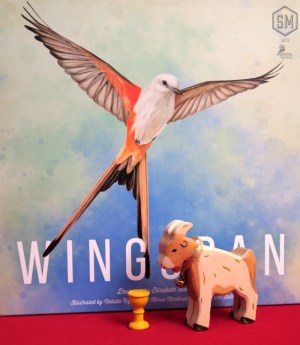
With this being the annual GOATS UnChristmas Dinner, almost everyone was present for a festival of food and fun, when Blue and Pink arrived with a small car full of party.  There were lots of volunteers to help bring everything in and before long, pizza boxes were being handed round along with crackers stuffed full of bling and GOAT Award voting forms.  The glittery Wingspan eggs from the crackers were especially popular, partly because so many people have a copy, everyone liked the idea of adding them to their game.  As the last of the pizza boxes were being passed around, people started to think about this year’s GOAT awards.

Wingspan
– Image boardGOATS

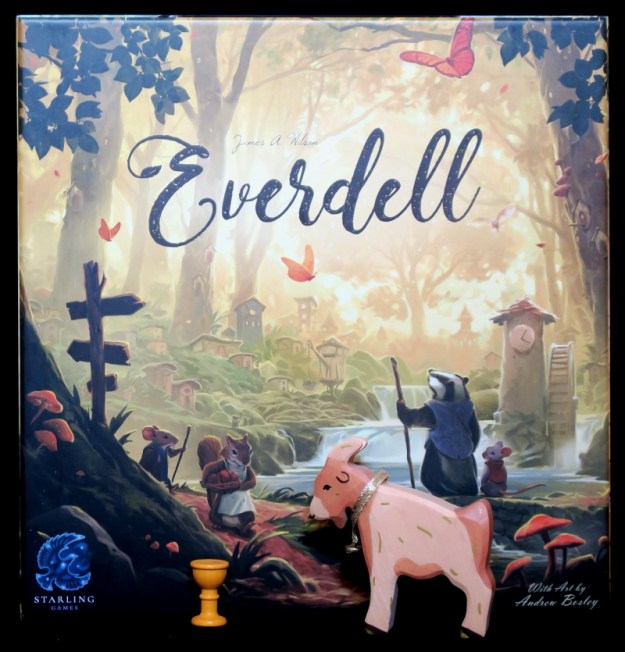
There was lots of umming and ahhhing as people tried to remember which game was which, but eventually the votes were in and people chatted while the returning officers (Pink and Green) did their counting thing.  Then Green announced the winners.  The GOAT Poo prize for the worst game of the year went to Villainous – The Worst takes it All and the Golden GOAT went to Everdell.  Three epic games, one of Viticulture, one of Tapestry and one of Turf Horse Racing were nominated for “Moment of the Year”, but that somewhat poignantly went to the 2021 UnChristmas Dinner which was the last meeting attended by Burgundy, and the last game he played with us, Santa’s Workshop.

Golden GOAT - 2022
– Image boardGOATS

Eventually, we all started thinking about playing games.  Ivory and Indigo were keen to play the “Feature Game“, Merry Madness: The Nightmare Before Christmas, while Jade had specially requested a game of Gingerbread House.  Eventually, largely due to logistics and lethargy (perhaps caused by too much pizza), everyone stayed pretty much where they were and played something with the people they were sat next to.  First underway was Green, Lilac, Pine, Teal and Lime, largely because they were playing a game they were all familiar with, Carcassonne, albeit the Winter Edition.

Carcassonne: Winter Edition
– Image boardGOATS

The Winter Edition is essentially the same game as the original “Blue-box” Carcassonne, but with snowy art work.  Thus, players take it in turns to draw and place a tile, add a meeple if desired/possible and then remove any meeples that are ready to score.  As in the original, the features on the tiles include city segments, roads and cloisters. Players score two points for each tile in a city or road they own if it is completed during the game, or one point at the end if incomplete. Similarly, Cloisters score nine points when completely surrounded or one point for the central tile and each surrounding it at the end of the game.

Carcassonne: Winter Edition
– Image boardGOATS

The clever part of the game is that while players cannot add a meeple to a feature that is already owned by another player, features can be joined together and then shared so that both players score.  Green and Lilac had played the same game last year at Christmas, with Der Lebkuchenman (aka Gingerbread Man) mini expansion which consists of additional Gingerbread Man tiles mixed in with the base game; when drawn, the player moves the brown Gingerbread Meeple to an unfinished city of their choice.  Before he is moved, however, the current city containing the Gingerbread Man is scored with each player receiving points for the number of meeples they have in the city multiplied by the number of tiles in the city.

Carcassonne: Winter Edition
– Image boardGOATS

Thus, even players that have only one meeple in the city when their opponents have more score a few points.  This year, in addition to Der Lebkuchenman, the group also added Die Kornkreise (aka Crop Circles) mini expansion. Although they were happy with the Gingerbread Meeple, they were less sure about the crop circles—they looked more like funny shaped snow “angels”.  The expansion consists of six extra tiles which allow each player to place a second follower on a feature that they have already-claimed or return an already-placed follower back to their supply.  Of course, the group did not play the rules quite right, however, initially thinking that each person had a free choice of which action to take and whether to take it or not.

Carcassonne: Winter Edition
– Image boardGOATS

It was only just after the second tile was placed that they realised it was the active player that chose the action (add an extra Meeple to the specific terrain type or pick up a Meeple) and everyone else had to do the same (they decided that if the player had no Meeple in an appropriate area then they just skipped the action).  As a result of the Kornkreise, Lime  ended up with three Farmers on the same tile, which at least it guaranteed him that particular field!  The Crop Circle expansion also led to the biggest coup of the game.  Lilac had started a city with her first tile and Pine positioned himself to muscle in on it a couple of turns later.

Carcassonne: Winter Edition
– Image boardGOATS

Their cities were joined, but they just could not get the city closed before Teal then joined the fray.  This became a very long city and then in the last quarter of the game, Lime also managed to add himself into the action on this game winning city.  Then the final Crop Circle tile came out for Teal. He decided he wanted everyone to add a Meeple to a city, which he, Pine and Lime were able to do. Unfortunately Lilac (who had started the city right at the beginning of the game) had no Meeples left, so couldn’t and found herself locked out of the scoring  at the end of the game as it was never completed.

Carcassonne: Winter Edition
– Image boardGOATS

It was a game where no-one seemed to be able to get the tiles they wanted. Green regularly selected from the pile nearest to him, but only ever got roads. When he tried from different piles, he still got roads and when others selected from the “Green” pile, they got cities!  Pine started to choose tiles from within the middle of the stack, raising cries of “cheat” from Green and Lilac. Pine’s argument was that the tile was still random, which was hard to disagree with and Lime started doing the same later on as well.  In the final scoring, Lime surprisingly edged everyone out for the win, with Teal and Pine not too far behind.

Carcassonne: Winter Edition
– Image boardGOATS

It had been fun though and the Winter edition is certainly the prettiest version of Carcassonne, so Green and Lilac are already looking forward playing it again next Christmas.  Meanwhile, on the next table, Blue, Pink, Ivory and Indigo were playing the “Feature Game“, Merry Madness: The Nightmare Before Christmas, a very quick and light dice chucking game where players are trying to gather together all the spooky-themed gifts in Sandy Claws’ Christmas Bag.  It really is very, very light and quick:  simultaneously players roll their three dice and do what they say (in a similar style to Escape: The Curse of the Temple).  The three dice are different: one shows which of the six gift types is moved, another shows how many, one, two or three, and the final die indicates where: to the player on their left, right or of their choice.

Merry Madness: The Nightmare before Christmas
– Image boardGOATS

The group played with the “Making Christmas Toys” variant.  Players started with the same number of each of the different toys.  The idea is to get rid of all the toys that don’t match the one depicted on their “Wish List” (shown on their player mat).  If they roll the toy on their Wish List, they take that toy from the player indicated, whereas for every other type they roll, they gift one of that type to the recipient indicated.  There really wasn’t a lot to it, and basically the game was all about who was most awake (possibly correlated to the person who had eaten the least pizza).  Blue won the first round, and Pink took the second.  Blue finished the game when she took another two rounds and, although it had been silly fun, it was time for something else and Purple joined the foursome from the next table.

Merry Madness: The Nightmare before Christmas
– Image boardGOATS

Meanwhile, Purple had been explaining Gingerbread House to Plum and Jade and their partners Byzantium and Sapphire, respectively.  In this game players are witches in the Enchanted Forest, building their gingerbread house and attracting hungry fairy tale characters with colorful gingerbread.  Each player has a board with a three-by-three grid of building spaces.  There is a face down stack of rectangular tiles with the top three turned face up (a little like the train cards in Ticket to Ride).  These tiles each feature two squares, similar to Kingdomino tiles.  On their turn, players draw one of the face up tiles and place it on their player board, then carry-out the effect of the symbols they covered up.  The most likely symbol is one of the four different types of gingerbread, which means they collect a token of that type.

Gingerbread House
– Image boardGOATS

Careful placement of pieces is important because if a player is able to cover the same two symbols in one one turn, the player gets the effect three times instead of twice.  Once a tile has been placed, the active player can use some of their gingerbread tokens to capture fairy-tale characters.  If placing tiles completes a level, the active player may also take a bonus card.  The group found the game simple enough once they got going, but it took a while to get there.  The “wilds” caused problems from the first and the group weren’t sure whether covering two at once meant doing three of the same thing.  After re-reading that bit of the rules, it was decided the extra actions didn’t have to be the same, and as a result, Plum was able to make more of her final turn. 

Gingerbread House
– Image boardGOATS

It was close, but despite his super-charged final turn, Byzantium finished two points clear of Plum with Jade coming in third.  Everyone had really enjoyed the game, though, so much so that Jade and Sapphire are now on the lookout for a reasonably priced copy!   Although it took a little while to get going, once Plum, Jade, Byzantium and Sapphire were playing, Purple was at a bit of a lose end.  Nightmare Before Christmas didn’t take long though, so when it was over, Purple joined Blue, Pink, Ivory and Indigo for a game of the husky sled-racing game, Snow Tails.

Snow Tails
– Image boardGOATS

The idea is that each player has a sled led by two dogs.  They start with a hand of five cards drawn from their personal deck.  On their turn, they can play up to three cards as long as they all have the same number.  There are three places a card can be played, two drive the dogs, and one activates the brake.  The idea is that a sled’s speed is the sum of the dogs’ speed minus the current value for the brake.  in addition, the difference between the dog values is the sled’s drift, which causes the sled to move left or right. At the end of their turn, players draw back up to five cards.

Snow Tails
– Image boardGOATS

In general, if players hit something, they pick up a dent card which goes into their hand, blocking space and limiting their options.  The game is quite simple, but as always, how and when to apply the “drift” caused some confusion; Pink certainly benefited from the rules malfunction, but others probably did as well.  The group started out with the “Treemendous” track, but it seemed to take an age to get the game going and everyone was concerned that they might not finish before midnight.  So, about half-way through the game, the track was truncated removing the the final bend and finishing with a straight section just before the finish line.

Snow Tails
– Image boardGOATS

Ivory stole a march in the first couple of turns and looked like he was going to leave everyone miles behind, but when he rammed the first corner it let everyone else catch up.  Ivory was still the first out, but Pink was now not far behind going into the first stand of pines and was taking a different line.  By this time, the damage to Ivory’s sled was starting to take its toll, and Pink was able to take advantage of his balanced sled (his dogs pulling evenly giving him a bonus equivalent to his position in the field) and moved into the lead.

Snow Tails
– Image boardGOATS

It was then that the act of shortening the track played into Pink’s dogs’ paws.  With just the finish line in front, his dogs stretched their legs, he released the brake and shot through the second stand of pines taking out a couple of saplings on his way through.  Everyone could see what was going to happen, but nobody could do anything about it, and Pink crossed the line miles ahead of Ivory who would, no doubt, have taken second had the group played on.  Everyone else was far behind, still working their way through the first plantation.  It had been fun, but it was time for home, so with many “Happy Christmases”, everyone headed off into the cold dark night.

Snow Tails
– Image boardGOATS

Learning Outcome:  Turkey, bacon, sausage, cranberry sauce and stuffing really do make a Pizza taste like Christmas Dinner!

3rd Movember 2021

Blue and Pink were, unexpectedly, joined by Green and Lilac thanks to a clock-reading malfunction.  So while Blue and Pink were dealing with their dinner, Green introduced Lilac to Tsuro.  This is a very accessible game that we actually managed to play a little over a year ago from home, but is much better played in person.  Each player starts with a stone lined up on the edge of the board and a hand of three tiles.  On their turn, they place one of their tiles on the board next to their stone, and move their stone along the path on the tile, then replenish their hand.

Tsuro
– Image by boardGOATS

The aim of the game is to stay on the board the longest, with the last player remaining, the winner.  It wasn’t long before Lilac had Green on the ropes and Blue and Pink urged her to take her chance and finish him off.  It’s not in Lilac’s nature to go for the jugular, however, and despite the encouragement, she didn’t make the most of her opportunity.  Inevitably, Green wriggled free and it wasn’t long before he was edging Lilac off the board himself.  With the first game over, and Blue and Pink finishing their dinner, there was a little chatter before others arrived and players were deciding what to play.

Tsuro
– Image by boardGOATS

The “Feature Game” was to be Modern Art, which is an auction game where players are buying and selling art trying to make a profit with paintings valued by the number of artworks of that type that were sold.  It is an older game, nearly thirty years old, and several people had played it before, albeit some years ago.  When Green admitted that he hadn’t really enjoyed it, Pink was shocked and suggested that not liking Modern Art was akin to not liking puppies, at which point Green, much to Pink’s horror, admitted he wasn’t that keen on them either…

Modern Art
– Image by boardGOATS

Needless to say, when settling on games, Green took himself away from the slightly offended Pink and his copy of Modern Art leaving him (with his brick and sack comments), to play the “Feature Game” with Ivory, Blue and Teal.  The game is a simple, yet clever auction game, and therein lies the problem—the group has had mixed responses to auction games.  For example, the highly regarded Ra (like Modern Art designed by Reiner Knizia) received mixed responses when that was played, however, one of the all-time favourites, Keyflower, is an auction game at its heart (though to be fair it doesn’t really feel like one).

Modern Art
– Image by boardGOATS

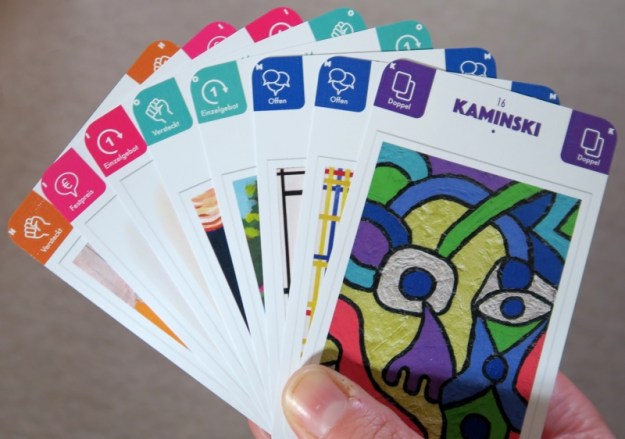
The group (aside from Pink) was therefore slightly reticent, but went for it positively, and in the event, really enjoyed it.  Each round consists of several auctions, each of which is conducted by a player.  The auctioneer chooses one card from their hand which is auctioned according to the indicator on the card.  There are five possible auction types:  Open, Fixed Price, Sealed Bid, Once Round the Table, and Double (where two pieces by the same artist are offered at the same time).

Modern Art
– Image by boardGOATS

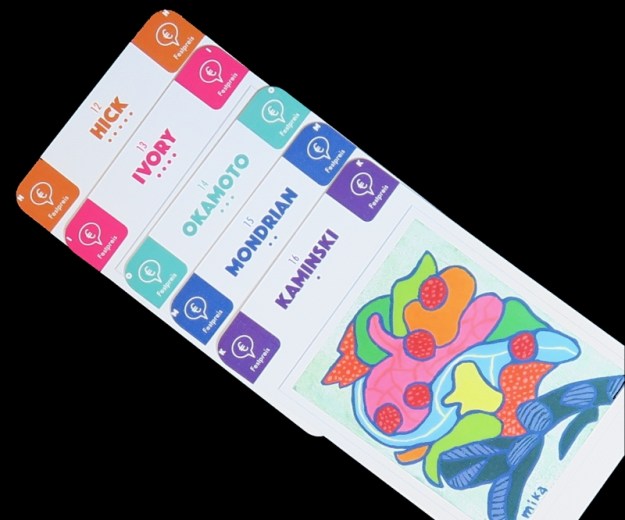
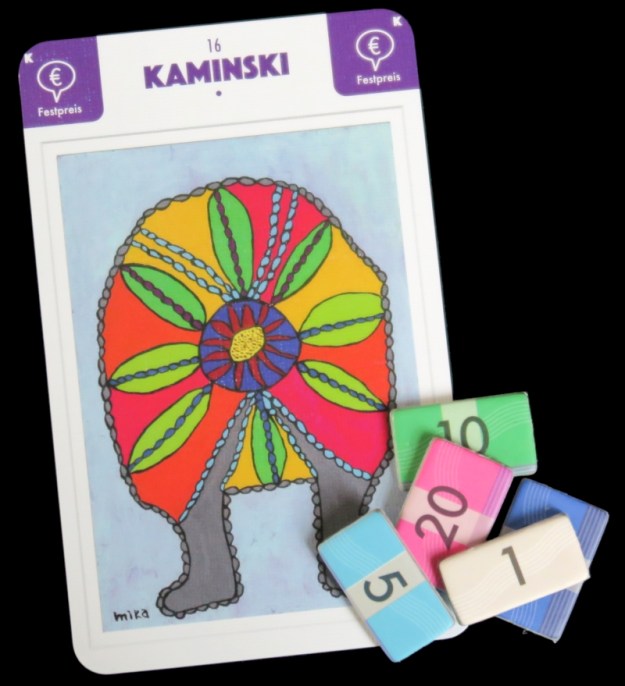
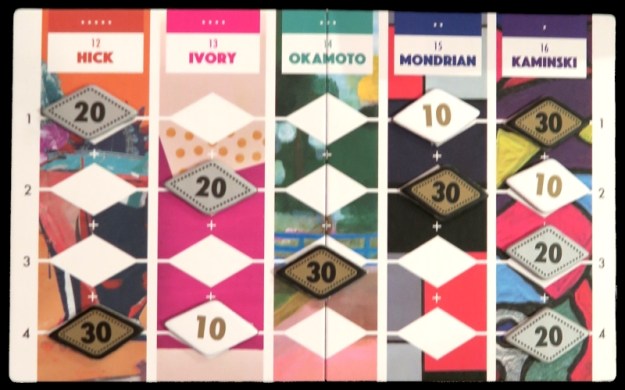
We were playing with the new Oink Games version, which features real modernist artwork from the likes of Mondrian, Kaminski and Ivory (who obviously has talent we were hitherto unaware of).  When the fifth work by an artist is offered for sale, the round ends (without the final auction), and the works valued.  The value depends on how many paintings were sold by that artist in the round, with the value increasing by $30,000 for the most popular.  Players then sell their art to the bank, but here there is a catch.  Players only get a return on art by the three most popular artists in that round—everything else is worthless.  The value of the art that is sold, however, is the cumulative total including increases over all the previous rounds.

Modern Art
– Image by boardGOATS

Thus, players sell their art giving them money to buy more, and more expensive art in the next round. Although the mechanics are clever, what makes the game fun is the auctioneer’s pitch as they try to describe the work they are selling and draw the other players’ attention to its clear and obvious assets and up-sell it.  One notable lot by Kaminski was initially described as “a cat’s pencil sharpener” and then to much hilarity as “a charming number depicting someone bending over picking up a fiver.”  The game ends after four rounds and the player with the most money at the end wins.

Modern Art
– Image by boardGOATS

This time, players clearly had a bit of a fixation with Kaminski with his works being the most popular in the first round, with Hick and Mondrian making a distant second and third.  The initial popularity of Kaminski inflated the perceived value of his work in the second round and, although fewer works were offered for sale, it still scored, though the Mondrian age was upon us.  The third round was dominated by the works of Okamoto, putting in a brief, but valuable appearance for those that made purchases, as it provided funds for the all-important final round.  This led to a resurgence of Hick as the most popular together with poor Ivory, who’s work had hitherto only had a brief period in the limelight in the second round.

Modern Art
– Image by boardGOATS

The eternal popularity of Kaminski continued until Blue brought the game to an end with a double auction ensuring Kaminski’s works gave a return again, and having scored in every round, they were very lucrative.  Despite the game feeling like there was a lot of ebb and flow, the final scores were remarkably close with a mere twenty grand between first and third—fine margins indeed in a game where the scores were measured in hundreds of thousands and players reserves fluctuated wildly during rounds.  It was Blue though, who made the most, finishing with $392,000, just ahead of Ivory (the gamer rather than the artist).

Modern Art
– Image by boardGOATS

Meanwhile, at the other table, Green, Lilac, Purple and Black (who also expressed a dislike of Modern Art, though not of puppies), were playing the puppy related game, Snow Tails.  This is a fun race game where players are racing dog sleds along a winding track of varying complexity.  The idea is that players have a hand of cards, which they play to adjust the dogs’ speed or apply the brake.  When they play cards, they can play up to three (one for each dog and one for the brake), but they must all have the same value.  The sled speed (how many spaces it moves) is then the sum of the dogs’ speed minus the value on the brake.

Snow Tails
– Image by boardGOATS

Additionally, the sled will drift left or right by the amount by which the two dogs’ speeds differ.  Players have to use this to negotiate corners and slalom round pine trees to get to the finish line.  The cards come from their own personal decks, and this is where the game gets clever because players have to manage the cards they play to make best use of them.  If a player crashes or goes into a corner with too much speed and exceeds the limit, they pick up a dent card.  These occupy space in the player’s hand which means they have less choice.

Snow Tails
– Image by boardGOATS

The first player to cross the line (or, in the case of a tie cross it and travel the furthest), is the winner.  The group spent far too long debating which track to use. Lilac had not played Snow Tails before so the group did not want to make it too extreme, but also not too trivial for everyone else.  In the end the group decided on a variation of “Treemendous” (chosen as it would fit on the “narrower than we would like” pub table) and swapping the first set of trees for a narrow canyon.  Through random selection, Lilac was chosen as start player, but as she wasn’t sure how the game would play she took a gentle start so Purple, Green and Black shot past her at speed.

Snow Tails
– Image by boardGOATS

Through the first corner and approaching the Canyon, Purple hit the side of the track and slowed up, while Green and Black raced forward. Lilac took her foot off the break and caught Purple, who was struggling to get her head around which side of the sled needed the higher number to move to the right to get around the corner.  With the bend successfully negotiated Black slowed for the canyon, but Green decided to let rip through it. He made it in one go without hitting anything, but was on the outside for the next corner.  Black took a steadier run through the canyon and came out on the inside of the corner behind Green.

Snow Tails
– Image by boardGOATS

Lilac also maintained a steady pace taking a couple of turns for the Canyon, while Purple continued to dally at the back, hampered somewhat by her reduced hand size from her earlier crash. Black and Green raced to the forest, with Black reaching it just before Green. He “dropped an anchor” and came to an almost complete stop at the entrance right in front of Green, causing him to slow up sharply and swerve to the left instead of taking the route ahead he had planned.

Snow Tails
– Image by boardGOATS

Black managed to clear the forest first but found himself drifting towards the outside of the long hairpin bend. Green was close behind, but his direction of travel sent him to the inside.  Lilac continued her steady progress, avoiding the hazards and came through the forest unscathed in the middle of the track.  Black and Green were racing hard:  Black had the speed, but was forced to the outside of the track and wasn’t able to make progress while Green going more slowly on the inside, manage to squeeze past to get just ahead.  Then it was a straight fight to the line.

Snow Tails
– Image by boardGOATS

Black was able to lift his break to a one, but could only manage a double four, so he positioned himself less advantageously to try and block Green. It didn’t work as Green came off the corner on another track, but he was a little heavier on his break, so still on a two, and also a double four, Black managed to just slide past for the win finishing just ahead.  Lilac continued her steady progress and finished the following round while Purple took a more leisurely ride through the forest, came out on the outside of the bend.  Struggling to stay on the track on the way round the corner, she finally found her speed down the final straight and came flying off the end of the track, unfortunately a couple of rounds too late to win.

Snow Tails
– Image by boardGOATS

Snow Tails was still going when Modern Art finished, but only just, so Tsuro got a second outing of the evening.  This time, Blue was out first by killing herself and taking her piece off the board, quickly followed by Pink who committed harakiri in a similar fashion.  That left them to cheer on Teal and Ivory.  It was close and they were down to the last few tiles, but in the end, Teal took victory when he pushed Ivory off the board.  As the huskies settled down for a well-earned nap, Pine arrived just in time for one last game of Bohnanza, replacing Green and Lilac who went home as they had an early start the next day.

Bohnanza
– Image by boardGOATS

Bohnanza is one of our old favourites, and barely even needs a reminder beyond the rules that are specific for the particular player count.  With six, players start with different numbers of cards, they plant one or two beans turn over two bean cards from the deck, plant and trade, then draw four cards to replenish their hand.  Buying a third bean field is cheaper as well with six, costing two Bohnentaler instead of three.  This is important because the game is shorter with more players and some players barely get a turn in the final round.

Bohnanza
– Image by boardGOATS

As a result, buying a third field is always a bit risky, and the general consensus is that it is rarely worth it. This time was the exception that proves the rule however, with lots of people deciding to buy a third field.  This had the unintended effect of shortening the game as more beans were left in fields at the ends of the rounds.  This didn’t stop the usual hilarity when people made the occasional silly trades and players got unfeasibly lucky with the draw of the cards.  This time the winner was Ivory, two Bohnentaler ahead of Pine, but in truth, we are all winners with a game that is so much fun.

Bohnanza
– Image by boardGOATS

Learning Outcome: It is amazing how much money people will spend on tat.

10th December 2019

The evening started with people arriving in festive attire and snow, glitter and other detritus all over the table, as people pulled crackers and party poppers.  While we waited for food everyone amused themselves writing “Secret GOAT Christmas Cards” and contemplating the voting possibilities for the Golden GOAT Awards (by far the most enjoyable poll of the week).  In the interlude between courses, people completed and submitted their voting papers and Blue and Mulberry conducted the count.  As the results came in, it was clear that there was only going to be one winner.

"Un-Christmas Party" 2019
– Image by boardGOATS

Although Key Flow put in a very strong showing to come second, Wingspan, already winner of the Kennerspiel des Jahres and Deutscher Spiele Preis, took the most coveted award of the year, the coveted Golden GOAT.  The GOAT Poo Prize was less clear cut – almost everyone said that for them there wasn’t a stand-out game deserving of the award.  In the end it went to 7 Wonders, which is a bit of a Marmite game among the GOATS – some people are very fond of it, but nearly a third of the group nominated as the least enjoyable game of the year.  Eventually, everyone finished dessert, but everyone was in festive mood and nobody seemed desperate keen on playing anything.

Golden GOAT - 2019
– Image by boardGOATS

Lime threatened to head off without playing anything as he had a long drive in the morning, but after some discussion about perhaps playing the Winter Edition of Carcassonne or repeating the snowy Nordic version of Ticket to Ride that we played last year,  eventually, he joined Mulberry, Blue, Pink and Ivory to play the “Feature Game”, Christmas Penguins.  This is a cute little game, with some interesting ideas, but proved to need more development and more complete, precise rules.  The premise is that players are naughty penguins trying to steal gifts from under the Christmas Tree, while trying to avoid being captured by Santa.

Christmas Penguins
– Image by boardGOATS

The rules for the second edition were only available in German and had been translated by Blue, so some aspects might have been missed, but the idea is that the round is started by Santa who rolls his die and moves accordingly, trying to catch one of the naughty Penguins. Then each Penguin takes their turn trying to get to the Christmas Tree to steal one of the presents under it.  If they manage to steal a pressie, Santa moves the tree to another location.  Penguins cannot pass through a space occupied by another Penguin, instead, playing a sort bumper-car game, they push the occupant onto an adjacent unoccupied space.

Christmas Penguins
– Image by boardGOATS

If a Penguin lands on a space with an Event Stone, by design or because they were pushed onto it, they take the stone and keep it until they need it.  Event Stones come in different colours which have different effects, but these primarily involve swapping places with other characters. To use an Event Stone, the player can call “Stop!” at any time and then carries out the action by spending the stone.  Rolling a one, has the additional effect of invoking the Polar Bear, who moves one space at a time, but if he ends on a space with a Penguin it drops a parcel and runs away to an unoccupied adjacent space.

Christmas Penguins
– Image by boardGOATS

One of the clever ideas is that when Santa captures a Penguin, the owner of the Penguin takes over the role of Santa and the player who had been Santa places their Penguin in Santa’s workshop.  The turn order was a bit of a problem, however, and may have been one of the things that didn’t make it from the German translation, certainly it was one of the things that mean the game didn’t really gel for us.  Another thing that our group found lacking was the fact that there was no mechanism for the Event Stones to return to play, which was a shame; perhaps we would house rule it that every time the Christmas tree was moved a stone would be left in its place.

Christmas Penguins
– Image by boardGOATS

Ivory started out at Santa and we went at it with a will.  Ivory quickly caught Lime, who looked most unimpressed.  Unfortunately, thereafter, every time Santa caught a Penguin, the upset it caused to the turn order confused everyone.  There was one other aspect of the game that we completely failed to use, which was the rivers—each player can place or remove one river piece per turn.  These cannot be crossed by Penguins, Polar Bears, or even Santa himself and are clearly designed to add an element of strategy to the game.  In practice though we just forgot they existed, only using them very occasionally.

Christmas Penguins
– Image by boardGOATS

The game ends when the final parcel is taken from under the tree, in our case, by Blue, which just left the scoring.  Even this was a little more complex than it needed to be: players get one point for each present they’ve stolen and bonus points are awarded in a Point Salad way to the player with the most parcels of each colour and the player with the most different colours.  It is almost as if this game doesn’t know what it is meant to be, silly fun or strategic, which is a great shame because it feels like it should be a good seasonal game. So, over the Christmas period, we’ll have a go at house-ruling it to try to improve it for our group.  This time, in the end, Blue and Ivory got a bit of a lead and Blue eventually put everyone out of their misery.

Christmas Penguins
– Image by boardGOATS

It wasn’t clear how bonus points should be awarded in the event of a tie.  In our first attempt, we decided that bonus points would only go to the person with more than anyone else, but this led to a three-way tie which was about as unsatisfying as the game.  So we decided to try friendly ties, which did at least give us a winner, with Lime just sneaking into the lead.  With that, Lime and Mulberry took themselves off leaving Ivory, Pink and Blue to play Christmas Lights, the game that was going to be the “Feature Game” until Pink had commented that he didn’t like it.

Christmas Lights: A Card Game
– Image by boardGOATS

Christmas Lights is a set collecting card game with a memory element.  The idea is that players have a hand of cards that are “reversed” so players can see everyone else’s hand, but not their own, like Hanabi.  Players are tying to make a string of lights by playing coloured light bulb cards in the correct order to match their cards.  On their turn, the active player first trades a card of their choice with one from any other player.  They then play one card, adding it to their string of lights.  This can be the card they’ve just swapped, or one they’ve had in hand, but if it does not match their pattern card, they must discard it.

Christmas Lights: A Card Game
– Image by boardGOATS

Once they have played a card, the active player then turns over the top two cards and then either adds one to their string, or can trade one of the cards for the one-word answer to a question of their choosing.   With just two players, it feels like the game plays itself, but with three or four players, its sweetspot, there is a more interesting interplay between planning, memory and navigating the event cards which can help or hinder.  This time, Pink was first to complete his first target string, but found it difficult to play the plug card that he needed to connect his first string with his second.  This was made worse by Blue, who stole his once he’d found one, and the fact that he had played a lot of broken bulb cards that needed replacing before he could continue.

Christmas Lights: A Card Game
– Image by boardGOATS

While Pink was struggling to sort out his plug, Ivory and Blue had both caught up and started work on their second string of lights.  With two cards played per turn, it wasn’t long before all three were threatening the end of the game, but Blue got there first, just.  Pink couldn’t quite finish his string and as Ivory had started first, he didn’t get another turn, leaving Blue to take victory without another tie-break.  Meanwhile, on the next table, Green, Black, Purple and Pine were playing a slightly more conventional, tie-break free game in one of our old favourites, Snow Tails.

Snow Tails
– Image by boardGOATS

Snow Tails is a husky sled-racing game where players have a deck of cards from which they draw a hand of five, playing one to three of these each turn so long as the cards played all have the same value.  Each player also has a dog sled with two dogs and a brake.  Forward movement is the sum of the dogs minus the value of the break, with a drift sideways of the difference between the two dog speeds (in the direction of the faster, stronger dog).  Using this, players have to navigate the course avoiding colliding with obstacles including other sleds, saplings and, of course, the wall of the track.

Snow Tails
– Image by boardGOATS

Corners are also a hazard, and players traveling too fast into them or hitting things they shouldn’t, pick up dent cards.  These are added to the players’ hand and stay there for the rest of the game obstructing their planning and management reducing the number of cards they can draw.  The track is modular and there is a “menu” players can choose from.  This time, Lime, on the next table chose the board layout, and picked one of the two double hairpin tracks, albeit one without the sledge destroying saplings.  It took us a couple of attempts to get the track right though, having to make sure there weren’t two red speed limit lines next to each other and adding a couple of saplings either side of the gorge to make it just a little more interesting.

Snow Tails
– Image by boardGOATS

Using a random selection, Pine was in pole position, followed by Black, then Purple with Green starting last.  There was a nice easy run to the first half bend, but those starting last had to make sure they did not crash into the back of the sledges in front.  Within a couple of turns Green had nudged from last to be alongside Black and on the inside of the track so theoretically in the lead.  Over the next few turns Green and Black vied for the lead while Pine and Purple were scrapping for third.

Snow Tails
– Image by boardGOATS

Eventually, Green got a good position for the first hairpin and pulled into the lead.  Although could have let the brake off at this point hurtle forward, he decided that the inevitable dents for breaking the speed limit would not be worth it, so instead slammed on the brake. This allowed Black to catch up, but his track position was not so good and soon found himself boxed in on the outside unable to get across the track fast enough, as a result picking up his first dent.  At about the same time, Pine also found himself sliding too wide at the hairpin also taking a dent, while Purple was taking it slow and steady, avoiding damage.

Snow Tails
– Image by boardGOATS

At the front Green used his inside track position to start to pull ahead of Black, and continue round the second hairpin, cutting in tight to the opposite half bend, for an easy dodge through the canyon and round the tree towards the finish line.  Black in second place had to manage his damaged sledge through the last corners, but had a good lead on Pine and Purple and was able to easily slide home in second, taking one of the trees with him to the line.

Snow Tails
– Image by boardGOATS

In the meantime, Pine found himself going too fast into the second hairpin and not only crossed the speed limit line too fast, he also crashed in the same accident black spot that had caused Black problems earlier.  Pine’s sledge was so badly damaged that everyone else took pity on him and allowed him to only take a single dent card, although he insisted he should take the lot.  At this point it looked like an easy third place for Purple, but she suddenly began to struggle as she didn’t have the right cards to do what she needed to do.  As a result she was crawling along so slowly that Pine caught her up. It was looking like it might be rather tight for that third place, until Pine’s impossibly damaged sledge finally got the better of him and Purple crossed the line for third.

Snow Tails
– Image by boardGOATS

Learning Outcome:  GOATS love a good party!

12th December 2017

With this being the last GOATS Tuesday before Christmas (and the Jockey shutting on Boxing Day which would be the next one), we decided to have an early “Christmas Party” with everyone arriving for supper at the same time and home-made crackers.  Out of habit, most of us ordered pizza from their Tuesday “Pizza Special” menu, though there was also the odd portion of scampi too.  Even though it was still nearly two weeks until Christmas, we were a bit short on numbers thanks to the combination of people leaving early for the holidays and work commitments.  That didn’t stop Pine and Ivory bringing out their favourite topical Christmas Cracker jokes though:  “Why doesn’t Trump ever finish decorating his Christmas tree?  Because people keep shouting “Moron”!”  “Why didn’t Teresa May visit the baby Jesus? Because she couldn’t form a stable government…!”

Pizza at the Horse and Jockey
– Image from horseandjockey.org

Once crackers, jokes and food had been dealt with, Magenta’s little one (who had come a long for the ride and a bit of pizza crust), found himself a friend to play with which gave everyone else the chance to get on with the “Feature Game”, Giftmas at Dungeon Abbey.  This is a short game designed by a local gamer and member of the Didcot Games Club, Rob Harper.  Blue and Pink picked up a pre-release copy at Essen in October and had saved it for a special, festive occasion, and this seemed appropriate.  The game is a fun, micro card game based in a world that is a sort of cross between Downton Abbey and the Adams Family.  The artwork is suitably gruesome, though it was very clear from the start who the Countess D’Ungeon was a caricature of!  Played over several short rounds, each player takes the role of one of the various eccentric and unpleasant family members grasping for whatever feels like the best present.  To this end, players begin with a character card and a couple of gift cards, all face down on the table in front of them.

Giftmas at Dungeon Abbey
– Image by boardGOATS

On their turn, the active player may either swap one of their face-down cards with one elsewhere on the table, or turn a card face-up, possibly activating a special action on the gift cards. The round ends when all a player’s cards are face up at the start of their turn or a bomb is revealed, at which point everyone scores points if they have collected the gifts wanted by their characters.  A lot of fun was had with everyone amused by the idea the sick combination of a set of electrodes and a puppy…  Before long, Magenta, Blue, Pine and Green had won one round a piece and Magenta’s son’s and his playmate was starting to look bored with the game they were playing, so although the we were just warming up nicely, we reluctantly decided to bring it to an early close when one player had won two rounds.  It was tight, but Green prevented Ivory and Burgundy getting in on the act and took his second round, and with it, the game.  Søn-Magenta had clearly had enough, so Mor-Magenta took him home leaving everyone else with a selection of wintery themed games to choose from.

Giftmas at Dungeon Abbey
– Image by boardGOATS

With five players left, the choice was actually rather limited and we quickly settled on an old favourite, the sled racing game, Snow Tails.  We played with the original edition, where players start by building the track which can either be from one of the suggested examples given in the rulebook, or, a home-designed one which we opted for.  On reflection, designing our own track might not have been all that clever, as we inevitably made it way more complicated than it needed to be.  The parcour began with a Chasm immediately after the start which caused an almighty bottle neck before everyone even got going.  Then there was a sweeping left hander and a short straight section followed by a right hander.  This wouldn’t have been so bad except they were immediately followed by a combination of a Crevasse (that had to be jumped at speed) and a field of saplings (adding a slalom element) just before the finish line.  As a result players had to control their speed very carefully throughout.

Snow Tails
– Image by boardGOATS

And that is what Snow Tails is all about really: controlling speed.  Players have a deck of number cards from which they draw a hand of five cards.  On their turn, cards are played on one to three of the active piles: the left husky, the right husky or the brake.  The catch is that if multiple cards are played, they must all be the same number, and once a card has been used, it can’t be used again until the player’s individual draw deck has been depleted.  The idea is that the sled’s speed is the sum of the dog cards in play, minus the current value of the brake; the speed dictates the number of spaces the sled moves forward in each turn.  Steering is carried out by adjusting the difference between the speeds of the two dogs which gives rise to “drift”, i.e. sliding movement to the left or right.  Drift occurs as a sled moves forward, with a maximum of one lane drift per forward movement.  An evenly matched pair of dogs goes faster leading to a balanced sled bonus, but for some reason we forgot about this.  It probably didn’t matter anyhow though, because the nature of the course meant that a balanced sled was a real rarity rarity and the close proximity of the obstacles meant it was unlikely that anyone would have been able to make use of the bonus as well.

Snow Tails
– Image by boardGOATS

Ivory and Blue were first out of the blocks and managed to steal a bit of march on everyone else, getting through the Chasm first and causing chaos behind as everyone else got stuck.  With nobody in his way, Ivory took an early lead and Blue gave chase, but bit by bit he continued to edge away.  It wasn’t long before Pine led the charge from the rear and those who had got jammed in the Chasm began to catch up.  This was partly because they had been able to store up a few good cards and plan their attack while they were waiting to get past the obstacle at the beginning, but also because first Blue, and then Ivory, paid the penalty for their quick start and were forced into the barriers.  Coming round the final corner, it was really tight, but Green, Burgundy and Pine were heading for home through the Saplings.  It was then that we realised the importance of positioning:  for those with no dents in their sled, it was possible just to mow through the saplings taking damage as necessary and career across the line.  There is a limit though as players got in his way, Pine stalled, allowing both Blue and Green through the gap, pipping him on the line.  Burgundy crossed the line first however, with Green finishing a close second in what had been a quite chaotic race.

Snow Tails
– Image by boardGOATS

With a shortage of five-player winter-themed games, we decide to go for one of our most popular games6 Nimmt!.  This is probably our most played game, which is strange as, even when we have a break, it always comes back into fashion again.  In the group we’ve discussed the phenomenon many times, and it is definitely a special game.  There are a combination of factors that add to it’s appeal including the time it takes to play, the number of players, the lack of down time, the simplicity etc..  Perhaps the biggest factor though is the illusion of control the game gives, until it all goes horribly wrong of course.  And of course it did this time too.  The first round was quite close with three players picking up almost exactly the same number of “Nimmts”.  It was the second round that was most amusing though as Pine and Ivory seemed to be competing to collect as many as they could, taking it in turns to pick up rows.  Unusually, as he usually has one catastrophic round, Burgundy managed to win both rounds with a clean sheet in the first and just five in the second.  This gave him a clear victory with Blue some way behind, just pipping Green to second place.  The excitement had all been far too much for Ivory and he decided it was home time, having won the unofficial “hat on the longest” competition that only he had been playing.

– Image by boardGOATS

This left everyone else with time for one last festive game, Christmas Tree.  This is an apparently simple card drafting game, which turns out to be surprisingly challenging in practice (not least because shuffling diamond-shaped cards is remarkably difficult!  Each player begins with an empty Christmas tree shaped board and a hand of eight cards.  Simultaneously, everyone chooses one card to keep and passes the rest on.  They then add the card to their tree, decorating it.  Each card features a bauble of some kind, a wrapped sweet or a gingerbread cookie and some additionally have half a light on the edges.  Points are scored at the end of the game for satisfying the gingerbread men’s neighbourhood preferences, matching the half lights to make whole ones, for sweets and baubles.  The largest number of points come from the “objective cards”, however, which give points for ornaments in a particular arrangement.  At the start of the game, each player is given four objective cards and players choose one at the start of each round, which is scored at the end of that round.  As only Blue and Green had played it before (and then without the objectives) it was felt that it was fairest to draw the objective cards at random this time.

Christmas Tree
– Image by boardGOATS

It took a while for everyone to get the hang of the game, and it quickly became apparent that Green’s experience was invaluable as he took an early lead.  Blue, on the other hand, was demonstrating how not benefit from the advantage she had been given and was grubbing about at the back of the pack.  It turned out that everyone had a different strategy and was targetting different objectives, as evidenced by the changing of places in the final scoring.  Green, who was a long way out in front, remained there unchallenged, but all of a sudden, Blue made a march from the back, thanks to her large number of completed festive lights and a couple of well-timed linzer cookies (which allow players to swap decorations positions on their tree).  It was very tight for second, in fact, there were just two points in it, which given that scores ranged from one hundred and forty to over one hundred and eighty was very close and merited a recount of the final round.  The scores stood, however, and Blue just managed to edge in front of Burgundy to take second.

Christmas Tree
– Image by boardGOATS

Learning Outcome:  There are very few festive themed games that play five!

29th December 2015

The pub was very busy, and with one chef down with the lurgy (which had got four of us as well), food was delayed. So, unusually, we started off with a quick game. Expecting more people, we decided to play something short, and opted for Qwixx. This game was designed by Steffen Bendorf who also designed The Game (which has been popular with the group this year) and was nominated for Spiel des Jahres in 2013. So, it has a good pedigree, however, when it was nominated there were a lot of comments about its suitability and eventually, it was beaten by Hanabi, which most people agreed was a better game. We finally got the chance to give it a go in October and generally felt that although the rules made for a promising sounding filler, the resulting game was disappointing. Given how some people continue rave about it though, we’d were keen to give it another try and see if we’d been mistaken.

Qwixx
– Image used with permission of BGG contributor punkin312

Qwixx is a very simple game: each player has a score card displaying the numbers two to twelve in the four different colours, red and yellow ascending and blue and green ascending.  On their turn, the active player rolls six dice, two white, and one of each of the colours, red, blue, green and yellow.  Every player may cross out the number corresponding to the sum of the white dice. The active player may then also cross out a coloured number corresponding to the sum of one white die and one matching coloured die. If the active player cannot or chooses not to cross off a number, then they must tick a penalty box, which costs them five points at the end of the game. The snag is that although numbers can be skipped, they must be crossed off in order, red and yellow ascending, blue and green descending.

Qwixx
– Image by boardGOATS

Points are scored for the number of each colour crossed out and penalties subtracted; the game ends when one player has picked up four penalties, or players have crossed off the last number for two colours locking them for everyone. Scarlet, an experienced local gamer who is usually unavailable on Tuesday evenings, commented that it was a bit like Yahtzee, but with slightly more decisions to make. This didn’t further endear the game to Blue, who has bad memories of playing Yahtzee as a child. Scarlet did manage to demonstrate a modicum of strategy when he chose to cross off a sixth red number rather than his first green number since that would give more points at the end. His discovery clearly gave him a bit of an edge as he took second place, eight behind Burgundy who won with eighty.  We had a bit of discussion about what strategy there was, but it was not really enough to rescue the game in anyone’s eyes and it now faces donation to a worthy cause.

Qwixx
– Image used with permission of BGG contributor punkin312

Meanwhile, Grey and Cerise had arrived and seeing everyone else engaged decided to play a quick game of Hey, That’s My Fish!. This is a cute little abstract with a penguin theme, and, in common with games like Carcassonne, although it plays more, in many ways, it is at its best as a two player game when it is most vicious. The game is played on a grid of hexagonal tiles, with each player starting with four penguin figurines which players take it in turns to move in straight lines across the tiles. When a penguin is moved, the active player gets the tile it was sitting on, leaving a gap that cannot be crossed. Thus, the ice flow progressively melts away trapping the penguins in increasingly smaller spaces.

Hey, That's My Fish!
– Image used with permission of BGG contributor aleacarv

A number of fish is depicted on each tile, and the player with the most fish at the end of the game, i.e. when there are no more valid moves, is the winner. This is just the sort of game that Grey likes, deliciously savage with plenty of opportunity to go for the jugular and for a while he had Cerise under the cosh. Her delight at the end was obvious though when the final reckoning put her four fish clear.  With food imminent for those who hadn’t yet eaten, and Green expected, we decided to split the group and start the “Feature Game”, Broom Service.  This game uses the role selection mechanic from Witch’s Brew (a game we played a few weeks ago), but adds much more with a board and a delivery mechanic.  Witch’s Brew was nominated for the Spiel des Jahres in 2008, but was beaten by Keltis (a boardgame equivalent of the popular two player card game Lost Cities), but its reincarnation, Broom Service, won the Kennerspiel des Jahres this year.

Broom Service
– Image used with permission of BGG contributor punkin312

Like Witch’s Brew, players start with a hand of character cards from which they simultaneously choose a subset in secret. The start player then chooses a card and announces they are that character declaring they are either “brave” or “cowardly”. The other players then must follow suit if they hold that card. If a player is cowardly they take a lesser reward immediately, but if they are brave, they must wait until the end of the round to see if they get a reward. Once everyone has declared their position, the last brave player takes a greater prize and anyone who was brave earlier in the round gets nothing.  The character cards come in three types, Gatherers (who provide ingredients), Witches (who allow players to travel to an adjacent region) and Druids (who deliver potions to the towers). There is also the Weather Fairy who charms away clouds using magic wands.

Broom Service
– Image used with permission of BGG contributor punkin312

The rules are modified by event cards that are revealed at the start of the round, and with less than five players, the game is also made tighter by the inclusion of “bewitched” roles (cue Burgundy and Pink demonstrating how to wiggle-twitch their noses like Tabitha). The game is considerably more complex than the cute theme and artwork imply. Compared with Witch’s Brew, there are also a number of small rules that it is difficult to remember at the start, though they are in keeping with the theme.  The game ends after eight rounds, and, although points are awarded for delivering potions during the game, there are extra points for weather clouds and sets of potions collected.

Broom Service
– Image used with permission of BGG contributor punkin312

Grey quickly got his nose in front delivering potions early, but Scarlet and and Cerise followed suit and kept the points difference down. It didn’t last however, and before long, Grey had moved his witches away from everyone else’s into the south-east corner of the board where he was able to score heavily without competition.  Despite Cerise’s best efforts with the Weather Fairy and Scarlet’s set collecting, Grey had an unassailable lead and finished nearly thirty points clear with ninety-three points. Second place was much closer, however, Scarlet taking it by just two points from Cerise.

Broom Service
– Image used with permission of BGG contributor punkin312

Meanwhile, once the matter of food had been dealt with, Blue, Pink and Burgundy were debating what to play. It had been narrowed down to Snow Tails or Snowdonia (with Pink requesting an expansion to add interest), when Green appeared, newly arrived from visiting relations over Christmas. He was keen to play Snowdonia, so that sealed the deal, with the Jungfraubahn expansion added as a sweetener.

Snowdonia
– Image by BGG contributor duchamp

The base game is not that complex and we’ve played it a few times, however, it is one of those games that somehow everyone struggles to remember how it works. With both Burgundy and Blue suffering with Seasonal Lurgy, adding the expansion was always going to make things more complicated too.  The idea is that players take it in turns to place their workers in the seven possible actions, which are then activated in order. These actions include, visiting the stockyard; converting iron ore into iron bars; digging to remove rubble from the track-bed; laying track; building part of a station; taking contract cards; and surveying the route.

Snowdonia
– Image used with permission of BGG contributor aleacarv

There are two twists: the weather and the game. The stockyard is refilled from a bag, and there are small number of white cubes in the bag which, when drawn cause the game to play itself. This mechanism came about because the designer dislikes players who hoard resources, so in this game, if people don’t keep things moving, the likelihood of white cubes coming out increases and the game moves along on its own. The other interesting mechanism is the weather which increases and decreases the digging and track laying rate making players’ timing key.

Snowdonia
– Image used with permission of BGG contributor winterplum

Green, Pink, Blue and Burgundy were still setting out the game and trying to work out what modifications the Jungfraubahn expansion made, when Broom Service finished, so Grey, Cerise and Scarlet played a quick game of Cosmic Encounter. This is a game they were all familiar with, though we’ve not played it on a Tuesday night before.  The game is reasonably straight forward, with each player leading an alien race trying to establish colonies on other players’ planets with the winner the first player to have five colonies on planets outside their home system.

Cosmic Encounter
– Image by BGG contributor RRunner

On their turn, The active player becomes “The Offense”. The Offense encounters another player on a planet by moving a group of his or her ships through the hyperspace gate to that planet. They draw cards from the destiny deck which contains colors, wilds and specials. The Offense then takes the hyperspace gate and points at one planet in the system indicated by the drawn destiny card. The Offense and The Defense both commit ships to the encounter and both sides are able to invite allies, play an encounter card as well as special cards to try and tip the encounter in their favour.  The game was close with lots of too-ing and fro-ing, but Cerise was the one to finally successfully establish five colonies, with Grey and Scarlet finishing with four and three colonies respectively.

Cosmic Encounter
– Image used with permission of BGG contributor kilroy_locke

By this time, the other group had finally sussed out what they were doing and had got under way with Snowdonia.  The Jungfraubahn expansion changes the game quite considerably replacing fog with snow which adds rubble to the track that must be cleared again before track can be built.  It also introduces dynamite which can be used to remove large amounts of rubble as well as being used to initially clear a route through the mountains before the track-bed is prepared. Added to these, the new contract cards, seemed to introduce even more bad weather than “north-wet” Wales!

Snowdonia
– Image used with permission of BGG contributor winterplum

Blue and Burgundy were both a bit slow off the mark and struggled to really get going. In contrast, Green quickly picked up an engine and Pink got a couple of valuable contract cards. With Grey and Cerise leaving, Scarlet was left as an interested spectator. Eventually, Blue and Burgundy got going, but it was a bit of a rear-guard action.  With the expansion, the game was taking slightly longer than expected, so Green, decided to take the opportunity to play Scarlet as a substitute and went home leaving the rest to finish the game without him. He had set out his plan and Scarlet did an excellent job executing it, however, Pink just had the edge.

Snowdonia
– Image used with permission of BGG contributor ansi

Green/Scarlet took a massive seventy-nine points in bonuses and with twenty-nine points for station building together with the maximum for his surveyor, they finished with one hundred and twenty-two.  The break down for Pink was nearly completely reversed with him taking seventy-eight points for station building and nearly sixty more in bonuses, giving a total of one hundred and thirty-eight, and the game.

Snowdonia
– Image used with permission of BGG contributor winterplum

Learning outcome: Lurgy does not improve gaming ability.